[]
您当前的选择
资产 资产
您的报价 0

您的选择

清除选择
商品已加入购物车
{"event":"pageview","page_type1":"undetected","page_type2":"_assets_search_override","language":"cn","user_logged":"false","user_type":"ecommerce","nl_subscriber":"false"}
{"event":"ecommerce_event","event_name":"view_item","event_category":"browse_catalog","ecommerce":{"items":[{"item_id":"HFE4439268","item_category":"photo","item_category2":"no_copyright","item_category3":"standard","item_category4":"florent_lamontagne","item_category5":"not_balown","item_list_name":"search_results","item_name":"amsonia_tabernaemontana_blue_amsonie_blue_star_broadleaf_amsonie_blue_star_eastern_blue_star","item_variant":"undefined"},{"item_id":"HFE4450163","item_category":"photo","item_category2":"no_copyright","item_category3":"standard","item_category4":"florent_lamontagne","item_category5":"not_balown","item_list_name":"search_results","item_name":"amsonia_tabernaemontana_blue_amsonie_blue_star_broadleaf_amsonie_blue_star_eastern_blue_star","item_variant":"undefined"},{"item_id":"PIX4610214","item_category":"photo","item_category2":"no_copyright","item_category3":"standard","item_category5":"not_balown","item_list_name":"search_results","item_name":"barree_spiral_galaxy_ngc_2903_in_the_lion_barred_spiral_galaxy_ngc_2903_in_leo_the_barree_spiral_gal","item_variant":"undefined"},{"item_id":"PIX4572156","item_category":"photo","item_category2":"no_copyright","item_category3":"standard","item_category5":"not_balown","item_list_name":"search_results","item_name":"flying_star_zeta_ophiuchi_runaway_star_zeta_ophiuchi_the_blue_star_near_the_center_of_the_image_is_z","item_variant":"undefined"},{"item_id":"PIX4613594","item_category":"photo","item_category2":"no_copyright","item_category3":"standard","item_category5":"not_balown","item_list_name":"search_results","item_name":"galaxy_of_the_wheel_of_the_charette_in_the_sculptor_the_cartwheel_galaxy_the_ring_galaxy_of_the_whee","item_variant":"undefined"},{"item_id":"PIX4618457","item_category":"photo","item_category2":"no_copyright","item_category3":"standard","item_category5":"not_balown","item_list_name":"search_results","item_name":"the_rosette_nebula_in_the_unicorn_the_rosette_nebula_and_ngc_2244_cluster_the_rosette_nebula_is_a_va","item_variant":"undefined"},{"item_id":"PIX4592395","item_category":"photo","item_category2":"no_copyright","item_category3":"standard","item_category4":"b_s_fletcher","item_category5":"not_balown","item_list_name":"search_results","item_name":"constellation_orion_constellation_of_orio","item_variant":"undefined"},{"item_id":"PIX4572996","item_category":"photo","item_category2":"no_copyright","item_category3":"standard","item_category4":"p_carril","item_category5":"not_balown","item_list_name":"search_results","item_name":"hertzsprung_russell_the_hertzsprung_russell_diagram_hr_diagram_hertzsprung_russell_displaying_stars_","item_variant":"undefined"},{"item_id":"PIX4573012","item_category":"photo","item_category2":"no_copyright","item_category3":"standard","item_category4":"p_carril","item_category5":"not_balown","item_list_name":"search_results","item_name":"hertzsprung_russell_the_hertzsprung_russell_diagram_hertzsprung_russell_hr_diagram_displaying_stars_","item_variant":"undefined"},{"item_id":"PIX4564490","item_category":"photo","item_category2":"no_copyright","item_category3":"standard","item_category5":"not_balown","item_list_name":"search_results","item_name":"globular_cluster_m5_in_serpens_globular_cluster_m5_in_serpens_this_cluster_of_stars_is_located_about","item_variant":"undefined"},{"item_id":"PIX4590972","item_category":"photo","item_category2":"no_copyright","item_category3":"standard","item_category5":"not_balown","item_list_name":"search_results","item_name":"constellation_of_the_great_dog_constellation_of_canis_major_sirius_the_bright_star_on_this_image_is_","item_variant":"undefined"},{"item_id":"PIX4611087","item_category":"photo","item_category2":"no_copyright","item_category3":"standard","item_category4":"r_gendler","item_category5":"not_balown","item_list_name":"search_results","item_name":"interacting_galaxies_ngc_4038_4039_in_the_raven_ngc_4038_39_the_interacting_galaxies_of_the_antennae","item_variant":"undefined"},{"item_id":"PIX4611081","item_category":"photo","item_category2":"no_copyright","item_category3":"standard","item_category4":"jim_misti","item_category5":"not_balown","item_list_name":"search_results","item_name":"interacting_galaxies_ngc_4038_4039_in_the_raven_ngc_4038_39_the_interacting_galaxies_of_the_antennae","item_variant":"undefined"},{"item_id":"PIX4611108","item_category":"photo","item_category2":"no_copyright","item_category3":"standard","item_category4":"adam_block","item_category5":"not_balown","item_list_name":"search_results","item_name":"interacting_galaxies_ngc_4038_4039_in_the_raven_ngc_4038_39_the_interacting_galaxies_of_the_antennae","item_variant":"undefined"},{"item_id":"PIX4609868","item_category":"photo","item_category2":"no_copyright","item_category3":"standard","item_category5":"not_balown","item_list_name":"search_results","item_name":"galaxy_ngc_1427a_in_the_furnace_the_irregular_galaxy_ngc_1427a_in_fornax_the_galaxy_ngc_1427a_is_loc","item_variant":"undefined"},{"item_id":"PIX4621903","item_category":"photo","item_category2":"no_copyright","item_category3":"standard","item_category4":"adam_block","item_category5":"not_balown","item_list_name":"search_results","item_name":"nebula_ic_405_star_ae_aurigae_in_the_coach_nebula_ic_405_and_runaway_star_ae_aurigae_ic_405_is_a_neb","item_variant":"undefined"},{"item_id":"PIX4572239","item_category":"photo","item_category2":"no_copyright","item_category3":"standard","item_category5":"not_balown","item_list_name":"search_results","item_name":"star_field_in_the_antenna_galaxy_starfield_in_the_antennae_detail_in_the_antenna_galaxy_ngc_4038_403","item_variant":"undefined"},{"item_id":"PIX4611114","item_category":"photo","item_category2":"no_copyright","item_category3":"standard","item_category5":"not_balown","item_list_name":"search_results","item_name":"interacting_galaxies_ngc_4038_4039_in_the_raven_ngc_4038_39_the_interacting_galaxies_of_the_antennae","item_variant":"undefined"},{"item_id":"PIX4611091","item_category":"photo","item_category2":"no_copyright","item_category3":"standard","item_category5":"not_balown","item_list_name":"search_results","item_name":"interacting_galaxies_ngc_4038_4039_in_the_raven_ngc_4038_39_the_interacting_galaxies_of_the_antennae","item_variant":"undefined"},{"item_id":"PIX4611076","item_category":"photo","item_category2":"no_copyright","item_category3":"standard","item_category5":"not_balown","item_list_name":"search_results","item_name":"interacting_galaxies_ngc_4038_4039_in_the_raven_ngc_4038_39_the_interacting_galaxies_of_the_antennae","item_variant":"undefined"},{"item_id":"PIX4592402","item_category":"photo","item_category2":"no_copyright","item_category3":"standard","item_category4":"jerry_lodriguss","item_category5":"not_balown","item_list_name":"search_results","item_name":"constellation_orion_constellation_of_orio","item_variant":"undefined"},{"item_id":"PIX4611051","item_category":"photo","item_category2":"no_copyright","item_category3":"standard","item_category5":"not_balown","item_list_name":"search_results","item_name":"interacting_galaxies_ngc_4038_4039_in_the_raven_the_antennae_galaxy_in_corvus_on_the_left_seen_from_","item_variant":"undefined"},{"item_id":"PIX4611075","item_category":"photo","item_category2":"no_copyright","item_category3":"standard","item_category5":"not_balown","item_list_name":"search_results","item_name":"interacting_galaxies_ngc_4038_4039_in_the_raven_the_antennae_galaxy_in_corvus_image_of_the_galaxy_ng","item_variant":"undefined"},{"item_id":"PIX4613542","item_category":"photo","item_category2":"no_copyright","item_category3":"standard","item_category5":"not_balown","item_list_name":"search_results","item_name":"galaxy_am_0644_741_in_flying_fish_ring_galaxy_am_0644_741_in_volans_the_annular_galaxy_am_0644_741_i","item_variant":"undefined"},{"item_id":"PIX4611111","item_category":"photo","item_category2":"no_copyright","item_category3":"standard","item_category5":"not_balown","item_list_name":"search_results","item_name":"young_stars_in_the_dwarf_galaxy_ngc_4163_young_stars_in_dwarf_galaxy_ngc_4163_ngc_4163_is_an_irregul","item_variant":"undefined"},{"item_id":"PIX4613605","item_category":"photo","item_category2":"no_copyright","item_category3":"standard","item_category5":"not_balown","item_list_name":"search_results","item_name":"galaxy_ugc_10214_in_the_dragon_galaxy_ugc_10214_in_draco_the_galaxy_ugc_10214_is_about_420_million_y","item_variant":"undefined"},{"item_id":"PIX4611053","item_category":"photo","item_category2":"no_copyright","item_category3":"standard","item_category5":"not_balown","item_list_name":"search_results","item_name":"interacting_galaxies_ngc_4038_4039_in_the_raven_the_antennae_galaxy_in_corvus_the_galaxy_ngc_4038_39","item_variant":"undefined"},{"item_id":"PIX4613572","item_category":"photo","item_category2":"no_copyright","item_category3":"standard","item_category5":"not_balown","item_list_name":"search_results","item_name":"galaxy_of_the_wheel_of_the_charette_in_the_sculptor_the_cartwheel_galaxy_the_ring_galaxy_of_the_whee","item_variant":"undefined"},{"item_id":"PIX4613581","item_category":"photo","item_category2":"no_copyright","item_category3":"standard","item_category5":"not_balown","item_list_name":"search_results","item_name":"galaxy_ugc_10214_in_the_dragon_galaxy_ugc_10214_in_draco_the_galaxy_ugc_10214_is_about_420_million_y","item_variant":"undefined"},{"item_id":"PIX4611107","item_category":"photo","item_category2":"no_copyright","item_category3":"standard","item_category5":"not_balown","item_list_name":"search_results","item_name":"interacting_galaxies_ngc_4038_4039_in_the_raven_ngc_4038_39_the_interacting_galaxies_of_the_antennae","item_variant":"undefined"},{"item_id":"PIX4611122","item_category":"photo","item_category2":"no_copyright","item_category3":"standard","item_category5":"not_balown","item_list_name":"search_results","item_name":"young_stars_in_the_dwarf_galaxy_ngc_4163_young_stars_in_dwarf_galaxy_ngc_4163_ngc_4163_is_an_irregul","item_variant":"undefined"},{"item_id":"PIX4590797","item_category":"photo","item_category2":"no_copyright","item_category3":"standard","item_category5":"not_balown","item_list_name":"search_results","item_name":"constellations_of_the_great_dog_and_orion_orion_and_canis_major_on_the_left_down_the_constellation_o","item_variant":"undefined"},{"item_id":"PIX4571710","item_category":"photo","item_category2":"no_copyright","item_category3":"standard","item_category4":"m_carroll","item_category5":"not_balown","item_list_name":"search_results","item_name":"comparison_of_the_sizes_of_the_sun_rigel_betelgeuse_and_antares_size_comparison_sun_rigel_betelgeuse","item_variant":"undefined"},{"item_id":"PIX4617504","item_category":"photo","item_category2":"no_copyright","item_category3":"standard","item_category5":"not_balown","item_list_name":"search_results","item_name":"star_cluster_ic_1590_in_ngc_281_cassiopee_open_cluster_and_bok_globules_in_ngc_281_view_of_a_detail_","item_variant":"undefined"},{"item_id":"PIX4618445","item_category":"photo","item_category2":"no_copyright","item_category3":"standard","item_category5":"not_balown","item_list_name":"search_results","item_name":"the_rosette_nebula_in_the_unicorn_the_rosette_nebula_and_ngc_2244_cluster_the_rosette_nebula_is_a_va","item_variant":"undefined"},{"item_id":"PIX4617491","item_category":"photo","item_category2":"no_copyright","item_category3":"standard","item_category5":"not_balown","item_list_name":"search_results","item_name":"bok_s_cells_in_ngc_281_cassiopee_bok_globules_in_ngc_281_view_of_a_detail_of_the_nebula_ngc_281_in_c","item_variant":"undefined"},{"item_id":"PIX4618488","item_category":"photo","item_category2":"no_copyright","item_category3":"standard","item_category5":"not_balown","item_list_name":"search_results","item_name":"open_cluster_ngc_2244_in_the_nebula_of_the_rosette_the_rosette_nebula_and_ngc_2244_cluster_the_roset","item_variant":"undefined"},{"item_id":"PIX4619552","item_category":"photo","item_category2":"no_copyright","item_category3":"standard","item_category5":"not_balown","item_list_name":"search_results","item_name":"center_of_the_trifid_nebula_m20_center_of_the_trifid_nebula_the_trifid_nebula_m20_is_located_between","item_variant":"undefined"},{"item_id":"PIX4673645","item_category":"photo","item_category2":"no_copyright","item_category3":"standard","item_category4":"alex_conu","item_category5":"not_balown","item_list_name":"search_results","item_name":"blue_star_spring_yellowstone_blue_star_spring_a_hot_pool_in_yellowstone_national_park_the_blue_star_","item_variant":"undefined"},{"item_id":"PIX4592970","item_category":"photo","item_category2":"no_copyright","item_category3":"standard","item_category4":"b_s_fletcher","item_category5":"not_balown","item_list_name":"search_results","item_name":"constellations_of_orion_and_tauru_constellations_of_orion_and_tauru","item_variant":"undefined"},{"item_id":"CH1769940","item_category":"illustration","item_category2":"out_of_copyright","item_category3":"standard","item_category4":"shoesmith_kenneth_1890_1939","item_category5":"not_balown","item_list_name":"search_results","item_name":"poster_advertising_the_cruise_ship_arandora_star_by_the_shipping_company_blue_star_line_1935_lithogr","item_variant":"undefined"},{"item_id":"PIX4592404","item_category":"photo","item_category2":"no_copyright","item_category3":"standard","item_category5":"not_balown","item_list_name":"search_results","item_name":"orion_constellation_constellation_of_orion_orion_the_hunter_is_one_of_the_most_familar_and_best_know","item_variant":"undefined"},{"item_id":"PIX4572374","item_category":"photo","item_category2":"no_copyright","item_category3":"standard","item_category4":"m_carroll","item_category5":"not_balown","item_list_name":"search_results","item_name":"comparison_of_sun_sizes_sirius_and_rigel_size_comparison_sun_sirius_and_rigel_the_sun_yellow_star_at","item_variant":"undefined"},{"item_id":"PIX4592500","item_category":"photo","item_category2":"no_copyright","item_category3":"standard","item_category5":"not_balown","item_list_name":"search_results","item_name":"orion_constellation_constellation_of_orion_orion_the_hunter_is_one_of_the_most_familar_and_best_know","item_variant":"undefined"},{"item_id":"PIX4590776","item_category":"photo","item_category2":"no_copyright","item_category3":"standard","item_category4":"b_s_fletcher","item_category5":"not_balown","item_list_name":"search_results","item_name":"constellations_of_orion_and_great_dog_constellations_of_canis_major_and_orion_on_the_left_the_conste","item_variant":"undefined"},{"item_id":"PIX4591024","item_category":"photo","item_category2":"no_copyright","item_category3":"standard","item_category4":"sebastian_voltmer","item_category5":"not_balown","item_list_name":"search_results","item_name":"constellation_of_the_great_dog_constellation_of_canis_major_sirius_the_bright_star_on_this_image_is_","item_variant":"undefined"},{"item_id":"QMG428228","item_category":"illustration","item_category2":"out_of_copyright","item_category3":"standard","item_category4":"english_school_19th_century","item_category5":"not_balown","item_list_name":"search_results","item_name":"cambridge_blue_coat_school_coverlet_by_the_pupils_of_blue_coat_school_1872_textile","item_variant":"undefined"},{"item_id":"PIX4565155","item_category":"photo","item_category2":"no_copyright","item_category3":"standard","item_category5":"not_balown","item_list_name":"search_results","item_name":"globular_cluster_m30_in_capricornus_globular_cluster_m30_in_capricornus_the_globular_cluster_m30_ngc","item_variant":"undefined"},{"item_id":"SZT11777471","item_category":"photo","item_category2":"no_copyright","item_category3":"standard","item_category4":"zollner_rolf","item_category5":"not_balown","item_list_name":"search_results","item_name":"blue_star_cinema_1990_photo","item_variant":"undefined"},{"item_id":"SZT11777763","item_category":"photo","item_category2":"no_copyright","item_category3":"standard","item_category4":"zollner_rolf","item_category5":"not_balown","item_list_name":"search_results","item_name":"blue_star_cinema_1990_photo","item_variant":"undefined"},{"item_id":"SZT11777764","item_category":"photo","item_category2":"no_copyright","item_category3":"standard","item_category4":"zollner_rolf","item_category5":"not_balown","item_list_name":"search_results","item_name":"blue_star_cinema_1990_photo","item_variant":"undefined"},{"item_id":"HFE4447745","item_category":"photo","item_category2":"no_copyright","item_category3":"standard","item_category4":"tourmente","item_category5":"not_balown","item_list_name":"search_results","item_name":"brachyscome_iberidifolia_brachycome_blue_star","item_variant":"undefined"},{"item_id":"PIX4564913","item_category":"photo","item_category2":"no_copyright","item_category3":"standard","item_category5":"not_balown","item_list_name":"search_results","item_name":"globular_cluster_ngc_6642_stars_in_globular_cluster_ngc_6642_in_sagittarius_stars_in_globular_cluste","item_variant":"undefined"},{"item_id":"PIX4580123","item_category":"photo","item_category2":"no_copyright","item_category3":"standard","item_category4":"alex_conu","item_category5":"not_balown","item_list_name":"search_results","item_name":"nebula_california_ngc_1499_in_persee_the_california_nebula_ngc_1499_in_perseus_ngc_1499_is_a_very_la","item_variant":"undefined"},{"item_id":"PIX4564803","item_category":"photo","item_category2":"no_copyright","item_category3":"standard","item_category5":"not_balown","item_list_name":"search_results","item_name":"globular_cluster_ngc_6397_in_the_altar_stars_in_globular_cluster_ngc_6397_in_ara_image_of_the_center","item_variant":"undefined"},{"item_id":"PIX4590815","item_category":"photo","item_category2":"no_copyright","item_category3":"standard","item_category4":"jerry_lodriguss","item_category5":"not_balown","item_list_name":"search_results","item_name":"constellations_of_the_great_dog_orion_and_taurus_winter_constellations_on_the_left_the_constellation","item_variant":"undefined"},{"item_id":"ELZ2711739","item_category":"object","item_category2":"no_copyright","item_category3":"standard","item_category5":"not_balown","item_list_name":"search_results","item_name":"kitchen_clock_star_transistor_blue","item_variant":"undefined"},{"item_id":"TOR89389","item_category":"illustration","item_category2":"out_of_copyright","item_category3":"standard","item_category4":"jopling_louise_nee_goode_1843_1933","item_category5":"not_balown","item_list_name":"search_results","item_name":"portrait_of_a_young_girl_oil_on_canvas","item_variant":"undefined"},{"item_id":"PIX4619656","item_category":"photo","item_category2":"no_copyright","item_category3":"standard","item_category4":"r_gendler","item_category5":"not_balown","item_list_name":"search_results","item_name":"nebula_of_the_lagoon_m8_in_sagittarius_the_lagoon_nebula_m8_in_sagittarius_view_of_the_nebula_of_the","item_variant":"undefined"},{"item_id":"PIX4617554","item_category":"photo","item_category2":"no_copyright","item_category3":"standard","item_category4":"d_de_martin","item_category5":"not_balown","item_list_name":"search_results","item_name":"nebula_california_ngc_1499_in_persee_the_california_nebula_ngc_1499_in_perseus_ngc_1499_is_a_very_la","item_variant":"undefined"},{"item_id":"PIX4619667","item_category":"photo","item_category2":"no_copyright","item_category3":"standard","item_category4":"jerry_lodriguss","item_category5":"not_balown","item_list_name":"search_results","item_name":"nebula_of_the_lagoon_m8_in_sagittarius_m8_the_lagoon_nebula_view_of_the_nebula_of_the_lagoon_m8_ngc_","item_variant":"undefined"},{"item_id":"PIX4590837","item_category":"photo","item_category2":"no_copyright","item_category3":"standard","item_category5":"not_balown","item_list_name":"search_results","item_name":"constellation_of_the_great_dog_constellation_of_canis_major_sirius_the_bright_star_on_this_image_is_","item_variant":"undefined"},{"item_id":"LLM3651898","item_category":"illustration","item_category2":"in_copyright","item_category3":"standard","item_category4":"drigin_serge_1894_1977","item_category5":"not_balown","item_list_name":"search_results","item_name":"luxury_liner_of_the_blue_star_line_colour_litho","item_variant":"undefined"},{"item_id":"PIX4592489","item_category":"photo","item_category2":"no_copyright","item_category3":"standard","item_category4":"sebastian_voltmer","item_category5":"not_balown","item_list_name":"search_results","item_name":"constellation_orion_constellation_of_orio","item_variant":"undefined"},{"item_id":"PIX4619585","item_category":"photo","item_category2":"no_copyright","item_category3":"standard","item_category4":"r_gendler","item_category5":"not_balown","item_list_name":"search_results","item_name":"view_of_the_nebula_of_the_lagoon_m8_ngc_6523_located_in_sagittarius_at_a_distance_of_5800_light_year","item_variant":"undefined"},{"item_id":"PIX4564265","item_category":"photo","item_category2":"no_copyright","item_category3":"standard","item_category5":"not_balown","item_list_name":"search_results","item_name":"blue_stragglers_in_cluster_47_toucan_blue_stragglers_in_globular_cluster_47_tucanae_this_image_obtai","item_variant":"undefined"},{"item_id":"PIX4573087","item_category":"photo","item_category2":"no_copyright","item_category3":"standard","item_category5":"not_balown","item_list_name":"search_results","item_name":"the_evolution_of_stars_illustration_the_evolution_of_stars_illustration_all_stars_are_born_in_inters","item_variant":"undefined"},{"item_id":"PIX4619726","item_category":"photo","item_category2":"no_copyright","item_category3":"standard","item_category4":"r_jay_gabany","item_category5":"not_balown","item_list_name":"search_results","item_name":"nebula_of_the_lagoon_m8_in_sagittarius_the_lagoon_nebula_m8_in_sagittarius_view_of_the_nebula_of_the","item_variant":"undefined"},{"item_id":"PIX4619146","item_category":"photo","item_category2":"no_copyright","item_category3":"standard","item_category5":"not_balown","item_list_name":"search_results","item_name":"detail_of_the_nebula_ngc_3603_in_the_carene_star_life_cycle_in_ngc_3603_in_the_center_of_the_picture","item_variant":"undefined"},{"item_id":"XRD1705234","item_category":"film_still","item_category2":"no_copyright","item_category3":"standard","item_category5":"balown","item_list_name":"search_results","item_name":"the_wilde_one_1953_film_still","item_variant":"undefined"},{"item_id":"PIX6333930","item_category":"photo","item_category2":"no_copyright","item_category3":"standard","item_category4":"sebastian_voltmer","item_category5":"not_balown","item_list_name":"search_results","item_name":"california_nebula_ngc_1499_in_perseus_photo","item_variant":"undefined"},{"item_id":"PIX4619157","item_category":"photo","item_category2":"no_copyright","item_category3":"standard","item_category5":"not_balown","item_list_name":"search_results","item_name":"star_cluster_in_the_nebula_ngc_3603_star_cluster_in_ngc_3603_nebula_cluster_of_young_stars_in_the_ne","item_variant":"undefined"},{"item_id":"PIX4619593","item_category":"photo","item_category2":"no_copyright","item_category3":"standard","item_category5":"not_balown","item_list_name":"search_results","item_name":"nebula_of_the_lagoon_m8_in_sagittarius_the_lagoon_nebula_m8_in_sagittarius_view_of_the_nebula_of_the","item_variant":"undefined"},{"item_id":"UIG535611","item_category2":"no_copyright","item_category3":"standard","item_category5":"not_balown","item_list_name":"search_results","item_name":"flag_of_venezuela","item_variant":"undefined"},{"item_id":"PIX4619950","item_category":"photo","item_category2":"no_copyright","item_category3":"standard","item_category5":"not_balown","item_list_name":"search_results","item_name":"centre_of_the_nebula_of_the_lagoon_m8_seen_by_the_hubble_space_telescope_the_lagoon_nebula_is_a_star","item_variant":"undefined"},{"item_id":"PIX4573031","item_category":"photo","item_category2":"no_copyright","item_category3":"standard","item_category4":"p_carril","item_category5":"not_balown","item_list_name":"search_results","item_name":"the_evolution_of_stars_illustration_the_evolution_of_the_stars_illustration_all_stars_are_born_in_in","item_variant":"undefined"},{"item_id":"PIX4573028","item_category":"photo","item_category2":"no_copyright","item_category3":"standard","item_category4":"p_carril","item_category5":"not_balown","item_list_name":"search_results","item_name":"the_evolution_of_stars_illustration_the_evolution_of_the_stars_illustration_all_stars_are_born_in_in","item_variant":"undefined"},{"item_id":"MCX349471","item_category":"illustration","item_category2":"in_copyright","item_category3":"premium","item_category4":"coxall_margaret","item_category5":"not_balown","item_list_name":"search_results","item_name":"bright_star_keats_acrylic_collage","item_variant":"undefined"},{"item_id":"XRD1702028","item_category":"film_still","item_category2":"no_copyright","item_category3":"standard","item_category5":"balown","item_list_name":"search_results","item_name":"bloodbrothers_1978_fim_still","item_variant":"undefined"},{"item_id":"ARV951670","item_category2":"out_of_copyright","item_category3":"standard","item_category5":"not_balown","item_list_name":"search_results","item_name":"t_s_s_arandora_blue_star_line_dampfschiff","item_variant":"undefined"},{"item_id":"PIX4592414","item_category":"photo","item_category2":"no_copyright","item_category3":"standard","item_category4":"christopher_picking","item_category5":"not_balown","item_list_name":"search_results","item_name":"constellation_orion_constellation_of_orion_orion_a_constellation_often_referred_to_as_the_hunter_is_","item_variant":"undefined"},{"item_id":"PIX4568254","item_category":"photo","item_category2":"no_copyright","item_category3":"standard","item_category4":"r_gendler","item_category5":"not_balown","item_list_name":"search_results","item_name":"open_cluster_ngc_4755_jewel_box_the_jewel_box_cluster_the_ngc_4755_cluster_is_located_in_the_constel","item_variant":"undefined"},{"item_id":"PIX4568246","item_category":"photo","item_category2":"no_copyright","item_category3":"standard","item_category5":"not_balown","item_list_name":"search_results","item_name":"open_cluster_ngc_4755_jewel_box_the_jewel_box_star_cluster_the_ngc_4755_cluster_is_located_in_the_co","item_variant":"undefined"},{"item_id":"PIX4583280","item_category":"photo","item_category2":"no_copyright","item_category3":"standard","item_category5":"not_balown","item_list_name":"search_results","item_name":"evolution_of_a_giant_blue_star_artist_view_death_of_a_blue_giant_star_artist_view_vue_d_artiste_de_l","item_variant":"undefined"},{"item_id":"UIG3079275","item_category2":"out_of_copyright","item_category3":"standard","item_category5":"not_balown","item_list_name":"search_results","item_name":"lustre_star_tiles_with_blue_borders","item_variant":"undefined"},{"item_id":"UIG3079278","item_category2":"out_of_copyright","item_category3":"standard","item_category5":"not_balown","item_list_name":"search_results","item_name":"lustre_star_tiles_with_blue_borders","item_variant":"undefined"},{"item_id":"UIG3079277","item_category2":"out_of_copyright","item_category3":"standard","item_category5":"not_balown","item_list_name":"search_results","item_name":"lustre_star_tiles_with_blue_borders","item_variant":"undefined"},{"item_id":"UIG3079276","item_category2":"out_of_copyright","item_category3":"standard","item_category5":"not_balown","item_list_name":"search_results","item_name":"lustre_star_tiles_with_blue_borders","item_variant":"undefined"},{"item_id":"UIG532305","item_category2":"no_copyright","item_category3":"standard","item_category5":"not_balown","item_list_name":"search_results","item_name":"flag_of_north_korea","item_variant":"undefined"},{"item_id":"INC2972886","item_category":"illustration","item_category2":"in_copyright","item_category3":"standard","item_category4":"kazuo_shiraga_1924_2008","item_category5":"not_balown","item_list_name":"search_results","item_name":"chikatsusei_maunkinshi_golden_wings_brushing_the_clouds_incarnated_from_earthly_wide_star_1960_oil_o","item_variant":"undefined"}]}}
{"event":"custom_event","event_name":"view_search_result","event_category":"browse_catalog","keyword":"blue star","search_type":"standard","search_bridgeman_artists":"false","search_mode":"automatic","search_zero_result":"false","search_results":1594,"search_results_page_number":1}

Blue Star' 图片和/或视频结果 page 1 of 18

主要过滤器
购买印刷品选项
免版税选项
电子商务选项
路透社业绩
媒体类型
方向
颜色
权利类型
权利
更多过滤器
布里奇曼艺术家
布里奇曼摄影师
世纪
镜头滤镜
视频原始格式
视频分辨率
视频分类
Filter group
Filter colors
按以下排序:
每页
Filter group
权利类型
媒体类型
无版权
Filter colors

显示选项

View
Image Size
Amsonia tabernaemontana/Blue Amsonie/Blue Star/Broadleaf Amsonie/Blue Star/Eastern Blue Star
Barree spiral galaxy NGC 2903 in the Lion - Barred spiral galaxy NGC 2903 in Leo - The barree spiral galaxy Ngc 2903 is located about 25 million years ago - light and extends over 80,000 years - light. It is home to regions of intense star formations. The barred spiral galaxy NGC 2903 is located about 25 million light - years away in the direction of the constellation Leo and its width is roughly 80,000 light - years from edge to edge. NGC 2903 is known to contain numerous hot spots of violent stellar activity
Flying Star Zeta Ophiuchi - Runaway Star Zeta Ophiuchi - The blue star near the center of the image is Zeta Ophiuchi, a very massive star moving at 24 km per second. It is a “” fleeing star”, a star ejected by the explosion of his companion star. In this infrared image obtained by the WISE (Wide - field Infrared Survey Explorer) satellite, the interstellar dust traversed by the star appears, as well as an arc-shaped shock wave caused by the powerful stellar winds that the star breaks. The blue star near the center of this image is Zeta Ophiuchi. When seen in visible light it appears as a relatively dim red star surrounded by other dim stars and no dust. However, in this infrared image taken with Nasa's Wide - field Infrared Survey Explorer, or WISE, a completely different view emerges. Zeta Ophiuchi is actually a very massive, hot, bright blue star plowing its way through a large cloud of interstellar dust and gas. Astronomers theorize that this stellar juggernaut was likely once part of a binary star system with an even more massive partner. It's believed that when the partner exploded as a supernova, blasting away most of its mass, Zeta Ophiuchi was suddenly freed from its partner's pull and shot away like a bullet moving 24 kilometers per second (54,000 miles per hour). Zeta Ophiuchi is about 20 times more massive and 65,000 times more luminous than the sun. If it werenn't surrounded by so much dust, it would be one of the brightest stars in the sky and appear blue to the eye. Like all stars with this kind of extreme mass and power, it subscribes to the 'live fast, die young' motto. It's already about halfway through its very short 8 - million - year lifespan. In comparison, the sun is roughly halfway through its 10 - billion - year lifespan. While the sun will eventually become a quiet white dwarf, Zeta Ophiuchi, like its ex - partner, will ultimately die in a massive explosion called a supernova. Perhaps t
Galaxy of the Wheel of the Charette in the Sculptor - The Cartwheel Galaxy - The ring galaxy of the Wheel of the Charette is about 500 million years away - light from the Earth. It is surrounded by a ring of 150,000 years - light of diameter composed of young and very bright stars. This particular form is the result of a collision, probably with one of the two galaxies on the right. Image obtained by the Hubble Space Telescope in October 1994. A rare and spectacular head - on collision between two galaxies appears in this NASA Hubble Space Telescope true - color image of the Cartwheel Galaxy, located 500 million light - years away in the constellation Sculptor. The details of star birth resolved by Hubble provide an opportunity to study how extremely massive stars are born in large fragmented gas clouds. The striking ring - like feature is a direct result of a smaller intruder galaxy - - possibly one of two objects to the right of the ring - - that careened through the core of the host galaxy. Like a rock tossed into a lake, the collision sent a ripple of energy into space, plowing gas and dust in front of it. Expanding at 200,000 miles per hour, this cosmic tsunami leaves in its wake a firestorm of new star creation. Hubble resolves bright blue knots that are gigantic clusters of newborn stars and immense loops and bubbles blown into space by exploding stars (supernovae) going off like a string of firecrackers. The Cartwheel Galaxy presumably was a normal spiral galaxy like our Milky Way before the collision. This spiral structure is beginning to re - emerge, as seen in the faint arms or spokes between the outer ring and bulls - eye shaped nucleus. The ring contains at least several billion new stars that would not normally have been created in such a short time span and is so large (150,000 light - years across) our entire Milky Way Galaxy would fit inside. Hubble's new view does not solve the mystery as to which of the two small galaxies m
The Rosette Nebula in the Unicorn - The Rosette Nebula and NGC 2244 cluster - The Rosette Nebula is a vast cloud of dust and gas located about 5500 years from Earth. Towards the center of the nebula, a cluster of blue stars, NGC 2244 formed less than a million years ago. Image obtained by Siding Spring's 3.9m telescope. In the hollowed - out centre of the Rosette nebula lies NGC 2244, the cluster of young stars recently formed there. The cluster has itself created the cavity, radiation pressure and stellar winds from the stars blowing the gas and dust away from the young cluster. The hottest (and brightest) members of the group are seen as distinctly blue on this photograph, a colour corresponding to a surface temperature around 20,000K which may be compared with the Sun's 5500K. The nebula and its cluster is at a distance of about 4500 light years and shows many streaks and globules of dust, remnants of the cloud from which the stars formed
Constellation Orion - Constellation of Orio
Hertzsprung - Russell - The Hertzsprung - Russell diagram - HR diagram (Hertzsprung - Russell) displaying stars according to their surface temperature and luminosite. The Hertzsprung - Russell diagram is named after the Danish astronomer Einar Hertzsprung (1873 - 1967) and the American astronomer Henry Norris Russell (1877 - 1957). At the beginning of the 20th century they independently noticed that red stars come in very different sizes, pioneering subsequent studies of stellar parameters (e.g., temperature, size and mass). In its basic version, this diagram plots stellar temperature (or colour) against brightness (or magnitude) and is therefore also referred to as the “” colour - magnitude diagram””. The position of a particular star in the diagram also provides information about its evolutionary stage (and age)
Hertzsprung - Russell - The Hertzsprung - Russell diagram - Hertzsprung - Russell (HR) diagram displaying stars according to their surface temperature and luminosite. The Hertzsprung - Russell diagram is named after the Danish astronomer Einar Hertzsprung (1873 - 1967) and the American astronomer Henry Norris Russell (1877 - 1957). At the beginning of the 20th century they independently noticed that red stars come in very different sizes, pioneering subsequent studies of stellar parameters (e.g., temperature, size and mass). In its basic version, this diagram plots stellar temperature (or colour) against brightness (or magnitude) and is therefore also referred to as the “” colour - magnitude diagram””. The position of a particular star in the diagram also provides information about its evolutionary stage (and age)
Globular cluster M5 in Serpens - Globular cluster M5 in Serpens - This cluster of stars is located about 25,000 light years away from Earth. It is one of the most extensive (165 years - light) and one of the oldest known globular clusters. Globular clusters are generally peoples of very old stars, but here the Hubble space telescope has identified some young stars, blue stragglers. The globular cluster Messier 5, shown here in this NASA/ESA Hubble Space Telescope image, is one of the oldest belonging to the Milky Way. The majority of its stars formed more than 12 billion years ago, but there are some unexpected newcomers on the scene, adding some vitality to this aging population. Stars in globular clusters form in the same stellar nursery and grow old together. The most massive stars age quickly, exhausting their fuel supply in less than a million years, and end their lives in spectacular supernovae explosions. This process should have left the ancient cluster Messier 5 with only old, low - mass stars, which, as they have aged and cooled, have become red giants, while the oldest stars have evolved even further into blue horizontal branch stars. Yet astronomers have spotted many young, blue stars in this cluster, hiding among the much more luminous ancient stars. Astronomers think that these laggard youngsters, called blue stragglers, were created either by stellar collisions or by the transfer of mass between binary stars. Such events are easy to imagine in densely populated globular clusters, in which up to a few million stars are tightly packed together. Messier 5 lies at a distance of about 25 000 light - years in the constellation of Serpens (The Snake). This image was taken with Wide Field Channel of Hubble's Advanced Camera for Surveys
Constellation of the Great Dog - Constellation of Canis Major - Sirius, the bright star on this image is the brightest star in the sky. Canis Major (the Greater Dog) is one of two dogs accompanying Orion the hunter across the sky. The other is Canis Minor. The constellation figure is ancient, and was one of 48 constellations mentioned by Ptolemy (83 - 161 AD), no doubt reflecting earlier ideas. The modern stick figure joining the brightest stars (above) certainly has a very doggy appearance. The brightest star in the sky is here, Sirius, the Dog Star, so called because its emanations were thought to affect dogs in the heat of summer, the 'Dog Days' when the star is in the same part of the sky as the Sun. Sirius is bright because it is only 8.6 light years from the Sun and it is in any case it is an intrinsically bright star, 25 times more luminous than the Sun
Interacting galaxies NGC 4038 - 4039 in the Raven - NGC 4038 - 39, the interacting galaxies of the Antennae - Image of the galaxy NGC 4038 - 39 (antenna galaxy), located about 63 million years ago - light. These two galaxies are interacting. The collision started at least 100 million years ago causes intense star formation. NGC 4038 and 4039 are the well - known pair of interacting galaxies that show two broadly curved tails of stars, the 'antenna', extending a considerable distance from the action. Massive star formations are resulting of a recent collision between two galaxies (100 million years ago). This galaxy is located 63 million light year from us
Interacting galaxies NGC 4038 - 4039 in the Raven - NGC 4038 - 39, the interacting galaxies of the Antennae - Image of the galaxy NGC 4038 - 39 (antenna galaxy), located about 45 million years ago - light. These two galaxies are interacting. The collision started at least 100 million years ago causes intense star formation. NGC 4038 and 4039 are the well - known pair of interacting galaxies that show two broadly curved tails of stars, the 'antenna', extending a considerable distance from the action. Massive star formations are resulting of a recent collision between two galaxies (100 million years ago). This galaxy is located 45 million light year from us
Interacting galaxies NGC 4038 - 4039 in the Raven - NGC 4038 - 39, the interacting galaxies of the Antennae - Image of the galaxy NGC 4038 - 39 (antenna galaxy), located about 45 million years ago - light from Earth. These two galaxies are interacting. The collision started at least 100 million years ago causes intense star formation. NGC 4038 and 4039 are the well - known pair of interacting galaxies that show two broadly curved tails of stars, the 'antenna', extending a considerable distance from the action, as seen here. The colour picture reveals the burst of star formation triggered by the encounter, the large numbers of pink emission nebulae in the inter - galaxy region and the location of the numerous dark, brownish - yellow clouds of dust
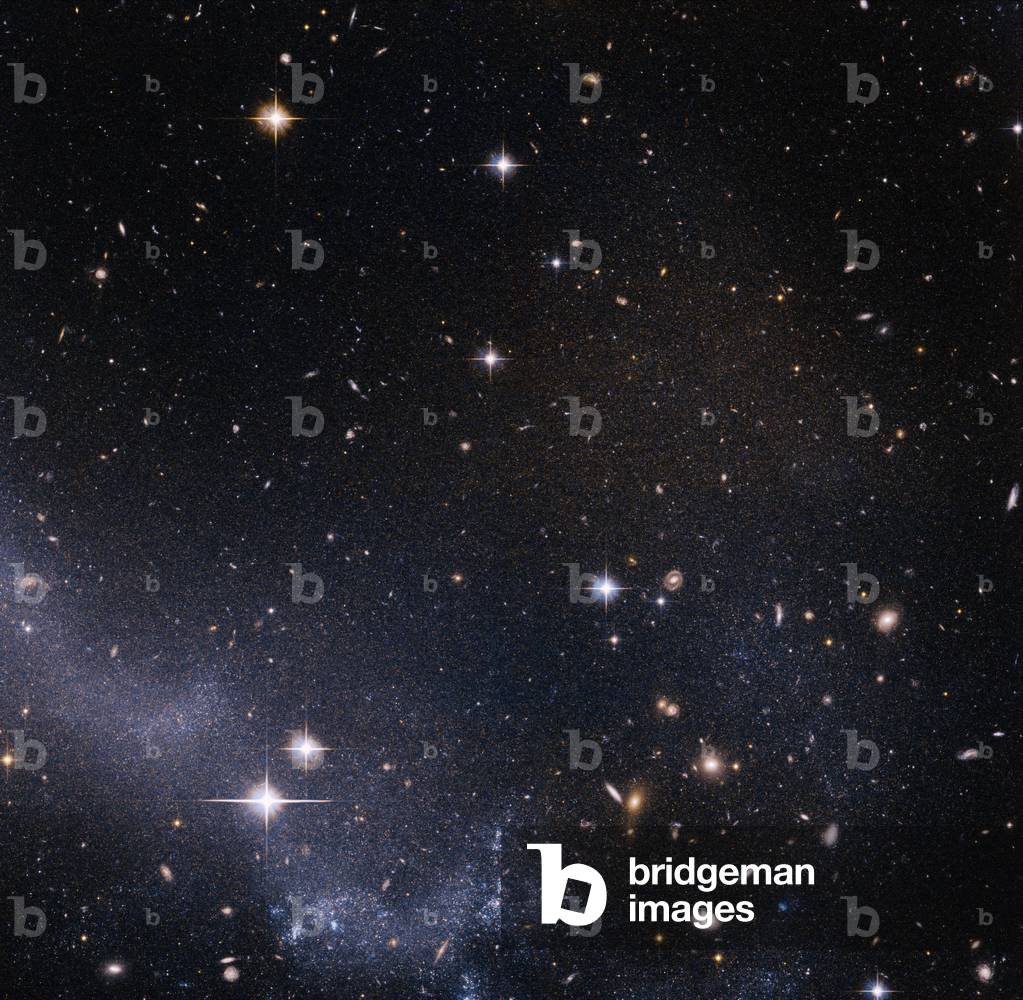
Galaxy NGC 1427A in the Furnace - The irregular galaxy NGC 1427A in Fornax - The galaxy NGC 1427A is located in the Furnace cluster about 62 million years ago - light from Earth. It is an irregular galaxy populated with young clusters of blue stars and many star-forming regions. Further away, other galaxies are visible in the background. The irregular galaxy NGC 1427A is a small bluish galaxy plunging headlong into the Fornax galaxy group at 600 kilometers per second or nearly 400 miles per second. NGC 1427A, which is located some 62 million light - years away from Earth in the direction of the constellation Fornax, shows numerous hot, blue stars in this image obtained by the Hubble Space Telescope. These blue stars have been formed very recently, showing that star formation is occurring extensively throughout the galaxy. NGC 1427A will not survive long as an identifiable galaxy passing through the cluster. Within the next billion years, it will be completely disrupted, spilling its stars and remaining gas into intergalactic space within the Fornax cluster. To the upper left of NGC 1427A is a background galaxy that happens to lie near Hubble's line of sight but is some 25 times further away
Nebula IC 405, star AE Aurigae in the Coach - Nebula IC 405 and runaway star AE Aurigae - IC 405, is a nebula illuminated by the massive star AE Aurigae. This type O star is a “” fleeing star”, a star ejected from the Orion nebula about 2.5 million years ago and continues its race at a speed of 200 km per second. The Flaming Star Nebula, IC 405, surrounds the variable star AE Aurigae. AE Aurigae is normally a 5.96 magnitude star of spectral class O. The star AE Aurigae itself is very bright, young, blue, and known as a runaway star since it appears to have been ejected from the Orion Nebula region about 2.5 million years ago
Star Field in the Antenna Galaxy - Starfield in the Antennae - Detail in the Antenna Galaxy (NGC 4038 - 4039) photograph by the Hubble space telescope showing young blue stars as well as many galaxies in the background. Located about 45 million years ago - light, NGC 4038 and NGC 4039 interact. The collision started at least 100 million years ago causes intense star formation. NGC 4038 and 4039 are the well - known pair of interacting galaxies that show two broadly curved tails of stars, the 'antenna', extending a considerable distance from the action. Massive star formations are resulting of a recent collision between two galaxies (100 million years ago). This galaxy is located 45 million light year from us. Here is an image taken by the Hubble space telescope showing young blue stars and several galaxies in background
Interacting galaxies NGC 4038 - 4039 in the Raven - NGC 4038 - 39, the interacting galaxies of the Antennae - Image of the galaxy NGC 4038 - 39 (antenna galaxy), located about 45 million years ago - light from Earth. These two galaxies are interacting. The collision started at least 100 million years ago causes intense star formation. NGC 4038 and 4039 are the well - known pair of interacting galaxies that show two broadly curved tails of stars, the 'antenna', extending a considerable distance from the action, as seen here. The colour picture reveals the burst of star formation triggered by the encounter, the large numbers of pink emission nebulae in the inter - galaxy region and the location of the numerous dark, brownish - yellow clouds of dust. The yellow nuclei of the two galaxies are also still visible in the colour picture as separate entities
Interacting galaxies NGC 4038 - 4039 in the Raven - NGC 4038 - 39, the interacting galaxies of the Antennae - On the left, an image of the galaxy NGC 4038 - 39 (antenna galaxy), obtained from the ground. On the right, a detail photograph by the Hubble space telescope showing young blue stars and numerous galaxies in the background. Located about 45 million years ago - light, NGC 4038 and NGC 4039 interact. The collision started at least 100 million years ago causes intense star formation. NGC 4038 and 4039 are the well - known pair of interacting galaxies that show two broadly curved tails of stars, the 'antenna', extending a considerable distance from the action. Massive star formations are resulting of a recent collision between two galaxies (100 million years ago). This galaxy is located 45 million light year from us. At left, an image taken from the ground, at right, an image taken by the Hubble space telescope showing young blue stars and several galaxies in background
Interacting galaxies NGC 4038 - 4039 in the Raven - NGC 4038 - 39, the interacting galaxies of the Antennae - Image of the galaxy NGC 4038 - 39 (antenna galaxy), located about 45 million years ago - light from Earth. These two galaxies are interacting. The collision started at least 100 million years ago causes intense star formation. NGC 4038 and 4039 are the well - known pair of interacting galaxies that show two broadly curved tails of stars, the 'antenna', extending a considerable distance from the action. The colour picture reveals the burst of star formation triggered by the encounter, the large numbers of pink emission nebulae in the inter - galaxy region and the location of the numerous dark, brownish - yellow clouds of dust. The yellow nuclei of the two galaxies are also still visible in the colour picture as separate entities
Constellation Orion - Constellation of Orio
Interacting galaxies NGC 4038 - 4039 in the Raven - The Antennae galaxy in Corvus - On the left, seen from the ground of the galaxy NGC 4038 - 39 (antenna galaxy), located about 45 million years ago - light. These two galaxies are interacting. The collision started at least 100 million years ago causes intense star formation. On the right, the image made by the space telescope Hubble on 20 January 1996 shows in detail the nuclei of these two twin galaxies surrounded by young clusters of blue stars, more than 1000, made up of young and massive stars. At left, a ground - based telescopic view of the Antennae galaxies (known formally as NGC 4038/4039) - so named because a pair of long tails of luminous matter, formed by the gravitational tidal forces of their encounter, resemble an insect's antennae. The galaxies are located 45 million light - years away in the southern constellation Corvus. At right, the respective cores of the twin galaxies are the orange blobs, left and right of image center, crisscrossed by filaments of dark dust. A wide band of chaotic dust, called the overlap region, stretches between the cores of the two galaxies. The sweeping spiral - like patterns, traced by bright blue star clusters, shows the result of a firestorm of star birth activity which was triggered by the collision. This natural - color image is a composite of four separately filtered images taken with the Wide Field Planetary Camera 2, on January 20, 1996
Interacting galaxies NGC 4038 - 4039 in the Raven - The Antennae galaxy in Corvus - Image of the galaxy NGC 4038 - 39 (antenna galaxy), located about 45 million years ago - light. These two galaxies are interacting. The collision started at least 100 million years ago causes intense star formation. Image obtained by the Hubble Space Telescope. The two spiral galaxies started to interact a few hundred million years ago, making the Antennae galaxies one of the nearest (about 45 million light years away) and youngest examples of a pair of colliding galaxies. Almost half of the faint objects in the Antennae image are young clusters containing tens of thousands of stars. The orange blobs to the left and right of image center are the two cores of the original galaxies and consist mainly of old stars criss - crossed by filaments of dust, which appears brown in the image. The two galaxies are dotted with brilliant blue star - forming regions surrounded by glowing hydrogen gas, appearing in the image in pink. Image taken with the Hubble space telescope
Galaxy AM 0644 - 741 in Flying Fish - Ring galaxy AM 0644 - 741 in Volans - The annular galaxy AM 0644 - 741 is about 300 million years away - light from Earth. A collision with another galaxy causes its ring shape. This ring extends over 150,000 years - light and is composed of recently formed and extremely bright blue stars. Image obtained by the Hubble Space Telescope in January 2004. This galaxy, cataloged as AM 0644 - 741, is a member of the class of so - called “” ring galaxies.”” It lies 300 million light - years away in the direction of the southern constellation Volans. Ring galaxies are an especially striking example of how collisions between galaxies can dramatically change their structure, while also triggering the formation of new stars. In the case of AM 0644 - 741, the galaxy that pierced through the ring galaxy is out of the image but visible in larger - field images. The soft spiral galaxy that is visible to the left of the ring galaxy in the image is a coincidental background galaxy that is not interacting with the ring. The resulting gravitational shock imparted due to the collision drastically changes the orbits of stars and gas in the target galaxy's disk, causing them to rush outward, somewhat like ripples in a pond after a large rock has been thrown in. As the ring plows outward into its surroundings, gas clouds collide and are compressed. The clouds can then contract under their own gravity, collapse, and form an abundance of new stars. The rampant star formation explains why the ring is so blue: It is continuously forming massive, young, hot stars, which are blue in color. Another sign of robust star formation is the pink regions along the ring. These are rarefied clouds of glowing hydrogen gas, fluorescing because of the strong ultraviolet light from the newly formed massive stars
Galaxy UGC 10214 in the Dragon - Galaxy UGC 10214 in Draco - The galaxy UGC 10214 is about 420 million years away - light from Earth. The shape of this galaxy is due to a collision with another galaxy, the small galaxy, blue, visible in the upper left corner of the image. Powerful gravitational forces are responsible for the formation of the tail, consisting of stars of dust and gas, which stretches over nearly 28,000 light years and is composed of recently formed and extremely bright blue stars. In the background, more than 6000 galaxies are visible, some more than 12 billion years apart - light. Image obtained by the Hubble Space Telescope in April 2002. This picture of the galaxy UGC 10214 was taken by the Advanced Camera for Surveys (ACS), which was installed aboard Nasa's Hubble Space Telescope in March during Servicing Mission 3B. Its distorted shape was caused by a small interloper, a very blue, compact galaxy visible in the upper left corner of the more massive Tadpole. The Tadpole resides about 420 million light - years away in the constellation Draco. Seen shining through the Tadpole's disk, the tiny intruder is likely a hit - and - run galaxy that is now leaving the scene of the accident. Strong gravitational forces from the interaction created the long tail of debris, consisting of stars and gas that stretch out more than 280,000 light - years. Numerous young blue stars and star clusters, spawned by the galaxy collision, are seen in the spiral arms, as well as in the long “” tidal”” tail of stars. Each of these clusters represents the formation of up to about a million stars. Their color is blue because they contain very massive stars, which are 10 times hotter and 1 million times brighter than our Sun. Once formed, the star clusters become redder with age as the most massive and bluest stars exhaust their fuel and burn out. These clusters will eventually become old globula
Interacting galaxies NGC 4038 - 4039 in the Raven - The Antennae galaxy in Corvus - The galaxy NGC 4038 - 39 (antenna galaxy) is located about 45 million years ago - light. These two galaxies are interacting. The collision started at least 100 million years ago causes intense star formation. These images made by the Hubble space telescope on 20 January 1996 show in detail the nuclei of these two twin galaxies (right) as well as clusters of blue stars, consisting of young and massive stars (left). The scale bar at the top of each image represents 1500 years - light. These four close - up views are taken from a head - on collision between two spiral galaxies, called the Antennae galaxies, seen at image center. The scale bar at the top of each image is 1,500 light - years across. Left: the collision triggers the birth of new stars in brilliant blue star clusters, the brightest of which contains roughly a million stars. The star clusters are blue because they are very young, the youngest being only a few million years old, a mere blink of the eye on the astronomical time scale. <BR>Right: these close - up views of the cores of each galaxy show entrapped dust and gas funneled into the center. The nucleus of NGC 4038 (lower right) is obscured by dust which dims and reddens starlight by scattering the shorter, bluer wavelengths. This is also the reason the young star clusters in the dusty regions appear red instead of blue. This natural - color image is a composite of four separately filtered images taken with the Wide Field Planetary Camera 2 on January 20, 1996
Galaxy of the Wheel of the Charette in the Sculptor - The Cartwheel Galaxy - The ring galaxy of the Wheel of the Charette is about 500 million years away - light from Earth. It is surrounded by a ring of 150,000 years - light of diameter composed of young and very bright stars (detail at the top left). This particular form is the result of a collision, probably with one of the two galaxies on the right. Bottom left, close-up on the nucleus of the galaxy. Image obtained by the Hubble Space Telescope in October 1994. A rare and spectacular head - on collision between two galaxies appears in this NASA Hubble Space Telescope true - color image of the Cartwheel Galaxy, located 500 million light - years away in the constellation Sculptor. The details of star birth resolved by Hubble provide an opportunity to study how extremely massive stars are born in large fragmented gas clouds. The striking ring - like feature is a direct result of a smaller intruder galaxy - - possibly one of two objects to the right of the ring - - that careened through the core of the host galaxy. Like a rock tossed into a lake, the collision sent a ripple of energy into space, plowing gas and dust in front of it. Expanding at 200,000 miles per hour, this cosmic tsunami leaves in its wake a firestorm of new star creation. Hubble resolves bright blue knots that are gigantic clusters of newborn stars and immense loops and bubbles blown into space by exploding stars (supernovae) going off like a string of firecrackers. The Cartwheel Galaxy presumably was a normal spiral galaxy like our Milky Way before the collision. This spiral structure is beginning to re - emerge, as seen in the faint arms or spokes between the outer ring and bulls - eye shaped nucleus. The ring contains at least several billion new stars that would not normally have been created in such a short time span and is so large (150,000 light - years across) our entire Milky Way Galaxy would fit inside. Hub
Galaxy UGC 10214 in the Dragon - Galaxy UGC 10214 in Draco - The galaxy UGC 10214 is about 420 million years away - light from Earth. The shape of this galaxy is due to a collision with another galaxy, the small galaxy, blue, visible in the upper left corner of the image. Powerful gravitational forces are responsible for the formation of the tail, consisting of stars of dust and gas, which stretches over nearly 28,000 light years and is composed of recently formed and extremely bright blue stars. In the background, more than 6000 galaxies are visible, some more than 12 billion years apart - light. Image obtained by the Hubble Space Telescope in April 2002. This picture of the galaxy UGC 10214 was taken by the Advanced Camera for Surveys (ACS), which was installed aboard Nasa's Hubble Space Telescope in March during Servicing Mission 3B. Its distorted shape was caused by a small interloper, a very blue, compact galaxy visible in the upper left corner of the more massive Tadpole. The Tadpole resides about 420 million light - years away in the constellation Draco. Seen shining through the Tadpole's disk, the tiny intruder is likely a hit - and - run galaxy that is now leaving the scene of the accident. Strong gravitational forces from the interaction created the long tail of debris, consisting of stars and gas that stretch out more than 280,000 light - years. Numerous young blue stars and star clusters, spawned by the galaxy collision, are seen in the spiral arms, as well as in the long “” tidal”” tail of stars. Each of these clusters represents the formation of up to about a million stars. Their color is blue because they contain very massive stars, which are 10 times hotter and 1 million times brighter than our Sun. Once formed, the star clusters become redder with age as the most massive and bluest stars exhaust their fuel and burn out. These clusters will eventually become old globula
Interacting galaxies NGC 4038 - 4039 in the Raven - NGC 4038 - 39, the interacting galaxies of the Antennae - Image of the galaxy NGC 4038 - 39 (antenna galaxy), located about 45 million years ago - light. These two galaxies are interacting. The collision started at least 100 million years ago causes intense star formation. NGC 4038 and 4039 are the well - known pair of interacting galaxies that show two broadly curved tails of stars, the 'antenna', extending a considerable distance from the action. Massive star formations are resulting of a recent collision between two galaxies (100 million years ago). This galaxy is located 45 million light year from us
Constellations of the Great Dog and Orion - Orion and Canis Major - On the left down, the constellation of the Great Dog with the star Sirius, on the right, the constellation Orion. At the top left, the star Procyon of the Little Dog. The stars Betelgeuse, Procyon and Sirius form the asterism of the Winter Triangle. The brightest star is Sirius in Canis Major. Above right, Orion, and above Sirius, on the left, Procyon in Canis Minor. Betelgeuse, Procyon and Sirius composes an asterism named the winter triangle
Comparison of the sizes of the Sun, Rigel, Betelgeuse and Antares - Size comparison: Sun, Rigel, Betelgeuse and Antares - The Sun (small dot on the right), and the blue supergiant star Rigel, are here compared to the supergiant red stars Betelgeuse (left), and Antares (in the background). The Sun (little dot at right) and Rigel are dwarfed by the red supergiants Betelgeuse (at left) and Antares (in background). Antares (alpha Scorpii) is the brightest star in the constellation Scorpius
Star cluster IC 1590 in NGC 281 (Cassiopee) - Open cluster and Bok globules in NGC 281 - View of a detail in the center of the nebula NGC 281 in Cassiopee. The brightest stars of the open cluster IC 1590 are visible, accompanied by Bok's blood cells, dark interstellar clouds consisting of gas and dust that absorb light. Image obtained by the Hubble Space Telescope (HST). Astronomers have used the NASA/ESA Hubble Space Telescope to study the young open star cluster IC 1590, which is found within the star formation region NGC 281 - - nicknamed the Pacman Nebula due to its resemblance to the famous arcade game character. This image only shows the central part of the nebula, where the brightest stars at the core of the cluster are found, with part of the Pacman's hungry mouth visible as the dark region below. But Pacman isn't gobbling up these stars. Instead, the nebula's gas and dust are being used as raw ingredients to make new stars. However, the stars in IC 1590 are still plotting their escape from the Pacman Nebula, as open clusters are only loosely bound together and the grouping will eventually disperse within a few tens of millions of years. IC 1590 lies about ten thousand light - years from Earth in the constellation of Cassiopeia (The Queen). Through small telescopes the core of the cluster that appears at the top of this picture shows up as a triple star, but the nebula that surrounds it is much fainter and very hard to see
The Rosette Nebula in the Unicorn - The Rosette Nebula and NGC 2244 cluster - The Rosette Nebula is a vast cloud of dust and gas located about 5500 years from Earth. Towards the center of the nebula, a cluster of blue stars, NGC 2244 formed less than a million years ago. Image obtained from the 1.2m Schmidt UK telescope of Siding Spring. The Rosette Nebula exhibits a striking circular symmetry which gives it the appearance of a partly opened rose, an allusion further enhanced by the rich red hues seen in this colour photograph. Near the centre of the nebula is a cluster of blue stars catalogued as NGC 2244. These stars are responsible for making the nebula visible and for creating the hollowed - out central cavity. This cluster of stars formed from the gas which now surrounds it less than a million years ago and is thus very young on the cosmic timescale. The gas and dust at the centre of the nebula have been forced away from the bright stars by radiation pressure and the intense stellar wind which is often associated with very hot stars, forming a hollow centred on the cluster. This will gradually expand and dissipate until the stars are free from nebulosity
Bok's cells in NGC 281 (Cassiopee) - Bok globules in NGC 281 - View of a detail of the nebula NGC 281 in Cassiopee center on Bok's Globules. A Bok's blood cell is a dark interstellar cloud of gases and dust that absorb light. If it condenses enough, it gives birth to new stars. Near these blood cells shine blue stars; they belong to the young cluster of stars IC 1590. Image obtained by the Hubble Space Telescope in October 2005. These opaque, dark knots of gas and dust are called “” Bok globules,””” and they are absorbing light in the center of the nearby emission nebula and star - forming region. Bok hypothesized that giant molecular clouds, on the order of hundreds of light - years in size, can become perturbed and form small pockets where the dust and gas are highly concentrated. These small pockets become gravitationally bound and accumulate dust and gas from the surrounding area. If they can capture enough mass, they have the potential of creating stars in their cores; however, not all Bok globules will form stars. Some will dissipate before they can collapse to form stars. That may be what's happening to the globules seen here in NGC 281. Near the globules are bright blue stars, members of the young open cluster IC 1590. The cluster is made up of a few hundred stars. The club's core, off the image towards the top, is a tight grouping of extremely hot, massive stars with an immense stellar wind. The stars emit visible and ultraviolet light that energizes the surrounding hydrogen gas in NGC 281. This gas then becomes super heated in a process called ionization, and it glows pink in the image. The Bok globules in NGC 281 are located very close to the center of the IC 1590 cluster. The heavy fracturing of the globules may appear beautifully serene but is in fact evident of the harsh
Open cluster NGC 2244 in the nebula of the Rosette - The Rosette Nebula and NGC 2244 cluster - The Rosette nebula is a vast cloud of dust and gas situated about 5500 years away from Earth. Towards the center of the nebula, a cluster of blue stars, NGC 2244 formed less than a million years ago. Image obtained by Siding Spring's 3.9m telescope. In the hollowed - out centre of the Rosette nebula lies NGC 2244, the cluster of young stars recently formed there. The cluster has itself created the cavity, radiation pressure and stellar winds from the stars blowing the gas and dust away from the young cluster. The hottest (and brightest) members of the group are seen as distinctly blue on this photograph, a colour corresponding to a surface temperature around 20,000K which may be compared with the Sun's 5500K. The nebula and its cluster is at a distance of about 4500 light years and shows many streaks and globules of dust, remnants of the cloud from which the stars formed
Center of the Trifid Nebula (M20) - Center of the Trifid Nebula - The Trifid Nebula (M20) is located between 5000 and 10,000 years - light of the Earth in the constellation of Sagittarius. This image obtained by the Hubble space telescope shows the center of this nebula. A group of bright stars is visible in the center of the image near the dark bands of interstellar dust. These stars are young, blue, massive and extremely hot stars; they are O-type stars and the radiation they emit influence the evolution and structure of the nebula. Trifid Nebula, also known as Messier 20 and NGC 6514, lies within our own Milky Way Galaxy between 5000 and 10 000 light - years from Earth, in the constellation Sagittarius. This image from the Hubble Space Telescope offers a close - up view of the center of the Trifid Nebula, near the intersection of the dust bands, where a group of recently formed, massive, bright stars is easily visible. These stars, which astronomers classify as belonging to the hottest and bluest types of stars called type “” O,””” are releasing a flood of ultraviolet radiation that dramatically influences the structure and evolution of the surrounding nebula
Blue Star Spring - Yellowstone - Blue Star Spring, a hot pool in Yellowstone National Park. The Blue Star spring in Yellowstone National Park, USA
Constellations of Orion and Tauru - Constellations of Orion and Tauru
Orion Constellation - Constellation of Orion - Orion the Hunter is one of the most familar and best known constellations. There is extensive and varied mythology about this beautiful collection of stars, but the most common Greek legend has Orion as a giant huntsman, and he appears in this role in Homer's Odyssey. The most persistent legend seems to be that he died from the sting of a giant scorpion, which was placed in the sky so that Orion sets as the Scorpius rises, in an eternal chase across the sky. The momorable outline of the Hunter proudly bestrides the celestial equator and is equally visible from both hemispheres. The distinctive, equally spaced line of stars of Orion's Belt are more or less on the equator and are framed by quartet of bright and colourful stars. More subtle is Orions short sword, hanging from his belt. Under dark skies or in binoculars the central 'star' is distinctly misty. This is the famous Orion nebula, one of many well known telescopic objects that fill this part of the sky. The westernmost Orion Belt star delta Orionis (Minkata) is about a quarter of a degree of arc south of the celestial equator and all three belt stars are within 2 degrees of it. This means they rise and set due east or west of the observer and track the equator across the sky during the night, tracing straight lines in star trail photographs. Note that Orion is upside down as seen from the southern hemisphere, where it is often called 'the saucepan', with the Belt stars forming the base and the Sword stars the handle
Comparison of Sun Sizes, Sirius and Rigel - Size comparison: Sun, Sirius and Rigel - The Sun (yellow star at the top), and the star Sirius A, (the brightest star in the sky) compared to the huge star Rigel, a supergeant blue star in the constellation of Orion. The brightest star in Earth's sky, Sirius, is seen here next to our Sun and the blue giant Rigel. Sirius has a small companion star, Sirius B. Rigel forms the left foot in the constellation Orion, and its light is equal to 40,000 suns
Orion Constellation - Constellation of Orion - Orion the Hunter is one of the most familar and best known constellations. There is extensive and varied mythology about this beautiful collection of stars, but the most common Greek legend has Orion as a giant huntsman, and he appears in this role in Homer's Odyssey. The most persistent legend seems to be that he died from the sting of a giant scorpion, which was placed in the sky so that Orion sets as the Scorpius rises, in an eternal chase across the sky. The momorable outline of the Hunter proudly bestrides the celestial equator and is equally visible from both hemispheres. The distinctive, equally spaced line of stars of Orion's Belt are more or less on the equator and are framed by quartet of bright and colourful stars. More subtle is Orions short sword, hanging from his belt. Under dark skies or in binoculars the central 'star' is distinctly misty. This is the famous Orion nebula, one of many well known telescopic objects that fill this part of the sky. The westernmost Orion Belt star delta Orionis (Minkata) is about a quarter of a degree of arc south of the celestial equator and all three belt stars are within 2 degrees of it. This means they rise and set due east or west of the observer and track the equator across the sky during the night, tracing straight lines in star trail photographs. Note that Orion is upside down as seen from the southern hemisphere, where it is often called 'the saucepan', with the Belt stars forming the base and the Sword stars the handle
Constellation of the Great Dog - Constellation of Canis Major - Sirius, the bright star on this image is the brightest star in the sky; it belongs to the constellation of the Great Dog. The brightest star in the sky is here, Sirius, the Dog Star, so called because its emanations were thought to affect dogs in the heat of summer, the 'Dog Days' when the star is in the same part of the sky as the Sun. Sirius is bright because it is only 8.6 light years from the Sun and it is in any case it is an intrinsically bright star, 25 times more luminous than the Sun
Globular cluster M30 in Capricornus - Globular cluster M30 in Capricornus - The globular cluster M30 (NGC 7099) is located about 28,000 light years away from Earth. Globular clusters are generally peoples of very old stars, but here the Hubble space telescope has identified some young stars, blue stragglers. Messier 30 formed 13 billion years ago and was discovered in 1764 by Charles Messier. Located about 28 000 light - years away from Earth, this globular cluster - - a dense swarm of several hundred thousand stars - - is about 90 light - years across. Although globular clusters such as this one are mainly populated by old stars, the crowded field of stars leads to some old stars apparently reclaiming their youth in the form of blue stragglers. Researchers using data from Hubble's now - retired Wide Field Planetary Camera 2 (WFPC2) have identified two types of blue stragglers in Messier 30: those that form in near head - on collisions with one another and those that are in twin (or binary) systems where the less massive star siphons “” life - giving”” hydrogen from its more massive companion. This image of Messier 30 (M30) was taken by Hubble's Advanced Camera for Surveys (ACS)
Blue Star Cinema, 1990 (photo)
图片限制
  • Content within this photograph may require additional clearances (eg: trademark and personality rights) depending on Licensee's specific use of material, which may include book and magazine cover use.
Blue Star Cinema, 1990 (photo)
图片限制
  • Content within this photograph may require additional clearances (eg: trademark and personality rights) depending on Licensee's specific use of material, which may include book and magazine cover use.
Blue Star Cinema, 1990 (photo)
图片限制
  • Content within this photograph may require additional clearances (eg: trademark and personality rights) depending on Licensee's specific use of material, which may include book and magazine cover use.
Brachyscome iberidifolia/Brachycome 'Blue Star'
Globular cluster NGC 6642 - Stars in globular cluster NGC 6642 in Sagittarius - Stars in globular cluster NGC 6642 in Sagittarius - Image of the center of the globular cluster NGC 6642 located in the constellation Sagittarius. The Hubble Space Telescope (HST) observed blue straggler. The core of NGC 6642, shown here in this Hubble Space Telescope image, is particularly dense, making this globular a difficult observational target for most telescopes. Using Hubble's ACS, astronomers have already made many interesting finds about NGC 6642. For example, many blue stragglers”” (stars which seemingly lag behind in their rate of aging) have been spotted in this globular, and it is known to be lacking in low - mass stars. This picture was created from visible and infrared images taken with the Wide Field Channel of the Advanced Camera for Surveys. The field of view is approximately 1.6 by 1.6 arcminutes.
Globular cluster NGC 6397 in the Altar - Stars in globular cluster NGC 6397 in Ara - Image of the center of the globular cluster NGC 6397 located 8200 years - light in the southern constellation of the Altar. The density of stars is very important, the stars are distant from each other only a few weeks light (the star closest to our Sun is four years away - light). Sometimes a collision between two stars occurs; they merge into a single, young, bright and warm star called a blue straggler; some of these stars are visible near the center of the image. This Hubble Space Telescope view of the core of one of the nearest globular star clusters, called NGC 6397, located 8,200 light - years away in the constellation Ara. The stellar density is about a million times greater than in our Sun's stellar neighborhood. The stars are only a few light - weeks apart, while the nearest star to our Sun is over four light - years away. The ancient stars are so crowded together that a few of them inevitably collide with each other once in a while. Near misses are even more common. Even so, collisions only occur every few million years or so. When direct collisions occur, the two stars may merge to form a new star called a “” blue straggler”””; these hot, bright, young stars stand out among the old stars that make up the vast majority of stars in a globular cluster. Several such bright blue stars are visible near the center of the cluster in the image. This Hubble image is a mosaic of two sets of images taken several years apart by the Wide Field Planetary Camera 2 taken in 1997 and 1999
Constellations of the Great Dog, Orion and Taurus - Winter constellations. On the left the constellation of the Great Dog with the star Sirius, in the center the constellation Orion, on the right the constellation of the Taurus with the cluster of the Hyades and the cluster of the Pleiades. Image obtained on November 3, 2005 in New Jersey - USA. The constellations of Canis Major (the Big Dog), Orion (the Hunter), and Taurus (the Bull) stretch across the winter sky just before the start of dawn in the beginning of November. Sirius, the brightest star in the night sky, dominates the left side of the frame. Sirius is the alpha star in the constellation of Canis Major and is located only 9 light years away. Orion, the most distinctive of the winter constellations, is in the middle of the frame. The Hyades and Pleiades (the 7 Sisters), two beautiful open clusters in Taurus, are on the right side of the image
Kitchen Clock Star Transistor Blue
图片限制
  • Content within this photograph may require additional clearances (eg: trademark and personality rights) depending on Licensee's specific use of material, which may include book and magazine cover use.
Nebula of the Lagoon (M8) in Sagittarius - The Lagoon nebula (M8) in Sagittarius - View of the Nebula of the Lagoon (M8/NGC 6523). Located in Sagittarius, at a distance of 5800 years - light, it is visible to the naked eye in good conditions. It is a star-forming region illuminated by several large O-type stars that belong to the open cluster NGC 6530 visible in the center of the image. The brightest part of the nebula is called the hourglass nebula whose gases are excited mainly by two massive supergeant stars Herschel 36 and 9 Sagittarii. M8 has at least 60 Giant B stars, 3 to 4 times more than the Orion Nebula. The Lagoon nebula (M8), can be visible to the unaided eye as a small bright patch above the large Sagittarius star cloud in the Milky Way. The Lagoon nebula is a star - forming region about 5800 light years from us. The nebula is illuminated by several O - type giants within the open cluster NGC 6530 near the center of the nebula. The brightest part of the nebula is known as the “hourglass nebula”” and its gases are excited primarily by two massive O - type supergiants designated Herschel 36 and 9 Sagittarii. These two stars lie to the west of NGC 6530 and are separated from it by a dark lane dividing the nebula like a black lagoon, giving it its name. Twisted funnel shaped clouds are visible close to the illuminating stars, especially Herschel 36. They are due to shear forces between the hot excited gases at the surface and the cold interior of the clouds. At least 60 B - type giants are embedded in the nebula which make M8 3 to 4 times richer in massive stars than the Orion nebula
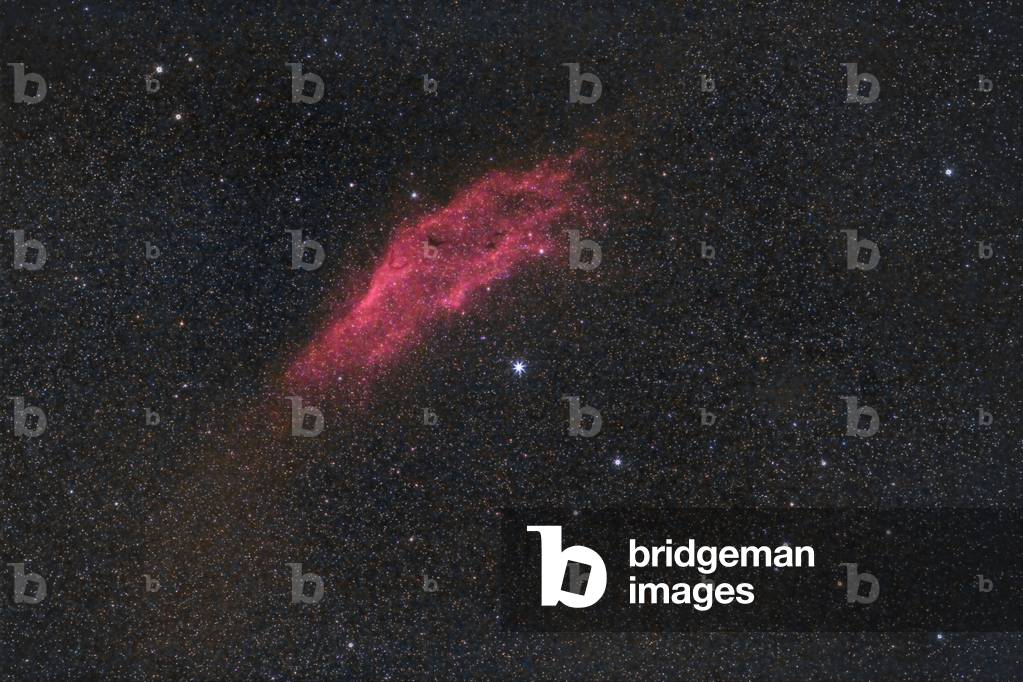
Nebula California (NGC 1499) in Persee - The California Nebula (NGC 1499) in Perseus - NGC 1499 is a very large emission nebula located 1140 years - light from Earth in the constellation Persee. Image obtained by the Oschin telescope of Mount Palomar through several filters and composed. The north is at top. This is a huge emission nebula in Perseus constellation. It is a cloud of gas, mainly hydrogen, which glows due to the ionization by radiation from a hot nearby star. The California Nebula is made glowing by the 4th magnitude star Menkib (Xi Persei, the bright blue star in center right). The nebula is named because recall the shape of the US state when viewed from the west. This image is based on data acquired by the Oschin Telescope at the Mount Palomar Observatory
Nebula of the Lagoon (M8) in Sagittarius - M8, The Lagoon Nebula - View of the Nebula of the Lagoon (M8/NGC 6523). Located in Sagittarius, at a distance of 5800 years - light, it is visible to the naked eye in good conditions. It is a star-forming region illuminated by several giant O stars that belong to the open cluster NGC 6530 visible in the center of the image. The brightest part of the nebula is called the hourglass nebula whose gases are excited mainly by two supergiant stars Herschel 36 and 9 Sagittarii. M8 has at least 60 giant B stars, 3 to 4 times more than the Orion nebula. M8 is an amazing stellar nursery. Hot young stars that formed out of the hydrogen gas in the nebula cause it to glow in the light of ionized hydrogen at the hydrogen - alpha wavelength of 656nm. The Lagoon Nebula gets its name from the distinctive dark lane that runs through the heart of the nebula, just to the west of open cluster NGC 6530. Bok globules, small dark knots which are condensing protostellar clouds, can be seen sprinkled throughout the nebula. The brightest part of M8 has an apparent size of about 1 degree on the sky (the size of two full Moons) and is 100 light years across in space. It is located about 5,200 light years away
Constellation of the Great Dog - Constellation of Canis Major - Sirius, the bright star on this image is the brightest star in the sky. Canis Major (the Greater Dog) is one of two dogs accompanying Orion the hunter across the sky. The other is Canis Minor. The constellation figure is ancient, and was one of 48 constellations mentioned by Ptolemy (83 - 161 AD), no doubt reflecting earlier ideas. The modern stick figure joining the brightest stars (above) certainly has a very doggy appearance. The brightest star in the sky is here, Sirius, the Dog Star, so called because its emanations were thought to affect dogs in the heat of summer, the 'Dog Days' when the star is in the same part of the sky as the Sun. Sirius is bright because it is only 8.6 light years from the Sun and it is in any case it is an intrinsically bright star, 25 times more luminous than the Sun
Constellation Orion - Constellation of Orio
View of the nebula of the Lagoon (M8/NGC 6523). Located in Sagittarius, at a distance of 5800 light years, it is visible to the naked eye in good conditions. It is a star-forming region illuminated by several large O-type stars that belong to the open cluster NGC 6530 visible in the center of the image. The brightest part of the nebula is called the hourglass nebula whose gases are excited mainly by two massive supergeant stars Herschel 36 and 9 Sagittarii. M8 has at least 60 Giant B stars, 3 to 4 times more than the Orion nebula - The Lagoon nebula (M8), can be visible to the unaided eye as a small bright patch above the large Sagittarius star cloud in the Milky Way. The Lagoon nebula is a star-forming region about 5800 light years from us. The nebula is illuminated by several O-type giants within the open cluster NGC 6530 near the center of the nebula. The brightest part of the nebula is known as the “hourglass nebula”” and its gases are excited primarily by two massive O-type supergiants designated Herschel 36 and 9 Sagittarii. These two stars lie to the west of NGC 6530 and are separated from it by a dark lane dividing the nebula like a black lagoon, giving it its name. Twisted funnel shaped clouds are visible close to the illuminating stars, especially Herschel 36. They are due to shear forces between the hot excited gases at the surface and the cold interior of the clouds. At least 60 B-type giants are embedded in the nebula which make M8 3 to 4 times richer in massive stars than the Orion nebula: Nebula of the Lagoon (M8) in Sagittarius
Blue stragglers in cluster 47 Toucan - Blue stragglers in globular cluster 47 Tucanae - This image obtained by the Hubble space telescope shows a detail of the 47 Toucan cluster near its center (the field is indicated on the left image taken from the ground). The yellow circles on the right image indicate the position of stars identified by the telescope as blue trainers. Because of the high density of stars within a globular cluster, a collision between two stars sometimes occurs, merging into a single young, bright and warm star called a blue straggler. The core of globular cluster 47 Tucanae is home to many blue stragglers, rejuvenated stars that glow with the blue light of young stars. A ground - based telescope image (on the left) shows the entire crowded core of 47 Tucanae, located 15,000 light - years away in the constellation Tucana. Peering into the heart of the globular cluster's bright core, the Hubble Space Telescope's Wide Field and Planetary Camera 2 separated the dense clump of stars into many individual stars (image on right). Some of these stars shine with the light of old stars; others with the blue light of blue stragglers. The yellow circles in the Hubble telescope image highlight several of the club's blue stragglers. Astronomers theorize that blue stragglers are formed either by the slow merger of stars in a double - star system or by the collision of two unrelated stars. For the blue straggler in 47 Tucanae, astronomers favor the slow merger scenario. This photo is a three - color composite of Wide Field and Planetary Camera 2 archival images taken with ultraviolet, blue, and violet filters. Green, blue, and red colors were assigned to the filters and scaled so that the red giant stars appear orange, the main sequence stars are white/green, and the blue stragglers are appropriately blue. The ultraviolet images were taken on
The evolution of stars - Illustration - The evolution of stars - Illustration - All stars are born in interstellar clouds but according to their masses they will follow different destinies. From top to bottom: - The brown dwarf - The red dwarf, a small star that will become a white dwarf and then a black dwarf. - A star of the same type as the Sun, which will evolve into a red giant then planetary nebula to become a white dwarf and end up as a black dwarf. - A blue giant star that becomes supergeant red to explode in supernova and finish either black hole or neutron star. Every stars come to life in interstellar clouds, but their evolution will depend on their mass; from top to bottom: - A brown dwarf - A red dwarf, a small star which will slowly collapse to become a white dwarf then a black dwarf. - A Sun - like star will become a red giant then a planetary nebula, a white dwarf and will end as a black dwarf. - A blue star will become a red supergiant, then will explode in a supernova to end as a black hole or a neutron star
Nebula of the Lagoon (M8) in Sagittarius - The Lagoon nebula (M8) in Sagittarius - View of the Nebula of the Lagoon (M8/NGC 6523). Located in Sagittarius, at a distance of 5800 years - light, it is visible to the naked eye in good conditions. It is a star-forming region illuminated by several large O-type stars that belong to the open cluster NGC 6530 visible in the center of the image. The brightest part of the nebula is called the hourglass nebula whose gases are excited mainly by two massive supergeant stars Herschel 36 and 9 Sagittarii. M8 has at least 60 Giant B stars, 3 to 4 times more than the Orion Nebula. The Lagoon nebula (M8), can be visible to the unaided eye as a small bright patch above the large Sagittarius star cloud in the Milky Way. The Lagoon nebula is a star - forming region about 5800 light years from us. The nebula is illuminated by several O - type giants within the open cluster NGC 6530 near the center of the nebula. The brightest part of the nebula is known as the “hourglass nebula”” and its gases are excited primarily by two massive O - type supergiants designated Herschel 36 and 9 Sagittarii. These two stars lie to the west of NGC 6530 and are separated from it by a dark lane dividing the nebula like a black lagoon, giving it its name. Twisted funnel shaped clouds are visible close to the illuminating stars, especially Herschel 36. They are due to shear forces between the hot excited gases at the surface and the cold interior of the clouds. At least 60 B - type giants are embedded in the nebula which make M8 3 to 4 times richer in massive stars than the Orion nebula
Detail of the nebula NGC 3603 in the Carene - Star life cycle in NGC 3603 - In the center of the picture is a cluster of massive young stars formed from the gas surrounding them. Two pillars of gas and dust visible on the right at the top and bottom will one day form other stars, as probably the dark cloud at the top right of the image called Bok's globule. Above the left of the star cluster, an old blue supergiant star, Sher 25, arrives at the end of life. The nebula NGC 3603 is located approximately 20,000 light years from Earth in the southern constellation of Carene. Image obtained by the Hubble Space Telescope. This image made by the Hubble space telescope nicely illustrates the entire stellar life cycle of stars, starting with the Bok globules (dark clouds at the upper right) and giant gaseous pillars, followed by circumstellar disks and progressing to evolved massive stars in the young starburst cluster (center). The blue supergiant star Sher 25 with its ring and bipolar outflow (upper left of center) marks the end of the life cycle. NGC 3603 is located 20 000 light years away in Carina constellation
The Wilde One, 1953 (film still)
图片限制
  • Access rights only to the digital file & only for editorial coverage of this specific motion picture/TV programme. Standard warranties regarding copyrights and moral rights are expressly excluded and third party rights may need to be cleared.
California Nebula (NGC 1499) in Perseus (photo)
Star cluster in the nebula NGC 3603 - Star cluster in NGC 3603 nebula - Cluster of young stars in the nebula NGC 3603, located about 20,000 years ago - light from Earth in the southern constellation of Carene. Image obtained by the Hubble Space Telescope on 29 December 2005. NGC 3603 is a prominent star - forming region located in the Carina spiral arm of the Milky Way, about 20,000 light - years away from our Solar System. This image from the NASA/ESA Hubble Space Telescope shows a young star cluster surrounded by a vast region of dust and gas. Most of the bright stars in the image are hot blue stars whose ultraviolet radiation and violent winds have blown out an enormous cavity in the gas and dust enveloping the cluster
Nebula of the Lagoon (M8) in Sagittarius - The Lagoon nebula (M8) in Sagittarius - View of the Nebula of the Lagoon (M8/NGC 6523). Located in Sagittarius, at a distance of 5800 years - light, it is visible to the naked eye in good conditions. It is a star-forming region illuminated by several large O-type stars that belong to the open cluster NGC 6530 visible towards the center of the image. The brightest part of the nebula is called the hourglass nebula whose gases are excited mainly by two massive supergeant stars Herschel 36 and 9 Sagittarii. M8 has at least 60 Giant B stars, 3 to 4 times more than the Orion Nebula. The Lagoon nebula (M8), can be visible to the unaided eye as a small bright patch above the large Sagittarius star cloud in the Milky Way. The Lagoon nebula is a star - forming region about 5800 light years from us. The nebula is illuminated by several O - type giants within the open cluster NGC 6530 near the center of the nebula. The brightest part of the nebula is known as the “hourglass nebula”” and its gases are excited primarily by two massive O - type supergiants designated Herschel 36 and 9 Sagittarii. At least 60 B - type giants are embedded in the nebula which make M8 3 to 4 times richer in massive stars than the Orion nebula
Flag of Venezuela
Bright Star, Keats (acrylic collage)
版权
  • 版权适用
premium
Bloodbrothers, 1978 (fim still)
图片限制
  • Access rights only to the digital file & only for editorial coverage of this specific motion picture/TV programme. Standard warranties regarding copyrights and moral rights are expressly excluded and third party rights may need to be cleared.
T.S.S. Arandora, Blue Star Line, Dampfschiff
Open cluster NGC 4755 - Jewel box - The Jewel Box cluster - The NGC 4755 cluster is located in the constellation of the Southern Cross at a distance of 7800 years - light from Earth. The bright orange star is Kappa Crucis, a supergiant red star. This cluster contains about fifty stars formed about 14 million years ago. NGC4755 (Caldwell 94) is called the Jewel Box, based on John Herschel's comment in the 1830's that it looked like a superb piece of jewelry. There are about 50 stars in this cluster which formed some 14 million years ago. Most of the cluster members are blue giants which in a few million years will exhaust their hydrogen fuel and become red giants on their way to a cataclysmic end as supernovae. One red giant can already be seen at the center of the cluster
Open cluster NGC 4755 - Jewel Box - The Jewel Box star cluster - The NGC 4755 cluster is located in the constellation of the Southern Cross at a distance of 6400 years - light from Earth. The bright orange star on the top right is Kappa Crucis, a supergiant red star. This cluster contains about fifty stars formed about 16 million years ago. This close-up of the center of the cluster was obtained with the Hubble Space Telescope. This image is a “” close - up 'view from the NASA/ESA Hubble Space Telescope of NGC 4755, or the Jewel Box cluster. Several very bright, pale blue supergiant stars, a solitary ruby - red supergiant and a variety of other brilliantly coloured stars are visible in the image, as well as many much fainter ones, often with intriguing colours. The huge variety in brightness exists because the brighter stars are 15 to 20 times the mass of the Sun, while the dimmest stars are less than half the mass of the Sun. This is the first image of an open galactic cluster with imaging extending from the far ultraviolet to the near - infrared. NGC 4755 (Caldwell 94) is called the Jewel Box, based on John Herschel's comment in the 1830's that it looked like a superb piece of jewelry. There are about 50 stars in this cluster which formed some 14 million years ago. Most of the cluster members are blue giants which in a few million years will exhaust their hydrogen fuel and become red giants on their way to a cataclysmic end as supernovae. One red giant can already be seen at the center of the cluster (top right)
Evolution of a giant blue star - Artist view - Death of a blue giant star - Artist view - Vue d'artiste de la mort d'une supergeante. After several million years of existence, the blue giant star (on the left) swell to become a red supergeante; its heart contracts and its weight heats, resulting in the evaporation of the outer layers of the star (in the centre). When the nucleus is empty of its energy, it compresses itself causing the explosion of the star (a supernova, on the right). This image shows steps in a celestial cataclysm. After several million years, a blue giant star (at left) is becoming a red supergiant (center). As the nuclear reaction within a giant star's core falters, the core collapses, triggering an intensely energetic rebound and the star explodes (a supernova, at right)
Lustre star tiles with blue borders
Flag of North Korea
Chikatsusei Maunkinshi (Golden Wings Brushing the Clouds Incarnated from Earthly Wide Star), 1960 (oil on canvas)
权限
  • Permission required for product and merchandise licensing - Please contact us
版权
  • 版权适用