[]
您当前的选择
资产 资产
您的报价 0

您的选择

清除选择
商品已加入购物车
{"event":"pageview","page_type1":"undetected","page_type2":"_assets_search_override","language":"cn","user_logged":"false","user_type":"ecommerce","nl_subscriber":"false"}
{"event":"ecommerce_event","event_name":"view_item","event_category":"browse_catalog","ecommerce":{"items":[{"item_id":"PIX4574352","item_category":"photo","item_category2":"no_copyright","item_category3":"standard","item_category4":"bergeron_joe","item_category5":"not_balown","item_list_name":"search_results","item_name":"artist_s_view_of_an_exoplanet_exoplanet_illustration_artist_s_view_of_a_gas_giant_exoplanet_accompan","item_variant":"undefined"},{"item_id":"LLM5997299","item_category":"illustration","item_category2":"out_of_copyright","item_category3":"standard","item_category4":"green_nathaniel_everett_d_1899","item_category5":"not_balown","item_list_name":"search_results","item_name":"jupiter_lithograph","item_variant":"undefined"},{"item_id":"PIX4573237","item_category":"photo","item_category2":"no_copyright","item_category3":"standard","item_category4":"walter_b_myers","item_category5":"not_balown","item_list_name":"search_results","item_name":"gas_exoplanete_gas_exoplanet_artist_s_view_of_an_extrasolar_gas_planet_in_the_sky_of_one_of_its_sate","item_variant":"undefined"},{"item_id":"LLM6000092","item_category":"illustration","item_category2":"in_copyright","item_category3":"standard","item_category4":"campbell_john_f_1885_1966","item_category5":"not_balown","item_list_name":"search_results","item_name":"the_planet_saturn_lithograph","item_variant":"undefined"},{"item_id":"LLM5996198","item_category":"illustration","item_category2":"out_of_copyright","item_category3":"standard","item_category4":"english_school_20th_century","item_category5":"not_balown","item_list_name":"search_results","item_name":"the_planet_jupiter_as_seen_from_one_of_its_moons_lithograph","item_variant":"undefined"},{"item_id":"XOS1218575","item_category":"photo","item_category2":"no_copyright","item_category3":"standard","item_category5":"balown","item_list_name":"search_results","item_name":"view_of_neptune_captured_by_voyager_ii_1989_photo","item_variant":"undefined"},{"item_id":"UIG5669236","item_category":"photo","item_category2":"no_copyright","item_category3":"standard","item_category5":"not_balown","item_list_name":"search_results","item_name":"saturn_is_the_sixth_planet_from_the_sun","item_variant":"undefined"},{"item_id":"LLM5996182","item_category":"illustration","item_category2":"out_of_copyright","item_category3":"standard","item_category4":"english_school_20th_century","item_category5":"not_balown","item_list_name":"search_results","item_name":"the_planet_saturn_lithograph","item_variant":"undefined"},{"item_id":"PIX4609732","item_category":"photo","item_category2":"no_copyright","item_category3":"standard","item_category5":"not_balown","item_list_name":"search_results","item_name":"elliptical_galaxy_ngc_1275_in_persee_elliptical_galaxy_ngc_1275_in_perseus_view_of_the_giant_ellipti","item_variant":"undefined"},{"item_id":"XOS1218576","item_category":"photo","item_category2":"no_copyright","item_category3":"standard","item_category5":"balown","item_list_name":"search_results","item_name":"montage_of_neptune_and_it_s_moon_triton_digital_image","item_variant":"undefined"},{"item_id":"KES6254056","item_category":"photo","item_category2":"no_copyright","item_category3":"standard","item_category4":"stringer_str","item_category5":"not_balown","item_list_name":"search_results","item_name":"switzerland_kiosk_giant_mushroom_b_w_photo","item_variant":"undefined"},{"item_id":"PIX4607770","item_category":"photo","item_category2":"no_copyright","item_category3":"standard","item_category4":"miller_ron_b_1947","item_category5":"not_balown","item_list_name":"search_results","item_name":"life_on_an_exoplanet_view_of_an_alien_life_artist_in_the_clouds_of_a_gas_giant_exoplanet_extraterres","item_variant":"undefined"},{"item_id":"PIX4620060","item_category":"photo","item_category2":"no_copyright","item_category3":"standard","item_category5":"not_balown","item_list_name":"search_results","item_name":"eagle_nebula_ic_4703_in_the_snake_detail_star_forming_region_in_the_eagle_nebula_view_of_a_column_of","item_variant":"undefined"},{"item_id":"PIX4572591","item_category":"photo","item_category2":"no_copyright","item_category3":"standard","item_category5":"not_balown","item_list_name":"search_results","item_name":"nova_de_l_eagle_nova_aquilae_artwork_artist_s_view_of_a_nova_a_white_dwarf_star_that_attracts_the_ma","item_variant":"undefined"},{"item_id":"UIG528815","item_category":"photo","item_category2":"no_copyright","item_category3":"standard","item_category5":"not_balown","item_list_name":"search_results","item_name":"spitzer_space_telescope_comparison_views_in_visible_light_and_infrared_of_the_glowing_trifid_nebula_","item_variant":"undefined"},{"item_id":"UIG528812","item_category":"photo","item_category2":"no_copyright","item_category3":"standard","item_category5":"not_balown","item_list_name":"search_results","item_name":"spitzer_space_telescope_composite_comparison_visible_light_and_infrared_views_of_the_glowing_trifid_","item_variant":"undefined"},{"item_id":"PIX4574140","item_category":"photo","item_category2":"no_copyright","item_category3":"standard","item_category5":"not_balown","item_list_name":"search_results","item_name":"exoplanets_around_kepler_47_artist_s_impression_of_the_kepler_47_system_kepler_47_c_is_a_giant_gas_e","item_variant":"undefined"},{"item_id":"PIX4623419","item_category":"photo","item_category2":"no_copyright","item_category3":"standard","item_category5":"not_balown","item_list_name":"search_results","item_name":"planetary_nebula_m_27_ngc_6853_in_the_little_fox_this_excellent_image_of_the_dumbbell_nebula_m27_ngc","item_variant":"undefined"},{"item_id":"PIX4623483","item_category":"photo","item_category2":"no_copyright","item_category3":"standard","item_category5":"not_balown","item_list_name":"search_results","item_name":"star_hd_189733_and_nebula_planetary_dumbbell_m27_a_star_field_with_hd_189733_and_dumbell_nebula_imag","item_variant":"undefined"},{"item_id":"PIX4617491","item_category":"photo","item_category2":"no_copyright","item_category3":"standard","item_category5":"not_balown","item_list_name":"search_results","item_name":"bok_s_cells_in_ngc_281_cassiopee_bok_globules_in_ngc_281_view_of_a_detail_of_the_nebula_ngc_281_in_c","item_variant":"undefined"},{"item_id":"PIX4618883","item_category":"photo","item_category2":"no_copyright","item_category3":"standard","item_category5":"not_balown","item_list_name":"search_results","item_name":"detail_of_the_nebula_ngc_3324_in_the_carene_detail_of_nebula_ngc_3324_in_carina_detail_of_the_nebula","item_variant":"undefined"},{"item_id":"PIX4569094","item_category":"photo","item_category2":"no_copyright","item_category3":"standard","item_category5":"not_balown","item_list_name":"search_results","item_name":"open_cluster_westerlund_2_in_carene_open_cluster_westerlund_2_in_carina_the_open_cluster_westerlund_","item_variant":"undefined"},{"item_id":"PIX4623194","item_category":"photo","item_category2":"no_copyright","item_category3":"standard","item_category5":"not_balown","item_list_name":"search_results","item_name":"planetary_nebula_ngc_6369_in_ophiuchus_hst_ngc_6369_is_known_to_amateur_astronomers_as_the_little_gh","item_variant":"undefined"},{"item_id":"PIX4610442","item_category":"photo","item_category2":"no_copyright","item_category3":"standard","item_category5":"not_balown","item_list_name":"search_results","item_name":"galaxy_m82_view_in_different_wavelength_galaxy_m82_in_multi_wavelength_composite_of_different_images","item_variant":"undefined"},{"item_id":"UIG866415","item_category2":"no_copyright","item_category3":"standard","item_category5":"not_balown","item_list_name":"search_results","item_name":"saturn_s_largest_moon_titan_looks_small_here_pictured_to_the_right_of_the_gas_giant_in_this_cassini_","item_variant":"undefined"},{"item_id":"PIX4623677","item_category":"photo","item_category2":"no_copyright","item_category3":"standard","item_category5":"not_balown","item_list_name":"search_results","item_name":"planetary_nebula_ic_418_dans_le_lievre_hst_ic_418_the_spirograph_nebula_glowing_like_a_multi_faceted","item_variant":"undefined"},{"item_id":"PIX4623523","item_category":"photo","item_category2":"no_copyright","item_category3":"standard","item_category4":"r_jay_gabany","item_category5":"not_balown","item_list_name":"search_results","item_name":"planetary_nebula_dumbbell_m27_in_little_fox_dumbell_planetary_nebula_m27_in_vulpecula_the_planetary_","item_variant":"undefined"},{"item_id":"PIX4620812","item_category":"photo","item_category2":"no_copyright","item_category3":"standard","item_category5":"not_balown","item_list_name":"search_results","item_name":"nebuleuse_n44_in_the_great_magellan_cloud_this_photo_shows_the_southern_part_of_the_spectacular_n44_","item_variant":"undefined"},{"item_id":"GEG6398285","item_category":"illustration","item_category2":"no_copyright","item_category3":"standard","item_category5":"not_balown","item_list_name":"search_results","item_name":"the_giant_hugo_lighting_his_cigar_postcard_circa_1905","item_variant":"undefined"},{"item_id":"REU7461703","item_category":"photo","item_category2":"no_copyright","item_category3":"standard","item_category4":"arnd_wiegmann","item_category5":"not_balown","item_list_name":"search_results","item_name":"rem_vyakhirev_chairman_of_russian_gas_giant_gazprom_listens_to_russian_president_vladimir_putin_ahe_","item_variant":"undefined"},{"item_id":"PIX4619585","item_category":"photo","item_category2":"no_copyright","item_category3":"standard","item_category4":"r_gendler","item_category5":"not_balown","item_list_name":"search_results","item_name":"view_of_the_nebula_of_the_lagoon_m8_ngc_6523_located_in_sagittarius_at_a_distance_of_5800_light_year","item_variant":"undefined"},{"item_id":"PIX4565141","item_category":"photo","item_category2":"no_copyright","item_category3":"standard","item_category5":"not_balown","item_list_name":"search_results","item_name":"globular_cluster_m15_in_pegase_globular_cluster_m15_in_pegasus_view_of_the_globular_cluster_m15_by_t","item_variant":"undefined"},{"item_id":"PIX4623489","item_category":"photo","item_category2":"no_copyright","item_category3":"standard","item_category5":"not_balown","item_list_name":"search_results","item_name":"planetary_nebula_dumbbell_m27_in_little_fox_dumbell_planetary_nebula_m27_in_vulpecula_the_planetary_","item_variant":"undefined"},{"item_id":"PIX4623530","item_category":"photo","item_category2":"no_copyright","item_category3":"standard","item_category5":"not_balown","item_list_name":"search_results","item_name":"planetary_nebula_dumbbell_m27_in_little_fox_dumbell_planetary_nebula_m27_in_vulpecula_the_planetary_","item_variant":"undefined"},{"item_id":"UIS5093428","item_category":"photo","item_category2":"no_copyright","item_category3":"standard","item_category5":"not_balown","item_list_name":"search_results","item_name":"the_glowing_eye_of_ngc_6751_2000","item_variant":"undefined"},{"item_id":"PIX4612157","item_category":"photo","item_category2":"no_copyright","item_category3":"standard","item_category5":"not_balown","item_list_name":"search_results","item_name":"centaurus_a_elliptical_galaxy_ngc_5128_in_the_centaur_galaxy_centaurus_a_the_ngc_5128_galaxy_is_abou","item_variant":"undefined"},{"item_id":"PIX4618865","item_category":"photo","item_category2":"no_copyright","item_category3":"standard","item_category5":"not_balown","item_list_name":"search_results","item_name":"nebula_ngc_3372_in_the_carene_in_false_colours_ngc_3372_carina_nebula_image_of_the_nebula_of_the_car","item_variant":"undefined"},{"item_id":"PIX4619726","item_category":"photo","item_category2":"no_copyright","item_category3":"standard","item_category4":"r_jay_gabany","item_category5":"not_balown","item_list_name":"search_results","item_name":"nebula_of_the_lagoon_m8_in_sagittarius_the_lagoon_nebula_m8_in_sagittarius_view_of_the_nebula_of_the","item_variant":"undefined"},{"item_id":"PIX4611440","item_category":"photo","item_category2":"no_copyright","item_category3":"standard","item_category5":"not_balown","item_list_name":"search_results","item_name":"m87_elliptical_galaxy_in_virgo_m87_elliptical_galaxy_in_virgo_the_m87_galaxy_ngc_4486_is_54_million_","item_variant":"undefined"},{"item_id":"PIX4608186","item_category":"photo","item_category2":"no_copyright","item_category3":"standard","item_category4":"miller_ron_b_1947","item_category5":"not_balown","item_list_name":"search_results","item_name":"exoplanete_kepler_36_c_kepler_36_c_view_from_the_surface_of_kepler_36_b_these_two_planets_have_close","item_variant":"undefined"},{"item_id":"PIX4619146","item_category":"photo","item_category2":"no_copyright","item_category3":"standard","item_category5":"not_balown","item_list_name":"search_results","item_name":"detail_of_the_nebula_ngc_3603_in_the_carene_star_life_cycle_in_ngc_3603_in_the_center_of_the_picture","item_variant":"undefined"},{"item_id":"PIX4611830","item_category":"photo","item_category2":"no_copyright","item_category3":"standard","item_category5":"not_balown","item_list_name":"search_results","item_name":"colliding_galaxies_ngc_4676_in_berenice_s_hair_colliding_galaxies_ngc_4676_the_galaxy_ngc_4676_is_lo","item_variant":"undefined"},{"item_id":"PIX4611811","item_category":"photo","item_category2":"no_copyright","item_category3":"standard","item_category5":"not_balown","item_list_name":"search_results","item_name":"colliding_galaxies_ngc_4676_in_berenice_s_hair_colliding_galaxies_ngc_4676_the_galaxy_ngc_4676_is_lo","item_variant":"undefined"},{"item_id":"PIX4611841","item_category":"photo","item_category2":"no_copyright","item_category3":"standard","item_category4":"adam_block","item_category5":"not_balown","item_list_name":"search_results","item_name":"colliding_galaxies_ngc_4676_in_berenice_s_hair_colliding_galaxies_ngc_4676_the_galaxy_ngc_4676_is_lo","item_variant":"undefined"},{"item_id":"PIX4610249","item_category":"photo","item_category2":"no_copyright","item_category3":"standard","item_category5":"not_balown","item_list_name":"search_results","item_name":"interacting_galaxies_ngc_2936_and_ngc_2937_interacting_galaxies_ngc_2936_and_ngc_2937_in_hydra_these","item_variant":"undefined"},{"item_id":"PIX4611833","item_category":"photo","item_category2":"no_copyright","item_category3":"standard","item_category4":"adam_block","item_category5":"not_balown","item_list_name":"search_results","item_name":"colliding_galaxies_ngc_4676_in_berenice_s_hair_colliding_galaxies_ngc_4676_the_galaxy_ngc_4676_is_lo","item_variant":"undefined"},{"item_id":"PIX4622984","item_category":"photo","item_category2":"no_copyright","item_category3":"standard","item_category5":"not_balown","item_list_name":"search_results","item_name":"planetary_nebula_ngc_3242_ultraviolet_view_planetary_nebula_ngc_3242_seen_in_ultraviolet_the_planeta","item_variant":"undefined"},{"item_id":"PIX4619656","item_category":"photo","item_category2":"no_copyright","item_category3":"standard","item_category4":"r_gendler","item_category5":"not_balown","item_list_name":"search_results","item_name":"nebula_of_the_lagoon_m8_in_sagittarius_the_lagoon_nebula_m8_in_sagittarius_view_of_the_nebula_of_the","item_variant":"undefined"},{"item_id":"PIX4613610","item_category":"photo","item_category2":"no_copyright","item_category3":"standard","item_category5":"not_balown","item_list_name":"search_results","item_name":"galaxy_ugc_9618_in_bovier_galaxy_ugc_9618_in_botes_the_galaxy_ugc_9618_also_called_vv_340_or_arp_302","item_variant":"undefined"},{"item_id":"PIX4619667","item_category":"photo","item_category2":"no_copyright","item_category3":"standard","item_category4":"jerry_lodriguss","item_category5":"not_balown","item_list_name":"search_results","item_name":"nebula_of_the_lagoon_m8_in_sagittarius_m8_the_lagoon_nebula_view_of_the_nebula_of_the_lagoon_m8_ngc_","item_variant":"undefined"},{"item_id":"UIG867254","item_category2":"no_copyright","item_category3":"standard","item_category5":"not_balown","item_list_name":"search_results","item_name":"astronomers_have_discovered_a_giant_supernova_that_is_smothered_in_its_own_dust_in_this_artist_s_ren","item_variant":"undefined"},{"item_id":"PIX4619593","item_category":"photo","item_category2":"no_copyright","item_category3":"standard","item_category5":"not_balown","item_list_name":"search_results","item_name":"nebula_of_the_lagoon_m8_in_sagittarius_the_lagoon_nebula_m8_in_sagittarius_view_of_the_nebula_of_the","item_variant":"undefined"},{"item_id":"PIX4623431","item_category":"photo","item_category2":"no_copyright","item_category3":"standard","item_category4":"r_jay_gabany","item_category5":"not_balown","item_list_name":"search_results","item_name":"the_planetary_nebula_dumbbell_m27_is_located_about_1200_light_years_from_earth_in_the_constellation_","item_variant":"undefined"},{"item_id":"PIX4611820","item_category":"photo","item_category2":"no_copyright","item_category3":"standard","item_category4":"adam_block","item_category5":"not_balown","item_list_name":"search_results","item_name":"colliding_galaxies_ngc_4676_in_berenice_s_hair_colliding_galaxies_ngc_4676_the_galaxy_ngc_4676_is_lo","item_variant":"undefined"},{"item_id":"PIX4617554","item_category":"photo","item_category2":"no_copyright","item_category3":"standard","item_category4":"d_de_martin","item_category5":"not_balown","item_list_name":"search_results","item_name":"nebula_california_ngc_1499_in_persee_the_california_nebula_ngc_1499_in_perseus_ngc_1499_is_a_very_la","item_variant":"undefined"},{"item_id":"PIX4572330","item_category":"photo","item_category2":"no_copyright","item_category3":"standard","item_category5":"not_balown","item_list_name":"search_results","item_name":"variable_star_mira_ceti_view_in_ultraviolet_star_mira_ceti_seen_in_ultraviolet_ultraviolet_view_of_t","item_variant":"undefined"},{"item_id":"PIX4618269","item_category":"photo","item_category2":"no_copyright","item_category3":"standard","item_category5":"not_balown","item_list_name":"search_results","item_name":"detail_of_the_tarantula_nebula_ngc_2070_in_the_dorado_detail_of_the_tarentula_nebula_in_dorado_image","item_variant":"undefined"},{"item_id":"PIX4623411","item_category":"photo","item_category2":"no_copyright","item_category3":"standard","item_category5":"not_balown","item_list_name":"search_results","item_name":"planetary_nebula_m57_ngc_6720_in_lyra_the_ring_nebula_m57_in_lyra_the_planetary_nebula_of_lyra_m57_i","item_variant":"undefined"},{"item_id":"PIX4609334","item_category":"photo","item_category2":"no_copyright","item_category3":"standard","item_category5":"not_balown","item_list_name":"search_results","item_name":"spiral_galaxy_m33_infrared_view_spiral_galaxy_m33_seen_in_infrared_m33_ngc_598_the_galaxy_of_the_tri","item_variant":"undefined"},{"item_id":"PIX4609803","item_category":"photo","item_category2":"no_copyright","item_category3":"standard","item_category5":"not_balown","item_list_name":"search_results","item_name":"elliptical_galaxy_ngc_1316_in_the_furnace_giant_elliptical_galaxy_ngc_1316_by_studying_the_clusters_","item_variant":"undefined"},{"item_id":"PIX4623257","item_category":"photo","item_category2":"no_copyright","item_category3":"standard","item_category5":"not_balown","item_list_name":"search_results","item_name":"planetary_nebula_ngc_6543_in_the_dragon_planetary_nebula_ngc_6543_in_draco_composite_view_of_the_pla","item_variant":"undefined"},{"item_id":"PIX4619569","item_category":"photo","item_category2":"no_copyright","item_category3":"standard","item_category5":"not_balown","item_list_name":"search_results","item_name":"nebula_trifide_m20_in_sagittarius_view_in_visible_and_infrared_this_image_composite_compares_the_wel","item_variant":"undefined"},{"item_id":"PIX4623752","item_category":"photo","item_category2":"no_copyright","item_category3":"standard","item_category5":"not_balown","item_list_name":"search_results","item_name":"planetary_nebula_crl_2688_dans_le_swan_hst_this_image_of_the_egg_nebula_also_known_as_crl2688_and_lo","item_variant":"undefined"},{"item_id":"PIX4621115","item_category":"photo","item_category2":"no_copyright","item_category3":"standard","item_category5":"not_balown","item_list_name":"search_results","item_name":"star_formation_in_the_dr21_region_star_formation_in_the_dr21_region_this_star_formation_region_is_ab","item_variant":"undefined"},{"item_id":"UIS5071008","item_category":"photo","item_category2":"no_copyright","item_category3":"standard","item_category5":"not_balown","item_list_name":"search_results","item_name":"great_red_spot_on_jupiter_1979","item_variant":"undefined"},{"item_id":"PIX4621130","item_category":"photo","item_category2":"no_copyright","item_category3":"standard","item_category5":"not_balown","item_list_name":"search_results","item_name":"star_formation_in_the_dr21_region_star_formation_in_the_dr21_region_this_star_forming_region_is_abou","item_variant":"undefined"},{"item_id":"PIX4573888","item_category":"photo","item_category2":"no_copyright","item_category3":"standard","item_category4":"walter_b_myers","item_category5":"not_balown","item_list_name":"search_results","item_name":"exoplanete_near_a_star_at_the_end_of_life_a_dying_star_sheds_its_outer_layers_an_artist_s_view_of_a_","item_variant":"undefined"},{"item_id":"UIS5093525","item_category":"photo","item_category2":"no_copyright","item_category3":"standard","item_category5":"not_balown","item_list_name":"search_results","item_name":"life_cycle_of_stars_1999","item_variant":"undefined"},{"item_id":"PIX4612686","item_category":"photo","item_category2":"no_copyright","item_category3":"standard","item_category5":"not_balown","item_list_name":"search_results","item_name":"spiral_galaxy_m101_in_the_great_bear_spiral_galaxy_m101_in_ursa_major_the_galaxy_m101_ngc_5457_is_lo","item_variant":"undefined"},{"item_id":"UIS5071021","item_category":"photo","item_category2":"no_copyright","item_category3":"standard","item_category5":"not_balown","item_list_name":"search_results","item_name":"great_red_spot_on_jupiter_1979","item_variant":"undefined"},{"item_id":"UIS5071013","item_category":"photo","item_category2":"no_copyright","item_category3":"standard","item_category5":"not_balown","item_list_name":"search_results","item_name":"great_red_spot_on_jupiter_1979","item_variant":"undefined"},{"item_id":"UIS5070992","item_category":"photo","item_category2":"no_copyright","item_category3":"standard","item_category5":"not_balown","item_list_name":"search_results","item_name":"great_red_spot_on_jupiter_1979","item_variant":"undefined"},{"item_id":"UIS5071019","item_category":"photo","item_category2":"no_copyright","item_category3":"standard","item_category5":"not_balown","item_list_name":"search_results","item_name":"great_red_spot_on_jupiter_1979","item_variant":"undefined"},{"item_id":"PIX4609694","item_category":"photo","item_category2":"no_copyright","item_category3":"standard","item_category5":"not_balown","item_list_name":"search_results","item_name":"elliptical_galaxy_ngc_1275_in_persee_elliptical_galaxy_ngc_1275_in_perseus_this_image_obtained_by_th","item_variant":"undefined"},{"item_id":"LLM5228979","item_category":"illustration","item_category2":"out_of_copyright","item_category3":"standard","item_category4":"english_school_19th_century","item_category5":"not_balown","item_list_name":"search_results","item_name":"edith_and_milly_s_housekeeping_lithograph","item_variant":"undefined"},{"item_id":"UIS5071004","item_category":"photo","item_category2":"no_copyright","item_category3":"standard","item_category5":"not_balown","item_list_name":"search_results","item_name":"great_red_spot_on_jupiter_1979","item_variant":"undefined"},{"item_id":"UIS5071189","item_category":"photo","item_category2":"no_copyright","item_category3":"standard","item_category5":"not_balown","item_list_name":"search_results","item_name":"close_up_of_the_red_spot_on_jupiter_photographed_by_voyager_2_1979","item_variant":"undefined"},{"item_id":"PIX4620728","item_category":"photo","item_category2":"no_copyright","item_category3":"standard","item_category5":"not_balown","item_list_name":"search_results","item_name":"nebula_ngc_7635_in_cassiopee_the_bubble_nebula_this_nebula_is_located_about_8000_light_years_from_ea","item_variant":"undefined"},{"item_id":"PIX4572109","item_category":"photo","item_category2":"no_copyright","item_category3":"standard","item_category5":"not_balown","item_list_name":"search_results","item_name":"super_massive_star_eta_carinae_super_massive_star_eta_carinae_eta_carinae_is_one_of_the_most_massive","item_variant":"undefined"},{"item_id":"PIX4623115","item_category":"photo","item_category2":"no_copyright","item_category3":"standard","item_category5":"not_balown","item_list_name":"search_results","item_name":"planetary_nebula_ngc_5189_in_the_fly_this_nebula_is_located_about_3000_light_years_from_earth_in_the","item_variant":"undefined"},{"item_id":"PIX4623091","item_category":"photo","item_category2":"no_copyright","item_category3":"standard","item_category5":"not_balown","item_list_name":"search_results","item_name":"planetary_nebula_ngc_5189_in_the_fly_ngc_5189_planetary_nebula_in_musca_this_nebula_is_located_about","item_variant":"undefined"},{"item_id":"PIX4634800","item_category":"photo","item_category2":"no_copyright","item_category3":"standard","item_category4":"walter_b_myers","item_category5":"not_balown","item_list_name":"search_results","item_name":"uranus_illustration_the_planet_uranus_and_its_system_of_rings_this_image_suggests_how_uranus_might_l","item_variant":"undefined"},{"item_id":"UIS5071014","item_category":"photo","item_category2":"no_copyright","item_category3":"standard","item_category5":"not_balown","item_list_name":"search_results","item_name":"great_red_spot_on_jupiter_1979","item_variant":"undefined"},{"item_id":"PIX4623396","item_category":"photo","item_category2":"no_copyright","item_category3":"standard","item_category5":"not_balown","item_list_name":"search_results","item_name":"planetary_nebula_ngc_6781_a_planetary_nebula_ngc_6781_this_fairly_inconspicuous_planetary_nebula_is_","item_variant":"undefined"},{"item_id":"PIX4572090","item_category":"photo","item_category2":"no_copyright","item_category3":"standard","item_category5":"not_balown","item_list_name":"search_results","item_name":"super_massive_star_eta_carinae_super_massive_star_eta_carinae_eta_carinae_is_one_of_the_most_massive","item_variant":"undefined"},{"item_id":"PIX5620129","item_category":"photo","item_category2":"no_copyright","item_category3":"standard","item_category5":"not_balown","item_list_name":"search_results","item_name":"elliptical_galaxy_ngc_1275_in_perseus","item_variant":"undefined"},{"item_id":"PIX4634312","item_category":"photo","item_category2":"no_copyright","item_category3":"standard","item_category5":"not_balown","item_list_name":"search_results","item_name":"map_of_the_sky_seen_by_planck_the_microwave_sky_as_seen_by_planck_380_000_years_after_the_formation_","item_variant":"undefined"},{"item_id":"PIX4609671","item_category":"illustration","item_category2":"no_copyright","item_category3":"standard","item_category5":"not_balown","item_list_name":"search_results","item_name":"elliptical_galaxy_ngc_1132_and_distant_galaxies_elliptical_galaxy_ngc_1132_and_distant_galaxies_the_","item_variant":"undefined"},{"item_id":"PIX4623639","item_category":"photo","item_category2":"no_copyright","item_category3":"standard","item_category4":"r_jay_gabany","item_category5":"not_balown","item_list_name":"search_results","item_name":"planetary_nebula_helix_ngc_7293_in_aquarius_planetary_nebula_helix_ngc_7293_this_nebula_is_located_4","item_variant":"undefined"},{"item_id":"PIX4574132","item_category":"photo","item_category2":"no_copyright","item_category3":"standard","item_category4":"bergeron_joe","item_category5":"not_balown","item_list_name":"search_results","item_name":"artist_s_view_of_a_hot_jupiter_exoplanet_hot_jupiter_artist_s_view_of_a_gas_giant_exoplanet_very_clo","item_variant":"undefined"}]}}
{"event":"custom_event","event_name":"view_search_result","event_category":"browse_catalog","keyword":"gigante del gas","search_type":"standard","search_bridgeman_artists":"false","search_mode":"automatic","search_zero_result":"false","search_results":142,"search_results_page_number":1}

Gigante Del Gas' 图片和/或视频结果 page 1 of 2

主要过滤器
购买印刷品选项
免版税选项
电子商务选项
路透社业绩
媒体类型
方向
颜色
权利类型
权利
更多过滤器
布里奇曼艺术家
布里奇曼摄影师
世纪
镜头滤镜
视频原始格式
视频分辨率
视频分类
Filter group
Filter colors
按以下排序:
每页
Filter group
权利类型
媒体类型
无版权
Filter colors

显示选项

View
Image Size

[2, 无限[找到'Gigante Del Gas'的图片,142

Artist's view of an exoplanet - Exoplanet - Illustration - Artist's view of a gas giant exoplanet accompanied by satellites. A gas giant exoplanet with satellites
The Planet Saturn (lithograph)
版权
  • 版权适用
View of Neptune captured by Voyager II, 1989 (photo)
内容合作伙伴限制
  • Editorial use only
Saturn is the sixth planet from the Sun
Elliptical galaxy NGC 1275 in Persee - Elliptical galaxy NGC 1275 in Perseus - View of the giant elliptical galaxy NGC 1275 located 230 million years ago - light in the center of the cluster of Persee galaxies. This image obtained by the Hubble Space Telescope in 2006 reveals filamentary structures surrounding the galaxy. These gas filaments would come from the interaction between the cold gas of the center of the galaxy or resides a supermassive black hole and the warmer gas present in the galaxy cluster. This Hubble Space Telescope image of galaxy NGC 1275 reveals the fine, thread - like filamentary structures in the gas surrounding the galaxy. The red filaments are composed of cool gas being suspended by a magnetic field, and are surrounded by the 100 - million - degree Fahrenheit hot gas in the center of the Perseus galaxy cluster. The filaments are dramatic markers of the feedback process through which energy is transferred from the central massive black hole to the surrounding gas. The filaments originate when cool gas is transported from the center of the galaxy by radio bubbles that rise in the hot interstellar gas. At a distance of 230 million light - years, NGC 1275 is one of the closest giant elliptical galaxies and lies at the center of the Perseus cluster of galaxies. The galaxy was photographed in July and August 2006 with the Advanced Camera for Surveys in three color filters
Montage of Neptune and it's moon Triton (digital image)
内容合作伙伴限制
  • Editorial use only
Switzerland Kiosk Giant Mushroom (b/w photo)
权限
  • Permission required for non-editorial use (inc book and magazine covers). Please contact us
内容合作伙伴限制
  • Not available to clients invoiced in Liechstenstein;Not available to clients invoiced in Switzerland
Life on an exoplanet: View of an alien life artist in the clouds of a gas giant exoplanet. Extraterrestrial life on a gas giant exoplanet
Eagle Nebula (IC 4703) in the Snake - detail - Star forming region in the Eagle nebula - View of a column of gas and dust in the Eagle nebula. This Pillar of creation “” is a region where stars are born. Stars in the Eagle Nebula are born in clouds of cold hydrogen gas that reside in chaotic neighbourhoods, where energy from young stars sculpts fantasy - like landscapes in the gas. The tower may be a giant incubator for those newborn stars. A torrent of ultraviolet light from a band of massive, hot, young stars (off the top of the image) is eroding the pillar. The starlight also is responsible for illuminating the tower's rough surface. Ghostly streamers of gas can be seen boiling off this surface, creating the haze around the structure and highlighting its three - dimensional shape. The column is silhouetted against the background glow of more distant gas. cloud. The dominant colours in the image were produced by gas energized by the star club's powerful ultraviolet light. The blue colour at the top is from glowing oxygen. The red colon in the lower region is from glowing hydrogen. The Eagle Nebula image was taken in November 2004 with the Advanced Camera for Surveys aboard the NASA/ESA Hubble Space Telescope.
Nova de l'Eagle - Nova Aquilae. Artwork - Artist's view of a nova, a white dwarf star that attracts the material of a companion star at the end of life, a red giant, and compresses these gases and then unleash a nuclear fusion reaction releasing a huge amount of energy in the form of a brief, extremely bright light. Here the artist showed the binary system just before the explosion of the nova. The artist's illustration depicts a classical nova binary system just before an explosion on the surface of the white dwarf. Classical novas occur in a system where a white dwarf closely orbits a normal, companion star. In this illustration, gas is flowing from the large red, companion star into a disk and then onto the white dwarf that is hidden inside the white area. As the gas flows ever closer to the white dwarf, it gets increasingly hotter, as indicated by the change in colors from yellow to white. When the explosion occurs, it engulfs the disk of gas and the red companion star
Planetary nebula M 27 (NGC 6853) in the little fox - This excellent image of the Dumbbell Nebula (M27, NGC6853), a planetary nebula in the constellation of Vulpecula, was taken at the 3.5 - meter WIYN telescope using the mini - mosaic imager. The nebula was formed when an evolved, red giant star ejected its outer envelope near the end of its lifetime. The expanding cloud of gas becomes visible once the hot core of the star, visible near the center, is exposed and the high - energy, ultraviolet light from the core ionizes the cloud. This makes the nebula emit mostly a strong emission - line spectrum. This color image was obtained by combining three separate pictures, each one taken through a narrow filter centered at the emission wavelengths of Hydrogen (H alpha, red, 656 nm), doubly ionized Oxygen (OII, green, 501 nm), and neutral Oxygen (OI, blue, 630 nm). It is physically very interesting that neutral gas can survive in a region right next to highly ionized gas, and this image shows how, as the blue component is concentrated in very dense clumps which act to protect the neutral oxygen from the intense ultraviolet radiation which has ionized the other gas components. The Dumbbell nebula is about 850 light - years away from Earth and about 1.5 light - years in diameter
Star HD 189733 and nebula planetary Dumbbell (M27) - A star field with HD 189733 and Dumbell nebula - Image centree on the star HD 189733 located 63 years ago - light in the constellation Petite Fox. Astronomers discovered around this star an exoplanet (HD 189733b). This gas planet a little bigger than Jupiter is very close to its star; this type of planet is called hot Jupiter. We detected the presence of mists in his atmosphere. To the right of this star is the planetary nebula Dumbbell (M27) located about 1400 years from Earth. A planetary nebula is a gas shell from a small late-life star whose heart collapsed to become a white dwarf and expelled the outer layers of its matter. A star field image showing the star HD 189733 (centre) with Dumbell nebula. Orbiting close to its parent star, is an extrasolar planet, HD 189733b, a 'hot - Jupiter' type of gas giant slightly larger than Jupiter. The observations provide clear evidence of the presence of hazes in its atmosphere. To the right of the star is the notable planetary nebula Messier 27. The Dumbbell Nebula (M27, NGC6853), is a planetary nebula located about 1400 light years from the earth in the constellation of Vulpecula. The nebula was formed when an evolved, red giant star ejected its outer envelope near the end of its lifetime
Bok's cells in NGC 281 (Cassiopee) - Bok globules in NGC 281 - View of a detail of the nebula NGC 281 in Cassiopee center on Bok's Globules. A Bok's blood cell is a dark interstellar cloud of gases and dust that absorb light. If it condenses enough, it gives birth to new stars. Near these blood cells shine blue stars; they belong to the young cluster of stars IC 1590. Image obtained by the Hubble Space Telescope in October 2005. These opaque, dark knots of gas and dust are called “” Bok globules,””” and they are absorbing light in the center of the nearby emission nebula and star - forming region. Bok hypothesized that giant molecular clouds, on the order of hundreds of light - years in size, can become perturbed and form small pockets where the dust and gas are highly concentrated. These small pockets become gravitationally bound and accumulate dust and gas from the surrounding area. If they can capture enough mass, they have the potential of creating stars in their cores; however, not all Bok globules will form stars. Some will dissipate before they can collapse to form stars. That may be what's happening to the globules seen here in NGC 281. Near the globules are bright blue stars, members of the young open cluster IC 1590. The cluster is made up of a few hundred stars. The club's core, off the image towards the top, is a tight grouping of extremely hot, massive stars with an immense stellar wind. The stars emit visible and ultraviolet light that energizes the surrounding hydrogen gas in NGC 281. This gas then becomes super heated in a process called ionization, and it glows pink in the image. The Bok globules in NGC 281 are located very close to the center of the IC 1590 cluster. The heavy fracturing of the globules may appear beautifully serene but is in fact evident of the harsh
Detail of the nebula NGC 3324 in the Carene - Detail of nebula NGC 3324 in Carina - Detail of the nebula NGC 3324 obtained by the Hubble space telescope. This nebula is located in the southern hemisphere, close to the great Carene nebula about 7200 light years from Earth. The image obtained by the Hubble Space Telescope shows a gas wall at the edge of a cavite created by the radiation and stellar winds blown by young warm stars. Hubble space telescope image shows the edge of a giant gaseous cavity within the star - forming region called NGC 3324. The glowing nebula has been carved out by intense ultraviolet radiation and stellar winds from several hot, young stars. A cluster of extremely massive stars, located well outside this image in the center of the nebula, is responsible for the ionization of the nebula and excavation of the cavity. The image also reveals dramatic dark towers of cool gas and dust that rise above the glowing wall of gas. The dense gas at the top resists the blistering ultraviolet radiation from the central stars, and creates a tower that points in the direction of the energy flow. The high - energy radiation blazing out from the hot, young stars in NGC 3324 is sculpting the wall of the nebula by slowly eroding it away. Located in the Southern Hemisphere, NGC 3324 is at the northwest corner of the Carina Nebula (NGC 3372), home of the Keyhole Nebula and the active, outbursting star Eta Carinae. The entire Carina Nebula complex is located at a distance of roughly 7,200 light - years, and lies in the constellation Carina. This image is a composite of data taken with two of Hubble's science instruments. Data taken with the Advanced Camera for Surveys (ACS) in 2006 isolated light emitted by hydrogen. More recent data, taken in 2008 with the Wide Field Planetary Camera 2 (WFPC2), isolated light emitted by sulfur and oxygen gas. To create a color composite, the data from the sulfur filter are represented by re
Open cluster Westerlund 2 in Carene - Open cluster Westerlund 2 in Carina - The open cluster Westerlund 2 is located about 20,000 years - light in the southern constellation of Carene, within the nebula Gum 29. About 3000 stars form this cluster. It contains a significant number of massive stars including one of the most massive stars known to date: WR 20a. Image obtained by the Hubble Space Telescope. The sparkling centerpiece of this image taken by the Hubble space telescope is a giant cluster of about 3,000 stars called Westerlund 2, named for Swedish astronomer Bengt Westerlund, who discovered the grouping in the 1960s. The cluster resides in a raucous stellar breeding ground known as Gum 29, located 20,000 light - years away from Earth in the constellation Carina. To capture this image, Hubble's near - infrared Wide Field Camera 3 near - infrared pierced through the dusty veil shrouding the stellar nursery, giving astronomers a clear view of the nebula and the dense concentration of stars in the central cluster. The cluster measures between 6 to 13 light - years across. The giant star cluster is only about 2 million years old and contains some of our galaxy's hottest, brightest, and most massive stars. Some of its heftiest stars unleash torrents of ultraviolet light and hurricane - force winds of charged particles that etch at the enveloping hydrogen gas cloud. The nebula reveals a fantasy landscape of pillars, ridges, and valleys. The pillars, composed of dense gas and thought to be incubators for new stars are a few light - years tall and point to the central star cluster. Other dense regions surround the pillars, including reddish - brown filaments of gas and dust. The brilliant stars sculpt the gaseous terrain of the nebula and help create a successive generation of baby stars. When the stellar winds hit dense walls of gas, the shockwaves may spark a new torrent of star birth along the wall of the cavity. The red dots scattered t
Planetary nebula NGC 6369 in Ophiuchus/HST - NGC 6369 is known to amateur astronomers as the “” Little Ghost Nebula,”” because it appears as a small, ghostly cloud surrounding the faint, dying central star. NGC 6369 lies in the direction of the constellation Ophiuchus, at a distance estimated to be between about 2,000 and 5,000 light - years from Earth. When a star with a mass similar to that of our own Sun nears the end of its lifetime, it expands in size to become a red giant. The red - giant stage ends when the star expels its outer layers into space, producing a faintly glowing nebula. Astronomers call such an object a planetary nebula, because its round shape resembles that of a planet when viewed with a small telescope. The Hubble photograph of NGC 6369, captured with the Wide Field Planetary Camera 2 (WFPC2) in February 2002, reveals remarkable details of the ejection process that are not visible from ground - based telescopes because of the blurring produced by the Earth's atmosphere. The remnant stellar core in the center is now sending out a flood of ultraviolet (UV) light into the surrounding gas. The prominent blue - green ring, nearly a light - year in diameter, marks the location where the energetic UV light has stripped electrons off of atoms in the gas. This process is called ionization. In the redder gas at larger distances from the star, where the UV light is less intense, the ionization process is less advanced. Even farther outside the main body of the nebula, one can see fainter wisps of gas that were lost from the star at the beginning of the ejection process. The color image has been produced by combining WFPC2 pictures taken through filters that isolate light emitted by three different chemical elements with different degrees of ionization. The doughnut - shaped blue - green ring represents light from ionized oxygen atoms that have lost two electrons (blue) and from hydrogen atoms that have lost their single electrons (green). Red marks
Galaxy M82 view in different wavelength - Galaxy M82 in multi - wavelength - Composite of different images: in blue the image obtained by Chandra in X-rays, in red the infrared image obtained by Spitzer, in yellow, orange, green, the image of Hubble. M82 is an irregular galaxy distant about 12 million years - light from Earth. Its nucleus, which appears to have suffered from the passage of the neighbouring galaxy M81, is in a phase of violent star activity. Its central regions are rich in star formation. These hot stars blow a stellar wind that becomes a very violent galactic wind. Composite of multi - wavelength images of the active galaxy M82 from the three Great Observatories. X - ray data recorded by Chandra appears here in blue; infrared light recorded by Spitzer appears in red; Hubble's observations of hydrogen emission appears in orange, and the bluest visible light appears in yellow - green. Another Hubble observation designed to image 10,000 degree Celsius hydrogen gas (orange) reveals a startlingly different picture of matter blasting out of the galaxy. The Spitzer Space Telescope infrared image (red) shows that cool gas and dust are also being ejected. Chandra's X - ray image (blue) reveals gas that has been heated to millions of degrees by the violent outflow. The eruption can be traced back to the central regions of the galaxy where stars are forming at a furious rate, some 10 times faster than in the Milky Way Galaxy. The burst of star formation in M82 is thought to have been initiated by shock waves generated in a close encounter with a large nearby galaxy, M81, about 100 million years ago. These shock waves triggered the collapse of giant clouds of dust and gas in M82. In another 100 million years or so, most of the gas and dust will have been used to form stars, or blown out of the galaxy, so the starburst will subside
Planetary nebula IC 418 dans le Lievre/HST - IC 418: The “” Spirograph” Nebula Glowing like a multi - faceted jewel, the planetary nebula IC 418 lies about 2,000 light - years from Earth in the direction of the constellation Lepus. This photograph is from Nasa's Hubble Space Telescope, obtained with the Wide Field Planetary Camera 2. A planetary nebula represents the final stage in the evolution of a star similar to our Sun. The star at the center of IC 418 was a red giant a few thousand years ago, but then ejected its outer layers into space to form the nebula, which has now expanded to a diameter of about 0.1 light - year. The stellar remnant at the center is the hot core of the red giant, from which ultraviolet radiation floods out into the surrounding gas, causing it to fluoresce. Over the next several thousand years, the nebula will gradually disperse into space, and then the star will cool and fade away for billions of years as a white dwarf. Our own Sun is expected to undergo a similar fate, but fortunately this will not occur until some 5 billion years from now. The Hubble image of IC 418 is shown in a false - color representation, based on Wide Field Planetary Camera 2 exposures taken in February and September, 1999 through filters that isolate light from various chemical elements. Red shows emission from ionized nitrogen (the coolest gas in the nebula, located furthest from the hot nucleus), green shows emission from hydrogen, and blue traces the emission from ionized oxygen (the hottest gas, closest to the central star)
Planetary nebula Dumbbell (M27) in Little Fox - Dumbell planetary nebula (M27) in Vulpecula - The planetary nebula Dumbbell (M27) is located about 1400 years - light from Earth in the constellation Little Fox. A planetary nebula is a gas shell from a small late-life star whose heart collapsed to become a white dwarf and expelled the outer layers of its matter. Image obtained with a 50 cm telescope, through various filters including an H-alpha filter. The Dumbbell Nebula (M27, NGC 6853), is a planetary nebula located about 1200 light years from the earth in the constellation of Vulpecula. The nebula was formed when an evolved, red giant star ejected its outer envelope near the end of its lifetime. The expanding cloud of gas becomes visible once the hot core of the star, visible near the center, is exposed and the high - energy, ultraviolet light from the core ionizes the cloud
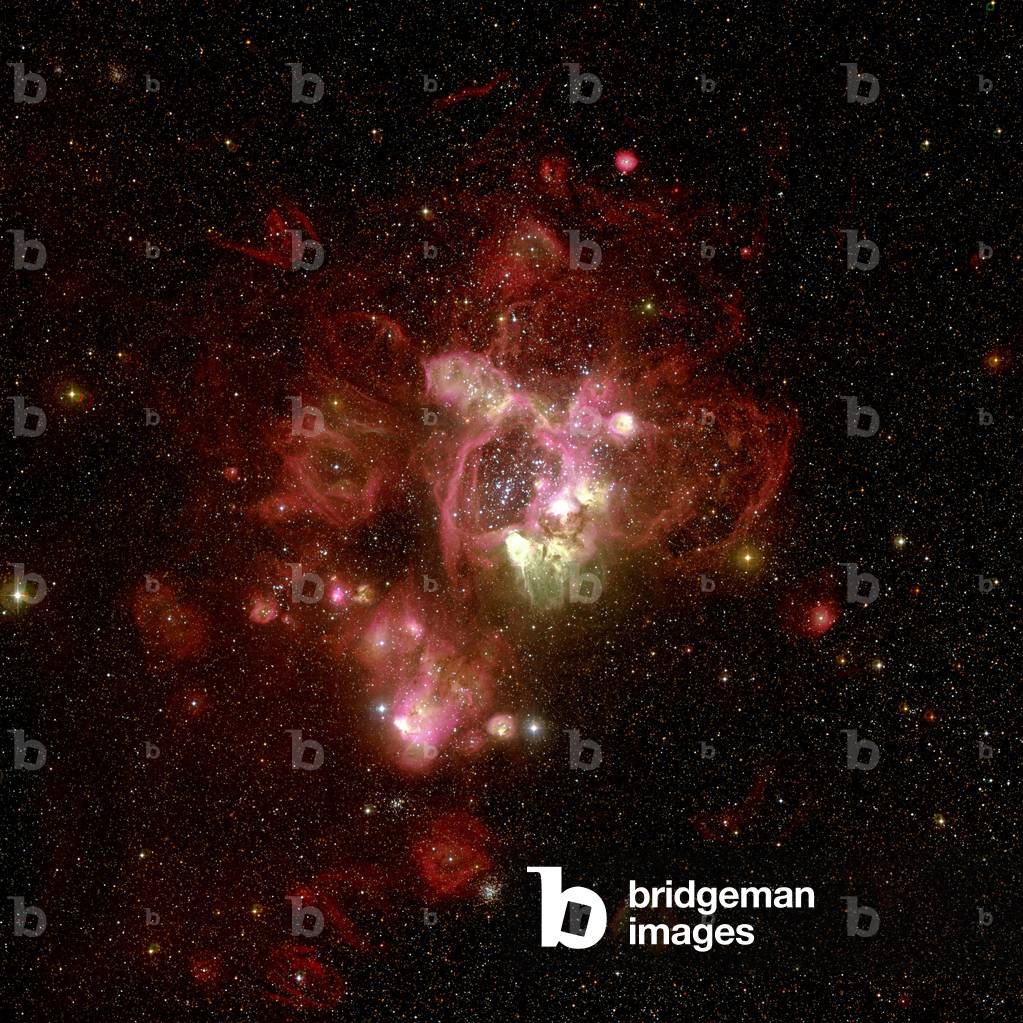
Nebuleuse N44 in the Great Magellan Cloud - This photo shows the southern part of the spectacular N44 region in the Large Magellanic Cloud. The green colour indicates areas that are particularly hot. The field measures 27.5 x 26.5 arcmin2., North is up and East is left. The two best known satellite galaxies of the Milky Way, the Magellanic Clouds, are located in the southern sky at a distance of about 170,000 light - years. They host many giant nebular complexes with very hot and luminous stars whose intense ultraviolet radiation causes the surrounding interstellar gas to glow. The intricate and colourful nebulae are produced by ionised gas that shines as electrons and positively charged atomic nuclei recombine, emitting a cascade of photons at well defined wavelengths. Such nebulae are called “” H II regions””, signifying ionised hydrogen, i.e. hydrogen atoms that have lost one electron (protons). Their spectra are characterized by emission lines whose relative intensities carry useful information about the composition of the emitting gas, its temperature, as well as the mechanisms that cause the ionization. Since the wavelengths of these spectral lines correspond to different colours, these alone are already very informative about the physical conditions of the gas. N44 in the Large Magellanic Cloud is a spectacular example of such a giant H II region. Having observed it in 1999 a team of European astronomers again used the Wide - Field - Imager (WFI) at the MPG/ESO 2.2 - m telescope of the La Silla Observatory, pointing this 67 - million pixel digital camera to the same sky region in order to provide another striking - and scientifically extremely rich - image of this complex of nebulae. With a size of roughly 1,000 light - years, the peculiar shape of N44 clearly outlines a ring that includes a bright stellar association of about 40 very luminous and bluish stars. These stars are the origin of powerful “” stellar winds””” that blow away the surrounding gas, pilin
The giant Hugo lighting his cigar (Postcard circa 1905)
Rem Vyakhirev, chairman of Russian gas giant Gazprom listens to Russian President Vladimir Putin ahe.., 2000 (photo)
权限
  • Permission required for non-editorial use (inc book covers and in-context promotional use in documentaries). Please contact us
图片限制
  • Content within this photograph may require additional clearances (eg: trademark and personality rights) depending on Licensee's specific use of material, which may include book and magazine cover use.
内容合作伙伴限制
  • Minimum fee applies to this image;Only available to clients invoiced in Australia, Belgium, Brazil, Bulgaria, Canada, China, Cyprus, Czech Republic, Estonia, Finland, France, French Southern Territories, Greece, Hong Kong, Hungary, India, Ireland, Israel, Italy, Lebanon, Luxembourg, Mexico, the Netherlands, New Zealand, Portugal, Qatar, Republic of Korea, Romania, Russian Federation, Singapore, South Africa, Spain, Sweden, Switzerland, Taiwan, Turkey, United Arab Emirates, United Kingdom and United States
View of the nebula of the Lagoon (M8/NGC 6523). Located in Sagittarius, at a distance of 5800 light years, it is visible to the naked eye in good conditions. It is a star-forming region illuminated by several large O-type stars that belong to the open cluster NGC 6530 visible in the center of the image. The brightest part of the nebula is called the hourglass nebula whose gases are excited mainly by two massive supergeant stars Herschel 36 and 9 Sagittarii. M8 has at least 60 Giant B stars, 3 to 4 times more than the Orion nebula - The Lagoon nebula (M8), can be visible to the unaided eye as a small bright patch above the large Sagittarius star cloud in the Milky Way. The Lagoon nebula is a star-forming region about 5800 light years from us. The nebula is illuminated by several O-type giants within the open cluster NGC 6530 near the center of the nebula. The brightest part of the nebula is known as the “hourglass nebula”” and its gases are excited primarily by two massive O-type supergiants designated Herschel 36 and 9 Sagittarii. These two stars lie to the west of NGC 6530 and are separated from it by a dark lane dividing the nebula like a black lagoon, giving it its name. Twisted funnel shaped clouds are visible close to the illuminating stars, especially Herschel 36. They are due to shear forces between the hot excited gases at the surface and the cold interior of the clouds. At least 60 B-type giants are embedded in the nebula which make M8 3 to 4 times richer in massive stars than the Orion nebula: Nebula of the Lagoon (M8) in Sagittarius
Globular cluster M15 in Pegase - Globular cluster M15 in Pegasus - View of the globular cluster M15 by the Hubble space telescope. Located about 35,000 light years away from Earth in the constellation Pegase, M15 is one of 150 known globular clusters forming a vast halo around our galaxy. The bluish object in the middle left of the image is a planetary nebula: Kuestner 648 (Pease 1). Planetary nebulae are gas shells ejected by a star at the end of life, after its phase of red giante; they are very rarely observed in globular clusters or their presence is not yet well understood. The globular cluster Messier 15 is shown in this color image obtained with the NASA Hubble Space Telescope. Lying some 35,000 light - years from Earth in the direction of the constellation Pegasus, M15 is one of almost 150 known globular clusters that form a vast halo surrounding our Milky Way galaxy. The bluish object to the middle left of the image is a gas cloud surrounding a dying star, a planetary nebula known as Kuestner 648 (or Pease 1), its existence among a globular cluster is not well understood
Planetary nebula Dumbbell (M27) in Little Fox - Dumbell planetary nebula (M27) in Vulpecula - The planetary nebula Dumbbell (M27) is located about 1400 years - light from Earth in the constellation Little Fox. A planetary nebula is a gas shell from a small late-life star whose heart collapsed to become a white dwarf and expelled the outer layers of its matter. Image obtained with a 90 cm telescope, through various filters including an H-alpha filter. The Dumbbell Nebula (M27, NGC6853), is a planetary nebula located about 1200 light years from the earth in the constellation of Vulpecula. The nebula was formed when an evolved, red giant star ejected its outer envelope near the end of its lifetime. The expanding cloud of gas becomes visible once the hot core of the star, visible near the center, is exposed and the high - energy, ultraviolet light from the core ionizes the cloud
Planetary nebula Dumbbell (M27) in Little Fox - Dumbell planetary nebula (M27) in Vulpecula - The planetary nebula Dumbbell (M27) is located about 1400 years - light from Earth in the constellation Little Fox. A planetary nebula is a gas shell from a small late-life star whose heart collapsed to become a white dwarf and expelled the outer layers of its matter. Composite image obtained with a 90 cm telescope, and the Hubble and Subaru telescopes. The Dumbbell Nebula (M27, NGC6853), is a planetary nebula located about 1200 light years from the earth in the constellation of Vulpecula. The nebula was formed when an evolved, red giant star ejected its outer envelope near the end of its lifetime. The expanding cloud of gas becomes visible once the hot core of the star, visible near the center, is exposed and the high - energy, ultraviolet light from the core ionizes the cloud. Image Composite
The Glowing Eye of NGC 6751, 2000
内容合作伙伴限制
  • Not available to clients invoiced in the UK
Centaurus A Elliptical Galaxy (NGC 5128) in the Centaur - Galaxy Centaurus A - The NGC 5128 galaxy is about 13 million years away - light from Earth. This image obtained by the Hubble Space Telescope in 1998 shows the star flames that occur in the dark band of the galaxy. In blue, these are the clusters of newly shaped young stars. At the top left, a photo of the galaxy obtained from the ground. This giant galaxy is a powerful radio source known as Centaurus A. It is an active galaxy whose energy comes from a supermassive black hole. NGC 5128 is the nearest large elliptical galaxies to our sun. It is also the nearest of the giant radio galaxies, possessing an active galactic nucleus (AGN) and optically one of the most luminous galaxies in the sky. Among many other things NGC 5128 is also the prototypical postmerger elliptical galaxy. Structural peculiarities including the prominent rotating disk of stars and gas and the complex shell structure of its halo point to a large scale merger within the last billion years. Tidal streams of young stars have also been identified in the halo of NGC 5128 thought to have occurred by cannibalization of a nearby gas rich dwarf galaxy some 300 million years ago, long after the large scale merger. Elliptical galaxies are typically devoid of gas, dust and young stars. The unexpected presence of gas rich disk elements within the structure of NGC 5128 supports the current belief that accretions and mergers of low mass galaxies may be an important agent in the evolution of galaxy formation. As a radio galaxy, NGC 5128 belongs to the subgroup of galaxies called Active Galaxies, which include Quasars, Seyfert galaxies, Blazars and Radio Galaxies. Active galaxies are distinguished by their prodigious energy output which cannot be explained by their stellar populations and must have another source. Active galaxies have in common an “Active Galactic Nucleus (AGN)”” which is beli
Nebula NGC 3372 in the Carene in false colours - NGC 3372 Carina nebula - Image of the nebula of the Carene (NGC 3372), a very vast region of star formation, obtained by combining light through 3 different filters that highlight oxygen in blue, hydrogen in green, and sulfur in red. The colors also represent different gas temperatures, warm, blue, colder in red. The bright star in the center of the image is Eta Carinae, a super massive star. Image obtained with the Curtis - Schmidt telescope of the Cerro Tololo Observatory. This image shows a giant star - forming region in the southern sky known as the Carina Nebula (NGC 3372), combining the light from 3 different filters tracing emission from oxygen (blue), hydrogen (green), and sulphur (red). The color is also representative of the temperature in the ionized gas: blue is relatively hot and red is cooler. The Carina Nebula is a good example of how very massive stars rip apart the molecular clouds that give birth to them. The bright star near the center of the image is Eta Carinae, which is one of the most massive and luminous stars known. This picture is a composite of several exposures made with the Curtis - Schmidt telescope at the Cerro Tololo Interamerican Observatory
Nebula of the Lagoon (M8) in Sagittarius - The Lagoon nebula (M8) in Sagittarius - View of the Nebula of the Lagoon (M8/NGC 6523). Located in Sagittarius, at a distance of 5800 years - light, it is visible to the naked eye in good conditions. It is a star-forming region illuminated by several large O-type stars that belong to the open cluster NGC 6530 visible in the center of the image. The brightest part of the nebula is called the hourglass nebula whose gases are excited mainly by two massive supergeant stars Herschel 36 and 9 Sagittarii. M8 has at least 60 Giant B stars, 3 to 4 times more than the Orion Nebula. The Lagoon nebula (M8), can be visible to the unaided eye as a small bright patch above the large Sagittarius star cloud in the Milky Way. The Lagoon nebula is a star - forming region about 5800 light years from us. The nebula is illuminated by several O - type giants within the open cluster NGC 6530 near the center of the nebula. The brightest part of the nebula is known as the “hourglass nebula”” and its gases are excited primarily by two massive O - type supergiants designated Herschel 36 and 9 Sagittarii. These two stars lie to the west of NGC 6530 and are separated from it by a dark lane dividing the nebula like a black lagoon, giving it its name. Twisted funnel shaped clouds are visible close to the illuminating stars, especially Herschel 36. They are due to shear forces between the hot excited gases at the surface and the cold interior of the clouds. At least 60 B - type giants are embedded in the nebula which make M8 3 to 4 times richer in massive stars than the Orion nebula
M87 elliptical galaxy in Virgo - M87 elliptical galaxy in Virgo - The M87 galaxy (NGC 4486) is 54 million years ago - light from Earth, in the heart of the Virgin's cluster. This image is a composite obtained in X-rays, radio and visible. Gas material is ejected from the heart of the galaxy. A supermassive black hole would have caused this jet. This image is a composite of visible (or optical), radio, and X - ray data of the giant elliptical galaxy, M87. M87 lies at a distance of 54 million light years and is the largest galaxy in the Virgo cluster of galaxies. Bright jets moving at close to the speed of light are seen at all wavelengths coming from the massive black hole at the center of the galaxy. It has also been identified with the strong radio source, Virgo A, and is a powerful source of X - rays as it resides near the center of a hot, X - ray emitting cloud that extends over much of the Virgo cluster. The extended radio emission consists of plumes of fast - moving gas from the jets rising into the X - ray emitting cluster medium. Chandra X - ray image in X - rays, M87 also reveals evidence for a series of outbursts from the central supermassive black hole. The loops and bubbles in the hot, X - ray emitting gas are relics of small outbursts from close to the black hole. Other interesting features in M87 are narrow filaments of X - ray emission, which may be due to hot gas trapped by magnetic fields. One of these filaments is over 100,000 light years long, and extends below and to the right of the center of M87 in almost a straight line. The optical data of M87 were obtained with Hubble's Advanced Camera for Surveys in visible and infrared filters
Detail of the nebula NGC 3603 in the Carene - Star life cycle in NGC 3603 - In the center of the picture is a cluster of massive young stars formed from the gas surrounding them. Two pillars of gas and dust visible on the right at the top and bottom will one day form other stars, as probably the dark cloud at the top right of the image called Bok's globule. Above the left of the star cluster, an old blue supergiant star, Sher 25, arrives at the end of life. The nebula NGC 3603 is located approximately 20,000 light years from Earth in the southern constellation of Carene. Image obtained by the Hubble Space Telescope. This image made by the Hubble space telescope nicely illustrates the entire stellar life cycle of stars, starting with the Bok globules (dark clouds at the upper right) and giant gaseous pillars, followed by circumstellar disks and progressing to evolved massive stars in the young starburst cluster (center). The blue supergiant star Sher 25 with its ring and bipolar outflow (upper left of center) marks the end of the life cycle. NGC 3603 is located 20 000 light years away in Carina constellation
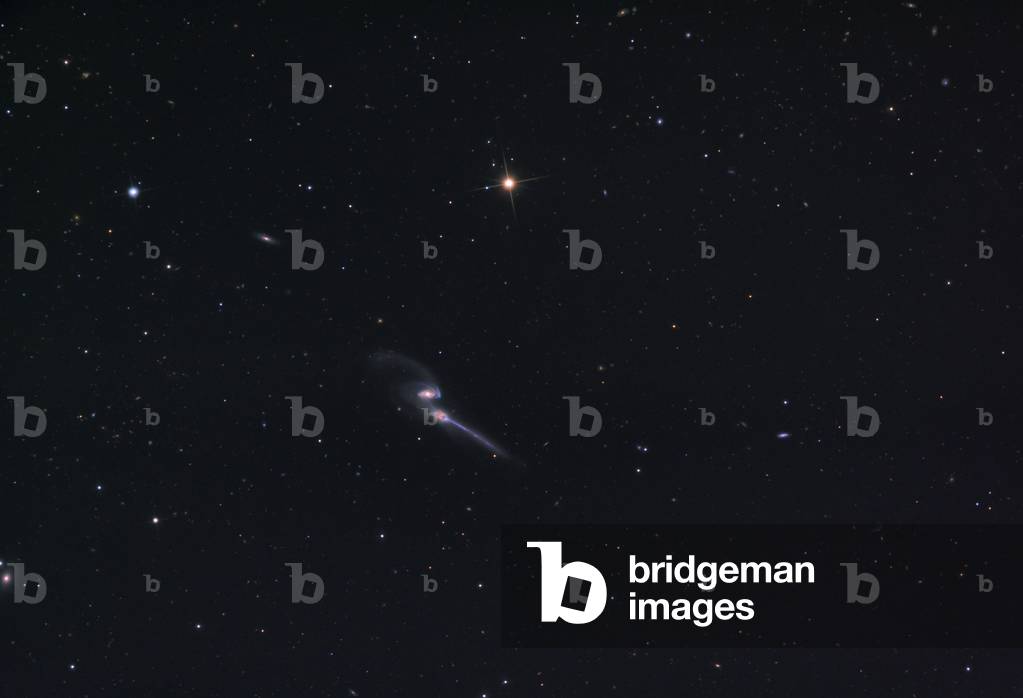
Colliding galaxies NGC 4676 in Berenice's Hair - Colliding galaxies NGC 4676 - The galaxy NGC 4676 is located about 300 million years away - light from Earth. It is a system of two spiral galaxies that collide and eventually become one galaxy. This image was obtained by the Hubble Space Telescope in April 2002. Located 300 million light - years away in the constellation Coma Berenices, the colliding galaxies have been nicknamed “” The Mice”” because of the long tails of stars and gas emanating from each galaxy. Otherwise known as NGC 4676, the pair will eventually merge into a single giant galaxy. Image obtained by the Hubble space telescope in April 2002
Colliding galaxies NGC 4676 in Berenice's Hair - Colliding galaxies NGC 4676 - The galaxy NGC 4676 is located about 300 million years away - light from Earth. It is a system of two spiral galaxies that collide and eventually become one galaxy. Image obtained on May 31, 2008 with a telescope 61 cm in diameter. Located 300 million light - years away in the constellation Coma Berenices, the colliding galaxies have been nicknamed “” The Mice”” because of the long tails of stars and gas emanating from each galaxy. Otherwise known as NGC 4676, the pair will eventually merge into a single giant galaxy. Image taken on May 31 2008 with a 24 - inch telescope
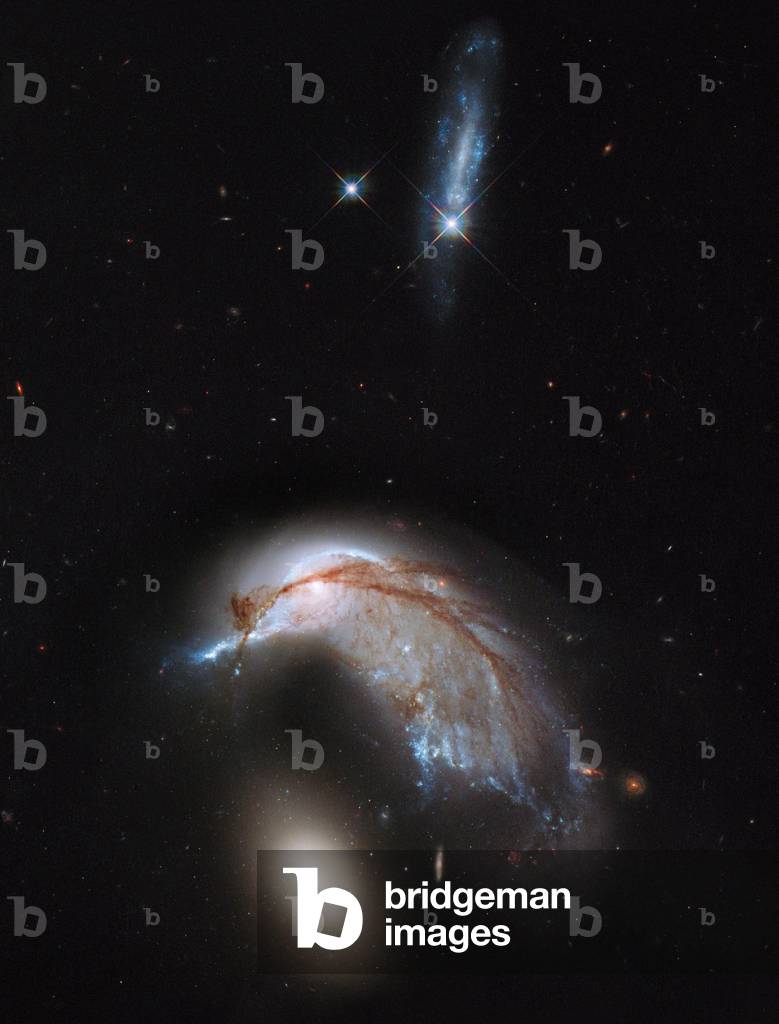
Interacting galaxies NGC 2936 and NGC 2937 - Interacting Galaxies NGC 2936 and NGC 2937 in Hydra - These two interacting galaxies also called Arp 142 are located approximately 326 million years ago - light from Earth in the constellation Hydra. NGC 2936 is a spiral galaxy, NGC 2937 is an elliptical galaxy. Above the torque, a blue galaxy UGC 5130, located closer to us is 230 million light years. Image obtained by the Hubble Space Telescope (HST). This interacting galaxy duo is collectively called Arp 142. The pair contains the disturbed, star - forming spiral galaxy NGC 2936, along with its elliptical companion, NGC 2937 at lower left. Once part of a flat, spiral disk, the orbits of the galaxy's stars have become scrambled due to gravitational tidal interactions with the other galaxy. This warps the galaxy's orderly spiral, and interstellar gas is strewn out into giant tails like stretched taffy. Gas and dust drawn from the heart of NGC 2936 becomes compressed during the encounter, which in turn triggers star formation. These bluish knots are visible along the distorted arms that are closest to the companion elliptical. The reddish dust, once within the galaxy, has been thrown out of the galaxy's plane and into dark veins that are silhouetted against the bright starlight from what is left of the nucleus and disk. The companion elliptical, NGC 2937, is a puffball of stars with little gas or dust present. The stars contained within the galaxy are mostly old, as evidenced by their reddish color. There are no blue stars that would be evidence of recent star formation. While the orbits of this elliptical's stars may be altered by the encounter, it's not apparent that the gravitational pull by its neighboring galaxy is having much of an effect. Above the pair, an unrelated, lone, bluish galaxy, inconsistently cataloged as UGC 5130, appears to be an elongated irregular or an edge - on spiral. Located 230 million light - ye
Colliding galaxies NGC 4676 in Berenice's Hair - Colliding galaxies NGC 4676 - The galaxy NGC 4676 is located about 300 million years away - light from Earth. It is a system of two spiral galaxies that collide and eventually become one galaxy. Image obtained on May 31, 2008 with a telescope 61 cm in diameter. Located 300 million light - years away in the constellation Coma Berenices, the colliding galaxies have been nicknamed “” The Mice”” because of the long tails of stars and gas emanating from each galaxy. Otherwise known as NGC 4676, the pair will eventually merge into a single giant galaxy. Image taken on May 31 2008 with a 24 - inch telescope
Planetary nebula NGC 3242 ultraviolet view - Planetary nebula NGC 3242 seen in ultraviolet - The planetary nebula NGC 3242, also called the ghost of Jupiter, ultraviolet view by the GALEX satellite. NGC 3242 is located between 1400 and 2500 years - light of the Earth, in the constellation Hydra (hydra, or female hydra). This ultraviolet image from NASA's Galaxy Evolution Explorer (GALEX) shows NGC 3242, a planetary nebula frequently referred to as “” Jupiter's Ghost.””” When stars with a mass similar to our sun approach the end of their lives by exhausting supplies of hydrogen and helium fuel in their cores, they swell up into cool red - giant stars. In a last gasp before death, they expel the layers of gas in their outer atmosphere. This exposes the core of the dying star, a dense hot ball of carbon and oxygen called a white dwarf. The white dwarf is so hot that it shines very brightly in the ultraviolet. The ultraviolet light from the white dwarf, in turn, ionizes the gaseous material expelled by the star causing it to glow. A planetary nebula is really the death of a low - mass star. Although low - mass stars like our sun live for billions of years, planetary nebulae only last for about ten thousand years. As the central white dwarf quickly cools and the ultraviolet light dwindles, the surrounding gas also cools and fades. In this image of NGC 3242 from the Galaxy Evolution Explorer, the extended region around the planetary nebula is shown in dramatic detail. The small circular white and blue area at the center of the image is the well - known portion of the famous planetary nebula. The precise origin and composition of the extended wispy white features is not known for certain. It is most likely material ejected during the star's red - giant phase before the white dwarf was exposed. However, it may be possible that the extended material is simply interstellar gas that, by coincidence, is located close enough to the white dwarf to be energized by i
Nebula of the Lagoon (M8) in Sagittarius - The Lagoon nebula (M8) in Sagittarius - View of the Nebula of the Lagoon (M8/NGC 6523). Located in Sagittarius, at a distance of 5800 years - light, it is visible to the naked eye in good conditions. It is a star-forming region illuminated by several large O-type stars that belong to the open cluster NGC 6530 visible in the center of the image. The brightest part of the nebula is called the hourglass nebula whose gases are excited mainly by two massive supergeant stars Herschel 36 and 9 Sagittarii. M8 has at least 60 Giant B stars, 3 to 4 times more than the Orion Nebula. The Lagoon nebula (M8), can be visible to the unaided eye as a small bright patch above the large Sagittarius star cloud in the Milky Way. The Lagoon nebula is a star - forming region about 5800 light years from us. The nebula is illuminated by several O - type giants within the open cluster NGC 6530 near the center of the nebula. The brightest part of the nebula is known as the “hourglass nebula”” and its gases are excited primarily by two massive O - type supergiants designated Herschel 36 and 9 Sagittarii. These two stars lie to the west of NGC 6530 and are separated from it by a dark lane dividing the nebula like a black lagoon, giving it its name. Twisted funnel shaped clouds are visible close to the illuminating stars, especially Herschel 36. They are due to shear forces between the hot excited gases at the surface and the cold interior of the clouds. At least 60 B - type giants are embedded in the nebula which make M8 3 to 4 times richer in massive stars than the Orion nebula
Galaxy UGC 9618 in Bovier - Galaxy UGC 9618 in Botes - The galaxy UGC 9618, also called VV 340 or Arp 302, is about 450 million years away from Earth. It is a pair of interacting spiral galaxies, VV 340A (view from the edge, bottom) and VV 340B (view from the front, top). Massive stars are formed in abundance. Image obtained by the Hubble Space Telescope in January 2002. UGC 9618, also known as VV 340 or Arp 302 consists of a pair of very gas - rich spiral galaxies in their early stages of interaction: VV 340A is seen edge - on to the left, and VV 340B face - on to the right. An enormous amount of infrared light is radiated by the gas from massive stars that are forming at a rate similar to the most vigorous giant star - forming regions in our own Milky Way. UGC 9618 is 450 million light - years away from Earth, and is the 302nd galaxy in ARP's Atlas of Peculiar Galaxies
Nebula of the Lagoon (M8) in Sagittarius - M8, The Lagoon Nebula - View of the Nebula of the Lagoon (M8/NGC 6523). Located in Sagittarius, at a distance of 5800 years - light, it is visible to the naked eye in good conditions. It is a star-forming region illuminated by several giant O stars that belong to the open cluster NGC 6530 visible in the center of the image. The brightest part of the nebula is called the hourglass nebula whose gases are excited mainly by two supergiant stars Herschel 36 and 9 Sagittarii. M8 has at least 60 giant B stars, 3 to 4 times more than the Orion nebula. M8 is an amazing stellar nursery. Hot young stars that formed out of the hydrogen gas in the nebula cause it to glow in the light of ionized hydrogen at the hydrogen - alpha wavelength of 656nm. The Lagoon Nebula gets its name from the distinctive dark lane that runs through the heart of the nebula, just to the west of open cluster NGC 6530. Bok globules, small dark knots which are condensing protostellar clouds, can be seen sprinkled throughout the nebula. The brightest part of M8 has an apparent size of about 1 degree on the sky (the size of two full Moons) and is 100 light years across in space. It is located about 5,200 light years away
Nebula of the Lagoon (M8) in Sagittarius - The Lagoon nebula (M8) in Sagittarius - View of the Nebula of the Lagoon (M8/NGC 6523). Located in Sagittarius, at a distance of 5800 years - light, it is visible to the naked eye in good conditions. It is a star-forming region illuminated by several large O-type stars that belong to the open cluster NGC 6530 visible towards the center of the image. The brightest part of the nebula is called the hourglass nebula whose gases are excited mainly by two massive supergeant stars Herschel 36 and 9 Sagittarii. M8 has at least 60 Giant B stars, 3 to 4 times more than the Orion Nebula. The Lagoon nebula (M8), can be visible to the unaided eye as a small bright patch above the large Sagittarius star cloud in the Milky Way. The Lagoon nebula is a star - forming region about 5800 light years from us. The nebula is illuminated by several O - type giants within the open cluster NGC 6530 near the center of the nebula. The brightest part of the nebula is known as the “hourglass nebula”” and its gases are excited primarily by two massive O - type supergiants designated Herschel 36 and 9 Sagittarii. At least 60 B - type giants are embedded in the nebula which make M8 3 to 4 times richer in massive stars than the Orion nebula
The planetary nebula Dumbbell (M27) is located about 1200 light years from Earth in the constellation Little Fox. A planetary nebula is a gas shell from a small late-life star whose heart collapsed to become a white dwarf and expelled the outer layers of its matter. In this image the nova appeared on August 18, 2005 is visible. The Dumbbell Nebula (M27, NGC6853), is a planetary nebula located about 1200 light years from the earth in the constellation of Vulpecula. The nebula was formed when an evolved, red giant star ejected its outer envelope near the end of its lifetime. The expanding cloud of gas becomes visible once the hot core of the star, visible near the center, is exposed and the high-energy, ultraviolet light from the core ionizes the cloud. On the evening of August 17- 18, 2005, two European astronomers simultaneously discovered a new star in the Dumbbell Nebula. This image is a portrait of the Dumbbell Nebula featuring the 2005 nova. It is comprised of thirty separate fifteen minute images digitally combined into a single picture that is equivalent to a single seven and a half hour exposure. Images taken through a 20 inch Ritchey-Chretien telescope and an eleven mega-pixel camera situated in New Mexico's south central mountains were supplemented with images gathered from San Jose, California with a twelve inch Dall-Kirkham Cassegrain reflector and a three mega-pixel SBIG camera -: Nebuleuse planetaire Dumbbell (M27) dans le Petite Fox - The Dumbell nebula with a nova 08-2005
Colliding galaxies NGC 4676 in Berenice's Hair - Colliding galaxies NGC 4676 - The galaxy NGC 4676 is located about 300 million years away - light from Earth. It is a system of two spiral galaxies that collide and eventually become one galaxy. Image obtained on May 31, 2008 with a telescope 61 cm in diameter. Located 300 million light - years away in the constellation Coma Berenices, the colliding galaxies have been nicknamed “” The Mice”” because of the long tails of stars and gas emanating from each galaxy. Otherwise known as NGC 4676, the pair will eventually merge into a single giant galaxy. Image taken on May 31 2008 with a 24 - inch telescope
Nebula California (NGC 1499) in Persee - The California Nebula (NGC 1499) in Perseus - NGC 1499 is a very large emission nebula located 1140 years - light from Earth in the constellation Persee. Image obtained by the Oschin telescope of Mount Palomar through several filters and composed. The north is at top. This is a huge emission nebula in Perseus constellation. It is a cloud of gas, mainly hydrogen, which glows due to the ionization by radiation from a hot nearby star. The California Nebula is made glowing by the 4th magnitude star Menkib (Xi Persei, the bright blue star in center right). The nebula is named because recall the shape of the US state when viewed from the west. This image is based on data acquired by the Oschin Telescope at the Mount Palomar Observatory
Variable star Mira Ceti view in ultraviolet - Star Mira Ceti seen in ultraviolet - Ultraviolet view of the star Mira of the Whale revealing a long train of material ejected by the large red star. This trail extends over 13 years - light. Mosaic of images obtained by the Galex satellite in November and December 2006. Ultraviolet image of the star Mira taken with the Galex satellite in November and December 2006. In this image, Mira is moving from left to right. It is visible as the small white dot in the bulb shape at right. The shed material can be seen in light blue. The dots in the picture are stars and distant galaxies. The large blue dot at left is a star that is closer to us than Mira. Mira is traveling so fast (130 kilometers per second) that it's creating a bow shock, or build - up of gas, in front of it, as can be seen here at right
Detail of the Tarantula nebula (NGC 2070) in the Dorado - Detail of the Tarentula nebula in Dorado - Image of a detail of the Tarantula nebula obtained in December 2001 with the WFI instrument of the ESO/MPG 2.2 telescope - m at the La Silla Observatory. The Tarantula Nebula (or 30 Dorada) is the largest star-forming region of the Great Magellan Cloud, a galaxy adjacent to ours. It is located 170,000 light years ago in the constellation Dorado (southern hemisphere). This image shows the turbulent region around the ring - shaped nebula DEM L 299 in the Large Magellanic Cloud, a satellite galaxy of the Milky Way system. It was produced by combining three monochromatic images obtained in December 2001 with the Wide - Field - Imager (WFI) at the ESO/MPG 2.2 - m telescope at the La Silla Observatory. North is up and East is left. The coloured rings seen near some of the brighter stars in the field result from light reflections in the telescope optics. The Tarantula Nebula is one of the most impressive views in the Southern sky. Visible to the unaided eye in the Large Magellanic Cloud (LMC), a satellite galaxy of the Milky Way that is located in the direction of the southern constellation Doradus at a distance of about 170,000 light - years, this huge nebula is the prototype of what astronomers refer to as a “Giant HII region”. In this complex of glowing gas and very hot and luminous stars, the gas is mainly composed of protons and electrons, which are kept apart by energetic photons emitted by the stars in this area. The Tarantula Nebula (also designated 30 Doradus) owes its name to the arrangement of its brightest patches of nebulosity that somewhat resemble the legs of a spider. They extend from a central “” body”” where a cluster of hot stars (designated “” R136”) resides that illuminate the nebula. This name, of the biggest spiders on the Earth, is also very fitting in view of the gigantic proportions of the celestial nebula -
Planetary nebula M57 (NGC 6720) in Lyra - The Ring nebula M57 in Lyra - The planetary nebula of Lyra (M57) is located about 2000 years - light from Earth. A planetary nebula is a gas shell from a small late-life star whose heart collapsed to become a white dwarf and expelled the outer layers of its matter. Image obtained by the Hubble Space Telescope and the Large Binocular Telescope. In this composite image, visible - light observations by Nasa's Hubble Space Telescope are combined with infrared data from the ground - based Large Binocular Telescope in Arizona to assemble a dramatic view of the well - known Ring Nebula. Called a planetary nebula, the Ring Nebula is the glowing remains of a Sun - like star. The object is tilted towards Earth so that astronomers see the ring face - on. The Hubble observations reveal that the nebula's shape is more complicated than astronomers thought. The blue gas in the nebula's center is actually a football - shaped structure that pierces the red doughnut - shaped material. Hubble also uncovers the detailed structure of the dark, irregular knots of dense gas embedded along the inner rim of the ring. The knots look like spokes in a bicycle. The Hubble images have allowed the research team to match up the knots with the spikes of light around the bright, main ring, which are a shadow effect. The faint, scallop - shaped material surrounding the ring was expelled by the star during the early stages of the planetary nebula formation. This outer material was imaged by the Large Binocular Telescope. Most Sun - like stars become planetary nebulae at the end of their lives. Once a star consumes all of its hydrogen, the nuclear fuel that makes it shine, it expands to a red giant. The bloated star then expels its outer layers, exposing its hot core. Ultraviolet radiation from the core illuminates the discarded material, making it glow. The smoldering core, called a whi
Spiral galaxy M33 infrared view - Spiral galaxy M33 seen in infrared - M33, (NGC 598), the galaxy of the Triangle, is located about 2.9 million years ago - light from Earth. It belongs to the local group, just like our galaxy or Andromede galaxy. This infrared image from the Spitzer space telescope shows stars in blue, gas in green, star formations in red - orange. Red dots are distant galaxies. In infrared, the galaxy appears larger than visible light, revealing cold gas and dust that spread around the galaxy. Also known as M33 or NGC 598, the Triangulum Galaxy is part of the Local Group of galaxies, which includes the Andromeda Galaxy (M31) and our galaxy, the Milky Way. M33 is over thirty thousand light - years across, and more than two million light - years away. Viewed here with Spitzer's infrared eyes, this elegant spiral galaxy sparkles with color and detail. Stars appear as glistening blue gems (several of which are actually foreground stars in our own galaxy), while dust rich in organic molecules glows green. The diffuse orange - red glowing areas indicate star - forming regions, while small red flecks outside the spiral disk of M33 are most likely distant background galaxies. But not only is this new image beautiful, it also shows M33 to be surprising large - - bigger than its visible - light appearance would suggest. With its ability to detect cold, dark dust, Spitzer can see emission from cooler material well beyond the visible range of M33's disk. Exactly how this cold material moved outward from the galaxy is still a mystery, but winds from giant stars or supernovas may be responsible. This is a three - color composite image showing infrared observations from two of Spitzer instruments. Blue represents combined 3.6 - and 4.5 - micron light and green shows light of 8 microns, both captured by Spitzer's infrared array camera. Red is 24 - micron light dete
Elliptical galaxy NGC 1316 in the Furnace - Giant elliptical galaxy NGC 1316 - By studying the clusters of stars and clouds of dust visible in this photo taken by the Hubble space telescope in March 2003, it is believed that the giant elliptical galaxy NGC 1316 is the result of a collision of two spiral galaxies that occurred some billions of years ago. This galaxy resides about 75 million light years ago in the cluster of galaxies of the Furnace. Also called Fornax A, it is one of the strongest radio sources in the sky. This image made from data obtained with the NASA Hubble Space Telescope reveals the dust lanes and star clusters of this giant galaxy that give evidence that it was formed from a past merger of two gas - rich galaxies. NGC 1316 is on the outskirts of a nearby cluster of galaxies in the southern constellation of Fornax, at a distance of about 75 million light - years. It is one of the brightest ellipticals in the Fornax galaxy cluster. NGC 1316, also known as Fornax A, is one of the strongest and largest radio sources in the sky, with radio lobes extending over several degrees of sky (well off the Hubble image)
Planetary nebula NGC 6543 in the Dragon - Planetary nebula NGC 6543 in Draco - Composite view of the planetary nebula NGC 6543 in the Dragon obtained by the Hubble space telescope and X-ray (blue) by the Chandra satellite. NGC 6543 is located about 3000 years of light from Earth. This composite of data from Nasa's Chandra X - ray Observatory and Hubble Space Telescope is a new look for NGC 6543, better known as the Cat's Eye nebula. This famous object is a so - called planetary nebula that represents a phase of stellar evolution that the Sun should experience several billion years from now. When a star like the Sun begins to run out of fuel, it becomes what is known as a red giant. In this phase, a star sheds some of its outer layers, eventually leaving behind a hot core that collapses to form a dense white dwarf star. A fast wind emanating from the hot core rams into the ejected atmosphere, pushes it outward, and creates the graceful filamentary structures seen with optical telescopes. Chandra's X - ray data (colored in blue) of NGC 6543 shows that its central star is surrounded by a cloud of multi - million - degree gas. By comparing where the X - rays lie in relation to the structures seen in optical light by Hubble (red and purple), astronomers were able to deduce that the chemical abundances in the region of hot gas were like those in the wind from the central star and different from the outer cooler material. In the case of the Cat's Eye, material shed by the star is flying away at a speed of about 4 million miles per hour. The star itself is expected to collapse to become a white dwarf star in a few million years
Nebula Trifide (M20) in Sagittarius view in visible and infrared - This image composite compares the well - known visible - light picture of the glowing Trifid Nebula (left panel) with infrared views from Nasa's Spitzer Space Telescope (remaining three panels). The Trifid Nebula is a giant star - forming cloud of gas and dust located 5,400 light - years away in the constellation Sagittarius. The false - color Spitzer images reveal a different side of the Trifid Nebula. Where dark lanes of dust are visible trisecting the nebula in the visible - light picture, bright regions of star - forming activity are seen in the Spitzer pictures. All together, Spitzer uncovered 30 massive embryonic stars and 120 smaller newborn stars throughout the Trifid Nebula, in both its dark lanes and luminous clouds. These stars are visible in all the Spitzer images, mainly as yellow or red spots. Embryonic stars are developing stars about to burst into existence. Ten of the 30 massive embryos discovered by Spitzer were found in four dark cores, or stellar “” incubators,””” where stars are born. Astronomers using data from the Institute of Radioastronomy millimeter telescope in Spain had previously identified these cores but thought they were not quite ripe for stars. Spitzer's highly sensitive infrared eyes were able to penetrate all four cores to reveal rapidly growing embryos. Astronomers can actually count the individual embryos tucked inside the cores by looking closely at the Spitzer image taken by its infrared array camera (top right). This instrument has the highest spatial resolution of Spitzer's imaging cameras. The Spitzer image from the multiband imaging photometer (bottom right), on the other hand, specializes in detecting cooler materials. Its view highlights the relatively cool core material falling onto the Trifidi's growing embryos. The middle panel is a combination of Spitzer data from both of these instruments. The embryos are thought to have been triggered by a massiv
Planetary nebula CRL 2688 dans le Swan/HST - This image of the Egg Nebula, also known as CRL2688 and located roughly 3,000 light - years from us, was taken in red light with the Wide Field and Planetary Camera 2 (WFPC2) aboard Nasa's Hubble Space Telescope.The image shows a pair of mysterious “” searchlight” beams emerging from a hidden star, criss - Yeah. crossed by numerous bright arcs. This image sheds new light on the poorly understood ejection of stellar matter which accompanies the slow death of Sun - like stars. The image is shown in false color. The central star in CRL2688 was a red giant a few hundred years ago. The nebula is really a large cloud of dust and gas ejected by the star, expanding at a speed of 20 km/s (115,000 mph). A dense cocoon of dust (the dark band in the image center) enshrouds the star and hides it from our view. Starlight escapes more easily in directions where the cocoon is thinner, and is reflected towards us by dust particles in the cloud, giving it its overall appearance. Objects like CRL2688 are rare because they are in an evolutionary phase which lasts for a very short time (~ 1,000 to 2,000 years). However, they may hold the key to our understanding of how red giant stars transform themselves into planetary nebulae. For the first time, we can see a 10,000 year - old history of mass - ejection in a red giant star in such exquisite detail. The arcs in CRL2688 represent dense shells of matter within a smooth cloud, and show that the rate of mass ejection from the central star has varied on time scales of ~ 100 to 500 years throughout its mass - loss history. With Hubble we have detected matter in this nebula to a radius of 0.6 light - years - - much further out than has been possible before, giving a better estimate of the amount of matter in the nebula. Other unexpected results seen in this image are the very sharply defined edges of the beams and fine spoke - like features which suggest that, contrary to previous models, the searchli
Star Formation in the DR21 Region - Star Formation in the DR21 Region - This star formation region is about 6200 years old - light. Hidden in light visible by interstellar dust, this region rises in infrared light. Gas filaments appear in red; they emphasize the presence of aromatic polycyclic hydrocarbons (PAH); they are organic molecules composed of carbon atoms and hydrogen that could be the germs on which the first bricks of life appeared. Composite image in different wavelengths obtained by the Spitzer space telescope; in blue the visible light, in yellow and red the infrared light. Hidden behind a shroud of dust in the constellation Cygnus is a stellar nursery called DR21, which is giving birth to some of the most massive stars in our galaxy. Visible light images reveal no trace of this interstellar cauldron because of heavy dust obscuration. This image from Nasa's Spitzer Space Telescope allow us to peek behind the cosmic veil and pinpoint one of the most massive natal stars yet seen in our Milky Way galaxy. The never - before - seen star is 100,000 times as bright as the Sun. Also revealed for the first time is a powerful outflow of hot gas emanating from this star and bursting through a giant molecular cloud. This colorful image is a large - scale composite mosaic assembled from data collected at a variety of different wavelengths. Views at visible wavelengths appear blue, near - infrared light is depicted as green, and mid - infrared data is portrayed as red. The result is a contrast between structures seen in visible light (blue) and those observed in the infrared (yellow and red). The image covers an area about two times that of a full moon. The red filaments stretching across the Spitzer image denote the presence of polycyclic aromatic hydrocarbons. These organic molecules, comprised of carbon and hydrogen, are excited by surrounding i
Great Red Spot on Jupiter, 1979
内容合作伙伴限制
  • Not available to clients invoiced in the UK
Star Formation in the DR21 Region - Star Formation in the DR21 Region - This star-forming region is about 6200 years old - light. Hidden in light visible by interstellar dust, this region rises in infrared light. Gas filaments appear in red; they emphasize the presence of aromatic polycyclic hydrocarbons (PAH); they are organic molecules composed of carbon atoms and hydrogen that could be the germs on which the first bricks of life appeared. Image obtained by the Spitzer space telescope in 2003. Hidden behind a shroud of dust in the constellation Cygnus is a stellar nursery called DR21, which is giving birth to some of the most massive stars in our galaxy. Visible light images reveal no trace of this interstellar cauldron because of heavy dust obscuration. This image from Nasa's Spitzer Space Telescope allow us to peek behind the cosmic veil and pinpoint one of the most massive natal stars yet seen in our Milky Way galaxy. The never - before - seen star is 100,000 times as bright as the Sun. Also revealed for the first time is a powerful outflow of hot gas emanating from this star and bursting through a giant molecular cloud. The image is a large - scale mosaic assembled from individual photographs obtained with the Infraared Array Camera (IRAC) aboard Spitzer. The image covers an area about two times that of a full moon. The mosaic is a composite of images obtained at mid - infrared wavelengths of 3.6 microns (blue), 4.5 microns (green), 5.8 microns (orange) and 8 microns (red). The brightest infrared cloud near the top center corresponds to DR21, which presumably contains a cluster of newly forming stars at a distance of 10,000 light - years. Protruding out from DR21 toward the bottom left of the image is a gaseous outflow (green), containing both carbon monoxide and molecular hydrogen. Data from the Spitzer spectrograph, which breaks light into its constitutes
Exoplanete near a star at the end of life - A dying star sheds its outer layers - An artist's view of a star that, like the Sun at the end of life, turns into a red giant, and expels its upper layers into concentric circles, before becoming a white dwarf. In the foreground, an exoplanet distant from its star that sees its surface reheat. When a star like our sun nears the end of its life, it expands to more than 50 times its original diameter, becoming a red giant. Then over the next several tens of thousands of years the star episodically ejects its outer layers into space, sometimes producing concentric shells. These ejected layers eventually form a planetary nebula. What will subsequently remain of the star is a small, extremely hot core which cools off to become a white dwarf. In this image a red giant star expels its first of many shells of gas into space. In the years to come this spherical shell will grow outward, its circumference eventually expanding far beyond the orbit of this planet. As for this planet, being so far from its parent sun for most of its life has kept it in a deep, dark freeze for the past ten billion years (think Pluto). It has been during only the past 100 million years, when its sun first blossomed into a red giant, that this planet has experienced such light and warmth. This effluence is short - lived, however; in about another million years darkness and cold will again be the norm for this world
Life Cycle of Stars, 1999
内容合作伙伴限制
  • Not available to clients invoiced in the UK
Spiral galaxy M101 in the Great Bear - Spiral galaxy M101 in Ursa Major - The galaxy M101 (NGC 5457) is located about 27 million years away from Earth. It spans more than 170,000 light years, almost double the size of our galaxy. We think that of the trillion stars in it, 100 billion stars could be similar to our Sun. Composite image obtained from 51 different clicks made by the Hubble space telescope from March 1994 to January 2003 and from ground photos at Kitt Peak and CFHT in Hawaii. Spiral galaxy M101 is a beautiful, large, face - on spiral galaxy located about 27 million light - years away in the constellation Ursa Major. This galaxy's portrait is actually composed of 51 individual Hubble exposures, in addition to elements from images from ground - based photos. The giant spiral disk of stars, dust, and gas is 170,000 light - years across or almost twice the diameter of our galaxy, the Milky Way. M101 is estimated to contain at least one trillion stars. Approximately 100 billion of these stars could be like our Sun in terms of temperature and lifetime. The galaxy's spiral arms are sprinkled with large regions of star - forming nebulae. These nebulae are areas of intense star formation within giant molecular hydrogen clouds. Brilliant young clusters of hot, blue, newborn stars trace out the spiral arms. The disk of M101 is so thin that Hubble easily sees many more distant galaxies lying behind the galaxy
Great Red Spot on Jupiter, 1979
内容合作伙伴限制
  • Not available to clients invoiced in the UK
Great Red Spot on Jupiter, 1979
内容合作伙伴限制
  • Not available to clients invoiced in the UK
Great Red Spot on Jupiter, 1979
内容合作伙伴限制
  • Not available to clients invoiced in the UK
Great Red Spot on Jupiter, 1979
内容合作伙伴限制
  • Not available to clients invoiced in the UK
Elliptical galaxy NGC 1275 in Persee - Elliptical galaxy NGC 1275 in Perseus - This image obtained by the Hubble space telescope in 1995 shows a system of two colliding galaxies; in the foreground, a spiral galaxy seen almost from the edge, with many stars forming in the background, a giant, very bright elliptical galaxy, special because it has a spiral structure in its center. Its core probably houses a black hole. NGC 1275 is located about 230 million years ago - light; it belongs to the large cluster of galaxies of Persee. These images, taken with Hubble's Wide Field Planetary Camera 2 (WFPC2), show traces of spiral structure accompanied by dramatic dust lanes and bright blue regions that mark areas of active star formation. Detailed observations of NGC 1275 indicate that the dusty material belongs to a spiral system seen nearly edge - on in the foreground. The second galaxy, lying beyond the first, is actually a giant elliptical with peculiar faint spiral structure in its nucleus. These galaxies are believed to be colliding at over 6 million miles per hour. NGC 1275 is about 230 million light - years away in the constellation Perseus. Embedded in the center of a large cluster of galaxies known as the Perseus Cluster, it is also known to emit a powerful signal at both X - ray and radio frequencies. The galaxy collision causes the gas and dust already existing in the central bright galaxy to swirl into the center of the object. The X - ray and radio emission indicates the probable existence of a black hole at the bright galaxy's center. While the dark dusty material in the Hubble image falls inward, NGC 1275 displays intricate filamentary structures at a much larger scale outside the image. This is a typical feature of bright cluster galaxies
Great Red Spot on Jupiter, 1979
内容合作伙伴限制
  • Not available to clients invoiced in the UK
Close up of the Red Spot on Jupiter, photographed by Voyager 2, 1979
内容合作伙伴限制
  • Not available to clients invoiced in the UK
Nebula NGC 7635 in Cassiopee - The Bubble Nebula: This nebula is located about 8000 light years from Earth. A star 40 times more massive than our Sun, called Wolf-Rayet, is responsible for the formation of this bubble; it is the star BD+60* 2522. Image obtained by the space telescope Hubble - The Bubble Nebula, also known as NGC 7635, is an emission nebula located 8 000 light-years away - This complete view of the Bubble Nebula allows us to fully appreciate the almost perfectly symmetrical shell which gives the nebula its name. This shell is the result of a powerful flow of gas - known as a stellar wind - from the bright star visible just to the left of centre in this image. The star, SAO 20575, is between ten and twenty times the mass of the Sun and the pressure created by its stellar wind forces the surrounding interstellar material outwards into this bubble-like form - The giant molecular cloud that surrounds the star - glowing in the star's intense ultraviolet radiation - tries to stop the expansion of the bubble. However, although the sphere already measures around ten light-years in diameter, it is still growing, owing to the constant pressure of the stellar wind - currently at more than 100,000 kilometers per hour! - This stunning new image was observed by the NASA/ESA Hubble Space Telescope
Super massive star Eta Carinae - Super massive star Eta Carinae - Eta Carinae is one of the most massive stars in our galaxy. Its mass would be about 120 times that of the Sun with a diameter 1000 times larger than our star. The image obtained by the Hubble space telescope reveals two expanding gas lobes; it is the nebula called the Homuncule, vestige of a huge explosion that the star experienced 150 years ago. The star blows its exterior atmosphere and will eventually explode in a supernova. Eta Carinae is located approximately 8000 light years from Earth in the southern constellation of Carene. A huge, billowing pair of gas and dust clouds is captured in this stunning Hubble telescope picture of the super - massive star Eta Carinae. Even though Eta Carinae is more than 8,000 light - years away, features 10 billion miles across (about the diameter of our solar system) can be distinguished. Eta Carinae suffered giant outburst about 150 years ago, when it became one of the brightest stars in the southern sky. Although the star released as much visible light as a supernova explosion, it survived the outburst. Somehow, the explosion produced two lobes and a large, thin equatorial disk, all moving outward at about 1.5 million miles per hour. Estimated to be 100 times heftier than our Sun, Eta Carinae may be one of the most massive stars in our galaxy
Planetary nebula NGC 5189 in the fly - This nebula is located about 3000 light years from Earth in the southern constellation of the fly. Image obtained by the Gemini and Hubble telescopes (HST). NGC 5189 is a planetary nebula. At the end of its life, a star with a mass less than eight times that of the Sun will blow its outer layers away, giving rise to a planetary nebula. Some of these stellar puffballs are almost round, resembling huge soap bubbles or giant planets (hence the name), but others, such as NGC 5189 are more intricate. In particular, this planetary nebula exhibits a curious S” - shaped profile, with a central bar that is most likely the projection of an inner ring of gas discharged by the star, seen edge on. The details of the physical processes producing such a complex symmetry from a simple, spherical star are still the object of astronomical controversy. One possibility is that the star has a very close (but unseen) companion. Over time the orbits drift due to precession and this could result in the complex curves on the opposite sides of the star visible in this image. This image has been taken with the Gemini and Hubble space Telescope.
Planetary nebula NGC 5189 in the Fly - NGC 5189 - Planetary nebula in Musca - This nebula is located about 3000 light years from Earth in the southern constellation of Fly. Image obtained by the Gemini telescope. NGC 5189 is a planetary nebula. At the end of its life, a star with a mass less than eight times that of the Sun will blow its outer layers away, giving rise to a planetary nebula. Some of these stellar puffballs are almost round, resembling huge soap bubbles or giant planets (hence the name), but others, such as NGC 5189 are more intricate. In particular, this planetary nebula exhibits a curious S” - shaped profile, with a central bar that is most likely the projection of an inner ring of gas discharged by the star, seen edge on. The details of the physical processes producing such a complex symmetry from a simple, spherical star are still the object of astronomical controversy. One possibility is that the star has a very close (but unseen) companion. Over time the orbits drift due to precession and this could result in the complex curves on the opposite sides of the star visible in this image. This image has been taken with the Gemini Telescope.
Uranus - Illustration - The planet Uranus and its system of rings. This image suggests how Uranus might look from a position in space several hundred thousand miles above its south pole. Like Saturn and Jupiter, Uranus is a Gas Giant, composed primarily of hydrogen and helium gases surrounding a relatively small, dense core of molten rock and metal. Its bluish color is due to the presence of methane in its upper atmosphere. Also like Saturn and Jupiter, Uranus has rings. However Uranus' rings are over three orders of magnitude dimmer than Saturn's; where Saturn's rings are almost white, Uranus' rings are more like the color of charcoal. Uranus 'rings are so dim that they went undetected from 1781, when the English astronomer William Herschel first observed Uranus through a telescope, until 1977 when astronomers watched as a star passing behind Uranus appeared to blink several times, caused by the ten rings surrounding the planet. One bizarre aspect of Uranus is that its axis of rotation is tipped beyond 90 degrees in relation to the plane of its orbit around the Sun. This puts Uranus' north and south poles, relative to the Sun, where the other planets have their equators
Great Red Spot on Jupiter, 1979
内容合作伙伴限制
  • Not available to clients invoiced in the UK
Planetary nebula NGC 6781 - A planetary nebula, NGC 6781 - This fairly inconspicuous planetary nebula is in Aquila and it marks the end of the long life of a sun - like star. Despite the longevity of their parent stars and the very brief lifetime of the nebula (typically less than 100,000 years) such sights are common because sun - like stars are common. The nebula has nothing to do with planet formation, indeed the formation of the nebula would effectively destroy any planets the parent star had, rather the name refers to the telescopic appearance of the nebula. Some planetaries are very bright and their discs look like solar system planets. A close look at this picture shows some structure in the expanding shell of gas around the star, reminiscent of the much more complex Helix nebula. The nebula we see is the ejected surface of the star expanding into material left from an earlier stage in its decline, when it briefly expanded as a 'red giant'. Irregularities in the earlier ejecta, asymmetrical outburst of the central star and motion of the new nebula through the interstellar medium as well as the star's orientation in space all affect the physical form of planetary nebulae, so a detailed interpretation of the outburst is difficult. The common factor is the central star, which is externemly hot. However, it is stripped of its energy source and destined to cool into oblivion long after the nebula has dispersed
Super massive star Eta Carinae - Super massive star Eta Carinae - Eta Carinae is one of the most massive stars in our galaxy. Its mass would be about 120 times that of the Sun with a diameter 1000 times larger than our star. The image obtained by the Hubble space telescope reveals two expanding gas lobes; it is the nebula called the Homuncule, vestige of a huge explosion that the star experienced 150 years ago. The star blows its exterior atmosphere and will eventually explode in a supernova. Eta Carinae is located approximately 8000 light years from Earth in the southern constellation of Carene. A huge, billowing pair of gas and dust clouds is captured in this stunning Hubble telescope picture of the super - massive star Eta Carinae. Even though Eta Carinae is more than 8,000 light - years away, features 10 billion miles across (about the diameter of our solar system) can be distinguished. Eta Carinae suffered giant outburst about 150 years ago, when it became one of the brightest stars in the southern sky. Although the star released as much visible light as a supernova explosion, it survived the outburst. Somehow, the explosion produced two lobes and a large, thin equatorial disk, all moving outward at about 1.5 million miles per hour. Estimated to be 100 times heftier than our Sun, Eta Carinae may be one of the most massive stars in our galaxy
Elliptical galaxy NGC 1275 in Perseus
Map of the sky seen by Planck - The microwave sky as seen by Planck - 380,000 years after the formation of the universe, when the temperature had become low enough, the light could be released from the extremely dense material that imprisoned it and spread throughout the universe. This moment appears to us today in the form of a radiation called fossil radiation, or cosmological diffuse background. This image is the map of temperature fluctuations of the cosmological diffuse background (in orange) seen by the Planck satellite between August 2009 and June 2010. Overlay, in blue, the Lactee Way and clear, filamentary structures that extend beyond the plane of our Lactee Way. This multi-frequency all-sky image of the microwave sky has been composed using data from Planck covering the electromagnetic spectrum from 30 GHz to 857 GHz. The mottled structure of the CMBR, with its tiny temperature fluctuations reflecting the primordial density variations from which today's cosmic structure originated, is clearly visible in the high-latitude regions of the map. The central band is the plane of our Galaxy. A large portion of the image is dominated by the diffuse emission from its gas and dust. The image was derived from data collected by Planck during its first all-sky survey and comes from observations taken between August 2009 and June 2010. To the right of the main image, below the plane of the Galaxy, is a large cloud of gas in our Galaxy. The obvious arc of light surrounding it is Barnard's Loop - the expanding bubble of an exploded star. Planck has seen whole other galaxies. The great spiral galaxy in Andromeda, 2.2 million light-years from Earth, appears as a sliver of microwave light, released by the coldest dust in its giant body. Other, more distant, galaxies with supermassive black holes appear as single points of microwaves dotting the image
Elliptical galaxy NGC 1132 and distant galaxies - Elliptical galaxy NGC 1132 and distant galaxies - The galaxy NGC 1132 is about 320 million years - light from Earth in the constellation Eridan. This giant elliptical galaxy is surrounded by a vast halo of dark matter; it and the dwarf galaxies surrounding it are probably the rest of a larger group of galaxies that have merged over time. In the background, many more distant galaxies are visible. Composite of images obtained by the Hubble Space Telescope in 2005 and 2006. The elliptical galaxy NGC 1132, seen in this image from Hubble space telescope, belongs to a category of galaxies called giant ellipticals. NGC 1132, together with the small dwarf galaxies surrounding it, are dubbed a fossil group” as they are most likely the remains of a group of galaxies that merged together in the recent past. In visible light NGC 1132 appears as a single, isolated, giant elliptical galaxy, but this is only the tip of the iceberg. Scientists have found that NGC 1132 resides in an enormous halo of dark matter, comparable to the amount of dark matter usually found in an entire group of tens or hundreds of galaxies. It also has a strong X - ray glow from an abundant amount of hot gas - an amount normally only found in galaxy groups. Its X - ray glow extends over a region of space ten times larger than the 120,000 light - year radius it has in visible light. An X - ray glow that is equal in size to that of an entire group of galaxies. In this Hubble image, NGC 1132 is seen surrounded by thousands of ancient globular clusters, swarming around the galaxy like bees around a hive. These globular clusters are likely to be the survivors of the disruption of their cannibalised parent galaxies that have been eaten by NGC 1132 and may reveal its merger history. In the background, there is a stunning tapestry of numerous galaxies that are much further away. NGC 1132 is locate
Planetary nebula Helix (NGC 7293) in Aquarius - Planetary nebula Helix (NGC 7293) - This nebula is located 450 years - light from Earth. Image obtained by a 50 cm telescope, 42 poses of 15 minutes accumulated. Located in the constellation of Aquarius, the Helix is our closest planetary nebula at only 450 light years distance. It is so close that it can be telescopically seen shifting one side to the other in front of the more distant background stars as the earth moves around the sun - a phenomenon called parallax. Parallax measurements are used to trigonometrically deduce distance between an object in space and the earth. A planetary nebula results when a red giant star, near the ends of it's productive life, sheds its outer layers into space and creates a breathtaking shell of surrounding gas that early visual astronomers likened to the disks of planets. This planetary spans approximately 1.5 light years and is still expanding. The name associated with the Helix is derived from the cork - screw appearance that resulted from the spin induced by the nebula's central star as its outer layers were thrown off into the surrounding vacuum of space. This image of the Helix Nebula, photographed by R. Jay GabAny was the result of combining forty two, fifteen minute digital exposures taken during the month of September 2005, through a remotely controlled twenty inch Ritchey - Chretien telescope with an eleven mega - pixel camera at f/8. The remote observatory is located in Cloudcroft, New Mexico City, 7,000 feet above sea level in the Sacramento Mountains
Artist's view of a hot Jupiter - Exoplanet - Hot Jupiter - Artist's view of a gas giant exoplanet very close to its star. Many of the extra - solar planets which have been discovered in recent years are large, massive, and orbit surprisingly close to their parent stars. These are believed to be gas giant planets similar to Jupiter. Since they're so close to their sun, they're hot. Thus the common term for them has become “” hot Jupiter””. This one is hot enough to glow a dull red even on its night side. The existence of these planets has proven that the arrangement of other solar systems need not closely resemble our own