[]
您当前的选择
资产 资产
您的报价 0

您的选择

清除选择
商品已加入购物车
{"event":"pageview","page_type1":"undetected","page_type2":"_assets_search_override","language":"cn","user_logged":"false","user_type":"ecommerce","nl_subscriber":"false"}
{"event":"ecommerce_event","event_name":"view_item","event_category":"browse_catalog","ecommerce":{"items":[{"item_id":"PIX4622058","item_category":"photo","item_category2":"no_copyright","item_category3":"standard","item_category4":"sebastian_voltmer","item_category5":"not_balown","item_list_name":"search_results","item_name":"horsehead_nebula_b33_in_orion_horsehead_nebula_b33_in_orion_the_horse_s_head_nebula_barnard_33_is_a_","item_variant":"undefined"},{"item_id":"PIX4619870","item_category":"photo","item_category2":"no_copyright","item_category3":"standard","item_category5":"not_balown","item_list_name":"search_results","item_name":"nebulae_ic_1283_84_and_ngc_6589_90_in_sagittarius_nebulosity_in_sagittarius_ngc_6589_90_these_nebula","item_variant":"undefined"},{"item_id":"XLF3792830","item_category2":"out_of_copyright","item_category3":"standard","item_category5":"balown","item_list_name":"search_results","item_name":"orion_nebula","item_variant":"undefined"},{"item_id":"PIX4620168","item_category":"photo","item_category2":"no_copyright","item_category3":"standard","item_category5":"not_balown","item_list_name":"search_results","item_name":"omega_nebula_m17_in_sagittarius_the_omega_nebula_m17_in_sagittarius_view_of_the_omega_nebula_m17_ngc","item_variant":"undefined"},{"item_id":"PIX4620089","item_category":"photo","item_category2":"no_copyright","item_category3":"standard","item_category4":"r_gendler","item_category5":"not_balown","item_list_name":"search_results","item_name":"nebula_omega_m17_in_sagittarius_the_omega_nebula_m17_in_the_constellation_sagittarius_view_of_the_ne","item_variant":"undefined"},{"item_id":"PIX4617801","item_category":"photo","item_category2":"no_copyright","item_category3":"standard","item_category5":"not_balown","item_list_name":"search_results","item_name":"a_deep_infrared_view_of_the_orion_nebula_from_hawk_i_located_1500_light_years_from_the_earth_the_ori","item_variant":"undefined"},{"item_id":"PIX4582533","item_category":"photo","item_category2":"no_copyright","item_category3":"standard","item_category4":"adam_block","item_category5":"not_balown","item_list_name":"search_results","item_name":"remains_of_supernova_ic_443_in_the_gemels_supernova_remnant_ic_443_in_gemini_located_about_5000_year","item_variant":"undefined"},{"item_id":"PIX4618584","item_category":"photo","item_category2":"no_copyright","item_category3":"standard","item_category4":"jerry_lodriguss","item_category5":"not_balown","item_list_name":"search_results","item_name":"cone_and_hubble_nebulae_in_the_unicorn_cone_and_hubble_nebulae_in_monoceros_the_cone_nebula_at_the_b","item_variant":"undefined"},{"item_id":"PIX4618345","item_category":"photo","item_category2":"no_copyright","item_category3":"standard","item_category4":"sebastian_voltmer","item_category5":"not_balown","item_list_name":"search_results","item_name":"star_forming_region_in_the_large_magellanic_cloud_star_forming_regions_north_of_the_magellanic_cloud","item_variant":"undefined"},{"item_id":"PIX4622675","item_category":"photo","item_category2":"no_copyright","item_category3":"standard","item_category5":"not_balown","item_list_name":"search_results","item_name":"nebula_ic_5076_in_the_swan_ic5076_reflection_nebula_this_small_and_sometimes_overlooked_nebula_is_lo","item_variant":"undefined"},{"item_id":"PIX4621097","item_category":"photo","item_category2":"no_copyright","item_category3":"standard","item_category5":"not_balown","item_list_name":"search_results","item_name":"sh2_155_or_caldwell_9_cave_nebula_sh2_155_is_a_nebula_in_the_constellation_cephee_sh2_155_or_caldwel","item_variant":"undefined"},{"item_id":"PIX4619986","item_category":"photo","item_category2":"no_copyright","item_category3":"standard","item_category5":"not_balown","item_list_name":"search_results","item_name":"eagle_nebula_ic_4703_and_star_cluster_m16_in_the_snake_this_wide_field_image_of_the_eagle_nebula_was","item_variant":"undefined"},{"item_id":"PIX4618075","item_category":"photo","item_category2":"no_copyright","item_category3":"standard","item_category4":"adam_block","item_category5":"not_balown","item_list_name":"search_results","item_name":"ngc_nebulae_1973_1975_1977_in_orion_running_man_nebula_in_orion_reflection_nebulae_located_just_nort","item_variant":"undefined"},{"item_id":"PIX4621793","item_category":"photo","item_category2":"no_copyright","item_category3":"standard","item_category4":"tom_davis","item_category5":"not_balown","item_list_name":"search_results","item_name":"nebula_vdb_154_in_cephee_nebula_vdb_154_in_cepheus_vdb_154_is_a_nebula_by_reflexion_other_objects_vi","item_variant":"undefined"},{"item_id":"PIX4618132","item_category":"photo","item_category2":"no_copyright","item_category3":"standard","item_category4":"jerry_lodriguss","item_category5":"not_balown","item_list_name":"search_results","item_name":"nebula_m78_in_orion_m78_nebula_in_orion_the_nebula_m78_ngc_2068_is_located_about_1300_years_light_fr","item_variant":"undefined"},{"item_id":"PIX4619800","item_category":"photo","item_category2":"no_copyright","item_category3":"standard","item_category5":"not_balown","item_list_name":"search_results","item_name":"nebula_ngc_6559_in_sagittarius_ngc_6559_and_ic_1274_75_in_sagittarius_located_in_sagittarius_this_ne","item_variant":"undefined"},{"item_id":"PIX4622023","item_category":"photo","item_category2":"no_copyright","item_category3":"standard","item_category5":"not_balown","item_list_name":"search_results","item_name":"horsehead_nebula_b33_in_orion_horsehead_nebula_in_orion_the_horse_head_nebula_barnard_33_is_a_dark_n","item_variant":"undefined"},{"item_id":"PIX4619498","item_category":"photo","item_category2":"no_copyright","item_category3":"standard","item_category4":"r_gendler","item_category5":"not_balown","item_list_name":"search_results","item_name":"nebula_trifide_m20_in_the_constellation_sagittarius_trifid_nebula_m20_in_sagittarius_view_of_the_tri","item_variant":"undefined"},{"item_id":"PIX4619048","item_category":"photo","item_category2":"no_copyright","item_category3":"standard","item_category4":"r_gendler","item_category5":"not_balown","item_list_name":"search_results","item_name":"nebula_ngc_3372_in_carene_nebula_ngc_3372_in_carina_the_nebula_of_the_carene_is_located_about_7000_y","item_variant":"undefined"},{"item_id":"PIX4621654","item_category":"photo","item_category2":"no_copyright","item_category3":"standard","item_category4":"adam_block","item_category5":"not_balown","item_list_name":"search_results","item_name":"dark_nebula_ldn_673_in_aquarius_ldn_673_dark_nebula_in_aquila_this_telescopic_close_up_looks_towards","item_variant":"undefined"},{"item_id":"PIX4618145","item_category":"photo","item_category2":"no_copyright","item_category3":"standard","item_category4":"jerry_lodriguss","item_category5":"not_balown","item_list_name":"search_results","item_name":"barnard_s_loop_detail_and_m78_nebula_in_orion_barnard_s_loop_detail_and_m78_nebula_in_orion_barnard_","item_variant":"undefined"},{"item_id":"PIX4593754","item_category":"photo","item_category2":"no_copyright","item_category3":"standard","item_category4":"stephane_guisard","item_category5":"not_balown","item_list_name":"search_results","item_name":"constellation_scorpio_and_jupiter_scorpius_constellation_with_jupiter_jupiter_the_brightest_point_on","item_variant":"undefined"},{"item_id":"PIX4621635","item_category":"photo","item_category2":"no_copyright","item_category3":"standard","item_category4":"adam_block","item_category5":"not_balown","item_list_name":"search_results","item_name":"nebula_ldn_1622_in_orion_ldn_1622_nebula_in_orion_dark_nebula_ldn_1622_near_barnard_s_loop_in_the_co","item_variant":"undefined"},{"item_id":"PIX4619882","item_category":"photo","item_category2":"no_copyright","item_category3":"standard","item_category4":"adam_block","item_category5":"not_balown","item_list_name":"search_results","item_name":"nebula_ngc_6559_in_sagittarius_nebula_ngc_6559_in_sagittarius_located_in_sagittarius_this_nebula_is_","item_variant":"undefined"},{"item_id":"PIX4618192","item_category":"photo","item_category2":"no_copyright","item_category3":"standard","item_category5":"not_balown","item_list_name":"search_results","item_name":"nebula_m78_in_orion_m78_nebula_in_orion_the_nebula_m78_ngc_2068_is_located_about_1300_years_light_fr","item_variant":"undefined"},{"item_id":"PIX4621239","item_category":"photo","item_category2":"no_copyright","item_category3":"standard","item_category5":"not_balown","item_list_name":"search_results","item_name":"nebulae_b175_and_vdb_152_in_cephee_dark_nebula_b175_and_reflection_nebula_vdb_152_in_the_center_of_t","item_variant":"undefined"},{"item_id":"PIX4618183","item_category":"photo","item_category2":"no_copyright","item_category3":"standard","item_category4":"tom_davis","item_category5":"not_balown","item_list_name":"search_results","item_name":"nebula_m78_in_orion_m78_nebula_in_orion_the_nebula_m78_ngc_2068_is_located_about_1600_years_light_fr","item_variant":"undefined"},{"item_id":"PIX4621491","item_category":"photo","item_category2":"no_copyright","item_category3":"standard","item_category4":"sebastian_voltmer","item_category5":"not_balown","item_list_name":"search_results","item_name":"nebula_vdb_105_near_the_star_rho_ophiuchi_nebula_vdb_105_near_rho_ophiuchi_nebula_vdb_105_near_the_s","item_variant":"undefined"},{"item_id":"PIX4619831","item_category":"photo","item_category2":"no_copyright","item_category3":"standard","item_category5":"not_balown","item_list_name":"search_results","item_name":"nebula_ngc_6559_in_sagittarius_ngc_6559_and_ic_1274_75_in_sagittarius_located_in_sagittarius_this_ne","item_variant":"undefined"},{"item_id":"PIX4582910","item_category":"photo","item_category2":"no_copyright","item_category3":"standard","item_category4":"tom_davis","item_category5":"not_balown","item_list_name":"search_results","item_name":"nebulae_near_the_remains_of_the_supernova_of_the_sails_nebulae_near_vela_supernova_remnant_at_the_bo","item_variant":"undefined"},{"item_id":"PIX4621773","item_category":"photo","item_category2":"no_copyright","item_category3":"standard","item_category4":"tom_davis","item_category5":"not_balown","item_list_name":"search_results","item_name":"nebula_vdb_126_in_little_fox_nebula_vdb_126_in_vulpecula_vdb_126_is_a_nebula_by_reflexion_other_obje","item_variant":"undefined"},{"item_id":"PIX4621762","item_category":"photo","item_category2":"no_copyright","item_category3":"standard","item_category5":"not_balown","item_list_name":"search_results","item_name":"nebula_vdb_27_in_the_taurea","item_variant":"undefined"},{"item_id":"PIX4621104","item_category":"photo","item_category2":"no_copyright","item_category3":"standard","item_category4":"adam_block","item_category5":"not_balown","item_list_name":"search_results","item_name":"nebula_sh2_155_in_cephee_nebula_sh2_155_in_cepheus_region_of_star_formation_located_2900_years_light","item_variant":"undefined"},{"item_id":"PIX4617765","item_category":"photo","item_category2":"no_copyright","item_category3":"standard","item_category5":"not_balown","item_list_name":"search_results","item_name":"orion_nebula_m42_m43_the_great_nebula_in_orion_located_1500_years_light_the_orion_nebula_is_the_clos","item_variant":"undefined"},{"item_id":"PIX4619510","item_category":"photo","item_category2":"no_copyright","item_category3":"standard","item_category4":"adam_block","item_category5":"not_balown","item_list_name":"search_results","item_name":"nebula_trifide_m20_in_the_constellation_sagittarius_trifid_nebula_m20_in_sagittarius_view_of_the_tri","item_variant":"undefined"},{"item_id":"PIX4619514","item_category":"photo","item_category2":"no_copyright","item_category3":"standard","item_category4":"jerry_lodriguss","item_category5":"not_balown","item_list_name":"search_results","item_name":"nebula_trifide_m20_in_the_constellation_sagittarius_trifid_nebula_m20_in_sagittarius_view_of_the_tri","item_variant":"undefined"},{"item_id":"PIX4618171","item_category":"photo","item_category2":"no_copyright","item_category3":"standard","item_category4":"adam_block","item_category5":"not_balown","item_list_name":"search_results","item_name":"nebula_m78_in_orion_m78_nebula_in_orion_the_nebula_m78_ngc_2068_is_located_about_1600_years_light_fr","item_variant":"undefined"},{"item_id":"PIX4650987","item_category":"photo","item_category2":"no_copyright","item_category3":"standard","item_category4":"sebastian_voltmer","item_category5":"not_balown","item_list_name":"search_results","item_name":"mars_planet_passage_middle_left_of_the_image_in_front_of_the_nebula_rho_ophiuchi_on_august_25_2016_t","item_variant":"undefined"},{"item_id":"PIX4619512","item_category":"photo","item_category2":"no_copyright","item_category3":"standard","item_category4":"r_jay_gabany","item_category5":"not_balown","item_list_name":"search_results","item_name":"nebula_trifide_m20_in_the_constellation_sagittarius_trifid_nebula_m20_in_sagittarius_view_of_the_tri","item_variant":"undefined"},{"item_id":"PIX4619560","item_category":"photo","item_category2":"no_copyright","item_category3":"standard","item_category4":"r_jay_gabany","item_category5":"not_balown","item_list_name":"search_results","item_name":"nebula_trifide_m20_in_the_constellation_sagittarius_trifid_nebula_m20_in_sagittarius_view_of_the_tri","item_variant":"undefined"},{"item_id":"PIX4621776","item_category":"photo","item_category2":"no_copyright","item_category3":"standard","item_category4":"tom_davis","item_category5":"not_balown","item_list_name":"search_results","item_name":"nebula_vdb_143_in_cephee_nebula_vdb_143_in_cepheus_vdb_143_is_a_nebula_by_reflexion_other_objects_vi","item_variant":"undefined"},{"item_id":"PIX4622095","item_category":"photo","item_category2":"no_copyright","item_category3":"standard","item_category5":"not_balown","item_list_name":"search_results","item_name":"horsehead_nebula_b33_in_orion_horsehead_nebula_in_orion_the_horse_head_nebula_barnard_33_is_a_dark_n","item_variant":"undefined"},{"item_id":"PIX4620966","item_category":"photo","item_category2":"no_copyright","item_category3":"standard","item_category4":"tom_davis","item_category5":"not_balown","item_list_name":"search_results","item_name":"nebula_sh2_82_in_fleche_nebula_sh2_82_in_sagitta_nebula_emission_in_the_constellation_fleche_this_co","item_variant":"undefined"},{"item_id":"PIX4590258","item_category":"photo","item_category2":"no_copyright","item_category3":"standard","item_category5":"not_balown","item_list_name":"search_results","item_name":"constellation_of_the_southern_cross_the_southern_cross_the_southern_cross_and_the_alpha_and_beta_sta","item_variant":"undefined"},{"item_id":"PIX4593736","item_category":"photo","item_category2":"no_copyright","item_category3":"standard","item_category4":"stephane_guisard","item_category5":"not_balown","item_list_name":"search_results","item_name":"constellation_scorpio_and_jupiter_scorpius_constellation_with_jupiter_jupiter_the_brightest_point_on","item_variant":"undefined"},{"item_id":"PIX4619427","item_category":"photo","item_category2":"no_copyright","item_category3":"standard","item_category4":"jerry_lodriguss","item_category5":"not_balown","item_list_name":"search_results","item_name":"nebula_trifide_m20_in_the_constellation_sagittarius_trifid_nebula_m20_and_open_cluster_m21_view_of_t","item_variant":"undefined"},{"item_id":"UIG5307776","item_category":"illustration","item_category2":"out_of_copyright","item_category3":"standard","item_category5":"not_balown","item_list_name":"search_results","item_name":"the_filamentary_nebula","item_variant":"undefined"},{"item_id":"PIX4621638","item_category":"photo","item_category2":"no_copyright","item_category3":"standard","item_category4":"tom_davis","item_category5":"not_balown","item_list_name":"search_results","item_name":"nebula_ldn_1622_in_orion_ldn_1622_nebula_in_orion_dark_nebula_ldn_1622_and_nebula_vdb_62_and_vdb_63_","item_variant":"undefined"},{"item_id":"PIX4622088","item_category":"photo","item_category2":"no_copyright","item_category3":"standard","item_category4":"stephane_guisard","item_category5":"not_balown","item_list_name":"search_results","item_name":"horsehead_nebula_ic_434_in_orion_horsehead_nebula_b33_in_orion_the_horse_s_head_nebula_barnard_33_is","item_variant":"undefined"},{"item_id":"PIX4619846","item_category":"photo","item_category2":"no_copyright","item_category3":"standard","item_category4":"stephane_guisard","item_category5":"not_balown","item_list_name":"search_results","item_name":"nebula_ngc_6559_in_sagittarius_nebula_ngc_6559_in_sagittarius_located_in_sagittarius_this_nebula_is_","item_variant":"undefined"},{"item_id":"PIX4618001","item_category":"photo","item_category2":"no_copyright","item_category3":"standard","item_category4":"jerry_lodriguss","item_category5":"not_balown","item_list_name":"search_results","item_name":"nebulae_of_the_horse_s_head_and_m42_in_orion_horsead_nebula_and_orion_nebula_dark_nebula_of_the_hors","item_variant":"undefined"},{"item_id":"PIX4619810","item_category":"photo","item_category2":"no_copyright","item_category3":"standard","item_category4":"r_gendler","item_category5":"not_balown","item_list_name":"search_results","item_name":"nebula_ngc_6559_in_sagittarius_nebula_ngc_6559_in_sagittarius_located_in_sagittarius_this_nebula_is_","item_variant":"undefined"},{"item_id":"PIX4617692","item_category":"photo","item_category2":"no_copyright","item_category3":"standard","item_category4":"r_gendler","item_category5":"not_balown","item_list_name":"search_results","item_name":"orion_s_nebula_m42_43_the_orion_nebula_located_1500_years_from_earth_s_light_orion_s_nebula_is_a_vas","item_variant":"undefined"},{"item_id":"PIX4617633","item_category":"photo","item_category2":"no_copyright","item_category3":"standard","item_category4":"r_gendler","item_category5":"not_balown","item_list_name":"search_results","item_name":"orion_nebula_the_great_orion_nebula_located_1500_years_ago_the_orion_nebula_is_the_closest_star_form","item_variant":"undefined"},{"item_id":"PIX4568953","item_category":"photo","item_category2":"no_copyright","item_category3":"standard","item_category4":"tom_davis","item_category5":"not_balown","item_list_name":"search_results","item_name":"ic_348_in_persee_ic_348_in_perseus_ic_348_near_the_star_omicron_persei_is_a_cluster_of_300_stars_ass","item_variant":"undefined"},{"item_id":"PIX4617721","item_category":"photo","item_category2":"no_copyright","item_category3":"standard","item_category4":"sebastian_voltmer","item_category5":"not_balown","item_list_name":"search_results","item_name":"orion_nebula_the_great_nebula_in_orion_located_1500_years_ago_the_orion_nebula_is_the_closest_star_f","item_variant":"undefined"},{"item_id":"PIX4621779","item_category":"photo","item_category2":"no_copyright","item_category3":"standard","item_category5":"not_balown","item_list_name":"search_results","item_name":"vdb_149_nebula_in_cephee_vdb_149_is_a_reflexion_nebula","item_variant":"undefined"},{"item_id":"PIX4621752","item_category":"photo","item_category2":"no_copyright","item_category3":"standard","item_category4":"tom_davis","item_category5":"not_balown","item_list_name":"search_results","item_name":"nebula_vdb_27_in_taurus_nebula_vdb_27_in_taurus_vdb_27_is_a_nebula_by_light_reflexion_other_objects_","item_variant":"undefined"},{"item_id":"PIX4622085","item_category":"photo","item_category2":"no_copyright","item_category3":"standard","item_category5":"not_balown","item_list_name":"search_results","item_name":"horsehead_nebula_ic_434_in_orion_horsehead_nebula_b33_in_orion_the_horse_s_head_nebula_barnard_33_is","item_variant":"undefined"},{"item_id":"PIX4622118","item_category":"photo","item_category2":"no_copyright","item_category3":"standard","item_category5":"not_balown","item_list_name":"search_results","item_name":"nebulae_ngc_2024_and_head_of_horse_seen_by_vista_flame_nebula_and_the_horsehead_nebula_first_image_o","item_variant":"undefined"},{"item_id":"PIX4620955","item_category":"photo","item_category2":"no_copyright","item_category3":"standard","item_category4":"tom_davis","item_category5":"not_balown","item_list_name":"search_results","item_name":"nebula_sh2_64_in_snake_nebula_sh2_64_in_serpens_low_emission_nebula_red_in_the_constellation_serpent","item_variant":"undefined"},{"item_id":"PIX4620070","item_category":"photo","item_category2":"no_copyright","item_category3":"standard","item_category5":"not_balown","item_list_name":"search_results","item_name":"nebula_of_the_eagle_ic_4703_in_the_snake_detail_star_birth_in_the_eagle_nebula_the_pillars_of_creati","item_variant":"undefined"},{"item_id":"PIX4618137","item_category":"photo","item_category2":"no_copyright","item_category3":"standard","item_category4":"stephane_guisard","item_category5":"not_balown","item_list_name":"search_results","item_name":"nebula_m78_in_orion_m78_nebula_in_orion_the_nebula_m78_ngc_2068_is_located_about_1300_years_light_fr","item_variant":"undefined"},{"item_id":"PIX4617736","item_category":"photo","item_category2":"no_copyright","item_category3":"standard","item_category5":"not_balown","item_list_name":"search_results","item_name":"orion_s_nebula_the_great_nebula_in_orion_located_1500_years_ago_the_light_of_the_earth_orion_s_nebul","item_variant":"undefined"},{"item_id":"PIX4617629","item_category":"photo","item_category2":"no_copyright","item_category3":"standard","item_category5":"not_balown","item_list_name":"search_results","item_name":"orion_nebula_m42_in_orion_the_orion_nebula_located_1500_years_light_orion_nebula_is_the_closest_star","item_variant":"undefined"},{"item_id":"PIX4618217","item_category":"photo","item_category2":"no_copyright","item_category3":"standard","item_category5":"not_balown","item_list_name":"search_results","item_name":"nebula_m78_in_orion_m78_nebula_in_orion_the_reflexion_nebula_m78_ngc_2068_is_located_about_1300_year","item_variant":"undefined"},{"item_id":"PIX4580154","item_category":"photo","item_category2":"no_copyright","item_category3":"standard","item_category4":"alex_conu","item_category5":"not_balown","item_list_name":"search_results","item_name":"antares_star_and_the_rho_ophiuchi_nebula_this_coloree_nebula_represents_the_visible_part_of_a_very_l","item_variant":"undefined"},{"item_id":"PIX4618405","item_category":"photo","item_category2":"no_copyright","item_category3":"standard","item_category4":"adam_block","item_category5":"not_balown","item_list_name":"search_results","item_name":"nebula_ngc_2183_in_the_unicorn_nebula_ngc_2183_in_monoceros_nebulae_ngc_2183_and_ngc_2185_image_obta","item_variant":"undefined"},{"item_id":"PIX4580186","item_category":"photo","item_category2":"no_copyright","item_category3":"standard","item_category4":"alex_conu","item_category5":"not_balown","item_list_name":"search_results","item_name":"nebulae_m20_m8_and_ngc_6559_in_sagittarius_view_of_nebulae_of_the_lagoon_m8_ngc_6523_below_from_trif","item_variant":"undefined"},{"item_id":"PIX4620086","item_category":"photo","item_category2":"no_copyright","item_category3":"standard","item_category5":"not_balown","item_list_name":"search_results","item_name":"omega_nebula_m17_in_sagittarius_the_omega_nebula_m17_in_sagittarius_view_of_the_omega_nebula_m17_ngc","item_variant":"undefined"},{"item_id":"PIX4622142","item_category":"photo","item_category2":"no_copyright","item_category3":"standard","item_category4":"adam_block","item_category5":"not_balown","item_list_name":"search_results","item_name":"nebula_ic_1274_in_sagittariu_nebula_ic_1274_in_sagittariu","item_variant":"undefined"},{"item_id":"PIX4617791","item_category":"photo","item_category2":"no_copyright","item_category3":"standard","item_category5":"not_balown","item_list_name":"search_results","item_name":"orion_nebula_m42_m43_the_great_nebula_in_orion_located_1500_years_light_the_orion_nebula_is_the_clos","item_variant":"undefined"},{"item_id":"PIX4619447","item_category":"photo","item_category2":"no_copyright","item_category3":"standard","item_category5":"not_balown","item_list_name":"search_results","item_name":"nebula_trifide_m20_in_the_constellation_sagittarius_trifid_nebula_m20_in_sagittarius_view_of_the_tri","item_variant":"undefined"},{"item_id":"PIX4619391","item_category":"photo","item_category2":"no_copyright","item_category3":"standard","item_category4":"r_gendler","item_category5":"not_balown","item_list_name":"search_results","item_name":"nebulae_ngc_6334_and_ngc_6357_in_scorpio_nebulae_ngc_6334_and_ngc_6357_in_scorpius_these_nebulae_are","item_variant":"undefined"},{"item_id":"PIX4621610","item_category":"photo","item_category2":"no_copyright","item_category3":"standard","item_category4":"tom_davis","item_category5":"not_balown","item_list_name":"search_results","item_name":"nebula_ldn_988_in_the_swan_ldn_988_nebula_in_cygnus_region_around_the_dark_nebula_ldn_988_in_the_swa","item_variant":"undefined"},{"item_id":"PIX4619274","item_category":"photo","item_category2":"no_copyright","item_category3":"standard","item_category5":"not_balown","item_list_name":"search_results","item_name":"nebula_ngc_6188_in_the_altar_the_ngc_6188_nebula_and_ngc_6193_in_ara_nebula_ngc_6188_is_located_abou","item_variant":"undefined"},{"item_id":"PIX4619542","item_category":"photo","item_category2":"no_copyright","item_category3":"standard","item_category5":"not_balown","item_list_name":"search_results","item_name":"nebula_trifide_m20_in_the_constellation_sagittarius_trifid_nebula_m20_in_sagittarius_view_of_the_tri","item_variant":"undefined"},{"item_id":"PIX4622130","item_category":"photo","item_category2":"no_copyright","item_category3":"standard","item_category4":"r_jay_gabany","item_category5":"not_balown","item_list_name":"search_results","item_name":"horse_s_head_nebula_and_ic_434_in_orion_the_horsehead_nebula_in_orion_the_horse_s_head_nebula_barnar","item_variant":"undefined"},{"item_id":"PIX4617748","item_category":"photo","item_category2":"no_copyright","item_category3":"standard","item_category5":"not_balown","item_list_name":"search_results","item_name":"orion_s_nebula_the_great_nebula_in_orion_located_1500_years_ago_light_orion_s_nebula_is_the_closest_","item_variant":"undefined"},{"item_id":"PIX4619532","item_category":"photo","item_category2":"no_copyright","item_category3":"standard","item_category4":"sebastian_voltmer","item_category5":"not_balown","item_list_name":"search_results","item_name":"trifide_nebula_m20_in_the_constellation_sagittarius_view_of_the_trifide_nebula_m20_ngc_6514_located_","item_variant":"undefined"},{"item_id":"PIX4621387","item_category":"photo","item_category2":"no_copyright","item_category3":"standard","item_category5":"not_balown","item_list_name":"search_results","item_name":"dark_stars_and_nebulae_in_sagittarius_and_scorpio_star_clouds_and_dust_in_sagittarius_scorpius_star_","item_variant":"undefined"},{"item_id":"PIX4620192","item_category":"photo","item_category2":"no_copyright","item_category3":"standard","item_category5":"not_balown","item_list_name":"search_results","item_name":"omega_nebula_m17_in_sagittarius_the_omega_nebula_m17_in_sagittarius_view_of_the_omega_nebula_m17_ngc","item_variant":"undefined"},{"item_id":"PIX4618116","item_category":"photo","item_category2":"no_copyright","item_category3":"standard","item_category4":"adam_block","item_category5":"not_balown","item_list_name":"search_results","item_name":"nebula_ngc_2024_in_the_constellation_orion_nebula_ngc_2024_in_the_constellation_orion_nebula_ngc_202","item_variant":"undefined"},{"item_id":"PIX4618039","item_category":"photo","item_category2":"no_copyright","item_category3":"standard","item_category4":"r_gendler","item_category5":"not_balown","item_list_name":"search_results","item_name":"nebulae_ngc_1973_1975_1977_and_m42_43_in_orion_nebulae_in_orion_reflection_of_nebula_ngc_1973_1975_1","item_variant":"undefined"},{"item_id":"PIX4617657","item_category":"photo","item_category2":"no_copyright","item_category3":"standard","item_category5":"not_balown","item_list_name":"search_results","item_name":"orion_nebula_m42_43_the_orion_nebula_located_1500_years_ago_the_orion_nebula_is_the_closest_region_t","item_variant":"undefined"},{"item_id":"PIX4617663","item_category":"photo","item_category2":"no_copyright","item_category3":"standard","item_category5":"not_balown","item_list_name":"search_results","item_name":"orion_nebula_m42_43_the_orion_nebula_m42_and_m43_located_1500_years_light_the_orion_nebula_is_the_cl","item_variant":"undefined"},{"item_id":"PIX4620160","item_category":"photo","item_category2":"no_copyright","item_category3":"standard","item_category4":"adam_block","item_category5":"not_balown","item_list_name":"search_results","item_name":"omega_nebula_m17_in_sagittarius_the_omega_nebula_m17_in_sagittarius_view_of_the_omega_nebula_m17_ngc","item_variant":"undefined"},{"item_id":"PIX4619490","item_category":"photo","item_category2":"no_copyright","item_category3":"standard","item_category5":"not_balown","item_list_name":"search_results","item_name":"nebula_trifide_m20_in_the_constellation_sagittarius_trifid_nebula_m20_in_sagittarius_view_of_the_tri","item_variant":"undefined"},{"item_id":"PIX4619434","item_category":"photo","item_category2":"no_copyright","item_category3":"standard","item_category5":"not_balown","item_list_name":"search_results","item_name":"nebula_trifide_m20_in_the_constellation_sagittarius_trifid_nebula_m20_in_sagittarius_view_of_the_tri","item_variant":"undefined"},{"item_id":"PIX4617824","item_category":"photo","item_category2":"no_copyright","item_category3":"standard","item_category5":"not_balown","item_list_name":"search_results","item_name":"orion_nebula_m42_m43_the_great_nebula_in_orion_located_1500_years_light_the_orion_nebula_is_the_clos","item_variant":"undefined"}]}}
{"event":"custom_event","event_name":"view_search_result","event_category":"browse_catalog","keyword":"nebula","search_type":"standard","search_bridgeman_artists":"false","search_mode":"automatic","search_zero_result":"false","search_results":1424,"search_results_page_number":1}

Nebula' 图片和/或视频结果 page 1 of 16

主要过滤器
购买印刷品选项
免版税选项
电子商务选项
路透社业绩
媒体类型
方向
颜色
权利类型
权利
更多过滤器
布里奇曼艺术家
布里奇曼摄影师
世纪
镜头滤镜
视频原始格式
视频分辨率
视频分类
Filter group
Filter colors
按以下排序:
每页
Filter group
权利类型
媒体类型
无版权
Filter colors

显示选项

View
Image Size
Horsehead Nebula (B33) in Orion - Horsehead Nebula (B33) in Orion - The horse's head nebula, Barnard 33, is a dark nebula located in front of the IC 434 nebula about 1500 years - light from Earth in the constellation Orion. At the bottom left, the nebula NGC 2024 with just above the star Alnitak, a supergeant star belonging to the Orion Baudrier. Towards the center of the image, a reflexion nebula, NGC 2023. The Horsehead Nebula (also known as Barnard 33 in nebula IC 434) is a dark nebula in the Orion constellation at approximately 1,500 light years from Earth. On bottom left of the image is the Flame Nebula (NGC 2024) with star Alnitak which belongs to the Belt of Orion; in the center, the reflection nebula NGC 2023. Dunkelwolke (B33) vor einer HII - Region (Nebel) im Sternbild Orion
Nebulae IC 1283 - 84 and NGC 6589 - 90 in Sagittarius - Nebulosity in Sagittarius, NGC 6589 - 90 - These nebulae are located in Sagittarius at a distance of about 5900 light years from Earth. Image made with Siding Spring's 3.9m telescope. Our view towards the centre of the Galaxy is obscured by extensive clouds of interstellar dust in the direction of the constellation of Sagittarius. The large - scale, patchy nature of the obscuration can be seen with the unaided eye and it is evident on smaller scales from the uneven distribution of background stars across this picture. Light from bright stars within the dust produces the two blue reflection nebulae (NGC 6589 and 6590), and these stars are members of a loose open cluster of stars, NGC 6595 (Sharpless 37) which is at a distance of about 5,900 light years. A large, almost transparent cloud of hydrogen, mixed with traces of dust, glows with a characteristic magenta hue over most of the field of view. This is known as IC 1283, 1284 and 4700 and is likely at a similar distance to NCC 6595
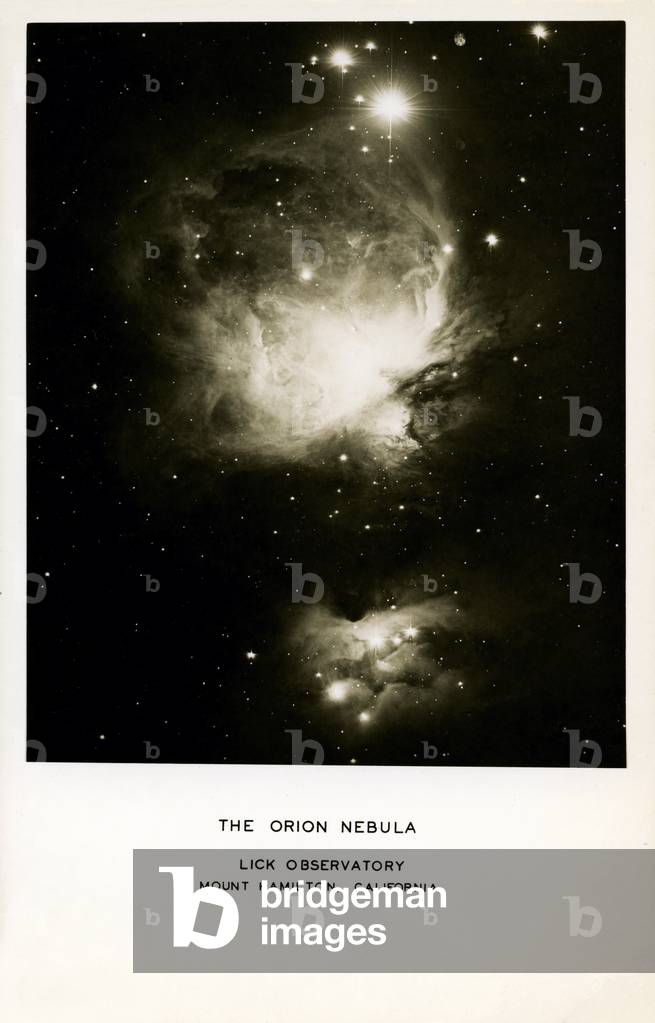
Orion Nebula
Omega nebula (M17) in Sagittarius - The Omega nebula (M17) in Sagittarius - View of the Omega nebula (M17/NGC 6618) located in the constellation Sagittarius at a distance of 5700 light years. This object derives its name from its looped shape reminiscent of the Greek letter when the nebula is seen in a telescope. The gas cloud is unusual in that it does not appear to be illuminated by the bright stars that commonly found in emission nebulae such as this. However, the nebulosity is very bright, so the exciting stars must be hidden within the cloud, an idea confirmed by the infrared brightness of the nebula. It is about 6000 light years distant
Nebula Omega (M17) in Sagittarius - The Omega Nebula (M17) in the constellation Sagittarius - View of the nebula Omega (M17/NGC 6618) located in the constellation Sagittarius at a distance of 5700 light years. The Omega Nebula, Messier object 17 (M17), NGC 6618, in the constellation Sagittarius is a bright nebula, criss - crossed by clouds and lanes of opaque dust and gas. It is also known as the Swan Nebula and the Horseshoe Nebula. At a distance of 5700 light - years, M17 is also a source of radio noise
Cone and Hubble Nebulae in the Unicorn - Cone and Hubble nebulae in Monoceros - The Cone nebula, at the bottom left, is an H II region located about 2600 years - light from Earth. The bright star in the middle left is S Monocerotis, a star of magnitude 4.7. Lower right, the Hubble nebula, overexposed. This large area of emission nebulosity and patch of blue reflection nebulosity also contains the Cone Nebula, a dark nebula at the lower right corner of the red nebulae. At the bottom right of the frame is NGC 2261, Hubble's Variable Nebula, in this image looking like an overexposed mis - shaped star because of the extreme processing needed to bring out the faint nebulosity in the Cone Nebula
Eagle Nebula (IC 4703) and star cluster M16 in the Snake - This wide - field image of the Eagle Nebula was taken at the National Science Foundation's 0.9 - meter telescope on Kitt Peak with the NOAO Mosaic CCD camera. Located in the constellation of Serpens, the Serpent, the Eagle Nebula is a very luminous open cluster of stars surrounded by dust and gas. The three pillars at the center of the image, made famous in an image by the Hubble Space Telescope, are being sculpted by the intense radiation from the hot stars in the cluster. This image was created by combining emission - line images in Hydrogen - alpha (green), Oxygen [O III] (blue) and Sulfur [S II] (red)
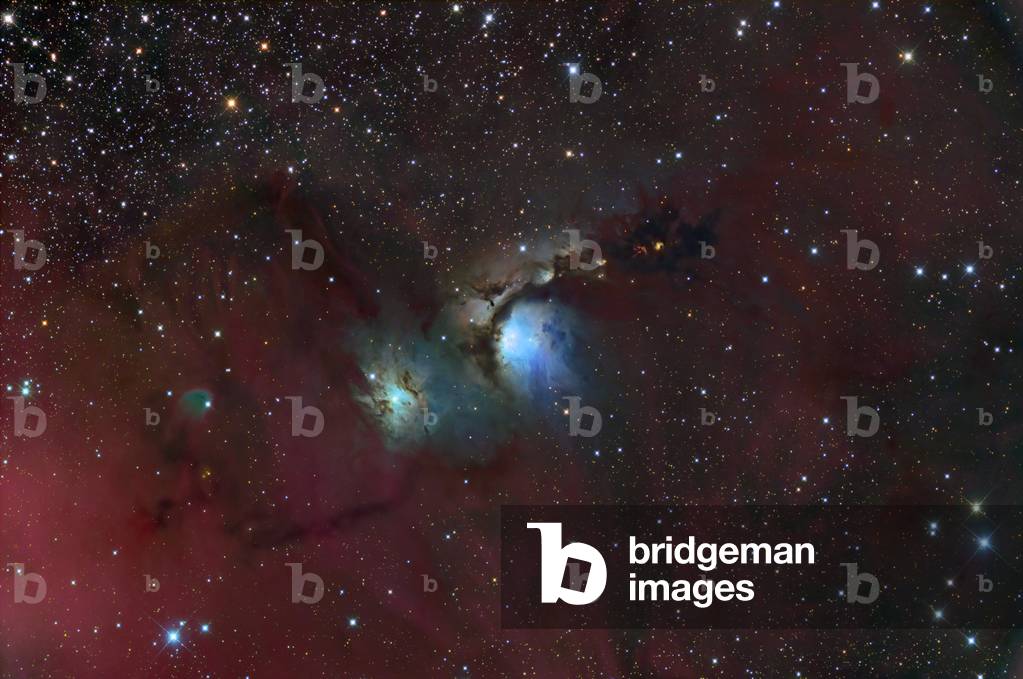
Nebula M78 in Orion - M78 nebula in Orion - The nebula M78 (NGC 2068) is located about 1300 years - light from Earth and extends over 4 years - light. M78, (NGC 2068) is part of the Orion complex, a large region of star - forming gas and dust centred around M42 and M43. It is the brightest diffuse reflection nebula in the sky, and fairly easy to see with binoculars (and almost visible to the naked eye, claim some observers). M78 is some 1600 light - years away and around 4 light - years across
Nebula NGC 6559 in Sagittarius - NGC 6559 and IC 1274 - 75 in Sagittarius - Located in Sagittarius, this nebula is located at a distance of about 5000 years - light from Earth. Image made with the 1.2m Telescope of Schmidt UK from Siding Spring. This dusty region is probably associated with the brighter and better - known Lagoon and Trifid Nebulae which are nearby in the sky and part of the same molecular cloud. The soft red glow of fluorescent hydrogen is evidence that there are young hot stars associated with the dusty clouds. These bright stars also illuminate the tiny solid particles, producing blue reflection nebulae bordering some of the emission regions. The dust is also evident in silhouette, both as sinuous dark lanes winding through the luminous gas and as the dark patches obscuring the ancient, yellow stars that populate the central parts of the Milky Way
Horsehead Nebula (B33) in Orion - Horsehead nebula in Orion - The horse head nebula, Barnard 33, is a dark nebula located in front of the IC 434 emission nebula about 1500 years - light of the Earth in the constellation Orion. Lower left is the reflexion nebula, NGC 2023. This curious dark nebula is one of the best - known images in astronomy, probably because of its chance likeness to a recognisable form. The horse - head shape is an extension of a large cloud of dust which fills the lower part (east) of the picture and hides the light of stars beyond. The outer surface of the dusty gas (IC 434) runs roughly north - south and is illuminated by sigma Orionis (off the top of the picture) which causes the hydrogen there to fluoresce, outlining the horse - head shape. The diffuse haze to the left of the image (north) is scattered light from the bright star zeta Orionis. Though conspicuous here, the Horsehead is very difficult to see visually, even with a large telescope. A bright star is partially enveloped in the dust cloud and its scattered light is seen as the large, irregular blue reflection nebula, NGC 2023. All these objects are about 1500 light years distant
Nebula Trifide (M20) in the constellation Sagittarius - Trifid nebula (M20) in Sagittarius - View of the Trifide nebula (M20/NGC 6514) located in the constellation Sagittarius between 5000 and 10,000 years - light from Earth. Measuring some forty light years across, this nebula contains enough gas to make many thousands of suns. Within it a number of young hot stars have already formed. The hottest cause the gas, mostly hydrogen, to emit its characteristic red light. Around the red emission nebula the gas contains many dust grains which preferentially reflect the blue component of starlight, and to the north (top) of the nebula can be seen a bright star which illuminates part of the dust to create a region of blue reflection. In some parts of the nebula there are so many dust grains that they hide the glowing gas, producing the three dark lanes which give the object its name. Trifid is located in Sagittarius constellation between 5000 and 10 000 light - years away
Nebula NGC 3372 in Carene - Nebula NGC 3372 in Carina - The nebula of the Carene is located about 7000 years - light from Earth. It is home to many hot stars, including the star Eta Carinae (on the left, the brightest star in the picture). In the right center, a cluster of young stars, Trumpler 14. This image shows a giant star - forming region in the southern sky known as the Carina Nebula (NGC 3372). The bright star on the left of the image is Eta Carinae, which is one of the most massive and luminous stars known
Dark Nebula LDN 673 in Aquarius - LDN 673 dark nebula in Aquila - This telescopic close - up looks towards the region at a fragmented Aquila dark cloud complex identified as LDN 673, stretching across a field of view slightly wider than the full moon. In the scene, visible indications of energetic outflows associated with young stars include the small red tinted nebulosity RNO 109 at top left and Herbig - Haro object HH32 above and right of center. The dark clouds in Aquila are estimated to be some 600 light - years away
Barnard's Loop detail and M78 nebula in Orion - Barnard's Loop detail and M78 nebula in Orion - Barnard's Loop is a very low emission nebula, very large, that surrounds the great Orion nebula. Here, the brightest part of the Loop, with lower left the cluster of stars NGC 2112, and to the right the nebula by refexion M78. Also visible is a dark nebula LDN 1622 at the top left of the image. Barnard's Loop is an extremely faint emission nebula which is part of an amazing, even larger complex of nebulosity in the constellation of Orion. This photo shows only the brightest central portion of the loop which runs diagonally across the frame here from lower left to upper right. NGC 2112, a ninth magnitude open cluster 11 arc minutes in diameter and containing about 50 stars, is seen at lower left - center, and reflection nebulae M78 and NGC 2071 are at lower right. An interesting dark nebula, LDN 1622, lies at the upper left of the image, surrounded by very faint emission nebulosity, with a hint of reflection nebulosity on the outlying western edge
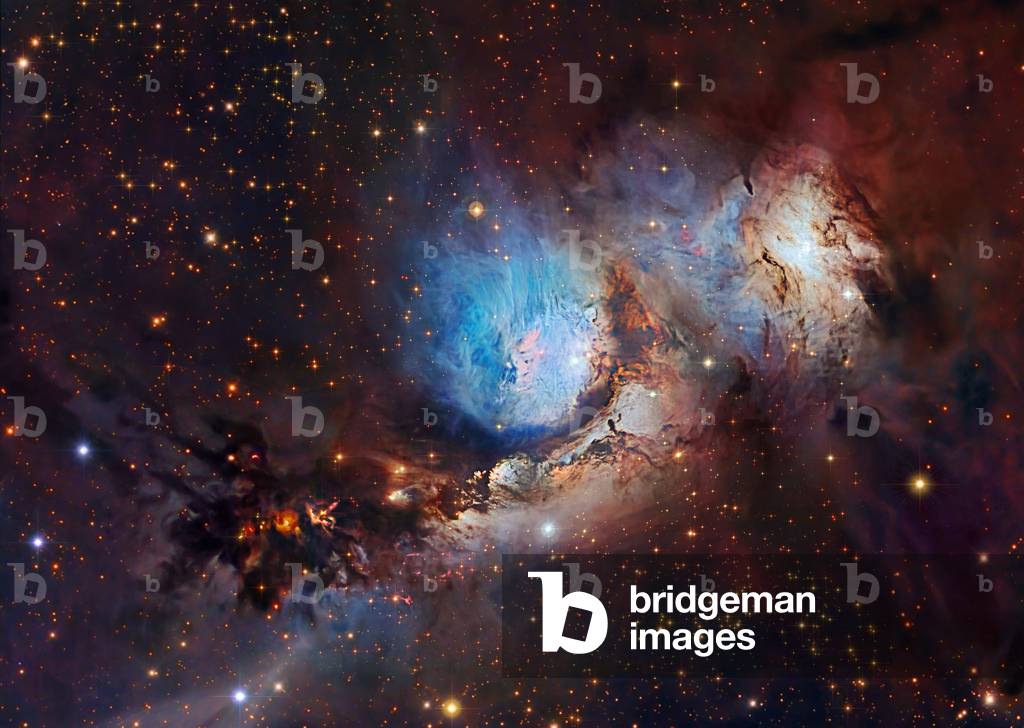
Nebula M78 in Orion - M78 nebula in Orion - The nebula M78 (NGC 2068) is located about 1300 years - light from Earth and extends over 4 years - light. Composite image obtained with different large telescopes. M78, (NGC2068) is part of the Orion complex, a large region of star - forming gas and dust centred around M42 and M43. It is the brightest diffuse reflection nebula in the sky. M78 is some 1600 light - years away and around 4 light - years across. Composite Image from Multiple Data Sources
Nebula NGC 6559 in Sagittarius - NGC 6559 and IC 1274 - 75 in Sagittarius - Located in Sagittarius, this nebula is located at a distance of about 5000 years - light from Earth. Image made with the 1.2m Telescope of Schmidt UK from Siding Spring. This dusty region is probably associated with the brighter and better - known Lagoon and Trifid Nebulae which are nearby in the sky and part of the same molecular cloud. The soft red glow of fluorescent hydrogen is evidence that there are young hot stars associated with the dusty clouds. These bright stars also illuminate the tiny solid particles, producing blue reflection nebulae bordering some of the emission regions. The dust is also evident in silhouette, both as sinuous dark lanes winding through the luminous gas and as the dark patches obscuring the ancient, yellow stars that populate the central parts of the Milky Way
Nebula VDB 27 in the Taurea
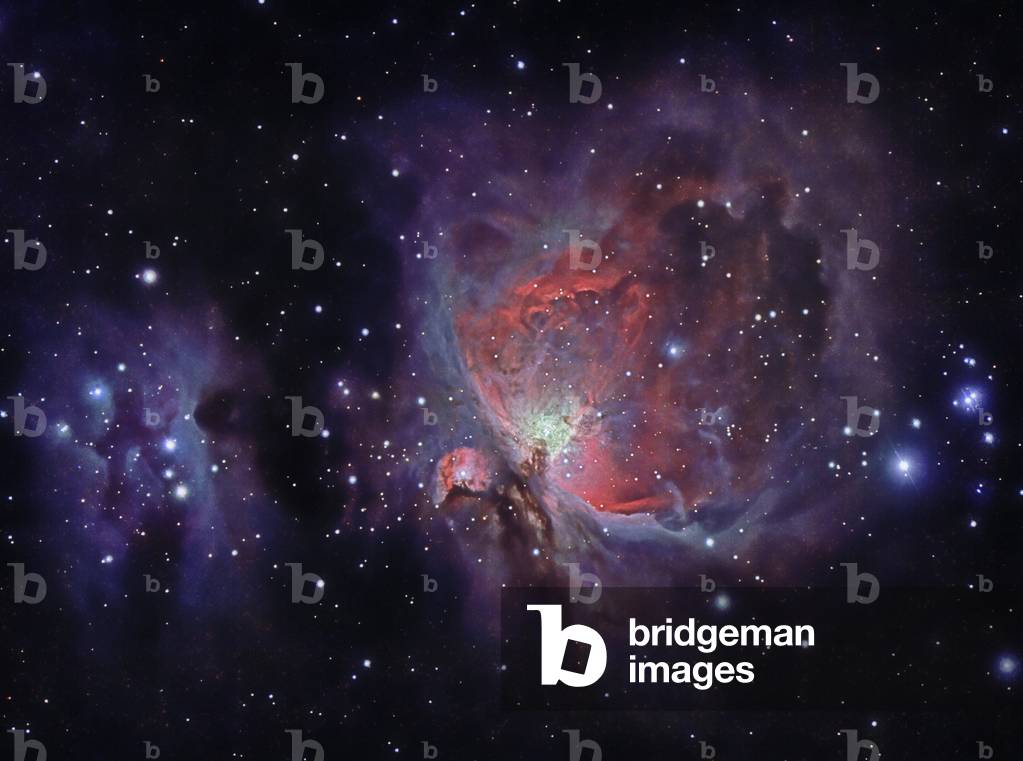
Orion Nebula - M42 - M43 - The Great Nebula in Orion - Located 1500 years - light, the Orion Nebula is the closest region to the formation of stars of the Sun. The Orion Nebula is the greatest of all HII clouds visible from our location within the Milky Way. With a gaseous repository of 10,000 suns, and illuminated by a cluster of hot young stars, the clouds of M42 glow with fantastic colors and shapes, giving us a birds eye view of one of the greatest star forming nurseries in our part of the galaxy. At a distance of 1500 light years, the Orion nebula is the nearest star - forming region to the Sun
Nebula Trifide (M20) in the constellation Sagittarius - Trifid nebula (M20) in Sagittarius - View of the Trifide nebula (M20 or NGC 6514) located in the constellation Sagittarius between 5000 and 10,000 years - light from Earth. Image obtained with a telescope of 61 cm. Trifid nebula is located in Sagittarius constellation between 5000 and 10 000 light - years away. Stars, the Sun included, were born within clouds of dusty gas such as the Trifid Nebula. Within it a number of young hot stars have already formed. The hottest cause the gas, mostly hydrogen, to emit its characteristic red light. Around the red emission nebula the gas contains many dust grains which preferentially reflect the blue component of starlight, and to the north (top) of the nebula can be seen a bright star which illuminates part of the dust to create a region of blue reflection. In some parts of the nebula there are so many dust grains that they hide the glowing gas, producing the three dark lanes which give the object its name. Image taken with a 24 - inch telescope
Nebula Trifide (M20) in the constellation Sagittarius - Trifid nebula (M20) in Sagittarius - View of the Trifide nebula (M20/NGC 6514) located in the constellation Sagittarius between 5000 and 10,000 years - light from Earth. Image obtained with a bezel Astro - Physics 130 EDT, 12x6min of poses. M20, The Trifid Nebula, in the constellation of Sagittarius, is a remarkable object - large, bright and beautiful. It is a complex of red emission, blue reflection, and dark nebulae about the size of the full moon. It was shot at 1,000 mm of focal length with 130 mm of aperture at f/8 (Astro - Physics 130EDT apochromatic refractor) with a Canon 20Da DSLR and only 12 x 6 minutes of exposure at ISO 1600
Mars Planet Passage (middle left of the image) in front of the nebula Rho Ophiuchi on August 25, 2016 - This star-forming region is located about 520 light years away. The brightest star below is the star Antares, from the Scorpio. Right, star cluster M4 - Mars passing the Rho Ophiuchi cloud complex on Aug 25, 2016 - This star-forming region is located at about 520 light years in Scorpius constellation. The area is highlighted by the bright star Antares (bottom), a red supergiant 40,000 times more luminous than our sun
Nebula Trifide (M20) in the constellation Sagittarius - Trifid nebula (M20) in Sagittarius - View of the Trifide nebula (M20/NGC 6514) located in the constellation Sagittarius between 5000 and 10,000 years - light from Earth. Measuring some forty light years across, this nebula contains enough gas to make many thousands of suns. Within it a number of young hot stars have already formed. The hottest cause the gas, mostly hydrogen, to emit its characteristic red light. Around the red emission nebula the gas contains many dust grains which preferentially reflect the blue component of starlight. In some parts of the nebula there are so many dust grains that they hide the glowing gas, producing the three dark lanes which give the object its name. Trifid is located in Sagittarius constellation between 5000 and 10 000 light - years away
Nebula Trifide (M20) in the constellation Sagittarius - Trifid nebula (M20) in Sagittarius - View of the Trifide nebula (M20/NGC 6514) located in the constellation Sagittarius between 5000 and 10,000 years - light from Earth. Measuring some forty light years across, this nebula contains enough gas to make many thousands of suns. Within it a number of young hot stars have already formed. The hottest cause the gas, mostly hydrogen, to emit its characteristic red light. Around the red emission nebula the gas contains many dust grains which preferentially reflect the blue component of starlight, and to the north (top) of the nebula can be seen a bright star which illuminates part of the dust to create a region of blue reflection. In some parts of the nebula there are so many dust grains that they hide the glowing gas, producing the three dark lanes which give the object its name. Trifid is located in Sagittarius constellation between 5000 and 10 000 light - years away
Horsehead Nebula (B33) in Orion - Horsehead nebula in Orion - The horse head nebula, Barnard 33, is a dark nebula located in front of the IC 434 emission nebula about 1500 years - light of the Earth in the constellation Orion. Lower left is the reflexion nebula, NGC 2023. This curious dark nebula is one of the best - known images in astronomy, probably because of its chance likeness to a recognisable form. The horse - head shape is an extension of a large cloud of dust which fills the lower part (east) of the picture and hides the light of stars beyond. The outer surface of the dusty gas (IC 434) runs roughly north - south and is illuminated by sigma Orionis (off the top of the picture) which causes the hydrogen there to fluoresce, outlining the horse - head shape. The diffuse haze to the left of the image (north) is scattered light from the bright star zeta Orionis. Though conspicuous here, the Horsehead is very difficult to see visually, even with a large telescope. A bright star is partially enveloped in the dust cloud and its scattered light is seen as the large, irregular blue reflection nebula, NGC 2023. All these objects are about 1500 light years distant
Nebula Trifide (M20) in the constellation Sagittarius - Trifid nebula (M20) and open cluster M21 - View of the Trifide nebula (M20/NGC 6514) located in the constellation Sagittarius between 5000 and 10,000 years - light from Earth. Above it, the M21 star cluster. M20, the Trifid Nebula is a remarkable object, large, bright and beautiful. It is a complex of red emission and blue reflection nebulosity about the size of the full moon, intersected by three dark lanes, from which the Trifid gets its name. M21 is a rich open cluster comprised of some 70 stars with a large brightness range and strong central condensation, approximately 13 arc minutes in diameter and magnitude 5.9, and located 1/2 degree to the northeast of M20
The Filamentary Nebula.
Horsehead Nebula (IC 434) in Orion - Horsehead Nebula (B33) in Orion - The horse's head nebula, Barnard 33, is a dark nebula located in front of the IC 434 emitting nebula about 1500 years - light from Earth in the constellation Orion. At the bottom left, the nebula NGC 2024 with just above the star Alnitak, a supergiant star belonging to the Baudrier of Orion. Towards the center of the image, a reflexion nebula, NGC 2023. This distinctive red emission nebula (IC 434) is the result of radiation from sigma Orionis interacting with the surface of a dusty cloud of gas from which projects the dark shape of the head of a horse. Sigma is the second brightest star in the picture and is at about the same distance from the Sun as the nebula. The brightest star here is zeta Orionis, easily visible to the unaided eye as the easternmost star in the line of three which form Orion's Belt. Alnitak (Zeta Orionis) is a supergiant star with a brightness 35,000 times greater than the Sun. Its mass is 20 times the solar mass. Partly obscured by the glare of zeta is the curious yellowish nebula NGC 2024, whose energy comes from stars hidden in the dark lane, while other nebulae simply reflect the light of embedded hot stars and appear blue. All these objects are about 1500 light years distant
Nebulae of the horse's head and M42 in Orion - Horsead nebula and Orion nebula - Dark Nebula of the horse's head (IC434 - B33). On the right, the large Orion nebula (M42) is a vast region of star formation. This large complex of nebulosity is located about 1,500 light years away in Orion. The Orion complex is a gigantic stellar nursery where stars are forming out of the dust and gas in the region. Young energetic stars excite the gas in the region ionizing it and causing it to glow in the hydrogen - alpha and oxygen III emission lines. The brightest star in the photo at left at magnitude 1.8 is Alnilam, the middle star of the three distinctive stars in the belt of Orion. At the bottom is the Flame, NGC 2024, and the dark nebula B33, the Horsehead Nebula. Top right is a patch of blue reflection nebulosity NGC 1973 - 4 - 5 and the beautiful Orion Nebula, M 42
Orion Nebula - The Great Nebula in Orion - Located 1500 years ago - the Orion Nebula is the closest star-forming region of the Sun. The Orion Nebula is the greatest of all HII clouds visible from our location within the Milky Way. With a gaseous repository of 10,000 suns, and illuminated by a cluster of hot young stars, the clouds of M42 glow with fantastic colors and shapes, giving us a birds eye view of one of the greatest star forming nurseries in our part of the galaxy. At a distance of 1500 light years, the Orion nebula is the nearest star - forming region to the Sun
VDB 149 nebula in Cephee - VDB 149 is a reflexion nebula
Horsehead Nebula (IC 434) in Orion - Horsehead Nebula (B33) in Orion - The horse's head nebula, Barnard 33, is a dark nebula located in front of the IC 434 emitting nebula about 1500 years - light from Earth in the constellation Orion. At the bottom left, the nebula NGC 2024 with just above the star Alnitak, a supergiant star belonging to the Baudrier of Orion. Towards the center of the image, a reflexion nebula, NGC 2023. Image obtained with the 1.2m Schmidt UK Telescope from Siding Spring. This distinctive red emission nebula (IC 434) is the result of radiation from sigma Orionis interacting with the surface of a dusty cloud of gas from which projects the dark shape of the head of a horse. Sigma is the second brightest star in the picture and is at about the same distance from the Sun as the nebula. The brightest star here is zeta Orionis, easily visible to the unaided eye as the easternmost star in the line of three which form Orion's Belt. Alnitak (Zeta Orionis) is a supergiant star with a brightness 35,000 times greater than the Sun. Its mass is 20 times the solar mass. Partly obscured by the glare of zeta is the curious yellowish nebula NGC 2024, whose energy comes from stars hidden in the dark lane, while other nebulae simply reflect the light of embedded hot stars and appear blue. All these objects are about 1500 light years distant. This photograph was produced by combining three separate photographs taken with the 1.2m UK Schmidt Telescope through different coloured filters
Nebulae NGC 2024 and Head of Horse seen by VISTA - Flame nebula and the Horsehead Nebula - First image obtained by the telescope of 4 meters in diameter VISTA. This infrared image shows the nebula NGC 2024 (left), the small nebula NGC 2023 (right middle) and the nebula of the horse's head (top right). The bright star on the top left is the star Alnitak. This image, the first to be released publicly from VISTA, the world's largest survey telescope, shows the spectacular star - forming region known as the Flame Nebula, or NGC 2024, in the constellation of Orion (the Hunter) and its surroundings. In views of this evocative object in visible light the core of the nebula is completely hidden behind obscuring dust, but in this VISTA view, taken in infrared light, the cluster of very young stars at the object's heart is revealed. The wide - field VISTA view also includes the glow of the reflection nebula NGC 2023, middle right, and the ghostly outline of the Horsehead Nebula (Barnard 33) towards the upper right. The bright bluish star top left is one of the three bright stars forming the Belt of Orion, Alnitak. The image was created from VISTA images taken through J, H and Ks filters in the near - infrared part of the spectrum. The image shows about half the area of the full VISTA field and is about 40 x 50 arcminutes in extent. The total exposure time was 14 minutes
Nebula of the Eagle (IC 4703) in the Snake - detail - Star - birth in the Eagle nebula. - The Pillars of Creation “” is undoubtedly the most famous image realized by the Hubble space telescope, obtained in 1995. 20 years later, the same telescope rephotographed this region with more finesse. These cold gas columns are home to star embryos. The NASA/ESA Hubble Space Telescope has revisited one of its most iconic and popular images: the Eagle Nebula's Pillars of Creation. This image shows the pillars as seen in visible light, capturing the multi - coloured glow of gas clouds, wispy tendrils of dark cosmic dust, and the rust - colored elephants trunks of the nebula's famous pillars. The dust and gas in the pillars is seared by the intense radiation from young stars and eroded by strong winds from massive nearby stars. With these new images comes better contrast and a clearer view for astronomers to study how the structure of the pillars is changing over time.
Orion's Nebula - The Great Nebula in Orion - Located 1500 years ago - the light of the Earth, Orion's Nebula is the closest region to the formation of stars of the Sun. In its heart, a group of young stars called Orion's Trapeze. To the eye, the nebula appears as a misty patch around the central star of the line of three which form Orion's sword. The central group of stars is the Trapezium cluster and these stars are responsible for producing the nebula. It is the high concentration of dust and gas in this part of the sky which has resulted in the formation of the stars, so the Orion nebula is no random association of bright stars and dusty gas. At a distance of 1500 light years, the Orion nebula is the nearest star - forming region to the Sun
Orion Nebula M42 in Orion - The Orion Nebula - Located 1500 years - light, Orion Nebula is the closest star-forming region of the Sun. Image obtained with the 1.2m Schmidt UK Telescope from Siding Spring. To the eye, the nebula appears as a misty patch around the central star of the line of three which form Orion's sword. Binoculars or a modest telescope will show that these three 'stars' are loose groups of several individuals some of which can be seen in this photograph. The central group of stars, the Trapezium cluster is hidden in the glow of the Orion Nebula in this photograph, but these stars are responsible for producing the nebula. It is the high concentration of dust and gas in this part of the sky which has resulted in the formation of the stars, so the Orion nebula is no random association of bright stars and dusty gas. At a distance of 1500 light years, the Orion nebula is the nearest star - forming region to the Sun
Nebula M78 in Orion - M78 nebula in Orion - The reflexion nebula M78 (NGC 2068) is located about 1300 years - light from Earth and extends over 4 years - light. Image obtained with the 2.2 meter MPG/ESO telescope at the La Silla Observatory. Messier 78 is a fine example of a reflection nebula. The ultraviolet radiation from the stars that illuminate it is not intense enough to ionise the gas to make it glow - - its dust particles simply reflect the starlight that falls on them. Despite this, Messier 78 can easily be observed with a small telescope, being one of the brightest reflection nebulae in the sky. It lies about 1350 light - years away in the constellation of Orion (The Hunter) and can be found northeast of the easternmost star of Orion's belt. Two bright stars, HD 38563A and HD 38563B, are the main powerhouses behind Messier 78. However, the nebula is home to many more stars, including a collection of about 45 low mass, young stars (less than 10 million years old) in which the cores are still too cool for hydrogen fusion to start, known as T Tauri stars. Studying T Tauri stars is important for understanding the early stages of star formation and how planetary systems are created. Remarkably, this complex of nebulae has also changed significantly in the last ten years. In February 2004 the experienced amateur observer Jay McNeil took an image of this region with a 75 mm telescope and was surprised to see a bright nebula - - the prominent fan shaped feature near the bottom of this picture - - where nothing was seen on most earlier images. This object is now known as McNeil's Nebula and it appears to be a highly variable reflection nebula around a young star. Image taken with the MPG/ESO 2.2 - metre telescope at the La Silla Observatory
Antares star and the Rho Ophiuchi nebula - This coloree nebula represents the visible part of a very large molecule cloud, the Ophiuchus cloud. This star-forming region is located about 520 light years away. The brightest star below is the star Antares, from the Scorpio. On the right, the M4 star cluster. View of the region surrounding the bright triple star Rho Ophiuchus (in the blue cloud). This star-forming region is located at about 520 light years in Scorpius constellation. The area is highlighted by the bright star Antares (bottom), a red supergiant 40,000 times more luminous than our sun
Nebula IC 1274 in Sagittariu - Nebula IC 1274 in Sagittariu
Orion Nebula - M42 - M43 - The Great Nebula in Orion - Located 1500 years - light, the Orion Nebula is the closest region to the formation of stars of the Sun. Image obtained from the 2.2 meter MPG/ESO telescope of the La Silla Observatory. The Orion Nebula is the greatest of all HII clouds visible from our location within the Milky Way. With a gaseous repository of 10,000 suns, and illuminated by a cluster of hot young stars, the clouds of M42 glow with fantastic colors and shapes, giving us a birds eye view of one of the greatest star forming nurseries in our part of the galaxy. At a distance of 1500 light years, the Orion nebula is the nearest star - forming region to the Sun. This new image of the Orion Nebula was captured using the Wide Field Imager camera on the MPG/ESO 2.2 - metre telescope at the La Silla Observatory, Chile. This image is a composite of several exposures taken through a total of five different filters. Light that passed through a red filter, as well as light from a filter that shows the glowing hydrogen gas, is colored red. Light in the yellow - green part of the spectrum is colored green, blue light is colored blue and light that passed through an ultraviolet filter has been colored purple. The exposure times were about 52 minutes through each filter
Nebula Trifide (M20) in the constellation Sagittarius - Trifid nebula (M20) in Sagittarius - View of the Trifide nebula (M20/NGC 6514) located in the constellation Sagittarius between 5000 and 10,000 years - light from Earth. Image obtained by Siding Spring's 3.9m telescope. The spectacular Trifid nebula (Messier 20) is one of the best known in the sky. It is a striking mixture of brilliant red light emitted from excited hydrogen gas and the soft blue glow of a reflection nebula. The blue arises from starlight, scattered by dust particles between the stars. The size of the particles is minute, similar to those of smoke, which also has a bluish hue. However, the scattered light is not a pure blue, and if we see it through a medium that is yellow (i.e. absorbs blue light) some green colouration remains. This effect can be seen in some of the darker parts of the faint reflection nebula that surrounds the Trifid, where partial absorption of light by foreground dust provides a yellow 'filter', producing shades of green. This image has been photographically enhanced using an unsharp mask
Nebulae NGC 6334 and NGC 6357 in Scorpio - Nebulae NGC 6334 and NGC 6357 in Scorpius: These nebulae are located about 5500 light years from Earth - Located in the constellation of Scorpius, the Cat's Paw Nebula resemble a faint, luminous paw-print on the sky. Deep images reveal that the nebula is about a degree across in the sky. At a distance of about 5500 light-years away it is a truly vast structure spanning almost 100 light-years across. The sculpted gases of NGC 6334 are illuminated by the light of numerous powerful stars, some exceeding 10 solar masses. The two brilliant blue stars in the upper left are Lambda and Kappa Scorpii. Many of these luminous hot stars are surprisingly not visible because they lie within the dusty plane of our galaxy. At infrared wavelengths the numerous hot stars are revealed and the nature of this object as a region of massive star formation becomes clear. In the past decade water masers, molecular outflows, and x-ray sources have provided direct evidence of clusters of protostars within NGC 6334. The nebula was discovered by John Herschel in 1837, and the brief and uninformative description in his Cape Observations catalog is a testament to its faintness. The ruddy hue of this complex is the result of the absorption of blue light by the ubiquitous dust clouds along our line of sight in the plane of the Milky Way. The red, intricate bubble making up the left paw print is particularly striking and is most likely either a star expelling large amounts of matter at high speed as it nears the end of its life or the remnant of a recent supernova - Located near the famous “” Cat Paw”” nebula (NGC 6334), the Stellar Cluster Pismis 24 lies at the core of NGC 6357. Its stars include some of the most massive stellar behemoths known. One of the brightest stars in the cluster, Pismis 24-1, was thought possibly to be the most massive on record, approaching 300 solar masses, until it was discovered by the Hubble Telescope to b
Nebula LDN 988 in the Swan - LDN 988 nebula in Cygnus - Region around the dark nebula LDN 988 in the Swan. Area around the dark nebula LDN 988 with two blue reflection nebulae GN 21.01.3 and LBN 409. The emission nebula in the upper right of the image near the open cluster NGC 7031 seems uncataloged. Another interesting object is [C86] L988a. This is a looped nebula in LDN988. Sh2 - 120 and 121 are the two small HII regions left of center. Faint dust makes some of the background appear blue from reflection
Nebula NGC 6188 in the Altar - The NGC 6188 nebula and NGC 6193 in Ara - Nebula NGC 6188 is located about 4000 years from Earth. It is home to a cluster of young stars NGC 6193, formed three million years ago. Image obtained by Siding Spring's 3.9m telescope. Here we see two bright stars whose radiant energy is beating down on to the surface of a dark cloud, very similar to the Horsehead in Orion. The cloud itself is opaque and because of that, very cold inside. These conditions are ideal for the formation of organic molecules on the surfaces of the chilled dust particles. The opacity of the cloud protects the fragile molecules within from the energetic radiation of nearby stars, but as its surface is gradually warmed and eroded, the delicate organic molecules are destroyed and the hydrogen released glows as a distinctive red emission nebula
Nebula Trifide (M20) in the constellation Sagittarius - Trifid nebula (M20) in Sagittarius - View of the Trifide nebula (M20/NGC 6514) located in the constellation Sagittarius between 5000 and 10,000 years - light from Earth. Image obtained by combining light through 3 different filters that highlight oxygen, hydrogen, and sulfur. Trifid is located in Sagittarius constellation between 5000 and 10 000 light - years away. Composite image from Hubble space telescope and Subaru data sources. Narrowband composite H - alpha, OIII, SII
Horse's Head Nebula and IC 434 in Orion - The Horsehead nebula in Orion - The Horse's Head Nebula, Barnard 33, is a dark nebula located in front of the IC 434 emitting nebula about 1500 years - Earth light in the constellation Orion. Lower left is the reflexion nebula, NGC 2023. The Horsehead nebula is located in the constellation of Orion, slightly below the left - most star of the three that form the Hunter's belt. It is part of a vast molecular cloud of dust and gas that includes the Great Orion Nebula and extends throughout the entire constellation as well. Here, we see the Horsehead as it appeared 1,500 years ago, due to distance and the time it takes light to travel. The bright complex of dust and gas below the Horsehead reflects the light given off by the bright star near it's center and is one of the brightest examples of reflection nebulae in the northern sky. The central star is surrounded with a thin shell of hydrogen that glows red by emitting it's own light in a rare example of a unique process called vibrational fluorescence
Orion's Nebula - The Great Nebula in Orion - Located 1500 years ago - light, Orion's Nebula is the closest region of star formation in the Sun. Image obtained with the 1.2m Schmidt UK Telescope from Siding Spring. To the eye, the nebula appears as a misty patch around the central star of the line of three which form Orion's sword. Binoculars or a modest telescope will show that these three 'stars' are loose groups of several individuals some of which can be seen in this photograph. The central group of stars, the Trapezium cluster is hidden in the glow of the Orion Nebula in this photograph, but these stars are responsible for producing the nebula. It is the high concentration of dust and gas in this part of the sky which has resulted in the formation of the stars, so the Orion nebula is no random association of bright stars and dusty gas. At a distance of 1500 light years, the Orion nebula is the nearest star - forming region to the Sun
Omega nebula (M17) in Sagittarius - The Omega nebula (M17) in Sagittarius - View of the Omega nebula (M17/NGC 6618) located in the constellation Sagittarius at a distance of 5700 light years. Image obtained by the VST (VLT Survey Telescope) in Chile in June 2011. The first released VST image shows the spectacular star - forming region Messier 17, also known as the Omega Nebula or the Swan Nebula, as it has never been seen before. This vast region of gas, dust and hot young stars lies in the heart of the Milky Way in the constellation of Sagittarius (The Archer). The VST field of view is so large that the entire nebula, including its fainter outer parts, is captured - - and retains its superb sharpness across the entire image
Nebulae NGC 1973 - 1975 - 1977 and M42 - 43 in Orion - Nebulae in Orion - Reflection of nebula NGC 1973 - 1975 - 1977 (bottom of image) and nebulae M43 and M42 in Orion. The nebulae NGC 1973 - 5 - 7 are reflection nebula. Most of the blue nebulosity is starlight scattered by dust, while some of the stars are sufficiently hot to excite the wisps of hydrogen that linger here and create a distinctive red glow. To the south of the nebula (at the top of the picture) the Orion nebula, M43 and M42
Orion Nebula (M42 - 43) - The Orion Nebula - Located 1500 years ago - the Orion Nebula is the closest region to the formation of stars of the Sun. Image obtained with Siding Spring's 3.9m telescope. The Orion Nebula is famous for a number of reasons. It is the nearest bright nebula to us and can be seen with the naked eye. Its brightness led to it being the first nebula ever photographed (in 1882) and its proximity (1500 light years) means that we know more about it than any other star - forming region. It is also in a very active stage of star formation and it is perfectly placed for us to explore the intimate details of the birth of stars. The inner regions are glowing mainly in the red light of excited hydrogen, which together with some green emission from oxygen give the centre of the nebula a yellowish colour. The energy for this spectacular display comes from the small cluster of stars in the brightest part of the nebula. Three, five - minute exposures were used to make this picture using the Anglo - Australian Telescope at Siding Spring
Omega nebula (M17) in Sagittarius - The Omega nebula (M17) in Sagittarius - View of the Omega nebula (M17/NGC 6618) located in the constellation Sagittarius at a distance of 5700 light years. This object derives its name from its looped shape reminiscent of the Greek letter when the nebula is seen in a telescope. The gas cloud is unusual in that it does not appear to be illuminated by the bright stars that commonly found in emission nebulae such as this. However, the nebulosity is very bright, so the exciting stars must be hidden within the cloud, an idea confirmed by the infrared brightness of the nebula. As well as exciting the nebula we can see, the embedded stars heat the dust that surrounds them, so M17 is one of the brightest objects in the infrared sky. It is about 6000 light years distant
Nebula Trifide (M20) in the constellation Sagittarius - Trifid nebula (M20) in Sagittarius - View of the Trifide nebula (M20/NGC 6514) located in the constellation Sagittarius between 5000 and 10,000 years - light from Earth. Image obtained by Siding Spring's 3.9m telescope. The spectacular Trifid nebula (Messier 20) is one of the best known in the sky. It is a striking mixture of brilliant red light emitted from excited hydrogen gas and the soft blue glow of a reflection nebula. The blue arises from starlight, scattered by dust particles between the stars. The size of the particles is minute, similar to those of smoke, which also has a bluish hue. However, the scattered light is not a pure blue, and if we see it through a medium that is yellow (i.e. absorbs blue light) some green colouration remains. This effect can be seen in some of the darker parts of the faint reflection nebula that surrounds the Trifid, where partial absorption of light by foreground dust provides a yellow 'filter', producing shades of green. This image has been photographically enhanced using an unsharp mask
Nebula Trifide (M20) in the constellation Sagittarius - Trifid nebula (M20) in Sagittarius - View of the Trifide nebula (M20 or NGC 6514) located in the constellation Sagittarius between 5000 and 10,000 years - light from Earth. Image obtained by Siding Spring's 3.9m telescope. Trifid nebula is located in Sagittarius constellation between 5000 and 10 000 light - years away. Stars, the Sun included, were born within clouds of dusty gas such as the Trifid Nebula. Within it a number of young hot stars have already formed. The hottest cause the gas, mostly hydrogen, to emit its characteristic red light. Around the red emission nebula the gas contains many dust grains which preferentially reflect the blue component of starlight, and to the north (top) of the nebula can be seen a bright star which illuminates part of the dust to create a region of blue reflection. In some parts of the nebula there are so many dust grains that they hide the glowing gas, producing the three dark lanes which give the object its name
Orion Nebula - M42 - M43 - The Great Nebula in Orion - Located 1500 years - light, the Orion Nebula is the closest region to the formation of stars of the Sun. Image obtained from the 2.2 meter MPG/ESO telescope of the La Silla Observatory. The Orion Nebula is the greatest of all HII clouds visible from our location within the Milky Way. With a gaseous repository of 10,000 suns, and illuminated by a cluster of hot young stars, the clouds of M42 glow with fantastic colors and shapes, giving us a birds eye view of one of the greatest star forming nurseries in our part of the galaxy. At a distance of 1500 light years, the Orion nebula is the nearest star - forming region to the Sun. This new image of the Orion Nebula was captured using the Wide Field Imager camera on the MPG/ESO 2.2 - metre telescope at the La Silla Observatory, Chile. This image is a composite of several exposures taken through a total of five different filters. Light that passed through a red filter, as well as light from a filter that shows the glowing hydrogen gas, is colored red. Light in the yellow - green part of the spectrum is colored green, blue light is colored blue and light that passed through an ultraviolet filter has been colored purple. The exposure times were about 52 minutes through each filter