[]
您当前的选择
资产 资产
您的报价 0

您的选择

清除选择
商品已加入购物车
{"event":"pageview","page_type1":"undetected","page_type2":"_assets_search_override","language":"cn","user_logged":"false","user_type":"ecommerce","nl_subscriber":"false"}
{"event":"ecommerce_event","event_name":"view_item","event_category":"browse_catalog","ecommerce":{"items":[{"item_id":"PIX4593592","item_category":"photo","item_category2":"no_copyright","item_category3":"standard","item_category5":"not_balown","item_list_name":"search_results","item_name":"constellations_of_sagittarius_and_the_southern_crown_constellations_of_sagittarius_and_corona_austra","item_variant":"undefined"},{"item_id":"PIX4593578","item_category":"photo","item_category2":"no_copyright","item_category3":"standard","item_category5":"not_balown","item_list_name":"search_results","item_name":"constellations_of_sagittarius_and_the_southern_crown_constellations_of_sagittarius_and_corona_austra","item_variant":"undefined"},{"item_id":"PIX4593557","item_category":"photo","item_category2":"no_copyright","item_category3":"standard","item_category4":"b_s_fletcher","item_category5":"not_balown","item_list_name":"search_results","item_name":"the_lactee_way_and_the_sagittarius_part_of_the_sagittarius_constellatio","item_variant":"undefined"},{"item_id":"PIX4593652","item_category":"photo","item_category2":"no_copyright","item_category3":"standard","item_category5":"not_balown","item_list_name":"search_results","item_name":"constellations_of_sagittarius_and_the_southern_crown_constellations_of_sagittarius_and_corona_austra","item_variant":"undefined"},{"item_id":"PIX4619678","item_category":"photo","item_category2":"no_copyright","item_category3":"standard","item_category4":"jerry_lodriguss","item_category5":"not_balown","item_list_name":"search_results","item_name":"the_lagoon_nebula_m8_without_stars_the_lagoon_nebula_m8_with_stars_removed_in_this_image_the_stars_w","item_variant":"undefined"},{"item_id":"PIX4593590","item_category":"photo","item_category2":"no_copyright","item_category3":"standard","item_category5":"not_balown","item_list_name":"search_results","item_name":"constellations_of_sagittarius_and_the_southern_crown_constellations_of_sagittarius_and_corona_austra","item_variant":"undefined"},{"item_id":"PIX4593659","item_category":"photo","item_category2":"no_copyright","item_category3":"standard","item_category5":"not_balown","item_list_name":"search_results","item_name":"constellations_of_sagittarius_and_the_southern_crown_constellations_of_sagittarius_and_corona_austra","item_variant":"undefined"},{"item_id":"PIX4619937","item_category":"photo","item_category2":"no_copyright","item_category3":"standard","item_category5":"not_balown","item_list_name":"search_results","item_name":"planet_mars_between_the_nebulae_of_the_lagoon_m8_ngc_6523_below_and_trifide_m20_at_the_top_march_19_","item_variant":"undefined"},{"item_id":"PIX4619776","item_category":"photo","item_category2":"no_copyright","item_category3":"standard","item_category4":"tom_davis","item_category5":"not_balown","item_list_name":"search_results","item_name":"nebulae_m20_m8_and_ngc_6559_in_sagittarius_m8_m20_and_the_ngc_6559_nebulae_view_of_nebulae_of_the_la","item_variant":"undefined"},{"item_id":"PIX4619775","item_category":"photo","item_category2":"no_copyright","item_category3":"standard","item_category5":"not_balown","item_list_name":"search_results","item_name":"nebulae_m20_m8_and_ngc_6559_in_sagittarius_nebulae_ngc_6559_lagoon_and_trifid_in_sagittarius_view_of","item_variant":"undefined"},{"item_id":"PIX4637874","item_category":"photo","item_category2":"no_copyright","item_category3":"standard","item_category4":"r_gendler","item_category5":"not_balown","item_list_name":"search_results","item_name":"the_milky_way_looking_towards_the_galactic_centre_mosaic_of_50_images_presenting_the_region_of_the_c","item_variant":"undefined"},{"item_id":"PIX4619605","item_category":"photo","item_category2":"no_copyright","item_category3":"standard","item_category4":"christopher_picking","item_category5":"not_balown","item_list_name":"search_results","item_name":"the_nebula_of_the_lagoon_m_8_ngc_6523_view_of_the_nebula_of_the_lagoon_m_8_ngc_6523_located_in_sagit","item_variant":"undefined"},{"item_id":"UIG867327","item_category":"photo","item_category2":"no_copyright","item_category3":"standard","item_category5":"not_balown","item_list_name":"search_results","item_name":"swirling_dust_clouds_and_bright_newborn_stars_dominate_the_view_in_this_image_of_the_lagoon_nebula_f","item_variant":"undefined"},{"item_id":"PIX4636007","item_category":"photo","item_category2":"no_copyright","item_category3":"standard","item_category4":"stephane_guisard","item_category5":"not_balown","item_list_name":"search_results","item_name":"the_center_of_our_galaxy_the_milky_way_the_center_of_our_galaxy_the_milky_way_this_billion_pixel_mos","item_variant":"undefined"},{"item_id":"PIX4619692","item_category":"photo","item_category2":"no_copyright","item_category3":"standard","item_category5":"not_balown","item_list_name":"search_results","item_name":"centre_de_la_nebula_de_la_lagoon_m8_dans_le_sagittarius_in_the_heart_of_the_lagoon_nebula_centre_de_","item_variant":"undefined"},{"item_id":"PIX4619790","item_category":"photo","item_category2":"no_copyright","item_category3":"standard","item_category4":"sebastian_voltmer","item_category5":"not_balown","item_list_name":"search_results","item_name":"nebulae_m20_m8_and_ngc_6559_in_sagittarius_nebulae_ngc_6559_lagoon_and_trifid_in_sagittarius_view_of","item_variant":"undefined"},{"item_id":"UIG867328","item_category2":"no_copyright","item_category3":"standard","item_category5":"not_balown","item_list_name":"search_results","item_name":"swirling_dust_clouds_and_bright_newborn_stars_dominate_the_view_in_this_image_of_the_lagoon_nebula_f","item_variant":"undefined"},{"item_id":"PIX4619624","item_category":"photo","item_category2":"no_copyright","item_category3":"standard","item_category5":"not_balown","item_list_name":"search_results","item_name":"nebula_of_the_lagoon_m8_in_sagittarius_the_lagoon_nebula_m8_ngc_6523_view_of_the_nebula_of_the_lagoo","item_variant":"undefined"},{"item_id":"PIX4619660","item_category":"photo","item_category2":"no_copyright","item_category3":"standard","item_category5":"not_balown","item_list_name":"search_results","item_name":"hourglass_nebula_in_m8_the_hourglass_nebula_in_m8_ngc_6523_view_of_the_hourglass_nebula_in_the_heart","item_variant":"undefined"},{"item_id":"PIX4619672","item_category":"photo","item_category2":"no_copyright","item_category3":"standard","item_category4":"adam_block","item_category5":"not_balown","item_list_name":"search_results","item_name":"nebula_of_the_lagoon_m8_in_sagittarius_the_hourglass_nebula_in_m8_ngc_6523_view_of_the_nebula_of_the","item_variant":"undefined"},{"item_id":"PIX4619615","item_category":"photo","item_category2":"no_copyright","item_category3":"standard","item_category5":"not_balown","item_list_name":"search_results","item_name":"nebula_of_the_lagoon_m8_in_sagittarius_the_hourglass_nebula_in_m8_ngc_6523_view_of_the_nebula_of_the","item_variant":"undefined"},{"item_id":"PIX4619726","item_category":"photo","item_category2":"no_copyright","item_category3":"standard","item_category4":"r_jay_gabany","item_category5":"not_balown","item_list_name":"search_results","item_name":"nebula_of_the_lagoon_m8_in_sagittarius_the_lagoon_nebula_m8_in_sagittarius_view_of_the_nebula_of_the","item_variant":"undefined"},{"item_id":"PIX4637914","item_category":"photo","item_category2":"no_copyright","item_category3":"standard","item_category4":"alex_tudorica","item_category5":"not_balown","item_list_name":"search_results","item_name":"lactee_way_galactic_centre_region_the_milky_way_looking_towards_the_galactic_centre","item_variant":"undefined"},{"item_id":"PIX4637870","item_category":"photo","item_category2":"no_copyright","item_category3":"standard","item_category5":"not_balown","item_list_name":"search_results","item_name":"the_milky_way_looking_towards_the_galactic_centre_the_milky_way_looking_towards_the_galactic_centre_","item_variant":"undefined"},{"item_id":"PIX4619656","item_category":"photo","item_category2":"no_copyright","item_category3":"standard","item_category4":"r_gendler","item_category5":"not_balown","item_list_name":"search_results","item_name":"nebula_of_the_lagoon_m8_in_sagittarius_the_lagoon_nebula_m8_in_sagittarius_view_of_the_nebula_of_the","item_variant":"undefined"},{"item_id":"PIX4619667","item_category":"photo","item_category2":"no_copyright","item_category3":"standard","item_category4":"jerry_lodriguss","item_category5":"not_balown","item_list_name":"search_results","item_name":"nebula_of_the_lagoon_m8_in_sagittarius_m8_the_lagoon_nebula_view_of_the_nebula_of_the_lagoon_m8_ngc_","item_variant":"undefined"},{"item_id":"PIX4619593","item_category":"photo","item_category2":"no_copyright","item_category3":"standard","item_category5":"not_balown","item_list_name":"search_results","item_name":"nebula_of_the_lagoon_m8_in_sagittarius_the_lagoon_nebula_m8_in_sagittarius_view_of_the_nebula_of_the","item_variant":"undefined"},{"item_id":"PIX4619950","item_category":"photo","item_category2":"no_copyright","item_category3":"standard","item_category5":"not_balown","item_list_name":"search_results","item_name":"centre_of_the_nebula_of_the_lagoon_m8_seen_by_the_hubble_space_telescope_the_lagoon_nebula_is_a_star","item_variant":"undefined"},{"item_id":"PIX4619732","item_category":"photo","item_category2":"no_copyright","item_category3":"standard","item_category4":"jerry_lodriguss","item_category5":"not_balown","item_list_name":"search_results","item_name":"nebulae_m8_and_ngc_6559_in_sagittarius_nebulae_m8_and_ngc_6559_in_sagittarius_view_of_nebulae_of_the","item_variant":"undefined"},{"item_id":"PIX4619585","item_category":"photo","item_category2":"no_copyright","item_category3":"standard","item_category4":"r_gendler","item_category5":"not_balown","item_list_name":"search_results","item_name":"view_of_the_nebula_of_the_lagoon_m8_ngc_6523_located_in_sagittarius_at_a_distance_of_5800_light_year","item_variant":"undefined"},{"item_id":"PIX4619731","item_category":"photo","item_category2":"no_copyright","item_category3":"standard","item_category4":"christopher_picking","item_category5":"not_balown","item_list_name":"search_results","item_name":"nebulae_m20_m8_and_ngc_6559_in_sagittarius_view_of_nebulae_of_the_lagoon_m_8_ngc_6523_bottom_trifide","item_variant":"undefined"},{"item_id":"PIX4619744","item_category":"photo","item_category2":"no_copyright","item_category3":"standard","item_category4":"jerry_lodriguss","item_category5":"not_balown","item_list_name":"search_results","item_name":"nebulae_m20_m8_and_ngc_6559_in_sagittarius_nebulae_m20_m8_and_ngc_6559_in_sagittarius_view_of_nebula","item_variant":"undefined"},{"item_id":"PIX4619747","item_category":"photo","item_category2":"no_copyright","item_category3":"standard","item_category5":"not_balown","item_list_name":"search_results","item_name":"nebulae_m20_m8_and_ngc_6559_in_sagittarius_view_of_nebulae_of_the_lagoon_m8_ngc_6523_below_from_trif","item_variant":"undefined"},{"item_id":"PIX4619713","item_category":"photo","item_category2":"no_copyright","item_category3":"standard","item_category4":"r_jay_gabany","item_category5":"not_balown","item_list_name":"search_results","item_name":"nebula_of_the_lagoon_m8_in_the_sagittarius_view_of_the_nebula_of_the_lagoon_m_8_ngc_6523_located_in_","item_variant":"undefined"},{"item_id":"PIX4619725","item_category":"photo","item_category2":"no_copyright","item_category3":"standard","item_category4":"r_gendler","item_category5":"not_balown","item_list_name":"search_results","item_name":"nebulae_m20_m8_and_ngc_6559_in_sagittarius_nebulae_m20_m8_and_ngc_6559_in_sagittarius_view_of_nebula","item_variant":"undefined"},{"item_id":"PIX4619741","item_category":"photo","item_category2":"no_copyright","item_category3":"standard","item_category4":"stephane_guisard","item_category5":"not_balown","item_list_name":"search_results","item_name":"nebulae_m8_and_m20_view_of_nebulae_of_the_lagoon_m_8_ngc_6523_on_the_left_and_trifide_m20_on_the_rig","item_variant":"undefined"},{"item_id":"PIX4619616","item_category":"photo","item_category2":"no_copyright","item_category3":"standard","item_category4":"r_gendler","item_category5":"not_balown","item_list_name":"search_results","item_name":"nebula_of_the_lagoon_m8_in_the_sagittarius_nebula_of_the_lagoon_m8_in_the_sagittarius_view_of_the_ne","item_variant":"undefined"},{"item_id":"PIX4580186","item_category":"photo","item_category2":"no_copyright","item_category3":"standard","item_category4":"alex_conu","item_category5":"not_balown","item_list_name":"search_results","item_name":"nebulae_m20_m8_and_ngc_6559_in_sagittarius_view_of_nebulae_of_the_lagoon_m8_ngc_6523_below_from_trif","item_variant":"undefined"},{"item_id":"PIX4619639","item_category":"photo","item_category2":"no_copyright","item_category3":"standard","item_category5":"not_balown","item_list_name":"search_results","item_name":"nebula_of_the_lagoon_m8_in_sagittarius_view_of_the_center_of_the_nebula_of_the_lagoon_m_8_ngc_6523_l","item_variant":"undefined"},{"item_id":"PIX4619632","item_category":"photo","item_category2":"no_copyright","item_category3":"standard","item_category5":"not_balown","item_list_name":"search_results","item_name":"nebula_of_the_lagoon_m8_in_the_sagittarius_view_of_the_nebula_of_the_lagoon_m_8_ngc_6523_located_in_","item_variant":"undefined"},{"item_id":"PIX4619767","item_category":"photo","item_category2":"no_copyright","item_category3":"standard","item_category4":"stephane_guisard","item_category5":"not_balown","item_list_name":"search_results","item_name":"nebulae_m20_m8_in_sagittarius_m20_and_m8_nebulas_in_sagittarius_view_of_nebulae_of_the_lagoon_m8_ngc","item_variant":"undefined"}]}}
{"event":"custom_event","event_name":"view_search_result","event_category":"browse_catalog","keyword":"ngc 6523","search_type":"standard","search_bridgeman_artists":"false","search_mode":"automatic","search_zero_result":"false","search_results":41,"search_results_page_number":1}

Ngc 6523' 图片和/或视频结果 page 1 of 1

主要过滤器
购买印刷品选项
免版税选项
电子商务选项
路透社业绩
媒体类型
方向
颜色
权利类型
权利
更多过滤器
布里奇曼艺术家
布里奇曼摄影师
世纪
镜头滤镜
视频原始格式
视频分辨率
视频分类
Filter group
Filter colors
按以下排序:
每页
Filter group
权利类型
媒体类型
无版权
Filter colors

显示选项

View
Image Size

[2, 无限[找到'Ngc 6523'的图片,41

The Lactee Way and the Sagittarius - Part of the Sagittarius constellatio
Constellations of Sagittarius and the Southern Crown - Constellations of Sagittarius and Corona Australis - From ancient times the constellation of Sagittarius (the Archer) was represented as a Centaur, half man, half horse, ready to fire his/its bow and arrow at the heart of Scorpius, the Scorpion. The constellation is the 15th largest in the sky and covers about 867 square degrees, including the brightest part of the Milky Way. It contains no fewer than 15 Messier objects. Sagittarius is a zodiacal constellation, so the ecliptic, the apparent path of the Sun, among the stars, pases through it, between M8 and M20. The much smaller constellation of Corona Australis (the Southern Crown) is quite distinctive to the eye though its stars are fainter than those in neighbouring Sagittarius. It is quite ancient having be recognised by Ptolemy, and one legend has it that it represents the coronet worn by Sagittarius. Who knows. It is 80th in size among the 88 constellations and covers 128 square degrees
The Lagoon nebula (M8) without stars - The Lagoon nebula (M8) with stars removed - In this image, the stars were removed by computer processing. Located in Sagittarius, at a distance of 5800 years - light, M8 is visible to the naked eye in good conditions. It is a star-forming region illuminated by several large O-type stars that belong to the open cluster NGC 6530 visible in the center of the image. The brightest part of the nebula is called the hourglass nebula whose gases are excited mainly by two massive supergeant stars Herschel 36 and 9 Sagittarii. M8 has at least 60 Giant B stars, 3 to 4 times more than the Orion Nebula. This image was processed to remove the stars so the incredible complex of dark and light nebulosity could more easily be seen. M8 is an amazing stellar nursery. Hot young stars that formed out of the hydrogen gas in the nebula cause it to glow in the light of ionized hydrogen at the hydrogen - alpha wavelength of 656nm. The Lagoon Nebula gets its name from the distinctive dark lane that runs through the heart of the nebula, just to the west of open cluster NGC 6530. Bok globules, small dark knots which are condensing protostellar clouds, can be seen sprinkled throughout the nebula. The brightest part of M8 has an apparent size of about 1 degree on the sky (the size of two full Moons) and is 100 light years across in space. It is located about 5,200 light years away
Constellations of Sagittarius and the Southern Crown - Constellations of Sagittarius and Corona Australis - From ancient times the constellation of Sagittarius (the Archer) was represented as a Centaur, half man, half horse, ready to fire his/its bow and arrow at the heart of Scorpius, the Scorpion. The constellation is the 15th largest in the sky and covers about 867 square degrees, including the brightest part of the Milky Way. It contains no fewer than 15 Messier objects. Sagittarius is a zodiacal constellation, so the ecliptic, the apparent path of the Sun, among the stars, pases through it, between M8 and M20. The much smaller constellation of Corona Australis (the Southern Crown) is quite distinctive to the eye though its stars are fainter than those in neighbouring Sagittarius. It is quite ancient having be recognised by Ptolemy, and one legend has it that it represents the coronet worn by Sagittarius. Who knows. It is 80th in size among the 88 constellations and covers 128 square degrees
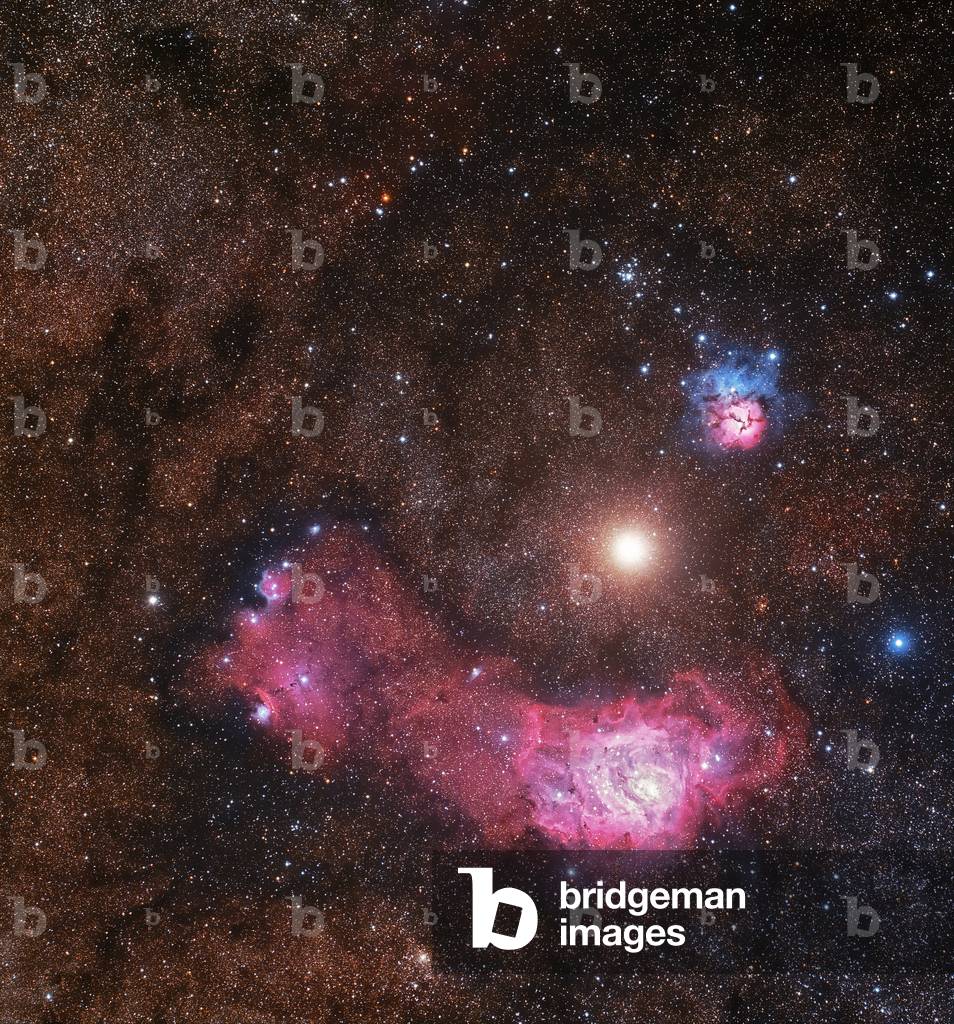
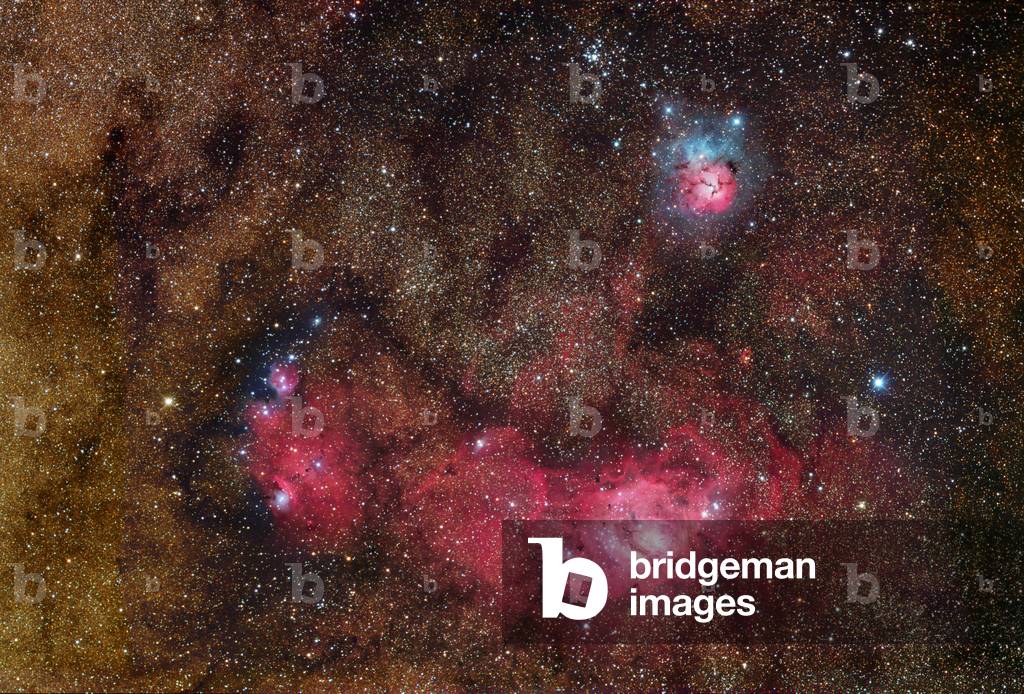
Nebulae M20, M8 and NGC 6559 in Sagittarius - M8, M20 and the NGC 6559 nebulae - View of nebulae of the Lagoon (M8/NGC 6523), bottom, Trifide (M20), top, and NGC 6559 (left). Located in Sagittarius, these nebulae are about 5000 light years away from Earth. This image shows the great diversity of celestial objects in the region of M8. These include the emission nebulae M8, M20, IC4685 and IC1274. Reflection nebulae are also seen in M20, IC1274 - 5, vDb 115, IC 4678. M21 open cluster is also seen. Many of the nebulae seen here are not often imaged do to their low surface brightness. Of note is the bluish halo surrounding and encompassing M8 itself. This appears to not be cataloged. It may be just a portion of M8 itself that is usually not seen. Purposefully the background is bright so to see this nebula
Nebulae M20 - M8 and NGC 6559 in Sagittarius - Nebulae NGC 6559 Lagoon and Trifid in Sagittarius - View of nebulae of the Lagoon (M8/NGC 6523), bottom, Trifide (M20), top, and NGC 6559 (left). Located in Sagittarius, these nebulae are about 5000 light years away from Earth. Composite image. Lagoon nebula (bottom), NGC 6559 (bottom left), Trifid (top right) with top left the open cluster M21. These nebulae are located 5000 light years away in Sagittarius constellation. Composite image from multiple data sources
The Milky Way, looking towards the Galactic Centre - Mosaic of 50 images presenting the region of the center of our galaxy. 60 hours of cumulative poses. The center of our galaxy is a remarkable place. In visible light the central brightening known as “” Baade's Window”” represents not the true center but a discrete “” window””” in the dust which allows the light of millions of bulge stars to shine through. This allowed Walter Baade to peer through and calculate the distance to the galactic center in the 1940's. The true galactic center lies in the lower right of the image, near the NGC 6334-6357 nebulas complex. 50 Frame Mosaic, 60 Hours Exposure
The nebula of the Lagoon (M - 8/ngc 6523) - View of the nebula of the Lagoon (M - 8/ngc 6523). Located in Sagittarius, at a distance of 6500 light years, it extends over a diameter of 60 AL
The center of our galaxy, the milky way - The center of our galaxy, the milky way - This billion pixel mosaic shows the central region of our galaxy, the Lactee Way. The 52 assembled images cover an area that extends from Sagittarius (with the galactic center and nebulae M8 and M20) on the left, to the Scorpio, with the star Antares and the colored cloud of Rho Ophiuchus on the right. Image obtained with a Takahashi FSQ 106 Ed bezel at Cerro Paranal Observatory in Chile; 200 hours of poses. This image is a 1 billion pixel RGB mosaic of the galactic center region (340 million pixels in each R, V and B color). It shows the region spanning from Sagittarius (with the Milky Way center and M8/M20 area on the left) to Scorpius (with colorful Antares and Rho Ophiuchus region on the right) and cat paw nebula (red nebula at the bottom). This mosaic was assembled from 52 different sky fields made from 1200 individual images and 200 hours total exposure time, final image size is 24000x14000 pixels. The images were taken with a SBIG STL camera+Takahashi FSQ106ed f/3.6 telescope and NJP160 mount from the clear skies of ESO Paranal Observatory in Chile. This mosaic is one of the three parts of the ESO Gigagalaxy Zoom project
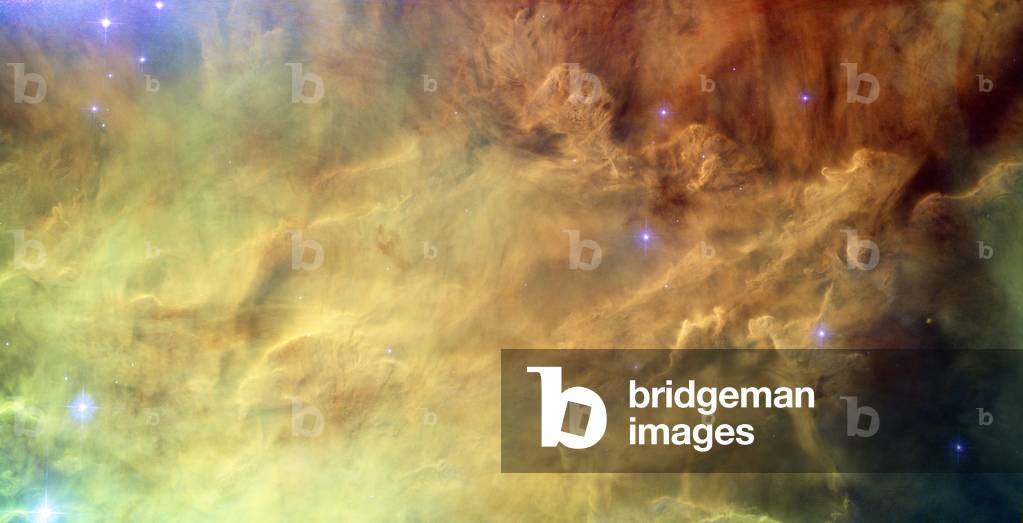
Centre de la nebula de la Lagoon (M8) dans le Sagittarius - In the heart of the Lagoon Nebula - Centre de la nebula de la Lagoon (M8) vue par le telescope Hubble (HST). This close - up shot of the centre of the Lagoon Nebula (Messier 8) clearly shows the delicate structures formed when the powerful radiation of young stars interacts with the hydrogen cloud they formed from. This image was created from exposures taken with the Wide Field Channel of the Advanced Camera for Surveys on Hubble. Light from glowing hydrogen (through the F658N filter) is coloured red. Light from ionised nitrogen (through the F660N filter) is coloured green and light through a yellow filter (F550M) is coloured blue. The exposure times through each filter are 1560 s, 1600 s and 400 s respectively. The blue - white flare at the upper - left of the image is scattered light from a bright star just outside the field of view. The field of view is about 3.3 by 1.7 arcminutes
Nebula of the Lagoon (M8) in Sagittarius - The Lagoon Nebula, M8, NGC 6523 - View of the Nebula of the Lagoon (M8/NGC 6523). Located in Sagittarius, at a distance of 6500 years - light, it extends over a diameter of 60 AL. Image made with the 1.2m Telescope of Schmidt UK from Siding Spring. The irregular distribution of light in this beautiful part of the sky is due mainly to clouds of dust that dim the light of vast clouds of stars that make Sagittarius one of the brightest parts of the Milky Way. The Lagoon nebula is an illuminated part of such a dark ('molecule') cloud and it reveals the dust as dark lanes and globules silhouetted against the luminous gas. Within the nebula is the scattered young star cluster NGC 6530, recently formed from this material, though the centre of star - forming activity has now shifted westwards from the cluster to the brightest part of the nebula, around the tiny Hourglass Nebula
Hourglass Nebula in M8 - The Hourglass Nebula in M8, NGC 6523 - View of the Hourglass Nebula in the heart of the Lagoon Nebula (M8/NGC 6523). Located in Sagittarius, at a distance of 5800 light years, it is a region of star formation whose gases are excited mainly by two massive supergeant stars Herschel 36 and 9 Sagittarii. Image made with the 1.5m Danish telescope of La Silla in Chile. At the heart of the Lagoon Nebula in Sagittarius lies the diminutive Hourglass Nebula. Its gases are excited primarily by two massive O-type supergiants designated Herschel 36 and 9 Sagittarii. These two stars lie to the west of NGC 6530 and are separated from it by a dark lane which divides the nebula like a black lagoon, giving it its name. Twisted funnel shaped clouds are visible close to the illuminating stars, especially Herschel 36. The twists are due to shear forces between the hot excited gases at the surface and the cold interior of the clouds. These stars are probably less than 10,000 years old, about as old as the Hourglass itself, and are evidence of recent star-formation in this very dusty and active region. Image taken with the ESO/Danish 1.5m telescope at La Silla observatory in Chile
Nebula of the Lagoon (M8) in Sagittarius - The Hourglass Nebula in M8, NGC 6523 - View of the Nebula of the Lagoon (M8/NGC 6523). Located in Sagittarius, at a distance of 5800 years - light, it is visible to the naked eye in good conditions. It is a star-forming region illuminated by several large O-type stars that belong to the open cluster NGC 6530 visible on the left of the image. The brightest part of the nebula is called the hourglass nebula whose gases are excited mainly by two massive supergeant stars Herschel 36 and 9 Sagittarii. At the heart of the Lagoon Nebula in Sagittarius lies the diminutive Hourglass Nebula. This extremely bright object is associated with the blue star alongside it, named Herschel 36 after its discoverer. Herschel described M8 as 'A noble nebula' and 'a fine and complicated nebula', but he was clearly intrigued by the Hourglass which he compared to the nucleus of the Andromeda nebula, M31 as 'decidedly not stellar'. The tiny bright nebula that captures Herschel's attention is energised partly by the bright star H36 and partly by a star which, for the present, remains hidden in the pinched waist of the Hourglass. The obscured star is only visible in infrared light which can penetrate the thick clouds of dust seen over much of the Lagoon Nebula and clearly evident in a recent Hubble Space Telescope photograph. These stars are probably less than 10,000 years old, about as old as the Hourglass itself, and are evidence of recent star - formation in this very dusty and active region
Nebula of the Lagoon (M8) in Sagittarius - The Hourglass Nebula in M8, NGC 6523 - View of the Nebula of the Lagoon (M8/NGC 6523). Located in Sagittarius, at a distance of 5800 years - light, it is visible to the naked eye in good conditions. It is a star-forming region illuminated by several large O-type stars that belong to the open cluster NGC 6530 visible on the left of the image. The brightest part of the nebula is called the hourglass nebula whose gases are excited mainly by two massive supergeant stars Herschel 36 and 9 Sagittarii. Image made with Siding Spring's 3.9m telescope. At the heart of the Lagoon Nebula in Sagittarius lies the diminutive Hourglass Nebula. This extremely bright object is associated with the blue star alongside it, named Herschel 36 after its discoverer. Herschel described M8 as 'A noble nebula' and 'a fine and complicated nebula', but he was clearly intrigued by the Hourglass which he compared to the nucleus of the Andromeda nebula, M31 as 'decidedly not stellar'. The tiny bright nebula that captures Herschel's attention is energised partly by the bright star H36 and partly by a star which, for the present, remains hidden in the pinched waist of the Hourglass. The obscured star is only visible in infrared light which can penetrate the thick clouds of dust seen over much of the Lagoon Nebula and clearly evident in a recent Hubble Space Telescope photograph. These stars are probably less than 10,000 years old, about as old as the Hourglass itself, and are evidence of recent star - formation in this very dusty and active region
Nebula of the Lagoon (M8) in Sagittarius - The Lagoon nebula (M8) in Sagittarius - View of the Nebula of the Lagoon (M8/NGC 6523). Located in Sagittarius, at a distance of 5800 years - light, it is visible to the naked eye in good conditions. It is a star-forming region illuminated by several large O-type stars that belong to the open cluster NGC 6530 visible in the center of the image. The brightest part of the nebula is called the hourglass nebula whose gases are excited mainly by two massive supergeant stars Herschel 36 and 9 Sagittarii. M8 has at least 60 Giant B stars, 3 to 4 times more than the Orion Nebula. The Lagoon nebula (M8), can be visible to the unaided eye as a small bright patch above the large Sagittarius star cloud in the Milky Way. The Lagoon nebula is a star - forming region about 5800 light years from us. The nebula is illuminated by several O - type giants within the open cluster NGC 6530 near the center of the nebula. The brightest part of the nebula is known as the “hourglass nebula”” and its gases are excited primarily by two massive O - type supergiants designated Herschel 36 and 9 Sagittarii. These two stars lie to the west of NGC 6530 and are separated from it by a dark lane dividing the nebula like a black lagoon, giving it its name. Twisted funnel shaped clouds are visible close to the illuminating stars, especially Herschel 36. They are due to shear forces between the hot excited gases at the surface and the cold interior of the clouds. At least 60 B - type giants are embedded in the nebula which make M8 3 to 4 times richer in massive stars than the Orion nebula
Lactee Way - Galactic Centre Region - The Milky Way looking towards the Galactic Centre
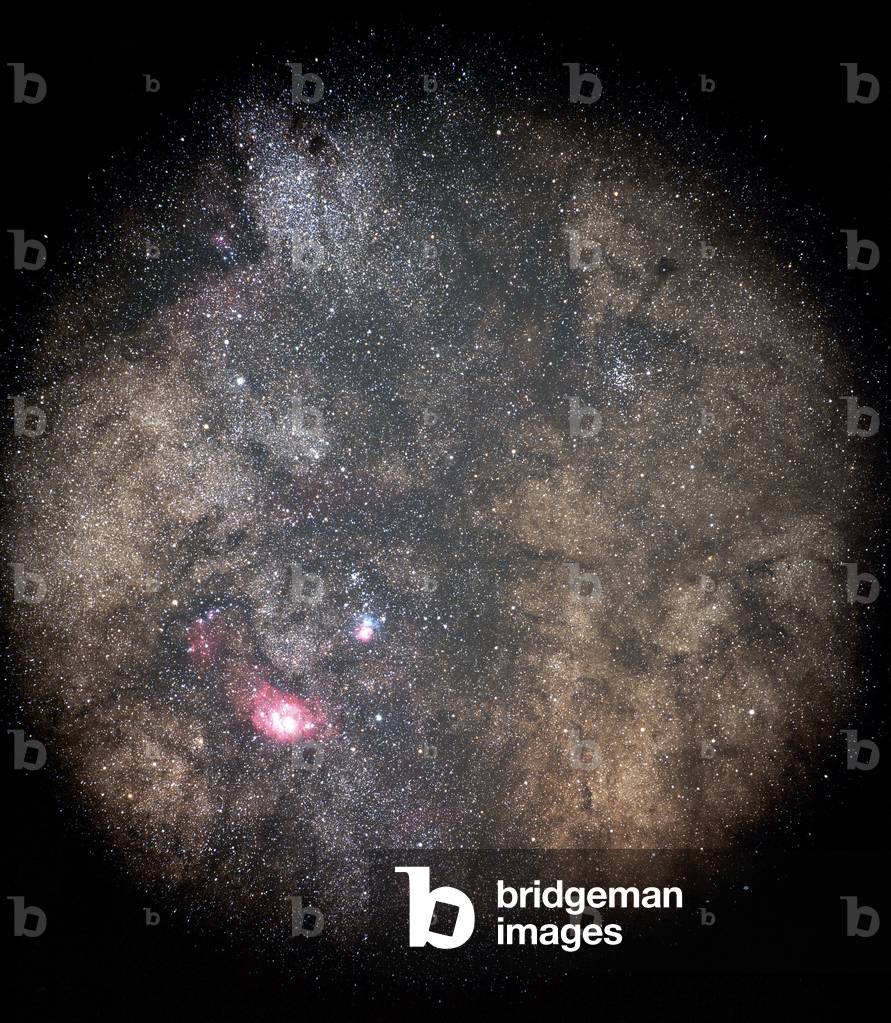
The Milky Way, looking towards the Galactic Centre - The Milky Way, looking towards the Galactic Centre - The bright point at the bottom left is Jupiter Planet The Milky Way is best seen on winter nights (May to August) from the southern hemisphere. This wide-angle picture shows a broad span of the southern Milky Way and is a photograph made using colour film in a conventional camera. The camera which was pointed towards the centre of our Galaxy, in the direction of the constellation of Sagittarius. The Galactic centre itself is totally hidden at visible wavelengths by the band of dust which divides the Milky Way along much of its length. The dust lane is only visible because it blots out background stars. Embedded in the dust are many star-forming regions, seen as bright red emission nebulae. The brightest, left of the centre of the picture, is Messier 8, the Lagoon Nebula, which is visible to the unaided eye. The bright 'star' at lower left is the planet Jupiter
Nebula of the Lagoon (M8) in Sagittarius - The Lagoon nebula (M8) in Sagittarius - View of the Nebula of the Lagoon (M8/NGC 6523). Located in Sagittarius, at a distance of 5800 years - light, it is visible to the naked eye in good conditions. It is a star-forming region illuminated by several large O-type stars that belong to the open cluster NGC 6530 visible in the center of the image. The brightest part of the nebula is called the hourglass nebula whose gases are excited mainly by two massive supergeant stars Herschel 36 and 9 Sagittarii. M8 has at least 60 Giant B stars, 3 to 4 times more than the Orion Nebula. The Lagoon nebula (M8), can be visible to the unaided eye as a small bright patch above the large Sagittarius star cloud in the Milky Way. The Lagoon nebula is a star - forming region about 5800 light years from us. The nebula is illuminated by several O - type giants within the open cluster NGC 6530 near the center of the nebula. The brightest part of the nebula is known as the “hourglass nebula”” and its gases are excited primarily by two massive O - type supergiants designated Herschel 36 and 9 Sagittarii. These two stars lie to the west of NGC 6530 and are separated from it by a dark lane dividing the nebula like a black lagoon, giving it its name. Twisted funnel shaped clouds are visible close to the illuminating stars, especially Herschel 36. They are due to shear forces between the hot excited gases at the surface and the cold interior of the clouds. At least 60 B - type giants are embedded in the nebula which make M8 3 to 4 times richer in massive stars than the Orion nebula
Nebula of the Lagoon (M8) in Sagittarius - M8, The Lagoon Nebula - View of the Nebula of the Lagoon (M8/NGC 6523). Located in Sagittarius, at a distance of 5800 years - light, it is visible to the naked eye in good conditions. It is a star-forming region illuminated by several giant O stars that belong to the open cluster NGC 6530 visible in the center of the image. The brightest part of the nebula is called the hourglass nebula whose gases are excited mainly by two supergiant stars Herschel 36 and 9 Sagittarii. M8 has at least 60 giant B stars, 3 to 4 times more than the Orion nebula. M8 is an amazing stellar nursery. Hot young stars that formed out of the hydrogen gas in the nebula cause it to glow in the light of ionized hydrogen at the hydrogen - alpha wavelength of 656nm. The Lagoon Nebula gets its name from the distinctive dark lane that runs through the heart of the nebula, just to the west of open cluster NGC 6530. Bok globules, small dark knots which are condensing protostellar clouds, can be seen sprinkled throughout the nebula. The brightest part of M8 has an apparent size of about 1 degree on the sky (the size of two full Moons) and is 100 light years across in space. It is located about 5,200 light years away
Nebula of the Lagoon (M8) in Sagittarius - The Lagoon nebula (M8) in Sagittarius - View of the Nebula of the Lagoon (M8/NGC 6523). Located in Sagittarius, at a distance of 5800 years - light, it is visible to the naked eye in good conditions. It is a star-forming region illuminated by several large O-type stars that belong to the open cluster NGC 6530 visible towards the center of the image. The brightest part of the nebula is called the hourglass nebula whose gases are excited mainly by two massive supergeant stars Herschel 36 and 9 Sagittarii. M8 has at least 60 Giant B stars, 3 to 4 times more than the Orion Nebula. The Lagoon nebula (M8), can be visible to the unaided eye as a small bright patch above the large Sagittarius star cloud in the Milky Way. The Lagoon nebula is a star - forming region about 5800 light years from us. The nebula is illuminated by several O - type giants within the open cluster NGC 6530 near the center of the nebula. The brightest part of the nebula is known as the “hourglass nebula”” and its gases are excited primarily by two massive O - type supergiants designated Herschel 36 and 9 Sagittarii. At least 60 B - type giants are embedded in the nebula which make M8 3 to 4 times richer in massive stars than the Orion nebula
View of the nebula of the Lagoon (M8/NGC 6523). Located in Sagittarius, at a distance of 5800 light years, it is visible to the naked eye in good conditions. It is a star-forming region illuminated by several large O-type stars that belong to the open cluster NGC 6530 visible in the center of the image. The brightest part of the nebula is called the hourglass nebula whose gases are excited mainly by two massive supergeant stars Herschel 36 and 9 Sagittarii. M8 has at least 60 Giant B stars, 3 to 4 times more than the Orion nebula - The Lagoon nebula (M8), can be visible to the unaided eye as a small bright patch above the large Sagittarius star cloud in the Milky Way. The Lagoon nebula is a star-forming region about 5800 light years from us. The nebula is illuminated by several O-type giants within the open cluster NGC 6530 near the center of the nebula. The brightest part of the nebula is known as the “hourglass nebula”” and its gases are excited primarily by two massive O-type supergiants designated Herschel 36 and 9 Sagittarii. These two stars lie to the west of NGC 6530 and are separated from it by a dark lane dividing the nebula like a black lagoon, giving it its name. Twisted funnel shaped clouds are visible close to the illuminating stars, especially Herschel 36. They are due to shear forces between the hot excited gases at the surface and the cold interior of the clouds. At least 60 B-type giants are embedded in the nebula which make M8 3 to 4 times richer in massive stars than the Orion nebula: Nebula of the Lagoon (M8) in Sagittarius
Nebulae M20 - M8 in Sagittarius - M20 and M8 nebulas in Sagittarius - View of nebulae of the Lagoon (M8/NGC 6523), below, and Trifide (M20), above. Located in Sagittarius, these nebulae are about 5000 light years away from Earth. From a dark site, the Lagoon nebula (M8), bottom, is visible to the unaided eye as a small bright patch above the large Sagittarius star cloud in the Milky Way. Taking its name from the dark lane that runs through the center of the nebula, just to the west of open cluster NGC 6530, the Lagoon nebula is a beautiful sight in any size telescope. M20, top, is a spectacular combination of emission and reflection nebulosity, bisected by the dark nebula B85