[]
您当前的选择
资产 资产
您的报价 0

您的选择

清除选择
商品已加入购物车
{"event":"pageview","page_type1":"undetected","page_type2":"_assets_search_override","language":"cn","user_logged":"false","user_type":"ecommerce","nl_subscriber":"false"}
{"event":"ecommerce_event","event_name":"view_item","event_category":"browse_catalog","ecommerce":{"items":[{"item_id":"UIG867152","item_category":"photo","item_category2":"no_copyright","item_category3":"standard","item_category5":"not_balown","item_list_name":"search_results","item_name":"this_image_from_the_herschel_space_observatory_shows_most_the_cloud_associated_with_the_rosette_nebu","item_variant":"undefined"},{"item_id":"UIG867154","item_category2":"no_copyright","item_category3":"standard","item_category5":"not_balown","item_list_name":"search_results","item_name":"this_image_from_the_herschel_space_observatory_shows_most_the_cloud_associated_with_the_rosette_nebu","item_variant":"undefined"},{"item_id":"UIG867155","item_category2":"no_copyright","item_category3":"standard","item_category5":"not_balown","item_list_name":"search_results","item_name":"this_image_from_the_herschel_space_observatory_shows_most_the_cloud_associated_with_the_rosette_nebu","item_variant":"undefined"},{"item_id":"UIG867307","item_category2":"no_copyright","item_category3":"standard","item_category5":"not_balown","item_list_name":"search_results","item_name":"astronomers_using_the_herschel_space_observatory_have_discovered_that_a_suspected_ring_at_the_center","item_variant":"undefined"},{"item_id":"UIG867369","item_category2":"no_copyright","item_category3":"standard","item_category5":"not_balown","item_list_name":"search_results","item_name":"this_herschel_image_of_the_eagle_nebula_shows_the_self_emission_of_the_intensely_cold_nebula_s_gas_a","item_variant":"undefined"},{"item_id":"UIG867370","item_category2":"no_copyright","item_category3":"standard","item_category5":"not_balown","item_list_name":"search_results","item_name":"this_herschel_image_of_the_eagle_nebula_shows_the_self_emission_of_the_intensely_cold_nebula_s_gas_a","item_variant":"undefined"},{"item_id":"UIG867368","item_category2":"no_copyright","item_category3":"standard","item_category5":"not_balown","item_list_name":"search_results","item_name":"this_herschel_image_of_the_eagle_nebula_shows_the_self_emission_of_the_intensely_cold_nebula_s_gas_a","item_variant":"undefined"},{"item_id":"UIG867308","item_category2":"no_copyright","item_category3":"standard","item_category5":"not_balown","item_list_name":"search_results","item_name":"astronomers_using_the_herschel_space_observatory_have_discovered_that_a_suspected_ring_at_the_center","item_variant":"undefined"},{"item_id":"UIG867367","item_category2":"no_copyright","item_category3":"standard","item_category5":"not_balown","item_list_name":"search_results","item_name":"this_herschel_image_of_the_eagle_nebula_shows_the_self_emission_of_the_intensely_cold_nebula_s_gas_a","item_variant":"undefined"},{"item_id":"UIG867153","item_category":"photo","item_category2":"no_copyright","item_category3":"standard","item_category5":"not_balown","item_list_name":"search_results","item_name":"this_image_from_the_herschel_space_observatory_shows_most_the_cloud_associated_with_the_rosette_nebu","item_variant":"undefined"},{"item_id":"UIG867358","item_category2":"no_copyright","item_category3":"standard","item_category5":"not_balown","item_list_name":"search_results","item_name":"this_image_shows_the_small_magellanic_cloud_galaxy_in_infrared_light_from_the_herschel_space_observa","item_variant":"undefined"},{"item_id":"UIG867359","item_category":"photo","item_category2":"no_copyright","item_category3":"standard","item_category5":"not_balown","item_list_name":"search_results","item_name":"this_image_shows_the_small_magellanic_cloud_galaxy_in_infrared_light_from_the_herschel_space_observa","item_variant":"undefined"},{"item_id":"UIG867309","item_category":"photo","item_category2":"no_copyright","item_category3":"standard","item_category5":"not_balown","item_list_name":"search_results","item_name":"astronomers_using_the_herschel_space_observatory_have_discovered_that_a_suspected_ring_at_the_center","item_variant":"undefined"},{"item_id":"UIG867382","item_category2":"no_copyright","item_category3":"standard","item_category5":"not_balown","item_list_name":"search_results","item_name":"the_herschel_space_observatory_has_shown_that_galaxies_with_the_most_powerful_active_supermassive_bl","item_variant":"undefined"},{"item_id":"UIG867356","item_category":"photo","item_category2":"no_copyright","item_category3":"standard","item_category5":"not_balown","item_list_name":"search_results","item_name":"this_image_shows_the_large_magellanic_cloud_galaxy_in_infrared_light_as_seen_by_the_herschel_space_o","item_variant":"undefined"},{"item_id":"UIG867354","item_category":"photo","item_category2":"no_copyright","item_category3":"standard","item_category5":"not_balown","item_list_name":"search_results","item_name":"this_image_shows_the_large_magellanic_cloud_galaxy_in_infrared_light_as_seen_by_the_herschel_space_o","item_variant":"undefined"},{"item_id":"UIG867355","item_category2":"no_copyright","item_category3":"standard","item_category5":"not_balown","item_list_name":"search_results","item_name":"this_image_shows_the_large_magellanic_cloud_galaxy_in_infrared_light_as_seen_by_the_herschel_space_o","item_variant":"undefined"},{"item_id":"UIG867357","item_category2":"no_copyright","item_category3":"standard","item_category5":"not_balown","item_list_name":"search_results","item_name":"this_image_shows_the_large_magellanic_cloud_galaxy_in_infrared_light_as_seen_by_the_herschel_space_o","item_variant":"undefined"},{"item_id":"PIX4646082","item_category":"photo","item_category2":"no_copyright","item_category3":"standard","item_category4":"p_dumas","item_category5":"not_balown","item_list_name":"search_results","item_name":"mirror_of_the_herschel_satellite_herschel_spacecraft_s_mirror_inspection_of_the_mirror_of_the_europe","item_variant":"undefined"},{"item_id":"PIX4646096","item_category":"photo","item_category2":"no_copyright","item_category3":"standard","item_category4":"p_dumas","item_category5":"not_balown","item_list_name":"search_results","item_name":"mirror_of_the_herschel_satellite_herschel_spacecraft_s_mirror_inspection_of_the_mirror_of_the_europe","item_variant":"undefined"},{"item_id":"PIX4646076","item_category":"photo","item_category2":"no_copyright","item_category3":"standard","item_category4":"p_dumas","item_category5":"not_balown","item_list_name":"search_results","item_name":"mirror_of_the_herschel_satellite_herschel_spacecraft_s_mirror_inspection_of_the_mirror_of_the_europe","item_variant":"undefined"},{"item_id":"PIX4646089","item_category":"photo","item_category2":"no_copyright","item_category3":"standard","item_category4":"p_dumas","item_category5":"not_balown","item_list_name":"search_results","item_name":"mirror_of_the_herschel_satellite_herschel_spacecraft_s_mirror_inspection_of_the_mirror_of_the_europe","item_variant":"undefined"},{"item_id":"PIX4646124","item_category":"illustration","item_category2":"no_copyright","item_category3":"standard","item_category4":"c_carreau","item_category5":"not_balown","item_list_name":"search_results","item_name":"satellite_herschel_illustration_artist_s_view_of_the_european_satellite_herschel_the_herschel_space_","item_variant":"undefined"},{"item_id":"PIX4646142","item_category":"illustration","item_category2":"no_copyright","item_category3":"standard","item_category4":"d_ducros","item_category5":"not_balown","item_list_name":"search_results","item_name":"satellite_herschel_illustration_artist_s_view_of_the_european_satellite_herschel_the_herschel_space_","item_variant":"undefined"},{"item_id":"PIX4646125","item_category":"illustration","item_category2":"no_copyright","item_category3":"standard","item_category4":"d_ducros","item_category5":"not_balown","item_list_name":"search_results","item_name":"satellite_herschel_illustration_ariane_5_fairing_with_satellite_herschel_artwork_artist_s_view_of_th","item_variant":"undefined"},{"item_id":"PIX4646098","item_category":"illustration","item_category2":"no_copyright","item_category3":"standard","item_category4":"d_ducros","item_category5":"not_balown","item_list_name":"search_results","item_name":"satellite_herschel_illustration_artist_s_view_of_the_european_satellite_herschel_the_herschel_space_","item_variant":"undefined"},{"item_id":"PIX4646169","item_category":"illustration","item_category2":"no_copyright","item_category3":"standard","item_category4":"d_ducros","item_category5":"not_balown","item_list_name":"search_results","item_name":"satellite_herschel_illustration_ariane_5_fairing_with_satellite_herschel_artwork_artist_s_view_of_th","item_variant":"undefined"},{"item_id":"PIX4646080","item_category":"photo","item_category2":"no_copyright","item_category3":"standard","item_category4":"a_le_floch","item_category5":"not_balown","item_list_name":"search_results","item_name":"herschel_satellite_herschel_spacecraft_being_prepared_for_acoustic_tests_the_european_satellite_hers","item_variant":"undefined"},{"item_id":"PIX4646153","item_category":"illustration","item_category2":"no_copyright","item_category3":"standard","item_category4":"d_ducros","item_category5":"not_balown","item_list_name":"search_results","item_name":"satellite_herschel_illustration_ariane_5_stage_with_satellite_herschel_artwork_artist_s_view_of_the_","item_variant":"undefined"},{"item_id":"PIX4646048","item_category":"illustration","item_category2":"no_copyright","item_category3":"standard","item_category5":"not_balown","item_list_name":"search_results","item_name":"herschel_satellite_illustration_herschel_satellite_artwork_artist_s_view_of_the_european_satellite_h","item_variant":"undefined"},{"item_id":"PIX4646040","item_category":"illustration","item_category2":"no_copyright","item_category3":"standard","item_category5":"not_balown","item_list_name":"search_results","item_name":"herschel_satellite_illustration_herschel_satellite_artwork_artist_s_view_of_the_european_satellite_h","item_variant":"undefined"},{"item_id":"PIX4609049","item_category":"photo","item_category2":"no_copyright","item_category3":"standard","item_category5":"not_balown","item_list_name":"search_results","item_name":"andromede_galaxy_m31_seen_in_x_and_infrared_andromeda_galaxy_infrared_and_x_ray_composite_andromede_","item_variant":"undefined"},{"item_id":"PIX4621141","item_category":"photo","item_category2":"no_copyright","item_category3":"standard","item_category5":"not_balown","item_list_name":"search_results","item_name":"star_formation_in_the_southern_cross_star_formation_in_the_southern_cross_part_of_the_lactee_route_i","item_variant":"undefined"}]}}
{"event":"custom_event","event_name":"view_search_result","event_category":"browse_catalog","keyword":"osservatorio spaziale herschel","search_type":"standard","search_bridgeman_artists":"false","search_mode":"automatic","search_zero_result":"false","search_results":33,"search_results_page_number":1}

Osservatorio Spaziale Herschel' 图片和/或视频结果 page 1 of 1

主要过滤器
购买印刷品选项
免版税选项
电子商务选项
路透社业绩
媒体类型
方向
颜色
权利类型
权利
更多过滤器
布里奇曼艺术家
布里奇曼摄影师
世纪
镜头滤镜
视频原始格式
视频分辨率
视频分类
Filter group
Filter colors
按以下排序:
每页
Filter group
权利类型
媒体类型
无版权
Filter colors

显示选项

View
Image Size

[2, 无限[找到'Osservatorio Spaziale Herschel'的图片,33

Mirror of the Herschel satellite - Herschel spacecraft's mirror - Inspection of the mirror of the European Herschel satellite. The Herschel Space Observatory, scheduled to launch in 2009, will study in the infrared the formation of galaxies, stars and planetary systems. This satellite measures nearly 7 metres high by 4.3 metres wide and weighs 3.25 tonnes. Its telescope has a 3.5-meter mirror, making it the largest mirror ever made for a scientific space mission. Herschel will orbit around Lagrange 2, approximately 1.5 million kilometres from Earth. The gigantic telescope of ESA's space - based infrared observatory, Herschel, is being prepared to be assembled with its spacecraft. Herschel's telescope, which will carry the largest mirror ever flown in space, has been delivered to ESA's European Space Research and Technology Centre, ESTEC, where engineers and scientists are busy with the final steps that will prepare the infrared observatory for launch in 2009. ESA's Herschel Space Observatory will observe at wavelengths never covered before. It will be located 1.5 million kilometers away from Earth, farther than any previous space telescope
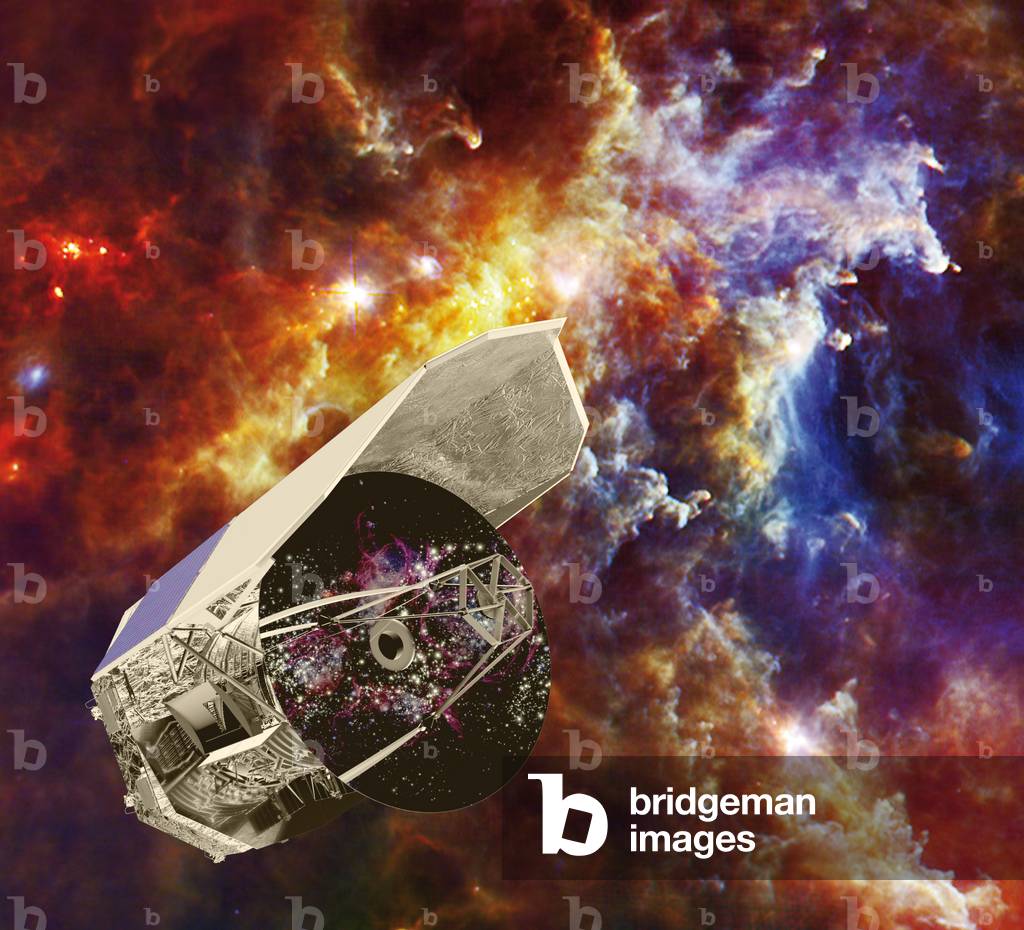
Satellite Herschel - Illustration - Artist's view of the European satellite Herschel. The Herschel Space Observatory, launched in 2009, studies the formation of galaxies, stars and planetary systems in the infrared. This satellite measures nearly 7 metres high by 4.3 metres wide and weighs 3.25 tonnes. Its telescope has a 3.5-meter mirror, making it the largest mirror ever made for a scientific space mission. Herschel is in orbit around Lagrange 2, approximately 1.5 million kilometres from Earth. ESA's Herschel Space Observatory (formerly called Far Infrared and Submillimetre Telescope or FIRST) studies the mystery of how stars and galaxies were born. Objects such as other planetary systems, or processes like the birth of galaxies in the early universe, can best be studied with infrared space telescopes in space. This is the reason for Esa's Herschel. ESA's Herschel Space Observatory is bigger and better than any of its predecessors. Moreover, it observes at wavelengths never covered before. It is located 1.5 million kilometers away from Earth, farther than any previous space telescope. Launched in 2009, Herschel is one the Cornerstone missions ESA's Horizons 2000 programme. Herschel is a key project space astronomy in the next millennium
Satellite Herschel - Illustration - Artist's view of the European satellite Herschel. The Herschel Space Observatory, scheduled to launch in 2009, will study in the infrared the formation of galaxies, stars and planetary systems. This satellite measures nearly 7 metres high by 4.3 metres wide and weighs 3.25 tonnes. Its telescope has a 3.5-meter mirror, making it the largest mirror ever made for a scientific space mission. Herschel will orbit around Lagrange 2, approximately 1.5 million kilometres from Earth. ESA's Herschel Space Observatory (formerly called Far Infrared and Submillimetre Telescope or FIRST) will solve the mystery of how stars and galaxies were born. Objects such as other planetary systems, or processes like the birth of galaxies in the early universe, can best be studied with infrared space telescopes in space. This is the reason for Esa's Herschel. ESA's Herschel Space Observatory will be bigger and better than any of its predecessors. Moreover, it will observe at wavelengths never covered before. It will be located 1.5 million kilometers away from Earth, farther than any previous space telescope. Due for launch in 2009, Herschel is one the Cornerstone missions ESA's Horizons 2000 programme. Herschel is a key project space astronomy in the next millennium
Satellite Herschel - Illustration - Ariane 5 fairing with satellite Herschel. Artwork - Artist's view of the European satellite Herschel during its launch by an Ariane 5 rocket. The Herschel Space Observatory, scheduled to launch in 2009, will study in the infrared the formation of galaxies, stars and planetary systems. This satellite measures nearly 7 metres high by 4.3 metres wide and weighs 3.25 tonnes. Its telescope has a 3.5-meter mirror, making it the largest mirror ever made for a scientific space mission. Herschel will orbit around Lagrange 2, approximately 1.5 million kilometres from Earth. ESA's Herschel Space Observatory (formerly called Far Infrared and Submillimetre Telescope or FIRST) will solve the mystery of how stars and galaxies were born. Objects such as other planetary systems, or processes like the birth of galaxies in the early universe, can best be studied with infrared space telescopes in space. This is the reason for Esa's Herschel. ESA's Herschel Space Observatory will be bigger and better than any of its predecessors. Moreover, it will observe at wavelengths never covered before. It will be located 1.5 million kilometers away from Earth, farther than any previous space telescope. Due for launch in 2009, Herschel is one the Cornerstone missions ESA's Horizons 2000 programme. Herschel is a key project space astronomy in the next millennium
Satellite Herschel - Illustration - Artist's view of the European satellite Herschel. The Herschel Space Observatory, scheduled to launch in 2009, will study in the infrared the formation of galaxies, stars and planetary systems. This satellite measures nearly 7 metres high by 4.3 metres wide and weighs 3.25 tonnes. Its telescope has a 3.5-meter mirror, making it the largest mirror ever made for a scientific space mission. Herschel will orbit around Lagrange 2, approximately 1.5 million kilometres from Earth. ESA's Herschel Space Observatory (formerly called Far Infrared and Submillimetre Telescope or FIRST) will solve the mystery of how stars and galaxies were born. Objects such as other planetary systems, or processes like the birth of galaxies in the early universe, can best be studied with infrared space telescopes in space. This is the reason for Esa's Herschel. ESA's Herschel Space Observatory will be bigger and better than any of its predecessors. Moreover, it will observe at wavelengths never covered before. It will be located 1.5 million kilometers away from Earth, farther than any previous space telescope. Due for launch in 2009, Herschel is one the Cornerstone missions ESA's Horizons 2000 programme. Herschel is a key project space astronomy in the next millennium
Satellite Herschel - Illustration - Ariane 5 fairing with satellite Herschel. Artwork - Artist's view of the European satellite Herschel during its launch by an Ariane 5 rocket. The Herschel Space Observatory, launched on 14 May 2009, is studying in the infrared the formation of galaxies, stars and planetary systems. This satellite measures nearly 7 metres high by 4.3 metres wide and weighs 3.25 tonnes. Its telescope has a 3.5-meter mirror, making it the largest mirror ever made for a scientific space mission. Herschel is in orbit around Lagrange 2, approximately 1.5 million kilometres from Earth. ESA's Herschel Space Observatory (formerly called Far Infrared and Submillimetre Telescope or FIRST) will solve the mystery of how stars and galaxies were born. Objects such as other planetary systems, or processes like the birth of galaxies in the early universe, can best be studied with infrared space telescopes in space. This is the reason for Esa's Herschel. ESA's Herschel Space Observatory will be bigger and better than any of its predecessors. Moreover, it will observe at wavelengths never covered before. It will be located 1.5 million kilometers away from Earth, farther than any previous space telescope. Launched on May 14 2009, Herschel is one the Cornerstone missions ESA's Horizons 2000 programme. Herschel is a key project space astronomy in the next millennium
Herschel satellite - Herschel spacecraft being prepared for acoustic tests - The European satellite Herschel prepares for acoustic tests in June 2008. The Herschel Space Observatory, scheduled to launch in 2009, will study in the infrared the formation of galaxies, stars and planetary systems. This satellite measures nearly 7 metres high by 4.3 metres wide and weighs 3.25 tonnes. Its telescope has a 3.5-meter mirror, making it the largest mirror ever made for a scientific space mission. Herschel will orbit around Lagrange 2, approximately 1.5 million kilometres from Earth. A picture of the Herschel spacecraft being prepared for acoustic tests. On 5 and 6 June 2008, the Herschel spacecraft successfully passed its acoustic tests. During the tests, the spacecraft was subjected to acoustic noise, generated to simulate the noise levels during launch, at the European Space Research and Technology Centre's Large European Acoustic Facility (LEAF). ESA's Herschel Space Observatory will observe at wavelengths never covered before. It will be located 1.5 million kilometers away from Earth, farther than any previous space telescope. Due for launch in 2009, Herschel is one the Cornerstone missions ESA's Horizons 2000 programme. Herschel is a key project space astronomy in the next millennium
Satellite Herschel - Illustration - Ariane 5 stage with satellite Herschel. Artwork - Artist's view of the European satellite Herschel during its launch by an Ariane 5 rocket. The Herschel Space Observatory, launched on 14 May 2009, is studying in the infrared the formation of galaxies, stars and planetary systems. This satellite measures nearly 7 metres high by 4.3 metres wide and weighs 3.25 tonnes. Its telescope has a 3.5-meter mirror, making it the largest mirror ever made for a scientific space mission. Herschel is in orbit around Lagrange 2, approximately 1.5 million kilometres from Earth. ESA's Herschel Space Observatory (formerly called Far Infrared and Submillimetre Telescope or FIRST) will solve the mystery of how stars and galaxies were born. Objects such as other planetary systems, or processes like the birth of galaxies in the early universe, can best be studied with infrared space telescopes in space. This is the reason for Esa's Herschel. ESA's Herschel Space Observatory will be bigger and better than any of its predecessors. Moreover, it will observe at wavelengths never covered before. It will be located 1.5 million kilometers away from Earth, farther than any previous space telescope. Launched on May 14 2009, Herschel is one the Cornerstone missions ESA's Horizons 2000 programme. Herschel is a key project space astronomy in the next millennium
Herschel Satellite - Illustration - Herschel Satellite. Artwork - Artist's view of the European satellite Herschel. The Herschel Space Observatory, scheduled to launch in 2009, will study in the infrared the formation of galaxies, stars and planetary systems. This satellite measures nearly 7 metres high by 4.3 metres wide and weighs 3.25 tonnes. Its telescope has a 3.5-meter mirror, making it the largest mirror ever made for a scientific space mission. Herschel will orbit around Lagrange 2, approximately 1.5 million kilometres from Earth. ESA's Herschel Space Observatory (formerly called Far Infrared and Submillimetre Telescope or FIRST) will solve the mystery of how stars and galaxies were born. Infrared astronomy is as young as it is fruitful. In less than three decades infrared astronomers have unveiled tens of thousands of new galaxies, and have made discoveries as surprising as the huge amounts of water vapour that fill the galaxy. Yet scientists know there is still much more to discover. Objects such as other planetary systems, or processes like the birth of galaxies in the early universe, can best be studied with infrared space telescopes in space. This is the reason for Esa's Herschel. ESA's Herschel Space Observatory will be bigger and better than any of its predecessors. Moreover, it will observe at wavelengths never covered before. It will be located 1.5 million kilometers away from Earth, farther than any previous space telescope. Due for launch in 2009, Herschel is one the Cornerstone missions ESA's Horizons 2000 programme. Herschel is a key project space astronomy in the next millennium
Andromede galaxy (M31) seen in X and infrared - Andromeda galaxy infrared and X - Ray composite - Andromede spiral galaxy seen in X-ray (blue) by the XMM - Newton space telescope and in infrared (orange) by the Herschel space telescope. This mosaic of the Andromeda spiral galaxy highlights explosive stars in its interior, and cooler, dusty stars forming in its many rings. The image is a combination of observations from the Herschel Space Observatory taken in infrared light (seen in orange hues), and the XMM - Newton telescope captured in X - rays (seen in blues). Herschel provides a detailed look at the cool clouds of star birth that line the galaxy's five concentric rings. Massive young stars are heating blankets of dust that surround them, causing them to glow in the longer - wavelength infrared light, known as far - infrared, that Herschel sees. In contrast, XMM - Newton is capturing what happens at the end of the lives of massive stars. It shows the high - energy X - rays that come from, among other objects, supernova explosions and massive dead stars rotating around companions. These X - ray sources are clustered in the center of the galaxy, where the most massive stars tend to form. Andromeda is our Milky Way galaxy's nearest large neighbor. It is located about 2.5 million light - years away and holds up to an estimated trillion stars. Our Milky Way is thought to contain about 200 billion to 400 billion stars
Star Formation in the Southern Cross - Star Formation in the Southern Cross - Part of the lactee route in the constellation of the Southern Cross seen in infrared by the Herschel space telescope. The hottest dust appears in blue, the coldest ones appear in red, the new stars will be born. Composite images obtained by SPIRE and PACS instruments on September 3, 2009. Some of the coldest and darkest dust in space shines brightly in this infrared image from the Herschel Observatory, a European Space Agency mission with important participation from NASA. The image is a composite of light captured simultaneously by two of Herschel's three instruments - - the photodetector array camera and spectrometer, and its spectral and photometric imaging receiver. The image reveals a cold and turbulent region where material is just beginning to condense into new stars. It is located in the plane of our Milky Way galaxy, 60 degrees from the center. Blue shows warmer material, red the coolest. The red filaments are made up of the coldest material pictured here - - material that is slightly warmer than the coldest temperature theoretically attainable in the universe. Stars form in cold, dense environments. Light captured by the photodetector array camera and spectrometer (PACS) is colored blue (blue represents 70 - micron light). The light detected by the spectral and photometric imaging receiver (SPIRE) is colored red (and shows the combined wavelengths of 250, 350 and 500 microns). The image spans a region 2 by 2 degrees