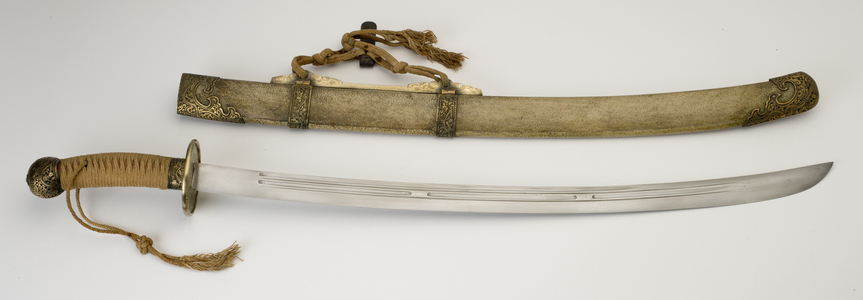
Cavalry officers regimental pattern sword.
Manufactured by Charles Reeves and Company Limited, 18 St Martin's Street, London.
This sword is an example of the idiosyncratic types or styles purchased by officers of Indian regiments. While the hilt is the Pattern 1896 officer's type, the blade is virtually the same as that of the Pattern 1796 Light Cavalry weapon. It is clear that many Indian cavalry officers preferred a slashing blade to the compromise cut-and-thrust type of official patterns. Indian sowars preferred the 1796 pattern above all and would refashion discarded blades of this type.
The blade is broad and curved with a broad shallow fuller and bears etched decoration. The hilt is a Pattern 1896 honeysuckle design, in plated steel, with a chequered backpiece and pommel. The grip is covered in grey fish skin and bound with silver wire.
Harold Souther Stewart (b 1881) the owner of this sword, transferred from the Royal Artillery, into which he had been commissioned in 1900, to the Indian Army as a lieutenant in the 17th Cavalry in 1906. Rapidly promoted to captain, he became a major in 1913. In 1922, when the 17th were amalgamated with the 37th Cavalry to form the 15th Lancers, staff appointments prevented Stewart from joining the new regiment, and he transferred to the 15th Punjab Regiment, becoming second in command of the 2nd Battalion in October 1925.

 商品已加入购物车