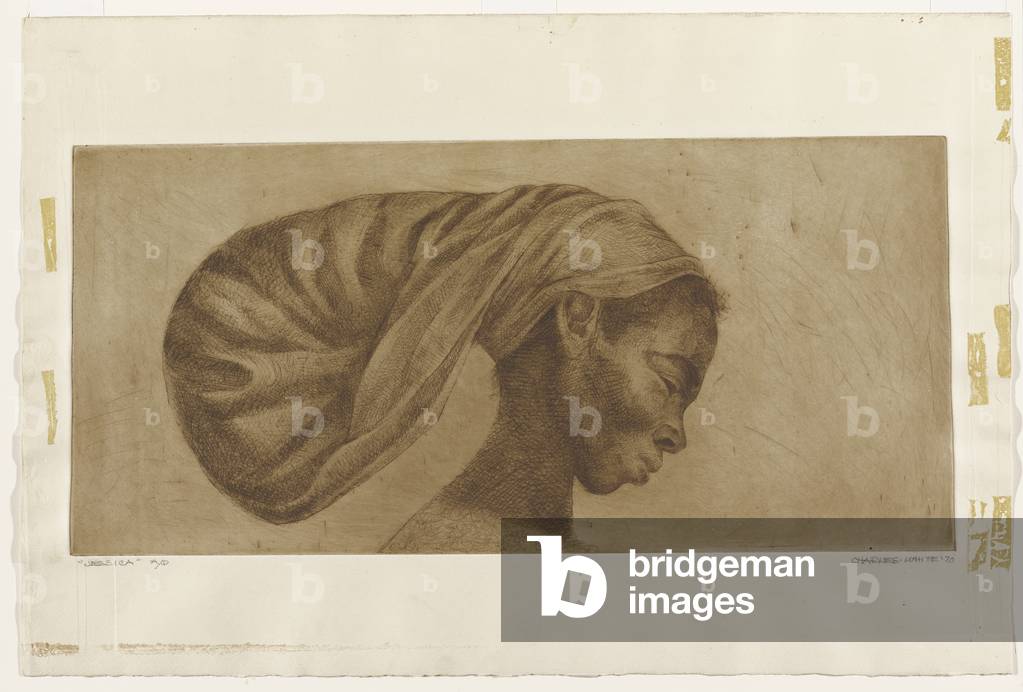
Charles White was a prominent twentieth-century African American artist who celebrated the intrinsic dignity of blacks as a strategy to counteract negative stereotypes that too often undermined the values and virtues of black history and culture. Published in 1970, White’s portrait of “Jessica” embodies the grace, beauty, and confidence of African American women at a time when black cultural awareness was emerging as a social and political force. In this context, the portrait is both a symbol of affirmation and resistance, specifically the resistance to cultural suppression and the practice of being defined by others. Here, White depicts his model wearing an elaborate coiffure and a headscarf that covers the entirety of her hair. Variously known as a dhuku, a gele, or more commonly, a headwrap, its significance as a cultural symbol for women of African descent is directly linked to its history. Though the practice of wearing a headwrap is centuries old among sub-Saharan African women, it is also a vestige of American slavery, a system that required female slaves to cover their hair with a headscarf or kerchief, essentially a badge of subjugation and enslavement. The headwrap is thus emblematic of the wearer’s bond to both enslaved American ancestors and to those who remained in Africa, and worn as a symbol of racial pride and consciousness.
testThis artwork is in copyright. You are responsible for identifying and obtaining permission from the rightsholder before use by carrying out a due diligence search and consulting recognised resources, for example the WATCH database - https://research.hrc.utexas.edu/watch/. Proceeding with use constitutes acceptance of full responsibility for this clearance.

 商品已加入购物车