[]
Ihre AuswahlIhre aktuelle Auswahl
asset(s) Assets
Ihr Preis 0

Ihre Auswahl

Auswahl aufheben
Asset zum Warenkorb hinzugefügt
{"event":"pageview","page_type1":"undetected","page_type2":"_assets_search_override","language":"de","user_logged":"false","user_type":"ecommerce","nl_subscriber":"false"}
{"event":"ecommerce_event","event_name":"view_item","event_category":"browse_catalog","ecommerce":{"items":[{"item_id":"PIX4568290","item_category":"photo","item_category2":"no_copyright","item_category3":"standard","item_category5":"not_balown","item_list_name":"search_results","item_name":"open_cluster_ngc_6231_in_scorpio_open_star_cluster_ngc_6231_in_scorpius_ngc_6231_is_a_cluster_of_sta","item_variant":"undefined"},{"item_id":"REU7524166","item_category":"photo","item_category2":"no_copyright","item_category3":"standard","item_category4":"khaled_al_hariri","item_category5":"not_balown","item_list_name":"search_results","item_name":"a_fossilized_dinosaur_egg_of_18_cm_length_14_cm_width_and_eight_mm_deep_is_displyed_after_it_was_fo_","item_variant":"undefined"},{"item_id":"PIX4568984","item_category":"photo","item_category2":"no_copyright","item_category3":"standard","item_category4":"r_gendler","item_category5":"not_balown","item_list_name":"search_results","item_name":"pleiades_open_cluster_the_pleiades_star_cluster_the_pleiades_star_cluster_contains_about_500_stars_f","item_variant":"undefined"},{"item_id":"PIX4565530","item_category":"photo","item_category2":"no_copyright","item_category3":"standard","item_category5":"not_balown","item_list_name":"search_results","item_name":"group_of_galaxies_hcg_31_hickson_compact_group_31_this_group_of_interacting_galaxies_is_located_166_","item_variant":"undefined"},{"item_id":"PIX4608449","item_category":"photo","item_category2":"no_copyright","item_category3":"standard","item_category4":"miller_ron_b_1947","item_category5":"not_balown","item_list_name":"search_results","item_name":"artist_view_of_beta_pictoris_b_beta_pictoris_b_artwork_artist_s_view_of_beta_pictoris_b_a_giant_exop","item_variant":"undefined"},{"item_id":"REU8041167","item_category":"photo","item_category2":"no_copyright","item_category3":"standard","item_category4":"gregg_newton","item_category5":"not_balown","item_list_name":"search_results","item_name":"ronald_biggs_speaks_in_reuters_interview_1997_07_30_photo","item_variant":"undefined"},{"item_id":"PIX4574181","item_category":"photo","item_category2":"no_copyright","item_category3":"standard","item_category5":"not_balown","item_list_name":"search_results","item_name":"beta_pictoris_b_artist_s_view_of_beta_pictoris_b_a_giant_exoplanet_with_a_mass_equivalent_to_9_times","item_variant":"undefined"}]}}
{"event":"custom_event","event_name":"view_search_result","event_category":"browse_catalog","keyword":"8 millionen jahre alt","search_type":"standard","search_bridgeman_artists":"false","search_mode":"automatic","search_zero_result":"false","search_results":7,"search_results_page_number":1}

'8 Millionen Jahre Alt' Bilder und Clips Suchergebnisse page 1 of 1

Hauptfilter
Option "Kunstdruck kaufen" verfügbar
Royalty-free Optionen
Ecommerce option
Medium
Orientation
Farbbilder
Kategorie
Rechte
Mehr Filter
Bridgeman Artists
Bridgeman Fotografen
Jahrhundert
Footage-Filter
Video Original Format
Video Resolution
Video Category
Filter group
Filter colors
Sortieren nach:
pro Seite
Filter group
Kategorie
Medium
No copyright
Filter colors

Anzeigeoptionen

View
Image Size

Bilder zu '8 Millionen Jahre Alt' gefunden, 7

A fossilized dinosaur egg of 18 cm length,14 cm width and eight mm deep, is displyed after it was fo.., 2001-04-13 (photo)
Zusätzliche Genehmigungen
  • Permission required for non-editorial use (inc book covers and in-context promotional use in documentaries). Please contact us
Bildbeschränkungen
  • Content within this photograph may require additional clearances (eg: trademark and personality rights) depending on Licensee's specific use of material, which may include book and magazine cover use.
Nutzungsbeschränkungen von unseren Content-Partnern
  • Minimum fee applies to this image;Only available to clients invoiced in Australia, Belgium, Brazil, Bulgaria, Canada, China, Cyprus, Czech Republic, Estonia, Finland, France, French Southern Territories, Greece, Hong Kong, Hungary, India, Ireland, Israel, Italy, Lebanon, Luxembourg, Mexico, the Netherlands, New Zealand, Portugal, Qatar, Republic of Korea, Romania, Russian Federation, Singapore, South Africa, Spain, Sweden, Switzerland, Taiwan, Turkey, United Arab Emirates, United Kingdom and United States
Pleiades open cluster - The Pleiades star cluster - The Pleiades star cluster contains about 500 stars formed 100 million years ago. It is located 440 light years from Earth, in the constellation Taurus. Mosaic of 8 images obtained with a telescope of 30 cm in diameter.20h of pose. M45, the Pleiades, is a beautiful open cluster in Taurus surrounded by reflection nebulosity. The cluster has been known since ancient times and contains six bright stars that can easily be seen with the unaided eye, and 500 stars total, most too faint to be seen. The blue nebulosity is visible by starlight reflected off of dust in space. The cluster is located about 440 light years from the Earth and is estimated to be about 100 million years old
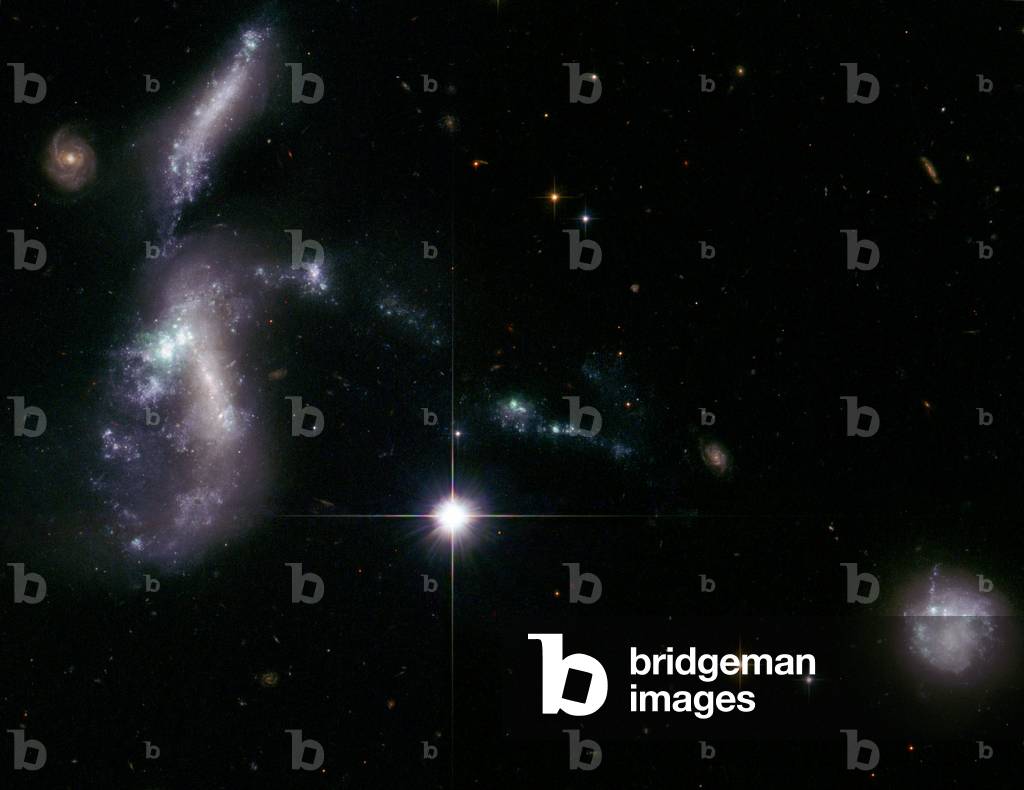
Group of Galaxies HCG 31 - Hickson Compact Group 31 - This group of interacting galaxies is located 166 million years of light from Earth in the constellation Eridan. Dwarf galaxies are merging causing intense star formation. This long fusion process will lead to the birth of a large elliptical galaxy. Image obtained by the Hubble Space Telescope on August 8, 2006. These four dwarf galaxies waited billions of years to come together, setting off a fireworks show as thousands of new star clusters come to life. The distorted galaxies are quickly producing massive, hot, young stars that are pumping out ultraviolet radiation, heating up surrounding gas clouds, and causing them to glow. Such encounters between dwarf galaxies are normally seen billions of light - years away and therefore occurred billions of years ago. But these galaxies, members of Hickson Compact Group 31, are relatively nearby, only 166 million light - years away. In this image, taken by Nasa's Hubble Space Telescope, the bright, distorted object at middle, left, is actually two colliding dwarf galaxies. Myriad star clusters have formed in the streamers of debris pulled from the galaxies and at the site of their head - on collision. The cigar - shaped object above the galaxy duo is another member of the group. A bridge of star clusters connects the trio. A long rope of bright star clusters points to the fourth member of the group, at lower right. The bright object in the center is a foreground star. Astronomers used Hubble's Advanced Camera for Surveys to resolve the youngest and brightest of star clusters, which allowed them to calculate the clusters' ages, map the star - formation history, and determine that the galaxies are starting the final stages of galaxy assembly. Hubble reveals that the brightest clusters, hefty groups each holding at least 100,000 stars, are less than 10 million years old. Astronomers say the interacting galaxies will form
Artist view of Beta Pictoris b - Beta Pictoris b. Artwork: Artist's view of Beta Pictoris b, a giant exoplanet with a mass equivalent to 9 times the mass of Jupiter orbit around the star Beta Pictoris. This artist's impression shows how the planet inside the disc of Beta Pictoris may look. Only 12 million years old, or less than three-thousandths of the age of the Sun, Beta Pictoris is 75% more massive than our parent star. It is located about 60 light-years away towards the constellation of Pictor (the Painter) and is one of the best-known examples of a star surrounded by a dusty debris disc. Earlier observations showed a warp of the disc, a secondary inclined disc and comets falling onto the star, all indirect, but tell-tale signs that strongly suggested the presence of a massive planet. Observations done with the NACO instrument on Eso's Very Large Telescope in 2003, 2008 and 2009, have proven the presence of a planet around Beta Pictoris. It is located at a distance between 8 and 15 times the Earth-Sun separation - or Astronomical Units - which is about the distance Saturn is from the Sun. The planet has a mass of about nine Jupiter masses and is right mass and location to explain the observed warp in the inner parts of the disc
RONALD BIGGS SPEAKS IN REUTERS INTERVIEW, 1997-07-30 (photo)
Zusätzliche Genehmigungen
  • Permission required for non-editorial use (inc book covers and in-context promotional use in documentaries). Please contact us
Bildbeschränkungen
  • Content within this photograph may require additional clearances (eg: trademark and personality rights) depending on Licensee's specific use of material, which may include book and magazine cover use.
Nutzungsbeschränkungen von unseren Content-Partnern
  • Minimum fee applies to this image;Only available to clients invoiced in Australia, Belgium, Brazil, Bulgaria, Canada, China, Cyprus, Czech Republic, Estonia, Finland, France, French Southern Territories, Greece, Hong Kong, Hungary, India, Ireland, Israel, Italy, Lebanon, Luxembourg, Mexico, the Netherlands, New Zealand, Portugal, Qatar, Republic of Korea, Romania, Russian Federation, Singapore, South Africa, Spain, Sweden, Switzerland, Taiwan, Turkey, United Arab Emirates, United Kingdom and United States
Beta Pictoris b - Artist's view of Beta Pictoris b, a giant exoplanet with a mass equivalent to 9 times the mass of Jupiter orbiting the star Beta Pictoris. This artist's impression shows how the planet inside the disc of Beta Pictoris may look. Only 12 million years old, or less than three - thousandths of the age of the Sun, Beta Pictoris is 75% more massive than our parent star. It is located about 60 light - years away towards the constellation of Pictor (the Painter) and is one of the best - known examples of a star surrounded by a dusty debris disc. Earlier observations showed a warp of the disc, a secondary inclined disc and comets falling onto the star, all indirect, but tell - tale signs that strongly suggested the presence of a massive planet. Observations done with the NACO instrument on Eso's Very Large Telescope in 2003, 2008 and 2009, have proven the presence of a planet around Beta Pictoris. It is located at a distance between 8 and 15 times the Earth - Sun separation - - or Astronomical Units - - which is about the distance Saturn is from the Sun. The planet has a mass of about nine Jupiter masses and is right mass and location to explain the observed warp in the inner parts of the disc