[]
Ihre AuswahlIhre aktuelle Auswahl
asset(s) Assets
Ihr Preis 0

Ihre Auswahl

Auswahl aufheben
Asset zum Warenkorb hinzugefügt
{"event":"pageview","page_type1":"undetected","page_type2":"_assets_search_override","language":"de","user_logged":"false","user_type":"ecommerce","nl_subscriber":"false"}
{"event":"ecommerce_event","event_name":"view_item","event_category":"browse_catalog","ecommerce":{"items":[{"item_id":"UIG867035","item_category":"photo","item_category2":"no_copyright","item_category3":"standard","item_category5":"not_balown","item_list_name":"search_results","item_name":"a_panoramic_view_of_a_vast_sculpted_area_of_gas_and_dust_where_thousands_of_stars_are_being_born_in_","item_variant":"undefined"},{"item_id":"UIG867034","item_category":"photo","item_category2":"no_copyright","item_category3":"standard","item_category5":"not_balown","item_list_name":"search_results","item_name":"a_panoramic_view_of_a_vast_sculpted_area_of_gas_and_dust_where_thousands_of_stars_are_being_born_in_","item_variant":"undefined"},{"item_id":"UIG867045","item_category":"photo","item_category2":"no_copyright","item_category3":"standard","item_category5":"not_balown","item_list_name":"search_results","item_name":"ngc_2080_nicknamed_the_ghost_head_nebula_is_one_of_a_chain_of_star_forming_regions_lying_south_of_th","item_variant":"undefined"},{"item_id":"PIX7331193","item_category":"photo","item_category2":"no_copyright","item_category3":"standard","item_category5":"not_balown","item_list_name":"search_results","item_name":"tarantula_nebula_ngc_2070_in_doradus_2022_photograph","item_variant":"undefined"},{"item_id":"UIG867036","item_category2":"no_copyright","item_category3":"standard","item_category5":"not_balown","item_list_name":"search_results","item_name":"a_panoramic_view_of_a_vast_sculpted_area_of_gas_and_dust_where_thousands_of_stars_are_being_born_in_","item_variant":"undefined"},{"item_id":"UIG867319","item_category2":"no_copyright","item_category3":"standard","item_category5":"not_balown","item_list_name":"search_results","item_name":"this_composite_of_30_doradus_aka_the_tarantula_nebula_contains_data_from_chandra_hubble_and_spitzer_","item_variant":"undefined"},{"item_id":"PIX4582367","item_category":"photo","item_category2":"no_copyright","item_category3":"standard","item_category5":"not_balown","item_list_name":"search_results","item_name":"tarantula_nebula_before_the_appearance_of_supernova_1987a_the_tarantula_nebula_before_supernova_sn19","item_variant":"undefined"},{"item_id":"PIX4572713","item_category":"photo","item_category2":"no_copyright","item_category3":"standard","item_category5":"not_balown","item_list_name":"search_results","item_name":"artist_s_view_of_a_fugitive_star_a_runaway_star_in_the_large_magellanic_cloud_the_star_he0457_5439_i","item_variant":"undefined"},{"item_id":"PIX4613513","item_category":"photo","item_category2":"no_copyright","item_category3":"standard","item_category5":"not_balown","item_list_name":"search_results","item_name":"the_large_magellanic_cloud_the_large_magellanic_cloud_the_great_magellan_cloud_galaxy_is_about_160_0","item_variant":"undefined"},{"item_id":"UIG867351","item_category2":"no_copyright","item_category3":"standard","item_category5":"not_balown","item_list_name":"search_results","item_name":"the_star_forming_region_30_doradus_is_one_of_the_largest_located_close_to_the_milky_way_and_is_found","item_variant":"undefined"},{"item_id":"UIG867352","item_category2":"no_copyright","item_category3":"standard","item_category5":"not_balown","item_list_name":"search_results","item_name":"the_star_forming_region_30_doradus_is_one_of_the_largest_located_close_to_the_milky_way_and_is_found","item_variant":"undefined"},{"item_id":"UIG867317","item_category2":"no_copyright","item_category3":"standard","item_category5":"not_balown","item_list_name":"search_results","item_name":"this_composite_of_30_doradus_aka_the_tarantula_nebula_contains_data_from_chandra_hubble_and_spitzer_","item_variant":"undefined"},{"item_id":"PIX4618345","item_category":"photo","item_category2":"no_copyright","item_category3":"standard","item_category4":"sebastian_voltmer","item_category5":"not_balown","item_list_name":"search_results","item_name":"star_forming_region_in_the_large_magellanic_cloud_star_forming_regions_north_of_the_magellanic_cloud","item_variant":"undefined"},{"item_id":"PIX4618271","item_category":"photo","item_category2":"no_copyright","item_category3":"standard","item_category5":"not_balown","item_list_name":"search_results","item_name":"tarantula_nebula_in_the_great_magellan_cloud_tarantula_nebula_in_the_great_magellan_cloud_ngc_2070_t","item_variant":"undefined"},{"item_id":"PIX4613538","item_category":"photo","item_category2":"no_copyright","item_category3":"standard","item_category4":"r_gendler","item_category5":"not_balown","item_list_name":"search_results","item_name":"large_magellanic_cloud_galaxy_large_magellanic_cloud_galaxy_the_galaxy_of_the_great_magellan_cloud_i","item_variant":"undefined"},{"item_id":"PIX4582389","item_category":"photo","item_category2":"no_copyright","item_category3":"standard","item_category5":"not_balown","item_list_name":"search_results","item_name":"tarantula_nebula_and_supernova_1987a_the_tarantula_nebula_and_supernova_1987a_in_the_lmc_tarantula_n","item_variant":"undefined"},{"item_id":"PIX4613476","item_category":"photo","item_category2":"no_copyright","item_category3":"standard","item_category4":"stephane_guisard","item_category5":"not_balown","item_list_name":"search_results","item_name":"the_large_magellanic_cloud_the_large_magellanic_cloud_the_great_magellan_cloud_galaxy_is_about_160_0","item_variant":"undefined"},{"item_id":"PIX4618269","item_category":"photo","item_category2":"no_copyright","item_category3":"standard","item_category5":"not_balown","item_list_name":"search_results","item_name":"detail_of_the_tarantula_nebula_ngc_2070_in_the_dorado_detail_of_the_tarentula_nebula_in_dorado_image","item_variant":"undefined"},{"item_id":"UIG867316","item_category":"photo","item_category2":"no_copyright","item_category3":"standard","item_category5":"not_balown","item_list_name":"search_results","item_name":"this_composite_of_30_doradus_aka_the_tarantula_nebula_contains_data_from_chandra_hubble_and_spitzer_","item_variant":"undefined"},{"item_id":"PIX4613473","item_category":"photo","item_category2":"no_copyright","item_category3":"standard","item_category4":"stephane_guisard","item_category5":"not_balown","item_list_name":"search_results","item_name":"the_large_magellanic_cloud_the_large_magellanic_cloud_the_great_magellan_cloud_galaxy_is_about_160_0","item_variant":"undefined"},{"item_id":"PIX4613499","item_category":"photo","item_category2":"no_copyright","item_category3":"standard","item_category4":"w_promper","item_category5":"not_balown","item_list_name":"search_results","item_name":"the_large_magellanic_cloud_the_large_magellanic_cloud_the_great_magellan_cloud_galaxy_is_about_160_0","item_variant":"undefined"},{"item_id":"PIX4613460","item_category":"photo","item_category2":"no_copyright","item_category3":"standard","item_category4":"s_numazawa","item_category5":"not_balown","item_list_name":"search_results","item_name":"the_large_magellanic_cloud_irregular_galaxy_the_large_magellanic_cloud_the_irregular_galaxy_of_the_g","item_variant":"undefined"},{"item_id":"PIX4613496","item_category":"photo","item_category2":"no_copyright","item_category3":"standard","item_category4":"stephane_guisard","item_category5":"not_balown","item_list_name":"search_results","item_name":"the_large_magellanic_cloud_the_large_magellanic_cloud_the_great_magellan_cloud_galaxy_is_about_160_0","item_variant":"undefined"},{"item_id":"PIX4613443","item_category":"photo","item_category2":"no_copyright","item_category3":"standard","item_category4":"christopher_picking","item_category5":"not_balown","item_list_name":"search_results","item_name":"the_large_magellanic_cloud_the_large_magellanic_cloud_the_great_magellan_cloud_galaxy_is_about_160_0","item_variant":"undefined"},{"item_id":"UIG867318","item_category":"photo","item_category2":"no_copyright","item_category3":"standard","item_category5":"not_balown","item_list_name":"search_results","item_name":"this_composite_of_30_doradus_aka_the_tarantula_nebula_contains_data_from_chandra_hubble_and_spitzer_","item_variant":"undefined"},{"item_id":"PIX4613495","item_category":"photo","item_category2":"no_copyright","item_category3":"standard","item_category4":"sebastian_voltmer","item_category5":"not_balown","item_list_name":"search_results","item_name":"the_large_magellanic_cloud_the_large_magellanic_cloud_the_great_magellan_cloud_galaxy_is_about_160_0","item_variant":"undefined"},{"item_id":"PIX4613444","item_category":"photo","item_category2":"no_copyright","item_category3":"standard","item_category5":"not_balown","item_list_name":"search_results","item_name":"the_large_magellanic_cloud_the_large_magellanic_cloud_the_great_magellan_cloud_galaxy_is_about_160_0","item_variant":"undefined"},{"item_id":"PIX4618320","item_category":"photo","item_category2":"no_copyright","item_category3":"standard","item_category5":"not_balown","item_list_name":"search_results","item_name":"around_the_tarantula_nebula_around_the_tarantula_nebula_in_the_large_magellanic_cloud_the_tarantula_","item_variant":"undefined"},{"item_id":"PIX4613427","item_category":"photo","item_category2":"no_copyright","item_category3":"standard","item_category5":"not_balown","item_list_name":"search_results","item_name":"the_large_magellanic_cloud_the_large_magellanic_cloud_the_great_magellan_cloud_galaxy_is_located_abo","item_variant":"undefined"},{"item_id":"PIX4613440","item_category":"photo","item_category2":"no_copyright","item_category3":"standard","item_category4":"serge_brunier","item_category5":"not_balown","item_list_name":"search_results","item_name":"the_large_magellan_cloud_galaxy_the_large_magellanic_cloud_the_great_magellan_cloud_galaxy_is_about_","item_variant":"undefined"},{"item_id":"PIX4618349","item_category":"photo","item_category2":"no_copyright","item_category3":"standard","item_category5":"not_balown","item_list_name":"search_results","item_name":"the_tarantula_nebula_or_30_bream_is_the_largest_star_forming_region_of_the_magellan_grand_cloud_it_i","item_variant":"undefined"},{"item_id":"PIX4618203","item_category":"photo","item_category2":"no_copyright","item_category3":"standard","item_category5":"not_balown","item_list_name":"search_results","item_name":"tarantula_nebula_ngc_2070_in_the_river_bream_the_tarantula_nebula_the_tarantula_nebula_or_30_sea_bre","item_variant":"undefined"},{"item_id":"PIX4618257","item_category":"photo","item_category2":"no_copyright","item_category3":"standard","item_category5":"not_balown","item_list_name":"search_results","item_name":"around_the_tarantula_nebula_around_the_tarantula_nebula_in_the_large_magellanic_cloud_the_tarantula_","item_variant":"undefined"},{"item_id":"PIX4618229","item_category":"photo","item_category2":"no_copyright","item_category3":"standard","item_category5":"not_balown","item_list_name":"search_results","item_name":"detail_of_the_tarantula_nebula_ngc_2070_in_the_dorado_central_region_of_the_tarantula_nebula_the_tar","item_variant":"undefined"},{"item_id":"PIX4618146","item_category":"photo","item_category2":"no_copyright","item_category3":"standard","item_category5":"not_balown","item_list_name":"search_results","item_name":"detail_in_the_tarantula_nebula_part_of_the_tarantula_nebula_the_tarantula_nebula_or_30_bream_bream_i","item_variant":"undefined"},{"item_id":"PIX4618312","item_category":"photo","item_category2":"no_copyright","item_category3":"standard","item_category5":"not_balown","item_list_name":"search_results","item_name":"around_the_tarantula_nebula_around_the_tarantula_nebula_in_the_large_magellanic_cloud_the_tarantula_","item_variant":"undefined"},{"item_id":"PIX4618210","item_category":"photo","item_category2":"no_copyright","item_category3":"standard","item_category5":"not_balown","item_list_name":"search_results","item_name":"tarantula_nebula_ngc_2070_in_the_constellation_of_bream_the_tarantula_nebula_in_dorado_tarantula_neb","item_variant":"undefined"},{"item_id":"PIX4618335","item_category":"photo","item_category2":"no_copyright","item_category3":"standard","item_category5":"not_balown","item_list_name":"search_results","item_name":"clubs_r136_in_the_tarantula_nebula_ngc_2070_central_region_of_the_tarantula_nebula_the_tarantula_neb","item_variant":"undefined"},{"item_id":"PIX4618266","item_category":"photo","item_category2":"no_copyright","item_category3":"standard","item_category5":"not_balown","item_list_name":"search_results","item_name":"tarantula_ngc_2070_in_the_lmc_the_nebula_around_30_doradus_ngc_2070_in_the_lmc_the_tarantula_nebula_","item_variant":"undefined"},{"item_id":"PIX4618255","item_category":"photo","item_category2":"no_copyright","item_category3":"standard","item_category5":"not_balown","item_list_name":"search_results","item_name":"tarantula_nebula_ngc_2070_in_the_river_bream_the_tarantula_nebula_around_the_30_dor_cluster_the_tara","item_variant":"undefined"},{"item_id":"PIX4618215","item_category":"illustration","item_category2":"no_copyright","item_category3":"standard","item_category5":"not_balown","item_list_name":"search_results","item_name":"central_region_of_the_tarantula_nebula_the_tarantula_nebula_the_tarantula_nebula_or_30_dorada_is_the","item_variant":"undefined"},{"item_id":"PIX4618301","item_category":"photo","item_category2":"no_copyright","item_category3":"standard","item_category4":"sebastian_voltmer","item_category5":"not_balown","item_list_name":"search_results","item_name":"tarantula_nebula_in_the_great_magellan_cloud_tarantula_nebula_ngc_2070_in_dorado_ngc_2070_the_tarant","item_variant":"undefined"},{"item_id":"PIX4582335","item_category":"photo","item_category2":"no_copyright","item_category3":"standard","item_category5":"not_balown","item_list_name":"search_results","item_name":"supernova_1987a_supernova_1987a_image_of_the_supernova_1987a_obtained_on_march_8_1987_with_the_3_9m_","item_variant":"undefined"},{"item_id":"PIX4620807","item_category":"photo","item_category2":"no_copyright","item_category3":"standard","item_category5":"not_balown","item_list_name":"search_results","item_name":"nebula_n44_in_the_great_magellan_cloud_henize_44_an_emission_nebula_in_the_lmc_vast_region_of_star_f","item_variant":"undefined"},{"item_id":"PIX4582336","item_category":"photo","item_category2":"no_copyright","item_category3":"standard","item_category5":"not_balown","item_list_name":"search_results","item_name":"supernova_1987a_before_and_after_explosion_supernova_1987a_before_and_after_the_explosion_images_of_","item_variant":"undefined"},{"item_id":"PIX4582378","item_category":"photo","item_category2":"no_copyright","item_category3":"standard","item_category5":"not_balown","item_list_name":"search_results","item_name":"supernova_1987a_before_and_after_explosion_supernova_1987a_with_precursor_image_overlaid_image_of_th","item_variant":"undefined"},{"item_id":"PIX4620819","item_category":"photo","item_category2":"no_copyright","item_category3":"standard","item_category5":"not_balown","item_list_name":"search_results","item_name":"field_around_the_nebula_henize_55_the_henize_55_star_forming_region_in_the_lmc_henize_55_ngc_2014_on","item_variant":"undefined"},{"item_id":"PIX4582384","item_category":"photo","item_category2":"no_copyright","item_category3":"standard","item_category5":"not_balown","item_list_name":"search_results","item_name":"light_echo_of_supernova_1987a_july_1989_the_light_echo_of_supernova_1987a_july_1989_image_obtained_w","item_variant":"undefined"},{"item_id":"PIX4618298","item_category":"photo","item_category2":"no_copyright","item_category3":"standard","item_category4":"r_gendler","item_category5":"not_balown","item_list_name":"search_results","item_name":"tarantula_nebula_ngc_2070_in_the_sea_bream_around_the_tarantula_nebula_in_the_large_magellanic_cloud","item_variant":"undefined"},{"item_id":"PIX4567832","item_category":"photo","item_category2":"no_copyright","item_category3":"standard","item_category5":"not_balown","item_list_name":"search_results","item_name":"ngc_1850_star_cluster_in_dorado_double_cluster_ngc_1850_in_dorado_the_double_cluster_ngc_1850_is_loc","item_variant":"undefined"},{"item_id":"PIX4618276","item_category":"photo","item_category2":"no_copyright","item_category3":"standard","item_category4":"r_gendler","item_category5":"not_balown","item_list_name":"search_results","item_name":"tarantula_nebula_ngc_2070_in_the_sea_bream_around_the_tarantula_nebula_in_the_large_magellanic_cloud","item_variant":"undefined"},{"item_id":"PIX4574329","item_category":"photo","item_category2":"no_copyright","item_category3":"standard","item_category4":"alex_conu","item_category5":"not_balown","item_list_name":"search_results","item_name":"large_magellanic_cloud_galaxy_large_magellanic_cloud_galaxy_the_great_magellan_cloud_galaxy_is_locat","item_variant":"undefined"}]}}
{"event":"custom_event","event_name":"view_search_result","event_category":"browse_catalog","keyword":"doradus","search_type":"standard","search_bridgeman_artists":"false","search_mode":"automatic","search_zero_result":"false","search_results":52,"search_results_page_number":1}

'Doradus' Bilder und Clips Suchergebnisse page 1 of 1

Hauptfilter
Option "Kunstdruck kaufen" verfügbar
Royalty-free Optionen
Ecommerce option
Medium
Orientation
Farbbilder
Kategorie
Rechte
Mehr Filter
Bridgeman Artists
Bridgeman Fotografen
Jahrhundert
Footage-Filter
Video Original Format
Video Resolution
Video Category
Filter group
Filter colors
Sortieren nach:
pro Seite
Filter group
Kategorie
Medium
No copyright
Filter colors

Anzeigeoptionen

View
Image Size

Bilder zu 'Doradus' gefunden, 52

Tarantula nebula (NGC 2070) in Doradus, 2022 (photograph)
Tarantula nebula before the appearance of supernova 1987A - The Tarantula Nebula, before supernova SN1987A - Tarantula Nebula photographed in 1984. Image obtained with Siding Spring's 3.9m telescope. Supernova 1987A appeared in the constellation Doradus on February 23, 1987. By great good fortune, the star (Sanduleak - 69* 202) which exploded as the supernova, had been observed some years previously and was found to be a typical young, bluish star, much hotter and brighter than stars like the Sun. There are many similar stars in this part of the LMC which is dominated by the spectacular red cloud of the Tarantula Nebula. It in such nebulae that stars are formed, often in compact groups such as those scattered across this photograph, which was taken in 1984
Artist's view of a fugitive star - A runaway star in the Large Magellanic cloud - The star HE0457 - 5439 is a massive star in the Grand Cloud of Magellan; it is a star escaping from this galaxy at a speed of 2.6 Million km/h Background image obtained at the observatory of La Silla in Chile; the star fleeing has been added on the image. The star HE0457 - 5439 is a massive star wich lies closer to one of the Milky Way satellite galaxies, the Large Magellanic Cloud, located 160,000 light - years away from us. This is a runaway star, moving at more than 2.6 million kilometers per hour. Astronomers find it likely for the star to have reached its present position had it been ejected from the centre of the LMC. The background image has been obtained at La Silla observatory, the star moving has been added
Large Magellanic Cloud galaxy - Large Magellanic Cloud galaxy - The galaxy of the Great Magellan Cloud is about 160,000 light years away from Earth in the southern constellation of Dorado. Visible with the naked eye in the southern hemishere it is one of the closest galaxies to ours. Mosaic of 10 images, 30 hours of poses. The irregular galaxy Large Magellanic Cloud (LMC) is located at a distance of 160,000 light years in the southern constellation of Dorado. It is one of the nearest galaxy, visible to naked eye. 10 frame mosaic image, 30 hours of exposure
Tarantula Nebula and Supernova 1987A - The Tarantula Nebula and supernova 1987a in the LMC - Tarantula Nebula photographed in 1987, two weeks after the appearance of the 1987A supernova. Image obtained with Siding Spring's 3.9m telescope. Supernova 1987A appeared in the constellation Doradus on February 23, 1987. The brightest star in this picture is the first supernova to be visible to the unaided eye for almost 400 years. It occured in a region rich in young, blue stars and it was one of these which destroyed itself. When this picture was taken, about 2 weeks after the supernova was discovered, at the end of February, 1987, the expanding shell of material had already changed from blue to orange - red as it cooled. The location of the supernova in the Large Magellanic Cloud (LMC) means that it can only be seen from the southern hemisphere
Detail of the Tarantula nebula (NGC 2070) in the Dorado - Detail of the Tarentula nebula in Dorado - Image of a detail of the Tarantula nebula obtained in December 2001 with the WFI instrument of the ESO/MPG 2.2 telescope - m at the La Silla Observatory. The Tarantula Nebula (or 30 Dorada) is the largest star-forming region of the Great Magellan Cloud, a galaxy adjacent to ours. It is located 170,000 light years ago in the constellation Dorado (southern hemisphere). This image shows the turbulent region around the ring - shaped nebula DEM L 299 in the Large Magellanic Cloud, a satellite galaxy of the Milky Way system. It was produced by combining three monochromatic images obtained in December 2001 with the Wide - Field - Imager (WFI) at the ESO/MPG 2.2 - m telescope at the La Silla Observatory. North is up and East is left. The coloured rings seen near some of the brighter stars in the field result from light reflections in the telescope optics. The Tarantula Nebula is one of the most impressive views in the Southern sky. Visible to the unaided eye in the Large Magellanic Cloud (LMC), a satellite galaxy of the Milky Way that is located in the direction of the southern constellation Doradus at a distance of about 170,000 light - years, this huge nebula is the prototype of what astronomers refer to as a “Giant HII region”. In this complex of glowing gas and very hot and luminous stars, the gas is mainly composed of protons and electrons, which are kept apart by energetic photons emitted by the stars in this area. The Tarantula Nebula (also designated 30 Doradus) owes its name to the arrangement of its brightest patches of nebulosity that somewhat resemble the legs of a spider. They extend from a central “” body”” where a cluster of hot stars (designated “” R136”) resides that illuminate the nebula. This name, of the biggest spiders on the Earth, is also very fitting in view of the gigantic proportions of the celestial nebula -
The Large Magellanic Cloud Irregular Galaxy - The Large Magellanic Cloud - The irregular galaxy of the Great Magellan Cloud is located approximately 160,000 light years away from Earth in the southern constellation of the Sea bream. Visible with the naked eye in the southern hemishere it is one of the closest galaxies to ours. The Large Magellanic cloud is about 160 000 light - years from Earth in the constellation Dorado. Naked - eye visible in the southern hemisphere, it is one of the nearest galaxy
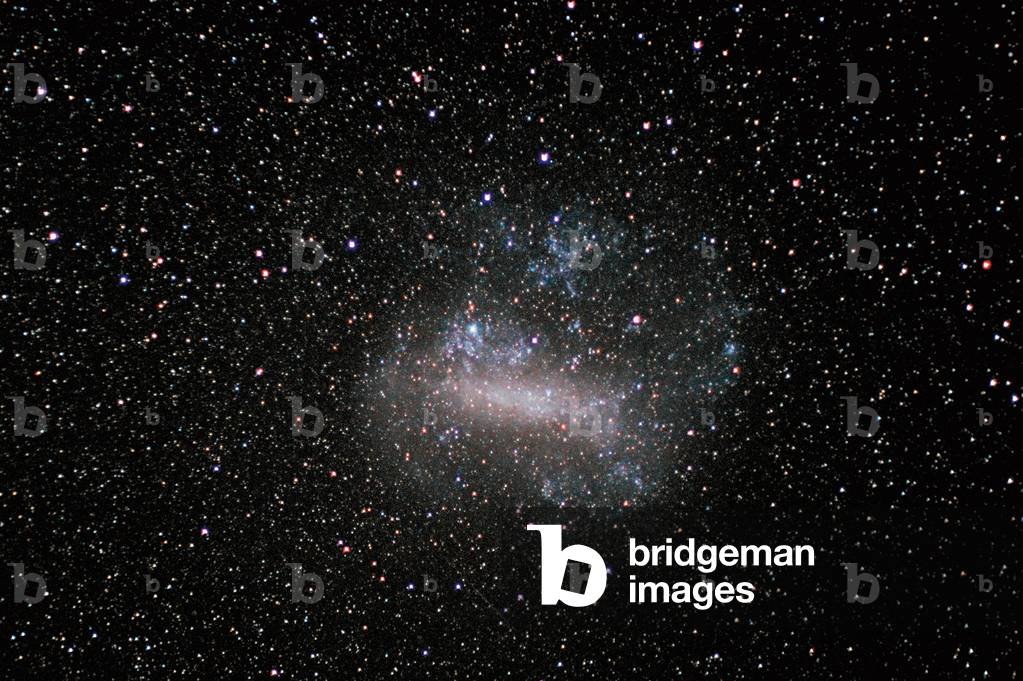
The Large Magellanic Cloud - The Large Magellanic Cloud - The Great Magellan Cloud galaxy is about 160,000 light years away from Earth in the southern constellation of Bream. Visible with the naked eye in the southern hemishere it is one of the closest galaxies to ours. The Large Magellanic Cloud is an irregular galaxy located about 160,000 light years distance from Earth in the constellation Dorado. Visible naked - eye in the night sky of the southern hemisphere, it is one of the closest galaxy from us
The Large Magellanic Cloud - The Large Magellanic Cloud - The Great Magellan Cloud galaxy is about 160,000 light years away from Earth in the southern constellation of the Sea bream. Visible with the naked eye in the southern hemishere it is one of the closest galaxies to us. It contains large star-forming areas such as the Tarantula Nebula (30 Bream, visible right), the most active star-forming regions of the local group. The irregular galaxy Large Magellanic Cloud (LMC) is located at a distance of 160,000 light years in the southern constellation of Dorado. It is one of the nearest galaxy, visible to naked eye
Around the Tarantula Nebula - Around the Tarantula nebula in the Large Magellanic Cloud - The Tarantula Nebula, NGC 2070, is a vast star-forming region located north of the Great Magellan Cloud galaxy in the southern hemisphere about 170,000 years - light from Earth. Image obtained with the 1.2m Schmidt UK Telescope from Siding Spring. Known as the Tarantula Nebula for its spidery appearance, the 30 Doradus complex is a monstrous stellar factory. It is the largest emission nebula in the sky, and can be seen far down in the southern sky at a distance of about 170,000 light - years, in the southern constellation Dorado. It is part of one of the Milky Way's neighbouring galaxies, the Large Magellanic Cloud. The Tarantula Nebula contains some of the most massive stars known
The Large Magellanic Cloud - The Large Magellanic Cloud - The Great Magellan Cloud galaxy is located about 160,000 light years away from Earth in the southern constellation of Dorado. Visible with the naked eye in the southern hemishere it is one of the closest galaxies to us. It contains large star-forming zones such as the Tarantula Nebula (30 Sea bream, visible to the left), the most active star-forming regions of the local group. Image obtained by the 1.2m UK Schmidt telescope from Siding Spring, Australia. The Large Magellanic Cloud (LMC) is the nearest galaxy to the Milky Way but less than one tenth as massive; even so it contains the equivalent of over ten billion solar masses of material in the form of stars, gas and dust. The LMC is at a distance of 160,000 light years and is visible to the unaided eye from southern latitudes, rather like a detached piece of the Milky Way. The nearness of the LMC ensures that it is well resolved into stars in quite a modest telescope, and deep photographs reveal it to be a highly complex system with large numbers of clusters, nebulae and dust clouds scattered apparently at random across the face of the galaxy. The bright red patch at the eastern end of the galaxy is the star - forming region 30 Doradus
Tarantula Nebula (NGC 2070) in the river bream - The Tarantula Nebula - The Tarantula Nebula (or 30 Sea bream) is the largest star-forming region of the Great Magellan Cloud. It is located 170,000 light years ago in the constellation Dorado (southern hemisphere). At the center of this nebula, the open cluster of R136 stars, clusters of hot and massive stars. Image obtained with the large field camera of the 2.2m ESO/MPG telescope in Chile. Composite colour image of the Tarantula Nebula in the Large Magellanic Cloud (LMC) and its surroundings. The LMC is a satellite galaxy to our Milky Way system, located in the southern constellation Dorado (The Swordfish) at a distance of approximately 170,000 light - years. The image is based on 15 exposures in the visual part of the spectrum with the Wide Field Imager (WFI) camera on the 2.2 - m MPG/ESO telescope at the La Silla Observatory
Around the Tarantula Nebula - Around the Tarantula nebula in the Large Magellanic Cloud - The Tarantula Nebula (or 30 Bream) is the largest star-forming region of the Great Magellan Cloud. It is located 170,000 light years ago in the constellation Dorado (southern hemisphere). At the center of this nebula, the open cluster of R136 stars, clusters of hot and massive stars. Image obtained with the 1.2m Schmidt UK Telescope from Siding Spring. In this picture we see the eastern end of the Large Magellanic Cloud where lies one of the most active star formation regions known. If this enormous complex of stars, gas and dust were at the distance of the better - known Orion Nebula the brightest parts of it would visible during the day and would cover a quarter of the sky at night. While the Orion Nebula contains a mere handful of the hot blue stars which energise it, the Tarantula nebula has spawned many thousands in the bright central region, which surrounds a compact, brilliant cluster known as 30 Doradus. Like the Orion Nebula, the 30 Doradus region is a naked eye object for the keen sighted. It is however over one hundred times more distant! Surrounding this nebula is a huge and much fainter series of interlocking bubbles and shells of gas and dust blow away from the center of activity by intense stellar winds and supernova explosions
Detail of the Tarantula Nebula (NGC 2070) in the Dorado - Central region of the Tarantula Nebula - The Tarantula Nebula (or 30 Dorado) is the largest star-forming region of the Magellan Cloud. It is located 170,000 light years ago in the constellation Dorado (southern hemisphere). At the center of this nebula, the open cluster of R136 stars, clusters of young, hot and massive stars, aged just 5 million years. Mosaic of 15 images obtained by the Hubble Space Telescope. The Tarantula is situated 170,000 light - years away in the Large Magellanic Cloud (LMC) in the Southern sky and is clearly visible to the naked eye as a large milky patch. Astronomers believe that this smallish irregular galaxy is currently going through a violent period in its life. It is orbiting around the Milky Way and has had several close encounters with it. It is believed that the interaction with the Milky Way has caused an episode of energetic star formation - part of which is visible as the Tarantula Nebula. Just above the centre of the image there is a huge cluster of very hot stars called R136. The stars in R136 are also among the most massive stars we know. R136 is also a very young cluster, its oldest stars being just”” 5 million years old or so. Its smallest stars, however, are still forming, so astronomers observe R136 to try to understand the early stages of stellar evolution. Near the lower edge of the image we find the star cluster Hodge 301. Hodge 301 is almost 10 times older than R136. Some of the stars in Hodge 301 are so old that they have already exploded as supernovae. The shockwave from this explosion has compressed the gas in the Tarantula into the filaments and sheets that are seen around the cluster.
Detail in the Tarantula Nebula - Part of the Tarantula Nebula - The Tarantula Nebula (or 30 Bream bream) is the largest star-forming region of the Magellan Cloud. It is located 170,000 light years ago in the constellation Dorado (southern hemisphere). This image obtained by the Hubble Space Telescope (HST) shows a detail of the nebula around NGC 2060, a cluster of stars associated with a remnant of supernova (N157b) housing a pulsar. The part of the Tarentula nebula visible in this image from Hubble's Advanced Camera for Surveys is criss - crossed with tendrils of dust and gas churned up by recent supernovae. These supernova remnants include NGC 2060, visible above and to the left of the centre of this image, which contains the brightest known pulsar. The tarantula's bite goes beyond NGC 2060. Near the edge of the nebula, outside the frame, below and to the right, lie the remains of supernova SN 1987a, the closest supernova to Earth to be observed since the invention of telescopes in the 17th century. Together with dying stars, the Tarantula Nebula is packed with young stars which have recently formed from the nebula's supply of hydrogen gas. These toddler - stars shine forth with intense ultraviolet light that ionises the gas, making it light up red. The light is so intense that although around 170,000 light - years distant, and outside the Milky Way, the Tarantula Nebula is nevertheless visible without a telescope on a dark night to Earth - bound observers. This nebula might be far away, but it is the most luminous example of its type that astronomers have observed in the local Universe
Around the Tarantula Nebula - Around the Tarantula nebula in the Large Magellanic Cloud - The Tarantula Nebula, NGC 2070, is a vast star-forming region located north of the Great Magellan Cloud galaxy in the southern hemisphere about 170,000 years - light from Earth. Image obtained with Siding Spring's 3.9m telescope. Known as the Tarantula Nebula for its spidery appearance, the 30 Doradus complex is a monstrous stellar factory. It is the largest emission nebula in the sky, and can be seen far down in the southern sky at a distance of about 170,000 light - years, in the southern constellation Dorado. It is part of one of the Milky Way's neighbouring galaxies, the Large Magellanic Cloud. The Tarantula Nebula contains some of the most massive stars known
Tarantula Nebula (NGC 2070) in the constellation of Bream - The Tarantula Nebula in Dorado - Tarantula Nebula in the large Magellan cloud seen with the FORS2 instrument on the KUEYEN telescope (VLT) February 1, 2000. The Tarantula Nebula (or 30 bream) is the largest star-forming region of the Magellan Grand Cloud. It is located 170,000 light years ago in the constellation Dorado (southern hemisphere). At the center of this nebula, the open cluster of R136 stars, clusters of hot and massive stars. The Tarantula Nebula in the Large Magellanic Cloud, as obtained with FORS2 at KUEYEN (VLT) on the night of January 31 - February 1, 2000. It is a composite of three exposures
Clubs R136 in the Tarantula Nebula (NGC 2070) - Central region of the Tarantula Nebula - The Tarantula Nebula (or 30 Bream) is the largest star-forming region of the Magellan Cloud. It is located 170,000 light years ago in the constellation Dorado (southern hemisphere). In the center of this nebula, the open cluster of R136 stars (on the right), clusters of young, hot and massive stars, age barely 5 million years. Image obtained by the Hubble Space Telescope in October 2009. The Tarantula is situated 170,000 light - years away in the Large Magellanic Cloud (LMC) in the southern sky and is clearly visible to the naked eye as a large milky patch. To thr right of the image there is a huge cluster of very hot stars called R136. The stars in R136 are also among the most massive stars we know. R136 is also a very young cluster, its oldest stars being 'just' 5 million years old or so. Its smallest stars, however, are still forming. The image, taken in ultraviolet, visible, and red light by Hubble's Wide Field Camera 3, spans about 100 light - years. The Hubble observations were taken Oct. 20 - 27, 2009. The blue color is light from the hottest, most massive stars; the green from the glow of oxygen; and the red from fluorescing hydrogen
Tarantula (NGC 2070) in the LMC - The nebula around 30 Doradus (NGC 2070) in the LMC - The Tarantula Nebula (or 30 Bream) is the largest star-forming region of the Great Magellan Cloud. It is located 170,000 light years ago in the constellation Dorado (southern hemisphere). At the center of this nebula, the open cluster of R136 stars, clusters of hot and massive stars. Image obtained with Siding Spring's 3.9m telescope. The brightest cluster of stars in this picture was believed until recently to contain a single, uniquely massive object with the mass equivalent to 1000 suns, and was named as a star, 30 Doradus. Sophisticated image analysis techniques have been used to show that 30 Doradus is a very compact group of stars, many of which are massive, but not unimaginably so. The radiation from this star cluster is sufficient to excite a huge cloud of hydrogen gas in its vicinity so that it glows with its distinctive red colour. This picture is essentially a one minute exposure. A longer exposure would show that the curving tendrils of nebulosity are the brightest parts of the huge Tarantula nebula, one of the largest star - forming regions known anywhere
Tarantula Nebula (NGC 2070) in the river bream - The Tarantula Nebula, around the 30 Dor cluster - The Tarantula Nebula (or 30 Bream) is the largest star-forming region of the Great Magellan Cloud. It is located 170,000 light years ago in the constellation Dorado (southern hemisphere). At the center of this nebula, the open cluster of R136 stars, clusters of hot and massive stars. Image obtained with Siding Spring's 3.9m telescope. This object is the only extra - galactic nebula which can be seen with the unaided eye. It is a faint patch of light at the eastern end of the Large Magellanic Cloud, 170,000 light years distant. A small telescope reveals narrow spindly tendrils of glowing gas which have been likened to the legs of a spider. The 'body' of the spider is the bright nebula seen at the centre of the photograph, while at its core is an extremely dense clump of very hot stars, until recently thought to a single, unusually massive star known as 30 Doradus. The very hot stars of 30 Dor are responsible for making the nebula visible
Central region of the Tarantula Nebula - The Tarantula Nebula - The Tarantula Nebula (or 30 Dorada) is the largest star-forming region of the Magellan Cloud. It is located 170,000 light years ago in the constellation Dorado (southern hemisphere). At the center of this nebula, the open cluster of R136 stars, clusters of young, hot and massive stars, aged just 5 million years. Mosaic of 5 images obtained by the Hubble space telescope. Vast Star - Forming Region 30 Doradus Nasa's Hubble Space Telescope has snapped a panoramic portrait of a vast, sculpted landscape of gas and dust where thousands of stars are being born. This fertile star - forming region, called the 30 Doradus Nebula, has a sparkling stellar centerpiece: the most spectacular cluster of massive stars in our cosmic neighborhood of about 25 galaxies. The mosaic picture shows that ultraviolet radiation and high - speed material unleashed by the stars in the cluster, called R136, are weaving a tapestry of creation and destruction, triggering the collapse of looming gas and dust clouds and forming pillar - like structures that are incubators for nascent stars. The photo offers an unprecedented, detailed view of the entire inner region of 30 Doradus, measuring 200 light - years wide by 150 light - years high. The nebula resides in the Large Magellanic Cloud (a satellite galaxy of the Milky Way), 170,000 light - years from Earth. Nebulas like 30 Doradus are the “” signposts”” of recent star birth. High - energy ultraviolet radiation from the young, hot, massive stars in R136 causes the surrounding gaseous material to glow. Previous Hubble telescope observations showed that R136 contains several dozen of the most massive stars known, each about 100 times the mass of the Sun and about 10 times as hot. These stellar behemoths all formed at the same time about 2 million years ago. The stars in R136 are producing intense “” stellar winds”” (
Tarantula Nebula in the Great Magellan Cloud - Tarantula nebula (NGC 2070) in Dorado - NGC 2070, the Tarantula Nebula is a vast star-forming region located north of the Great Magellan Cloud galaxy, in the southern hemisphere about 170,000 years - light from Earth. Image obtained by combining light through different filters (SII 5x 2min, Ha 20x 2min, [OIII] 11x 2min, H - beta 10x 2min, L (IR) 2x 2min, IR 4x 2min, R 8x 2min, G 5x 2min). The largest emission nebula in the sky, the Tarantula Nebula (also known as NGC 2070 or 30 Doradus) is located in the Large Magellanic Cloud (LMC) in the southern hemisphere at about 170,000 light year from Earth. Image obtained with different filters (SII 5x 2min, Ha 20x 2min, [OIII] 11x 2min, H - beta 10x 2min, L (IR) 2x 2min, IR 4x 2min, R 8x 2min, G 5x 2min)
Supernova 1987A - Supernova 1987A - Image of the Supernova 1987A, obtained on March 8, 1987 with the 3.9m telescope of Siding Spring. Supernova 1987A appeared in the constellation Doradus on February 23, 1987. Sometime during 23 February 1987 a supernova exploded in the Large Magellanic Cloud (LMC), a nearby galaxy. However, the LMC is about 170,000 light years distant, so the supernova exploded 170,000 years ago. It was discovered the following day and brightened rapidly to become the first supernova to be easily visible to the unaided eye for almost 400 years. This photograph shows the field around the site of the supernova in great detail about 10 days afterwards, when it was still brightening
Nebula N44 in the Great Magellan Cloud - Henize 44, an emission nebula in the LMC - Vast region of star formation located in the Great Magellan Cloud. Image obtained by the 1.2m Schmidt UK Telescope from Siding Spring. The nearby Large Magellanic Cloud (LMC) is a very active star - forming galaxy. The most massive region of star formation is around 30 Doradus (the Tarantula nebula) which can be seen with the unaided eye, but hundreds of lesser examples are visible with a telescope. This picture shows Henize 44. The energetic ultraviolet light from these stars is absorbed by hydrogen and produces the distinctive red glow from an enormous distance around the cluster. Image obtained with the Schmidt UK telescope of Siding Spring
Supernova 1987A before and after explosion - Supernova 1987A before and after the explosion - Images of the Supernova 1987A, on the left, obtained on March 8, 1987, and of the same photograph field on the right on February 5, 1984. Images obtained with Siding Spring's 3.9m telescope. Supernova 1987A appeared in the constellation Doradus on February 23, 1987. Sometime during 23 February 1987 a supernova exploded in the Large Magellanic Cloud (LMC), a nearby galaxy. However, the LMC is about 170,000 light years distant, so the supernova exploded 170,000 years ago. It was discovered the following day and brightened rapidly to become the first supernova to be easily visible to the unaided eye for almost 400 years. This photograph shows the field around the site of the supernova in great detail, both before the supernova exploded (right) and about 10 days afterwards, when it was still brightening
Supernova 1987A before and after explosion - Supernova 1987A with precursor image overlaid - Image of the Supernova 1987A, obtained on March 8, 1987. The photo of the star Sanduleak - 69* 202, photographed two years ago. Images obtained with Siding Spring's 3.9m telescope. Supernova 1987A appeared in the constellation Doradus on February 23, 1987. The brightest star in the colour photograph is supernova 1987A, photographed with the AAT two months before it reached its maximum brightness. Superimposed in register on this image is a negative photograph of the region around the supernova copied from an AAT plate that was exposed in 1985, two years before the supernova was seen to explode. The precursor star appears to be a peculiar shape only because its image is blended with those of two other stars that happen to lie in the same line of sight. Many similar blended images can be seen in the colour photograph. However, it was soon found that the brighter of the three had exploded, and that was a star which had been previously observed and catalogued, as Sanduleak - 69* 202
Field around the Nebula Henize 55 - The Henize 55 star forming region in the LMC - Henize 55 (NGC 2014), on the right, is a star-forming region located north of the Great Magellan Cloud. Image obtained from the 1.2m Schmidt UK telescope of Siding Spring. The nearby Large Magellanic Cloud (LMC) is a very active star - forming galaxy. The most massive region of star formation is around 30 Doradus (the Tarantula nebula) which can be seen with the unaided eye, but hundreds of lesser examples are visible with a telescope. This picture shows one of the more intriguing, NGC 2014 (Henize 55), at right. It contains cluster of hot, young stars, almost hidden in the brightest part of the nebula. The energetic ultraviolet light from these stars is absorbed by hydrogen and produces the distinctive red glow from an enormous distance around the cluster. This picture was made photographically from three glass plates taken with the UK Schmidt telescope of Siding Spring
Light echo of supernova 1987A - July 1989 - The light echo of supernova 1987A - July 1989 - Image obtained with Siding Spring's 3.9m telescope. Supernova 1987A appeared in the constellation Doradus on February 23, 1987. When supernova 1987A was seen to explode in the Large Magellanic Cloud, the Milky Way's nearest companion galaxy, the brilliant flash of light from the self - destructing star had taken about 170,000 years to arrive. Some light was deflected by two sheets of dust near the supernova, and is seen after the star has faded away because it covers a longer path to reach us. The dust responsible for the rings seen here lies in two distinct sheets, about 470 and 1300 light years from the supernova. The colour picture, made by subtracting images on plates taken before and after the supernova, is an accurate reproduction of the colour of the extremely faint light echo, which in turn reflects the yellow colour of the supernova when it was at its brightest, in May 1987.
Tarantula Nebula (NGC 2070) in the Sea bream - Around the Tarantula nebula in the Large Magellanic Cloud - The Tarantula Nebula (or 30 Bream bream) is the largest star-forming region of the Great Magellan Cloud. It is located 170,000 light years ago in the constellation Dorado (southern hemisphere). At the center of this nebula, the open cluster of R136 stars, clusters of hot and massive stars. Mosaic of 14 images, 70 hours of cumulative poses. Known as the Tarantula Nebula for its spidery appearance, the 30 Doradus complex is a huge stellar factory. It is the largest emission nebula in the sky, and can be seen far down in the southern sky at a distance of about 170,000 light - years, in the southern constellation Dorado. It is part of one of the Milky Way's neighbouring galaxies, the Large Magellanic Cloud. The Tarantula Nebula is thought to contain more than half a million times the mass of the Sun in gas and this vast, blazing labyrinth hosts some of the most massive stars known. Surrounding this nebula is a huge and much fainter series of interlocking bubbles and shells of gas and dust blow away from the center of activity by intense stellar winds and supernova explosions. 14 Panel Mosaic, Total Exposure 70 Hours with a 14.5” telescope
NGC 1850 Star Cluster in Dorado - Double Cluster NGC 1850 in Dorado - The double cluster NGC 1850 is located in the galaxy of the Great Magellan Cloud. It contains a cluster of globular form, but young, 50 million years, in the center of the image and another cluster, at the bottom right, even younger (4 million years), consists of warm and blue stars and a few T - Tauri stars. NGC 1850, imaged here with the NASA/ESA Hubble Space Telescope, is an unusual double cluster that lies in the bar of the Large Magellanic Cloud, a satellite galaxy of our own Milky Way. After the 30 Doradus complex, NGC 1850 is the brightest star cluster in the Large Magellanic Cloud. It is representative of a special class of objects - young, globular - like star clusters - that have no counterpart in our own Galaxy. The two components of the cluster are both relatively young and consist of a main globular - like cluster in the centre and an even younger, smaller cluster, seen below and to the right, composed of extremely hot, blue stars and fainter red T - Tauri stars. The main cluster is about 50 million years old and the smaller cluster is only 4 million years old
Tarantula Nebula (NGC 2070) in the Sea bream - Around the Tarantula nebula in the Large Magellanic Cloud - The Tarantula Nebula (or 30 Bream bream) is the largest star-forming region of the Great Magellan Cloud. It is located 170,000 light years ago in the constellation Dorado (southern hemisphere). At the center of this nebula, the open cluster of R136 stars, clusters of hot and massive stars. Mosaic of 14 images, 70 hours of cumulative poses. Known as the Tarantula Nebula for its spidery appearance, the 30 Doradus complex is a huge stellar factory. It is the largest emission nebula in the sky, and can be seen far down in the southern sky at a distance of about 170,000 light - years, in the southern constellation Dorado. It is part of one of the Milky Way's neighbouring galaxies, the Large Magellanic Cloud. The Tarantula Nebula is thought to contain more than half a million times the mass of the Sun in gas and this vast, blazing labyrinth hosts some of the most massive stars known. Surrounding this nebula is a huge and much fainter series of interlocking bubbles and shells of gas and dust blow away from the center of activity by intense stellar winds and supernova explosions. 14 Panel Mosaic, Total Exposure 70 Hours with a 14.5” telescope