[]
Ihre AuswahlIhre aktuelle Auswahl
asset(s) Assets
Ihr Preis 0

Ihre Auswahl

Auswahl aufheben
Asset zum Warenkorb hinzugefügt
{"event":"pageview","page_type1":"undetected","page_type2":"_assets_search_override","language":"de","user_logged":"false","user_type":"ecommerce","nl_subscriber":"false"}
{"event":"ecommerce_event","event_name":"view_item","event_category":"browse_catalog","ecommerce":{"items":[{"item_id":"PIX4608687","item_category":"photo","item_category2":"no_copyright","item_category3":"standard","item_category4":"b_s_fletcher","item_category5":"not_balown","item_list_name":"search_results","item_name":"spiral_galaxy_m31_in_andromede_m31_the_great_galaxy_in_andromeda_the_galaxy_of_andromede_is_located_","item_variant":"undefined"},{"item_id":"PIX4574285","item_category":"photo","item_category2":"no_copyright","item_category3":"standard","item_category4":"alex_conu","item_category5":"not_balown","item_list_name":"search_results","item_name":"andromede_galaxy_the_andromeda_galaxy_m31_the_andromede_galaxy_is_located_about_2_3_million_light_ye","item_variant":"undefined"},{"item_id":"PIX4608891","item_category":"photo","item_category2":"no_copyright","item_category3":"standard","item_category4":"sebastian_voltmer","item_category5":"not_balown","item_list_name":"search_results","item_name":"spiral_galaxy_m31_in_andromede_spiral_galaxy_m31_in_andromeda_the_galaxy_of_andromede_is_located_abo","item_variant":"undefined"},{"item_id":"PIX4611510","item_category":"photo","item_category2":"no_copyright","item_category3":"standard","item_category4":"stefan_seip","item_category5":"not_balown","item_list_name":"search_results","item_name":"elliptical_galaxy_m89_in_virgo_elliptical_galaxy_m89_in_virgo_m89_ngc_4552_is_an_e0_elliptical_galax","item_variant":"undefined"},{"item_id":"PIX4608934","item_category":"photo","item_category2":"no_copyright","item_category3":"standard","item_category5":"not_balown","item_list_name":"search_results","item_name":"andromede_galaxy_the_andromeda_galaxy_m31_the_andromede_galaxy_is_located_about_2_3_million_years_ag","item_variant":"undefined"},{"item_id":"PIX4565322","item_category":"photo","item_category2":"no_copyright","item_category3":"standard","item_category4":"e_mouquet","item_category5":"not_balown","item_list_name":"search_results","item_name":"persee_galaxy_cluster_galaxy_cluster_in_perseus_the_persee_galaxy_cluster_abell_426_contains_at_leas","item_variant":"undefined"},{"item_id":"PIX4614013","item_category":"photo","item_category2":"no_copyright","item_category3":"standard","item_category4":"s_numazawa","item_category5":"not_balown","item_list_name":"search_results","item_name":"classification_of_galaxies_the_hubble_sequence_edwin_hubble_s_galaxy_classification_the_hubble_seque","item_variant":"undefined"},{"item_id":"PIX4612792","item_category":"photo","item_category2":"no_copyright","item_category3":"standard","item_category4":"adam_block","item_category5":"not_balown","item_list_name":"search_results","item_name":"spiral_galaxy_ngc_5850_in_virgo_spiral_galaxy_ngc_5850_in_virgo_barree_spiral_galaxy_ngc_5850_with_r","item_variant":"undefined"},{"item_id":"PIX4611406","item_category":"photo","item_category2":"no_copyright","item_category3":"standard","item_category4":"r_gendler","item_category5":"not_balown","item_list_name":"search_results","item_name":"m87_elliptical_galaxy_in_virgo_m87_elliptical_galaxy_in_virgo_the_m87_galaxy_ngc_4486_is_located_abo","item_variant":"undefined"},{"item_id":"PIX4612262","item_category":"photo","item_category2":"no_copyright","item_category3":"standard","item_category5":"not_balown","item_list_name":"search_results","item_name":"central_region_of_the_elliptical_galaxy_centaurus_a_ngc_5128_central_part_of_the_galaxy_centaurus_a_","item_variant":"undefined"},{"item_id":"PIX4608661","item_category":"photo","item_category2":"no_copyright","item_category3":"standard","item_category4":"jim_misti","item_category5":"not_balown","item_list_name":"search_results","item_name":"elliptical_galaxy_m110_ngc_205_in_andromede_elliptical_galaxy_m110_ngc_205_in_andromeda_the_elliptic","item_variant":"undefined"},{"item_id":"PIX4610514","item_category":"photo","item_category2":"no_copyright","item_category3":"standard","item_category4":"jim_misti","item_category5":"not_balown","item_list_name":"search_results","item_name":"galaxies_ngc_3193_ngc_3190_ngc_3187_in_the_lion_galaxies_ngc_3193_ngc_3190_ngc_3187_in_leo_group_of_","item_variant":"undefined"},{"item_id":"PIX4613894","item_category":"photo","item_category2":"no_copyright","item_category3":"standard","item_category4":"d_de_martin","item_category5":"not_balown","item_list_name":"search_results","item_name":"galaxies_maffei_1_and_maffei_2_in_cassiopee_maffei_galaxies_in_cassiopeia_maffei_1_right_is_an_ellip","item_variant":"undefined"},{"item_id":"PIX4611387","item_category":"photo","item_category2":"no_copyright","item_category3":"standard","item_category4":"vincent_toporenko","item_category5":"not_balown","item_list_name":"search_results","item_name":"elliptical_galaxy_m49_elliptical_galaxy_m49_in_virgo_m49_ngc_4472_is_an_e4_elliptical_galaxy_located","item_variant":"undefined"},{"item_id":"PIX4565381","item_category":"photo","item_category2":"no_copyright","item_category3":"standard","item_category4":"e_mouquet","item_category5":"not_balown","item_list_name":"search_results","item_name":"central_part_of_the_virgo_cluster_of_galaxies_the_virgin_s_cluster_contains_several_thousand_galaxie","item_variant":"undefined"},{"item_id":"PIX4612889","item_category":"photo","item_category2":"no_copyright","item_category3":"standard","item_category4":"r_gendler","item_category5":"not_balown","item_list_name":"search_results","item_name":"galaxies_ngc_5981_ngc_5982_and_ngc_5985_in_the_dragon_ngc_5981_ngc_5982_and_ngc_5985_galaxies_in_dra","item_variant":"undefined"},{"item_id":"PIX4612579","item_category":"photo","item_category2":"no_copyright","item_category3":"standard","item_category4":"jim_misti","item_category5":"not_balown","item_list_name":"search_results","item_name":"galaxies_ngc_5350_ngc_5353_54_ngc_5355_and_ngc_5358_galaxies_ngc_5350_ngc_5353_54_ngc_5355_and_ngc_5","item_variant":"undefined"},{"item_id":"PIX4608907","item_category":"photo","item_category2":"no_copyright","item_category3":"standard","item_category5":"not_balown","item_list_name":"search_results","item_name":"andromede_galaxy_andromeda_galaxy_the_andromede_galaxy_is_located_about_2_3_million_years_ago_light_","item_variant":"undefined"},{"item_id":"PIX4611693","item_category":"photo","item_category2":"no_copyright","item_category3":"standard","item_category5":"not_balown","item_list_name":"search_results","item_name":"galaxy_ngc_4631_in_hunting_dogs_spiral_galaxy_ngc_4631_in_canes_venatici_spiral_galaxy_seen_by_the_s","item_variant":"undefined"},{"item_id":"PIX4608702","item_category":"photo","item_category2":"no_copyright","item_category3":"standard","item_category4":"b_s_fletcher","item_category5":"not_balown","item_list_name":"search_results","item_name":"spiral_galaxy_m31_in_andromede_m31_the_great_galaxy_in_andromeda_the_galaxy_of_andromede_is_located_","item_variant":"undefined"},{"item_id":"PIX4611307","item_category":"photo","item_category2":"no_copyright","item_category3":"standard","item_category5":"not_balown","item_list_name":"search_results","item_name":"spiral_galaxy_m100_in_berenice_s_hair_spiral_galaxy_m100_in_coma_berenices_the_spiral_galaxy_m100_is","item_variant":"undefined"},{"item_id":"PIX4565253","item_category":"photo","item_category2":"no_copyright","item_category3":"standard","item_category5":"not_balown","item_list_name":"search_results","item_name":"galaxy_clusters_abell_1060_in_hydra_the_hydra_cluster_of_galaxies_abell_1060_the_galaxy_in_the_cente","item_variant":"undefined"},{"item_id":"PIX4565323","item_category":"photo","item_category2":"no_copyright","item_category3":"standard","item_category5":"not_balown","item_list_name":"search_results","item_name":"cluster_of_galaxies_ic_4765_cluster_of_galaxies_ic_4765_in_pavo_cluster_of_galaxies_in_the_southern_","item_variant":"undefined"},{"item_id":"PIX4611461","item_category":"photo","item_category2":"no_copyright","item_category3":"standard","item_category5":"not_balown","item_list_name":"search_results","item_name":"m87_elliptical_galaxy_in_virgo_m87_elliptical_galaxy_in_virgo_the_m87_galaxy_ngc_4486_is_located_abo","item_variant":"undefined"},{"item_id":"PIX4611847","item_category":"photo","item_category2":"no_copyright","item_category3":"standard","item_category5":"not_balown","item_list_name":"search_results","item_name":"elliptical_galaxy_ngc_4696_in_centaur_elliptical_galaxy_ngc_4696_image_of_the_elliptical_galaxy_ngc_","item_variant":"undefined"},{"item_id":"PIX4610632","item_category":"photo","item_category2":"no_copyright","item_category3":"standard","item_category4":"r_gendler","item_category5":"not_balown","item_list_name":"search_results","item_name":"galaxies_m95_m96_and_m105_in_the_lion_galaxies_m95_m96_and_m105_in_leo_m95_ngc_3351_at_the_top_left_","item_variant":"undefined"},{"item_id":"PIX4610687","item_category":"photo","item_category2":"no_copyright","item_category3":"standard","item_category4":"vincent_toporenko","item_category5":"not_balown","item_list_name":"search_results","item_name":"galaxies_m105_ngc_3384_and_ngc_3389_in_the_lion_m105_ngc_3384_and_ngc_3389_galaxies_in_leo_these_gal","item_variant":"undefined"},{"item_id":"PIX4611798","item_category":"photo","item_category2":"no_copyright","item_category3":"standard","item_category5":"not_balown","item_list_name":"search_results","item_name":"the_elliptical_galaxy_ngc_4660_the_elliptical_galaxy_ngc_4660_the_galaxy_ngc_4660_is_located_49_mill","item_variant":"undefined"},{"item_id":"PIX4611377","item_category":"photo","item_category2":"no_copyright","item_category3":"standard","item_category5":"not_balown","item_list_name":"search_results","item_name":"the_elliptical_galaxy_ngc_4458_the_elliptical_galaxy_ngc_4458_the_galaxy_ngc_4458_is_53_million_year","item_variant":"undefined"},{"item_id":"PIX4613733","item_category":"photo","item_category2":"no_copyright","item_category3":"standard","item_category5":"not_balown","item_list_name":"search_results","item_name":"elliptical_galaxy_eso_306_17_elliptical_galaxy_eso_306_17_the_galaxy_eso_306_17_is_an_isolated_ellip","item_variant":"undefined"},{"item_id":"PIX4611678","item_category":"photo","item_category2":"no_copyright","item_category3":"standard","item_category4":"vincent_toporenko","item_category5":"not_balown","item_list_name":"search_results","item_name":"elliptical_galaxy_m59_in_virgo_elliptical_galaxy_m59_in_virgo_m59_ngc_4621_is_an_e5_elliptical_galax","item_variant":"undefined"},{"item_id":"PIX4610522","item_category":"photo","item_category2":"no_copyright","item_category3":"standard","item_category5":"not_balown","item_list_name":"search_results","item_name":"hickson_44_group_of_galaxies_in_the_lion_hickson_44_galaxy_group_in_leo_group_of_galaxies_located_ab","item_variant":"undefined"},{"item_id":"PIX4611750","item_category":"photo","item_category2":"no_copyright","item_category3":"standard","item_category4":"vincent_toporenko","item_category5":"not_balown","item_list_name":"search_results","item_name":"elliptical_galaxy_m60_in_virgo_elliptical_galaxy_m60_in_virgo_m60_ngc_4649_is_an_e2_elliptical_galax","item_variant":"undefined"},{"item_id":"PIX4612000","item_category":"photo","item_category2":"no_copyright","item_category3":"standard","item_category5":"not_balown","item_list_name":"search_results","item_name":"galaxies_around_ngc_4874_galaxies_around_ngc_4874_ngc_4874_right_middle_is_a_large_elliptical_galaxy","item_variant":"undefined"},{"item_id":"PIX4565331","item_category":"photo","item_category2":"no_copyright","item_category3":"standard","item_category4":"jim_misti","item_category5":"not_balown","item_list_name":"search_results","item_name":"persee_galaxy_cluster_galaxy_cluster_in_perseus_the_persee_galaxy_cluster_abell_426_contains_at_leas","item_variant":"undefined"},{"item_id":"PIX4571983","item_category":"photo","item_category2":"no_copyright","item_category3":"standard","item_category5":"not_balown","item_list_name":"search_results","item_name":"star_mirach_and_ngc_404_in_andromede_star_mirach_and_galaxy_ngc_404_in_andromeda_mirach_beta_androme","item_variant":"undefined"},{"item_id":"PIX4613098","item_category":"photo","item_category2":"no_copyright","item_category3":"standard","item_category5":"not_balown","item_list_name":"search_results","item_name":"interacting_galaxies_in_the_austral_fish_interacting_galaxies_in_piscis_austrinus_the_galaxies_ngc_7","item_variant":"undefined"},{"item_id":"PIX4610710","item_category":"photo","item_category2":"no_copyright","item_category3":"standard","item_category4":"r_gendler","item_category5":"not_balown","item_list_name":"search_results","item_name":"galaxies_m105_ngc_3384_and_ngc_3389_in_the_lion_galaxies_m105_ngc_3384_and_ngc_3389_in_leo_these_gal","item_variant":"undefined"},{"item_id":"PIX4612176","item_category":"photo","item_category2":"no_copyright","item_category3":"standard","item_category5":"not_balown","item_list_name":"search_results","item_name":"jet_of_the_galaxy_centaurus_a_ngc_5128_seen_in_x_rays_galaxy_centaurus_a_x_ray_jet_view_in_false_col","item_variant":"undefined"},{"item_id":"PIX4565332","item_category":"photo","item_category2":"no_copyright","item_category3":"standard","item_category4":"r_jay_gabany","item_category5":"not_balown","item_list_name":"search_results","item_name":"persee_galaxy_cluster_perseus_galaxy_cluster_the_persee_galaxy_cluster_abell_426_contains_at_least_5","item_variant":"undefined"},{"item_id":"PIX4609203","item_category":"photo","item_category2":"no_copyright","item_category3":"standard","item_category5":"not_balown","item_list_name":"search_results","item_name":"interacting_galaxies_ngc_454_interacting_galaxies_ngc_454_ngc_454_is_located_about_164_million_light","item_variant":"undefined"},{"item_id":"PIX4612149","item_category":"photo","item_category2":"no_copyright","item_category3":"standard","item_category5":"not_balown","item_list_name":"search_results","item_name":"galaxies_ngc_5090_ngc_5091_in_centaurus_interacting_galaxies_ngc_5090_5091_in_centaurus_ngc_5090_is_","item_variant":"undefined"},{"item_id":"PIX4611777","item_category":"photo","item_category2":"no_copyright","item_category3":"standard","item_category4":"adam_block","item_category5":"not_balown","item_list_name":"search_results","item_name":"elliptical_galaxy_m60_in_virgo_elliptical_galaxy_m60_in_virgo_m60_ngc_4649_is_an_e2_elliptical_galax","item_variant":"undefined"},{"item_id":"PIX4565268","item_category":"photo","item_category2":"no_copyright","item_category3":"standard","item_category5":"not_balown","item_list_name":"search_results","item_name":"galaxy_clusters_abell_1060_in_hydra_the_hydra_cluster_of_galaxies_abell_1060_the_galaxy_in_the_cente","item_variant":"undefined"},{"item_id":"PIX4565382","item_category":"photo","item_category2":"no_copyright","item_category3":"standard","item_category5":"not_balown","item_list_name":"search_results","item_name":"the_cluster_of_galaxies_in_fornax_the_cluster_of_galaxies_in_fornax_the_cluster_of_galaxies_in_the_f","item_variant":"undefined"},{"item_id":"PIX4565370","item_category":"photo","item_category2":"no_copyright","item_category3":"standard","item_category5":"not_balown","item_list_name":"search_results","item_name":"the_cluster_of_galaxies_in_fornax_the_cluster_of_galaxies_in_fornax_clusters_of_galaxies_situated_ab","item_variant":"undefined"},{"item_id":"PIX4565539","item_category":"photo","item_category2":"no_copyright","item_category3":"standard","item_category5":"not_balown","item_list_name":"search_results","item_name":"group_of_galaxies_hcg_87_in_capricorn_hickson_compact_group_87_in_capricornus_group_of_galaxies_in_i","item_variant":"undefined"},{"item_id":"PIX4565291","item_category":"photo","item_category2":"no_copyright","item_category3":"standard","item_category4":"adam_block","item_category5":"not_balown","item_list_name":"search_results","item_name":"coma_cluster_of_galaxies_abell_1656_coma_cluster_of_galaxies_the_coma_cluster_of_galaxies_consists_o","item_variant":"undefined"},{"item_id":"PIX4565712","item_category":"photo","item_category2":"no_copyright","item_category3":"standard","item_category5":"not_balown","item_list_name":"search_results","item_name":"abell_383_galaxy_cluster_and_primitive_galaxy_abell_383_cluster_of_galaxies_with_gravitational_arcs_","item_variant":"undefined"},{"item_id":"PIX4611992","item_category":"photo","item_category2":"no_copyright","item_category3":"standard","item_category5":"not_balown","item_list_name":"search_results","item_name":"elliptical_galaxy_ngc_4881_and_distant_galaxies_elliptical_galaxy_ngc_4881_and_distant_galaxies_the_","item_variant":"undefined"},{"item_id":"PIX4608773","item_category":"photo","item_category2":"no_copyright","item_category3":"standard","item_category4":"r_gendler","item_category5":"not_balown","item_list_name":"search_results","item_name":"spiral_galaxy_m31_in_andromede_spiral_galaxy_m31_in_andromeda_the_galaxy_of_andromede_is_located_abo","item_variant":"undefined"},{"item_id":"PIX4565645","item_category":"photo","item_category2":"no_copyright","item_category3":"standard","item_category5":"not_balown","item_list_name":"search_results","item_name":"galaxy_clusters_abell_370_abell_370_cluster_of_galaxies_with_gravitational_arcs_this_cluster_contain","item_variant":"undefined"},{"item_id":"PIX4611410","item_category":"photo","item_category2":"no_copyright","item_category3":"standard","item_category4":"jerry_lodriguss","item_category5":"not_balown","item_list_name":"search_results","item_name":"m87_elliptical_galaxy_in_virgo_m87_elliptical_galaxy_in_virgo_the_m87_galaxy_ngc_4486_is_located_abo","item_variant":"undefined"},{"item_id":"PIX4611740","item_category":"photo","item_category2":"no_copyright","item_category3":"standard","item_category4":"jerry_lodriguss","item_category5":"not_balown","item_list_name":"search_results","item_name":"galaxies_ngc_4631_and_ngc_4656_57_in_hunting_dogs_galaxies_ngc_4631_and_ngc_4656_57_the_spiral_galax","item_variant":"undefined"},{"item_id":"PIX4610249","item_category":"photo","item_category2":"no_copyright","item_category3":"standard","item_category5":"not_balown","item_list_name":"search_results","item_name":"interacting_galaxies_ngc_2936_and_ngc_2937_interacting_galaxies_ngc_2936_and_ngc_2937_in_hydra_these","item_variant":"undefined"},{"item_id":"PIX4612309","item_category":"photo","item_category2":"no_copyright","item_category3":"standard","item_category5":"not_balown","item_list_name":"search_results","item_name":"centaurus_a_elliptical_galaxy_ngc_5128_in_centaurus_the_radio_galaxy_centaurus_a_ngc_5128_the_galaxy","item_variant":"undefined"},{"item_id":"PIX4613994","item_category":"photo","item_category2":"no_copyright","item_category3":"standard","item_category5":"not_balown","item_list_name":"search_results","item_name":"artist_s_view_of_colliding_galaxies_colliding_galaxies_artwork_illustration_showing_the_evolution_of","item_variant":"undefined"},{"item_id":"PIX4565631","item_category":"photo","item_category2":"no_copyright","item_category3":"standard","item_category5":"not_balown","item_list_name":"search_results","item_name":"abell_2218_galaxy_cluster_in_the_dragon_gravitational_lenses_in_the_galaxy_cluster_abell_2218_the_ab","item_variant":"undefined"},{"item_id":"PIX4612894","item_category":"photo","item_category2":"no_copyright","item_category3":"standard","item_category4":"jim_misti","item_category5":"not_balown","item_list_name":"search_results","item_name":"galaxies_ngc_5981_ngc_5982_and_ngc_5985_in_the_dragon_galaxies_ngc_5981_ngc_5982_and_ngc_5985_in_dra","item_variant":"undefined"},{"item_id":"PIX4611454","item_category":"photo","item_category2":"no_copyright","item_category3":"standard","item_category4":"adam_block","item_category5":"not_balown","item_list_name":"search_results","item_name":"elliptical_galaxy_m87_in_virgo_elliptical_galaxy_m87_in_virgo_the_galaxy_m87_ngc_4486_is_located_abo","item_variant":"undefined"},{"item_id":"PIX4611275","item_category":"photo","item_category2":"no_copyright","item_category3":"standard","item_category4":"adam_block","item_category5":"not_balown","item_list_name":"search_results","item_name":"spiral_galaxy_m100_in_berenice_s_hair_spiral_galaxy_m100_in_coma_berenices_the_spiral_galaxy_m100_ng","item_variant":"undefined"},{"item_id":"PIX4565270","item_category":"photo","item_category2":"no_copyright","item_category3":"standard","item_category4":"vincent_toporenko","item_category5":"not_balown","item_list_name":"search_results","item_name":"cluster_of_galaxies_abell_1656_coma_cluster_the_coma_cluster_abell_1656_large_cluster_of_galaxies_co","item_variant":"undefined"},{"item_id":"PIX4565651","item_category":"photo","item_category2":"no_copyright","item_category3":"standard","item_category5":"not_balown","item_list_name":"search_results","item_name":"galaxies_clusters_abell_370_abell_370_cluster_of_galaxies_with_gravitational_arcs_this_cluster_of_ga","item_variant":"undefined"},{"item_id":"PIX4610524","item_category":"photo","item_category2":"no_copyright","item_category3":"standard","item_category4":"adam_block","item_category5":"not_balown","item_list_name":"search_results","item_name":"hickson_44_galaxy_group_in_leo_hickson_44_galaxy_group_in_leo_group_of_galaxies_located_about_60_mil","item_variant":"undefined"},{"item_id":"PIX4565516","item_category":"photo","item_category2":"no_copyright","item_category3":"standard","item_category5":"not_balown","item_list_name":"search_results","item_name":"seyfert_s_sextet_group_of_galaxies_in_the_snake_seyfert_s_sextet_group_of_galaxies_this_group_of_int","item_variant":"undefined"},{"item_id":"PIX4565430","item_category":"photo","item_category2":"no_copyright","item_category3":"standard","item_category5":"not_balown","item_list_name":"search_results","item_name":"central_part_of_the_galaxy_cluster_of_the_virgin_the_virgo_cluster_detail_part_of_the_galaxy_cluster","item_variant":"undefined"},{"item_id":"PIX4565672","item_category":"photo","item_category2":"no_copyright","item_category3":"standard","item_category5":"not_balown","item_list_name":"search_results","item_name":"galaxy_clusters_abell_370_abell_370_cluster_of_galaxies_with_gravitational_arcs_this_galaxy_cluster_","item_variant":"undefined"},{"item_id":"PIX4611703","item_category":"photo","item_category2":"no_copyright","item_category3":"standard","item_category4":"jim_misti","item_category5":"not_balown","item_list_name":"search_results","item_name":"galaxy_ngc_4631_in_hunting_dogs_spiral_galaxy_ngc_4631_in_canes_venatici_spiral_galaxy_seen_by_the_s","item_variant":"undefined"},{"item_id":"PIX4565560","item_category":"photo","item_category2":"no_copyright","item_category3":"standard","item_category5":"not_balown","item_list_name":"search_results","item_name":"galaxy_cluster_abell_s0740_in_centaurus_galaxy_cluster_abell_s0740_in_centaurus_the_hubble_space_tel","item_variant":"undefined"},{"item_id":"PIX4608904","item_category":"photo","item_category2":"no_copyright","item_category3":"standard","item_category4":"r_gendler","item_category5":"not_balown","item_list_name":"search_results","item_name":"core_of_the_andromede_galaxy_m31_the_andromede_galaxy_is_located_about_2_million_years_away_light_fr","item_variant":"undefined"},{"item_id":"PIX4608783","item_category":"photo","item_category2":"no_copyright","item_category3":"standard","item_category4":"r_gendler","item_category5":"not_balown","item_list_name":"search_results","item_name":"spiral_galaxy_m31_in_andromede_spiral_galaxy_m31_in_andromeda_the_galaxy_of_andromede_is_located_abo","item_variant":"undefined"},{"item_id":"PIX4608789","item_category":"photo","item_category2":"no_copyright","item_category3":"standard","item_category4":"r_gendler","item_category5":"not_balown","item_list_name":"search_results","item_name":"spiral_galaxy_m31_in_andromede_spiral_galaxy_m31_in_andromeda_the_galaxy_of_andromede_is_located_abo","item_variant":"undefined"},{"item_id":"PIX4608843","item_category":"photo","item_category2":"no_copyright","item_category3":"standard","item_category4":"s_numazawa","item_category5":"not_balown","item_list_name":"search_results","item_name":"spiral_galaxy_m31_in_andromede_spiral_galaxy_m31_in_andromeda_the_galaxy_of_andromede_is_located_abo","item_variant":"undefined"},{"item_id":"PIX4609803","item_category":"photo","item_category2":"no_copyright","item_category3":"standard","item_category5":"not_balown","item_list_name":"search_results","item_name":"elliptical_galaxy_ngc_1316_in_the_furnace_giant_elliptical_galaxy_ngc_1316_by_studying_the_clusters_","item_variant":"undefined"},{"item_id":"PIX4611436","item_category":"photo","item_category2":"no_copyright","item_category3":"standard","item_category4":"jim_misti","item_category5":"not_balown","item_list_name":"search_results","item_name":"m87_elliptical_galaxy_in_virgo_m87_elliptical_galaxy_in_virgo_the_m87_galaxy_ngc_4486_is_located_abo","item_variant":"undefined"},{"item_id":"PIX4611305","item_category":"photo","item_category2":"no_copyright","item_category3":"standard","item_category4":"jim_misti","item_category5":"not_balown","item_list_name":"search_results","item_name":"spiral_galaxy_m100_in_berenice_s_hair_spiral_galaxy_m100_in_coma_berenices_the_spiral_galaxy_m100_ng","item_variant":"undefined"},{"item_id":"PIX4611735","item_category":"photo","item_category2":"no_copyright","item_category3":"standard","item_category4":"r_jay_gabany","item_category5":"not_balown","item_list_name":"search_results","item_name":"galaxy_ngc_4631_in_hunting_dogs_spiral_galaxy_ngc_4631_in_canes_venatici_spiral_galaxy_seen_by_the_s","item_variant":"undefined"},{"item_id":"PIX4611719","item_category":"photo","item_category2":"no_copyright","item_category3":"standard","item_category4":"adam_block","item_category5":"not_balown","item_list_name":"search_results","item_name":"galaxy_ngc_4631_in_hunting_dogs_spiral_galaxy_ngc_4631_in_canes_venatici_spiral_galaxy_seen_by_the_s","item_variant":"undefined"},{"item_id":"PIX4608847","item_category":"photo","item_category2":"no_copyright","item_category3":"standard","item_category4":"stephane_guisard","item_category5":"not_balown","item_list_name":"search_results","item_name":"spiral_galaxy_m31_in_andromede_spiral_galaxy_m31_in_andromeda_the_galaxy_of_andromede_is_located_abo","item_variant":"undefined"},{"item_id":"PIX4609671","item_category":"illustration","item_category2":"no_copyright","item_category3":"standard","item_category5":"not_balown","item_list_name":"search_results","item_name":"elliptical_galaxy_ngc_1132_and_distant_galaxies_elliptical_galaxy_ngc_1132_and_distant_galaxies_the_","item_variant":"undefined"},{"item_id":"PIX4612265","item_category":"photo","item_category2":"no_copyright","item_category3":"standard","item_category4":"stephane_guisard","item_category5":"not_balown","item_list_name":"search_results","item_name":"centaurus_a_elliptical_galaxy_ngc_5128_in_centaurus_elliptical_galaxy_centaurus_a_ngc_5128_the_galax","item_variant":"undefined"},{"item_id":"PIX4608837","item_category":"photo","item_category2":"no_copyright","item_category3":"standard","item_category4":"r_gendler","item_category5":"not_balown","item_list_name":"search_results","item_name":"center_of_the_andromede_galaxy_m31_center_of_the_andromeda_galaxy_the_andromede_galaxy_is_located_ab","item_variant":"undefined"},{"item_id":"PIX4565314","item_category":"photo","item_category2":"no_copyright","item_category3":"standard","item_category5":"not_balown","item_list_name":"search_results","item_name":"galaxy_cluster_abell_1656_coma_cluster_wide_field_image_around_the_coma_galaxy_cluster_large_field_a","item_variant":"undefined"},{"item_id":"PIX4608696","item_category":"photo","item_category2":"no_copyright","item_category3":"standard","item_category4":"jerry_lodriguss","item_category5":"not_balown","item_list_name":"search_results","item_name":"spiral_galaxy_m31_in_andromede_spiral_galaxy_m31_in_andromeda_the_galaxy_of_andromede_is_located_abo","item_variant":"undefined"},{"item_id":"PIX4608856","item_category":"photo","item_category2":"no_copyright","item_category3":"standard","item_category5":"not_balown","item_list_name":"search_results","item_name":"spiral_galaxy_m31_in_andromede_the_andromeda_galaxy_m31_the_andromede_galaxy_is_located_about_2_3_mi","item_variant":"undefined"},{"item_id":"PIX4613107","item_category":"photo","item_category2":"no_copyright","item_category3":"standard","item_category5":"not_balown","item_list_name":"search_results","item_name":"field_around_the_group_of_galaxies_hcg_90_wide_field_around_group_of_galaxies_hcg_90_region_around_t","item_variant":"undefined"},{"item_id":"PIX4611429","item_category":"photo","item_category2":"no_copyright","item_category3":"standard","item_category5":"not_balown","item_list_name":"search_results","item_name":"m87_elliptical_galaxy_in_virgo_m87_elliptical_galaxy_in_virgo_the_m87_galaxy_ngc_4486_is_located_abo","item_variant":"undefined"},{"item_id":"PIX4612201","item_category":"photo","item_category2":"no_copyright","item_category3":"standard","item_category5":"not_balown","item_list_name":"search_results","item_name":"centaurus_a_elliptical_galaxy_ngc_5128_in_the_centaurus_galaxy_centaurus_a_ngc_5128_the_galaxy_ngc_5","item_variant":"undefined"},{"item_id":"PIX4608859","item_category":"photo","item_category2":"no_copyright","item_category3":"standard","item_category5":"not_balown","item_list_name":"search_results","item_name":"spiral_galaxy_m31_in_andromede_the_andromeda_galaxy_m31_the_andromede_galaxy_is_located_about_2_3_mi","item_variant":"undefined"},{"item_id":"PIX4608940","item_category":"photo","item_category2":"no_copyright","item_category3":"standard","item_category5":"not_balown","item_list_name":"search_results","item_name":"andromede_galaxy_m31_ultraviolet_view_the_andromeda_galaxy_seen_in_uv_this_ultraviolet_image_is_a_mo","item_variant":"undefined"}]}}
{"event":"custom_event","event_name":"view_search_result","event_category":"browse_catalog","keyword":"elliptische galaxie","search_type":"standard","search_bridgeman_artists":"false","search_mode":"automatic","search_zero_result":"false","search_results":153,"search_results_page_number":1}

'Elliptische Galaxie' Bilder und Clips Suchergebnisse page 1 of 2

Hauptfilter
Option "Kunstdruck kaufen" verfügbar
Royalty-free Optionen
Ecommerce option
Medium
Orientation
Farbbilder
Kategorie
Rechte
Mehr Filter
Bridgeman Artists
Bridgeman Fotografen
Jahrhundert
Footage-Filter
Video Original Format
Video Resolution
Video Category
Filter group
Filter colors
Sortieren nach:
pro Seite
Filter group
Kategorie
Medium
No copyright
Filter colors

Anzeigeoptionen

View
Image Size

Bilder zu 'Elliptische Galaxie' gefunden, 153

Spiral galaxy M31 in Andromede - M31, the Great galaxy in Andromeda - The galaxy of Andromede is located about 2 million years ago - light from Earth. Two satellite galaxies accompany it: M32 (NGC 221) in the center left, and M110 (NGC 205) below. Like the lactee path, the Andromede galaxy belongs to the local group, making up about thirty galaxies. M31, the Great galaxy in Andromeda, is a gigantic collection of more than 300 billion stars and is located about 2 million light years from Earth. Companion dwarf elliptical galaxies M32 and M110 are also visible. M31 and its companions are part of our local group of galaxies, which includes the Milky Way and Magellanic Clouds, and M33. The Andromeda Galaxy is headed towards our Milky Way Galaxy and is expected to collide with it and possibly merge into a gigantic elliptical galaxy in about 3 billion years
Andromede Galaxy - The Andromeda Galaxy (M31) - The Andromede galaxy is located about 2.3 million light years away from Earth. Two satellite galaxies accompany it: M32 (NGC 221) at the top left of the nucleus, and M110 (NGC 205) at the bottom. Like the lactee path, the Andromede galaxy belongs to the local group, making up about thirty galaxies. M31, the Great galaxy in Andromeda, is a gigantic collection of more than 300 billion stars and is located about 2 million light years from Earth. Companion dwarf elliptical galaxies M32 and M110 are also visible. M31 and its companions are part of our local group of galaxies, which includes the Milky Way and Magellanic Clouds, and M33. The Andromeda Galaxy is headed towards our Milky Way Galaxy and is expected to collide with it and possibly merge into a gigantic elliptical galaxy in about 3 billion years
Spiral Galaxy M31 in Andromede - Spiral galaxy M31 in Andromeda - The galaxy of Andromede is located about 2 million years ago - light from Earth. Two satellite galaxies accompany him: M32 (NGC 221) at the top, and M110 (NGC 205) at the bottom. Like the lactee path, the Andromede galaxy belongs to the local group, making up about thirty galaxies. M31, the Great Galaxy in Andromeda, is a gigantic collection of more than 300 billion stars and is located about 2 million light years from Earth. Companion dwarf elliptical galaxies M32 and M110 are also visible. M31 and its companions are part of our local group of galaxies, which includes the Milky Way and Magellanic Clouds, and M33. The Andromeda Galaxy is headed towards our Milky Way Galaxy and is expected to collide with it and possibly merge into a gigantic elliptical galaxy in about 3 billion years. Die Andromeda - Galaxie liegt in einer Entfernung von rund 2,5 Millionen Lichtjahren. Der Durchmesser der sichtbaren Scheibe betraegt 150.000 Lj. Zum Vergleich: unsere Milchstrasse hat einen Durchmesser von ca. 100.000 Lj. Nach neuesten Erkenntnissen enthaelt M31 etwa eine Billion Sterne, waehrend die Milchstrasse 100 bis 200 Milliarden Sterne enthaelt. The Andromeda - Galaxy ist umgeben von den beiden elliptischen Galaxien M32 und M110
Andromede Galaxy - The Andromeda Galaxy (M31) - The Andromede galaxy is located about 2.3 million years ago - light from Earth. Two satellite galaxies accompany it: M32 (NGC 221) at the top left of the nucleus, and M110 (NGC 205) at the bottom. Like the lactee path, the Andromede galaxy belongs to the local group, making up about thirty galaxies. M31, the Great galaxy in Andromeda, is a gigantic collection of more than 300 billion stars and is located about 2 million light years from Earth. Companion dwarf elliptical galaxies M32 and M110 are also visible. M31 and its companions are part of our local group of galaxies, which includes the Milky Way and Magellanic Clouds, and M33. The Andromeda Galaxy is headed towards our Milky Way Galaxy and is expected to collide with it and possibly merge into a gigantic elliptical galaxy in about 3 billion years
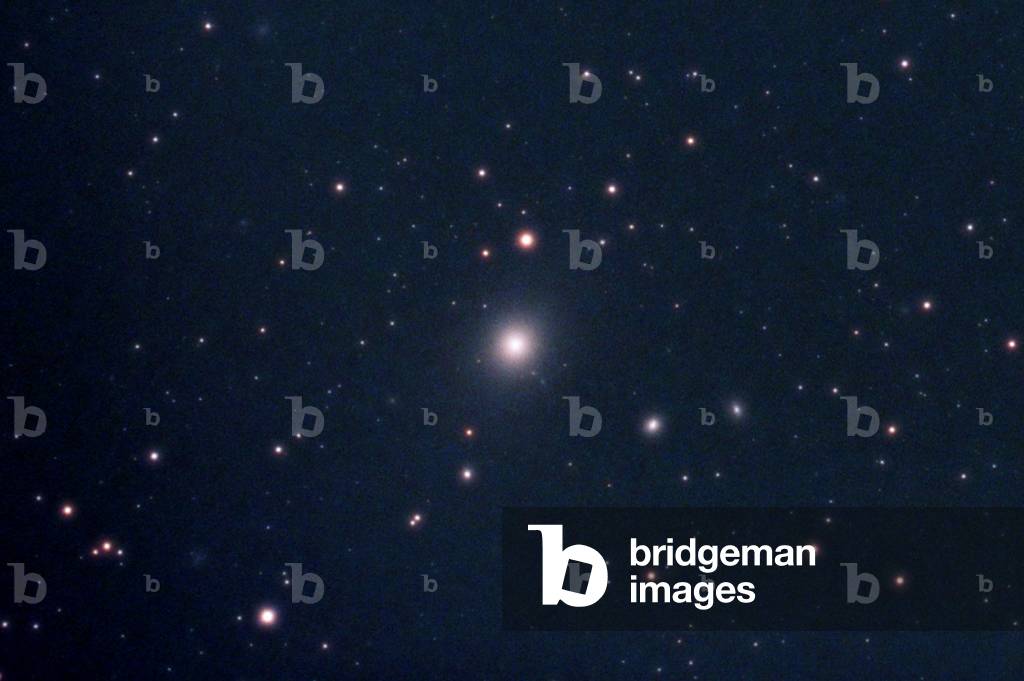
Persee Galaxy Cluster - Galaxy cluster in Perseus - The Persee galaxy cluster (Abell 426) contains at least 500 galaxies including the large elliptical galaxy NGC 1275. This galaxy (the largest to the lower left of the image) is located about 235 million years ago - light; it is a very strong source of radio wave transmission. Image obtained with a 400 mm telescope through several filters and composite. More than 4 hours of installation. The Perseus galaxy cluster (Abell 426) is a rich cluster containing over 500 members centered on the large elliptical galaxy NGC 1275 (bottom left). Also known as Perseus A, NGC 1275 is an extremely powerful radio source
Classification of galaxies. The Hubble sequence - Edwin Hubble's galaxy classification - The Hubble sequence is a classification of galaxy types based on morphological criteria developed by astronomer Edwin Hubble in 1936. Artist's view. The Hubble sequence is a morphological classification scheme for galaxies created by the astronomer Edwin Hubble in 1936. Artwork
M87 elliptical galaxy in Virgo - M87 elliptical galaxy in Virgo - The M87 galaxy (NGC 4486) is located about 52 million years away - light from Earth, in the heart of the Virgin's cluster. M87 is the brightest radio source of the constellation, it is also called Virgo A. NGC 4486 (M87) is the largest and brightest elliptical galaxy within the northern Virgo Cluster at about 52 million light years from Earth. The galaxy also called Virgo A contains a notable active galactic nucleus that is a strong source of multiwavelength radiation, particularly radio waves. In 1918 astronomer Heber Curtis discovered a jet of matter coming from M87 which extends at least 5000 light - years from the nucleus of M87 and is made up of matter ejected from the galaxy, most likely by a supermassive black hole
Central region of the elliptical galaxy Centaurus A (NGC 5128) - Central part of the galaxy Centaurus A (NGC 5128) - The galaxy NGC 5128 is located about 13 million years away from Earth in the southern constellation of Centaurus. A broad dark band crosses it in the middle, a probable vestige of a collision with a spiral galaxy. This giant galaxy is a powerful radio source known as Centaurus A. It is an active galaxy whose energy comes from a supermassive black hole. The green dot visible in the dust strip is a supernova, the supernova 1986g. It appears green because the red filter image that made this trichromy image was only taken a year after the event and the supernova had weakened. Image obtained from the 3.9m telescope of Siding Spring, Australia. The nearby radio source Centaurus A (NGC 5128) looks like an elliptical galaxy, crossed by a broad, irregular dust lane. The dark band is probably the remains of a dusty spiral galaxy which is being absorbed by the giant elliptical. One of the nearer galaxies, 13 million light years away, Centaurus A is the most powerful nearby radio source and is also a copious source of X - and gamma rays as well as visible and infrared radiation.The three plates which were combined to make this colour picture have been copied to enhance the fine detail of the dust lane and to suppress the bright background of the elliptical galaxy. This process reveals many tiny red star - forming regions, especially prominent towards the end of the dust lane, and the clumps of young blue stars recently formed from them. The curious green star in the dust lane is because the blue and green - light plates were taken when supernova 1986g had just appeared, while the red - light plate was taken a year later when the supernova had faded
Elliptical Galaxy M110 (NGC 205) in Andromede - Elliptical galaxy M110 (NGC 205) in Andromeda - The elliptical galaxy M110, Andromede's satellite galaxy, is about the same distance from us as M31, about 2.9 million years - light. It is of type E6 “special” because it presents some unusual dark structures (probably dust clouds). M110 is the second small companion (along with M32) to our sister galaxy, M31, the Andromeda Nebula. It is classified as type E5 or E6, often with the additional “” p”” for peculiar because of the structure clearly visible in this short exposure image, which is probably due to dust clouds. Because of its small size, it is usually counted as a dwarf spheroidal rather than a normal elliptical
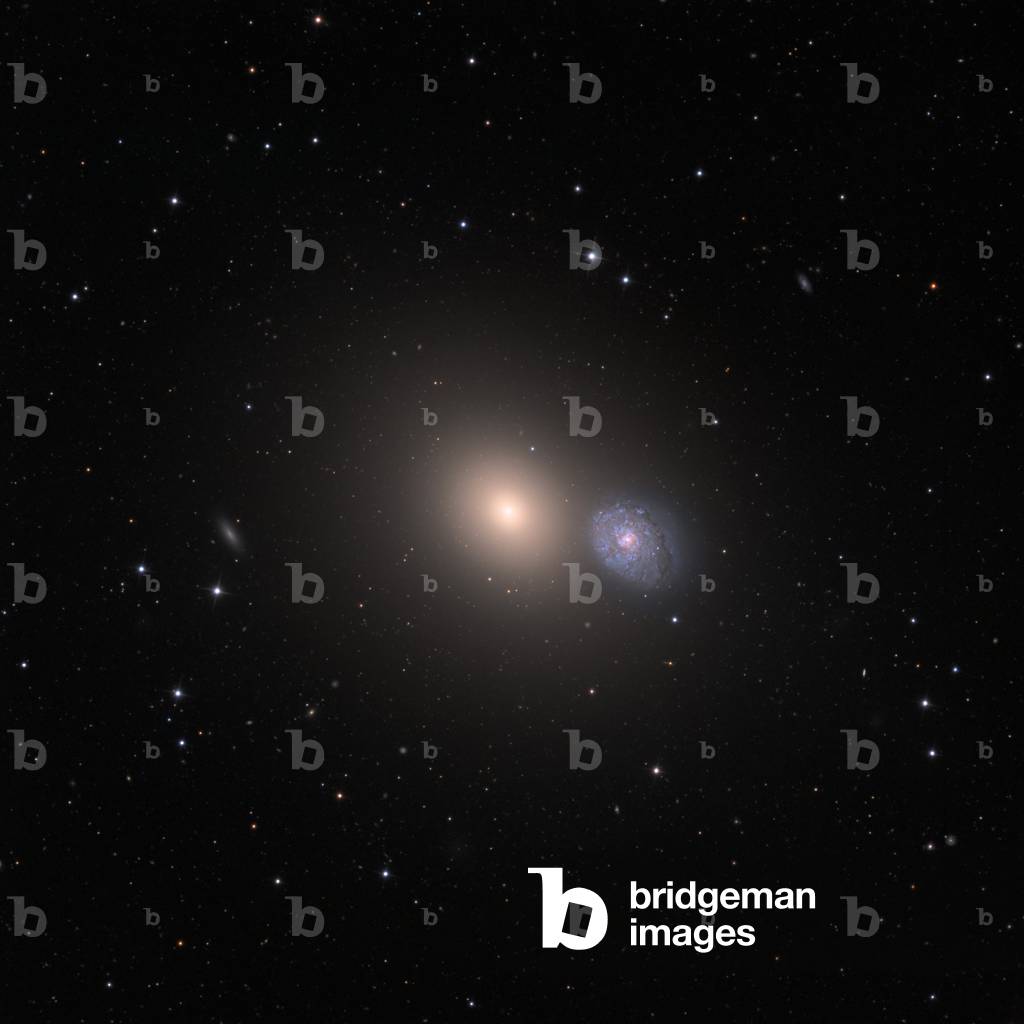
Galaxies Maffei 1 and Maffei 2 in Cassiopee - Maffei Galaxies in Cassiopeia - Maffei 1 (right) is an elliptical galaxy, Maffei 2 (left) is a barree spiral galaxy. These two galaxies are located about 8 million light years away from Earth. Image obtained by the Oschin telescope of Mount Palomar through several filters and composed. The picture show two galaxies lying at 2.5 degrees northeast of h and Chi Persei the famous Double Cluster in Cassiopeia. Although the galaxies has been obstructed by inner galactic matters, their actual sizes are larger than 10 arc minutes, fairly large - sized neighboring galaxies. The Maffei I (on the right) is an elliptic, and the Maffei II (on the left) is classified as a bared galaxy. The galaxies are estimated about 8 million light years away. They were discovered by the Italian astronomer Paolo Maffei in 1968. Now we know about 20 galaxies belonging to Maffei Group. This image is based on data acquired by the Oschin Telescope at the Mount Palomar Observatory
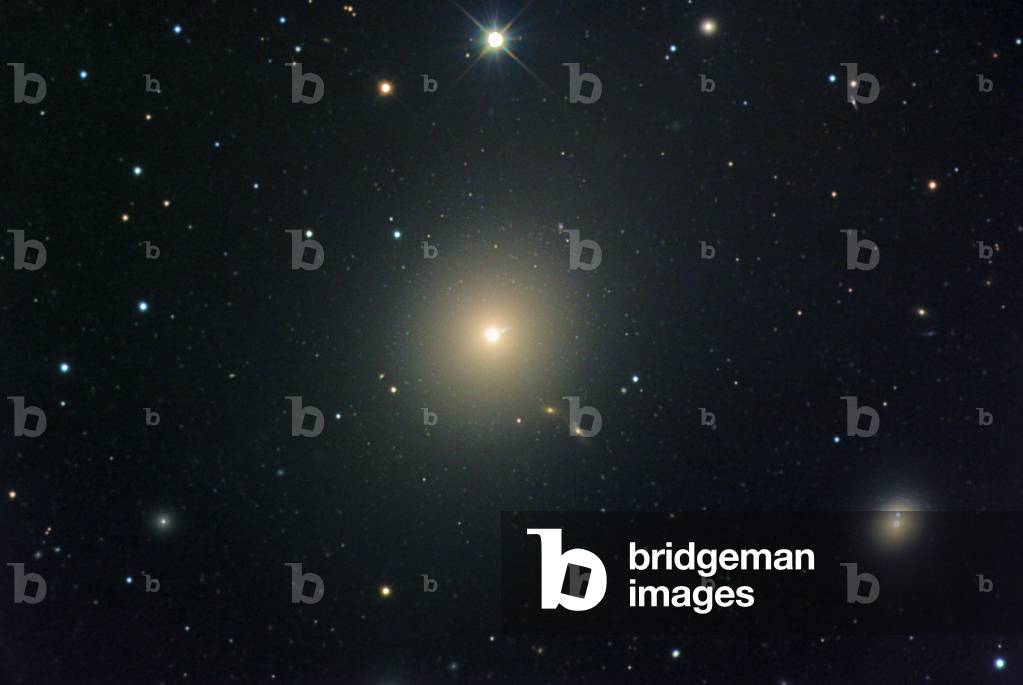
Elliptical Galaxy M49 - Elliptical galaxy M49 in Virgo - M49 (NGC 4472) is an E4 elliptical galaxy located in the Virgin's cluster. Elliptical galaxy M49 (NGC 4472) located in the Virgo cluster of galaxies
Central part of the Virgo cluster of galaxies - The Virgin's cluster contains several thousand galaxies. It is located about 70 million light years away from Earth. To the right are the galaxies M84 (NGC 4374) and M86 (NGC 4406) (to the left) dominate the image. Lower left is the elliptical galaxy M87. Located about 70 million light years away, the Virgo cluster is a gigantic collection of several thousand galaxies that dominate our local part of the universe. Markarian's Chain of galaxies is in the center, including giant elliptical galaxies M86 and M84. M87 is another giant elliptical galaxy at lower left in the photo
Galaxies NGC 5981, NGC 5982 and NGC 5985 in the Dragon - NGC 5981, NGC 5982 and NGC 5985 galaxies in Draco - This group of galaxies is located about 100 million years ago - light from Earth in the constellation of Dragon. On the left, the spiral galaxy NGC 5985, in the center, the elliptical galaxy NGC 5982, on the right the spiral galaxy seen by the slice NGC 5981. This galaxy group is about 100 million light years from Earth in the contellation Draco. To the left of the image, the NGC 5985 spiral galaxy; in center, the NGC 5982 elliptic galaxy with the edge - on NGC 5981 spiral galaxy on its right
Galaxies NGC 5350, NGC 5353/54, NGC 5355 and NGC 5358 - Galaxies NGC 5350, NGC 5353/54, NGC 5355 and NGC 5358 - This group of galaxies is located about 100 million years ago - light from Earth in the constellation Hunting Dogs. On the right, the spiral galaxy NGC 5350, below, the interaction galaxies NGC 5353 and NGC 5354. Group of galaxies at about 100 million light years away in Canes Venatici constellation. At right is the spiral galaxy NGC 5350, below the interacting galaxies NGC 5353 and NGC 5354
Andromede Galaxy - Andromeda galaxy - The Andromede galaxy is located about 2.3 million years ago - light from Earth. Two satellite galaxies accompany it: M32 (NGC 221) at the top left of the nucleus, and M110 (NGC 205) at the bottom. Like the lactee path, the Andromede galaxy belongs to the local group, making up about thirty galaxies. M31, the Great galaxy in Andromeda, is a gigantic collection of more than 300 billion stars and is located about 2 million light years from Earth. Companion dwarf elliptical galaxies M32 and M110 are also visible. M31 and its companions are part of our local group of galaxies, which includes the Milky Way and Magellanic Clouds, and M33. The Andromeda Galaxy is headed towards our Milky Way Galaxy and is expected to collide with it and possibly merge into a gigantic elliptical galaxy in about 3 billion years
Spiral galaxy M31 in Andromede - M31, the Great galaxy in Andromeda - The galaxy of Andromede is located about 2 million years ago - light from Earth. Two satellite galaxies accompany it: M32 (NGC 221) in the center left, and M110 (NGC 205) below. Like the lactee path, the Andromede galaxy belongs to the local group, making up about thirty galaxies. M31, the Great galaxy in Andromeda, is a gigantic collection of more than 300 billion stars and is located about 2 million light years from Earth. Companion dwarf elliptical galaxies M32 and M110 are also visible. M31 and its companions are part of our local group of galaxies, which includes the Milky Way and Magellanic Clouds, and M33. The Andromeda Galaxy is headed towards our Milky Way Galaxy and is expected to collide with it and possibly merge into a gigantic elliptical galaxy in about 3 billion years
Spiral Galaxy M100 in Berenice's Hair - Spiral galaxy M100 in Coma Berenices - The spiral galaxy M100 is located about 60 million years ago - light from Earth. It belongs to the Virgin's galaxy cluster. Several dwarf elliptic galaxies are visible in this image, one just above M100 probably interacting. This image was obtained by Siding Spring's 3.9m telescope. In this deep image fainter galaxies appear. One seems to be involved with the faint outskirts of the large spiral. The somewhat distorted shape of the dwarf galaxy suggests it could be both influencing and being influenced by M100, and may be the cause of the asymmetry in the spiral arms. Nearby is an even fainter, elongated dwarf galaxy and elsewhere in the picture are several others, all probably members of the Virgo cluster, which spills over into the adjoining constellation of Coma Berenices
Galaxy clusters Abell 1060 in Hydra - The Hydra cluster of galaxies (Abell 1060) - The galaxy in the center is the spiral galaxy NGC 3312. To its right, the brightest elliptical galaxies of this cluster: NGC 3311. The two bright stars are closer and belong to our galaxy. This splendid cluster of galaxies in Hydra is framed by two nearby, cool stars in our own Milky Way. The brightest is about 5th magnitude, visible to the unaided eye only under a dark sky; the second brightest is below naked - eye visibility. In contrast the galaxies appear featureless in all but the largest telescopes. The bluish, elongated galaxy is an edge - on spiral, NGC 3312. It has been distorted by interactions with its neighbours. They in turn have been affected, and the brightest of the two adjacent yellow elliptical galaxies (NGC 3311) has an assymetrical envelope, perhaps as a result of this encounter. It's hard to tell who is jostling who in a crowded group of galaxies such as this. Among the most interesting galaxies in the group are two faint spirals (NGC 3314) that are by chance aligned along the line of sight. They are seen a little to the left of the fainter star and directly below the brighter
M87 elliptical galaxy in Virgo - M87 elliptical galaxy in Virgo - The M87 galaxy (NGC 4486) is located about 60 million years ago - light from Earth, in the heart of the Virgin's cluster. M87 is the brightest radio source in the constellation, it is also called Virgo A. Image made with Siding Spring's 3.9m telescope. Messier 87 (NGC 4486) lies near the centre of the nearby cluster of galaxies in Virgo at a distance of about 60 million light years. Although the physical boundaries of elliptical galaxies are not well defined, their mass can be, and by any standards M87 is enormous. It contains several thousand billion stars. Associated with this giant galaxy are large numbers of globular clusters, visible in this photograph as the cloud of slightly fuzzy objects around it. Like all ellipticals, M 87 is composed mainly of old stars and is largely devoid of the materials needed to make new ones. The galaxy is not inert however; high energy X - rays have been detected from an extensive outer halo and the galaxy itself is also known as Virgo A, the strongest radio source in the Virgo cluster. The source for this extreme behavior is probably a massive black hole at the center of the galaxy
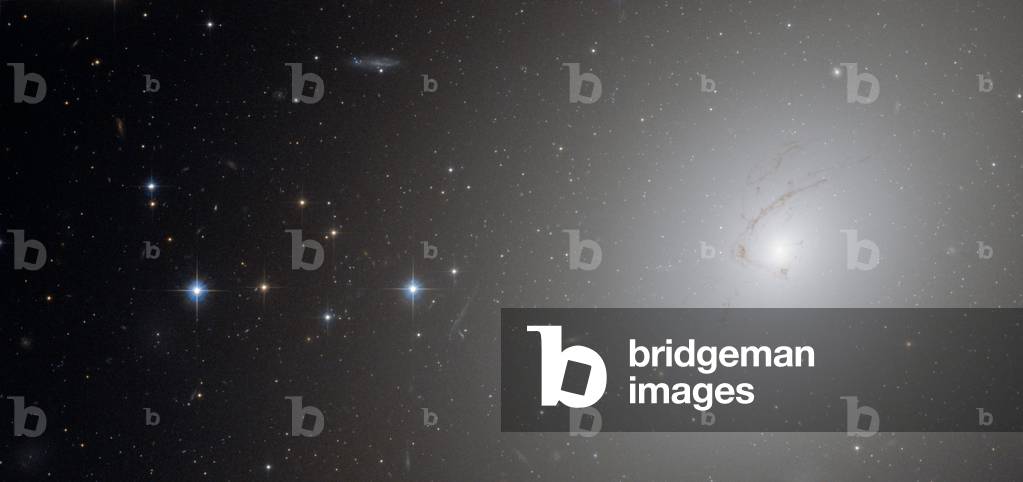
Elliptical galaxy NGC 4696 in Centaur - Elliptical galaxy NGC 4696 - Image of the elliptical galaxy NGC 4696, in Centaur, obtained by the Hubble space telescope. This picture, taken by Hubble's Advanced Camera for Surveys, shows NGC 4696, the largest galaxy in the Centaurus Cluster. The huge dust lane, around 30 000 light - years across, that sweeps across the face of the galaxy makes NGC 4696 look different from most other elliptical galaxies. Viewed at certain wavelengths, strange thin filaments of ionised hydrogen are visible within it. In this picture, these structures are visible as a subtle marbling effect across the galaxy's bright centre
Galaxies M95, M96 and M105 in the Lion - Galaxies M95, M96 and M105 in Leo - M95 (NGC 3351), at the top left, is a barred spiral of type SBB, M96 (NGC 3368), on its right, is a spiral galaxy of type Sa. M96 is the brightest member of the Leo I galaxy group, which is also called the M96 group. It also contains the elliptical galaxy M105, at the bottom of the image and a number of weaker galaxies. M95 (NGC 3351, top left), is a barred spiral galaxy, M96 (NGC 3368, right), is a spiral galaxy. With M105 (bottom), they are dominant members of the Leo I galactic group which also includes several fainter galaxies
Galaxies M105, NGC 3384 and NGC 3389 in the Lion - M105, NGC 3384 and NGC 3389 galaxies in Leo - These galaxies belong to the group of Leo 1 galaxies. Below is the elliptical galaxy M105, type E1, located about 40 million years ago - light from Earth; above, NGC 3384, at the top NGC 3389, a galaxy in the background. M105 (bottom) is a type E1 elliptical galaxy and the brightest member of the Leo I galaxy grouping. The entire group is about 40 million light - years away. Also visble are galaxies NGC 3384 (above and right of center), which is part of the Leo I group, and NGC 3389 (top left), which is a more distant background galaxy
Elliptical Galaxy ESO 306 - 17 - Elliptical galaxy ESO 306 - 17 - The galaxy ESO 306 - 17 is an isolated elliptical galaxy located about 500 million years ago - light from Earth. In the background, many distant galaxies are visible. This image from the Advanced Camera for Surveys aboard the NASA/ESA Hubble Space Telescope highlights the large and bright elliptical galaxy called ESO 306 - 17 in the southern sky. In this image, it appears that ESO 306 - 17 is surrounded by other galaxies but the bright galaxies at bottom left are thought to be in the foreground, not at the same distance in the sky. In reality, ESO 306 - 17 lies fairly abandoned at half a billion light - years from Earth in an enormous sea of dark matter and hot gas
Hickson 44, Group of Galaxies in the Lion - Hickson 44 Galaxy Group in Leo - Group of galaxies located about 60 million light years away from Earth. At the top is the elliptical galaxy NGC 3193, in the center is the spiral galaxy NGC 3190, under its right is the spiral galaxy NGC 3187, and on the left, NGC 3185. The Hickson Galaxy Group is about 60 million light years from Earth. To the top of the image, the NGC 3193 elliptic galaxy; in the center, the NGC 3190 spiral galaxy with NGC 3187 just under on its right and NGC 3185 on its left
Galaxies around NGC 4874 - Galaxies around NGC 4874 - NGC 4874 (right middle) is a large elliptical galaxy belonging to a cluster of galaxies comprising more than a thousand galaxies situated 330 million years - light in the constellation of Coma Berenices (Berenice's Hair). Image obtained by the Hubble Space Telescope (HST). In this NASA/ESA Hubble Space Telescope image, NGC 4874 is the brightest object, located to the right of the frame and seen as a bright star - like core surrounded by a hazy halo. A few of the other galaxies of the cluster are also visible, looking like flying saucers dancing around NGC 4874. But the really remarkable feature of this image is the point - like objects around NGC 4874, revealed on a closer look: almost all of them are clusters of stars that belong to the galaxy. Each of these globular star clusters contains many hundreds of thousands of stars. Recently, astronomers discovered that a few of these point - like objects are not star clusters but ultra - compact dwarf galaxies, also under the gravitational influence of NGC 4874. Being only about 200 light - years across and mostly made up of old stars, these galaxies resemble brighter and larger versions of globular clusters. They are thought to be the cores of small elliptical galaxies that, due to the violent interactions with other galaxies in the cluster, lost their gas and surrounding stars. This Hubble image also shows many more distant galaxies that do not belong to the cluster, seen as small smudges in the background. While the galaxies in the Coma Cluster are located about 350 million light - years away, these other objects are much further out
Persee Galaxy Cluster - Galaxy cluster in Perseus - The Persee galaxy cluster (Abell 426) contains at least 500 galaxies including the large elliptical galaxy NGC 1275. This galaxy (the largest to the bottom left of the image) is located about 235 million years ago - light; it is a very strong source of radio waves known as Perseus A. Perseus galaxy cluster (Abell 426) is a cluster of about 500 galaxies. The biggest (bottom left) is NGC 1275, located 235 million light years away; it is a strong radio source known as Perseus A
Interacting galaxies in the Austral Fish - Interacting galaxies in Piscis Austrinus - The galaxies NGC 7173 (middle left), NGC 7174 (middle right) and NGC 7176 (bottom right) photographed here by the Hubble Space Telescope (HST), belong to a cluster of galaxies called Hickson Compact Group 90 (HCG 90), located about 100 million years ago lights in the constellation of Southern Fish. NGC 7173 and NGC 7176 are two elliptical galaxies while NGC 7174 is a spiral galaxy deformed by the gravitational forces exerted by its neighbors. The three pictured galaxies - - NGC 7173 (middle left), NCG 7174 (middle right) and NGC 7176 (lower right) - - are part of the Hickson Compact Group 90, named after astronomer Paul Hickson, who first catalogued these small clusters of galaxies in the 1980s. NGC 7173 and NGC 7176 appear to be smooth, normal elliptical galaxies without much gas and dust. In stark contrast, NGC 7174 is a mangled spiral galaxy, barely clinging to independent existence as it is ripped apart by its close neighbours. The strong tidal interaction surging through the galaxies has dragged a significant number of stars away from their home galaxies. These stars are now spread out, forming a tenuous luminous component in the galaxy group. This trio is part of a tight cluster of 16 galaxies, many of them being dwarf galaxies. The galaxy cluster Hickson Compact Group 90 lies about 100 million light - years away in the direction of the constellation Piscis Austrinus, the Southern Fish
Galaxies M105, NGC 3384 and NGC 3389 in the Lion - Galaxies M105, NGC 3384 and NGC 3389 in Leo - These galaxies belong to the group of Leo 1 galaxies. On the right is the elliptical galaxy M105, type E1, located about 37 million years ago - light from the Earth; on its left, the galaxy NGC 3384, down, NGC 3389, a galaxy in the background. M105 (right) is a type E1 elliptical galaxy and the brightest member of the Leo I galaxy grouping. The entire group is about 37 million light - years away. Also visble are galaxies NGC 3384 (left), which is part of the Leo I group, and NGC 3389 (bottom), which is a more distant background galaxy
Jet of the Galaxy Centaurus A (NGC 5128) seen in X-rays - Galaxy Centaurus A X - ray jet - View in false colours of a 30 000-year long jet - light that escapes from the nucleus of the Galaxy Centaurus A where a massive black hole is suspected. The galaxy NGC 5128 is located about 13 million light years away from Earth. Image obtained by the Chandra Space Telescope in May 2000. Chandra space telescope detects a jet emanating from the NGC 5128 core and numerous point - like X - ray sources, all bathed in diffuse X - rays produced by several - million - degree gas that fills the galaxy. It is believed that most of these sources are X - ray binaries in which a neutron star or stellar - sized black hole is accreting matter from a nearby companion star. The Cen A image was created from Chandra observations taken on December 5, 1999 and May 17, 2000
Persee Galaxy Cluster - Perseus galaxy cluster - The Persee galaxy cluster (Abell 426) contains at least 500 galaxies including the large elliptical galaxy NGC 1275. This galaxy (the galaxy with pink filaments to the left of the image) is located about 235 million years ago - light; it is a very strong source of radio wave transmission known as Perseus A. In the right center of the image, note the presence of a supernova, SN 2008fg, in a small blue spiral galaxy, NGC 1268. Perseus galaxy cluster (Abell 426) is a cluster of about 500 galaxies. The biggest (left) is NGC 1275, located 235 million light years away; it is a strong radio source known as Perseus A. The gravity exerted by the luminous parts of a galaxy cluster is insufficient to hold the cluster together. Thus, scientists have concluded the missing adhesive must be dark matter and since it's invisible to modern instruments - it can only be inferred. So, when one views the image of the Perseus Galaxy Cluster, ones sees only a small fraction of what's actually there. This image was serendipitously exposed during the brief appearance of a supernova, designated SN2008FG, in one of the small blue spiral galaxies caught in the field of view (center right). It was discovered on August 30, 2008 by the 30 - inch KAIT robotic supernova patrol telescope located at historic Lick Observatory near San Jose, California. The stellar explosion, characterized by its bright blue color, is located near the bottom right edge of the galaxy. This cataclysmic event easily outshines the combined light of its home star system, NGC 1268
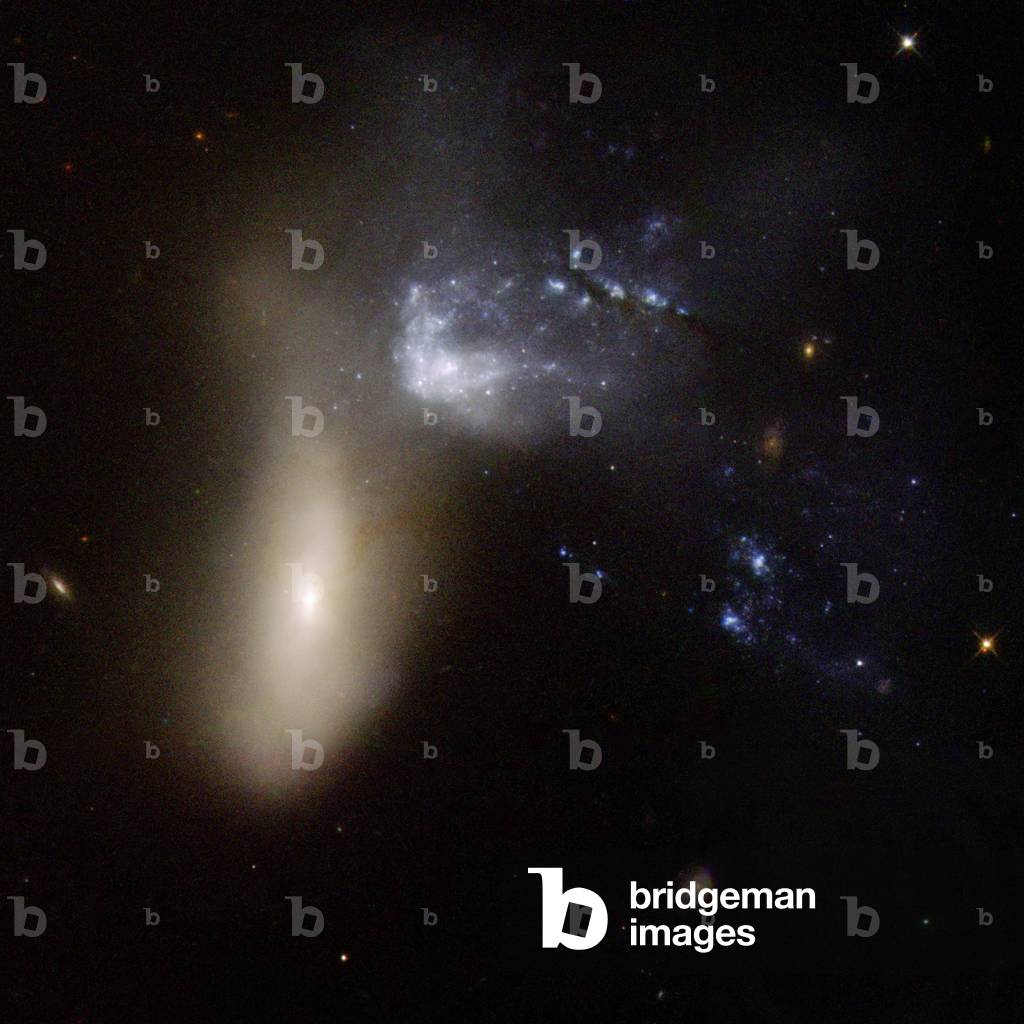
Interacting galaxies NGC 454 - Interacting galaxies NGC 454 - NGC 454 is located about 164 million light years away from Earth in the southern constellation of Phenix. This pair of interacting galaxies consists of a large elliptical galaxy and an irregular galaxy. The fusion process between the two galaxies is still in its early stages and no sign of star formation caused by this interaction has been detected. Image obtained by the Hubble Space Telescope on 6 March 1997. NGC 454 is galaxy pair comprising a large red elliptical galaxy and an irregular gas - rich blue galaxy. The system is in the early stages of an interaction that has severely distorted both components. The three bright blue knots of very young stars to the left of the two main components are probably part of the irregular blue galaxy. Although the dust lanes that stretch all the way to the center of the elliptical galaxy suggest that gas has penetrated that far, no signs of star formation or nuclear activity are visible. The pair is approximately 164 million light - years away. Image taken by the Hubble space telescope on March 6, 1997
Galaxies NGC 5090 - NGC 5091 in Centaurus - Interacting galaxies NGC 5090 - 5091 in Centaurus - NGC 5090 is an elliptical galaxy and NGC 5091 a spiral galaxy. These two galaxies interact and lie about 150 million light years away from Earth. This image was obtained by the ANTU telescope of the VLT on March 29, 1999. NGC 5090 is an elliptical galaxy interacting with the spiral galaxy NGC 5091. Both are located at about 150 million light - years away. Image taken with ANTU telescope (VLT) on March 29, 1999
Galaxy clusters Abell 1060 in Hydra - The Hydra cluster of galaxies (Abell 1060) - The galaxy in the center is the spiral galaxy NGC 3312. To its right, the brightest elliptical galaxies of this cluster: NGC 3311. The two bright stars are closer and belong to our galaxy. This splendid cluster of galaxies in Hydra is framed by two nearby, cool stars in our own Milky Way. The brightest is about 5th magnitude, visible to the unaided eye only under a dark sky; the second brightest is below naked - eye visibility. In contrast the galaxies appear featureless in all but the largest telescopes. The bluish, elongated galaxy is an edge - on spiral, NGC 3312. It has been distorted by interactions with its neighbours. They in turn have been affected, and the brightest of the two adjacent yellow elliptical galaxies (NGC 3311) has an assymetrical envelope, perhaps as a result of this encounter. It's hard to tell who is jostling who in a crowded group of galaxies such as this. Among the most interesting galaxies in the group are two faint spirals (NGC 3314) that are by chance aligned along the line of sight. They are seen a little to the left of the fainter star and directly below the brighter
The cluster of galaxies in Fornax - The cluster of galaxies in Fornax - clusters of galaxies situated about 55 million years ago - light. In the center of the image is the barree spiral galaxy NGC 1365; at the bottom right of the image, the interaction galaxy NGC 1316 - 17 (Fornax A), which is one of the strongest known radiosource. Galaxies can be separated by their appearance into two broad groups, spirals and ellipticals. An example of a spiral galaxy, NGC 1365, is seen in center of this picture. In contrast, most of the galaxies in this cluster are ellipticals, which contain little or no gas or evidence of star formation; indeed they are composed millions of rather old, yellowish stars. Unlike many of the stars in spiral systems, those in ellipticals have orbits which are not confined to a narrow plane, so the galaxy can have a shape anywhere between a perfect sphere and an American football. This kind of galaxy is the most common type in the photograph as it is in all of the nearby Universe. The picture also illustrates another distinctive property of ellipticals, their gregarious nature - they congregate in clusters, like this group of galaxies in Fornax, 55 million light years distant. This image also shows us another, less common kind of galaxy. In the lower right corner is NGC 1316 - 17. This is interacting pair of galaxies is one of the strongest nearby radio galaxies, known as Fornax A. Finally, in the opposite corner is a bright yellow (K5) 4.5 magnitude star in the adjoining constellation of Eridanus
Group of galaxies HCG 87 in Capricorn - Hickson Compact Group 87 in Capricornus - Group of galaxies in interaction situated 400 million years ago - light from Earth. The largest of these galaxies (HCG 87a) is a spiral galaxy seen by the slice; it and its neighbor the elliptical galaxy HCG 87b probably have a central black hole. The third member of this group, the spiral galaxy HCG 87c appears to be in an active phase of star formation. Group of interacting galaxies located at about 400 million light - years. The largest galaxy member (HCG 87a), which is actually disk - shaped, but tilted so that we see it nearly edge - on and its elliptically shaped nearest neighbor (87b) have active galactic nuclei which are believed to harbor black holes that are consuming gas. A third group member, the nearby spiral galaxy 87c, may be undergoing a burst of active star formation. These three galaxies are so close to each other that gravitational forces disrupt their structure and alter their evolution
Coma cluster of galaxies Abell 1656 - Coma cluster of galaxies - The Coma cluster of galaxies consists of more than a thousand galaxies located 330 million years - light in the constellation Coma Berenices. This cluster is dominated by two large elliptical galaxies NGC 4874 on the right and NGC 4889 on the left. The Coma cluster of galaxies (Abell 1656) is one of the densest galaxy cluster known. It contains a thousand of galaxies and is located 330 million light years away. Two big elliptical galaxies dominate it: NGC 4874 (right) and NGC 4889 (left)
Abell 383 galaxy cluster and primitive galaxy - Abell 383 cluster of galaxies with gravitational arcs - Abell 383 is a cluster of galaxies located in the constellation Eridan. This image obtained by the Hubble Space Telescope (HST) in 2011 shows gravitational arcs among galaxies. These mirages are deformed images of farther galaxies located behind the cluster. Thanks to this magnifying effect, the resulting image revealed the presence of a primitive galaxy, nee 200 million years after the big blow. Astronomers have uncovered one of the youngest galaxies in the distant universe, with stars that formed 13.5 billion years ago, a mere 200 million years after the Big Bang. The finding addresses questions about when the first galaxies arose, and how the early universe evolved. Nasa's Hubble Space Telescope was the first to spot the newfound galaxy. Detailed observations from the W.M. Keck Observatory on Mauna Kea in Hawaii revealed the observed light dates to when the universe was only 950 million years old; the universe formed about 13.7 billion years ago. Infrared data from both Hubble and Nasa's Spitzer Space Telescope revealed the galaxy's stars are quite mature, having formed when the universe was just a toddler at 200 million years old. The galaxy's image is being magnified by the gravity of a massive cluster of galaxies (Abell 383) parked in front of it, making it appear 11 times brighter. This phenomenon is called gravitational lensing. Hubble imaged the lensing galaxy Abell 383 with the Wide Field Camera 3 and the Advanced Camera for Surveys in November 2010 through March 2011
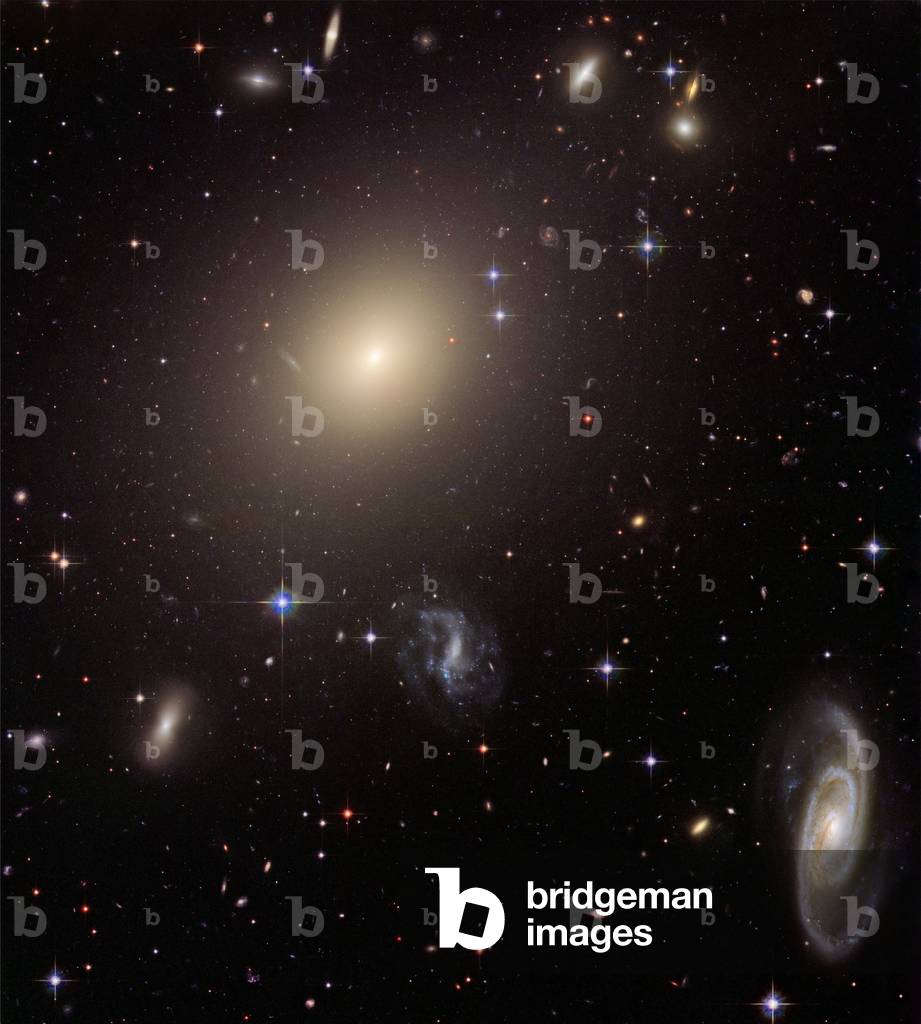
Elliptical galaxy NGC 4881 and distant galaxies - Elliptical galaxy NGC 4881 and distant galaxies - The elliptical galaxy NGC 4881 (upper left) is about 300 million years away - light from Earth. NGC 4881 is located in the Coma galaxy cluster that contains at least 1,000 galaxies and is five times farther from us than the Virgin's cluster. Almost all the objects visible in this photo are located far behind the Coma cluster, except for the spiral galaxy to the right of Ngc 4881. Image obtained by the Hubble Space Telescope in 1994. This photo mosaic, which shows a field of distant galaxies, is a computer enhanced reproduction of a picture taken 4 March 1994 with the repaired Hubble Space Telescope. The brightest object in this picture is NGC 4881. It is a 13th - magnitude elliptical galaxy in the outskirts of the Coma Cluster, a great cluster of galaxies more than 5 times farther away than the Virgo Cluster. Except for a 16th - magnitude Coma spiral at the right and a few foreground stars of the Milky Way, almost everything else in this field lies far beyond the Coma Cluster. There is a fascinating assortment of background galaxies, including an apparent galaxian merger in progress
Spiral Galaxy M31 in Andromede - Spiral galaxy M31 in Andromeda - The galaxy of Andromede is located about 2 million years ago - light from Earth. Two satellite galaxies accompany it: M32 (NGC 221) at the top left, and M110 (NGC 205) outside the image. Like the lactee path, the Andromede galaxy belongs to the local group, making up about thirty galaxies. M31, the Great galaxy in Andromeda, is a gigantic collection of more than 300 billion stars and is located about 2 million light years from Earth. Companion dwarf elliptical galaxy M32 is also visible. M31 and its companions are part of our local group of galaxies, which includes the Milky Way and Magellanic Clouds, and M33. The Andromeda Galaxy is headed towards our Milky Way Galaxy and is expected to collide with it and possibly merge into a gigantic elliptical galaxy in about 3 billion years
Galaxy clusters Abell 370 - Abell 370 cluster of galaxies with gravitational arcs - This cluster contains a large number of galaxies, most of which are elliptical. A gravitational arc is visible at the bottom of the image. This is the deformed image of a galaxy farther away behind the cluster. This cluster hosts one of the most prominent gravitational arcs known to date. The light of a very remote object is deformed by the foreground cluster. Abell 370, at the center of the photo, contains a large number of galaxies - most of them are ellipticals. The two brightest red galaxies slightly above the gravitational arc are the most massive in the cluster and give an important contribution to the lensing event. This gravitational arc - in combination with the cluster of galaxies - provides a natural laboratory to study the physics of gravity. The exact shape of the arc allows to estimate the mass of the cluster through the equations of general relativity
M87 elliptical galaxy in Virgo - M87 elliptical galaxy in Virgo - The M87 galaxy (NGC 4486) is located about 60 million years ago - light from Earth, in the heart of the Virgin's cluster. M87 is the brightest radio source of the constellation, it is also called Virgo A. Image made with an amateur instrument, a 130 mm bezel. Gigantic elliptical galaxy M87 is located at the heart of the Virgo Cluster of galaxies. Also known as radio source Virgo A, M87 is located about 60 million light years away. It appears to have a linear size of 120,000 light years and a mass estimated at 2.7 trillion solar masses, and an extreme luminosity, with an absolute magnitude of about - 22
Galaxies NGC 4631 and NGC 4656 - 57 in Hunting Dogs - Galaxies NGC 4631 and NGC 4656 - 57 - The spiral galaxy NGC 4631 (upper right) is a galaxy seen by the slice that is located at a distance of 30 million years - light. His small companion, the elliptical galaxy NGC 4627, is visible just above it. Below the irregular galaxies NGC 4656 and NGC 4657. Galaxies NGC 4631 (top right) and NGC 4656 (bottom left) are two unusual galaxies in Canes Venatici. A small companion galaxy, NGC 4627, can be seen next to NGC 4631. The galaxies, which are located about 30 million lights years away, get their unusual shapes from gravitational interactions with each other. NGC 6431 and NGC 4627 are also listed in ARP's Atlas of Peculiar Galaxies as Arp 281
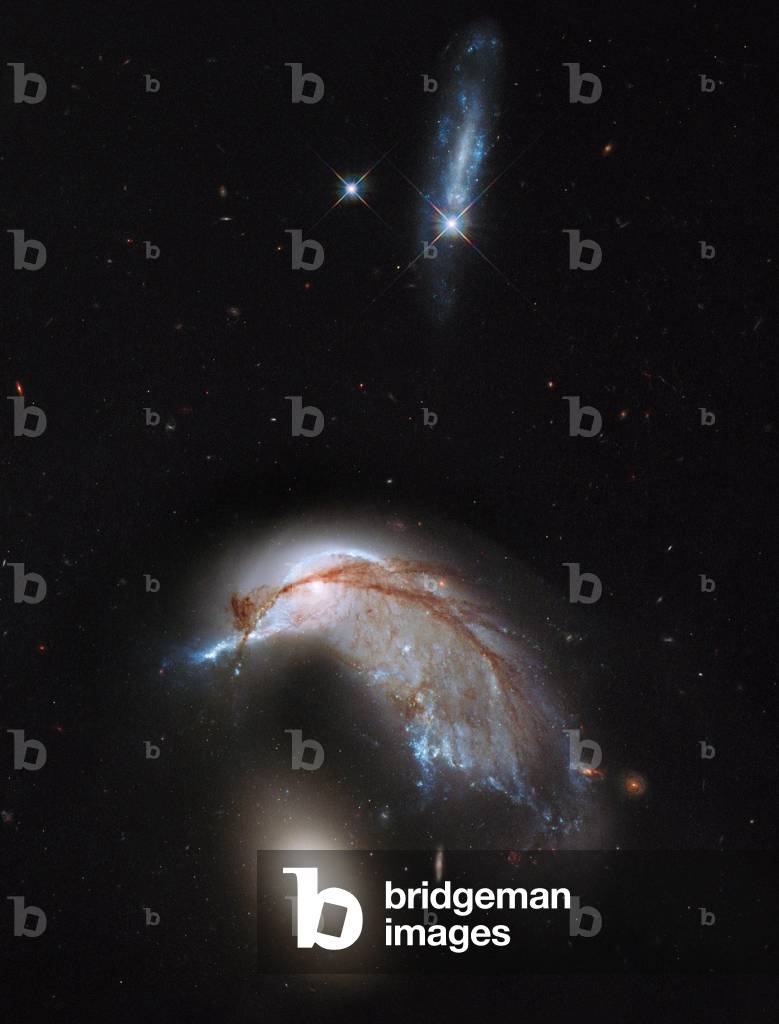
Interacting galaxies NGC 2936 and NGC 2937 - Interacting Galaxies NGC 2936 and NGC 2937 in Hydra - These two interacting galaxies also called Arp 142 are located approximately 326 million years ago - light from Earth in the constellation Hydra. NGC 2936 is a spiral galaxy, NGC 2937 is an elliptical galaxy. Above the torque, a blue galaxy UGC 5130, located closer to us is 230 million light years. Image obtained by the Hubble Space Telescope (HST). This interacting galaxy duo is collectively called Arp 142. The pair contains the disturbed, star - forming spiral galaxy NGC 2936, along with its elliptical companion, NGC 2937 at lower left. Once part of a flat, spiral disk, the orbits of the galaxy's stars have become scrambled due to gravitational tidal interactions with the other galaxy. This warps the galaxy's orderly spiral, and interstellar gas is strewn out into giant tails like stretched taffy. Gas and dust drawn from the heart of NGC 2936 becomes compressed during the encounter, which in turn triggers star formation. These bluish knots are visible along the distorted arms that are closest to the companion elliptical. The reddish dust, once within the galaxy, has been thrown out of the galaxy's plane and into dark veins that are silhouetted against the bright starlight from what is left of the nucleus and disk. The companion elliptical, NGC 2937, is a puffball of stars with little gas or dust present. The stars contained within the galaxy are mostly old, as evidenced by their reddish color. There are no blue stars that would be evidence of recent star formation. While the orbits of this elliptical's stars may be altered by the encounter, it's not apparent that the gravitational pull by its neighboring galaxy is having much of an effect. Above the pair, an unrelated, lone, bluish galaxy, inconsistently cataloged as UGC 5130, appears to be an elongated irregular or an edge - on spiral. Located 230 million light - ye
Centaurus A elliptical galaxy (NGC 5128) in Centaurus - The radio galaxy Centaurus A (NGC 5128): The galaxy NGC 5128 is located about 13 million light years away from Earth in the southern constellation of Centaurus. A broad dark band crosses it in the middle, a probable vestige of a collision with a spiral galaxy. This giant galaxy is a powerful radio source known as Centaurus A. It is an active galaxy whose energy comes from a supermassive black hole. - NGC 5128 is the nearest large elliptical galaxies to our sun at about 13 million light years. It is also the nearest of the giant radio galaxies, possessing an active galactic nucleus (AGN) and optically one of the most luminous galaxies in the sky. In 1949, NGC 5128 was found to be a loud source of radio energy, in fact the loudest radio source in its region of the sky (second overall to Cygnus A), earning it the designation Centarus A. As a radio galaxy it releases 1000 times the radio energy of the Milky Way in the form of large bi-directional radio lobes that extend some 800,000 light years into intergalactic space. The source of the radio emission is very compact, about 10 light days across and is believed to be a supermassive black hole in the galaxy's center with a total mass of 200 million to possibly one billion suns. As a radio galaxy, NGC 5128 belongs to the subgroup of galaxies called Active Galaxies, which include Quasars, Seyfert galaxies, Blazars and Radio Galaxies. Active galaxies are distinguished by their prodigious energy output which cannot be explained by their stellar populations and must have another source. Active galaxies have in common an “Active Galactic Nucleus (AGN)”” which is believed responsible for their prodigious energy output. Supermassive black holes are almost certainly the central engines of Active Galactic Nuclei, powering the enormous outflows of energy which characterize this subgroup of bright galaxies. Composite Image from M
Abell 2218 galaxy cluster in the Dragon - Gravitational lenses in the galaxy cluster Abell 2218 - The Abell 2218 galaxy cluster is located about 2 billion years ago - light from Earth in the constellation of the Dragon. It is so massive that its gravity curved and amplifies the light from other galaxies located behind it. Thus, these galaxies appear on this cliche obtained by the Hubble space telescope in the form of arcs. Abell 2218 resides in the constellation Draco, some 2 billion light - years from Earth. The cluster is so massive that its enormous gravitational field deflects light rays passing through it, much as an optical lens bends light to form an image. This phenomenon, called gravitational lensing, magnifies, brightens, and distorts images from faraway objects. The cluster's magnifying powers provides a powerful “” zoom lens”” for viewing distant galaxies that could not normally be observed with the largest telescopes. This useful phenomenon has produced the arc - shaped patterns found throughout the Hubble picture. These “” arcs”” are the distorted images of very distant galaxies, which lie 5 to 10 times farther than the lensing cluster. This distant population existed when the universe was just a quarter of its present age. Through gravitational lensing these remote objects are magnified, enabling scientists to study them in more detail. This analysis provides a direct glimpse of how star - forming regions are distributed in remote galaxies and yields other clues to the early evolution of galaxies. The picture is dominated by spiral and elliptical galaxies. Resembling a string of tree lights, the biggest and brightest galaxies are members of the foreground cluster. Researchers are intrigued by a tiny red dot just left of top center. This dot may be an extremely remote object made visible by the cluster's magnifying powers. The colors in this picture yield clues to the ages, distances, and temperatures of stars, the stuff of galaxies. Blu
Galaxies NGC 5981, NGC 5982 and NGC 5985 in the Dragon - Galaxies NGC 5981, NGC 5982 and NGC 5985 in Draco - This group of galaxies is located about 100 million years ago - light from Earth in the constellation of the Dragon. On the left, the spiral galaxy NGC 5985, in the center, the elliptical galaxy NGC 5982, on the right the spiral galaxy seen by the slice NGC 5981. This group of galaxies is located 100 million light years away. At left is the spiral galaxy NGC 5985, center is an elliptical galaxy NGC 5982, at right an edge - on spiral galaxy NGC 5981
Elliptical Galaxy M87 in Virgo - Elliptical galaxy M87 in Virgo - The galaxy M87 (NGC 4486) is located about 52 million years away - light from Earth, in the heart of the Virgin's cluster. M87 is the brightest radio source in the constellation, it is also called Virgo A. Gigantic elliptical galaxy M87 is located at the heart of the Virgo Cluster of galaxies. Also known as radio source Virgo A, M87 is located about 60 million light years away. It appears to have a linear size of 120,000 light years and a mass estimated at 2.7 trillion solar masses, and an extreme luminosity, with an absolute magnitude of about - 22
Spiral galaxy M100 in Berenice's Hair - Spiral galaxy M100 in Coma Berenices - The spiral galaxy M100 (NGC 4321) is located about 60 million years ago - light from Earth. It belongs to the Virgin's galaxy cluster. Several dwarf elliptic galaxies are visible in this image, one just above M100 probably interacting. This face - on spiral M100, is one of the finest spirals in the Virgo galaxy cluster. As might be expected in a galaxy - rich environment, the lack of perfect symmetry in its brightest spiral arms suggests that M100 has been disturbed by gravitational interaction with its neighbours. At the top of the image is a less spectacular galaxy, a so - called 'nucleated dwarf' elliptical galaxy, probably interacting with M100
Cluster of galaxies Abell 1656 - Coma cluster - The Coma cluster (Abell 1656) - Large cluster of galaxies consists of about a thousand galaxies located 330 million years - light in the constellation of Coma Berenices (Berenice hair). This cluster is dominated by two large elliptical galaxies NGC 4874 on the right and NGC 4889, left. The Coma cluster (Abell 1656) is a particularly rich cluster of individual galaxies (over 1000 members), most prominently the two giant ellipticals, NGC 4874 (right) and NGC 4889 (left). The remaining members are mostly smaller ellipticals. The cluster is seen towards the constellation Coma Berenices, and is actually at a distance of about 100 Mpc (330 million light years, or a redshift of 0.023) from us. Image based on data acquired by the Oschin Telescope at the Mount Palomar Observatory
Galaxies clusters Abell 370 - Abell 370 cluster of galaxies with gravitational arcs - This cluster of galaxies is located about 5 billion years away from Earth. This image obtained by the Hubble Space Telescope on July 16, 2009 shows gravitational arcs among galaxies. These mirages are deformed images of farther galaxies located behind the cluster. The NASA/ESA Hubble Space Telescope's newly repaired Advanced Camera for Surveys (ACS) has peered across almost five billion light - years to resolve intricate details in the galaxy cluster Abell 370. Abell 370 is one of the very first galaxy clusters where astronomers observed the phenomenon of gravitational lensing, the warping of space - time by the cluster's gravitational field that distorts the light from galaxies lying far behind it. This is manifested as arcs and streaks in the picture, which are the stretched images of background galaxies. Gravitational lensing is a vital tool for astronomers when measuring the dark matter distribution in massive clusters, since the mass distribution can be reconstructed from observations of its gravitational effects. These observations were taken with Hubble's Advanced Camera for Surveys (ACS) in its Wide Field mode on 16 July 2009. The composite image was made using filters that isolate light from green, red and infrared wavelengths
Hickson 44 Galaxy Group in Leo - Hickson 44 Galaxy Group in Leo - Group of galaxies located about 60 million light years away from Earth. At the top is the elliptical galaxy NGC 3193, at the top center the spiral galaxy NGC 3190, at its right the spiral galaxy NGC 3187, and at the bottom, NGC 3185. The Hickson Galaxy Group is about 60 million light years from Earth. To the top of the image, the NGC 3193 elliptic galaxy; in the center, the NGC 3190 spiral galaxy with NGC 3187 just on its right and NGC 3185 at bottom
Seyfert's Sextet Group of Galaxies in the Snake - Seyfert's Sextet group of galaxies - This group of interacting galaxies resides approximately 190 million years ago - light in the constellation of the Snake and extends over 100,000 years - light. The small spiral galaxy seen from the front does not belong to this group. The small face - on spiral with the prominent arms [center] of gas and stars is a background galaxy almost five times farther away than the other four. Only a chance alignment makes it appear as if it is part of the group. The sixth member of the sextet isn't a galaxy at all but a long “” tidal tail””” of stars [below, right] torn from one of the galaxies. The group resides 190 million light - years away in the constellation Serpens. This densely packed grouping spans just 100,000 light - years, occupying less volume than the Milky Way galaxy. Each galaxy is about 35,000 light - years wide. Three of the galaxies [the elliptical galaxy, second from top, and the two spiral galaxies at the bottom] bear the telltale marks of close interactions with each other, or perhaps with an interloper galaxy not pictured here. Their distorted shapes suggest that gravitational forces have reshaped them. The halos around the galaxies indicate that stars have been ripped away. The galaxy at bottom, center, has a 35,000 light - year - long tail of stars flowing from it. The tail may have been pulled from the galaxy about 500 million years ago. Although part of the group, the nearly edge - on spiral galaxy at top, center, remains relatively undisturbed, except for the slight warp in its disk. Most of its stars have remained within its galactic boundaries. Unlike most other galaxy interactions observed with the Hubble telescope, this group shows no evidence of the characteristic blue regions of young star clusters, which generally arise during galaxy interactions. The lack of star - forming clusters suggests that there is something different about Seyfert's Sextet compared wi
Galaxy clusters Abell 370 - Abell 370 cluster of galaxies with gravitational arcs - This galaxy cluster is located about 4 billion light years from Earth in the constellation of the Whale. This image obtained by the Hubble Space Telescope shows gravitational arcs among galaxies. These mirages are deformed images of farther galaxies located behind the cluster. The galaxy cluster Abell 370 contains an astounding assortment of several hundred galaxies tied together by the mutual pull of gravity
Galaxy Cluster Abell S0740 in Centaurus - Galaxy Cluster Abell S0740 in Centaurus - The Hubble space telescope photographed a cluster of galaxies 450 million years ago - Earth light, Abell S0740. There are galaxies of various shapes alongside the giant elliptical galaxy ESO 325 - G004. Image obtained by the ACS camera in January 2005 and February 2006. Hubble Space Telescope image showing the diverse collection of galaxies in a galaxy cluster Abell S0740, at about 450 million light - years away in the constellation Centaurus. The giant elliptical galaxy ESO 325 - G004 looms large at the club's center
Core of the Andromede Galaxy (M31) - The Andromede Galaxy is located about 2 million years away - light from Earth. View of its dual nucleus obtained by the Hubble Space Telescope (HST). Andromeda is the nearest major galaxy to our own Milky Way Galaxy. Our Galaxy is thought to look much like Andromeda. Together these two galaxies dominate the Local Group of galaxies. M31 is so distant it takes about two million years for light to reach us from there. Much about M31 remains unknown, including how the center acquired two nuclei. Image taken with the Hubble space telescope (HST)
Spiral Galaxy M31 in Andromede - Spiral galaxy M31 in Andromeda - The galaxy of Andromede is located about 2.9 million years ago - light from Earth. Two satellite galaxies accompany it: M32 (NGC 221) in the center left, and M110 (NGC 205) below. Like the lactee path, the Andromede galaxy belongs to the local group, making up about thirty galaxies. M31, the Great galaxy in Andromeda, is a gigantic collection of more than 300 billion stars and is located about 2 million light years from Earth. Companion dwarf elliptical galaxies M32 and M110 are also visible. M31 and its companions are part of our local group of galaxies, which includes the Milky Way and Magellanic Clouds, and M33. The Andromeda Galaxy is headed towards our Milky Way Galaxy and is expected to collide with it and possibly merge into a gigantic elliptical galaxy in about 3 billion years
Spiral Galaxy M31 in Andromede - Spiral galaxy M31 in Andromeda - The galaxy of Andromede is located about 2 million years ago - light from Earth. Two satellite galaxies accompany it: M32 (NGC 221) in the center left, and M110 (NGC 205) below. Like the lactee path, the Andromede galaxy belongs to the local group, making up about thirty galaxies. M31, the Great Galaxy in Andromeda, is a gigantic collection of more than 300 billion stars and is located about 2 million light years from Earth. Companion dwarf elliptical galaxies M32 and M110 are also visible. M31 and its companions are part of our local group of galaxies, which includes the Milky Way and Magellanic Clouds, and M33. The Andromeda Galaxy is headed towards our Milky Way Galaxy and is expected to collide with it and possibly merge into a gigantic elliptical galaxy in about 3 billion years
Elliptical galaxy NGC 1316 in the Furnace - Giant elliptical galaxy NGC 1316 - By studying the clusters of stars and clouds of dust visible in this photo taken by the Hubble space telescope in March 2003, it is believed that the giant elliptical galaxy NGC 1316 is the result of a collision of two spiral galaxies that occurred some billions of years ago. This galaxy resides about 75 million light years ago in the cluster of galaxies of the Furnace. Also called Fornax A, it is one of the strongest radio sources in the sky. This image made from data obtained with the NASA Hubble Space Telescope reveals the dust lanes and star clusters of this giant galaxy that give evidence that it was formed from a past merger of two gas - rich galaxies. NGC 1316 is on the outskirts of a nearby cluster of galaxies in the southern constellation of Fornax, at a distance of about 75 million light - years. It is one of the brightest ellipticals in the Fornax galaxy cluster. NGC 1316, also known as Fornax A, is one of the strongest and largest radio sources in the sky, with radio lobes extending over several degrees of sky (well off the Hubble image)
M87 elliptical galaxy in Virgo - M87 elliptical galaxy in Virgo - The M87 galaxy (NGC 4486) is located about 52 million years away - light from Earth, in the heart of the Virgin's cluster. M87 is the brightest radio source in the constellation, it is also called Virgo A. Gigantic elliptical galaxy M87 is located at the heart of the Virgo Cluster of galaxies. Also known as radio source Virgo A, M87 is located about 60 million light years away. It appears to have a linear size of 120,000 light years and a mass estimated at 2.7 trillion solar masses, and an extreme luminosity, with an absolute magnitude of about - 22
Spiral galaxy M100 in Berenice's Hair - Spiral galaxy M100 in Coma Berenices - The spiral galaxy M100 (NGC 4321) is located about 60 million years ago - light from Earth. It belongs to the Virgin's galaxy cluster. Several dwarf elliptic galaxies are visible in this image, one just above M100 probably interacting. This face - on spiral M100, is one of the finest spirals in the Virgo galaxy cluster. As might be expected in a galaxy - rich environment, the lack of perfect symmetry in its brightest spiral arms suggests that M100 has been disturbed by gravitational interaction with its neighbours. At the top of the image is a less spectacular galaxy, a so - called 'nucleated dwarf' elliptical galaxy, probably interacting with M100
Spiral Galaxy M31 in Andromede - Spiral galaxy M31 in Andromeda - The galaxy of Andromede is located about 2 million years ago - light from Earth. Two satellite galaxies accompany it: M32 (NGC 221) in the center left, and M110 (NGC 205) below. Like the lactee path, the Andromede galaxy belongs to the local group, making up about thirty galaxies. M31, the Great Galaxy in Andromeda, is a gigantic collection of more than 300 billion stars and is located about 2 million light years from Earth. Companion dwarf elliptical galaxies M32 and M110 are also visible. M31 and its companions are part of our local group of galaxies, which includes the Milky Way and Magellanic Clouds, and M33. The Andromeda Galaxy is headed towards our Milky Way Galaxy and is expected to collide with it and possibly merge into a gigantic elliptical galaxy in about 3 billion years
Elliptical galaxy NGC 1132 and distant galaxies - Elliptical galaxy NGC 1132 and distant galaxies - The galaxy NGC 1132 is about 320 million years - light from Earth in the constellation Eridan. This giant elliptical galaxy is surrounded by a vast halo of dark matter; it and the dwarf galaxies surrounding it are probably the rest of a larger group of galaxies that have merged over time. In the background, many more distant galaxies are visible. Composite of images obtained by the Hubble Space Telescope in 2005 and 2006. The elliptical galaxy NGC 1132, seen in this image from Hubble space telescope, belongs to a category of galaxies called giant ellipticals. NGC 1132, together with the small dwarf galaxies surrounding it, are dubbed a fossil group” as they are most likely the remains of a group of galaxies that merged together in the recent past. In visible light NGC 1132 appears as a single, isolated, giant elliptical galaxy, but this is only the tip of the iceberg. Scientists have found that NGC 1132 resides in an enormous halo of dark matter, comparable to the amount of dark matter usually found in an entire group of tens or hundreds of galaxies. It also has a strong X - ray glow from an abundant amount of hot gas - an amount normally only found in galaxy groups. Its X - ray glow extends over a region of space ten times larger than the 120,000 light - year radius it has in visible light. An X - ray glow that is equal in size to that of an entire group of galaxies. In this Hubble image, NGC 1132 is seen surrounded by thousands of ancient globular clusters, swarming around the galaxy like bees around a hive. These globular clusters are likely to be the survivors of the disruption of their cannibalised parent galaxies that have been eaten by NGC 1132 and may reveal its merger history. In the background, there is a stunning tapestry of numerous galaxies that are much further away. NGC 1132 is locate
Centaurus A elliptical galaxy (NGC 5128) in Centaurus - Elliptical galaxy Centaurus A (NGC 5128) - The galaxy NGC 5128 is located about 13 million years away from Earth in the southern constellation of Centaurus. A broad dark band crosses it in the middle, a probable vestige of a collision with a spiral galaxy. This giant galaxy is a powerful radio source known as Centaurus A. NGC 5128 is the nearest large elliptical galaxies to our sun located at about 13 million light years. It is also the nearest of the giant radio galaxies, possessing an active galactic nucleus (AGN) and optically one of the most luminous galaxies in the sky
Center of the Andromede Galaxy (M31) - Center of the Andromeda galaxy - The Andromede galaxy is located about 2 million years ago - light from Earth. Two satellite galaxies accompany it: M32 (NGC 221) on the left and M110 (NGC 205) (off-field). Like the lactee path, the Andromede galaxy belongs to the local group, making up about thirty galaxies. Andromeda is the nearest major galaxy to our own Milky Way Galaxy. Our Galaxy is thought to look much like Andromeda. Together these two galaxies dominate the Local Group of galaxies. The diffuse light from Andromeda is caused by the hundreds of billions of stars that compose it. The several distinct stars that surround Andromeda's image are actually stars in our Galaxy that are well in front of the background object. M31 is so distant it takes about two million years for light to reach us from there. Much about M31 remains unknown, including how the center acquired two nuclei
Galaxy Cluster Abell 1656 - Coma Cluster - Wide - field image around the Coma galaxy cluster - Large field around the Coma galaxy cluster. This cluster consists of about a thousand galaxies and is located 330 million light years away in the constellation Coma Berenices (Berenice hair). This cluster is dominated by two large elliptical galaxies (NGC 4874 on the right and NGC 4889 on the left). Below the middle of the image, to the right, is the galaxy NGC 4921. Mosaic of images obtained by the Oschin telescope of 1.2m from Mount Palomar through several filters and composed. The Coma cluster (Abell 1656) is a particularly rich cluster of individual galaxies (over 1000 members), most prominently the two giant ellipticals, NGC 4874 (right) and NGC 4889 (left). NGC 4921 is the small circular galaxy below and a little to the right of the centre of the image. The remaining members are mostly smaller ellipticals. The cluster is seen towards the constellation Coma Berenices, and is actually at a distance of about 100 Mpc (330 million light years, or a redshift of 0.023) from us. Image based on data acquired by the Oschin Telescope at the Mount Palomar Observatory
Spiral Galaxy M31 in Andromede - Spiral galaxy M31 in Andromeda - The galaxy of Andromede is located about 2 million years ago - light from Earth. Two satellite galaxies accompany it: M32 (NGC 221) in the center left, and M110 (NGC 205) below. Like the lactee path, the Andromede galaxy belongs to the local group, making up about thirty galaxies. M31, the Great Galaxy in Andromeda, is a gigantic collection of more than 300 billion stars and is located about 3 million light years from Earth. Companion dwarf elliptical galaxies M32 and M110 are also visible. M31 and its companions are part of our local group of galaxies, which includes the Milky Way and Magellanic Clouds, and M33. The Andromeda Galaxy is headed towards our Milky Way Galaxy and is expected to collide with it and possibly merge into a gigantic elliptical galaxy in about 3 billion years
Spiral Galaxy M31 in Andromede - The Andromeda Galaxy (M31) - The Andromede galaxy is located about 2.3 million years ago - light from Earth. Two satellite galaxies accompany him: M32 (NGC 221) on the left, and M110 (NGC 205) on the bottom right. Like the lactee path, the Andromede galaxy belongs to the local group, making up about thirty galaxies. Andromeda is the nearest major galaxy to our own Milky Way Galaxy. M31 is about 2.3 million light years far from us in the constellation Andromeda. It is the biggest member in our Local Group. Its diameter is more than 150,000 light years, compared to the Milky Way's 100,000 light years. M31 has two satellite galaxies: M110 (NGC 205) the elliptic galaxy at bottom right respect M31 core and M32 (NGC 221), the bright star - like object at left. The bright blue star at top is the 4.5th magnitude naked Andromedae
M87 elliptical galaxy in Virgo - M87 elliptical galaxy in Virgo - The M87 galaxy (NGC 4486) is located about 60 million years ago - light from Earth, in the heart of the Virgin's cluster. M87 is the brightest radio source in the constellation, it is also called Virgo A. Image made with Siding Spring's 3.9m telescope. Messier 87 (NGC 4486) is at the heart of the Virgo cluster and has a mass many times that of the Milky Way, itself no lightweight. Unlike our galaxy however, M87 is an elliptical galaxy. Though it appears more - or - less spherical on this photograph, a deep image shows it to be markedly elongated. Also unlike the Milky Way, M87 contains relatively little gas and dust. It is composed mainly of cool stars, which gives it a yellowish colour, in contrast to the blue of spiral galaxies. Despite the lack of star - forming materials, M87 is not a quiescent backwater. It is a powerful source of radio waves and the orbits of stars near its nucleus suggest they are held by a very massive, extremely compact core. Also, from the nucleus (but not seen here) extends a curious jet, all of which suggests that a massive black hole is hidden in the bright core of the galaxy
Centaurus A elliptical galaxy (NGC 5128) in the Centaurus - Galaxy Centaurus A (NGC 5128) - The galaxy NGC 5128 is located about 13 million years away from Earth. This Giant Galaxy is a powerful radio source known as Centaurus A. It is an active galaxy whose energy comes from a supermassive black hole. Image obtained from the 3.9m telescope of Siding Spring, Australia. Centaurus A is a most unusual galaxy. The circular, uniformly bright portion is composed of several thousand million stars, most of them old and yellowish. The galaxy is girded by a dense dust lane which obscures and reddens the light of stars behind it. Some younger, blue stars can be seen at the edges of the dust cloud. One of the nearer galaxies, 13 million light years away, Centaurus A is the most powerful nearby radio source and is also a copious source of X - and gamma rays as well as visible and infrared radiation
Spiral Galaxy M31 in Andromede - The Andromeda Galaxy (M31) - The Andromede galaxy is located about 2.3 million years ago - light from Earth. Two satellite galaxies accompany him: M32 (NGC 221) on the left, and M110 (NGC 205) on the bottom right. Like the lactee path, the Andromede galaxy belongs to the local group, making up about thirty galaxies. Andromeda is the nearest major galaxy to our own Milky Way Galaxy. M31 is about 2.3 million light years far from us in the constellation Andromeda. It is the biggest member in our Local Group. Its diameter is more than 150,000 light years, compared to the Milky Way's 100,000 light years. M31 has two satellite galaxies: M110 (NGC 205) the elliptic galaxy at bottom right respect M31 core and M32 (NGC 221), the bright star - like object at left. The bright blue star at top is the 4.5th magnitude naked Andromedae
Andromede Galaxy (M31) Ultraviolet View - The Andromeda galaxy seen in UV - This ultraviolet image is a mosaic of 330 images obtained by the SWIFT satellite from May to July 2008. This mosaic of M31 merges 330 individual images taken by the Ultraviolet/Optical Telescope aboard Nasa's Swift spacecraft in 2008. It is the highest - resolution image of the galaxy ever recorded in the ultraviolet. The image shows a region 200,000 light - years wide and 100,000 light - years high (100 arcminutes by 50 arcminutes)