[]
Ihre AuswahlIhre aktuelle Auswahl
asset(s) Assets
Ihr Preis 0

Ihre Auswahl

Auswahl aufheben
Asset zum Warenkorb hinzugefügt
{"event":"pageview","page_type1":"undetected","page_type2":"_assets_search_override","language":"de","user_logged":"false","user_type":"ecommerce","nl_subscriber":"false"}
{"event":"ecommerce_event","event_name":"view_item","event_category":"browse_catalog","ecommerce":{"items":[{"item_id":"PIX4608891","item_category":"photo","item_category2":"no_copyright","item_category3":"standard","item_category4":"sebastian_voltmer","item_category5":"not_balown","item_list_name":"search_results","item_name":"spiral_galaxy_m31_in_andromede_spiral_galaxy_m31_in_andromeda_the_galaxy_of_andromede_is_located_abo","item_variant":"undefined"},{"item_id":"UIG2570981","item_category":"illustration","item_category2":"no_copyright","item_category3":"standard","item_category5":"not_balown","item_list_name":"search_results","item_name":"galaxias","item_variant":"undefined"},{"item_id":"DGA571045","item_category2":"out_of_copyright","item_category3":"standard","item_category5":"not_balown","item_list_name":"search_results","item_name":"stars_and_galaxies_illustration","item_variant":"undefined"},{"item_id":"PIX5620161","item_category":"photo","item_category2":"no_copyright","item_category3":"standard","item_category4":"adam_block","item_category5":"not_balown","item_list_name":"search_results","item_name":"interacting_galaxies_arp_81","item_variant":"undefined"},{"item_id":"PIX4613783","item_category":"photo","item_category2":"no_copyright","item_category3":"standard","item_category5":"not_balown","item_list_name":"search_results","item_name":"hubble_ultra_deep_field_in_the_southern_constellation_of_the_furnace_the_hubble_space_telescope_pose","item_variant":"undefined"},{"item_id":"PIX4565684","item_category":"photo","item_category2":"no_copyright","item_category3":"standard","item_category5":"not_balown","item_list_name":"search_results","item_name":"galaxies_cluster_1e_0657_556_dark_matter_in_the_galaxy_cluster_1e_0657_556_composite_view_of_the_gal","item_variant":"undefined"},{"item_id":"PIX4565291","item_category":"photo","item_category2":"no_copyright","item_category3":"standard","item_category4":"adam_block","item_category5":"not_balown","item_list_name":"search_results","item_name":"coma_cluster_of_galaxies_abell_1656_coma_cluster_of_galaxies_the_coma_cluster_of_galaxies_consists_o","item_variant":"undefined"},{"item_id":"PIX4565674","item_category":"photo","item_category2":"no_copyright","item_category3":"standard","item_category5":"not_balown","item_list_name":"search_results","item_name":"galaxy_has_13_billion_years_light_in_cluster_cl1358_62_galaxy_13_billion_light_years_away_image_obta","item_variant":"undefined"},{"item_id":"PIX4565623","item_category":"photo","item_category2":"no_copyright","item_category3":"standard","item_category5":"not_balown","item_list_name":"search_results","item_name":"galaxy_cluster_cl2244_02_galaxy_cluster_cl2244_02_with_gravitational_arcs_galaxy_cluster_cl2244_02_s","item_variant":"undefined"},{"item_id":"PIX4613552","item_category":"photo","item_category2":"no_copyright","item_category3":"standard","item_category5":"not_balown","item_list_name":"search_results","item_name":"quasars_seen_by_the_hubble_space_telescope_quasars_seen_by_the_hubble_space_telescope_gallery_of_qua","item_variant":"undefined"},{"item_id":"PIX4613733","item_category":"photo","item_category2":"no_copyright","item_category3":"standard","item_category5":"not_balown","item_list_name":"search_results","item_name":"elliptical_galaxy_eso_306_17_elliptical_galaxy_eso_306_17_the_galaxy_eso_306_17_is_an_isolated_ellip","item_variant":"undefined"},{"item_id":"PIX4565683","item_category":"photo","item_category2":"no_copyright","item_category3":"standard","item_category5":"not_balown","item_list_name":"search_results","item_name":"galaxy_cluster_sdss_j1004_4112_galaxy_cluster_sdss_j1004_4112_view_of_the_cluster_of_sdss_j1004_4112","item_variant":"undefined"},{"item_id":"PIX4565601","item_category":"photo","item_category2":"no_copyright","item_category3":"standard","item_category5":"not_balown","item_list_name":"search_results","item_name":"clusters_of_distant_galaxies_cl0024_1654_distant_cluster_of_galaxies_cl0024_1654_false_color_image_o","item_variant":"undefined"},{"item_id":"PIX4612005","item_category":"photo","item_category2":"no_copyright","item_category3":"standard","item_category5":"not_balown","item_list_name":"search_results","item_name":"spiral_galaxy_ngc_4911_galaxy_spiral_ngc_4911_the_ngc_4911_galaxy_photographed_here_by_the_hubble_sp","item_variant":"undefined"},{"item_id":"PIX4613828","item_category":"photo","item_category2":"no_copyright","item_category3":"standard","item_category5":"not_balown","item_list_name":"search_results","item_name":"distant_galaxies_in_the_fornax_constellation_distant_galaxies_in_the_fornax_constellation_image_of_d","item_variant":"undefined"},{"item_id":"PIX4565741","item_category":"photo","item_category2":"no_copyright","item_category3":"standard","item_category5":"not_balown","item_list_name":"search_results","item_name":"galaxy_clusters_abell_2744_this_image_of_the_galaxy_cluster_abell_2744_located_in_the_constellation_","item_variant":"undefined"},{"item_id":"UIG541341","item_category":"photo","item_category2":"no_copyright","item_category3":"standard","item_category5":"not_balown","item_list_name":"search_results","item_name":"galaxies_m8_m20_m16_and_m17","item_variant":"undefined"},{"item_id":"AVE6327790","item_category":"footage","item_category2":"no_copyright","item_category3":"standard","item_category5":"not_balown","item_list_name":"search_results","item_name":"united_states_1990s_photographs_of_galaxies","item_variant":"undefined"},{"item_id":"PIX4613775","item_category":"photo","item_category2":"no_copyright","item_category3":"standard","item_category5":"not_balown","item_list_name":"search_results","item_name":"goods_chandra_deep_field_south_cdf_s_image_of_distant_galaxies_obtained_by_the_hubble_space_telescop","item_variant":"undefined"},{"item_id":"PIX4565703","item_category":"photo","item_category2":"no_copyright","item_category3":"standard","item_category5":"not_balown","item_list_name":"search_results","item_name":"galaxy_cluster_macs_j0717_5_3745_galaxy_cluster_macs_j0717_5_3745_view_of_the_galaxy_cluster_macs_j0","item_variant":"undefined"},{"item_id":"PIX4613806","item_category":"photo","item_category2":"no_copyright","item_category3":"standard","item_category5":"not_balown","item_list_name":"search_results","item_name":"hubble_deep_field_sud_hubble_deep_field_south_in_the_southern_constellation_of_toucan_the_hubble_spa","item_variant":"undefined"},{"item_id":"PIX4612079","item_category":"photo","item_category2":"no_copyright","item_category3":"standard","item_category5":"not_balown","item_list_name":"search_results","item_name":"spiral_galaxy_ngc_4921_unusual_spiral_ngc_4921_in_the_coma_galaxy_cluster_galaxy_ngc_4921_photograph","item_variant":"undefined"},{"item_id":"PIX4565630","item_category":"photo","item_category2":"no_copyright","item_category3":"standard","item_category5":"not_balown","item_list_name":"search_results","item_name":"galaxy_clusters_1es_0657_55_in_the_carene_gravitational_lens_in_galaxy_cluster_1es_0657_55_false_col","item_variant":"undefined"},{"item_id":"PIX4612034","item_category":"photo","item_category2":"no_copyright","item_category3":"standard","item_category5":"not_balown","item_list_name":"search_results","item_name":"spiral_galaxy_ngc_4921_galaxy_spiral_ngc_4921_galaxy_ngc_4921_photographed_by_the_hubble_space_teles","item_variant":"undefined"},{"item_id":"AVE6327789","item_category":"footage","item_category2":"no_copyright","item_category3":"standard","item_category5":"not_balown","item_list_name":"search_results","item_name":"united_states_1990s_photographs_of_galaxies","item_variant":"undefined"},{"item_id":"AVE6327751","item_category":"footage","item_category2":"no_copyright","item_category3":"standard","item_category5":"not_balown","item_list_name":"search_results","item_name":"united_states_1990s_photographs_of_galaxies","item_variant":"undefined"},{"item_id":"PIX4634456","item_category":"photo","item_category2":"no_copyright","item_category3":"standard","item_category4":"l_bret","item_category5":"not_balown","item_list_name":"search_results","item_name":"artist_s_view_of_the_evolution_of_galaxies_on_the_left_in_red_the_gas_from_where_galaxies_are_born_t","item_variant":"undefined"},{"item_id":"PIX4565645","item_category":"photo","item_category2":"no_copyright","item_category3":"standard","item_category5":"not_balown","item_list_name":"search_results","item_name":"galaxy_clusters_abell_370_abell_370_cluster_of_galaxies_with_gravitational_arcs_this_cluster_contain","item_variant":"undefined"},{"item_id":"PIX4565707","item_category":"photo","item_category2":"no_copyright","item_category3":"standard","item_category5":"not_balown","item_list_name":"search_results","item_name":"galaxy_clusters_lcdcs_0829_galaxy_cluster_lcdcs_0829_gravitational_lenses_in_the_galaxy_cluster_lcdc","item_variant":"undefined"},{"item_id":"PIX4613831","item_category":"photo","item_category2":"no_copyright","item_category3":"standard","item_category5":"not_balown","item_list_name":"search_results","item_name":"field_of_distant_galaxies_hubble_extreme_deep_field_xdf_distant_galaxies_hubble_extreme_deep_field_x","item_variant":"undefined"},{"item_id":"PIX4613757","item_category":"photo","item_category2":"no_copyright","item_category3":"standard","item_category5":"not_balown","item_list_name":"search_results","item_name":"hubble_deep_field_north_hubble_deep_field_north_north_of_the_constellation_of_the_great_bear_the_hub","item_variant":"undefined"},{"item_id":"DND357261","item_category":"photo","item_category2":"no_copyright","item_category3":"standard","item_category5":"not_balown","item_list_name":"search_results","item_name":"cosmic_images_computer_processed_images_of_galaxies_photo","item_variant":"undefined"},{"item_id":"PIX4565323","item_category":"photo","item_category2":"no_copyright","item_category3":"standard","item_category5":"not_balown","item_list_name":"search_results","item_name":"cluster_of_galaxies_ic_4765_cluster_of_galaxies_ic_4765_in_pavo_cluster_of_galaxies_in_the_southern_","item_variant":"undefined"},{"item_id":"PIX4611992","item_category":"photo","item_category2":"no_copyright","item_category3":"standard","item_category5":"not_balown","item_list_name":"search_results","item_name":"elliptical_galaxy_ngc_4881_and_distant_galaxies_elliptical_galaxy_ngc_4881_and_distant_galaxies_the_","item_variant":"undefined"},{"item_id":"PIX4565672","item_category":"photo","item_category2":"no_copyright","item_category3":"standard","item_category5":"not_balown","item_list_name":"search_results","item_name":"galaxy_clusters_abell_370_abell_370_cluster_of_galaxies_with_gravitational_arcs_this_galaxy_cluster_","item_variant":"undefined"},{"item_id":"PIX4613788","item_category":"photo","item_category2":"no_copyright","item_category3":"standard","item_category5":"not_balown","item_list_name":"search_results","item_name":"goods_hubble_deep_field_north_hdf_n_image_of_distant_galaxies_obtained_by_the_hubble_space_telescope","item_variant":"undefined"},{"item_id":"PIX4613225","item_category":"photo","item_category2":"no_copyright","item_category3":"standard","item_category4":"adam_block","item_category5":"not_balown","item_list_name":"search_results","item_name":"ngc_7771_in_pegase_ngc_7771_in_pegasus_group_of_interacting_galaxies_in_the_constellation_pegase_a_g","item_variant":"undefined"},{"item_id":"PIX4565613","item_category":"photo","item_category2":"no_copyright","item_category3":"standard","item_category5":"not_balown","item_list_name":"search_results","item_name":"galaxy_cluster_abell_1689_gravitational_lenses_in_abell_1689_galaxy_cluster_galaxy_cluster_abell_168","item_variant":"undefined"},{"item_id":"PIX4565586","item_category":"photo","item_category2":"no_copyright","item_category3":"standard","item_category5":"not_balown","item_list_name":"search_results","item_name":"galaxy_clusters_abell_1689_details_gravitational_lenses_in_abell_1689_galaxy_cluster_close_up_of_the","item_variant":"undefined"},{"item_id":"PIX4565712","item_category":"photo","item_category2":"no_copyright","item_category3":"standard","item_category5":"not_balown","item_list_name":"search_results","item_name":"abell_383_galaxy_cluster_and_primitive_galaxy_abell_383_cluster_of_galaxies_with_gravitational_arcs_","item_variant":"undefined"},{"item_id":"PIX4565849","item_category":"photo","item_category2":"no_copyright","item_category3":"standard","item_category5":"not_balown","item_list_name":"search_results","item_name":"galaxies_cluster_abell_2744_this_image_of_the_galaxy_cluster_abell_2744_located_in_the_constellation","item_variant":"undefined"},{"item_id":"PIX4613853","item_category":"photo","item_category2":"no_copyright","item_category3":"standard","item_category5":"not_balown","item_list_name":"search_results","item_name":"sagittarius_dwarf_irregular_galaxy_sagdig_sagittarius_dwarf_irregular_galaxy_image_of_the_irregular_","item_variant":"undefined"},{"item_id":"PIX4565631","item_category":"photo","item_category2":"no_copyright","item_category3":"standard","item_category5":"not_balown","item_list_name":"search_results","item_name":"abell_2218_galaxy_cluster_in_the_dragon_gravitational_lenses_in_the_galaxy_cluster_abell_2218_the_ab","item_variant":"undefined"},{"item_id":"PIX4613808","item_category":"photo","item_category2":"no_copyright","item_category3":"standard","item_category5":"not_balown","item_list_name":"search_results","item_name":"goods_chandra_deep_field_south_cdf_s_image_of_distant_galaxies_obtained_by_the_2_2m_mpg_telescope_in","item_variant":"undefined"},{"item_id":"UIG867017","item_category":"photo","item_category2":"no_copyright","item_category3":"standard","item_category5":"not_balown","item_list_name":"search_results","item_name":"this_artist_s_concept_showing_a_pair_of_colliding_galaxies","item_variant":"undefined"},{"item_id":"PIX4565651","item_category":"photo","item_category2":"no_copyright","item_category3":"standard","item_category5":"not_balown","item_list_name":"search_results","item_name":"galaxies_clusters_abell_370_abell_370_cluster_of_galaxies_with_gravitational_arcs_this_cluster_of_ga","item_variant":"undefined"},{"item_id":"PIX4609671","item_category":"illustration","item_category2":"no_copyright","item_category3":"standard","item_category5":"not_balown","item_list_name":"search_results","item_name":"elliptical_galaxy_ngc_1132_and_distant_galaxies_elliptical_galaxy_ngc_1132_and_distant_galaxies_the_","item_variant":"undefined"},{"item_id":"UIG867016","item_category":"photo","item_category2":"no_copyright","item_category3":"standard","item_category5":"not_balown","item_list_name":"search_results","item_name":"this_artist_s_concept_showing_a_pair_of_colliding_galaxies","item_variant":"undefined"},{"item_id":"PIX4565622","item_category":"photo","item_category2":"no_copyright","item_category3":"standard","item_category5":"not_balown","item_list_name":"search_results","item_name":"abell_1689_galaxy_cluster_and_black_matter_dark_matter_in_abell_1689_galaxy_cluster_view_of_black_ma","item_variant":"undefined"},{"item_id":"PIX4565787","item_category":"photo","item_category2":"no_copyright","item_category3":"standard","item_category5":"not_balown","item_list_name":"search_results","item_name":"galaxy_clusters_abell_2744_black_material_x_rays_dark_matter_and_galaxies_in_cluster_abell_2744","item_variant":"undefined"},{"item_id":"PIX4613652","item_category":"photo","item_category2":"no_copyright","item_category3":"standard","item_category4":"adam_block","item_category5":"not_balown","item_list_name":"search_results","item_name":"arp_248_wild_triplet_arp_248_wild_s_triplet_group_of_interacting_galaxies_in_the_constellation_virgo","item_variant":"undefined"},{"item_id":"PIX4613817","item_category":"photo","item_category2":"no_copyright","item_category3":"standard","item_category5":"not_balown","item_list_name":"search_results","item_name":"goods_chandra_deep_field_south_cdf_s_image_of_distant_galaxies_obtained_by_the_hubble_space_telescop","item_variant":"undefined"},{"item_id":"PIX4613605","item_category":"photo","item_category2":"no_copyright","item_category3":"standard","item_category5":"not_balown","item_list_name":"search_results","item_name":"galaxy_ugc_10214_in_the_dragon_galaxy_ugc_10214_in_draco_the_galaxy_ugc_10214_is_about_420_million_y","item_variant":"undefined"},{"item_id":"PIX4565382","item_category":"photo","item_category2":"no_copyright","item_category3":"standard","item_category5":"not_balown","item_list_name":"search_results","item_name":"the_cluster_of_galaxies_in_fornax_the_cluster_of_galaxies_in_fornax_the_cluster_of_galaxies_in_the_f","item_variant":"undefined"},{"item_id":"PIX4613581","item_category":"photo","item_category2":"no_copyright","item_category3":"standard","item_category5":"not_balown","item_list_name":"search_results","item_name":"galaxy_ugc_10214_in_the_dragon_galaxy_ugc_10214_in_draco_the_galaxy_ugc_10214_is_about_420_million_y","item_variant":"undefined"},{"item_id":"PIX4634245","item_category":"photo","item_category2":"no_copyright","item_category3":"standard","item_category5":"not_balown","item_list_name":"search_results","item_name":"from_big_bang_to_today_from_big_bang_to_the_earth_artwork_artist_s_view_showing_the_stages_of_format","item_variant":"undefined"},{"item_id":"PIX4613824","item_category":"illustration","item_category2":"no_copyright","item_category3":"standard","item_category5":"not_balown","item_list_name":"search_results","item_name":"field_of_distant_galaxies_distant_galaxies_image_of_distant_galaxies_obtained_by_the_hubble_space_te","item_variant":"undefined"},{"item_id":"DND357262","item_category":"photo","item_category2":"no_copyright","item_category3":"standard","item_category5":"not_balown","item_list_name":"search_results","item_name":"cosmic_images_computer_processed_images_of_galaxies_photo","item_variant":"undefined"},{"item_id":"DND357274","item_category":"photo","item_category2":"no_copyright","item_category3":"standard","item_category5":"not_balown","item_list_name":"search_results","item_name":"cosmic_images_computer_processed_images_of_galaxies_photo","item_variant":"undefined"},{"item_id":"DND357269","item_category":"photo","item_category2":"no_copyright","item_category3":"standard","item_category5":"not_balown","item_list_name":"search_results","item_name":"cosmic_images_computer_processed_images_of_galaxies_photo","item_variant":"undefined"},{"item_id":"DND357272","item_category":"photo","item_category2":"no_copyright","item_category3":"standard","item_category5":"not_balown","item_list_name":"search_results","item_name":"cosmic_images_computer_processed_images_of_galaxies_photo","item_variant":"undefined"},{"item_id":"DND357275","item_category":"photo","item_category2":"no_copyright","item_category3":"standard","item_category5":"not_balown","item_list_name":"search_results","item_name":"cosmic_images_computer_processed_images_of_galaxies_photo","item_variant":"undefined"},{"item_id":"DND357256","item_category":"photo","item_category2":"no_copyright","item_category3":"standard","item_category5":"not_balown","item_list_name":"search_results","item_name":"cosmic_images_computer_processed_images_of_galaxies_photo","item_variant":"undefined"},{"item_id":"MMM7340928","item_category":"photo","item_category2":"in_copyright","item_category3":"standard","item_category4":"lorenzi_marco_21st_century","item_category5":"not_balown","item_list_name":"search_results","item_name":"shell_galaxies_ngc474_and_ngc467_2011_digital_photo","item_variant":"undefined"},{"item_id":"DND357249","item_category":"photo","item_category2":"no_copyright","item_category3":"standard","item_category5":"not_balown","item_list_name":"search_results","item_name":"cosmic_images_computer_processed_images_of_galaxies_photo","item_variant":"undefined"},{"item_id":"DND357258","item_category":"photo","item_category2":"no_copyright","item_category3":"standard","item_category5":"not_balown","item_list_name":"search_results","item_name":"cosmic_images_computer_processed_images_of_galaxies_photo","item_variant":"undefined"},{"item_id":"DND357264","item_category":"photo","item_category2":"no_copyright","item_category3":"standard","item_category5":"not_balown","item_list_name":"search_results","item_name":"cosmic_images_computer_processed_images_of_galaxies_photo","item_variant":"undefined"},{"item_id":"DND357270","item_category":"photo","item_category2":"no_copyright","item_category3":"standard","item_category5":"not_balown","item_list_name":"search_results","item_name":"cosmic_images_computer_processed_images_of_galaxies_photo","item_variant":"undefined"},{"item_id":"DND357248","item_category":"photo","item_category2":"no_copyright","item_category3":"standard","item_category5":"not_balown","item_list_name":"search_results","item_name":"cosmic_images_computer_processed_images_of_galaxies_photo","item_variant":"undefined"},{"item_id":"DND357251","item_category":"photo","item_category2":"no_copyright","item_category3":"standard","item_category5":"not_balown","item_list_name":"search_results","item_name":"cosmic_images_computer_processed_images_of_galaxies_photo","item_variant":"undefined"},{"item_id":"DND357254","item_category":"photo","item_category2":"no_copyright","item_category3":"standard","item_category5":"not_balown","item_list_name":"search_results","item_name":"cosmic_images_computer_processed_images_of_galaxies_photo","item_variant":"undefined"},{"item_id":"DND357257","item_category":"photo","item_category2":"no_copyright","item_category3":"standard","item_category5":"not_balown","item_list_name":"search_results","item_name":"cosmic_images_computer_processed_images_of_galaxies_photo","item_variant":"undefined"},{"item_id":"DND357263","item_category":"photo","item_category2":"no_copyright","item_category3":"standard","item_category5":"not_balown","item_list_name":"search_results","item_name":"cosmic_images_computer_processed_images_of_galaxies_photo","item_variant":"undefined"},{"item_id":"DND357253","item_category":"photo","item_category2":"no_copyright","item_category3":"standard","item_category5":"not_balown","item_list_name":"search_results","item_name":"cosmic_images_computer_processed_images_of_galaxies_photo","item_variant":"undefined"},{"item_id":"DND357266","item_category":"photo","item_category2":"no_copyright","item_category3":"standard","item_category5":"not_balown","item_list_name":"search_results","item_name":"cosmic_images_computer_processed_images_of_galaxies_photo","item_variant":"undefined"},{"item_id":"DND357252","item_category":"photo","item_category2":"no_copyright","item_category3":"standard","item_category5":"not_balown","item_list_name":"search_results","item_name":"cosmic_images_computer_processed_images_of_galaxies_photo","item_variant":"undefined"},{"item_id":"DND357273","item_category":"photo","item_category2":"no_copyright","item_category3":"standard","item_category5":"not_balown","item_list_name":"search_results","item_name":"cosmic_images_computer_processed_images_of_galaxies_photo","item_variant":"undefined"},{"item_id":"DND357247","item_category":"photo","item_category2":"no_copyright","item_category3":"standard","item_category5":"not_balown","item_list_name":"search_results","item_name":"cosmic_images_computer_processed_images_of_galaxies_photo","item_variant":"undefined"},{"item_id":"DND357268","item_category":"photo","item_category2":"no_copyright","item_category3":"standard","item_category5":"not_balown","item_list_name":"search_results","item_name":"cosmic_images_computer_processed_images_of_galaxies_photo","item_variant":"undefined"},{"item_id":"PIX7331192","item_category":"photo","item_category2":"no_copyright","item_category3":"standard","item_category4":"r_gendler","item_category5":"not_balown","item_list_name":"search_results","item_name":"galaxies_m81_and_m82_in_the_big_dipper_2022_photograph","item_variant":"undefined"},{"item_id":"PIX4613813","item_category":"photo","item_category2":"no_copyright","item_category3":"standard","item_category5":"not_balown","item_list_name":"search_results","item_name":"far_galaxies_chandra_deep_field_south_distant_galaxies_goods_chandra_deep_field_south_a_myriad_of_di","item_variant":"undefined"},{"item_id":"PIX4565327","item_category":"photo","item_category2":"no_copyright","item_category3":"standard","item_category4":"jim_misti","item_category5":"not_balown","item_list_name":"search_results","item_name":"coma_cluster_of_galaxies_abell_1656_coma_cluster_of_galaxies_the_coma_cluster_of_galaxies_consists_o","item_variant":"undefined"},{"item_id":"PIX4611005","item_category":"photo","item_category2":"no_copyright","item_category3":"standard","item_category4":"adam_block","item_category5":"not_balown","item_list_name":"search_results","item_name":"galaxies_ngc_3718_and_ngc_3729_in_the_great_bear","item_variant":"undefined"},{"item_id":"DND357260","item_category":"photo","item_category2":"no_copyright","item_category3":"standard","item_category5":"not_balown","item_list_name":"search_results","item_name":"cosmic_images_computer_processed_images_of_galaxies_photo","item_variant":"undefined"},{"item_id":"DND357244","item_category":"photo","item_category2":"no_copyright","item_category3":"standard","item_category5":"not_balown","item_list_name":"search_results","item_name":"cosmic_images_computer_processed_images_of_galaxies_photo","item_variant":"undefined"},{"item_id":"DND357271","item_category":"photo","item_category2":"no_copyright","item_category3":"standard","item_category5":"not_balown","item_list_name":"search_results","item_name":"cosmic_images_computer_processed_images_of_galaxies_photo","item_variant":"undefined"},{"item_id":"DND357255","item_category":"photo","item_category2":"no_copyright","item_category3":"standard","item_category5":"not_balown","item_list_name":"search_results","item_name":"cosmic_images_computer_processed_images_of_galaxies_photo","item_variant":"undefined"},{"item_id":"UIS5104636","item_category":"photo","item_category2":"no_copyright","item_category3":"standard","item_category5":"not_balown","item_list_name":"search_results","item_name":"hubble_ultra_deep_field_view_of_galaxies_2003_2004","item_variant":"undefined"},{"item_id":"DND357245","item_category":"photo","item_category2":"no_copyright","item_category3":"standard","item_category5":"not_balown","item_list_name":"search_results","item_name":"cosmic_images_computer_processed_images_of_galaxies_photo","item_variant":"undefined"},{"item_id":"DND357250","item_category":"photo","item_category2":"no_copyright","item_category3":"standard","item_category5":"not_balown","item_list_name":"search_results","item_name":"cosmic_images_computer_processed_images_of_galaxies_photo","item_variant":"undefined"}]}}
{"event":"custom_event","event_name":"view_search_result","event_category":"browse_catalog","keyword":"galaxien","search_type":"standard","search_bridgeman_artists":"false","search_mode":"automatic","search_zero_result":"false","search_results":699,"search_results_page_number":1}

'Galaxien' Bilder und Clips Suchergebnisse page 1 of 8

Hauptfilter
Option "Kunstdruck kaufen" verfügbar
Royalty-free Optionen
Ecommerce option
Medium
Orientation
Farbbilder
Kategorie
Rechte
Mehr Filter
Bridgeman Artists
Bridgeman Fotografen
Jahrhundert
Footage-Filter
Video Original Format
Video Resolution
Video Category
Filter group
Filter colors
Sortieren nach:
pro Seite
Filter group
Kategorie
Medium
No copyright
Filter colors

Anzeigeoptionen

View
Image Size
Spiral Galaxy M31 in Andromede - Spiral galaxy M31 in Andromeda - The galaxy of Andromede is located about 2 million years ago - light from Earth. Two satellite galaxies accompany him: M32 (NGC 221) at the top, and M110 (NGC 205) at the bottom. Like the lactee path, the Andromede galaxy belongs to the local group, making up about thirty galaxies. M31, the Great Galaxy in Andromeda, is a gigantic collection of more than 300 billion stars and is located about 2 million light years from Earth. Companion dwarf elliptical galaxies M32 and M110 are also visible. M31 and its companions are part of our local group of galaxies, which includes the Milky Way and Magellanic Clouds, and M33. The Andromeda Galaxy is headed towards our Milky Way Galaxy and is expected to collide with it and possibly merge into a gigantic elliptical galaxy in about 3 billion years. Die Andromeda - Galaxie liegt in einer Entfernung von rund 2,5 Millionen Lichtjahren. Der Durchmesser der sichtbaren Scheibe betraegt 150.000 Lj. Zum Vergleich: unsere Milchstrasse hat einen Durchmesser von ca. 100.000 Lj. Nach neuesten Erkenntnissen enthaelt M31 etwa eine Billion Sterne, waehrend die Milchstrasse 100 bis 200 Milliarden Sterne enthaelt. The Andromeda - Galaxy ist umgeben von den beiden elliptischen Galaxien M32 und M110
Galaxias
Stars and galaxies, illustration
Zusätzliche Genehmigungen
  • Permission required for any use in perpetuity - Please contact us;Permission required for certain ebook uses - Please contact us;Permission required for certain film, TV and streaming uses - Please contact us;Permission required for immersive exhibition use - Please contact us
Nutzungsbeschränkungen von unseren Content-Partnern
  • Not available to clients invoiced in Italy
Interacting galaxies Arp 81
Hubble ultra deep field - In the southern constellation of the furnace, the Hubble space telescope posed 270h to obtain this image of the distant universe. Approximately 10,000 galaxies distant from 5 to 13 billion light years are visible in this image. This view of nearly 10,000 galaxies is the deepest visible - light image of the cosmos. Called the Hubble Ultra Deep Field, this galaxy - studded view represents a “” deep”” core sample of the universe, cutting across billions of light - years. The snapshot includes galaxies of various ages, sizes, shapes, and colors. The smallest, reddest galaxies, about 100, may be among the most distant known, existing when the universe was just 800 million years old. The nearest galaxies - the larger, brighter, well - defined spirals and ellipticals - thrived about 1 billion years ago, when the cosmos was 13 billion years old. In ground - based photographs, the patch of sky in which the galaxies reside (just one - tenth the diameter of the full Moon) is largely empty. Located in the constellation Fornax, the region is so empty that only a handful of stars within the Milky Way galaxy can be seen in the image. In this image, blue and green correspond to colors that can be seen by the human eye, such as hot, young, blue stars and the glow of Sun - like stars in the disks of galaxies. Red represents near - infrared light, which is invisible to the human eye, such as the red glow of dust - enshrouded galaxies.The image required 800 exposures taken over the course of 400 Hubble orbits around Earth. The total amount of exposure time was 11.3 days, taken between Sept. 24, 2003 and Jan. 16, 2004
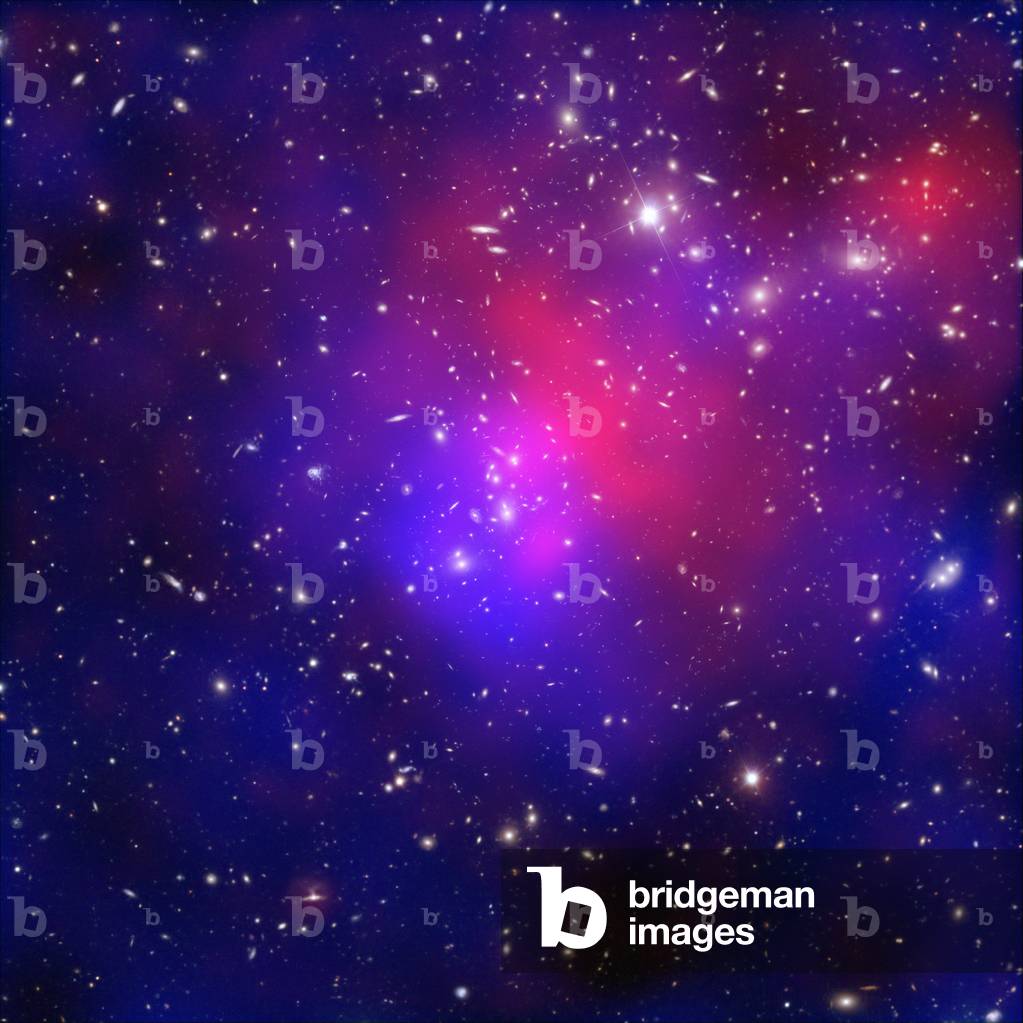
Galaxies cluster 1E 0657 - 556 - Dark matter in the galaxy cluster 1E 0657 - 556 - Composite view of the galaxy cluster 1E 0657 - 556 visible and X-rays. The hot gas that surrounds this galaxy cluster, detects in X-rays by the Chandra satellite, is visible in pink on this image. The galaxy cluster, photographed by the Magellan telescope and the Hubble space telescope, appears in the background. By studying the mass of this cluster, astronomers were able to determine that most of this mass was concentrated not in the hot gas detected by Chandra but in the blue coloured areas here, suggesting the existence of dark matter. This composite image shows the galaxy cluster 1E 0657 - 556, also known as the “” bullet cluster.”” This cluster was formed after the collision of two large clusters of galaxies, the most energetic event known in the universe since the Big Bang. Hot gas detected by Chandra telescope in X - rays is seen as two pink clumps in the image and contains most of the “” normal,””” or baryonic, matter in the two clusters. The bullet - shaped clump on the right is the hot gas from one cluster, which passed through the hot gas from the other larger cluster during the collision. An optical image from Magellan and the Hubble Space Telescope shows the galaxies in orange and white. The blue areas in this image depict where astronomers find most of the mass in the clusters. The concentration of mass is determined by analyzing the effect of so - called gravitational lensing, where light from the distant objects is distorted by intervening matter. Most of the matter in the clusters (blue) is clearly separate from the normal matter (pink), giving direct evidence that nearly all of the matter in the clusters is dark
Coma cluster of galaxies Abell 1656 - Coma cluster of galaxies - The Coma cluster of galaxies consists of more than a thousand galaxies located 330 million years - light in the constellation Coma Berenices. This cluster is dominated by two large elliptical galaxies NGC 4874 on the right and NGC 4889 on the left. The Coma cluster of galaxies (Abell 1656) is one of the densest galaxy cluster known. It contains a thousand of galaxies and is located 330 million light years away. Two big elliptical galaxies dominate it: NGC 4874 (right) and NGC 4889 (left)
Galaxy has 13 billion years - light in cluster CL1358+62 - Galaxy 13 billion light - years away - Image obtained by the Hubble space telescope of the galaxy cluster CL1358+62. This cluster reveals to us, by a gravitational mirage effect, the deformed image of a galaxy, located behind the cluster at a distance of 13 billion years - light (the red crescent at the bottom right of the image). At the top right, a close-up of this arc reveals brighter points, indicating a strong star-forming activity within this galaxy. At the bottom right, a modeling of this arc. A NASA Hubble Space Telescope image of the galaxy cluster CL1358+62 has uncovered a gravitationally - lensed image of a more distant galaxy located far beyond the cluster. The gravitationally - lensed image appears as a red crescent to the lower right of center. The galaxy's image is brightened, magnified, and smeared into an arc - shape by the gravitational influence of the intervening galaxy cluster, which acts like a gigantic lens. Exact measurement of the distance from spectroscopic observations with the W. M. Keck Observatory in Hawaii show the lensed galaxy is one of the farthest ever seen. Its light is only reaching us now from a time when the universe was but 7% its current age of approximately 14 billion years. This places the young galaxy as far as 13 billion light - years away. The lensing foreground cluster is 5 billion light - years from us. [UPPER RIGHT] A close - up of the gravitationally - lensed image shows why astronomers are excited about this unique opportunity to study the distant galaxy's structure. The stretched - out image reveals tiny knots of vigorous starbirth activity. This provides a first detailed look at the early construction phase of a galaxy undergoing training. [LOWER RIGHT] A theoretical model of the cluster lens is used to “” unsmear””” the gravitationally - lensed image back into the galaxy's normal appearance. The corrected image gives a highly
Galaxy Cluster CL2244 - 02 - Galaxy Cluster CL2244 - 02 with gravitational arcs - Galaxy cluster CL2244 - 02 seen with the VLT in Chile. A gravitational mirage is visible in the form of an arc; it is the image of an even farther away galaxy curved and amplified by the gravite of this cluster. Colour composite image of the galaxy cluster CL2244 - 02 (redshift z = 0.3), obtained with the VLT Test Camera at the UT1 Nasmyth Focus.In addition to the prominent blue arc, produced by gravitational lensing of a galaxy at redshift z = 2.24, there are also notable, very red arcs, both closer to the centre and further out. They were only detected in the infrared image and are probably due to lensing of a much more distant galaxy
Quasars seen by the Hubble Space Telescope - Quasars seen by the Hubble Space Telescope - Gallery of quasars observed in different types of galaxies; left column, quasars in normal galaxies, center in colliding galaxies, right in particular galaxies. Top left: quasar PG 0052+251, has about 1.4 billion years - light. Bottom left: Quasar PHL 909 has about 1.5 billion years - light. High center: quasar IRAS04505 - 2958, has about 3 billion years - light. Low center: quasar PG 1012+008, has about 1.6 billion years - light. High right: quasar 0316 - 346, has about 2.2 billion years - light. Low right: quasar IRAS13218+0552. has about 2 billion years - light. Images obtained by the Hubble Space Telescope in 1996. Quasars reside in a variety of galaxies, from normal to highly disturbed. When seen through ground - based telescopes, these compact, enigmatic light sources resemble stars, yet they are billions of light - years away and several hundred billion times brighter than normal stars. The following Hubble Space Telescope images show examples of different home sites of all quasars. The column of images on the left represents normal galaxies; the center, colliding galaxies; and the right, peculiar galaxies.Top left: This image shows quasar PG 0052+251, which is 1.4 billion light - years from Earth, at the core of a normal spiral galaxy. Astronomers are surprised to find host galaxies, such as this one, that appear undisturbed by the strong quasar radiation. Bottom left: Quasar PHL 909 is 1.5 billion light - years from Earth and lies at the core of an apparently normal elliptical galaxy. Top center: The photo reveals evidence of a catastrophic collision between two galaxies traveling at about 1 million mph. The debris from this collision may be fueling quasar IRAS04505 - 2958, which is 3 billion light - years from Earth. Astronomers believe that a galaxy plunged vertically through the
Elliptical Galaxy ESO 306 - 17 - Elliptical galaxy ESO 306 - 17 - The galaxy ESO 306 - 17 is an isolated elliptical galaxy located about 500 million years ago - light from Earth. In the background, many distant galaxies are visible. This image from the Advanced Camera for Surveys aboard the NASA/ESA Hubble Space Telescope highlights the large and bright elliptical galaxy called ESO 306 - 17 in the southern sky. In this image, it appears that ESO 306 - 17 is surrounded by other galaxies but the bright galaxies at bottom left are thought to be in the foreground, not at the same distance in the sky. In reality, ESO 306 - 17 lies fairly abandoned at half a billion light - years from Earth in an enormous sea of dark matter and hot gas
Galaxy cluster SDSS J1004+4112 - Galaxy Cluster SDSS J1004+4112 - View of the cluster of SDSS J1004+4112 by the Hubble space telescope; located in the Little Lion about 7 billion years ago - light, this cluster reveals us by a gravitational mirage effect, the deformed image of a quasar, located behind the cluster has a distance of 10 billion years - light. The most unique feature in a new image taken with the NASA/ESA Hubble Space Telescope is a group of five quasar images produced by a process called gravitational lensing, in which the gravitational field of a massive object - in this case, a cluster of galaxies - bends and amplifies light from an object - in this case, a quasar farther behind it. The background quasar is the brilliant core of a galaxy. It is powered by a black hole, which is devouring gas and dust and creating a gusher of light in the process. When the quasar's light passes through the gravity field of the galaxy cluster that lies between us and the quasar, the light is bent by the space - warping gravity field in such a way that five separate images of the object are produced surrounding the cluster's centre. The fifth quasar image is embedded to the right of the core of the central galaxy in the cluster. The cluster also creates a cobweb of images of other distant galaxies gravitationally lensed into arcs. The galaxy cluster creating the lens is known as SDSS J1004+4112 and was discovered as part of the Sloan Digital Sky Survey. It is one of the more distant clusters known (seven billion light - years, redshift z = 0.68), and is seen when the Universe was half its present age. The galaxy hosting the background quasar is at a distance of 10 billion light years (at redshift 1.74). The quasar host galaxy can be seen in the image as faint red arcs. This is the most highly magnified quasar host galaxy ever seen
Clusters of distant galaxies CL0024+1654 - Distant cluster of galaxies CL0024+1654 - False color image of cluster CL0024+1654 obtained with the 12k camera of CFHT (Canada France Hawaii Telescope) in Hawaii. This cluster is 4.5 billion light years away. This is a colour image of the galaxy cluster CL0024+1654 obtained with the CFHT12k camera at the Canada France Hawaii Telescope on Mauna Kea (Hawaii). Distance of 4.5 thousand million light - years (about one third of the look - back time to the Big Bang) from Earth. The cluster clearly appears as a concentration of yellow galaxies in the centre of this image although cluster galaxies actually extend at least to the edge of this image. This image measures 21 x 21 arc - minutes
Spiral Galaxy NGC 4911 - Galaxy Spiral NGC 4911 - The NGC 4911 galaxy photographed here by the Hubble Space Telescope (HST) is located in the Coma galaxy cluster (Abell 1656) about 320 million light years ago. Image obtained from different cliches obtained from 2006 to 2009, 28 hours of installation in total. A long - exposure Hubble Space Telescope image shows a majestic face - on spiral galaxy located deep within the Coma Cluster of galaxies, which lies 320 million light - years away in the northern constellation Coma Berenices. The galaxy, known as NGC 4911, contains rich lanes of dust and gas near its center. These are silhouetted against glowing newborn star clusters and iridescent pink clouds of hydrogen, the existence of which indicates ongoing star formation. Hubble has also captured the outer spiral arms of NGC 4911, along with thousands of other galaxies of varying sizes. This natural - color Hubble image, which combines data obtained in 2006, 2007, and 2009 from the Wide Field Planetary Camera 2 and the Advanced Camera for Surveys, required 28 hours of exposure time
Distant galaxies in the Fornax constellation - Distant galaxies in the Fornax constellation - Image of distant galaxies obtained by the Hubble space telescope in the constellation Forneau in September 2003. This image represents a typical view of our distant universe. In taking this picture, Hubble is looking down a long corridor of galaxies stretching billions of light - years distant in space, corresponding to looking billions of years back in time. The field shown in this picture covers a relatively small patch of sky, a fraction of the area of the full moon, yet it is richly populated with a variety of galaxy types. A handful of large fully formed galaxies are scattered throughout the image. These galaxies are easy to see because they are relatively close to us. Several of the galaxies are spirals with flat disks that are oriented edge - on or face - on to our line of sight, or somewhere in between. Elliptical galaxies and more exotic galaxies with bars or tidal tails are also visible. Many galaxies that appear small in this image are simply farther away. These visibly smaller galaxies are so distant that their light has taken billions of years to reach us. One red galaxy to the lower left of the bright central star is acting as a lens to a large galaxy directly behind it. Light from the farther galaxy is bent around the nearby galaxy's nucleus to form a distorted arc. Sprinkled among the thousands of galaxies in this image are at least a dozen foreground stars that reside in our Milky Way Galaxy. The brightest of these foreground stars is the red object in the center of the image. The stars are easily discernable from galaxies because of their diffraction spikes, long cross - hair - like features that look like they are emanating from the centers of the stars. Diffraction spikes are an image artifact caused by starlight traveling through the telescope's optical system. This image is a composite of multiple exposures of a single field taken by
Galaxy clusters Abell 2744 - This image of the galaxy cluster Abell 2744 located in the constellation of the Sculptor, reveals several hundred galaxies within this cluster, aged 3.5 billion years. By a gravitational lens effect, nearly 3000 galaxies are also visible. Composite of visible and near-infrared images obtained by the Hubble Space Telescope (HST). Abell 2744, located in the constellation Sculptor, appears in the foreground of this image. It contains several hundred galaxies as they looked 3.5 billion years ago. The immense gravity in Abell 2744 acts as a gravitational lens to warp space and brighten and magnify images of nearly 3,000 distant background galaxies. The more distant galaxies appear as they did longer than 12 billion years ago, not long after the big bangs. This image is part of an unprecedented long - distance view of the universe from an ambitious collaborative project among the NASA Great Observatories called The Frontier Fields. Over the next several years select patches of the sky will be photographed for the purpose of better understanding galaxy evolution. This visible - light and near - infrared composite image was taken with the Wide Field Camera 3
Galaxies M8, M20, M16, And M17
United States, 1990s: Photographs of galaxies
Spezielle Anweisungen
  • Content within this clip may require additional clearances (eg: trademark, audio rights and/or property/personality releases) depending on Licensee’s specific use of material.
GOODS Chandra Deep Field South (CDF - S) - Image of distant galaxies obtained by the Hubble space telescope in the constellation of the furnace. Several thousand galaxies, some of which are more than 10 billion light years old, are visible in this image. Some closer galaxies also appear, including two colliding galaxies (middle left). This image is a detail (1/10th) of the complete field observed by Hubble (which contains about 25,000 galaxies) in the framework of the GOODS programme, an extensive program of study of primordial galaxies in a field of the Boreal Constellation of the Great Bear and in a field of the southern hemisphere in the constellation of the furnace. This image, taken with Hubble's Advanced Camera for Surveys, shows several thousand galaxies, many of which appear to be interacting or in the process of forming. Some of these galaxies existed when the cosmos was less than about 2 billion years old. The foreground galaxies, however, are much closer to Earth. Two of them [the white, elongated galaxies, left of center] appear to be colliding. This image represents less than one - tenth of the entire field surveyed by Hubble. The full field, consisting of about 25,000 galaxies, is part of a larger survey called the Great Observatories Origins Deep Survey (GOODS), the most ambitious study of the early universe yet undertaken with the Hubble telescope. This survey targeted two representative spots in the sky - one in the Northern Hemisphere and the other in the Southern Hemisphere. This image represents the southern field, located in the constellation Fornax. The entire GOODS survey reveals roughly 50,000 galaxies. Astronomers have identified more than 2,000 of them as infant galaxies, observed when the universe was less than about 2 billion years old. This image of the southern field was assembled from observations taken between July 2002 and February 2003. 5 days exposure
Galaxy cluster MACS J0717.5+3745 - Galaxy cluster MACS J0717.5+3745 - View of the galaxy cluster MACS J0717.5+3745 visible. This cluster located approximately 5.4 billion years ago - light from the Earth in the constellation of the Coach, is the result of the collision of three clusters of galaxies. Image obtained by the Hubble Space Telescope. This picture shows a region where three galaxy clusters are merging and releasing enormous amounts of energy in the form of X - rays. These distant objects are around 5.4 billion light - years from Earth, in the constellation of Auriga and were imaged during the Massive Cluster Survey, a project to study distant clusters of galaxies using Hubble. The amount of mass in this sea of galaxies is huge, and is great enough to visibly bend the fabric of spacetime. The strange distortion in the shapes of many of the galaxies in this picture, which appear stretched and bent as if they were looked at through a glass bottle, is a result of gravitational lensing, where the gravitational fields around massive objects bend light around them. Image taken by the Hubble space telescope (HST). The exposure times were about 67 minutes and 33 minutes respectively and the field of view of the image is about 3 arcminutes across
Hubble deep field sud - Hubble deep field south - In the southern constellation of Toucan, the Hubble space telescope posed 75h to obtain this image of the distant universe. Thousands of galaxies away from 1 to 12 billion light years are visible in this image. From Earth, the target field is the one “” that one would see through the eye of a needle held at arm's length.” If the distribution of galaxies over the entire Celestial vault were similar to this field, the number of galaxies observable up to magnitude 30 would be 50 billion. This picture is the culmination of a 10 - day - long observation called the Hubble Deep Field South which was carried out in October 1998. This new “” far - look”” complements the original Hubble “” deep field””” taken in late 1995, when Hubble was aimed at a small patch of space near the Big Dipper. The new region is in the constellation Tucana, near the south celestial pole. Hubble's sharp vision allows astronomers to sort galaxy shapes. The image is dominated by beautiful pinwheel - shaped disk galaxies, which are like our Milky Way. The picture also contains a variety of peculiar - shaped galaxies that are in collision with companion galaxies. Elliptical galaxies appear as reddish blobs. A sprinkling of foreground stars (belonging to our Milky Way) appear as bright points with “” diffraction spikes”” an artifact of all telescope optics. The colors in the pictures are a natural representation of the galaxies' stellar populations. Blue corresponds to young hot stars. Red may indicate older stars, starlight scattered by dust, or very distant starlight that has been stretched to redder wavelengths by the university's expansion
Spiral Galaxy NGC 4921 - Unusual Spiral NGC 4921 in the Coma Galaxy Cluster - Galaxy NGC 4921 photographed by the Hubble Space Telescope (HST). Located in the cluster of Coma galaxies (Abell 1656) is about 320 million light years old, this spiral galaxy presents an unusual structure with poorly marked arms; some young blue stars are visible but the activity of star formation here is much less strong than in other spiral galaxies. In the background, many more distant galaxies appear. This very deep image taken with the NASA/ESA Hubble Space Telescope shows the spiral galaxy NGC 4921 along with a spectacular backdrop of more distant galaxies. It was created from a total of 80 separate pictures through yellow and near - infrared filters. The Coma Galaxy Cluster, in the northern constellation of Coma Berenices, the hair of Queen Berenice, is one of the closest very rich collections of galaxies in the nearby Universe. The cluster, also known as Abell 1656, is about 320 million light - years from Earth and contains more than 1000 members. The brightest galaxies, including NGC 4921 shown here, were discovered back in the late 18th century by William Herschel. The galaxies in rich clusters undergo many interactions and mergers that tend to gradually turn gas - rich spirals into elliptical systems without much active star formation. As a result there are far more ellipticals and fewer spirals in the Coma Cluster than are found in quieter corners of the Universe. NGC 4921 is one of the rare spirals in Coma, and a rather unusual one - - it is an example of an “” anaemic spiral”” where the normal vigorous star formation that creates a spiral galaxy's familiar bright arms is much less intense. As a result there is just a delicate swirl of dust in a ring around the galaxy, accompanied by some bright young blue stars that are clearly separated out by Hubble's sharp vision. Much of the pale spiral structure in the outer
Galaxy clusters 1ES 0657 - 55 in the Carene - Gravitational lens in galaxy cluster 1ES 0657 - 55 - False color image of the distant galaxy cluster 1ES 0657 - 55 in the southern constellation of Carene obtained by the VLT. A gravitational mirage is visible in the form of a green arc at the top right of the image; it is the image of an even farther away galaxy curved and amplified by the gravity of this cluster. An Arc at z = 3.23 in galaxy cluster 1ES 0657 - 55. The galaxy cluster 1ES 0657 - 55 is located in the southern constellation Carina (The Keel), south of the Milky Way band. Its redshift has been measured as z = 0.29. It is a source of strong and very hot X - ray emission and has an asymmetric galaxy distribution, indicating a large mass and recent formation
Spiral Galaxy NGC 4921 - Galaxy Spiral NGC 4921 - Galaxy NGC 4921 photographed by the Hubble Space Telescope (HST). Located in the cluster of Coma galaxies (Abell 1656) is about 320 million light years old, this spiral galaxy presents an unusual structure with poorly marked arms; some young blue stars are visible but the activity of star formation here is much less strong than in other spiral galaxies. In the background, many more distant galaxies appear. This very deep image taken with the NASA/ESA Hubble Space Telescope shows the spiral galaxy NGC 4921 along with a spectacular backdrop of more distant galaxies. The Coma Galaxy Cluster, in the northern constellation of Coma Berenices, the hair of Queen Berenice, is one of the closest very rich collections of galaxies in the nearby Universe. The cluster, also known as Abell 1656, is about 320 million light - years from Earth and contains more than 1000 members. The brightest galaxies, including NGC 4921 shown here, were discovered back in the late 18th century by William Herschel. NGC 4921 is one of the rare spirals in Coma, and a rather unusual one - - it is an example of an “anaemic spiral”” where the normal vigorous star formation that creates a spiral galaxy's familiar bright arms is much less intense
United States, 1990s: Photographs of galaxies
Spezielle Anweisungen
  • Content within this clip may require additional clearances (eg: trademark, audio rights and/or property/personality releases) depending on Licensee’s specific use of material.
United States, 1990s: Photographs of galaxies
Spezielle Anweisungen
  • Content within this clip may require additional clearances (eg: trademark, audio rights and/or property/personality releases) depending on Licensee’s specific use of material.
Galaxy clusters Abell 370 - Abell 370 cluster of galaxies with gravitational arcs - This cluster contains a large number of galaxies, most of which are elliptical. A gravitational arc is visible at the bottom of the image. This is the deformed image of a galaxy farther away behind the cluster. This cluster hosts one of the most prominent gravitational arcs known to date. The light of a very remote object is deformed by the foreground cluster. Abell 370, at the center of the photo, contains a large number of galaxies - most of them are ellipticals. The two brightest red galaxies slightly above the gravitational arc are the most massive in the cluster and give an important contribution to the lensing event. This gravitational arc - in combination with the cluster of galaxies - provides a natural laboratory to study the physics of gravity. The exact shape of the arc allows to estimate the mass of the cluster through the equations of general relativity
Galaxy clusters LCDCS - 0829 - Galaxy cluster LCDCS - 0829 - Gravitational lenses in the galaxy cluster LCDCS - 0829. Image obtained by the Hubble Space Telescope. The NASA/ESA Hubble Space Telescope usually works as a solo artist to capture awe - inspiring images of the distant Universe. For this picture, though, Hubble had a helping hand from the subject of the image, a galaxy cluster called LCDCS - 0829, as the huge mass of the galaxies in the cluster acted like a giant magnifying glass. This strange effect is called gravitational lensing. The object was discovered during the Las Campanas Distant Clusters Survey, which explains the cluster's unusual name. This survey was carried out in March 1995 using a 1 - metre telescope at the Las Campanas Observatory in Chile. More than one thousand clusters of galaxies, most of them previously unknown, were found in a dedicated survey of a long, but narrow, section of the southern sky. The bizarre phenomenon of gravitational lensing is a consequence of Albert Einstein's general theory of relativity, which says that the huge mass of the galaxy cluster bends the fabric of the Universe, and the light from one of the distant galaxies will then travel along this bend in the fabric. In addition to making some objects appear bigger and brighter, gravitational lensing can produce multiple images of distant galaxies and stretch them into strange arcs. Many such arcs can be seen in this image. This deep image of the cluster was created from a total of 36 exposures taken using the Wide Field Channel of Hubble's Advanced Camera for Surveys
Field of distant galaxies - Hubble eXtreme Deep Field (XDF) - Distant galaxies - Hubble eXtreme Deep Field (XDF) - Image of distant galaxies obtained in infrared by the Hubble space telescope in the constellation of the Furnace. The farthest galaxies visible in this image are 13.2 billion light years away. Called the Extreme Deep Field, or XDF, the photo was assembled by combining 10 years of NASA Hubble Space Telescope photographs taken of a patch of sky at the center of the original Hubble Ultra Deep Field. The XDF is a small fraction of the angular diameter of the full Moon. The Hubble Ultra Deep Field is an image of a small area of space in the constellation Fornax, created using Hubble Space Telescope data from 2003 and 2004. By collecting faint light over many hours of observation, it revealed thousands of galaxies, both nearby and very distant, making it the deepest image of the universe ever taken at that time. The new full - color XDF image reaches much fainter galaxies, and includes very deep exposures in red light from Hubble's new infrared camera, enabling new studies of the earliest galaxies in the universe. The XDF contains about 5,500 galaxies even within its smaller field of view. The faintest galaxies are one ten - billionth the brightness of what the human eye can see. The universe is 13.7 billion years old, and the XDF reveals galaxies that span back 13.2 billion years in time. Most of the galaxies in the XDF are seen when they were young, small, and growing, often violently as they collided and merged together. The early universe was a time of dramatic birth for galaxies containing brilliant blue stars extraordinarily brighter than our Sun. The light from those past events is just arriving at Earth now, and so the XDF is a “” time tunnel into the distant past.” The youngest galaxy found in the XDF existed just 450 million years after the university's birth in the big bangs
Hubble deep field north - Hubble Deep Field North - North of the constellation of the Great Bear, the Hubble space telescope posed 75h to obtain this image of the distant universe. More than 1500 galaxies distant from 1 to 12 billion years - light are visible in this image. From Earth, the target field is the one “” that one would see through the eye of a needle held at arm's length.” If the distribution of galaxies over the entire Celestial vault were similar to this field, the number of galaxies observable up to magnitude 30 would be 50 billion. Representing a narrow “” keyhole”” view all the way to the visible horizon of the universe, the HDF image covers a speck of sky 1/30th the diameter of the full Moon. This is so narrow, just a few foreground stars in our Milky Way galaxy are visible and are vastly outnumbered by the menagerie of far more distant galaxies, some nearly as faint as 30th magnitude, or nearly four billion times fainter than the limits of human vision. Although the field is a very small sample of sky area it is considered representative of the typical distribution of galaxies in space because the universe, statistically, looks the same in all directions. The image was assembled from many separate exposures with the Wide Field and Planetary Camera 2 for ten consecutive days between December 18 to 28, 1995
Cosmic images computer processed images of galaxies (photo)
Elliptical galaxy NGC 4881 and distant galaxies - Elliptical galaxy NGC 4881 and distant galaxies - The elliptical galaxy NGC 4881 (upper left) is about 300 million years away - light from Earth. NGC 4881 is located in the Coma galaxy cluster that contains at least 1,000 galaxies and is five times farther from us than the Virgin's cluster. Almost all the objects visible in this photo are located far behind the Coma cluster, except for the spiral galaxy to the right of Ngc 4881. Image obtained by the Hubble Space Telescope in 1994. This photo mosaic, which shows a field of distant galaxies, is a computer enhanced reproduction of a picture taken 4 March 1994 with the repaired Hubble Space Telescope. The brightest object in this picture is NGC 4881. It is a 13th - magnitude elliptical galaxy in the outskirts of the Coma Cluster, a great cluster of galaxies more than 5 times farther away than the Virgo Cluster. Except for a 16th - magnitude Coma spiral at the right and a few foreground stars of the Milky Way, almost everything else in this field lies far beyond the Coma Cluster. There is a fascinating assortment of background galaxies, including an apparent galaxian merger in progress
Galaxy clusters Abell 370 - Abell 370 cluster of galaxies with gravitational arcs - This galaxy cluster is located about 4 billion light years from Earth in the constellation of the Whale. This image obtained by the Hubble Space Telescope shows gravitational arcs among galaxies. These mirages are deformed images of farther galaxies located behind the cluster. The galaxy cluster Abell 370 contains an astounding assortment of several hundred galaxies tied together by the mutual pull of gravity
GOODS Hubble Deep Field North (HDF - N) - Image of distant galaxies obtained by the Hubble space telescope in the constellation of the Great Bear. Several thousand galaxies, some of which are more than 10 billion light years old, are visible in this image. This image is the complete field observed by Hubble (which contains about 25,000 galaxies) in the framework of the GOODS programme, an extensive program of study of primordial galaxies in a field of the Boreal Constellation of the Great Bear and in a field of the southern hemisphere, in the constellation of the furnace. This image, taken with Hubble's Advanced Camera for Surveys, shows several thousand galaxies, many of which appear to be interacting or in the process of forming. Some of these galaxies existed when the cosmos was less than about 2 billion years old. This image represents the entire field surveyed by Hubble. The full field, consisting of about 25,000 galaxies, is part of a larger survey called the Great Observatories Origins Deep Survey (GOODS), the most ambitious study of the early universe yet undertaken with the Hubble telescope. This survey targeted two representative spots in the sky - one in the Northern Hemisphere and the other in the Southern Hemisphere. This image represents the northern field, located in the constellation Ursa Major. The entire GOODS survey reveals roughly 50,000 galaxies. Astronomers have identified more than 2,000 of them as infant galaxies, observed when the universe was less than about 2 billion years old
NGC 7771 in Pegase - NGC 7771 in Pegasus - Group of interacting galaxies in the constellation Pegase. A group of interacting galaxies in Pegasus
Galaxy cluster Abell 1689 - Gravitational lenses in Abell 1689 galaxy cluster - Galaxy cluster Abell 1689 is about 2.2 billion years ago - light in the constellation of the Virgin. This image shows, by a gravitational mirage effect, the deformed image of many galaxies located behind the cluster. Near infrared and visible image obtained by the Hubble space telescope. 34 hours of installation. This new Hubble image shows galaxy cluster Abell 1689. It combines both visible and infrared data from Hubble's Advanced Camera for Surveys (ACS) with a combined exposure time of over 34 hours (image on left over 13 hours, image on right over 20 hours) to reveal this patch of sky in greater and striking detail than in previous observations. This image is peppered with glowing golden clumps, bright stars, and distant, ethereal spiral galaxies. Material from some of these galaxies is being stripped away, giving the impression that the galaxy is dripping, or bleeding, into the surrounding space. Also visible are a number of electric blue streaks, circling and arcing around the fuzzy galaxies in the centre. These streaks are the telltale signs of a cosmic phenomenon known as gravitational lensing. Abell 1689 is so massive that it bends and warps the space around it, affecting how light from objects behind the cluster travels through space. These streaks are the distorted forms of galaxies that lie behind the cluster
Galaxy Clusters Abell 1689 - details - Gravitational lenses in Abell 1689 galaxy cluster - Close-up of the various gravitational mirages observed in the Abell 1689 galaxy cluster. Near infrared and visible image obtained by the Hubble space telescope in June 2002. 13 hours of installation. A selection of cropped images from a NASA Hubble Space Telescope Advanced Camera for Surveys view of one of the most massive galaxy clusters known, called Abell 1689. These close - ups show “” lensed”” images of background galaxies that have been brightened and smeared by the gravitational bending of light by the foreground cluster. The yellow - white objects are the cluster galaxies located 2.2 billion light - years away. The blue arcs are the distorted images of background galaxies located billions of light - years farther away than Abell 1689. The distribution of both “” normal”” and dark matter, and the alignment of the background galaxies determine the amount of distortion. In a perfectly aligned gravitational lens the background object would be smeared into an “” Einstein ring.”” Instead, there are numerous ring sections or arcs corresponding to individual galaxies. Though the galaxy images are distorted, numerous structural details such as star clusters and dust lanes are magnified. These would not normally be resolved without the lensing effect of the foreground cluster. Red objects in the field may be nearby cool stars, or galaxies at great distances. Images of the same galaxies are also mirrored on either side of the cluster. These distortions yield clues to dark matter in space, and the curvature of the universe. They also beautifully demonstrate Einstein's theory of general relativity that predicted that gravity warps space. This representative color image is a composite of visible - light and near - infrared exposures taken in June 2002
Abell 383 galaxy cluster and primitive galaxy - Abell 383 cluster of galaxies with gravitational arcs - Abell 383 is a cluster of galaxies located in the constellation Eridan. This image obtained by the Hubble Space Telescope (HST) in 2011 shows gravitational arcs among galaxies. These mirages are deformed images of farther galaxies located behind the cluster. Thanks to this magnifying effect, the resulting image revealed the presence of a primitive galaxy, nee 200 million years after the big blow. Astronomers have uncovered one of the youngest galaxies in the distant universe, with stars that formed 13.5 billion years ago, a mere 200 million years after the Big Bang. The finding addresses questions about when the first galaxies arose, and how the early universe evolved. Nasa's Hubble Space Telescope was the first to spot the newfound galaxy. Detailed observations from the W.M. Keck Observatory on Mauna Kea in Hawaii revealed the observed light dates to when the universe was only 950 million years old; the universe formed about 13.7 billion years ago. Infrared data from both Hubble and Nasa's Spitzer Space Telescope revealed the galaxy's stars are quite mature, having formed when the universe was just a toddler at 200 million years old. The galaxy's image is being magnified by the gravity of a massive cluster of galaxies (Abell 383) parked in front of it, making it appear 11 times brighter. This phenomenon is called gravitational lensing. Hubble imaged the lensing galaxy Abell 383 with the Wide Field Camera 3 and the Advanced Camera for Surveys in November 2010 through March 2011
Galaxies cluster Abell 2744 - This image of the galaxy cluster Abell 2744 located in the constellation of the Sculptor, combines images obtained in visible form by the Hubble Space Telescope (HST) and the Very Large Telescope (VLT). This image of galaxy cluster Abell 2744 combines data from the NASA/ESA Hubble Space Telescope's Advanced Camera for Surveys, with an image taken with the European Southern Observatory's Very Large Telescope (VLT). Hubble provides the central, most detailed part of the image, while the VLT, which has a wider field of view, provides the outer parts of the image. This object has been nicknamed Pandora's Cluster because of the many different and strange phenomena that were unleashed by a huge collision that occurred over a period of 350 million years. A simultaneous pile - up between at least four separate clusters has produced strange effects that have never been seen together before
Sagittarius dwarf irregular galaxy - SagDig - Sagittarius dwarf irregular galaxy - Image of the irregular dwarf galaxy ESO 594 - 4 located 3.5 million years ago - light seen by the Hubble space telescope on August 18, 2003. The Sagittarius dwarf irregular galaxy (SagDig, ESO 594 - 4) lies some 3.5 million light - years (1.1 Megaparsecs) from us. Background galaxies (reddish/brown extended objects with spiral arms and halos) are located even further beyond SagDig at several tens of millions parsecs away. This dwarf irregular galaxy was observed by the Advanced Camera for Surveys on - board the Hubble Space Telescope on 18 August 2003. Fifty-minute exposures were taken in blue, green and red filters
Abell 2218 galaxy cluster in the Dragon - Gravitational lenses in the galaxy cluster Abell 2218 - The Abell 2218 galaxy cluster is located about 2 billion years ago - light from Earth in the constellation of the Dragon. It is so massive that its gravity curved and amplifies the light from other galaxies located behind it. Thus, these galaxies appear on this cliche obtained by the Hubble space telescope in the form of arcs. Abell 2218 resides in the constellation Draco, some 2 billion light - years from Earth. The cluster is so massive that its enormous gravitational field deflects light rays passing through it, much as an optical lens bends light to form an image. This phenomenon, called gravitational lensing, magnifies, brightens, and distorts images from faraway objects. The cluster's magnifying powers provides a powerful “” zoom lens”” for viewing distant galaxies that could not normally be observed with the largest telescopes. This useful phenomenon has produced the arc - shaped patterns found throughout the Hubble picture. These “” arcs”” are the distorted images of very distant galaxies, which lie 5 to 10 times farther than the lensing cluster. This distant population existed when the universe was just a quarter of its present age. Through gravitational lensing these remote objects are magnified, enabling scientists to study them in more detail. This analysis provides a direct glimpse of how star - forming regions are distributed in remote galaxies and yields other clues to the early evolution of galaxies. The picture is dominated by spiral and elliptical galaxies. Resembling a string of tree lights, the biggest and brightest galaxies are members of the foreground cluster. Researchers are intrigued by a tiny red dot just left of top center. This dot may be an extremely remote object made visible by the cluster's magnifying powers. The colors in this picture yield clues to the ages, distances, and temperatures of stars, the stuff of galaxies. Blu
GOODS Chandra Deep Field South (CDF - S) - Image of distant galaxies obtained by the 2,2m MPG telescope in the constellation of the Furnneau. Several thousand galaxies, some of which are more than 10 billion light years old, are visible in this image. Some closer galaxies also appear. This image was realized within the framework of the GOODS program, an extensive program of study of primordial galaxies in a field of the Boreal Constellation of the Great Bear and in a field of the southern hemisphere, in the constellation of the furnace. This program is currently being conducted by various terrestrial and space observatories. Three - colour composite image of the Chandra Deep Field South, obtained with the Wide Field Imager camera on the 2.2 - m MPG/ESO telescope at the ESO La Silla Observatory (Chile). It was produced by the combination of about 450 images with a total exposure time of nearly 50 hours. The image covers an area somewhat larger than the full moon. It displays more than 100,000 galaxies, several thousand stars and hundreds of quasars. It is based on images with a total exposure time of nearly 50 hours
This artist's concept showing a pair of colliding galaxies.
Galaxies clusters Abell 370 - Abell 370 cluster of galaxies with gravitational arcs - This cluster of galaxies is located about 5 billion years away from Earth. This image obtained by the Hubble Space Telescope on July 16, 2009 shows gravitational arcs among galaxies. These mirages are deformed images of farther galaxies located behind the cluster. The NASA/ESA Hubble Space Telescope's newly repaired Advanced Camera for Surveys (ACS) has peered across almost five billion light - years to resolve intricate details in the galaxy cluster Abell 370. Abell 370 is one of the very first galaxy clusters where astronomers observed the phenomenon of gravitational lensing, the warping of space - time by the cluster's gravitational field that distorts the light from galaxies lying far behind it. This is manifested as arcs and streaks in the picture, which are the stretched images of background galaxies. Gravitational lensing is a vital tool for astronomers when measuring the dark matter distribution in massive clusters, since the mass distribution can be reconstructed from observations of its gravitational effects. These observations were taken with Hubble's Advanced Camera for Surveys (ACS) in its Wide Field mode on 16 July 2009. The composite image was made using filters that isolate light from green, red and infrared wavelengths
Elliptical galaxy NGC 1132 and distant galaxies - Elliptical galaxy NGC 1132 and distant galaxies - The galaxy NGC 1132 is about 320 million years - light from Earth in the constellation Eridan. This giant elliptical galaxy is surrounded by a vast halo of dark matter; it and the dwarf galaxies surrounding it are probably the rest of a larger group of galaxies that have merged over time. In the background, many more distant galaxies are visible. Composite of images obtained by the Hubble Space Telescope in 2005 and 2006. The elliptical galaxy NGC 1132, seen in this image from Hubble space telescope, belongs to a category of galaxies called giant ellipticals. NGC 1132, together with the small dwarf galaxies surrounding it, are dubbed a fossil group” as they are most likely the remains of a group of galaxies that merged together in the recent past. In visible light NGC 1132 appears as a single, isolated, giant elliptical galaxy, but this is only the tip of the iceberg. Scientists have found that NGC 1132 resides in an enormous halo of dark matter, comparable to the amount of dark matter usually found in an entire group of tens or hundreds of galaxies. It also has a strong X - ray glow from an abundant amount of hot gas - an amount normally only found in galaxy groups. Its X - ray glow extends over a region of space ten times larger than the 120,000 light - year radius it has in visible light. An X - ray glow that is equal in size to that of an entire group of galaxies. In this Hubble image, NGC 1132 is seen surrounded by thousands of ancient globular clusters, swarming around the galaxy like bees around a hive. These globular clusters are likely to be the survivors of the disruption of their cannibalised parent galaxies that have been eaten by NGC 1132 and may reveal its merger history. In the background, there is a stunning tapestry of numerous galaxies that are much further away. NGC 1132 is locate
This artist's concept showing a pair of colliding galaxies.
Abell 1689 galaxy cluster and black matter - Dark matter in Abell 1689 galaxy cluster - View of black matter (purple) in Abell 1689 galaxy cluster. The image shows, by a gravitational mirage effect, the deformed image of many galaxies located behind the cluster. Abell 1689 is about 2.2 billion light years away in the constellation Virgo. Image obtained by the Hubble Space Telescope. This is the Hubble Space Telescope image of the inner region of Abell 1689, an immense cluster of galaxies located 2.2 billion light - years away in Virgo constellation. Dark matter in the cluster is mapped by plotting the plethora of arcs produced by the light from background galaxies that is warped by the foreground club's gravitational field. Dark matter cannot be photographed, but its distribution is shown in the blue overlay. The dark matter concentration and distribution is then used to better understand the nature of dark energy, a pressure that is accelerating the expansion of the universe. The imaging data used in the natural - color photo was taken in 2002 with Hubble's Advanced Camera for Surveys
Galaxy clusters Abell 2744 - Black material - X - rays, dark matter and galaxies in cluster Abell 2744
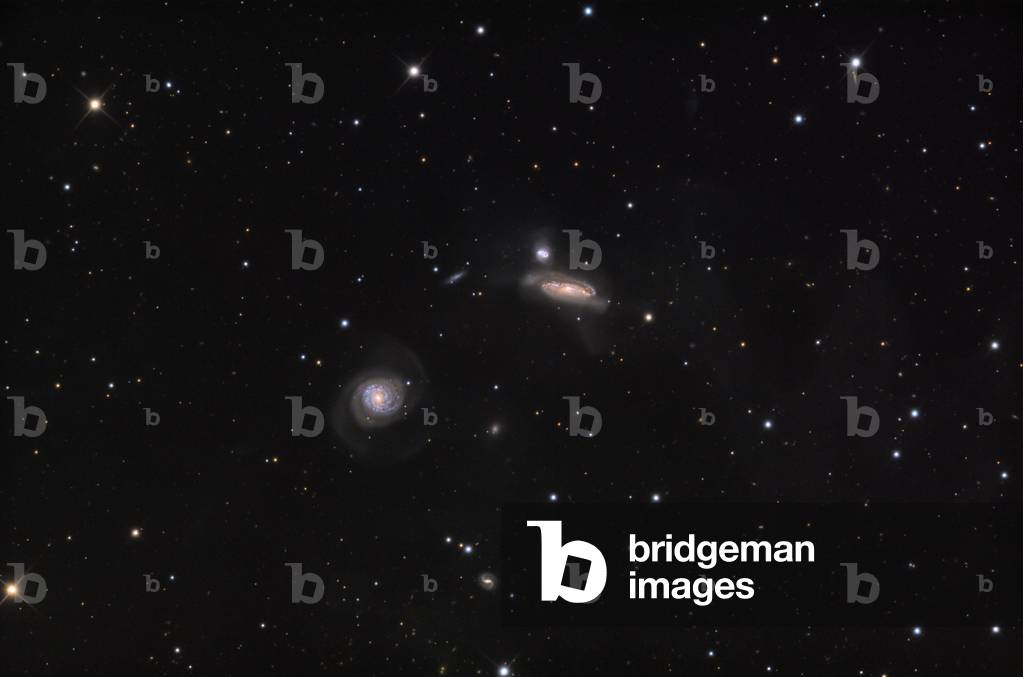
Arp 248 - Wild Triplet - Arp 248 - Wild's triplet - Group of interacting galaxies in the constellation Virgo. Interacting galaxies in Virgo
GOODS Chandra Deep Field South (CDF - S) - Image of distant galaxies obtained by the Hubble space telescope in the constellation of the furnace. Several thousand galaxies, some of which are more than 10 billion light years old, are visible in this image. A few closer galaxies also appear; this image is the complete field observed by Hubble (which contains about 25,000 galaxies) in the framework of the GOODS programme, an extensive program of study of primordial galaxies in a field of the boreal constellation of the Great Bear and in a field of the southern hemisphere, in the constellation of the furnace. This image, taken with Hubble's Advanced Camera for Surveys, shows several thousand galaxies, many of which appear to be interacting or in the process of forming. Some of these galaxies existed when the cosmos was less than about 2 billion years old. The foreground galaxies, however, are much closer to Earth. This image represents the entire field surveyed by Hubble. The full field, consisting of about 25,000 galaxies, is part of a larger survey called the Great Observatories Origins Deep Survey (GOODS), the most ambitious study of the early universe yet undertaken with the Hubble telescope. This survey targeted two representative spots in the sky - one in the Northern Hemisphere and the other in the Southern Hemisphere. This image represents the southern field, located in the constellation Fornax. The entire GOODS survey reveals roughly 50,000 galaxies. Astronomers have identified more than 2,000 of them as infant galaxies, observed when the universe was less than about 2 billion years old. This image of the southern field was assembled from observations taken between July 2002 and February 2003. 5 days exposure
Galaxy UGC 10214 in the Dragon - Galaxy UGC 10214 in Draco - The galaxy UGC 10214 is about 420 million years away - light from Earth. The shape of this galaxy is due to a collision with another galaxy, the small galaxy, blue, visible in the upper left corner of the image. Powerful gravitational forces are responsible for the formation of the tail, consisting of stars of dust and gas, which stretches over nearly 28,000 light years and is composed of recently formed and extremely bright blue stars. In the background, more than 6000 galaxies are visible, some more than 12 billion years apart - light. Image obtained by the Hubble Space Telescope in April 2002. This picture of the galaxy UGC 10214 was taken by the Advanced Camera for Surveys (ACS), which was installed aboard Nasa's Hubble Space Telescope in March during Servicing Mission 3B. Its distorted shape was caused by a small interloper, a very blue, compact galaxy visible in the upper left corner of the more massive Tadpole. The Tadpole resides about 420 million light - years away in the constellation Draco. Seen shining through the Tadpole's disk, the tiny intruder is likely a hit - and - run galaxy that is now leaving the scene of the accident. Strong gravitational forces from the interaction created the long tail of debris, consisting of stars and gas that stretch out more than 280,000 light - years. Numerous young blue stars and star clusters, spawned by the galaxy collision, are seen in the spiral arms, as well as in the long “” tidal”” tail of stars. Each of these clusters represents the formation of up to about a million stars. Their color is blue because they contain very massive stars, which are 10 times hotter and 1 million times brighter than our Sun. Once formed, the star clusters become redder with age as the most massive and bluest stars exhaust their fuel and burn out. These clusters will eventually become old globula
From Big Bang to Today - From Big Bang to the Earth. Artwork - Artist's view showing the stages of formation of the universe. From left to right, the Big Bang, the first stars, the formation of galaxies, and the universe today. Universe from the beginning (left), the first stars, first galaxies, to the universe seen nowadays
Field of distant galaxies - Distant galaxies - Image of distant galaxies obtained by the Hubble space telescope in the furnace constellation. 7500 galaxies, some of which are more than 13 billion years old - light are visible on this image. Some closer galaxies also appear. This image covers a field equivalent to one third of a full moon. This image, taken by Nasa's Hubble Space Telescope, was made from mosaics taken in September and October 2009 with the newly installed Wide Field Camera 3 (WFC3) and in 2004 with the Advanced Camera for Surveys (ACS). The view covers a portion of the southern field of a large galaxy census called the Great Observatories Origins Deep Survey (GOODS), a deep - sky study by several observatories to trace the formation and evolution of galaxies. The final image combines a broad range of colors, from the ultraviolet, through visible light, and into the near - infrared. The image reveals galaxy shapes that appear increasingly chaotic at each earlier epoch, as galaxies grew through accretion, collisions, and mergers. The galaxies range from the mature spirals and ellipticals in the foreground, to smaller, fainter, irregularly shaped galaxies, most of which are farther away, and therefore existed farther back in time. These smaller galaxies are considered the building blocks of the larger galaxies we see today. Astronomers are using this multi - color panorama to trace many details of galaxy assembly over cosmic time, including the star - formation rate in galaxies, the rate of mergers among galaxies, and the abundance of weak active galactic nuclei. The image shows a rich tapestry of 7,500 galaxies stretching back through most of the university's history. The closest galaxies seen in the foreground emitted their observed light about a billion years ago. The farthest galaxies, a few of the very faint red specks, are seen as they appeared more than 13 billion years ago, or roughly 650 million years ago,
Cosmic images computer processed images of galaxies (photo)
Shell Galaxies (NGC474 and NGC467), 2011 (digital photo)
Nutzungsbeschränkungen von unseren Content-Partnern
  • Not available to clients invoiced in the UK
Urheberrecht
  • Urheberrechtlich Geschützt
Cosmic images computer processed images of galaxies (photo)
Galaxies M81 and M82 in the Big Dipper, 2022 (photograph)
Far Galaxies - Chandra Deep Field South - Distant Galaxies - GOODS Chandra Deep Field South - A myriad of distant galaxies, accompanied by a few stars of our Lactee Way, covers almost the entire picture. Some detected galaxies are a billion times weaker than the human eye can perceive without instrument. Many new galaxies are so distant that they appear to us as they were when the Universe was only two billion years old. The image was made by the Very Large Telescope and the 2.2m telescope of La Silla within the framework of the GOODS programme, an extensive programme of study of primordial galaxies conducted by different terrestrial and spatial observatories, in a field of the boreal constellation of the Great Bear and in a field of the southern hemisphere, as here in the constellation of the Furnace. November 2008. Obtained in part with the Very Large Telescope, the image contains more than 27 million pixels and is the result of 55 hours of observations with the VIMOS instrument. This patchwork image, with its myriad of brightly coloured galaxies, shows the Chandra Deep Field South (CDF - S), arguably the most observed and best studied region in the entire sky. The CDF - S is one of the two regions selected as part of the Great Observatories Origins Deep Survey (GOODS), an effort of the worldwide astronomical community that unites the deepest observations from ground - and space - based facilities at all wavelengths from X - ray to radio. Its primary purpose is to provide astronomers with the most sensitive census of the distant Universe to assist in their study of the formation and evolution of galaxies. The new image released in november 2008 combines data obtained with the VIMOS instrument in the U - and R - bands, as well as data obtained in the B - band with the Wide - Field Imager (WFI) attached to the 2.2 m MPG/ESO telescope at La Silla, in the framework of the GABODS surv
Coma cluster of galaxies Abell 1656 - Coma cluster of galaxies - The Coma cluster of galaxies consists of more than a thousand galaxies located 330 million years - light in the constellation Coma Berenices. This cluster is dominated by two large elliptical galaxies NGC 4874 on the right and NGC 4889 on the left. The Coma cluster of galaxies (Abell 1656) is one of the densest galaxy cluster known. It contains a thousand of galaxies and is located 330 million light years away. Two big elliptical galaxies dominate it: NGC 4874 (right) and NGC 4889 (left)
Galaxies NGC 3718 and NGC 3729 in the Great Bear
Cosmic images computer processed images of galaxies (photo)
Hubble ultra deep field view of galaxies, 2003-2004
Nutzungsbeschränkungen von unseren Content-Partnern
  • Not available to clients invoiced in the UK
Cosmic images computer processed images of galaxies (photo)