[]
Ihre AuswahlIhre aktuelle Auswahl
asset(s) Assets
Ihr Preis 0

Ihre Auswahl

Auswahl aufheben
Asset zum Warenkorb hinzugefügt
{"event":"pageview","page_type1":"undetected","page_type2":"_assets_search_override","language":"de","user_logged":"false","user_type":"ecommerce","nl_subscriber":"false"}
{"event":"ecommerce_event","event_name":"view_item","event_category":"browse_catalog","ecommerce":{"items":[{"item_id":"PIX4625712","item_category":"photo","item_category2":"no_copyright","item_category3":"standard","item_category4":"walter_b_myers","item_category5":"not_balown","item_list_name":"search_results","item_name":"saturn_illustration_saturn_illustration_artist_s_view_of_the_planet_saturn_the_ring_system_is_compos","item_variant":"undefined"},{"item_id":"PIX4606029","item_category":"photo","item_category2":"no_copyright","item_category3":"standard","item_category4":"bergeron_joe","item_category5":"not_balown","item_list_name":"search_results","item_name":"cassini_huygens_and_saturn_cassini_spacecraft_at_saturn_artist_s_view_of_the_cassini_probe_around_sa","item_variant":"undefined"},{"item_id":"PIX4624811","item_category":"photo","item_category2":"no_copyright","item_category3":"standard","item_category5":"not_balown","item_list_name":"search_results","item_name":"the_planet_saturn_observed_with_the_hubble_space_telescope_in_october_1997_saturn_is_120_000_km_in_d","item_variant":"undefined"},{"item_id":"PIX4625825","item_category":"photo","item_category2":"no_copyright","item_category3":"standard","item_category4":"steven_hobbs","item_category5":"not_balown","item_list_name":"search_results","item_name":"geysers_sur_enceladus_artist_view_enceladus_ice_geysers_artist_view_artist_view_of_ice_jets_on_the_s","item_variant":"undefined"},{"item_id":"PIX4643515","item_category":"illustration","item_category2":"no_copyright","item_category3":"standard","item_category4":"steven_hobbs","item_category5":"not_balown","item_list_name":"search_results","item_name":"cassini_spacecraft_with_enceladus_geysers_artist_s_view_of_the_cassini_probe_observing_geysers_on_th","item_variant":"undefined"},{"item_id":"PIX4625859","item_category":"photo","item_category2":"no_copyright","item_category3":"standard","item_category4":"bergeron_joe","item_category5":"not_balown","item_list_name":"search_results","item_name":"geyser_sur_enceladus_artist_view_water_geyser_on_enceladus_artist_view_artist_view_of_an_ice_geyser_","item_variant":"undefined"},{"item_id":"PIX4625757","item_category":"photo","item_category2":"no_copyright","item_category3":"standard","item_category4":"bergeron_joe","item_category5":"not_balown","item_list_name":"search_results","item_name":"in_the_rings_of_saturn_illustration_saturn_ring_particles_artist_view_artist_view_of_the_countless_i","item_variant":"undefined"},{"item_id":"PIX4630235","item_category":"photo","item_category2":"no_copyright","item_category3":"standard","item_category5":"not_balown","item_list_name":"search_results","item_name":"artist_s_view_of_the_solar_system_solar_system_artwork_artist_s_view_of_the_solar_system_planets_are","item_variant":"undefined"},{"item_id":"PIX4584210","item_category":"photo","item_category2":"no_copyright","item_category3":"standard","item_category4":"miller_ron_b_1947","item_category5":"not_balown","item_list_name":"search_results","item_name":"artist_s_view_of_the_asteroid_2060_chiron_2060_chiron_also_designed_as_95p_chiron_is_a_centaur_type_","item_variant":"undefined"},{"item_id":"PIX4625451","item_category":"photo","item_category2":"no_copyright","item_category3":"standard","item_category5":"not_balown","item_list_name":"search_results","item_name":"enceladus_saturn_s_satellite_seen_by_the_cassini_probe_saturn_s_moon_enceladus_seen_by_cassini_space","item_variant":"undefined"},{"item_id":"PIX4643494","item_category":"illustration","item_category2":"no_copyright","item_category3":"standard","item_category5":"not_balown","item_list_name":"search_results","item_name":"the_cassini_and_saturn_probe_cassini_spacecraft_at_saturn_artist_s_view_of_the_cassini_probe_above_t","item_variant":"undefined"},{"item_id":"PIX4582280","item_category":"photo","item_category2":"no_copyright","item_category3":"standard","item_category5":"not_balown","item_list_name":"search_results","item_name":"saturn_seen_by_the_cassini_probe_saturn_seen_by_cassini_spacecraft_saturn_seen_by_the_cassini_probe_","item_variant":"undefined"},{"item_id":"PIX4626034","item_category":"photo","item_category2":"no_copyright","item_category3":"standard","item_category4":"walter_b_myers","item_category5":"not_balown","item_list_name":"search_results","item_name":"saturn_above_the_clouds_of_titan_illustration_saturn_from_atop_titan_s_hydrocarbon_haze_artist_s_vie","item_variant":"undefined"},{"item_id":"AII78801","item_category":"illustration","item_category2":"out_of_copyright","item_category3":"standard","item_category4":"viani_antonio_maria_1555_60_1629","item_category5":"not_balown","item_list_name":"search_results","item_name":"the_gods_on_olympus_ceiling_painting_fresco","item_variant":"undefined"},{"item_id":"PIX4626030","item_category":"photo","item_category2":"no_copyright","item_category3":"standard","item_category4":"steven_hobbs","item_category5":"not_balown","item_list_name":"search_results","item_name":"methane_lake_on_titan_artist_view_titan_lake_artist_view_artist_view_from_the_surface_of_the_titan_s","item_variant":"undefined"},{"item_id":"PIX4945569","item_category2":"no_copyright","item_category3":"standard","item_category4":"miller_ron_b_1947","item_category5":"not_balown","item_list_name":"search_results","item_name":"the_formation_of_saturn_s_rings_artist_s_view_saturn_moon_break_up_a_satellite_of_saturn_breaks_givi","item_variant":"undefined"},{"item_id":"PIX4625173","item_category":"photo","item_category2":"no_copyright","item_category3":"standard","item_category5":"not_balown","item_list_name":"search_results","item_name":"saturn_seen_by_the_cassini_probe_saturn_seen_by_cassini_saturn_seen_by_the_cassini_probe_on_22_augus","item_variant":"undefined"},{"item_id":"PIX4625794","item_category":"photo","item_category2":"no_copyright","item_category3":"standard","item_category4":"miller_ron_b_1947","item_category5":"not_balown","item_list_name":"search_results","item_name":"in_the_atmosphere_of_saturn_in_saturn_s_atmosphere_artwork_the_rings_seen_from_the_clouds_of_saturn_","item_variant":"undefined"},{"item_id":"PIX4636579","item_category":"photo","item_category2":"no_copyright","item_category3":"standard","item_category4":"alex_conu","item_category5":"not_balown","item_list_name":"search_results","item_name":"centre_of_the_milky_way_central_region_center_of_the_milky_way_central_part_of_the_lactee_route_seen","item_variant":"undefined"},{"item_id":"PIX5940218","item_category":"photo","item_category2":"no_copyright","item_category3":"standard","item_category5":"not_balown","item_list_name":"search_results","item_name":"saturn_planet_hubble_space_telescope_on_june_20_2019","item_variant":"undefined"},{"item_id":"PIX4626232","item_category":"photo","item_category2":"no_copyright","item_category3":"standard","item_category4":"steven_hobbs","item_category5":"not_balown","item_list_name":"search_results","item_name":"saturn_seen_from_the_atmosphere_of_titan_saturn_from_titan_illustration","item_variant":"undefined"},{"item_id":"PIX4625308","item_category":"photo","item_category2":"no_copyright","item_category3":"standard","item_category5":"not_balown","item_list_name":"search_results","item_name":"titan_saturn_satellite_seen_by_cassini_titan_near_saturn_seen_by_cassini_spacecraft_natural_color_im","item_variant":"undefined"},{"item_id":"CHT307486","item_category":"illustration","item_category2":"out_of_copyright","item_category3":"standard","item_category4":"french_school_13th_century","item_category5":"not_balown","item_list_name":"search_results","item_name":"ms_2200_f_115v_the_world_according_to_aristotle_miniature_from_de_philosophia_mundi_by_guillaume_de_","item_variant":"undefined"},{"item_id":"STC129825","item_category":"illustration","item_category2":"out_of_copyright","item_category3":"standard","item_category4":"cellarius_andreas_c_1596_1665","item_category5":"not_balown","item_list_name":"search_results","item_name":"map_showing_tycho_brahe_s_system_of_planetary_orbits_around_the_earth_from_the_celestial_atlas_or_th","item_variant":"undefined"},{"item_id":"PIX4588007","item_category":"photo","item_category2":"no_copyright","item_category3":"standard","item_category5":"not_balown","item_list_name":"search_results","item_name":"planetary_alignment_of_2002_the_planetary_alignment_of_april_23_2002_includes_the_planets_jupiter_sa","item_variant":"undefined"},{"item_id":"PIX4625793","item_category":"photo","item_category2":"no_copyright","item_category3":"standard","item_category4":"m_carroll","item_category5":"not_balown","item_list_name":"search_results","item_name":"geysers_sur_enceladus_artist_view_enceladus_ice_geysers_artist_view_artist_view_of_the_ice_jets_on_t","item_variant":"undefined"},{"item_id":"PIX4626263","item_category":"photo","item_category2":"no_copyright","item_category3":"standard","item_category4":"miller_ron_b_1947","item_category5":"not_balown","item_list_name":"search_results","item_name":"saturn_view_from_his_satellite_tethys_artist_view_saturn_from_tethys_artist_view_artist_view_from_it","item_variant":"undefined"},{"item_id":"PIX4625909","item_category":"photo","item_category2":"no_copyright","item_category3":"standard","item_category4":"miller_ron_b_1947","item_category5":"not_balown","item_list_name":"search_results","item_name":"astronauts_and_geyser_on_enceladus_artist_view_astronauts_and_water_geyser_on_enceladus_artist_view_","item_variant":"undefined"},{"item_id":"PIX4588186","item_category":"photo","item_category2":"no_copyright","item_category3":"standard","item_category4":"t_edelmann","item_category5":"not_balown","item_list_name":"search_results","item_name":"occultation_of_saturn_by_the_moon_from_03_11_2001_moon_is_occulting_saturn_november_3_2001_view_with","item_variant":"undefined"},{"item_id":"XJF128029","item_category":"illustration","item_category2":"out_of_copyright","item_category3":"standard","item_category4":"german_school_15th_century","item_category5":"balown","item_list_name":"search_results","item_name":"cover_illustration_from_pronosticatio_in_latino_by_johannes_lichtenberger_1526_engraving","item_variant":"undefined"},{"item_id":"PIX4625936","item_category":"photo","item_category2":"no_copyright","item_category3":"standard","item_category4":"miller_ron_b_1947","item_category5":"not_balown","item_list_name":"search_results","item_name":"astronauts_and_geyser_on_enceladus_artist_view_astronauts_and_water_geyser_on_enceladus_artist_view_","item_variant":"undefined"},{"item_id":"XIR170599","item_category":"object","item_category2":"out_of_copyright","item_category3":"standard","item_category4":"french_school_18th_century","item_category5":"balown","item_list_name":"search_results","item_name":"the_solar_system_from_entretiens_sur_la_pluralite_des_mondes_written_by_bernard_le_bovier_de_fontene","item_variant":"undefined"},{"item_id":"PIX6318764","item_category":"illustration","item_category2":"no_copyright","item_category3":"standard","item_category5":"not_balown","item_list_name":"search_results","item_name":"illustration_of_the_solar_system","item_variant":"undefined"},{"item_id":"PIX4624899","item_category":"photo","item_category2":"no_copyright","item_category3":"standard","item_category4":"steven_hobbs","item_category5":"not_balown","item_list_name":"search_results","item_name":"saturn_seen_by_voyager_1_saturn_seen_by_voyager_1_the_planet_saturn_seen_through_its_rings_image_obt","item_variant":"undefined"},{"item_id":"PIX4569523","item_category":"photo","item_category2":"no_copyright","item_category3":"standard","item_category4":"alex_conu","item_category5":"not_balown","item_list_name":"search_results","item_name":"occultation_of_saturn_by_the_moon_the_moon_and_planet_saturn_end_of_the_blackout_on_22_may_2007_moon","item_variant":"undefined"},{"item_id":"PIX4643503","item_category":"illustration","item_category2":"no_copyright","item_category3":"standard","item_category4":"steven_hobbs","item_category5":"not_balown","item_list_name":"search_results","item_name":"the_cassini_probe_and_the_rings_of_saturn_cassini_spacecraft_with_saturn_s_rings_artist_s_view_of_th","item_variant":"undefined"},{"item_id":"PIX4626066","item_category":"photo","item_category2":"no_copyright","item_category3":"standard","item_category4":"walter_b_myers","item_category5":"not_balown","item_list_name":"search_results","item_name":"saturn_and_titan_illustration_saturn_from_titan_orbit_the_planet_saturn_seen_from_the_orbit_of_its_t","item_variant":"undefined"},{"item_id":"PIX4626441","item_category":"photo","item_category2":"no_copyright","item_category3":"standard","item_category4":"miller_ron_b_1947","item_category5":"not_balown","item_list_name":"search_results","item_name":"saturn_seen_from_a_satellite_irregulier_illustration_irregular_satellite_of_saturn","item_variant":"undefined"},{"item_id":"PIX4629732","item_category":"photo","item_category2":"no_copyright","item_category3":"standard","item_category4":"d_ducros","item_category5":"not_balown","item_list_name":"search_results","item_name":"giant_planets_of_our_solar_system_from_top_to_bottom_the_planets_jupiter_neptune_and_saturn_illustra","item_variant":"undefined"},{"item_id":"PIX4624898","item_category":"photo","item_category2":"no_copyright","item_category3":"standard","item_category4":"steven_hobbs","item_category5":"not_balown","item_list_name":"search_results","item_name":"saturn_seen_by_voyager_1_saturn_seen_by_voyager_1_the_shadow_of_the_planet_saturn_is_projected_on_it","item_variant":"undefined"},{"item_id":"PIX4625115","item_category":"photo","item_category2":"no_copyright","item_category3":"standard","item_category5":"not_balown","item_list_name":"search_results","item_name":"saturn_and_mimas_seen_by_the_cassini_probe_on_04_09_2007_saturn_and_mimas_seen_by_cassini_spacecraft","item_variant":"undefined"},{"item_id":"PIX4625625","item_category":"photo","item_category2":"no_copyright","item_category3":"standard","item_category5":"not_balown","item_list_name":"search_results","item_name":"tethys_saturn_satellite_seen_by_the_cassini_probe_saturn_s_moon_tethys_seen_by_cassini_spacecraft_th","item_variant":"undefined"},{"item_id":"STC956782","item_category":"illustration","item_category2":"out_of_copyright","item_category3":"standard","item_category4":"jamieson_alexander_fl_1820","item_category5":"not_balown","item_list_name":"search_results","item_name":"the_moon_venus_and_saturn_plate_xxx_from_a_celestial_atlas_by_alexander_jamieson_pub_london_1822_han","item_variant":"undefined"},{"item_id":"PIX4974168","item_category2":"no_copyright","item_category3":"standard","item_category4":"miller_ron_b_1947","item_category5":"not_balown","item_list_name":"search_results","item_name":"saturn_view_of_its_satellite_hyperion_artist_view_saturn_from_its_moon_hyperion_artist_view","item_variant":"undefined"},{"item_id":"PIX4588174","item_category":"photo","item_category2":"no_copyright","item_category3":"standard","item_category4":"sebastian_voltmer","item_category5":"not_balown","item_list_name":"search_results","item_name":"occultation_of_saturn_by_the_moon_from_03_11_2001_moon_is_occulting_saturn_november_3_2001_sequence_","item_variant":"undefined"},{"item_id":"PIX4643513","item_category":"illustration","item_category2":"no_copyright","item_category3":"standard","item_category5":"not_balown","item_list_name":"search_results","item_name":"the_cassini_and_saturn_probe_cassini_spacecraft_at_saturn_artist_s_view_of_the_cassini_probe_during_","item_variant":"undefined"},{"item_id":"PIX4624910","item_category":"photo","item_category2":"no_copyright","item_category3":"standard","item_category4":"steven_hobbs","item_category5":"not_balown","item_list_name":"search_results","item_name":"saturn_seen_by_voyager_1_saturn_seen_by_voyager_1_the_shadow_of_saturn_s_rings_is_projected_on_the_p","item_variant":"undefined"},{"item_id":"PIX4626539","item_category":"photo","item_category2":"no_copyright","item_category3":"standard","item_category4":"miller_ron_b_1947","item_category5":"not_balown","item_list_name":"search_results","item_name":"a_satellite_of_saturn_breaks_into_the_rings_of_saturn_and_has_small_satellites","item_variant":"undefined"},{"item_id":"PIX4625591","item_category":"photo","item_category2":"no_copyright","item_category3":"standard","item_category5":"not_balown","item_list_name":"search_results","item_name":"rhea_satellite_of_saturn_seen_by_cassini_saturn_s_moon_rhea_seen_by_cassini_mosaic_of_images_obtaine","item_variant":"undefined"},{"item_id":"PIX4630070","item_category":"photo","item_category2":"no_copyright","item_category3":"standard","item_category4":"miller_ron_b_1947","item_category5":"not_balown","item_list_name":"search_results","item_name":"the_solar_system_our_solar_system_artwork_illustration_of_the_solar_system_planets_and_their_main_sa","item_variant":"undefined"},{"item_id":"DIL1637623","item_category":"film_still","item_category2":"no_copyright","item_category3":"standard","item_category5":"not_balown","item_list_name":"search_results","item_name":"saturn_3_by_stanley_donen_1980","item_variant":"undefined"},{"item_id":"PIX4625257","item_category":"photo","item_category2":"no_copyright","item_category3":"standard","item_category5":"not_balown","item_list_name":"search_results","item_name":"saturn_seen_by_the_cassini_probe_saturn_northern_hemisphere_seen_by_cassini_spacecraft_saturn_seen_b","item_variant":"undefined"},{"item_id":"PIX4625616","item_category":"photo","item_category2":"no_copyright","item_category3":"standard","item_category5":"not_balown","item_list_name":"search_results","item_name":"tethys_saturn_satellite_seen_by_the_cassini_probe_saturn_s_moon_tethys_seen_by_cassini_spacecraft_th","item_variant":"undefined"},{"item_id":"PIX4626289","item_category":"photo","item_category2":"no_copyright","item_category3":"standard","item_category4":"walter_b_myers","item_category5":"not_balown","item_list_name":"search_results","item_name":"saturn_seen_from_its_satellite_japet_saturn_from_iapetus_the_planet_saturn_accompanied_by_three_sate","item_variant":"undefined"},{"item_id":"PIX4625759","item_category":"photo","item_category2":"no_copyright","item_category3":"standard","item_category4":"bergeron_joe","item_category5":"not_balown","item_list_name":"search_results","item_name":"saturn_clouds_clouds_of_saturn_artwork_saturn_rings_seen_through_saturn_clouds_a_view_of_the_rings_a","item_variant":"undefined"},{"item_id":"PIX4636541","item_category":"photo","item_category2":"no_copyright","item_category3":"standard","item_category4":"alex_conu","item_category5":"not_balown","item_list_name":"search_results","item_name":"centre_of_the_milky_way_central_region_center_of_the_milky_way_central_part_of_the_lactee_route_seen","item_variant":"undefined"},{"item_id":"PIX4643481","item_category":"illustration","item_category2":"no_copyright","item_category3":"standard","item_category5":"not_balown","item_list_name":"search_results","item_name":"the_cassini_and_saturn_probe_cassini_spacecraft_at_saturn_artist_s_view_of_the_cassini_probe_around_","item_variant":"undefined"},{"item_id":"PIX4624969","item_category":"photo","item_category2":"no_copyright","item_category3":"standard","item_category5":"not_balown","item_list_name":"search_results","item_name":"saturn_seen_in_infrared_by_cassini_spacecraft_saturn_seen_in_infrared_by_cassini_spacecraft_composit","item_variant":"undefined"},{"item_id":"PIX4625779","item_category":"photo","item_category2":"no_copyright","item_category3":"standard","item_category4":"miller_ron_b_1947","item_category5":"not_balown","item_list_name":"search_results","item_name":"the_formation_of_saturn_s_rings_artist_s_view_the_origin_of_saturn_s_rings","item_variant":"undefined"},{"item_id":"PIX4643507","item_category":"illustration","item_category2":"no_copyright","item_category3":"standard","item_category5":"not_balown","item_list_name":"search_results","item_name":"la_prode_cassini_et_saturn_cassini_spacecraft_at_saturn_this_illustration_shows_nasa_s_cassini_space","item_variant":"undefined"},{"item_id":"PIX4625303","item_category":"photo","item_category2":"no_copyright","item_category3":"standard","item_category5":"not_balown","item_list_name":"search_results","item_name":"saturn_seen_by_the_cassin_probe_saturn_seen_by_cassini_spacecraft_on_october_10_2013_saturn_seen_by_","item_variant":"undefined"},{"item_id":"PIX4625061","item_category":"photo","item_category2":"no_copyright","item_category3":"standard","item_category5":"not_balown","item_list_name":"search_results","item_name":"saturn_rings_seen_in_ultraviolet_by_cassini_saturn_s_rings_in_utraviolet_saturn_rings_seen_in_ultrav","item_variant":"undefined"},{"item_id":"PIX4625645","item_category":"photo","item_category2":"no_copyright","item_category3":"standard","item_category4":"miller_ron_b_1947","item_category5":"not_balown","item_list_name":"search_results","item_name":"saturn_from_his_satellite_dione_illustration","item_variant":"undefined"},{"item_id":"PIX4606016","item_category":"photo","item_category2":"no_copyright","item_category3":"standard","item_category4":"bergeron_joe","item_category5":"not_balown","item_list_name":"search_results","item_name":"cassini_huygens_and_saturn_cassini_spacecraft_at_saturn_artist_s_view_of_the_cassini_probe_around_sa","item_variant":"undefined"},{"item_id":"PIX4625119","item_category":"photo","item_category2":"no_copyright","item_category3":"standard","item_category5":"not_balown","item_list_name":"search_results","item_name":"saturn_and_satellites_seen_by_the_cassini_probe_on_30_01_2008_saturn_and_satellites_seen_by_cassini_","item_variant":"undefined"},{"item_id":"PIX4626379","item_category":"photo","item_category2":"no_copyright","item_category3":"standard","item_category4":"miller_ron_b_1947","item_category5":"not_balown","item_list_name":"search_results","item_name":"saturn_view_from_its_satellite_rhea_artist_view_saturn_from_rhea_artist_view_artist_view_of_the_surf","item_variant":"undefined"},{"item_id":"PIX4588586","item_category":"photo","item_category2":"no_copyright","item_category3":"standard","item_category4":"s_numazawa","item_category5":"not_balown","item_list_name":"search_results","item_name":"occultation_of_saturn_by_the_moon_saturn_occultation_by_the_moon_artwork_artist_view","item_variant":"undefined"},{"item_id":"DIL1637622","item_category":"film_still","item_category2":"no_copyright","item_category3":"standard","item_category5":"not_balown","item_list_name":"search_results","item_name":"saturn_3_by_stanley_donen_1980","item_variant":"undefined"},{"item_id":"PIX4625835","item_category":"photo","item_category2":"no_copyright","item_category3":"standard","item_category4":"walter_b_myers","item_category5":"not_balown","item_list_name":"search_results","item_name":"saturn_view_of_enceladus_illustration_saturn_from_the_surface_of_enceladus_the_planet_saturn_seen_fr","item_variant":"undefined"},{"item_id":"PIX4625574","item_category":"photo","item_category2":"no_copyright","item_category3":"standard","item_category5":"not_balown","item_list_name":"search_results","item_name":"tethys_saturn_satellite_seen_by_the_cassini_probe_saturn_s_moon_tethys_seen_by_cassini_spacecraft_th","item_variant":"undefined"},{"item_id":"PIX4626221","item_category":"photo","item_category2":"no_copyright","item_category3":"standard","item_category4":"miller_ron_b_1947","item_category5":"not_balown","item_list_name":"search_results","item_name":"the_clouds_of_titan_artist_view_titan_s_clouds","item_variant":"undefined"},{"item_id":"PIX4626419","item_category":"photo","item_category2":"no_copyright","item_category3":"standard","item_category4":"miller_ron_b_1947","item_category5":"not_balown","item_list_name":"search_results","item_name":"saturn_from_its_moon_epimethee_illustration_saturn_from_its_moon_epimetheus","item_variant":"undefined"},{"item_id":"PIX4625231","item_category":"photo","item_category2":"no_copyright","item_category3":"standard","item_category5":"not_balown","item_list_name":"search_results","item_name":"saturn_in_false_colours_saturn_in_infrared_the_planet_saturn_seen_in_visible_and_infrared_by_the_cas","item_variant":"undefined"},{"item_id":"PIX4625460","item_category":"photo","item_category2":"no_copyright","item_category3":"standard","item_category5":"not_balown","item_list_name":"search_results","item_name":"enceladus_saturn_s_satellite_seen_by_cassini_saturn_s_moon_enceladus_from_cassini_mosaic_of_false_co","item_variant":"undefined"},{"item_id":"PIX4626388","item_category":"photo","item_category2":"no_copyright","item_category3":"standard","item_category4":"miller_ron_b_1947","item_category5":"not_balown","item_list_name":"search_results","item_name":"saturn_view_from_its_satellite_rhea_artist_view_saturn_from_rhea_artist_view_artist_view_of_the_surf","item_variant":"undefined"},{"item_id":"PIX4624813","item_category":"photo","item_category2":"no_copyright","item_category3":"standard","item_category5":"not_balown","item_list_name":"search_results","item_name":"saturn_seen_from_the_hubble_space_telescope_in_november_2000_saturn_seen_from_the_hubble_space_teles","item_variant":"undefined"},{"item_id":"PIX4606024","item_category":"photo","item_category2":"no_copyright","item_category3":"standard","item_category4":"steven_hobbs","item_category5":"not_balown","item_list_name":"search_results","item_name":"the_cassini_huygens_probe_crosses_the_rings_of_saturn_cassini_huygens_spacecraft_crossing_saturn_s_r","item_variant":"undefined"},{"item_id":"PIX4626362","item_category":"photo","item_category2":"no_copyright","item_category3":"standard","item_category4":"miller_ron_b_1947","item_category5":"not_balown","item_list_name":"search_results","item_name":"saturn_view_from_its_satellite_rhea_artist_view_saturn_from_rhea_artist_view_artist_view_of_the_surf","item_variant":"undefined"},{"item_id":"LAL724430","item_category":"illustration","item_category2":"no_copyright","item_category3":"standard","item_category4":"hardy_wilf_wilfred_20th_century","item_category5":"not_balown","item_list_name":"search_results","item_name":"early_unmanned_space_missions_to_the_outer_planets_gouache_on_paper","item_variant":"undefined"},{"item_id":"LAL2816615","item_category":"illustration","item_category2":"no_copyright","item_category3":"standard","item_category4":"english_school_20th_century","item_category5":"not_balown","item_list_name":"search_results","item_name":"gaea_unlocked_the_chains_of_her_son_saturn_time_litho","item_variant":"undefined"},{"item_id":"PIX4974169","item_category2":"no_copyright","item_category3":"standard","item_category4":"miller_ron_b_1947","item_category5":"not_balown","item_list_name":"search_results","item_name":"saturn_seen_from_his_satellite_japet_saturn_as_seen_from_iapetus","item_variant":"undefined"},{"item_id":"COK196116","item_category":"illustration","item_category2":"in_copyright","item_category3":"premium","item_category4":"cook_simon","item_category5":"not_balown","item_list_name":"search_results","item_name":"source_of_truth_acrylic_on_canvas","item_variant":"undefined"},{"item_id":"PIX4629905","item_category":"photo","item_category2":"no_copyright","item_category3":"standard","item_category4":"walter_b_myers","item_category5":"not_balown","item_list_name":"search_results","item_name":"size_comparison_earth_and_saturn_saturn_and_the_earth_compared_saturn_the_second_largest_planet_in_t","item_variant":"undefined"},{"item_id":"PIX4626404","item_category":"photo","item_category2":"no_copyright","item_category3":"standard","item_category4":"bergeron_joe","item_category5":"not_balown","item_list_name":"search_results","item_name":"saturn_and_satellites_shepherds_artist_view_saturn_and_shepherd_moons_artist_view_artist_view_of_sat","item_variant":"undefined"},{"item_id":"PIX4625563","item_category":"photo","item_category2":"no_copyright","item_category3":"standard","item_category5":"not_balown","item_list_name":"search_results","item_name":"mimas_satellite_of_saturn_seen_by_the_cassini_probe_on_13_02_2010_saturn_s_moon_mimas_seen_by_cassin","item_variant":"undefined"},{"item_id":"PIX4625632","item_category":"photo","item_category2":"no_copyright","item_category3":"standard","item_category4":"walter_b_myers","item_category5":"not_balown","item_list_name":"search_results","item_name":"saturn_view_of_the_surroundings_of_dione_illustration_saturn_from_the_vicinity_of_dione_the_planet_s","item_variant":"undefined"},{"item_id":"PIX4625578","item_category":"photo","item_category2":"no_copyright","item_category3":"standard","item_category5":"not_balown","item_list_name":"search_results","item_name":"mimas_satellite_of_saturn_seen_by_the_cassini_probe_on_13_02_2010_saturn_s_moon_mimas_seen_by_cassin","item_variant":"undefined"},{"item_id":"PIX4625773","item_category":"photo","item_category2":"no_copyright","item_category3":"standard","item_category4":"miller_ron_b_1947","item_category5":"not_balown","item_list_name":"search_results","item_name":"saturn_s_b_ring_artist_view_mountains_of_saturns_rings_artist_view_of_the_shadows_projected_by_ice_m","item_variant":"undefined"},{"item_id":"PIX4624799","item_category":"photo","item_category2":"no_copyright","item_category3":"standard","item_category5":"not_balown","item_list_name":"search_results","item_name":"the_planet_saturn_observed_with_the_hubble_space_telescope_in_october_1998_saturn_is_120_000_km_in_d","item_variant":"undefined"},{"item_id":"PIX4625583","item_category":"photo","item_category2":"no_copyright","item_category3":"standard","item_category5":"not_balown","item_list_name":"search_results","item_name":"tethys_saturn_satellite_seen_by_the_cassini_probe_saturn_s_moon_tethys_seen_by_cassini_spacecraft_th","item_variant":"undefined"}]}}
{"event":"custom_event","event_name":"view_search_result","event_category":"browse_catalog","keyword":"ges\u00e4ttigt","search_type":"standard","search_bridgeman_artists":"false","search_mode":"automatic","search_zero_result":"false","search_results":600,"search_results_page_number":1}

'Gesättigt' Bilder und Clips Suchergebnisse page 1 of 7

Hauptfilter
Option "Kunstdruck kaufen" verfügbar
Royalty-free Optionen
Ecommerce option
Medium
Orientation
Farbbilder
Kategorie
Rechte
Mehr Filter
Bridgeman Artists
Bridgeman Fotografen
Jahrhundert
Footage-Filter
Video Original Format
Video Resolution
Video Category
Filter group
Filter colors
Sortieren nach:
pro Seite
Filter group
Kategorie
Medium
No copyright
Filter colors

Anzeigeoptionen

View
Image Size
Saturn - Illustration - Saturn - Illustration - Artist's view of the planet Saturn. The ring system is composed from the closest to Saturn to the furthest by ring D, then C, B, the division of Cassini, A with the division of Encke, F, G and E. The brightest part of the rings is ring B. This image suggests how Saturn might look from high above the ring plane and at a right angle to the Sun, a perspective that we could never get from the Earth nor from the Hubble Space Telescope
Cassini - Huygens and Saturn - Cassini spacecraft at Saturn - Artist's view of the Cassini probe around Saturn. The Huygens European module is attached to the probe. The Cassini-Huygens probe was launched on 15 October 1997 and has been placed in orbit around Saturn since 1 July 2004. The great Cassini orbiter, with the Huygens probe still in place, prepares to slip through the ring plane of Saturn. Cassini - Huygens was launched from the earth on october 15 1997 and is orbiting Saturn system from july 1st 2004
Artist's view of the solar system - Solar system artwork - Artist's view of the solar system. Planets are represented in order of proximity to the sun. From left to right: Mercury, Venus, Earth, Mars, Jupiter, Saturn, Uranus, Neptune. A comet and a galaxy are also represented. Solar system artwork. The planets are shown from the nearest planet of the Sun, Mercury (left), to the farthest (right), Neptune. A comet and a galaxy are shown. Since August 2006, Pluto is no more a planet but a dwarf planet called 134340 Pluto
Artist's view of the asteroid 2060 Chiron: (2060) Chiron, also designed as 95P/Chiron, is a centaur type cometary asteroid, an ice body of 166 kilometres of diameter orbiting around the Sun between Saturn and Uranus. 2060 Chiron, also known as 95P/Chiron, is a minor planet in the outer Solar System, orbiting the Sun between Saturn and Uranus. Discovered in 1977 it was the first-identified member of a new class of objects now known as centaurs - bodies orbiting between the asteroid belt and the Kuiper belt. Besides the four giant planets, Chiron and 10199 Chariklo, also a centaur, are the only other bodies in the Solar System known to have rings. Although it was initially called an asteroid and classified only as a minor planet with the designation “” 2060 Chiron””, it was later found to exhibit behavior typical of a comet. Today it is classified as both a minor planet and a comet, and is accordingly also known by the cometary designation “” 95P/Chiron””
Enceladus, Saturn's satellite, seen by the Cassini probe - Saturn's moon Enceladus seen by Cassini spacecraft - Mosaic of false-coloured images obtained by the Cassini probe during the flight over this satellite on 5 October 2008. The image shows a fractured region in the southern hemisphere of the satellite. On Oct. 5, 2008, just after coming within 25 kilometers (15.6 miles) of the surface of Enceladus, Nasa's Cassini captured this stunning mosaic as the spacecraft sped away from this geologically active moon of Saturn. Craters and cratered terrains are rare in this view of the southern region of the moon's Saturn - facing hemisphere. Instead, the surface is replete with fractures, folds, and ridges - - all hallmarks of remarkable tectonic activity for a relatively small world. In this enhanced - color view, regions that appear blue - green are thought to be coated with larger grains than those that appear white or gray. Portions of the tiger stripe fractures, or sulci, are visible along the terminator at lower right, surrounded by a circumpolar belt of mountains. The icy moon's famed jets emanate from at least eight distinct source regions, which lie on or near the tiger stripes. However, in this view, the most prominent feature is Labtayt Sulci, the approximately one - kilometer (0.6 miles) deep northward - trending chasm located just above the center of the mosaic. Near the top, the conspicuous ridges are Ebony and Cufa Dorsae. This false - color mosaic was created from 28 images obtained at seven footprints, or pointing positions, by Cassini's narrow - angle camera. At each footprint, four images using filters sensitive to ultraviolet, visible and infrared light (spanning wavelengths from 338 to 930 nanometers) were combined to create the individual frames. The mosaic is an orthographic projection centered at 64.49 degrees south latitude, 283.87 west longitude, and it has an image scale of 196 kilometers (122.5 miles) per pixel. The original images ranged in resolution
The Cassini and Saturn probe - Cassini spacecraft at Saturn - Artist's view of the Cassini probe above the northern hemisphere of Saturn. This illustration shows Cassini above Saturn's northern hemisphere prior to making one of its Grand Finale dives. During Cassini's Grand Finale, the spacecraft will make 22 orbits around Saturn that carry the spacecraft over the planet's north before diving between Saturn and its rings. At the conclusion of this final set of daring orbits, the spacecraft will plunge into Saturn's atmosphere, ending its mission on Sept. 15, 2017.
Saturn seen by the Cassini probe - Saturn seen by Cassini spacecraft: Saturn seen by the Cassini probe on 28 October 2016. Images taken on Oct. 28, 2016 with the wide angle camera using red, green and blue spectral filters were combined to create this color view. This view looks toward the sunlit side of the rings from about 25 degrees above the ringplane. The view was acquired at a distance of approximately 870,000 miles (1.4 million kilometers) from Saturn. Image scale is 50 miles (80 kilometers) per pixel
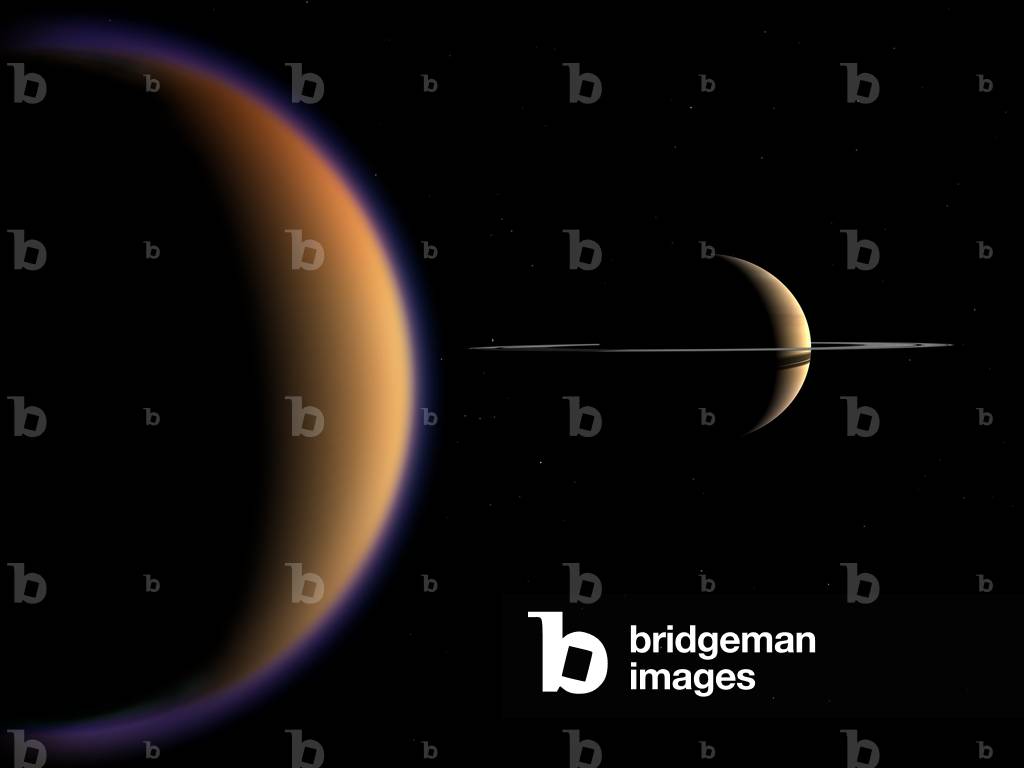
Saturn above the clouds of Titan - Illustration - Saturn from atop Titan's hydrocarbon haze - Artist's view of the planet Saturn view 80 km above the surface of his satellite Titan. In the plane of the rings of the planet appear from left to right the satellites Enceladus, Dione, Tethys and Rhea. Saturn and its rings would be a majestic sight lording over Titan's hydrocarbon haze. The viewpoint is from 50 miles above Titan's surface and three - quarters of a million miles away from Saturn itself. Four of Saturn's smaller satellites can also be seen along the ring plane: left to right are Enceladus, Dione, Tethys and Rhea. Technically, the orange clouds mark the beginning of Titan's condensate haze, which consists of ethane, methane, nitrogen, and a variety of hydrocarbons known collectively as tholin. These gases and hydrocarbons extend upward another 250 miles, resulting in a bluish, earthlike sky, albeit darker due to Titan's great distance from the Sun. Tholin is created by the interaction of the nitrogen - rich gases with ultraviolet light from the Sun and ultimately precipitates all the way down to Titan's surface. Notwithstanding its flame - like colors, this haze is chilled to minus 330o F
The Gods on Olympus, ceiling painting (fresco)
Bildbeschränkungen
  • Bridgeman Images only provides access to this image. Consent to license this image for any usage that includes Italy as a territory may be required according to the Italian Cultural Heritage Code. In such cases, an additional fee may apply, with the Ministry of Culture charging a potential minimum of €100. Any such clearance must be obtained in advance from the institution where the work is kept. Please contact us for further assistance.
The formation of Saturn's rings - Artist's view - Saturn moon break up - A satellite of Saturn breaks giving birth to the rings of Saturn and has small satellites
Saturn seen by the Cassini probe - Saturn seen by Cassini - Saturn seen by the Cassini probe on 22 August 2008 at a distance of 1.2 million km from the planet. The Cassini spacecraft looks toward the sunlit face of Saturn's rings, whose shadows continue to slide southward on the planet toward their temporary disappearance during equinox in August 2009. This view looks toward the sunlit side of the rings from about 3 degrees below the ringplane. Images taken using red, green and blue spectral filters were combined to create this natural color view. The images were acquired with the Cassini spacecraft wide - angle camera on Aug. 22, 2008 at a distance of approximately 1.2 million kilometers (728,000 miles) from Saturn. Image scale is 66 kilometers (41 miles) per pixel
In the atmosphere of Saturn - In Saturn's atmosphere. Artwork: The rings seen from the clouds of Saturn. Artist's view. Rings seen from Saturn's atmosphere
Saturn Planet - Hubble Space Telescope on June 20, 2019.
Saturn seen from the Atmosphere of Titan - Saturn from Titan - Illustration
Titan, Saturn satellite seen by Cassini - Titan near Saturn seen by Cassini spacecraft - Natural color image of Titan near Saturn blade taken by the Cassini probe on 29 January 2008 at a distance of about 2.3 million km from the satellite. Swathed in its thick blanket of atmosphere, frigid Titan approaches the brilliant limb of Saturn. Images taken using red, green and blue spectral filters were combined to create this natural color view. The images were acquired with the Cassini spacecraft narrow - angle camera on Jan. 29, 2008 at a distance of approximately 2.3 million kilometers (1.4 million miles) from Titan. Image scale is 14 kilometers (8 miles) per pixel
Astronauts and Geyser on Enceladus - Artist view - Astronauts and Water geyser on Enceladus - Artist view: Two astronauts explore the surface of the Enceladus satellite
Occultation of Saturn by the Moon from 03/11/2001 - Moon is occulting Saturn. November 3 2001 - View with a C8 telescope and Televue-Barlow (2,5x
Astronauts and Geyser on Enceladus - Artist view - Astronauts and Water geyser on Enceladus - Artist view: Two astronauts explore the surface of the Enceladus satellite
Illustration of the solar system
Occultation of Saturn by the Moon - The Moon and Planet Saturn. End of the blackout on 22 May 2007. Moon with Saturn. End of the occultation of may 22 2007
Saturn and Titan - Illustration - Saturn from Titan orbit - The planet Saturn seen from the orbit of its Titan satellite. This is how Saturn and Titan might look from a position in orbit around Titan. While in reality Saturn is vastly larger than Titan, it appears smaller here because Titan's orbit puts Saturn at a distance of about 700 thousand miles. Sunlight filtering through Titan's upper atmospheric haze - - extending over 300 miles above the surface - - gives a bluish cast to its limb
Saturn seen from a satellite Irregulier - Illustration: Irregular satellite of Saturn
Spezielle Anweisungen
  • No additional copyright fee required
Saturn and Mimas seen by the Cassini probe on 04/09/2007 - Saturn and Mimas seen by Cassini spacecraft Sept. 4 2007 - Saturn seen by the Cassini probe on 4/09/2007 at a distance of 2.7 million km from the planet. The Mimas ice satellite is visible under Saturn's rings. The Cassini spacecraft looks beyond Saturn's limb towards the icy face of Mimas, the innermost of the planet's major moons. This view looks toward the sunlit side of the rings from about 3 degrees below the ringplane. Mimas is 396 kilometers (246 miles) across. Images taken using red, green and blue spectral filters were combined to create this natural color view. The images were acquired with the Cassini spacecraft narrow - angle camera on Sept. 4, 2007 at a distance of approximately 2.7 million kilometers (1.7 million miles) from Saturn and 2.8 million kilometers (1.8 million miles) from Mimas. Image scale is 16 kilometers (10 miles) per pixel on Saturn and 17 kilometers (11 miles) per pixel on Mimas
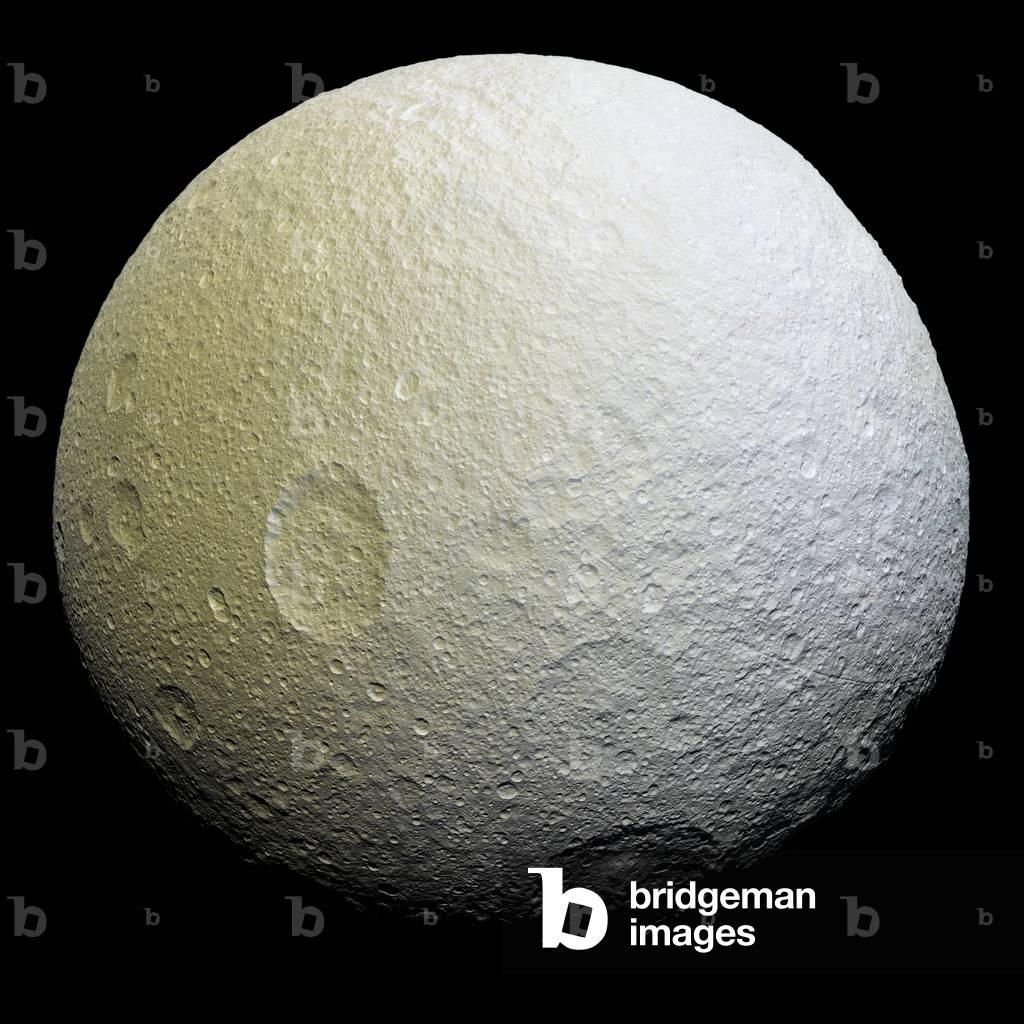
Tethys, Saturn satellite, seen by the Cassini probe - Saturn's moon Tethys seen by Cassini spacecraft: The Tethys satellite photographed by the Cassini probe on 11 April 2015 has a distance of 53,000 km from the satellite. Tethys is about 1070 km in diameter. - This enhancement-color mosaic of Saturn's icy moon Tethys shows a range of features on the moon's trailing hemisphere. Tethys is tidally locked to Saturn, so the trailing hemisphere is the side of the moon that always faces opposite its direction of motion as it orbits the planet - Images taken using clear, green, infrared and ultraviolet spectral filters were combined to create the view, which highlights subtle color differences across Tethys' surface at wavelengths not visible to human eyes. The moon's surface is fairly uniform in natural color - The color of the surface changes conspicuously across the disk, from yellowish hues to nearly white. These broad color changes are affected by a number of external processes. First, Saturn's diffuse E-ring preferentially bombards Tethys' leading hemisphere, towards the right side of this image, with ice bright ice grains. At the same time, charged particles from Saturn's radiation belt bombard the surface on the trailing side, causing color changes due to chemical alteration of the materials there. The albedo - a measure of the surface's reflectivity - drops by 10 to 15 percent from the moon's leading side to the trailing side. Similar global color patterns exist on other Saturnian moons - This mosaic is an orthographic projection constructed from 52 Cassini images obtained on April 11, 2015 with the Cassini spacecraft narrow-angle camera. Resolution is about 1,000 feet (300 meters) per pixel. The images were obtained at a distance of approximately 33,000 miles (53,000 kilometers) from Tethys
Saturn view of its satellite Hyperion - Artist view - Saturn from its moon Hyperion - Artist view
Spezielle Anweisungen
  • No additional copyright fee required
Occultation of Saturn by the Moon from 03/11/2001 - Moon is occulting Saturn. November 3 2001 - Sequence of images showing the passage of the Moon in front of Saturn
The Cassini and Saturn probe - Cassini spacecraft at Saturn - Artist's view of the Cassini probe during its final dip into the atmosphere of Saturn on September 15, 2017. As depicted in this illustration, Cassini will plunge into Saturn's atmosphere on Sept 15, 2017. Using its attitude control thrusters, the spacecraft will work to keep its antenna pointed at Earth while it sends its final data, including the composition of Saturn's upper atmosphere. The atmospheric torque will quickly become stronger than what the thrusters can compensate for, and after that point, Cassini will begin to tumble. When this happens, its radio connection to Earth will be severed, ending the mission. Following loss of signal, the spacecraft will burn up like a meteor in Saturn's upper atmosphere.
A satellite of Saturn breaks into the rings of Saturn and has small satellites.
Spezielle Anweisungen
  • No additional copyright fee required
Rhea, satellite of Saturn, seen by Cassini - Saturn's moon Rhea seen by Cassini - Mosaic of images obtained by the Cassini probe in March 2015. Rhea is the second largest satellite in Saturn (1528 km in diameter). After a couple of years in high - inclination orbits that limited its ability to encounter Saturn's moons, Nasa's Cassini spacecraft returned to Saturn's equatorial plane in March 2015.Image taken using clear, green, infrared and ultraviolet spectral filters were combined to create these enhanced color views, which offer an expanded range of the colors visible to human eyes in order to highlight subtle color differences across Rhea's surface. The moon's surface is fairly uniform in natural color.This view at right is centered at 9 degrees north latitude, 254 degrees west longitude. Resolution in this mosaic is 300 meters (984 feet) per pixel. The image was acquired at a distance that ranged from about 36,000 to 32.100 miles (57,900 to 51,700 kilometers) from Rhea
Saturn 3 by Stanley Donen, 1980
Zusätzliche Genehmigungen
  • Permission required for non-editorial use (inc book and magazine covers). Please contact us
Bildbeschränkungen
  • Access rights only to the digital file & only for editorial coverage of this specific motion picture/TV programme. Standard warranties regarding copyrights and moral rights are expressly excluded and third party rights may need to be cleared.;Content within this photograph may require additional clearances (eg: trademark and personality rights) depending on Licensee's specific use of material, which may include book and magazine cover use.
Saturn seen by the Cassini probe - Saturn northern hemisphere seen by Cassini spacecraft: Saturn seen by the Cassini probe on 25 April 2016. Cassini scanned across the planet and its rings on April 25, 2016, capturing three sets of red, green and blue images to cover this entire scene showing the planet and the main rings. The images were obtained using Cassini's wide-angle camera at a distance of approximately 1.9 million miles (3 million kilometers) from Saturn and at an elevation of about 30 degrees above the ring plane. The view looks toward the sunlit side of the rings from a Sun-saturn-spacecraft angle, or phase angle, of 55 degrees.
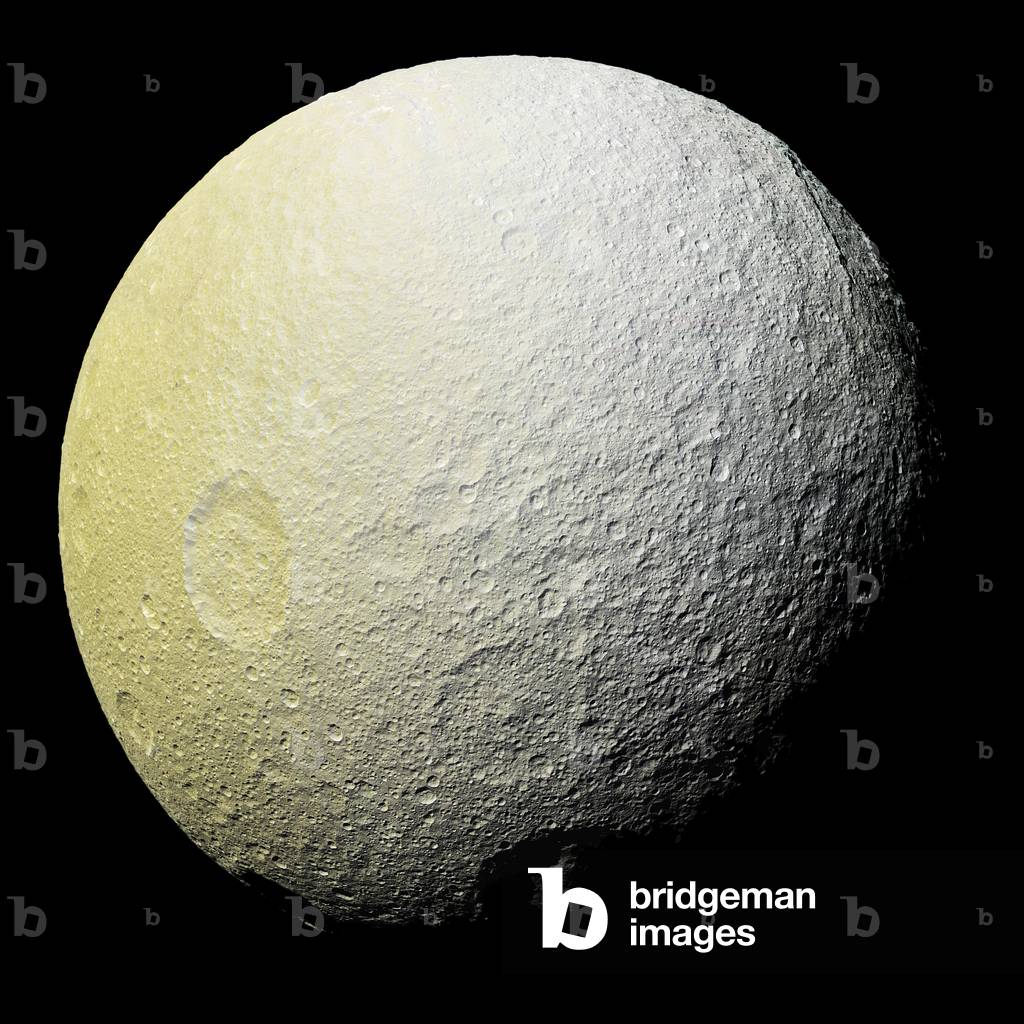
Tethys, Saturn satellite, seen by the Cassini probe - Saturn's moon Tethys seen by Cassini spacecraft: The Tethys satellite photographed by the Cassini probe on 11 April 2015 has a distance of 53,000 km from the satellite. Tethys is about 1070 km in diameter. - This enhancement-color mosaic of Saturn's icy moon Tethys shows a range of features on the moon's trailing hemisphere. Tethys is tidally locked to Saturn, so the trailing hemisphere is the side of the moon that always faces opposite its direction of motion as it orbits the planet - Images taken using clear, green, infrared and ultraviolet spectral filters were combined to create the view, which highlights subtle color differences across Tethys' surface at wavelengths not visible to human eyes. The moon's surface is fairly uniform in natural color - The color of the surface changes conspicuously across the disk, from yellowish hues to nearly white. These broad color changes are affected by a number of external processes. First, Saturn's diffuse E-ring preferentially bombards Tethys' leading hemisphere, towards the right side of this image, with ice bright ice grains. At the same time, charged particles from Saturn's radiation belt bombard the surface on the trailing side, causing color changes due to chemical alteration of the materials there. The albedo - a measure of the surface's reflectivity - drops by 10 to 15 percent from the moon's leading side to the trailing side. Similar global color patterns exist on other Saturnian moons - Mountains on the floor of the 280 mile- (450 km-) wide Odysseus impact basin are visible at upper right, around the two o'clock position - This mosaic is an orthographic projection constructed from 52 Cassini images obtained on April 11, 2015 with the Cassini spacecraft narrow-angle camera. Resolution is about 1,000 feet (300 meters) per pixel. The images were obtained at a distance of approximately 33,000 miles (53,000 kilometers) from Tethys
Saturn seen from its satellite Japet - Saturn from Iapetus - The planet Saturn accompanied by three satellites (from left to right Tethys, Rhea and Dione) seen from the icy surface of Japet. In this image Saturn dominates Iapetus' velvet black sky framed by three inner moons. Left to right are Tethys, Rhea and Dione. Less than half the size of the Earth's moon, ice - covered Iapetus is one of the few places in the Solar System that offers a good view of Saturn's rings. This is because Iapetus' orbit is inclined almost 15 degrees to Saturn's equator. With the exception of Phoebe, none of Saturn's other satellites offer such a vantage point. Unlike haze - shrouded Titan, Iapetus has no atmosphere to speak of and is believed to be composed almost entirely of water ice
Saturn Clouds - Clouds of Saturn - Artwork - Saturn rings seen through Saturn clouds. A view of the rings as seen from a point just above the main cloud deck of Saturn
Centre of the Milky Way Central Region - Center of the Milky Way: Central part of the lactee route seen in New Zealand. Planet Saturn is the bright white dot towards the center of the image (near the nebula of the pipe). The central part of our Milky Way photographed from New Zealand. Lots of emission and obscure nebulae are visible in the image. Planet Saturn in the bright white “” star”” close to the center of the image. A diffusing filter was used to enhance star color and general shape of the constellations.
Saturn seen in infrared by Cassini spacecraft - Saturn seen in infrared by Cassini spacecraft - Composite image of Saturn in false colours obtained from infrared observations collected by the Cassini probe on 24 February 2007 at a distance of 1.58 million km from the planet. Flying over the unlit side of Saturn's rings, the Cassini spacecraft captures Saturn's glow, represented in brilliant shades of electric blue, sapphire and mint green, while the planet's shadow casts a wide net on the rings. This striking false - color mosaic was created from 25 images taken by Cassini's visual and infrared mapping spectrometer over a period of 13 hours, and captures Saturn in nighttime and daytime conditions. The visual and infrared mapping spectrometer acquires data simultaneously at 352 different wavelengths, or spectral channels. Data at wavelengths of 2.3, 3.0 and 5.1 microns were combined in the blue, green and red channels of a standard color image, respectively, to make this false - color mosaic. This image was acquired on Feb. 24, 2007, while the spacecraft was 1.58 million kilometers (1 million miles) from the planet and 34.6 degrees above the ring plane. The solar phase angle was 69.5 degrees. In this view, Cassini was looking down on the northern, unlit side of the rings, which are rendered visible by sunlight filtering through from the sunlit, southern face. On the night side (right side of image), with no sunlight, Saturn's own thermal radiation lights things up. This light at 5.1 microns wavelength (some seven times the longest wavelength visible to the human eye) is generated deep within Saturn, and works its way upward, eventually escaping into space. Thick clouds deep in the atmosphere block that light. An amazing array of dark streaks, spots, and globe - encircling bands is visible instead. Saturn's strong thermal glow at 5.1 microns even allows these deep clouds to be seen on portions of the dayside (left side), especially where overlying h
The formation of Saturn's rings - Artist's view - The origin of Saturn's rings
Spezielle Anweisungen
  • No additional copyright fee required
Saturn seen by the Cassin probe - Saturn seen by Cassini spacecraft on october 10 2013: Saturn seen by the Cassini probe on October 10, 2013. - A swing high above Saturn by Nasa's Cassini spacecraft revealed this stately view of the golden-hued planet and its main rings. The view is in natural color, as human eyes would have seen it. This mosaic was made from 36 images in three color filters obtained by Cassini's imaging science subsystem on Oct. 10, 2013 - A bright, narrow wave of clouds around 42 degrees north latitude appears to be some of the turbulent aftermath of a giant storm that reached its violent peak in early 2011. The mysterious six-sided weather pattern known as the hexagon is visible around Saturn's north pole - The rings shown here include Saturn's main rings. The rings known as the C, B and A rings - listed here in order of closeness to Saturn - are easily seen. The F ring is also there, but not easily seen without enhancing the contrast of the image. (Rings were named in order of their discovery rather than their position around Saturn.) The rings also cast a shadow on Saturn at the limb of the planet in the lower right quadrant
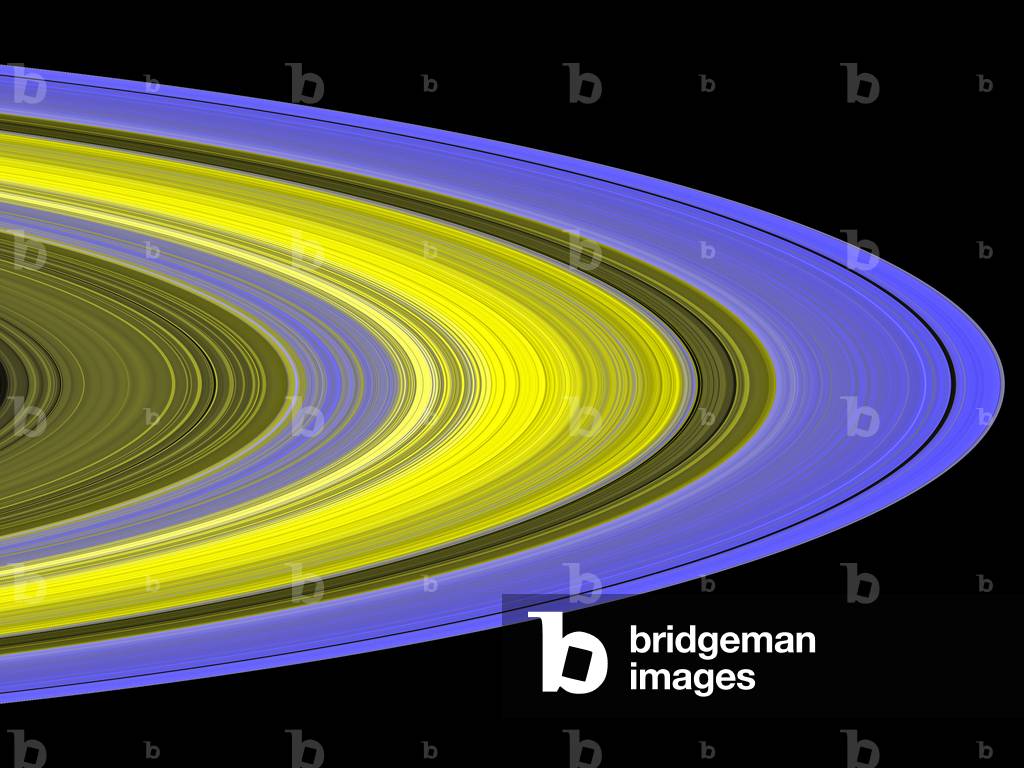
Saturn rings seen in ultraviolet by Cassini - Saturn's rings in utraviolet - Saturn rings seen in ultraviolet by the Cassini probe. The colours indicate a different distribution of the material within the rings. This false - color image of Saturn's main rings was made by combining data from multiple star occultations using the Cassini ultraviolet imaging spectrograph. During occultations, scientists observe the brightness of a star as the rings pass in front of the star. This provides a measurement of the amount of ring material between the spacecraft and the star. Cassini has given scientists the most detailed view yet of Saturn's densely packed B ring. Cassini found that this part of the rings is densely packed with clumps, called self - gravity wakes, separated by almost empty gaps. These clumps in Saturn's B ring are neatly organized and constantly colliding, which surprised scientists. The clumps in Saturn's B ring, 30 to 50 meters (100 to 160 feet) across, are too small to be seen directly. However, scientists can map the distribution, shape and orientation of the clumps. Colors in this image indicate the orientation of clumps, and brightness indicates the density of ring particles. The formation of wakes is strongest in the bluer regions, where ring particles clump together in tilted wakes. Particles in the central yellow regions are too densely packed for any starlight to pass through. The ultraviolet imaging spectrograph measured the flickering of the star Alpha Arae as it passed by the rings Nov. 9 and 10, 2006
Saturn from his satellite Dione - Illustration
Spezielle Anweisungen
  • No additional copyright fee required
Cassini - Huygens and Saturn - Cassini spacecraft at Saturn - Artist's view of the Cassini probe around Saturn. The Huygens European module is attached to the probe. The Cassini-Huygens probe was launched on 15 October 1997 and has been placed in orbit around Saturn since 1 July 2004. The great Cassini orbiter, with the Huygens probe still in place, prepares to slip through the ring plane of Saturn. Cassini - Huygens was launched from the earth on october 15 1997 and is orbiting Saturn system from july 1st 2004
Saturn and satellites seen by the Cassini probe on 30/01/2008 - Saturn and satellites seen by Cassini spacecraft Jan. 30 2008 - Saturn seen by the Cassini probe on 30 January 2008 at a distance of 1.3 million km from the planet. The Tethys satellite is visible under Saturn's rings and the Titan satellite appears at the top of the picture. Titan emerges from behind Saturn, while Tethys streaks into view, in this colorful scene. Saturn's shadow darkens the far arm of the rings near the planet's limb. Titan is 5,150 kilometers (3,200 miles) wide; Tethys is 1,071 kilometers (665 miles) wide. This view looks toward the unilluminated side of the rings from about 3 degrees above the ringplane. Images taken using red, green and blue spectral filters were combined to create this natural color view. The images were acquired with the Cassini spacecraft wide - angle camera on Jan. 30, 2008 at a distance of approximately 1.3 million kilometers (800,000 miles) from Saturn. Image scale is 77 kilometers (48 miles) per pixel on Saturn
Occultation of Saturn by the Moon - Saturn occultation by the moon Artwork - Artist view
Nutzungsbeschränkungen von unseren Content-Partnern
  • Only available to clients invoiced in France
Saturn 3 by Stanley Donen, 1980
Zusätzliche Genehmigungen
  • Permission required for non-editorial use (inc book and magazine covers). Please contact us
Bildbeschränkungen
  • Access rights only to the digital file & only for editorial coverage of this specific motion picture/TV programme. Standard warranties regarding copyrights and moral rights are expressly excluded and third party rights may need to be cleared.;Content within this photograph may require additional clearances (eg: trademark and personality rights) depending on Licensee's specific use of material, which may include book and magazine cover use.
Saturn view of Enceladus - Illustration - Saturn from the surface of Enceladus - The planet Saturn seen from the ice surface of Enceladus. This is how Saturn may appear from the icy surface of Enceladus, one of Saturn's eight major satellites. At a distance of 148 thousand miles, Saturn would subtend an angle of 29o in Enceladus' sky, about the same width as 58 Earth moon's lined up side - by - side. While the surface of Enceladus is as reflective as new fallen snow, it would probably appear leaden about an hour before sunrise with a crescent Saturn as the only source of illumination. Like all of Saturn's major satellites, Enceladus always keeps the same side facing its host planet. From the perspective of a stationary observer on Enceladus, Saturn would always appear in the same position in the sky, cycling through its phases in about one - and - half Earth days. This image also illustrates a phenomenon only recently discovered by Nasa's Cassini probe: sunlight reflecting off of Saturn's rings casts a faint glow onto the cloud tops of Saturn's night side. The illumination is about the same as three of Earth's full moon combined
Tethys, Saturn satellite, seen by the Cassini probe - Saturn's moon Tethys seen by Cassini spacecraft - The Tethys satellite photographed by the Cassini probe on August 30, 2007 at a distance of 97,000 km. Tethys is about 1070 km in diameter. At the top left of the picture is the gigantic impact crater Odysseus, which measures 450 km in diameter. The vast expanse of the crater Odysseus spreads out below Cassini in this mosaic view of Saturn's moon Tethys. The crater (450 kilometers or 280 miles across) is a remarkably well - preserved example of an ancient multi - ringed impact basin: the outer ring is defined by steep, cliff - like walls that descend to generally broad internal terraces. The inner ring is formed by a prominent, crown - shaped, 140 - kilometer (88 - mile) diameter circular band of icy mountains. Multi - ring basins are seen on rocky bodies as well as icy ones. The complex internal structure and multi - ringed nature of these very large basins are believed to arise from the rebound of intense shock waves that penetrated the body at the time of impact. Tethys is 1,071 kilometers (665 miles) across. This mosaic was assembled from four clear filter, narrow - angle camera images. The view is an orthographic projection centered on 3 degrees south latitude, 119 degrees west longitude and has a resolution of 572 meters (0.35 mile) per pixel. An orthographic view is most like the view seen by a distant observer looking through a telescope. North is up. The view was obtained by the Cassini spacecraft on Aug. 30, 2007, from a distance of approximately 97,000 kilometers (60,000 miles) and at a sun - Tethys - spacecraft, or phase, angle of 51 degrees
The clouds of Titan - Artist view - Titan's clouds
Spezielle Anweisungen
  • No additional copyright fee required
Saturn from its moon Epimethee - Illustration - Saturn from its moon Epimetheus
Spezielle Anweisungen
  • No additional copyright fee required
Saturn in false colours - Saturn in infrared - The planet Saturn seen in visible and infrared by the Cassini probe on November 1, 2008. This false - color composite image, constructed from data obtained by Nasa's Cassini spacecraft, shows Saturn's rings and southern hemisphere. The composite image was made from 65 individual observations by Cassini's visual and infrared mapping spectrometer in the near - infrared portion of the light spectrum on Nov. 1, 2008. The observations were each six minutes long. In this image constructed from data collected in the near - infrared wavelengths of light, scientists designated blue to indicate sunlight reflected at a wavelength of 2 microns, green to indicate sunlight reflected at 3 microns and red to indicate thermal emission at 5 microns. Saturn's rings reflect sunlight at 2 microns, but not at 3 and 5 microns, so they appear deep blue. Saturn's high altitude haze reflects sunlight at both 2 and 3 microns, but not at 5 microns, and so it appears green to blue - green. The heat emission from the interior of Saturn is only seen at 5 microns wavelength in the spectrometer data, and thus appears red. The dark spots and banded features in the image are clouds and small storms that outline the deeper weather systems and circulation patterns of the planet. They are illuminated from underneath by Saturn's thermal emission, and thus appear in silhouette
Enceladus, Saturn's satellite, seen by Cassini - Saturn's moon Enceladus from Cassini - Mosaic of false-coloured images obtained by the Cassini probe during the flight over this satellite on 11 August 2008. The image shows a fractured region in the southern hemisphere of the satellite. This mosaic of Saturn's moon Enceladus provides broad regional context for the ultra - sharp, close - up views Nasa's Cassini spacecraft acquired minutes earlier, during its flyby on Aug. 11, 2008. This false - color mosaic combines Imaging Science Subsystem (ISS) narrow - angle camera images obtained through ultraviolet, green, and near - infrared camera filters. Areas that are greenish in appearance are believed to represent deposits of coarser grained ice and solid boulders that are too small to be seen at this scale, but which are visible in the higher resolution views, while whitish deposits represent finer grained ice. The mosaic shows that coarse - grained and solid ice are concentrated along valley floors and walls, as well as along the upraised flanks of the “” tiger stripe”” fractures, which may be covered with plume fallout that landed not far from the sources. Elsewhere on Enceladus, this coarse water ice is concentrated within outcrops along cliff faces and at the top of ridges. The sinuous boundary of scarps and ridges that encircles the south polar terrain at about 55 degrees south latitude is conspicuous. Much of the coarse - grained or solid ice along this boundary may be blocky rubble that has crumbled off of cliff faces as a result of ongoing seismic activity. The lighting conditions over the polar region highlight features, such as fractures and ridges, that are barely visible in the July 2005 views, and vice versa. The four most prominent sulci (from top to bottom: Damascus, Baghdad, Alexandria and Cairo) appear as generally horizontal fractures near lower right, and they extend into the moon's night side. The mosaic is an orthographic projection centered at 63.0 degrees south
The Cassini - Huygens probe crosses the rings of Saturn - Cassini - Huygens spacecraft crossing Saturn's rings - Artist's view of the Cassini probe as he crossed the rings of Saturn. The Huygens European module is attached to the probe. The Cassini-Huygens probe was launched on 15 October 1997 and has been placed in orbit around Saturn since 1 July 2004. The Cassini/Huygens spacecraft makes a dangerous journey through Saturn's debris filled ring plane before entering orbit around the planet
Early unmanned space missions to the outer planets (gouache on paper)
Spezielle Anweisungen
  • No additional copyright fee required
Gaea unlocked the chains of her son Saturn (Time) (litho)
Spezielle Anweisungen
  • No additional copyright fee required
Saturn seen from his satellite Japet - Saturn as seen from Iapetus
Spezielle Anweisungen
  • No additional copyright fee required
Source of Truth (acrylic on canvas)
Urheberrecht
  • Urheberrechtlich Geschützt
premium
Size comparison: Earth and Saturn - Saturn and the Earth compared - Saturn, the second largest planet in the solar system compared to Earth. Saturn's diameter is about nine times greater than the Earth's. If you weigh 180 pounds on Earth, you would weigh only 165 pounds at Saturn's cloud tops (despite Saturn's enormous mass, its density is so low that if you were able to stand atop Saturn's clouds, you would feel a pull of gravity slightly less than what you feel on the Earth's surface). Saturn is ten times further from the Sun than the Earth. Saturn has the honor of being the second-largest planet in the Solar System, though it has only 30% the mass of its jovian better Jupiter. Like Jupiter, Saturn is blanketed by thick clouds and is believed to have no solid surface except for a relatively small, Earth-size core of rock and metals
Mimas, satellite of Saturn, seen by the Cassini probe on 13/02/2010 - Saturn's moon Mimas seen by Cassini spacecraft - February 13 2010 - The Mimas satellite seen in false colours by the Cassini probe on 13 February 2010 has a distance of 16,000 km from the satellite. Color differences reveal differences in terrain nature. Mimas is about 400 km in diameter. At the right centre is the large impact crater Herschel, 130 km wide. Subtle color differences on Saturn's moon Mimas are apparent in this false - color view of Herschel Crater captured by Nasa's Cassini spacecraft during its closest - ever flyby of that moon. The image shows terrain - dependent color variations, particularly the contrast between the bluish materials in and around Herschel Crater (130 kilometers, or 80 miles, wide) and the greenish cast on older, more heavily cratered terrain elsewhere. The origin of the color differences is not yet understood, but may be caused by subtle differences in the surface composition between the two terrains. Herschel Crater covers most of the bottom of this image. To create this false - color view, ultraviolet, green and infrared images were combined into a single picture that exaggerates the color differences of terrain on the moon. These data were combined with a high - resolution image taken in visible light to provide the high - resolution information from the clear - filter image and the color information from the ultraviolet, green and infrared filter images. The natural color of Mimas visible to the human eye may be a uniform gray or yellow color, but this mosaic has been contrast - enhanced and shows differences at other wavelengths of light. During its closest - ever flyby on Feb. 13, 2010, Cassini came within about 9,500 kilometers (5,900 miles) of Mimas. This view looks toward the northern part of the hemisphere of Mimas that leads in the moon's orbit around Saturn. Mimas is 396 kilometers (246 miles) across. North on Mimas is up
Saturn view of the surroundings of Dione - Illustration - Saturn from the vicinity of Dione - The planet Saturn seen from the surroundings of its satellite Dione. Dione, visible in the foreground, has a diameter of about 1100 km and is mainly composed of ice. In the background, another Saturn ice satellite is visible, Tethys. This is how Saturn might appear from near Dione, one of Saturn's inner icy satellites. Dione is about 700 miles in diameter and is believed to be composed primarily of water ice along with lesser amounts of silicate rocks. In this image, Dione is in the foreground orbiting about 197 thousand miles above Saturn's cloud tops. Further towards Saturn at a distance of 50 thousand miles from Dione is Tethys, another icy moon, slightly smaller than Dione. Tethys is silhouetted against the “” ring shine”” on Saturn's night side - - reflected sunlight on the cloud tops from Saturn's rings
Mimas, satellite of Saturn, seen by the Cassini probe on 13/02/2010 - Saturn's moon Mimas seen by Cassini spacecraft - February 13 2010 - The Mimas satellite photographed by the Cassini probe on 13 February 2010 has a distance of 16,000 km from the satellite. Mimas is about 400 km in diameter. In the centre left, the large impact crater Herschel, 130 km wide. Relatively dark regions below bright crater walls and streaks on some of the walls are seen in this mosaic of Saturn's moon Mimas, created from images taken by Nasa's Cassini spacecraft during its closest flyby of the moon. The crater floors and surroundings are about 20 percent darker than the steep crater walls in this view. Mimas 'original surface, like the surfaces of most of the other major Saturnian moons without atmospheres, is not pure ice but contains some dark impurities. The relatively dark markings appear along the lower portion of the walls of Herschel Crater (130 kilometers, 80 miles wide) and some of the smaller craters and are marked in green in the annotated version of the image. Cassini scientists interpret this darkening as evidence for the gradual concentration of impurities from evaporating icy materials in areas where the dark impurities slide slowly down the crater wall. There, the bright ice is baked away by the sun and the vacuum of space. At Herschel, the edge where the darker regions contact the crater floor is interrupted by an extensive hummocky area. Scientists believe the hummocky texture came from the flow of melted ice that occurred during the impact that created the crater. That melt filled the bottom of the crater around the central peak. Dark streaks are seen making their way down the sides of some craters and often originated from pockets of dark contaminants embedded just below the rim of the crater wall. The pockets themselves likely represent small, pre - existing, dark - floored craters that were buried by the blanket of material thrown out from the newer im
Tethys, Saturn satellite, seen by the Cassini probe - Saturn's moon Tethys seen by Cassini spacecraft - The southern pole of the Tethys satellite photographed by the Cassini probe on September 24, 2005. Mosaic of nine images. With this full - disk mosaic, Cassini presents the best view yet of the south pole of Saturn's moon Tethys. The giant rift Ithaca Chasma cuts across the disk. Much of the topography seen here, including that of Ithaca Chasma, has a soft, muted appearance. It is clearly very old and has been heavily bombarded by impacts over time. Many of the fresh - appearing craters (ones with crisp relief) exhibit unusually bright crater floors. The origin of the apparent brightness (or “” albedo”) contrast is not known. It is possible that impacts punched through to a brighter layer underneath, or perhaps it is brighter because of different grain sizes or textures of the crater floor material in comparison to material along the crater walls and surrounding surface. The moon's high southern latitudes, seen here at the bottom, were not imaged by Nasa's Voyager spacecraft during their flybys of Tethys 25 years ago. The mosaic is composed of nine images taken during Cassini's close flyby of Tethys (1,071 kilometers, or 665 miles across) on Sept. 24, 2005, during which the spacecraft passed approximately 1,500 kilometers (930 miles) above the Moon's surface. This view is centered on terrain at approximately 1.2 degrees south latitude and 342 degrees west longitude on Tethys. It has been rotated so that north is up. The clear filter images in this mosaic were taken with the Cassini spacecraft narrow - angle camera at distances ranging from 71,600 kilometers (44,500 miles) to 62,400 kilometers (38,800 miles) from Tethys and at a Sun - Tethys - spacecraft, or phase, angle of 21 degrees. The image scale is 370 meters (1,200 feet) per pixel