[]
Ihre AuswahlIhre aktuelle Auswahl
asset(s) Assets
Ihr Preis 0

Ihre Auswahl

Auswahl aufheben
Asset zum Warenkorb hinzugefügt
{"event":"pageview","page_type1":"undetected","page_type2":"_assets_search_override","language":"de","user_logged":"false","user_type":"ecommerce","nl_subscriber":"false"}
{"event":"ecommerce_event","event_name":"view_item","event_category":"browse_catalog","ecommerce":{"items":[{"item_id":"PIX4571310","item_category":"photo","item_category2":"no_copyright","item_category3":"standard","item_category5":"not_balown","item_list_name":"search_results","item_name":"the_ison_comete_05_2013_the_ison_comet_seen_on_may_8_2013_by_the_hubble_space_telescope_hst_hubble_s","item_variant":"undefined"},{"item_id":"PIX4624811","item_category":"photo","item_category2":"no_copyright","item_category3":"standard","item_category5":"not_balown","item_list_name":"search_results","item_name":"the_planet_saturn_observed_with_the_hubble_space_telescope_in_october_1997_saturn_is_120_000_km_in_d","item_variant":"undefined"},{"item_id":"PIX4569558","item_category":"photo","item_category2":"no_copyright","item_category3":"standard","item_category5":"not_balown","item_list_name":"search_results","item_name":"the_comet_shoemaker_levy_9_01_1994_shoemaker_levy_9_comet_01_1994_the_comet_shoemaker_levy_9_seen_in","item_variant":"undefined"},{"item_id":"PIX5940207","item_category":"photo","item_category2":"no_copyright","item_category3":"standard","item_category5":"not_balown","item_list_name":"search_results","item_name":"jupiter_seen_by_the_hubble_space_telescope","item_variant":"undefined"},{"item_id":"PIX4571322","item_category":"photo","item_category2":"no_copyright","item_category3":"standard","item_category5":"not_balown","item_list_name":"search_results","item_name":"the_ison_comete_10_2013_the_ison_comet_seen_on_october_9_2013_by_the_hubble_space_telescope_hst_hubb","item_variant":"undefined"},{"item_id":"PIX4583555","item_category":"photo","item_category2":"no_copyright","item_category3":"standard","item_category5":"not_balown","item_list_name":"search_results","item_name":"asteroide_p_2010_a2_seen_by_the_space_telescope_hubble_comet_like_asteroid_p_2010_a2_p_2010_a2_is_no","item_variant":"undefined"},{"item_id":"PIX5940218","item_category":"photo","item_category2":"no_copyright","item_category3":"standard","item_category5":"not_balown","item_list_name":"search_results","item_name":"saturn_planet_hubble_space_telescope_on_june_20_2019","item_variant":"undefined"},{"item_id":"PIX4569561","item_category":"photo","item_category2":"no_copyright","item_category3":"standard","item_category5":"not_balown","item_list_name":"search_results","item_name":"the_comet_shoemaker_levy_9_01_1994_shoemaker_levy_9_comet_01_1994_the_comet_shoemaker_levy_9_seen_in","item_variant":"undefined"},{"item_id":"UIG532091","item_category2":"no_copyright","item_category3":"standard","item_category5":"not_balown","item_list_name":"search_results","item_name":"hubble_space_telescope_launch","item_variant":"undefined"},{"item_id":"UIG531595","item_category2":"no_copyright","item_category3":"standard","item_category5":"not_balown","item_list_name":"search_results","item_name":"image_of_mars_from_hubble_space_telescope","item_variant":"undefined"},{"item_id":"PIX4572231","item_category":"photo","item_category2":"no_copyright","item_category3":"standard","item_category5":"not_balown","item_list_name":"search_results","item_name":"star_field_in_the_constellation_sagittarius_starfield_in_sagittarius_stars_in_sagittarius_towards_th","item_variant":"undefined"},{"item_id":"PIX4609816","item_category":"photo","item_category2":"no_copyright","item_category3":"standard","item_category5":"not_balown","item_list_name":"search_results","item_name":"barree_spiral_galaxy_ngc_1345_in_eridan_barred_spiral_galaxy_ngc_1345_in_eridanus_located_about_85_m","item_variant":"undefined"},{"item_id":"PIX4612901","item_category":"photo","item_category2":"no_copyright","item_category3":"standard","item_category5":"not_balown","item_list_name":"search_results","item_name":"barree_spiral_galaxy_ngc_6217_barred_galaxy_ngc_6217_the_barree_spiral_galaxy_ngc_6217_is_located_60","item_variant":"undefined"},{"item_id":"UIG532089","item_category2":"no_copyright","item_category3":"standard","item_category5":"not_balown","item_list_name":"search_results","item_name":"hubble_space_telescope_repair","item_variant":"undefined"},{"item_id":"UIG532087","item_category2":"no_copyright","item_category3":"standard","item_category5":"not_balown","item_list_name":"search_results","item_name":"hubble_space_telescope","item_variant":"undefined"},{"item_id":"PIX4626476","item_category":"photo","item_category2":"no_copyright","item_category3":"standard","item_category5":"not_balown","item_list_name":"search_results","item_name":"kepler_is_the_rest_of_a_supernova_that_exploded_about_400_years_ago_located_about_13_000_light_years","item_variant":"undefined"},{"item_id":"PIX4568849","item_category":"photo","item_category2":"no_copyright","item_category3":"standard","item_category5":"not_balown","item_list_name":"search_results","item_name":"cloud_ic_349_illuminates_by_the_star_merope_barnard_s_merope_nebula_ic_349_ic_349_is_an_interstellar","item_variant":"undefined"},{"item_id":"PIX4565015","item_category":"photo","item_category2":"no_copyright","item_category3":"standard","item_category5":"not_balown","item_list_name":"search_results","item_name":"globular_cluster_ngc_6752_stars_in_globular_cluster_ngc_6752_image_of_the_center_of_the_globular_clu","item_variant":"undefined"},{"item_id":"UIG867136","item_category2":"no_copyright","item_category3":"standard","item_category5":"not_balown","item_list_name":"search_results","item_name":"the_central_region_of_our_milky_way_galaxy_hubble_spitzer_and_chandra","item_variant":"undefined"},{"item_id":"PIX4613167","item_category":"photo","item_category2":"no_copyright","item_category3":"standard","item_category5":"not_balown","item_list_name":"search_results","item_name":"spiral_galaxy_ngc_7331_in_pegase_spiral_galaxy_ngc_7331_in_pegasus_the_galaxy_ngc_7331_is_located_ab","item_variant":"undefined"},{"item_id":"PIX4565214","item_category":"photo","item_category2":"no_copyright","item_category3":"standard","item_category5":"not_balown","item_list_name":"search_results","item_name":"globular_cluster_terzan_5_in_sagittarius_globular_cluster_terzan_5_in_sagittarius_the_globular_clust","item_variant":"undefined"},{"item_id":"PIX4564826","item_category":"photo","item_category2":"no_copyright","item_category3":"standard","item_category5":"not_balown","item_list_name":"search_results","item_name":"globular_cluster_ngc_6401_in_ophiuchus_globular_cluster_ngc_6401_in_ophiuchus_the_nasa_esa_hubble_sp","item_variant":"undefined"},{"item_id":"PIX4565068","item_category":"photo","item_category2":"no_copyright","item_category3":"standard","item_category5":"not_balown","item_list_name":"search_results","item_name":"globular_cluster_m71_in_the_fleche_globular_cluster_m71_in_sagitta_m71_is_located_about_12_000_light","item_variant":"undefined"},{"item_id":"PIX4574271","item_category":"photo","item_category2":"no_copyright","item_category3":"standard","item_category5":"not_balown","item_list_name":"search_results","item_name":"galaxy_ngc_891_in_andromede_edge_on_spiral_galaxy_ngc_891_in_andromeda_spiral_galaxy_seen_by_the_sli","item_variant":"undefined"},{"item_id":"UDK844647","item_category":"photo","item_category2":"no_copyright","item_category3":"standard","item_category5":"not_balown","item_list_name":"search_results","item_name":"the_hubble_space_telescope","item_variant":"undefined"},{"item_id":"PIX4564321","item_category":"photo","item_category2":"no_copyright","item_category3":"standard","item_category5":"not_balown","item_list_name":"search_results","item_name":"globular_cluster_ngc_288_the_globular_cluster_ngc_288_ngc_288_is_a_cluster_of_stars_located_about_30","item_variant":"undefined"},{"item_id":"PIX4565139","item_category":"photo","item_category2":"no_copyright","item_category3":"standard","item_category5":"not_balown","item_list_name":"search_results","item_name":"globular_cluster_ngc_6934_globular_cluster_ngc_6934_ngc_6934_is_located_about_50_000_light_years_awa","item_variant":"undefined"},{"item_id":"PIX4572363","item_category":"photo","item_category2":"no_copyright","item_category3":"standard","item_category5":"not_balown","item_list_name":"search_results","item_name":"star_t_tauri_in_orion_bow_shock_around_t_tauri_star_in_the_orion_nebula_ll_ori_is_a_star_t_tauri_loc","item_variant":"undefined"},{"item_id":"PIX4572282","item_category":"photo","item_category2":"no_copyright","item_category3":"standard","item_category5":"not_balown","item_list_name":"search_results","item_name":"star_v838_monocerotis_28_10_2004_v838_monocerotis_10_2004_this_variable_star_is_located_approximatel","item_variant":"undefined"},{"item_id":"PIX4613272","item_category":"photo","item_category2":"no_copyright","item_category3":"standard","item_category5":"not_balown","item_list_name":"search_results","item_name":"spiral_galaxy_ic_391_in_the_giraffe_spiral_galaxy_ic_391_in_camelopardalis_spiral_galaxy_ic_391_loca","item_variant":"undefined"},{"item_id":"PIX4565206","item_category":"photo","item_category2":"no_copyright","item_category3":"standard","item_category5":"not_balown","item_list_name":"search_results","item_name":"djorgovski_globular_cluster_1_in_scorpio_globular_cluster_djorgovski_1_in_scorpius_the_djorgovski_gl","item_variant":"undefined"},{"item_id":"PIX4612914","item_category":"photo","item_category2":"no_copyright","item_category3":"standard","item_category5":"not_balown","item_list_name":"search_results","item_name":"galaxy_ngc_6384_in_ophiuchus_galaxy_ngc_6384_in_ophiuchus_the_spiral_galaxy_ngc_6384_is_located_abou","item_variant":"undefined"},{"item_id":"PIX4614034","item_category":"photo","item_category2":"no_copyright","item_category3":"standard","item_category5":"not_balown","item_list_name":"search_results","item_name":"jupiter_seen_by_hubble_space_telescope_jupiter_seen_by_hst_image_obtained_on_april_3_2017_by_hubble_","item_variant":"undefined"},{"item_id":"PIX4615036","item_category":"photo","item_category2":"no_copyright","item_category3":"standard","item_category5":"not_balown","item_list_name":"search_results","item_name":"mars_and_phobos_seen_by_the_hubble_space_telescope_2016_mars_with_phobos_seen_by_the_hubble_space_te","item_variant":"undefined"},{"item_id":"PIX4610141","item_category":"photo","item_category2":"no_copyright","item_category3":"standard","item_category4":"r_gendler","item_category5":"not_balown","item_list_name":"search_results","item_name":"spiral_galaxy_ngc_2683_in_lynx_spiral_galaxy_ngc_2683_in_lynx_spiral_galaxy_ngc_2683_distant_about_1","item_variant":"undefined"},{"item_id":"PIX4583169","item_category":"photo","item_category2":"no_copyright","item_category3":"standard","item_category5":"not_balown","item_list_name":"search_results","item_name":"crab_pulsar_in_nebula_m1_the_crab_pulsar_this_false_colored_image_obtained_by_the_hubble_space_teles","item_variant":"undefined"},{"item_id":"PIX5940204","item_category":"photo","item_category2":"no_copyright","item_category3":"standard","item_category5":"not_balown","item_list_name":"search_results","item_name":"spiral_galaxy_ngc_3147_in_the_constellation_dragon","item_variant":"undefined"},{"item_id":"PIX4572084","item_category":"photo","item_category2":"no_copyright","item_category3":"standard","item_category5":"not_balown","item_list_name":"search_results","item_name":"pistol_star_massive_star_in_the_constellation_sagittarius_the_massive_star_pistol_star_in_sagittariu","item_variant":"undefined"},{"item_id":"PIX4572304","item_category":"photo","item_category2":"no_copyright","item_category3":"standard","item_category5":"not_balown","item_list_name":"search_results","item_name":"star_v838_monocerotis_v838_monocerotis_light_echo_this_variable_star_is_located_approximately_20_000","item_variant":"undefined"},{"item_id":"PIX4565191","item_category":"photo","item_category2":"no_copyright","item_category3":"standard","item_category5":"not_balown","item_list_name":"search_results","item_name":"globular_cluster_g1_mayall_ii_globular_cluster_g1_mayall_ii_the_g1_globular_cluster_is_the_brightest","item_variant":"undefined"},{"item_id":"PIX6323594","item_category":"photo","item_category2":"no_copyright","item_category3":"standard","item_category5":"not_balown","item_list_name":"search_results","item_name":"the_spiral_galaxy_ngc_2775_or_caldwell_48_photo","item_variant":"undefined"},{"item_id":"PIX4572295","item_category":"photo","item_category2":"no_copyright","item_category3":"standard","item_category5":"not_balown","item_list_name":"search_results","item_name":"star_v838_monocerotis_11_2005_star_v838_monocerotis_seen_by_the_hubble_space_telescope_11_2005_this_","item_variant":"undefined"},{"item_id":"PIX4572319","item_category":"photo","item_category2":"no_copyright","item_category3":"standard","item_category5":"not_balown","item_list_name":"search_results","item_name":"star_v838_monocerotis_09_2006_v838_monocerotis_seen_by_the_hubble_space_telescope_09_2006_this_varia","item_variant":"undefined"},{"item_id":"PIX4609410","item_category":"photo","item_category2":"no_copyright","item_category3":"standard","item_category5":"not_balown","item_list_name":"search_results","item_name":"spiral_galaxy_ngc_634_ngc_634_is_a_spiral_galaxy_located_about_250_million_light_years_away_from_ear","item_variant":"undefined"},{"item_id":"PIX4572157","item_category":"photo","item_category2":"no_copyright","item_category3":"standard","item_category5":"not_balown","item_list_name":"search_results","item_name":"cepheides_in_the_galaxy_m81_cepheids_in_the_galaxy_m81_cepheides_are_very_bright_variable_stars_that","item_variant":"undefined"},{"item_id":"UIG531012","item_category2":"no_copyright","item_category3":"standard","item_category5":"not_balown","item_list_name":"search_results","item_name":"image_taken_by_the_hubble_telescope","item_variant":"undefined"},{"item_id":"PIX4564726","item_category":"photo","item_category2":"no_copyright","item_category3":"standard","item_category5":"not_balown","item_list_name":"search_results","item_name":"globular_cluster_m12_in_ophiuchus_globular_cluster_m12_in_ophiuchus_m12_ngc_6218_is_a_cluster_of_sta","item_variant":"undefined"},{"item_id":"PIX4572025","item_category":"photo","item_category2":"no_copyright","item_category3":"standard","item_category5":"not_balown","item_list_name":"search_results","item_name":"polaris_system_polaris_is_a_triple_system_consisting_of_a_supergiant_star_and_two_dwarf_stars_it_is_","item_variant":"undefined"},{"item_id":"PIX4564731","item_category":"photo","item_category2":"no_copyright","item_category3":"standard","item_category5":"not_balown","item_list_name":"search_results","item_name":"globular_cluster_m10_in_ophiuchus_globular_cluster_m10_m10_ngc_6254_is_a_globular_cluster_of_magnitu","item_variant":"undefined"},{"item_id":"PIX4614997","item_category":"photo","item_category2":"no_copyright","item_category3":"standard","item_category5":"not_balown","item_list_name":"search_results","item_name":"mars_seen_by_the_hubble_space_telescope_2016_mars_in_opposition_2016_image_obtained_on_12_may_2016_a","item_variant":"undefined"},{"item_id":"PIX4613142","item_category":"photo","item_category2":"no_copyright","item_category3":"standard","item_category5":"not_balown","item_list_name":"search_results","item_name":"spiral_galaxy_ngc_7331_in_pegase_spiral_galaxy_ngc_7331_in_pegasus_the_galaxy_ngc_7331_is_located_ab","item_variant":"undefined"},{"item_id":"PIX4564490","item_category":"photo","item_category2":"no_copyright","item_category3":"standard","item_category5":"not_balown","item_list_name":"search_results","item_name":"globular_cluster_m5_in_serpens_globular_cluster_m5_in_serpens_this_cluster_of_stars_is_located_about","item_variant":"undefined"},{"item_id":"PIX4609999","item_category":"photo","item_category2":"no_copyright","item_category3":"standard","item_category5":"not_balown","item_list_name":"search_results","item_name":"barree_spiral_galaxy_ngc_2146_in_the_giraffe_barred_spiral_galaxy_ngc_2146_in_camelopardalis_ngc_214","item_variant":"undefined"},{"item_id":"PIX4564944","item_category":"photo","item_category2":"no_copyright","item_category3":"standard","item_category4":"r_gendler","item_category5":"not_balown","item_list_name":"search_results","item_name":"globular_cluster_m22_in_sagittarius_globular_cluster_m22_in_sagittarius_m22_ngc_6656_is_one_of_the_c","item_variant":"undefined"},{"item_id":"PIX4572243","item_category":"photo","item_category2":"no_copyright","item_category3":"standard","item_category5":"not_balown","item_list_name":"search_results","item_name":"star_field_in_the_constellation_sagittarius_scattered_stars_in_sagittarius_stars_in_sagittarius_seen","item_variant":"undefined"},{"item_id":"PIX4565111","item_category":"photo","item_category2":"no_copyright","item_category3":"standard","item_category5":"not_balown","item_list_name":"search_results","item_name":"globular_cluster_m72_in_aquarius_globular_cluster_m72_in_aquarius_m72_ngc_6981_is_a_cluster_of_stars","item_variant":"undefined"},{"item_id":"PIX4574344","item_category":"photo","item_category2":"no_copyright","item_category3":"standard","item_category5":"not_balown","item_list_name":"search_results","item_name":"globular_cluster_ngc_362_the_globular_cluster_ngc_362_the_globular_cluster_ngc_362_is_a_cluster_of_s","item_variant":"undefined"},{"item_id":"PIX4624317","item_category":"photo","item_category2":"no_copyright","item_category3":"standard","item_category5":"not_balown","item_list_name":"search_results","item_name":"pluto_pluto_the_dwarf_planet_pluto_seen_by_the_hubble_space_telescope_these_images_recomposed_by_com","item_variant":"undefined"},{"item_id":"PIX4610150","item_category":"photo","item_category2":"no_copyright","item_category3":"standard","item_category5":"not_balown","item_list_name":"search_results","item_name":"spiral_galaxy_ngc_2683_in_lynx_spiral_galaxy_ngc_2683_in_lynx_spiral_galaxy_ngc_2683_distant_about_1","item_variant":"undefined"},{"item_id":"PIX4610122","item_category":"photo","item_category2":"no_copyright","item_category3":"standard","item_category5":"not_balown","item_list_name":"search_results","item_name":"colliding_galaxies_ngc_2623_in_cancer_colliding_galaxies_ngc_2623_the_galaxy_ngc_2623_arp_243_is_loc","item_variant":"undefined"},{"item_id":"PIX4564980","item_category":"photo","item_category2":"no_copyright","item_category3":"standard","item_category5":"not_balown","item_list_name":"search_results","item_name":"globular_cluster_m70_in_sagittarius_globular_cluster_m70_in_sagittarius_star_cluster_located_about_2","item_variant":"undefined"},{"item_id":"PIX4609990","item_category":"photo","item_category2":"no_copyright","item_category3":"standard","item_category5":"not_balown","item_list_name":"search_results","item_name":"spiral_galaxy_ngc_2082_in_dorado_galaxy_ngc_2082_in_dorado_the_spiral_galaxy_ngc_2082_is_located_abo","item_variant":"undefined"},{"item_id":"PIX4624313","item_category":"photo","item_category2":"no_copyright","item_category3":"standard","item_category5":"not_balown","item_list_name":"search_results","item_name":"pluto_hubble_s_full_photomap_of_pluto_the_dwarf_planet_pluto_seen_by_the_hubble_space_telescope_thes","item_variant":"undefined"},{"item_id":"PIX4565578","item_category":"photo","item_category2":"no_copyright","item_category3":"standard","item_category5":"not_balown","item_list_name":"search_results","item_name":"clusters_of_distant_galaxies_rdcs1252_9_2927_distant_galaxy_cluster_rdcs1252_9_2927_this_cluster_of_","item_variant":"undefined"},{"item_id":"PIX4610976","item_category":"photo","item_category2":"no_copyright","item_category3":"standard","item_category5":"not_balown","item_list_name":"search_results","item_name":"spiral_galaxy_ngc_3810_in_the_lion_spiral_galaxy_ngc_3810_in_leo_ngc_3810_is_a_spiral_galaxy_located","item_variant":"undefined"},{"item_id":"PIX4611847","item_category":"photo","item_category2":"no_copyright","item_category3":"standard","item_category5":"not_balown","item_list_name":"search_results","item_name":"elliptical_galaxy_ngc_4696_in_centaur_elliptical_galaxy_ngc_4696_image_of_the_elliptical_galaxy_ngc_","item_variant":"undefined"},{"item_id":"PIX4645818","item_category":"illustration","item_category2":"no_copyright","item_category3":"standard","item_category5":"not_balown","item_list_name":"search_results","item_name":"jwst_mirror_compares_to_the_hubble_space_telescope_mirror_size_comparison_between_the_jwst_s_mirror_","item_variant":"undefined"},{"item_id":"PIX4610165","item_category":"photo","item_category2":"no_copyright","item_category3":"standard","item_category5":"not_balown","item_list_name":"search_results","item_name":"spiral_galaxy_ngc_2683_in_lynx_spiral_galaxy_ngc_2683_in_lynx_spiral_galaxy_ngc_2683_distant_about_1","item_variant":"undefined"},{"item_id":"PIX4613187","item_category":"photo","item_category2":"no_copyright","item_category3":"standard","item_category5":"not_balown","item_list_name":"search_results","item_name":"barree_spiral_galaxy_ngc_7479_in_pegase_barred_spiral_galaxy_ngc_7479_in_pegasus_image_obtained_by_t","item_variant":"undefined"},{"item_id":"PIX4583175","item_category":"photo","item_category2":"no_copyright","item_category3":"standard","item_category5":"not_balown","item_list_name":"search_results","item_name":"supernova_remnants_snr_b0509_67_5_supernova_remnant_snr_b0509_67_5_snr_b0509_67_5_or_snr_0509_is_the","item_variant":"undefined"},{"item_id":"PIX4583494","item_category":"photo","item_category2":"no_copyright","item_category3":"standard","item_category5":"not_balown","item_list_name":"search_results","item_name":"asteroide_vesta_seen_by_the_hubble_space_telescope_asteroid_vesta_photo_obtained_in_visible_view_of_","item_variant":"undefined"},{"item_id":"PIX4609197","item_category":"photo","item_category2":"no_copyright","item_category3":"standard","item_category5":"not_balown","item_list_name":"search_results","item_name":"spiral_galaxy_ngc_406_in_toucan_spiral_galaxy_ngc_406_in_tucana_ngc_406_is_a_spiral_galaxy_located_a","item_variant":"undefined"},{"item_id":"PIX4611257","item_category":"photo","item_category2":"no_copyright","item_category3":"standard","item_category5":"not_balown","item_list_name":"search_results","item_name":"barree_spiral_galaxy_ngc_4319_and_markarian_quasar_205_galaxy_ngc_4319_and_quasar_markarian_205_the_","item_variant":"undefined"},{"item_id":"PIX4583523","item_category":"photo","item_category2":"no_copyright","item_category3":"standard","item_category5":"not_balown","item_list_name":"search_results","item_name":"asteroide_ceres_seen_by_the_space_telescope_hubble_asteroid_ceres_photos_obtained_in_visible_and_ult","item_variant":"undefined"},{"item_id":"PIX4613644","item_category":"photo","item_category2":"no_copyright","item_category3":"standard","item_category5":"not_balown","item_list_name":"search_results","item_name":"galaxy_eso_69_6_galaxy_eso_69_6_the_galaxy_eso_69_6_is_about_650_million_light_years_away_from_earth","item_variant":"undefined"},{"item_id":"PIX4613003","item_category":"photo","item_category2":"no_copyright","item_category3":"standard","item_category5":"not_balown","item_list_name":"search_results","item_name":"interacting_galaxies_ngc_6786_and_leda_62867_interacting_galaxies_ngc_6786_and_leda_62867_the_galaxy","item_variant":"undefined"},{"item_id":"PIX4621001","item_category":"photo","item_category2":"no_copyright","item_category3":"standard","item_category5":"not_balown","item_list_name":"search_results","item_name":"nebula_sh2_106_in_the_swan_sh2_106_nebula_in_cygnus_sharpless_106_sh2_106_is_a_star_forming_region_i","item_variant":"undefined"},{"item_id":"PIX4572272","item_category":"photo","item_category2":"no_copyright","item_category3":"standard","item_category5":"not_balown","item_list_name":"search_results","item_name":"star_v838_monocerotis_08_02_2004_v838_monocerotis_02_2004_this_variable_star_is_located_approximatel","item_variant":"undefined"},{"item_id":"PIX4611473","item_category":"photo","item_category2":"no_copyright","item_category3":"standard","item_category5":"not_balown","item_list_name":"search_results","item_name":"spiral_galaxy_ngc_4522_galaxy_spiral_ngc_4522_moving_at_a_speed_of_10_million_km_h_in_the_virgin_s_g","item_variant":"undefined"},{"item_id":"PIX4564712","item_category":"photo","item_category2":"no_copyright","item_category3":"standard","item_category5":"not_balown","item_list_name":"search_results","item_name":"globular_cluster_m13_hercules_cluster_the_great_globular_cluster_in_hercules_m13_m13_ngc_6205_extend","item_variant":"undefined"},{"item_id":"PIX4624813","item_category":"photo","item_category2":"no_copyright","item_category3":"standard","item_category5":"not_balown","item_list_name":"search_results","item_name":"saturn_seen_from_the_hubble_space_telescope_in_november_2000_saturn_seen_from_the_hubble_space_teles","item_variant":"undefined"},{"item_id":"UIG867082","item_category":"photo","item_category2":"no_copyright","item_category3":"standard","item_category5":"not_balown","item_list_name":"search_results","item_name":"the_eagle_nebula_an_industrious_star_making_factory_located_7_000_light_years_away_in_the_serpens_co","item_variant":"undefined"},{"item_id":"UIG867043","item_category":"photo","item_category2":"no_copyright","item_category3":"standard","item_category5":"not_balown","item_list_name":"search_results","item_name":"the_galaxy_ngc_4622_a_spiral_galaxy_that_may_rotate_in_the_opposite_direction_from_what_was_expected","item_variant":"undefined"},{"item_id":"UIG867042","item_category":"photo","item_category2":"no_copyright","item_category3":"standard","item_category5":"not_balown","item_list_name":"search_results","item_name":"the_galaxy_ngc_4622_a_spiral_galaxy_that_may_rotate_in_the_opposite_direction_from_what_was_expected","item_variant":"undefined"},{"item_id":"PIX4613741","item_category":"photo","item_category2":"no_copyright","item_category3":"standard","item_category5":"not_balown","item_list_name":"search_results","item_name":"galaxy_system_arp_274_galaxy_triplet_arp_274_arp_274_ngc_5679_is_a_system_of_three_galaxies_located_","item_variant":"undefined"},{"item_id":"PIX4609126","item_category":"photo","item_category2":"no_copyright","item_category3":"standard","item_category5":"not_balown","item_list_name":"search_results","item_name":"spiral_galaxy_ngc_253_ngc_253_is_the_brightest_galaxy_in_the_sculptor_s_group_the_closest_galaxy_gro","item_variant":"undefined"},{"item_id":"PIX4624826","item_category":"photo","item_category2":"no_copyright","item_category3":"standard","item_category5":"not_balown","item_list_name":"search_results","item_name":"saturn_by_the_hubble_space_telecope_natural_colors_11_1999_saturn_seen_from_the_hubble_space_telesco","item_variant":"undefined"},{"item_id":"PIX4621402","item_category":"photo","item_category2":"no_copyright","item_category3":"standard","item_category5":"not_balown","item_list_name":"search_results","item_name":"nebula_iras_05437_2502_nebula_iras_05437_2502_nebula_iras_05437_2502_is_located_in_the_constellation","item_variant":"undefined"},{"item_id":"PIX4624800","item_category":"photo","item_category2":"no_copyright","item_category3":"standard","item_category5":"not_balown","item_list_name":"search_results","item_name":"the_planet_saturn_observed_with_the_hubble_space_telescope_in_october_1996_saturn_measures_120_000_k","item_variant":"undefined"},{"item_id":"PIX4610527","item_category":"photo","item_category2":"no_copyright","item_category3":"standard","item_category4":"r_gendler","item_category5":"not_balown","item_list_name":"search_results","item_name":"galaxy_ngc_3190_in_the_lion_galaxy_ngc_3190_in_leo_the_spiral_galaxy_ngc_3190_photographed_by_the_hu","item_variant":"undefined"}]}}
{"event":"custom_event","event_name":"view_search_result","event_category":"browse_catalog","keyword":"hubspace teleskop","search_type":"standard","search_bridgeman_artists":"false","search_mode":"automatic","search_zero_result":"false","search_results":481,"search_results_page_number":1}

'Hubspace Teleskop' Bilder und Clips Suchergebnisse page 1 of 6

Hauptfilter
Option "Kunstdruck kaufen" verfügbar
Royalty-free Optionen
Ecommerce option
Medium
Orientation
Farbbilder
Kategorie
Rechte
Mehr Filter
Bridgeman Artists
Bridgeman Fotografen
Jahrhundert
Footage-Filter
Video Original Format
Video Resolution
Video Category
Filter group
Filter colors
Sortieren nach:
pro Seite
Filter group
Kategorie
Medium
No copyright
Filter colors

Anzeigeoptionen

View
Image Size
Jupiter seen by the Hubble Space Telescope
Saturn Planet - Hubble Space Telescope on June 20, 2019.
Hubble Space Telescope Launch
Image of Mars from Hubble Space Telescope
Barree spiral galaxy NGC 1345 in Eridan - Barred Spiral galaxy NGC 1345 in Eridanus - Located about 85 million years ago - light from Earth, NGC 1345 is a barree spiral galaxy located in the constellation Eridan. This galaxy belongs to the Eridan galaxy cluster, a group of 70 galaxies. Many galaxies are visible in the background. The spiral galaxy NGC 1345 and its loose and ragged arms dominate this rich image from the NASA/ESA Hubble Space Telescope. It is a member of the Eridanus Galaxy Cluster - - a group of about 70 galaxies that lies 85 million light - years away in the constellation of Eridanus (the River). This region of the night sky is well populated with bright galaxies, with the Fornax Cluster of galaxies also nearby on the celestial sphere, although the two clusters are actually separated by about 20 million light - years. Collectively, they are known as the Fornax Supercluster or the Southern Supercluster. Apart from the main galaxy that dominates the picture, lots more distant galaxies of many shapes and sizes can be seen in this image, some shining right through the foreground galaxy. NGC 1345 itself features an elongated bar extending from the nucleus and spiral arms that emanate outwards, making it a barred spiral type. Classifying galaxy shapes is an important part of astronomical research as it tells us much about how the Universe has evolved. This picture was created from images taken with the Wide Field Channel of Hubble's Advanced Camera for Surveys
Hubble Space Telescope Repair
Hubble Space Telescope
Kepler is the rest of a supernova that exploded about 400 years ago located about 13,000 light years from Earth in the constellation Ophiuchus. This image obtained from the Hubble space telescope shows the filamentous structures of gases heated in contact with the shock wave. Composite of images obtained in August 2003 and May 2004; cumulative poses of 6 hours 30 minutes - Visible-light images from the Hubble telescope's Advanced Camera for Surveys reveal where the supernova shock wave is slamming into the densest regions of surrounding gas. The bright glowing knots are dense clumps from instabilities that form behind the shock wave. The Hubble data also show thin filaments of gas that look like rippled sheets seen edge-on. These filaments reveal where the shock wave is encountering low-density, more uniform interstellar material. Hubble's image was taken with the Advanced Camera for Surveys (ACS) on August 28/29, 2003 & May 26, 2004 for a total of 6.5 hours: Remains of the supernova Kepler in Ophiuchus - Kepler's supernova remnant
Cloud IC 349 illuminates by the star Merope - Barnard's Merope Nebula (IC 349) - IC 349 is an interstellar cloud illuminated by the star Merope (off-field) of the Pleiades cluster. Image obtained by the Hubble Space Telescope. This ghostly apparition is actually an interstellar cloud caught in the process of destruction by strong radiation from a nearby hot star. This picture, snapped by the Hubble telescope, shows a cloud illuminated by light from the bright star Merope. Located in the Pleiades star cluster, the cloud is called IC 349 or Barnard's Merope Nebul
Globular cluster NGC 6752 - Stars in globular cluster NGC 6752 - Image of the center of the globular cluster NGC 6752 located in the constellation Peacock. The Hubble Space Telescope (HST) observed blue straggler. NGC 6752 is a globular cluster, and at over 10 billion years old is one the most ancient collections of stars known. It has been blazing for well over twice as long as our Solar System has existed. NGC 6752 contains a high number of blue straggler”” stars, some of which are visible in this image. These stars display characteristics of stars younger than their neighbours, despite models suggesting that most of the stars within globular clusters should have formed at approximately the same time. Their origin is therefore something of a mystery. Studies of NGC 6752 may shed light on this situation. It appears that a very high number - - up to 38% - - of the stars within its core region are binary systems. Collisions between stars in this turbulent area could produce the blue stragglers that are so prevalent. Lying 13 000 light - years distant in Pavo constellation, NGC 6752 is far beyond our reach, yet the clarity of Hubble's images brings it tantalisingly close.
The central region of our Milky Way galaxy. Hubble, Spitzer and Chandra.
Spiral galaxy NGC 7331 in Pegase - Spiral galaxy NGC 7331 in Pegasus: The galaxy NGC 7331 is located about 45 million light years away from Earth. Image obtained with the Hubble Space Telescope. NGC 7331 is located about 45 million light-years away in the constellation of Pegasus (The Winged Horse). Facing us partially edge-on, the galaxy showcases it's beautiful arms which swirl like a whirlpool around its bright central region. Astronomers took this image using Hubble's Wide Field Camera 3 (WFC3), as they were observing an extraordinary exploding star - a supernova - which can still be faintly seen as a tiny red dot near the galaxy's central yellow core. Named SN2014C, it rapidly evolved from a supernova containing very little Hydrogen to one that is Hydrogen-rich - in just one year. This rarely observed metamorphosis was luminous at high energies and provides unique insight into the poorly understood final phases of massive stars. NGC 7331 is similar in size, shape, and mass to the Milky Way. It also has a comparable star formation rate, hosts a similar number of stars, has a central supermassive black hole and comparable spiral arms. The primary difference between our galaxies is that NGC 7331 is an unbarred spiral galaxy - it lacks a “” bar”” of stars, gas and dust cutting through its nucleus, as we see in the Milky Way. Its central bulge also displays a quirky and unusual rotation pattern, spinning in the opposite direction to the galactic disc itself
Globular cluster Terzan 5 in Sagittarius - Globular cluster Terzan 5 in Sagittarius - The globular cluster Terzan 5 is located in the constellation Sagittarius. Its stars are not all at the same time and show great age differences between 6 and 12 billion years. Image obtained by the Hubble Space Telescope (HST). Deep within the Milky Way lies the ancient globular cluster Terzan 5. This NASA/ESA Hubble Space Telescope image shows the cluster in wonderful detail, but it is the chaotic motions of its stars that make it particularly interesting to astronomers. Terzan 5 has an exceptionally dense core. As a result, it is thought to have one of the highest stellar collision rates for a globular cluster. And packed in at such close quarters, many stars are pushed so close together that they form tight binary systems. Interestingly, studies of individual stars within the cluster reveal that they can be split into two age groups: 6 and 12 billion years old. Some astronomers have hypothesised that the younger crowd may have been stripped away from a dwarf galaxy
Globular cluster NGC 6401 in Ophiuchus - Globular cluster NGC 6401 in Ophiuchus - The NASA/ESA Hubble Space Telescope has used its powerful optics to separate the globular cluster NGC 6401 into its constituent stars. What was once only visible as a ghostly mist in the eyepieces of astronomical instruments has been transformed into a stunning stellar landscape. NGC 6401 can be found within the constellation of Ophiuchus (The Serpent Bearer). The globular cluster itself is relatively faint, so a telescope and some observational experience are required to see it. Globular clusters are very rich, and generally spherical, collections of stars, hence the name. They orbit the cores of galaxies, with the force of gravity also keeping the stars bound as a group. There are around 160 globular clusters associated with our Milky Way, of which NGC 6401 is one. These objects are very old, containing some of the most ancient stars known. However, there are many mysteries surrounding them, with the origin of globular clusters and their role within galaxy evolution not being completely understood. The famous astronomer William Herschel discovered this cluster in 1784 with his 47 cm telescope, but mistakenly believed it to be a bright nebula. Later his son, John Herschel, was to make the same error - - evidently the technology of the day was insufficient to allow the individual stars to be resolved visually. NGC 6401 has confused more modern astronomers as well. In 1977 it was thought that a low - mass star in the cluster had been discovered venting its outer layers (known as a planetary nebula). However, a further study in 1990 concluded that the object is in fact a symbiotic star: a binary composed of a red giant and a small hot star such as a white dwarf, with surrounding nebulosity. It could be that the study in 1977 was simply a few thousand years ahead of its time, as symbiotic stars are thought to become a type of planetary nebula. This picture was created from images taken
Globular cluster M71 in the Fleche - Globular cluster M71 in Sagitta - M71 is located about 12,000 light years away from Earth. Image of the central region of the cluster obtained by the Hubble space telescope. This NASA/ESA Hubble Space Telescope image shows a bright scattering of stars in the small constellation of Sagitta (the Arrow). This is the centre of the globular cluster Messier 71, a great ball of ancient stars on the edge of our galaxy around 13,000 light - years from Earth. M71 is around 27 light - years across. Globular clusters are like galactic suburbs, pockets of stars that exist on the edge of major galaxies. These clusters are tightly bound together by their gravitational attraction, hence their spherical shape and their name: globulus means little sphere”” in Latin. Around 150 such globular clusters are known to exist around our Milky Way, each one of them containing several hundred thousand stars. Despite being a familiar object, Messier 71's precise nature was disputed until recently. Was it simply an open cluster, a loosely bound group of stars? This was for many years the dominant view. But in the 1970s, astronomers came to the view that it is in fact a relatively sparse globular cluster. The stars in Messier 71, as is usual in such clusters, are relatively old, at around 9 to 10 billion years, and consequently are low in elements other than hydrogen and helium.
The Hubble space telescope
Nutzungsbeschränkungen von unseren Content-Partnern
  • Not available to clients invoiced in China
Globular cluster NGC 6934 - Globular Cluster NGC 6934 - NGC 6934 is located about 50,000 light years away from Earth in the constellation Dolphin. Image obtained by the Hubble Space Telescope (HST). This bright spray of stars in the small constellation of Delphinus (the Dolphin) is the globular cluster NGC 6934. Globular clusters are large balls of (typically) a few hundred thousand ancient stars that exist on the edges of galaxies. Lying 50 000 light - years from Earth, in the outer reaches of our Milky Way galaxy, NGC 6934 is home to some of the most distant stars still to be part of our galactic system - - in a sense, it is a far - flung suburb to the Milky Way's city centre. This picture was taken with the Wide Field Channel of the NASA/ESA Hubble Space Telescope's Advanced Camera for Surveys
Star T - Tauri in Orion - Bow Shock around T - Tauri Star in the Orion Nebula - LL Ori is a star T - Tauri located about 1500 years ago - light from Earth in Orion's nebula. This young star emits a powerful stellar wind that hits the surrounding gas creating an arc-shaped shock wave Image obtained by the Hubble space telescope in February 1995. A bow shock can be created in space when two streams of gas collide. The star LL Ori emits a vigorous solar wind, a stream of charged particles moving rapidly outward from the star. Our own Sun has a less energetic version of this wind that is responsible for auroral displays on the Earth. The material in the fast wind from LL Ori collides with slow - moving gas evaporating away from the center of the Orion Nebula, which is located to the lower right in this Heritage image. The surface where the two winds collide is the crescent - shaped bow shock seen in the image. Unlike a water wave made by a ship, this interstellar bow shock is a three - dimensional structure. The filamentary emission has a very distinct boundary on the side facing away from LL Ori, but is diffuse on the side closest to the star, a characteristic common to many bow shocks. A second, fainter bow shock can be seen around a star near the upper right - hand corner of the image. Astronomers have identified numerous shock fronts in this complex star - forming region and are using this data to understand the many complex phenomena associated with the birth of stars. This image was taken in February 1995 as part of the Hubble Orion Nebula mosaic. A close visitor in our Milky Way galaxy, the nebula is only 1,500 light - years from Earth. The filters used in this color composite represent oxygen, nitrogen, and hydrogen emissions
Star V838 Monocerotis 28/10/2004 - V838 Monocerotis 10/2004 - This variable star is located approximately 20,000 years - light from Earth in the constellation Unicorn. In the beginning of 2002, this star illuminated temporarily becoming one of the brightest stars in the sky. Viewed here in October 2004 by the Hubble space telescope, the light echo shows details in the interstellar dust surrounding the star. In January 2002, a variable star in the Monoceros constellation suddenly became 600,000 times more luminous than our Sun, temporarily making it the brightest star in our Milky Way galaxy. The mysterious star, called V838 Monocerotis, has long since faded back to obscurity. Seen here by Nasa's Hubble Space Telescope on October 28, 2004, the light echo around the star has uncovered details in the interstellar dust round the star
Spiral galaxy IC 391 in the Giraffe - Spiral galaxy IC 391 in Camelopardalis - Spiral galaxy IC 391 located about 80 million years ago - light in the constellation Giraffe. Image obtained with the Hubble Space Telescope (HST). IC 391 lies about 80 million light - years away in the constellation of Camelopardalis (the Giraffe) in the far northern part of the sky. The British amateur observer William Denning discovered it in the late nineteenth century, and described it as faint, small and round. Image taken with the Hubble space Telescope (HST)
Djorgovski globular cluster 1 in Scorpio - Globular cluster Djorgovski 1 in Scorpius - The Djorgovski globular cluster 1 is a cluster of light stars located near the galactic center, 40,000 years - light from Earth. Its discovery is recent (1987) and studies show that its stars are composed only of hydrogene and helium. The absence of heavier elements that are usually present in stars remains an enigma. Image obtained by the Hubble Space Telescope (HST). The NASA/ESA Hubble Space Telescope has imaged an area so jam - packed with stars that they almost overwhelm the inky blackness of space. This includes the globular star cluster Djorgovski 1, which was only discovered in 1987 Djorgovski 1 is located close to the centre of our Milky Way Galaxy, within the bulge. If the galaxy is thought of as being like a city, then this bulge is the very busiest district at its centre. Djorgovski 1's proximity to this hub - - within just a few degrees - - explains why the picture is teeming with stars. Globular clusters like Djorgovski 1 formed early in the Milky Way's history, and as such may hold clues about the inner galaxy's early evolution. However, with so much material in the way, obtaining accurate data is problematic. To make matters worse, these stars are faint. Even the most luminous stars in Djorgovski 1 are fainter than the brightest giant stars in the bulge. Another quandary is apparent: how do you know which stars belong to Djorgovski 1, and which are from the bulge? To determine this, astronomers have studied the chemical composition of numerous stars in the area. Stars with a similar composition likely belong in the same group, like siblings in a family. This technique has successfully provided the information to distinguish between stars in Djorgovski 1 and the surrounding bulge. These studies also reveal that Djorgovski 1's stars contain hydrogen and helium, but not much else. In astronomical terms, they
Galaxy NGC 6384 in Ophiuchus - Galaxy NGC 6384 in Ophiuchus - The spiral galaxy NGC 6384, is located about 80 million years ago - light from Earth in the constellation Ophiuchus. Image obtained by the Hubble Space Telescope (HST). The NASA/ESA Hubble Space Telescope has produced this finely detailed image of the beautiful spiral galaxy NGC 6384. This galaxy lies 80 million light years away in the constellation of Ophiuchus (The Serpent Bearer), not far from the centre of the Milky Way on the sky. The positioning of NGC 6384 means that we have to peer at it past many dazzling foreground Milky Way stars that are scattered across this image
Jupiter seen by Hubble Space Telescope - Jupiter seen by HST - Image obtained on April 3, 2017 by Hubble Space Telescope. On April 3, 2017, as Jupiter made its nearest approach to Earth in a year, Nasa's Hubble Space Telescope viewed the solar system's largest planet in all of its up-close glory. At a distance of 415 million miles (668 million kilometers) from Earth, Jupiter offered spectacular views of its colorful, roiling atmosphere, the legendary Great Red Spot, and its smaller companion at farther southern latitudes dubbed “” Red Spot Jr.””
Mars and Phobos seen by the Hubble space telescope -2016 - Mars with Phobos seen by the Hubble space telescope in 2016/The Tiny Moon Phobos Is Photographed During Its Quick Trip Around Mars: Image obtained on May 12, 2016 a few days before the opposition of Mars when the planet was only 80 million km away from Earth. Multiple poses showing the passage of the Phobos satellite around Mars. This image shows planet Mars with tiny moon Phobos on its trek around the Red Planet, as it was observed shortly before opposition in 2016, taken when the planet was 50 million miles from Earth on May 12, 2016. by the NASA/ESA Hubble Space Telescope
Crab Pulsar in Nebula M1 - The Crab pulsar: This false-colored image obtained by the Hubble Space Telescope shows the central region of the Crab Nebula or resides its pulsar. The pulsar is visible in the center of the image. It is a very dense neutron star from the explosion of a massive supernova star. This star quickly rotates on itself developing a powerful magnetic field, emitting beams of light and radio waves. M1 is located about 6000 light-years in the constellation Taurus.. In 1054 AD, during the Song dynasty, Chinese astronomers spotted a bright new star in the night sky. This newcomer turned out to be a violent explosion within the Milky Way, caused by the spectacular death of a star some 1600 light-years away. This explosion created one of the most well-studied and beautiful objects in the night sky - the Crab Nebula. The beautiful result of this cataclysmic Type II supernova is shown here, imaged by the NASA/ESA Hubble Space Telescope's Advanced Camera for Surveys. Unlike more commonly seen views of this remnant, which show incredibly intricate branches and spires laced throughout the region, this image uses just a single filter, giving rise to a smoother and far simpler view of the famous nebula. The unstoppable collapse of the Crab's progenitor star led to the formation of a rapidly rotating neutron star named the Crab Pulsar, which lurks at the heart of the nebula. This object is roughly the same size as Mars' small moon Phobos, but contains almost one and a half times the mass of the Sun, and whirls around thirty times every second. This causes jets of high-energy radiation to periodically sweep in the direction of Earth, like the spinning beams of a lighthouse, causing the Crab Nebula to appear to pulse at specific wavelengths. The Crab Nebula is also known as NGC 1952 and Messier 1. The second of these names was assigned by Charles Messier. He initially misclassified the neb
Spiral galaxy NGC 3147 in the constellation Dragon
Pistol star - Massive star in the constellation Sagittarius - The massive star Pistol star in Sagittarius - Pistol star is one of the most massive stars in our galaxy. Located about 25,000 years ago - the light of the Earth in the constellation of Sagittarius, this star shines like 10 million Sun consuming in six seconds as much energy as our star in a year. This star is masked by the numerous interstellar dust present in the Sagittarius near the galactic center and appears only in infrared wavelengths, as in this image obtained with the NICMOS instrument embark on the Hubble space telescope. The nebula that surrounds it (in the shape of a gun), extends over 4 years - light. Image obtained in 1997. Astronomers using Nasa's Hubble Space Telescope have identified what may be the most luminous star known “” a celestial mammoth which releases up to 10 million times the power of the Sun and is big enough to fill the diameter of Earth's orbit. The star unleashes as much energy in six seconds as our Sun does in one year. The image, taken with the Near - Infrared Camera and Multi - Object Spectrometer (NICMOS) aboard Hubble, also reveals a bright nebula, created by extremely massive stellar eruptions. The nebula is so big (four light - years) that it would almost span the distance from the Sun to Alpha Centauri, the nearest star to Earth's solar system. The astronomers estimate that when the titanic star was formed one to three million years ago, it may have weighed up to 200 times the mass of the Sun before shedding much of its mass in violent eruptions. The star, called the “” Pistol Star”” (for the pistol shaped nebula surrounding it), is approximately 25,000 light - years from Earth near the center of our Milky Way galaxy. The Pistol Star is not visible to the eye, but is located in the direction of the constellation Sagittarius, hidden behind the great dust clouds along the Milky Way
Star V838 Monocerotis - V838 Monocerotis light echo - This variable star is located approximately 20,000 years from Earth in the constellation Unicorn. In the beginning of 2002, this star illuminated temporarily becoming one of the brightest stars in the sky. Viewed here from May 2002 to October 2004 by the Hubble space telescope, the light echo shows details in the interstellar dust surrounding the star. In January 2002, a variable star in the Monoceros constellation suddenly became 600,000 times more luminous than our Sun, temporarily making it the brightest star in our Milky Way galaxy. The mysterious star, called V838 Monocerotis, has long since faded back to obscurity. Seen here by Nasa's Hubble Space Telescope from May 2002 to October 2004, the light echo around the star has uncovered details in the interstellar dust round the star
Globular cluster G1 (Mayall II) - Globular cluster G1 (Mayall II) - The G1 globular cluster is the brightest globular cluster in the group of about thirty galaxies known as the Local Group (including the Lactee Way). It is orbiting the Andromede galaxy and contains at least 300,000 stars. This image is a composite of visible and near infrared images obtained by the Hubble Space Telescope in July 1994. Hubble Space Telescope has captured a view of a globular cluster called G1, a large, bright ball of light in the center of the photograph consisting of at least 300,000 old stars. G1, also known as Mayall II, orbits the Andromeda galaxy (M31), the nearest major spiral galaxy to our Milky Way. Located 130,000 light - years from Andromeda's nucleus, G1 is the brightest globular cluster in the Local Group of galaxies. The Local Group consists of about 20 nearby galaxies, including the Milky Way. A glimpse into the cluster's finer details allow astronomers to see its fainter helium - burning stars whose temperatures and brightnesses show that this cluster in Andromeda and the oldest Milky Way clusters have approximately the same age. These clusters probably were formed shortly after the beginning of the universe, providing astronomers with a record of the earliest era of galaxy formation. The color picture was assembled from separate images taken in visible and near - infrared wavelengths taken in July of 1994
The spiral galaxy NGC 2775 (or Caldwell 48) (photo)
Star V838 Monocerotis. 11/2005 - Star V838 Monocerotis seen by the Hubble space telescope. 11/2005 - This variable star is located about 20,000 years ago - light from Earth in the constellation Unicorn. Beginning in 2002, this star illuminated temporarily becoming one of the brightest stars in the sky. Viewed here in November 2005 by the Hubble space telescope, the light echo reveals details in the interstellar dust surrounding the star. Light from a star that erupted almost five years ago continues propagating outward through a cloud of dust surrounding the star. The light reflects or “” echoes”” off the dust and then travels to Earth. Because of the extra distance the scattered light travels, it reaches the Earth long after the light from the stellar outburst itself. Therefore, a light echo is an analog of a sound echo produced, for example, when sound from an Alpine yodeler echoes off of the surrounding mountainsides. The echo comes from the unusual variable star V838 Monocerotis (V838 Mon), located 20,000 light - years away on the periphery of our Galaxy. In early 2002, V838 Mon increased in brightness temporarily to become 600,000 times brighter than our Sun. The reason for the eruption is still unclear
Star V838 Monocerotis. 09/2006 - V838 Monocerotis seen by the Hubble space telescope. 09/2006 - This variable star is located about 20,000 years ago - light from Earth in the constellation of Unicorn. Beginning in 2002, this star illuminated temporarily becoming one of the brightest stars in the sky. Viewed here in September 2006 by the Hubble space telescope, the light echo reveals details in the interstellar dust surrounding the star. Light from a star that erupted almost five years ago continues propagating outward through a cloud of dust surrounding the star. The light reflects or “” echoes”” off the dust and then travels to Earth. Because of the extra distance the scattered light travels, it reaches the Earth long after the light from the stellar outburst itself. Therefore, a light echo is an analog of a sound echo produced, for example, when sound from an Alpine yodeler echoes off of the surrounding mountainsides. The echo comes from the unusual variable star V838 Monocerotis (V838 Mon), located 20,000 light - years away on the periphery of our Galaxy. In early 2002, V838 Mon increased in brightness temporarily to become 600,000 times brighter than our Sun. The reason for the eruption is still unclear
Spiral Galaxy NGC 634 - NGC 634 is a spiral galaxy located about 250 million light years away from Earth in the constellation Andromede. Image obtained by the Hubble Space Telescope (HST). NGC 634 is located 250 million light years away in the constellation of Andromeda. This spiral galaxy was discovered back in the nineteenth century by English astronomer Edouard Jean - Marie Stephan, but in 2008 it became a prime target for observations thanks to the violent demise of a white dwarf star. The type Ia supernova known as SN2008A was spotted in the galaxy and briefly rivalled the brilliance of its entire host galaxy but, despite the energy of the explosion, it can no longer be seen this Hubble image, which was taken around a year and a half later
Cepheides in the galaxy M81 - Cepheids in the galaxy M81 - Cepheides are very bright variable stars that serve as cosmic beacons to measure distance from nearby galaxies. Their pulse period is measured and their absolute luminosite is calculated. By comparing the result to their apparent luminosite in the sky, they can be calculated accurately. Here, the space telescope identified cepheides in the M81 galaxy; astronomers were able to deduce a new distance for this galaxy; it would be 11 million years - light from Earth; previous estimates gave a figure of 18 million light years. Image obtained in 1993. Astronomers have discovered variable stars in the spiral galaxy M81, and measured the distance of the galaxy to be 11 million light - years (3.4 megaparsecs). They quote a 10% uncertainty in this result (plus or minus approximately one million light - years). Previous estimates of the galaxy's distance have ranged from 4.5 to 18 million light - years (1.4 to 5.6 megaparsecs). The astronomers used the Hubble '5 Wide Field & Planetary Camera to study two fields in M81. In each field they took 22 twenty - minute exposures spread over 14 months to find the variable stars and measure their periods and brightness. Cepheids are pulsating stars that become alternately brighter and fainter with periods ranging from 10 to 50 days. Astronomers have known for over 50 years that the periods of these stars precisely predict their total luminous power, which allows their distance to be measured. Messier 81 is a large spiral galaxy in the constellation Ursa Major. It is a rotating system of gas and stars similar to our own Galaxy, the Milky Way, but approximately twice as massive. This galaxy achieved prominence three months ago when the brightest northern supernova this century was discovered. In the expanding universe, the Hubble Constant (H0) is the ratio of the rec
Image taken by the Hubble Telescope
Polaris System - Polaris is a triple system consisting of a supergiant star and two dwarf stars. It is a pulsating variable star, cepheide of low amplitude. This montage shows the polar star and constellations of the Little Bear and the Big Bear (left), Polaris A and his companion Polaris B seen by the Hubble Space Telescope (top right), and Polaris Ab photographed for the first time by the Hubble Space Telescope (bottom right). This sequence of images shows that the North Star, Polaris is really a triple star system. For the first time, the close companion of Polaris has been seen directly. The left frame shows Polaris's location very close to the position of Earth's north celestial pole in Ursa Minor (the Small Bear). The upper right image shows Polaris A and its distant companion Polaris B, as viewed by Hubble. They are separated by approximately 240 billion miles. Polaris B, the wide companion, is visible in small telescopes, and was first noticed by William Herschel in 1780. The close companion, Polaris Ab was known to exist from its gravitational tug on Polaris A, but has only been seen directly now using Hubble (lower right image). The companion is only 2 trillion miles from Polaris A. The triple system is 430 light - years away
Globular cluster M10 in Ophiuchus - Globular Cluster M10 - M10 (NGC 6254) is a globular cluster of magnitude 7 located about 15,000 years - light from Earth in the constellation Ophiuchus. Image obtained by the Hubble Space Telescope (HST). M10, or NGC 6254, is a seventh magnitude globular cluster in the constellation Ophiuchus, close to M12. About 15000 light - years away and about 70 light - years across, M10 on the sky has about half the diameter of the full moon. This image is made up of observations made in visible and infrared light using Hubble's Advanced Camera for Surveys
Mars seen by the Hubble Space Telescope - 2016 - Mars in opposition 2016 - Image obtained on 12 May 2016 a few days before the opposition of Mars when the planet was only 80 million km away from Earth. This image shows planet Mars, as it was observed shortly before opposition in 2016, taken when the planet was 50 million miles from Earth on May 12, 2016. by the NASA/ESA Hubble Space Telescope. The photo reveals details as small as 20 miles to 30 miles across. This observation was made just a few days before March opposition on May 22, when the sun and Mars will be on exact opposite sides of Earth. Mars also will be 47.4 million miles from Earth. On May 30, Mars will be the closest it has been to Earth in 11 years, at a distance of 46.8 million miles. Some prominent features of the planet are clearly visible: the ancient and inactive shield volcano Syrtis Major; the bright and oval Hellas Planitia basin; the heavily eroded Arabia Terra in the centre of the image; the dark features of Sinus Sabaeous and Sinus Meridiani along the equator; and the small southern polar cap
Globular cluster M5 in Serpens - Globular cluster M5 in Serpens - This cluster of stars is located about 25,000 light years away from Earth. It is one of the most extensive (165 years - light) and one of the oldest known globular clusters. Globular clusters are generally peoples of very old stars, but here the Hubble space telescope has identified some young stars, blue stragglers. The globular cluster Messier 5, shown here in this NASA/ESA Hubble Space Telescope image, is one of the oldest belonging to the Milky Way. The majority of its stars formed more than 12 billion years ago, but there are some unexpected newcomers on the scene, adding some vitality to this aging population. Stars in globular clusters form in the same stellar nursery and grow old together. The most massive stars age quickly, exhausting their fuel supply in less than a million years, and end their lives in spectacular supernovae explosions. This process should have left the ancient cluster Messier 5 with only old, low - mass stars, which, as they have aged and cooled, have become red giants, while the oldest stars have evolved even further into blue horizontal branch stars. Yet astronomers have spotted many young, blue stars in this cluster, hiding among the much more luminous ancient stars. Astronomers think that these laggard youngsters, called blue stragglers, were created either by stellar collisions or by the transfer of mass between binary stars. Such events are easy to imagine in densely populated globular clusters, in which up to a few million stars are tightly packed together. Messier 5 lies at a distance of about 25 000 light - years in the constellation of Serpens (The Snake). This image was taken with Wide Field Channel of Hubble's Advanced Camera for Surveys
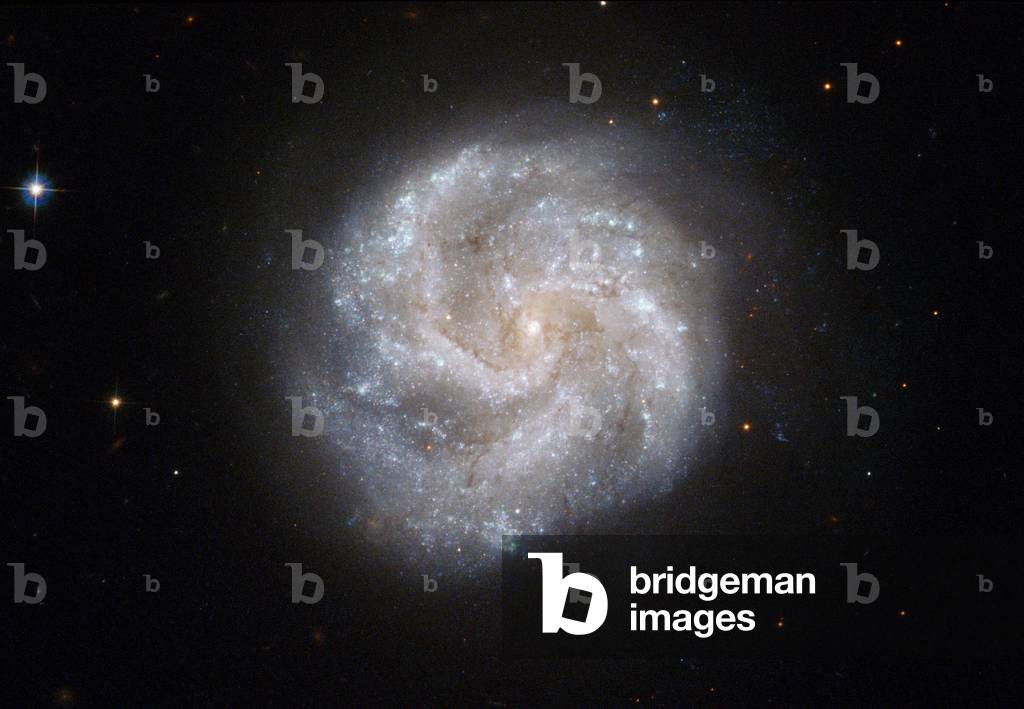
Barree spiral galaxy NGC 2146 in the Giraffe - Barred spiral galaxy NGC 2146 in Camelopardalis - NGC 2146 is a barree spiral galaxy located about 70 million years ago - light from Earth in the constellation Giraffe (Camelopardalis). Image obtained by the Hubble Space Telescope (HST). NGC 2146 is classified as a barred spiral due to its shape, but the most distinctive feature is the dusty spiral arm that has looped in front of the galaxy's core as seen from our perspective. The forces required to pull this structure out of its natural shape and twist it up to 45 degrees are colossal. The most likely explanation is that a neighbouring galaxy is gravitationally perturbing it and distorting the orbits of many of NGC 2146's stars. It is probable that we are currently witnessing the end stages of a process which has been occurring for tens of millions of years. NCG 2146 is undergoing intense bouts of star formation, to such an extent that it is referred to as a starburst galaxy. This is a common state for barred spirals, but the extra gravitational disruption that NGC 2146 is enduring no doubt exacerbates the situation, compressing hydrogen - rich nebulae and triggering stellar birth. Measuring about 80 000 light - years from end to end, NGC 2146 is slightly smaller than the Milky Way. It lies approximately 70 million light - years distant in the faint northern constellation of Camelopardalis (The Giraffe). Although it is fairly easy to see with a moderate - sized telescope as a faint elongated blur of light it was not spotted until 1876 when the German astronomer Friedrich Winnecke found it visually using just a 16 cm telescope. This picture was created from images taken with the Wide Field Channel of Hubble's Advanced Camera for Surveys. Images through a near - infrared filter (F814W, coloured blue and orange/brown) were combined with images taken in a filter that isolates the glow from hydrogen gas (F658N, coloured red). An additional green colour
Globular cluster M22 in Sagittarius - Globular cluster M22 in Sagittarius - M22 (NGC 6656) is one of the closest globular clusters of the Sun, located about 10 400 years ago - light. Age 12 billion years, it is the third most brilliant globular cluster among the 150 known in the lactee pathway. Image obtained by the Hubble Space Telescope (HST). M22 (NGC 6656) is one of the nearest globular clusters to our sun (distance 10 400 light years). Its stars stretch some 200 light years across and its collective brightness ranks it third among the 150 known Milky Way globulars. It is outshined visually only by the two bright southern globulars, Omega Centauri and 47 Tucanae. M22 is considered an old globular cluster having its beginning some 12 billion years ago not long after the formation of the Milky Way
Star field in the constellation Sagittarius - Scattered stars in Sagittarius: Stars in Sagittarius seen by the space telescope Hubble. This colourful and star-studded view of the Milky Way galaxy was captured when the NASA/ESA Hubble Space Telescope pointed its cameras towards the constellation of Sagittarius (The Archer). Blue stars can be seen scattered across the frame, set against a distant backdrop of red-hued cosmic companions. This blue litter most likely formed at the same time from the same collapsing molecular cloud. The colour of a star can reveal many of its secrets. Shades of red indicate a star much cooler than the Sun, so either at the end of its life, or much less massive. These low-mass stars are called red dwarfs and are thought to be the most common type of star within the Milky Way. Similarly, brilliant blue hues indicate hot, young, or massive stars, many times the mass of the Sun. A star's mass decides its fate; more massive stars burn brightly over a short lifespan, and die young after only tens of millions of years. Stars like the Sun typically have more sedentary lifestyles and live longer, burning for approximately ten billion years. Smaller stars, on the other hand, live life in the slow lane and are predicted to exist for trillions of years, well beyond the current age of the Universe
Globular cluster M72 in Aquarius - Globular cluster M72 in Aquarius - M72 (NGC 6981) is a cluster of stars located about 50,000 years from Earth. Image obtained by the Hubble Space Telescope. This rich collection of scattered stars, known as Messier 72, is actually a globular cluster, an ancient spherical collection of old stars packed much closer together at its centre. As well as huge numbers of stars in the cluster itself the picture also captures the images of many much more distant galaxies seen between and around the cluster stars. English astronomer Pierre Megchain discovered this rich cluster in August of 1780, but we take Messier 72's most common name from Mechain's colleague Charles Messier, who recorded it as the 72nd entry in his famous catalog of comet - like objects just two months later. This globular cluster lies in the constellation of Aquarius (the Water Bearer) about 50 000 light - years from Earth. This image was taken with the Wide Field Channel of the Advanced Camera for Surveys on the NASA/ESA Hubble Space Telescope. The exposure times were about ten minutes per filter and the field of view is about 3.4 arcminutes across
Pluto - Pluto - The dwarf planet Pluto seen by the Hubble space telescope. These images, recomposed by computer from cliches obtained in 2002 and 2003, are not sufficiently precise to show Pluto's surface in detail but reveal color differences. This is the most detailed view to date of the entire surface of the dwarf planet Pluto, as constructed from multiple NASA Hubble Space Telescope photographs taken from 2002 to 2003. Hubble's view isn't sharp enough to see craters or mountains, if they exist on the surface, but Hubble reveals a complex - looking and variegated world with white, dark - orange, and charcoal - black terrain. The overall color is believed to be a result of ultraviolet radiation from the distant Sun breaking up methane that is present on Pluto's surface, leaving behind a dark, molasse - colored, carbon - rich residue. The center disk (180 degrees) has a mysterious bright spot that is unusually rich in carbon monoxide frost. This region will be photographed in the highest possible detail when Nasa's New Horizons probe flies by Pluto in 2015. The Hubble images are a few pixels wide. But through a technique called dithering, multiple, slightly offset pictures can be combined through computer - image processing to synthesize a higher - resolution view than could be seen in a single exposure. This series of pictures took four years and 20 computers operating continuously and simultaneously to accomplish
Colliding galaxies NGC 2623 in Cancer - Colliding galaxies NGC 2623 - The galaxy NGC 2623 (Arp 243) is located about 250 million years ago - light from Earth in the constellation of Cancer. It is a system of two spiral galaxies colliding and eventually forming only one galaxy. This image was obtained by the Hubble Space Telescope in 2007. Located 250 million light - years away in the constellation of Cancer, these colliding galaxies are in the late stages of the merging process with the centres of the original galaxy pair now merged into one nucleus. Image obtained by the Hubble space telescope in 2007
Globular cluster M70 in Sagittarius - Globular cluster M70 in Sagittarius - Star cluster located about 29,000 years away from Earth. Image obtained by the Hubble Space Telescope (HST). The NASA/ESA Hubble Space Telescope has captured the brilliance of the compact centre of Messier 70, a globular cluster. Messier 70 orbits close to the Milky Way's center, around 30 000 light - years away from the Solar System. Messier 70 is only about 68 light - years in diameter and can be seen, albeit very faintly, with binoculars in dark skies in the constellation of Sagittarius (The Archer). This picture was obtained with the Wide Field Camera of Hubble's Advanced Camera for Surveys. The field of view is around 3.3 by 3.3 arcminutes
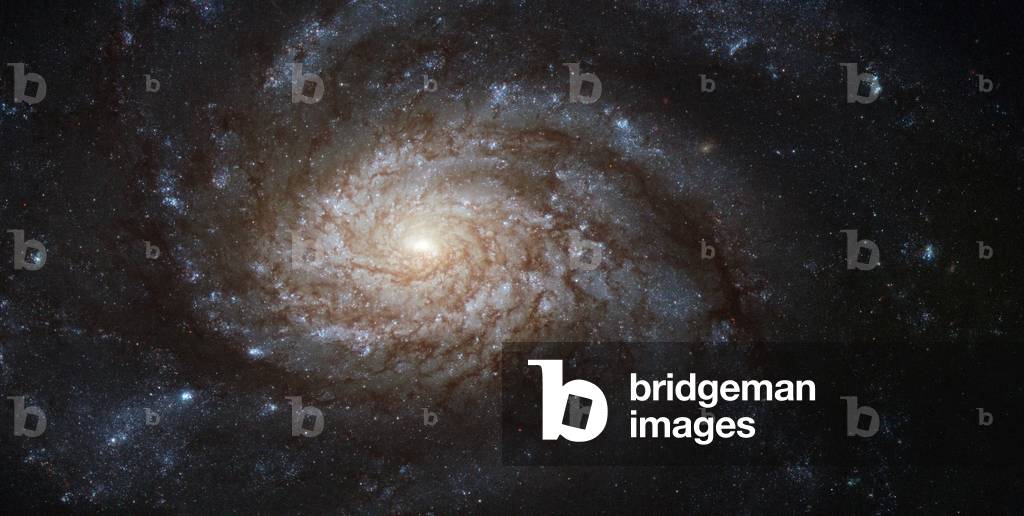
Spiral Galaxy NGC 2082 in Dorado - Galaxy NGC 2082 in Dorado - The spiral galaxy NGC 2082 is located about 60 million light years away from Earth in the southern constellation of Dorado. Image obtained by the Hubble Space Telescope (HST). The richly textured spiral galaxy NGC 2082 is found about 60 million light - years away in the constellation of Dorado (the Swordfish), deep in the southern sky. As seen here in a very detailed image from the Advanced Camera for Surveys on the NASA/ESA Hubble Space Telescope, filaments of dark dust splay across NGC 2082's luminous curved arms and dense central bulge of stars. Hubble's sharp vision also reveals many of the individual bright blue stars dotting the galaxy's rather ragged spiral arms as well as many much more distant galaxies in the background
Pluto - Hubble's Full Photomap of Pluto - The dwarf planet Pluto seen by the Hubble space telescope. These images, recomposed by computer from cliches obtained in 2002 and 2003, are not sufficiently precise to show Pluto's surface in detail but reveal color differences. This is the most detailed view to date of the entire surface of the dwarf planet Pluto, as constructed from multiple NASA Hubble Space Telescope photographs taken from 2002 to 2003. Hubble's view isn't sharp enough to see craters or mountains, if they exist on the surface, but Hubble reveals a complex - looking and variegated world with white, dark - orange, and charcoal - black terrain. The overall color is believed to be a result of ultraviolet radiation from the distant Sun breaking up methane that is present on Pluto's surface, leaving behind a dark, molasse - colored, carbon - rich residue. The center disk (180 degrees) has a mysterious bright spot that is unusually rich in carbon monoxide frost. This region will be photographed in the highest possible detail when Nasa's New Horizons probe flies by Pluto in 2015. The Hubble images are a few pixels wide. But through a technique called dithering, multiple, slightly offset pictures can be combined through computer - image processing to synthesize a higher - resolution view than could be seen in a single exposure. This series of pictures took four years and 20 computers operating continuously and simultaneously to accomplish
Clusters of distant galaxies RDCS1252.9 - 2927 - Distant galaxy cluster RDCS1252.9 - 2927 - This cluster of galaxies is 9 billion years old - light in the constellation Hydra, and is the most massive known to date. It probably contains several thousand galaxies. Image obtained by the Hubble Space Telescope and the VLT. The image shows the entire galaxy cluster (1/15 of a degree, corresponding to about 7 million light - years, across). The cluster probably contains many thousands of galaxies. Most of the other galaxies in the image, including most of the blue galaxies, are foreground or background galaxies. The image, which is made with an additional infrared exposure taken with the European Southern Observatory's Very Large Telescope, shows mature galaxies in a massive cluster that existed when the cosmos was 5000 million years old. The cluster, called RDCS1252.9 - 2927, is as massive as '300 trillion' suns and is the most massive known cluster for its epoch. Dominating the core are a pair of large, reddish elliptical galaxies [near centre of image]. Their red colour indicates an older population of stars. Most of the stars are at least 1000 million years old. The two galaxies appear to be interacting and may eventually merge to form a larger galaxy that is comparable to the brightest galaxies seen in present - day clusters. The red galaxies surrounding the central pair are also cluster members. The colour - composite image was assembled from two observations taken between May and June 2002 by the ACS Wide Field Camera, and one image with the ISAAC instrument on the VLT taken in 2002
Spiral Galaxy NGC 3810 in the Lion - Spiral galaxy NGC 3810 in Leo - NGC 3810 is a spiral galaxy located at a distance of about 50 million light years in the constellation Lion. Image obtained by the Hubble Space Telescope. The bright galaxy NGC 3810 demonstrates classical spiral structure in this very detailed image from Hubble. The bright central region is thought to be forming many new stars and is outshining the outer areas of the galaxy by some margin. Further out the galaxy displays strikingly rich dust clouds along its spiral arms. A close look shows that Hubble's sharp vision also allows many individual stars to be seen. Hot young blue stars show up in giant clusters far from the center and the arms are also littered with bright red giant stars. NGC 3810 is located about 50 million light - years from Earth in the constellation of Leo (the lion). It was discovered by William Herschel in 1784 and is easily seen as a faint smudge in small telescopes
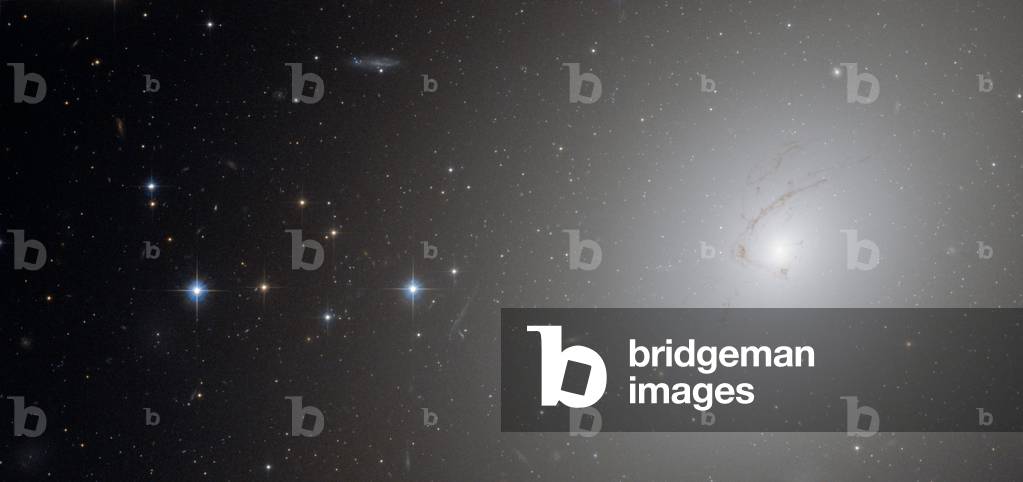
Elliptical galaxy NGC 4696 in Centaur - Elliptical galaxy NGC 4696 - Image of the elliptical galaxy NGC 4696, in Centaur, obtained by the Hubble space telescope. This picture, taken by Hubble's Advanced Camera for Surveys, shows NGC 4696, the largest galaxy in the Centaurus Cluster. The huge dust lane, around 30 000 light - years across, that sweeps across the face of the galaxy makes NGC 4696 look different from most other elliptical galaxies. Viewed at certain wavelengths, strange thin filaments of ionised hydrogen are visible within it. In this picture, these structures are visible as a subtle marbling effect across the galaxy's bright centre
JWST mirror compares to the Hubble space telescope mirror - Size comparison between the JWST's mirror and HST's mirror - The 6.5-metre primary mirror of the James Webb Space Telescope (JWST), composed of 18 mirrors, compares to the primary mirror of the Hubble space telescope. The large JWST 6.5 meters (21.3 feet) mirror compared to the Hubble Space Telescope primary mirror (at left). The James Webb Space Telescope (JWST) is a large, infrared - optimized space telescope scheduled for launch in 2014
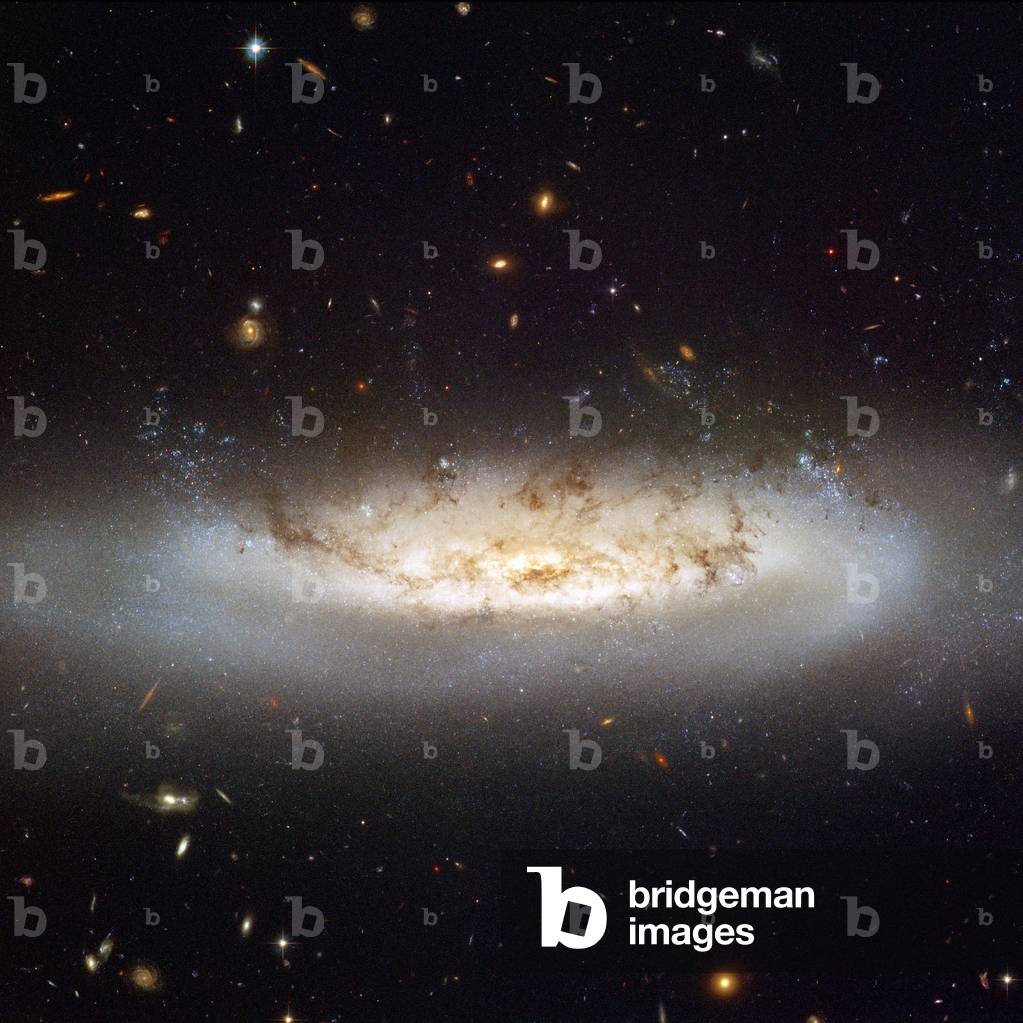
Spiral galaxy NGC 2683 in Lynx - Spiral galaxy NGC 2683 in Lynx - Spiral galaxy NGC 2683 distant about 16 million years - light in the constellation Lynx. Image obtained by the Hubble Space Telescope (HST). NGC 2683 is a spiral galaxy seen almost edge - on, giving it the shape of a classic science fiction spaceship. The delicate dusty lanes of the spiral arms are silhouetted against the golden haze of the galaxy's core. In addition, brilliant clusters of young blue stars shine scattered throughout the disc, mapping the galaxy's star - forming regions. Perhaps surprisingly, side - on views of galaxies like this one do not prevent astronomers from deducing their structures. Studies of the properties of the light coming from NGC 2683 suggest that this is a barred spiral galaxy, even though the angle we see it at does not let us see this directly. NGC 2683, discovered on 5 February 1788 by the famous astronomer William Herschel, lies in the Northern constellation of Lynx. A constellation named not because of its resemblance to the feline animal, but because it is fairly faint, requiring the sensitive eyes of a cat”” to discern it. And when you manage to get a look at it, you'll find treasures like this, making it well worth the effort. This image is produced from two adjacent fields observed in visible and infrared light by Hubble's Advanced Camera for Surveys. A narrow strip which appears slightly blurred and crosses most the image horizontally is a result of a gap between Hubble's detectors. This strip has been patched using images from observations of the galaxy made by ground - based telescopes, which show significantly less detail. The field of view is approximately 6.5 by 3.3 arcminutes.
Supernova Remnants SNR B0509 - 67.5 - Supernova Remnant SNR B0509 - 67.5 - SNR B0509 - 67.5 (or SNR 0509) is the rest of a star explosion in the galaxy of the Great Magellan Cloud. This 23-year bubble - light of diameter extends at a speed of 18 million km/h. Composite of images obtained by the Hubble Space Telescope (HST) in 2006 and 2010. This delicate shell, photographed by the NASA/ESA Hubble Space Telescope, appears to float serenely in the depths of space, but this apparent calm hides an inner turmoil. The gaseous envelope formed as the expanding blast wave and ejected material from a supernova tore through the nearby interstellar medium. Called SNR B0509 - 67.5 (or SNR 0509 for short), the bubble is the visible remnant of a powerful stellar explosion in the Large Magellanic Cloud (LMC), a small galaxy about 160,000 light - years from Earth. Ripples in the shell's surface may be caused either by subtle variations in the density of the ambient interstellar gas, or possibly be driven from the interior by fragments from the initial explosion. The bubble - shaped shroud of gas is 23 light - years across and is expanding at more than 18 million km/h. Hubble's Advanced Camera for Surveys observed the supernova remnant on 28 October 2006 with a filter that isolates light from the glowing hydrogen seen in the expanding shell. These observations were then combined with visible - light images of the surrounding star field that were imaged with Hubble's Wide Field Camera 3 on 4 November 2010
Asteroide Vesta seen by the Hubble Space Telescope - Asteroid Vesta - Photo obtained in visible view of the Vesta asteroid in May 1996 by the Hubble Space Telescope. The images reveal a huge impact crater 450 km in diameter south of the asteroid; the original image is at the top left, modeled in 3D on the right. Astronomers have used the Hubble Space telescope to discover a giant impact crater on the asteroid Vesta. <BR>Left is a Hubble Space Telescope image of the asteroid Vesta, taken in May 1996 when the asteroid was 110 million miles from Earth. The asymmetry of the asteroid and “” nub”” and the south pole is suggestive that it suffered a large impact event. Center is a color-encoded elevation map of Vesta that clearly shows the giant 285- mile diameter impact basin and “” bull 's-eye”” central peak. Right is a 3-D computer model of the asteroid Vesta synthesized from Hubble topographic data. The crater's 8-mile high central peak can clearly be seen near the pole. At the bottom an elevation map has been reconstructed and clearly shows in blue the large impact basin and its central peak (in red)
Spiral galaxy NGC 406 in Toucan - Spiral galaxy NGC 406 in Tucana - NGC 406 is a spiral galaxy located at a distance of about 65 million light years in the southern constellation of Toucan. Image obtained by the Hubble Space Telescope. The spiral galaxy NGC 406 was discovered in 1834 by John Herschel and is here imaged in great detail by the NASA/ESA Hubble Space Telescope. Located some 65 million light - years away, in the southern constellation of Tucana (the Toucan), NGC 406 is about 60 000 light - years across, roughly half the diameter of our galaxy, the Milky Way. In a moderate - sized amateur telescope NGC 406 would appear as a faint hazy blob, like thousands of others across the sky, and none of the spectacular fine detail in the Hubble picture could be made out. In this image the galaxy exhibits spiral arms that are mainly populated by young, massive, bluish stars and crossed by dark dust lanes. As is typically observed in this kind of spiral galaxy, the yellowish central bulge, dominated by an older stellar population, is less prominent and almost totally embedded in the disk structure. The deep image also shows a significant number of more distant galaxies in the background. Some of them are visible as reddish fuzzy spots through the bluish spiral arms of the foreground galaxy. This picture was created from images taken through near - infrared (F814W) and blue (F435W) filters, shown in red and blue respectively, using the Wide Field Channel of Hubble's Advanced Camera for Surveys. The exposure times were twenty minutes per filter and the field of view is 2.7 by 1.6 arcminutes
Barree spiral galaxy NGC 4319 and Markarian quasar 205 - Galaxy NGC 4319 and quasar Markarian 205 - The barree spiral galaxy NGC 4319, in the center, is 80 million years - light in the constellation of the Dragon. The Markarian 205 quasar, on the top right, is 14 times further at about 1 billion light years. These two objects are therefore not interacting; on the other hand, the galaxy NGC 4319 is probably interacting with the galaxy NGC 4291, out of field, as the weak arm at the bottom left allows. Quasars are galaxies that create an extremely bright core. Image made by the Hubble Space Telescope in 2002. In this NASA Hubble Space Telescope image, an odd celestial duo, the spiral galaxy NGC 4319 (center) and a quasar called Markarian 205 (upper right), appear to be neighbors. In reality, the two objects don't even live in the same city. NGC 4319 is 80 million light - years from Earth. Markarian 205 (Mrk 205) is more than 14 times farther away, residing 1 billion light - years from Earth. The apparent close alignment of Mrk 205 and NGC 4319 is simply a matter of chance. Astronomers used two methods to determine the distances to these objects. First, they measured how their light has been stretched in space due to the university's expansion. Then they measured how much the ultraviolet light from Mrk 205 dimmed as it passed through the interstellar gas of NGC 4319. <BR>The Hubble Wide Field and Planetary Camera 2 image shows the inner region of NGC 4319. In addition to the galaxy's inner spiral arms, an outer arm is faintly visible at lower left. The unusually dark and misshapen dust lanes in the galaxy's inner region are evidence of a disturbance, probably caused by an earlier interaction with another galaxy, NGC 4291, which is not in the photograph. At a distance of 1 billion light - years, Mrk 205 is a relatively nearby quasar. Many quasars reside much farther away. Quasars, once known only as mysterious point -
Galaxy ESO 69 - 6 - Galaxy ESO 69 - 6 - The galaxy ESO 69 - 6 is about 650 million light years away from Earth in the constellation of the Southern Triangle. This system consists of two interacting galaxies. Image obtained by the Hubble Space Telescope on April 8, 2002. ESO 69 - 6 is an interacting pair of galaxies located in the constellation of Triangulum Australe, the Southern Triangle, about 650 million light - years away from Earth. Long tidal tails sweep out from the two galaxies: gas and stars were stripped out and torn away from the outer regions of the galaxies. The presence of these tails is the unique signature of an interaction. Image taken by the Hubble space telescope on April 8, 2002
Interacting galaxies NGC 6786 and LEDA 62867 - Interacting galaxies NGC 6786 and LEDA 62867 - The galaxy NGC 6786, on the right, is about 350 million years away - light from Earth in the constellation of the Dragon. It interacts with another spiral galaxy, LEDA 62867, on the left; it will probably swallow it in the distant future. Image obtained by the Hubble Space Telescope on March 10, 2002. This Hubble image displays a beautiful pair of interacting spiral galaxies with swirling arms. The smaller of the two, dubbed LEDA 62867 and positioned to the left of the frame, seems to be safe for now, but will probably be swallowed by the larger spiral galaxy, NGC 6786 (to the right) eventually. There is already some disturbance visible in both components. The pair is number 538 in Karachentsev's Catalog of Pairs of Galaxies. A supernova was seen to explode in the large spiral in 2004. NGC 6786 is located in the constellation of Draco, the Dragon, about 350 million light - years away. Image taken by the Hubble space telescope on march 10, 2002
Nebula Sh2 - 106 in the Swan - Sh2 - 106 nebula in Cygnus - Sharpless 106 (Sh2 - 106) is a star-forming region in the constellation Swan. Image obtained by the Hubble Space Telescope (HST). The bipolar star - forming region, called Sharpless 2 - 106, or S106 for short, looks like a soaring, celestial snow angel. The outstretched “” wings”” of the nebula record the contrasting imprint of heat and motion against the backdrop of a colder medium. Twin lobes of super - hot gas, glowing blue in this image, stretch outward from the central star. This hot gas creates the “” wings”” of our angel. A ring of dust and gas orbiting the star acts like a belt, cinching the expanding nebula into an “” hourglass”” shape
Star V838 Monocerotis 08/02/2004 - V838 Monocerotis 02/2004 - This variable star is located approximately 20,000 years - light from Earth in the constellation Unicorn. In the beginning of 2002, this star illuminated temporarily becoming one of the brightest stars in the sky. Viewed here in February 2004 by the Hubble space telescope, the light echo shows details in the interstellar dust surrounding the star. In January 2002, a variable star in the Monoceros constellation suddenly became 600,000 times more luminous than our Sun, temporarily making it the brightest star in our Milky Way galaxy. The mysterious star, called V838 Monocerotis, has long since faded back to obscurity. Seen here by Nasa's Hubble Space Telescope on February 8, 2004, the light echo around the star has uncovered details in the interstellar dust round the star
Spiral Galaxy NGC 4522 - Galaxy Spiral NGC 4522 - Moving at a speed of 10 million km/h in the Virgin's galaxy cluster, this spiral galaxy loses some of its gas. NGC 4522 is located about 60 million light years away from Earth. Image obtained by the Hubble Space Telescope. NGC 4522 is a spectacular example of a spiral galaxy that is currently being stripped of its gas content. The galaxy is part of the Virgo galaxy cluster and its rapid motion within the cluster results in strong winds across the galaxy as the gas within is left behind. Scientists estimate that the galaxy is moving at more than 10 million kilometers per hour. A number of newly formed star clusters that developed in the stripped gas can be seen in the Hubble image. The stripped spiral galaxy is located some 60 million light - years away from Earth
Globular cluster M13 - Hercules cluster - The Great Globular Cluster in Hercules M13 - M13 (NGC 6205), extends for about 150 years - light and is approximately 25,000 years - light from Earth in the constellation of Hercules. Image obtained by the Hubble Space Telescope. M13 is home to over 100,000 stars and located at a distance of 25,000 light - years. These stars are packed so closely together in a ball, approximately 150 light - years across, that they will spend their entire lives whirling around in the cluster. Near the core of this cluster, the density of stars is about a hundred times greater than the density in the neighborhood of our sun. These stars are so crowded that they can, at times, slam into each other and even form a new star, called a “blue straggler.” The brightest reddish stars in the cluster are ancient red giants. These aging stars have expanded to many times their original diameters and cooled. The blue - white stars are the hottest in the cluster. Globular clusters can be found spread largely in a vast halo around our galaxy. M13 is one of nearly 150 known globular clusters surrounding our Milky Way galaxy. Globular clusters have some of the oldest stars in the universe. They likely formed before the disk of our Milky Way, so they are older than nearly all other stars in our galaxy. Studying globular clusters therefore tells us about the history of our galaxy. This image is a composite of archival Hubble data taken with the Wide Field Planetary Camera 2 and the Advanced Camera for Surveys. Observations from four separate science proposals taken in November 1999, April 2000, August 2005, and April 2006 were used. The image includes broadband filters that isolate light from the blue, visible, and infrared portions of the spectrum
Galaxy System Arp 274 - Galaxy triplet Arp 274 - Arp 274 (NGC 5679) is a system of three galaxies located about 400 million years ago - light in the constellation of Virgo. Image obtained by the Hubble Space Telescope. Arp 274, also known as NGC 5679, is a system of three galaxies that appear to be partially overlapping in the image, although they may be at somewhat different distances. The spiral shapes of two of these galaxies appear mostly intact. The third galaxy (to the far left) is more compact, but shows evidence of star formation. Two of the three galaxies are forming new stars at a high rate. This is evident in the bright blue knots of star formation that are strung along the arms of the galaxy on the right and along the small galaxy on the left. The largest component is located in the middle of the three. It appears as a spiral galaxy, which may be barred. The entire system resides at about 400 million light - years away from Earth in the constellation Virgo. Hubble's Wide Field Planetary Camera 2 was used to image Arp 274. Blue, visible, and infrared filters were combined with a filter that isolates hydrogen emission. The colors in this image reflect the intrinsic color of the different stellar populations that make up the galaxies. Yellowish older stars can be seen in the central bulge of each galaxy. A bright central cluster of stars pinpoint each nucleus. Younger blue stars trace the spiral arms, along with pinkish nebulae that are illuminated by new star formation. Interstellar dust is silhouetted against the starry population. A pair of foreground stars inside our own Milky Way are at far right
Spiral Galaxy NGC 253 - NGC 253 is the brightest galaxy in the Sculptor's group, the closest galaxy group to the Local Group. It is about 13 million light years away. Composite image obtained from the Hubble sptial telescope, the Subaru, VLT and the 1.5m Danish telescopes. NGC 253 is a large, almost edge - on spiral galaxy, and is one of the nearest galaxies beyond our local neighborhood of galaxies. In this image taken by Hubble space telescope thousands of individual stars are resolved in this galaxy located 13 million light years away.Multipanel Mosaic and Composite from Four Data Sources 8.2 Meter Subaru Telescope, Hubble Space Telescope European Southern Observatory (VLT and Danish 1.5M
Nebula IRAS 05437+2502 - Nebula IRAS 05437+2502 - Nebula IRAS 05437+2502 is located in the constellation Taurus. Image obtained by the Hubble Space Telescope (HST). The little - known nebula IRAS 05437+2502 billows out among the bright stars and dark dust clouds that surround it in this striking image from the Hubble Space Telescope. It is located in the constellation of Taurus (the Bull), close to the central plane of our Milky Way galaxy. It appears to be a small, rather isolated, region of star formation and one might assume that the effects of fierce ultraviolet radiation from bright young stars probably were the cause of the eye - catching shapes of the gas. However, the bright boomerang - shaped feature may tell a more dramatic tale. The interaction of a high velocity young star and the cloud of gas and dust may have created this unusually sharp - edged bright arc. Such a reckless star would have been ejected from the distant young cluster where it was born and would travel at 200,000 km/hour or more through the nebula. This faint cloud was originally discovered in 1983 by the Infrared Astronomical Satellite (IRAS), the first space telescope to survey the whole sky in the infrared. This image was taken with the Wide Field Channel of the Advanced Camera for Surveys on Hubble. The exposure times were about eleven minutes per filter and the field of view is about 100 arcseconds across