[]
Ihre AuswahlIhre aktuelle Auswahl
asset(s) Assets
Ihr Preis 0

Ihre Auswahl

Auswahl aufheben
Asset zum Warenkorb hinzugefügt
{"event":"pageview","page_type1":"undetected","page_type2":"_assets_search_override","language":"de","user_logged":"false","user_type":"ecommerce","nl_subscriber":"false"}
{"event":"ecommerce_event","event_name":"view_item","event_category":"browse_catalog","ecommerce":{"items":[{"item_id":"UIG867008","item_category":"photo","item_category2":"no_copyright","item_category3":"standard","item_category5":"not_balown","item_list_name":"search_results","item_name":"this_infrared_image_showed_a_snake_upper_left_and_its_surrounding_stormy_environment_the_object_is_a","item_variant":"undefined"},{"item_id":"UIG867007","item_category":"photo","item_category2":"no_copyright","item_category3":"standard","item_category5":"not_balown","item_list_name":"search_results","item_name":"this_infrared_image_showed_a_snake_upper_left_and_its_surrounding_stormy_environment_the_object_is_a","item_variant":"undefined"},{"item_id":"UIG867006","item_category":"photo","item_category2":"no_copyright","item_category3":"standard","item_category5":"not_balown","item_list_name":"search_results","item_name":"this_infrared_image_showed_a_snake_upper_left_and_its_surrounding_stormy_environment_the_object_is_a","item_variant":"undefined"},{"item_id":"UIG867028","item_category2":"out_of_copyright","item_category3":"standard","item_category5":"not_balown","item_list_name":"search_results","item_name":"the_many_sides_of_the_supernova_remnant_cassiopeia_a_located_10_000_light_years_away_in_the_northern","item_variant":"undefined"},{"item_id":"UIG867026","item_category2":"out_of_copyright","item_category3":"standard","item_category5":"not_balown","item_list_name":"search_results","item_name":"the_many_sides_of_the_supernova_remnant_cassiopeia_a_located_10_000_light_years_away_in_the_northern","item_variant":"undefined"},{"item_id":"UIG867030","item_category":"photo","item_category2":"no_copyright","item_category3":"standard","item_category5":"not_balown","item_list_name":"search_results","item_name":"located_1_000_light_years_from_earth_in_the_constellation_perseus_a_reflection_nebula_called_ngc_133","item_variant":"undefined"},{"item_id":"UIG867011","item_category":"photo","item_category2":"no_copyright","item_category3":"standard","item_category5":"not_balown","item_list_name":"search_results","item_name":"the_scattered_remains_of_an_exploded_star_named_cassiopeia_a_much_of_the_star_s_original_layering_ha","item_variant":"undefined"},{"item_id":"UIG867013","item_category":"photo","item_category2":"no_copyright","item_category3":"standard","item_category5":"not_balown","item_list_name":"search_results","item_name":"the_scattered_remains_of_an_exploded_star_named_cassiopeia_a_much_of_the_star_s_original_layering_ha","item_variant":"undefined"},{"item_id":"UIG867010","item_category":"photo","item_category2":"no_copyright","item_category3":"standard","item_category5":"not_balown","item_list_name":"search_results","item_name":"a_star_s_spectacular_death_in_the_constellation_taurus_was_observed_on_earth_as_the_supernova_of_105","item_variant":"undefined"},{"item_id":"UIG867009","item_category":"photo","item_category2":"no_copyright","item_category3":"standard","item_category5":"not_balown","item_list_name":"search_results","item_name":"a_star_s_spectacular_death_in_the_constellation_taurus_was_observed_on_earth_as_the_supernova_of_105","item_variant":"undefined"},{"item_id":"UIG867031","item_category":"photo","item_category2":"no_copyright","item_category3":"standard","item_category5":"not_balown","item_list_name":"search_results","item_name":"located_1_000_light_years_from_earth_in_the_constellation_perseus_a_reflection_nebula_called_ngc_133","item_variant":"undefined"},{"item_id":"UIG5447801","item_category":"photo","item_category2":"no_copyright","item_category3":"standard","item_category5":"not_balown","item_list_name":"search_results","item_name":"governors_island_new_york_c_1937_an_infra_red_image_of_the_southern_skyline_of_manhattan_as_seen_fro","item_variant":"undefined"},{"item_id":"UIG867169","item_category":"photo","item_category2":"no_copyright","item_category3":"standard","item_category5":"not_balown","item_list_name":"search_results","item_name":"an_infrared_image_from_nasa_s_wise_showcases_the_tadpole_nebula_a_star_forming_hub_in_the_auriga_con","item_variant":"undefined"},{"item_id":"UIG866566","item_category":"photo","item_category2":"no_copyright","item_category3":"standard","item_category5":"not_balown","item_list_name":"search_results","item_name":"images_of_iceland_s_eyjafyallajoekull_volcano_on_april_19_2010_figure_1_is_a_visible_image_and_figur","item_variant":"undefined"},{"item_id":"UIG867171","item_category2":"no_copyright","item_category3":"standard","item_category5":"not_balown","item_list_name":"search_results","item_name":"an_infrared_image_from_nasa_s_wise_showcases_the_tadpole_nebula_a_star_forming_hub_in_the_auriga_con","item_variant":"undefined"},{"item_id":"UIG866578","item_category":"photo","item_category2":"no_copyright","item_category3":"standard","item_category5":"not_balown","item_list_name":"search_results","item_name":"images_of_iceland_s_eyjafyallajoekull_volcano_on_april_19_2010_figure_1_is_a_visible_image_and_figur","item_variant":"undefined"},{"item_id":"PIX4619703","item_category":"photo","item_category2":"no_copyright","item_category3":"standard","item_category5":"not_balown","item_list_name":"search_results","item_name":"lagoon_nebula_m8_infrared_image_of_the_lagoon_nebula_obtained_by_msx_satellite_the_nebula_of_the_lag","item_variant":"undefined"},{"item_id":"UIG867167","item_category":"photo","item_category2":"no_copyright","item_category3":"standard","item_category5":"not_balown","item_list_name":"search_results","item_name":"this_infrared_image_from_nasa_s_wise_features_one_of_the_bright_stars_in_the_constellation_perseus_n","item_variant":"undefined"},{"item_id":"UIG867325","item_category2":"no_copyright","item_category3":"standard","item_category5":"not_balown","item_list_name":"search_results","item_name":"in_an_infrared_image_from_nasa_s_wise_there_are_some_clouds_that_are_so_cool_and_thick_that_even_inf","item_variant":"undefined"},{"item_id":"UIG867166","item_category2":"no_copyright","item_category3":"standard","item_category5":"not_balown","item_list_name":"search_results","item_name":"this_infrared_image_from_nasa_s_wise_features_one_of_the_bright_stars_in_the_constellation_perseus_n","item_variant":"undefined"},{"item_id":"UIG867323","item_category":"photo","item_category2":"no_copyright","item_category3":"standard","item_category5":"not_balown","item_list_name":"search_results","item_name":"in_an_infrared_image_from_nasa_s_wise_there_are_some_clouds_that_are_so_cool_and_thick_that_even_inf","item_variant":"undefined"},{"item_id":"UIG867326","item_category":"photo","item_category2":"no_copyright","item_category3":"standard","item_category5":"not_balown","item_list_name":"search_results","item_name":"in_an_infrared_image_from_nasa_s_wise_there_are_some_clouds_that_are_so_cool_and_thick_that_even_inf","item_variant":"undefined"},{"item_id":"PIX4660875","item_category":"photo","item_category2":"no_copyright","item_category3":"standard","item_category5":"not_balown","item_list_name":"search_results","item_name":"the_sakura_jima_japan_infrared_image_of_the_sakura_jima_volcano_one_of_the_most_active_volcanoes_on_","item_variant":"undefined"},{"item_id":"UIG867322","item_category2":"no_copyright","item_category3":"standard","item_category5":"not_balown","item_list_name":"search_results","item_name":"in_an_infrared_image_from_nasa_s_wise_there_are_some_clouds_that_are_so_cool_and_thick_that_even_inf","item_variant":"undefined"},{"item_id":"UIG866255","item_category":"photo","item_category2":"no_copyright","item_category3":"standard","item_category5":"not_balown","item_list_name":"search_results","item_name":"this_infrared_image_showing_thermal_radiation_at_a_wavelength_of_9_7_microns_was_obtained_by_the_gem","item_variant":"undefined"},{"item_id":"UIG528805","item_category":"photo","item_category2":"no_copyright","item_category3":"standard","item_category5":"not_balown","item_list_name":"search_results","item_name":"spitzer_space_telescope_infrared_image_of_a_snake_upper_left_and_surrounding_stormy_environment_it_i","item_variant":"undefined"},{"item_id":"SZT5183512","item_category":"photo","item_category2":"no_copyright","item_category3":"standard","item_category5":"not_balown","item_list_name":"search_results","item_name":"aerial_view_of_jericho_1934","item_variant":"undefined"},{"item_id":"UIG867116","item_category2":"no_copyright","item_category3":"standard","item_category5":"not_balown","item_list_name":"search_results","item_name":"the_cassiopeia_a_supernova_s_first_flash_of_radiation_makes_six_clumps_of_dust_circled_in_annotated_","item_variant":"undefined"},{"item_id":"UIG867117","item_category2":"no_copyright","item_category3":"standard","item_category5":"not_balown","item_list_name":"search_results","item_name":"the_cassiopeia_a_supernova_s_first_flash_of_radiation_makes_six_clumps_of_dust_circled_in_annotated_","item_variant":"undefined"},{"item_id":"PIX4611601","item_category":"photo","item_category2":"no_copyright","item_category3":"standard","item_category5":"not_balown","item_list_name":"search_results","item_name":"sombrero_m104_spiral_galaxy_visible_composite_infrared_the_sombrero_galaxy_composite_of_visible_and_","item_variant":"undefined"},{"item_id":"PIX4617801","item_category":"photo","item_category2":"no_copyright","item_category3":"standard","item_category5":"not_balown","item_list_name":"search_results","item_name":"a_deep_infrared_view_of_the_orion_nebula_from_hawk_i_located_1500_light_years_from_the_earth_the_ori","item_variant":"undefined"},{"item_id":"PIX4622111","item_category":"photo","item_category2":"no_copyright","item_category3":"standard","item_category5":"not_balown","item_list_name":"search_results","item_name":"the_horsehead_nebula_in_infrared_the_horsehead_nebula_in_infrared_this_infrared_image_shows_the_nebu","item_variant":"undefined"},{"item_id":"PIX4568939","item_category":"photo","item_category2":"no_copyright","item_category3":"standard","item_category5":"not_balown","item_list_name":"search_results","item_name":"star_clusters_ic_348_in_persee_seen_in_infrared_star_clusters_ic_348_in_perseus_ic_348_is_a_cluster_","item_variant":"undefined"},{"item_id":"PIX4622127","item_category":"photo","item_category2":"no_copyright","item_category3":"standard","item_category5":"not_balown","item_list_name":"search_results","item_name":"the_horsehead_nebula_in_infrared_the_horsehead_nebula_in_infrared_this_infrared_image_shows_the_nebu","item_variant":"undefined"},{"item_id":"PIX4565063","item_category":"photo","item_category2":"no_copyright","item_category3":"standard","item_category5":"not_balown","item_list_name":"search_results","item_name":"globular_cluster_m55_in_sagittarius_globular_star_cluster_messier_55_star_cluster_located_about_17_0","item_variant":"undefined"},{"item_id":"PIX4583130","item_category":"photo","item_category2":"no_copyright","item_category3":"standard","item_category5":"not_balown","item_list_name":"search_results","item_name":"visible_crab_nebula_infrared_and_x_the_crab_nebula_m1_the_crab_nebula_is_the_rest_of_a_supernova_tha","item_variant":"undefined"},{"item_id":"PIX4583119","item_category":"photo","item_category2":"no_copyright","item_category3":"standard","item_category5":"not_balown","item_list_name":"search_results","item_name":"visible_crab_nebula_infrared_and_x_visible_crab_nebula_infrared_and_x_m1_the_crab_nebula_is_the_rest","item_variant":"undefined"},{"item_id":"PIX4618403","item_category":"photo","item_category2":"no_copyright","item_category3":"standard","item_category5":"not_balown","item_list_name":"search_results","item_name":"this_image_compares_infrared_and_visible_views_of_the_monoceros_r2_star_forming_region_the_visible_l","item_variant":"undefined"},{"item_id":"UIG538943","item_category":"photo","item_category2":"no_copyright","item_category3":"standard","item_category5":"not_balown","item_list_name":"search_results","item_name":"andromeda_galaxy_m_31_spiral_photo","item_variant":"undefined"},{"item_id":"PIX4565623","item_category":"photo","item_category2":"no_copyright","item_category3":"standard","item_category5":"not_balown","item_list_name":"search_results","item_name":"galaxy_cluster_cl2244_02_galaxy_cluster_cl2244_02_with_gravitational_arcs_galaxy_cluster_cl2244_02_s","item_variant":"undefined"},{"item_id":"PIX4612203","item_category":"photo","item_category2":"no_copyright","item_category3":"standard","item_category5":"not_balown","item_list_name":"search_results","item_name":"galaxy_centaurus_a_ngc_5128_in_visible_and_infrared_galaxy_centaurus_a_in_visible_and_infrared_the_g","item_variant":"undefined"},{"item_id":"UIS5071412","item_category":"photo","item_category2":"no_copyright","item_category3":"standard","item_category5":"not_balown","item_list_name":"search_results","item_name":"satellites_weather_usa_infrared_picture_of_part_of_north_west_europe_from_space_1978","item_variant":"undefined"},{"item_id":"SZT7138872","item_category":"photo","item_category2":"no_copyright","item_category3":"standard","item_category5":"not_balown","item_list_name":"search_results","item_name":"aerial_view_of_the_english_coast_1940_b_w_photo","item_variant":"undefined"},{"item_id":"PIX4572156","item_category":"photo","item_category2":"no_copyright","item_category3":"standard","item_category5":"not_balown","item_list_name":"search_results","item_name":"flying_star_zeta_ophiuchi_runaway_star_zeta_ophiuchi_the_blue_star_near_the_center_of_the_image_is_z","item_variant":"undefined"},{"item_id":"PIX4582276","item_category":"photo","item_category2":"no_copyright","item_category3":"standard","item_category5":"not_balown","item_list_name":"search_results","item_name":"titan_saturn_satellite_seen_by_cassini_saturn_s_moon_titan_as_seen_by_cassini_spacecraft_titan_image","item_variant":"undefined"},{"item_id":"PIX4611595","item_category":"photo","item_category2":"no_copyright","item_category3":"standard","item_category5":"not_balown","item_list_name":"search_results","item_name":"spiral_galaxy_of_the_sombrero_m104_infrared_view_sombrero_galaxy_seen_in_infrared_infrared_image_of_","item_variant":"undefined"},{"item_id":"PIX4565251","item_category":"photo","item_category2":"no_copyright","item_category3":"standard","item_category5":"not_balown","item_list_name":"search_results","item_name":"galaxy_cluster_abell_1656_coma_cluster_the_coma_cluster_abell_1656_a_large_cluster_of_galaxies_consi","item_variant":"undefined"},{"item_id":"PIX4574942","item_category":"photo","item_category2":"no_copyright","item_category3":"standard","item_category5":"not_balown","item_list_name":"search_results","item_name":"infrared_jupiter_seen_by_the_new_horizons_probe_jupiter_seen_by_new_horizons_spacecraft_view_of_jupi","item_variant":"undefined"},{"item_id":"PIX4568892","item_category":"photo","item_category2":"no_copyright","item_category3":"standard","item_category5":"not_balown","item_list_name":"search_results","item_name":"open_cluster_of_pleiades_seen_in_infrared_the_pleiades_open_cluster_seen_in_infrared_clouds_of_dust_","item_variant":"undefined"},{"item_id":"PIX4621141","item_category":"photo","item_category2":"no_copyright","item_category3":"standard","item_category5":"not_balown","item_list_name":"search_results","item_name":"star_formation_in_the_southern_cross_star_formation_in_the_southern_cross_part_of_the_lactee_route_i","item_variant":"undefined"},{"item_id":"UIS5072430","item_category":"photo","item_category2":"no_copyright","item_category3":"standard","item_category5":"not_balown","item_list_name":"search_results","item_name":"satellites_weather_usa_infrared_picture_the_gulf_stream_1970s","item_variant":"undefined"},{"item_id":"PIX7331184","item_category":"photo","item_category2":"no_copyright","item_category3":"standard","item_category5":"not_balown","item_list_name":"search_results","item_name":"first_image_of_the_jwst_smacs_galaxy_cluster_0723_2022_photography","item_variant":"undefined"},{"item_id":"PIX4622118","item_category":"photo","item_category2":"no_copyright","item_category3":"standard","item_category5":"not_balown","item_list_name":"search_results","item_name":"nebulae_ngc_2024_and_head_of_horse_seen_by_vista_flame_nebula_and_the_horsehead_nebula_first_image_o","item_variant":"undefined"},{"item_id":"PIX4613420","item_category":"photo","item_category2":"no_copyright","item_category3":"standard","item_category5":"not_balown","item_list_name":"search_results","item_name":"irregular_galaxy_of_the_little_magellan_cloud_ngc_292_the_small_magellanic_cloud_the_galaxy_of_the_l","item_variant":"undefined"},{"item_id":"PIX4622272","item_category":"photo","item_category2":"no_copyright","item_category3":"standard","item_category5":"not_balown","item_list_name":"search_results","item_name":"nebula_ic_1396_in_cephee_infrared_view_18_12_2003_the_large_composite_image_on_the_left_is_a_product","item_variant":"undefined"},{"item_id":"PIX4621160","item_category":"photo","item_category2":"no_copyright","item_category3":"standard","item_category5":"not_balown","item_list_name":"search_results","item_name":"star_formation_in_cassiopee_star_formation_in_cassiopeia_this_star_forming_region_called_w5_is_locat","item_variant":"undefined"},{"item_id":"PIX4619072","item_category":"photo","item_category2":"no_copyright","item_category3":"standard","item_category5":"not_balown","item_list_name":"search_results","item_name":"birth_of_stars_in_the_nebula_ngc_3372_star_formation_in_the_carina_nebula_detail_of_the_nebula_of_th","item_variant":"undefined"},{"item_id":"PIX4621152","item_category":"photo","item_category2":"no_copyright","item_category3":"standard","item_category5":"not_balown","item_list_name":"search_results","item_name":"star_formation_in_cassiopee_star_formation_in_cassiopeia_this_star_forming_region_called_w5_is_locat","item_variant":"undefined"},{"item_id":"PIX4637936","item_category":"photo","item_category2":"no_copyright","item_category3":"standard","item_category5":"not_balown","item_list_name":"search_results","item_name":"the_galactic_center_seen_by_spitzer_space_telescope_the_galactic_center_region_seen_by_spitzer_satel","item_variant":"undefined"},{"item_id":"PIX4621533","item_category":"photo","item_category2":"no_copyright","item_category3":"standard","item_category5":"not_balown","item_list_name":"search_results","item_name":"the_rho_ophiuchi_nebula_seen_in_infrared_rho_ophiuchi_in_infrared_this_coloree_nebula_represents_par","item_variant":"undefined"},{"item_id":"PIX4626499","item_category":"photo","item_category2":"no_copyright","item_category3":"standard","item_category5":"not_balown","item_list_name":"search_results","item_name":"crab_nebula_seen_in_different_wavelength_the_crab_nebula_in_multi_wavelength_m1_the_crab_nebula_is_t","item_variant":"undefined"},{"item_id":"UIS5071038","item_category":"photo","item_category2":"no_copyright","item_category3":"standard","item_category5":"not_balown","item_list_name":"search_results","item_name":"infrared_and_visible_images_of_jupiter_1979","item_variant":"undefined"},{"item_id":"PIX4610442","item_category":"photo","item_category2":"no_copyright","item_category3":"standard","item_category5":"not_balown","item_list_name":"search_results","item_name":"galaxy_m82_view_in_different_wavelength_galaxy_m82_in_multi_wavelength_composite_of_different_images","item_variant":"undefined"},{"item_id":"PIX4609334","item_category":"photo","item_category2":"no_copyright","item_category3":"standard","item_category5":"not_balown","item_list_name":"search_results","item_name":"spiral_galaxy_m33_infrared_view_spiral_galaxy_m33_seen_in_infrared_m33_ngc_598_the_galaxy_of_the_tri","item_variant":"undefined"},{"item_id":"MMM7340926","item_category":"photo","item_category2":"in_copyright","item_category3":"standard","item_category4":"lewis_martin_21st_century","item_category5":"not_balown","item_list_name":"search_results","item_name":"the_grace_of_venus_2017_digital_photo","item_variant":"undefined"},{"item_id":"PIX4574952","item_category":"photo","item_category2":"no_copyright","item_category3":"standard","item_category5":"not_balown","item_list_name":"search_results","item_name":"jupiter_and_io_seen_by_the_new_horizons_probe","item_variant":"undefined"},{"item_id":"PIX4637943","item_category":"photo","item_category2":"no_copyright","item_category3":"standard","item_category5":"not_balown","item_list_name":"search_results","item_name":"panorama_of_galactic_center_seen_in_infrared","item_variant":"undefined"}]}}
{"event":"custom_event","event_name":"view_search_result","event_category":"browse_catalog","keyword":"infrarotbild","search_type":"standard","search_bridgeman_artists":"false","search_mode":"automatic","search_zero_result":"false","search_results":67,"search_results_page_number":1}

'Infrarotbild' Bilder und Clips Suchergebnisse page 1 of 1

Hauptfilter
Option "Kunstdruck kaufen" verfügbar
Royalty-free Optionen
Ecommerce option
Medium
Orientation
Farbbilder
Kategorie
Rechte
Mehr Filter
Bridgeman Artists
Bridgeman Fotografen
Jahrhundert
Footage-Filter
Video Original Format
Video Resolution
Video Category
Filter group
Filter colors
Sortieren nach:
pro Seite
Filter group
Kategorie
Medium
No copyright
Filter colors

Anzeigeoptionen

View
Image Size

Bilder zu 'Infrarotbild' gefunden, 67

Aerial view of Jericho, 1934
Bildbeschränkungen
  • Content within this photograph may require additional clearances (eg: trademark and personality rights) depending on Licensee's specific use of material, which may include book and magazine cover use.
Sombrero M104 Spiral Galaxy - Visible Composite - Infrared - The Sombrero galaxy. Composite of visible and infrared views - Composite image of the spiral galaxy M104 (Sombrero galaxy), located about 28 million years ago - light. Infrared image obtained with the Spitzer space telescope in 2004 and January 2005 superimposed on the image made by the Hubble space telescope visible in May and June 2003. The dark band of girders in this galaxy is visible throughout the circumference. Composite image of a visible image and an infrared image of the galaxy M104. The visible image was obtained by the Hubble space telescope in 2003, the infrared view by Spitzer telescope in 2004 and 2005. This spiral galaxy is located some 28 million light - years away. The infrared image obtained by Spitzer space telescope pierces through the obscuring dust, along with the bulge of stars. It shows that the disk is warped, which is often the result of a gravitational encounter with another galaxy; clumpy areas spotted in the far edges of the ring indicate young star - forming regions. Spitzer detected infrared emission not only from the ring, but from the center of the galaxy too, where there is a huge black hole, believed to be a billion times more massive than our Sun
Star clusters IC 348 in Persee seen in infrared - Star clusters IC 348 in Perseus - IC 348 is a cluster of 300 stars associated with a relatively bright nebula. The infrared image of the Spitzer telescope shows young stars (red and pink) that appeared about 3 million years ago and still surrounded by their gas cocoon. The nebula is located 1043 years of light from Earth. The IC 348 is a cluster which contains more than 300 young stars. Baby stars are forming near the eastern rim of the cosmic cloud Perseus, in this infrared image from Nasa's Spitzer Space Telescope. The baby stars are approximately three million years old and are shown as reddish - pink dots to the right of the image. The pinkish color indicates that these infant stars are still shrouded by the cosmic dust and gas that collapsed to form them. The Perseus Nebula is located about 1,043 light - years away in the Perseus constellation
Globular cluster M55 in Sagittarius - globular star cluster Messier 55 - Star cluster located about 17,000 years ago - light from Earth. Infrared image obtained by the Vista telescope. This striking view of the globular star cluster Messier 55 in the constellation of Sagittarius (The Archer) was obtained in infrared light with the VISTA survey telescope at Eso's Paranal Observatory in Chile. This vast ball of ancient stars is located at a distance of about 17,000 light - years from Earth
Visible Crab Nebula - Infrared and X - The Crab Nebula - M1, the Crab Nebula, is the rest of a supernova that exploded on July 4, 1054. It is located about 7000 light years from Earth in the constellation Taurus. At the heart of this nebula is a pulsar. To obtain this photo, three spatial observatories combined their observations: the Hubble telescope for the visible part (here in red and yellow), the Chandra telescope for the X-ray data (blue) and the Spitzer telescope for the infrared image (purple). The pulsar is the bright spot in the center of the image. The Crab Nebula (M1) is a supernova remnant at about 7,000 light - year from Earth in the constellation Taurus. The star explosion occured on July 04 1054. At the center of this nebula lies a pulsar. This composite image uses data from three of Nasa's Great Observatories. The Chandra X - ray image is shown in blue, the Hubble Space Telescope optical images are in red and yellow, and the Spitzer Space Telescope's infrared image is in purple
Visible Crab Nebula - Infrared and X - Visible Crab Nebula - Infrared and X - M1, the Crab Nebula, is the rest of a supernova that exploded in July or August 1054. It is located about 7000 light years from Earth in the constellation Taurus. At the heart of this nebula is a pulsar. To obtain this photo, three spatial observatories combined their observations: the Hubble telescope for the visible part (here in green and dark blue), the Chandra telescope for X-ray data (light blue) and the Spitzer telescope for the infrared image (in red). The pulsar is the bright spot in the center of the image
This image compares infrared and visible views of the Monoceros R2 star - forming region. The visible light image (left) was created from digitised photographs through red and blue filters forming part of the Digitized Sky Survey 2. The new infrared image (right) was taken with the VISTA telescope at Eso's Paranal Observatory. In the infrared, the thick rich dust clouds that cover much of the image become almost transparent and a whole host of young stars and associated outflows become apparent. Credit: ESO/J. Emerson/VISTA/Digitized Sky Survey 2. Acknowledgment: Cambridge Astronomical Survey United Kingdom
Andromeda Galaxy (M 31) - spiral (photo)
Galaxy Cluster CL2244 - 02 - Galaxy Cluster CL2244 - 02 with gravitational arcs - Galaxy cluster CL2244 - 02 seen with the VLT in Chile. A gravitational mirage is visible in the form of an arc; it is the image of an even farther away galaxy curved and amplified by the gravite of this cluster. Colour composite image of the galaxy cluster CL2244 - 02 (redshift z = 0.3), obtained with the VLT Test Camera at the UT1 Nasmyth Focus.In addition to the prominent blue arc, produced by gravitational lensing of a galaxy at redshift z = 2.24, there are also notable, very red arcs, both closer to the centre and further out. They were only detected in the infrared image and are probably due to lensing of a much more distant galaxy
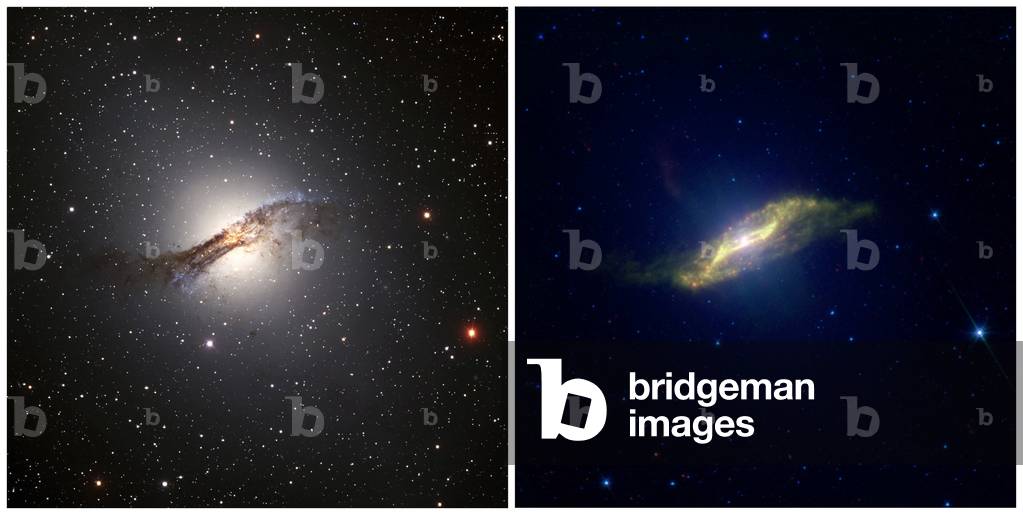
Galaxy Centaurus A (NGC 5128) in visible and infrared - Galaxy Centaurus A in visible and infrared - The galaxy NGC 5128 is about 13 million years away - light from Earth. This an elliptical galaxy that cannibalized a small spiral galaxy. The infrared image, on the right, reveals the complex structure of the central dust strip. Images obtained on the left by Cerro Tololo's 4m telescope and on the right by the Spitzer space telescope. Centaurus A (NGC 5128) is the nearest active galaxy to Earth. Located 13 million light - years away in the southern constellation Centaurus, 'Cen A' appears to be the result of a merger - collision between a large elliptical galaxy (which has a black hole at its center) and a smaller spiral galaxy that veered too close to the larger one, resulting in the cannabalization of the small galaxy. The visible image (left) from the National Science Foundation's Blanco 4 - meter telescope at Cerro Tololo Inter - American Observatory in Chile is dominated by a bright halo of light caused by the stars in the galaxy. Many of these stars are hidden by the dense band of dust that blocks our view of their light. Infrared light is not so readily obscured by dust as visible light, so the infrared image (right) from instruments on the NASA - JPL Spitzer Space Telescope reveals the complex structure of the dust lane, and the stars and gas embedded within it
Satellites, Weather, USA Infrared picture of part of north-west Europe from space, 1978
Nutzungsbeschränkungen von unseren Content-Partnern
  • Not available to clients invoiced in the UK
Aerial view of the English coast, 1940 (b/w photo)
Zusätzliche Genehmigungen
  • Permission required for non-editorial use (inc book and magazine covers). Please contact us
Bildbeschränkungen
  • Content within this photograph may require additional clearances (eg: trademark and personality rights) depending on Licensee's specific use of material, which may include book and magazine cover use.
Flying Star Zeta Ophiuchi - Runaway Star Zeta Ophiuchi - The blue star near the center of the image is Zeta Ophiuchi, a very massive star moving at 24 km per second. It is a “” fleeing star”, a star ejected by the explosion of his companion star. In this infrared image obtained by the WISE (Wide - field Infrared Survey Explorer) satellite, the interstellar dust traversed by the star appears, as well as an arc-shaped shock wave caused by the powerful stellar winds that the star breaks. The blue star near the center of this image is Zeta Ophiuchi. When seen in visible light it appears as a relatively dim red star surrounded by other dim stars and no dust. However, in this infrared image taken with Nasa's Wide - field Infrared Survey Explorer, or WISE, a completely different view emerges. Zeta Ophiuchi is actually a very massive, hot, bright blue star plowing its way through a large cloud of interstellar dust and gas. Astronomers theorize that this stellar juggernaut was likely once part of a binary star system with an even more massive partner. It's believed that when the partner exploded as a supernova, blasting away most of its mass, Zeta Ophiuchi was suddenly freed from its partner's pull and shot away like a bullet moving 24 kilometers per second (54,000 miles per hour). Zeta Ophiuchi is about 20 times more massive and 65,000 times more luminous than the sun. If it werenn't surrounded by so much dust, it would be one of the brightest stars in the sky and appear blue to the eye. Like all stars with this kind of extreme mass and power, it subscribes to the 'live fast, die young' motto. It's already about halfway through its very short 8 - million - year lifespan. In comparison, the sun is roughly halfway through its 10 - billion - year lifespan. While the sun will eventually become a quiet white dwarf, Zeta Ophiuchi, like its ex - partner, will ultimately die in a massive explosion called a supernova. Perhaps t
Titan, Saturn satellite seen by Cassini - Saturn's moon Titan as seen by Cassini spacecraft: Titan images obtained by the Cassini probe on 21 March 2017. On the left, Titan seen in real colors. On the right, infrared image showing surface details as well as clouds in the northern hemisphere. These views were obtained with the Cassini spacecraft narrow-angle camera on March 21, 2017. Images taken using red, green and blue spectral filters were combined to create the natural-color view at left. The false-color view at right was made by substituting an infrared image (centered at 938 nanometers) for the red color channel. A large, bright and feathery band of summer clouds can be seen arcing across high northern latitudes in the view at right. The views were acquired at a distance of approximately 613,000 miles (986,000 kilometers) from Titan. Image scale is about 4 miles (6 kilometers) per pixel
Spiral galaxy of the Sombrero M104 infrared view - Sombrero galaxy seen in infrared - Infrared image of the spiral galaxy M104 (Sombrero galaxy), located about 28 million years ago - light, obtained with the Spitzer space telescope in 2004 and January 2005. Infrared radiation shows the dust of the disc visible throughout the circumference. A high emission also comes from the center of the galaxy where a supermassive black hole is thought to reside there. This spiral galaxy is located some 28 million light - years away. The infrared image obtained by Spitzer space telescope in 2004 and 2005 pierces through the obscuring dust, along with the bulge of stars. It shows that the disk is warped, which is often the result of a gravitational encounter with another galaxy; clumpy areas spotted in the far edges of the ring indicate young star - forming regions. Spitzer detected infrared emission not only from the ring, but from the center of the galaxy too, where there is a huge black hole, believed to be a billion times more massive than our Sun
Galaxy cluster Abell 1656 - Coma cluster - The Coma cluster (Abell 1656) - A large cluster of galaxies consists of about a thousand galaxies located 330 million years - light in the constellation Coma Berenices (Berenice hair). This cluster is dominated by two large elliptical galaxies NGC 4874 on the right and NGC 4889 on the left. Image obtained near infrared by a 1.3m (2Mass) telescope. The Coma cluster (Abell 1656) is a particularly rich cluster of individual galaxies (over 1000 members), most prominently the two giant ellipticals, NGC 4874 (right) and NGC 4889 (left). The remaining members are mostly smaller ellipticals, but spiral galaxies are also evident in this 2MASS image. The cluster is seen towards the constellation Coma Berenices, and is actually at a distance of about 100 Mpc (330 million light years, or a redshift of 0.023) from us. Near infrared image
Infrared Jupiter seen by the New Horizons probe. - Jupiter seen by New Horizons spacecraft - View of Jupiter obtained on February 28, 2007 by the New Horizons probe. This infrared image shows the different altitudes of the Jovian clouds; in blue, the high altitudes clouds, in red, the lower clouds. Jupiter seen by New Horizons spacecraft during the Jupiter flyby in early 2007. This image is an infrared color composite taken by the spacecraft's near - infrared imaging spectrometer, the Linear Etalon Imaging Spectral Array (LEISA) at 1:40 UT on Feb. 28, 2007. The infrared wavelengths used (red: 1.59 um, green: 1.94 um, blue: 1.85 um) highlight variations in the altitude of the Jovian cloud tops, with blue denoting high - altitude clouds and hazes, and red indicating deeper clouds. The prominent bluish - white oval is the Great Red Spot. The observation was made at a solar phase angle of 75 degrees but has been projected onto a crescent to remove distortion caused by Jupiter's rotation during the scan
Open cluster of Pleiades seen in infrared - The Pleiades open cluster seen in infrared - Clouds of dust in the Pleiades cluster seen in infrared by the Spitzer space telescope. The Pleiades star cluster contains about 500 stars formed 100 million years ago. It is located 440 light years from Earth, in the constellation Taurus. The Pleiades, located more than 400 light - years away in the Taurus constellation, is a star cluster born when dinosaurs still roamed the Earth, about 100 million years ago. It is significantly younger than our 5 - billion - year - old sun. The brightest members of the cluster, also the highest - mass stars, are known in Greek mythology as two parents, Atlas and Pleione, and their seven daughters, Alcyone, Electra, Maia, Merope, Taygeta, Celaeno and Asterope. There are thousands of additional lower - mass members, including many stars like our sun. Some scientists believe that our sun grew up in a crowded region like the Pleiades, before migrating to its present, more isolated home. The infrared image from Spitzer highlights the filaments, colored yellow, green and red in this view, made up of dust associated with the cloud through which the cluster is traveling. The densest portion of the cloud appears in yellow and red, and the more diffuse outskirts are shown in green hues. One of the parent stars, Atlas, can be seen at the bottom left, while six of the sisters are visible at top. Additional stars in the cluster are sprinkled throughout the picture in blue
Star Formation in the Southern Cross - Star Formation in the Southern Cross - Part of the lactee route in the constellation of the Southern Cross seen in infrared by the Herschel space telescope. The hottest dust appears in blue, the coldest ones appear in red, the new stars will be born. Composite images obtained by SPIRE and PACS instruments on September 3, 2009. Some of the coldest and darkest dust in space shines brightly in this infrared image from the Herschel Observatory, a European Space Agency mission with important participation from NASA. The image is a composite of light captured simultaneously by two of Herschel's three instruments - - the photodetector array camera and spectrometer, and its spectral and photometric imaging receiver. The image reveals a cold and turbulent region where material is just beginning to condense into new stars. It is located in the plane of our Milky Way galaxy, 60 degrees from the center. Blue shows warmer material, red the coolest. The red filaments are made up of the coldest material pictured here - - material that is slightly warmer than the coldest temperature theoretically attainable in the universe. Stars form in cold, dense environments. Light captured by the photodetector array camera and spectrometer (PACS) is colored blue (blue represents 70 - micron light). The light detected by the spectral and photometric imaging receiver (SPIRE) is colored red (and shows the combined wavelengths of 250, 350 and 500 microns). The image spans a region 2 by 2 degrees
Satellites, Weather, USA Infrared picture the Gulf Stream, 1970s
Nutzungsbeschränkungen von unseren Content-Partnern
  • Not available to clients invoiced in the UK
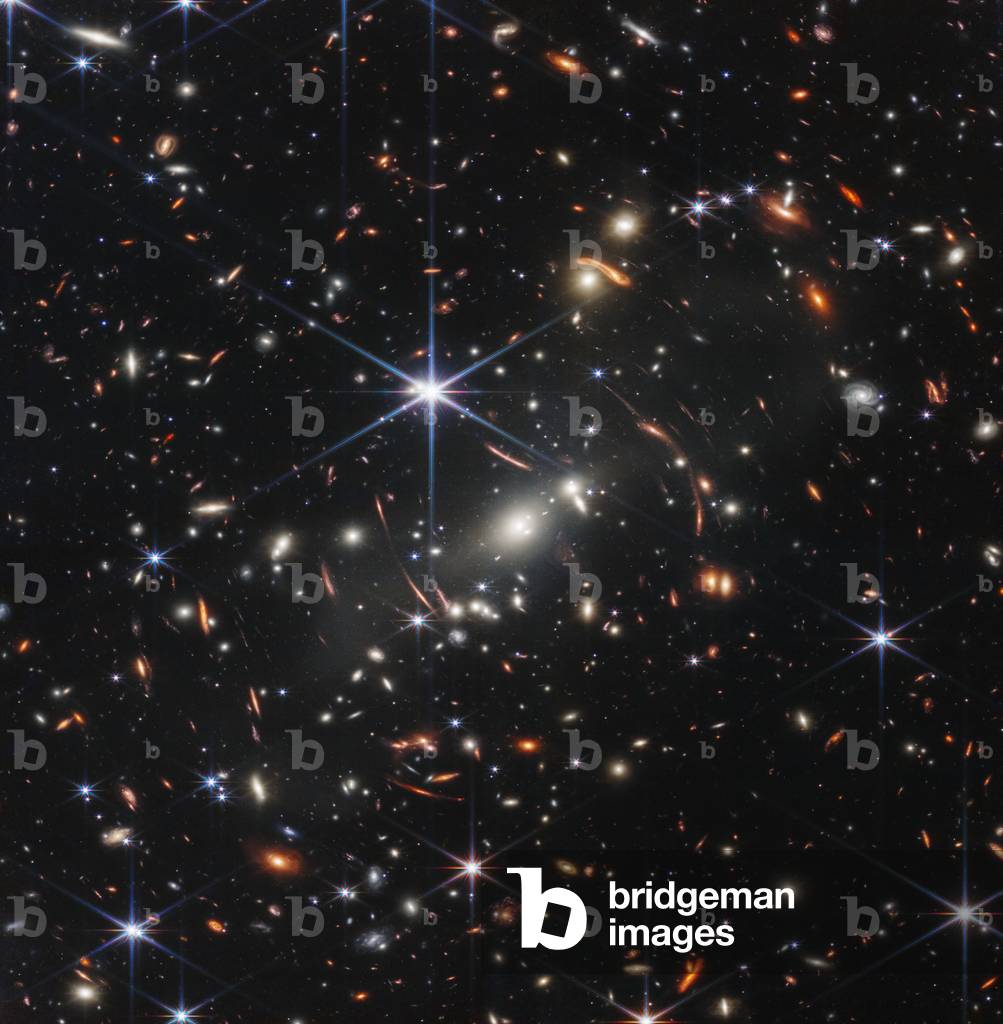
First image of the JWST - SMACS galaxy cluster 0723, 2022 (photography)
Nebulae NGC 2024 and Head of Horse seen by VISTA - Flame nebula and the Horsehead Nebula - First image obtained by the telescope of 4 meters in diameter VISTA. This infrared image shows the nebula NGC 2024 (left), the small nebula NGC 2023 (right middle) and the nebula of the horse's head (top right). The bright star on the top left is the star Alnitak. This image, the first to be released publicly from VISTA, the world's largest survey telescope, shows the spectacular star - forming region known as the Flame Nebula, or NGC 2024, in the constellation of Orion (the Hunter) and its surroundings. In views of this evocative object in visible light the core of the nebula is completely hidden behind obscuring dust, but in this VISTA view, taken in infrared light, the cluster of very young stars at the object's heart is revealed. The wide - field VISTA view also includes the glow of the reflection nebula NGC 2023, middle right, and the ghostly outline of the Horsehead Nebula (Barnard 33) towards the upper right. The bright bluish star top left is one of the three bright stars forming the Belt of Orion, Alnitak. The image was created from VISTA images taken through J, H and Ks filters in the near - infrared part of the spectrum. The image shows about half the area of the full VISTA field and is about 40 x 50 arcminutes in extent. The total exposure time was 14 minutes
Irregular Galaxy of the Little Magellan Cloud (NGC 292) - The Small Magellanic Cloud - The galaxy of the Little Magellan Cloud is about 240,000 light years from Earth in the southern constellation of Toucan. It's one of the closest galaxies of the Lactee Way. Infrared image obtained by Spitzer space telescope. This infrared portrait of the Small Magellanic Cloud, taken by Nasa's Spitzer Space Telescope, reveals the stars and dust in this galaxy as never seen before. The Small Magellanic Cloud is a nearby satellite galaxy to our Milky Way galaxy, approximately 200,000 light - years away. The image shows the main body of the Small Magellanic Cloud, which is comprised of the “” bar”” on the left and a “” wing”” extending to the right. The bar contains both old stars (in blue) and young stars lighting up their natal dust (green/red). The wing mainly contains young stars. In addition, the image contains a galactic globular cluster in the lower left (blue cluster of stars) and emission from dust in our own galaxy (green in the upper right and lower right corners). This image was captured by Spitzer's infrared array camera and multiband imaging photometer (blue is 3.6 - micron light; green is 8.0 microns; and red is combination of 24 -, 70 - and 160 - micron light). The blue color mainly traces old stars. The green color traces emission from organic dust grains (mainly polycyclic aromatic hydrocarbons). The red traces emission from larger, cooler dust grains
Nebula IC 1396 in Cephee infrared view - 18/12/2003 The large composite image on the left is a product of combining data from the observator's multiband imaging photometer and the infrared array camera. The thermal emission at 24 microns measured by the photometer (red) is combined with near - infrared emission from the camera at 3.6/4.5 microns (blue) and from 5.8/8.0 microns (green). The colors of the diffuse emission and filaments vary, and are a combination of molecular hydrogen (which tends to be green) and polycyclic aromatic hydrocarbon (brown) emissions. Nasa's Spitzer Space Telescope image of a glowing stellar nursery provides a spectacular contrast to the opaque cloud seen in visible light. The Elephant's Trunk Nebula is an elongated dark globule within the emission nebula IC 1396 in the constellation of Cepheus. Located at a distance of 2,450 light - years, the globule is a condensation of dense gas that is barely surviving the strong ionizing radiation from a nearby massive star. The globule is being compressed by the surrounding ionized gas. The dark globule is seen in silhouette at visible - light wavelengths, backlit by the illumination of a bright star located to the left of the field of view. The Spitzer Space Telescope pierces through the obscuration to reveal the birth of new protostars, or embryonic stars, and previously unseen young stars. The infrared image, was obtained by Spitzer's infrared array camera. The filamentary appearance of the globule results from the sculpting effects of competing physical processes. The winds from a massive star, located to the left of the image, produce a dense circular rim comprising the 'head' of the globule and a swept - back tail of gas
Star Formation in Cassiopee - Star Formation in Cassiopeia - This star-forming region, called W5, is located approximately 6500 light years ago in the constellation Cassiopee. Several generations of stars appear on this cliche; the older ones are the blue stars in the centre of the two cavities; the younger stars are grouped at the edges of these cavities and at the ends of the gas pillars or they appear like pink dots; the white areas are home to the very young stars in formation. In this infrared image, heated dust appears in red, dense gas clouds appear in green. Composite image obtained by the Spitzer space telescope in 2006 and 2007. Generations of stars can be seen in this infrared portrait from Nasa's Spitzer Space Telescope. In this wispy star - forming region, called W5, the oldest stars can be seen as blue dots in the centers of the two hollow cavities (other blue dots are background and foreground stars not associated with the region). Younger stars line the rims of the cavities, and some can be seen as pink dots at the tips of the elephant - trunk - like pillars. The white knotty areas are where the youngest stars are forming. Red shows heated dust that pervades the region's cavities, while green highlights dense clouds. W5 spans an area of sky equivalent to four full moons and is about 6,500 light - years away in the constellation Cassiopeia. The Spitzer picture was taken over a period of 24 hours. Like other massive star - forming regions, such as Orion and Carina, W5 contains large cavities that were carved out by radiation and winds from the region's most massive stars. According to the theory of triggered star - formation, the carving out of these cavities pushes gas together, causing it to ignite into successive generations of new stars. This image contains some of the best evidence yet for the triggered star - formation theory. Scientists analyzing the photo have been able to sho
Birth of stars in the nebula NGC 3372 - Star formation in the Carina Nebula - Detail of the nebula of the Carene seen in visible light (top) and infrared (bottom) by the Hubble space telescope. The top image shows a column of gas and dust eroded by ultraviolet radiation emitted by young stars. Jets are also visible, showing the presence of a nascent star. In the infrared image, the dust clouds radiate little, the nascent star responsible for these jets appears. NGC 3372 is located about 7000 light years away from Earth. Images obtained in July 2009. The pictures demonstrate one example of the broad wavelength range of the new Wide Field Camera 3 (WFC3) aboard the Hubble telescope, extending from ultraviolet to visible to infrared light. Composed of gas and dust, the pillar resides in a tempestuous stellar nursery called the Carina Nebula, located 7500 light - years away in the southern constellation of Carina. The pair of images shows that astronomers are given a much more complete view of the pillar and its contents when distinct details not seen at visible wavelengths are uncovered in near - infrared light. The top image, taken in visible light, shows the tip of the three - light - year - long pillar, bathed in the glow of light from hot, massive stars off the top of the image. Scorching radiation and fast winds (streams of charged particles) from these stars are sculpting the pillar and causing new stars to form within it. Streamers of gas and dust can be seen flowing off the top of the structure. Nestled inside this dense structure are fledgling stars. They cannot be seen in this image because they are hidden by a wall of gas and dust. Although the stars themselves are invisible, one of them is providing evidence of its existence. Thin puffs of material can be seen travelling to the left and to the right of a dark notch in the centre of the pillar. The matter is part of
Star Formation in Cassiopee - Star Formation in Cassiopeia - This star-forming region, called W5, is located approximately 6500 light years ago in the constellation Cassiopee. Several generations of stars appear on this cliche; the older ones are the blue stars in the centre of the two cavities; the younger stars are grouped at the edges of these cavities and at the ends of the gas pillars or they appear like pink dots; the white areas are home to the very young stars in formation. In this infrared image, heated dust appears in red, dense gas clouds appear in green. Composite image obtained by the Spitzer space telescope in 2006 and 2007. Generations of stars can be seen in this infrared portrait from Nasa's Spitzer Space Telescope. In this wispy star - forming region, called W5, the oldest stars can be seen as blue dots in the centers of the two hollow cavities (other blue dots are background and foreground stars not associated with the region). Younger stars line the rims of the cavities, and some can be seen as pink dots at the tips of the elephant - trunk - like pillars. The white knotty areas are where the youngest stars are forming. Red shows heated dust that pervades the region's cavities, while green highlights dense clouds. W5 spans an area of sky equivalent to four full moons and is about 6,500 light - years away in the constellation Cassiopeia. The Spitzer picture was taken over a period of 24 hours. Like other massive star - forming regions, such as Orion and Carina, W5 contains large cavities that were carved out by radiation and winds from the region's most massive stars. According to the theory of triggered star - formation, the carving out of these cavities pushes gas together, causing it to ignite into successive generations of new stars. This image contains some of the best evidence yet for the triggered star - formation theory. Scientists analyzing the photo have been able to sho
The galactic center seen by Spitzer Space Telescope - The galactic center region seen by Spitzer satellite. The area photographed extends over 890 light-years and over 640 light-years high. In visible light, this area is hidden by a large amount of interstellar dust. This picture in false colors shows the old and cold stars in blue, and the red regions the hot and massive stars. Dark and bright filamentous clouds are star-forming regions. The brightest area in the center of the image is the center of our galaxy which houses a supermassive black hole. This infrared image from Nasa's Spitzer Space Telescope shows hundreds of thousands of stars crowded into the swirling core of our spiral Milky Way galaxy. In visible-light pictures, this region cannot be seen at all because dust lying between Earth and the galactic center blocks our view. In this false-color picture, old and cool stars are blue, while dust features lit up by blazing hot, massive stars are shown in a reddish hue. Both bright and dark filamentary clouds can be seen, many of which harbor stellar nurseries. The plane of the Milky Way's flat disk is apparent as the main, horizontal band of clouds. The brightest white spot in the middle is the very center of the galaxy, which also marks the site of a supermassive black hole. The region pictured here is immense, with a horizontal span of 890 light-years and a vertical span of 640 light-years. Earth is located 26,000 light-years away, out in one of the Milky Way's spiral arms. Though most of the objects seen in this image are located at the galactic center, the features above and below the galactic plane tend to lie closer to Earth. This image is a mosaic of thousands of short exposures taken by Spitzer's Infrared Array Camera. The entire region was imaged in less than 16 hours
The Rho Ophiuchi nebula seen in infrared - Rho Ophiuchi in infrared - This coloree nebula represents part of a very vast molecular cloud, the Ophiuchus cloud. This star-forming region is about 520 years old - light. The triple star Rho Ophiuchus is located in the top center of the image. Below, a very bright nebula is visible, accompanied by a group of very young stars. At the bottom right, surrounded by a reddish nebula, the star Sigma Scorpii. The globular clusters NGC 6144 (bottom, center of the image) and M80 (top right of the image) are also visible on this infrared image obtained from the Wide - field Infrared Explorer (WISE) satellite. A rich collection of colorful astronomical objects is revealed in this picturesque image of the Rho Ophiuchi cloud complex from Nasa's Wide - field Infrared Explorer, or WISE. The Rho Ophiuchi cloud (pronounced 'oh - fee - yoo - ki' and named after a bright star in the region) is found rising above the plane of the Milky Way in the night sky, bordering the constellations Ophiuchus and Scorpius. It's one of the nearest star - forming regions to Earth, allowing us to resolve much more detail than in more distant similar regions, like the Orion nebula. The amazing variety of colors seen in this image represents different wavelengths of infrared light. The bright white nebula in the center of the image is glowing due to heating from nearby stars, resulting in what is called an emission nebula. The same is true for most of the multi - hued gas prevalent throughout the entire image, including the bluish, bow - shaped feature near the bottom right. The bright red area in the bottom right is light from the star in the center - - Sigma Scorpii - - that is reflected off of the dust surrounding it, creating what is called a reflection nebula. And the much darker areas scattered throughout the image are pockets of cool, dense gas that block out the background light, resulting in
Crab Nebula seen in different wavelength - The Crab Nebula in multi wavelength: M1, the Crab Nebula, is the rest of a supernova that exploded on July 4, 1054. It is located about 6500 light years from Earth in the constellation Taurus. At the heart of this nebula is a pulsar. To obtain this photo, different observatories and telescopes combined their observations; the VLA provided the radio image (in red), the Spitzer telescope the infrared image (in yellow), the Hubble telescope for the visible part (here in green), XMM-Newton the ultraviolet image (in blue) and the Chandra telescope for X-ray data (purple). The pulsar is the bright spot in the center of the image. The unusual image was produced by combining data from telescopes spanning almost the entire electromagnetic spectrum, from radio waves to X-rays. The Karl G. Jansky Very Large Array (VLA) provided information about the nebula gathered in the radio regime (colored in red). Nasa's Spitzer Space Telescope took images in the infrared (yellow). The NASA/ESA Hubble Space Telescope provided the images made in optical wavelengths (colored in green). ESA's XMM-Newton telescope observed the Crab Nebula in the ultraviolet (blue) and Nasa's Chandra X-ray Observatory provided the data for X-ray radiation (purple). The Crab Nebula, located 6500 light-years from Earth in the constellation of Taurus, is the result of a supernova explosion which was observed by Chinese and other astronomers in 1054. At its centre is a pulsar: a super-dense neutron star, spinning once every 33 milliseconds, shooting out rotating light-like beams of radio waves and visible light. Surrounding the pulsar lies a mix of material; some of it was originally expelled from the star before it went supernova, and the rest was ejected during the explosion itself. Fast-moving winds of particles fly off from the neutron star, energising the dust and gas around it.
Infrared and visible images of Jupiter, 1979
Nutzungsbeschränkungen von unseren Content-Partnern
  • Not available to clients invoiced in the UK
Galaxy M82 view in different wavelength - Galaxy M82 in multi - wavelength - Composite of different images: in blue the image obtained by Chandra in X-rays, in red the infrared image obtained by Spitzer, in yellow, orange, green, the image of Hubble. M82 is an irregular galaxy distant about 12 million years - light from Earth. Its nucleus, which appears to have suffered from the passage of the neighbouring galaxy M81, is in a phase of violent star activity. Its central regions are rich in star formation. These hot stars blow a stellar wind that becomes a very violent galactic wind. Composite of multi - wavelength images of the active galaxy M82 from the three Great Observatories. X - ray data recorded by Chandra appears here in blue; infrared light recorded by Spitzer appears in red; Hubble's observations of hydrogen emission appears in orange, and the bluest visible light appears in yellow - green. Another Hubble observation designed to image 10,000 degree Celsius hydrogen gas (orange) reveals a startlingly different picture of matter blasting out of the galaxy. The Spitzer Space Telescope infrared image (red) shows that cool gas and dust are also being ejected. Chandra's X - ray image (blue) reveals gas that has been heated to millions of degrees by the violent outflow. The eruption can be traced back to the central regions of the galaxy where stars are forming at a furious rate, some 10 times faster than in the Milky Way Galaxy. The burst of star formation in M82 is thought to have been initiated by shock waves generated in a close encounter with a large nearby galaxy, M81, about 100 million years ago. These shock waves triggered the collapse of giant clouds of dust and gas in M82. In another 100 million years or so, most of the gas and dust will have been used to form stars, or blown out of the galaxy, so the starburst will subside
Spiral galaxy M33 infrared view - Spiral galaxy M33 seen in infrared - M33, (NGC 598), the galaxy of the Triangle, is located about 2.9 million years ago - light from Earth. It belongs to the local group, just like our galaxy or Andromede galaxy. This infrared image from the Spitzer space telescope shows stars in blue, gas in green, star formations in red - orange. Red dots are distant galaxies. In infrared, the galaxy appears larger than visible light, revealing cold gas and dust that spread around the galaxy. Also known as M33 or NGC 598, the Triangulum Galaxy is part of the Local Group of galaxies, which includes the Andromeda Galaxy (M31) and our galaxy, the Milky Way. M33 is over thirty thousand light - years across, and more than two million light - years away. Viewed here with Spitzer's infrared eyes, this elegant spiral galaxy sparkles with color and detail. Stars appear as glistening blue gems (several of which are actually foreground stars in our own galaxy), while dust rich in organic molecules glows green. The diffuse orange - red glowing areas indicate star - forming regions, while small red flecks outside the spiral disk of M33 are most likely distant background galaxies. But not only is this new image beautiful, it also shows M33 to be surprising large - - bigger than its visible - light appearance would suggest. With its ability to detect cold, dark dust, Spitzer can see emission from cooler material well beyond the visible range of M33's disk. Exactly how this cold material moved outward from the galaxy is still a mystery, but winds from giant stars or supernovas may be responsible. This is a three - color composite image showing infrared observations from two of Spitzer instruments. Blue represents combined 3.6 - and 4.5 - micron light and green shows light of 8 microns, both captured by Spitzer's infrared array camera. Red is 24 - micron light dete
The Grace of Venus, 2017 (digital photo)
Nutzungsbeschränkungen von unseren Content-Partnern
  • Not available to clients invoiced in the UK
Urheberrecht
  • Urheberrechtlich Geschützt
Jupiter and Io seen by the New Horizons probe
Panorama of galactic center seen in infrared