[]
Ihre AuswahlIhre aktuelle Auswahl
asset(s) Assets
Ihr Preis 0

Ihre Auswahl

Auswahl aufheben
Asset zum Warenkorb hinzugefügt
{"event":"pageview","page_type1":"undetected","page_type2":"_assets_search_override","language":"de","user_logged":"false","user_type":"ecommerce","nl_subscriber":"false"}
{"event":"ecommerce_event","event_name":"view_item","event_category":"browse_catalog","ecommerce":{"items":[{"item_id":"CHT236037","item_category":"illustration","item_category2":"out_of_copyright","item_category3":"standard","item_category4":"french_school_19th_century","item_category5":"not_balown","item_list_name":"search_results","item_name":"ionisation_chamber_devised_by_marie_curie_1867_1934_c_1897","item_variant":"undefined"},{"item_id":"UIG5311599","item_category":"illustration","item_category2":"out_of_copyright","item_category3":"standard","item_category5":"not_balown","item_list_name":"search_results","item_name":"an_engraving_depicting_a_gold_leaf_electroscope_bennett_s_electroscope_19th_century","item_variant":"undefined"},{"item_id":"PIX4617554","item_category":"photo","item_category2":"no_copyright","item_category3":"standard","item_category4":"d_de_martin","item_category5":"not_balown","item_list_name":"search_results","item_name":"nebula_california_ngc_1499_in_persee_the_california_nebula_ngc_1499_in_perseus_ngc_1499_is_a_very_la","item_variant":"undefined"},{"item_id":"REU7477569","item_category":"photo","item_category2":"no_copyright","item_category3":"standard","item_category4":"yves_herman","item_category5":"not_balown","item_list_name":"search_results","item_name":"pierre_dardenne_director_of_griffith_mediris_belgium_holds_a_news_conference_in_fleurus_southern_199","item_variant":"undefined"},{"item_id":"REU7477565","item_category":"photo","item_category2":"no_copyright","item_category3":"standard","item_category4":"yves_herman","item_category5":"not_balown","item_list_name":"search_results","item_name":"outside_view_of_the_griffith_mediris_plant_in_fleurus_southern_belgium_october_11_french_food_fir_19","item_variant":"undefined"},{"item_id":"PIX4623194","item_category":"photo","item_category2":"no_copyright","item_category3":"standard","item_category5":"not_balown","item_list_name":"search_results","item_name":"planetary_nebula_ngc_6369_in_ophiuchus_hst_ngc_6369_is_known_to_amateur_astronomers_as_the_little_gh","item_variant":"undefined"},{"item_id":"PIX4617491","item_category":"photo","item_category2":"no_copyright","item_category3":"standard","item_category5":"not_balown","item_list_name":"search_results","item_name":"bok_s_cells_in_ngc_281_cassiopee_bok_globules_in_ngc_281_view_of_a_detail_of_the_nebula_ngc_281_in_c","item_variant":"undefined"},{"item_id":"PIX4620812","item_category":"photo","item_category2":"no_copyright","item_category3":"standard","item_category5":"not_balown","item_list_name":"search_results","item_name":"nebuleuse_n44_in_the_great_magellan_cloud_this_photo_shows_the_southern_part_of_the_spectacular_n44_","item_variant":"undefined"},{"item_id":"PIX4618883","item_category":"photo","item_category2":"no_copyright","item_category3":"standard","item_category5":"not_balown","item_list_name":"search_results","item_name":"detail_of_the_nebula_ngc_3324_in_the_carene_detail_of_nebula_ngc_3324_in_carina_detail_of_the_nebula","item_variant":"undefined"}]}}
{"event":"custom_event","event_name":"view_search_result","event_category":"browse_catalog","keyword":"ionisierung","search_type":"standard","search_bridgeman_artists":"false","search_mode":"automatic","search_zero_result":"false","search_results":9,"search_results_page_number":1}

'Ionisierung' Bilder und Clips Suchergebnisse page 1 of 1

Hauptfilter
Option "Kunstdruck kaufen" verfügbar
Royalty-free Optionen
Ecommerce option
Medium
Orientation
Farbbilder
Kategorie
Rechte
Mehr Filter
Bridgeman Artists
Bridgeman Fotografen
Jahrhundert
Footage-Filter
Video Original Format
Video Resolution
Video Category
Filter group
Filter colors
Sortieren nach:
pro Seite
Filter group
Kategorie
Medium
No copyright
Filter colors

Anzeigeoptionen

View
Image Size

Bilder zu 'Ionisierung' gefunden, 9

An engraving depicting a gold-leaf electroscope (Bennett's electroscope), 19th century
Nebula California (NGC 1499) in Persee - The California Nebula (NGC 1499) in Perseus - NGC 1499 is a very large emission nebula located 1140 years - light from Earth in the constellation Persee. Image obtained by the Oschin telescope of Mount Palomar through several filters and composed. The north is at top. This is a huge emission nebula in Perseus constellation. It is a cloud of gas, mainly hydrogen, which glows due to the ionization by radiation from a hot nearby star. The California Nebula is made glowing by the 4th magnitude star Menkib (Xi Persei, the bright blue star in center right). The nebula is named because recall the shape of the US state when viewed from the west. This image is based on data acquired by the Oschin Telescope at the Mount Palomar Observatory
Pierre Dardenne, Director of Griffith Mediris Belgium, holds a news conference in Fleurus, southern .., 1999 (photo)
Zusätzliche Genehmigungen
  • Permission required for non-editorial use (inc book covers and in-context promotional use in documentaries). Please contact us
Bildbeschränkungen
  • Content within this photograph may require additional clearances (eg: trademark and personality rights) depending on Licensee's specific use of material, which may include book and magazine cover use.
Nutzungsbeschränkungen von unseren Content-Partnern
  • Minimum fee applies to this image;Only available to clients invoiced in Australia, Belgium, Brazil, Bulgaria, Canada, China, Cyprus, Czech Republic, Estonia, Finland, France, French Southern Territories, Greece, Hong Kong, Hungary, India, Ireland, Israel, Italy, Lebanon, Luxembourg, Mexico, the Netherlands, New Zealand, Portugal, Qatar, Republic of Korea, Romania, Russian Federation, Singapore, South Africa, Spain, Sweden, Switzerland, Taiwan, Turkey, United Arab Emirates, United Kingdom and United States
Outside view of the Griffith Mediris plant in Fleurus, southern Belgium, October 11. French food fir.., 1999 (photo)
Zusätzliche Genehmigungen
  • Permission required for non-editorial use (inc book covers and in-context promotional use in documentaries). Please contact us
Bildbeschränkungen
  • Content within this photograph may require additional clearances (eg: trademark and personality rights) depending on Licensee's specific use of material, which may include book and magazine cover use.
Nutzungsbeschränkungen von unseren Content-Partnern
  • Minimum fee applies to this image;Only available to clients invoiced in Australia, Belgium, Brazil, Bulgaria, Canada, China, Cyprus, Czech Republic, Estonia, Finland, France, French Southern Territories, Greece, Hong Kong, Hungary, India, Ireland, Israel, Italy, Lebanon, Luxembourg, Mexico, the Netherlands, New Zealand, Portugal, Qatar, Republic of Korea, Romania, Russian Federation, Singapore, South Africa, Spain, Sweden, Switzerland, Taiwan, Turkey, United Arab Emirates, United Kingdom and United States
Planetary nebula NGC 6369 in Ophiuchus/HST - NGC 6369 is known to amateur astronomers as the “” Little Ghost Nebula,”” because it appears as a small, ghostly cloud surrounding the faint, dying central star. NGC 6369 lies in the direction of the constellation Ophiuchus, at a distance estimated to be between about 2,000 and 5,000 light - years from Earth. When a star with a mass similar to that of our own Sun nears the end of its lifetime, it expands in size to become a red giant. The red - giant stage ends when the star expels its outer layers into space, producing a faintly glowing nebula. Astronomers call such an object a planetary nebula, because its round shape resembles that of a planet when viewed with a small telescope. The Hubble photograph of NGC 6369, captured with the Wide Field Planetary Camera 2 (WFPC2) in February 2002, reveals remarkable details of the ejection process that are not visible from ground - based telescopes because of the blurring produced by the Earth's atmosphere. The remnant stellar core in the center is now sending out a flood of ultraviolet (UV) light into the surrounding gas. The prominent blue - green ring, nearly a light - year in diameter, marks the location where the energetic UV light has stripped electrons off of atoms in the gas. This process is called ionization. In the redder gas at larger distances from the star, where the UV light is less intense, the ionization process is less advanced. Even farther outside the main body of the nebula, one can see fainter wisps of gas that were lost from the star at the beginning of the ejection process. The color image has been produced by combining WFPC2 pictures taken through filters that isolate light emitted by three different chemical elements with different degrees of ionization. The doughnut - shaped blue - green ring represents light from ionized oxygen atoms that have lost two electrons (blue) and from hydrogen atoms that have lost their single electrons (green). Red marks
Bok's cells in NGC 281 (Cassiopee) - Bok globules in NGC 281 - View of a detail of the nebula NGC 281 in Cassiopee center on Bok's Globules. A Bok's blood cell is a dark interstellar cloud of gases and dust that absorb light. If it condenses enough, it gives birth to new stars. Near these blood cells shine blue stars; they belong to the young cluster of stars IC 1590. Image obtained by the Hubble Space Telescope in October 2005. These opaque, dark knots of gas and dust are called “” Bok globules,””” and they are absorbing light in the center of the nearby emission nebula and star - forming region. Bok hypothesized that giant molecular clouds, on the order of hundreds of light - years in size, can become perturbed and form small pockets where the dust and gas are highly concentrated. These small pockets become gravitationally bound and accumulate dust and gas from the surrounding area. If they can capture enough mass, they have the potential of creating stars in their cores; however, not all Bok globules will form stars. Some will dissipate before they can collapse to form stars. That may be what's happening to the globules seen here in NGC 281. Near the globules are bright blue stars, members of the young open cluster IC 1590. The cluster is made up of a few hundred stars. The club's core, off the image towards the top, is a tight grouping of extremely hot, massive stars with an immense stellar wind. The stars emit visible and ultraviolet light that energizes the surrounding hydrogen gas in NGC 281. This gas then becomes super heated in a process called ionization, and it glows pink in the image. The Bok globules in NGC 281 are located very close to the center of the IC 1590 cluster. The heavy fracturing of the globules may appear beautifully serene but is in fact evident of the harsh
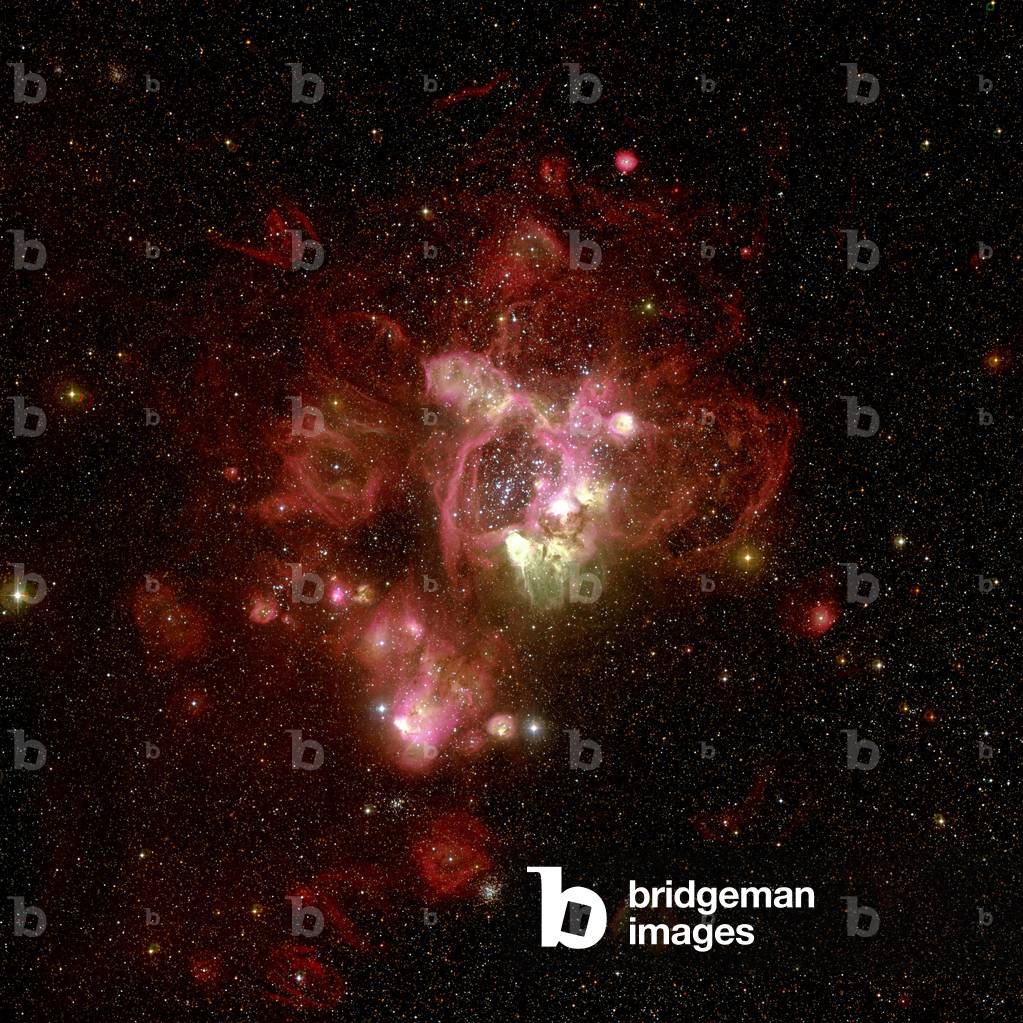
Nebuleuse N44 in the Great Magellan Cloud - This photo shows the southern part of the spectacular N44 region in the Large Magellanic Cloud. The green colour indicates areas that are particularly hot. The field measures 27.5 x 26.5 arcmin2., North is up and East is left. The two best known satellite galaxies of the Milky Way, the Magellanic Clouds, are located in the southern sky at a distance of about 170,000 light - years. They host many giant nebular complexes with very hot and luminous stars whose intense ultraviolet radiation causes the surrounding interstellar gas to glow. The intricate and colourful nebulae are produced by ionised gas that shines as electrons and positively charged atomic nuclei recombine, emitting a cascade of photons at well defined wavelengths. Such nebulae are called “” H II regions””, signifying ionised hydrogen, i.e. hydrogen atoms that have lost one electron (protons). Their spectra are characterized by emission lines whose relative intensities carry useful information about the composition of the emitting gas, its temperature, as well as the mechanisms that cause the ionization. Since the wavelengths of these spectral lines correspond to different colours, these alone are already very informative about the physical conditions of the gas. N44 in the Large Magellanic Cloud is a spectacular example of such a giant H II region. Having observed it in 1999 a team of European astronomers again used the Wide - Field - Imager (WFI) at the MPG/ESO 2.2 - m telescope of the La Silla Observatory, pointing this 67 - million pixel digital camera to the same sky region in order to provide another striking - and scientifically extremely rich - image of this complex of nebulae. With a size of roughly 1,000 light - years, the peculiar shape of N44 clearly outlines a ring that includes a bright stellar association of about 40 very luminous and bluish stars. These stars are the origin of powerful “” stellar winds””” that blow away the surrounding gas, pilin
Detail of the nebula NGC 3324 in the Carene - Detail of nebula NGC 3324 in Carina - Detail of the nebula NGC 3324 obtained by the Hubble space telescope. This nebula is located in the southern hemisphere, close to the great Carene nebula about 7200 light years from Earth. The image obtained by the Hubble Space Telescope shows a gas wall at the edge of a cavite created by the radiation and stellar winds blown by young warm stars. Hubble space telescope image shows the edge of a giant gaseous cavity within the star - forming region called NGC 3324. The glowing nebula has been carved out by intense ultraviolet radiation and stellar winds from several hot, young stars. A cluster of extremely massive stars, located well outside this image in the center of the nebula, is responsible for the ionization of the nebula and excavation of the cavity. The image also reveals dramatic dark towers of cool gas and dust that rise above the glowing wall of gas. The dense gas at the top resists the blistering ultraviolet radiation from the central stars, and creates a tower that points in the direction of the energy flow. The high - energy radiation blazing out from the hot, young stars in NGC 3324 is sculpting the wall of the nebula by slowly eroding it away. Located in the Southern Hemisphere, NGC 3324 is at the northwest corner of the Carina Nebula (NGC 3372), home of the Keyhole Nebula and the active, outbursting star Eta Carinae. The entire Carina Nebula complex is located at a distance of roughly 7,200 light - years, and lies in the constellation Carina. This image is a composite of data taken with two of Hubble's science instruments. Data taken with the Advanced Camera for Surveys (ACS) in 2006 isolated light emitted by hydrogen. More recent data, taken in 2008 with the Wide Field Planetary Camera 2 (WFPC2), isolated light emitted by sulfur and oxygen gas. To create a color composite, the data from the sulfur filter are represented by re