[]
Ihre AuswahlIhre aktuelle Auswahl
asset(s) Assets
Ihr Preis 0

Ihre Auswahl

Auswahl aufheben
Asset zum Warenkorb hinzugefügt
{"event":"pageview","page_type1":"undetected","page_type2":"_assets_search_override","language":"de","user_logged":"false","user_type":"ecommerce","nl_subscriber":"false"}
{"event":"ecommerce_event","event_name":"view_item","event_category":"browse_catalog","ecommerce":{"items":[{"item_id":"PIX4583380","item_category":"photo","item_category2":"no_copyright","item_category3":"standard","item_category4":"p_carril","item_category5":"not_balown","item_list_name":"search_results","item_name":"explosion_of_a_hypernova_artist_view_explosion_of_a_hypernova_artist_view_artist_view_of_a_hypernova","item_variant":"undefined"},{"item_id":"PIX4573073","item_category":"photo","item_category2":"no_copyright","item_category3":"standard","item_category4":"miller_ron_b_1947","item_category5":"not_balown","item_list_name":"search_results","item_name":"comparison_of_sun_sizes_and_vy_canis_majoris_vy_canis_majoris_vy_cma_is_a_red_hypergeant_star_locate","item_variant":"undefined"},{"item_id":"PIX4573022","item_category":"photo","item_category2":"no_copyright","item_category3":"standard","item_category4":"p_carril","item_category5":"not_balown","item_list_name":"search_results","item_name":"the_evolution_of_stars_illustration_the_evolution_of_the_stars_illustration_all_stars_are_born_in_in","item_variant":"undefined"},{"item_id":"PIX4621694","item_category":"photo","item_category2":"no_copyright","item_category3":"standard","item_category5":"not_balown","item_list_name":"search_results","item_name":"star_birth_in_scorpio_stellar_nursery_in_scorpius_rcw_120_is_a_star_forming_region_about_4200_years_","item_variant":"undefined"},{"item_id":"PIX4617828","item_category":"photo","item_category2":"no_copyright","item_category3":"standard","item_category4":"sebastian_voltmer","item_category5":"not_balown","item_list_name":"search_results","item_name":"orion_nebula_the_trapeze_the_trapezium_region_in_m42_located_1500_years_light_orion_nebula_is_the_cl","item_variant":"undefined"},{"item_id":"PIX4572046","item_category":"photo","item_category2":"no_copyright","item_category3":"standard","item_category4":"christopher_picking","item_category5":"not_balown","item_list_name":"search_results","item_name":"gamma_velorum_gamma_velorum_gamma_velorum_is_the_brightest_star_in_the_southern_constellation_sails_","item_variant":"undefined"},{"item_id":"PIX4572979","item_category":"photo","item_category2":"no_copyright","item_category3":"standard","item_category5":"not_balown","item_list_name":"search_results","item_name":"artist_s_view_of_a_wolf_star_rayet_artwork_of_a_wolf_rayet_star_wolf_stars_rayet_are_extremely_massi","item_variant":"undefined"},{"item_id":"PIX4569094","item_category":"photo","item_category2":"no_copyright","item_category3":"standard","item_category5":"not_balown","item_list_name":"search_results","item_name":"open_cluster_westerlund_2_in_carene_open_cluster_westerlund_2_in_carina_the_open_cluster_westerlund_","item_variant":"undefined"},{"item_id":"PIX4572090","item_category":"photo","item_category2":"no_copyright","item_category3":"standard","item_category5":"not_balown","item_list_name":"search_results","item_name":"super_massive_star_eta_carinae_super_massive_star_eta_carinae_eta_carinae_is_one_of_the_most_massive","item_variant":"undefined"},{"item_id":"PIX4569042","item_category":"photo","item_category2":"no_copyright","item_category3":"standard","item_category5":"not_balown","item_list_name":"search_results","item_name":"the_cluster_of_stars_pismis_24_in_the_scorpio_pismis_24_star_cluster_in_scorpius_this_image_shows_th","item_variant":"undefined"},{"item_id":"PIX4572139","item_category":"photo","item_category2":"no_copyright","item_category3":"standard","item_category5":"not_balown","item_list_name":"search_results","item_name":"contact_binary_star_vfts_352_illustration_binary_contact_star_vfts_352_vfts_352_is_a_contact_binary_","item_variant":"undefined"},{"item_id":"PIX4572123","item_category":"photo","item_category2":"no_copyright","item_category3":"standard","item_category5":"not_balown","item_list_name":"search_results","item_name":"hypergeante_star_hr_5171_illustration_this_artist_view_shows_the_yellow_hypergeant_star_hr_5171_it_i","item_variant":"undefined"},{"item_id":"PIX4573016","item_category":"photo","item_category2":"no_copyright","item_category3":"standard","item_category4":"p_carril","item_category5":"not_balown","item_list_name":"search_results","item_name":"the_evolution_of_stars_illustration_the_evolution_of_the_stars_illustration_all_stars_are_born_in_in","item_variant":"undefined"},{"item_id":"PIX4572084","item_category":"photo","item_category2":"no_copyright","item_category3":"standard","item_category5":"not_balown","item_list_name":"search_results","item_name":"pistol_star_massive_star_in_the_constellation_sagittarius_the_massive_star_pistol_star_in_sagittariu","item_variant":"undefined"},{"item_id":"PIX4622981","item_category":"photo","item_category2":"no_copyright","item_category3":"standard","item_category5":"not_balown","item_list_name":"search_results","item_name":"old_open_cluster_ngc_2818_and_planetary_nebula_ngc_2818a_old_open_cluster_ngc_2818_and_planetary_neb","item_variant":"undefined"},{"item_id":"PIX4619216","item_category":"photo","item_category2":"no_copyright","item_category3":"standard","item_category5":"not_balown","item_list_name":"search_results","item_name":"nebula_ngc_3603_in_carene_star_formation_region_ngc_3603_in_carina_ngc_3603_is_located_about_7000_ye","item_variant":"undefined"},{"item_id":"PIX4619048","item_category":"photo","item_category2":"no_copyright","item_category3":"standard","item_category4":"r_gendler","item_category5":"not_balown","item_list_name":"search_results","item_name":"nebula_ngc_3372_in_carene_nebula_ngc_3372_in_carina_the_nebula_of_the_carene_is_located_about_7000_y","item_variant":"undefined"},{"item_id":"PIX4618345","item_category":"photo","item_category2":"no_copyright","item_category3":"standard","item_category4":"sebastian_voltmer","item_category5":"not_balown","item_list_name":"search_results","item_name":"star_forming_region_in_the_large_magellanic_cloud_star_forming_regions_north_of_the_magellanic_cloud","item_variant":"undefined"},{"item_id":"PIX4611087","item_category":"photo","item_category2":"no_copyright","item_category3":"standard","item_category4":"r_gendler","item_category5":"not_balown","item_list_name":"search_results","item_name":"interacting_galaxies_ngc_4038_4039_in_the_raven_ngc_4038_39_the_interacting_galaxies_of_the_antennae","item_variant":"undefined"},{"item_id":"PIX4619986","item_category":"photo","item_category2":"no_copyright","item_category3":"standard","item_category5":"not_balown","item_list_name":"search_results","item_name":"eagle_nebula_ic_4703_and_star_cluster_m16_in_the_snake_this_wide_field_image_of_the_eagle_nebula_was","item_variant":"undefined"},{"item_id":"PIX4637984","item_category":"photo","item_category2":"no_copyright","item_category3":"standard","item_category5":"not_balown","item_list_name":"search_results","item_name":"galactic_center_region_the_galactic_center_the_galactic_center_region_of_the_center_of_our_galaxy_se","item_variant":"undefined"},{"item_id":"PIX4617879","item_category":"photo","item_category2":"no_copyright","item_category3":"standard","item_category4":"jerry_lodriguss","item_category5":"not_balown","item_list_name":"search_results","item_name":"orion_s_trapeze_trapezium_multiple_star_system_in_orion_orion_s_trapeze_is_one_of_the_youngest_open_","item_variant":"undefined"},{"item_id":"PIX4618987","item_category":"photo","item_category2":"no_copyright","item_category3":"standard","item_category5":"not_balown","item_list_name":"search_results","item_name":"nebula_ngc_3372_in_the_carene_the_carina_nebula_the_carene_nebula_is_located_about_8000_years_from_t","item_variant":"undefined"},{"item_id":"PIX4572109","item_category":"photo","item_category2":"no_copyright","item_category3":"standard","item_category5":"not_balown","item_list_name":"search_results","item_name":"super_massive_star_eta_carinae_super_massive_star_eta_carinae_eta_carinae_is_one_of_the_most_massive","item_variant":"undefined"},{"item_id":"PIX4619134","item_category":"photo","item_category2":"no_copyright","item_category3":"standard","item_category5":"not_balown","item_list_name":"search_results","item_name":"massive_stars_in_the_carene_massive_stars_in_the_carina_nebula_detail_of_the_nebula_of_the_carene_lo","item_variant":"undefined"},{"item_id":"PIX4619260","item_category":"photo","item_category2":"no_copyright","item_category3":"standard","item_category5":"not_balown","item_list_name":"search_results","item_name":"nebula_ngc_6164_5_in_the_rule_the_emission_nebula_ngc_6164_65_this_nebula_is_located_about_4000_ligh","item_variant":"undefined"},{"item_id":"PIX4617817","item_category":"photo","item_category2":"no_copyright","item_category3":"standard","item_category5":"not_balown","item_list_name":"search_results","item_name":"orion_nebula_the_trapeze_the_trapezium_region_in_m42_located_1500_years_light_orion_nebula_is_the_cl","item_variant":"undefined"},{"item_id":"PIX4611091","item_category":"photo","item_category2":"no_copyright","item_category3":"standard","item_category5":"not_balown","item_list_name":"search_results","item_name":"interacting_galaxies_ngc_4038_4039_in_the_raven_ngc_4038_39_the_interacting_galaxies_of_the_antennae","item_variant":"undefined"},{"item_id":"PIX4620555","item_category":"photo","item_category2":"no_copyright","item_category3":"standard","item_category4":"adam_block","item_category5":"not_balown","item_list_name":"search_results","item_name":"nebula_ngc_7023_in_cephee_ngc_7023_the_iris_nebula_in_cepheus_the_iris_nebula_ngc_7023_is_a_reflexio","item_variant":"undefined"},{"item_id":"PIX4619215","item_category":"photo","item_category2":"no_copyright","item_category3":"standard","item_category5":"not_balown","item_list_name":"search_results","item_name":"nebula_ngc_6164_5_in_the_rule_the_field_around_ngc_6164_65_this_nebula_is_located_about_4000_years_f","item_variant":"undefined"},{"item_id":"PIX4618927","item_category":"photo","item_category2":"no_copyright","item_category3":"standard","item_category5":"not_balown","item_list_name":"search_results","item_name":"detail_of_the_nebula_ngc_3372_in_the_carene_eta_carinae_nebula_detail_detail_of_the_nebula_ngc_3372_","item_variant":"undefined"},{"item_id":"PIX4617863","item_category":"photo","item_category2":"no_copyright","item_category3":"standard","item_category5":"not_balown","item_list_name":"search_results","item_name":"center_of_the_orion_nebula_trapeze_orion_nebula_center_mosaic_of_infrared_images_showing_the_center_","item_variant":"undefined"},{"item_id":"PIX4619228","item_category":"photo","item_category2":"no_copyright","item_category3":"standard","item_category5":"not_balown","item_list_name":"search_results","item_name":"nebula_ngc_6164_5_in_the_rule_the_emission_nebula_ngc_6164_65_this_nebula_is_located_about_4000_year","item_variant":"undefined"},{"item_id":"PIX4611051","item_category":"photo","item_category2":"no_copyright","item_category3":"standard","item_category5":"not_balown","item_list_name":"search_results","item_name":"interacting_galaxies_ngc_4038_4039_in_the_raven_the_antennae_galaxy_in_corvus_on_the_left_seen_from_","item_variant":"undefined"},{"item_id":"PIX4611075","item_category":"photo","item_category2":"no_copyright","item_category3":"standard","item_category5":"not_balown","item_list_name":"search_results","item_name":"interacting_galaxies_ngc_4038_4039_in_the_raven_the_antennae_galaxy_in_corvus_image_of_the_galaxy_ng","item_variant":"undefined"},{"item_id":"PIX4617799","item_category":"photo","item_category2":"no_copyright","item_category3":"standard","item_category4":"jerry_lodriguss","item_category5":"not_balown","item_list_name":"search_results","item_name":"orion_nebula_the_trapeze_the_trapezium_in_orion_nebula_the_orion_trapeze_is_among_the_youngest_open_","item_variant":"undefined"},{"item_id":"PIX4569073","item_category":"photo","item_category2":"no_copyright","item_category3":"standard","item_category5":"not_balown","item_list_name":"search_results","item_name":"open_cluster_westerlund_1_in_the_altar_open_cluster_westerlund_1_in_ara_the_open_cluster_westerlund_","item_variant":"undefined"},{"item_id":"PIX4620345","item_category":"photo","item_category2":"no_copyright","item_category3":"standard","item_category4":"jerry_lodriguss","item_category5":"not_balown","item_list_name":"search_results","item_name":"nebula_of_the_crescent_ngc_6888_in_the_swan_crescent_nebula_in_cygnus_ngc_6888_the_nebula_of_the_cre","item_variant":"undefined"},{"item_id":"PIX4619137","item_category":"photo","item_category2":"no_copyright","item_category3":"standard","item_category5":"not_balown","item_list_name":"search_results","item_name":"detail_of_nebula_ngc_3372_in_carene_eta_carinae_nebula_detail_detail_of_nebula_ngc_3372_in_the_const","item_variant":"undefined"},{"item_id":"PIX4619045","item_category":"photo","item_category2":"no_copyright","item_category3":"standard","item_category5":"not_balown","item_list_name":"search_results","item_name":"nebula_ngc_3372_in_the_carene_carina_nebula_ngc_3372_the_carene_nebula_is_located_about_7500_years_f","item_variant":"undefined"},{"item_id":"PIX4619139","item_category":"photo","item_category2":"no_copyright","item_category3":"standard","item_category5":"not_balown","item_list_name":"search_results","item_name":"massive_stars_in_the_carene_massive_stars_in_the_carina_nebula_the_image_shows_a_cluster_of_stars_na","item_variant":"undefined"},{"item_id":"PIX4569076","item_category":"photo","item_category2":"no_copyright","item_category3":"standard","item_category5":"not_balown","item_list_name":"search_results","item_name":"the_cluster_of_stars_pismis_24_in_the_scorpio_pismis_24_star_cluster_in_scorpius_this_image_obtained","item_variant":"undefined"},{"item_id":"PIX4620709","item_category":"photo","item_category2":"no_copyright","item_category3":"standard","item_category4":"adam_block","item_category5":"not_balown","item_list_name":"search_results","item_name":"nebula_ngc_7635_in_cassiopee_the_bubble_nebula_ngc_7635_in_cassiopeia_this_nebula_is_located_about_7","item_variant":"undefined"},{"item_id":"PIX4620374","item_category":"photo","item_category2":"no_copyright","item_category3":"standard","item_category4":"adam_block","item_category5":"not_balown","item_list_name":"search_results","item_name":"nebula_of_the_crescent_ngc_6888_in_the_swan_crescent_nebula_in_cygnus_ngc_6888_the_nebula_of_the_cre","item_variant":"undefined"},{"item_id":"PIX4611081","item_category":"photo","item_category2":"no_copyright","item_category3":"standard","item_category4":"jim_misti","item_category5":"not_balown","item_list_name":"search_results","item_name":"interacting_galaxies_ngc_4038_4039_in_the_raven_ngc_4038_39_the_interacting_galaxies_of_the_antennae","item_variant":"undefined"},{"item_id":"PIX4611108","item_category":"photo","item_category2":"no_copyright","item_category3":"standard","item_category4":"adam_block","item_category5":"not_balown","item_list_name":"search_results","item_name":"interacting_galaxies_ngc_4038_4039_in_the_raven_ngc_4038_39_the_interacting_galaxies_of_the_antennae","item_variant":"undefined"},{"item_id":"PIX4618903","item_category":"photo","item_category2":"no_copyright","item_category3":"standard","item_category5":"not_balown","item_list_name":"search_results","item_name":"nebula_ngc_3372_in_the_carene_the_eta_carinae_nebula_and_trumpler_14_the_carene_nebula_is_located_ab","item_variant":"undefined"},{"item_id":"PIX4619112","item_category":"photo","item_category2":"no_copyright","item_category3":"standard","item_category4":"tom_davis","item_category5":"not_balown","item_list_name":"search_results","item_name":"nebula_ngc_3372_in_the_carene_ngc_3372_carina_nebula_the_carene_nebula_ngc_3372_is_a_very_large_regi","item_variant":"undefined"},{"item_id":"PIX4572239","item_category":"photo","item_category2":"no_copyright","item_category3":"standard","item_category5":"not_balown","item_list_name":"search_results","item_name":"star_field_in_the_antenna_galaxy_starfield_in_the_antennae_detail_in_the_antenna_galaxy_ngc_4038_403","item_variant":"undefined"},{"item_id":"PIX4611114","item_category":"photo","item_category2":"no_copyright","item_category3":"standard","item_category5":"not_balown","item_list_name":"search_results","item_name":"interacting_galaxies_ngc_4038_4039_in_the_raven_ngc_4038_39_the_interacting_galaxies_of_the_antennae","item_variant":"undefined"},{"item_id":"PIX4620358","item_category":"photo","item_category2":"no_copyright","item_category3":"standard","item_category5":"not_balown","item_list_name":"search_results","item_name":"nebula_of_the_crescent_ngc_6888_in_the_swan_ngc_6888_the_crescent_nebula_ngc_6888_nebula_of_the_cres","item_variant":"undefined"},{"item_id":"PIX4620681","item_category":"photo","item_category2":"no_copyright","item_category3":"standard","item_category5":"not_balown","item_list_name":"search_results","item_name":"nebula_ngc_7635_in_cassiopee_bubble_nebula_ngc_7635_in_cassiopeia_this_nebula_is_located_about_7100_","item_variant":"undefined"},{"item_id":"PIX4618776","item_category":"photo","item_category2":"no_copyright","item_category3":"standard","item_category4":"r_gendler","item_category5":"not_balown","item_list_name":"search_results","item_name":"nebula_ngc_2359_in_the_big_dog_ngc_2359_nebula_in_canis_major_ngc_2359_is_a_nebula_in_the_big_dog_th","item_variant":"undefined"},{"item_id":"PIX4572713","item_category":"photo","item_category2":"no_copyright","item_category3":"standard","item_category5":"not_balown","item_list_name":"search_results","item_name":"artist_s_view_of_a_fugitive_star_a_runaway_star_in_the_large_magellanic_cloud_the_star_he0457_5439_i","item_variant":"undefined"},{"item_id":"PIX4618335","item_category":"photo","item_category2":"no_copyright","item_category3":"standard","item_category5":"not_balown","item_list_name":"search_results","item_name":"clubs_r136_in_the_tarantula_nebula_ngc_2070_central_region_of_the_tarantula_nebula_the_tarantula_neb","item_variant":"undefined"},{"item_id":"PIX4618913","item_category":"photo","item_category2":"no_copyright","item_category3":"standard","item_category5":"not_balown","item_list_name":"search_results","item_name":"heart_of_the_nebula_ngc_3372_in_the_carene_eta_carinae_and_the_keyhole_nebula_the_nebula_of_the_care","item_variant":"undefined"},{"item_id":"PIX4622391","item_category":"photo","item_category2":"no_copyright","item_category3":"standard","item_category5":"not_balown","item_list_name":"search_results","item_name":"mel_15_star_cluster_in_the_nebula_ic_1805_ic1805_heart_nebula_melotte_15_is_a_cluster_of_young_stars","item_variant":"undefined"},{"item_id":"PIX4618875","item_category":"photo","item_category2":"no_copyright","item_category3":"standard","item_category4":"jerry_lodriguss","item_category5":"not_balown","item_list_name":"search_results","item_name":"nebula_ngc_3372_in_the_carene_ngc_3372_eta_carinae_nebula_the_nebula_of_the_carene_is_located_about_","item_variant":"undefined"},{"item_id":"PIX4611053","item_category":"photo","item_category2":"no_copyright","item_category3":"standard","item_category5":"not_balown","item_list_name":"search_results","item_name":"interacting_galaxies_ngc_4038_4039_in_the_raven_the_antennae_galaxy_in_corvus_the_galaxy_ngc_4038_39","item_variant":"undefined"},{"item_id":"PIX4618887","item_category":"photo","item_category2":"no_copyright","item_category3":"standard","item_category5":"not_balown","item_list_name":"search_results","item_name":"nebula_ngc_3372_in_the_carene_the_carina_nebula_ngc_3372_the_carene_nebula_is_located_about_7000_yea","item_variant":"undefined"},{"item_id":"PIX4611107","item_category":"photo","item_category2":"no_copyright","item_category3":"standard","item_category5":"not_balown","item_list_name":"search_results","item_name":"interacting_galaxies_ngc_4038_4039_in_the_raven_ngc_4038_39_the_interacting_galaxies_of_the_antennae","item_variant":"undefined"},{"item_id":"PIX4611076","item_category":"photo","item_category2":"no_copyright","item_category3":"standard","item_category5":"not_balown","item_list_name":"search_results","item_name":"interacting_galaxies_ngc_4038_4039_in_the_raven_ngc_4038_39_the_interacting_galaxies_of_the_antennae","item_variant":"undefined"},{"item_id":"PIX4620807","item_category":"photo","item_category2":"no_copyright","item_category3":"standard","item_category5":"not_balown","item_list_name":"search_results","item_name":"nebula_n44_in_the_great_magellan_cloud_henize_44_an_emission_nebula_in_the_lmc_vast_region_of_star_f","item_variant":"undefined"},{"item_id":"PIX4620669","item_category":"photo","item_category2":"no_copyright","item_category3":"standard","item_category4":"r_gendler","item_category5":"not_balown","item_list_name":"search_results","item_name":"nebulae_ngc_7635_ngc_7538_and_m52_clusters_in_cassiopee_m52_the_bubble_nebula_and_ngc_7538_in_cassio","item_variant":"undefined"},{"item_id":"PIX4622518","item_category":"photo","item_category2":"no_copyright","item_category3":"standard","item_category5":"not_balown","item_list_name":"search_results","item_name":"nebula_ic_2220_in_the_carene_the_ic_2220_nebula_deep_image_this_nebula_is_illuminated_by_a_large_red","item_variant":"undefined"},{"item_id":"PIX4618841","item_category":"photo","item_category2":"no_copyright","item_category3":"standard","item_category4":"r_gendler","item_category5":"not_balown","item_list_name":"search_results","item_name":"nebula_ngc_2359_in_the_great_dog_ngc_2359_nebula_in_canis_major_ngc_2359_is_a_nebula_located_about_1","item_variant":"undefined"},{"item_id":"PIX4619951","item_category":"photo","item_category2":"no_copyright","item_category3":"standard","item_category4":"jerry_lodriguss","item_category5":"not_balown","item_list_name":"search_results","item_name":"eagle_nebula_ic_4703_and_star_cluster_m16_in_the_snake_m16_the_eagle_nebula_130_edt_f_8_60_minute_ex","item_variant":"undefined"},{"item_id":"PIX4618865","item_category":"photo","item_category2":"no_copyright","item_category3":"standard","item_category5":"not_balown","item_list_name":"search_results","item_name":"nebula_ngc_3372_in_the_carene_in_false_colours_ngc_3372_carina_nebula_image_of_the_nebula_of_the_car","item_variant":"undefined"},{"item_id":"PIX4620728","item_category":"photo","item_category2":"no_copyright","item_category3":"standard","item_category5":"not_balown","item_list_name":"search_results","item_name":"nebula_ngc_7635_in_cassiopee_the_bubble_nebula_this_nebula_is_located_about_8000_light_years_from_ea","item_variant":"undefined"},{"item_id":"PIX4618863","item_category":"photo","item_category2":"no_copyright","item_category3":"standard","item_category4":"jim_misti","item_category5":"not_balown","item_list_name":"search_results","item_name":"nebula_ngc_2359_in_the_grand_chie","item_variant":"undefined"},{"item_id":"PIX4618255","item_category":"photo","item_category2":"no_copyright","item_category3":"standard","item_category5":"not_balown","item_list_name":"search_results","item_name":"tarantula_nebula_ngc_2070_in_the_river_bream_the_tarantula_nebula_around_the_30_dor_cluster_the_tara","item_variant":"undefined"},{"item_id":"PIX4619235","item_category":"photo","item_category2":"no_copyright","item_category3":"standard","item_category5":"not_balown","item_list_name":"search_results","item_name":"nebula_ngc_6164_5_in_the_rule_the_emission_nebula_ngc_6164_65_this_nebula_is_located_about_4000_year","item_variant":"undefined"},{"item_id":"PIX4618821","item_category":"photo","item_category2":"no_copyright","item_category3":"standard","item_category5":"not_balown","item_list_name":"search_results","item_name":"nebula_ngc_2359_in_the_big_dog_a_wolf_rayet_star_in_ngc_2359_ngc_2359_is_a_nebula_in_the_big_dog_tha","item_variant":"undefined"},{"item_id":"PIX4619656","item_category":"photo","item_category2":"no_copyright","item_category3":"standard","item_category4":"r_gendler","item_category5":"not_balown","item_list_name":"search_results","item_name":"nebula_of_the_lagoon_m8_in_sagittarius_the_lagoon_nebula_m8_in_sagittarius_view_of_the_nebula_of_the","item_variant":"undefined"},{"item_id":"PIX4620372","item_category":"photo","item_category2":"no_copyright","item_category3":"standard","item_category5":"not_balown","item_list_name":"search_results","item_name":"nebula_of_the_crescent_ngc_6888_in_the_swan_ngc_6888_crescent_nebula_ngc_6888_nebula_of_the_crescent","item_variant":"undefined"},{"item_id":"PIX4622497","item_category":"photo","item_category2":"no_copyright","item_category3":"standard","item_category5":"not_balown","item_list_name":"search_results","item_name":"nebula_ic_2220_in_the_carene_a_mass_loss_star_in_ic_2220_this_nebula_is_illuminated_by_a_giant_red_s","item_variant":"undefined"},{"item_id":"PIX4622508","item_category":"photo","item_category2":"no_copyright","item_category3":"standard","item_category4":"r_gendler","item_category5":"not_balown","item_list_name":"search_results","item_name":"nebula_ic_2220_in_the_carene_the_ic_2220_nebula_this_reflexion_nebula_is_illuminated_by_a_giant_red_","item_variant":"undefined"},{"item_id":"PIX4618531","item_category":"photo","item_category2":"no_copyright","item_category3":"standard","item_category4":"jerry_lodriguss","item_category5":"not_balown","item_list_name":"search_results","item_name":"rosette_nebula_the_rosette_nebula_ngc_2237_rosette_nebula_in_the_constellation_unicorn_in_the_centre","item_variant":"undefined"},{"item_id":"PIX4617504","item_category":"photo","item_category2":"no_copyright","item_category3":"standard","item_category5":"not_balown","item_list_name":"search_results","item_name":"star_cluster_ic_1590_in_ngc_281_cassiopee_open_cluster_and_bok_globules_in_ngc_281_view_of_a_detail_","item_variant":"undefined"},{"item_id":"PIX4620688","item_category":"photo","item_category2":"no_copyright","item_category3":"standard","item_category5":"not_balown","item_list_name":"search_results","item_name":"nebulae_ngc_7635_ngc_7538_and_m52_clusters_in_cassiopee_m52_the_bubble_nebula_and_ngc_7538_in_cassio","item_variant":"undefined"},{"item_id":"PIX4618819","item_category":"photo","item_category2":"no_copyright","item_category3":"standard","item_category4":"vincent_toporenko","item_category5":"not_balown","item_list_name":"search_results","item_name":"ngc2359_ngc2359_star_wolf_raye","item_variant":"undefined"},{"item_id":"PIX4618837","item_category":"photo","item_category2":"no_copyright","item_category3":"standard","item_category4":"jerry_lodriguss","item_category5":"not_balown","item_list_name":"search_results","item_name":"nebula_ngc_2359_in_the_big_dog_ngc_2359_is_a_nebula_in_the_big_dog_that_houses_a_star_wolf_rayet_hd_","item_variant":"undefined"},{"item_id":"PIX4569078","item_category":"photo","item_category2":"no_copyright","item_category3":"standard","item_category5":"not_balown","item_list_name":"search_results","item_name":"the_cluster_of_stars_pismis_24_in_the_scorpio_pismis_24_star_cluster_in_scorpius_this_image_obtained","item_variant":"undefined"},{"item_id":"PIX4619010","item_category":"photo","item_category2":"no_copyright","item_category3":"standard","item_category5":"not_balown","item_list_name":"search_results","item_name":"nebula_ngc_3372_in_the_carene_in_fake_colors_ngc_3372_carina_nebula_in_narrow_band_the_nebula_of_the","item_variant":"undefined"},{"item_id":"PIX4617491","item_category":"photo","item_category2":"no_copyright","item_category3":"standard","item_category5":"not_balown","item_list_name":"search_results","item_name":"bok_s_cells_in_ngc_281_cassiopee_bok_globules_in_ngc_281_view_of_a_detail_of_the_nebula_ngc_281_in_c","item_variant":"undefined"},{"item_id":"PIX4619158","item_category":"photo","item_category2":"no_copyright","item_category3":"standard","item_category5":"not_balown","item_list_name":"search_results","item_name":"star_cluster_in_the_nebula_ngc_3603_star_cluster_in_ngc_3603_nebula_cluster_of_young_stars_in_the_ne","item_variant":"undefined"},{"item_id":"PIX4618867","item_category":"photo","item_category2":"no_copyright","item_category3":"standard","item_category5":"not_balown","item_list_name":"search_results","item_name":"nebula_ngc_3372_in_the_carene_in_false_colours_ngc_3372_carina_nebula_the_nebula_of_the_carene_is_lo","item_variant":"undefined"},{"item_id":"PIX4618229","item_category":"photo","item_category2":"no_copyright","item_category3":"standard","item_category5":"not_balown","item_list_name":"search_results","item_name":"detail_of_the_tarantula_nebula_ngc_2070_in_the_dorado_central_region_of_the_tarantula_nebula_the_tar","item_variant":"undefined"},{"item_id":"PIX4620035","item_category":"photo","item_category2":"no_copyright","item_category3":"standard","item_category5":"not_balown","item_list_name":"search_results","item_name":"eagle_nebula_ic_4703_and_m16_star_cluster_in_the_snake_eagle_nebula_in_serpens_the_eagle_nebula_is_a","item_variant":"undefined"},{"item_id":"PIX4618203","item_category":"photo","item_category2":"no_copyright","item_category3":"standard","item_category5":"not_balown","item_list_name":"search_results","item_name":"tarantula_nebula_ngc_2070_in_the_river_bream_the_tarantula_nebula_the_tarantula_nebula_or_30_sea_bre","item_variant":"undefined"}]}}
{"event":"custom_event","event_name":"view_search_result","event_category":"browse_catalog","keyword":"massive star","search_type":"standard","search_bridgeman_artists":"false","search_mode":"automatic","search_zero_result":"false","search_results":457,"search_results_page_number":1}

'Massive Star' Bilder und Clips Suchergebnisse page 1 of 6

Hauptfilter
Option "Kunstdruck kaufen" verfügbar
Royalty-free Optionen
Ecommerce option
Medium
Orientation
Farbbilder
Kategorie
Rechte
Mehr Filter
Bridgeman Artists
Bridgeman Fotografen
Jahrhundert
Footage-Filter
Video Original Format
Video Resolution
Video Category
Filter group
Filter colors
Sortieren nach:
pro Seite
Filter group
Kategorie
Medium
No copyright
Filter colors

Anzeigeoptionen

View
Image Size
Star Birth in Scorpio - Stellar nursery in Scorpius - RCW 120 is a star-forming region about 4200 years from Earth in the constellation Scorpio. In the center a hot and massive star emits powerful ultraviolet radiation, which ionize the surrounding gas, tearing off electrons from the hydrogen atoms and producing the characteristic red glow of H - alpha emissions. As this ionized region extends into space, the associated shock wave meets the surrounding cold interstellar gas and cosmic dust. This gas becomes unstable and collapses under its own gravite forming dense, cold clouds or new stars will be born. These very cold clouds (- 250 degres Celsius) can only be detected in submillimetre wavelength; they appear here in blue thanks to the data obtained by the APEX telescope which observes this radiation. Illustrating the power of submillimetre - wavelength astronomy, an APEX image reveals how an expanding bubble of ionised gas about ten light - years across is causing the surrounding material to collapse into dense clumps that are the birthplaces of new stars. The region, called RCW120, is about 4200 light years from Earth, towards the constellation of Scorpius. A hot, massive star in its centre is emitting huge amounts of ultraviolet radiation, which ionises the surrounding gas, stripping the electrons from hydrogen atoms and producing the characteristic red glow of so - called H - alpha emission. Here, the submillimetre emission is shown as the blue clouds surrounding the reddish glow of the ionised gas (shown with data from the SuperCosmoS H - alpha survey). The image also contains data from the Second Generation Digitized Sky Survey (I - band shown in blue, R - band shown in red). As this ionised region expands into space, the associated shock wave sweeps up a layer of the surrounding cold interstellar gas and cosmic dust. This layer b
Orion Nebula - the trapeze - The Trapezium region in M42 - Located 1500 years - light, Orion Nebula is the closest region of formation of stars of the Sun. In the center of the picture, the Trapeze of Orion. The Trapeze is among the youngest known open clusters, it is made up of 4 massive stars that make the nebula shine. The central 'star' of the three groups forming the asterism of Orion's sword is in reality a nebula, and is clearly nebulous to the unaided eye. At the heart of the most luminous nebulosity shimmer a handful of stars known as the Trapezium cluster, visible in binoculars. These are the brightest members of a substantial cluster of stars, most of which are still hidden in the dusty recesses of the Orion nebula against which they are seen. The stars of the Trapezium provide much of the energy which makes the brilliant Orion Nebula visible and are at a distance of about 1500 light years
Gamma Velorum - Gamma Velorum - Gamma Velorum is the brightest star in the southern constellation Sails. It's a Wolf - Rayet star associated with a blue star. Wolf - Rayet stars are extremely massive stars that lose their material by a powerful stellar wind. At the bottom of the picture, the open cluster NGC 2547. Gamma Velorum in the constellation Vela is the brightest Wolf - Rayet star in the sky. These stars have masses 10 - 50 times larger than our sun. Also visible at bottom right is open cluster NGC 2547
Artist's view of a Wolf Star - Rayet - Artwork of a Wolf - Rayet star - Wolf Stars - Rayet are extremely massive stars that lose their material under the influence of a powerful stellar wind. A Wolf - Rayet star in its final hours. Wolf - Rayet stars are extremely massive bluish stars, containing the mass of 10 to 15 suns. The blue - white color of the star indicates that its surface temperature is approximately 50,000 C. Surrounding the star are wisps of gas that have recently been shed from the outer atmosphere
Open cluster Westerlund 2 in Carene - Open cluster Westerlund 2 in Carina - The open cluster Westerlund 2 is located about 20,000 years - light in the southern constellation of Carene, within the nebula Gum 29. About 3000 stars form this cluster. It contains a significant number of massive stars including one of the most massive stars known to date: WR 20a. Image obtained by the Hubble Space Telescope. The sparkling centerpiece of this image taken by the Hubble space telescope is a giant cluster of about 3,000 stars called Westerlund 2, named for Swedish astronomer Bengt Westerlund, who discovered the grouping in the 1960s. The cluster resides in a raucous stellar breeding ground known as Gum 29, located 20,000 light - years away from Earth in the constellation Carina. To capture this image, Hubble's near - infrared Wide Field Camera 3 near - infrared pierced through the dusty veil shrouding the stellar nursery, giving astronomers a clear view of the nebula and the dense concentration of stars in the central cluster. The cluster measures between 6 to 13 light - years across. The giant star cluster is only about 2 million years old and contains some of our galaxy's hottest, brightest, and most massive stars. Some of its heftiest stars unleash torrents of ultraviolet light and hurricane - force winds of charged particles that etch at the enveloping hydrogen gas cloud. The nebula reveals a fantasy landscape of pillars, ridges, and valleys. The pillars, composed of dense gas and thought to be incubators for new stars are a few light - years tall and point to the central star cluster. Other dense regions surround the pillars, including reddish - brown filaments of gas and dust. The brilliant stars sculpt the gaseous terrain of the nebula and help create a successive generation of baby stars. When the stellar winds hit dense walls of gas, the shockwaves may spark a new torrent of star birth along the wall of the cavity. The red dots scattered t
Super massive star Eta Carinae - Super massive star Eta Carinae - Eta Carinae is one of the most massive stars in our galaxy. Its mass would be about 120 times that of the Sun with a diameter 1000 times larger than our star. The image obtained by the Hubble space telescope reveals two expanding gas lobes; it is the nebula called the Homuncule, vestige of a huge explosion that the star experienced 150 years ago. The star blows its exterior atmosphere and will eventually explode in a supernova. Eta Carinae is located approximately 8000 light years from Earth in the southern constellation of Carene. A huge, billowing pair of gas and dust clouds is captured in this stunning Hubble telescope picture of the super - massive star Eta Carinae. Even though Eta Carinae is more than 8,000 light - years away, features 10 billion miles across (about the diameter of our solar system) can be distinguished. Eta Carinae suffered giant outburst about 150 years ago, when it became one of the brightest stars in the southern sky. Although the star released as much visible light as a supernova explosion, it survived the outburst. Somehow, the explosion produced two lobes and a large, thin equatorial disk, all moving outward at about 1.5 million miles per hour. Estimated to be 100 times heftier than our Sun, Eta Carinae may be one of the most massive stars in our galaxy
The cluster of stars Pismis 24 in the Scorpio - Pismis 24 star cluster in Scorpius - This image shows the cluster of young stars Pismis 24, located about 8000 years - light in the nebula NGC 6357 of the Scorpio. This cluster is home to some of the most massive stars known to date. Image made with the 1.5m Danish telescope of La Silla in Chile in 2009. Located near the famous “” Cat Paw”” nebula (NGC 6334), the Stellar Cluster Pismis 24 lies at the core of NGC 6357. Its stars include some of the most massive stellar behemoths known. One of the brightest stars in the cluster, Pismis 24 - 1, was thought possibly to be the most massive on record, approaching 300 solar masses, until it was discovered by the Hubble Telescope to be a triple star, with large components exceeding 100 solar masses. Several of the other central stars also exceed 100 solar masses. The nebulosity visible in the image shows the effects of intense radiation which has sculpted the clouds into curious shapes. Massive protostars, invisible to optical telescopes, lie hidden within the gas and dust of the region. Image taken with the ESO/Danish 1.5m telescope at La Silla observatory in Chile
Contact Binary Star VFTS 352 - Illustration - Binary Contact Star VFTS 352: VFTS 352 is a contact binary star composed of two O stars located in the Nebula of the Tarantula in the Great Magellan Cloud 160,000 light years from Earth. It's the most massive contact binary ever seen. It is composed of two stars orbiting each other in just over a day, the stars being so close that their surfaces touch each other. This artist's impression shows VFTS 352, the hottest and most massive double star system to date where the two components are in contact and sharing material. The two stars in this extreme system lie about 160,000 light-years from Earth in the Large Magellanic Cloud. This intriguing system could be heading for a dramatic end, either with the formation of a single giant star or as a future binary black hole
Hypergeante Star HR 5171 - Illustration: This artist view shows the yellow hypergeant star HR 5171. It is a very rare star of which only a dozen people our galaxy. Its dimensions are more than 1300 times greater than those of the Sun, making it one of the ten largest stars discovered to date. Observations have shown that it is actually a double star, whose companion is in direct contact with the main star. This artist's impression shows the yellow hypergiant star HR 5171. This is a very rare type of star with only a dozen known in our galaxy. Its size is over 1300 times that of our Sun - one of the largest ten stars found so far. Observations with Eso's Very Large Telescope Interferometer have shown that it is actually a double star, with the companion in contact with the main star
Pistol star - Massive star in the constellation Sagittarius - The massive star Pistol star in Sagittarius - Pistol star is one of the most massive stars in our galaxy. Located about 25,000 years ago - the light of the Earth in the constellation of Sagittarius, this star shines like 10 million Sun consuming in six seconds as much energy as our star in a year. This star is masked by the numerous interstellar dust present in the Sagittarius near the galactic center and appears only in infrared wavelengths, as in this image obtained with the NICMOS instrument embark on the Hubble space telescope. The nebula that surrounds it (in the shape of a gun), extends over 4 years - light. Image obtained in 1997. Astronomers using Nasa's Hubble Space Telescope have identified what may be the most luminous star known “” a celestial mammoth which releases up to 10 million times the power of the Sun and is big enough to fill the diameter of Earth's orbit. The star unleashes as much energy in six seconds as our Sun does in one year. The image, taken with the Near - Infrared Camera and Multi - Object Spectrometer (NICMOS) aboard Hubble, also reveals a bright nebula, created by extremely massive stellar eruptions. The nebula is so big (four light - years) that it would almost span the distance from the Sun to Alpha Centauri, the nearest star to Earth's solar system. The astronomers estimate that when the titanic star was formed one to three million years ago, it may have weighed up to 200 times the mass of the Sun before shedding much of its mass in violent eruptions. The star, called the “” Pistol Star”” (for the pistol shaped nebula surrounding it), is approximately 25,000 light - years from Earth near the center of our Milky Way galaxy. The Pistol Star is not visible to the eye, but is located in the direction of the constellation Sagittarius, hidden behind the great dust clouds along the Milky Way
Old open cluster NGC 2818 and planetary nebula NGC 2818A - Old Open cluster NGC 2818 and planetary nebula in Pyxis - The open cluster NGC 2818 in the southern constellation of the Compsole is distinguished by the fact that most of its bright stars have already become supernovae; this indicates that this cluster must be very old, perhaps a billion years. It has a planetary nebula, NGC 2818A, a star at the end of life. These objects are located approximately 10,000 light years away from Earth. The open cluster NGC 2818 is not very conspicuous because most of the brilliant, massive stars that normally distinguish such groupings have vanished as supernovae, indicating that the cluster is quite mature. The massive stars dominating the scene in young clusters leaving the fainter, long - lived stars behind. Eventually, they too come to the end of their lives, throwing off their outer layers as planetary nebulae. This one, identified as NGC 2818A, is particularly graceful, and its existence suggests that the cluster to which it belongs is unusually old, at least a billion years. Most such clusters have lost their identity after a few hundred million years. The cluster and its planetary nebula are about 10,000 light years distant
Nebula NGC 3603 in Carene - Star formation region NGC 3603 in Carina - NGC 3603 is located about 7000 years - light from Earth in the constellation Carene. Within this nebula, a cluster of massive stars, Wolf - Rayet stars. Image obtained by Siding Spring's 3.9m telescope. Although stars are well known to form in clusters, most of the stars in the young groups we know of in our own galaxy are well separated in space. In NGC 3603 the stars are remarkably close together. Moreover, many of the stars in this compact constellation are Wolf - Rayet stars, extremely hot, massive objects, rarely found in such profusion in clusters. Exactly why some clusters form massive stars and others do not is a hot topic in astronomy, so this cluster and its environment has been extensively studied. This curious collection of young objects is, as far as we know, unique in our galaxy, though the enigmatic object at the centre of the Tarantula Nebula in the Large Magellanic Cloud is now known to be a similar compact cluster. The stars and their associated nebula are seen through considerable dust along the line of sight, and are dimmed and reddened by it
Nebula NGC 3372 in Carene - Nebula NGC 3372 in Carina - The nebula of the Carene is located about 7000 years - light from Earth. It is home to many hot stars, including the star Eta Carinae (on the left, the brightest star in the picture). In the right center, a cluster of young stars, Trumpler 14. This image shows a giant star - forming region in the southern sky known as the Carina Nebula (NGC 3372). The bright star on the left of the image is Eta Carinae, which is one of the most massive and luminous stars known
Interacting galaxies NGC 4038 - 4039 in the Raven - NGC 4038 - 39, the interacting galaxies of the Antennae - Image of the galaxy NGC 4038 - 39 (antenna galaxy), located about 63 million years ago - light. These two galaxies are interacting. The collision started at least 100 million years ago causes intense star formation. NGC 4038 and 4039 are the well - known pair of interacting galaxies that show two broadly curved tails of stars, the 'antenna', extending a considerable distance from the action. Massive star formations are resulting of a recent collision between two galaxies (100 million years ago). This galaxy is located 63 million light year from us
Eagle Nebula (IC 4703) and star cluster M16 in the Snake - This wide - field image of the Eagle Nebula was taken at the National Science Foundation's 0.9 - meter telescope on Kitt Peak with the NOAO Mosaic CCD camera. Located in the constellation of Serpens, the Serpent, the Eagle Nebula is a very luminous open cluster of stars surrounded by dust and gas. The three pillars at the center of the image, made famous in an image by the Hubble Space Telescope, are being sculpted by the intense radiation from the hot stars in the cluster. This image was created by combining emission - line images in Hydrogen - alpha (green), Oxygen [O III] (blue) and Sulfur [S II] (red)
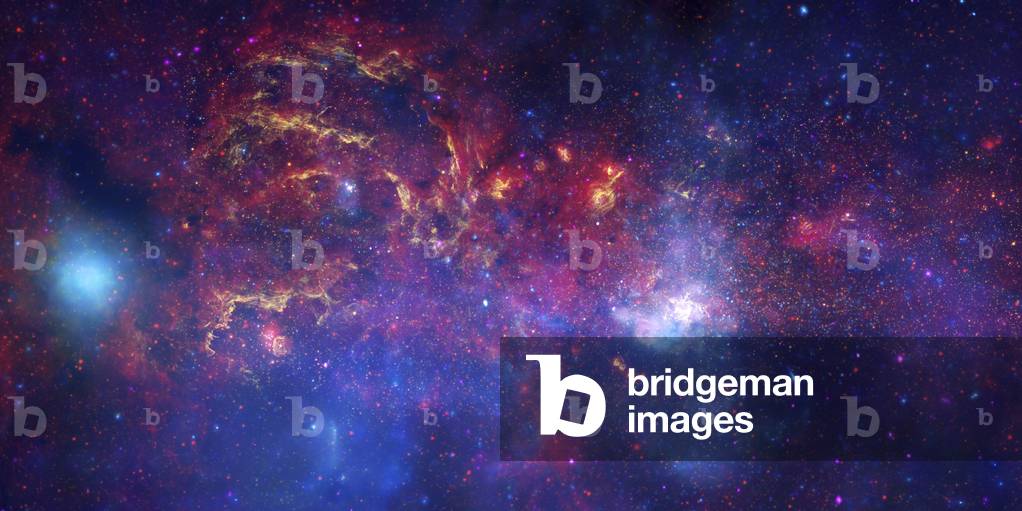
Galactic Center Region - The Galactic Center - The Galactic Center Region of the center of our galaxy seen the Chandra, Spitzer and Hubble satellites. The galactic center (Sagittarius A*) is located in the white area in the middle to the right of the image. In yellow, near-infrared images obtained by the Hubble Space Telescope; in red, infrared images obtained by the Spitzer Space Telescope; in blue and purple, X-ray observations obtained by the Chandra Space Telescope. Nasa's Great Observatories - the Hubble Space Telescope, the Spitzer Space Telescope, and the Chandra X-ray Observatory - have collaborated to produce an unprecedented image of the central region of our Milky Way galaxy. In this spectacular image, observations using infrared light and X-ray light see through the obscuring dust and reveal the intense activity near the galactic core. Note that the center of the galaxy is located within the bright white region to the right of and just below the middle of the image. The entire image width covers about one-half a degree, about the same angular width as the full moon. Each telescope's contribution is presented in a different color: - Yellow represents the near-infrared observations of Hubble. These observations outline the energetic regions where stars are being born as well as reveal hundreds of thousands of stars. - Red represents the infrared observations of Spitzer. The radiation and winds from stars create glowing dust clouds that exhibit complex structures from compact, spherical globules to long, stringy filaments. - Blue and violet represent the X-ray observations of Chandra. X-rays are emitted by gas heated to millions of degrees by stellar explosions and by outflows from the supermassive black hole in the galaxy's center. The bright blue blob on the left side is emission from a double star system containing either a neutron star or a black hole. When these views are brought together, this composite image provides one of the most detailed
Orion's Trapeze - Trapezium Multiple Star System in Orion - Orion's Trapeze is one of the youngest open clusters known, with new stars still forming in this region. The Trapezium is the most famous multiple star system in the entire night sky. Located at the very heart of M42, the Orion Nebula, it is one of the youngest star clusters known. The four brightest stars in the Trapezium (A, B, C and D) are easily visible in a four inch telescope with decent optical quality under good seeing conditions. They range in brightness from magnitude 5 to magnitude 8. They can be seen merged together as one star to the unaided eye as the middle star in the sword of Orion. The image above shows the four brightest stars of the Trapezium at the center of the photo. The core of M42 surrounding the Trapezium is a blue - green color from the predominantly green spectral emission line of Oxygen III, with a smaller amount of blue - green mixed in from the hydrogen - beta emission line. These particular wavelengths also happen to be the wavelengths to which the human visual system is most sensitive for color vision. Much of the rest of the Orion Nebula has a lot of red hydrogen - alpha emission, but the eye is not very sensitive to this wavelength. Some red can be seen in the brightest parts of the nebula that emit hydrogen - alpha light by observers with sensitive color vision. For most people however, if they see any color at all, it will be a very pale green, or blue - green, from the Oxygen III spectral lines
Nebula NGC 3372 in the Carene - The Carina nebula - The Carene nebula is located about 8000 years from the Earth. It is home to many hot stars, including the massive star Eta Carinae in the centre of the nebula. Image obtained from the 1.2m Schmidt UK telescope of Siding Spring. Although no bright naked - eye stars are associated with the Carina nebula now, 150 years ago there blazed forth here one of the most unusual and peculiar stars ever seen. The star is known as Eta Carinae and for a few months in 1843 it was the second or third brightest star in the sky. Since then it has faded and is today about 1000 times fainter than it was at its brightest as the nebula it created during its outburst has cooled and become opaque. The whole region around Eta Carinae is rich in hot stars of which Eta is an extreme example and it is their combined radiation that produces the spectacular Carina nebula that dominates this picture. The nebula and its peculiar star are about 8000 light years away
Super massive star Eta Carinae - Super massive star Eta Carinae - Eta Carinae is one of the most massive stars in our galaxy. Its mass would be about 120 times that of the Sun with a diameter 1000 times larger than our star. The image obtained by the Hubble space telescope reveals two expanding gas lobes; it is the nebula called the Homuncule, vestige of a huge explosion that the star experienced 150 years ago. The star blows its exterior atmosphere and will eventually explode in a supernova. Eta Carinae is located approximately 8000 light years from Earth in the southern constellation of Carene. A huge, billowing pair of gas and dust clouds is captured in this stunning Hubble telescope picture of the super - massive star Eta Carinae. Even though Eta Carinae is more than 8,000 light - years away, features 10 billion miles across (about the diameter of our solar system) can be distinguished. Eta Carinae suffered giant outburst about 150 years ago, when it became one of the brightest stars in the southern sky. Although the star released as much visible light as a supernova explosion, it survived the outburst. Somehow, the explosion produced two lobes and a large, thin equatorial disk, all moving outward at about 1.5 million miles per hour. Estimated to be 100 times heftier than our Sun, Eta Carinae may be one of the most massive stars in our galaxy
Massive stars in the Carene - Massive stars in the Carina Nebula - Detail of the nebula of the Carene, located about 7500 years ago - light from Earth, obtained by the Hubble space telescope. The image shows down the image a cluster of stars named Trumpler 16 which contains two very massive stars, WR 25 at Tr16 - 244. The image shows a pair of colossal stars, WR 25 and Tr16 - 244, located within the open cluster Trumpler 16, at the bottom of the image. This cluster is embedded within the Carina Nebula, an immense cauldron of gas and dust that lies approximately 7500 light - years from Earth in the constellation of Carina, the Keel. At the top of the image, a peculiar nebula with the shape of a “” defiant”” finger points towards WR25 and Tr16 - 244
Nebula NGC 6164-5 in the Rule - The emission nebula NGC 6164-65: This nebula is located about 4000 light years from Earth. It is a bipolar nebula around a very hot star at the end of life, the star HD 148937 - NGC 6164-65 is a bipolar nebula surrounding the peculiar O 7f star HD 148937. Although the nebula was believed initially to represent a planetary nebula, it is now understood to represent a shell-like ejected nebula, formed by the winds of its young central star. Wind blown nebulae are usually considered the outcome of Wolf-Rayet type stars (WR), evolved O-type stars that have left the main sequence, molding their surroundings by way of fierce stellar winds. In the case of the S-shaped bipolar nebula NGC 6164-65, the central star is not a WR star, but a young O-type supergiant of 40 solar masses. Relatively few examples of such objects are known to exist, making NGC 6164-65 particularly unique. The true age of the star is not known although estimates of its age vary from a pre-main sequence age of 350,000 years to a more evolved age of one to two million years. HD 148937 is a peculiar type of Of star with exotic emission lines (carbon emission lines (CIII) equal in strength to Nitrogen (NIII)) and other peculiar spectra indicative of significant mass loss. Only five such stars are known to exist, three in our galaxy and two in Small Magellanic Cloud
Orion Nebula - the trapeze - The Trapezium region in M42 - Located 1500 years - light, Orion Nebula is the closest region of formation of stars of the Sun. In the center of the picture, the Trapeze of Orion. The Trapeze is among the youngest known open clusters, it is made up of 4 massive stars that make the nebula shine. Image obtained from the 1.5m Danish telescope of La Silla in Chile. The central 'star' of the three groups forming the asterism of Orion's sword is in reality a nebula, and is clearly nebulous to the unaided eye. At the heart of the most luminous nebulosity shimmer a handful of stars known as the Trapezium cluster, visible in binoculars. These are the brightest members of a substantial cluster of stars, most of which are still hidden in the dusty recesses of the Orion nebula against which they are seen. The stars of the Trapezium provide much of the energy which makes the brilliant Orion Nebula visible and are at a distance of about 1500 light years. This image was made at the danish 1.5 meter telescope in La Silla, Chile
Interacting galaxies NGC 4038 - 4039 in the Raven - NGC 4038 - 39, the interacting galaxies of the Antennae - On the left, an image of the galaxy NGC 4038 - 39 (antenna galaxy), obtained from the ground. On the right, a detail photograph by the Hubble space telescope showing young blue stars and numerous galaxies in the background. Located about 45 million years ago - light, NGC 4038 and NGC 4039 interact. The collision started at least 100 million years ago causes intense star formation. NGC 4038 and 4039 are the well - known pair of interacting galaxies that show two broadly curved tails of stars, the 'antenna', extending a considerable distance from the action. Massive star formations are resulting of a recent collision between two galaxies (100 million years ago). This galaxy is located 45 million light year from us. At left, an image taken from the ground, at right, an image taken by the Hubble space telescope showing young blue stars and several galaxies in background
Nebula NGC 7023 in Cephee - NGC 7023 (The Iris Nebula) in Cepheus - The Iris Nebula (NGC 7023) is a reflexion nebula illuminated by the massive star HD 200775. The bright star HD 200775 shining through the nebula NGC 7023 is a 10 solar mass star centrally imbedded in a region surrounded by ambient molecular cloud material. Suns are born from vast clouds of dust and gas that gather in the dark places between the stars. Gravity causes these interstellar vapors to collapse inward until the pressure causes high enough temperatures at its center to fuse hydrogen, the university's basic building block, into helium - an event that also releases gamma - ray photons. These photons can take a million years to travel outward through the overlying matter until they reach the surface and escape into space as visible light. The push of the photon's rush to make an exit also stops the cloud's collapse and thus what began as thin gas and dust becomes a brilliant star illuminating the heavens and possibly warming near - by planets. This picture shows a place in deep space where these kinds of events have occurred. The brilliant star near the center of the picture is young and very hot - in relative terms, it was only recently created. The cloud from which it formed still surrounds this young Sun but is being blown away by the push of star's massive radiation. This picture shows the way it looked 1,300 years ago due to the distance that separates it from Earth and the speed that light travels
Nebula NGC 6164 - 5 in the Rule - The field around NGC 6164 - 65 - This nebula is located about 4000 years from Earth. It's a bipolar nebula around a hot O star at the end of life. Image obtained by Siding Spring's 3.9m telescope. Very hot, massive stars lose substantial amounts of matter from their surfaces during much of their brief lives. Mass - loss is usually a fairly steady process but some stars occasionally develop instabilities and have major outbursts. This star has thrown off at least two distinct lots of material during its lifetime, the brightest and most recent being the bright lobes of NGC 6164 - 5 at the centre of the picture while a much fainter rim of nebulosity can be seen at a considerable distance from the central star, indicating an earlier episode of violent ejection. The nebula is at a distance of about 4200 light years
Detail of the nebula NGC 3372 in the Carene - Eta Carinae nebula detail - Detail of the nebula NGC 3372 near the star Eta Carinae (off field). Region of star formation. Image obtained by the Hubble Space Telescope in April 1999. The Hubble Space Telescope image reveals complex structure in the Carina Nebula (NGC 3372). The picture is dominated by a large, approximately circular feature, which is part of the Keyhole Nebula. This region, about 8000 light - years from Earth, is located adjacent to the famous explosive variable star Eta Carinae, which lies just outside the field of view towards the upper right. The Carina Nebula also contains several other stars that are among the hottest and most massive known, each about 10 times as hot, and 100 times as massive, as our Sun
Center of the Orion Nebula - Trapeze - Orion nebula center - Mosaic of infrared images showing the center of the Orion Nebula, the Trapeze region. 4 massive stars form the Trapeze but the image also shows the cluster of stars associated with it, constitutes a thousand stars of about 1 million years old. Mosaic of 81 infrared images obtained by the ISAAC instrument at the VLT. Colour composite mosaic image of the central part of the Orion Nebula, based on 81 images obtained with the infrared multi - mode ISAAC instrument on the ESO Very Large Telescope (VLT) at the Paranal Observatory. The famous Trapezium stars are seen near the centre and the photo also shows the associated cluster of about one thousand stars, about a million years old
Nebula NGC 6164 - 5 in the Rule - The emission nebula NGC 6164 - 65 - This nebula is located about 4000 years - light from Earth. It is a bipolar nebula around a very hot star at the end of life, the star HD 148937. NGC 6164 - 65 is a bipolar nebula surrounding the peculiar O 7f star HD 148937. Although the nebula was believed initially to represent a planetary nebula, it is now understood to represent a shell - like ejected nebula, formed by the winds of its young central star. Wind blown nebulae are usually considered the outcome of Wolf - Rayet type stars (WR), evolved O - type stars that have left the main sequence, molding their surroundings by way of fierce stellar winds. In the case of the S - shaped bipolar nebula NGC 6164 - 65, the central star is not a WR star, but a young O - type supergiant of 40 solar masses. Relatively few examples of such objects are known to exist, making NGC 6164 - 5 particularly unique. The true age of the star is not known although estimates of its age vary from a pre - main sequence age of 350,000 years to a more evolved age of one to two million years. HD 148937 is a peculiar type of Of star with exotic emission lines (carbon emission lines (CIII) equal in strength to Nitrogen (NIII)) and other peculiar spectra indicative of significant mass loss. Only five such stars are known to exist, three in our galaxy and two in Small Magellanic Cloud
Interacting galaxies NGC 4038 - 4039 in the Raven - The Antennae galaxy in Corvus - On the left, seen from the ground of the galaxy NGC 4038 - 39 (antenna galaxy), located about 45 million years ago - light. These two galaxies are interacting. The collision started at least 100 million years ago causes intense star formation. On the right, the image made by the space telescope Hubble on 20 January 1996 shows in detail the nuclei of these two twin galaxies surrounded by young clusters of blue stars, more than 1000, made up of young and massive stars. At left, a ground - based telescopic view of the Antennae galaxies (known formally as NGC 4038/4039) - so named because a pair of long tails of luminous matter, formed by the gravitational tidal forces of their encounter, resemble an insect's antennae. The galaxies are located 45 million light - years away in the southern constellation Corvus. At right, the respective cores of the twin galaxies are the orange blobs, left and right of image center, crisscrossed by filaments of dark dust. A wide band of chaotic dust, called the overlap region, stretches between the cores of the two galaxies. The sweeping spiral - like patterns, traced by bright blue star clusters, shows the result of a firestorm of star birth activity which was triggered by the collision. This natural - color image is a composite of four separately filtered images taken with the Wide Field Planetary Camera 2, on January 20, 1996
Interacting galaxies NGC 4038 - 4039 in the Raven - The Antennae galaxy in Corvus - Image of the galaxy NGC 4038 - 39 (antenna galaxy), located about 45 million years ago - light. These two galaxies are interacting. The collision started at least 100 million years ago causes intense star formation. Image obtained by the Hubble Space Telescope. The two spiral galaxies started to interact a few hundred million years ago, making the Antennae galaxies one of the nearest (about 45 million light years away) and youngest examples of a pair of colliding galaxies. Almost half of the faint objects in the Antennae image are young clusters containing tens of thousands of stars. The orange blobs to the left and right of image center are the two cores of the original galaxies and consist mainly of old stars criss - crossed by filaments of dust, which appears brown in the image. The two galaxies are dotted with brilliant blue star - forming regions surrounded by glowing hydrogen gas, appearing in the image in pink. Image taken with the Hubble space telescope
Open cluster Westerlund 1 in the Altar - Open cluster Westerlund 1 in Ara - The open cluster Westerlund 1 is located about 16,000 years - light in the southern constellation of the Altar. It contains hundreds of very young massive stars as well as the supergiant red star W26. Image obtained by the VST telescope in Chile. This exceptionally bright cluster lies about 16 000 light - years from Earth in the southern constellation of Ara (The Altar). It contains hundreds of very massive and brilliant stars, all of which are just a few million years old - - babies by stellar standards. But our view of this cluster is hampered by gas and dust that prevents most of the visible light from the cluster's stars from getting to Earth. Around one of the stars - - known as W26, a red supergiant and possibly the biggest star known - - astronomers have discovered clouds of glowing hydrogen gas, shown as green features in this new image. Such glowing clouds around massive stars are very rare, and are even rarer around a red supergiant - - this is the first ionised nebula discovered around such a star. W26 itself would be too cool to make the gas glow; the astronomers speculate that the source of the ionising radiation may be either hot blue stars elsewhere in the cluster, or possibly a fainter, but much hotter, companion star to W26. W26 will eventually explode as a supernova. The nebula that surrounds it is very similar to the nebula surrounding SN1987A, the remnants of a star that went supernova in 198
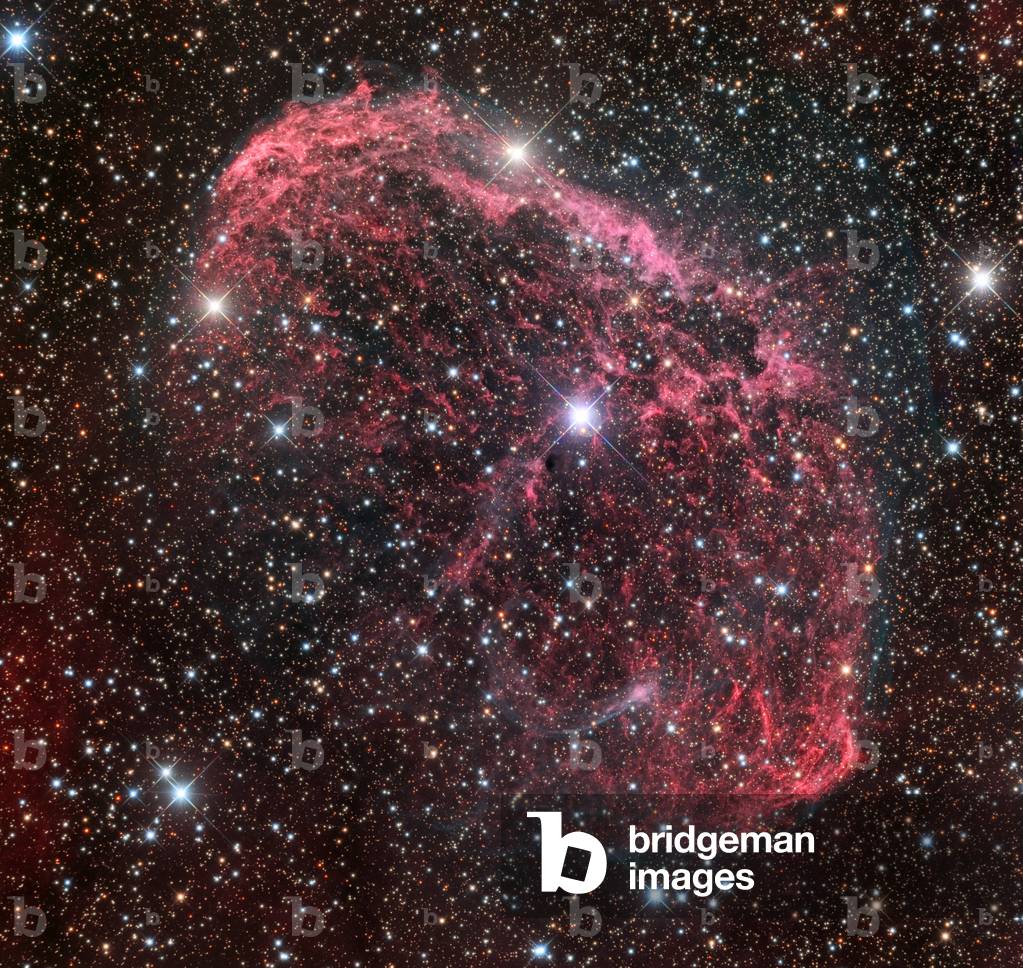
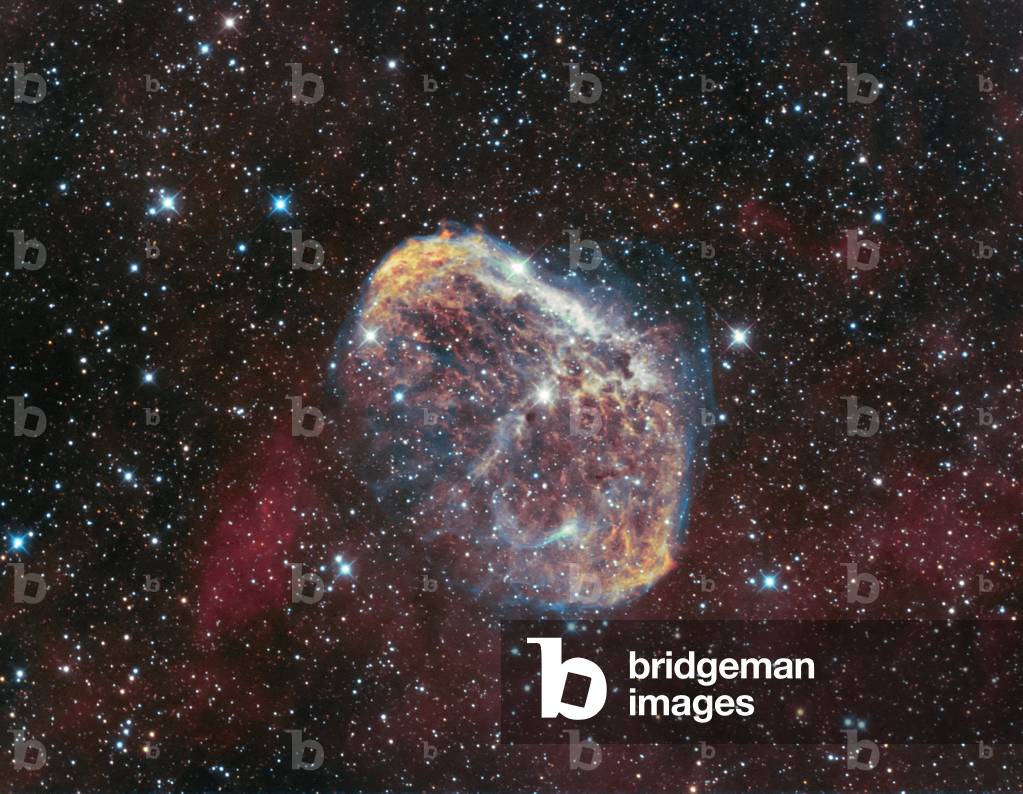
Nebula of the crescent NGC 6888 in the Swan - Crescent nebula in Cygnus - NGC 6888 the nebula of the Crescent. This nebula is a gas shell located in the constellation Swan. The bright star in the center of the nebula is the star WR 136, a star of Wolf - Rayet, massive, very hot. The nebula is a shell of gas that is being energized by the strong stellar wind from the Wolf - Rayet star WR 136, the bright star at the center of the nebula. It is located about 5,000 light years from Earth in the constellation of Cygnus, the Swan. Wolf - Rayet stars are very hot, massive stars that are blowing off their outer layers
Detail of nebula NGC 3372 in Carene - Eta Carinae nebula detail - Detail of nebula NGC 3372 in the constellation Carene. Within the dark structures visible in this image, stars will be born. Image obtained by the Hubble Space Telescope in 2005 and 2010. These one - light - year - tall pillars of cold hydrogen and dust, imaged by the Hubble Space Telescope, are located in the Carina Nebula. Violent stellar winds and powerful radiation from massive stars are sculpting the surrounding nebula. Inside the dense structures, new stars may be born. This image of dust pillars in the Carina Nebula is a composite of 2005 observations taken of the region in hydrogen light (light emitted by hydrogen atoms) along with 2010 observations taken in oxygen light (light emitted by oxygen atoms), both times with Hubble's Advanced Camera for Surveys. The immense Carina Nebula is an estimated 7,500 light - years away in the southern constellation Carina
Nebula NGC 3372 in the Carene - Carina nebula NGC 3372 - The Carene nebula is located about 7500 years from the Earth. It is home to many hot stars, including the massive star Eta Carinae at the bottom left of the image, the clusters of young stars Trumpler 14 (above the right of eta carinae) and Collinder 228 (below eta carinae). Image obtained by the 2.2m ESO/MPG telescope of the La Silla Observatory in Chile. Colour - composite image of the Carina Nebula, revealing exquisite details in the stars and dust of the region. Several well known astronomical objects can be seen in this wide field image: to the bottom left of the image is one of the most impressive binary stars in the Universe, Eta Carinae, with the famous Keyhole Nebula just adjacent to the star. The collection of very bright, young stars above and to the right of Eta Carinae is the open star cluster Trumpler 14. A second open star cluster, Collinder 228 is also seen in the image, just below Eta Carinae. North is up and East is to the left. The field of view is 0.55 x 0.55 degrees, covering a 144 x 144 light - year region at the distance of the nebula. This image was produced by combining exposures through six different filters from the Wide Field Imager (WFI), attached to the 2.2 m ESO/MPG telescope at Eso's La Silla Observatory, in Chile
Massive Stars in the Carene - Massive stars in the Carina Nebula - The image shows a cluster of stars named Trumpler 16 which contains two very massive stars, WR 25 at Tr16 - 244. WR 25 is the brightest star on the image. It is a double star composed of a star at least 50 times more massive than the Sun. Tr16 - 244 is the third brightest star in this image (top left of WR 25). It's a triple star. The second bright star in the image, to the left of WR 25, is a small star, which does not belong to this cluster and is located much closer to us. The Carene Nebula is located about 7500 years from Earth
The cluster of stars Pismis 24 in the Scorpio - Pismis 24 star cluster in Scorpius - This image obtained by the Hubble space telescope shows the cluster of young stars Pismis 24, located about 8000 years - light in the nebula NGC 6357 of the Scorpio. This cluster houses a star that was thought to be the most massive star in our galaxy, between 200 and 300 solar masses (the brightest star in the top center of the image). The measurements obtained by the Hubble telescope showed that this star, Pismis 24 - 1, was actually a double star and that its mass was actually only about 100 solar masses. The small open star cluster Pismis 24 lies in the core of the large emission nebula NGC 6357 in Scorpius, about 8,000 light - years away from Earth. Some of the stars in this cluster are extremely massive and emit intense ultraviolet radiation. The brightest object in the picture is designated Pismis 24 - 1. It was once thought to weigh as much as 200 to 300 solar masses. This would not only have made it by far the most massive known star in the galaxy, but would have put it considerably above the currently believed upper mass limit of about 150 solar masses for individual stars. Hubble space telescope images of the star show that it is really two stars orbiting one another (inset pictures at top right and bottom right). They are estimated to each be 100 solar masses
Nebula NGC 7635 in Cassiopee - The Bubble Nebula (NGC 7635) in Cassiopeia - This nebula is located about 7100 years - light from Earth. A star 40 times more massive than our Sun, called Wolf - Rayet, is responsible for the formation of this bubble; it is the star BD+60* 2522. The Bubble Nebula in Cassiopeia is one of the most dramatic emission nebulae visible in the northern hemisphere. Lying at a distance of about 7,000 light - years away and spanning six light - years in diameter, NGC 7635 is quite bright with a magnitude of 7.0. The star in the middle of the bubble, BD+602522, is responsible for this stunning site, for this very hot star emits so much UV radiation that it is able to also heat and excite the surrounding dust and gas, thus emitting its own radiation. It is a Wolf - Rayet star, a very luminous star and also very short - lived. This Wolf - Rayet star is 40 times as massive than our sun
Nebula of the crescent NGC 6888 in the Swan - Crescent nebula in Cygnus - NGC 6888, the nebula of the Crescent. This nebula is a gas shell located in the constellation Swan. The bright star in the center of the nebula is the star WR 136, a star of Wolf - Rayet, massive, very hot. The nebula NGC 6888 is a shell of gas that is being energized by the strong stellar wind from the Wolf - Rayet star WR 136, the bright star at the center of the nebula. It is located in the constellation of Cygnus, the Swan. Wolf - Rayet stars are very hot, massive stars that are blowing off their outer layers
Interacting galaxies NGC 4038 - 4039 in the Raven - NGC 4038 - 39, the interacting galaxies of the Antennae - Image of the galaxy NGC 4038 - 39 (antenna galaxy), located about 45 million years ago - light. These two galaxies are interacting. The collision started at least 100 million years ago causes intense star formation. NGC 4038 and 4039 are the well - known pair of interacting galaxies that show two broadly curved tails of stars, the 'antenna', extending a considerable distance from the action. Massive star formations are resulting of a recent collision between two galaxies (100 million years ago). This galaxy is located 45 million light year from us
Interacting galaxies NGC 4038 - 4039 in the Raven - NGC 4038 - 39, the interacting galaxies of the Antennae - Image of the galaxy NGC 4038 - 39 (antenna galaxy), located about 45 million years ago - light from Earth. These two galaxies are interacting. The collision started at least 100 million years ago causes intense star formation. NGC 4038 and 4039 are the well - known pair of interacting galaxies that show two broadly curved tails of stars, the 'antenna', extending a considerable distance from the action, as seen here. The colour picture reveals the burst of star formation triggered by the encounter, the large numbers of pink emission nebulae in the inter - galaxy region and the location of the numerous dark, brownish - yellow clouds of dust
Nebula NGC 3372 in the Carene - The Eta Carinae Nebula and Trumpler 14 - The Carene nebula is located about 7000 years from the Earth. It is home to many hot stars, including the star Eta Carinae (lower left, the brightest star in the picture). Top right is a cluster of young stars, Trumpler 14. Image obtained by Siding Spring's 3.9m telescope. In the small region pictured here are three of the brightest stars known in our Galaxy, each a million times more luminous than the Sun. To the left of the picture is an even more extreme star, Eta Carinae itself, shrouded in a small bright irregular nebula of its own making. In the upper right of the photograph is Trumpler 14, a cluster of very young stars which appears to be associated with a number of bright - edged 'elephant trunk' dust lanes, typical of star - forming regions. All these objects and most of the bright stars scattered across the face of the nebula are together in space at a distance of about 7000 light years. Despite this distance, the Carina nebula is clearly visible to the unaided eye to those of us who live in the southern hemisphere
Nebula NGC 3372 in the Carene - NGC 3372 Carina nebula - The Carene Nebula (NGC 3372) is a very large region of star formation visible in the southern hemisphere. Image obtained through 3 different filters that highlight oxygen (blue), hydrogen (green), and sulfur (red). The bright star in the center of the image is Eta Carinae, a super massive star. The Carina Nebula (also known as the Great Nebula in Carina, the Eta Carinae Nebula, or NGC 3372) is a large bright nebula that surrounds several open clusters of stars. Eta Carinae and HD 93129A, two of the most massive and luminous stars in our Milky Way galaxy, are among them. The nebula lies at an estimated distance between 6,500 and 10,000 light years from Earth. It is located in the constellation of Carina. The nebula contains multiple O - type stars. This nebula is one of the largest H II regions in the Milky Way. It has a visual magnitude of 1.0. The nebula is one of the largest diffuse nebulae in our skies. Although it is some four times as large and even brighter than the famous Orion Nebula, the Carina Nebula is much less well known, due to its location far in the Southern Hemisphere. It was discovered by Nicolas Louis de Lacaille in 1751 - 52 from the Cape of Good Hope. This is an amazingly bright nebula. This image is in the classic “” Hubble palette”” where SII is assigned to red, H - alpha to green, and OIII to blue. RGB frames were taken for star colors
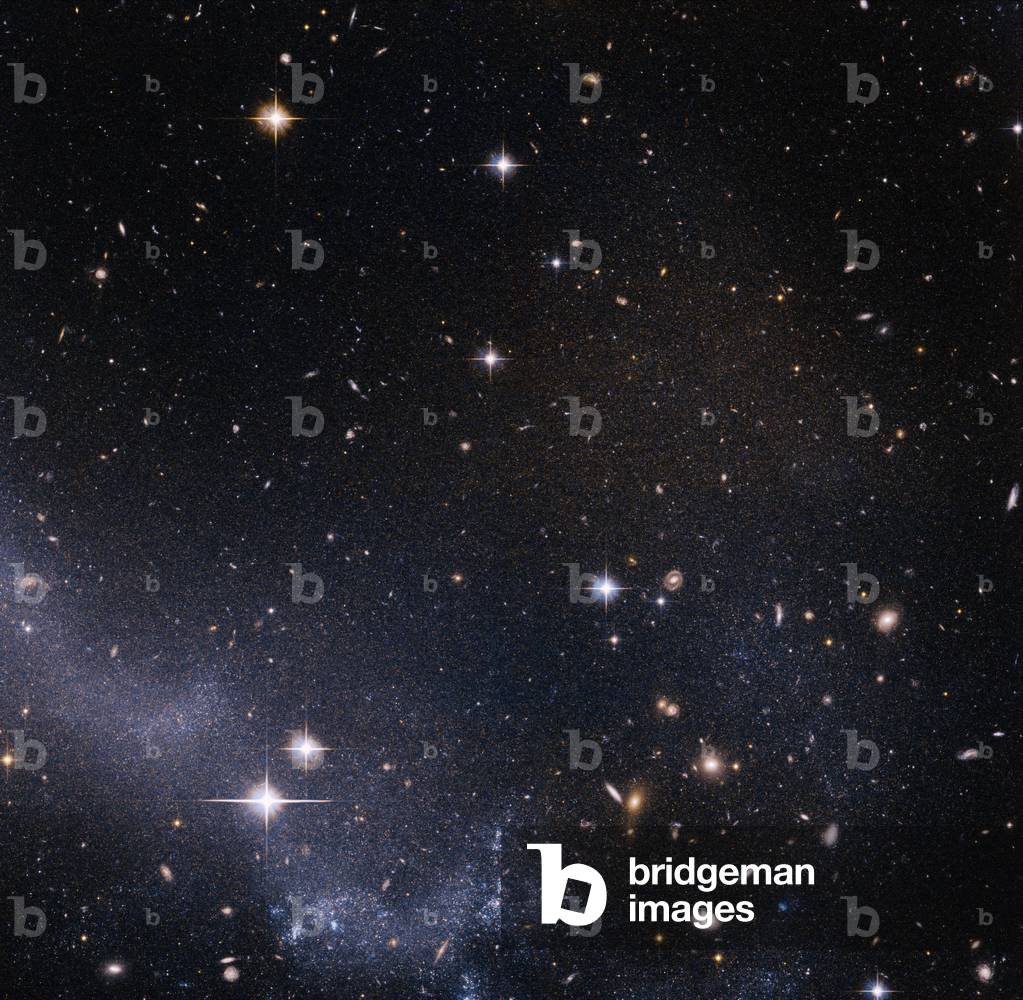
Star Field in the Antenna Galaxy - Starfield in the Antennae - Detail in the Antenna Galaxy (NGC 4038 - 4039) photograph by the Hubble space telescope showing young blue stars as well as many galaxies in the background. Located about 45 million years ago - light, NGC 4038 and NGC 4039 interact. The collision started at least 100 million years ago causes intense star formation. NGC 4038 and 4039 are the well - known pair of interacting galaxies that show two broadly curved tails of stars, the 'antenna', extending a considerable distance from the action. Massive star formations are resulting of a recent collision between two galaxies (100 million years ago). This galaxy is located 45 million light year from us. Here is an image taken by the Hubble space telescope showing young blue stars and several galaxies in background
Interacting galaxies NGC 4038 - 4039 in the Raven - NGC 4038 - 39, the interacting galaxies of the Antennae - Image of the galaxy NGC 4038 - 39 (antenna galaxy), located about 45 million years ago - light from Earth. These two galaxies are interacting. The collision started at least 100 million years ago causes intense star formation. NGC 4038 and 4039 are the well - known pair of interacting galaxies that show two broadly curved tails of stars, the 'antenna', extending a considerable distance from the action, as seen here. The colour picture reveals the burst of star formation triggered by the encounter, the large numbers of pink emission nebulae in the inter - galaxy region and the location of the numerous dark, brownish - yellow clouds of dust. The yellow nuclei of the two galaxies are also still visible in the colour picture as separate entities
Nebula of the crescent NGC 6888 in the Swan - NGC 6888 The Crescent Nebula - NGC 6888 Nebula of the Crescent. This nebula is a gas shell located in the constellation Swan. The bright star in the center of the nebula is the star WR 136, a star of Wolf - Rayet, massive, very hot. The nebula is a shell of gas that is being energized by the strong stellar wind from the Wolf - Rayet star WR 136, the bright star at the center of the nebula. It is located in the constellation of Cygnus, the Swan. Wolf - Rayet stars are very hot, massive stars that are blowing off their outer layers
Nebula NGC 7635 in Cassiopee - Bubble Nebula (NGC 7635) in Cassiopeia - This nebula is located about 7100 years - light from Earth. A massive star, called Wolf - Rayet, is responsible for the formation of this bubble; it is the star BD+60* 2522. The Bubble Nebula in Cassiopeia is one of the most dramatic emission nebulae visible in the northern hemisphere. Lying at a distance of about 7,000 light - years away and spanning six light - years in diameter, NGC 7635 is quite bright with a magnitude of 7.0. The star in the middle of the bubble, BD+602522, is responsible for this stunning site, for this very hot star emits so much UV radiation that it is able to also heat and excite the surrounding dust and gas, thus emitting its own radiation. It is a Wolf - Rayet star, a very luminous star and also very short - lived. This Wolf - Rayet star is 40 times as massive than our sun
Nebula NGC 2359 in the Big Dog - NGC 2359 nebula in Canis Major - NGC 2359 is a nebula in the Big Dog that houses a star Wolf - Rayet, HD 56925. NGC 2359 (Thor's Helmet) is a prototypical wind blown bubble powered by the extremely massive and unstable Wolf - Rayet star HD 56925. These types of stars (only about 300 are known presently) represent a late evolutionary phase of massive O - type blue giants which have become unstable in the late stages of their short stellar life
Artist's view of a fugitive star - A runaway star in the Large Magellanic cloud - The star HE0457 - 5439 is a massive star in the Grand Cloud of Magellan; it is a star escaping from this galaxy at a speed of 2.6 Million km/h Background image obtained at the observatory of La Silla in Chile; the star fleeing has been added on the image. The star HE0457 - 5439 is a massive star wich lies closer to one of the Milky Way satellite galaxies, the Large Magellanic Cloud, located 160,000 light - years away from us. This is a runaway star, moving at more than 2.6 million kilometers per hour. Astronomers find it likely for the star to have reached its present position had it been ejected from the centre of the LMC. The background image has been obtained at La Silla observatory, the star moving has been added
Clubs R136 in the Tarantula Nebula (NGC 2070) - Central region of the Tarantula Nebula - The Tarantula Nebula (or 30 Bream) is the largest star-forming region of the Magellan Cloud. It is located 170,000 light years ago in the constellation Dorado (southern hemisphere). In the center of this nebula, the open cluster of R136 stars (on the right), clusters of young, hot and massive stars, age barely 5 million years. Image obtained by the Hubble Space Telescope in October 2009. The Tarantula is situated 170,000 light - years away in the Large Magellanic Cloud (LMC) in the southern sky and is clearly visible to the naked eye as a large milky patch. To thr right of the image there is a huge cluster of very hot stars called R136. The stars in R136 are also among the most massive stars we know. R136 is also a very young cluster, its oldest stars being 'just' 5 million years old or so. Its smallest stars, however, are still forming. The image, taken in ultraviolet, visible, and red light by Hubble's Wide Field Camera 3, spans about 100 light - years. The Hubble observations were taken Oct. 20 - 27, 2009. The blue color is light from the hottest, most massive stars; the green from the glow of oxygen; and the red from fluorescing hydrogen
Heart of the nebula NGC 3372 in the Carene - Eta Carinae and the Keyhole Nebula - The nebula of the Carene is located about 7000 years - light from the Earth. It is home to many hot stars, including the star Eta Carinae visible in the centre left of the image. Eta Carinae is a supermassive star (100 to 150 times the mass of the Sun). Image obtained by Siding Spring's 3.9m telescope. This wonderfully complex region at the heart of the NGC 3372 nebula was first described in detail by Sir John Herschel in 1838. He saw the bright circular shell visible in the upper part of the picture extending to the south to form a keyhole - shaped nebula. This luminous outline is no longer seen and the southern extension appears only as a dark dust cloud. It seems that the curious, explosively variable star Eta Carinae has enveloped itself in a cocoon of obscuring matter in the years since Herschel's observations and light from the star is no longer able to illuminate the rim of the dust cloud. The nebula thrown off by eta Car in Herschel's time has grown to the tiny orange nebula seen to the left of the dust cloud and is known as the Homunculus nebula
Nebula NGC 3372 in the Carene - NGC 3372, Eta Carinae nebula - The nebula of the Carene is located about 8000 years - light from the Earth. It is home to many hot massive stars, including the star Eta Carinae in the centre of the nebula. This nebula is larger than the Great Nebula in Orion, but is not visible from most northern latitudes. It is a giant complex of emission and dark nebulae surrounding the unique variable star Eta Carinae, which scientists believe is the most massive and energetic star in the Milky Way galaxy. Located about 8,500 light years from the Earth, the star is about 100 times as massive as our own Sun, but produces 6 million times the light output. It was observed producing a remarkable burst of X - ray emissions that doubled its X - ray output in only four months. In the 1840's, Eta Carinae erupted visibly and was the second brightest star in the sky during this time
Interacting galaxies NGC 4038 - 4039 in the Raven - The Antennae galaxy in Corvus - The galaxy NGC 4038 - 39 (antenna galaxy) is located about 45 million years ago - light. These two galaxies are interacting. The collision started at least 100 million years ago causes intense star formation. These images made by the Hubble space telescope on 20 January 1996 show in detail the nuclei of these two twin galaxies (right) as well as clusters of blue stars, consisting of young and massive stars (left). The scale bar at the top of each image represents 1500 years - light. These four close - up views are taken from a head - on collision between two spiral galaxies, called the Antennae galaxies, seen at image center. The scale bar at the top of each image is 1,500 light - years across. Left: the collision triggers the birth of new stars in brilliant blue star clusters, the brightest of which contains roughly a million stars. The star clusters are blue because they are very young, the youngest being only a few million years old, a mere blink of the eye on the astronomical time scale. <BR>Right: these close - up views of the cores of each galaxy show entrapped dust and gas funneled into the center. The nucleus of NGC 4038 (lower right) is obscured by dust which dims and reddens starlight by scattering the shorter, bluer wavelengths. This is also the reason the young star clusters in the dusty regions appear red instead of blue. This natural - color image is a composite of four separately filtered images taken with the Wide Field Planetary Camera 2 on January 20, 1996
Nebula NGC 3372 in the Carene - The Carina nebula, NGC 3372 - The Carene nebula is located about 7000 years from the Earth. It is home to many hot stars, including the star Eta Carinae in the centre of the nebula. Image obtained by Siding Spring's 3.9m telescope. The brightest part of the Milky Way, as seen by the unaided eye, lies in the southern constellation Carina. Here there are an unusually large number of young, hot stars. Their radiation is rich in energetic ultraviolet light. Many of these stars were born within the spectacular Carinae nebula, seen here. The nebula is a cloud of glowing gas composed mostly of hydrogen. It excited by ultrviolet light from the embedded stars. This dostictive emission radiation is responsible for the red colour. About a quarter of the nebula is made of helium gas, the second most abundant element in the universe after hydrogen, and all the other chemical elements account for only a few percent of the total mass. The brightest star in the nebula is known as eta Carinae. This remarkable object is one of the most luminous and most massive stars known
Interacting galaxies NGC 4038 - 4039 in the Raven - NGC 4038 - 39, the interacting galaxies of the Antennae - Image of the galaxy NGC 4038 - 39 (antenna galaxy), located about 45 million years ago - light. These two galaxies are interacting. The collision started at least 100 million years ago causes intense star formation. NGC 4038 and 4039 are the well - known pair of interacting galaxies that show two broadly curved tails of stars, the 'antenna', extending a considerable distance from the action. Massive star formations are resulting of a recent collision between two galaxies (100 million years ago). This galaxy is located 45 million light year from us
Interacting galaxies NGC 4038 - 4039 in the Raven - NGC 4038 - 39, the interacting galaxies of the Antennae - Image of the galaxy NGC 4038 - 39 (antenna galaxy), located about 45 million years ago - light from Earth. These two galaxies are interacting. The collision started at least 100 million years ago causes intense star formation. NGC 4038 and 4039 are the well - known pair of interacting galaxies that show two broadly curved tails of stars, the 'antenna', extending a considerable distance from the action. The colour picture reveals the burst of star formation triggered by the encounter, the large numbers of pink emission nebulae in the inter - galaxy region and the location of the numerous dark, brownish - yellow clouds of dust. The yellow nuclei of the two galaxies are also still visible in the colour picture as separate entities
Nebula N44 in the Great Magellan Cloud - Henize 44, an emission nebula in the LMC - Vast region of star formation located in the Great Magellan Cloud. Image obtained by the 1.2m Schmidt UK Telescope from Siding Spring. The nearby Large Magellanic Cloud (LMC) is a very active star - forming galaxy. The most massive region of star formation is around 30 Doradus (the Tarantula nebula) which can be seen with the unaided eye, but hundreds of lesser examples are visible with a telescope. This picture shows Henize 44. The energetic ultraviolet light from these stars is absorbed by hydrogen and produces the distinctive red glow from an enormous distance around the cluster. Image obtained with the Schmidt UK telescope of Siding Spring
Nebula IC 2220 in the Carene - The IC 2220, nebula, deep image - This nebula is illuminated by a large red star, the star HD 65670. Image obtained by Siding Spring's 3.9m telescope. Many stars lose a substantial part of their mass as they age. The more massive the star, the greater the fraction of their substance is lost. Much material is ejected by intense stellar winds driven from the surface of extremely hot stars and the mass loss is often only detectable in the stellar spectrum. In cooler stars temperatures may be low enough for elements or simple compounds to form solid grains in the star's outer atmosphere. This is seen as dust, and sometimes there is enough to reflect the light of the star within. As is often the case with stellar outflows, the IC 2220 reflection nebula is bipolar, hinting at conditions near the surface of the central star
Nebula NGC 2359 in the Great Dog - NGC 2359 nebula in Canis Major - NGC 2359 is a nebula located about 15 000 years - light from Earth, in the constellation Big Dog. It houses a star Wolf - Rayet, HD 56925. NGC 2359 (Thor's Helmet) is a prototypical wind blown bubble powered by the extremely massive and unstable Wolf - Rayet star HD 56925. These types of stars (only about 300 are known presently) represent a late evolutionary phase of massive O - type blue giants which have become unstable in the late stages of their short stellar life
Eagle Nebula (IC 4703) and Star Cluster M16 in the Snake - M16, The Eagle Nebula 130 EDT f/8 60 minute exposure hypered Fuji Super G 800 1:36 am am May 29, 1995 Sentinel, A
Nebula NGC 3372 in the Carene in false colours - NGC 3372 Carina nebula - Image of the nebula of the Carene (NGC 3372), a very vast region of star formation, obtained by combining light through 3 different filters that highlight oxygen in blue, hydrogen in green, and sulfur in red. The colors also represent different gas temperatures, warm, blue, colder in red. The bright star in the center of the image is Eta Carinae, a super massive star. Image obtained with the Curtis - Schmidt telescope of the Cerro Tololo Observatory. This image shows a giant star - forming region in the southern sky known as the Carina Nebula (NGC 3372), combining the light from 3 different filters tracing emission from oxygen (blue), hydrogen (green), and sulphur (red). The color is also representative of the temperature in the ionized gas: blue is relatively hot and red is cooler. The Carina Nebula is a good example of how very massive stars rip apart the molecular clouds that give birth to them. The bright star near the center of the image is Eta Carinae, which is one of the most massive and luminous stars known. This picture is a composite of several exposures made with the Curtis - Schmidt telescope at the Cerro Tololo Interamerican Observatory
Nebula NGC 7635 in Cassiopee - The Bubble Nebula: This nebula is located about 8000 light years from Earth. A star 40 times more massive than our Sun, called Wolf-Rayet, is responsible for the formation of this bubble; it is the star BD+60* 2522. Image obtained by the space telescope Hubble - The Bubble Nebula, also known as NGC 7635, is an emission nebula located 8 000 light-years away - This complete view of the Bubble Nebula allows us to fully appreciate the almost perfectly symmetrical shell which gives the nebula its name. This shell is the result of a powerful flow of gas - known as a stellar wind - from the bright star visible just to the left of centre in this image. The star, SAO 20575, is between ten and twenty times the mass of the Sun and the pressure created by its stellar wind forces the surrounding interstellar material outwards into this bubble-like form - The giant molecular cloud that surrounds the star - glowing in the star's intense ultraviolet radiation - tries to stop the expansion of the bubble. However, although the sphere already measures around ten light-years in diameter, it is still growing, owing to the constant pressure of the stellar wind - currently at more than 100,000 kilometers per hour! - This stunning new image was observed by the NASA/ESA Hubble Space Telescope
Nebula NGC 2359 in the Grand Chie
Tarantula Nebula (NGC 2070) in the river bream - The Tarantula Nebula, around the 30 Dor cluster - The Tarantula Nebula (or 30 Bream) is the largest star-forming region of the Great Magellan Cloud. It is located 170,000 light years ago in the constellation Dorado (southern hemisphere). At the center of this nebula, the open cluster of R136 stars, clusters of hot and massive stars. Image obtained with Siding Spring's 3.9m telescope. This object is the only extra - galactic nebula which can be seen with the unaided eye. It is a faint patch of light at the eastern end of the Large Magellanic Cloud, 170,000 light years distant. A small telescope reveals narrow spindly tendrils of glowing gas which have been likened to the legs of a spider. The 'body' of the spider is the bright nebula seen at the centre of the photograph, while at its core is an extremely dense clump of very hot stars, until recently thought to a single, unusually massive star known as 30 Doradus. The very hot stars of 30 Dor are responsible for making the nebula visible
Nebula NGC 6164 - 5 in the Rule - The emission nebula NGC 6164 - 65 - This nebula is located about 4000 years - light from Earth. It is a bipolar nebula around a very hot star at the end of life, the star HD 148937. Image obtained by Siding Spring's 3.9m telescope. Superficially similar to a planetary nebula, NGC 6164 - 5 is in reality a rather unusual object associated with a rather unusual star. The vivid blue central star, known only as HD 148937, is the brightest member of a triple system of stars in orbit around each other. This extremely hot star is loosing mass from its outer layers continuously, but occasionally more vigorous outbursts give rise to the symmetrical shells seen in this picture. The two catalogue numbers, NGC 6164 and 6165, refer to these shells as separate objects
Nebula NGC 2359 in the Big Dog - A Wolf - Rayet star in NGC 2359 - NGC 2359 is a nebula in the Big Dog that houses a star Wolf - Rayet, HD 56925. Image obtained by Siding Spring's 3.9m telescope. NGC 2359 is the nebula produced by a single, extremely hot star HD 56925. This is one of the rare Wolf - Rayet stars, whose intrinsic brilliance is combined with high rates of mass loss from its surface. This material is ejected from the star with velocities which approach 2000 kilometers per second. This violent activity quickly reduces the mass of the star which in turn reduces the instability. The rapidly - moving ejected material interacts with the gas and dust around the star producing the cosmic bubble seen here. Such stars are unusual, largely because extreme behaviour of this kind cannot be sustained for long. This particular example is spectacular because it happens to inhabit a part of our Galaxy rich in interstellar gas
Nebula of the Lagoon (M8) in Sagittarius - The Lagoon nebula (M8) in Sagittarius - View of the Nebula of the Lagoon (M8/NGC 6523). Located in Sagittarius, at a distance of 5800 years - light, it is visible to the naked eye in good conditions. It is a star-forming region illuminated by several large O-type stars that belong to the open cluster NGC 6530 visible in the center of the image. The brightest part of the nebula is called the hourglass nebula whose gases are excited mainly by two massive supergeant stars Herschel 36 and 9 Sagittarii. M8 has at least 60 Giant B stars, 3 to 4 times more than the Orion Nebula. The Lagoon nebula (M8), can be visible to the unaided eye as a small bright patch above the large Sagittarius star cloud in the Milky Way. The Lagoon nebula is a star - forming region about 5800 light years from us. The nebula is illuminated by several O - type giants within the open cluster NGC 6530 near the center of the nebula. The brightest part of the nebula is known as the “hourglass nebula”” and its gases are excited primarily by two massive O - type supergiants designated Herschel 36 and 9 Sagittarii. These two stars lie to the west of NGC 6530 and are separated from it by a dark lane dividing the nebula like a black lagoon, giving it its name. Twisted funnel shaped clouds are visible close to the illuminating stars, especially Herschel 36. They are due to shear forces between the hot excited gases at the surface and the cold interior of the clouds. At least 60 B - type giants are embedded in the nebula which make M8 3 to 4 times richer in massive stars than the Orion nebula
Nebula of the crescent NGC 6888 in the Swan - NGC 6888 Crescent Nebula - NGC 6888 Nebula of the Crescent. This nebula is a gas shell located in the constellation Swan. The bright star in the center of the nebula is the star WR 136, a star of Wolf - Rayet, massive, very hot. Image obtained by combining light through 3 different filters that highlight oxygen, hydrogen, and sulfur. The nebula is a shell of gas that is being energized by the strong stellar wind from the Wolf - Rayet star WR 136, the bright star at the center of the nebula. It is located in the constellation of Cygnus, the Swan. Wolf - Rayet stars are very hot, massive stars that are blowing off their outer layers. Narrowband false color composite H - alpha, OIII, SII
Nebula IC 2220 in the Carene - A mass - loss star in IC 2220 - This nebula is illuminated by a giant red star, the star HD 65670. Image obtained by Siding Spring's 3.9m telescope. The bright, supergiant star at the centre of this nebula is known only by its catalog designation, HD 65750. The nebulosity around the star is the result of light reflected by dust surrounding it. The dust is thought to consist mainly of particles of silica condensed from material which the star is losing from its distended surface at a fairly steady rate. The rate of mass loss is much higher than in normal stars and is sufficient to produce the reflection nebula IC 2220. The stellar nature of the central object is revealed by the four diffraction spikes extending from it. These are artifacts due to structures within the telescope. The light from the star has also produced the annular halation ring (a photographic artefact) that ornaments the nebula. These features, real or otherwise, have provoked the name 'Toby Jug' for this nebula, after the ornamental English drinking vessel or beer mug
Nebula IC 2220 in the Carene - The IC 2220 nebula - This reflexion nebula is illuminated by a giant red star, the star HD 65670. IC2220 is a type of reflection nebula formed as a result of mass loss from its parent star, the red giant HD 65750. The yellowish red light is the reflected 1ight of this parent star. The bipolar nebula (the mass of 1/100 that of our sun) was produced in an earlier phase of intense mass loss during the “” giant”” phase of this evolving star
Rosette nebula - The Rosette Nebula, NGC 2237 - Rosette nebula in the constellation Unicorn. In the centre is the cluster of stars NGC 2244 which contains about 30 massive OB stars. The Rosette Nebula, NGC 2237, is a large cloud of hydrogen gas and dust located in the constellation of Monoceros. At the center of the nebula is open star cluster NGC 2244, the birthplace of the hot young stars that energize the stellar nursery in the heart of the nebula. The Rosette is located about 5,000 light years away and is about 100 light years across
Star cluster IC 1590 in NGC 281 (Cassiopee) - Open cluster and Bok globules in NGC 281 - View of a detail in the center of the nebula NGC 281 in Cassiopee. The brightest stars of the open cluster IC 1590 are visible, accompanied by Bok's blood cells, dark interstellar clouds consisting of gas and dust that absorb light. Image obtained by the Hubble Space Telescope (HST). Astronomers have used the NASA/ESA Hubble Space Telescope to study the young open star cluster IC 1590, which is found within the star formation region NGC 281 - - nicknamed the Pacman Nebula due to its resemblance to the famous arcade game character. This image only shows the central part of the nebula, where the brightest stars at the core of the cluster are found, with part of the Pacman's hungry mouth visible as the dark region below. But Pacman isn't gobbling up these stars. Instead, the nebula's gas and dust are being used as raw ingredients to make new stars. However, the stars in IC 1590 are still plotting their escape from the Pacman Nebula, as open clusters are only loosely bound together and the grouping will eventually disperse within a few tens of millions of years. IC 1590 lies about ten thousand light - years from Earth in the constellation of Cassiopeia (The Queen). Through small telescopes the core of the cluster that appears at the top of this picture shows up as a triple star, but the nebula that surrounds it is much fainter and very hard to see
ngc2359 - NGC2359 Star Wolf Raye
Nebula NGC 2359 in the Big Dog - NGC 2359 is a nebula in the Big Dog that houses a star Wolf - Rayet, HD 56925
The cluster of stars Pismis 24 in the Scorpio - Pismis 24 star cluster in Scorpius - This image obtained by the Hubble space telescope shows the cluster of young stars Pismis 24, located about 8000 years - light in the nebula NGC 6357 of the Scorpio. This cluster houses a star that was thought to be the most massive star in our galaxy, between 200 and 300 solar masses. The measurements obtained by the Hubble telescope showed that this star, Pismis 24 - 1, was actually a double star and that its mass was actually only about 100 solar masses. High - resolution observations from Hubble have shed light on the real mass of a star previously believed to be among the heaviest known in our Milky Way. Originally, the mass of the star was thought to be an incredible 200 - 300 solar masses, but turned out to be only 100 solar masses
Nebula NGC 3372 in the Carene in fake colors - NGC 3372 Carina nebula in narrow band - The nebula of the Carene is located about 8000 years - light from Earth. It is home to many hot stars, including the massive star Eta Carinae in the centre of the nebula. Image obtained by the 1.2m Schmidt UK Telescope of Siding Spring through 3 different filters that highlight oxygen, hydrogen, and sulfur. Although no bright naked - eye stars are associated with the Carina nebula now, 150 years ago there blazed forth here one of the most unusual and peculiar stars ever seen. The star is known as Eta Carinae and for a few months in 1843 it was the second or third brightest star in the sky. Since then it has faded and is today about 1000 times fainter than it was at its brightest as the nebula it created during its outburst has cooled and become opaque. The whole region around Eta Carinae is rich in hot stars of which Eta is an extreme example and it is their combined radiation that produces the spectacular Carina nebula that dominates this picture. The nebula and its peculiar star are about 8000 light years away
Bok's cells in NGC 281 (Cassiopee) - Bok globules in NGC 281 - View of a detail of the nebula NGC 281 in Cassiopee center on Bok's Globules. A Bok's blood cell is a dark interstellar cloud of gases and dust that absorb light. If it condenses enough, it gives birth to new stars. Near these blood cells shine blue stars; they belong to the young cluster of stars IC 1590. Image obtained by the Hubble Space Telescope in October 2005. These opaque, dark knots of gas and dust are called “” Bok globules,””” and they are absorbing light in the center of the nearby emission nebula and star - forming region. Bok hypothesized that giant molecular clouds, on the order of hundreds of light - years in size, can become perturbed and form small pockets where the dust and gas are highly concentrated. These small pockets become gravitationally bound and accumulate dust and gas from the surrounding area. If they can capture enough mass, they have the potential of creating stars in their cores; however, not all Bok globules will form stars. Some will dissipate before they can collapse to form stars. That may be what's happening to the globules seen here in NGC 281. Near the globules are bright blue stars, members of the young open cluster IC 1590. The cluster is made up of a few hundred stars. The club's core, off the image towards the top, is a tight grouping of extremely hot, massive stars with an immense stellar wind. The stars emit visible and ultraviolet light that energizes the surrounding hydrogen gas in NGC 281. This gas then becomes super heated in a process called ionization, and it glows pink in the image. The Bok globules in NGC 281 are located very close to the center of the IC 1590 cluster. The heavy fracturing of the globules may appear beautifully serene but is in fact evident of the harsh
Star cluster in the nebula NGC 3603 - Star cluster in NGC 3603 nebula - Cluster of young stars in the nebula NGC 3603, located about 20,000 years ago - light from Earth in the southern constellation of Carene. Image obtained by the Hubble Space Telescope in August and December 2009. NGC 3603 is a prominent star - forming region located in the Carina spiral arm of the Milky Way, about 20,000 light - years away from our Solar System. This image from the NASA/ESA Hubble Space Telescope shows a young star cluster surrounded by a vast region of dust and gas. Most of the bright stars in the image are hot blue stars whose ultraviolet radiation and violent winds have blown out an enormous cavity in the gas and dust enveloping the cluster. This Hubble Space Telescope image was captured in August 2009 and December 2009 with the Wide Field Camera 3 in both visible and infrared light, which trace the glow of sulfur, hydrogen, and iron
Nebula NGC 3372 in the Carene in false colours - NGC 3372 Carina nebula - The nebula of the Carene is located about 8000 years - light from the Earth. It is home to many hot stars, including the massive star Eta Carinae in the centre of the nebula. Top right is the cluster of stars NGC 3293. Image obtained from the 1.2m Schmidt UK telescope of Siding Spring. Although no bright naked - eye stars are associated with the Carina nebula now, 150 years ago there blazed forth here one of the most unusual and peculiar stars ever seen. The star is known as Eta Carinae and for a few months in 1843 it was the second or third brightest star in the sky. Since then it has faded and is today about 1000 times fainter than it was at its brightest as the nebula it created during its outburst has cooled and become opaque. The whole region around Eta Carinae is rich in hot stars of which Eta is an extreme example and it is their combined radiation that produces the spectacular Carina nebula that dominates this picture. The nebula and its peculiar star are about 8000 light years away
Detail of the Tarantula Nebula (NGC 2070) in the Dorado - Central region of the Tarantula Nebula - The Tarantula Nebula (or 30 Dorado) is the largest star-forming region of the Magellan Cloud. It is located 170,000 light years ago in the constellation Dorado (southern hemisphere). At the center of this nebula, the open cluster of R136 stars, clusters of young, hot and massive stars, aged just 5 million years. Mosaic of 15 images obtained by the Hubble Space Telescope. The Tarantula is situated 170,000 light - years away in the Large Magellanic Cloud (LMC) in the Southern sky and is clearly visible to the naked eye as a large milky patch. Astronomers believe that this smallish irregular galaxy is currently going through a violent period in its life. It is orbiting around the Milky Way and has had several close encounters with it. It is believed that the interaction with the Milky Way has caused an episode of energetic star formation - part of which is visible as the Tarantula Nebula. Just above the centre of the image there is a huge cluster of very hot stars called R136. The stars in R136 are also among the most massive stars we know. R136 is also a very young cluster, its oldest stars being just”” 5 million years old or so. Its smallest stars, however, are still forming, so astronomers observe R136 to try to understand the early stages of stellar evolution. Near the lower edge of the image we find the star cluster Hodge 301. Hodge 301 is almost 10 times older than R136. Some of the stars in Hodge 301 are so old that they have already exploded as supernovae. The shockwave from this explosion has compressed the gas in the Tarantula into the filaments and sheets that are seen around the cluster.
Eagle Nebula (IC 4703) and M16 star cluster in the Snake - Eagle nebula in Serpens - The Eagle Nebula is a cluster of massive young stars (M16) surrounded by clouds of gas and dust. The three columns in the center of the image were sculpted by the intense radiation emitted by these massive stars. Stars will be born in these clouds if they survive the intense radiation that erodes these pillars. Image obtained by the 2,2m MPG/ESO telescope of the La Silla Observatory. Located in the constellation of Serpens, the Serpent, the Eagle Nebula is a very luminous open cluster of stars surrounded by dust and gas. The three pillars near the center of the image, made famous in an image by the Hubble Space Telescope, are being sculpted by the intense radiation from the hot stars in the cluster. This example is about 6000 - 7000 light years distant. Three - colour composite mosaic image based on images obtained with the Wide - Field Imager camera on the MPG/ESO 2.2 - metre telescope at the La Silla Observatory
Tarantula Nebula (NGC 2070) in the river bream - The Tarantula Nebula - The Tarantula Nebula (or 30 Sea bream) is the largest star-forming region of the Great Magellan Cloud. It is located 170,000 light years ago in the constellation Dorado (southern hemisphere). At the center of this nebula, the open cluster of R136 stars, clusters of hot and massive stars. Image obtained with the large field camera of the 2.2m ESO/MPG telescope in Chile. Composite colour image of the Tarantula Nebula in the Large Magellanic Cloud (LMC) and its surroundings. The LMC is a satellite galaxy to our Milky Way system, located in the southern constellation Dorado (The Swordfish) at a distance of approximately 170,000 light - years. The image is based on 15 exposures in the visual part of the spectrum with the Wide Field Imager (WFI) camera on the 2.2 - m MPG/ESO telescope at the La Silla Observatory