[]
Ihre AuswahlIhre aktuelle Auswahl
asset(s) Assets
Ihr Preis 0

Ihre Auswahl

Auswahl aufheben
Asset zum Warenkorb hinzugefügt
{"event":"pageview","page_type1":"undetected","page_type2":"_assets_search_override","language":"de","user_logged":"false","user_type":"ecommerce","nl_subscriber":"false"}
{"event":"ecommerce_event","event_name":"view_item","event_category":"browse_catalog","ecommerce":{"items":[{"item_id":"LLM11698803","item_category":"illustration","item_category2":"out_of_copyright","item_category3":"standard","item_category4":"english_school_20th_century","item_category5":"not_balown","item_list_name":"search_results","item_name":"sea_fishes_sea_bream_colour_litho","item_variant":"undefined"},{"item_id":"CUB4479971","item_category":"photo","item_category2":"no_copyright","item_category3":"standard","item_category4":"stefano_venturini","item_category5":"not_balown","item_list_name":"search_results","item_name":"common_seabream_italy","item_variant":"undefined"},{"item_id":"UDK5441021","item_category":"photo","item_category2":"no_copyright","item_category3":"standard","item_category5":"not_balown","item_list_name":"search_results","item_name":"red_dorade_sea_bream","item_variant":"undefined"},{"item_id":"AKO5862765","item_category":"illustration","item_category2":"in_copyright","item_category3":"premium","item_category4":"shakespeare_jocasta","item_category5":"not_balown","item_list_name":"search_results","item_name":"sea_bream_2019_oil_on_canvas","item_variant":"undefined"},{"item_id":"MNS881740","item_category":"illustration","item_category2":"out_of_copyright","item_category3":"standard","item_category4":"hiroshige_ando_or_utagawa_1797_1858","item_category5":"not_balown","item_list_name":"search_results","item_name":"sea_bream_sweetfish_and_nandina_branches_c_1840","item_variant":"undefined"},{"item_id":"PIX4582378","item_category":"photo","item_category2":"no_copyright","item_category3":"standard","item_category5":"not_balown","item_list_name":"search_results","item_name":"supernova_1987a_before_and_after_explosion_supernova_1987a_with_precursor_image_overlaid_image_of_th","item_variant":"undefined"},{"item_id":"UIG3522191","item_category2":"out_of_copyright","item_category3":"standard","item_category5":"not_balown","item_list_name":"search_results","item_name":"illustration_depicting_the_bringing_in_the_sea_bream","item_variant":"undefined"},{"item_id":"PIX4582336","item_category":"photo","item_category2":"no_copyright","item_category3":"standard","item_category5":"not_balown","item_list_name":"search_results","item_name":"supernova_1987a_before_and_after_explosion_supernova_1987a_before_and_after_the_explosion_images_of_","item_variant":"undefined"},{"item_id":"PIX4609990","item_category":"photo","item_category2":"no_copyright","item_category3":"standard","item_category5":"not_balown","item_list_name":"search_results","item_name":"spiral_galaxy_ngc_2082_in_dorado_galaxy_ngc_2082_in_dorado_the_spiral_galaxy_ngc_2082_is_located_abo","item_variant":"undefined"},{"item_id":"FLP2561253","item_category":"illustration","item_category2":"out_of_copyright","item_category3":"standard","item_category4":"hiroshige_ando_or_utagawa_1797_1858","item_category5":"not_balown","item_list_name":"search_results","item_name":"sea_bream_and_bamboo_grass_1840_woodcut","item_variant":"undefined"},{"item_id":"PIX4582335","item_category":"photo","item_category2":"no_copyright","item_category3":"standard","item_category5":"not_balown","item_list_name":"search_results","item_name":"supernova_1987a_supernova_1987a_image_of_the_supernova_1987a_obtained_on_march_8_1987_with_the_3_9m_","item_variant":"undefined"},{"item_id":"PIX4609879","item_category":"photo","item_category2":"no_copyright","item_category3":"standard","item_category5":"not_balown","item_list_name":"search_results","item_name":"barree_spiral_galaxy_ngc_1483_in_dorado_barred_spiral_galaxy_ngc_1483_in_dorado_ngc_1483_is_a_barree","item_variant":"undefined"},{"item_id":"PIX4583175","item_category":"photo","item_category2":"no_copyright","item_category3":"standard","item_category5":"not_balown","item_list_name":"search_results","item_name":"supernova_remnants_snr_b0509_67_5_supernova_remnant_snr_b0509_67_5_snr_b0509_67_5_or_snr_0509_is_the","item_variant":"undefined"},{"item_id":"PIX4582403","item_category":"photo","item_category2":"no_copyright","item_category3":"standard","item_category5":"not_balown","item_list_name":"search_results","item_name":"supernova_1987a_4_years_after_supernova_1987a_after_4_years_image_obtained_with_siding_spring_s_3_9m","item_variant":"undefined"},{"item_id":"PIX4565244","item_category":"photo","item_category2":"no_copyright","item_category3":"standard","item_category5":"not_balown","item_list_name":"search_results","item_name":"globular_cluster_hodge_11_globular_cluster_hodge_11_this_cluster_of_stars_is_located_about_160_000_y","item_variant":"undefined"},{"item_id":"PIX4564335","item_category":"photo","item_category2":"no_copyright","item_category3":"standard","item_category5":"not_balown","item_list_name":"search_results","item_name":"globular_cluster_ngc_1806_in_dorado_globular_cluster_ngc_1806_in_dorado_image_of_the_globular_cluste","item_variant":"undefined"},{"item_id":"PIX4582384","item_category":"photo","item_category2":"no_copyright","item_category3":"standard","item_category5":"not_balown","item_list_name":"search_results","item_name":"light_echo_of_supernova_1987a_july_1989_the_light_echo_of_supernova_1987a_july_1989_image_obtained_w","item_variant":"undefined"},{"item_id":"LLM3649412","item_category":"illustration","item_category2":"out_of_copyright","item_category3":"standard","item_category4":"english_school_20th_century","item_category5":"not_balown","item_list_name":"search_results","item_name":"the_sea_bream_mussel_chromolitho","item_variant":"undefined"},{"item_id":"PIX4583187","item_category":"photo","item_category2":"no_copyright","item_category3":"standard","item_category5":"not_balown","item_list_name":"search_results","item_name":"supernova_remnants_snr_b0509_67_5_supernova_remnant_snr_b0509_67_5_snr_b0509_67_5_or_snr_0509_is_the","item_variant":"undefined"},{"item_id":"PIX4582367","item_category":"photo","item_category2":"no_copyright","item_category3":"standard","item_category5":"not_balown","item_list_name":"search_results","item_name":"tarantula_nebula_before_the_appearance_of_supernova_1987a_the_tarantula_nebula_before_supernova_sn19","item_variant":"undefined"},{"item_id":"PIX4574329","item_category":"photo","item_category2":"no_copyright","item_category3":"standard","item_category4":"alex_conu","item_category5":"not_balown","item_list_name":"search_results","item_name":"large_magellanic_cloud_galaxy_large_magellanic_cloud_galaxy_the_great_magellan_cloud_galaxy_is_locat","item_variant":"undefined"},{"item_id":"PIX4573752","item_category":"photo","item_category2":"no_copyright","item_category3":"standard","item_category5":"not_balown","item_list_name":"search_results","item_name":"super_land_around_the_star_hd_40307_super_earths_around_hd_40307_artist_view_of_three_super_earth_or","item_variant":"undefined"},{"item_id":"PIX4593550","item_category":"photo","item_category2":"no_copyright","item_category3":"standard","item_category5":"not_balown","item_list_name":"search_results","item_name":"constellations_of_reticulum_and_dorado_constellations_of_reticulum_and_dorado_constellations_of_reti","item_variant":"undefined"},{"item_id":"PIX4613513","item_category":"photo","item_category2":"no_copyright","item_category3":"standard","item_category5":"not_balown","item_list_name":"search_results","item_name":"the_large_magellanic_cloud_the_large_magellanic_cloud_the_great_magellan_cloud_galaxy_is_about_160_0","item_variant":"undefined"},{"item_id":"PIX4569564","item_category":"photo","item_category2":"no_copyright","item_category3":"standard","item_category5":"not_balown","item_list_name":"search_results","item_name":"la_comete_wilson_et_le_grand_cloud_de_magellan_comet_wilson_and_the_large_magellanic_cloud_la_comete","item_variant":"undefined"},{"item_id":"PIX4567854","item_category":"photo","item_category2":"no_copyright","item_category3":"standard","item_category5":"not_balown","item_list_name":"search_results","item_name":"star_cluster_ngc_1872_in_dorado_star_cluster_ngc_1872_in_dorado_the_ngc_1872_cluster_is_located_in_t","item_variant":"undefined"},{"item_id":"PIX4609939","item_category":"photo","item_category2":"no_copyright","item_category3":"standard","item_category5":"not_balown","item_list_name":"search_results","item_name":"spiral_galaxy_ngc_1566_in_the_bream_the_seyfert_galaxy_ngc_1566_ngc_1566_is_a_spiral_galaxy_located_","item_variant":"undefined"},{"item_id":"PIX4618271","item_category":"photo","item_category2":"no_copyright","item_category3":"standard","item_category5":"not_balown","item_list_name":"search_results","item_name":"tarantula_nebula_in_the_great_magellan_cloud_tarantula_nebula_in_the_great_magellan_cloud_ngc_2070_t","item_variant":"undefined"},{"item_id":"CFU3102348","item_category":"illustration","item_category2":"in_copyright","item_category3":"premium","item_category4":"furr_christian_b_1966","item_category5":"not_balown","item_list_name":"search_results","item_name":"sea_bream_and_lime_2010_oil_on_wood","item_variant":"undefined"},{"item_id":"PIX4620798","item_category":"photo","item_category2":"no_copyright","item_category3":"standard","item_category5":"not_balown","item_list_name":"search_results","item_name":"nebula_n159_in_the_great_magellan_cloud_n159_star_forming_region_in_large_magellanic_cloud_lmc_n159_","item_variant":"undefined"},{"item_id":"PIX4593553","item_category":"photo","item_category2":"no_copyright","item_category3":"standard","item_category5":"not_balown","item_list_name":"search_results","item_name":"constellations_of_reticulum_and_dorado_constellations_of_reticulum_and_dorado_constellations_of_reti","item_variant":"undefined"},{"item_id":"DGA1140941","item_category":"illustration","item_category2":"out_of_copyright","item_category3":"standard","item_category5":"not_balown","item_list_name":"search_results","item_name":"fishes_perciformes_diplodus_sp_different_examples_illustration","item_variant":"undefined"},{"item_id":"PIX4567832","item_category":"photo","item_category2":"no_copyright","item_category3":"standard","item_category5":"not_balown","item_list_name":"search_results","item_name":"ngc_1850_star_cluster_in_dorado_double_cluster_ngc_1850_in_dorado_the_double_cluster_ngc_1850_is_loc","item_variant":"undefined"},{"item_id":"PIX4582389","item_category":"photo","item_category2":"no_copyright","item_category3":"standard","item_category5":"not_balown","item_list_name":"search_results","item_name":"tarantula_nebula_and_supernova_1987a_the_tarantula_nebula_and_supernova_1987a_in_the_lmc_tarantula_n","item_variant":"undefined"},{"item_id":"PIX4613538","item_category":"photo","item_category2":"no_copyright","item_category3":"standard","item_category4":"r_gendler","item_category5":"not_balown","item_list_name":"search_results","item_name":"large_magellanic_cloud_galaxy_large_magellanic_cloud_galaxy_the_galaxy_of_the_great_magellan_cloud_i","item_variant":"undefined"},{"item_id":"PIX4609961","item_category":"photo","item_category2":"no_copyright","item_category3":"standard","item_category5":"not_balown","item_list_name":"search_results","item_name":"field_around_the_galaxy_ngc_1672_in_the_bream_wide_field_around_galaxy_ngc_1672_the_barree_spiral_ga","item_variant":"undefined"},{"item_id":"DGA1140929","item_category":"illustration","item_category2":"out_of_copyright","item_category3":"standard","item_category5":"not_balown","item_list_name":"search_results","item_name":"fishes_perciformes_sparidae_blackspot_seabream_pagellus_bogaraveo_illustration","item_variant":"undefined"},{"item_id":"PIX4613319","item_category":"photo","item_category2":"no_copyright","item_category3":"standard","item_category4":"f_espenak","item_category5":"not_balown","item_list_name":"search_results","item_name":"large_and_small_magellan_clouds_large_and_small_magellanic_clouds_these_two_irregular_galaxies_are_c","item_variant":"undefined"},{"item_id":"PIX4613476","item_category":"photo","item_category2":"no_copyright","item_category3":"standard","item_category4":"stephane_guisard","item_category5":"not_balown","item_list_name":"search_results","item_name":"the_large_magellanic_cloud_the_large_magellanic_cloud_the_great_magellan_cloud_galaxy_is_about_160_0","item_variant":"undefined"},{"item_id":"PIX4609942","item_category":"photo","item_category2":"no_copyright","item_category3":"standard","item_category5":"not_balown","item_list_name":"search_results","item_name":"spiral_galaxy_ngc_1566_in_the_dorado_the_seyfert_galaxy_ngc_1566_ngc_1566_is_a_spiral_galaxy_located","item_variant":"undefined"},{"item_id":"PIX4618269","item_category":"photo","item_category2":"no_copyright","item_category3":"standard","item_category5":"not_balown","item_list_name":"search_results","item_name":"detail_of_the_tarantula_nebula_ngc_2070_in_the_dorado_detail_of_the_tarentula_nebula_in_dorado_image","item_variant":"undefined"},{"item_id":"PIX4620819","item_category":"photo","item_category2":"no_copyright","item_category3":"standard","item_category5":"not_balown","item_list_name":"search_results","item_name":"field_around_the_nebula_henize_55_the_henize_55_star_forming_region_in_the_lmc_henize_55_ngc_2014_on","item_variant":"undefined"},{"item_id":"PIX4620865","item_category":"photo","item_category2":"no_copyright","item_category3":"standard","item_category5":"not_balown","item_list_name":"search_results","item_name":"nebula_n70_in_the_great_magellan_cloud_the_n_70_nebula_in_large_magellanic_cloud_lmc_the_henize_70_n","item_variant":"undefined"},{"item_id":"PIX4618349","item_category":"photo","item_category2":"no_copyright","item_category3":"standard","item_category5":"not_balown","item_list_name":"search_results","item_name":"the_tarantula_nebula_or_30_bream_is_the_largest_star_forming_region_of_the_magellan_grand_cloud_it_i","item_variant":"undefined"},{"item_id":"PIX4620807","item_category":"photo","item_category2":"no_copyright","item_category3":"standard","item_category5":"not_balown","item_list_name":"search_results","item_name":"nebula_n44_in_the_great_magellan_cloud_henize_44_an_emission_nebula_in_the_lmc_vast_region_of_star_f","item_variant":"undefined"},{"item_id":"PIX4613443","item_category":"photo","item_category2":"no_copyright","item_category3":"standard","item_category4":"christopher_picking","item_category5":"not_balown","item_list_name":"search_results","item_name":"the_large_magellanic_cloud_the_large_magellanic_cloud_the_great_magellan_cloud_galaxy_is_about_160_0","item_variant":"undefined"},{"item_id":"PIX4613496","item_category":"photo","item_category2":"no_copyright","item_category3":"standard","item_category4":"stephane_guisard","item_category5":"not_balown","item_list_name":"search_results","item_name":"the_large_magellanic_cloud_the_large_magellanic_cloud_the_great_magellan_cloud_galaxy_is_about_160_0","item_variant":"undefined"},{"item_id":"PIX4618320","item_category":"photo","item_category2":"no_copyright","item_category3":"standard","item_category5":"not_balown","item_list_name":"search_results","item_name":"around_the_tarantula_nebula_around_the_tarantula_nebula_in_the_large_magellanic_cloud_the_tarantula_","item_variant":"undefined"},{"item_id":"PIX4613338","item_category":"photo","item_category2":"no_copyright","item_category3":"standard","item_category5":"not_balown","item_list_name":"search_results","item_name":"large_and_small_magellan_clouds_large_and_small_magellanic_clouds_these_two_irregular_galaxies_are_c","item_variant":"undefined"},{"item_id":"PIX4613444","item_category":"photo","item_category2":"no_copyright","item_category3":"standard","item_category5":"not_balown","item_list_name":"search_results","item_name":"the_large_magellanic_cloud_the_large_magellanic_cloud_the_great_magellan_cloud_galaxy_is_about_160_0","item_variant":"undefined"},{"item_id":"PIX4618257","item_category":"photo","item_category2":"no_copyright","item_category3":"standard","item_category5":"not_balown","item_list_name":"search_results","item_name":"around_the_tarantula_nebula_around_the_tarantula_nebula_in_the_large_magellanic_cloud_the_tarantula_","item_variant":"undefined"},{"item_id":"PIX4620872","item_category":"photo","item_category2":"no_copyright","item_category3":"standard","item_category5":"not_balown","item_list_name":"search_results","item_name":"nebula_n70_in_the_great_magellan_cloud_the_n_70_nebula_in_large_magellanic_cloud_lmc_the_henize_70_n","item_variant":"undefined"},{"item_id":"PIX4618203","item_category":"photo","item_category2":"no_copyright","item_category3":"standard","item_category5":"not_balown","item_list_name":"search_results","item_name":"tarantula_nebula_ngc_2070_in_the_river_bream_the_tarantula_nebula_the_tarantula_nebula_or_30_sea_bre","item_variant":"undefined"},{"item_id":"PIX4589528","item_category":"photo","item_category2":"no_copyright","item_category3":"standard","item_category5":"not_balown","item_list_name":"search_results","item_name":"carene_constellation_and_southern_constellation_constellation_of_carina_and_southern_constellations_","item_variant":"undefined"},{"item_id":"PIX4613411","item_category":"photo","item_category2":"no_copyright","item_category3":"standard","item_category4":"alex_tudorica","item_category5":"not_balown","item_list_name":"search_results","item_name":"large_and_small_magellanic_clouds_these_two_irregular_galaxies_are_adjacent_to_our_galaxy_visible_in","item_variant":"undefined"},{"item_id":"PIX4613495","item_category":"photo","item_category2":"no_copyright","item_category3":"standard","item_category4":"sebastian_voltmer","item_category5":"not_balown","item_list_name":"search_results","item_name":"the_large_magellanic_cloud_the_large_magellanic_cloud_the_great_magellan_cloud_galaxy_is_about_160_0","item_variant":"undefined"},{"item_id":"PIX4613473","item_category":"photo","item_category2":"no_copyright","item_category3":"standard","item_category4":"stephane_guisard","item_category5":"not_balown","item_list_name":"search_results","item_name":"the_large_magellanic_cloud_the_large_magellanic_cloud_the_great_magellan_cloud_galaxy_is_about_160_0","item_variant":"undefined"},{"item_id":"PIX4613499","item_category":"photo","item_category2":"no_copyright","item_category3":"standard","item_category4":"w_promper","item_category5":"not_balown","item_list_name":"search_results","item_name":"the_large_magellanic_cloud_the_large_magellanic_cloud_the_great_magellan_cloud_galaxy_is_about_160_0","item_variant":"undefined"},{"item_id":"PIX4613460","item_category":"photo","item_category2":"no_copyright","item_category3":"standard","item_category4":"s_numazawa","item_category5":"not_balown","item_list_name":"search_results","item_name":"the_large_magellanic_cloud_irregular_galaxy_the_large_magellanic_cloud_the_irregular_galaxy_of_the_g","item_variant":"undefined"},{"item_id":"PIX4613427","item_category":"photo","item_category2":"no_copyright","item_category3":"standard","item_category5":"not_balown","item_list_name":"search_results","item_name":"the_large_magellanic_cloud_the_large_magellanic_cloud_the_great_magellan_cloud_galaxy_is_located_abo","item_variant":"undefined"},{"item_id":"PIX4618146","item_category":"photo","item_category2":"no_copyright","item_category3":"standard","item_category5":"not_balown","item_list_name":"search_results","item_name":"detail_in_the_tarantula_nebula_part_of_the_tarantula_nebula_the_tarantula_nebula_or_30_bream_bream_i","item_variant":"undefined"},{"item_id":"PIX4618210","item_category":"photo","item_category2":"no_copyright","item_category3":"standard","item_category5":"not_balown","item_list_name":"search_results","item_name":"tarantula_nebula_ngc_2070_in_the_constellation_of_bream_the_tarantula_nebula_in_dorado_tarantula_neb","item_variant":"undefined"},{"item_id":"PIX4618335","item_category":"photo","item_category2":"no_copyright","item_category3":"standard","item_category5":"not_balown","item_list_name":"search_results","item_name":"clubs_r136_in_the_tarantula_nebula_ngc_2070_central_region_of_the_tarantula_nebula_the_tarantula_neb","item_variant":"undefined"},{"item_id":"PIX4594567","item_category":"photo","item_category2":"no_copyright","item_category3":"standard","item_category5":"not_balown","item_list_name":"search_results","item_name":"constellations_near_the_south_pole_constellations_near_southern_celestial_pole_the_constellation_abe","item_variant":"undefined"},{"item_id":"PIX4569741","item_category":"photo","item_category2":"no_copyright","item_category3":"standard","item_category5":"not_balown","item_list_name":"search_results","item_name":"the_comete_wilson_and_the_clouds_of_magellan_the_large_and_small_magellanic_clouds_comet_wilson_and_","item_variant":"undefined"},{"item_id":"PIX4613440","item_category":"photo","item_category2":"no_copyright","item_category3":"standard","item_category4":"serge_brunier","item_category5":"not_balown","item_list_name":"search_results","item_name":"the_large_magellan_cloud_galaxy_the_large_magellanic_cloud_the_great_magellan_cloud_galaxy_is_about_","item_variant":"undefined"},{"item_id":"PIX4618312","item_category":"photo","item_category2":"no_copyright","item_category3":"standard","item_category5":"not_balown","item_list_name":"search_results","item_name":"around_the_tarantula_nebula_around_the_tarantula_nebula_in_the_large_magellanic_cloud_the_tarantula_","item_variant":"undefined"},{"item_id":"DGA1141129","item_category":"illustration","item_category2":"out_of_copyright","item_category3":"standard","item_category5":"not_balown","item_list_name":"search_results","item_name":"fishes_perciformes_sparidae_common_dentex_dentex_dentex_sharpsnout_seabream_diplodus_puntazzo_illust","item_variant":"undefined"},{"item_id":"PIX4618229","item_category":"photo","item_category2":"no_copyright","item_category3":"standard","item_category5":"not_balown","item_list_name":"search_results","item_name":"detail_of_the_tarantula_nebula_ngc_2070_in_the_dorado_central_region_of_the_tarantula_nebula_the_tar","item_variant":"undefined"},{"item_id":"DGA1141085","item_category":"illustration","item_category2":"out_of_copyright","item_category3":"standard","item_category5":"not_balown","item_list_name":"search_results","item_name":"fishes_perciformes_brown_comber_serranus_hepatus_zebra_seabream_diplodus_cervinus_cervinus_damselfis","item_variant":"undefined"},{"item_id":"PIX4613391","item_category":"photo","item_category2":"no_copyright","item_category3":"standard","item_category4":"stephane_guisard","item_category5":"not_balown","item_list_name":"search_results","item_name":"large_and_small_magellanic_clouds_these_two_irregular_galaxies_are_adjacent_to_our_galaxy_visible_in","item_variant":"undefined"},{"item_id":"PIX4618215","item_category":"illustration","item_category2":"no_copyright","item_category3":"standard","item_category5":"not_balown","item_list_name":"search_results","item_name":"central_region_of_the_tarantula_nebula_the_tarantula_nebula_the_tarantula_nebula_or_30_dorada_is_the","item_variant":"undefined"},{"item_id":"PIX4589536","item_category":"photo","item_category2":"no_copyright","item_category3":"standard","item_category4":"s_numazawa","item_category5":"not_balown","item_list_name":"search_results","item_name":"constellation_of_carene_and_other_constellations_of_the_southern_hemisphere_southern_constellations_","item_variant":"undefined"},{"item_id":"PIX4618266","item_category":"photo","item_category2":"no_copyright","item_category3":"standard","item_category5":"not_balown","item_list_name":"search_results","item_name":"tarantula_ngc_2070_in_the_lmc_the_nebula_around_30_doradus_ngc_2070_in_the_lmc_the_tarantula_nebula_","item_variant":"undefined"},{"item_id":"PIX4618255","item_category":"photo","item_category2":"no_copyright","item_category3":"standard","item_category5":"not_balown","item_list_name":"search_results","item_name":"tarantula_nebula_ngc_2070_in_the_river_bream_the_tarantula_nebula_around_the_30_dor_cluster_the_tara","item_variant":"undefined"},{"item_id":"MAM714439","item_category":"illustration","item_category2":"out_of_copyright","item_category3":"standard","item_category4":"kunisada_utagawa_toyokuni_iii_1786_1865","item_category5":"not_balown","item_list_name":"search_results","item_name":"ebisu_wrestling_with_sea_bream_c_1810_woodblock_print","item_variant":"undefined"},{"item_id":"PIX4609955","item_category":"photo","item_category2":"no_copyright","item_category3":"standard","item_category5":"not_balown","item_list_name":"search_results","item_name":"barree_spiral_galaxy_ngc_1672_in_dorado_barred_spiral_galaxy_ngc_1672_in_dorado_the_barree_spiral_ga","item_variant":"undefined"},{"item_id":"PIX4589603","item_category":"photo","item_category2":"no_copyright","item_category3":"standard","item_category5":"not_balown","item_list_name":"search_results","item_name":"constellation_of_carene_constellation_of_carina_the_constellation_of_carene_the_great_magellan_cloud","item_variant":"undefined"},{"item_id":"PIX4609965","item_category":"photo","item_category2":"no_copyright","item_category3":"standard","item_category4":"r_gendler","item_category5":"not_balown","item_list_name":"search_results","item_name":"barree_spiral_galaxy_ngc_1672_in_dorado_barred_spiral_galaxy_ngc_1672_in_dorado_the_barree_spiral_ga","item_variant":"undefined"},{"item_id":"PIX4620791","item_category":"photo","item_category2":"no_copyright","item_category3":"standard","item_category5":"not_balown","item_list_name":"search_results","item_name":"nebula_n11_in_the_great_magellan_cloud_n11_star_forming_region_in_large_magellanic_cloud_lmc_n11_lha","item_variant":"undefined"},{"item_id":"PIX4618301","item_category":"photo","item_category2":"no_copyright","item_category3":"standard","item_category4":"sebastian_voltmer","item_category5":"not_balown","item_list_name":"search_results","item_name":"tarantula_nebula_in_the_great_magellan_cloud_tarantula_nebula_ngc_2070_in_dorado_ngc_2070_the_tarant","item_variant":"undefined"},{"item_id":"PIX4613332","item_category":"photo","item_category2":"no_copyright","item_category3":"standard","item_category4":"f_espenak","item_category5":"not_balown","item_list_name":"search_results","item_name":"large_and_small_magellan_clouds_large_and_small_magellanic_clouds_these_two_irregular_galaxies_are_c","item_variant":"undefined"},{"item_id":"FLP2561255","item_category":"illustration","item_category2":"out_of_copyright","item_category3":"standard","item_category4":"hiroshige_ando_or_utagawa_1797_1858","item_category5":"not_balown","item_list_name":"search_results","item_name":"sea_bream_and_sansho_pepper_c_1830_woodcut","item_variant":"undefined"},{"item_id":"PIX4620765","item_category":"photo","item_category2":"no_copyright","item_category3":"standard","item_category4":"r_gendler","item_category5":"not_balown","item_list_name":"search_results","item_name":"nebula_n11_in_the_great_magellan_cloud_n11_star_forming_region_in_large_magellanic_cloud_lmc_n11_hen","item_variant":"undefined"},{"item_id":"PIX4613326","item_category":"photo","item_category2":"no_copyright","item_category3":"standard","item_category4":"f_espenak","item_category5":"not_balown","item_list_name":"search_results","item_name":"large_and_small_magellan_clouds_large_and_small_magellanic_clouds_these_two_irregular_galaxies_are_c","item_variant":"undefined"},{"item_id":"FLO4652716","item_category":"illustration","item_category2":"out_of_copyright","item_category3":"standard","item_category5":"not_balown","item_list_name":"search_results","item_name":"grey_triggerfish_balistes_capriscus_1_moray_eel_muraena_species_4_lower_jawbones_of_sea_bream_sparus","item_variant":"undefined"},{"item_id":"PIX4590607","item_category":"photo","item_category2":"no_copyright","item_category3":"standard","item_category5":"not_balown","item_list_name":"search_results","item_name":"constellation_of_eridan_constellation_of_eridanus_view_from_the_hyadas_to_the_hydra_male_in_the_cent","item_variant":"undefined"},{"item_id":"PIX4594625","item_category":"photo","item_category2":"no_copyright","item_category3":"standard","item_category5":"not_balown","item_list_name":"search_results","item_name":"southern_constellations_around_the_clock_southern_constellations_around_horologium_southern_constell","item_variant":"undefined"},{"item_id":"MEB1191308","item_category":"illustration","item_category2":"out_of_copyright","item_category3":"standard","item_category5":"not_balown","item_list_name":"search_results","item_name":"wall_with_still_life_by_unknown_artist_62_79_1st_century_a_d_ripped_fresco_298_x_447_cm","item_variant":"undefined"},{"item_id":"PIX4590625","item_category":"photo","item_category2":"no_copyright","item_category3":"standard","item_category5":"not_balown","item_list_name":"search_results","item_name":"constellation_of_eridan_constellation_of_eridanus_view_from_the_hyadas_to_the_hydra_male_in_the_cent","item_variant":"undefined"}]}}
{"event":"custom_event","event_name":"view_search_result","event_category":"browse_catalog","keyword":"meerbrasse","search_type":"standard","search_bridgeman_artists":"false","search_mode":"automatic","search_zero_result":"false","search_results":98,"search_results_page_number":1}

'Meerbrasse' Bilder und Clips Suchergebnisse page 1 of 2

Hauptfilter
Option "Kunstdruck kaufen" verfügbar
Royalty-free Optionen
Ecommerce option
Medium
Orientation
Farbbilder
Kategorie
Rechte
Mehr Filter
Bridgeman Artists
Bridgeman Fotografen
Jahrhundert
Footage-Filter
Video Original Format
Video Resolution
Video Category
Filter group
Filter colors
Sortieren nach:
pro Seite
Filter group
Kategorie
Medium
No copyright
Filter colors

Anzeigeoptionen

View
Image Size
Common seabream, Italy
Red Dorade (Sea Bream)
Nutzungsbeschränkungen von unseren Content-Partnern
  • Not available to clients invoiced in China
sea bream, 2019 (oil on canvas)
Urheberrecht
  • Urheberrechtlich Geschützt
premium
Supernova 1987A before and after explosion - Supernova 1987A with precursor image overlaid - Image of the Supernova 1987A, obtained on March 8, 1987. The photo of the star Sanduleak - 69* 202, photographed two years ago. Images obtained with Siding Spring's 3.9m telescope. Supernova 1987A appeared in the constellation Doradus on February 23, 1987. The brightest star in the colour photograph is supernova 1987A, photographed with the AAT two months before it reached its maximum brightness. Superimposed in register on this image is a negative photograph of the region around the supernova copied from an AAT plate that was exposed in 1985, two years before the supernova was seen to explode. The precursor star appears to be a peculiar shape only because its image is blended with those of two other stars that happen to lie in the same line of sight. Many similar blended images can be seen in the colour photograph. However, it was soon found that the brighter of the three had exploded, and that was a star which had been previously observed and catalogued, as Sanduleak - 69* 202
Illustration depicting the bringing in the sea-bream
Supernova 1987A before and after explosion - Supernova 1987A before and after the explosion - Images of the Supernova 1987A, on the left, obtained on March 8, 1987, and of the same photograph field on the right on February 5, 1984. Images obtained with Siding Spring's 3.9m telescope. Supernova 1987A appeared in the constellation Doradus on February 23, 1987. Sometime during 23 February 1987 a supernova exploded in the Large Magellanic Cloud (LMC), a nearby galaxy. However, the LMC is about 170,000 light years distant, so the supernova exploded 170,000 years ago. It was discovered the following day and brightened rapidly to become the first supernova to be easily visible to the unaided eye for almost 400 years. This photograph shows the field around the site of the supernova in great detail, both before the supernova exploded (right) and about 10 days afterwards, when it was still brightening
Spiral Galaxy NGC 2082 in Dorado - Galaxy NGC 2082 in Dorado - The spiral galaxy NGC 2082 is located about 60 million light years away from Earth in the southern constellation of Dorado. Image obtained by the Hubble Space Telescope (HST). The richly textured spiral galaxy NGC 2082 is found about 60 million light - years away in the constellation of Dorado (the Swordfish), deep in the southern sky. As seen here in a very detailed image from the Advanced Camera for Surveys on the NASA/ESA Hubble Space Telescope, filaments of dark dust splay across NGC 2082's luminous curved arms and dense central bulge of stars. Hubble's sharp vision also reveals many of the individual bright blue stars dotting the galaxy's rather ragged spiral arms as well as many much more distant galaxies in the background
Supernova 1987A - Supernova 1987A - Image of the Supernova 1987A, obtained on March 8, 1987 with the 3.9m telescope of Siding Spring. Supernova 1987A appeared in the constellation Doradus on February 23, 1987. Sometime during 23 February 1987 a supernova exploded in the Large Magellanic Cloud (LMC), a nearby galaxy. However, the LMC is about 170,000 light years distant, so the supernova exploded 170,000 years ago. It was discovered the following day and brightened rapidly to become the first supernova to be easily visible to the unaided eye for almost 400 years. This photograph shows the field around the site of the supernova in great detail about 10 days afterwards, when it was still brightening
Barree spiral galaxy NGC 1483 in Dorado - Barred spiral galaxy NGC 1483 in Dorado - NGC 1483 is a barree spiral galaxy located about 60 million years ago - light in the southern constellation of Dorado. Image obtained by the Hubble Space Telescope (HST). NGC 1483 is a barred spiral galaxy located in the southern constellation of Dorado. The nebulous galaxy features a bright central bulge and diffuse arms with distinct star - forming regions. In the background, many other distant galaxies can be seen. The constellation Dorado is home to the Dorado Group of galaxies, a loose group comprising an estimated 70 galaxies and located some 62 million light - years away. The Dorado group is much larger than the Local Group that includes the Milky Way (and which contains around 30 galaxies) and approaches the size of a galaxy cluster. Galaxy clusters are the largest groupings of galaxies (and indeed the largest structures of any type) in the Universe to be held together by their gravity. Barred spiral galaxies are so named because of the prominent bar - shaped structures found in their center. They form about two thirds of all spiral galaxies, including the Milky Way. Recent studies suggest that bars may be a common stage in the formation of spiral galaxies, and may indicate that a galaxy has reached full maturity. Image taken with the Hubble space telescope (HST)
Supernova Remnants SNR B0509 - 67.5 - Supernova Remnant SNR B0509 - 67.5 - SNR B0509 - 67.5 (or SNR 0509) is the rest of a star explosion in the galaxy of the Great Magellan Cloud. This 23-year bubble - light of diameter extends at a speed of 18 million km/h. Composite of images obtained by the Hubble Space Telescope (HST) in 2006 and 2010. This delicate shell, photographed by the NASA/ESA Hubble Space Telescope, appears to float serenely in the depths of space, but this apparent calm hides an inner turmoil. The gaseous envelope formed as the expanding blast wave and ejected material from a supernova tore through the nearby interstellar medium. Called SNR B0509 - 67.5 (or SNR 0509 for short), the bubble is the visible remnant of a powerful stellar explosion in the Large Magellanic Cloud (LMC), a small galaxy about 160,000 light - years from Earth. Ripples in the shell's surface may be caused either by subtle variations in the density of the ambient interstellar gas, or possibly be driven from the interior by fragments from the initial explosion. The bubble - shaped shroud of gas is 23 light - years across and is expanding at more than 18 million km/h. Hubble's Advanced Camera for Surveys observed the supernova remnant on 28 October 2006 with a filter that isolates light from the glowing hydrogen seen in the expanding shell. These observations were then combined with visible - light images of the surrounding star field that were imaged with Hubble's Wide Field Camera 3 on 4 November 2010
Supernova 1987A 4 years after - Supernova 1987A after 4 years - Image obtained with Siding Spring's 3.9m telescope. Supernova 1987A appeared in the constellation of Dorado on February 23, 1987. 4 years later the star appears as a red dot and pulls. The elongated red 'star' marks the site of supernova 1987A in the Large Magellanic Cloud (LMC). The two blue stars that bracket the glowing ember are almost certainly in the LMC as well, but not necessarily near the supernova. They initially confused the issue of which star had exploded. The red image is the expanding remnant of a massive star and can be seen to be slightly elongated in this picture. The elongation is in the same direction as the well - known Hubble Space Telescope picture of the ellipse around the supernova and both represent the expanding shock wave from the supernova interacting with material that was ejected from the star before it exploded
Globular cluster NGC 1806 in Dorado - Globular cluster NGC 1806 in Dorado - Image of the globular cluster NGC 1806 located in the southern constellation of Dorado. NGC 1806 belongs to the galaxy of the Great Magellan Cloud, a galaxy adjacent to our lactee path. Image obtained by the Hubble Space Telescope (HST). The NASA/ESA Hubble Space Telescope has turned its sharp eye towards a tight collection of stars, first seen 174 years ago. The result is a sparkling image of NGC 1806, tens of thousands of stars gravitationally bound into a rich cluster. Commonly called globular clusters, most of these objects are very old, having formed in the distant past when the Universe was only a fraction of its current age. NGC 1806 lies within the Large Magellanic Cloud, a satellite galaxy of our own Milky Way. It can be observed within the constellation of Dorado (the dolphin - fish), an area of the sky best seen from the Earth's southern hemisphere. NGC 1806 was discovered in 1836 by the British astronomer John Herschel. The Wide Field Channel of Hubble's Advanced Camera for Surveys was used to obtain this picture that was created from images taken through blue (F435W, coloured blue), yellow (F555W, coloured green) and near - infrared (F814W, coloured red) filters. The exposure times were 770 s, 720 s and 688 s, respectively, and the field of view is 3.1 by 1.9 arcminutes
Light echo of supernova 1987A - July 1989 - The light echo of supernova 1987A - July 1989 - Image obtained with Siding Spring's 3.9m telescope. Supernova 1987A appeared in the constellation Doradus on February 23, 1987. When supernova 1987A was seen to explode in the Large Magellanic Cloud, the Milky Way's nearest companion galaxy, the brilliant flash of light from the self - destructing star had taken about 170,000 years to arrive. Some light was deflected by two sheets of dust near the supernova, and is seen after the star has faded away because it covers a longer path to reach us. The dust responsible for the rings seen here lies in two distinct sheets, about 470 and 1300 light years from the supernova. The colour picture, made by subtracting images on plates taken before and after the supernova, is an accurate reproduction of the colour of the extremely faint light echo, which in turn reflects the yellow colour of the supernova when it was at its brightest, in May 1987.
Supernova Remnants SNR B0509 - 67.5 - Supernova Remnant SNR B0509 - 67.5 - SNR B0509 - 67.5 (or SNR 0509) is the rest of a star explosion in the galaxy of the Great Magellan Cloud. This 23-year bubble - light of diameter extends at a speed of 18 million km/h. A composite of visible images and X-rays obtained by the Hubble Space Telescope (HST) in 2006 and 2010 and by the Chandra satellite. This delicate shell, photographed by the NASA/ESA Hubble Space Telescope, appears to float serenely in the depths of space, but this apparent calm hides an inner turmoil. The gaseous envelope formed as the expanding blast wave and ejected material from a supernova tore through the nearby interstellar medium. Called SNR B0509 - 67.5 (or SNR 0509 for short), the bubble is the visible remnant of a powerful stellar explosion in the Large Magellanic Cloud (LMC), a small galaxy about 160,000 light - years from Earth. Ripples in the shell's surface may be caused either by subtle variations in the density of the ambient interstellar gas, or possibly be driven from the interior by fragments from the initial explosion. The bubble - shaped shroud of gas is 23 light - years across and is expanding at more than 18 million km/h. Hubble's Advanced Camera for Surveys observed the supernova remnant on 28 October 2006 with a filter that isolates light from the glowing hydrogen seen in the expanding shell. These observations were then combined with visible - light images of the surrounding star field that were imaged with Hubble's Wide Field Camera 3 on 4 November 2010, and archival X - ray observations taken by Nasa's Chandra X - ray Observatory
Tarantula nebula before the appearance of supernova 1987A - The Tarantula Nebula, before supernova SN1987A - Tarantula Nebula photographed in 1984. Image obtained with Siding Spring's 3.9m telescope. Supernova 1987A appeared in the constellation Doradus on February 23, 1987. By great good fortune, the star (Sanduleak - 69* 202) which exploded as the supernova, had been observed some years previously and was found to be a typical young, bluish star, much hotter and brighter than stars like the Sun. There are many similar stars in this part of the LMC which is dominated by the spectacular red cloud of the Tarantula Nebula. It in such nebulae that stars are formed, often in compact groups such as those scattered across this photograph, which was taken in 1984
Super - Land around the star HD 40307 - Super - Earths around HD 40307 - Artist view of three super - Earth orbiting around the star HD 40307, about 42 years ago - light from our Sun. The planets, observed by the HARPS instrument installed on the 3.6m telescope of La Silla, have a mass ranging from 4 to 9 times the mass of the Earth. Artist's impression of the trio of super - Earths discovered by an European team using the HARPS spectrograph on Eso's 3.6 - m telescope at La Silla, Chile, after 5 years of monitoring. The three planets, having 4.2, 6.7, and 9.4 times the mass of the Earth, orbit the star HD 40307 with periods of 4.3, 9.6, and 20.4 days, respectively
Constellations of Reticulum and Dorado - Constellations of Reticulum and Dorado - Constellations of Reticulum and Bream (top) near the galaxy of the Great Magellan Cloud. Reticulum is another small and insignificant southern constellation introduced by Lacaille in the 1750s. It commemorates a reticle, the cross hairs in an eyepiece used for measuring star positions, from the Latin for 'net' (hence reticulation, network). It is best found by looking for the Large Magellanic Cloud in the adjoining constellation of Dorado. Dorado, the Goldfish or Swordfish (Xiphias), is a constellation introduced by Johann Bayer, best known for his 1603 star atlas Uranometria, which was the first to cover the entire sky. It is notable mainly for containing most of the Large Magellanic Cloud (LMC), the nearest galaxy to the Milky Way
Star Cluster NGC 1872 in Dorado - Star Cluster NGC 1872 in Dorado - The NGC 1872 cluster is located in the galaxy of the Great Magellan Cloud. It is a cluster of globular shape, but young, composed of warm, blue stars. Image obtained by the Hubble Space Telescope. This Hubble Space Telescope picture shows NGC 1872, a rich cluster of thousands of stars lying in our small neighbouring galaxy, the Large Magellanic Cloud. This little - studied cluster is located in the constellation of Dorado. The Scottish astronomer James Dunlop was probably the first to spot NGC 1872 in 1826 with a small telescope near Sydney in Australia. Star clusters are usually classed as either open or globular but NGC 1872 has characteristics of both - - it is as rich as a typical globular but is much younger, and, like many open clusters, has bluer stars. Such intermediate clusters are common in the Large Magellanic Cloud
Spiral galaxy NGC 1566 in the bream - The Seyfert Galaxy NGC 1566: NGC 1566 is a spiral galaxy located about 40 million light years ago. Its core is very bright. It is an active galaxy called Seyfert, which probably houses a black hole in its heart. Image obtained with the Hubble telescope - NGC 1566 is a galaxy located approximately 40 million light-years away in the constellation of Dorado (The Dolphinfish). NGC 1566 is an intermediate spiral galaxy, meaning that while it does not have a well defined bar-shaped region of stars at its centre - like barred spirals - it is not quite an unbarred spiral either (heic9902o). The small but extremely bright nucleus of NGC 1566 is clearly visible in this image, a telltale sign of its membership of the Seyfert class of galaxies. The centres of such galaxies are very active and luminous, emitting strong bursts of radiation and potentially harbouring supermassive black holes that are many millions of times the mass of the Sun. NGC 1566 is not just any Seyfert galaxy; it is the second brightest Seyfert galaxy known. It is also the brightest and most dominant member of the Dorado Group, a loose concentration of galaxies that together comprise one of the richest galaxy groups of the southern hemisphere. This image highlights the beauty and awe-inspiring nature of this unique galaxy group, with NGC 1566 glittering and glowing, its bright nucleus framed by swirling and symmetrical lavender arms. This image was taken by Hubble's Wide Field Camera 3 (WFC3) in the near-infrared part of the spectrum
Sea Bream and Lime, 2010 (oil on wood)
Zusätzliche Genehmigungen
  • Permission required for non-editorial use (inc book and magazine covers). Please contact us
Urheberrecht
  • Urheberrechtlich Geschützt
premium
Nebula N159 in the Great Magellan Cloud - N159 star forming region in Large Magellanic Cloud (LMC): N159 is a star-forming region located in the galaxy of the Great Magellan Cloud. Image obtained by the Hubble Space Telescope (HST) - This shot from the NASA/ESA Hubble Space Telescope shows a maelstrom of glowing gas and dark dust within one of the Milky Way's satellite galaxies, the Large Magellanic Cloud (LMC). This stormy scene shows a stellar nursery known as N159, an HII region over 150 light-years across. N159 contains many hot young stars. These stars are emitting intense ultraviolet light, which causes nearby hydrogen gas to glow, and torrential stellar winds, which are carving out ridges, arcs, and filaments from the surrounding material. At the heart of this cosmic cloud lies the Papillon Nebula, a butterfly-shaped region of nebulosity. This small, dense object is classified as a High-Excitation Blob, and is thought to be tightly linked to the early stages of massive star formation. N159 is located over 160 000 light-years away. It resides just south of the Tarantula Nebula, another massive star-forming complex within the LMC
Constellations of Reticulum and Dorado - Constellations of Reticulum and Dorado - Constellations of Reticulum and Bream (top) near the galaxy of the Great Magellan Cloud. Reticulum is another small and insignificant southern constellation introduced by Lacaille in the 1750s. It commemorates a reticle, the cross hairs in an eyepiece used for measuring star positions, from the Latin for 'net' (hence reticulation, network). It is best found by looking for the Large Magellanic Cloud in the adjoining constellation of Dorado. Dorado, the Goldfish or Swordfish (Xiphias), is a constellation introduced by Johann Bayer, best known for his 1603 star atlas Uranometria, which was the first to cover the entire sky. It is notable mainly for containing most of the Large Magellanic Cloud (LMC), the nearest galaxy to the Milky Way
Fishes: Perciformes, (Diplodus Sp.) different examples, illustration
Zusätzliche Genehmigungen
  • Permission required for any use in perpetuity - Please contact us;Permission required for certain ebook uses - Please contact us;Permission required for certain film, TV and streaming uses - Please contact us;Permission required for immersive exhibition use - Please contact us
Nutzungsbeschränkungen von unseren Content-Partnern
  • Not available to clients invoiced in Italy
NGC 1850 Star Cluster in Dorado - Double Cluster NGC 1850 in Dorado - The double cluster NGC 1850 is located in the galaxy of the Great Magellan Cloud. It contains a cluster of globular form, but young, 50 million years, in the center of the image and another cluster, at the bottom right, even younger (4 million years), consists of warm and blue stars and a few T - Tauri stars. NGC 1850, imaged here with the NASA/ESA Hubble Space Telescope, is an unusual double cluster that lies in the bar of the Large Magellanic Cloud, a satellite galaxy of our own Milky Way. After the 30 Doradus complex, NGC 1850 is the brightest star cluster in the Large Magellanic Cloud. It is representative of a special class of objects - young, globular - like star clusters - that have no counterpart in our own Galaxy. The two components of the cluster are both relatively young and consist of a main globular - like cluster in the centre and an even younger, smaller cluster, seen below and to the right, composed of extremely hot, blue stars and fainter red T - Tauri stars. The main cluster is about 50 million years old and the smaller cluster is only 4 million years old
Tarantula Nebula and Supernova 1987A - The Tarantula Nebula and supernova 1987a in the LMC - Tarantula Nebula photographed in 1987, two weeks after the appearance of the 1987A supernova. Image obtained with Siding Spring's 3.9m telescope. Supernova 1987A appeared in the constellation Doradus on February 23, 1987. The brightest star in this picture is the first supernova to be visible to the unaided eye for almost 400 years. It occured in a region rich in young, blue stars and it was one of these which destroyed itself. When this picture was taken, about 2 weeks after the supernova was discovered, at the end of February, 1987, the expanding shell of material had already changed from blue to orange - red as it cooled. The location of the supernova in the Large Magellanic Cloud (LMC) means that it can only be seen from the southern hemisphere
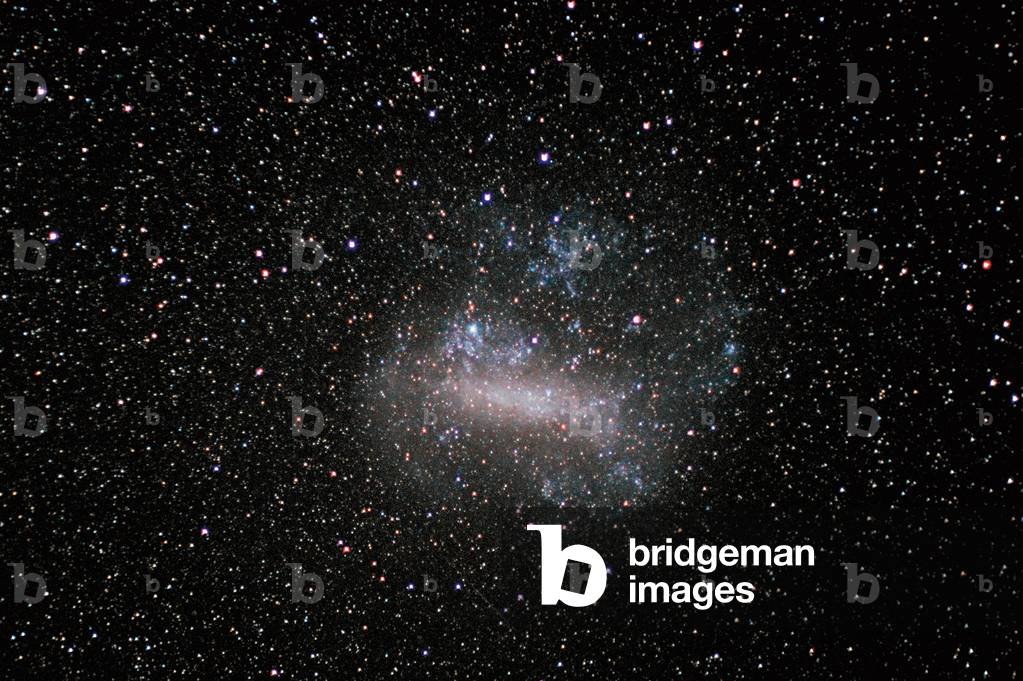
Large Magellanic Cloud galaxy - Large Magellanic Cloud galaxy - The galaxy of the Great Magellan Cloud is about 160,000 light years away from Earth in the southern constellation of Dorado. Visible with the naked eye in the southern hemishere it is one of the closest galaxies to ours. Mosaic of 10 images, 30 hours of poses. The irregular galaxy Large Magellanic Cloud (LMC) is located at a distance of 160,000 light years in the southern constellation of Dorado. It is one of the nearest galaxy, visible to naked eye. 10 frame mosaic image, 30 hours of exposure
Field around the galaxy NGC 1672 in the bream - Wide field around galaxy NGC 1672 - The barree spiral galaxy NGC 1672 is located 60 million years - light in the southern constellation of the bream. Intense star formations are observed and many clusters of young stars are visible in the arms of the galaxy. NGC 1672 is a galaxy of Seyfert, whose core houses a supermassive black hole. Wide field ground - based image of NGC 1672's region in the Southern constellation of Dorado. This image is a colour composite taken by the Digitized Sky Survey
Fishes Perciformes Sparidae, Blackspot seabream, (Pagellus bogaraveo), illustration
Zusätzliche Genehmigungen
  • Permission required for any use in perpetuity - Please contact us;Permission required for certain ebook uses - Please contact us;Permission required for certain film, TV and streaming uses - Please contact us;Permission required for immersive exhibition use - Please contact us
Nutzungsbeschränkungen von unseren Content-Partnern
  • Not available to clients invoiced in Italy
Spiral Galaxy NGC 1566 in the Dorado - The Seyfert Galaxy NGC 1566 - NGC 1566 is a spiral galaxy located about 50 million years ago - light. Its core is very bright. It is an active galaxy called Seyfert, which probably houses a black hole in its heart. Image made with Siding Spring's 3.9m telescope. NGC 1566 is the brightest member of a nearby group of galaxies in Dorado and is at a distance of about 50 million light years. It has beautifully symmetrical, tightly - wound spiral arms, which on deep images appear to almost encircle the galaxy. This striking galaxy is also of interest because it has a very luminous nucleus which has many of the characteristics of a quasar, though it is much less energetic. Galaxies of this type are known as Seyfert galaxies, after Carl Seyfert who first recognised their peculiar nature in 1943. The active region at the centre of NGC 1566 has recently been found to vary on a timescale of less than a month, which indicates that it is extremely compact. Spectra show that hot gas near the tiny nucleus is moving at an abnormally high velocity, suggesting that it may be in orbit around a massive black hole at the heart of NGC 1566
Detail of the Tarantula nebula (NGC 2070) in the Dorado - Detail of the Tarentula nebula in Dorado - Image of a detail of the Tarantula nebula obtained in December 2001 with the WFI instrument of the ESO/MPG 2.2 telescope - m at the La Silla Observatory. The Tarantula Nebula (or 30 Dorada) is the largest star-forming region of the Great Magellan Cloud, a galaxy adjacent to ours. It is located 170,000 light years ago in the constellation Dorado (southern hemisphere). This image shows the turbulent region around the ring - shaped nebula DEM L 299 in the Large Magellanic Cloud, a satellite galaxy of the Milky Way system. It was produced by combining three monochromatic images obtained in December 2001 with the Wide - Field - Imager (WFI) at the ESO/MPG 2.2 - m telescope at the La Silla Observatory. North is up and East is left. The coloured rings seen near some of the brighter stars in the field result from light reflections in the telescope optics. The Tarantula Nebula is one of the most impressive views in the Southern sky. Visible to the unaided eye in the Large Magellanic Cloud (LMC), a satellite galaxy of the Milky Way that is located in the direction of the southern constellation Doradus at a distance of about 170,000 light - years, this huge nebula is the prototype of what astronomers refer to as a “Giant HII region”. In this complex of glowing gas and very hot and luminous stars, the gas is mainly composed of protons and electrons, which are kept apart by energetic photons emitted by the stars in this area. The Tarantula Nebula (also designated 30 Doradus) owes its name to the arrangement of its brightest patches of nebulosity that somewhat resemble the legs of a spider. They extend from a central “” body”” where a cluster of hot stars (designated “” R136”) resides that illuminate the nebula. This name, of the biggest spiders on the Earth, is also very fitting in view of the gigantic proportions of the celestial nebula -
Field around the Nebula Henize 55 - The Henize 55 star forming region in the LMC - Henize 55 (NGC 2014), on the right, is a star-forming region located north of the Great Magellan Cloud. Image obtained from the 1.2m Schmidt UK telescope of Siding Spring. The nearby Large Magellanic Cloud (LMC) is a very active star - forming galaxy. The most massive region of star formation is around 30 Doradus (the Tarantula nebula) which can be seen with the unaided eye, but hundreds of lesser examples are visible with a telescope. This picture shows one of the more intriguing, NGC 2014 (Henize 55), at right. It contains cluster of hot, young stars, almost hidden in the brightest part of the nebula. The energetic ultraviolet light from these stars is absorbed by hydrogen and produces the distinctive red glow from an enormous distance around the cluster. This picture was made photographically from three glass plates taken with the UK Schmidt telescope of Siding Spring
Nebula N70 in the Great Magellan Cloud - The N 70 nebula in Large Magellanic Cloud (LMC) - The Henize 70 nebula extends for about 400 years - light, it is located in the Great Magellan Cloud. In the center, a small group of very massive and extremely hot stars, stars of Wolf - Rayet. Image obtained by Siding Spring's 3.9m telescope. At the centre of this remarkable bubble - like nebula nebula is a small group of extremely hot stars. Some of these stars are rapdly losing mass and have stellar winds blowing from their surfaces with velocities that approach 4000 kilometers per second. Such stars are known as Wolf - Rayet stars and are found in galaxies capable of forming massive stars. There are many such stars in the Large Magellanic Cloud (LMC) but not all of them are associated with distinctive nebulae. The outward flowing streams of energetic particles from Wolf - Rayet (and other energetic stars) eventually interact with the relatively stationary interstellar medium pervading the LMC, releasing much of their energy as a thin spherical shell of luminous material. The hollow structure accounts for the shape we see in the sky. This nebula is almost 400 light years across, about 100 times the distance from the Sun to the nearest star. The LMC is about 160,000 light years away and is the closest galaxy to the Milky Way
Nebula N44 in the Great Magellan Cloud - Henize 44, an emission nebula in the LMC - Vast region of star formation located in the Great Magellan Cloud. Image obtained by the 1.2m Schmidt UK Telescope from Siding Spring. The nearby Large Magellanic Cloud (LMC) is a very active star - forming galaxy. The most massive region of star formation is around 30 Doradus (the Tarantula nebula) which can be seen with the unaided eye, but hundreds of lesser examples are visible with a telescope. This picture shows Henize 44. The energetic ultraviolet light from these stars is absorbed by hydrogen and produces the distinctive red glow from an enormous distance around the cluster. Image obtained with the Schmidt UK telescope of Siding Spring
The Large Magellanic Cloud - The Large Magellanic Cloud - The Great Magellan Cloud galaxy is about 160,000 light years away from Earth in the southern constellation of Bream. Visible with the naked eye in the southern hemishere it is one of the closest galaxies to ours. The Large Magellanic Cloud is an irregular galaxy located about 160,000 light years distance from Earth in the constellation Dorado. Visible naked - eye in the night sky of the southern hemisphere, it is one of the closest galaxy from us
Around the Tarantula Nebula - Around the Tarantula nebula in the Large Magellanic Cloud - The Tarantula Nebula, NGC 2070, is a vast star-forming region located north of the Great Magellan Cloud galaxy in the southern hemisphere about 170,000 years - light from Earth. Image obtained with the 1.2m Schmidt UK Telescope from Siding Spring. Known as the Tarantula Nebula for its spidery appearance, the 30 Doradus complex is a monstrous stellar factory. It is the largest emission nebula in the sky, and can be seen far down in the southern sky at a distance of about 170,000 light - years, in the southern constellation Dorado. It is part of one of the Milky Way's neighbouring galaxies, the Large Magellanic Cloud. The Tarantula Nebula contains some of the most massive stars known
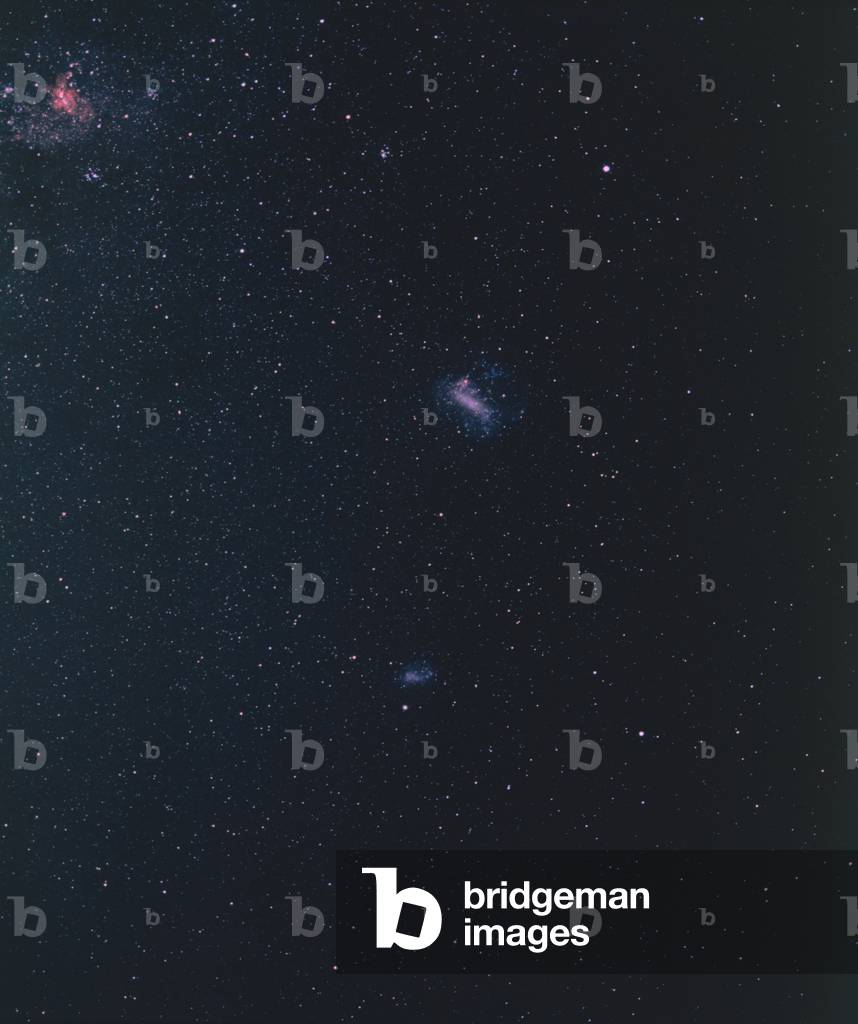
Large and Small Magellan Clouds - Large and Small Magellanic clouds - These two irregular galaxies are close to our galaxy. Visible in the southern hemisphere, they are located approximately 160,000 (Grand Cloud, right) and 240,000 light years (Small Cloud, left). The Magellanic Clouds are the nearest galaxies to the Milky Way, about 170,000 and 240,000 light years distant respectively. They are in the far southern sky, practically invisible from northern latitudes, and their low surface brightness makes them difficult to see unless they are high in the sky. Both Magellanic Clouds are less than 25 degrees from the South Celestial Pole and are visible at some time on any clear, dark night from Siding Spring, where this picture was taken. To the dark adapted eye the Magellanic Clouds look like detached pieces of the Milky Way, but this apparent detachment is misleading because both are in orbit around it. Although the Magellanic Clouds are separate galaxies they are interacting with each other and with the Milky Way itself. Already the SMC has been substantially disrupted by this process, and the LMC distorted. Eventually the galaxies will merge with each other and with the Milky Way itself
The Large Magellanic Cloud - The Large Magellanic Cloud - The Great Magellan Cloud galaxy is about 160,000 light years away from Earth in the southern constellation of the Sea bream. Visible with the naked eye in the southern hemishere it is one of the closest galaxies to us. It contains large star-forming areas such as the Tarantula Nebula (30 Bream, visible right), the most active star-forming regions of the local group. The irregular galaxy Large Magellanic Cloud (LMC) is located at a distance of 160,000 light years in the southern constellation of Dorado. It is one of the nearest galaxy, visible to naked eye
Around the Tarantula Nebula - Around the Tarantula nebula in the Large Magellanic Cloud - The Tarantula Nebula (or 30 Bream) is the largest star-forming region of the Great Magellan Cloud. It is located 170,000 light years ago in the constellation Dorado (southern hemisphere). At the center of this nebula, the open cluster of R136 stars, clusters of hot and massive stars. Image obtained with the 1.2m Schmidt UK Telescope from Siding Spring. In this picture we see the eastern end of the Large Magellanic Cloud where lies one of the most active star formation regions known. If this enormous complex of stars, gas and dust were at the distance of the better - known Orion Nebula the brightest parts of it would visible during the day and would cover a quarter of the sky at night. While the Orion Nebula contains a mere handful of the hot blue stars which energise it, the Tarantula nebula has spawned many thousands in the bright central region, which surrounds a compact, brilliant cluster known as 30 Doradus. Like the Orion Nebula, the 30 Doradus region is a naked eye object for the keen sighted. It is however over one hundred times more distant! Surrounding this nebula is a huge and much fainter series of interlocking bubbles and shells of gas and dust blow away from the center of activity by intense stellar winds and supernova explosions
Nebula N70 in the Great Magellan Cloud - The N 70 nebula in Large Magellanic Cloud (LMC) - The Henize 70 nebula extends for about 400 years - light, it is located in the Great Magellan Cloud. In the center, a small group of very massive and extremely hot stars, stars of Wolf - Rayet. Image obtained by Siding Spring's 3.9m telescope. At the centre of this remarkable bubble - like nebula nebula is a small group of extremely hot stars. Some of these stars are rapdly losing mass and have stellar winds blowing from their surfaces with velocities that approach 4000 kilometers per second. Such stars are known as Wolf - Rayet stars and are found in galaxies capable of forming massive stars. There are many such stars in the Large Magellanic Cloud (LMC) but not all of them are associated with distinctive nebulae. The outward flowing streams of energetic particles from Wolf - Rayet (and other energetic stars) eventually interact with the relatively stationary interstellar medium pervading the LMC, releasing much of their energy as a thin spherical shell of luminous material. The hollow structure accounts for the shape we see in the sky. This nebula is almost 400 light years across, about 100 times the distance from the Sun to the nearest star. The LMC is about 160,000 light years away and is the closest galaxy to the Milky Way
Tarantula Nebula (NGC 2070) in the river bream - The Tarantula Nebula - The Tarantula Nebula (or 30 Sea bream) is the largest star-forming region of the Great Magellan Cloud. It is located 170,000 light years ago in the constellation Dorado (southern hemisphere). At the center of this nebula, the open cluster of R136 stars, clusters of hot and massive stars. Image obtained with the large field camera of the 2.2m ESO/MPG telescope in Chile. Composite colour image of the Tarantula Nebula in the Large Magellanic Cloud (LMC) and its surroundings. The LMC is a satellite galaxy to our Milky Way system, located in the southern constellation Dorado (The Swordfish) at a distance of approximately 170,000 light - years. The image is based on 15 exposures in the visual part of the spectrum with the Wide Field Imager (WFI) camera on the 2.2 - m MPG/ESO telescope at the La Silla Observatory
Carene Constellation and Southern Constellation - Constellation of Carina and southern constellations - The constellation of Carene, the Great Magellan Cloud, the southern Celestial pole, and the star Canopus. This part of the sky is best seen in the early evening between April and June. Carina the Keel, is a remnant of Argo Navis, a giant mythical sailing vessel afloat on the southern Milky Way, described elsewhere. The constellation is a delight for southern hemisphere observers, with many star clusters and nebulae visible in binoculars or modest telescopes. Some of these are quite spectacular in a large telescope. The second brightest star in the sky, Canopus (a Car) is here as is Eta Carinae, one of the most massive and unstable stars in the Galaxy. Eta is hidden in the most conspicuous nebula in Carina, NGC 3372, the Great Carina nebula. This photograph also shows the location of the south celestial pole and the Large Magellanic Cloud as well as several complete or almost complete constellations, including Apus, Chameleon, Crux, Dorado, Mensa, Musca, Octans, Pictor and Volans
The Large Magellanic Cloud Irregular Galaxy - The Large Magellanic Cloud - The irregular galaxy of the Great Magellan Cloud is located approximately 160,000 light years away from Earth in the southern constellation of the Sea bream. Visible with the naked eye in the southern hemishere it is one of the closest galaxies to ours. The Large Magellanic cloud is about 160 000 light - years from Earth in the constellation Dorado. Naked - eye visible in the southern hemisphere, it is one of the nearest galaxy
The Large Magellanic Cloud - The Large Magellanic Cloud - The Great Magellan Cloud galaxy is located about 160,000 light years away from Earth in the southern constellation of Dorado. Visible with the naked eye in the southern hemishere it is one of the closest galaxies to us. It contains large star-forming zones such as the Tarantula Nebula (30 Sea bream, visible to the left), the most active star-forming regions of the local group. Image obtained by the 1.2m UK Schmidt telescope from Siding Spring, Australia. The Large Magellanic Cloud (LMC) is the nearest galaxy to the Milky Way but less than one tenth as massive; even so it contains the equivalent of over ten billion solar masses of material in the form of stars, gas and dust. The LMC is at a distance of 160,000 light years and is visible to the unaided eye from southern latitudes, rather like a detached piece of the Milky Way. The nearness of the LMC ensures that it is well resolved into stars in quite a modest telescope, and deep photographs reveal it to be a highly complex system with large numbers of clusters, nebulae and dust clouds scattered apparently at random across the face of the galaxy. The bright red patch at the eastern end of the galaxy is the star - forming region 30 Doradus
Detail in the Tarantula Nebula - Part of the Tarantula Nebula - The Tarantula Nebula (or 30 Bream bream) is the largest star-forming region of the Magellan Cloud. It is located 170,000 light years ago in the constellation Dorado (southern hemisphere). This image obtained by the Hubble Space Telescope (HST) shows a detail of the nebula around NGC 2060, a cluster of stars associated with a remnant of supernova (N157b) housing a pulsar. The part of the Tarentula nebula visible in this image from Hubble's Advanced Camera for Surveys is criss - crossed with tendrils of dust and gas churned up by recent supernovae. These supernova remnants include NGC 2060, visible above and to the left of the centre of this image, which contains the brightest known pulsar. The tarantula's bite goes beyond NGC 2060. Near the edge of the nebula, outside the frame, below and to the right, lie the remains of supernova SN 1987a, the closest supernova to Earth to be observed since the invention of telescopes in the 17th century. Together with dying stars, the Tarantula Nebula is packed with young stars which have recently formed from the nebula's supply of hydrogen gas. These toddler - stars shine forth with intense ultraviolet light that ionises the gas, making it light up red. The light is so intense that although around 170,000 light - years distant, and outside the Milky Way, the Tarantula Nebula is nevertheless visible without a telescope on a dark night to Earth - bound observers. This nebula might be far away, but it is the most luminous example of its type that astronomers have observed in the local Universe
Tarantula Nebula (NGC 2070) in the constellation of Bream - The Tarantula Nebula in Dorado - Tarantula Nebula in the large Magellan cloud seen with the FORS2 instrument on the KUEYEN telescope (VLT) February 1, 2000. The Tarantula Nebula (or 30 bream) is the largest star-forming region of the Magellan Grand Cloud. It is located 170,000 light years ago in the constellation Dorado (southern hemisphere). At the center of this nebula, the open cluster of R136 stars, clusters of hot and massive stars. The Tarantula Nebula in the Large Magellanic Cloud, as obtained with FORS2 at KUEYEN (VLT) on the night of January 31 - February 1, 2000. It is a composite of three exposures
Clubs R136 in the Tarantula Nebula (NGC 2070) - Central region of the Tarantula Nebula - The Tarantula Nebula (or 30 Bream) is the largest star-forming region of the Magellan Cloud. It is located 170,000 light years ago in the constellation Dorado (southern hemisphere). In the center of this nebula, the open cluster of R136 stars (on the right), clusters of young, hot and massive stars, age barely 5 million years. Image obtained by the Hubble Space Telescope in October 2009. The Tarantula is situated 170,000 light - years away in the Large Magellanic Cloud (LMC) in the southern sky and is clearly visible to the naked eye as a large milky patch. To thr right of the image there is a huge cluster of very hot stars called R136. The stars in R136 are also among the most massive stars we know. R136 is also a very young cluster, its oldest stars being 'just' 5 million years old or so. Its smallest stars, however, are still forming. The image, taken in ultraviolet, visible, and red light by Hubble's Wide Field Camera 3, spans about 100 light - years. The Hubble observations were taken Oct. 20 - 27, 2009. The blue color is light from the hottest, most massive stars; the green from the glow of oxygen; and the red from fluorescing hydrogen
Around the Tarantula Nebula - Around the Tarantula nebula in the Large Magellanic Cloud - The Tarantula Nebula, NGC 2070, is a vast star-forming region located north of the Great Magellan Cloud galaxy in the southern hemisphere about 170,000 years - light from Earth. Image obtained with Siding Spring's 3.9m telescope. Known as the Tarantula Nebula for its spidery appearance, the 30 Doradus complex is a monstrous stellar factory. It is the largest emission nebula in the sky, and can be seen far down in the southern sky at a distance of about 170,000 light - years, in the southern constellation Dorado. It is part of one of the Milky Way's neighbouring galaxies, the Large Magellanic Cloud. The Tarantula Nebula contains some of the most massive stars known
Fishes: Perciformes Sparidae, Common dentex (Dentex dentex), Sharpsnout seabream (Diplodus puntazzo), illustration
Zusätzliche Genehmigungen
  • Permission required for any use in perpetuity - Please contact us;Permission required for certain ebook uses - Please contact us;Permission required for certain film, TV and streaming uses - Please contact us;Permission required for immersive exhibition use - Please contact us
Nutzungsbeschränkungen von unseren Content-Partnern
  • Not available to clients invoiced in Italy
Detail of the Tarantula Nebula (NGC 2070) in the Dorado - Central region of the Tarantula Nebula - The Tarantula Nebula (or 30 Dorado) is the largest star-forming region of the Magellan Cloud. It is located 170,000 light years ago in the constellation Dorado (southern hemisphere). At the center of this nebula, the open cluster of R136 stars, clusters of young, hot and massive stars, aged just 5 million years. Mosaic of 15 images obtained by the Hubble Space Telescope. The Tarantula is situated 170,000 light - years away in the Large Magellanic Cloud (LMC) in the Southern sky and is clearly visible to the naked eye as a large milky patch. Astronomers believe that this smallish irregular galaxy is currently going through a violent period in its life. It is orbiting around the Milky Way and has had several close encounters with it. It is believed that the interaction with the Milky Way has caused an episode of energetic star formation - part of which is visible as the Tarantula Nebula. Just above the centre of the image there is a huge cluster of very hot stars called R136. The stars in R136 are also among the most massive stars we know. R136 is also a very young cluster, its oldest stars being just”” 5 million years old or so. Its smallest stars, however, are still forming, so astronomers observe R136 to try to understand the early stages of stellar evolution. Near the lower edge of the image we find the star cluster Hodge 301. Hodge 301 is almost 10 times older than R136. Some of the stars in Hodge 301 are so old that they have already exploded as supernovae. The shockwave from this explosion has compressed the gas in the Tarantula into the filaments and sheets that are seen around the cluster.
Fishes: Perciformes, Brown comber (Serranus hepatus), Zebra seabream ( Diplodus cervinus cervinus), Damselfish (Chromis chromis)., illustration
Zusätzliche Genehmigungen
  • Permission required for any use in perpetuity - Please contact us;Permission required for certain ebook uses - Please contact us;Permission required for certain film, TV and streaming uses - Please contact us;Permission required for immersive exhibition use - Please contact us
Nutzungsbeschränkungen von unseren Content-Partnern
  • Not available to clients invoiced in Italy
Central region of the Tarantula Nebula - The Tarantula Nebula - The Tarantula Nebula (or 30 Dorada) is the largest star-forming region of the Magellan Cloud. It is located 170,000 light years ago in the constellation Dorado (southern hemisphere). At the center of this nebula, the open cluster of R136 stars, clusters of young, hot and massive stars, aged just 5 million years. Mosaic of 5 images obtained by the Hubble space telescope. Vast Star - Forming Region 30 Doradus Nasa's Hubble Space Telescope has snapped a panoramic portrait of a vast, sculpted landscape of gas and dust where thousands of stars are being born. This fertile star - forming region, called the 30 Doradus Nebula, has a sparkling stellar centerpiece: the most spectacular cluster of massive stars in our cosmic neighborhood of about 25 galaxies. The mosaic picture shows that ultraviolet radiation and high - speed material unleashed by the stars in the cluster, called R136, are weaving a tapestry of creation and destruction, triggering the collapse of looming gas and dust clouds and forming pillar - like structures that are incubators for nascent stars. The photo offers an unprecedented, detailed view of the entire inner region of 30 Doradus, measuring 200 light - years wide by 150 light - years high. The nebula resides in the Large Magellanic Cloud (a satellite galaxy of the Milky Way), 170,000 light - years from Earth. Nebulas like 30 Doradus are the “” signposts”” of recent star birth. High - energy ultraviolet radiation from the young, hot, massive stars in R136 causes the surrounding gaseous material to glow. Previous Hubble telescope observations showed that R136 contains several dozen of the most massive stars known, each about 100 times the mass of the Sun and about 10 times as hot. These stellar behemoths all formed at the same time about 2 million years ago. The stars in R136 are producing intense “” stellar winds”” (
Constellation of Carene and other constellations of the southern hemisphere - Southern constellations with Large and Small Magellanic clouds - Carene, cameleon, flying fish, painter, seam, table, reticule, bird of paradise, octant, male hydra, Toucan and part of the horlog
Tarantula (NGC 2070) in the LMC - The nebula around 30 Doradus (NGC 2070) in the LMC - The Tarantula Nebula (or 30 Bream) is the largest star-forming region of the Great Magellan Cloud. It is located 170,000 light years ago in the constellation Dorado (southern hemisphere). At the center of this nebula, the open cluster of R136 stars, clusters of hot and massive stars. Image obtained with Siding Spring's 3.9m telescope. The brightest cluster of stars in this picture was believed until recently to contain a single, uniquely massive object with the mass equivalent to 1000 suns, and was named as a star, 30 Doradus. Sophisticated image analysis techniques have been used to show that 30 Doradus is a very compact group of stars, many of which are massive, but not unimaginably so. The radiation from this star cluster is sufficient to excite a huge cloud of hydrogen gas in its vicinity so that it glows with its distinctive red colour. This picture is essentially a one minute exposure. A longer exposure would show that the curving tendrils of nebulosity are the brightest parts of the huge Tarantula nebula, one of the largest star - forming regions known anywhere
Tarantula Nebula (NGC 2070) in the river bream - The Tarantula Nebula, around the 30 Dor cluster - The Tarantula Nebula (or 30 Bream) is the largest star-forming region of the Great Magellan Cloud. It is located 170,000 light years ago in the constellation Dorado (southern hemisphere). At the center of this nebula, the open cluster of R136 stars, clusters of hot and massive stars. Image obtained with Siding Spring's 3.9m telescope. This object is the only extra - galactic nebula which can be seen with the unaided eye. It is a faint patch of light at the eastern end of the Large Magellanic Cloud, 170,000 light years distant. A small telescope reveals narrow spindly tendrils of glowing gas which have been likened to the legs of a spider. The 'body' of the spider is the bright nebula seen at the centre of the photograph, while at its core is an extremely dense clump of very hot stars, until recently thought to a single, unusually massive star known as 30 Doradus. The very hot stars of 30 Dor are responsible for making the nebula visible
Ebisu Wrestling with Sea Bream, c.1810 (woodblock print)
Zusätzliche Genehmigungen
  • Permission required for non-editorial use (inc book and magazine covers). Please contact us
Constellation of Carene - Constellation of Carina - The constellation of Carene, the Great Magellan Cloud, the southern Celestial pole, and the star Canopus. This part of the sky is best seen in the early evening between April and June. Carina the Keel, is a remnant of Argo Navis, a giant mythical sailing vessel afloat on the southern Milky Way, described elsewhere. The constellation is a delight for southern hemisphere observers, with many star clusters and nebulae visible in binoculars or modest telescopes. Some of these are quite spectacular in a large telescope. The second brightest star in the sky, Canopus (a Car) is here as is Eta Carinae, one of the most massive and unstable stars in the Galaxy. Eta is hidden in the most conspicuous nebula in Carina, NGC 3372, the Great Carina nebula. This photograph also shows the location of the south celestial pole and the Large Magellanic Cloud as well as several complete or almost complete constellations, including Apus, Chameleon, Crux, Dorado, Mensa, Musca, Octans, Pictor and Volans
Nebula N11 in the Great Magellan Cloud - N11 star forming region in Large Magellanic Cloud (LMC) - N11 (LHA 120 - N 11) is a large star-forming region located in the Great Magellan Cloud galaxy. Image, obtained by the Hubble space telescope. This broad vista of young stars and gas clouds in our neighbouring galaxy, the Large Magellanic Cloud, was captured by the NASA/ESA Hubble Space Telescope's Advanced Camera for Surveys (ACS). This region is named LHA 120 - N 11, informally known as N11, and is one of the most active star formation regions in the nearby Universe. This picture is a mosaic of ACS data from five different positions and covers a region about six arcminutes across
Tarantula Nebula in the Great Magellan Cloud - Tarantula nebula (NGC 2070) in Dorado - NGC 2070, the Tarantula Nebula is a vast star-forming region located north of the Great Magellan Cloud galaxy, in the southern hemisphere about 170,000 years - light from Earth. Image obtained by combining light through different filters (SII 5x 2min, Ha 20x 2min, [OIII] 11x 2min, H - beta 10x 2min, L (IR) 2x 2min, IR 4x 2min, R 8x 2min, G 5x 2min). The largest emission nebula in the sky, the Tarantula Nebula (also known as NGC 2070 or 30 Doradus) is located in the Large Magellanic Cloud (LMC) in the southern hemisphere at about 170,000 light year from Earth. Image obtained with different filters (SII 5x 2min, Ha 20x 2min, [OIII] 11x 2min, H - beta 10x 2min, L (IR) 2x 2min, IR 4x 2min, R 8x 2min, G 5x 2min)
Nebula N11 in the Great Magellan Cloud - N11 star forming region in Large Magellanic Cloud (LMC) - N11 (Henize 11) is a vast star-forming region located in the Great Magellan Cloud galaxy. It is home to a cluster of hot young stars, NGC 1760. This glowing complex of rings, shells, and powerful young stars lies in the Large Magellanic Cloud, a satellite galaxy of the Milky Way. The overall complex of glowing gas and stars is known as N11 while the central cluster of hot young blue stars is know as NGC 1760. The complex expanding shells of gas have likely formed from multiple generations of hot O and B type stars and their supernovae. N11 spans over 1000 light years across
Grey triggerfish, Balistes capriscus 1, Moray eel, Muraena species 4, lower jawbones of sea bream, Sparus aurata 2, and great white shark, Carcharodon carcharias 3. A marine pork, Caper, the lower jaw of this fish Sparus, the lower jaw of a young haay, Canis Cacharias, a Muraena water snake. Handcoloured copperplate engraving after an illustration by Johann Christoph Keller from Georg Wolfgang Knorr's Deliciae Naturae Selectae of Kabinet van Zeldzaamheden der Natuur, Blusse and Son, Nuremberg, 1771. Specimens from a Wunderkammer or Cabinet of Curiosities owned by P.L. Muller.
Constellation of Eridan - Constellation of Eridanus - View from the Hyadas to the Hydra Male. In the center is the great constellation of Eridan. The brightest stars visible here are Rigel, Sirius, Canopus and Achernar. In the center of image is the Eridanus constellation. Brightest stars visible are Rigel (top in Orion); Sirius (top left); Canopus (below) and Achernar (bottom center). Eridanus (the Celestial River) is very well named; since it winds its way over an enormous area of the sky. It is the 6th largest constellation (almost 1140 square degrees) and wanders over a huge range of Declination. The river runs from close to the celestial equator (which runs through Orion's Belt) to its brightest star Achernar (a Eri; from the English for 'river's end'); which is at 57* south declination
Southern constellations around the Clock - Southern constellations around Horologium - Southern constellations around the Clock. The two bright stars are Canopus (bottom) and Achernar. This wide angle image includes Horologium, Phoenix and Pictor, insignificant constellations roughly centred on an arc of delination 50* south, but at a scale too small to show the star identifications and stick figures. Horologium, the Pendulum Clock (originally l'Horloge and then Horologium Oscillitorium), was a constellation introduced by Abbe Nicolas Louis de Lacaille during his stay at the Cape of Good Hope between 1751 and 1752. It was named to honor Christian Huygens as the inventor of this type of clock, but the idea for such a method of regulating time came from Galileo. Lacaille's constellation drawing shows a remarkably detailed dial, weights and a pendulum that has little apparent connection with the scattering of faint stars in this part of the sky. There are no named stars and little else in Horologium to attract the eye of the casual observer. Phoenix, the Phoenix, is a long - lived mythological, eagle - like bird with vivid plumage. The word has entered the language as an entity that is able to resurrect itself after a firey death in its nest. The cycle of death and rebirth may have symbolised the rising and setting of the Sun. On the sky Phoenix is hemmed in on two sides by other birds in Grus and Tucana and a large snake in the form of Eridanus. The constellation was invented by the Dutch navigators Pieter Dirkszoon Keyser and Frederick de Houtman, and first appeared in Johan Beyer's altas of 1603. The only named star in Phoenix is Ankaa. Pictor was also named by Lacaille during his sojourn at the Cape of Good Hope. He originally called it le Easel et la Palette, the easel and palette and later Equuleus Pictorius, soon shortened to Pictor. It requires the imagination of an artist to find anything like an easle here. The constellation runs between Ca
Wall with Still Life, by unknown artist, 62-79, 1st Century A.D., ripped fresco, 298 x 447 cm
Nutzungsbeschränkungen von unseren Content-Partnern
  • Editorial use only ;Not available to clients invoiced in Italy
Constellation of Eridan - Constellation of Eridanus - View from the Hyadas to the Hydra Male. In the center is the great constellation of Eridan. The brightest stars visible here are Rigel, Sirius, Canopus and Achernar. In the center of image is the Eridanus constellation. Brightest stars visible are Rigel (top in Orion); Sirius (top left); Canopus (below) and Achernar (bottom center). Eridanus (the Celestial River) is very well named; since it winds its way over an enormous area of the sky. It is the 6th largest constellation (almost 1140 square degrees) and wanders over a huge range of Declination. The river runs from close to the celestial equator (which runs through Orion's Belt) to its brightest star Achernar (a Eri; from the English for 'river's end'); which is at 57* south declination