[]
Ihre AuswahlIhre aktuelle Auswahl
asset(s) Assets
Ihr Preis 0

Ihre Auswahl

Auswahl aufheben
Asset zum Warenkorb hinzugefügt
{"event":"pageview","page_type1":"undetected","page_type2":"_assets_search_override","language":"de","user_logged":"false","user_type":"ecommerce","nl_subscriber":"false"}
{"event":"ecommerce_event","event_name":"view_item","event_category":"browse_catalog","ecommerce":{"items":[{"item_id":"LLM3629943","item_category":"illustration","item_category2":"out_of_copyright","item_category3":"standard","item_category4":"english_school_20th_century","item_category5":"not_balown","item_list_name":"search_results","item_name":"monoceros_and_the_maiden_engraving","item_variant":"undefined"},{"item_id":"STC182242","item_category":"illustration","item_category2":"out_of_copyright","item_category3":"standard","item_category4":"thornhill_james_1675_1734_after","item_category5":"not_balown","item_list_name":"search_results","item_name":"constellation_of_gemini_with_canis_minor_plate_13_from_atlas_coelestis_by_john_flamsteed_1646_1710_p","item_variant":"undefined"},{"item_id":"STC182246","item_category":"illustration","item_category2":"out_of_copyright","item_category3":"standard","item_category4":"thornhill_james_1675_1734_after","item_category5":"not_balown","item_list_name":"search_results","item_name":"constellation_of_cancer_plate_4_from_atlas_coelestis_by_john_flamsteed_1646_1710_published_in_1729_h","item_variant":"undefined"},{"item_id":"BL3261659","item_category":"illustration","item_category2":"out_of_copyright","item_category3":"standard","item_category4":"english_school_13th_century","item_category5":"not_balown","item_list_name":"search_results","item_name":"harley_4751_f_15_monoceros_with_a_large_horn_from_a_bestiary_1230_40_ink_colour_on_vellum","item_variant":"undefined"},{"item_id":"PIX4607875","item_category":"photo","item_category2":"no_copyright","item_category3":"standard","item_category4":"miller_ron_b_1947","item_category5":"not_balown","item_list_name":"search_results","item_name":"exoplanete_corot_7b_exoplanet_corot_7b_artist_s_view_of_the_extrasolar_planet_corot_7b_a_small_terre","item_variant":"undefined"},{"item_id":"FLO5000152","item_category":"illustration","item_category2":"out_of_copyright","item_category3":"standard","item_category5":"not_balown","item_list_name":"search_results","item_name":"narwhal_or_narwhale_monodon_monoceros_and_short_beaked_common_dolphin_delphinus_delphis_chromolithog","item_variant":"undefined"},{"item_id":"PIX4572282","item_category":"photo","item_category2":"no_copyright","item_category3":"standard","item_category5":"not_balown","item_list_name":"search_results","item_name":"star_v838_monocerotis_28_10_2004_v838_monocerotis_10_2004_this_variable_star_is_located_approximatel","item_variant":"undefined"},{"item_id":"PIX4572304","item_category":"photo","item_category2":"no_copyright","item_category3":"standard","item_category5":"not_balown","item_list_name":"search_results","item_name":"star_v838_monocerotis_v838_monocerotis_light_echo_this_variable_star_is_located_approximately_20_000","item_variant":"undefined"},{"item_id":"PIX4572295","item_category":"photo","item_category2":"no_copyright","item_category3":"standard","item_category5":"not_balown","item_list_name":"search_results","item_name":"star_v838_monocerotis_11_2005_star_v838_monocerotis_seen_by_the_hubble_space_telescope_11_2005_this_","item_variant":"undefined"},{"item_id":"PIX4572319","item_category":"photo","item_category2":"no_copyright","item_category3":"standard","item_category5":"not_balown","item_list_name":"search_results","item_name":"star_v838_monocerotis_09_2006_v838_monocerotis_seen_by_the_hubble_space_telescope_09_2006_this_varia","item_variant":"undefined"},{"item_id":"PIX4573791","item_category":"photo","item_category2":"no_copyright","item_category3":"standard","item_category5":"not_balown","item_list_name":"search_results","item_name":"exoplanete_corot_7b_artist_s_impression_of_corot_7b_artist_s_view_of_the_extrasolar_planet_corot_7b_","item_variant":"undefined"},{"item_id":"PIX4572272","item_category":"photo","item_category2":"no_copyright","item_category3":"standard","item_category5":"not_balown","item_list_name":"search_results","item_name":"star_v838_monocerotis_08_02_2004_v838_monocerotis_02_2004_this_variable_star_is_located_approximatel","item_variant":"undefined"},{"item_id":"FLO4640875","item_category":"illustration","item_category2":"out_of_copyright","item_category3":"standard","item_category5":"not_balown","item_list_name":"search_results","item_name":"narwhal_or_narwhale_monodon_monoceros_horned_narval_or_sea_unicorn_drawn_from_a_stuffed_specimen_exh","item_variant":"undefined"},{"item_id":"GRC3035815","item_category":"illustration","item_category2":"undetermined_copyright","item_category3":"standard","item_category4":"scottish_school_20th_century","item_category5":"not_balown","item_list_name":"search_results","item_name":"star_map_with_constellations_cancer_gemini_and_taurus_1922_colour_litho","item_variant":"undefined"},{"item_id":"PIX4621748","item_category":"photo","item_category2":"no_copyright","item_category3":"standard","item_category4":"adam_block","item_category5":"not_balown","item_list_name":"search_results","item_name":"nebula_lbn_1022_in_the_unicorn_nebula_lbn_1022_in_monocero","item_variant":"undefined"},{"item_id":"PIX4618405","item_category":"photo","item_category2":"no_copyright","item_category3":"standard","item_category4":"adam_block","item_category5":"not_balown","item_list_name":"search_results","item_name":"nebula_ngc_2183_in_the_unicorn_nebula_ngc_2183_in_monoceros_nebulae_ngc_2183_and_ngc_2185_image_obta","item_variant":"undefined"},{"item_id":"PIX4567995","item_category":"photo","item_category2":"no_copyright","item_category3":"standard","item_category4":"r_gendler","item_category5":"not_balown","item_list_name":"search_results","item_name":"the_open_cluster_m50_ngc_2323_in_the_constellation_unicorn_open_cluster_m50_in_monoceros_the_open_cl","item_variant":"undefined"},{"item_id":"PIX4618379","item_category":"photo","item_category2":"no_copyright","item_category3":"standard","item_category4":"r_gendler","item_category5":"not_balown","item_list_name":"search_results","item_name":"nebula_ngc_2170_in_unicorn_nebula_ngc_2170_in_monoceros_nebula_by_reflexion_located_in_the_constella","item_variant":"undefined"},{"item_id":"PIX4569009","item_category":"photo","item_category2":"no_copyright","item_category3":"standard","item_category5":"not_balown","item_list_name":"search_results","item_name":"open_cluster_trumpler_5_in_unicorn_open_cluster_trumpler_5_in_monoceros_trumpler_5_is_a_cluster_of_s","item_variant":"undefined"},{"item_id":"PIX4608021","item_category":"photo","item_category2":"no_copyright","item_category3":"standard","item_category4":"miller_ron_b_1947","item_category5":"not_balown","item_list_name":"search_results","item_name":"exoplanete_corot_7b_artist_s_view_of_the_extrasolar_planet_corot_7b_a_small_terrestrial_exoplanet_lo","item_variant":"undefined"},{"item_id":"PIX4618770","item_category":"photo","item_category2":"no_copyright","item_category3":"standard","item_category4":"adam_block","item_category5":"not_balown","item_list_name":"search_results","item_name":"nebula_ngc_2327_in_unicorn_nebula_ngc_2327_in_monoceros_reflection_nebula_belonging_to_nebula_ic_217","item_variant":"undefined"},{"item_id":"PIX4622480","item_category":"photo","item_category2":"no_copyright","item_category3":"standard","item_category4":"r_gendler","item_category5":"not_balown","item_list_name":"search_results","item_name":"nebula_van_den_bergh_93_vdb_93_in_unicorn_nebula_van_den_bergh_93_vdb_93_vdb_93_is_a_star_forming_re","item_variant":"undefined"},{"item_id":"PIX4622496","item_category":"photo","item_category2":"no_copyright","item_category3":"standard","item_category4":"adam_block","item_category5":"not_balown","item_list_name":"search_results","item_name":"nebula_van_den_bergh_93_vdb_93_in_unicorn_nebula_van_den_bergh_93_vdb_93_vdb_93_is_a_star_forming_re","item_variant":"undefined"},{"item_id":"PIX4618377","item_category":"photo","item_category2":"no_copyright","item_category3":"standard","item_category4":"adam_block","item_category5":"not_balown","item_list_name":"search_results","item_name":"nebula_ngc_2170_in_unicorn_nebula_ngc_2170_in_monoceros_nebula_by_reflexion_located_in_the_constella","item_variant":"undefined"},{"item_id":"PIX4622952","item_category":"photo","item_category2":"no_copyright","item_category3":"standard","item_category5":"not_balown","item_list_name":"search_results","item_name":"planetary_nebula_ngc_2346_in_unicorn_the_planetary_nebula_ngc_2346_this_nebula_is_located_about_2000","item_variant":"undefined"},{"item_id":"PIX4623779","item_category":"photo","item_category2":"no_copyright","item_category3":"standard","item_category5":"not_balown","item_list_name":"search_results","item_name":"planetary_nebula_of_the_red_rectangle_in_the_unicorn_the_red_rectangle_afgl_915_this_planetary_nebul","item_variant":"undefined"},{"item_id":"PIX4618668","item_category":"photo","item_category2":"no_copyright","item_category3":"standard","item_category5":"not_balown","item_list_name":"search_results","item_name":"detail_of_the_cone_nebula_in_the_unicorn_the_cone_nebula_ngc_2264_detail_image_obtained_by_the_hubbl","item_variant":"undefined"},{"item_id":"PIX4622503","item_category":"photo","item_category2":"no_copyright","item_category3":"standard","item_category4":"jim_misti","item_category5":"not_balown","item_list_name":"search_results","item_name":"nebula_van_den_bergh_93_vdb_93_in_unicorn_nebula_van_den_bergh_93_vdb_93_vdb_93_is_a_star_forming_re","item_variant":"undefined"},{"item_id":"PIX4618692","item_category":"photo","item_category2":"no_copyright","item_category3":"standard","item_category5":"not_balown","item_list_name":"search_results","item_name":"nebula_near_the_star_s_mon_in_unicorn_fox_fur_nebula_in_monoceros_nebula_around_the_bright_star_s_mo","item_variant":"undefined"},{"item_id":"FLO4660312","item_category":"illustration","item_category2":"out_of_copyright","item_category3":"standard","item_category5":"not_balown","item_list_name":"search_results","item_name":"narwhal_monodon_monoceros_goose_beaked_whale_ziphius_cavirostris_and_northern_bottlenose_whale_hyper","item_variant":"undefined"},{"item_id":"PIX4618356","item_category":"photo","item_category2":"no_copyright","item_category3":"standard","item_category4":"r_gendler","item_category5":"not_balown","item_list_name":"search_results","item_name":"nebula_ngc_2170_in_unicorn_nebula_ngc_2170_in_monoceros_nebula_by_reflexion_located_in_the_constella","item_variant":"undefined"},{"item_id":"PIX4591966","item_category":"photo","item_category2":"no_copyright","item_category3":"standard","item_category5":"not_balown","item_list_name":"search_results","item_name":"unicorn_constellations_small_dog_and_typographic_workshop_constellation_of_monoceros_l_atelier_de_ty","item_variant":"undefined"},{"item_id":"PIX4618577","item_category":"photo","item_category2":"no_copyright","item_category3":"standard","item_category5":"not_balown","item_list_name":"search_results","item_name":"hubble_nebula_ngc_2261_in_unicorn_ngc_2261_hubble_s_variable_nebula_the_hubble_nebula_is_a_weak_nebu","item_variant":"undefined"},{"item_id":"PIX4591969","item_category":"photo","item_category2":"no_copyright","item_category3":"standard","item_category4":"sebastien_beaucourt","item_category5":"not_balown","item_list_name":"search_results","item_name":"unicorn_constellation_constellation_of_monoceros_constellation_of_unicorn_extracted_from_hevelius_ur","item_variant":"undefined"},{"item_id":"PIX4591927","item_category":"photo","item_category2":"no_copyright","item_category3":"standard","item_category5":"not_balown","item_list_name":"search_results","item_name":"constellations_of_the_unicorn_and_the_little_dog_constellations_of_monoceros_and_canis_minor_constel","item_variant":"undefined"},{"item_id":"PIX4618724","item_category":"photo","item_category2":"no_copyright","item_category3":"standard","item_category4":"adam_block","item_category5":"not_balown","item_list_name":"search_results","item_name":"s_star_monocerotis_and_nebula_fox_fur_nebula_in_monoceros_the_region_to_the_right_of_the_bright_star","item_variant":"undefined"},{"item_id":"PIX4622466","item_category":"photo","item_category2":"no_copyright","item_category3":"standard","item_category5":"not_balown","item_list_name":"search_results","item_name":"nebula_ic_2177dans_la_unicorn_ic_2177_the_seagull_nebula_ic_2177_is_a_large_emission_nebula_located_","item_variant":"undefined"},{"item_id":"PIX4618667","item_category":"photo","item_category2":"no_copyright","item_category3":"standard","item_category4":"r_jay_gabany","item_category5":"not_balown","item_list_name":"search_results","item_name":"cone_nebula_ngc_2264_in_the_unicorn_the_cone_nebula_ngc_2264_in_monoceros_the_cone_nebula_is_a_star_","item_variant":"undefined"},{"item_id":"PIX4618601","item_category":"photo","item_category2":"no_copyright","item_category3":"standard","item_category5":"not_balown","item_list_name":"search_results","item_name":"nebula_of_the_cone_ngc_2264_in_the_unicorn_the_cone_nebula_in_monoceros_region_h_ii_located_about_26","item_variant":"undefined"},{"item_id":"PIX4618672","item_category":"photo","item_category2":"no_copyright","item_category3":"standard","item_category5":"not_balown","item_list_name":"search_results","item_name":"cone_nebula_ngc_2264_in_the_unicorn_the_cone_nebula_ngc_2264_in_monoceros_the_cone_nebula_is_a_star_","item_variant":"undefined"},{"item_id":"PIX4618584","item_category":"photo","item_category2":"no_copyright","item_category3":"standard","item_category4":"jerry_lodriguss","item_category5":"not_balown","item_list_name":"search_results","item_name":"cone_and_hubble_nebulae_in_the_unicorn_cone_and_hubble_nebulae_in_monoceros_the_cone_nebula_at_the_b","item_variant":"undefined"},{"item_id":"PIX4618457","item_category":"photo","item_category2":"no_copyright","item_category3":"standard","item_category5":"not_balown","item_list_name":"search_results","item_name":"the_rosette_nebula_in_the_unicorn_the_rosette_nebula_and_ngc_2244_cluster_the_rosette_nebula_is_a_va","item_variant":"undefined"},{"item_id":"PIX4618674","item_category":"photo","item_category2":"no_copyright","item_category3":"standard","item_category5":"not_balown","item_list_name":"search_results","item_name":"cone_nebula_ngc_2264_in_unicorn_the_cone_nebula_ngc_2264_in_monoceros_the_cone_nebula_is_a_star_form","item_variant":"undefined"},{"item_id":"PIX4591930","item_category":"photo","item_category2":"no_copyright","item_category3":"standard","item_category5":"not_balown","item_list_name":"search_results","item_name":"constellations_of_the_unicorn_and_the_little_dog_constellations_of_monoceros_and_canis_minor_constel","item_variant":"undefined"},{"item_id":"PIX4618663","item_category":"photo","item_category2":"no_copyright","item_category3":"standard","item_category4":"r_jay_gabany","item_category5":"not_balown","item_list_name":"search_results","item_name":"cone_nebula_ngc_2264_in_the_unicorn_the_cone_nebula_ngc_2264_in_monoceros_the_cone_nebula_is_a_regio","item_variant":"undefined"},{"item_id":"PIX4618712","item_category":"photo","item_category2":"no_copyright","item_category3":"standard","item_category4":"r_jay_gabany","item_category5":"not_balown","item_list_name":"search_results","item_name":"s_star_monocerotis_and_nebula_fox_fur_nebula_in_monoceros_the_region_to_the_right_of_the_bright_star","item_variant":"undefined"},{"item_id":"PIX4618685","item_category":"photo","item_category2":"no_copyright","item_category3":"standard","item_category5":"not_balown","item_list_name":"search_results","item_name":"nebula_of_the_cone_ngc_2264_and_s_star_monocerotis_ngc_2264_and_s_monocerotis_region_h_ii_located_ab","item_variant":"undefined"},{"item_id":"PIX4618722","item_category":"photo","item_category2":"no_copyright","item_category3":"standard","item_category5":"not_balown","item_list_name":"search_results","item_name":"nebula_of_the_cone_ngc_2264_and_s_star_monocerotis_ngc_2264_and_s_monocerotis_region_h_ii_located_ab","item_variant":"undefined"},{"item_id":"PIX4618657","item_category":"photo","item_category2":"no_copyright","item_category3":"standard","item_category5":"not_balown","item_list_name":"search_results","item_name":"cone_nebula_ngc_2264_in_the_unicorn_the_cone_nebula_ngc_2264_in_monoceros_the_cone_nebula_is_a_regio","item_variant":"undefined"},{"item_id":"UIG867198","item_category2":"no_copyright","item_category3":"standard","item_category5":"not_balown","item_list_name":"search_results","item_name":"nasa_s_wise_shows_the_rosette_nebula_located_within_the_constellation_monoceros_or_the_unicorn_this_","item_variant":"undefined"},{"item_id":"PIX4618652","item_category":"photo","item_category2":"no_copyright","item_category3":"standard","item_category5":"not_balown","item_list_name":"search_results","item_name":"nebula_of_the_cone_ngc_2264_in_the_unicorn_nebulae_in_monoceros_the_nebula_of_the_cone_below_is_a_re","item_variant":"undefined"},{"item_id":"PIX4622441","item_category":"photo","item_category2":"no_copyright","item_category3":"standard","item_category4":"r_gendler","item_category5":"not_balown","item_list_name":"search_results","item_name":"nebula_ic_2177dans_la_unicorn_ic_2177_the_seagull_nebula_ic_2177_is_a_large_emission_nebula_located_","item_variant":"undefined"},{"item_id":"PIX4618488","item_category":"photo","item_category2":"no_copyright","item_category3":"standard","item_category5":"not_balown","item_list_name":"search_results","item_name":"open_cluster_ngc_2244_in_the_nebula_of_the_rosette_the_rosette_nebula_and_ngc_2244_cluster_the_roset","item_variant":"undefined"},{"item_id":"PIX4618434","item_category":"photo","item_category2":"no_copyright","item_category3":"standard","item_category4":"d_de_martin","item_category5":"not_balown","item_list_name":"search_results","item_name":"rosette_nebula_ngc_2237_in_the_unicorn_the_rosette_nebula_in_monoceros_the_rosette_nebula_is_a_vast_","item_variant":"undefined"},{"item_id":"UIG867197","item_category":"photo","item_category2":"no_copyright","item_category3":"standard","item_category5":"not_balown","item_list_name":"search_results","item_name":"nasa_s_wise_shows_the_rosette_nebula_located_within_the_constellation_monoceros_or_the_unicorn_this_","item_variant":"undefined"},{"item_id":"PIX4593026","item_category":"photo","item_category2":"no_copyright","item_category3":"standard","item_category4":"stefan_seip","item_category5":"not_balown","item_list_name":"search_results","item_name":"winter_hexagon_and_march_winter_hexagon_the_winter_hexagon_is_an_asterism_formed_by_the_stars_sirius","item_variant":"undefined"},{"item_id":"PIX4618445","item_category":"photo","item_category2":"no_copyright","item_category3":"standard","item_category5":"not_balown","item_list_name":"search_results","item_name":"the_rosette_nebula_in_the_unicorn_the_rosette_nebula_and_ngc_2244_cluster_the_rosette_nebula_is_a_va","item_variant":"undefined"},{"item_id":"PIX4593041","item_category":"photo","item_category2":"no_copyright","item_category3":"standard","item_category5":"not_balown","item_list_name":"search_results","item_name":"milky_way_and_winter_hexagon_the_winter_hexagon_is_an_asterism_formed_by_the_stars_sirius_procyon_po","item_variant":"undefined"},{"item_id":"PIX4618531","item_category":"photo","item_category2":"no_copyright","item_category3":"standard","item_category4":"jerry_lodriguss","item_category5":"not_balown","item_list_name":"search_results","item_name":"rosette_nebula_the_rosette_nebula_ngc_2237_rosette_nebula_in_the_constellation_unicorn_in_the_centre","item_variant":"undefined"},{"item_id":"PIX4618453","item_category":"photo","item_category2":"no_copyright","item_category3":"standard","item_category5":"not_balown","item_list_name":"search_results","item_name":"nebula_of_the_rosette_in_the_unicorn_seen_in_false_colors_rosette_nebula_in_monoceros_the_nebula_of_","item_variant":"undefined"},{"item_id":"PIX4618513","item_category":"photo","item_category2":"no_copyright","item_category3":"standard","item_category5":"not_balown","item_list_name":"search_results","item_name":"nebula_of_the_rosette_in_the_unicorn_rosette_nebula_in_monoceros_the_nebula_of_the_rosette_is_a_vast","item_variant":"undefined"},{"item_id":"PIX4618408","item_category":"photo","item_category2":"no_copyright","item_category3":"standard","item_category4":"r_gendler","item_category5":"not_balown","item_list_name":"search_results","item_name":"the_rosette_nebula_in_monoceros_the_rosette_nebula_in_monoceros_the_rosette_nebula_is_a_vast_cloud_o","item_variant":"undefined"},{"item_id":"PIX4618751","item_category":"photo","item_category2":"no_copyright","item_category3":"standard","item_category4":"d_de_martin","item_category5":"not_balown","item_list_name":"search_results","item_name":"nebulae_around_the_cluster_ngc_2264_and_the_nebula_of_the_cone_wide_field_around_ngc_2264_in_monocer","item_variant":"undefined"},{"item_id":"PIX4618768","item_category":"photo","item_category2":"no_copyright","item_category3":"standard","item_category5":"not_balown","item_list_name":"search_results","item_name":"ngc_2264_s_monocerotis_hubble_nebula_and_trumpler_5_clusters_ngc_2261_2264_the_cone_nebula_and_trump","item_variant":"undefined"},{"item_id":"PIX4618385","item_category":"photo","item_category2":"no_copyright","item_category3":"standard","item_category4":"tom_davis","item_category5":"not_balown","item_list_name":"search_results","item_name":"nebula_ngc_2170_in_unicorn_nebula_ngc_2170_in_monoceros_nebula_by_reflexion_located_in_the_constella","item_variant":"undefined"},{"item_id":"PIX4593057","item_category":"photo","item_category2":"no_copyright","item_category3":"standard","item_category4":"alex_conu","item_category5":"not_balown","item_list_name":"search_results","item_name":"star_sky_winter_hexagon_under_the_winter_hexagon_a_couple_observes_the_star_sky_in_winter_the_winter","item_variant":"undefined"},{"item_id":"PIX4591957","item_category":"photo","item_category2":"no_copyright","item_category3":"standard","item_category5":"not_balown","item_list_name":"search_results","item_name":"constellation_de_la_licorne_constellation_of_monoceros_atlas_celeste_by_john_flamsteed_published_in_","item_variant":"undefined"},{"item_id":"PIX4591949","item_category":"photo","item_category2":"no_copyright","item_category3":"standard","item_category5":"not_balown","item_list_name":"search_results","item_name":"constellation_de_la_licorne_constellation_of_monoceros_atlas_celeste_by_john_flamsteed_published_in_","item_variant":"undefined"},{"item_id":"FLO5004786","item_category":"illustration","item_category2":"out_of_copyright","item_category3":"standard","item_category4":"sowerby_james_1757_1822","item_category5":"not_balown","item_list_name":"search_results","item_name":"sea_unicorn_or_narwhal_monodon_monoceros_rare_specimen_with_double_tusks_handcoloured_copperplate_en","item_variant":"undefined"},{"item_id":"PIX4571657","item_category":"photo","item_category2":"no_copyright","item_category3":"standard","item_category4":"alex_conu","item_category5":"not_balown","item_list_name":"search_results","item_name":"star_sky_in_winter_starry_sky_in_winter_a_woman_in_the_lofoten_mountains_in_norway_in_the_sky_the_wi","item_variant":"undefined"},{"item_id":"FLO4691184","item_category":"illustration","item_category2":"out_of_copyright","item_category3":"standard","item_category4":"brodtmann_karl_joseph_1787_1862","item_category5":"not_balown","item_list_name":"search_results","item_name":"narwhal_monodon_monoceros_and_dugong_dugong_dugon_vulnerable_lithograph_by_karl_joseph_brodtmann_fro","item_variant":"undefined"},{"item_id":"PIX4622528","item_category":"photo","item_category2":"no_copyright","item_category3":"standard","item_category4":"tom_davis","item_category5":"not_balown","item_list_name":"search_results","item_name":"nebula_ic_2177_in_the_unicorn_ic_2177_the_seagull_nebula_ic_2177_is_a_large_emission_nebula_located_","item_variant":"undefined"},{"item_id":"PIX4593010","item_category":"photo","item_category2":"no_copyright","item_category3":"standard","item_category5":"not_balown","item_list_name":"search_results","item_name":"milky_way_and_winter_hexagon_the_winter_hexagon_is_an_asterism_formed_by_the_stars_sirius_procyon_po","item_variant":"undefined"},{"item_id":"PIX4593038","item_category":"photo","item_category2":"no_copyright","item_category3":"standard","item_category5":"not_balown","item_list_name":"search_results","item_name":"milky_way_and_winter_hexagon_the_winter_hexagon_is_an_asterism_formed_by_the_stars_sirius_procyon_po","item_variant":"undefined"},{"item_id":"FLO4654979","item_category":"illustration","item_category2":"out_of_copyright","item_category3":"standard","item_category5":"not_balown","item_list_name":"search_results","item_name":"narwhal_or_sea_canary_monodon_monoceros_1_2_handcoloured_copperplate_engraving_by_david_after_an_ill","item_variant":"undefined"},{"item_id":"PIX4593062","item_category":"photo","item_category2":"no_copyright","item_category3":"standard","item_category5":"not_balown","item_list_name":"search_results","item_name":"milky_way_and_winter_hexagon_the_winter_hexagon_is_an_asterism_formed_by_the_stars_sirius_procyon_po","item_variant":"undefined"},{"item_id":"PIX4593072","item_category":"photo","item_category2":"no_copyright","item_category3":"standard","item_category5":"not_balown","item_list_name":"search_results","item_name":"milky_way_and_winter_hexagon_the_winter_hexagon_is_an_asterism_formed_by_the_stars_sirius_procyon_po","item_variant":"undefined"},{"item_id":"PIX4571663","item_category":"photo","item_category2":"no_copyright","item_category3":"standard","item_category4":"alex_conu","item_category5":"not_balown","item_list_name":"search_results","item_name":"star_sky_winter_hexagon_starry_sky_winter_hexagon_a_woman_observes_the_star_sky_in_the_moonlight_the","item_variant":"undefined"},{"item_id":"DGA5184847","item_category":"illustration","item_category2":"out_of_copyright","item_category3":"standard","item_category4":"hevelius_johannes_1611_87","item_category5":"not_balown","item_list_name":"search_results","item_name":"monoceros_constellation_of_unicorn_engraving_from_the_celestial_atlas_firmamentum_sobiescianum_sive_","item_variant":"undefined"},{"item_id":"PIX4594610","item_category":"photo","item_category2":"no_copyright","item_category3":"standard","item_category5":"not_balown","item_list_name":"search_results","item_name":"canopus_and_sirius_canopus_and_sirius_view_of_the_sky_of_the_hyads_and_gemels_in_the_constellation_c","item_variant":"undefined"},{"item_id":"PIX4594600","item_category":"photo","item_category2":"no_copyright","item_category3":"standard","item_category5":"not_balown","item_list_name":"search_results","item_name":"the_two_brightest_stars_in_the_sky_canopus_and_sirius_canopus_and_sirius_from_the_southern_cross_and","item_variant":"undefined"},{"item_id":"FLO4684738","item_category":"illustration","item_category2":"out_of_copyright","item_category3":"standard","item_category5":"not_balown","item_list_name":"search_results","item_name":"bowhead_whale_balaena_mysticetus_sperm_whale_physeter_macrocephalus_short_beaked_dolphin_delphinus_d","item_variant":"undefined"}]}}
{"event":"custom_event","event_name":"view_search_result","event_category":"browse_catalog","keyword":"monozeros","search_type":"standard","search_bridgeman_artists":"false","search_mode":"automatic","search_zero_result":"false","search_results":82,"search_results_page_number":1}

'Monozeros' Bilder und Clips Suchergebnisse page 1 of 1

Hauptfilter
Option "Kunstdruck kaufen" verfügbar
Royalty-free Optionen
Ecommerce option
Medium
Orientation
Farbbilder
Kategorie
Rechte
Mehr Filter
Bridgeman Artists
Bridgeman Fotografen
Jahrhundert
Footage-Filter
Video Original Format
Video Resolution
Video Category
Filter group
Filter colors
Sortieren nach:
pro Seite
Filter group
Kategorie
Medium
No copyright
Filter colors

Anzeigeoptionen

View
Image Size

Bilder zu 'Monozeros' gefunden, 82

Harley 4751, f.15 Monoceros with a large horn, from a 'Bestiary', 1230-40 (ink & colour on vellum)
Zusätzliche Genehmigungen
  • Permission required for non-editorial use (inc book and magazine covers). Please contact us
Narwhal or narwhale, Monodon monoceros, and short-beaked common dolphin, Delphinus delphis. Chromolithograph from Gotthilf Heinrich von Schubert's Natural History (Naturgeschichte), Schreiber, Munich, 1886.
Star V838 Monocerotis 28/10/2004 - V838 Monocerotis 10/2004 - This variable star is located approximately 20,000 years - light from Earth in the constellation Unicorn. In the beginning of 2002, this star illuminated temporarily becoming one of the brightest stars in the sky. Viewed here in October 2004 by the Hubble space telescope, the light echo shows details in the interstellar dust surrounding the star. In January 2002, a variable star in the Monoceros constellation suddenly became 600,000 times more luminous than our Sun, temporarily making it the brightest star in our Milky Way galaxy. The mysterious star, called V838 Monocerotis, has long since faded back to obscurity. Seen here by Nasa's Hubble Space Telescope on October 28, 2004, the light echo around the star has uncovered details in the interstellar dust round the star
Star V838 Monocerotis - V838 Monocerotis light echo - This variable star is located approximately 20,000 years from Earth in the constellation Unicorn. In the beginning of 2002, this star illuminated temporarily becoming one of the brightest stars in the sky. Viewed here from May 2002 to October 2004 by the Hubble space telescope, the light echo shows details in the interstellar dust surrounding the star. In January 2002, a variable star in the Monoceros constellation suddenly became 600,000 times more luminous than our Sun, temporarily making it the brightest star in our Milky Way galaxy. The mysterious star, called V838 Monocerotis, has long since faded back to obscurity. Seen here by Nasa's Hubble Space Telescope from May 2002 to October 2004, the light echo around the star has uncovered details in the interstellar dust round the star
Star V838 Monocerotis. 11/2005 - Star V838 Monocerotis seen by the Hubble space telescope. 11/2005 - This variable star is located about 20,000 years ago - light from Earth in the constellation Unicorn. Beginning in 2002, this star illuminated temporarily becoming one of the brightest stars in the sky. Viewed here in November 2005 by the Hubble space telescope, the light echo reveals details in the interstellar dust surrounding the star. Light from a star that erupted almost five years ago continues propagating outward through a cloud of dust surrounding the star. The light reflects or “” echoes”” off the dust and then travels to Earth. Because of the extra distance the scattered light travels, it reaches the Earth long after the light from the stellar outburst itself. Therefore, a light echo is an analog of a sound echo produced, for example, when sound from an Alpine yodeler echoes off of the surrounding mountainsides. The echo comes from the unusual variable star V838 Monocerotis (V838 Mon), located 20,000 light - years away on the periphery of our Galaxy. In early 2002, V838 Mon increased in brightness temporarily to become 600,000 times brighter than our Sun. The reason for the eruption is still unclear
Star V838 Monocerotis. 09/2006 - V838 Monocerotis seen by the Hubble space telescope. 09/2006 - This variable star is located about 20,000 years ago - light from Earth in the constellation of Unicorn. Beginning in 2002, this star illuminated temporarily becoming one of the brightest stars in the sky. Viewed here in September 2006 by the Hubble space telescope, the light echo reveals details in the interstellar dust surrounding the star. Light from a star that erupted almost five years ago continues propagating outward through a cloud of dust surrounding the star. The light reflects or “” echoes”” off the dust and then travels to Earth. Because of the extra distance the scattered light travels, it reaches the Earth long after the light from the stellar outburst itself. Therefore, a light echo is an analog of a sound echo produced, for example, when sound from an Alpine yodeler echoes off of the surrounding mountainsides. The echo comes from the unusual variable star V838 Monocerotis (V838 Mon), located 20,000 light - years away on the periphery of our Galaxy. In early 2002, V838 Mon increased in brightness temporarily to become 600,000 times brighter than our Sun. The reason for the eruption is still unclear
Exoplanete Corot - 7b - Artist's impression of Corot - 7b - Artist's view of the extrasolar planet Corot - 7b, a small terrestrial exoplanet located in the constellation Unicorn. Artist's impression of the extrasolar planet Corot - 7b a small exoplanet located in the constellation of Monoceros. The exoplanet Corot - 7b is so close to its Sun - like host star that it must experience extreme conditions. This planet has a mass five times that of Earth's and is in fact the closest known exoplanet to its host star, which also makes it the fastest - - - it orbits its star at a speed of more than 750,000 kilometres per hour. The probable temperature on its day - face”” is above 2,000 degrees, but minus 200 degrees on its night face. Theoretical models suggest that the planet may have lava or boiling oceans on its surface. The artist has provided an impression of how it may look like if it were covered by lava. The sister planet, Corot - 7c, is seen in the distance.
Star V838 Monocerotis 08/02/2004 - V838 Monocerotis 02/2004 - This variable star is located approximately 20,000 years - light from Earth in the constellation Unicorn. In the beginning of 2002, this star illuminated temporarily becoming one of the brightest stars in the sky. Viewed here in February 2004 by the Hubble space telescope, the light echo shows details in the interstellar dust surrounding the star. In January 2002, a variable star in the Monoceros constellation suddenly became 600,000 times more luminous than our Sun, temporarily making it the brightest star in our Milky Way galaxy. The mysterious star, called V838 Monocerotis, has long since faded back to obscurity. Seen here by Nasa's Hubble Space Telescope on February 8, 2004, the light echo around the star has uncovered details in the interstellar dust round the star
Narwhal or narwhale, Monodon monoceros. (Horned narval or sea unicorn) Drawn from a stuffed specimen exhibited at the Mecklenburgh Coffee House in Charing Cross. Handcoloured copperplate engraving from “” The Naturalist's Pocket Magazine,”” Harrison, London, 1799.
Nebula LBN 1022 in the Unicorn - Nebula LBN 1022 in Monocero
Nebula NGC 2170 in Unicorn - Nebula NGC 2170 in Monoceros - Nebula by reflexion located in the constellation Unicorn. This rich collection of predominantly reflection and sparse emission nebulosity exists in the western part of a vast star forming region known as the Mon R 2 association. The “” R”” designation stands for reflection and indicates an association of stars illuminating reflection nebulae. Most of the members of Mon R 2 are type B stars located along an east - west line stretching across 2 degrees of the winter sky, situated about 8 degrees east of the Orion Nebula. The Mon R 2 association resides at a distance of 830 pc and formed about 6 to 10 million years ago along the edge of the Mon R2 molecular cloud
Open cluster Trumpler 5 in Unicorn - Open cluster Trumpler 5 in Monoceros - Trumpler 5 is a cluster of stars aged 125 million years. Image obtained by Siding Spring's 3.9m telescope As they age, open clusters of stars begin to lose their identity. This is partly because the brighter members tend to self - destruct as supernovae, and, though the group members share a common motion through space, they are only loosely bound. Thus stars drift away from the cluster in a process that accelerates with time. However, some clusters are big enough to retain their identity much longer than usual, and Trumpler 5 is one such. Its age is estimated to be 125 million years, and it must have been a spectacular sight in its youth. It seems to be at the edge of the Monoceros molecular cloud, where star formation is continuing new generations of young clusters
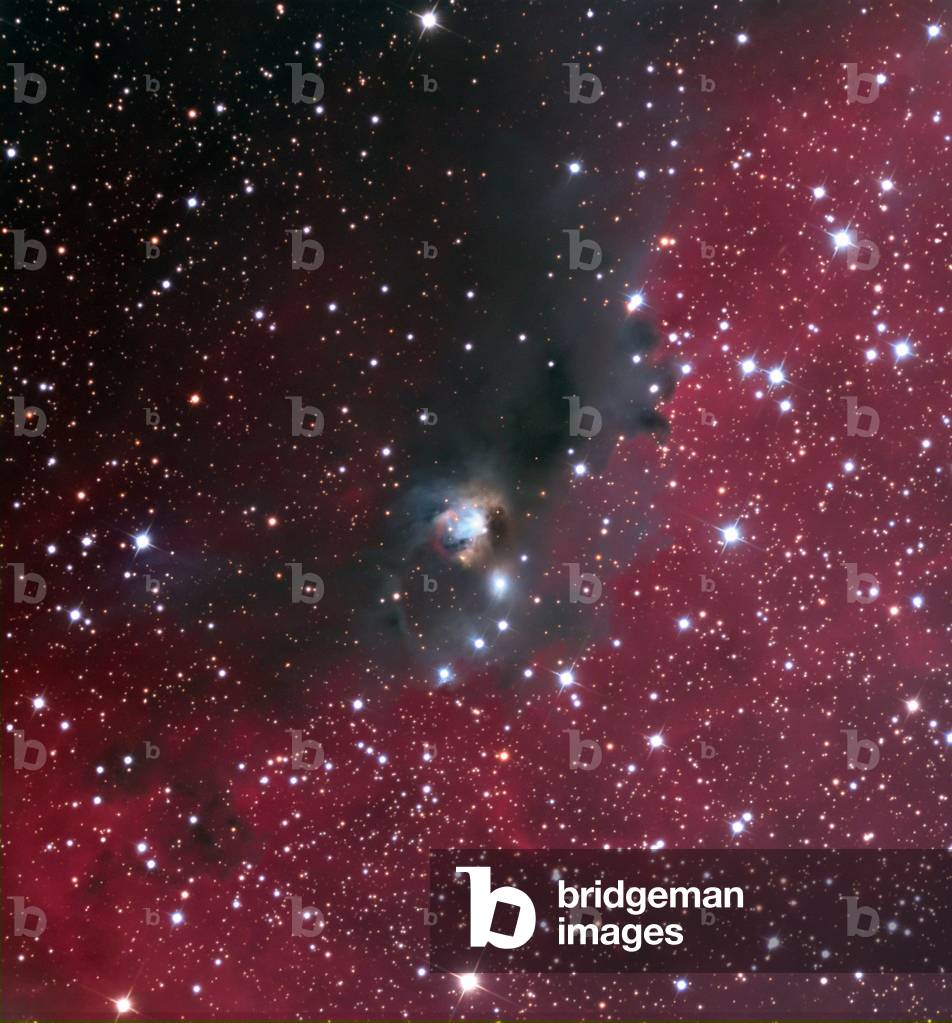
Nebula Van den Bergh 93 (VdB 93) in Unicorn - Nebula Van den Bergh 93 (VdB 93) - VDB 93 is a star-forming region belonging to nebula IC 2177. The star SAO 152320, in the center of the image, illuminates this nebula located in the constellation Unicorn, about 4000 years old - light from Earth. Curtains of gas and dust dramatically open here to reveal the inner region of this starforming region. Unceremoniously named, bright star SAO 152320 shines with intense light in the center of this field. Clouds of gas glow strongly and dust shrinks quickly under its radiative prowess. This vista lies some 4,000 light years away towards the constellation of Monoceros. This is a portion of a much larger nebula called Gum 1
Nebula NGC 2170 in Unicorn - Nebula NGC 2170 in Monoceros - Nebula by reflexion located in the constellation Unicorn. This rich collection of predominantly reflection and sparse emission nebulosity exists in the western part of a vast star forming region known as the Mon R 2 association. The “” R”” designation stands for reflection and indicates an association of stars illuminating reflection nebulae. Most of the members of Mon R 2 are type B stars located along an east - west line stretching across 2 degrees of the winter sky, situated about 8 degrees east of the Orion Nebula. The Mon R 2 association resides at a distance of 830 pc and formed about 6 to 10 million years ago along the edge of the Mon R2 molecular cloud
Planetary nebula NGC 2346 in Unicorn - The planetary nebula NGC 2346 - This nebula is located about 2000 years - light from Earth. A binary star resides in its center. Image obtained by the 3.9m telescope of Siding Spring NGC 2346 is a fine bipolar planetary nebula which is on the celestial equator in the constellation of Monoceros. It is bright and conspicuous and has been extensively studied. Among its most remarkable characteristics is its unusually cool central star, which is a 'spectroscopic binary'. The two components are identified by the effect of their movement around each other on the lines of their spectrum. The double star, which has a period of about 16 days, is also variable, probably due to dust in orbit around it. The dust itself is heated by the central star and so NGC 2346 is unusually bright in the infrared part of the spectrum
Planetary Nebula of the Red Rectangle in the Unicorn - The Red Rectangle, AFGL 915 - This planetary nebula is located about 2300 years ago - light. Image from Siding Spring 3.9m Telescope This surprising object is one of an unusual class of nebulae surrounding mature, sun - like stars that are about to turn into planetary nebulae. Not all pre - planetary nebulae have outbursts like this, and in those that do, the nebula lasts only a few thousand years, hence the rarity. The central star has a thick belt of dust like a girdle around its equator which restricts outflow in that direction. Instead, the star ejects material in a kind of cone from each of its poles. The spectrum of the nebula shows unusual, strong red lines from hydrogen bonded to grains of carbon, however there is sufficient light reflected from the embedded star to dilute the strong red spectrum to the deep yellow we see here
Detail of the Cone nebula in the Unicorn - The Cone Nebula (NGC 2264) - Detail - Image obtained by the Hubble space telescope of the upper part of the Cone nebula (NGC 2264), a star-forming region located about 2500 years ago - light from Earth. The Cone Nebula (NGC 2264) - - so named because, in ground - based images, it has a conical shape - - this giant pillar resides in a turbulent star - forming region. This picture, taken by the Advanced Camera for Surveys (ACS) aboard Nasa's Hubble Space Telescope, shows the upper 2.5 light - years of the nebula, a height that equals 23 million roundtrips to the Moon. The entire nebula is 7 light - years long. The Cone Nebula resides 2,500 light - years away in the constellation Monoceros. ACS made this observation on April 2, 2002. The color image is constructed from three separate images taken in blue, near - infrared, and hydrogen - alpha filters
Nebula Van den Bergh 93 (VdB 93) in Unicorn - Nebula Van den Bergh 93 (VdB 93) - VDB 93 is a star-forming region belonging to nebula IC 2177. The star SAO 152320, in the center of the image, illuminates this nebula located in the constellation Unicorn, about 4000 years old - light from Earth. Curtains of gas and dust dramatically open here to reveal the inner region of this starforming region. Unceremoniously named, bright star SAO 152320 shines with intense light in the center of this field. Clouds of gas glow strongly and dust shrinks quickly under its radiative prowess. This vista lies some 4,000 light years away towards the constellation of Monoceros. This is a portion of a much larger nebula called Gum 1
Nebula near the star S Mon in Unicorn - Fox Fur nebula in Monoceros - Nebula around the bright star S Monocerotis in the constellation Unicorn. S My belongs to a young cluster of stars located about 2600 years from Earth. The region around the 4.7 magnitude star S Mon is a fascinating mixture of red fluorescent hydrogen and dark, obscuring dust lanes. Some dust patches are close enough to bright stars to reflect light from them; these appear blue for the same reason that the day - time sky is blue - because some of the interstellar particles preferentially scatter blue light. The dust is mixed with gas and this affects the appearance of the emission nebulae, giving some of the faintest a curious 'fox fur' texture in this enhanced photograph. S Mon is part of a young open cluster of stars named NGC 2264 located about 2600 light years away, just north of the Cone nebula
Narwhal, Monodon monoceros, goose-beaked whale, Ziphius cavirostris, and northern bottlenose whale, Hyperoodon ampullatus. Handcoloured copperplate engraving from Rene Primevere Lesson's Complements de Buffon, Pourrat Freres, Paris, 1838.
Nebula NGC 2170 in Unicorn - Nebula NGC 2170 in Monoceros - Nebula by reflexion located in the constellation Unicorn. This rich collection of predominantly reflection and sparse emission nebulosity exists in the western part of a vast star forming region known as the Mon R 2 association. The “” R”” designation stands for reflection and indicates an association of stars illuminating reflection nebulae. Most of the members of Mon R 2 are type B stars located along an east - west line stretching across 2 degrees of the winter sky, situated about 8 degrees east of the Orion Nebula. The Mon R 2 association resides at a distance of 830 pc and formed about 6 to 10 million years ago along the edge of the Mon R2 molecular cloud
Hubble Nebula (NGC 2261) in Unicorn - NGC 2261, Hubble's variable nebula - The Hubble Nebula is a weak nebulosite that surrounds the star R Monocerotis (R Mon), the bright star at the bottom of the nebula. The mass of the star R Mon is about 10 times that of the sun. It is approximately 2600 light years away and is only 300,000 years old. Image obtained by Siding Spring's 3.9m telescope. Hubble's variable nebula is in Monoceros and was the first object to be photographed with the famous 200 inch Hale Telescope at Palomar in 1948. This curious object is a reflection nebula in which is embedded the star R Monocerotis. Variations in the appearance of the nebula were noted by the American astronomer Edwin Hubble in 1916. They are probably caused by opaque clouds of dust passing between the hidden star and the outskirts of the nebula we see, the moving shadows changing the apparent form of the glowing dust in an irregular way. This picture was made from three AAT plates taken over several years and subtle colour changes around the edge of the nebula are indications of the variability
Constellations of the Unicorn and the Little Dog - Constellations of Monoceros and Canis Minor - Constellation of the Unicorn, at its right Orion, at the top left the Little Dog with the star Procyon, at the bottom of Sirius. The stars Sirius, Procyon and Betelgeuse form the asterism of the winter triangle. Monoceros constellation, at right: Orion, top left Canis Minor with Procyon, bottom Sirius in Canis Major. Monoceros (the Unicorn) represents mythical creature set among the stars. This one has the forelegs and (horned) head of a horse, the hindquarters of a stag and the tail of a lion. Such creatures are sometimes seen in Assyrian (~ 2500 - 600 BCE) carvings, and have been interpreted as originating in traveller's tales of the Indian or African rhinoceros. The modern constellation sits astride both the Milky Way and the celestial equator. It is also enclosed on three sides by the bright stars of the Winter Triangle (Sirius, Procyon and Betelgeuse). Of course this refers to the northern hemisphere winter; these stars are equally visible in the southern summer and make Monoceros easy to find. However, the stars within the constellation itself are rather faint, though they can be joined tp produce a figure resembling a unicorn. The famous Rosette nebula is just visible in the only closed triangle of the constellation figure. Canis Minor (the Lesser Dog) is sometimes regarded as the smaller of the two dogs of Orion the hunter. It is minor indeed, just 185 degrees square, and 71st in size of the 88 modern constellations. The most obvious and interesting object Canis Minor is its main star, the pale yellow Procyon. Its name is from the Greek, meaning 'before the dog', since it rises before the Sirius, the Dog Star
S star Monocerotis and nebula - Fox Fur nebula in Monoceros - The region to the right of the bright star S Monocerotis is called Fox Fur nebula. This region where gas mixes with interstellar dust is located above the Cone nebula, about 2600 light years from Earth. Image obtained with a 61 cm telescope, composite of several images. The region around the 4.7 magnitude star S Mon is a fascinating mixture of red fluorescent hydrogen and dark, obscuring dust lanes. Some dust patches are close enough to bright stars to reflect light from them; these appear blue for the same reason that the day - time sky is blue - because some of the interstellar particles preferentially scatter blue light. The dust is mixed with gas and this affects the appearance of the emission nebulae, giving some of the faintest a curious 'fox fur' texture in this photograph. S Mon is part of a young open cluster of stars named NGC 2264 located about 2600 light years away, just north of the Cone nebula. Image taken with a 24 - inch telescope
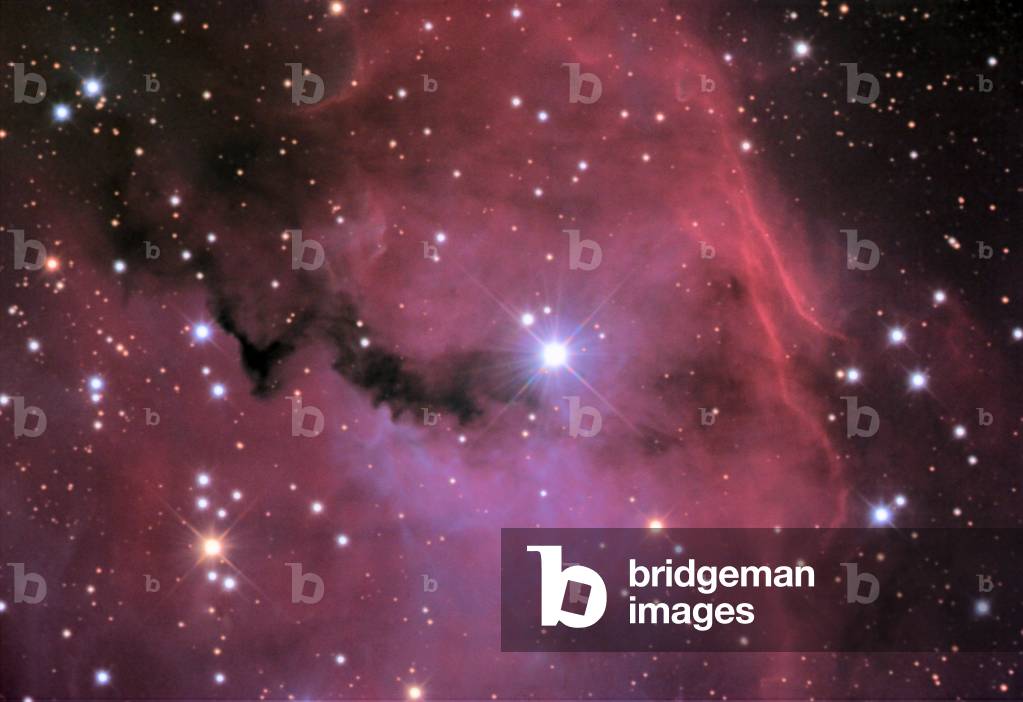
Nebula IC 2177dans la Unicorn - IC 2177 The Seagull nebula - IC 2177, is a large emission nebula located at the edge of the constellations of the Unicorn and the Great Dog. IC 2177, also known as the Eagle or Seagull Nebula, is a large emission nebulosity located on the border between Monoceros and Canis Major, about 7.5 degrees northeast of Sirius. The brightest portion is the “” head”” of the bird, NGC 2327, measuring some 19 x 17 arc minutes, surrounding an 8th magnitude star, and nearly bisected by an interesting dark lane that stretches from the star eastward, and also including some blue reflection nebulosity. Several open clusters are also involved in this area of nebulosity, the most prominent being NGC 2335, located on the northern “” wing”” of the figure of the Seagull nebula
Cone Nebula NGC 2264 in the Unicorn - The Cone Nebula NGC 2264 in Monoceros - The Cone Nebula is a star-forming region situated about 2600 years away from Earth. It is accompanied by a cluster of stars called the Christmas tree. Image obtained with a 50 cm telescope, composite of several images. The Cone Nebula (also known as NGC 2264) is an H II region in the constellation of Monoceros. It was discovered by William Herschel in 1785. The nebula is located about 800 parsecs or 2,600 light - years away from Earth. The Cone Nebula is part of the nebulosity surrounding the Christmas Tree Cluster. The designation of NGC 2264 in the New General Catalogue refers to both objects and not the nebula alone
Nebula of the cone NGC 2264 in the Unicorn - The Cone Nebula in Monoceros - Region H II located about 2600 years - light from Earth. Image obtained by Siding Spring's 3.9m telescope. The Cone nebula is part of an enormous cloud of hydrogen and tiny solid particles associated with the loose open cluster, NGC 2226 in the equatorial constellation of Monoceros. Within and around this cloud are many recently formed stars, some completely hidden within the dense interstellar matter. They can be detected by special infra - red techniques which are able to penetrate the obscuration. The largest of the dust clouds is the curious straight - sided feature which gives this object its name
Cone Nebula NGC 2264 in the Unicorn - The Cone Nebula NGC 2264 in Monoceros - The Cone Nebula is a star-forming region situated about 2600 years away from Earth. It is accompanied by a cluster of stars called the Christmas tree. Mosaic of 140 images obtained by the Subaru telescope. The Cone Nebula (also known as NGC 2264) is an H II region in the constellation of Monoceros. It was discovered by William Herschel in 1785. The nebula is located about 800 parsecs or 2,600 light - years away from Earth. The Cone Nebula is part of the nebulosity surrounding the Christmas Tree Cluster. The designation of NGC 2264 in the New General Catalogue refers to both objects and not the nebula alone
Cone and Hubble Nebulae in the Unicorn - Cone and Hubble nebulae in Monoceros - The Cone nebula, at the bottom left, is an H II region located about 2600 years - light from Earth. The bright star in the middle left is S Monocerotis, a star of magnitude 4.7. Lower right, the Hubble nebula, overexposed. This large area of emission nebulosity and patch of blue reflection nebulosity also contains the Cone Nebula, a dark nebula at the lower right corner of the red nebulae. At the bottom right of the frame is NGC 2261, Hubble's Variable Nebula, in this image looking like an overexposed mis - shaped star because of the extreme processing needed to bring out the faint nebulosity in the Cone Nebula
The Rosette Nebula in the Unicorn - The Rosette Nebula and NGC 2244 cluster - The Rosette Nebula is a vast cloud of dust and gas located about 5500 years from Earth. Towards the center of the nebula, a cluster of blue stars, NGC 2244 formed less than a million years ago. Image obtained by Siding Spring's 3.9m telescope. In the hollowed - out centre of the Rosette nebula lies NGC 2244, the cluster of young stars recently formed there. The cluster has itself created the cavity, radiation pressure and stellar winds from the stars blowing the gas and dust away from the young cluster. The hottest (and brightest) members of the group are seen as distinctly blue on this photograph, a colour corresponding to a surface temperature around 20,000K which may be compared with the Sun's 5500K. The nebula and its cluster is at a distance of about 4500 light years and shows many streaks and globules of dust, remnants of the cloud from which the stars formed
Cone Nebula NGC 2264 in Unicorn - The Cone Nebula NGC 2264 in Monoceros: The Cone Nebula is a star-forming region located about 2600 light years from Earth. It is accompanied by a cluster of stars called the Christmas tree. Mosaic of images - The Cone Nebula (also known as NGC 2264) is an H II region in the constellation of Monoceros. It was discovered by William Herschel in 1785. The nebula is located about 800 parsecs or 2,600 light-years away from Earth. The Cone Nebula is part of the nebulosity surrounding the Christmas Tree Cluster. The designation of NGC 2264 in the New General Catalogue refers to both objects and not the nebula alone.
Constellations of the Unicorn and the Little Dog - Constellations of Monoceros and Canis Minor - Constellation of the Unicorn, at its right Orion, at the top left the Little Dog with the star Procyon, at the bottom of Sirius. The stars Sirius, Procyon and Betelgeuse form the asterism of the winter triangle. Monoceros constellation, at right: Orion, top left Canis Minor with Procyon, bottom Sirius in Canis Major. Monoceros (the Unicorn) represents mythical creature set among the stars. This one has the forelegs and (horned) head of a horse, the hindquarters of a stag and the tail of a lion. Such creatures are sometimes seen in Assyrian (~ 2500 - 600 BCE) carvings, and have been interpreted as originating in traveller's tales of the Indian or African rhinoceros. The modern constellation sits astride both the Milky Way and the celestial equator. It is also enclosed on three sides by the bright stars of the Winter Triangle (Sirius, Procyon and Betelgeuse). Of course this refers to the northern hemisphere winter; these stars are equally visible in the southern summer and make Monoceros easy to find. However, the stars within the constellation itself are rather faint, though they can be joined tp produce a figure resembling a unicorn. The famous Rosette nebula is just visible in the only closed triangle of the constellation figure. Canis Minor (the Lesser Dog) is sometimes regarded as the smaller of the two dogs of Orion the hunter. It is minor indeed, just 185 degrees square, and 71st in size of the 88 modern constellations. The most obvious and interesting object Canis Minor is its main star, the pale yellow Procyon. Its name is from the Greek, meaning 'before the dog', since it rises before the Sirius, the Dog Star
Cone Nebula NGC 2264 in the Unicorn - The Cone Nebula NGC 2264 in Monoceros - The Cone Nebula is a region H II located about 2600 years from Earth. It is accompanied by a cluster of stars called the Christmas tree. The bright star at the top is S Monocerotis, a star of magnitude 4.7. Image obtained with a 50 cm telescope, composite of several images. Total installation of 52 hours. The Cone Nebula (also known as NGC 2264) is an H II region in the constellation of Monoceros. It was discovered by William Herschel in 1785. The nebula is located about 800 parsecs or 2,600 light - years away from Earth. The Cone Nebula is part of the nebulosity surrounding the Christmas Tree Cluster. The designation of NGC 2264 in the New General Catalogue refers to both objects and not the nebula alone. The brightest star on top of the image is S Monocerotis. This image was created by stitching six separate photographs, featuring over 52 total hours of exposure, into a single seamless mosaic. The exposures were taken during the fall of 2008 through a remotely controlled 20 inch Ritchey - Chretien telescope using a large format SBIG STL - 11000 camera
S star Monocerotis and nebula - Fox Fur nebula in Monoceros - The region to the right of the bright star S Monocerotis is called Fox Fur nebula. This region where gas mixes with interstellar dust is located above the Cone nebula, about 2600 light years from Earth. Image obtained with a 50 cm telescope, composite of several images. The region around the 4.7 magnitude star S Mon is a fascinating mixture of red fluorescent hydrogen and dark, obscuring dust lanes. Some dust patches are close enough to bright stars to reflect light from them; these appear blue for the same reason that the day - time sky is blue - because some of the interstellar particles preferentially scatter blue light. The dust is mixed with gas and this affects the appearance of the emission nebulae, giving some of the faintest a curious 'fox fur' texture in this photograph. S Mon is part of a young open cluster of stars named NGC 2264 located about 2600 light years away, just north of the Cone nebula
Nebula of the cone NGC 2264 and S star Monocerotis - NGC 2264 and S Monocerotis - Region H II located about 2600 years - light from Earth. The bright star is S Monocerotis, a star of magnitude 4.7. Image obtained by Siding Spring's 3.9m telescope. The region around the 4.7 magnitude star S Mon is a fascinating mixture of red fluorescent hydrogen and dark, obscuring dust lanes. Some dust patches are close enough to bright stars to reflect light from them; these appear blue for the same reason that the day - time sky is blue - because some of the interstellar particles preferentially scatter blue light. Some of the wispy tendrils of nebulosity are Herbig - Haro objects, jets of matter ejected from newly - formed stars still hidden within the nebula. About 250 stars have been recognised as members of NGC 2264 which is at a distance of about 2700 light years
Cone Nebula NGC 2264 in the Unicorn - The Cone Nebula NGC 2264 in Monoceros - The Cone Nebula is a region H II located about 2600 years from Earth. It is accompanied by a cluster of stars called the Christmas tree. The bright star at the top is S Monocerotis, a star of magnitude 4.7. Image obtained by the 2.2m telescope of La Silla. NGC 2264 and the Christmas Tree cluster lies about 2600 light - years from Earth in the constellation of Monoceros, the Unicorn, not far from the more familiar figure of Orion, the Hunter. The image shows a region of space about 30 light - years across. The cluster is very bright and can easily be seen with binoculars. With a small telescope (whose lenses will turn the view upside down) the stars resemble the glittering lights on a Christmas tree. The dazzling star at the top is S Monocerotis, bright enough to be seen with the unaided eye. It is a massive multiple star system that only emerged from the dust and gas a few million years ago. At the bottom of the frame, the dark triangular feature is the evocative Cone Nebula, a region of molecular gas flooded by the harsh light of the brightest cluster members. The region to the right of the brightest star has a curious, fur - like texture that has led to the name Fox Fur Nebula. Much of the image appears red because the huge gas clouds are glowing under the intense ultra - violet light coming from the energetic hot young stars. The stars themselves appear blue as they are hotter, younger and more massive than our own Sun. Some of this blue light is scattered by dust, as can be seen occurring in the upper part of the image. This picture of NGC 2264 was created from images taken with the Wide Field Imager (WFI), a specialised astronomical camera attached to the 2.2 - metre Max - Planck Society/ESO telescope at the La Silla observatory in Chile
Nebula of the cone NGC 2264 in the Unicorn - Nebulae in Monoceros - The nebula of the Cone below, is a region about 2600 years - light from the Earth. The bright star in the high center is S Monocerotis, a star of magnitude 4.7. Nests in these gas clouds, the Christmas tree, a cluster of young stars whose shape evokes a Christmas tree. This wide - field image of the Christmas Tree Cluster was taken at the National Science Foundation's 0.9 - meter telescope on Kitt Peak with the NOAO Mosaic CCD camera. Also known as NGC2264, it is an open cluster of stars embedded in a diffuse nebula. It is located in the constellation of Monoceros, the Unicorn. The image also contains two famous nebula. At the bottom center of the image is the Cone Nebula, and to the upper left is the Fox Fur Nebula. The bright star just above the center of the image is known as S Mon. The gentle arcs in orange and blue near the center of the image are Herbig Haro objects, jets of gas from protostars embedded in the nebula. This image was created by combining emission - line images in Hydrogen - alpha (red - orange), Oxygen [O III] (light blue) and Sulfur [S II] (blue - violet)
Nebula IC 2177dans la Unicorn - IC 2177 The Seagull nebula - IC 2177, is a large emission nebula located at the edge of the constellations of the Unicorn and the Great Dog. IC 2177, also known as the Eagle or Seagull Nebula, is a large emission nebulosity located on the border between Monoceros and Canis Major, about 7.5 degrees northeast of Sirius. The brightest portion is the “” head”” of the bird, NGC 2327, measuring some 19 x 17 arc minutes, surrounding an 8th magnitude star, and nearly bisected by an interesting dark lane that stretches from the star eastward, and also including some blue reflection nebulosity. Several open clusters are also involved in this area of nebulosity, the most prominent being NGC 2335, located on the northern “” wing”” of the figure of the Seagull nebula
Open cluster NGC 2244 in the nebula of the Rosette - The Rosette Nebula and NGC 2244 cluster - The Rosette nebula is a vast cloud of dust and gas situated about 5500 years away from Earth. Towards the center of the nebula, a cluster of blue stars, NGC 2244 formed less than a million years ago. Image obtained by Siding Spring's 3.9m telescope. In the hollowed - out centre of the Rosette nebula lies NGC 2244, the cluster of young stars recently formed there. The cluster has itself created the cavity, radiation pressure and stellar winds from the stars blowing the gas and dust away from the young cluster. The hottest (and brightest) members of the group are seen as distinctly blue on this photograph, a colour corresponding to a surface temperature around 20,000K which may be compared with the Sun's 5500K. The nebula and its cluster is at a distance of about 4500 light years and shows many streaks and globules of dust, remnants of the cloud from which the stars formed
Rosette nebula (NGC 2237) in the Unicorn - The Rosette nebula in Monoceros - The Rosette nebula is a vast cloud of dust and gas. In its center, the cluster of stars NGC 2244. Image obtained by the Oschin telescope of Mount Palomar through several filters and composed. The north is at top. Discovered by John Flamsteed about 1690, the Rosetta Nebula is a vast cloud of dust and gas, extending over an area of more than 1 degree across, or about 5 times the area covered by the full moon. Within the nebula, open star cluster NGC 2244 is situated, consisted of the young stars which recently formed from the nebula's material, and the brightest of which make the nebula shine by exciting its atoms to emit radiation. Star formation is still in progress in this vast cloud of interstellar matter. Although various values for its distance occur in the literature, an avarage value of about 5,500 light - years is generally accepted. This image is based on data acquired by the Oschin Telescope at the Mount Palomar Observatory
Winter hexagon and March - Winter hexagon - The winter hexagon is an asterism formed by the stars Sirius, Procyon, Pollux, Capella, Aldebaran and Rigel. The image also shows the planet Mars (the brightest spot) and the comet Holmes (scattered spot on the right. 19 December 2007. Winter hexagon is composed by bright stars Sirius, Procyon, Pollux, Capella, Aldebaran and Rigel. The image shows also the comet 17P/Holmes. But very prominent inside the Hexagon is Mars. December 19, 2007
The Rosette Nebula in the Unicorn - The Rosette Nebula and NGC 2244 cluster - The Rosette Nebula is a vast cloud of dust and gas located about 5500 years from Earth. Towards the center of the nebula, a cluster of blue stars, NGC 2244 formed less than a million years ago. Image obtained from the 1.2m Schmidt UK telescope of Siding Spring. The Rosette Nebula exhibits a striking circular symmetry which gives it the appearance of a partly opened rose, an allusion further enhanced by the rich red hues seen in this colour photograph. Near the centre of the nebula is a cluster of blue stars catalogued as NGC 2244. These stars are responsible for making the nebula visible and for creating the hollowed - out central cavity. This cluster of stars formed from the gas which now surrounds it less than a million years ago and is thus very young on the cosmic timescale. The gas and dust at the centre of the nebula have been forced away from the bright stars by radiation pressure and the intense stellar wind which is often associated with very hot stars, forming a hollow centred on the cluster. This will gradually expand and dissipate until the stars are free from nebulosity
Rosette nebula - The Rosette Nebula, NGC 2237 - Rosette nebula in the constellation Unicorn. In the centre is the cluster of stars NGC 2244 which contains about 30 massive OB stars. The Rosette Nebula, NGC 2237, is a large cloud of hydrogen gas and dust located in the constellation of Monoceros. At the center of the nebula is open star cluster NGC 2244, the birthplace of the hot young stars that energize the stellar nursery in the heart of the nebula. The Rosette is located about 5,000 light years away and is about 100 light years across
Nebula of the Rosette in the Unicorn seen in false colors - Rosette nebula in Monoceros - The nebula of the Rosette is a vast cloud of dust and gas situated about 5500 years - light from the Earth. In the center of the nebula, a cluster of blue stars, NGC 2244, formed less than a million years ago. Image in false colors obtained by Kitt Peak's 90 cm telescope. The Rosetta Nebula is a vast cloud of dust and gas, extending over an area of more than 1 degree across, or about 5 times the area covered by the full moon. Its parts have been assigned different NGC numbers: 2237, 2238, 2239, and 2246. Within the nebula, open star cluster NGC 2244 is situated, consisted of the young stars which recently formed from the nebula's material, and the brightest of which make the nebula shine by exciting its atoms to emit radiation. This stunning emission - line image of the Rosette nebula (NGC2237) in the constellation Monoceros (the Unicorn) was taken at the National Science Foundation's 0.9 - m telescope on Kitt Peak with the Mosaic camera, and is presented here in false color (hydrogen alpha, OIII oxygen, and SII sulfur red respectively, green and blue, using five ten - minute exposures each). The Rosette is a prominent star formation region, glowing due to ultraviolet light from the young, hot, blue stars whose winds also cleared the central hole. It is enormously large on the sky, covering more than six times the area of the full moon
Nebula of the Rosette in the Unicorn - Rosette nebula in Monoceros - The nebula of the Rosette is a vast cloud of dust and gas situated about 5500 years - light from the Earth. In the center of the nebula, a cluster of blue stars, NGC 2244, formed less than a million years ago. Image obtained by combining light through 3 different filters that highlight oxygen, hydrogen, and sulfur. The Rosetta Nebula in the constellation Monoceros (the Unicorn) is a vast cloud of dust and gas, extending over an area of more than 1 degree across, or about 5 times the area covered by the full moon. Its parts have been assigned different NGC numbers: 2237, 2238, 2239, and 2246. Within the nebula, open star cluster NGC 2244 is situated, consisted of the young stars which recently formed from the nebula's material, and the brightest of which make the nebula shine by exciting its atoms to emit radiation. Issue - line image presented here in false color
The Rosette nebula in Monoceros - The Rosette nebula in Monoceros - The Rosette nebula is a vast cloud of dust and gas situated about 5500 years from the Earth. In the center of the nebula, a cluster of blue stars, NGC 2244, formed less than a million years ago. The Rosetta Nebula is a vast cloud of dust and gas, extending over an area of more than 1 degree across, or about 5 times the area covered by the full moon. Its parts have been assigned different NGC numbers: 2237, 2238, 2239, and 2246. Within the nebula, open star cluster NGC 2244 is situated, consisted of the young stars which recently formed from the nebula's material, and the brightest of which make the nebula shine by exciting its atoms to emit radiation. This composite mosaic (Hybrid Image) was assembled from multiple frames taken at different focal lengths with different instruments. The image data included approximately 9 hours of hydrogen alpha filtered data and was acquired using an AP155 (F7), FSQ 106 (F5), STL11000. The composite was assembled using Adobe Photoshop 6.
Nebulae around the cluster NGC 2264 and the nebula of the Cone - Wide field around NGC 2264 in Monoceros - Region of star formation located in the constellation of Unicorn about 2700 years old - light from Earth. Image obtained by the Oschin telescope of Mount Palomar through several filters and composed. Wide field around the open cluster NGC 2264 with the brilliant star S Monocerotis (center of the image) and Cone nebula. Image made from 2 different photographic plates taken at Palomar Observatory between 1989 and 1992
NGC 2264, S Monocerotis, Hubble Nebula and Trumpler 5 clusters - NGC 2261, 2264, the Cone nebula and Trumpler 5 - The Cone nebula on the left is a region H II located about 2600 years - light from Earth. The bright star on the top left is S Monocerotis, a star of magnitude 4.7. On the right, an open cluster of stars, Trumpler 5. Downstairs in the center, the Hubble nebula. Image obtained from the 1.2m Schmidt telescope of Siding Spring. The western end of the large constellation of Monoceros crossed by the Galactic plane and so is rich in the ingredients of star formation. Only five degrees south (not shown) is the beautiful Rosette nebula, also close to the Galactic plane. To the east (left) is the outline of the dark Cone nebula with its distinctive bright tip, apparently pointing to the star S Mon at the top (north) of the photograph. All around is faint nebulosity, hinting at star formation in the region. Around the dusty red nebula there are areas where the light from background stars is blocked out by dust which is unlit. At the lower center of the picture is Hubble's variable nebula (NGC 2261), a young star in a dusty cocoon, while at right is a large, old, open cluster of stars, Trumpler 5
Nebula NGC 2170 in Unicorn - Nebula NGC 2170 in Monoceros - Nebula by reflexion located in the constellation Unicorn. This rich collection of predominantly reflection and sparse emission nebulosity exists in the western part of a vast star forming region known as the Mon R 2 association. The “” R”” designation stands for reflection and indicates an association of stars illuminating reflection nebulae. Most of the members of Mon R 2 are type B stars located along an east - west line stretching across 2 degrees of the winter sky, situated about 8 degrees east of the Orion Nebula. The Mon R 2 association resides at a distance of 830 pc and formed about 6 to 10 million years ago along the edge of the Mon R2 molecular cloud. NGC2170 is a common nebula imaged and yet with long exposures it takes on a whole new look. Many of the nebulae seen here appear to be uncataloged and not previously imaged. This image has been carefully processed to reveal the many faint and dusty nebulae in this region of Monoceros
Sea unicorn or narwhal, Monodon monoceros. Rare specimen with double tusks. Handcoloured copperplate engraving by James Sowerby from The British Miscellany, or Coloured figures of new, rare, or little known animal subjects.
Narwhal, Monodon monoceros, and dugong, Dugong dugon (vulnerable). Lithograph by Karl Joseph Brodtmann from Heinrich Rudolf Schinz's Illustrated Natural History of Men and Animals, 1836.
Nebula IC 2177 in the Unicorn - IC 2177 The Seagull nebula - IC 2177, is a large emission nebula located at the edge of the constellations of the Unicorn and the Great Dog. Image obtained through 3 different filters that highlight oxygen (blue), hydrogen (green), and sulfur (red). IC 2177, also known as the Eagle or Seagull Nebula, is a large emission nebulosity located on the border between Monoceros and Canis Major, about 7.5 degrees northeast of Sirius. This image is in the classic “” Hubble palette”” where SII is assigned to red, H - alpha to green, and OIII to blue. RGB frames were taken for star colors
Narwhal or sea canary, Monodon monoceros (1,2). Handcoloured copperplate engraving by David after an illustration by Jean-Gabriel Pretre from Bernard Germain de Lacepede's Natural History of Oviparous Quadrupeds, Snakes, Fish and Cetaceans, Eymery, Paris, 1825.
Monoceros, constellation of Unicorn, engraving from the celestial atlas Firmamentum Sobiescianum sive Uronographia, by Johann Hevelius (1611-1687), Gdansk, 1690, 17th century
Zusätzliche Genehmigungen
  • Permission required for any use in perpetuity - Please contact us;Permission required for certain ebook uses - Please contact us;Permission required for certain film, TV and streaming uses - Please contact us;Permission required for immersive exhibition use - Please contact us
Bildbeschränkungen
  • Bridgeman Images only provides access to this image. Consent to license this image for any usage that includes Italy as a territory may be required according to the Italian Cultural Heritage Code. In such cases, an additional fee may apply, with the Ministry of Culture charging a potential minimum of €100. Any such clearance must be obtained in advance from the institution where the work is kept. Please contact us for further assistance.
Bowhead whale, Balaena mysticetus, sperm whale, Physeter macrocephalus, short-beaked dolphin, Delphinus delphis, extinct Steller's sea cow, Hydrodamalis gigas, West Indian manatee, Trichechus manatus, and narwhal, Monodon monoceros. Lithograph from Lorenz Oken's Universal Natural History, Allgemeine Naturgeschichte fur alle Stande, Stuttgart, 1841.