[]
Ihre AuswahlIhre aktuelle Auswahl
asset(s) Assets
Ihr Preis 0

Ihre Auswahl

Auswahl aufheben
Asset zum Warenkorb hinzugefügt
{"event":"pageview","page_type1":"undetected","page_type2":"_assets_search_override","language":"de","user_logged":"false","user_type":"ecommerce","nl_subscriber":"false"}
{"event":"ecommerce_event","event_name":"view_item","event_category":"browse_catalog","ecommerce":{"items":[{"item_id":"EPL6791989","item_category":"illustration","item_category2":"out_of_copyright","item_category3":"standard","item_category5":"not_balown","item_list_name":"search_results","item_name":"josef_von_fraunhofer_with_his_spectrometer","item_variant":"undefined"},{"item_id":"EPL6792007","item_category":"illustration","item_category2":"out_of_copyright","item_category3":"standard","item_category5":"not_balown","item_list_name":"search_results","item_name":"josef_von_fraunhofer_with_his_spectrometer","item_variant":"undefined"},{"item_id":"PIX4650525","item_category":"photo","item_category2":"no_copyright","item_category3":"standard","item_category4":"aurelien_muller","item_category5":"not_balown","item_list_name":"search_results","item_name":"lhc_the_spectrometer_of_the_alice_experiment_lhc_spectrometer_alice_experiment_the_spectrometer_of_t","item_variant":"undefined"},{"item_id":"UIS5073560","item_category":"photo","item_category2":"no_copyright","item_category3":"standard","item_category5":"not_balown","item_list_name":"search_results","item_name":"spectrometer_for_the_hubble_telescope_1980s","item_variant":"undefined"},{"item_id":"PIX4655833","item_category":"photo","item_category2":"no_copyright","item_category3":"standard","item_category4":"patrick_lecureuil","item_category5":"not_balown","item_list_name":"search_results","item_name":"observatory_of_the_pic_du_midi_telescope_bernard_lyot_pic_du_midi_observatory_the_bernard_lyot_teles","item_variant":"undefined"},{"item_id":"AVE6328101","item_category":"footage","item_category2":"no_copyright","item_category3":"standard","item_category5":"not_balown","item_list_name":"search_results","item_name":"1980s_man_in_lab_adjusts_spectrometer","item_variant":"undefined"},{"item_id":"UIG529303","item_category2":"no_copyright","item_category3":"standard","item_category5":"not_balown","item_list_name":"search_results","item_name":"six_sided_feature_encircling_the_north_pole_of_saturn_near_by_the_visual_and_infrared_mapping_spectr","item_variant":"undefined"},{"item_id":"UIG3480080","item_category":"illustration","item_category2":"out_of_copyright","item_category3":"standard","item_category5":"not_balown","item_list_name":"search_results","item_name":"corby_browning_s_mircospectroscope_1895","item_variant":"undefined"},{"item_id":"UIG866563","item_category":"photo","item_category2":"no_copyright","item_category3":"standard","item_category5":"not_balown","item_list_name":"search_results","item_name":"the_nili_fossae_region_of_mars_is_one_of_the_largest_exposures_of_clay_minerals_discovered_by_the_om","item_variant":"undefined"},{"item_id":"UIS5067044","item_category":"object","item_category2":"no_copyright","item_category3":"standard","item_category5":"not_balown","item_list_name":"search_results","item_name":"instruments_spectroscopes_hilger_wavelength_spectrometer_spectrometre_with_camera_c_1919","item_variant":"undefined"},{"item_id":"UIG529528","item_category2":"no_copyright","item_category3":"standard","item_category5":"not_balown","item_list_name":"search_results","item_name":"this_envisat_image_2008_with_the_medium_resolution_imaging_spectrometer_captures_a_plankton_bloom_st","item_variant":"undefined"},{"item_id":"UIG3480079","item_category":"illustration","item_category2":"out_of_copyright","item_category3":"standard","item_category5":"not_balown","item_list_name":"search_results","item_name":"hofmann_s_spectroscope_1895","item_variant":"undefined"},{"item_id":"PIX4573710","item_category":"photo","item_category2":"no_copyright","item_category3":"standard","item_category5":"not_balown","item_list_name":"search_results","item_name":"artist_s_view_of_the_exoplanet_gliese_581c_artist_s_view_of_the_exoplanet_gliese_581c_discovered_by_","item_variant":"undefined"},{"item_id":"AVE6328100","item_category":"footage","item_category2":"no_copyright","item_category3":"standard","item_category5":"not_balown","item_list_name":"search_results","item_name":"1980s_man_and_woman_look_at_pipes_in_lab","item_variant":"undefined"},{"item_id":"PIX4645472","item_category":"illustration","item_category2":"no_copyright","item_category3":"standard","item_category5":"not_balown","item_list_name":"search_results","item_name":"hubble_space_telescope_artist_view_hubble_space_telescope_artist_view_the_hubble_space_telescope_is_","item_variant":"undefined"},{"item_id":"PIX4644965","item_category":"photo","item_category2":"no_copyright","item_category3":"standard","item_category5":"not_balown","item_list_name":"search_results","item_name":"hubble_space_telescope_2nd_maintenance_mission_02_1997_view_of_astronaut_steven_smith_evacuating_the","item_variant":"undefined"},{"item_id":"PIX4589059","item_category":"photo","item_category2":"no_copyright","item_category3":"standard","item_category5":"not_balown","item_list_name":"search_results","item_name":"position_of_the_exoplanet_gliese_581b_position_of_the_exoplanet_gliese_581b_trace_of_the_constellati","item_variant":"undefined"},{"item_id":"PIX4645506","item_category":"illustration","item_category2":"no_copyright","item_category3":"standard","item_category5":"not_balown","item_list_name":"search_results","item_name":"hubble_space_telescope_artist_s_view_hubble_space_telescope_artwork_the_hubble_space_telescope_is_a_","item_variant":"undefined"},{"item_id":"PIX4645535","item_category":"illustration","item_category2":"no_copyright","item_category3":"standard","item_category5":"not_balown","item_list_name":"search_results","item_name":"hubble_space_telescope_artist_s_view_hubble_space_telescope_artwork_artist_s_view_of_the_space_shutt","item_variant":"undefined"},{"item_id":"PIX4621141","item_category":"photo","item_category2":"no_copyright","item_category3":"standard","item_category5":"not_balown","item_list_name":"search_results","item_name":"star_formation_in_the_southern_cross_star_formation_in_the_southern_cross_part_of_the_lactee_route_i","item_variant":"undefined"},{"item_id":"XLF3792588","item_category2":"out_of_copyright","item_category3":"standard","item_category5":"balown","item_list_name":"search_results","item_name":"joseph_fraunhoferspectroscope","item_variant":"undefined"},{"item_id":"XLF3792615","item_category2":"out_of_copyright","item_category3":"standard","item_category4":"unknown_artist_20th_century","item_category5":"balown","item_list_name":"search_results","item_name":"joseph_fraunhofer_s_spectroscope_from_astronomy_for_all_by_burgel_print","item_variant":"undefined"},{"item_id":"PIX4607290","item_category":"photo","item_category2":"no_copyright","item_category3":"standard","item_category5":"not_balown","item_list_name":"search_results","item_name":"artist_s_view_of_the_new_horizons_probe_near_pluto_the_new_horizons_spacecraft_near_pluto_artist_s_v","item_variant":"undefined"},{"item_id":"PIX4607277","item_category":"photo","item_category2":"no_copyright","item_category3":"standard","item_category5":"not_balown","item_list_name":"search_results","item_name":"artist_s_view_of_the_new_horizons_probe_near_pluto_the_new_horizons_spacecraft_near_pluto_artist_s_v","item_variant":"undefined"},{"item_id":"PIX4607314","item_category":"photo","item_category2":"no_copyright","item_category3":"standard","item_category5":"not_balown","item_list_name":"search_results","item_name":"artist_s_view_of_the_new_horizons_probe_near_pluto_the_new_horizons_spacecraft_near_pluto_artist_s_v","item_variant":"undefined"},{"item_id":"PIX4607330","item_category":"photo","item_category2":"no_copyright","item_category3":"standard","item_category5":"not_balown","item_list_name":"search_results","item_name":"artist_s_view_of_the_new_horizons_probe_near_pluto_the_new_horizons_spacecraft_near_pluto_artist_s_v","item_variant":"undefined"},{"item_id":"UIS5069441","item_category":"object","item_category2":"no_copyright","item_category3":"standard","item_category5":"not_balown","item_list_name":"search_results","item_name":"instruments_spectroscopes_grating_spectrometer_1882_1905","item_variant":"undefined"},{"item_id":"PIX4625340","item_category":"photo","item_category2":"no_copyright","item_category3":"standard","item_category5":"not_balown","item_list_name":"search_results","item_name":"titan_saturn_satellite_seen_by_cassini_saturn_s_moon_titan_as_seen_by_cassini_spacecraft_visible_and","item_variant":"undefined"},{"item_id":"PIX4615739","item_category":"photo","item_category2":"no_copyright","item_category3":"standard","item_category5":"not_balown","item_list_name":"search_results","item_name":"march_spirit_panorama_mcmurdo_10_2006_march_mcmurdo_panorama_spirit_10_2006_panorama_of_360_degres_m","item_variant":"undefined"},{"item_id":"UIS5065019","item_category":"object","item_category2":"no_copyright","item_category3":"standard","item_category5":"not_balown","item_list_name":"search_results","item_name":"chemical_laboratories_1850_1949_unicam_sp_500_spectrophometer_c_1949","item_variant":"undefined"},{"item_id":"PIX4616152","item_category":"photo","item_category2":"no_copyright","item_category3":"standard","item_category5":"not_balown","item_list_name":"search_results","item_name":"march_hebes_chasma_mars_hebes_chasma_hebes_chasma_is_a_basin_of_almost_8000_m_deep_located_in_the_no","item_variant":"undefined"},{"item_id":"PIX4613739","item_category":"photo","item_category2":"no_copyright","item_category3":"standard","item_category5":"not_balown","item_list_name":"search_results","item_name":"center_of_the_particular_galaxy_arp_220_in_the_serpent_heart_of_the_galaxy_arp_220_the_galaxy_arp_22","item_variant":"undefined"},{"item_id":"UIS5104645","item_category":"photo","item_category2":"no_copyright","item_category3":"standard","item_category5":"not_balown","item_list_name":"search_results","item_name":"uranus_1998","item_variant":"undefined"},{"item_id":"PIX4572084","item_category":"photo","item_category2":"no_copyright","item_category3":"standard","item_category5":"not_balown","item_list_name":"search_results","item_name":"pistol_star_massive_star_in_the_constellation_sagittarius_the_massive_star_pistol_star_in_sagittariu","item_variant":"undefined"},{"item_id":"PIX4623549","item_category":"photo","item_category2":"no_copyright","item_category3":"standard","item_category5":"not_balown","item_list_name":"search_results","item_name":"the_hubble_space_telescope_s_near_infrared_camera_and_multi_object_spectrometer_nicmos_has_captured_","item_variant":"undefined"},{"item_id":"PIX4624969","item_category":"photo","item_category2":"no_copyright","item_category3":"standard","item_category5":"not_balown","item_list_name":"search_results","item_name":"saturn_seen_in_infrared_by_cassini_spacecraft_saturn_seen_in_infrared_by_cassini_spacecraft_composit","item_variant":"undefined"},{"item_id":"PIX4625361","item_category":"photo","item_category2":"no_copyright","item_category3":"standard","item_category5":"not_balown","item_list_name":"search_results","item_name":"titan_saturn_satellite_seen_by_cassini_saturn_s_moon_titan_as_seen_by_cassini_spacecraft_visible_and","item_variant":"undefined"},{"item_id":"UIS5065084","item_category":"object","item_category2":"no_copyright","item_category3":"standard","item_category5":"not_balown","item_list_name":"search_results","item_name":"chemical_laboratories_1850_1949_perkin_elmer_model_12c_infrared_spectrophotometer_1945","item_variant":"undefined"},{"item_id":"UIS5073621","item_category":"photo","item_category2":"no_copyright","item_category3":"standard","item_category5":"not_balown","item_list_name":"search_results","item_name":"testing_the_spectrometer_for_the_hubble_telescope_1980s","item_variant":"undefined"},{"item_id":"UIS5073620","item_category":"photo","item_category2":"no_copyright","item_category3":"standard","item_category5":"not_balown","item_list_name":"search_results","item_name":"diode_array_in_digicom_detector_of_hubble_telescope_spectrometer_1980s","item_variant":"undefined"},{"item_id":"UIS5073623","item_category":"photo","item_category2":"no_copyright","item_category3":"standard","item_category5":"not_balown","item_list_name":"search_results","item_name":"digicom_tube_of_spectrometer_for_the_hubble_telescope_1980s","item_variant":"undefined"},{"item_id":"UIS5073627","item_category":"photo","item_category2":"no_copyright","item_category3":"standard","item_category5":"not_balown","item_list_name":"search_results","item_name":"filter_wheels_of_spectrometer_for_the_hubble_telescope_1980s","item_variant":"undefined"},{"item_id":"UIS5073544","item_category":"photo","item_category2":"no_copyright","item_category3":"standard","item_category5":"not_balown","item_list_name":"search_results","item_name":"construction_of_spectrometer_for_the_hubble_telescope_1980s","item_variant":"undefined"}]}}
{"event":"custom_event","event_name":"view_search_result","event_category":"browse_catalog","keyword":"spektrometer","search_type":"standard","search_bridgeman_artists":"false","search_mode":"automatic","search_zero_result":"false","search_results":43,"search_results_page_number":1}

'Spektrometer' Bilder und Clips Suchergebnisse page 1 of 1

Hauptfilter
Option "Kunstdruck kaufen" verfügbar
Royalty-free Optionen
Ecommerce option
Medium
Orientation
Farbbilder
Kategorie
Rechte
Mehr Filter
Bridgeman Artists
Bridgeman Fotografen
Jahrhundert
Footage-Filter
Video Original Format
Video Resolution
Video Category
Filter group
Filter colors
Sortieren nach:
pro Seite
Filter group
Kategorie
Medium
No copyright
Filter colors

Anzeigeoptionen

View
Image Size

Bilder zu 'Spektrometer' gefunden, 43

Josef Von Fraunhofer with his Spectrometer
Zusätzliche Genehmigungen
  • Permission required for non-editorial use (inc book and magazine covers). Please contact us
Nutzungsbeschränkungen von unseren Content-Partnern
  • Only available to clients invoiced in France and North, Central and South America
Josef Von Fraunhofer with his Spectrometer
Zusätzliche Genehmigungen
  • Permission required for non-editorial use (inc book and magazine covers). Please contact us
Nutzungsbeschränkungen von unseren Content-Partnern
  • Only available to clients invoiced in France and North, Central and South America
Spectrometer for the Hubble Telescope, 1980s
Nutzungsbeschränkungen von unseren Content-Partnern
  • Not available to clients invoiced in the UK
Observatory of the Pic du Midi - Telescope Bernard Lyot - Pic du Midi observatory - The Bernard Lyot Telescope - Cassegrain telescope of 2 m diameter of the observatory of the Pic du Midi, team of the Narval spectropolarimeter. The Bernard Lyot Telescope (Telescope Bernard Lyot, or TBL) is a 2 m Cassegrain telescope operating in the visible domain, since 1980. Since 2007, the Bernard Lyot Telescope is housing an echelle spectropolarimeter NARVAL, allowing astronomers to probe stellar magnetic fields to an exquisite sensitivity
1980s: Man in lab, adjusts spectrometer
Spezielle Anweisungen
  • Content within this clip may require additional clearances (eg: trademark, audio rights and/or property/personality releases) depending on Licensee’s specific use of material.
Corby & Browning's mircospectroscope, 1895
Instruments, Spectroscopes Hilger wavelength spectrometer (spectrometre) with camera, c 1919
Nutzungsbeschränkungen von unseren Content-Partnern
  • Not available to clients invoiced in the UK
Hofmann's spectroscope, 1895
1980s: Man and woman look at pipes in lab
Spezielle Anweisungen
  • Content within this clip may require additional clearances (eg: trademark, audio rights and/or property/personality releases) depending on Licensee’s specific use of material.
Hubble space telescope - Artist view - Hubble space telescope - Artist view - The Hubble space telescope is a telescope orbiting the Earth at about 600 km altitude. It is 13 metres long, its main mirror has a diameter of 2.4 metres. He is equipped with spectrometer and several cameras observing the Universe in visible and infrared. The Hubble space telescope is in orbit at about 600 km around the Earth. This 13 meters in length telescope with a mirror of 2.4 meters (94.5 inches) in diameter is also equipped of many cameras and a spectrometer to observe the Universe in the visible and infrared light
Hubble space telescope - Artist's view - Hubble space telescope - Artwork - Artist's view of the space shuttle with the Hubble space telescope in its hold. The Hubble Space Telescope is a telescope orbiting the Earth at about 600 km altitude. It is 13 metres long, its main mirror has a diameter of 2.4 metres. He is equipped with spectrometer and several cameras observing the Universe in visible and infrared. Illustration showing the space shuttle with the Hubble space telescope in its payload bay during a servicing mission
Star Formation in the Southern Cross - Star Formation in the Southern Cross - Part of the lactee route in the constellation of the Southern Cross seen in infrared by the Herschel space telescope. The hottest dust appears in blue, the coldest ones appear in red, the new stars will be born. Composite images obtained by SPIRE and PACS instruments on September 3, 2009. Some of the coldest and darkest dust in space shines brightly in this infrared image from the Herschel Observatory, a European Space Agency mission with important participation from NASA. The image is a composite of light captured simultaneously by two of Herschel's three instruments - - the photodetector array camera and spectrometer, and its spectral and photometric imaging receiver. The image reveals a cold and turbulent region where material is just beginning to condense into new stars. It is located in the plane of our Milky Way galaxy, 60 degrees from the center. Blue shows warmer material, red the coolest. The red filaments are made up of the coldest material pictured here - - material that is slightly warmer than the coldest temperature theoretically attainable in the universe. Stars form in cold, dense environments. Light captured by the photodetector array camera and spectrometer (PACS) is colored blue (blue represents 70 - micron light). The light detected by the spectral and photometric imaging receiver (SPIRE) is colored red (and shows the combined wavelengths of 250, 350 and 500 microns). The image spans a region 2 by 2 degrees
Joseph  FraunhoferSpectroscope
Artist's view of the New Horizons probe near Pluto - The New Horizons spacecraft near Pluto - Artist's view of the New Horizons probe near Pluto and its largest satellite Charon. The New Horizons probe was launched on 19 January 2006 to Jupiter, then Pluto and Charon, which it will reach in 2015 and Kuiper's objects in 2020. Artist's concept of the New Horizons spacecraft as it approaches Pluto and its largest moon, Charon, in July 2015. The craft's miniature cameras, radio science experiment, ultraviolet and infrared spectrometers and space plasma experiments will characterize the global geology and geomorphology of Pluto and Charon, map their surface compositions and temperatures, and examine Pluto's atmosphere in detail. The spacecraft's most prominent design feature is a nearly 7 - foot (2.1 - meter) dish antenna, through which it will communicate with Earth from as far as 4.7 billion miles (7.5 billion kilometers) away
Artist's view of the New Horizons probe near Pluto - The New Horizons spacecraft near Pluto - Artist's view of the New Horizons probe near Pluto and its largest satellite Charon. The New Horizons probe was launched on 19 January 2006 to Jupiter, then Pluto and Charon, which it reached in 2015 and Kuiper's objects in 2020. Artist's concept of the New Horizons spacecraft as it approaches Pluto and its largest moon, Charon, in July 2015. The craft's miniature cameras, radio science experiment, ultraviolet and infrared spectrometers and space plasma experiments will characterize the global geology and geomorphology of Pluto and Charon, map their surface compositions and temperatures, and examine Pluto's atmosphere in detail. The spacecraft's most prominent design feature is a nearly 7 - foot (2.1 - meter) dish antenna, through which it will communicate with Earth from as far as 4.7 billion miles (7.5 billion kilometers) away
Instruments, Spectroscopes Grating spectrometer, 1882-1905
Nutzungsbeschränkungen von unseren Content-Partnern
  • Not available to clients invoiced in the UK
Titan, Saturn satellite seen by Cassini - Saturn's moon Titan as seen by Cassini spacecraft: Visible and infrared composite image of Titan taken by the Cassini probe on August 21, 2014. View of methane and ethane lakes lit by the Sun. - This near-infrared, color mosaic from Nasa's Cassini spacecraft shows the sun glinting off of Titan's north polar seas. - The sunglint, also called a specular reflection, is the bright area near the 11 o'clock position at upper left. This mirror-like reflection, known as the specular point, is in the south of Titan's largest sea, Kraken Mare, just north of an island archipelago separating two separate parts of the sea - This particular sunglint was so bright as to saturate the detector of Cassini's Visual and Infrared Mapping Spectrometer (VIMS) instrument, which captures the view. - The southern portion of Kraken Mare (the area surrounding the specular feature toward upper left) displays a “” bathtub ring”” - a bright margin of evaporate deposits - which indicates that the sea was larger at some point in the past and has become smaller due to evaporation. The deposits are material left behind after the methane & ethane liquid evaporates, somewhat akin to the saline crust on a salt flat
March - Spirit - Panorama McMurdo 10 - 2006 - March: McMurdo panorama - Spirit 10 - 2006 - Panorama of 360 degres “” Mac Murdo”” obtained by the Spirit rover from April to October 2006. Spirit stayed in the same place directing its solar panels towards the Sun to recharge its batteries. Many dark, porous volcanic rocks are visible in this image. The Rover Spirit landed on Mars in the Gusev crater area on July 4, 2004. This 360 - degree view, called the “” McMurdo”” panorama, comes from the panoramic camera (Pancam) on Nasa's Mars Exploration Rover Spirit. From April through October 2006, Spirit has stayed on a small hill known as “Low Ridge.”” There, the rover's solar panels are tilted towards the sun to maintain enough solar power for Spirit to keep making scientific observations throughout the winter on southern Mars. This view of the surroundings from Spirit's “” Winter Haven”” is presented in approximately true color. Many dark, porous - textured volcanic rocks can be seen around the rover, including many on Low Ridge. Two rocks to the right of center, brighter and smoother - looking in this image and more reflective in infrared observations by Spirit's miniature thermal emission spectrometer, are thought to be meteorites
Chemical Laboratories, 1850-1949 Unicam SP 500 spectrophometer, c 1949
Nutzungsbeschränkungen von unseren Content-Partnern
  • Not available to clients invoiced in the UK
March: Hebes Chasma - Mars: Hebes Chasma - Hebes Chasma is a basin of almost 8000 m deep located in the northern part of Valles Marineris, the great Martian canyon. At the centre of this depression is a stratified plateau that constitutes sedimentary deposits. Image obtained by the Mars Express probe in 2005. View of Hebes Chasma obtained by the High Resolution Stereo Camera (HRSC) on ESA's Mars Express spacecraft. Hebes Chasma is an enclosed trough, almost 8000 m deep, in Valles Marineris, the Grand Canyon of Mars. A mesa - like mountain is located in the center of Hebes Chasma. It reaches 8000 meters above the graben floor and extends almost to the top of the surrounding plain. The mountain is made up by numerous stacked rock layers. The layering may consists of remnants of the older plateau, lake sediments, wind blown sediments or volcanic rock. The rock layers were exposed by erosional processes. Newest data acquired by the OMEGA spectrometer on - board Mars Express revealed hydratized (water - bearing) minerals like gypsum in some areas of Hebes Chasma. What ever kind of processes led to the formation of the Interior Layered Deposits: at least some water once existed in Hebes Chasma. Hebes Chasma is located at approximately 1* south and 282* east. The HRSC obtained image data on 16 September 2005 with a ground resolution of approximately 15 m/pixel
Center of the particular galaxy Arp 220 in the Serpent - Heart of the galaxy Arp 220 - The galaxy Arp 220 (IC 4553) is about 250 million years away - light from Earth. Designee in the 1960s as a particular galaxy, today it is defined as an ultra-aluminous infrared galaxy. The Hubble space telescope photographed its heart in April 1997 in infrared light and discovered that its nucleus had two spiral galaxies colliding. The two nuclei (the two light points in the center) are 1200 light years apart and orbit around each other. This collision caused a tremendous flare of new stars. The Hubble Space Telescope's Near Infrared Camera and Multi - Object Spectrometer (NICMOS) has uncovered a collision between two spiral galaxies in the heart of the peculiar galaxy called Arp 220. The collision has provided the spark for a burst of star formation. The bright, crescent moon - shaped object is a remnant core of one of the colliding galaxies. The core is a cluster of 1 billion stars. The core's half - moon shape suggests that its bottom half is obscured by a disk of dust about 300 light - years across. This disk is embedded in the core and may be swirling around a black hole. The core of the other colliding galaxy is the bright round object to the left of the crescent moon - shaped object. Both cores are about 1,200 light - years apart and are orbiting each other. Arp 220, located 250 million light - years away in the constellation Serpens, is the 220th object in Halton Arp's Atlas of Peculiar Galaxies. The image was taken April 5, 1997
Uranus, 1998
Nutzungsbeschränkungen von unseren Content-Partnern
  • Not available to clients invoiced in the UK
Pistol star - Massive star in the constellation Sagittarius - The massive star Pistol star in Sagittarius - Pistol star is one of the most massive stars in our galaxy. Located about 25,000 years ago - the light of the Earth in the constellation of Sagittarius, this star shines like 10 million Sun consuming in six seconds as much energy as our star in a year. This star is masked by the numerous interstellar dust present in the Sagittarius near the galactic center and appears only in infrared wavelengths, as in this image obtained with the NICMOS instrument embark on the Hubble space telescope. The nebula that surrounds it (in the shape of a gun), extends over 4 years - light. Image obtained in 1997. Astronomers using Nasa's Hubble Space Telescope have identified what may be the most luminous star known “” a celestial mammoth which releases up to 10 million times the power of the Sun and is big enough to fill the diameter of Earth's orbit. The star unleashes as much energy in six seconds as our Sun does in one year. The image, taken with the Near - Infrared Camera and Multi - Object Spectrometer (NICMOS) aboard Hubble, also reveals a bright nebula, created by extremely massive stellar eruptions. The nebula is so big (four light - years) that it would almost span the distance from the Sun to Alpha Centauri, the nearest star to Earth's solar system. The astronomers estimate that when the titanic star was formed one to three million years ago, it may have weighed up to 200 times the mass of the Sun before shedding much of its mass in violent eruptions. The star, called the “” Pistol Star”” (for the pistol shaped nebula surrounding it), is approximately 25,000 light - years from Earth near the center of our Milky Way galaxy. The Pistol Star is not visible to the eye, but is located in the direction of the constellation Sagittarius, hidden behind the great dust clouds along the Milky Way
The Hubble Space Telescope's Near Infrared Camera and Multi - Object Spectrometer (NICMOS) has captured a glimpse of a brief stage in the burnout of NGC 7027, a medium - mass star like our sun. THE INFRARED VIEW - - The composite color image of NGC 7027 (on the left) is among the first data of a planetary nebula taken with NICMOS. This picture is actually composed of three separate images taken at different wavelengths. The red color represents cool molecular hydrogen gas, the most abundant gas in the universe. The image reveals the central star, which is difficult to see in images taken with visible light. Surrounding it is an elongated region of gas and dust cast off by the star. This gas (appearing as white) has a temperature of several tens of thousands of degrees Fahrenheit. The object has two “” cones”” of cool molecular hydrogen gas (the red material) glowing in the infrared. The gas has been energized by ultraviolet light from the star - a process known as fluorescence. Most of the material shed by the star remains outside of the bright regions. It is invisible in this image because the layers of material in and near the bright regions are still shielding it from the central star's intense radiation. NGC 7027 is one of the smallest objects of its kind to be imaged by the Hubble telescope. However, the region seen here is approximately 14,000 times the average distance between Earth and the sun. THE INFRARED AND VISIBLE LIGHT VIEW - - This visible and infrared light picture of NGC 7027 (on the right) provides a more complete view of how this planetary nebula is being shaped, revealing steps in its evolution. This image is composed of three exposures, one from the Wide Field and Planetary Camera 2 (WFPC2) and two from NICMOS. The blue represents the WFPC2 image; the green and red, NICMOS exposures. The white is emission from the hot gas surrounding the central star; the red and pink represent emission from cool
Saturn seen in infrared by Cassini spacecraft - Saturn seen in infrared by Cassini spacecraft - Composite image of Saturn in false colours obtained from infrared observations collected by the Cassini probe on 24 February 2007 at a distance of 1.58 million km from the planet. Flying over the unlit side of Saturn's rings, the Cassini spacecraft captures Saturn's glow, represented in brilliant shades of electric blue, sapphire and mint green, while the planet's shadow casts a wide net on the rings. This striking false - color mosaic was created from 25 images taken by Cassini's visual and infrared mapping spectrometer over a period of 13 hours, and captures Saturn in nighttime and daytime conditions. The visual and infrared mapping spectrometer acquires data simultaneously at 352 different wavelengths, or spectral channels. Data at wavelengths of 2.3, 3.0 and 5.1 microns were combined in the blue, green and red channels of a standard color image, respectively, to make this false - color mosaic. This image was acquired on Feb. 24, 2007, while the spacecraft was 1.58 million kilometers (1 million miles) from the planet and 34.6 degrees above the ring plane. The solar phase angle was 69.5 degrees. In this view, Cassini was looking down on the northern, unlit side of the rings, which are rendered visible by sunlight filtering through from the sunlit, southern face. On the night side (right side of image), with no sunlight, Saturn's own thermal radiation lights things up. This light at 5.1 microns wavelength (some seven times the longest wavelength visible to the human eye) is generated deep within Saturn, and works its way upward, eventually escaping into space. Thick clouds deep in the atmosphere block that light. An amazing array of dark streaks, spots, and globe - encircling bands is visible instead. Saturn's strong thermal glow at 5.1 microns even allows these deep clouds to be seen on portions of the dayside (left side), especially where overlying h
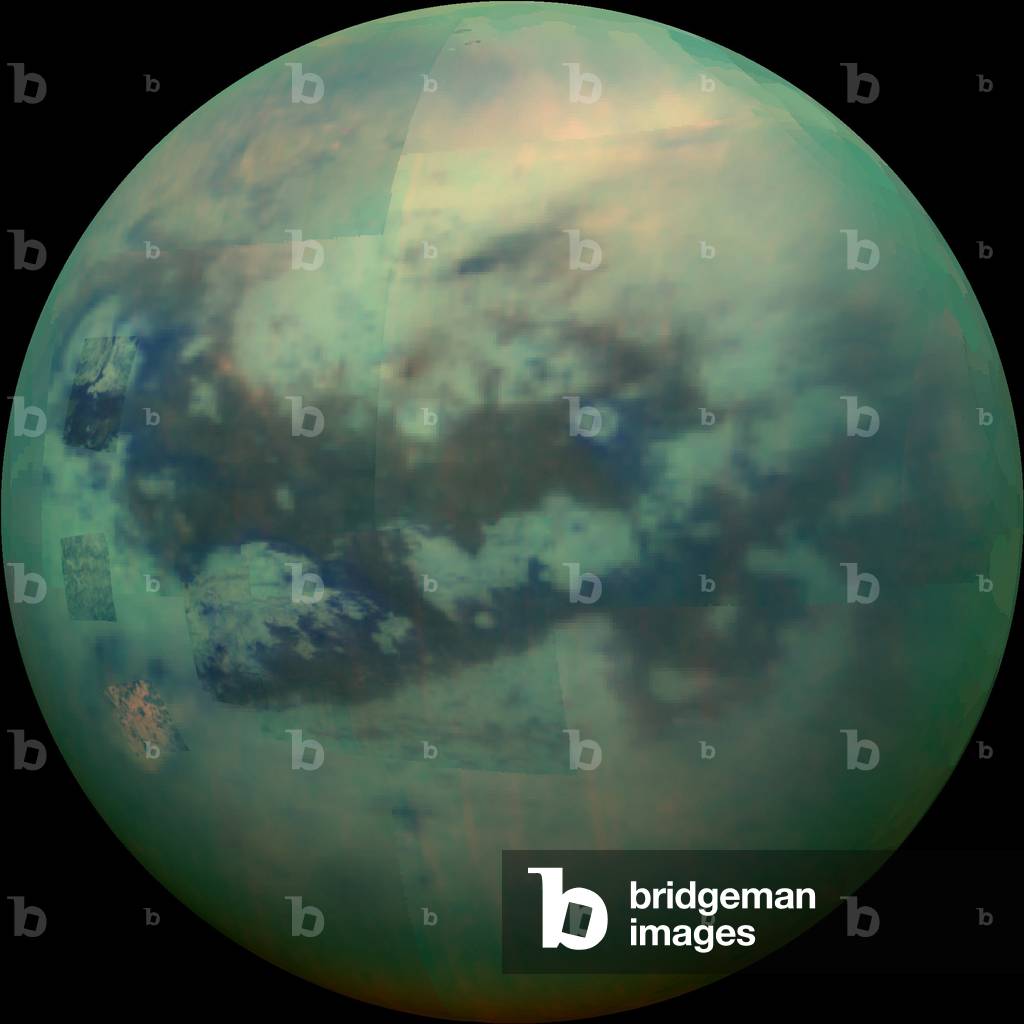
Titan, Saturn satellite seen by Cassini - Saturn's moon Titan as seen by Cassini spacecraft: Visible and infrared composite image of Titan taken by the Cassini probe on November 13, 2015. View of the hemisphere oriente towards Saturn - This composite image shows an infrared view of Saturn's moon Titan from Nasa's Cassini spacecraft, acquired during the mission's “” T-114”” flyby on Nov. 13, 2015. The spacecraft's visual and infrared mapping spectrometer (VIMS) instrument made these observations, in which blue represents wavelengths centered at 1.3 microns, green represents 2.0 microns, and red represents 5.0 microns. A view at visible wavelengths (centered around 0.5 microns) would show only Titan's hazy atmosphere (as in PIA14909). The near-infrared wavelengths in this image allow Cassini's vision to penetrate the haze and reveal the moon's surface - During this Titan flyby, the spacecraft's close-approach altitude was 6,200 miles (10,000 kilometers), which is considerably higher than those of typical flybys, which are around 750 miles (1,200 kilometers). The high flyby allowed VIMS to gather moderate-resolution views over wide areas (typically at a few kilometers per pixel) - The view looks toward terrain that is mostly on the Saturn-facing hemisphere of Titan. The scene features the parallel, dark, dune-filled regions named Fensal (to the north) and Aztlan (to the south), which form the shape of a sideways letter “” H.””” - Several places on the image show the surface at higher resolution than elsewhere. These areas, called subframes, show more detail because they were acquired near closest approach. They have finer resolution, but cover smaller areas than data obtained when Cassini was farther away from Titan - Near the limb at left, above center, is the best VIMS view so far of Titan's largest confirmed impact crater, Menrva. Similarly detailed subframes show eastern Xanadu, the basin Hotei Regio, and channels within bright terrains east of Xanadu. - Due to the
Chemical Laboratories, 1850-1949 Perkin Elmer model 12C infrared spectrophotometer, 1945
Nutzungsbeschränkungen von unseren Content-Partnern
  • Not available to clients invoiced in the UK
Testing the spectrometer for the Hubble Telescope, 1980s
Nutzungsbeschränkungen von unseren Content-Partnern
  • Not available to clients invoiced in the UK
Diode array in digicom detector of hubble Telescope spectrometer, 1980s
Nutzungsbeschränkungen von unseren Content-Partnern
  • Not available to clients invoiced in the UK
Digicom tube of spectrometer for the Hubble telescope, 1980s
Nutzungsbeschränkungen von unseren Content-Partnern
  • Not available to clients invoiced in the UK
Filter wheels of spectrometer for the Hubble Telescope, 1980s
Nutzungsbeschränkungen von unseren Content-Partnern
  • Not available to clients invoiced in the UK
Construction of spectrometer for the Hubble Telescope, 1980s
Nutzungsbeschränkungen von unseren Content-Partnern
  • Not available to clients invoiced in the UK