[]
Ihre AuswahlIhre aktuelle Auswahl
asset(s) Assets
Ihr Preis 0

Ihre Auswahl

Auswahl aufheben
Asset zum Warenkorb hinzugefügt
{"event":"pageview","page_type1":"undetected","page_type2":"_assets_search_override","language":"de","user_logged":"false","user_type":"ecommerce","nl_subscriber":"false"}
{"event":"ecommerce_event","event_name":"view_item","event_category":"browse_catalog","ecommerce":{"items":[{"item_id":"UIG532361","item_category2":"no_copyright","item_category3":"standard","item_category5":"not_balown","item_list_name":"search_results","item_name":"the_colours_of_the_visible_spectrum_vary_according_to_their_wavelengths","item_variant":"undefined"},{"item_id":"AVE6319849","item_category":"footage","item_category2":"no_copyright","item_category3":"standard","item_category5":"not_balown","item_list_name":"search_results","item_name":"1970s_needle_records_wavelength_on_drum","item_variant":"undefined"},{"item_id":"AVE6319848","item_category":"footage","item_category2":"no_copyright","item_category3":"standard","item_category5":"not_balown","item_list_name":"search_results","item_name":"1970s_needle_records_wavelength_on_drum","item_variant":"undefined"},{"item_id":"UIG865839","item_category":"illustration","item_category2":"out_of_copyright","item_category3":"standard","item_category5":"not_balown","item_list_name":"search_results","item_name":"continuous_spectrum_with_fraunhofer_lines_top_and_comparison_spectra_chromolithogrpah_1892","item_variant":"undefined"},{"item_id":"UIG3733254","item_category2":"out_of_copyright","item_category3":"standard","item_category5":"not_balown","item_list_name":"search_results","item_name":"early_rontgen_x_ray_of_wilhelm_rontgen_wife_s_hand","item_variant":"undefined"},{"item_id":"UIG3733269","item_category2":"no_copyright","item_category3":"standard","item_category5":"not_balown","item_list_name":"search_results","item_name":"wilhelm_rontgen","item_variant":"undefined"},{"item_id":"LLM8652640","item_category":"illustration","item_category2":"out_of_copyright","item_category3":"standard","item_category4":"european_school_19th_century","item_category5":"not_balown","item_list_name":"search_results","item_name":"marine_encyclopedia_crank_shafts_etc_thrust_shaft_etc_intermediate_shaft_adjusting_length_of_shaftin","item_variant":"undefined"},{"item_id":"UIG866429","item_category":"photo","item_category2":"no_copyright","item_category3":"standard","item_category5":"not_balown","item_list_name":"search_results","item_name":"this_composite_image_combines_extreme_ultravoilet_imaging_telescope_eit_images_from_three_wavelength","item_variant":"undefined"},{"item_id":"XEE4139919","item_category":"illustration","item_category2":"out_of_copyright","item_category3":"standard","item_category4":"anonymous","item_category5":"balown","item_list_name":"search_results","item_name":"vibratory_movements_wavelength_a_stone_that_falls_into_the_water_lowers_and_then_lifts_the_water_lev","item_variant":"undefined"},{"item_id":"UIG3733268","item_category":"photo","item_category2":"out_of_copyright","item_category3":"standard","item_category5":"not_balown","item_list_name":"search_results","item_name":"wilhelm_rontgen","item_variant":"undefined"},{"item_id":"UIG866430","item_category":"photo","item_category2":"no_copyright","item_category3":"standard","item_category5":"not_balown","item_list_name":"search_results","item_name":"this_composite_image_combines_extreme_ultravoilet_imaging_telescope_eit_images_from_three_wavelength","item_variant":"undefined"},{"item_id":"UIG3733270","item_category":"photo","item_category2":"out_of_copyright","item_category3":"standard","item_category5":"not_balown","item_list_name":"search_results","item_name":"wilhelm_rontgen","item_variant":"undefined"},{"item_id":"DGC746737","item_category":"photo","item_category2":"out_of_copyright","item_category3":"standard","item_category4":"american_school_19th_century","item_category5":"not_balown","item_list_name":"search_results","item_name":"diagram_showing_the_decomposition_of_light_structure_of_solar_rays_1855_colour_litho","item_variant":"undefined"},{"item_id":"UIG866255","item_category":"photo","item_category2":"no_copyright","item_category3":"standard","item_category5":"not_balown","item_list_name":"search_results","item_name":"this_infrared_image_showing_thermal_radiation_at_a_wavelength_of_9_7_microns_was_obtained_by_the_gem","item_variant":"undefined"},{"item_id":"PIX4627235","item_category":"photo","item_category2":"no_copyright","item_category3":"standard","item_category5":"not_balown","item_list_name":"search_results","item_name":"le_soleil_en_maximum_solaire_the_sun_seen_by_sdo_composite_le_soleil_vu_en_ultraviolet_by_sdo_solar_","item_variant":"undefined"},{"item_id":"PIX4583365","item_category":"photo","item_category2":"no_copyright","item_category3":"standard","item_category5":"not_balown","item_list_name":"search_results","item_name":"solar_eruption_the_sun_seen_by_sdo_coronal_rain_right_during_an_eruption_on_the_surface_of_the_sun_u","item_variant":"undefined"},{"item_id":"UIG558165","item_category2":"no_copyright","item_category3":"standard","item_category5":"not_balown","item_list_name":"search_results","item_name":"compton_effect","item_variant":"undefined"},{"item_id":"PIX4625231","item_category":"photo","item_category2":"no_copyright","item_category3":"standard","item_category5":"not_balown","item_list_name":"search_results","item_name":"saturn_in_false_colours_saturn_in_infrared_the_planet_saturn_seen_in_visible_and_infrared_by_the_cas","item_variant":"undefined"},{"item_id":"PIX4627123","item_category":"photo","item_category2":"no_copyright","item_category3":"standard","item_category5":"not_balown","item_list_name":"search_results","item_name":"le_soleil_vu_by_stereo_29_09_2008_solar_activity_seen_by_stereo_spacecraft_on_september_29_2008_prot","item_variant":"undefined"},{"item_id":"PIX4606775","item_category":"photo","item_category2":"no_copyright","item_category3":"standard","item_category5":"not_balown","item_list_name":"search_results","item_name":"mars_science_laboratory_artist_view_mars_science_laboratory_artist_view_mars_science_laboratory_msl_","item_variant":"undefined"},{"item_id":"UIS5066917","item_category":"object","item_category2":"no_copyright","item_category3":"standard","item_category5":"not_balown","item_list_name":"search_results","item_name":"equipment_spectrophotometers_part_of_a_spectrophotometer_1938_1939","item_variant":"undefined"},{"item_id":"UIS5066918","item_category":"object","item_category2":"no_copyright","item_category3":"standard","item_category5":"not_balown","item_list_name":"search_results","item_name":"equipment_spectrophotometers_part_of_a_spectrophotometer_1938_1939","item_variant":"undefined"},{"item_id":"PIX4571988","item_category":"photo","item_category2":"no_copyright","item_category3":"standard","item_category5":"not_balown","item_list_name":"search_results","item_name":"the_star_fomalhaut_and_its_dust_disc_star_fomalhaut_dust_ring_the_star_fomalhaut_is_located_25_years","item_variant":"undefined"},{"item_id":"PIX4624969","item_category":"photo","item_category2":"no_copyright","item_category3":"standard","item_category5":"not_balown","item_list_name":"search_results","item_name":"saturn_seen_in_infrared_by_cassini_spacecraft_saturn_seen_in_infrared_by_cassini_spacecraft_composit","item_variant":"undefined"},{"item_id":"PIX4627116","item_category":"photo","item_category2":"no_copyright","item_category3":"standard","item_category5":"not_balown","item_list_name":"search_results","item_name":"le_soleil_vu_by_stereo_on_16_08_2008_solar_activity_seen_by_stereo_spacecraft_on_august_16_2008_prot","item_variant":"undefined"},{"item_id":"UIS5075219","item_category":"photo","item_category2":"no_copyright","item_category3":"standard","item_category5":"not_balown","item_list_name":"search_results","item_name":"hienrich_hertz_german_physicist_1894","item_variant":"undefined"},{"item_id":"UIS5075232","item_category":"photo","item_category2":"no_copyright","item_category3":"standard","item_category5":"not_balown","item_list_name":"search_results","item_name":"heinrich_hertz_german_physicist_1886","item_variant":"undefined"},{"item_id":"UIS5075235","item_category":"photo","item_category2":"no_copyright","item_category3":"standard","item_category5":"not_balown","item_list_name":"search_results","item_name":"heinrich_hertz_german_physicist_1894","item_variant":"undefined"},{"item_id":"UIS5075208","item_category":"photo","item_category2":"no_copyright","item_category3":"standard","item_category5":"not_balown","item_list_name":"search_results","item_name":"elizabeth_hertz_wife_of_heinrich_hertz_20th_century","item_variant":"undefined"},{"item_id":"UIS5078241","item_category":"photo","item_category2":"no_copyright","item_category3":"standard","item_category5":"not_balown","item_list_name":"search_results","item_name":"lasers_laser_cutting_demonstration_late_1980s","item_variant":"undefined"},{"item_id":"UIS5075224","item_category":"photo","item_category2":"no_copyright","item_category3":"standard","item_category5":"not_balown","item_list_name":"search_results","item_name":"johanne_and_matilda_hertz_daughters_of_heirnrich_and_elizabeth_hertz_c_1889","item_variant":"undefined"},{"item_id":"UIS5075221","item_category":"photo","item_category2":"no_copyright","item_category3":"standard","item_category5":"not_balown","item_list_name":"search_results","item_name":"elizabeth_hertz_wife_of_heinrich_hertz_and_their_eldest_daughter_johanne_1889","item_variant":"undefined"},{"item_id":"UIS5075260","item_category":"illustration","item_category2":"no_copyright","item_category3":"standard","item_category5":"not_balown","item_list_name":"search_results","item_name":"hienrich_hertz_german_physicist_1886","item_variant":"undefined"},{"item_id":"KLG8726584","item_category":"illustration","item_category2":"in_copyright","item_category3":"premium","item_category4":"landrigan_karen","item_category5":"not_balown","item_list_name":"search_results","item_name":"colorsoundscape_1_2023_acrylic_on_canvas","item_variant":"undefined"},{"item_id":"UIS5075250","item_category":"photo","item_category2":"no_copyright","item_category3":"standard","item_category5":"not_balown","item_list_name":"search_results","item_name":"heinrich_hertz_german_physicist_with_his_wife_elizabetth_1886","item_variant":"undefined"},{"item_id":"UIS5622050","item_category":"illustration","item_category2":"no_copyright","item_category3":"standard","item_category5":"not_balown","item_list_name":"search_results","item_name":"original_manuscript_of_dr_heinrich_hertz_1888","item_variant":"undefined"},{"item_id":"UIS5065019","item_category":"object","item_category2":"no_copyright","item_category3":"standard","item_category5":"not_balown","item_list_name":"search_results","item_name":"chemical_laboratories_1850_1949_unicam_sp_500_spectrophometer_c_1949","item_variant":"undefined"},{"item_id":"UIS5071162","item_category":"illustration","item_category2":"no_copyright","item_category3":"standard","item_category5":"not_balown","item_list_name":"search_results","item_name":"heinrich_hertz_german_physicist_late_19th_century","item_variant":"undefined"},{"item_id":"PIX4605578","item_category":"photo","item_category2":"no_copyright","item_category3":"standard","item_category5":"not_balown","item_list_name":"search_results","item_name":"pioneer_plate_the_pioneer_plate_the_pioneer_10_and_pioneer_11_probes_have_embarked_on_a_plate_called","item_variant":"undefined"},{"item_id":"UIS5069452","item_category":"object","item_category2":"no_copyright","item_category3":"standard","item_category5":"not_balown","item_list_name":"search_results","item_name":"spectra_set_of_standard_solutions_used_in_spectroscopy_1870_1871","item_variant":"undefined"},{"item_id":"UIS5064573","item_category":"photo","item_category2":"no_copyright","item_category3":"standard","item_category5":"not_balown","item_list_name":"search_results","item_name":"radio_equipment_aerials_radio_aerials_sited_on_the_roof_of_the_science_museum_london_1980s","item_variant":"undefined"},{"item_id":"PIX4619667","item_category":"photo","item_category2":"no_copyright","item_category3":"standard","item_category4":"jerry_lodriguss","item_category5":"not_balown","item_list_name":"search_results","item_name":"nebula_of_the_lagoon_m8_in_sagittarius_m8_the_lagoon_nebula_view_of_the_nebula_of_the_lagoon_m8_ngc_","item_variant":"undefined"},{"item_id":"PIX4619678","item_category":"photo","item_category2":"no_copyright","item_category3":"standard","item_category4":"jerry_lodriguss","item_category5":"not_balown","item_list_name":"search_results","item_name":"the_lagoon_nebula_m8_without_stars_the_lagoon_nebula_m8_with_stars_removed_in_this_image_the_stars_w","item_variant":"undefined"},{"item_id":"PIX4625211","item_category":"photo","item_category2":"no_copyright","item_category3":"standard","item_category5":"not_balown","item_list_name":"search_results","item_name":"southern_aurora_on_the_planet_saturn_aurora_on_saturn_the_planet_saturn_accompanied_by_a_southern_au","item_variant":"undefined"},{"item_id":"PIX4617879","item_category":"photo","item_category2":"no_copyright","item_category3":"standard","item_category4":"jerry_lodriguss","item_category5":"not_balown","item_list_name":"search_results","item_name":"orion_s_trapeze_trapezium_multiple_star_system_in_orion_orion_s_trapeze_is_one_of_the_youngest_open_","item_variant":"undefined"},{"item_id":"REU7969876","item_category":"photo","item_category2":"no_copyright","item_category3":"standard","item_category4":"eric_miller","item_category5":"not_balown","item_list_name":"search_results","item_name":"donald_trump_speaks_with_minnesota_governor_jesse_ventura_2000_01_07_photo","item_variant":"undefined"},{"item_id":"UIS5069441","item_category":"object","item_category2":"no_copyright","item_category3":"standard","item_category5":"not_balown","item_list_name":"search_results","item_name":"instruments_spectroscopes_grating_spectrometer_1882_1905","item_variant":"undefined"},{"item_id":"PIX4582338","item_category":"photo","item_category2":"no_copyright","item_category3":"standard","item_category5":"not_balown","item_list_name":"search_results","item_name":"supernova_1987a_in_the_great_magellan_cloud_view_by_hst_this_hubble_space_telescope_picture_shows_su","item_variant":"undefined"},{"item_id":"UIS5064757","item_category":"illustration","item_category2":"no_copyright","item_category3":"standard","item_category5":"not_balown","item_list_name":"search_results","item_name":"spectra_dr_brewster_on_a_new_analysis_of_solar_light_c_1834","item_variant":"undefined"},{"item_id":"PIX4571724","item_category":"photo","item_category2":"no_copyright","item_category3":"standard","item_category5":"not_balown","item_list_name":"search_results","item_name":"sirius_a_and_sirius_b_in_the_big_dog_sirius_a_and_sirius_b_seen_in_x_ray_sirius_a_and_sirius_b_in_th","item_variant":"undefined"},{"item_id":"PIX4620190","item_category":"photo","item_category2":"no_copyright","item_category3":"standard","item_category5":"not_balown","item_list_name":"search_results","item_name":"the_omega_nebula_m17_seen_in_infrared_m17_nebula_in_infrared_the_omega_nebula_m17_seen_in_infrared_b","item_variant":"undefined"},{"item_id":"REU7951691","item_category":"photo","item_category2":"no_copyright","item_category3":"standard","item_category4":"eric_miller","item_category5":"not_balown","item_list_name":"search_results","item_name":"donald_trump_speaks_with_minnesota_governor_jesse_ventura_2000_01_07_photo","item_variant":"undefined"},{"item_id":"UIS5080074","item_category":"photo","item_category2":"no_copyright","item_category3":"standard","item_category5":"not_balown","item_list_name":"search_results","item_name":"radio_equipment_aerials_radio_aerials_sited_on_the_roof_of_the_science_museum_london_1980s","item_variant":"undefined"},{"item_id":"UIS5069700","item_category":"object","item_category2":"no_copyright","item_category3":"standard","item_category5":"not_balown","item_list_name":"search_results","item_name":"radio_communications_1886_1939_apparatus_used_by_heinrich_hertz_c_1887","item_variant":"undefined"},{"item_id":"PIX4571758","item_category":"photo","item_category2":"no_copyright","item_category3":"standard","item_category5":"not_balown","item_list_name":"search_results","item_name":"star_vega_in_the_lyre_star_vega_in_infrared_vega_alpha_lyrae_is_the_main_star_of_the_constellation_l","item_variant":"undefined"},{"item_id":"UIS5079977","item_category":"photo","item_category2":"no_copyright","item_category3":"standard","item_category5":"not_balown","item_list_name":"search_results","item_name":"radio_equipment_aerials_radio_aerials_sited_on_the_roof_of_the_science_museum_london_1980s","item_variant":"undefined"},{"item_id":"UIS5108066","item_category":"illustration","item_category2":"no_copyright","item_category3":"standard","item_category5":"not_balown","item_list_name":"search_results","item_name":"the_sun_with_handle_shaped_prominence_14_september_1999","item_variant":"undefined"},{"item_id":"UIS5067044","item_category":"object","item_category2":"no_copyright","item_category3":"standard","item_category5":"not_balown","item_list_name":"search_results","item_name":"instruments_spectroscopes_hilger_wavelength_spectrometer_spectrometre_with_camera_c_1919","item_variant":"undefined"},{"item_id":"PIX4626499","item_category":"photo","item_category2":"no_copyright","item_category3":"standard","item_category5":"not_balown","item_list_name":"search_results","item_name":"crab_nebula_seen_in_different_wavelength_the_crab_nebula_in_multi_wavelength_m1_the_crab_nebula_is_t","item_variant":"undefined"},{"item_id":"NTB8617211","item_category":"photo","item_category2":"no_copyright","item_category3":"standard","item_category4":"ivar_aaserud","item_category5":"not_balown","item_list_name":"search_results","item_name":"valdres_october_1967_nrk_employee_erik_byes_so_far_the_largest_project_ideabanken_which_was_to_help_","item_variant":"undefined"},{"item_id":"NTB8700402","item_category":"photo","item_category2":"no_copyright","item_category3":"standard","item_category5":"not_balown","item_list_name":"search_results","item_name":"valdres_october_1967_nrk_employee_erik_byes_so_far_the_largest_project_ideabanken_which_was_to_help_","item_variant":"undefined"},{"item_id":"PIX4574821","item_category":"photo","item_category2":"no_copyright","item_category3":"standard","item_category5":"not_balown","item_list_name":"search_results","item_name":"europe_jupiter_satellite_view_of_the_surface_of_the_europe_satellite_obtained_from_images_made_by_th","item_variant":"undefined"},{"item_id":"PIX4625336","item_category":"photo","item_category2":"no_copyright","item_category3":"standard","item_category5":"not_balown","item_list_name":"search_results","item_name":"titan_saturn_satellite_seen_by_cassini_visible_and_infrared_composite_image_of_titan_taken_by_the_ca","item_variant":"undefined"},{"item_id":"UIS5064536","item_category":"object","item_category2":"no_copyright","item_category3":"standard","item_category5":"not_balown","item_list_name":"search_results","item_name":"radio_communications_1886_1939_hertz_rectangular_oscillator_c_1888","item_variant":"undefined"},{"item_id":"UIS5071038","item_category":"photo","item_category2":"no_copyright","item_category3":"standard","item_category5":"not_balown","item_list_name":"search_results","item_name":"infrared_and_visible_images_of_jupiter_1979","item_variant":"undefined"},{"item_id":"MMM7342316","item_category":"photo","item_category2":"in_copyright","item_category3":"standard","item_category4":"smith_robert_21st_century","item_category5":"not_balown","item_list_name":"search_results","item_name":"iridis_2016_digital_photo","item_variant":"undefined"}]}}
{"event":"custom_event","event_name":"view_search_result","event_category":"browse_catalog","keyword":"wellenl\u00e4nge","search_type":"standard","search_bridgeman_artists":"false","search_mode":"automatic","search_zero_result":"false","search_results":66,"search_results_page_number":1}

'Wellenlänge' Bilder und Clips Suchergebnisse page 1 of 1

Hauptfilter
Option "Kunstdruck kaufen" verfügbar
Royalty-free Optionen
Ecommerce option
Medium
Orientation
Farbbilder
Kategorie
Rechte
Mehr Filter
Bridgeman Artists
Bridgeman Fotografen
Jahrhundert
Footage-Filter
Video Original Format
Video Resolution
Video Category
Filter group
Filter colors
Sortieren nach:
pro Seite
Filter group
Kategorie
Medium
No copyright
Filter colors

Anzeigeoptionen

View
Image Size

Bilder zu 'Wellenlänge' gefunden, 66

The colours of the visible spectrum vary according to their wavelengths.
1970s needle records wavelength on drum
Spezielle Anweisungen
  • Content within this clip may require additional clearances (eg: trademark, audio rights and/or property/personality releases) depending on Licensee’s specific use of material.
1970s needle records wavelength on drum
Spezielle Anweisungen
  • Content within this clip may require additional clearances (eg: trademark, audio rights and/or property/personality releases) depending on Licensee’s specific use of material.
Continuous spectrum with Fraunhofer lines, top, and comparison spectra. Chromolithogrpah, 1892.
Early Rontgen X-Ray of Wilhelm Rontgen wife's hand.
Wilhelm Rontgen.
Wilhelm Rontgen.
Wilhelm Rontgen.
Le Soleil en maximum solaire - The Sun seen by SDO - Composite - Le Soleil vu en ultraviolet by SDO (Solar Dynamics Observatory) from February 11, 2013 to February 11, 2014. Image composed of 25 different images, illustrating the sun in high activity. This image is a composite of 25 separate images spanning the period of February 11, 2013 to February 11, 2014. It uses the SDO AIA wavelength of 304 Angstroms and reveals the zones on the sun where active regions and associated eruptions most commonly occur during Solar Maximum
Solar eruption - The Sun seen by SDO: Coronal rain (right) during an eruption on the surface of the Sun, ultraviolet view by SDO (Solar Dynamics Observatory) on July 19, 2012. On July 19, 2012, an eruption occurred on the sun that produced a moderately powerful solar flare and a dazzling magnetic display known as coronal rain. Hot plasma in the corona cooled and condensed along strong magnetic fields in the region. Magnetic fields, are invisible, but the charged plasma is forced to move along the lines, showing up brightly in the extreme ultraviolet wavelength of 304 angstroms, and outlining the fields as it slowly falls back to the solar surface
Compton effect
Saturn in false colours - Saturn in infrared - The planet Saturn seen in visible and infrared by the Cassini probe on November 1, 2008. This false - color composite image, constructed from data obtained by Nasa's Cassini spacecraft, shows Saturn's rings and southern hemisphere. The composite image was made from 65 individual observations by Cassini's visual and infrared mapping spectrometer in the near - infrared portion of the light spectrum on Nov. 1, 2008. The observations were each six minutes long. In this image constructed from data collected in the near - infrared wavelengths of light, scientists designated blue to indicate sunlight reflected at a wavelength of 2 microns, green to indicate sunlight reflected at 3 microns and red to indicate thermal emission at 5 microns. Saturn's rings reflect sunlight at 2 microns, but not at 3 and 5 microns, so they appear deep blue. Saturn's high altitude haze reflects sunlight at both 2 and 3 microns, but not at 5 microns, and so it appears green to blue - green. The heat emission from the interior of Saturn is only seen at 5 microns wavelength in the spectrometer data, and thus appears red. The dark spots and banded features in the image are clouds and small storms that outline the deeper weather systems and circulation patterns of the planet. They are illuminated from underneath by Saturn's thermal emission, and thus appear in silhouette
Le Soleil vu by STEREO 29/09/2008 - Solar activity seen by STEREO spacecraft on september 29 2008 - Protuberances observed by one of the STEREO satellites on September 29, 2008. The STEREO spacecraft observed this visually stunning prominence eruption on Sept. 29, 2008, in the 304 angstrom wavelength of extreme UV light. Prominences are relatively cool clouds of gas suspended above the sun and controlled by magnetic forces. The prominence rose and cascaded to the right over several hours, appearing something like a flag unfurling, as it broke apart and headed into space. The prominence is composed of ionized Helium that is about 60,000 degrees Kelvin
Mars Science Laboratory - Artist View - Mars Science Laboratory - Artist view - Mars Science Laboratory (MSL), named Curiosity, is a NASA rover that will explore the surface of Mars from 2012 onwards. In this artist's view, Curiosity analyses the chemical composition of a Martian rock using the ChECAM instrument. This artist's concept depicts the rover Curiosity, of Nasa's Mars Science Laboratory mission, as it uses its Chemistry and Camera (ChemCam) instrument to investigate the composition of a rock surface. ChemCam fires laser pulses at a target and views the resulting spark with a telescope and spectrometers to identify chemical elements. The laser is actually in an invisible infrared wavelength, but is shown here as visible red light for purposes of illustration
Equipment, Spectrophotometers Part of a Spectrophotometer, 1938-1939
Nutzungsbeschränkungen von unseren Content-Partnern
  • Not available to clients invoiced in the UK
Equipment, Spectrophotometers Part of a Spectrophotometer, 1938-1939
Nutzungsbeschränkungen von unseren Content-Partnern
  • Not available to clients invoiced in the UK
The star Fomalhaut and its dust disc - Star Fomalhaut dust ring - The star Fomalhaut is located 25 years - light from Earth in the constellation of the Southern Fish. A dust disc surrounds it, seen here by the Hubble telescopes (left), Herschel (far infrared, centre) and Alma (right). This disc of interplanetary dust revolves around the young star at a distance of about 20 billion kilometers from it. The image taken at 850 microns wavelength by Alma seems to confirm that the planet discovered in 2008 in the Fomalhaut disc by Hubble does not exist. This image shows Fomalhaut and its dust ring. Images taken by the Hubble space telescope (HST, at left), Herschel telescope (middle) and Alma telescope (at right). Fomalhaut is much hotter than our Sun, 15 times as bright, and lies 25 light - years from Earth. An exoplanet was discovered in its dust ring but Alma observations seem to prove this planet doesn't exist
Saturn seen in infrared by Cassini spacecraft - Saturn seen in infrared by Cassini spacecraft - Composite image of Saturn in false colours obtained from infrared observations collected by the Cassini probe on 24 February 2007 at a distance of 1.58 million km from the planet. Flying over the unlit side of Saturn's rings, the Cassini spacecraft captures Saturn's glow, represented in brilliant shades of electric blue, sapphire and mint green, while the planet's shadow casts a wide net on the rings. This striking false - color mosaic was created from 25 images taken by Cassini's visual and infrared mapping spectrometer over a period of 13 hours, and captures Saturn in nighttime and daytime conditions. The visual and infrared mapping spectrometer acquires data simultaneously at 352 different wavelengths, or spectral channels. Data at wavelengths of 2.3, 3.0 and 5.1 microns were combined in the blue, green and red channels of a standard color image, respectively, to make this false - color mosaic. This image was acquired on Feb. 24, 2007, while the spacecraft was 1.58 million kilometers (1 million miles) from the planet and 34.6 degrees above the ring plane. The solar phase angle was 69.5 degrees. In this view, Cassini was looking down on the northern, unlit side of the rings, which are rendered visible by sunlight filtering through from the sunlit, southern face. On the night side (right side of image), with no sunlight, Saturn's own thermal radiation lights things up. This light at 5.1 microns wavelength (some seven times the longest wavelength visible to the human eye) is generated deep within Saturn, and works its way upward, eventually escaping into space. Thick clouds deep in the atmosphere block that light. An amazing array of dark streaks, spots, and globe - encircling bands is visible instead. Saturn's strong thermal glow at 5.1 microns even allows these deep clouds to be seen on portions of the dayside (left side), especially where overlying h
Le Soleil vu by STEREO on 16/08/2008 - Solar activity seen by STEREO spacecraft on august 16 2008 - Protuberances observed by one of the STEREO satellites on 16 August 2008. A STEREO spacecraft observed several solar prominences rise and gyrate above the Sun over a two - day period (Aug. 15 - 16, 2008), with the largest one arcing a distance at least equal to 30 Earth diameters. They are spread out with one in each quadrant. Magnetic forces control solar prominences that rise above the Sun's surface. The prominences were seen in the 304 Angstroms wavelength of ultraviolet light. The material observed is actually ionized Helium at about 60,000 degrees. Prominences are relatively cool clouds of gas suspended above the Sun and controlled by magnetic forces. They can last from hours to months, but most usually remain for just a few days
Hienrich Hertz, German physicist, 1894
Nutzungsbeschränkungen von unseren Content-Partnern
  • Not available to clients invoiced in the UK
Heinrich Hertz, German physicist, 1886
Nutzungsbeschränkungen von unseren Content-Partnern
  • Not available to clients invoiced in the UK
Heinrich Hertz, German physicist, 1894
Nutzungsbeschränkungen von unseren Content-Partnern
  • Not available to clients invoiced in the UK
Elizabeth Hertz, wife of Heinrich Hertz, 20th century
Nutzungsbeschränkungen von unseren Content-Partnern
  • Not available to clients invoiced in the UK
Lasers Laser cutting demonstration, late 1980s
Nutzungsbeschränkungen von unseren Content-Partnern
  • Not available to clients invoiced in the UK
Johanne and Matilda Hertz, daughters of Heirnrich and Elizabeth Hertz, c 1889
Nutzungsbeschränkungen von unseren Content-Partnern
  • Not available to clients invoiced in the UK
Elizabeth Hertz, wife of Heinrich Hertz, and their eldest daughter Johanne, 1889
Nutzungsbeschränkungen von unseren Content-Partnern
  • Not available to clients invoiced in the UK
Hienrich Hertz , German physicist, 1886
Nutzungsbeschränkungen von unseren Content-Partnern
  • Not available to clients invoiced in the UK
ColorSoundscape #1, 2023 (acrylic on canvas)
Zusätzliche Genehmigungen
  • Permission required for non-editorial use (inc book and magazine covers). Please contact us
Urheberrecht
  • Urheberrechtlich Geschützt
premium
Heinrich Hertz , German physicist, with his wife Elizabetth, 1886
Nutzungsbeschränkungen von unseren Content-Partnern
  • Not available to clients invoiced in the UK
Original manuscript of Dr Heinrich Hertz, 1888
Nutzungsbeschränkungen von unseren Content-Partnern
  • Not available to clients invoiced in the UK
Chemical Laboratories, 1850-1949 Unicam SP 500 spectrophometer, c 1949
Nutzungsbeschränkungen von unseren Content-Partnern
  • Not available to clients invoiced in the UK
Heinrich Hertz, German physicist, late 19th century
Nutzungsbeschränkungen von unseren Content-Partnern
  • Not available to clients invoiced in the UK
Pioneer Plate - The Pioneer Plate - The Pioneer 10 and Pioneer 11 probes have embarked on a plate, called the Pioneer Plate, containing a message intended for potential aliens. On this engraved metal plate are depicted a naked man and woman, the location of our Sun as well as 14 pulsars, the trajectory of the probe in the solar system... Pioneer 10 was launched on 3 March 1972 with as its first destination, the Jupiter Planet, which it flew over on 3 December 1973; it was the first space probe to approach this planet; it was also the first space probe to leave the solar system. The Pioneer F spacecraft, destined to be the first man made object to escape from the solar system into interstellar space, carries this pictorial plaque. It is designed to show scientifically educated inhabitants of some other star system, who might intercept it millions of years from now, when Pioneer was launched, from where, and by what kind of beings. The design is etched into a 6 inch by 9 inch gold - anodized aluminum plate, attached to the spacecraft's attenna support struts in a position to help shield it from erosion by interstellar dust. The radiating lines at left represents the positions of 14 pulsars, a cosmic source of radio energy, arranged to indicate our sun as the home star of our civilization. The “” 1 - “” symbols at the ends of the lines are binary numbers that represent the frequencies of these pulsars at the time of launch of Pioneer F relative of that to the hydrogen atom shown at the upper left with a “” 1”” unity symbol. The hydrogen atom is thus used as a “” universal clock,”” and the regular decrease in the frequencies of the pulsars will enable another civilization to determine the time that has elapsed since Pioneer F was launched. The hydrogen is also used as a “” universal yardstick”” for sizing the human figures and outline of the spacecraft shown on the right. The hydrogen wavelength, about 8 inches, multiplied by
Spectra Set of standard solutions used in spectroscopy, 1870-1871
Nutzungsbeschränkungen von unseren Content-Partnern
  • Not available to clients invoiced in the UK
Radio Equipment, Aerials Radio aerials sited on the roof of the Science Museum, London, 1980s
Nutzungsbeschränkungen von unseren Content-Partnern
  • Not available to clients invoiced in the UK
Nebula of the Lagoon (M8) in Sagittarius - M8, The Lagoon Nebula - View of the Nebula of the Lagoon (M8/NGC 6523). Located in Sagittarius, at a distance of 5800 years - light, it is visible to the naked eye in good conditions. It is a star-forming region illuminated by several giant O stars that belong to the open cluster NGC 6530 visible in the center of the image. The brightest part of the nebula is called the hourglass nebula whose gases are excited mainly by two supergiant stars Herschel 36 and 9 Sagittarii. M8 has at least 60 giant B stars, 3 to 4 times more than the Orion nebula. M8 is an amazing stellar nursery. Hot young stars that formed out of the hydrogen gas in the nebula cause it to glow in the light of ionized hydrogen at the hydrogen - alpha wavelength of 656nm. The Lagoon Nebula gets its name from the distinctive dark lane that runs through the heart of the nebula, just to the west of open cluster NGC 6530. Bok globules, small dark knots which are condensing protostellar clouds, can be seen sprinkled throughout the nebula. The brightest part of M8 has an apparent size of about 1 degree on the sky (the size of two full Moons) and is 100 light years across in space. It is located about 5,200 light years away
The Lagoon nebula (M8) without stars - The Lagoon nebula (M8) with stars removed - In this image, the stars were removed by computer processing. Located in Sagittarius, at a distance of 5800 years - light, M8 is visible to the naked eye in good conditions. It is a star-forming region illuminated by several large O-type stars that belong to the open cluster NGC 6530 visible in the center of the image. The brightest part of the nebula is called the hourglass nebula whose gases are excited mainly by two massive supergeant stars Herschel 36 and 9 Sagittarii. M8 has at least 60 Giant B stars, 3 to 4 times more than the Orion Nebula. This image was processed to remove the stars so the incredible complex of dark and light nebulosity could more easily be seen. M8 is an amazing stellar nursery. Hot young stars that formed out of the hydrogen gas in the nebula cause it to glow in the light of ionized hydrogen at the hydrogen - alpha wavelength of 656nm. The Lagoon Nebula gets its name from the distinctive dark lane that runs through the heart of the nebula, just to the west of open cluster NGC 6530. Bok globules, small dark knots which are condensing protostellar clouds, can be seen sprinkled throughout the nebula. The brightest part of M8 has an apparent size of about 1 degree on the sky (the size of two full Moons) and is 100 light years across in space. It is located about 5,200 light years away
Southern Aurora on the Planet Saturn - Aurora on Saturn - The Planet Saturn accompanied by a Southern Aurora, seen in visible and infrared by the Cassini probe on November 1, 2008. This false - color composite image, constructed from data obtained by Nasa's Cassini spacecraft, shows the glow of auroras streaking out about 1,000 kilometers (600 miles) from the cloud tops of Saturn's south polar region. In this image constructed from data collected in the near - infrared wavelengths of light, the auroral emission is shown in green. Scientists designated blue to indicate sunlight reflected at wavelengths from 2 to 3 microns, green to indicate light from hydrogen ions at wavelengths between 3 and 4 microns and red to indicate thermal emission at 5 microns. Saturn's rings and high altitude haze only reflect sunlight at 3 microns or less, so they appear deep blue. The glow from the aurora can only be seen at the wavelengths in the green channel. The heat emission from the interior of Saturn is only seen at 5 microns wavelength in the spectrometer data, and thus appears red. The dark spots and banded features in the image are clouds and small storms that outline the deeper weather systems and circulation patterns of the planet. They are illuminated from underneath by Saturn's thermal emission, and thus appear in silhouette. The composite image was made from 65 individual observations by Cassini's visual and infrared mapping spectrometer on Nov. 1, 2008. The observations were each six minutes long
Orion's Trapeze - Trapezium Multiple Star System in Orion - Orion's Trapeze is one of the youngest open clusters known, with new stars still forming in this region. The Trapezium is the most famous multiple star system in the entire night sky. Located at the very heart of M42, the Orion Nebula, it is one of the youngest star clusters known. The four brightest stars in the Trapezium (A, B, C and D) are easily visible in a four inch telescope with decent optical quality under good seeing conditions. They range in brightness from magnitude 5 to magnitude 8. They can be seen merged together as one star to the unaided eye as the middle star in the sword of Orion. The image above shows the four brightest stars of the Trapezium at the center of the photo. The core of M42 surrounding the Trapezium is a blue - green color from the predominantly green spectral emission line of Oxygen III, with a smaller amount of blue - green mixed in from the hydrogen - beta emission line. These particular wavelengths also happen to be the wavelengths to which the human visual system is most sensitive for color vision. Much of the rest of the Orion Nebula has a lot of red hydrogen - alpha emission, but the eye is not very sensitive to this wavelength. Some red can be seen in the brightest parts of the nebula that emit hydrogen - alpha light by observers with sensitive color vision. For most people however, if they see any color at all, it will be a very pale green, or blue - green, from the Oxygen III spectral lines
DONALD TRUMP SPEAKS WITH MINNESOTA GOVERNOR JESSE VENTURA, 2000-01-07 (photo)
Zusätzliche Genehmigungen
  • Permission required for non-editorial use (inc book covers and in-context promotional use in documentaries). Please contact us
Bildbeschränkungen
  • Content within this photograph may require additional clearances (eg: trademark and personality rights) depending on Licensee's specific use of material, which may include book and magazine cover use.
Nutzungsbeschränkungen von unseren Content-Partnern
  • Minimum fee applies to this image;Only available to clients invoiced in Australia, Belgium, Brazil, Bulgaria, Canada, China, Cyprus, Czech Republic, Estonia, Finland, France, French Southern Territories, Greece, Hong Kong, Hungary, India, Ireland, Israel, Italy, Lebanon, Luxembourg, Mexico, the Netherlands, New Zealand, Portugal, Qatar, Republic of Korea, Romania, Russian Federation, Singapore, South Africa, Spain, Sweden, Switzerland, Taiwan, Turkey, United Arab Emirates, United Kingdom and United States
Instruments, Spectroscopes Grating spectrometer, 1882-1905
Nutzungsbeschränkungen von unseren Content-Partnern
  • Not available to clients invoiced in the UK
Supernova 1987A in the Great Magellan Cloud View by HST - This Hubble Space Telescope picture shows Supernova 1987A and its neighborhood. The series of four panels shows the evolution of the SN 1987A debris from February 1994 to February 1996. Material from the stellar interior was ejected into space during the supernova explosion in February 1987. The explosion debris is expanding at nearly 6 million miles per hour. Ten years now after the explosion, this cosmic fireball is large enough - - - about one - sixth of a light - year in diameter - - - to be resolved from the Earth's orbit with the Hubble Space Telescope. The debris is resolved into two opposing blobs and is dim in the center. The apparent direction of ejection is the same as the short axis of the bright inner ring that surrounds the supernova. This suggests that the explosion is directed out of the plane of the ring. The ring is probably composed of materials lost by the pre - supernova star in the last stages of its evolution. Supernova 1987A is located 167,000 light - years away from Earth in the Large Magellanic Cloud. The telescope captured the images with the Wide Field and Planetary Camera 2. The central image of the supernova and the ring system was taken in light emitted by nitrogen gas (658 nanometers) on Sept. 24, 1994. The series of debris images were taken using a visible light filter of wavelength around 550 nanometers taken (from left to right) on Feb. 4, 1994, Sept. 24, 1994, March 5, 1995, and Feb. 6, 1996
Spectra Dr Brewster on a new analysis of solar light, c 1834
Nutzungsbeschränkungen von unseren Content-Partnern
  • Not available to clients invoiced in the UK
Sirius A and Sirius B in the Big Dog - Sirius A and Sirius B seen in X - ray - Sirius A and Sirius B in the Big Dog seen in X-ray by the Chandra telescope. The brightest source on this image is Sirius B, a white dwarf star whose surface, heated at a temperature of 25,000 degres, emits huge X-rays. The other point is Sirius A, the brightest star in the sky in visible light, but practically non-existent in this wavelength. An X - ray image of the Sirius star system located 8.6 light years from Earth. This image shows two sources and a spike - like pattern due to the support structure for the transmission grating. The bright source is Sirius B, a white dwarf star that has a surface temperature of about 25,000 degrees Celsius which produces very low energy X - rays. The dim source at the position of Sirius A, a normal star more than twice as massive as the Sun, may be due to ultraviolet radiation from Sirius A leaking through the filter on the detector. In contrast, Sirius A is the brightest star in the northern sky when viewed with an optical telescope, while Sirius B is 10,000 times dimmer. Because the two stars are so close together Sirius B escaped detection until 1862 when Alvan Clark discovered it while testing one of the best optical telescopes in the world at that time. The white dwarf, Sirius B, has a mass equal to the mass of the Sun, packed into a diameter that is 90% that of the Earth. The gravity on the surface of Sirius B is 400,000 times that of Earth
The Omega nebula (M17) seen in infrared - M17 nebula in infrared - The Omega nebula (M17) seen in infrared by the Spitzer space telescope. M17 is a star-forming region about 6000 light years ago in the constellation Sagittarius. In the center of the nebula is a group of massive stars. The dust appears in red, the hot gas in green, the regions or this gas and the dust mixes in white. Nasa's Spitzer Space Telescope has captured an infrared view of the star - making cloud called M17, or the Swan nebula. The cloud, located about 6,000 light - years away in the constellation Sagittarius, is dominated by a central group of massive stars - - the most massive stars in the region. These central stars give off intense flows of expanding gas, which rush like rivers against dense piles of material, carving out the deep pocket at center of the picture. Winds from the region's other massive stars push back against these oncoming rivers, creating bow shocks like those that pile up in front of speeding boats. Three of these bow shocks are nestled in the upper left side of the central cavity, but are difficult to spot in this view. They are composed of compressed gas in addition to dust that glows at infrared wavelengths Spitzer can see. The smiley - shaped bow shocks curve away from the stellar winds of the central massive stars. This picture was taken with Spitzer's infrared array camera. It is a four - color composite, in which light with a wavelength of 3.6 microns is blue; 4.5 - micron light is green; 5.8 - micron light is orange; and 8 - micron light is red. Dust is red, hot gas is green and white is where gas and dust intermingle. Foreground and background stars appear scattered through the image
DONALD TRUMP SPEAKS WITH MINNESOTA GOVERNOR JESSE VENTURA, 2000-01-07 (photo)
Zusätzliche Genehmigungen
  • Permission required for non-editorial use (inc book covers and in-context promotional use in documentaries). Please contact us
Bildbeschränkungen
  • Content within this photograph may require additional clearances (eg: trademark and personality rights) depending on Licensee's specific use of material, which may include book and magazine cover use.
Nutzungsbeschränkungen von unseren Content-Partnern
  • Minimum fee applies to this image;Only available to clients invoiced in Australia, Belgium, Brazil, Bulgaria, Canada, China, Cyprus, Czech Republic, Estonia, Finland, France, French Southern Territories, Greece, Hong Kong, Hungary, India, Ireland, Israel, Italy, Lebanon, Luxembourg, Mexico, the Netherlands, New Zealand, Portugal, Qatar, Republic of Korea, Romania, Russian Federation, Singapore, South Africa, Spain, Sweden, Switzerland, Taiwan, Turkey, United Arab Emirates, United Kingdom and United States
Radio Equipment, Aerials Radio aerials sited on the roof of the Science Museum, London, 1980s
Nutzungsbeschränkungen von unseren Content-Partnern
  • Not available to clients invoiced in the UK
Radio Communications, 1886-1939 Apparatus used by Heinrich Hertz, c 1887
Nutzungsbeschränkungen von unseren Content-Partnern
  • Not available to clients invoiced in the UK
Star Vega in the Lyre - Star Vega in infrared - Vega (Alpha Lyrae) is the main star of the constellation Lyra, located only 25.4 light years from the Sun. It is the second brightest star after Sirius in the northern hemisphere. It's seen here in infrared by the Spitzer space telescope. Observed in this wavelength, the dust cloud surrounding the star appears. Nasa's Spitzer Space Telescope captured these images of the star Vega, located 25 light years away in the constellation Lyra. Spitzer was able to detect the heat radiation from the cloud of dust around the star and found that the debris disk is much larger than previously thought. This side - by - side comparison, taken by Spitzer's multiband imaging photometer, shows the warm infrared glows from dust particles orbiting the star at wavelengths of 24 microns (on the left in blue) and 70 microns (on the right in red). Both images show a very large, circular and smooth debris disk. The disk radius extends to at least 815 astronomical units. (One astronomical unit is the distance from Earth to the Sun, which is 150 - million kilometers or 93 - million miles). Scientists compared the surface brightness of the disk in the infrared wavelengths to determine the temperature distribution of the disk and then refer the corresponding particle size in the disk. Most of the particles in the disk are only a few microns in size, or 100 times smaller than a grain of Earth sand. These fine dust particles originate from collisions of embryonic planets near the star at a radius of approximately 90 astronomical units, and are then blown away by Vega's intense radiation. The mass and short lifetime of these small particles indicate that the disk detected by Spitzer is the aftermath of a large and relatively recent collision, involving bodies perhaps as big as the planet Pluto. The images are 3 arcminutes on each side. North is oriented upward and east is to the left
Radio Equipment, Aerials Radio aerials sited on the roof of the Science Museum, London, 1980s
Nutzungsbeschränkungen von unseren Content-Partnern
  • Not available to clients invoiced in the UK
The Sun with handle-shaped prominence, 14 September 1999
Nutzungsbeschränkungen von unseren Content-Partnern
  • Not available to clients invoiced in the UK
Instruments, Spectroscopes Hilger wavelength spectrometer (spectrometre) with camera, c 1919
Nutzungsbeschränkungen von unseren Content-Partnern
  • Not available to clients invoiced in the UK
Crab Nebula seen in different wavelength - The Crab Nebula in multi wavelength: M1, the Crab Nebula, is the rest of a supernova that exploded on July 4, 1054. It is located about 6500 light years from Earth in the constellation Taurus. At the heart of this nebula is a pulsar. To obtain this photo, different observatories and telescopes combined their observations; the VLA provided the radio image (in red), the Spitzer telescope the infrared image (in yellow), the Hubble telescope for the visible part (here in green), XMM-Newton the ultraviolet image (in blue) and the Chandra telescope for X-ray data (purple). The pulsar is the bright spot in the center of the image. The unusual image was produced by combining data from telescopes spanning almost the entire electromagnetic spectrum, from radio waves to X-rays. The Karl G. Jansky Very Large Array (VLA) provided information about the nebula gathered in the radio regime (colored in red). Nasa's Spitzer Space Telescope took images in the infrared (yellow). The NASA/ESA Hubble Space Telescope provided the images made in optical wavelengths (colored in green). ESA's XMM-Newton telescope observed the Crab Nebula in the ultraviolet (blue) and Nasa's Chandra X-ray Observatory provided the data for X-ray radiation (purple). The Crab Nebula, located 6500 light-years from Earth in the constellation of Taurus, is the result of a supernova explosion which was observed by Chinese and other astronomers in 1054. At its centre is a pulsar: a super-dense neutron star, spinning once every 33 milliseconds, shooting out rotating light-like beams of radio waves and visible light. Surrounding the pulsar lies a mix of material; some of it was originally expelled from the star before it went supernova, and the rest was ejected during the explosion itself. Fast-moving winds of particles fly off from the neutron star, energising the dust and gas around it.
Valdres October 1967 NRK Employee Erik Byes so far the largest project Ideabanken, which was to help you get started and creative powers in Norway …, 1967 (photo)
Bildbeschränkungen
  • Content within this photograph may require additional clearances (eg: trademark and personality rights) depending on Licensee's specific use of material, which may include book and magazine cover use.
Valdres October 1967 NRK Employee Erik Byes so far the largest project Ideabanken, which was to help you get started and creative powers in Norway …, 1967 (photo)
Bildbeschränkungen
  • Content within this photograph may require additional clearances (eg: trademark and personality rights) depending on Licensee's specific use of material, which may include book and magazine cover use.
Europe - Jupiter Satellite - View of the surface of the Europe satellite obtained from images made by the Galileo probe in 1995 and 1998. Jupiter's icy moon Europa looms large in this newly - reprocessed color view, made from images taken by Nasa's Galileo spacecraft in the late 1990s. This is the color view of Europa from Galileo that shows the largest portion of the moon's surface at the highest resolution. To create this new version, the images were assembled into a realistic color view of the surface that approximates how Europa would appear to the human eye. The scene shows the stunning diversity of Europa's surface geology. Long, linear cracks and ridges crisscross the surface, interrupted by regions of disrupted terrain where the surface ice crust has been broken up and re - frozen into new patterns. Color variations across the surface are associated with differences in geologic feature type and location. For example, areas that appear blue or white contain relatively pure water ice, while reddish and brownish areas include non - ice components in higher concentrations. The polar regions, visible at the left and right of this view, are noticeably bluer than the more equatorial latitudes, which look more white. This color variation is thought to be due to differences in ice grain size in the two locations. Images taken through near - infrared, green and violet filters have been combined to produce this view. The images have been corrected for light scattered outside of the image, to provide a color correction that is calibrated by wavelength. Gaps in the images have been filled with simulated color based on the color of nearby surface areas with similar terrain types. This global color view consists of images acquired by the Galileo Solid - State Imaging (SSI) experiment on the spacecraft's first and fourteenth orbits through the Jupiter system, in 1995 and 1998, respectively. Image scale is 2 miles (1.6 kilometers) per pixel. North on Europa is at righ
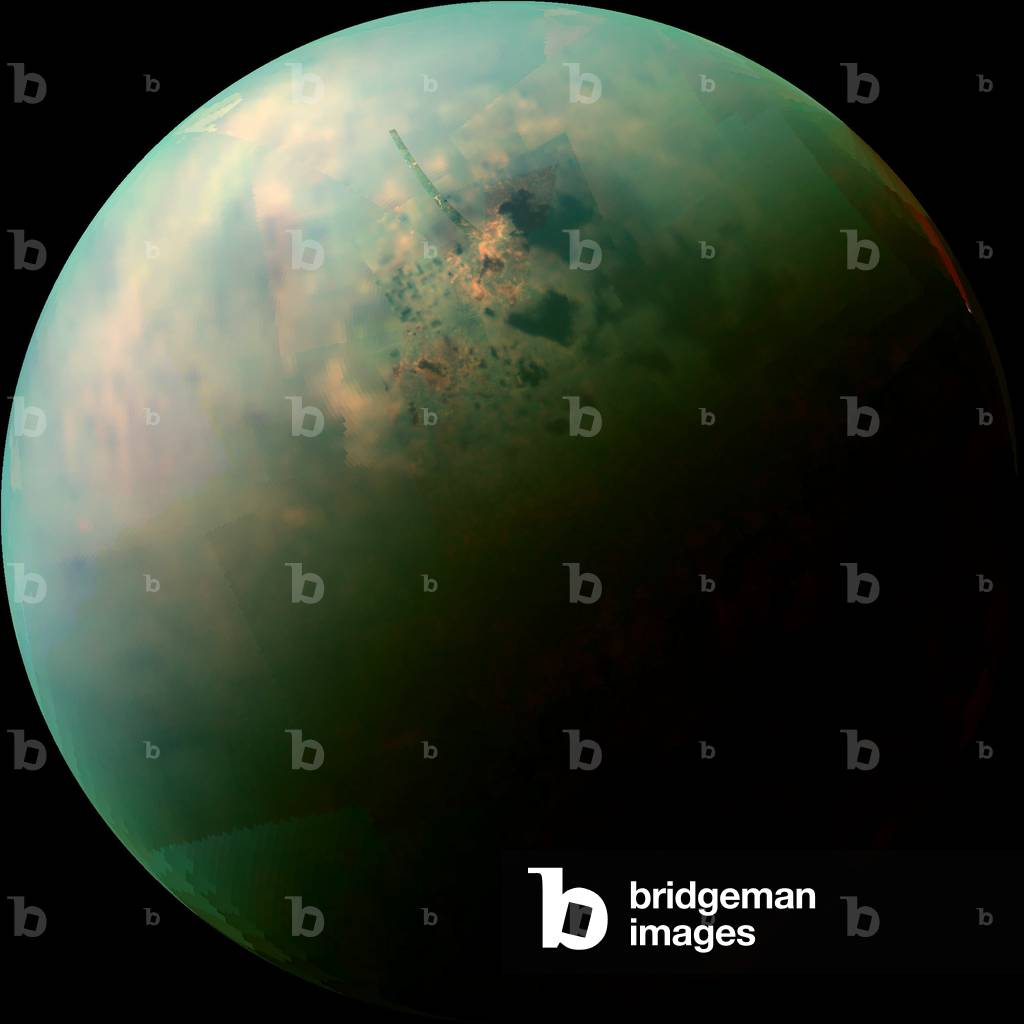
Titan, Saturn satellite seen by Cassini: Visible and infrared composite image of Titan taken by the Cassini probe on September 12, 2013. View of methane and ethane lakes. - This false-color mosaic, made from infrared data collected by Nasa's Cassini spacecraft, reveals the differences in the composition of surface materials around hydrocarbon lakes at Titan, Saturn's largest moon. Titan is the only other place in the solar system that we know has stable liquid on its surface, though its lakes are made of liquid ethane and methane rather than liquid water. While there is one large lake and a few smaller ones near Titan's south pole, almost all of Titan's lakes appear near the moon's north pole - Scientists mapped near-infrared colors onto the visible color spectrum. Red in this image was assigned a wavelength of 5 microns (10 times longer than visible light), green 2.0 microns (four times longer than visible light), and blue 1.3 microns (2.6 times longer than visible light) - The orange areas are thought to be evaporite - the Titan equivalent of salt flats on Earth. The evaporated material is thought to be organic chemicals originally from Titan's haze particles that once dissolved in liquid methane. They appear orange in this image against the greenish backdrop of Titan's typical bedrock of water ice - In this mosaic, Kraken Mare, which is Titan's largest sea and covers about the same area as Earth's Caspian Sea and Lake Superior combined, can be seen spreading out with many tendrils on the upper right,. The big dark zone up and left of Kraken is Ligeia Mare, the second largest sea. Below Ligeia, shaped similar to a sports fan's foam finger that points just up from left, is Punga Mare, the third largest Titan Sea. Numerous other smaller lakes dot the area. Titan's north pole is located in the geographic location just above the end of the “” finger”” of Punga Mare. The data shown here were obtained by Cassini's visual and infrared mapping spectrometer during
RADIO COMMUNICATIONS, 1886-1939 Hertz rectangular oscillator, c 1888
Nutzungsbeschränkungen von unseren Content-Partnern
  • Not available to clients invoiced in the UK
Infrared and visible images of Jupiter, 1979
Nutzungsbeschränkungen von unseren Content-Partnern
  • Not available to clients invoiced in the UK
Iridis, 2016 (digital photo)
Nutzungsbeschränkungen von unseren Content-Partnern
  • Not available to clients invoiced in the UK
Urheberrecht
  • Urheberrechtlich Geschützt