[]
Ihre AuswahlIhre aktuelle Auswahl
asset(s) Assets
Ihr Preis 0

Ihre Auswahl

Auswahl aufheben
Asset zum Warenkorb hinzugefügt
{"event":"pageview","page_type1":"undetected","page_type2":"_assets_search_override","language":"de","user_logged":"false","user_type":"ecommerce","nl_subscriber":"false"}
{"event":"ecommerce_event","event_name":"view_item","event_category":"browse_catalog","ecommerce":{"items":[{"item_id":"PIX4613932","item_category":"photo","item_category2":"no_copyright","item_category3":"standard","item_category5":"not_balown","item_list_name":"search_results","item_name":"leo_1_dwarf_galaxy_in_the_lion_leo_1_dwarf_galaxy_leo_1_is_located_about_900_000_light_years_from_ea","item_variant":"undefined"},{"item_id":"PIX4613898","item_category":"photo","item_category2":"no_copyright","item_category3":"standard","item_category5":"not_balown","item_list_name":"search_results","item_name":"sculptor_s_dwarf_galaxy_sculptor_dwarf_galaxy_the_sculptor_s_dwarf_galaxy_belongs_to_the_local_group","item_variant":"undefined"},{"item_id":"PIX4613904","item_category":"photo","item_category2":"no_copyright","item_category3":"standard","item_category5":"not_balown","item_list_name":"search_results","item_name":"the_dwarf_galaxy_of_the_furnace_fornax_dwarf_galaxy_the_dwarf_galaxy_of_the_furnace_belongs_to_the_l","item_variant":"undefined"},{"item_id":"PIX4611355","item_category":"photo","item_category2":"no_copyright","item_category3":"standard","item_category4":"jim_misti","item_category5":"not_balown","item_list_name":"search_results","item_name":"galaxy_ngc_4449_in_hunting_dogs_dwarf_irregular_galaxy_ngc_4449_in_canes_venatici_dwarf_galaxy_irreg","item_variant":"undefined"},{"item_id":"PIX4613865","item_category":"photo","item_category2":"no_copyright","item_category3":"standard","item_category5":"not_balown","item_list_name":"search_results","item_name":"regulus_and_the_dwarf_galaxy_leo_1_regulus_and_leo_1_dwarf_galaxy_leo_1_ugc_5470_is_located_about_90","item_variant":"undefined"},{"item_id":"PIX4565530","item_category":"photo","item_category2":"no_copyright","item_category3":"standard","item_category5":"not_balown","item_list_name":"search_results","item_name":"group_of_galaxies_hcg_31_hickson_compact_group_31_this_group_of_interacting_galaxies_is_located_166_","item_variant":"undefined"},{"item_id":"PIX4609139","item_category":"photo","item_category2":"no_copyright","item_category3":"standard","item_category5":"not_balown","item_list_name":"search_results","item_name":"spiral_galaxy_ngc_247_in_the_whale_spiral_galaxy_ngc_247_in_cetus_dwarf_spiral_galaxy_in_the_whale_l","item_variant":"undefined"},{"item_id":"PIX4611058","item_category":"photo","item_category2":"no_copyright","item_category3":"standard","item_category5":"not_balown","item_list_name":"search_results","item_name":"galaxy_ngc_4027_in_the_raven_galaxy_ngc_4027_in_corvus_ngc_4027_is_a_spiral_galaxy_located_about_80_","item_variant":"undefined"},{"item_id":"PIX4609014","item_category":"photo","item_category2":"no_copyright","item_category3":"standard","item_category4":"r_gendler","item_category5":"not_balown","item_list_name":"search_results","item_name":"spiral_galaxy_ngc_247_in_the_whale_spiral_galaxy_ngc_247_in_cetus_dwarf_spiral_galaxy_in_the_whale_l","item_variant":"undefined"},{"item_id":"PIX4609897","item_category":"photo","item_category2":"no_copyright","item_category3":"standard","item_category5":"not_balown","item_list_name":"search_results","item_name":"interacting_spiral_galaxy_ngc_1532_in_eridan_interacting_galaxy_ngc_1532_in_eridanus_the_spiral_gala","item_variant":"undefined"},{"item_id":"PIX4613513","item_category":"photo","item_category2":"no_copyright","item_category3":"standard","item_category5":"not_balown","item_list_name":"search_results","item_name":"the_large_magellanic_cloud_the_large_magellanic_cloud_the_great_magellan_cloud_galaxy_is_about_160_0","item_variant":"undefined"},{"item_id":"PIX4610376","item_category":"photo","item_category2":"no_copyright","item_category3":"standard","item_category4":"r_jay_gabany","item_category5":"not_balown","item_list_name":"search_results","item_name":"spiral_galaxy_m81_in_the_great_bear_spiral_galaxy_m81_in_ursa_major_the_spiral_galaxy_m81_is_located","item_variant":"undefined"},{"item_id":"PIX4613022","item_category":"photo","item_category2":"no_copyright","item_category3":"standard","item_category4":"r_gendler","item_category5":"not_balown","item_list_name":"search_results","item_name":"irregular_galaxy_ngc_6822_in_sagittarius_irregular_galaxy_ngc_6822_in_sagittarius_the_galaxy_ngc_682","item_variant":"undefined"},{"item_id":"PIX4611111","item_category":"photo","item_category2":"no_copyright","item_category3":"standard","item_category5":"not_balown","item_list_name":"search_results","item_name":"young_stars_in_the_dwarf_galaxy_ngc_4163_young_stars_in_dwarf_galaxy_ngc_4163_ngc_4163_is_an_irregul","item_variant":"undefined"},{"item_id":"PIX4611307","item_category":"photo","item_category2":"no_copyright","item_category3":"standard","item_category5":"not_balown","item_list_name":"search_results","item_name":"spiral_galaxy_m100_in_berenice_s_hair_spiral_galaxy_m100_in_coma_berenices_the_spiral_galaxy_m100_is","item_variant":"undefined"},{"item_id":"PIX4613873","item_category":"photo","item_category2":"no_copyright","item_category3":"standard","item_category5":"not_balown","item_list_name":"search_results","item_name":"irregular_dwarf_galaxy_i_zwicky_18_irregular_dwarf_galaxy_i_zwicky_18_the_irregular_dwarf_galaxy_i_z","item_variant":"undefined"},{"item_id":"PIX4611353","item_category":"photo","item_category2":"no_copyright","item_category3":"standard","item_category5":"not_balown","item_list_name":"search_results","item_name":"galaxy_ngc_4449_in_hunting_dogs_galaxy_ngc_4449_in_canes_venatici_irregular_dwarf_galaxy_located_in_","item_variant":"undefined"},{"item_id":"PIX4611275","item_category":"photo","item_category2":"no_copyright","item_category3":"standard","item_category4":"adam_block","item_category5":"not_balown","item_list_name":"search_results","item_name":"spiral_galaxy_m100_in_berenice_s_hair_spiral_galaxy_m100_in_coma_berenices_the_spiral_galaxy_m100_ng","item_variant":"undefined"},{"item_id":"PIX4611122","item_category":"photo","item_category2":"no_copyright","item_category3":"standard","item_category5":"not_balown","item_list_name":"search_results","item_name":"young_stars_in_the_dwarf_galaxy_ngc_4163_young_stars_in_dwarf_galaxy_ngc_4163_ngc_4163_is_an_irregul","item_variant":"undefined"},{"item_id":"PIX4611394","item_category":"photo","item_category2":"no_copyright","item_category3":"standard","item_category4":"r_gendler","item_category5":"not_balown","item_list_name":"search_results","item_name":"galaxy_ngc_4449_in_hunting_dogs_galaxy_ngc_4449_in_canes_venatici_irregular_dwarf_galaxy_located_in_","item_variant":"undefined"},{"item_id":"PIX4613853","item_category":"photo","item_category2":"no_copyright","item_category3":"standard","item_category5":"not_balown","item_list_name":"search_results","item_name":"sagittarius_dwarf_irregular_galaxy_sagdig_sagittarius_dwarf_irregular_galaxy_image_of_the_irregular_","item_variant":"undefined"},{"item_id":"PIX4611305","item_category":"photo","item_category2":"no_copyright","item_category3":"standard","item_category4":"jim_misti","item_category5":"not_balown","item_list_name":"search_results","item_name":"spiral_galaxy_m100_in_berenice_s_hair_spiral_galaxy_m100_in_coma_berenices_the_spiral_galaxy_m100_ng","item_variant":"undefined"},{"item_id":"PIX4610379","item_category":"photo","item_category2":"no_copyright","item_category3":"standard","item_category4":"r_gendler","item_category5":"not_balown","item_list_name":"search_results","item_name":"spiral_galaxy_m81_in_the_great_bear_spiral_galaxy_m81_in_ursa_major_the_spiral_galaxy_m81_is_located","item_variant":"undefined"},{"item_id":"PIX4613880","item_category":"photo","item_category2":"no_copyright","item_category3":"standard","item_category5":"not_balown","item_list_name":"search_results","item_name":"dwarf_galaxy_holmberg_ix_in_the_great_bear_dwarf_galaxy_holmberg_ix_in_ursa_major_the_dwarf_galaxy_h","item_variant":"undefined"},{"item_id":"PIX4609940","item_category":"photo","item_category2":"no_copyright","item_category3":"standard","item_category5":"not_balown","item_list_name":"search_results","item_name":"star_formation_in_the_dwarf_galaxy_ngc_1569_starburst_galaxy_ngc_1569_ngc_1569_is_a_dwarf_irregular_","item_variant":"undefined"},{"item_id":"PIX4610325","item_category":"photo","item_category2":"no_copyright","item_category3":"standard","item_category4":"r_jay_gabany","item_category5":"not_balown","item_list_name":"search_results","item_name":"spiral_galaxy_m81_in_the_great_bear_spiral_galaxy_m81_in_ursa_major_the_spiral_galaxy_m81_is_located","item_variant":"undefined"},{"item_id":"PIX4611342","item_category":"photo","item_category2":"no_copyright","item_category3":"standard","item_category5":"not_balown","item_list_name":"search_results","item_name":"spiral_galaxy_m100_in_berenice_s_hair_spiral_galaxy_m100_in_coma_berenices_the_spiral_galaxy_m100_ng","item_variant":"undefined"},{"item_id":"PIX4610335","item_category":"photo","item_category2":"no_copyright","item_category3":"standard","item_category4":"r_gendler","item_category5":"not_balown","item_list_name":"search_results","item_name":"spiral_galaxy_m81_in_the_great_bear_spiral_galaxy_m81_in_ursa_major_the_spiral_galaxy_m81_is_located","item_variant":"undefined"},{"item_id":"PIX4610399","item_category":"photo","item_category2":"no_copyright","item_category3":"standard","item_category5":"not_balown","item_list_name":"search_results","item_name":"spiral_galaxy_m81_in_the_great_bear_spiral_galaxy_m81_in_ursa_major_the_spiral_galaxy_m81_is_located","item_variant":"undefined"},{"item_id":"PIX4613538","item_category":"photo","item_category2":"no_copyright","item_category3":"standard","item_category4":"r_gendler","item_category5":"not_balown","item_list_name":"search_results","item_name":"large_magellanic_cloud_galaxy_large_magellanic_cloud_galaxy_the_galaxy_of_the_great_magellan_cloud_i","item_variant":"undefined"},{"item_id":"PIX4613319","item_category":"photo","item_category2":"no_copyright","item_category3":"standard","item_category4":"f_espenak","item_category5":"not_balown","item_list_name":"search_results","item_name":"large_and_small_magellan_clouds_large_and_small_magellanic_clouds_these_two_irregular_galaxies_are_c","item_variant":"undefined"},{"item_id":"PIX4613444","item_category":"photo","item_category2":"no_copyright","item_category3":"standard","item_category5":"not_balown","item_list_name":"search_results","item_name":"the_large_magellanic_cloud_the_large_magellanic_cloud_the_great_magellan_cloud_galaxy_is_about_160_0","item_variant":"undefined"},{"item_id":"PIX4613476","item_category":"photo","item_category2":"no_copyright","item_category3":"standard","item_category4":"stephane_guisard","item_category5":"not_balown","item_list_name":"search_results","item_name":"the_large_magellanic_cloud_the_large_magellanic_cloud_the_great_magellan_cloud_galaxy_is_about_160_0","item_variant":"undefined"},{"item_id":"PIX4613443","item_category":"photo","item_category2":"no_copyright","item_category3":"standard","item_category4":"christopher_picking","item_category5":"not_balown","item_list_name":"search_results","item_name":"the_large_magellanic_cloud_the_large_magellanic_cloud_the_great_magellan_cloud_galaxy_is_about_160_0","item_variant":"undefined"},{"item_id":"PIX4613496","item_category":"photo","item_category2":"no_copyright","item_category3":"standard","item_category4":"stephane_guisard","item_category5":"not_balown","item_list_name":"search_results","item_name":"the_large_magellanic_cloud_the_large_magellanic_cloud_the_great_magellan_cloud_galaxy_is_about_160_0","item_variant":"undefined"},{"item_id":"PIX4638150","item_category":"photo","item_category2":"no_copyright","item_category3":"standard","item_category4":"l_bret","item_category5":"not_balown","item_list_name":"search_results","item_name":"artist_s_view_of_our_galaxy_the_dwarf_galaxy_of_the_sagittarius_and_the_clouds_of_magella","item_variant":"undefined"},{"item_id":"PIX4613306","item_category":"photo","item_category2":"no_copyright","item_category3":"standard","item_category5":"not_balown","item_list_name":"search_results","item_name":"irregular_galaxy_of_the_little_magellan_cloud_ngc_292_the_small_magellanic_cloud_the_galaxy_of_the_l","item_variant":"undefined"},{"item_id":"PIX4613427","item_category":"photo","item_category2":"no_copyright","item_category3":"standard","item_category5":"not_balown","item_list_name":"search_results","item_name":"the_large_magellanic_cloud_the_large_magellanic_cloud_the_great_magellan_cloud_galaxy_is_located_abo","item_variant":"undefined"},{"item_id":"PIX4613356","item_category":"photo","item_category2":"no_copyright","item_category3":"standard","item_category4":"christopher_picking","item_category5":"not_balown","item_list_name":"search_results","item_name":"the_small_magellanic_cloud_the_small_magellanic_cloud_the_small_magellanic_cloud_galaxy_is_about_240","item_variant":"undefined"},{"item_id":"PIX4613473","item_category":"photo","item_category2":"no_copyright","item_category3":"standard","item_category4":"stephane_guisard","item_category5":"not_balown","item_list_name":"search_results","item_name":"the_large_magellanic_cloud_the_large_magellanic_cloud_the_great_magellan_cloud_galaxy_is_about_160_0","item_variant":"undefined"},{"item_id":"PIX4613460","item_category":"photo","item_category2":"no_copyright","item_category3":"standard","item_category4":"s_numazawa","item_category5":"not_balown","item_list_name":"search_results","item_name":"the_large_magellanic_cloud_irregular_galaxy_the_large_magellanic_cloud_the_irregular_galaxy_of_the_g","item_variant":"undefined"},{"item_id":"PIX4613499","item_category":"photo","item_category2":"no_copyright","item_category3":"standard","item_category4":"w_promper","item_category5":"not_balown","item_list_name":"search_results","item_name":"the_large_magellanic_cloud_the_large_magellanic_cloud_the_great_magellan_cloud_galaxy_is_about_160_0","item_variant":"undefined"},{"item_id":"PIX4613411","item_category":"photo","item_category2":"no_copyright","item_category3":"standard","item_category4":"alex_tudorica","item_category5":"not_balown","item_list_name":"search_results","item_name":"large_and_small_magellanic_clouds_these_two_irregular_galaxies_are_adjacent_to_our_galaxy_visible_in","item_variant":"undefined"},{"item_id":"PIX4613440","item_category":"photo","item_category2":"no_copyright","item_category3":"standard","item_category4":"serge_brunier","item_category5":"not_balown","item_list_name":"search_results","item_name":"the_large_magellan_cloud_galaxy_the_large_magellanic_cloud_the_great_magellan_cloud_galaxy_is_about_","item_variant":"undefined"},{"item_id":"PIX4613396","item_category":"photo","item_category2":"no_copyright","item_category3":"standard","item_category5":"not_balown","item_list_name":"search_results","item_name":"irregular_galaxy_of_the_little_magellan_cloud_ngc_292_the_small_magellanic_cloud_the_galaxy_of_the_l","item_variant":"undefined"},{"item_id":"PIX4613338","item_category":"photo","item_category2":"no_copyright","item_category3":"standard","item_category5":"not_balown","item_list_name":"search_results","item_name":"large_and_small_magellan_clouds_large_and_small_magellanic_clouds_these_two_irregular_galaxies_are_c","item_variant":"undefined"},{"item_id":"PIX4613366","item_category":"photo","item_category2":"no_copyright","item_category3":"standard","item_category4":"stephane_guisard","item_category5":"not_balown","item_list_name":"search_results","item_name":"the_small_magellanic_cloud_the_small_magellanic_cloud_the_small_magellanic_cloud_galaxy_is_about_210","item_variant":"undefined"},{"item_id":"PIX4613348","item_category":"photo","item_category2":"no_copyright","item_category3":"standard","item_category5":"not_balown","item_list_name":"search_results","item_name":"the_small_magellanic_cloud_ngc_292_the_small_magellanic_cloud_ngc_292_the_small_magellanic_cloud_gal","item_variant":"undefined"},{"item_id":"PIX4613363","item_category":"photo","item_category2":"no_copyright","item_category3":"standard","item_category4":"minoru_yoneto","item_category5":"not_balown","item_list_name":"search_results","item_name":"the_lactee_route_seen_in_the_southern_hemisphere_and_the_clouds_of_magellan_the_magellanic_clouds_wi","item_variant":"undefined"},{"item_id":"PIX4613495","item_category":"photo","item_category2":"no_copyright","item_category3":"standard","item_category4":"sebastian_voltmer","item_category5":"not_balown","item_list_name":"search_results","item_name":"the_large_magellanic_cloud_the_large_magellanic_cloud_the_great_magellan_cloud_galaxy_is_about_160_0","item_variant":"undefined"},{"item_id":"PIX4613329","item_category":"photo","item_category2":"no_copyright","item_category3":"standard","item_category5":"not_balown","item_list_name":"search_results","item_name":"irregular_galaxy_of_the_little_magellan_cloud_ngc_292_the_small_magellanic_cloud_the_galaxy_of_the_l","item_variant":"undefined"},{"item_id":"PIX4613420","item_category":"photo","item_category2":"no_copyright","item_category3":"standard","item_category5":"not_balown","item_list_name":"search_results","item_name":"irregular_galaxy_of_the_little_magellan_cloud_ngc_292_the_small_magellanic_cloud_the_galaxy_of_the_l","item_variant":"undefined"},{"item_id":"PIX4613391","item_category":"photo","item_category2":"no_copyright","item_category3":"standard","item_category4":"stephane_guisard","item_category5":"not_balown","item_list_name":"search_results","item_name":"large_and_small_magellanic_clouds_these_two_irregular_galaxies_are_adjacent_to_our_galaxy_visible_in","item_variant":"undefined"},{"item_id":"PIX4613326","item_category":"photo","item_category2":"no_copyright","item_category3":"standard","item_category4":"f_espenak","item_category5":"not_balown","item_list_name":"search_results","item_name":"large_and_small_magellan_clouds_large_and_small_magellanic_clouds_these_two_irregular_galaxies_are_c","item_variant":"undefined"},{"item_id":"PIX4613332","item_category":"photo","item_category2":"no_copyright","item_category3":"standard","item_category4":"f_espenak","item_category5":"not_balown","item_list_name":"search_results","item_name":"large_and_small_magellan_clouds_large_and_small_magellanic_clouds_these_two_irregular_galaxies_are_c","item_variant":"undefined"},{"item_id":"PIX4574329","item_category":"photo","item_category2":"no_copyright","item_category3":"standard","item_category4":"alex_conu","item_category5":"not_balown","item_list_name":"search_results","item_name":"large_magellanic_cloud_galaxy_large_magellanic_cloud_galaxy_the_great_magellan_cloud_galaxy_is_locat","item_variant":"undefined"},{"item_id":"PIX4612306","item_category":"photo","item_category2":"no_copyright","item_category3":"standard","item_category4":"e_mouquet","item_category5":"not_balown","item_list_name":"search_results","item_name":"spiral_galaxy_m51_in_hunting_dogs_spiral_galaxy_m51_in_canes_venatici_the_spiral_galaxy_m51_ngc_5194","item_variant":"undefined"},{"item_id":"PIX4609721","item_category":"photo","item_category2":"no_copyright","item_category3":"standard","item_category5":"not_balown","item_list_name":"search_results","item_name":"spiral_galaxy_ngc_1232_in_eridan_spiral_galaxy_ngc_1232_in_eridanus_the_large_spiral_galaxy_ngc_1232","item_variant":"undefined"},{"item_id":"PIX4609683","item_category":"photo","item_category2":"no_copyright","item_category3":"standard","item_category5":"not_balown","item_list_name":"search_results","item_name":"galaxy_ngc_1232_in_eridan_spiral_galaxy_ngc_1232_in_eridanus_the_large_spiral_galaxy_ngc_1232_is_loc","item_variant":"undefined"},{"item_id":"PIX4611793","item_category":"photo","item_category2":"no_copyright","item_category3":"standard","item_category4":"r_jay_gabany","item_category5":"not_balown","item_list_name":"search_results","item_name":"spiral_galaxy_ngc_4651_in_berenice_s_hair_spiral_galaxy_ngc_4651_in_coma_berenices_the_galaxy_ngc_46","item_variant":"undefined"},{"item_id":"PIX5620147","item_category":"photo","item_category2":"no_copyright","item_category3":"standard","item_category4":"e_mouquet","item_category5":"not_balown","item_list_name":"search_results","item_name":"spiral_galaxy_m51_in_canes_venatici","item_variant":"undefined"},{"item_id":"PIX4612856","item_category":"photo","item_category2":"no_copyright","item_category3":"standard","item_category4":"r_jay_gabany","item_category5":"not_balown","item_list_name":"search_results","item_name":"spiral_galaxy_ngc_5907_in_the_dragon_spiral_galaxy_ngc_5907_in_draco_the_galaxy_ngc_5907_is_about_35","item_variant":"undefined"},{"item_id":"PIX4611034","item_category":"photo","item_category2":"no_copyright","item_category3":"standard","item_category4":"r_jay_gabany","item_category5":"not_balown","item_list_name":"search_results","item_name":"spiral_galaxy_ngc_4013_in_the_great_bear_edge_on_galaxy_ngc_4013_in_ursa_major_the_spiral_galaxy_ngc","item_variant":"undefined"},{"item_id":"PIX4612972","item_category":"photo","item_category2":"no_copyright","item_category3":"standard","item_category4":"r_gendler","item_category5":"not_balown","item_list_name":"search_results","item_name":"spiral_galaxy_ngc_6744_in_the_constellation_peacock_spiral_galaxy_ngc_6744_in_pavo_the_galaxy_ngc_67","item_variant":"undefined"},{"item_id":"PIX4565214","item_category":"photo","item_category2":"no_copyright","item_category3":"standard","item_category5":"not_balown","item_list_name":"search_results","item_name":"globular_cluster_terzan_5_in_sagittarius_globular_cluster_terzan_5_in_sagittarius_the_globular_clust","item_variant":"undefined"},{"item_id":"PIX4611054","item_category":"photo","item_category2":"no_copyright","item_category3":"standard","item_category5":"not_balown","item_list_name":"search_results","item_name":"galaxy_ngc_4027_in_the_raven_galaxy_ngc_4027_in_corvus_ngc_4027_is_a_spiral_galaxy_located_about_80_","item_variant":"undefined"},{"item_id":"PIX4610320","item_category":"photo","item_category2":"no_copyright","item_category3":"standard","item_category5":"not_balown","item_list_name":"search_results","item_name":"ultraviolet_view_of_the_galaxies_m81_and_m82_ultraviolet_image_of_m81_and_m82_m81_left_is_a_spiral_g","item_variant":"undefined"},{"item_id":"PIX4611786","item_category":"photo","item_category2":"no_copyright","item_category3":"standard","item_category4":"r_jay_gabany","item_category5":"not_balown","item_list_name":"search_results","item_name":"spiral_galaxy_ngc_4651_in_berenice_s_hair_spiral_galaxy_ngc_4651_in_coma_berenices_the_galaxy_ngc_46","item_variant":"undefined"},{"item_id":"PIX4609687","item_category":"photo","item_category2":"no_copyright","item_category3":"standard","item_category5":"not_balown","item_list_name":"search_results","item_name":"galaxy_ngc_1232_in_eridan_spiral_galaxy_ngc_1232_in_eridanus_image_of_the_large_spiral_galaxy_ngc_12","item_variant":"undefined"},{"item_id":"PIX4565011","item_category":"photo","item_category2":"no_copyright","item_category3":"standard","item_category5":"not_balown","item_list_name":"search_results","item_name":"globular_cluster_m54_in_sagittarius_globular_cluster_m54_in_sagittarius_the_globular_cluster_m54_pho","item_variant":"undefined"},{"item_id":"PIX4612157","item_category":"photo","item_category2":"no_copyright","item_category3":"standard","item_category5":"not_balown","item_list_name":"search_results","item_name":"centaurus_a_elliptical_galaxy_ngc_5128_in_the_centaur_galaxy_centaurus_a_the_ngc_5128_galaxy_is_abou","item_variant":"undefined"},{"item_id":"PIX4564424","item_category":"photo","item_category2":"no_copyright","item_category3":"standard","item_category5":"not_balown","item_list_name":"search_results","item_name":"centaur_omega_globular_cluster_ngc_5139_omega_centauri_globular_cluster_visible_to_the_naked_eye_in_","item_variant":"undefined"},{"item_id":"MMM7340387","item_category":"photo","item_category2":"in_copyright","item_category3":"standard","item_category4":"bobillo_ignacio_diaz_20th_21st_century","item_category5":"not_balown","item_list_name":"search_results","item_name":"towards_the_small_magellanic_cloud_2015_digital_photo","item_variant":"undefined"}]}}
{"event":"custom_event","event_name":"view_search_result","event_category":"browse_catalog","keyword":"zwerggalaxie","search_type":"standard","search_bridgeman_artists":"false","search_mode":"automatic","search_zero_result":"false","search_results":73,"search_results_page_number":1}

'Zwerggalaxie' Bilder und Clips Suchergebnisse page 1 of 1

Hauptfilter
Option "Kunstdruck kaufen" verfügbar
Royalty-free Optionen
Ecommerce option
Medium
Orientation
Farbbilder
Kategorie
Rechte
Mehr Filter
Bridgeman Artists
Bridgeman Fotografen
Jahrhundert
Footage-Filter
Video Original Format
Video Resolution
Video Category
Filter group
Filter colors
Sortieren nach:
pro Seite
Filter group
Kategorie
Medium
No copyright
Filter colors

Anzeigeoptionen

View
Image Size

Bilder zu 'Zwerggalaxie' gefunden, 73

Leo 1 dwarf galaxy in the Lion - Leo 1 dwarf galaxy - Leo 1 is located about 900,000 light years from Earth. It belongs to the local group, just like our galaxy or Andromede galaxy. It has only been known since the 1950s; it is difficult to observe due to the proximity of the Regulus star, thousands of times brighter. Image obtained from the 3.9m telescope of Siding Spring. The 'Local Group' of galaxies, to which the Milky Way belongs, contains more dwarf galaxies than any other type. The low surface brightness and lack of bright stars makes them difficult to study, even with a large telescope. Leo I presents particular problems because the galaxy appears only 20 arc minutes (less than the apparent diameter of the Moon) from the brilliant star Regulus and special precautions had to be taken to prevent scattered light from the star obliterating its feeble image. The plates from which this picture was made (the first in colour of a dwarf elliptical galaxy) will be used to learn more about the origins of star formation in these light - weight objects
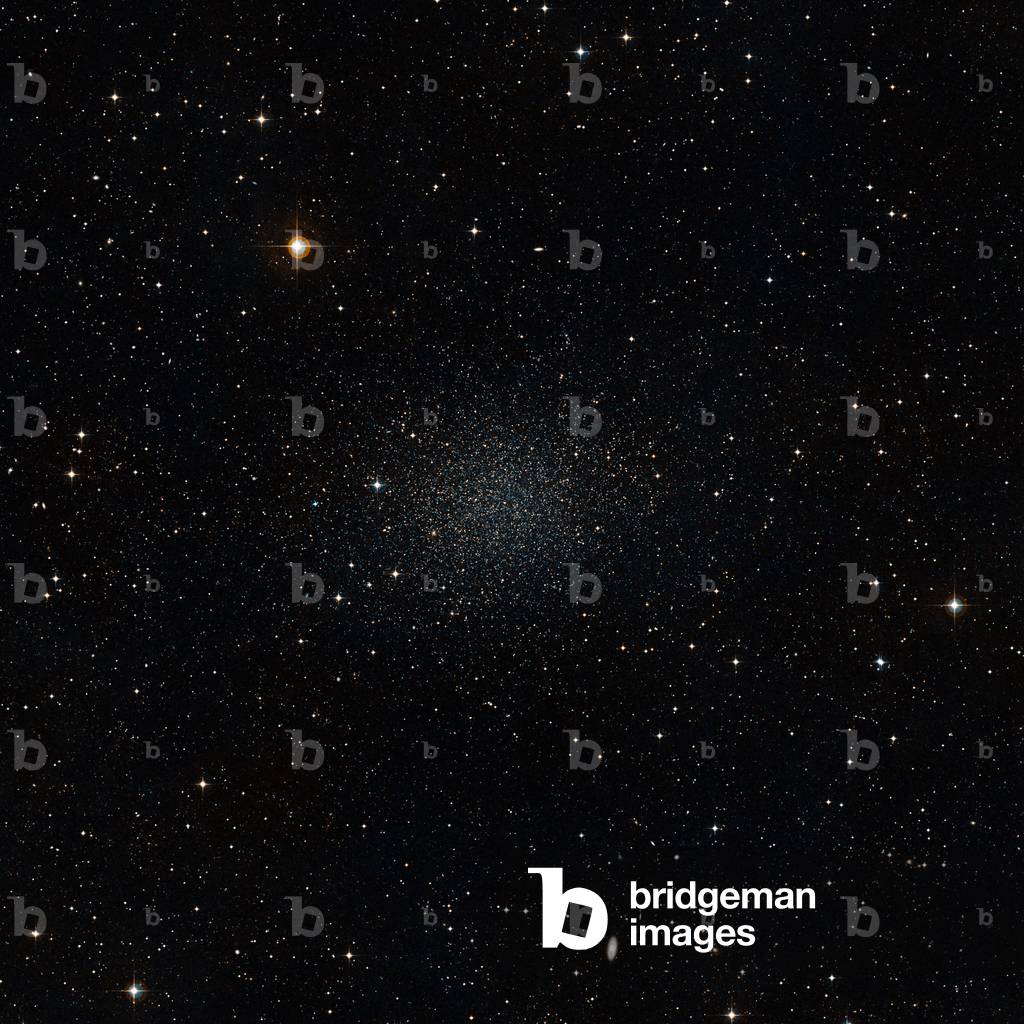
Sculptor's Dwarf Galaxy - Sculptor dwarf galaxy - The Sculptor's dwarf galaxy belongs to the local group, just like our galaxy or the Andromede galaxy. The Sculptor dwarf galaxy is one of our Milky Way's neighbouring dwarf galaxies. The Milky Way is, like all large galaxies, thought to have formed from smaller galaxies in the early days of the Universe. These small galaxies should also contain many very old stars, just as the Milky Way does, and a team of astronomers has now shown that this is indeed the case. This image was composed from data from the Digitized Sky Survey 2
The dwarf galaxy of the furnace - Fornax dwarf galaxy - The dwarf galaxy of the furnace belongs to the local group, just like our galaxy or the galaxy of Andromede. The Fornax dwarf galaxy is one of our Milky Way's neighbouring dwarf galaxies. The Milky Way is, like all large galaxies, thought to have formed from smaller galaxies in the early days of the Universe. These small galaxies should also contain many very old stars, just as the Milky Way does, and a team of astronomers has now shown that this is indeed the case. This image was composed from data from the Digitized Sky Survey 2
Galaxy NGC 4449 in Hunting Dogs - Dwarf irregular galaxy NGC 4449 in Canes Venatici - Dwarf galaxy irregular located in the constellation Hunting Dogs
Regulus and the dwarf galaxy Leo 1 - Regulus and Leo 1 dwarf galaxy - Leo 1 (UGC 5470) is located about 900,000 light years from Earth. It belongs to the local group, just like our galaxy or Andromede galaxy. It is known only since the 1950s; it is difficult to observe due to the proximity of the Regulus star (left), thousands of times brighter. Leo I (UGC 5470), a dwarf galaxy located 900 000 light - years away, is difficult to observe because it appears only 20 arc minutes (less than the apparent diameter of the Moon) from the brilliant star Regulus (at left)
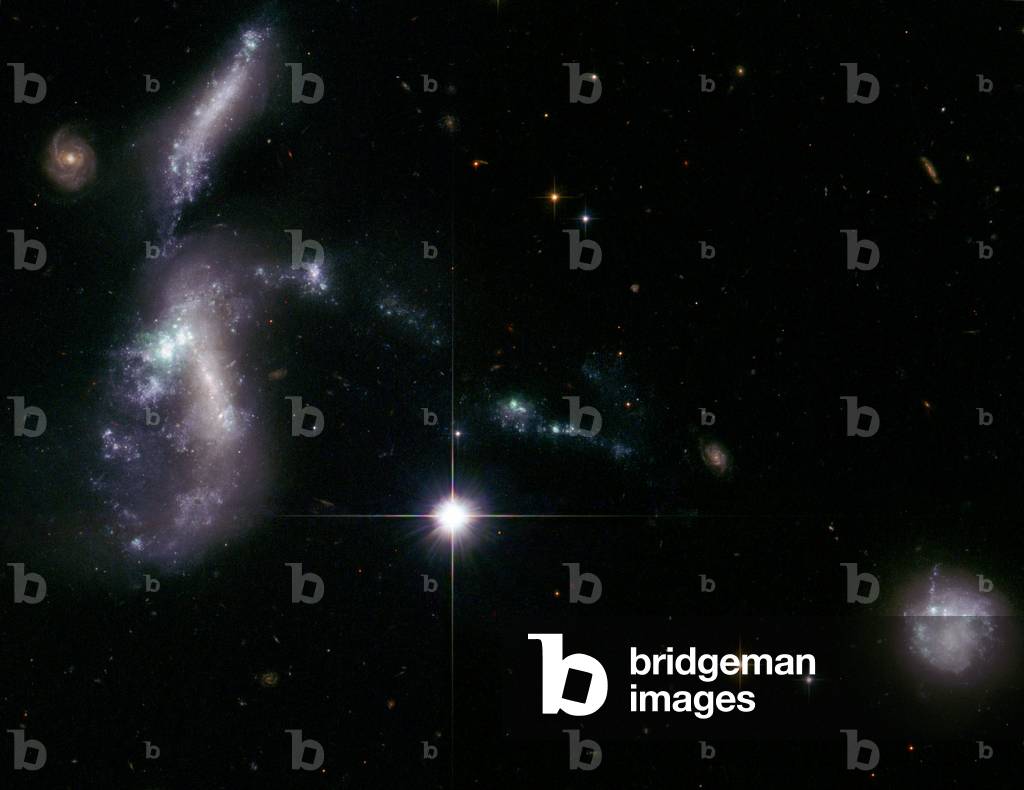
Group of Galaxies HCG 31 - Hickson Compact Group 31 - This group of interacting galaxies is located 166 million years of light from Earth in the constellation Eridan. Dwarf galaxies are merging causing intense star formation. This long fusion process will lead to the birth of a large elliptical galaxy. Image obtained by the Hubble Space Telescope on August 8, 2006. These four dwarf galaxies waited billions of years to come together, setting off a fireworks show as thousands of new star clusters come to life. The distorted galaxies are quickly producing massive, hot, young stars that are pumping out ultraviolet radiation, heating up surrounding gas clouds, and causing them to glow. Such encounters between dwarf galaxies are normally seen billions of light - years away and therefore occurred billions of years ago. But these galaxies, members of Hickson Compact Group 31, are relatively nearby, only 166 million light - years away. In this image, taken by Nasa's Hubble Space Telescope, the bright, distorted object at middle, left, is actually two colliding dwarf galaxies. Myriad star clusters have formed in the streamers of debris pulled from the galaxies and at the site of their head - on collision. The cigar - shaped object above the galaxy duo is another member of the group. A bridge of star clusters connects the trio. A long rope of bright star clusters points to the fourth member of the group, at lower right. The bright object in the center is a foreground star. Astronomers used Hubble's Advanced Camera for Surveys to resolve the youngest and brightest of star clusters, which allowed them to calculate the clusters' ages, map the star - formation history, and determine that the galaxies are starting the final stages of galaxy assembly. Hubble reveals that the brightest clusters, hefty groups each holding at least 100,000 stars, are less than 10 million years old. Astronomers say the interacting galaxies will form
Spiral Galaxy NGC 247 in the Whale - Spiral galaxy NGC 247 in Cetus - Dwarf spiral galaxy in the Whale, located about 11 million years ago - light from Earth. Image obtained with the 2.2 meter MPG/ESO telescope at the La Silla Observatory. The spiral galaxy NGC 247 is one of the closest spiral galaxies of the southern sky. In this view from the Wide Field Imager on the MPG/ESO 2.2 - metre telescope in Chile large numbers of the galaxy's component stars are clearly resolved and many glowing pink clouds of hydrogen, marking regions of active star formation, can be made out in the loose and ragged spiral arms. NGC 247 is part of the Sculptor Group. This is the nearest group of galaxies to our Local Group, which includes the Milky Way, but putting a precise value on such celestial distances is inherently difficult. Astronomers have reported that NGC 247 is more than a million light - years closer to the Milky Way than was previously thought, bringing its distance down to just over 11 million light - years
Galaxy NGC 4027 in the Raven - Galaxy NGC 4027 in Corvus - NGC 4027 is a spiral galaxy located about 80 million years ago - light. The photo shows some nearby dwarf galaxies. Image made with Siding Spring's 3.9m telescope. This galaxy is of interest because of its similarity to the Large Magellanic Cloud, (LMC) our nearest extra - galactic neighbour. Like the LMC, its light comes predominantly from young stars, which are hotter than the Sun and give the galaxy a bluish colour. However, because this galaxy is over 80 million light - years distant we see only the integrated light of millions of unresolved stars, rather than the individuals we see in the LMC. NGC 4027 has a somewhat distorted appearance and an elongated spiral arm, probably due to the gravitational effect of a smaller companion galaxy, not visible in this photograph but rather obvious on a much deeper image. NGC 4027 is less than half a degree south of the Antennae interacting galaxies
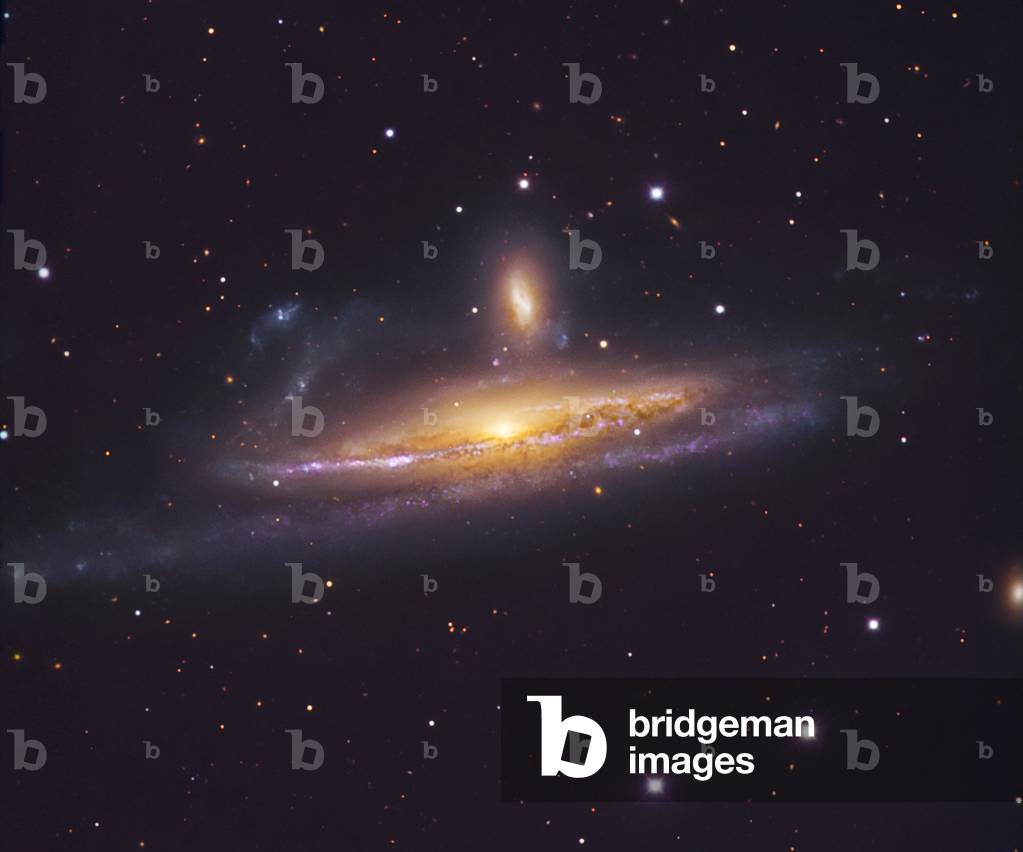
Interacting spiral galaxy NGC 1532 in Eridan - Interacting galaxy NGC 1532 in Eridanus - The spiral galaxy NGC 1532 is located about 70 million light years ago in the southern constellation of Eridan. It interacts with a dwarf galaxy, NGC 1531, visible just above it, which it will absorb in a few million years. Image obtained from the 1.5m Danish telescope of La Silla in Chile. NGC 1532, the large distorted spiral is in the process of cannibalizing the dwarf elliptical NGC 1531. The process takes millions of years. Large galaxies like our Milky Way typically engulf smaller galaxies, incorporating their stars and gas over millions of years into the larger galactic structure. These galaxies are located 70 million light years away in southern constellation of Eridanus. This image was made at the danish 1.5 meter telescope in La Silla, Chile
Spiral galaxy M81 in the Great Bear - Spiral galaxy M81 in Ursa Major - The spiral galaxy M81 is located 12 million years ago - light from Earth. Its arms are home to star-forming regions while its core is surrounded by much older yellow stars. In the background at the top, an irregular dwarf galaxy, Holmberg IX. This image obtained by a 50 cm amateur telescope, in February 2010 for 23 hours of poses, shows gas filaments whose origin is uncertain. Located about 12 million light - years from our planet, M81 (NGC 3031) together with M82 (NGC 3034), NGC 3077 and NGC 2976 forms one of the most iconic groups of interacting galaxies. The M81 group has also been the subject of many studies searching for and analyzing evidence of strong interactions among its components. In 1965, Halton Arp detected an unusual looping feature near M81 while examining photographic plates produced with the 48 - inch Schmidt on Mount Palomar. Traditionally, ARP's loop has been interpreted as a tail resulting from the tidal interaction between M81 and M82. However, since its discovery that explanation has been doubted by many researchers. Interestingly, the region of the sky containing the M81 group of galaxies is filled with Galactic cirrus and ARP's loop exhibits colors and emission properties similar to those observed in Galactic cirrus clouds. This optical image suggests that the light observed at optical wavelengths is a combination of emissions from: recent star forming regions situated near M81, the extended disk of M81 and scattered light from the same Galactic cirrus that is responsible for the bulk of the far infrared emissions. Although our observations cannot exclude the presence of some material stripped from the disk of M81 (NGC 3031) and/or M82 (NGC 3034) that is chance located in our line of sight to and far behind this intruiging structure, our findings suggest that ARP's Loop is situated between the observer and M81 (
Irregular galaxy NGC 6822 in Sagittarius - Irregular galaxy NGC 6822 in Sagittarius - The galaxy NGC 6822 is about 1.6 million years away - light from Earth. She belongs to our local group. Image obtained with a telescope of 35 cm, 12 hours of poses. The irregular dwarf galaxy NGC 6822 is located at only 1,6 million light year. It is a member of our local group and the third nearest galaxy to the Milky Way after the Sagittarius Dwarf Elliptical and the Magellanic Clouds. The galaxy was discovered by Barnard in 1881 using a 6 inch refractor. It is very similar to the LMC with its weak bar and its irregular distribution of bright OB associations and HII regions. In 1925 in a classic paper, Edwin Hubble reported on several bright objects in NGC 6822, later found to represent a grouping of bright star clusters and HII regions. The galaxy is rich in neutral hydrogen gas, the essential fuel of star formation. NGC 6822 started forming stars some 10 billion years ago. Similar to the LMC it has a large intermediate age population of stars of about 3 billion years old, although the galaxy has picked up its star forming rate over the last 100 to 200 million years. Prominent HII regions and scattered clusters of young blue stars are testament to its current constant rate of star formation. Image taken with 14.5”” RCOS telescope, 12 Hours of exposure
Spiral Galaxy M100 in Berenice's Hair - Spiral galaxy M100 in Coma Berenices - The spiral galaxy M100 is located about 60 million years ago - light from Earth. It belongs to the Virgin's galaxy cluster. Several dwarf elliptic galaxies are visible in this image, one just above M100 probably interacting. This image was obtained by Siding Spring's 3.9m telescope. In this deep image fainter galaxies appear. One seems to be involved with the faint outskirts of the large spiral. The somewhat distorted shape of the dwarf galaxy suggests it could be both influencing and being influenced by M100, and may be the cause of the asymmetry in the spiral arms. Nearby is an even fainter, elongated dwarf galaxy and elsewhere in the picture are several others, all probably members of the Virgo cluster, which spills over into the adjoining constellation of Coma Berenices
Irregular dwarf galaxy I Zwicky 18 - Irregular dwarf galaxy I Zwicky 18 - The irregular dwarf galaxy I Zwicky 18 is located 59 million years - light in the Great Bear and extends over about 3000 years - light. The two bright white spots are star-forming regions. At the top left, another galaxy is visible. This galaxy could be interacting with I Zwicky 18. This image is the result of observations made by the Hubble Space Telescope in 2005 and 2006. Called I Zwicky 18, this galaxy has a youthful appearance that resembles galaxies typically found only in the early universe. Hubble has now found faint, older stars within this galaxy, suggesting that the galaxy may have formed at the same time as most other galaxies. I Zwicky 18 is classified as a dwarf irregular galaxy and is much smaller than our Milky Way Galaxy. The concentrated bluish - white knots embedded in the heart of the galaxy are two major starburst regions where stars are forming at a furious rate. The wispy blue filaments surrounding the central starburst regions are bubbles of gas that have been blown away by stellar winds and supernovae explosions from a previous generation of hot, young stars. This gas is now heated by intense ultraviolet radiation unleashed by hot, young stars. A companion galaxy lies just above and to the left of I Zwicky 18. The companion may be interacting with I Zwicky 18 by gravitationally tugging on the galaxy. The interaction may have triggered the galaxy's recent star formation that is responsible for the youthful appearance. Besides the bluish - white young stars, white - reddish stars also are visible in both I Zwicky 18 and its companion. These stars may be as old as 10 billion years. The reddish extended objects surrounding I Zwicky 18 and its companion are ancient, fully formed galaxies of different shapes that are much farther away. Hubble data also allowed astronomers for the first time to identify Cephe
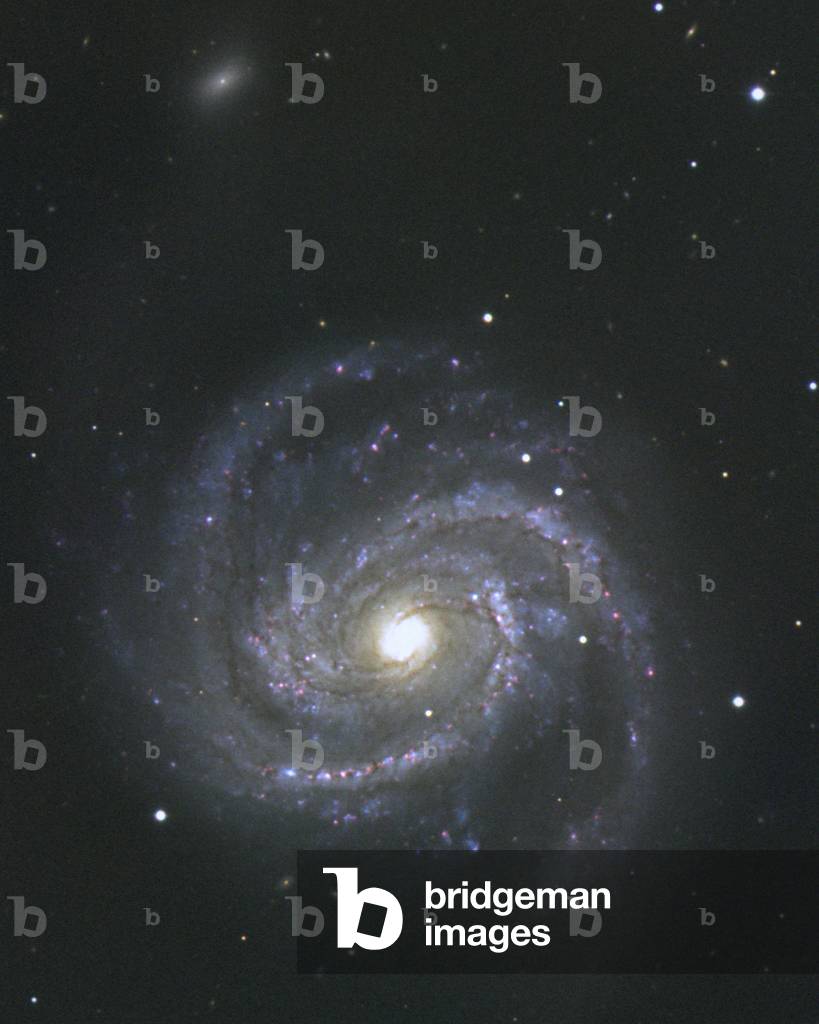
Spiral galaxy M100 in Berenice's Hair - Spiral galaxy M100 in Coma Berenices - The spiral galaxy M100 (NGC 4321) is located about 60 million years ago - light from Earth. It belongs to the Virgin's galaxy cluster. Several dwarf elliptic galaxies are visible in this image, one just above M100 probably interacting. This face - on spiral M100, is one of the finest spirals in the Virgo galaxy cluster. As might be expected in a galaxy - rich environment, the lack of perfect symmetry in its brightest spiral arms suggests that M100 has been disturbed by gravitational interaction with its neighbours. At the top of the image is a less spectacular galaxy, a so - called 'nucleated dwarf' elliptical galaxy, probably interacting with M100
Sagittarius dwarf irregular galaxy - SagDig - Sagittarius dwarf irregular galaxy - Image of the irregular dwarf galaxy ESO 594 - 4 located 3.5 million years ago - light seen by the Hubble space telescope on August 18, 2003. The Sagittarius dwarf irregular galaxy (SagDig, ESO 594 - 4) lies some 3.5 million light - years (1.1 Megaparsecs) from us. Background galaxies (reddish/brown extended objects with spiral arms and halos) are located even further beyond SagDig at several tens of millions parsecs away. This dwarf irregular galaxy was observed by the Advanced Camera for Surveys on - board the Hubble Space Telescope on 18 August 2003. Fifty-minute exposures were taken in blue, green and red filters
Spiral galaxy M100 in Berenice's Hair - Spiral galaxy M100 in Coma Berenices - The spiral galaxy M100 (NGC 4321) is located about 60 million years ago - light from Earth. It belongs to the Virgin's galaxy cluster. Several dwarf elliptic galaxies are visible in this image, one just above M100 probably interacting. This face - on spiral M100, is one of the finest spirals in the Virgo galaxy cluster. As might be expected in a galaxy - rich environment, the lack of perfect symmetry in its brightest spiral arms suggests that M100 has been disturbed by gravitational interaction with its neighbours. At the top of the image is a less spectacular galaxy, a so - called 'nucleated dwarf' elliptical galaxy, probably interacting with M100
Spiral galaxy M81 in the Great Bear - Spiral galaxy M81 in Ursa Major - The spiral galaxy M81 is located 12 million years ago - light from Earth. Its arms are home to star-forming regions while its core is surrounded by much older yellow stars. An irregular dwarf galaxy, PGC 28757 (Holmberg IX), is visible at the top of the picture. M81 is the brightest member of the nearby galactic group called the M81 group. This group contains at least 25 other members including the peculiar starburst galaxy M82, the peculiar galaxy NGC 3077 and many dwarfs galaxies. The core galaxies of the group (M81, M82, NGC 3077, NGC 2976) are strongly interacting and are all imbedded within a large and extended molecular gas cloud. The Dwarf irregular Holmberg IX (seen above M81 in the image) most likely condensed from tidal debri existing between M81 and M82. M81 has the distinction of being the nearest spiral galaxy to have an active galactic nucleus (AGN). AGN galaxies are luminous galaxies that demonstrate much of their luminosity as nonstellar emission arising from their nucleus. The modern interpretation for the unusual energy output is the presence of a super massive black hole which consumes infalling matter from a rotating accretion disk in the galaxy's center
Dwarf galaxy Holmberg IX in the Great Bear - Dwarf galaxy Holmberg IX in Ursa Major - The dwarf galaxy Holmberg IX is located 12 million years - light from Earth in the constellation of the Great Bear, just above the spiral galaxy M81. Of the 20,000 stars visible on this image obtained by the Hubble space telescope, more than 90% are young stars aged between 10 and 200 million years. The proximity of other galaxies, including M81, is believed to be at the origin of this recent star formation. This loose collection of stars is actually a dwarf irregular galaxy, called Holmberg IX. It resides just off the outer edge of M81, a large spiral galaxy in Ursa Major. This image was taken with Hubble's Advanced Camera for Surveys in early 2006. Holmberg IX is of the so - called Magellanic type of galaxy, as its size and irregularity in structure are similar to the Small Magellanic Cloud, a neighbour to our own Milky Way. It is suspected that the dwarf galaxy was created as a result of a galactic interaction between M81 and neighbouring galaxy M82. Of the more than 20,000 stars that can be resolved in this Hubble image, only about 10% are considered to be old stars with ages of billions of years. The rest are thought to be young stars with ages of only 10 - 200 million years. Simulations predict that the triplet M81, M82, and nearby NGC 3077 had a close passage 200 - 300 million years ago. This close encounter may have triggered the newer star formation that has occurred in Holmberg IX
Star Formation in the dwarf galaxy NGC 1569 - Starburst galaxy NGC 1569 - NGC 1569 is a dwarf irregular galaxy in the constellation Giraffe. The Hubble space telescope measured its distance with precision, placing it 11 million years - light from Earth, or 4 million years - light beyond the distance previously established by astronomers. This new measure explains better why this galaxy has a particularly high star formation rate. It resides among a group of galaxies that by gravity compresses its gas, thus creating a hundred times more stars than in our own galaxy. NGC 1569 is located in the middle of a group of about 10 galaxies centered on the spiral galaxy IC 342. Gravitational interactions among the group's galaxies may be compressing gas in NGC 1569 and igniting the star - birthing frenzy. The galaxy is forming stars at a rate more than 100 times higher than the rate in the Milky Way. This high star - formation rate has been almost continuous for the past 100 million years. Thanks to Hubble space telescope, astronomers have now measured the galaxy's distance at nearly 11 million light - years away, about 4 million light - years farther than the old distance
Spiral galaxy M81 in the Great Bear - Spiral galaxy M81 in Ursa Major - The spiral galaxy M81 is located 12 million years ago - light from Earth. Its arms are home to star-forming regions while its core is surrounded by much older yellow stars. In the background at the top, an irregular dwarf galaxy, Holmberg IX. Image obtained by an amateur telescope of 50 cm, composting different poses. M81 is the brightest member of the nearby galactic group called the M81 group. This group contains at least 25 other members including the peculiar starburst galaxy M82, the peculiar galaxy NGC 3077 and many dwarfs galaxies. The core galaxies of the group (M81, M82, NGC 3077, NGC 2976) are strongly interacting and are all imbedded within a large and extended molecular gas cloud. The Dwarf irregular Holmberg IX (seen above M81 in the image) most likely condensed from tidal debri existing between M81 and M82. M81 has the distinction of being the nearest spiral galaxy to have an active galactic nucleus (AGN). AGN galaxies are luminous galaxies that demonstrate much of their luminosity as nonstellar emission arising from their nucleus. The modern interpretation for the unusual energy output is the presence of a super massive black hole which consumes infalling matter from a rotating accretion disk in the galaxy's center
Spiral galaxy M100 in Berenice's Hair - Spiral galaxy M100 in Coma Berenices - The spiral galaxy M100 (NGC 4321) is located about 60 million years ago - light from Earth. It belongs to the Virgin's galaxy cluster. Above the galaxy a dwarf elliptical galaxy, probably interacting with M100. This image was obtained by Siding Spring's 3.9m telescope. This dominant galaxy is the face - on spiral M100, one of the finest spirals in the Virgo cluster. As might be expected in a galaxy - rich environment, the lack of perfect symmetry in its brightest spiral arms suggests that M100 has been disturbed by gravitational interaction with its neighbours. At the top of the image is the first colour picture of a much less spectacular galaxy, a so - called 'nucleated dwarf' elliptical galaxy, probably interacting with M100. Dwarf galaxies are by far the commonest kind in rich clusters such as this, but nucleated examples are quite rare
Spiral galaxy M81 in the Great Bear - Spiral galaxy M81 in Ursa Major - The spiral galaxy M81 is located 12 million years ago - light from Earth. Its arms are home to star-forming regions while its core is surrounded by much older yellow stars. An irregular dwarf galaxy, PGC 28757 (Holmberg IX), is visible at the top of the picture. Image obtained with a 50 cm telescope through different filters, total of different poses: 20h. M81 is the brightest member of the nearby galactic group called the M81 group. This group contains at least 25 other members including the peculiar starburst galaxy M82, the peculiar galaxy NGC 3077 and many dwarfs galaxies. The core galaxies of the group (M81, M82, NGC 3077, NGC 2976) are strongly interacting and are all imbedded within a large and extended molecular gas cloud. The Dwarf irregular Holmberg IX (seen above M81 in the image) most likely condensed from tidal debri existing between M81 and M82. M81 has the distinction of being the nearest spiral galaxy to have an active galactic nucleus (AGN). AGN galaxies are luminous galaxies that demonstrate much of their luminosity as nonstellar emission arising from their nucleus. The modern interpretation for the unusual energy output is the presence of a super massive black hole which consumes infalling matter from a rotating accretion disk in the galaxy's center
Spiral galaxy M81 in the Great Bear - Spiral galaxy M81 in Ursa Major: The spiral galaxy M81 is located 12 million light years from Earth. Its arms are home to star-forming regions while its core is surrounded by much older yellow stars. An irregular dwarf galaxy, PGC 28757 (Holmberg IX), is visible at the top of the picture. - M81 is the brightest member of the nearby galactic group called the M81 group. This group contains at least 25 other members including the peculiar starburst galaxy M82, the peculiar galaxy NGC 3077 and many dwarfs galaxies. The core galaxies of the group (M81, M82, NGC 3077, NGC 2976) are strongly interacting and are all imbedded within a large and extended molecular gas cloud. The Dwarf irregular Holmberg IX (seen above M81 in the image) most likely condensed from tidal debri existing between M81 and M82. M81 has the distinction of being the nearest spiral galaxy to have an active galactic nucleus (AGN). AGN galaxies are luminous galaxies that demonstrate much of their luminosity as nonstellar emission arising from their nucleus. The modern interpretation for the unusual energy output is the presence of a super massive black hole which consumes infalling matter from a rotating accretion disk in the galaxy's center. Composite Image from Multiple Data Sources
Large Magellanic Cloud galaxy - Large Magellanic Cloud galaxy - The galaxy of the Great Magellan Cloud is about 160,000 light years away from Earth in the southern constellation of Dorado. Visible with the naked eye in the southern hemishere it is one of the closest galaxies to ours. Mosaic of 10 images, 30 hours of poses. The irregular galaxy Large Magellanic Cloud (LMC) is located at a distance of 160,000 light years in the southern constellation of Dorado. It is one of the nearest galaxy, visible to naked eye. 10 frame mosaic image, 30 hours of exposure
The Large Magellanic Cloud - The Large Magellanic Cloud - The Great Magellan Cloud galaxy is about 160,000 light years away from Earth in the southern constellation of the Sea bream. Visible with the naked eye in the southern hemishere it is one of the closest galaxies to us. It contains large star-forming areas such as the Tarantula Nebula (30 Bream, visible right), the most active star-forming regions of the local group. The irregular galaxy Large Magellanic Cloud (LMC) is located at a distance of 160,000 light years in the southern constellation of Dorado. It is one of the nearest galaxy, visible to naked eye
The Large Magellanic Cloud - The Large Magellanic Cloud - The Great Magellan Cloud galaxy is about 160,000 light years away from Earth in the southern constellation of Bream. Visible with the naked eye in the southern hemishere it is one of the closest galaxies to ours. The Large Magellanic Cloud is an irregular galaxy located about 160,000 light years distance from Earth in the constellation Dorado. Visible naked - eye in the night sky of the southern hemisphere, it is one of the closest galaxy from us
Artist's view of our galaxy, the dwarf galaxy of the sagittarius and the clouds of Magella
Irregular Galaxy of the Little Magellan Cloud (NGC 292) - The Small Magellanic Cloud - The galaxy of the Little Magellan Cloud is about 240,000 light years from Earth in the southern constellation of Toucan. It's one of the closest galaxies of the Lactee Way. Two globular clusters are visible in this image, on the right the Toucan cluster, at the top of the galaxy the NGC 362 cluster. Image obtained by the 1.2m UK Schmidt telescope from Siding Spring, Australia. The Small Magellanic Cloud (SMC) is the second nearest galaxy to the Milky Way, (the LMC being the nearest) and is at the distance of about 240,000 light years, quite close enough for it to be resolved into individual stars on this colour picture made from plates taken on the UK Schmidt Telescope. The shape of the SMC defies description and it is therefore classified as an 'irregular' galaxy. The large globular cluster at right is 47 Tucanae, while a smaller one at the top of the picture is NGC 362. It is about 30,000 light years distant, twice as far away as 47 Tuc
The Large Magellanic Cloud - The Large Magellanic Cloud - The Great Magellan Cloud galaxy is located about 160,000 light years away from Earth in the southern constellation of Dorado. Visible with the naked eye in the southern hemishere it is one of the closest galaxies to us. It contains large star-forming zones such as the Tarantula Nebula (30 Sea bream, visible to the left), the most active star-forming regions of the local group. Image obtained by the 1.2m UK Schmidt telescope from Siding Spring, Australia. The Large Magellanic Cloud (LMC) is the nearest galaxy to the Milky Way but less than one tenth as massive; even so it contains the equivalent of over ten billion solar masses of material in the form of stars, gas and dust. The LMC is at a distance of 160,000 light years and is visible to the unaided eye from southern latitudes, rather like a detached piece of the Milky Way. The nearness of the LMC ensures that it is well resolved into stars in quite a modest telescope, and deep photographs reveal it to be a highly complex system with large numbers of clusters, nebulae and dust clouds scattered apparently at random across the face of the galaxy. The bright red patch at the eastern end of the galaxy is the star - forming region 30 Doradus
The Small Magellanic Cloud - The Small Magellanic Cloud - The Small Magellanic Cloud galaxy is about 240,000 light years away from Earth in the southern constellation of Toucan. It's one of the closest galaxies of the Lactee Way. Above the galaxy, the cluster of stars of Toucan. The Small Magellanic Cloud is an irregular galaxy located at about 240,000 light years distance from Earth in the constellation Tucanae, and is one of the closest galaxy of the milky way. The globular cluster 47 Tucanae appears in the upper part of the image
The Large Magellanic Cloud Irregular Galaxy - The Large Magellanic Cloud - The irregular galaxy of the Great Magellan Cloud is located approximately 160,000 light years away from Earth in the southern constellation of the Sea bream. Visible with the naked eye in the southern hemishere it is one of the closest galaxies to ours. The Large Magellanic cloud is about 160 000 light - years from Earth in the constellation Dorado. Naked - eye visible in the southern hemisphere, it is one of the nearest galaxy
Irregular Galaxy of the Little Magellan Cloud (NGC 292) - The Small Magellanic Cloud - The galaxy of the Little Magellan Cloud is about 240,000 light years from Earth in the southern constellation of Toucan. It's one of the closest galaxies of the Lactee Way. Upstairs, the cluster of stars NGC 362. Image obtained by the 1.2m UK Schmidt telescope from Siding Spring, Australia. The Small Magellanic Cloud (SMC) is the second nearest galaxy to the Milky Way, (the LMC being the nearest) and is at the distance of about 240,000 light years, quite close enough for it to be resolved into individual stars on this colour picture made from plates taken on the UK Schmidt Telescope. The shape of the SMC defies description and it is therefore classified as an 'irregular' galaxy. The small globular cluster at the top of the picture is NGC 362. It is about 30,000 light years distant
Large and Small Magellan Clouds - Large and Small Magellanic clouds - These two irregular galaxies are close to our galaxy. Visible in the southern hemisphere, they are located approximately 160,000 (Grand Cloud, right) and 240,000 light years (Small Cloud, left). The Magellanic Clouds are the nearest galaxies to the Milky Way, about 170,000 and 240,000 light years distant respectively. They are in the far southern sky, practically invisible from northern latitudes, and their low surface brightness makes them difficult to see unless they are high in the sky. Both Magellanic Clouds are less than 25 degrees from the South Celestial Pole and are visible at some time on any clear, dark night from Siding Spring, where this picture was taken. To the dark adapted eye the Magellanic Clouds look like detached pieces of the Milky Way, but this apparent detachment is misleading because both are in orbit around it. Although the Magellanic Clouds are separate galaxies they are interacting with each other and with the Milky Way itself. Already the SMC has been substantially disrupted by this process, and the LMC distorted. Eventually the galaxies will merge with each other and with the Milky Way itself
The Small Magellanic Cloud - The Small Magellanic Cloud - The Small Magellanic Cloud galaxy is about 210,000 light years away from Earth in the southern constellation of Toucan. It's one of the closest galaxies of the Lactee Way. Two globular clusters are visible in this image, on the left the Toucan cluster, at the bottom of the galaxy the NGC 362 cluster. The Small Magellanic Cloud is a dwarf irregular galaxy located at a distance of about 210,000 light years; it is one of the Milky Way's nearest neighbors. Two globular clusters are visible: at left NGC 104, better known as 47 Tucanae, at the bottom NGC 362
The Small Magellanic Cloud (NGC 292) - The Small Magellanic Cloud (NGC 292) - The Small Magellanic Cloud galaxy is about 240,000 years from Earth in the southern constellation of Toucan. It's one of the closest galaxies of the Lactee Way. Two globular clusters are visible in this image, on the right the Toucan cluster, at the top of the galaxy the NGC 362 cluster. The Small Magellanic Cloud is about 210,000 light years in the constellation of Tucana. It is one of the Milky Way's nearest neighbors. The globular clusters 47 Tucana (on the right) and NGC 362 (on the upper left corner) are also visible on this image
The lactee route seen in the southern hemisphere and the clouds of Magellan - The Magellanic clouds with Milky Way - These two irregular galaxies are adjacent to our galaxy. Visible in the southern hemisphere, they are located approximately 160,000 (Grand Cloud, right) and 240,000 light years (Small Cloud, left). Milky Way with the Magellanic clouds, visible in southern hemisphere. the Small Magellanic cloud (to the left) is about 240,000 light - years away and the Large Magellanic cloud (to the right) about 160,000 light - years. These two irregular galaxies are members of our Local Group of galaxies
Irregular Galaxy of the Little Magellan Cloud (NGC 292) - The Small Magellanic Cloud - The galaxy of the Little Magellan Cloud is about 240,000 light years from Earth in the southern constellation of Toucan. It's one of the closest galaxies of the Lactee Way. Two globular clusters are visible on this image, on the right the Toucan cluster, on the left, the NGC 362 cluster. The Small Magellanic Cloud (SMC) is the second nearest galaxy to the Milky Way, (the LMC being the nearest) and is at the distance of about 240,000 light years. The shape of the SMC defies description and it is therefore classified as an 'irregular' galaxy. The large globular cluster at right is 47 Tucanae, while a smaller one at left is NGC 362. It is about 30,000 light years distant, twice as far away as 47 Tuc
Irregular Galaxy of the Little Magellan Cloud (NGC 292) - The Small Magellanic Cloud - The galaxy of the Little Magellan Cloud is about 240,000 light years from Earth in the southern constellation of Toucan. It's one of the closest galaxies of the Lactee Way. Infrared image obtained by Spitzer space telescope. This infrared portrait of the Small Magellanic Cloud, taken by Nasa's Spitzer Space Telescope, reveals the stars and dust in this galaxy as never seen before. The Small Magellanic Cloud is a nearby satellite galaxy to our Milky Way galaxy, approximately 200,000 light - years away. The image shows the main body of the Small Magellanic Cloud, which is comprised of the “” bar”” on the left and a “” wing”” extending to the right. The bar contains both old stars (in blue) and young stars lighting up their natal dust (green/red). The wing mainly contains young stars. In addition, the image contains a galactic globular cluster in the lower left (blue cluster of stars) and emission from dust in our own galaxy (green in the upper right and lower right corners). This image was captured by Spitzer's infrared array camera and multiband imaging photometer (blue is 3.6 - micron light; green is 8.0 microns; and red is combination of 24 -, 70 - and 160 - micron light). The blue color mainly traces old stars. The green color traces emission from organic dust grains (mainly polycyclic aromatic hydrocarbons). The red traces emission from larger, cooler dust grains
Spiral galaxy NGC 1232 in Eridan - Spiral galaxy NGC 1232 in Eridanus - The large spiral galaxy NGC 1232 is located about 100 million years ago - light. She's accompanied by a dwarf galaxy at the end of one of her arms. Composite image obtained with the 1.5m Danish telescope of La Silla and Subaru. NGC 1232 is located 20 degrees south of the celestial equator, in the constellation Eridanus (The River). The distance is about 100 million light - years. Note the distorted companion galaxy on the top of the image. Composite image made at the danish 1.5 meter telescope in La Silla and Subaru
Galaxy NGC 1232 in Eridan - Spiral galaxy NGC 1232 in Eridanus - The large spiral galaxy NGC 1232 is located about 100 million years ago - light. She's accompanied by a dwarf galaxy at the end of one of her arms. Image obtained from the 1.5m Danish telescope of La Silla in Chile. NGC 1232 is located 20 degrees south of the celestial equator, in the constellation Eridanus (The River). The distance is about 100 million light - years. Note the distorted companion galaxy on the top of the image. This image was made at the danish 1.5 meter telescope in La Silla, Chile
Spiral galaxy NGC 4651 in Berenice's Hair - Spiral galaxy NGC 4651 in Coma Berenices: The galaxy NGC 4651 (Arp 189) is located about 50 million light years away from Earth - The Umbrella Galaxy (NGC 4651 or Arp 189) exhibits a jet like spear that's strikingly coherent and narrow. The structure was previously reported by Boris Vorontsov Velyaminov in 1959 but never interpreted as a stellar tidal stream. This deep image additionally shows a spectacular crescent shaped shell surrounding the east side of the star system that corresponds to the apocenter of the dwarf galaxy. This galaxy is located at about 50 million light years away.
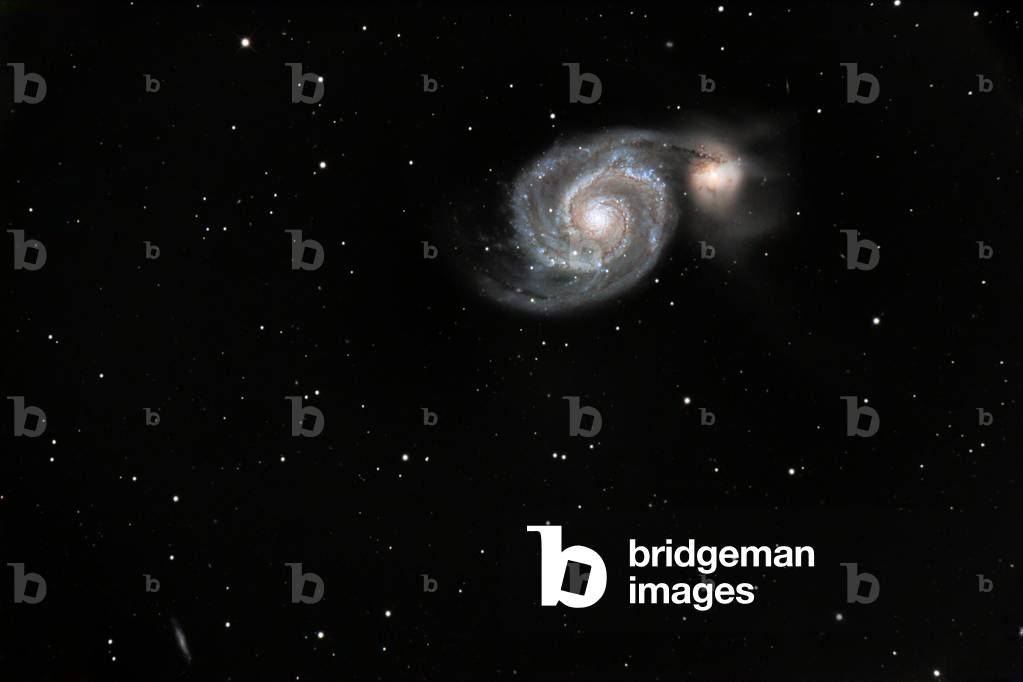
Spiral galaxy M51 in Canes Venatici
Spiral galaxy NGC 5907 in the Dragon - Spiral galaxy NGC 5907 in Draco - The galaxy NGC 5907 is about 35 million years away - light from Earth. In this image, traces left by the passage of a dwarf galaxy appear as a stellar current around this galaxy. Here is an extragalactic perspective of an extended stellar tidal stream wrapping around the edge - on, spiral galaxy NGC 5907. Our deep images reveal for the first time a large scale complex of arcing loops that is an excellent example of how a low - mass satellite accretion can produce a interweaved, rosette - like structure of debris dispersed in the halo of its host galaxy. The existence of this structure, which has probably survived for several Gigayears, confirms that halos of spiral galaxies in the Local Universe still contain a significant number of galactic fossils from their hierarchical formation. This edge - on spiral galaxy is located at 35 million light years away
Spiral galaxy NGC 4013 in the Great Bear - Edge - on galaxy NGC 4013 in Ursa Major - The spiral galaxy NGC 4013 is located 55 million years - light in the constellation Big Bear. In this image, traces left by the passage of a dwarf galaxy appear as a stellar current around that galaxy. A bright star seems to radiate from this galaxy; in reality, this star is much closer and belongs to our galaxy. Edge - on view of NGC 4013 spiral galaxy located about 55 million light years in Ursa Major. This deep color image reveals an enormous faint looping structure extending over 80,000 light years from the galaxy center. This is a stream of stars coming from a smaller galaxy who merged with NGC 4013. The very bright star in the center of the galaxy is very much closer to us than it appears and belongs to our galaxy
Spiral galaxy NGC 6744 in the constellation Peacock - Spiral galaxy NGC 6744 in Pavo - The galaxy NGC 6744 is about 25 million years away - light from Earth. This galaxy interacts with a dwarf galaxy. Image obtained with a telescope of 35 cm, 12 hours of poses. NGC 6744 is a majestic spiral galaxy in the southern constellation of Pavo. It has great similarities to the Milky Way galaxy in both form and structure. It lies at a distance of approximately 25 million Light Years. At its northern tip NGC 6744 is interacting with a dwarf companion galaxy much in the same way the Milky Way interacts with the Large Magellanic Cloud. The northernmost spiral arm is most likely being stretched and its stars and gas stripped due to tidal pull from the dwarf companion. Likewise the stars of the companion will likely be engulfed and the companion will ultimately merge with NGC 6744 at a far off future time. Image taken with 14.5”” RCOS telescope, 12 Hours of exposure
Globular cluster Terzan 5 in Sagittarius - Globular cluster Terzan 5 in Sagittarius - The globular cluster Terzan 5 is located in the constellation Sagittarius. Its stars are not all at the same time and show great age differences between 6 and 12 billion years. Image obtained by the Hubble Space Telescope (HST). Deep within the Milky Way lies the ancient globular cluster Terzan 5. This NASA/ESA Hubble Space Telescope image shows the cluster in wonderful detail, but it is the chaotic motions of its stars that make it particularly interesting to astronomers. Terzan 5 has an exceptionally dense core. As a result, it is thought to have one of the highest stellar collision rates for a globular cluster. And packed in at such close quarters, many stars are pushed so close together that they form tight binary systems. Interestingly, studies of individual stars within the cluster reveal that they can be split into two age groups: 6 and 12 billion years old. Some astronomers have hypothesised that the younger crowd may have been stripped away from a dwarf galaxy
Galaxy NGC 4027 in the Raven - Galaxy NGC 4027 in Corvus - NGC 4027 is a spiral galaxy located about 80 million years ago - light. One of his arms is more extended, probably by the presence of a nearby dwarf galaxy. Image made with Siding Spring's 3.9m telescope. This galaxy is of interest because of its similarity to the Large Magellanic Cloud, (LMC) our nearest extra - galactic neighbour. Like the LMC, its light comes predominantly from young stars, which are hotter than the Sun and give the galaxy a bluish colour. However, because this galaxy is over 80 million light - years distant we see only the integrated light of millions of unresolved stars, rather than the individuals we see in the LMC. NGC 4027 has a somewhat distorted appearance and an elongated spiral arm, probably due to the gravitational effect of a smaller companion galaxy, not visible in this photograph but rather obvious on a much deeper image. NGC 4027 is less than half a degree south of the Antennae interacting galaxies
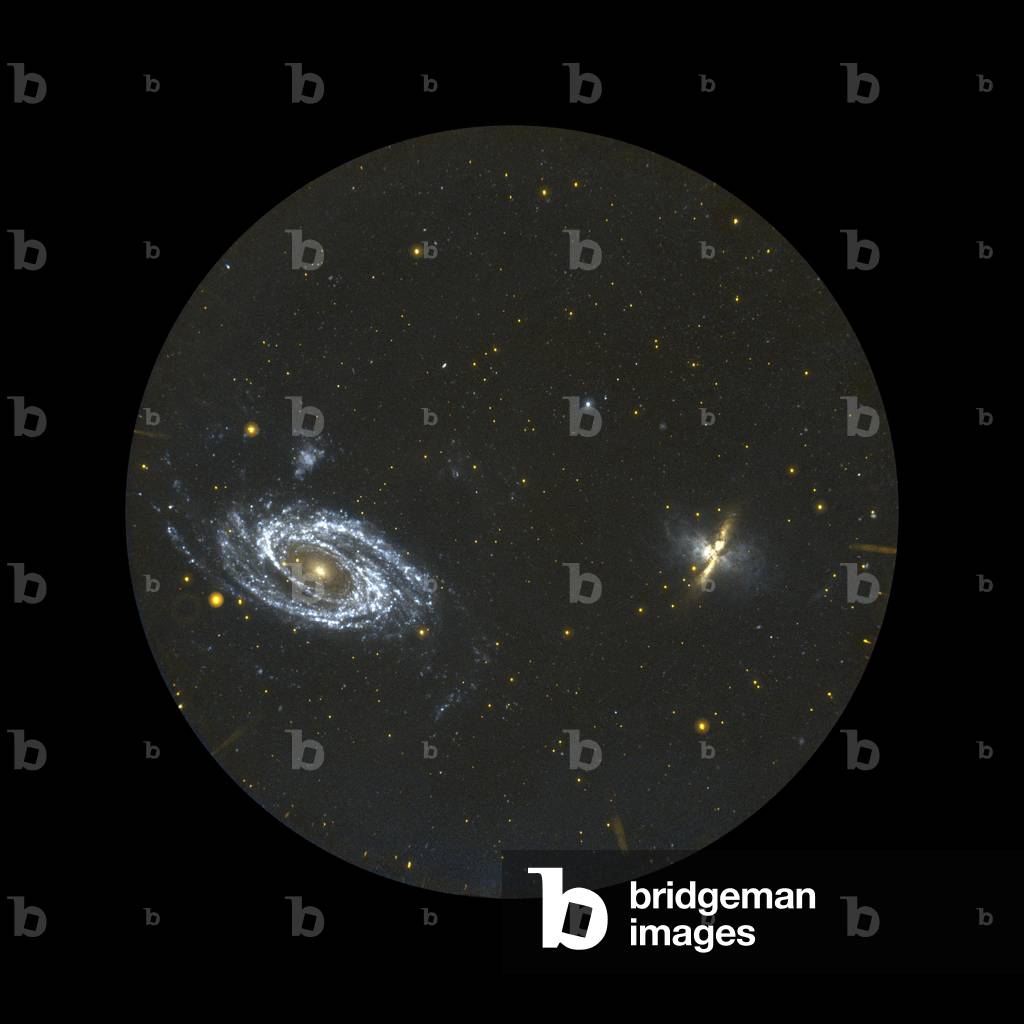
Ultraviolet view of the galaxies M81 and M82 - Ultraviolet image of M81 and M82 - M81 (left) is a spiral galaxy. M82 (right) an irregular galaxy. Separated for about 150,000 light years, these two galaxies belong to the galaxy cluster closest to our local group. These galaxies are approximately 10 - 12 million light years away from Earth. In ultraviolet, the Galex satellite highlights star-forming regions. Ultraviolet image of Messier 81 and Messier 82 (NGC 3031 and 3034), a pair of galaxies lying 10 million light - years distant. The stars in M81 spiral arms have formed within the last 100 million years, as have most of the stars in a nearby dwarf galaxy just to the left of M81. GALEX reveals that star formation is occurring quite distant from the nucleus of M81 in the faint blue extensions to the brighter spiral arms. The upper half of the full GALEX field of view shows the remarkable star forming galaxy M82
Spiral galaxy NGC 4651 in Berenice's Hair - Spiral galaxy NGC 4651 in Coma Berenices - The galaxy NGC 4651 (Arp 189) is located about 50 million years away - light from Earth. The Umbrella Galaxy (NGC 4651 or Arp 189) exhibits a jet like spear that's strikingly coherent and narrow. The structure was previously reported by Boris Vorontsov Velyaminov in 1959 but never interpreted as a stellar tidal stream. This deep image additionally shows a spectacular crescent shaped shell surrounding the east side of the star system that corresponds to the apocenter of the dwarf galaxy. Interestingly, a possible second arc on the western side of the galaxy can also be seen in this image. This feature is less obvious because it's partially hidden by the galaxy's disk and suggests we are observing a moderately inclined structure projected into the halo of NGC 4651. This image was produced by combining an hour of exposure through the Isaac Newton Telescope, located on the Spanish island of La Palma, with over 13 hours of imagery obtained with the 0.5 meter telescope at the Blackbird Observatory in New Mexico (USA). This galaxy is located at about 50 million light years away
Galaxy NGC 1232 in Eridan - Spiral galaxy NGC 1232 in Eridanus - Image of the large spiral galaxy NGC 1232 obtained by the VLT in September 1998. In the arms, many star-forming regions are visible, while in the center of the galaxy, older resident stars. Note the presence on the left of a dwarf galaxy. NGC 1232 is located about 100 million years ago - light. The field of this photo is about 200,000 years old - light, double our galaxy, the Lactee Way. NGC 1232 is located 20 degrees south of the celestial equator, in the constellation Eridanus (The River). The distance is about 100 million light - years. The edge of the field shown here corresponds to about 200,000 lightyears, or about twice the size of the Milky Way galaxy. This image of the large spiral galaxy NGC 1232 was obtained on September 21, 1998, by the FORS instrument at VLT. The colours of the different regions are well visible: the central areas contain older stars of reddish colour, while the spiral arms are populated by young, blue stars and many star - forming regions. Note the distorted companion galaxy on the left side of the image, shaped like the greek letter “” theta””
Globular cluster M54 in Sagittarius - Globular cluster M54 in Sagittarius - The globular cluster M54 photographed by the Hubble space telescope (HST). M54 resides about 90,000 light years from Earth, in the dwarf galaxy of Sagittarius. The object shown in this beautiful Hubble image, dubbed Messier 54, could be just another globular cluster, but this dense and faint group of stars was in fact the first globular cluster found that is outside our galaxy. Discovered by the famous astronomer Charles Messier in 1778, Messier 54 belongs to a satellite of the Milky Way called the Sagittarius Dwarf Elliptical Galaxy. Messier had no idea of the significance of his discovery at the time, and it wasn't until over two centuries later, in 1994, that astronomers found Messier 54 to be part of the miniature galaxy and not our own. Current estimates indicate that the Sagittarius dwarf, and hence the cluster, is situated almost 90 000 light - years away - - more than three times as far from the centre of our galaxy than the Solar System. Ironically, even though this globular cluster is now understood to lie outside the Milky Way, it will actually become part of it in the future. The strong gravitational pull of our galaxy is slowly engulfing the Sagittarius dwarf, which will eventually merge with the Milky Way creating one much larger galaxy. This picture is a composite created by combining images taken with the Wide Field Channel of Hubble's Advanced Camera for Surveys. Light that passed through a yellow - orange (F606W) was colored blue and light passing through a near - infrared filter (F814W) was colored red. The total exposure times were 3460 s and 3560 s, respectively and the field of view is approximately 3.4 by 3.4 arcminutes
Centaurus A Elliptical Galaxy (NGC 5128) in the Centaur - Galaxy Centaurus A - The NGC 5128 galaxy is about 13 million years away - light from Earth. This image obtained by the Hubble Space Telescope in 1998 shows the star flames that occur in the dark band of the galaxy. In blue, these are the clusters of newly shaped young stars. At the top left, a photo of the galaxy obtained from the ground. This giant galaxy is a powerful radio source known as Centaurus A. It is an active galaxy whose energy comes from a supermassive black hole. NGC 5128 is the nearest large elliptical galaxies to our sun. It is also the nearest of the giant radio galaxies, possessing an active galactic nucleus (AGN) and optically one of the most luminous galaxies in the sky. Among many other things NGC 5128 is also the prototypical postmerger elliptical galaxy. Structural peculiarities including the prominent rotating disk of stars and gas and the complex shell structure of its halo point to a large scale merger within the last billion years. Tidal streams of young stars have also been identified in the halo of NGC 5128 thought to have occurred by cannibalization of a nearby gas rich dwarf galaxy some 300 million years ago, long after the large scale merger. Elliptical galaxies are typically devoid of gas, dust and young stars. The unexpected presence of gas rich disk elements within the structure of NGC 5128 supports the current belief that accretions and mergers of low mass galaxies may be an important agent in the evolution of galaxy formation. As a radio galaxy, NGC 5128 belongs to the subgroup of galaxies called Active Galaxies, which include Quasars, Seyfert galaxies, Blazars and Radio Galaxies. Active galaxies are distinguished by their prodigious energy output which cannot be explained by their stellar populations and must have another source. Active galaxies have in common an “Active Galactic Nucleus (AGN)”” which is beli
Centaur Omega globular cluster - NGC 5139 Omega Centauri globular cluster - Visible to the naked eye in the southern hemisphere, Centaurus Omega is the most massive globular cluster in the galaxy. About 17,000 light years ago, millions of stars nearly 12 billion years old are concentrated here. This image obtained by the Spitzer space telescope reveals in yellow and red the big red stars, whose dust radiates infrared, and in blue the smaller and less evoluted stars. Omega Centauri is the biggest and brightest of the more than 150 similar objects, called globular clusters, that orbit around the outside of our Milky Way galaxy. Stargazers at southern latitudes can spot the stellar gem with the naked eye in the constellation Centaurus. While the visible - light observations highlight the cluster's millions of jam - packed stars, Spitzer's infrared eyes reveal the dustier, more evolved stars tossed throughout the region. Globular clusters are some of the oldest objects in our universe. Their stars are more than 12 billion years old, and, in most cases, formed all at once when the universe was just a toddler. Omega Centauri is unusual in that its stars are of different ages and possess varying levels of metals, or elements heavier than boron. Astronomers say this points to a different origin for Omega Centauri than other globular clusters: they think it might be the core of a dwarf galaxy that was ripped apart and absorbed by our Milky Way long ago. In this picture of Omega Centauri, the red - and yellow - colored dots represent the stars revealed by Spitzer. These are the more evolved, larger, dustier stars, called red giants. The stars colored blue are less evolved, like our own sun, and were captured by both Spitzer's infrared eyes and in visible light by the National Science Foundation's Blanco 4 - meter telescope at Cerro Tololo Inter - American Observatory in Chile. Some of the red spots in the picture are distant ga
Towards the Small Magellanic Cloud, 2015 (digital photo)
Nutzungsbeschränkungen von unseren Content-Partnern
  • Not available to clients invoiced in the UK
Urheberrecht
  • Urheberrechtlich Geschützt