[]
Your ongoing selection
Asset(s) Assets
Your quote 0

Your selection

Clear selection
Item added to cart
View cart and checkout
{"event":"pageview","page_type1":"undetected","page_type2":"_assets_search_override","language":"en","user_logged":"false","user_type":"ecommerce","nl_subscriber":"false"}
{"event":"ecommerce_event","event_name":"view_item","event_category":"browse_catalog","ecommerce":{"items":[{"item_id":"PIX4568892","item_category":"photo","item_category2":"no_copyright","item_category3":"standard","item_category5":"not_balown","item_list_name":"search_results","item_name":"open_cluster_of_pleiades_seen_in_infrared_the_pleiades_open_cluster_seen_in_infrared_clouds_of_dust_","item_variant":"undefined"},{"item_id":"PIX4609049","item_category":"photo","item_category2":"no_copyright","item_category3":"standard","item_category5":"not_balown","item_list_name":"search_results","item_name":"andromede_galaxy_m31_seen_in_x_and_infrared_andromeda_galaxy_infrared_and_x_ray_composite_andromede_","item_variant":"undefined"},{"item_id":"PIX4565251","item_category":"photo","item_category2":"no_copyright","item_category3":"standard","item_category5":"not_balown","item_list_name":"search_results","item_name":"galaxy_cluster_abell_1656_coma_cluster_the_coma_cluster_abell_1656_a_large_cluster_of_galaxies_consi","item_variant":"undefined"},{"item_id":"HFE6332600","item_category":"photo","item_category2":"no_copyright","item_category3":"standard","item_category4":"michel_viard","item_category5":"not_balown","item_list_name":"search_results","item_name":"infrared_photography_photo","item_variant":"undefined"},{"item_id":"HFE6332603","item_category":"photo","item_category2":"no_copyright","item_category3":"standard","item_category4":"michel_viard","item_category5":"not_balown","item_list_name":"search_results","item_name":"infrared_photography_photo","item_variant":"undefined"},{"item_id":"PIX4572156","item_category":"photo","item_category2":"no_copyright","item_category3":"standard","item_category5":"not_balown","item_list_name":"search_results","item_name":"flying_star_zeta_ophiuchi_runaway_star_zeta_ophiuchi_the_blue_star_near_the_center_of_the_image_is_z","item_variant":"undefined"},{"item_id":"PIX4582276","item_category":"photo","item_category2":"no_copyright","item_category3":"standard","item_category5":"not_balown","item_list_name":"search_results","item_name":"titan_saturn_satellite_seen_by_cassini_saturn_s_moon_titan_as_seen_by_cassini_spacecraft_titan_image","item_variant":"undefined"},{"item_id":"PIX4624208","item_category":"photo","item_category2":"no_copyright","item_category3":"standard","item_category4":"patrick_lecureuil","item_category5":"not_balown","item_list_name":"search_results","item_name":"carlos_sanchez_infrared_telescope_tenerife_observatory_1_52_m_infrared_telescope","item_variant":"undefined"},{"item_id":"PIX4624969","item_category":"photo","item_category2":"no_copyright","item_category3":"standard","item_category5":"not_balown","item_list_name":"search_results","item_name":"saturn_seen_in_infrared_by_cassini_spacecraft_saturn_seen_in_infrared_by_cassini_spacecraft_composit","item_variant":"undefined"},{"item_id":"UIG3524429","item_category2":"no_copyright","item_category3":"standard","item_category5":"not_balown","item_list_name":"search_results","item_name":"artist_animation_of_an_invisible_galaxy","item_variant":"undefined"},{"item_id":"PIX4622126","item_category":"photo","item_category2":"no_copyright","item_category3":"standard","item_category5":"not_balown","item_list_name":"search_results","item_name":"the_horsehead_nebula_in_infrared_the_horsehead_nebula_in_infrared_the_horse_head_nebula_seen_in_infr","item_variant":"undefined"},{"item_id":"UIS5105784","item_category":"photo","item_category2":"no_copyright","item_category3":"standard","item_category5":"not_balown","item_list_name":"search_results","item_name":"jupiter_in_infrared_light_2005","item_variant":"undefined"},{"item_id":"UIS5105798","item_category":"photo","item_category2":"no_copyright","item_category3":"standard","item_category5":"not_balown","item_list_name":"search_results","item_name":"jupiter_in_infrared_light_2005","item_variant":"undefined"},{"item_id":"UIS5105805","item_category":"photo","item_category2":"no_copyright","item_category3":"standard","item_category5":"not_balown","item_list_name":"search_results","item_name":"jupiter_in_infrared_light_2004","item_variant":"undefined"},{"item_id":"PIX4572084","item_category":"photo","item_category2":"no_copyright","item_category3":"standard","item_category5":"not_balown","item_list_name":"search_results","item_name":"pistol_star_massive_star_in_the_constellation_sagittarius_the_massive_star_pistol_star_in_sagittariu","item_variant":"undefined"},{"item_id":"PIX4645834","item_category":"photo","item_category2":"no_copyright","item_category3":"standard","item_category4":"c_carreau","item_category5":"not_balown","item_list_name":"search_results","item_name":"james_webb_space_telescope_jwst_artist_view_the_james_webb_space_telescope_jwst_artist_view_the_jame","item_variant":"undefined"},{"item_id":"XJL186982","item_category":"object","item_category2":"out_of_copyright","item_category3":"standard","item_category4":"hodges_ken_19th_century","item_category5":"balown","item_list_name":"search_results","item_name":"sir_william_herschel_1738_1822","item_variant":"undefined"},{"item_id":"UIG3524422","item_category2":"no_copyright","item_category3":"standard","item_category5":"not_balown","item_list_name":"search_results","item_name":"this_image_pia06908_and_pia06910_represent_views_of_kepler_s_supernova_remnant_taken_in_x_rays_visib","item_variant":"undefined"},{"item_id":"PIX4625231","item_category":"photo","item_category2":"no_copyright","item_category3":"standard","item_category5":"not_balown","item_list_name":"search_results","item_name":"saturn_in_false_colours_saturn_in_infrared_the_planet_saturn_seen_in_visible_and_infrared_by_the_cas","item_variant":"undefined"},{"item_id":"PIX4608974","item_category":"photo","item_category2":"no_copyright","item_category3":"standard","item_category5":"not_balown","item_list_name":"search_results","item_name":"andromede_galaxy_m31_infrared_view_by_herschel_herschel_infrared_view_of_the_andromeda_galaxy_androm","item_variant":"undefined"},{"item_id":"PIX4625211","item_category":"photo","item_category2":"no_copyright","item_category3":"standard","item_category5":"not_balown","item_list_name":"search_results","item_name":"southern_aurora_on_the_planet_saturn_aurora_on_saturn_the_planet_saturn_accompanied_by_a_southern_au","item_variant":"undefined"},{"item_id":"PIX4625361","item_category":"photo","item_category2":"no_copyright","item_category3":"standard","item_category5":"not_balown","item_list_name":"search_results","item_name":"titan_saturn_satellite_seen_by_cassini_saturn_s_moon_titan_as_seen_by_cassini_spacecraft_visible_and","item_variant":"undefined"},{"item_id":"UIG5307074","item_category":"photo","item_category2":"no_copyright","item_category3":"standard","item_category5":"not_balown","item_list_name":"search_results","item_name":"infrared_thermography_irt_thermal_imaging_and_thermal_video_are_examples_of_infrared_imaging_science","item_variant":"undefined"},{"item_id":"UIG539852","item_category":"photo","item_category2":"no_copyright","item_category3":"standard","item_category5":"not_balown","item_list_name":"search_results","item_name":"infrared_map_of_swan_nebula","item_variant":"undefined"},{"item_id":"PIX4608959","item_category":"photo","item_category2":"no_copyright","item_category3":"standard","item_category5":"not_balown","item_list_name":"search_results","item_name":"infrared_view_of_the_andromeda_galaxy_the_spitzer_space_telescope_observed_the_andromede_spiral_gala","item_variant":"undefined"},{"item_id":"PIX4625336","item_category":"photo","item_category2":"no_copyright","item_category3":"standard","item_category5":"not_balown","item_list_name":"search_results","item_name":"titan_saturn_satellite_seen_by_cassini_visible_and_infrared_composite_image_of_titan_taken_by_the_ca","item_variant":"undefined"},{"item_id":"UIS5105787","item_category":"photo","item_category2":"no_copyright","item_category3":"standard","item_category5":"not_balown","item_list_name":"search_results","item_name":"jupiter_in_infrared_light_2004","item_variant":"undefined"},{"item_id":"UIS5105808","item_category":"photo","item_category2":"no_copyright","item_category3":"standard","item_category5":"not_balown","item_list_name":"search_results","item_name":"jupiter_in_infrared_light_2005","item_variant":"undefined"},{"item_id":"PIX4608941","item_category":"photo","item_category2":"no_copyright","item_category3":"standard","item_category5":"not_balown","item_list_name":"search_results","item_name":"infrared_view_of_the_andromeda_galaxy_composite_of_three_different_wavelengths_24_microns_blue_70_mi","item_variant":"undefined"},{"item_id":"PIX4621160","item_category":"photo","item_category2":"no_copyright","item_category3":"standard","item_category5":"not_balown","item_list_name":"search_results","item_name":"star_formation_in_cassiopee_star_formation_in_cassiopeia_this_star_forming_region_called_w5_is_locat","item_variant":"undefined"},{"item_id":"PIX4655899","item_category":"photo","item_category2":"no_copyright","item_category3":"standard","item_category4":"guillaume_blanchard","item_category5":"not_balown","item_list_name":"search_results","item_name":"telescope_irsf_cape_town_observatory_south_africa_saao_irsf_1_4m_telescope_the_dome_of_the_1_4_m_inf","item_variant":"undefined"},{"item_id":"PIX4645827","item_category":"illustration","item_category2":"no_copyright","item_category3":"standard","item_category4":"walter_b_myers","item_category5":"not_balown","item_list_name":"search_results","item_name":"james_webb_space_telescope_jwst_artist_view_the_james_webb_space_telescope_jwst_artist_view_the_jame","item_variant":"undefined"},{"item_id":"PIX4571988","item_category":"photo","item_category2":"no_copyright","item_category3":"standard","item_category5":"not_balown","item_list_name":"search_results","item_name":"the_star_fomalhaut_and_its_dust_disc_star_fomalhaut_dust_ring_the_star_fomalhaut_is_located_25_years","item_variant":"undefined"},{"item_id":"PIX4646076","item_category":"photo","item_category2":"no_copyright","item_category3":"standard","item_category4":"p_dumas","item_category5":"not_balown","item_list_name":"search_results","item_name":"mirror_of_the_herschel_satellite_herschel_spacecraft_s_mirror_inspection_of_the_mirror_of_the_europe","item_variant":"undefined"},{"item_id":"PIX4646040","item_category":"illustration","item_category2":"no_copyright","item_category3":"standard","item_category5":"not_balown","item_list_name":"search_results","item_name":"herschel_satellite_illustration_herschel_satellite_artwork_artist_s_view_of_the_european_satellite_h","item_variant":"undefined"},{"item_id":"PIX4611595","item_category":"photo","item_category2":"no_copyright","item_category3":"standard","item_category5":"not_balown","item_list_name":"search_results","item_name":"spiral_galaxy_of_the_sombrero_m104_infrared_view_sombrero_galaxy_seen_in_infrared_infrared_image_of_","item_variant":"undefined"},{"item_id":"PIX4625340","item_category":"photo","item_category2":"no_copyright","item_category3":"standard","item_category5":"not_balown","item_list_name":"search_results","item_name":"titan_saturn_satellite_seen_by_cassini_saturn_s_moon_titan_as_seen_by_cassini_spacecraft_visible_and","item_variant":"undefined"},{"item_id":"PIX4583130","item_category":"photo","item_category2":"no_copyright","item_category3":"standard","item_category5":"not_balown","item_list_name":"search_results","item_name":"visible_crab_nebula_infrared_and_x_the_crab_nebula_m1_the_crab_nebula_is_the_rest_of_a_supernova_tha","item_variant":"undefined"},{"item_id":"PIX4646124","item_category":"illustration","item_category2":"no_copyright","item_category3":"standard","item_category4":"c_carreau","item_category5":"not_balown","item_list_name":"search_results","item_name":"satellite_herschel_illustration_artist_s_view_of_the_european_satellite_herschel_the_herschel_space_","item_variant":"undefined"},{"item_id":"PIX4621152","item_category":"photo","item_category2":"no_copyright","item_category3":"standard","item_category5":"not_balown","item_list_name":"search_results","item_name":"star_formation_in_cassiopee_star_formation_in_cassiopeia_this_star_forming_region_called_w5_is_locat","item_variant":"undefined"},{"item_id":"PIX4630475","item_category":"photo","item_category2":"no_copyright","item_category3":"standard","item_category5":"not_balown","item_list_name":"search_results","item_name":"arabian_desert_seen_by_satellite_01_2016_eastern_desert_egypt_part_of_the_arabian_desert_in_egypt_se","item_variant":"undefined"},{"item_id":"PIX4646089","item_category":"photo","item_category2":"no_copyright","item_category3":"standard","item_category4":"p_dumas","item_category5":"not_balown","item_list_name":"search_results","item_name":"mirror_of_the_herschel_satellite_herschel_spacecraft_s_mirror_inspection_of_the_mirror_of_the_europe","item_variant":"undefined"},{"item_id":"UIG3524425","item_category2":"no_copyright","item_category3":"standard","item_category5":"not_balown","item_list_name":"search_results","item_name":"artist_concept_of_stars_and_planets_in_visible_and_infrared_light","item_variant":"undefined"},{"item_id":"PIX4645824","item_category":"photo","item_category2":"no_copyright","item_category3":"standard","item_category5":"not_balown","item_list_name":"search_results","item_name":"james_webb_space_telescope_jwst_jwst_in_clean_room_view_of_the_james_webb_space_telescope_jwst_at_na","item_variant":"undefined"},{"item_id":"PIX4646048","item_category":"illustration","item_category2":"no_copyright","item_category3":"standard","item_category5":"not_balown","item_list_name":"search_results","item_name":"herschel_satellite_illustration_herschel_satellite_artwork_artist_s_view_of_the_european_satellite_h","item_variant":"undefined"},{"item_id":"PIX4645745","item_category":"photo","item_category2":"no_copyright","item_category3":"standard","item_category5":"not_balown","item_list_name":"search_results","item_name":"james_webb_space_telescope_mirrors_jwst_testing_of_the_jwst_s_mirrors_six_of_the_18_jwst_james_webb_","item_variant":"undefined"},{"item_id":"PIX4568939","item_category":"photo","item_category2":"no_copyright","item_category3":"standard","item_category5":"not_balown","item_list_name":"search_results","item_name":"star_clusters_ic_348_in_persee_seen_in_infrared_star_clusters_ic_348_in_perseus_ic_348_is_a_cluster_","item_variant":"undefined"},{"item_id":"PIX4637943","item_category":"photo","item_category2":"no_copyright","item_category3":"standard","item_category5":"not_balown","item_list_name":"search_results","item_name":"panorama_of_galactic_center_seen_in_infrared","item_variant":"undefined"},{"item_id":"PIX4617801","item_category":"photo","item_category2":"no_copyright","item_category3":"standard","item_category5":"not_balown","item_list_name":"search_results","item_name":"a_deep_infrared_view_of_the_orion_nebula_from_hawk_i_located_1500_light_years_from_the_earth_the_ori","item_variant":"undefined"},{"item_id":"PIX4646142","item_category":"illustration","item_category2":"no_copyright","item_category3":"standard","item_category4":"d_ducros","item_category5":"not_balown","item_list_name":"search_results","item_name":"satellite_herschel_illustration_artist_s_view_of_the_european_satellite_herschel_the_herschel_space_","item_variant":"undefined"},{"item_id":"PIX4610385","item_category":"photo","item_category2":"no_copyright","item_category3":"standard","item_category5":"not_balown","item_list_name":"search_results","item_name":"spiral_galaxy_m81_infrared_view_spiral_galaxy_m81_seen_in_infrared_view_obtained_by_spitzer_space_te","item_variant":"undefined"},{"item_id":"PIX4644503","item_category":"illustration","item_category2":"no_copyright","item_category3":"standard","item_category5":"not_balown","item_list_name":"search_results","item_name":"satellite_envisat_artist_s_impression_of_envisat_envisat_artist_view_location_credit_line_esa_silico","item_variant":"undefined"},{"item_id":"PIX4569048","item_category":"photo","item_category2":"no_copyright","item_category3":"standard","item_category5":"not_balown","item_list_name":"search_results","item_name":"cluster_of_stars_south_serpent_the_serpens_south_star_cluster_cluster_of_fifty_very_young_stars_35_o","item_variant":"undefined"},{"item_id":"XOS3742366","item_category":"photo","item_category2":"no_copyright","item_category3":"standard","item_category5":"balown","item_list_name":"search_results","item_name":"cyclones_encircle_jupiter_s_north_pole_photo","item_variant":"undefined"},{"item_id":"UIG1580021","item_category":"photo","item_category2":"no_copyright","item_category3":"standard","item_category5":"not_balown","item_list_name":"search_results","item_name":"infrared_view_of_the_lagoon_nebula_2010","item_variant":"undefined"},{"item_id":"UIS5071038","item_category":"photo","item_category2":"no_copyright","item_category3":"standard","item_category5":"not_balown","item_list_name":"search_results","item_name":"infrared_and_visible_images_of_jupiter_1979","item_variant":"undefined"},{"item_id":"PIX4608987","item_category":"photo","item_category2":"no_copyright","item_category3":"standard","item_category5":"not_balown","item_list_name":"search_results","item_name":"andromede_galaxy_m31_infrared_view_the_andromeda_galaxy_seen_in_infrared_this_image_shows_the_differ","item_variant":"undefined"},{"item_id":"PIX4611601","item_category":"photo","item_category2":"no_copyright","item_category3":"standard","item_category5":"not_balown","item_list_name":"search_results","item_name":"sombrero_m104_spiral_galaxy_visible_composite_infrared_the_sombrero_galaxy_composite_of_visible_and_","item_variant":"undefined"},{"item_id":"PIX4645815","item_category":"photo","item_category2":"no_copyright","item_category3":"standard","item_category5":"not_balown","item_list_name":"search_results","item_name":"james_webb_space_telescope_jwst_jwst_in_clean_room_curvature_measurements_of_the_jwst_space_telescop","item_variant":"undefined"},{"item_id":"PIX4644618","item_category":"illustration","item_category2":"no_copyright","item_category3":"standard","item_category4":"d_ducros","item_category5":"not_balown","item_list_name":"search_results","item_name":"satellite_msg_1_meteosat_8_artist_s_view_of_the_european_satellite_msg_1_meteosat_second_generation_","item_variant":"undefined"},{"item_id":"PIX4619072","item_category":"photo","item_category2":"no_copyright","item_category3":"standard","item_category5":"not_balown","item_list_name":"search_results","item_name":"birth_of_stars_in_the_nebula_ngc_3372_star_formation_in_the_carina_nebula_detail_of_the_nebula_of_th","item_variant":"undefined"},{"item_id":"PIX4613831","item_category":"photo","item_category2":"no_copyright","item_category3":"standard","item_category5":"not_balown","item_list_name":"search_results","item_name":"field_of_distant_galaxies_hubble_extreme_deep_field_xdf_distant_galaxies_hubble_extreme_deep_field_x","item_variant":"undefined"},{"item_id":"PIX4655907","item_category":"photo","item_category2":"no_copyright","item_category3":"standard","item_category4":"guillaume_blanchard","item_category5":"not_balown","item_list_name":"search_results","item_name":"telescope_irsf_cape_town_observatory_south_africa_saao_irsf_1_4m_telescope_the_irsf_1_4_m_infrared_t","item_variant":"undefined"},{"item_id":"PIX4644559","item_category":"illustration","item_category2":"no_copyright","item_category3":"standard","item_category4":"d_ducros","item_category5":"not_balown","item_list_name":"search_results","item_name":"satellite_meteosat_1_artist_s_view_of_the_european_satellite_meteosat_1_in_orbit_around_the_earth_la","item_variant":"undefined"},{"item_id":"PIX4621141","item_category":"photo","item_category2":"no_copyright","item_category3":"standard","item_category5":"not_balown","item_list_name":"search_results","item_name":"star_formation_in_the_southern_cross_star_formation_in_the_southern_cross_part_of_the_lactee_route_i","item_variant":"undefined"},{"item_id":"PIX4564424","item_category":"photo","item_category2":"no_copyright","item_category3":"standard","item_category5":"not_balown","item_list_name":"search_results","item_name":"centaur_omega_globular_cluster_ngc_5139_omega_centauri_globular_cluster_visible_to_the_naked_eye_in_","item_variant":"undefined"},{"item_id":"PIX4608960","item_category":"photo","item_category2":"no_copyright","item_category3":"standard","item_category5":"not_balown","item_list_name":"search_results","item_name":"infrared_view_of_the_andromeda_galaxy_infrared_view_of_the_andromeda_galaxy_this_image_shows_the_dif","item_variant":"undefined"},{"item_id":"PIX4620190","item_category":"photo","item_category2":"no_copyright","item_category3":"standard","item_category5":"not_balown","item_list_name":"search_results","item_name":"the_omega_nebula_m17_seen_in_infrared_m17_nebula_in_infrared_the_omega_nebula_m17_seen_in_infrared_b","item_variant":"undefined"},{"item_id":"PIX4609334","item_category":"photo","item_category2":"no_copyright","item_category3":"standard","item_category5":"not_balown","item_list_name":"search_results","item_name":"spiral_galaxy_m33_infrared_view_spiral_galaxy_m33_seen_in_infrared_m33_ngc_598_the_galaxy_of_the_tri","item_variant":"undefined"},{"item_id":"PIX4619986","item_category":"photo","item_category2":"no_copyright","item_category3":"standard","item_category5":"not_balown","item_list_name":"search_results","item_name":"eagle_nebula_ic_4703_and_star_cluster_m16_in_the_snake_this_wide_field_image_of_the_eagle_nebula_was","item_variant":"undefined"},{"item_id":"PIX4607520","item_category":"photo","item_category2":"no_copyright","item_category3":"standard","item_category5":"not_balown","item_list_name":"search_results","item_name":"james_webb_space_telescope_jwst_jwst_in_thermal_vacuum_test_facility_the_james_webb_space_telescope_","item_variant":"undefined"},{"item_id":"PIX4656386","item_category":"photo","item_category2":"no_copyright","item_category3":"standard","item_category5":"not_balown","item_list_name":"search_results","item_name":"the_sofia_telescope_sofia_telescope_view_of_the_infrared_telescope_sofia_stratospheric_observatory_f","item_variant":"undefined"},{"item_id":"PIX4612360","item_category":"photo","item_category2":"no_copyright","item_category3":"standard","item_category5":"not_balown","item_list_name":"search_results","item_name":"galaxy_of_hunting_dogs_m51_visible_and_infrared_spiral_galaxy_m51_in_canes_venatici_visible_infrared","item_variant":"undefined"},{"item_id":"PIX4571758","item_category":"photo","item_category2":"no_copyright","item_category3":"standard","item_category5":"not_balown","item_list_name":"search_results","item_name":"star_vega_in_the_lyre_star_vega_in_infrared_vega_alpha_lyrae_is_the_main_star_of_the_constellation_l","item_variant":"undefined"},{"item_id":"PIX4612203","item_category":"photo","item_category2":"no_copyright","item_category3":"standard","item_category5":"not_balown","item_list_name":"search_results","item_name":"galaxy_centaurus_a_ngc_5128_in_visible_and_infrared_galaxy_centaurus_a_in_visible_and_infrared_the_g","item_variant":"undefined"},{"item_id":"PIX4613739","item_category":"photo","item_category2":"no_copyright","item_category3":"standard","item_category5":"not_balown","item_list_name":"search_results","item_name":"center_of_the_particular_galaxy_arp_220_in_the_serpent_heart_of_the_galaxy_arp_220_the_galaxy_arp_22","item_variant":"undefined"},{"item_id":"PIX4646098","item_category":"illustration","item_category2":"no_copyright","item_category3":"standard","item_category4":"d_ducros","item_category5":"not_balown","item_list_name":"search_results","item_name":"satellite_herschel_illustration_artist_s_view_of_the_european_satellite_herschel_the_herschel_space_","item_variant":"undefined"},{"item_id":"PIX4645803","item_category":"photo","item_category2":"no_copyright","item_category3":"standard","item_category5":"not_balown","item_list_name":"search_results","item_name":"james_webb_space_telescope_mirrors_jwst_testing_of_the_jwst_s_mirrors_six_of_the_18_jwst_james_webb_","item_variant":"undefined"},{"item_id":"PIX4610926","item_category":"photo","item_category2":"no_copyright","item_category3":"standard","item_category5":"not_balown","item_list_name":"search_results","item_name":"interacting_galaxies_arp_299_interacting_galaxies_arp_299_the_particular_galaxy_arp_299_is_located_a","item_variant":"undefined"},{"item_id":"PIX4622111","item_category":"photo","item_category2":"no_copyright","item_category3":"standard","item_category5":"not_balown","item_list_name":"search_results","item_name":"the_horsehead_nebula_in_infrared_the_horsehead_nebula_in_infrared_this_infrared_image_shows_the_nebu","item_variant":"undefined"},{"item_id":"PIX4565504","item_category":"photo","item_category2":"no_copyright","item_category3":"standard","item_category5":"not_balown","item_list_name":"search_results","item_name":"galaxies_group_stephan_s_quintet_in_pegase_stephan_s_quintet_group_of_galaxies_this_group_of_5_galax","item_variant":"undefined"},{"item_id":"PIX4646153","item_category":"illustration","item_category2":"no_copyright","item_category3":"standard","item_category4":"d_ducros","item_category5":"not_balown","item_list_name":"search_results","item_name":"satellite_herschel_illustration_ariane_5_stage_with_satellite_herschel_artwork_artist_s_view_of_the_","item_variant":"undefined"},{"item_id":"PIX4645785","item_category":"photo","item_category2":"no_copyright","item_category3":"standard","item_category5":"not_balown","item_list_name":"search_results","item_name":"james_webb_space_telescope_mirrors_jwst_testing_of_the_jwst_s_mirrors_six_of_the_18_jwst_james_webb_","item_variant":"undefined"},{"item_id":"PIX4646169","item_category":"illustration","item_category2":"no_copyright","item_category3":"standard","item_category4":"d_ducros","item_category5":"not_balown","item_list_name":"search_results","item_name":"satellite_herschel_illustration_ariane_5_fairing_with_satellite_herschel_artwork_artist_s_view_of_th","item_variant":"undefined"},{"item_id":"PIX4617863","item_category":"photo","item_category2":"no_copyright","item_category3":"standard","item_category5":"not_balown","item_list_name":"search_results","item_name":"center_of_the_orion_nebula_trapeze_orion_nebula_center_mosaic_of_infrared_images_showing_the_center_","item_variant":"undefined"},{"item_id":"UIS5070913","item_category":"photo","item_category2":"no_copyright","item_category3":"standard","item_category5":"not_balown","item_list_name":"search_results","item_name":"false_colour_infrared_map_of_venus_1978","item_variant":"undefined"},{"item_id":"PIX4626499","item_category":"photo","item_category2":"no_copyright","item_category3":"standard","item_category5":"not_balown","item_list_name":"search_results","item_name":"crab_nebula_seen_in_different_wavelength_the_crab_nebula_in_multi_wavelength_m1_the_crab_nebula_is_t","item_variant":"undefined"},{"item_id":"PIX4656392","item_category":"photo","item_category2":"no_copyright","item_category3":"standard","item_category5":"not_balown","item_list_name":"search_results","item_name":"the_sofia_telescope_sofia_telescope_view_of_the_infrared_telescope_sofia_stratospheric_observatory_f","item_variant":"undefined"},{"item_id":"UIG867323","item_category":"photo","item_category2":"no_copyright","item_category3":"standard","item_category5":"not_balown","item_list_name":"search_results","item_name":"in_an_infrared_image_from_nasa_s_wise_there_are_some_clouds_that_are_so_cool_and_thick_that_even_inf","item_variant":"undefined"},{"item_id":"UIG867326","item_category":"photo","item_category2":"no_copyright","item_category3":"standard","item_category5":"not_balown","item_list_name":"search_results","item_name":"in_an_infrared_image_from_nasa_s_wise_there_are_some_clouds_that_are_so_cool_and_thick_that_even_inf","item_variant":"undefined"}]}}
{"event":"custom_event","event_name":"view_search_result","event_category":"browse_catalog","keyword":"infrared","search_type":"standard","search_bridgeman_artists":"false","search_mode":"automatic","search_zero_result":"false","search_results":1147,"search_results_page_number":1}

'Infrared' images and/or videos results page 1 of 13

Main filters
Buy Print option
Royalty-Free Option
Ecommerce option
Reuters Results
Media Type
Orientation
Colour
Rights Type
Rights
More filters
Bridgeman Artists
Bridgeman Photographers
Century
Footage filters
Video Original Format
Video Resolution
Video Category
Filter group
Filter colors
Order By:
per page
Filter group
Rights Type
Media Type
No copyright
Filter colors

Display options

View
Image Size
Open cluster of Pleiades seen in infrared - The Pleiades open cluster seen in infrared - Clouds of dust in the Pleiades cluster seen in infrared by the Spitzer space telescope. The Pleiades star cluster contains about 500 stars formed 100 million years ago. It is located 440 light years from Earth, in the constellation Taurus. The Pleiades, located more than 400 light - years away in the Taurus constellation, is a star cluster born when dinosaurs still roamed the Earth, about 100 million years ago. It is significantly younger than our 5 - billion - year - old sun. The brightest members of the cluster, also the highest - mass stars, are known in Greek mythology as two parents, Atlas and Pleione, and their seven daughters, Alcyone, Electra, Maia, Merope, Taygeta, Celaeno and Asterope. There are thousands of additional lower - mass members, including many stars like our sun. Some scientists believe that our sun grew up in a crowded region like the Pleiades, before migrating to its present, more isolated home. The infrared image from Spitzer highlights the filaments, colored yellow, green and red in this view, made up of dust associated with the cloud through which the cluster is traveling. The densest portion of the cloud appears in yellow and red, and the more diffuse outskirts are shown in green hues. One of the parent stars, Atlas, can be seen at the bottom left, while six of the sisters are visible at top. Additional stars in the cluster are sprinkled throughout the picture in blue
Andromede galaxy (M31) seen in X and infrared - Andromeda galaxy infrared and X - Ray composite - Andromede spiral galaxy seen in X-ray (blue) by the XMM - Newton space telescope and in infrared (orange) by the Herschel space telescope. This mosaic of the Andromeda spiral galaxy highlights explosive stars in its interior, and cooler, dusty stars forming in its many rings. The image is a combination of observations from the Herschel Space Observatory taken in infrared light (seen in orange hues), and the XMM - Newton telescope captured in X - rays (seen in blues). Herschel provides a detailed look at the cool clouds of star birth that line the galaxy's five concentric rings. Massive young stars are heating blankets of dust that surround them, causing them to glow in the longer - wavelength infrared light, known as far - infrared, that Herschel sees. In contrast, XMM - Newton is capturing what happens at the end of the lives of massive stars. It shows the high - energy X - rays that come from, among other objects, supernova explosions and massive dead stars rotating around companions. These X - ray sources are clustered in the center of the galaxy, where the most massive stars tend to form. Andromeda is our Milky Way galaxy's nearest large neighbor. It is located about 2.5 million light - years away and holds up to an estimated trillion stars. Our Milky Way is thought to contain about 200 billion to 400 billion stars
Galaxy cluster Abell 1656 - Coma cluster - The Coma cluster (Abell 1656) - A large cluster of galaxies consists of about a thousand galaxies located 330 million years - light in the constellation Coma Berenices (Berenice hair). This cluster is dominated by two large elliptical galaxies NGC 4874 on the right and NGC 4889 on the left. Image obtained near infrared by a 1.3m (2Mass) telescope. The Coma cluster (Abell 1656) is a particularly rich cluster of individual galaxies (over 1000 members), most prominently the two giant ellipticals, NGC 4874 (right) and NGC 4889 (left). The remaining members are mostly smaller ellipticals, but spiral galaxies are also evident in this 2MASS image. The cluster is seen towards the constellation Coma Berenices, and is actually at a distance of about 100 Mpc (330 million light years, or a redshift of 0.023) from us. Near infrared image
Infrared photography (photo)
Flying Star Zeta Ophiuchi - Runaway Star Zeta Ophiuchi - The blue star near the center of the image is Zeta Ophiuchi, a very massive star moving at 24 km per second. It is a “” fleeing star”, a star ejected by the explosion of his companion star. In this infrared image obtained by the WISE (Wide - field Infrared Survey Explorer) satellite, the interstellar dust traversed by the star appears, as well as an arc-shaped shock wave caused by the powerful stellar winds that the star breaks. The blue star near the center of this image is Zeta Ophiuchi. When seen in visible light it appears as a relatively dim red star surrounded by other dim stars and no dust. However, in this infrared image taken with Nasa's Wide - field Infrared Survey Explorer, or WISE, a completely different view emerges. Zeta Ophiuchi is actually a very massive, hot, bright blue star plowing its way through a large cloud of interstellar dust and gas. Astronomers theorize that this stellar juggernaut was likely once part of a binary star system with an even more massive partner. It's believed that when the partner exploded as a supernova, blasting away most of its mass, Zeta Ophiuchi was suddenly freed from its partner's pull and shot away like a bullet moving 24 kilometers per second (54,000 miles per hour). Zeta Ophiuchi is about 20 times more massive and 65,000 times more luminous than the sun. If it werenn't surrounded by so much dust, it would be one of the brightest stars in the sky and appear blue to the eye. Like all stars with this kind of extreme mass and power, it subscribes to the 'live fast, die young' motto. It's already about halfway through its very short 8 - million - year lifespan. In comparison, the sun is roughly halfway through its 10 - billion - year lifespan. While the sun will eventually become a quiet white dwarf, Zeta Ophiuchi, like its ex - partner, will ultimately die in a massive explosion called a supernova. Perhaps t
Titan, Saturn satellite seen by Cassini - Saturn's moon Titan as seen by Cassini spacecraft: Titan images obtained by the Cassini probe on 21 March 2017. On the left, Titan seen in real colors. On the right, infrared image showing surface details as well as clouds in the northern hemisphere. These views were obtained with the Cassini spacecraft narrow-angle camera on March 21, 2017. Images taken using red, green and blue spectral filters were combined to create the natural-color view at left. The false-color view at right was made by substituting an infrared image (centered at 938 nanometers) for the red color channel. A large, bright and feathery band of summer clouds can be seen arcing across high northern latitudes in the view at right. The views were acquired at a distance of approximately 613,000 miles (986,000 kilometers) from Titan. Image scale is about 4 miles (6 kilometers) per pixel
Carlos Sanchez Infrared Telescope - Tenerife Observatory: 1.52 m Infrared Telescope
Saturn seen in infrared by Cassini spacecraft - Saturn seen in infrared by Cassini spacecraft - Composite image of Saturn in false colours obtained from infrared observations collected by the Cassini probe on 24 February 2007 at a distance of 1.58 million km from the planet. Flying over the unlit side of Saturn's rings, the Cassini spacecraft captures Saturn's glow, represented in brilliant shades of electric blue, sapphire and mint green, while the planet's shadow casts a wide net on the rings. This striking false - color mosaic was created from 25 images taken by Cassini's visual and infrared mapping spectrometer over a period of 13 hours, and captures Saturn in nighttime and daytime conditions. The visual and infrared mapping spectrometer acquires data simultaneously at 352 different wavelengths, or spectral channels. Data at wavelengths of 2.3, 3.0 and 5.1 microns were combined in the blue, green and red channels of a standard color image, respectively, to make this false - color mosaic. This image was acquired on Feb. 24, 2007, while the spacecraft was 1.58 million kilometers (1 million miles) from the planet and 34.6 degrees above the ring plane. The solar phase angle was 69.5 degrees. In this view, Cassini was looking down on the northern, unlit side of the rings, which are rendered visible by sunlight filtering through from the sunlit, southern face. On the night side (right side of image), with no sunlight, Saturn's own thermal radiation lights things up. This light at 5.1 microns wavelength (some seven times the longest wavelength visible to the human eye) is generated deep within Saturn, and works its way upward, eventually escaping into space. Thick clouds deep in the atmosphere block that light. An amazing array of dark streaks, spots, and globe - encircling bands is visible instead. Saturn's strong thermal glow at 5.1 microns even allows these deep clouds to be seen on portions of the dayside (left side), especially where overlying h
Artist animation of an invisible galaxy
Jupiter in infrared light, 2005
Content Partner Restrictions
  • Not available to clients invoiced in the UK
Jupiter in infrared light, 2005
Content Partner Restrictions
  • Not available to clients invoiced in the UK
Jupiter in infrared light, 2004
Content Partner Restrictions
  • Not available to clients invoiced in the UK
Pistol star - Massive star in the constellation Sagittarius - The massive star Pistol star in Sagittarius - Pistol star is one of the most massive stars in our galaxy. Located about 25,000 years ago - the light of the Earth in the constellation of Sagittarius, this star shines like 10 million Sun consuming in six seconds as much energy as our star in a year. This star is masked by the numerous interstellar dust present in the Sagittarius near the galactic center and appears only in infrared wavelengths, as in this image obtained with the NICMOS instrument embark on the Hubble space telescope. The nebula that surrounds it (in the shape of a gun), extends over 4 years - light. Image obtained in 1997. Astronomers using Nasa's Hubble Space Telescope have identified what may be the most luminous star known “” a celestial mammoth which releases up to 10 million times the power of the Sun and is big enough to fill the diameter of Earth's orbit. The star unleashes as much energy in six seconds as our Sun does in one year. The image, taken with the Near - Infrared Camera and Multi - Object Spectrometer (NICMOS) aboard Hubble, also reveals a bright nebula, created by extremely massive stellar eruptions. The nebula is so big (four light - years) that it would almost span the distance from the Sun to Alpha Centauri, the nearest star to Earth's solar system. The astronomers estimate that when the titanic star was formed one to three million years ago, it may have weighed up to 200 times the mass of the Sun before shedding much of its mass in violent eruptions. The star, called the “” Pistol Star”” (for the pistol shaped nebula surrounding it), is approximately 25,000 light - years from Earth near the center of our Milky Way galaxy. The Pistol Star is not visible to the eye, but is located in the direction of the constellation Sagittarius, hidden behind the great dust clouds along the Milky Way
James Webb Space Telescope (JWST) - Artist View - The James Webb Space Telescope (JWST) - Artist view - The James Webb Space Telescope (JWST) will replace the Hubble Space Telescope in 2014. Equipped with a 6.5 m mirror, he will observe the universe mainly in infrared. The James Webb Space Telescope (JWST) is a large, infrared - optimized space telescope scheduled for launch in 2014. Equipped with a large mirror 6.5 meters (21.3 feet) in diameter, it will find the first galaxies that formed in the early Universe, connecting the Big Bang to our own Milky Way Galaxy and will reside in an orbit about 1.5 million km (1 million miles) from the Earth
Saturn in false colours - Saturn in infrared - The planet Saturn seen in visible and infrared by the Cassini probe on November 1, 2008. This false - color composite image, constructed from data obtained by Nasa's Cassini spacecraft, shows Saturn's rings and southern hemisphere. The composite image was made from 65 individual observations by Cassini's visual and infrared mapping spectrometer in the near - infrared portion of the light spectrum on Nov. 1, 2008. The observations were each six minutes long. In this image constructed from data collected in the near - infrared wavelengths of light, scientists designated blue to indicate sunlight reflected at a wavelength of 2 microns, green to indicate sunlight reflected at 3 microns and red to indicate thermal emission at 5 microns. Saturn's rings reflect sunlight at 2 microns, but not at 3 and 5 microns, so they appear deep blue. Saturn's high altitude haze reflects sunlight at both 2 and 3 microns, but not at 5 microns, and so it appears green to blue - green. The heat emission from the interior of Saturn is only seen at 5 microns wavelength in the spectrometer data, and thus appears red. The dark spots and banded features in the image are clouds and small storms that outline the deeper weather systems and circulation patterns of the planet. They are illuminated from underneath by Saturn's thermal emission, and thus appear in silhouette
Andromede Galaxy (M31) infrared view by Herschel - Herschel Infrared view of the Andromeda galaxy - Andromede's spiral galaxy seen in infrared by the Herschel space telescope in December 2010. This is the most detailed image of the Andromeda Galaxy ever taken at far - infrared wavelengths. The Herschel infrared space telescope captured the image during Christmas 2010. The large rings of dust that encircle the centre of the galaxy may be the result of a smaller galaxy having collided with Andromeda some time in the past
Southern Aurora on the Planet Saturn - Aurora on Saturn - The Planet Saturn accompanied by a Southern Aurora, seen in visible and infrared by the Cassini probe on November 1, 2008. This false - color composite image, constructed from data obtained by Nasa's Cassini spacecraft, shows the glow of auroras streaking out about 1,000 kilometers (600 miles) from the cloud tops of Saturn's south polar region. In this image constructed from data collected in the near - infrared wavelengths of light, the auroral emission is shown in green. Scientists designated blue to indicate sunlight reflected at wavelengths from 2 to 3 microns, green to indicate light from hydrogen ions at wavelengths between 3 and 4 microns and red to indicate thermal emission at 5 microns. Saturn's rings and high altitude haze only reflect sunlight at 3 microns or less, so they appear deep blue. The glow from the aurora can only be seen at the wavelengths in the green channel. The heat emission from the interior of Saturn is only seen at 5 microns wavelength in the spectrometer data, and thus appears red. The dark spots and banded features in the image are clouds and small storms that outline the deeper weather systems and circulation patterns of the planet. They are illuminated from underneath by Saturn's thermal emission, and thus appear in silhouette. The composite image was made from 65 individual observations by Cassini's visual and infrared mapping spectrometer on Nov. 1, 2008. The observations were each six minutes long
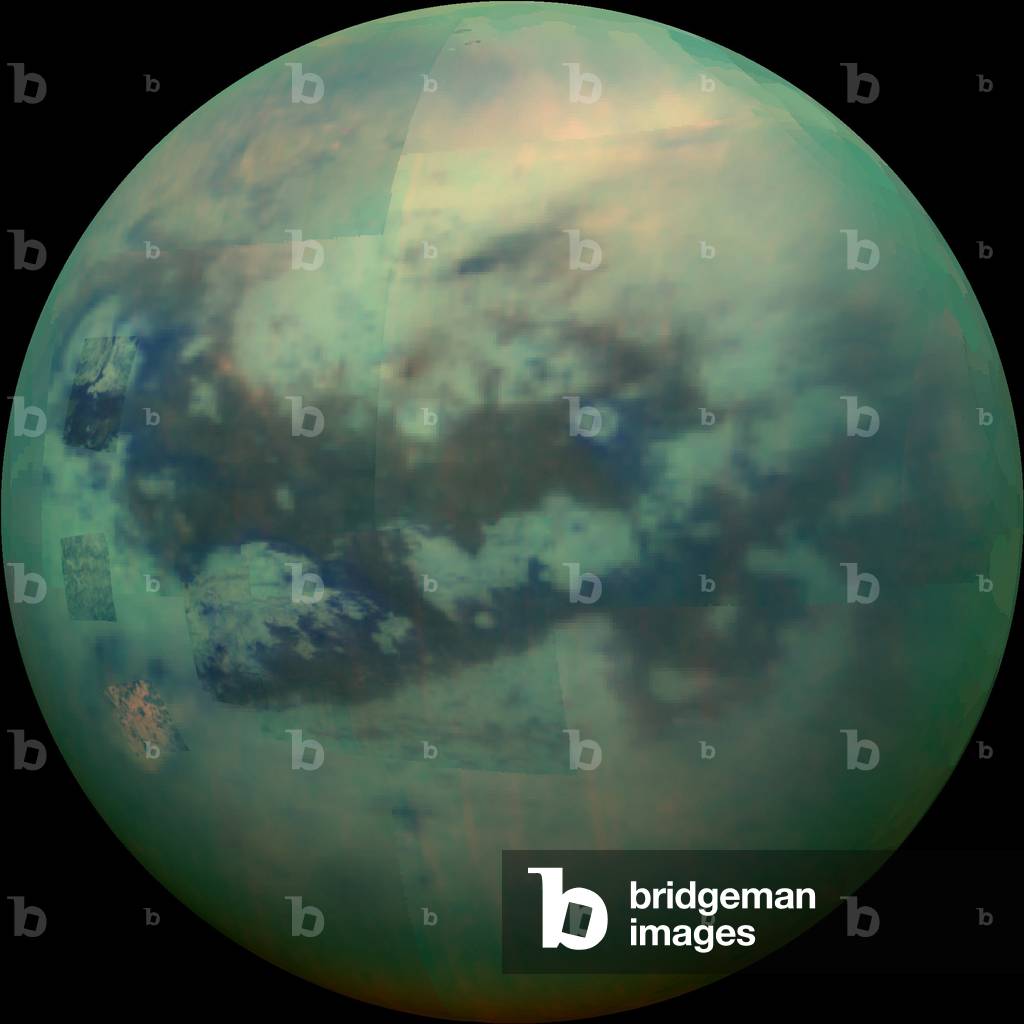
Titan, Saturn satellite seen by Cassini - Saturn's moon Titan as seen by Cassini spacecraft: Visible and infrared composite image of Titan taken by the Cassini probe on November 13, 2015. View of the hemisphere oriente towards Saturn - This composite image shows an infrared view of Saturn's moon Titan from Nasa's Cassini spacecraft, acquired during the mission's “” T-114”” flyby on Nov. 13, 2015. The spacecraft's visual and infrared mapping spectrometer (VIMS) instrument made these observations, in which blue represents wavelengths centered at 1.3 microns, green represents 2.0 microns, and red represents 5.0 microns. A view at visible wavelengths (centered around 0.5 microns) would show only Titan's hazy atmosphere (as in PIA14909). The near-infrared wavelengths in this image allow Cassini's vision to penetrate the haze and reveal the moon's surface - During this Titan flyby, the spacecraft's close-approach altitude was 6,200 miles (10,000 kilometers), which is considerably higher than those of typical flybys, which are around 750 miles (1,200 kilometers). The high flyby allowed VIMS to gather moderate-resolution views over wide areas (typically at a few kilometers per pixel) - The view looks toward terrain that is mostly on the Saturn-facing hemisphere of Titan. The scene features the parallel, dark, dune-filled regions named Fensal (to the north) and Aztlan (to the south), which form the shape of a sideways letter “” H.””” - Several places on the image show the surface at higher resolution than elsewhere. These areas, called subframes, show more detail because they were acquired near closest approach. They have finer resolution, but cover smaller areas than data obtained when Cassini was farther away from Titan - Near the limb at left, above center, is the best VIMS view so far of Titan's largest confirmed impact crater, Menrva. Similarly detailed subframes show eastern Xanadu, the basin Hotei Regio, and channels within bright terrains east of Xanadu. - Due to the
Infrared Map Of Swan Nebula.
Infrared view of the Andromeda galaxy - The Spitzer space telescope observed the Andromede spiral galaxy for over 18 hours on August 25, 2004, obtaining 11,000 different poses. Assembled in mosaic the result shows details never seen before. The brightest ring appears to be hole at the bottom right of the image; these are traces of the passage of a satellite galaxy. Nasa's Spitzer Space Telescope has captured stunning infrared views of the famous Andromeda galaxy to reveal insights that were only hinted at in visible light. Spitzer's 24 - micron mosaic is the sharpest image ever taken of the dust in another spiral galaxy. This is possible because Andromeda is a close neighbor to the Milky Way at a mere 2.5 million light - years away. The Spitzer multiband imaging photometer's 24 - micron detector recorded 11,000 separate snapshots to create this new comprehensive picture. Asymmetrical features are seen in the prominent ring of star formation. The ring appears to be split into two pieces, forming the hole to the lower right. These features may have been caused by interactions with satellite galaxies around Andromeda as they plunge through its disk. Spitzer also reveals delicate tracings of spiral arms within this ring that reach into the very center of the galaxy. One sees a scattering of stars within Andromeda, but only select stars that are wrapped in envelopes of dust light up at infrared wavelengths. This is a dramatic contrast to the traditional view at visible wavelengths, which shows the starlight instead of the dust. The center of the galaxy in this view is dominated by a large bulge that overwhelms the inner spirals seen in dust. The dust lanes are faintly visible in places, but only where they can be seen in silhouette against background stars. Exposure date 2004 August 2
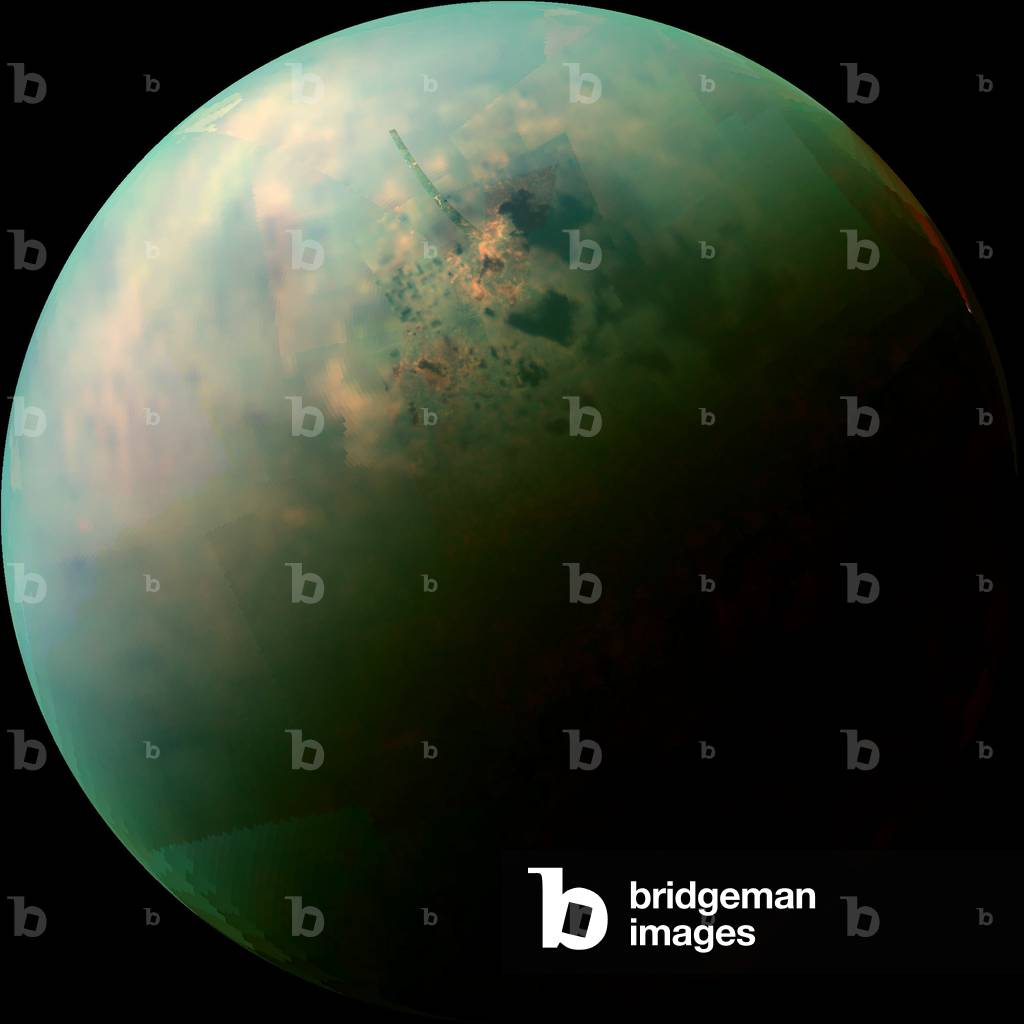
Titan, Saturn satellite seen by Cassini: Visible and infrared composite image of Titan taken by the Cassini probe on September 12, 2013. View of methane and ethane lakes. - This false-color mosaic, made from infrared data collected by Nasa's Cassini spacecraft, reveals the differences in the composition of surface materials around hydrocarbon lakes at Titan, Saturn's largest moon. Titan is the only other place in the solar system that we know has stable liquid on its surface, though its lakes are made of liquid ethane and methane rather than liquid water. While there is one large lake and a few smaller ones near Titan's south pole, almost all of Titan's lakes appear near the moon's north pole - Scientists mapped near-infrared colors onto the visible color spectrum. Red in this image was assigned a wavelength of 5 microns (10 times longer than visible light), green 2.0 microns (four times longer than visible light), and blue 1.3 microns (2.6 times longer than visible light) - The orange areas are thought to be evaporite - the Titan equivalent of salt flats on Earth. The evaporated material is thought to be organic chemicals originally from Titan's haze particles that once dissolved in liquid methane. They appear orange in this image against the greenish backdrop of Titan's typical bedrock of water ice - In this mosaic, Kraken Mare, which is Titan's largest sea and covers about the same area as Earth's Caspian Sea and Lake Superior combined, can be seen spreading out with many tendrils on the upper right,. The big dark zone up and left of Kraken is Ligeia Mare, the second largest sea. Below Ligeia, shaped similar to a sports fan's foam finger that points just up from left, is Punga Mare, the third largest Titan Sea. Numerous other smaller lakes dot the area. Titan's north pole is located in the geographic location just above the end of the “” finger”” of Punga Mare. The data shown here were obtained by Cassini's visual and infrared mapping spectrometer during
Jupiter in infrared light, 2004
Content Partner Restrictions
  • Not available to clients invoiced in the UK
Jupiter in infrared light, 2005
Content Partner Restrictions
  • Not available to clients invoiced in the UK
Infrared view of the Andromeda galaxy - Composite of three different wavelengths 24 microns (blue), 70 microns (green), and 160 microns (red). Using these three bands, we can know the temperature differences of the dust: the warmest are the brightest at 24 microns and the coldest shine at 160 microns. The blue/white areas contain the hottest dust. View obtained by Spitzer space telescope on 25 August 2004. The multi - wavelength view of Andromeda combines images taken at 24 microns (blue), 70 microns (green), and 160 microns (red). Using all three bands from the multiband imaging photometer allows astronomers to measure the temperature of the dust by its color. The warmest dust is brightest at 24 microns while the coolest is most evident at 160 microns. The blue/white areas have the hottest dust, as seen in the bulge and in the star - forming areas along the arms. The cooler dust floating further out in the ring and arms are in the redder regions. The data were taken on August 25, 2004 by Spitzer space telescope
Star Formation in Cassiopee - Star Formation in Cassiopeia - This star-forming region, called W5, is located approximately 6500 light years ago in the constellation Cassiopee. Several generations of stars appear on this cliche; the older ones are the blue stars in the centre of the two cavities; the younger stars are grouped at the edges of these cavities and at the ends of the gas pillars or they appear like pink dots; the white areas are home to the very young stars in formation. In this infrared image, heated dust appears in red, dense gas clouds appear in green. Composite image obtained by the Spitzer space telescope in 2006 and 2007. Generations of stars can be seen in this infrared portrait from Nasa's Spitzer Space Telescope. In this wispy star - forming region, called W5, the oldest stars can be seen as blue dots in the centers of the two hollow cavities (other blue dots are background and foreground stars not associated with the region). Younger stars line the rims of the cavities, and some can be seen as pink dots at the tips of the elephant - trunk - like pillars. The white knotty areas are where the youngest stars are forming. Red shows heated dust that pervades the region's cavities, while green highlights dense clouds. W5 spans an area of sky equivalent to four full moons and is about 6,500 light - years away in the constellation Cassiopeia. The Spitzer picture was taken over a period of 24 hours. Like other massive star - forming regions, such as Orion and Carina, W5 contains large cavities that were carved out by radiation and winds from the region's most massive stars. According to the theory of triggered star - formation, the carving out of these cavities pushes gas together, causing it to ignite into successive generations of new stars. This image contains some of the best evidence yet for the triggered star - formation theory. Scientists analyzing the photo have been able to sho
James Webb Space Telescope (JWST) - Artist view - The James Webb Space Telescope (JWST) - Artist view: The James Webb Space Telescope (JWST) will replace the Hubble Space Telescope in 2018. The James Webb Space Telescope (JWST) is a large, infrared-optimized space telescope scheduled for launch in 2018. Equipped with a large mirror 6.5 meters (21.3 feet) in diameter, it will find the first galaxies that formed in the early Universe, connecting the Big Bang to our own Milky Way Galaxy and will reside in an orbit about 1.5 million km (1 million miles) from the Earth - The shaded side of the James Webb Space Telescope (JWST) as it may appear later this decade when it is observing from the Earth-Sun L2 point about 930 thousand miles from the Earth. Part of the Milky Way can be seen reflected in the 21-foot diameter mirror assembly. This assembly is composed of 18 hexagonal segments of gold-coated beryllium which combines to create a near-infrared light-collecting area of about 80 square feet (the Hubble Space Telescope has a collecting area of 48 square feet) - The JWST's sensitive optical elements are shaded from the perpetual sunlight via a “” parasol” consisting of multiple spaced layers of polyimide film. These layers act as a passive cooling barrier between the 185* F sunward side and the -388* F shaded side hosting the optics and sensors
The star Fomalhaut and its dust disc - Star Fomalhaut dust ring - The star Fomalhaut is located 25 years - light from Earth in the constellation of the Southern Fish. A dust disc surrounds it, seen here by the Hubble telescopes (left), Herschel (far infrared, centre) and Alma (right). This disc of interplanetary dust revolves around the young star at a distance of about 20 billion kilometers from it. The image taken at 850 microns wavelength by Alma seems to confirm that the planet discovered in 2008 in the Fomalhaut disc by Hubble does not exist. This image shows Fomalhaut and its dust ring. Images taken by the Hubble space telescope (HST, at left), Herschel telescope (middle) and Alma telescope (at right). Fomalhaut is much hotter than our Sun, 15 times as bright, and lies 25 light - years from Earth. An exoplanet was discovered in its dust ring but Alma observations seem to prove this planet doesn't exist
Mirror of the Herschel satellite - Herschel spacecraft's mirror - Inspection of the mirror of the European Herschel satellite. The Herschel Space Observatory, scheduled to launch in 2009, will study in the infrared the formation of galaxies, stars and planetary systems. This satellite measures nearly 7 metres high by 4.3 metres wide and weighs 3.25 tonnes. Its telescope has a 3.5-meter mirror, making it the largest mirror ever made for a scientific space mission. Herschel will orbit around Lagrange 2, approximately 1.5 million kilometres from Earth. The gigantic telescope of ESA's space - based infrared observatory, Herschel, is being prepared to be assembled with its spacecraft. Herschel's telescope, which will carry the largest mirror ever flown in space, has been delivered to ESA's European Space Research and Technology Centre, ESTEC, where engineers and scientists are busy with the final steps that will prepare the infrared observatory for launch in 2009. ESA's Herschel Space Observatory will observe at wavelengths never covered before. It will be located 1.5 million kilometers away from Earth, farther than any previous space telescope
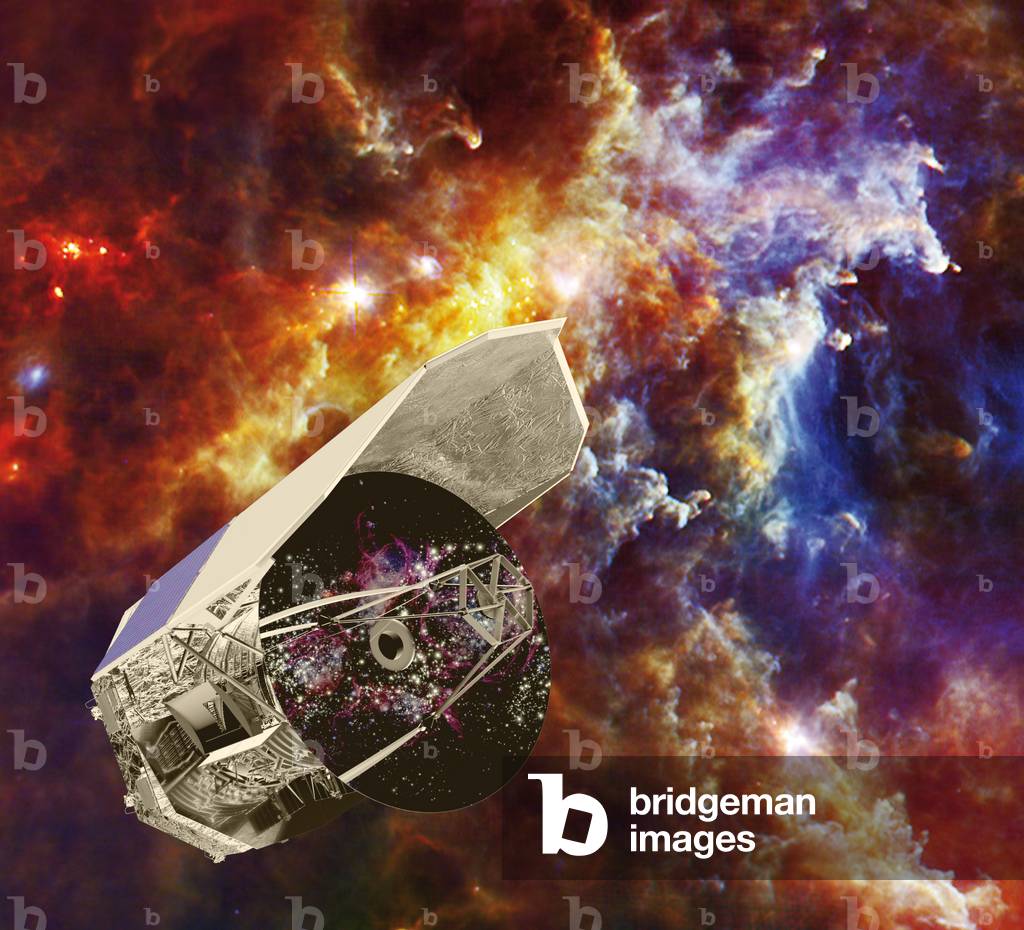
Herschel Satellite - Illustration - Herschel Satellite. Artwork - Artist's view of the European satellite Herschel. The Herschel Space Observatory, scheduled to launch in 2009, will study in the infrared the formation of galaxies, stars and planetary systems. This satellite measures nearly 7 metres high by 4.3 metres wide and weighs 3.25 tonnes. Its telescope has a 3.5-meter mirror, making it the largest mirror ever made for a scientific space mission. Herschel will orbit around Lagrange 2, approximately 1.5 million kilometres from Earth. ESA's Herschel Space Observatory (formerly called Far Infrared and Submillimetre Telescope or FIRST) will solve the mystery of how stars and galaxies were born. Infrared astronomy is as young as it is fruitful. In less than three decades infrared astronomers have unveiled tens of thousands of new galaxies, and have made discoveries as surprising as the huge amounts of water vapour that fill the galaxy. Yet scientists know there is still much more to discover. Objects such as other planetary systems, or processes like the birth of galaxies in the early universe, can best be studied with infrared space telescopes in space. This is the reason for Esa's Herschel. ESA's Herschel Space Observatory will be bigger and better than any of its predecessors. Moreover, it will observe at wavelengths never covered before. It will be located 1.5 million kilometers away from Earth, farther than any previous space telescope. Due for launch in 2009, Herschel is one the Cornerstone missions ESA's Horizons 2000 programme. Herschel is a key project space astronomy in the next millennium
Spiral galaxy of the Sombrero M104 infrared view - Sombrero galaxy seen in infrared - Infrared image of the spiral galaxy M104 (Sombrero galaxy), located about 28 million years ago - light, obtained with the Spitzer space telescope in 2004 and January 2005. Infrared radiation shows the dust of the disc visible throughout the circumference. A high emission also comes from the center of the galaxy where a supermassive black hole is thought to reside there. This spiral galaxy is located some 28 million light - years away. The infrared image obtained by Spitzer space telescope in 2004 and 2005 pierces through the obscuring dust, along with the bulge of stars. It shows that the disk is warped, which is often the result of a gravitational encounter with another galaxy; clumpy areas spotted in the far edges of the ring indicate young star - forming regions. Spitzer detected infrared emission not only from the ring, but from the center of the galaxy too, where there is a huge black hole, believed to be a billion times more massive than our Sun
Titan, Saturn satellite seen by Cassini - Saturn's moon Titan as seen by Cassini spacecraft: Visible and infrared composite image of Titan taken by the Cassini probe on August 21, 2014. View of methane and ethane lakes lit by the Sun. - This near-infrared, color mosaic from Nasa's Cassini spacecraft shows the sun glinting off of Titan's north polar seas. - The sunglint, also called a specular reflection, is the bright area near the 11 o'clock position at upper left. This mirror-like reflection, known as the specular point, is in the south of Titan's largest sea, Kraken Mare, just north of an island archipelago separating two separate parts of the sea - This particular sunglint was so bright as to saturate the detector of Cassini's Visual and Infrared Mapping Spectrometer (VIMS) instrument, which captures the view. - The southern portion of Kraken Mare (the area surrounding the specular feature toward upper left) displays a “” bathtub ring”” - a bright margin of evaporate deposits - which indicates that the sea was larger at some point in the past and has become smaller due to evaporation. The deposits are material left behind after the methane & ethane liquid evaporates, somewhat akin to the saline crust on a salt flat
Visible Crab Nebula - Infrared and X - The Crab Nebula - M1, the Crab Nebula, is the rest of a supernova that exploded on July 4, 1054. It is located about 7000 light years from Earth in the constellation Taurus. At the heart of this nebula is a pulsar. To obtain this photo, three spatial observatories combined their observations: the Hubble telescope for the visible part (here in red and yellow), the Chandra telescope for the X-ray data (blue) and the Spitzer telescope for the infrared image (purple). The pulsar is the bright spot in the center of the image. The Crab Nebula (M1) is a supernova remnant at about 7,000 light - year from Earth in the constellation Taurus. The star explosion occured on July 04 1054. At the center of this nebula lies a pulsar. This composite image uses data from three of Nasa's Great Observatories. The Chandra X - ray image is shown in blue, the Hubble Space Telescope optical images are in red and yellow, and the Spitzer Space Telescope's infrared image is in purple
Satellite Herschel - Illustration - Artist's view of the European satellite Herschel. The Herschel Space Observatory, launched in 2009, studies the formation of galaxies, stars and planetary systems in the infrared. This satellite measures nearly 7 metres high by 4.3 metres wide and weighs 3.25 tonnes. Its telescope has a 3.5-meter mirror, making it the largest mirror ever made for a scientific space mission. Herschel is in orbit around Lagrange 2, approximately 1.5 million kilometres from Earth. ESA's Herschel Space Observatory (formerly called Far Infrared and Submillimetre Telescope or FIRST) studies the mystery of how stars and galaxies were born. Objects such as other planetary systems, or processes like the birth of galaxies in the early universe, can best be studied with infrared space telescopes in space. This is the reason for Esa's Herschel. ESA's Herschel Space Observatory is bigger and better than any of its predecessors. Moreover, it observes at wavelengths never covered before. It is located 1.5 million kilometers away from Earth, farther than any previous space telescope. Launched in 2009, Herschel is one the Cornerstone missions ESA's Horizons 2000 programme. Herschel is a key project space astronomy in the next millennium
Star Formation in Cassiopee - Star Formation in Cassiopeia - This star-forming region, called W5, is located approximately 6500 light years ago in the constellation Cassiopee. Several generations of stars appear on this cliche; the older ones are the blue stars in the centre of the two cavities; the younger stars are grouped at the edges of these cavities and at the ends of the gas pillars or they appear like pink dots; the white areas are home to the very young stars in formation. In this infrared image, heated dust appears in red, dense gas clouds appear in green. Composite image obtained by the Spitzer space telescope in 2006 and 2007. Generations of stars can be seen in this infrared portrait from Nasa's Spitzer Space Telescope. In this wispy star - forming region, called W5, the oldest stars can be seen as blue dots in the centers of the two hollow cavities (other blue dots are background and foreground stars not associated with the region). Younger stars line the rims of the cavities, and some can be seen as pink dots at the tips of the elephant - trunk - like pillars. The white knotty areas are where the youngest stars are forming. Red shows heated dust that pervades the region's cavities, while green highlights dense clouds. W5 spans an area of sky equivalent to four full moons and is about 6,500 light - years away in the constellation Cassiopeia. The Spitzer picture was taken over a period of 24 hours. Like other massive star - forming regions, such as Orion and Carina, W5 contains large cavities that were carved out by radiation and winds from the region's most massive stars. According to the theory of triggered star - formation, the carving out of these cavities pushes gas together, causing it to ignite into successive generations of new stars. This image contains some of the best evidence yet for the triggered star - formation theory. Scientists analyzing the photo have been able to sho
Arabian desert seen by satellite 01/2016 - Eastern Desert - Egypt: Part of the Arabian desert in Egypt seen by Sentinel-2A satellite on 17 January 2016. The vegetation appears in red near the Nile. The Sentinel-2A satellite takes us over central-eastern Egypt with this image from 17 January. The image is dominated by arid desert - namely the Eastern Desert between the Nile River the Red Sea. The distinctive pattern of water erosion from rivers and streams is clearly visible as they make their way towards the Nile, at which point the rolling sandy highlands drop abruptly at the Nile valley, visible along the bottom of the image. Fields of intensive farming along the Nile appear red owing to this false-colour image being processed to include the near-infrared. The varying shades of red indicate how sensitive the multispectral instrument on Sentinel-2 is to differences in chlorophyll content, providing key information on plant health. Zooming in along the bottom we can see clusters of black dots where cities and towns are located, in addition to the fields. In the lower right, just above the red area, there is an interesting pattern of roads from our bird 's-eye view - possibly a developing residential area
Mirror of the Herschel satellite - Herschel spacecraft's mirror - Inspection of the mirror of the European Herschel satellite. The Herschel Space Observatory, scheduled to launch in 2009, will study in the infrared the formation of galaxies, stars and planetary systems. This satellite measures nearly 7 metres high by 4.3 metres wide and weighs 3.25 tonnes. Its telescope has a 3.5-meter mirror, making it the largest mirror ever made for a scientific space mission. Herschel will orbit around Lagrange 2, approximately 1.5 million kilometres from Earth. The gigantic telescope of ESA's space - based infrared observatory, Herschel, is being prepared to be assembled with its spacecraft. Herschel's telescope, which will carry the largest mirror ever flown in space, has been delivered to ESA's European Space Research and Technology Centre, ESTEC, where engineers and scientists are busy with the final steps that will prepare the infrared observatory for launch in 2009. ESA's Herschel Space Observatory will observe at wavelengths never covered before. It will be located 1.5 million kilometers away from Earth, farther than any previous space telescope
Artist concept of stars and planets in visible and infrared light
Herschel Satellite - Illustration - Herschel Satellite. Artwork - Artist's view of the European satellite Herschel. The Herschel Space Observatory, scheduled to launch in 2009, will study in the infrared the formation of galaxies, stars and planetary systems. This satellite measures nearly 7 metres high by 4.3 metres wide and weighs 3.25 tonnes. Its telescope has a 3.5-meter mirror, making it the largest mirror ever made for a scientific space mission. Herschel will orbit around Lagrange 2, approximately 1.5 million kilometres from Earth. ESA's Herschel Space Observatory (formerly called Far Infrared and Submillimetre Telescope or FIRST) will solve the mystery of how stars and galaxies were born. Infrared astronomy is as young as it is fruitful. In less than three decades infrared astronomers have unveiled tens of thousands of new galaxies, and have made discoveries as surprising as the huge amounts of water vapour that fill the galaxy. Yet scientists know there is still much more to discover. Objects such as other planetary systems, or processes like the birth of galaxies in the early universe, can best be studied with infrared space telescopes in space. This is the reason for Esa's Herschel. ESA's Herschel Space Observatory will be bigger and better than any of its predecessors. Moreover, it will observe at wavelengths never covered before. It will be located 1.5 million kilometers away from Earth, farther than any previous space telescope. Due for launch in 2009, Herschel is one the Cornerstone missions ESA's Horizons 2000 programme. Herschel is a key project space astronomy in the next millennium
James Webb Space Telescope Mirrors (JWST) - Testing of the JWST's mirrors - Six of the 18 JWST (James Webb Space Telescope) mirrors seen at Nasa's Marshall Space Center. These mirrors will be tested there to ensure they will withstand the extreme temperatures of space vacuum. The JWST will replace the Hubble Space Telescope in 2014. Equipped with a 6.5 m mirror, he will observe the universe mainly in infrared. Six of the 18 James Webb Space Telescope mirror segments are being moved into the X - ray and Cryogenic Facility, or XRCF, at Nasa's Marshall Space Flight Center in Huntsville, Ala., to eventually experience temperatures dipping to a chilling - 414 degrees Fahrenheit to ensure they can withstand the extreme space environments. The test chamber takes approximately five days to cool a mirror segment to cryogenic temperatures. Marshall's X - ray & Cryogenic Facility is the world's largest X - ray telescope test facility and a unique, cryogenic, clean room optical test location. The James Webb Space Telescope (JWST) is a large, infrared - optimized space telescope scheduled for launch in 2014. Equipped with a large mirror 6.5 meters (21.3 feet) in diameter, it will find the first galaxies that formed in the early Universe, connecting the Big Bang to our own Milky Way Galaxy and will reside in an orbit about 1.5 million km (1 million miles) from the Earth
Star clusters IC 348 in Persee seen in infrared - Star clusters IC 348 in Perseus - IC 348 is a cluster of 300 stars associated with a relatively bright nebula. The infrared image of the Spitzer telescope shows young stars (red and pink) that appeared about 3 million years ago and still surrounded by their gas cocoon. The nebula is located 1043 years of light from Earth. The IC 348 is a cluster which contains more than 300 young stars. Baby stars are forming near the eastern rim of the cosmic cloud Perseus, in this infrared image from Nasa's Spitzer Space Telescope. The baby stars are approximately three million years old and are shown as reddish - pink dots to the right of the image. The pinkish color indicates that these infant stars are still shrouded by the cosmic dust and gas that collapsed to form them. The Perseus Nebula is located about 1,043 light - years away in the Perseus constellation
Panorama of galactic center seen in infrared
Satellite Herschel - Illustration - Artist's view of the European satellite Herschel. The Herschel Space Observatory, scheduled to launch in 2009, will study in the infrared the formation of galaxies, stars and planetary systems. This satellite measures nearly 7 metres high by 4.3 metres wide and weighs 3.25 tonnes. Its telescope has a 3.5-meter mirror, making it the largest mirror ever made for a scientific space mission. Herschel will orbit around Lagrange 2, approximately 1.5 million kilometres from Earth. ESA's Herschel Space Observatory (formerly called Far Infrared and Submillimetre Telescope or FIRST) will solve the mystery of how stars and galaxies were born. Objects such as other planetary systems, or processes like the birth of galaxies in the early universe, can best be studied with infrared space telescopes in space. This is the reason for Esa's Herschel. ESA's Herschel Space Observatory will be bigger and better than any of its predecessors. Moreover, it will observe at wavelengths never covered before. It will be located 1.5 million kilometers away from Earth, farther than any previous space telescope. Due for launch in 2009, Herschel is one the Cornerstone missions ESA's Horizons 2000 programme. Herschel is a key project space astronomy in the next millennium
Spiral galaxy M81 infrared view - Spiral galaxy M81 seen in infrared - View obtained by Spitzer space telescope in different wavelengths. In infrared, Spitzer sees dust rather than stars, thus improving our understanding of star formation. The M81 spiral galaxy is located 12 million light years away from Earth. Its arms are home to star-forming regions while its core is surrounded by much older yellow stars. Located in the northern constellation of Ursa Major (which also includes the Big Dipper), this galaxy is easily visible through binoculars or a small telescope. M81 is located at a distance of 12 million light - years. These infrared images were obtained by Spitzer's infrared array camera. At these wavelengths, Spitzer sees the dust, rather than the stars, within the disc of silicates and carbonaceous grains. It is well - mixed with gas, which is best seen at radio wavelengths, to form the essential ingredients for future star formation
Satellite ENVISAT - Artist's impression of Envisat - ENVISAT artist view Location: Credit line: ESA - Silicon Worlds View of European satellite artist ENVISAT orbit the Earth. Launched on March 1, 2002, it is the largest scientific Earth observation satellite ever designed, observing the Earth in visible, infrared and radar. Launched in 2002, Envisat is the largest Earth Observation spacecraft ever built. It carries ten sophisticated optical and radar instruments to provide continuous observation and monitoring of the Earth's land, atmosphere, oceans and ice caps
Cluster of stars South Serpent - The Serpens South star cluster - Cluster of fifty very young stars (35 of which are still only proto - stars, stars in formation) observed by the Spitzer space telescope on 27 October 2006 in the constellation of the Serpent. Located only 848 years from Earth, this cluster of stars is completely masked by interstellar dust and is only revealed in infrared light. Red filaments in the background are organic molecules, PAH (aromatic polycyclic hydrocarbons composed of carbon atoms and hydrogen. In this image, Nasa's Spitzer Space Telescope spots the Serpens South star cluster, which consists of a relatively dense group of 50 young stars - - 35 of which are protostars, or stellar infants, that are just beginning to form. Stellar members of Serpens South star cluster can be seen as the green, yellow, and orange tinted specks sitting atop the black dust lane running down the center of the image. Like raindrops, stars form when thick patches of cosmic clouds condense. Tints of green in the image represent hot hydrogen gas excited when high - speed jets of gas ejected by infant stars collide with the cool gas in the surrounding cloud. Wisps of red in the background are organic molecules called polycyclic aromatic hydrocarbons (PAHS), which are being excited by stellar radiation from a neighboring star - forming region located to the east of this image, called W40. On Earth PAHS are found on charred barbeque grills and in the sooty automobile exhaust
Cyclones encircle Jupiter's North Pole (photo)
Content Partner Restrictions
  • Editorial use only
Infrared view of the Lagoon Nebula, 2010
Infrared and visible images of Jupiter, 1979
Content Partner Restrictions
  • Not available to clients invoiced in the UK
Andromede Galaxy (M31) infrared view - The Andromeda galaxy seen in infrared - This image shows the difference in infrared radiation between the light emitted by the aged stars (blue) and that emitted by the dust (star-forming zone, yellow and red). This image obtained by the WISE satellite also distinguishes the two Andromede satellite galaxies, M32 (above the nucleus of the Andromede galaxy) and NGC 205 (M110) below. Infrared composite at the following wavelengths: 3.4 and 4.6 microns (blue), 12 microns (green), and 22 microns dust sensitive, red. M31, is captured in full in this new image from Nasa's Wide - field Infrared Survey Explorer, or WISE. The mosaic covers an area equivalent to more than 100 full moons, or five degrees across the sky. WISE used all four of its infrared detectors to capture this picture (3.4 - and 4.6 - micron light is colored blue; 12 - micron light is green; and 22 - micron light is red). Blue highlights mature stars, while yellow and red show dust heated by newborn, massive stars. Andromeda is the closest large galaxy to our Milky Way galaxy, and is located 2.5 million light - years from our sun. It is close enough for telescopes to spy the details of its ringed arms of new stars and hazy blue backbone of older stars. Also seen in the mosaic are two satellite galaxies, known as M32, located just a bit above Andromeda to the left of center, and the fuzzy blue M110, located below the center of the great spiral arms. These satellites are the largest of several that are gravitationally bound to Andromeda. The Andromeda galaxy is larger than our Milky Way and contains more stars, but the Milky Way is thought to perhaps have more mass due to its larger proportion of a mysterious substance called dark matter. Both galaxies belong to our so - called Local Group, a collection of more than 50 galaxies, most of which are tiny dwarf systems. In its quest to map the wh
Sombrero M104 Spiral Galaxy - Visible Composite - Infrared - The Sombrero galaxy. Composite of visible and infrared views - Composite image of the spiral galaxy M104 (Sombrero galaxy), located about 28 million years ago - light. Infrared image obtained with the Spitzer space telescope in 2004 and January 2005 superimposed on the image made by the Hubble space telescope visible in May and June 2003. The dark band of girders in this galaxy is visible throughout the circumference. Composite image of a visible image and an infrared image of the galaxy M104. The visible image was obtained by the Hubble space telescope in 2003, the infrared view by Spitzer telescope in 2004 and 2005. This spiral galaxy is located some 28 million light - years away. The infrared image obtained by Spitzer space telescope pierces through the obscuring dust, along with the bulge of stars. It shows that the disk is warped, which is often the result of a gravitational encounter with another galaxy; clumpy areas spotted in the far edges of the ring indicate young star - forming regions. Spitzer detected infrared emission not only from the ring, but from the center of the galaxy too, where there is a huge black hole, believed to be a billion times more massive than our Sun
James Webb Space Telescope (JWST) - JWST in clean room: Curvature measurements of the JWST Space Telescope (James Webb Space Telescope) at Nasa's Goddard Space Center. The JWST will replace the Hubble Space Telescope in 2018. Equipped with a 6.5 m mirror, he will observe the universe mainly in infrared. The primary mirror of Nasa's James Webb Space Telescope consisting of 18 hexagonal mirrors looks like a giant puzzle piece standing in the massive clean room of Nasa's Goddard Space Flight Center in Greenbelt, Maryland. Appropriately, combined with the rest of the observatory, the mirrors will help piece together puzzles scientists have been trying to solve throughout the cosmos. Webb's primary mirror will collect light for the observatory in the scientific quest to better understand our solar system and beyond. Using these mirrors and Webb's infrared vision scientists will peer back over 13.5 billion years to see the first stars and galaxies forming out of the darkness of the early universe. Unprecedented infrared sensitivity will help astronomers to compare the faintest, earliest galaxies to today's grand spirals and ellipticals, helping us to understand how galaxies assemble over billions of years. Webb will see behind cosmic dust clouds to see where stars and planetary systems are being born. It will also help reveal information about atmospheres of planets outside our solar system, and perhaps even find signs of the building blocks of life elsewhere in the universe. The Webb telescope was mounted upright after a “” center of curvature”” test conducted at Goddard. This initial center of curvature test ensures the integrity and accuracy, and test will be repeated later to verify those same properties after the structure undergoes launch environment testing. In the photo, two technicians stand before the giant primary mirror
Satellite MSG - 1 - Meteosat 8 - Artist's view of the European satellite MSG - 1 (Meteosat Second Generation) or Meteosat 8, in orbit around the Earth. Launched on August 28, 2002, it is a geostationary satellite located 35 600 km from Earth; dedicated to meteorology, it observes the Earth in visible, and in infrared. Meteosat Second Generation (MSG), is equipped with an extremely sophisticated imaging radiometer that can separate the incoming radiation into 12 (3 with the current Meteosat) different spectral bands. Each section, four of them in the visible and eight in the thermal infrared, delivers different information. They vary from visible images of weather systems during the day to cloud temperature at night; from surface temperature and water vapour to trace gas concentrations and dust particles in the atmosphere. MSG will deliver about twenty times as much information as its predecessor Meteosat, resulting in much more accurate short and medium - range forecasts
Birth of stars in the nebula NGC 3372 - Star formation in the Carina Nebula - Detail of the nebula of the Carene seen in visible light (top) and infrared (bottom) by the Hubble space telescope. The top image shows a column of gas and dust eroded by ultraviolet radiation emitted by young stars. Jets are also visible, showing the presence of a nascent star. In the infrared image, the dust clouds radiate little, the nascent star responsible for these jets appears. NGC 3372 is located about 7000 light years away from Earth. Images obtained in July 2009. The pictures demonstrate one example of the broad wavelength range of the new Wide Field Camera 3 (WFC3) aboard the Hubble telescope, extending from ultraviolet to visible to infrared light. Composed of gas and dust, the pillar resides in a tempestuous stellar nursery called the Carina Nebula, located 7500 light - years away in the southern constellation of Carina. The pair of images shows that astronomers are given a much more complete view of the pillar and its contents when distinct details not seen at visible wavelengths are uncovered in near - infrared light. The top image, taken in visible light, shows the tip of the three - light - year - long pillar, bathed in the glow of light from hot, massive stars off the top of the image. Scorching radiation and fast winds (streams of charged particles) from these stars are sculpting the pillar and causing new stars to form within it. Streamers of gas and dust can be seen flowing off the top of the structure. Nestled inside this dense structure are fledgling stars. They cannot be seen in this image because they are hidden by a wall of gas and dust. Although the stars themselves are invisible, one of them is providing evidence of its existence. Thin puffs of material can be seen travelling to the left and to the right of a dark notch in the centre of the pillar. The matter is part of
Field of distant galaxies - Hubble eXtreme Deep Field (XDF) - Distant galaxies - Hubble eXtreme Deep Field (XDF) - Image of distant galaxies obtained in infrared by the Hubble space telescope in the constellation of the Furnace. The farthest galaxies visible in this image are 13.2 billion light years away. Called the Extreme Deep Field, or XDF, the photo was assembled by combining 10 years of NASA Hubble Space Telescope photographs taken of a patch of sky at the center of the original Hubble Ultra Deep Field. The XDF is a small fraction of the angular diameter of the full Moon. The Hubble Ultra Deep Field is an image of a small area of space in the constellation Fornax, created using Hubble Space Telescope data from 2003 and 2004. By collecting faint light over many hours of observation, it revealed thousands of galaxies, both nearby and very distant, making it the deepest image of the universe ever taken at that time. The new full - color XDF image reaches much fainter galaxies, and includes very deep exposures in red light from Hubble's new infrared camera, enabling new studies of the earliest galaxies in the universe. The XDF contains about 5,500 galaxies even within its smaller field of view. The faintest galaxies are one ten - billionth the brightness of what the human eye can see. The universe is 13.7 billion years old, and the XDF reveals galaxies that span back 13.2 billion years in time. Most of the galaxies in the XDF are seen when they were young, small, and growing, often violently as they collided and merged together. The early universe was a time of dramatic birth for galaxies containing brilliant blue stars extraordinarily brighter than our Sun. The light from those past events is just arriving at Earth now, and so the XDF is a “” time tunnel into the distant past.” The youngest galaxy found in the XDF existed just 450 million years after the university's birth in the big bangs
Star Formation in the Southern Cross - Star Formation in the Southern Cross - Part of the lactee route in the constellation of the Southern Cross seen in infrared by the Herschel space telescope. The hottest dust appears in blue, the coldest ones appear in red, the new stars will be born. Composite images obtained by SPIRE and PACS instruments on September 3, 2009. Some of the coldest and darkest dust in space shines brightly in this infrared image from the Herschel Observatory, a European Space Agency mission with important participation from NASA. The image is a composite of light captured simultaneously by two of Herschel's three instruments - - the photodetector array camera and spectrometer, and its spectral and photometric imaging receiver. The image reveals a cold and turbulent region where material is just beginning to condense into new stars. It is located in the plane of our Milky Way galaxy, 60 degrees from the center. Blue shows warmer material, red the coolest. The red filaments are made up of the coldest material pictured here - - material that is slightly warmer than the coldest temperature theoretically attainable in the universe. Stars form in cold, dense environments. Light captured by the photodetector array camera and spectrometer (PACS) is colored blue (blue represents 70 - micron light). The light detected by the spectral and photometric imaging receiver (SPIRE) is colored red (and shows the combined wavelengths of 250, 350 and 500 microns). The image spans a region 2 by 2 degrees
Centaur Omega globular cluster - NGC 5139 Omega Centauri globular cluster - Visible to the naked eye in the southern hemisphere, Centaurus Omega is the most massive globular cluster in the galaxy. About 17,000 light years ago, millions of stars nearly 12 billion years old are concentrated here. This image obtained by the Spitzer space telescope reveals in yellow and red the big red stars, whose dust radiates infrared, and in blue the smaller and less evoluted stars. Omega Centauri is the biggest and brightest of the more than 150 similar objects, called globular clusters, that orbit around the outside of our Milky Way galaxy. Stargazers at southern latitudes can spot the stellar gem with the naked eye in the constellation Centaurus. While the visible - light observations highlight the cluster's millions of jam - packed stars, Spitzer's infrared eyes reveal the dustier, more evolved stars tossed throughout the region. Globular clusters are some of the oldest objects in our universe. Their stars are more than 12 billion years old, and, in most cases, formed all at once when the universe was just a toddler. Omega Centauri is unusual in that its stars are of different ages and possess varying levels of metals, or elements heavier than boron. Astronomers say this points to a different origin for Omega Centauri than other globular clusters: they think it might be the core of a dwarf galaxy that was ripped apart and absorbed by our Milky Way long ago. In this picture of Omega Centauri, the red - and yellow - colored dots represent the stars revealed by Spitzer. These are the more evolved, larger, dustier stars, called red giants. The stars colored blue are less evolved, like our own sun, and were captured by both Spitzer's infrared eyes and in visible light by the National Science Foundation's Blanco 4 - meter telescope at Cerro Tololo Inter - American Observatory in Chile. Some of the red spots in the picture are distant ga
Infrared view of the Andromeda galaxy - Infrared view of the Andromeda galaxy - This image shows the difference in infrared radiation between the light emitted by the aged stars (blue) and that emitted by the dust (star-forming zone, red). By measuring the infrared radiation emitted by a galaxy, more or less important depending on the nature of the stars, the mass of that galaxy can be reduced. According to this method, the mass of stars in the Andromede galaxy would be 110 billion times that of the Sun, which means that this galaxy would have 1 trillion stars (our galaxy had 400 billion). In this image we distinguish the two satellite galaxies of Andromede, M32 at the bottom and NGC 205 (M110) at the top. Infrared composite at the following wavelengths: 3.6 and 4.5 microns: sensitive to star light (blue and green), and 8 micron sensitive to dust in red. 3000 different poses obtained by the Spitzer space telescope in January and August 2005 were required to achieve this complete view of the galaxy. This infrared composite image from Nasa's Spitzer Space Telescope shows the Andromeda galaxy, a neighbor to our Milky Way galaxy. The image highlights the contrast between the galaxy's choppy waves of dust (red) and smooth sea of older stars (blue). Spiral galaxies tend to form new stars in their dusty, clumpy arms, while their cores are populated by older stars.The Spitzer view also shows Andromeda's dust lanes twisting all the way into the center of the galaxy, a region that is crammed full of stars. In visible - light pictures, this central region tends to be dominated by starlight. Astronomers used these new images to measure the total infrared brightness of Andromeda. Because the amount of infrared light given off by stars depends on their masses, the brightness measurements provided a novel method for “” weighing””” the Andromeda galaxy. According to this method, the mass of the stars in
The Omega nebula (M17) seen in infrared - M17 nebula in infrared - The Omega nebula (M17) seen in infrared by the Spitzer space telescope. M17 is a star-forming region about 6000 light years ago in the constellation Sagittarius. In the center of the nebula is a group of massive stars. The dust appears in red, the hot gas in green, the regions or this gas and the dust mixes in white. Nasa's Spitzer Space Telescope has captured an infrared view of the star - making cloud called M17, or the Swan nebula. The cloud, located about 6,000 light - years away in the constellation Sagittarius, is dominated by a central group of massive stars - - the most massive stars in the region. These central stars give off intense flows of expanding gas, which rush like rivers against dense piles of material, carving out the deep pocket at center of the picture. Winds from the region's other massive stars push back against these oncoming rivers, creating bow shocks like those that pile up in front of speeding boats. Three of these bow shocks are nestled in the upper left side of the central cavity, but are difficult to spot in this view. They are composed of compressed gas in addition to dust that glows at infrared wavelengths Spitzer can see. The smiley - shaped bow shocks curve away from the stellar winds of the central massive stars. This picture was taken with Spitzer's infrared array camera. It is a four - color composite, in which light with a wavelength of 3.6 microns is blue; 4.5 - micron light is green; 5.8 - micron light is orange; and 8 - micron light is red. Dust is red, hot gas is green and white is where gas and dust intermingle. Foreground and background stars appear scattered through the image
Spiral galaxy M33 infrared view - Spiral galaxy M33 seen in infrared - M33, (NGC 598), the galaxy of the Triangle, is located about 2.9 million years ago - light from Earth. It belongs to the local group, just like our galaxy or Andromede galaxy. This infrared image from the Spitzer space telescope shows stars in blue, gas in green, star formations in red - orange. Red dots are distant galaxies. In infrared, the galaxy appears larger than visible light, revealing cold gas and dust that spread around the galaxy. Also known as M33 or NGC 598, the Triangulum Galaxy is part of the Local Group of galaxies, which includes the Andromeda Galaxy (M31) and our galaxy, the Milky Way. M33 is over thirty thousand light - years across, and more than two million light - years away. Viewed here with Spitzer's infrared eyes, this elegant spiral galaxy sparkles with color and detail. Stars appear as glistening blue gems (several of which are actually foreground stars in our own galaxy), while dust rich in organic molecules glows green. The diffuse orange - red glowing areas indicate star - forming regions, while small red flecks outside the spiral disk of M33 are most likely distant background galaxies. But not only is this new image beautiful, it also shows M33 to be surprising large - - bigger than its visible - light appearance would suggest. With its ability to detect cold, dark dust, Spitzer can see emission from cooler material well beyond the visible range of M33's disk. Exactly how this cold material moved outward from the galaxy is still a mystery, but winds from giant stars or supernovas may be responsible. This is a three - color composite image showing infrared observations from two of Spitzer instruments. Blue represents combined 3.6 - and 4.5 - micron light and green shows light of 8 microns, both captured by Spitzer's infrared array camera. Red is 24 - micron light dete
Eagle Nebula (IC 4703) and star cluster M16 in the Snake - This wide - field image of the Eagle Nebula was taken at the National Science Foundation's 0.9 - meter telescope on Kitt Peak with the NOAO Mosaic CCD camera. Located in the constellation of Serpens, the Serpent, the Eagle Nebula is a very luminous open cluster of stars surrounded by dust and gas. The three pillars at the center of the image, made famous in an image by the Hubble Space Telescope, are being sculpted by the intense radiation from the hot stars in the cluster. This image was created by combining emission - line images in Hydrogen - alpha (green), Oxygen [O III] (blue) and Sulfur [S II] (red)
Galaxy of Hunting Dogs - M51 visible and infrared - Spiral galaxy M51 in Canes Venatici. Visible - Infrared - The spiral galaxy M51 (NGC 5194) is about 31 million light years away from Earth. This galaxy is double; two galaxies interact: the largest, NGC 5194, the smallest NGC 5195. Images obtained on the left by Kitt Peak's 2.1 m telescope, on the right by the Spitzer space telescope. Located in the constellation of Canes Venatici, the “” hunting dogs””, M51 consists of the large spiral galaxy NGC 5194 and its smaller companion NGC 5195. M51 is approximately 31 million light years away and over 65,000 light years in diameter. At left the galaxy seen in visible, at right, seen in infrared with the Spitzer space telescope
Star Vega in the Lyre - Star Vega in infrared - Vega (Alpha Lyrae) is the main star of the constellation Lyra, located only 25.4 light years from the Sun. It is the second brightest star after Sirius in the northern hemisphere. It's seen here in infrared by the Spitzer space telescope. Observed in this wavelength, the dust cloud surrounding the star appears. Nasa's Spitzer Space Telescope captured these images of the star Vega, located 25 light years away in the constellation Lyra. Spitzer was able to detect the heat radiation from the cloud of dust around the star and found that the debris disk is much larger than previously thought. This side - by - side comparison, taken by Spitzer's multiband imaging photometer, shows the warm infrared glows from dust particles orbiting the star at wavelengths of 24 microns (on the left in blue) and 70 microns (on the right in red). Both images show a very large, circular and smooth debris disk. The disk radius extends to at least 815 astronomical units. (One astronomical unit is the distance from Earth to the Sun, which is 150 - million kilometers or 93 - million miles). Scientists compared the surface brightness of the disk in the infrared wavelengths to determine the temperature distribution of the disk and then refer the corresponding particle size in the disk. Most of the particles in the disk are only a few microns in size, or 100 times smaller than a grain of Earth sand. These fine dust particles originate from collisions of embryonic planets near the star at a radius of approximately 90 astronomical units, and are then blown away by Vega's intense radiation. The mass and short lifetime of these small particles indicate that the disk detected by Spitzer is the aftermath of a large and relatively recent collision, involving bodies perhaps as big as the planet Pluto. The images are 3 arcminutes on each side. North is oriented upward and east is to the left
Galaxy Centaurus A (NGC 5128) in visible and infrared - Galaxy Centaurus A in visible and infrared - The galaxy NGC 5128 is about 13 million years away - light from Earth. This an elliptical galaxy that cannibalized a small spiral galaxy. The infrared image, on the right, reveals the complex structure of the central dust strip. Images obtained on the left by Cerro Tololo's 4m telescope and on the right by the Spitzer space telescope. Centaurus A (NGC 5128) is the nearest active galaxy to Earth. Located 13 million light - years away in the southern constellation Centaurus, 'Cen A' appears to be the result of a merger - collision between a large elliptical galaxy (which has a black hole at its center) and a smaller spiral galaxy that veered too close to the larger one, resulting in the cannabalization of the small galaxy. The visible image (left) from the National Science Foundation's Blanco 4 - meter telescope at Cerro Tololo Inter - American Observatory in Chile is dominated by a bright halo of light caused by the stars in the galaxy. Many of these stars are hidden by the dense band of dust that blocks our view of their light. Infrared light is not so readily obscured by dust as visible light, so the infrared image (right) from instruments on the NASA - JPL Spitzer Space Telescope reveals the complex structure of the dust lane, and the stars and gas embedded within it
Center of the particular galaxy Arp 220 in the Serpent - Heart of the galaxy Arp 220 - The galaxy Arp 220 (IC 4553) is about 250 million years away - light from Earth. Designee in the 1960s as a particular galaxy, today it is defined as an ultra-aluminous infrared galaxy. The Hubble space telescope photographed its heart in April 1997 in infrared light and discovered that its nucleus had two spiral galaxies colliding. The two nuclei (the two light points in the center) are 1200 light years apart and orbit around each other. This collision caused a tremendous flare of new stars. The Hubble Space Telescope's Near Infrared Camera and Multi - Object Spectrometer (NICMOS) has uncovered a collision between two spiral galaxies in the heart of the peculiar galaxy called Arp 220. The collision has provided the spark for a burst of star formation. The bright, crescent moon - shaped object is a remnant core of one of the colliding galaxies. The core is a cluster of 1 billion stars. The core's half - moon shape suggests that its bottom half is obscured by a disk of dust about 300 light - years across. This disk is embedded in the core and may be swirling around a black hole. The core of the other colliding galaxy is the bright round object to the left of the crescent moon - shaped object. Both cores are about 1,200 light - years apart and are orbiting each other. Arp 220, located 250 million light - years away in the constellation Serpens, is the 220th object in Halton Arp's Atlas of Peculiar Galaxies. The image was taken April 5, 1997
Satellite Herschel - Illustration - Artist's view of the European satellite Herschel. The Herschel Space Observatory, scheduled to launch in 2009, will study in the infrared the formation of galaxies, stars and planetary systems. This satellite measures nearly 7 metres high by 4.3 metres wide and weighs 3.25 tonnes. Its telescope has a 3.5-meter mirror, making it the largest mirror ever made for a scientific space mission. Herschel will orbit around Lagrange 2, approximately 1.5 million kilometres from Earth. ESA's Herschel Space Observatory (formerly called Far Infrared and Submillimetre Telescope or FIRST) will solve the mystery of how stars and galaxies were born. Objects such as other planetary systems, or processes like the birth of galaxies in the early universe, can best be studied with infrared space telescopes in space. This is the reason for Esa's Herschel. ESA's Herschel Space Observatory will be bigger and better than any of its predecessors. Moreover, it will observe at wavelengths never covered before. It will be located 1.5 million kilometers away from Earth, farther than any previous space telescope. Due for launch in 2009, Herschel is one the Cornerstone missions ESA's Horizons 2000 programme. Herschel is a key project space astronomy in the next millennium
James Webb Space Telescope Mirrors (JWST) - Testing of the JWST's mirrors: Six of the 18 JWST (James Webb Space Telescope) mirrors seen at Nasa's Marshall Space Center. These mirrors will be tested there to ensure they will resist the extreme temperatures of space vacuum. The JWST will replace the Hubble Space Telescope in 2018. Equipped with a 6.5 m mirror, he will observe the universe mainly in infrared - Ball Aerospace lead optical test engineer Dave Chaney inspects six primary mirror segments, critical elements of Nasa's James Webb Space Telescope, prior to cryogenic testing in the X-ray & Cryogenic Facility at Nasa's Marshall Space Flight Center in Huntsville, Ala. The James Webb Space Telescope will be launched in 2018 to study the formation of the first stars and galaxies and shed new light on the evolution of the universe
Interacting Galaxies Arp 299 - Interacting galaxies Arp 299 - The particular galaxy Arp 299 is located about 150 million light years away from Earth in the constellation of the Great Bear. Composed of galaxies IC 694 and NGC 3690, this interacting system presents important star formations. Astronomers also observed the appearance of several supernovae. Arp 299 is an ultra-aluminous infrared galaxy. Image obtained by the Hubble Space Telescope on 18 March 2002. This system consists of a pair of galaxies, dubbed IC 694 and NGC 3690, which made a close pass some 700 million years ago. As a result of this interaction, the system underwent a fierce burst of star formation. In the last fifteen years or so six supernovae have popped off in the outer reaches of the galaxy, making this system a distinguished supernova factory. Arp 299 belongs to the family of ultra - luminous infrared galaxies and is located in the constellation of Ursa Major, the Great Bear, approximately 150 million light - years away. It is the 299th galaxy in ARP's Atlas of Peculiar Galaxies. Despite its enormous amount of absorbing dust, enough violet and near - ultraviolet light leaks out for it to be number 171 in B.E. Markarian's catalog of galaxies with excess ultraviolet emission. Image taken by the Hubble space telescope on march 18, 2002
Galaxies Group: Stephan's Quintet in Pegase - Stephan's Quintet group of galaxies - This group of 5 galaxies is located about 260 million years ago - light from Earth. These galaxies interact, however NGC 7320 (upper left) would be 7 times closer to us. Composite image obtained in visible light and infrared by the Hubble space telescope in August 2009. This portrait of Stephan's Quintet, also known as the Hickson Compact Group 92, was taken by the new Wide Field Camera 3 (WFC3) aboard the NASA/ESA Hubble Space Telescope. Stephan's Quintet, as the name implies, is a group of five galaxies. The name, however, is a bit of a misnomer. Studies have shown that group member NGC 7320, at upper left, is actually a foreground galaxy that is about seven times closer to Earth than the rest of the group. Three of the galaxies have distorted shapes, elongated spiral arms, and long, gaseous tidal tails containing myriad star clusters, proof of their close encounters. These interactions have sparked a frenzy of star birth in the central pair of galaxies. This drama is being played out against a rich backdrop of faraway galaxies. The image, taken in visible and near - infrared light, showcases WFC3's broad wavelength range. The colours trace the ages of the stellar populations, showing that star birth occurred at different epochs, stretching over hundreds of millions of years. The camera's infrared vision also peers through curtains of dust to see groupings of stars that cannot be seen in visible light. NGC 7319, at top right, is a barred spiral with distinct spiral arms that follow nearly 180 degrees back to the bar. The blue specks in the spiral arm at the top of NGC 7319 and the red dots just above and to the right of the core are clusters of many thousands of stars. Most of the Quintet is too far away even for Hubble to resolve individual stars. Continuing clockwise, the next galaxy appears to have two cores, but it is actually t
Satellite Herschel - Illustration - Ariane 5 stage with satellite Herschel. Artwork - Artist's view of the European satellite Herschel during its launch by an Ariane 5 rocket. The Herschel Space Observatory, launched on 14 May 2009, is studying in the infrared the formation of galaxies, stars and planetary systems. This satellite measures nearly 7 metres high by 4.3 metres wide and weighs 3.25 tonnes. Its telescope has a 3.5-meter mirror, making it the largest mirror ever made for a scientific space mission. Herschel is in orbit around Lagrange 2, approximately 1.5 million kilometres from Earth. ESA's Herschel Space Observatory (formerly called Far Infrared and Submillimetre Telescope or FIRST) will solve the mystery of how stars and galaxies were born. Objects such as other planetary systems, or processes like the birth of galaxies in the early universe, can best be studied with infrared space telescopes in space. This is the reason for Esa's Herschel. ESA's Herschel Space Observatory will be bigger and better than any of its predecessors. Moreover, it will observe at wavelengths never covered before. It will be located 1.5 million kilometers away from Earth, farther than any previous space telescope. Launched on May 14 2009, Herschel is one the Cornerstone missions ESA's Horizons 2000 programme. Herschel is a key project space astronomy in the next millennium
James Webb Space Telescope Mirrors (JWST) - Testing of the JWST's mirrors: Six of the 18 JWST (James Webb Space Telescope) mirrors seen at Nasa's Marshall Space Center. These mirrors will be tested there to ensure they will resist the extreme temperatures of space vacuum. The JWST will replace the Hubble Space Telescope in 2018. Equipped with a 6.5 m mirror, he will observe the universe mainly in infrared - Space Telescope's primary mirror segments are prepared to begin final cryogenic testing at Nasa's Marshall Space Flight Center in Huntsville, Ala. This represents the first six of 18 segments that will form Nasa's James Webb Space Telescope's primary mirror for space observations. Engineers began final round-the-clock cryogenic testing to confirm that the mirrors will respond as expected to the extreme temperatures of space prior to integration into the telescope's permanent housing structure
Satellite Herschel - Illustration - Ariane 5 fairing with satellite Herschel. Artwork - Artist's view of the European satellite Herschel during its launch by an Ariane 5 rocket. The Herschel Space Observatory, launched on 14 May 2009, is studying in the infrared the formation of galaxies, stars and planetary systems. This satellite measures nearly 7 metres high by 4.3 metres wide and weighs 3.25 tonnes. Its telescope has a 3.5-meter mirror, making it the largest mirror ever made for a scientific space mission. Herschel is in orbit around Lagrange 2, approximately 1.5 million kilometres from Earth. ESA's Herschel Space Observatory (formerly called Far Infrared and Submillimetre Telescope or FIRST) will solve the mystery of how stars and galaxies were born. Objects such as other planetary systems, or processes like the birth of galaxies in the early universe, can best be studied with infrared space telescopes in space. This is the reason for Esa's Herschel. ESA's Herschel Space Observatory will be bigger and better than any of its predecessors. Moreover, it will observe at wavelengths never covered before. It will be located 1.5 million kilometers away from Earth, farther than any previous space telescope. Launched on May 14 2009, Herschel is one the Cornerstone missions ESA's Horizons 2000 programme. Herschel is a key project space astronomy in the next millennium
Center of the Orion Nebula - Trapeze - Orion nebula center - Mosaic of infrared images showing the center of the Orion Nebula, the Trapeze region. 4 massive stars form the Trapeze but the image also shows the cluster of stars associated with it, constitutes a thousand stars of about 1 million years old. Mosaic of 81 infrared images obtained by the ISAAC instrument at the VLT. Colour composite mosaic image of the central part of the Orion Nebula, based on 81 images obtained with the infrared multi - mode ISAAC instrument on the ESO Very Large Telescope (VLT) at the Paranal Observatory. The famous Trapezium stars are seen near the centre and the photo also shows the associated cluster of about one thousand stars, about a million years old
False colour infrared map of Venus, 1978
Content Partner Restrictions
  • Not available to clients invoiced in the UK
Crab Nebula seen in different wavelength - The Crab Nebula in multi wavelength: M1, the Crab Nebula, is the rest of a supernova that exploded on July 4, 1054. It is located about 6500 light years from Earth in the constellation Taurus. At the heart of this nebula is a pulsar. To obtain this photo, different observatories and telescopes combined their observations; the VLA provided the radio image (in red), the Spitzer telescope the infrared image (in yellow), the Hubble telescope for the visible part (here in green), XMM-Newton the ultraviolet image (in blue) and the Chandra telescope for X-ray data (purple). The pulsar is the bright spot in the center of the image. The unusual image was produced by combining data from telescopes spanning almost the entire electromagnetic spectrum, from radio waves to X-rays. The Karl G. Jansky Very Large Array (VLA) provided information about the nebula gathered in the radio regime (colored in red). Nasa's Spitzer Space Telescope took images in the infrared (yellow). The NASA/ESA Hubble Space Telescope provided the images made in optical wavelengths (colored in green). ESA's XMM-Newton telescope observed the Crab Nebula in the ultraviolet (blue) and Nasa's Chandra X-ray Observatory provided the data for X-ray radiation (purple). The Crab Nebula, located 6500 light-years from Earth in the constellation of Taurus, is the result of a supernova explosion which was observed by Chinese and other astronomers in 1054. At its centre is a pulsar: a super-dense neutron star, spinning once every 33 milliseconds, shooting out rotating light-like beams of radio waves and visible light. Surrounding the pulsar lies a mix of material; some of it was originally expelled from the star before it went supernova, and the rest was ejected during the explosion itself. Fast-moving winds of particles fly off from the neutron star, energising the dust and gas around it.