[]
Your ongoing selection
Asset(s) Assets
Your quote 0

Your selection

Clear selection
Item added to cart
View cart and checkout
{"event":"pageview","page_type1":"undetected","page_type2":"_assets_search_override","language":"en","user_logged":"false","user_type":"ecommerce","nl_subscriber":"false"}
{"event":"ecommerce_event","event_name":"view_item","event_category":"browse_catalog","ecommerce":{"items":[{"item_id":"PIX4613977","item_category":"photo","item_category2":"no_copyright","item_category3":"standard","item_category5":"not_balown","item_list_name":"search_results","item_name":"quasar_illustration_artist_s_view_of_the_quasar_ulas_j1120_0641_the_furthest_quasar_discovered_to_da","item_variant":"undefined"},{"item_id":"PIX4613940","item_category":"photo","item_category2":"no_copyright","item_category3":"standard","item_category4":"s_numazawa","item_category5":"not_balown","item_list_name":"search_results","item_name":"quasars_illustration_quasars_artwor","item_variant":"undefined"},{"item_id":"PIX4613946","item_category":"photo","item_category2":"no_copyright","item_category3":"standard","item_category4":"l_bret","item_category5":"not_balown","item_list_name":"search_results","item_name":"black_hole_in_the_heart_of_a_quasar_artist_s_view_black_hole_with_jets_galactic_black_hole_of_a_few_","item_variant":"undefined"},{"item_id":"PIX4613921","item_category":"photo","item_category2":"no_copyright","item_category3":"standard","item_category4":"s_numazawa","item_category5":"not_balown","item_list_name":"search_results","item_name":"intensive_star_formation_in_an_active_galaxy_starburst_galaxy_artwor","item_variant":"undefined"},{"item_id":"PIX4613914","item_category":"photo","item_category2":"no_copyright","item_category3":"standard","item_category4":"s_numazawa","item_category5":"not_balown","item_list_name":"search_results","item_name":"active_galaxy_illustration_an_active_galaxy_artwor","item_variant":"undefined"},{"item_id":"PIX4613985","item_category":"photo","item_category2":"no_copyright","item_category3":"standard","item_category5":"not_balown","item_list_name":"search_results","item_name":"quasar_illustration","item_variant":"undefined"},{"item_id":"PIX4611406","item_category":"photo","item_category2":"no_copyright","item_category3":"standard","item_category4":"r_gendler","item_category5":"not_balown","item_list_name":"search_results","item_name":"m87_elliptical_galaxy_in_virgo_m87_elliptical_galaxy_in_virgo_the_m87_galaxy_ngc_4486_is_located_abo","item_variant":"undefined"},{"item_id":"PIX4612262","item_category":"photo","item_category2":"no_copyright","item_category3":"standard","item_category5":"not_balown","item_list_name":"search_results","item_name":"central_region_of_the_elliptical_galaxy_centaurus_a_ngc_5128_central_part_of_the_galaxy_centaurus_a_","item_variant":"undefined"},{"item_id":"PIX4609870","item_category":"photo","item_category2":"no_copyright","item_category3":"standard","item_category5":"not_balown","item_list_name":"search_results","item_name":"barree_spiral_galaxy_ngc_1365_in_the_furnace_barred_spiral_galaxy_ngc_1365_in_fornax_ngc_1365_is_a_b","item_variant":"undefined"},{"item_id":"PIX4613966","item_category":"photo","item_category2":"no_copyright","item_category3":"standard","item_category4":"bergeron_joe","item_category5":"not_balown","item_list_name":"search_results","item_name":"quasar_illustration_infant_galaxy_illustration_artist_s_view_of_a_young_spiral_galaxy_in_the_early_d","item_variant":"undefined"},{"item_id":"PIX4611461","item_category":"photo","item_category2":"no_copyright","item_category3":"standard","item_category5":"not_balown","item_list_name":"search_results","item_name":"m87_elliptical_galaxy_in_virgo_m87_elliptical_galaxy_in_virgo_the_m87_galaxy_ngc_4486_is_located_abo","item_variant":"undefined"},{"item_id":"PIX4611410","item_category":"photo","item_category2":"no_copyright","item_category3":"standard","item_category4":"jerry_lodriguss","item_category5":"not_balown","item_list_name":"search_results","item_name":"m87_elliptical_galaxy_in_virgo_m87_elliptical_galaxy_in_virgo_the_m87_galaxy_ngc_4486_is_located_abo","item_variant":"undefined"},{"item_id":"PIX4611934","item_category":"photo","item_category2":"no_copyright","item_category3":"standard","item_category4":"r_jay_gabany","item_category5":"not_balown","item_list_name":"search_results","item_name":"spiral_galaxy_m94_in_hunting_dogs_spiral_galaxy_m94_in_canes_venatici_the_spiral_galaxy_m94_ngc_4736","item_variant":"undefined"},{"item_id":"PIX4611173","item_category":"photo","item_category2":"no_copyright","item_category3":"standard","item_category4":"r_jay_gabany","item_category5":"not_balown","item_list_name":"search_results","item_name":"spiral_galaxy_m106_in_hunting_dogs_spiral_galaxy_m106_in_canes_venatici_the_galaxy_m106_ngc_4258_is_","item_variant":"undefined"},{"item_id":"PIX4611436","item_category":"photo","item_category2":"no_copyright","item_category3":"standard","item_category4":"jim_misti","item_category5":"not_balown","item_list_name":"search_results","item_name":"m87_elliptical_galaxy_in_virgo_m87_elliptical_galaxy_in_virgo_the_m87_galaxy_ngc_4486_is_located_abo","item_variant":"undefined"},{"item_id":"PIX4574362","item_category":"photo","item_category2":"no_copyright","item_category3":"standard","item_category4":"miller_ron_b_1947","item_category5":"not_balown","item_list_name":"search_results","item_name":"planet_near_an_active_galaxy_illustration_planet_and_active_galaxy_illustration","item_variant":"undefined"},{"item_id":"PIX4611454","item_category":"photo","item_category2":"no_copyright","item_category3":"standard","item_category4":"adam_block","item_category5":"not_balown","item_list_name":"search_results","item_name":"elliptical_galaxy_m87_in_virgo_elliptical_galaxy_m87_in_virgo_the_galaxy_m87_ngc_4486_is_located_abo","item_variant":"undefined"},{"item_id":"PIX4611948","item_category":"photo","item_category2":"no_copyright","item_category3":"standard","item_category5":"not_balown","item_list_name":"search_results","item_name":"spiral_galaxy_m94_in_hunting_dogs_spiral_galaxy_m94_in_canes_venatici_the_spiral_galaxy_m94_ngc_4736","item_variant":"undefined"},{"item_id":"PIX4611219","item_category":"photo","item_category2":"no_copyright","item_category3":"standard","item_category4":"jerry_lodriguss","item_category5":"not_balown","item_list_name":"search_results","item_name":"galaxy_m106_in_hunting_dogs_galaxy_m106_the_galaxy_m106_ngc_4258_is_about_24_million_years_away_ligh","item_variant":"undefined"},{"item_id":"PIX4611198","item_category":"photo","item_category2":"no_copyright","item_category3":"standard","item_category4":"jim_misti","item_category5":"not_balown","item_list_name":"search_results","item_name":"spiral_galaxy_m106_in_hunting_dogs_spiral_galaxy_m106_in_canes_venatici_the_galaxy_m106_ngc_4258_is_","item_variant":"undefined"},{"item_id":"PIX4611227","item_category":"photo","item_category2":"no_copyright","item_category3":"standard","item_category4":"r_jay_gabany","item_category5":"not_balown","item_list_name":"search_results","item_name":"spiral_galaxy_m106_in_hunting_dogs_spiral_galaxy_m106_in_canes_venatici_the_galaxy_m106_ngc_4258_is_","item_variant":"undefined"},{"item_id":"PIX4611936","item_category":"photo","item_category2":"no_copyright","item_category3":"standard","item_category4":"jim_misti","item_category5":"not_balown","item_list_name":"search_results","item_name":"spiral_galaxy_m94_in_hunting_dogs_spiral_galaxy_m94_in_canes_venatici_the_spiral_galaxy_m94_ngc_4736","item_variant":"undefined"},{"item_id":"PIX4611203","item_category":"photo","item_category2":"no_copyright","item_category3":"standard","item_category4":"r_gendler","item_category5":"not_balown","item_list_name":"search_results","item_name":"spiral_galaxy_m106_in_hunting_dogs_spiral_galaxy_m106_in_canes_venatici_the_galaxy_m106_ngc_4258_is_","item_variant":"undefined"},{"item_id":"PIX4611946","item_category":"photo","item_category2":"no_copyright","item_category3":"standard","item_category4":"r_jay_gabany","item_category5":"not_balown","item_list_name":"search_results","item_name":"spiral_galaxy_m94_in_hunting_dogs_spiral_galaxy_m94_ngc_4736_in_canes_venatici_the_spiral_galaxy_m94","item_variant":"undefined"},{"item_id":"PIX4609876","item_category":"photo","item_category2":"no_copyright","item_category3":"standard","item_category4":"r_gendler","item_category5":"not_balown","item_list_name":"search_results","item_name":"barree_spiral_galaxy_ngc_1365_in_the_furnace_ngc_1365_barred_spiral_galaxy_in_fornax_ngc_1365_is_a_b","item_variant":"undefined"},{"item_id":"PIX4611209","item_category":"photo","item_category2":"no_copyright","item_category3":"standard","item_category5":"not_balown","item_list_name":"search_results","item_name":"spiral_galaxy_m106_in_hunting_dogs_spiral_galaxy_m106_in_canes_venatici_the_galaxy_m106_ngc_4258_is_","item_variant":"undefined"},{"item_id":"PIX4611429","item_category":"photo","item_category2":"no_copyright","item_category3":"standard","item_category5":"not_balown","item_list_name":"search_results","item_name":"m87_elliptical_galaxy_in_virgo_m87_elliptical_galaxy_in_virgo_the_m87_galaxy_ngc_4486_is_located_abo","item_variant":"undefined"},{"item_id":"PIX4612201","item_category":"photo","item_category2":"no_copyright","item_category3":"standard","item_category5":"not_balown","item_list_name":"search_results","item_name":"centaurus_a_elliptical_galaxy_ngc_5128_in_the_centaurus_galaxy_centaurus_a_ngc_5128_the_galaxy_ngc_5","item_variant":"undefined"},{"item_id":"PIX4613531","item_category":"photo","item_category2":"no_copyright","item_category3":"standard","item_category5":"not_balown","item_list_name":"search_results","item_name":"black_holes_in_3c75_black_holes_in_3c75_composite_x_ray_image_blue_and_radio_pink_of_the_active_gala","item_variant":"undefined"},{"item_id":"PIX4612278","item_category":"photo","item_category2":"no_copyright","item_category3":"standard","item_category5":"not_balown","item_list_name":"search_results","item_name":"centaurus_a_elliptical_galaxy_ngc_5128_in_centaurus_galaxy_centaurus_a_ngc_5128_the_galaxy_ngc_5128_","item_variant":"undefined"},{"item_id":"PIX4612296","item_category":"photo","item_category2":"no_copyright","item_category3":"standard","item_category5":"not_balown","item_list_name":"search_results","item_name":"elliptical_galaxy_centaurus_a_ngc_5128_in_the_centaurus_galaxy_centaurus_a_ngc_5128_wide_field_the_n","item_variant":"undefined"},{"item_id":"PIX4612309","item_category":"photo","item_category2":"no_copyright","item_category3":"standard","item_category5":"not_balown","item_list_name":"search_results","item_name":"centaurus_a_elliptical_galaxy_ngc_5128_in_centaurus_the_radio_galaxy_centaurus_a_ngc_5128_the_galaxy","item_variant":"undefined"},{"item_id":"PIX4610379","item_category":"photo","item_category2":"no_copyright","item_category3":"standard","item_category4":"r_gendler","item_category5":"not_balown","item_list_name":"search_results","item_name":"spiral_galaxy_m81_in_the_great_bear_spiral_galaxy_m81_in_ursa_major_the_spiral_galaxy_m81_is_located","item_variant":"undefined"},{"item_id":"PIX4611231","item_category":"photo","item_category2":"no_copyright","item_category3":"standard","item_category4":"r_gendler","item_category5":"not_balown","item_list_name":"search_results","item_name":"spiral_galaxy_m106_in_hunting_dogs_spiral_galaxy_m106_in_canes_venatici_the_galaxy_m106_ngc_4258_is_","item_variant":"undefined"},{"item_id":"PIX4609836","item_category":"photo","item_category2":"no_copyright","item_category3":"standard","item_category5":"not_balown","item_list_name":"search_results","item_name":"barree_spiral_galaxy_ngc_1365_in_the_furnace_barred_spiral_galaxy_ngc_1365_in_fornax_ngc_1365_is_a_b","item_variant":"undefined"},{"item_id":"PIX4613954","item_category":"photo","item_category2":"no_copyright","item_category3":"standard","item_category4":"dixon_don_b_1951","item_category5":"not_balown","item_list_name":"search_results","item_name":"artist_s_view_of_a_quasar_quasar_illustratio","item_variant":"undefined"},{"item_id":"PIX4613024","item_category":"photo","item_category2":"no_copyright","item_category3":"standard","item_category5":"not_balown","item_list_name":"search_results","item_name":"spiral_galaxy_ngc_6814_in_the_eagle_spiral_galaxy_ngc_6814_ngc_6814_is_a_spiral_galaxy_located_in_th","item_variant":"undefined"},{"item_id":"PIX4611255","item_category":"photo","item_category2":"no_copyright","item_category3":"standard","item_category4":"r_gendler","item_category5":"not_balown","item_list_name":"search_results","item_name":"spiral_galaxy_m106_in_hunting_dogs_spiral_galaxy_m106_in_canes_venatici_the_galaxy_m106_ngc_4258_is_","item_variant":"undefined"},{"item_id":"PIX4609570","item_category":"photo","item_category2":"no_copyright","item_category3":"standard","item_category5":"not_balown","item_list_name":"search_results","item_name":"spiral_galaxy_m77_in_the_whale_active_galaxy_m77_ngc_1068_in_cetus_m77_ngc_1068_this_active_galaxy_i","item_variant":"undefined"},{"item_id":"PIX4609961","item_category":"photo","item_category2":"no_copyright","item_category3":"standard","item_category5":"not_balown","item_list_name":"search_results","item_name":"field_around_the_galaxy_ngc_1672_in_the_bream_wide_field_around_galaxy_ngc_1672_the_barree_spiral_ga","item_variant":"undefined"},{"item_id":"PIX4609594","item_category":"photo","item_category2":"no_copyright","item_category3":"standard","item_category4":"jim_misti","item_category5":"not_balown","item_list_name":"search_results","item_name":"spiral_galaxy_m77_in_the_whale_active_galaxy_m77_ngc_1068_in_cetus_m77_ngc_1068_this_active_galaxy_i","item_variant":"undefined"},{"item_id":"PIX4609602","item_category":"photo","item_category2":"no_copyright","item_category3":"standard","item_category4":"adam_block","item_category5":"not_balown","item_list_name":"search_results","item_name":"active_galaxy_ngc_1068_in_the_whale_active_galaxy_m77_ngc_1068_in_cetus_this_active_galaxy_is_the_ty","item_variant":"undefined"},{"item_id":"PIX4609939","item_category":"photo","item_category2":"no_copyright","item_category3":"standard","item_category5":"not_balown","item_list_name":"search_results","item_name":"spiral_galaxy_ngc_1566_in_the_bream_the_seyfert_galaxy_ngc_1566_ngc_1566_is_a_spiral_galaxy_located_","item_variant":"undefined"},{"item_id":"PIX4612061","item_category":"photo","item_category2":"no_copyright","item_category3":"standard","item_category4":"r_gendler","item_category5":"not_balown","item_list_name":"search_results","item_name":"spiral_galaxy_ngc_5033_in_hunting_dogs_seyfert_galaxy_ngc_5033_in_canes_venatici_the_spiral_galaxy_n","item_variant":"undefined"},{"item_id":"PIX4610335","item_category":"photo","item_category2":"no_copyright","item_category3":"standard","item_category4":"r_gendler","item_category5":"not_balown","item_list_name":"search_results","item_name":"spiral_galaxy_m81_in_the_great_bear_spiral_galaxy_m81_in_ursa_major_the_spiral_galaxy_m81_is_located","item_variant":"undefined"},{"item_id":"PIX4612090","item_category":"photo","item_category2":"no_copyright","item_category3":"standard","item_category4":"jim_misti","item_category5":"not_balown","item_list_name":"search_results","item_name":"spiral_galaxy_ngc_5033_in_hunting_dogs_seyfert_galaxy_ngc_5033_in_canes_venatici_the_spiral_galaxy_n","item_variant":"undefined"},{"item_id":"PIX4612081","item_category":"photo","item_category2":"no_copyright","item_category3":"standard","item_category4":"adam_block","item_category5":"not_balown","item_list_name":"search_results","item_name":"spiral_galaxy_ngc_5033_in_hunting_dogs_seyfert_galaxy_ngc_5033_in_canes_venatici_the_spiral_galaxy_n","item_variant":"undefined"},{"item_id":"PIX4610399","item_category":"photo","item_category2":"no_copyright","item_category3":"standard","item_category5":"not_balown","item_list_name":"search_results","item_name":"spiral_galaxy_m81_in_the_great_bear_spiral_galaxy_m81_in_ursa_major_the_spiral_galaxy_m81_is_located","item_variant":"undefined"},{"item_id":"PIX4609596","item_category":"photo","item_category2":"no_copyright","item_category3":"standard","item_category4":"r_jay_gabany","item_category5":"not_balown","item_list_name":"search_results","item_name":"spiral_galaxy_m77_in_the_whale_active_galaxy_m77_ngc_1068_in_cetus_this_active_galaxy_is_the_typical","item_variant":"undefined"},{"item_id":"PIX4612070","item_category":"photo","item_category2":"no_copyright","item_category3":"standard","item_category4":"r_jay_gabany","item_category5":"not_balown","item_list_name":"search_results","item_name":"spiral_galaxy_ngc_5033_in_hunting_dogs_seyfert_galaxy_ngc_5033_in_canes_venatici_the_spiral_galaxy_n","item_variant":"undefined"},{"item_id":"PIX4609613","item_category":"photo","item_category2":"no_copyright","item_category3":"standard","item_category5":"not_balown","item_list_name":"search_results","item_name":"active_galaxy_ngc_1068_in_the_whale_active_galaxy_m77_ngc_1068_in_cetus_this_active_galaxy_is_the_ty","item_variant":"undefined"},{"item_id":"PIX4609641","item_category":"photo","item_category2":"no_copyright","item_category3":"standard","item_category5":"not_balown","item_list_name":"search_results","item_name":"barree_spiral_galaxy_ngc_1097_in_the_furnace_barred_spiral_galaxy_ngc_1097_in_fornax_located_at_a_di","item_variant":"undefined"},{"item_id":"PIX4613991","item_category":"photo","item_category2":"no_copyright","item_category3":"standard","item_category4":"dixon_don_b_1951","item_category5":"not_balown","item_list_name":"search_results","item_name":"active_galaxies_in_collision_artist_view_active_galaxies_collide_artist_view_artist_view_of_a_quasar","item_variant":"undefined"},{"item_id":"PIX4609567","item_category":"photo","item_category2":"no_copyright","item_category3":"standard","item_category5":"not_balown","item_list_name":"search_results","item_name":"active_galaxy_ngc_1068_in_the_whale_composite_x_visible_active_galaxy_ngc_1068_seen_in_visible_and_x","item_variant":"undefined"},{"item_id":"PIX4609942","item_category":"photo","item_category2":"no_copyright","item_category3":"standard","item_category5":"not_balown","item_list_name":"search_results","item_name":"spiral_galaxy_ngc_1566_in_the_dorado_the_seyfert_galaxy_ngc_1566_ngc_1566_is_a_spiral_galaxy_located","item_variant":"undefined"},{"item_id":"PIX4612271","item_category":"photo","item_category2":"no_copyright","item_category3":"standard","item_category4":"r_gendler","item_category5":"not_balown","item_list_name":"search_results","item_name":"centaurus_a_elliptical_galaxy_ngc_5128_in_centaurus_the_radio_galaxy_centaurus_a_ngc_5128_the_galaxy","item_variant":"undefined"},{"item_id":"PIX4613953","item_category":"photo","item_category2":"no_copyright","item_category3":"standard","item_category4":"dixon_don_b_1951","item_category5":"not_balown","item_list_name":"search_results","item_name":"active_galaxies_in_collision_artist_view_active_galaxies_collide_artist_view_artist_view_of_a_quasar","item_variant":"undefined"},{"item_id":"PIX4613210","item_category":"photo","item_category2":"no_copyright","item_category3":"standard","item_category5":"not_balown","item_list_name":"search_results","item_name":"interacting_galaxies_markarian_533_interacting_galaxies_markarian_533_the_galaxy_ngc_7674_markarian_","item_variant":"undefined"},{"item_id":"PIX4611437","item_category":"photo","item_category2":"no_copyright","item_category3":"standard","item_category5":"not_balown","item_list_name":"search_results","item_name":"m87_elliptical_galaxy_in_virgo_m87_elliptical_galaxy_in_virgo_the_m87_galaxy_ngc_4486_is_54_million_","item_variant":"undefined"},{"item_id":"PIX4609610","item_category":"photo","item_category2":"no_copyright","item_category3":"standard","item_category4":"r_gendler","item_category5":"not_balown","item_list_name":"search_results","item_name":"spiral_galaxies_ngc_1055_and_ngc_1068_in_the_whale_ngc_1055_and_ngc_1068_spiral_galaxies_in_cetus_m7","item_variant":"undefined"},{"item_id":"PIX4609694","item_category":"photo","item_category2":"no_copyright","item_category3":"standard","item_category5":"not_balown","item_list_name":"search_results","item_name":"elliptical_galaxy_ngc_1275_in_persee_elliptical_galaxy_ngc_1275_in_perseus_this_image_obtained_by_th","item_variant":"undefined"},{"item_id":"PIX4609655","item_category":"photo","item_category2":"no_copyright","item_category3":"standard","item_category5":"not_balown","item_list_name":"search_results","item_name":"barree_spiral_galaxy_ngc_1097_in_the_furnace_barred_spiral_galaxy_ngc_1097_in_fornax_located_at_a_di","item_variant":"undefined"},{"item_id":"PIX4609732","item_category":"photo","item_category2":"no_copyright","item_category3":"standard","item_category5":"not_balown","item_list_name":"search_results","item_name":"elliptical_galaxy_ngc_1275_in_persee_elliptical_galaxy_ngc_1275_in_perseus_view_of_the_giant_ellipti","item_variant":"undefined"},{"item_id":"PIX4609650","item_category":"photo","item_category2":"no_copyright","item_category3":"standard","item_category4":"r_gendler","item_category5":"not_balown","item_list_name":"search_results","item_name":"barree_spiral_galaxy_ngc_1097_in_the_furnace_barred_spiral_galaxy_ngc_1097_in_fornax_located_at_a_di","item_variant":"undefined"},{"item_id":"PIX4611395","item_category":"photo","item_category2":"no_copyright","item_category3":"standard","item_category5":"not_balown","item_list_name":"search_results","item_name":"jet_from_the_elliptical_galaxy_m87_by_hubble_jet_in_the_elliptical_galaxy_m87_the_galaxy_m87_ngc_448","item_variant":"undefined"},{"item_id":"PIX4612179","item_category":"photo","item_category2":"no_copyright","item_category3":"standard","item_category5":"not_balown","item_list_name":"search_results","item_name":"centaurus_a_elliptical_galaxy_ngc_5128_in_the_centaurus_galaxy_centaurus_a_ngc_5128_the_galaxy_ngc_5","item_variant":"undefined"},{"item_id":"PIX4612191","item_category":"photo","item_category2":"no_copyright","item_category3":"standard","item_category5":"not_balown","item_list_name":"search_results","item_name":"centaurus_a_elliptical_galaxy_ngc_5128_in_the_centaur_galaxy_centaurus_a_the_ngc_5128_galaxy_is_abou","item_variant":"undefined"},{"item_id":"PIX4612157","item_category":"photo","item_category2":"no_copyright","item_category3":"standard","item_category5":"not_balown","item_list_name":"search_results","item_name":"centaurus_a_elliptical_galaxy_ngc_5128_in_the_centaur_galaxy_centaurus_a_the_ngc_5128_galaxy_is_abou","item_variant":"undefined"},{"item_id":"PIX4611313","item_category":"photo","item_category2":"no_copyright","item_category3":"standard","item_category5":"not_balown","item_list_name":"search_results","item_name":"the_elliptical_galaxy_m84_the_elliptical_galaxy_m84_the_m84_galaxy_ngc_4374_is_55_million_light_year","item_variant":"undefined"},{"item_id":"PIX4611440","item_category":"photo","item_category2":"no_copyright","item_category3":"standard","item_category5":"not_balown","item_list_name":"search_results","item_name":"m87_elliptical_galaxy_in_virgo_m87_elliptical_galaxy_in_virgo_the_m87_galaxy_ngc_4486_is_54_million_","item_variant":"undefined"},{"item_id":"PIX4609955","item_category":"photo","item_category2":"no_copyright","item_category3":"standard","item_category5":"not_balown","item_list_name":"search_results","item_name":"barree_spiral_galaxy_ngc_1672_in_dorado_barred_spiral_galaxy_ngc_1672_in_dorado_the_barree_spiral_ga","item_variant":"undefined"},{"item_id":"PIX4609662","item_category":"photo","item_category2":"no_copyright","item_category3":"standard","item_category5":"not_balown","item_list_name":"search_results","item_name":"active_galaxy_ngc_1068_in_the_whale_active_galaxy_ngc_1068_this_composite_image_shows_that_a_strong_","item_variant":"undefined"},{"item_id":"PIX4609965","item_category":"photo","item_category2":"no_copyright","item_category3":"standard","item_category4":"r_gendler","item_category5":"not_balown","item_list_name":"search_results","item_name":"barree_spiral_galaxy_ngc_1672_in_dorado_barred_spiral_galaxy_ngc_1672_in_dorado_the_barree_spiral_ga","item_variant":"undefined"}]}}
{"event":"custom_event","event_name":"view_search_result","event_category":"browse_catalog","keyword":"aktiv galaxy","search_type":"standard","search_bridgeman_artists":"false","search_mode":"automatic","search_zero_result":"false","search_results":73,"search_results_page_number":1}

'Aktiv Galaxy' images and/or videos results page 1 of 1

Main filters
Buy Print option
Royalty-Free Option
Ecommerce option
Reuters Results
Media Type
Orientation
Colour
Rights Type
Rights
More filters
Bridgeman Artists
Bridgeman Photographers
Century
Footage filters
Video Original Format
Video Resolution
Video Category
Filter group
Filter colors
Order By:
per page
Filter group
Rights Type
Media Type
No copyright
Filter colors

Display options

View
Image Size

Images of 'Aktiv Galaxy' found, 73

Quasars - Illustration - Quasars. Artwor
Content Partner Restrictions
  • Only available to clients invoiced in France
Intensive star formation in an active galaxy - Starburst galaxy. Artwor
Content Partner Restrictions
  • Only available to clients invoiced in France
Active Galaxy - Illustration - An active galaxy. Artwor
Content Partner Restrictions
  • Only available to clients invoiced in France
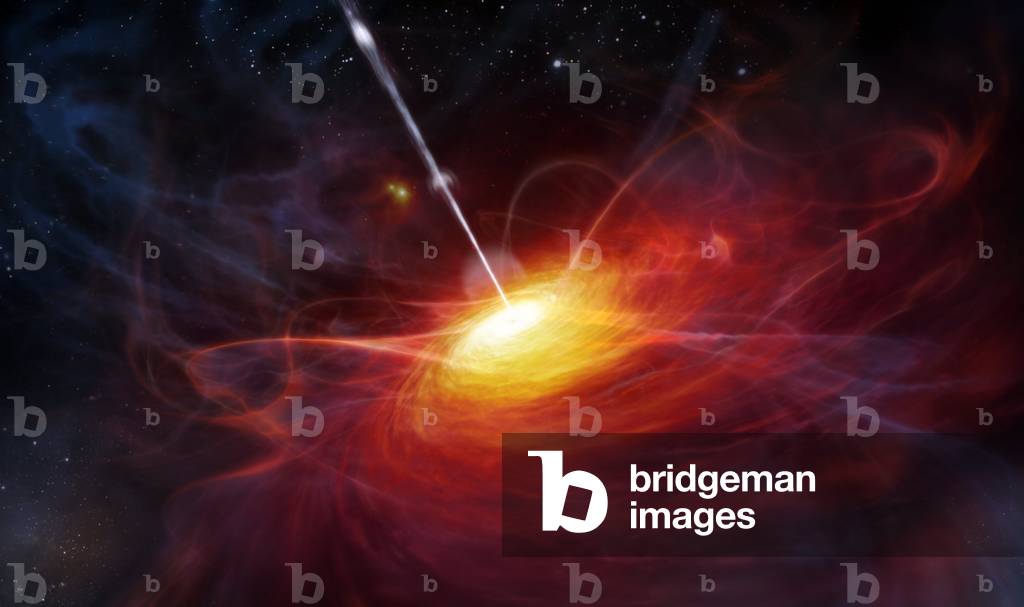
Quasar - Illustration
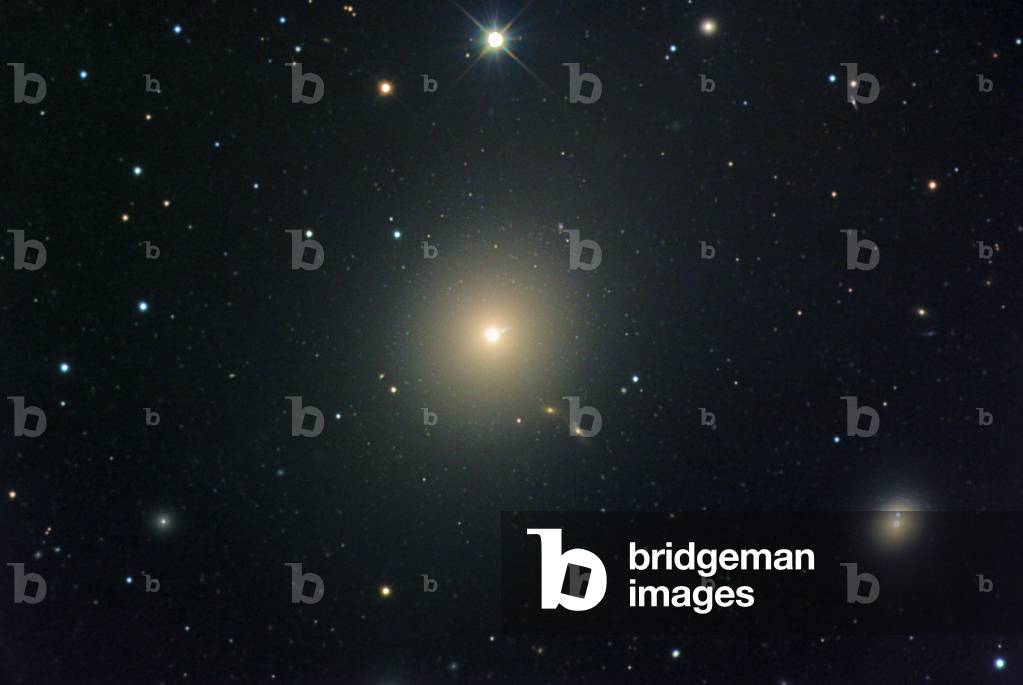
M87 elliptical galaxy in Virgo - M87 elliptical galaxy in Virgo - The M87 galaxy (NGC 4486) is located about 52 million years away - light from Earth, in the heart of the Virgin's cluster. M87 is the brightest radio source of the constellation, it is also called Virgo A. NGC 4486 (M87) is the largest and brightest elliptical galaxy within the northern Virgo Cluster at about 52 million light years from Earth. The galaxy also called Virgo A contains a notable active galactic nucleus that is a strong source of multiwavelength radiation, particularly radio waves. In 1918 astronomer Heber Curtis discovered a jet of matter coming from M87 which extends at least 5000 light - years from the nucleus of M87 and is made up of matter ejected from the galaxy, most likely by a supermassive black hole
Central region of the elliptical galaxy Centaurus A (NGC 5128) - Central part of the galaxy Centaurus A (NGC 5128) - The galaxy NGC 5128 is located about 13 million years away from Earth in the southern constellation of Centaurus. A broad dark band crosses it in the middle, a probable vestige of a collision with a spiral galaxy. This giant galaxy is a powerful radio source known as Centaurus A. It is an active galaxy whose energy comes from a supermassive black hole. The green dot visible in the dust strip is a supernova, the supernova 1986g. It appears green because the red filter image that made this trichromy image was only taken a year after the event and the supernova had weakened. Image obtained from the 3.9m telescope of Siding Spring, Australia. The nearby radio source Centaurus A (NGC 5128) looks like an elliptical galaxy, crossed by a broad, irregular dust lane. The dark band is probably the remains of a dusty spiral galaxy which is being absorbed by the giant elliptical. One of the nearer galaxies, 13 million light years away, Centaurus A is the most powerful nearby radio source and is also a copious source of X - and gamma rays as well as visible and infrared radiation.The three plates which were combined to make this colour picture have been copied to enhance the fine detail of the dust lane and to suppress the bright background of the elliptical galaxy. This process reveals many tiny red star - forming regions, especially prominent towards the end of the dust lane, and the clumps of young blue stars recently formed from them. The curious green star in the dust lane is because the blue and green - light plates were taken when supernova 1986g had just appeared, while the red - light plate was taken a year later when the supernova had faded
Barree spiral galaxy NGC 1365 in the Furnace - Barred spiral galaxy NGC 1365 in Fornax - NGC 1365 is a barree spiral galaxy that extends over 200,000 years - light. Located 60 million years ago - light, it belongs to the cluster of galaxies of the Furnace. Image obtained by Siding Spring's 3.9m telescope. NGC 1365, the largest spiral in the southern constellation of Fornax, is located at a distance of about 60 million light years. This beautiful galaxy is about as massive as the Milky Way, itself a substantial galaxy. Not much is known about how galaxies take on their beautiful forms, but a good deal is known about their internal organisation. The obvious 'bar' has the nucleus of the galaxy at its hub and is surrounded by masses of cooler stars that appear yellow on colour photographs. The bar itself is also yellowish, and has distinct dust lanes but it terminates abruptly in slender, curved arms that are lit by blue stars and the pink star - forming regions from which they spring
M87 elliptical galaxy in Virgo - M87 elliptical galaxy in Virgo - The M87 galaxy (NGC 4486) is located about 60 million years ago - light from Earth, in the heart of the Virgin's cluster. M87 is the brightest radio source in the constellation, it is also called Virgo A. Image made with Siding Spring's 3.9m telescope. Messier 87 (NGC 4486) lies near the centre of the nearby cluster of galaxies in Virgo at a distance of about 60 million light years. Although the physical boundaries of elliptical galaxies are not well defined, their mass can be, and by any standards M87 is enormous. It contains several thousand billion stars. Associated with this giant galaxy are large numbers of globular clusters, visible in this photograph as the cloud of slightly fuzzy objects around it. Like all ellipticals, M 87 is composed mainly of old stars and is largely devoid of the materials needed to make new ones. The galaxy is not inert however; high energy X - rays have been detected from an extensive outer halo and the galaxy itself is also known as Virgo A, the strongest radio source in the Virgo cluster. The source for this extreme behavior is probably a massive black hole at the center of the galaxy
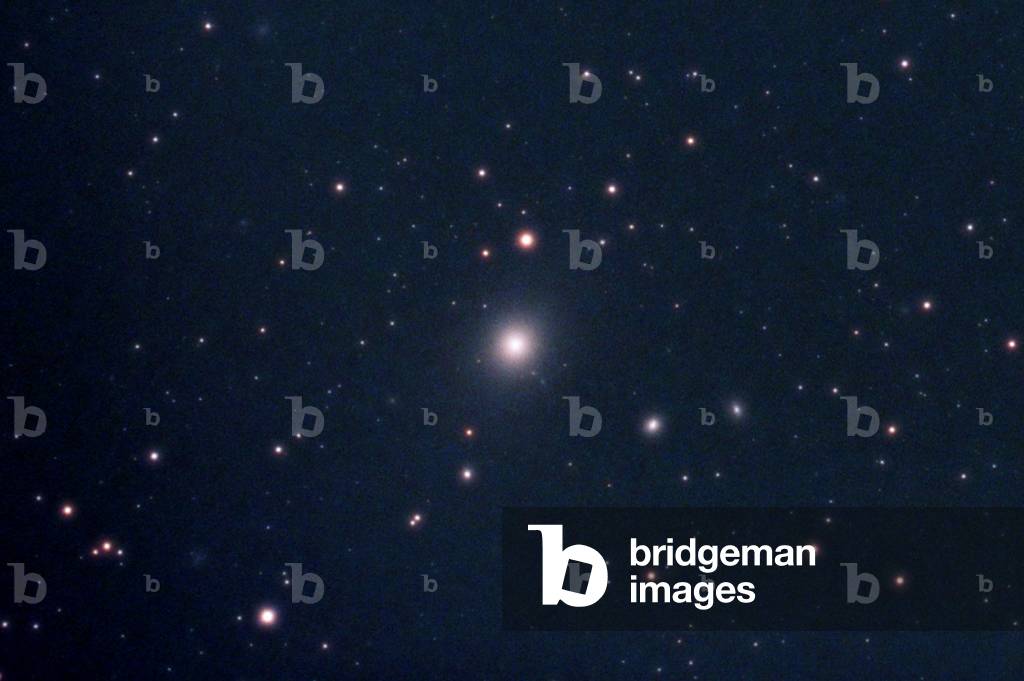
M87 elliptical galaxy in Virgo - M87 elliptical galaxy in Virgo - The M87 galaxy (NGC 4486) is located about 60 million years ago - light from Earth, in the heart of the Virgin's cluster. M87 is the brightest radio source of the constellation, it is also called Virgo A. Image made with an amateur instrument, a 130 mm bezel. Gigantic elliptical galaxy M87 is located at the heart of the Virgo Cluster of galaxies. Also known as radio source Virgo A, M87 is located about 60 million light years away. It appears to have a linear size of 120,000 light years and a mass estimated at 2.7 trillion solar masses, and an extreme luminosity, with an absolute magnitude of about - 22
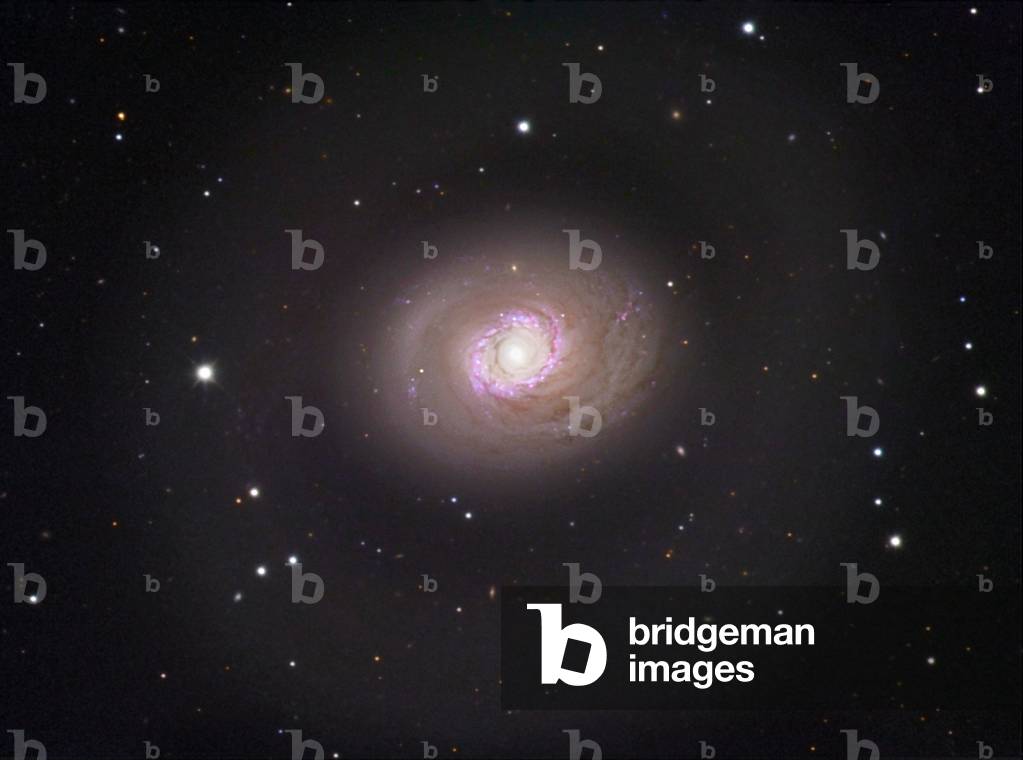
Spiral Galaxy M94 in Hunting Dogs - Spiral galaxy M94 in Canes Venatici - The spiral galaxy M94 (NGC 4736) is located about 15 million years ago - light from Earth. The M94 spiral galaxy was classified as Sab because of the extreme luminosite of its central region. This galaxy has several ring zones of star formation, one of which is very active. Image obtained with a 50 cm telescope, composite of several poses. M94 is a spiral galaxy located 15 million light - year away. Several active regions of star formation have been identified there
Spiral Galaxy M106 in Hunting Dogs - Spiral galaxy M106 in Canes Venatici - The galaxy M106 (NGC 4258) is located about 24 million years ago - light from Earth. It is an active galaxy with a black hole in its center. Image obtained with a 50 cm telescope, composite of several poses. M106 is a type Sb spiral galaxy in the constellation Canes Venatici. More edge - on than not, at a similar inclination to M31, its prominent dust lanes trace spiral structure back almost to its nucleus. M106 is around 25 million light - years away and is also a Seyfert galaxy
M87 elliptical galaxy in Virgo - M87 elliptical galaxy in Virgo - The M87 galaxy (NGC 4486) is located about 52 million years away - light from Earth, in the heart of the Virgin's cluster. M87 is the brightest radio source in the constellation, it is also called Virgo A. Gigantic elliptical galaxy M87 is located at the heart of the Virgo Cluster of galaxies. Also known as radio source Virgo A, M87 is located about 60 million light years away. It appears to have a linear size of 120,000 light years and a mass estimated at 2.7 trillion solar masses, and an extreme luminosity, with an absolute magnitude of about - 22
Planet near an active galaxy - Illustration - Planet and Active Galaxy - Illustration
Special Instructions
  • No additional copyright fee required
Elliptical Galaxy M87 in Virgo - Elliptical galaxy M87 in Virgo - The galaxy M87 (NGC 4486) is located about 52 million years away - light from Earth, in the heart of the Virgin's cluster. M87 is the brightest radio source in the constellation, it is also called Virgo A. Gigantic elliptical galaxy M87 is located at the heart of the Virgo Cluster of galaxies. Also known as radio source Virgo A, M87 is located about 60 million light years away. It appears to have a linear size of 120,000 light years and a mass estimated at 2.7 trillion solar masses, and an extreme luminosity, with an absolute magnitude of about - 22
Galaxy M106 in Hunting Dogs - Galaxy M106 - The galaxy M106 (NGC 4258) is about 24 million years away - light from Earth. It is an active galaxy with a black hole in its center. Lower right is NGC 4217 galaxy. Spiral galaxy M106, at upper left, is located in the constellation of Canes Venatici. Numerous other smaller galaxies are also seen in the frame, the most prominent being NGC 4217 at lower right. At 25 million lights years away, M106 is the closest example of a Seyfert galaxy, where large amounts of gas are thought to be falling into a massive black hole in the center of the galaxy
Spiral Galaxy M106 in Hunting Dogs - Spiral galaxy M106 in Canes Venatici - The galaxy M106 (NGC 4258) is located about 24 million years ago - light from Earth. It is an active galaxy with a black hole in its center. M106 is a type Sb spiral galaxy in the constellation Canes Venatici. More edge - on than not, at a similar inclination to M31, its prominent dust lanes trace spiral structure back almost to its nucleus. M106 is around 25 million light - years away and is also a Seyfert galaxy
Spiral Galaxy M106 in Hunting Dogs - Spiral galaxy M106 in Canes Venatici - The galaxy M106 (NGC 4258) is located about 24 million years ago - light from Earth. It is an active galaxy with a black hole in its center. Image obtained with a 50 cm telescope, composite of several poses. M106 is a type Sb spiral galaxy in the constellation Canes Venatici. More edge - on than not, at a similar inclination to M31, its prominent dust lanes trace spiral structure back almost to its nucleus. M106 is around 25 million light - years away and is also a Seyfert galaxy
Spiral Galaxy M94 in Hunting Dogs - Spiral galaxy M94 in Canes Venatici - The spiral galaxy M94 (NGC 4736) is located about 15 million years ago - light from Earth. The M94 spiral galaxy was classified as Sab because of the extreme luminosite of its central region. This galaxy has several ring zones of star formation, one of which is very active. Messier 94 (NGC 4736) is a spiral galaxy located in constellation Canes Venatici, and one of the nearer beyond our Local Group of Galaxies. M94 was classified Sab because of its extremely bright inner region. This bright circular disk is surrounded by a ring of active star - forming regions, traced by blue young star clusters
Spiral Galaxy M94 in Hunting Dogs - Spiral galaxy M94 (NGC 4736) in Canes Venatici - The spiral galaxy M94 (NGC 4736) is located about 15 million years ago - light from Earth. The M94 spiral galaxy was classified as Sab because of the extreme luminosite of its central region. This galaxy has several ring zones of star formation, one of which is very active. Image obtained with a 50 cm telescope, composite of several poses. M94 is a spiral galaxy located 15 million light - year away. Several active regions of star formation have been identified there
Barree spiral galaxy NGC 1365 in the Furnace - NGC 1365, barred spiral galaxy in Fornax - NGC 1365 is a barree spiral galaxy that extends over 200,000 years - light. Located 60 million years ago - light, it belongs to the cluster of galaxies of the Furnace. Image obtained with a telescope of 30 cm, cumulative poses of 14 hours. NGC 1365 is a giant barred spiral galaxy who spans 200 000 light years across. It is located 60 million years away in the Fornax constellation. Image made from Australia with a 14.5 inches telescope; total Exposure 14 Hours
Spiral Galaxy M106 in Hunting Dogs - Spiral galaxy M106 in Canes Venatici - The galaxy M106 (NGC 4258) is located about 24 million years ago - light from Earth. It is an active galaxy with a black hole in its center. M106 is a type Sb spiral galaxy in the constellation Canes Venatici. More edge - on than not, at a similar inclination to M31, its prominent dust lanes trace spiral structure back almost to its nucleus. M106 is around 25 million light - years away and is also a Seyfert galaxy
M87 elliptical galaxy in Virgo - M87 elliptical galaxy in Virgo - The M87 galaxy (NGC 4486) is located about 60 million years ago - light from Earth, in the heart of the Virgin's cluster. M87 is the brightest radio source in the constellation, it is also called Virgo A. Image made with Siding Spring's 3.9m telescope. Messier 87 (NGC 4486) is at the heart of the Virgo cluster and has a mass many times that of the Milky Way, itself no lightweight. Unlike our galaxy however, M87 is an elliptical galaxy. Though it appears more - or - less spherical on this photograph, a deep image shows it to be markedly elongated. Also unlike the Milky Way, M87 contains relatively little gas and dust. It is composed mainly of cool stars, which gives it a yellowish colour, in contrast to the blue of spiral galaxies. Despite the lack of star - forming materials, M87 is not a quiescent backwater. It is a powerful source of radio waves and the orbits of stars near its nucleus suggest they are held by a very massive, extremely compact core. Also, from the nucleus (but not seen here) extends a curious jet, all of which suggests that a massive black hole is hidden in the bright core of the galaxy
Centaurus A elliptical galaxy (NGC 5128) in the Centaurus - Galaxy Centaurus A (NGC 5128) - The galaxy NGC 5128 is located about 13 million years away from Earth. This Giant Galaxy is a powerful radio source known as Centaurus A. It is an active galaxy whose energy comes from a supermassive black hole. Image obtained from the 3.9m telescope of Siding Spring, Australia. Centaurus A is a most unusual galaxy. The circular, uniformly bright portion is composed of several thousand million stars, most of them old and yellowish. The galaxy is girded by a dense dust lane which obscures and reddens the light of stars behind it. Some younger, blue stars can be seen at the edges of the dust cloud. One of the nearer galaxies, 13 million light years away, Centaurus A is the most powerful nearby radio source and is also a copious source of X - and gamma rays as well as visible and infrared radiation
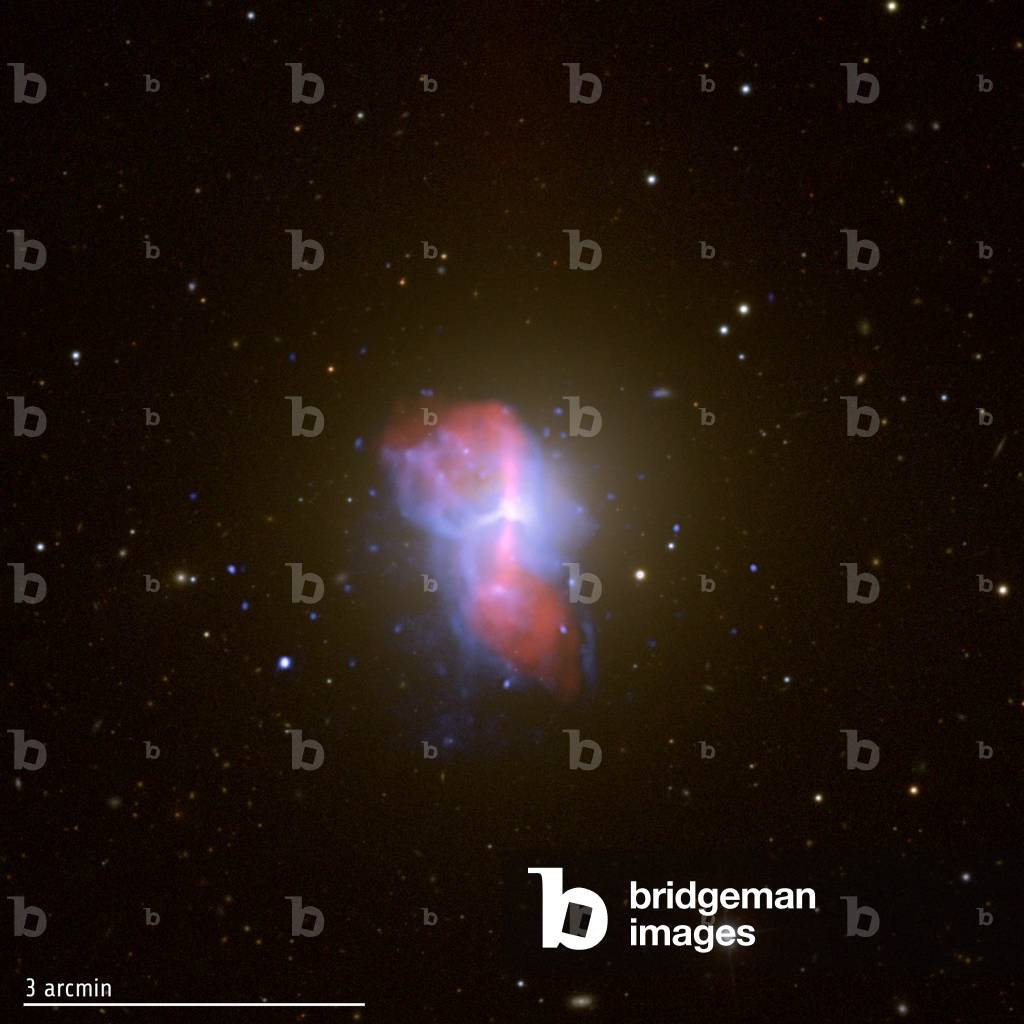
Black Holes in 3C75 - Black Holes in 3C75 - Composite X-ray image (blue) and radio (pink) of the active galaxy 3C 75. At the center of this very hot gas mass, two supermassive black holes separated by 25,000 years - light form a binary system of black holes (the two bright points). This composite X - ray/radio image of Abell 400 shows radio jets (pink), immersed in a vast cloud of multimillion degree X - ray emitting gas (blue) that pervades the cluster. The jets emanate from the vicinity of two supermassive black holes (bright spots in the image) in the galaxy. Chandra and radio data confirm that the unusual structure is due to the merger of two large galaxies, whose supermassive black holes are bound together by their mutual gravity. The swept - back appearance of the radio jets is produced by the rapid motion of the galaxy through the hot gas of the cluster, in much the same way that a motorcyclist's scarf is swept back while speeding down the road
Centaurus A elliptical galaxy (NGC 5128) in Centaurus - Galaxy Centaurus A (NGC 5128) - The galaxy NGC 5128 is located about 13 million light years away from Earth in the southern constellation of Centaurus. A broad dark band crosses it in the middle, a probable vestige of a collision with a spiral galaxy. This Giant Galaxy is a powerful radio source known as Centaurus A. It is an active galaxy whose energy comes from a supermassive black hole. The green dot visible in the dust strip is a supernova, the supernova 1986g. It appears green because the red filter image that made this trichromy image was only taken a year after the event and the supernova had weakened. Image obtained from the 3.9m telescope of Siding Spring, Australia. Centaurus A is a most unusual galaxy. The circular, uniformly bright portion is composed of several thousand million stars, most of them old and yellowish. The galaxy is girded by a dense dust lane which obscures and reddens the light of stars behind it. Some younger, blue stars can be seen at the edges of the dust cloud. One of the nearer galaxies, 13 million light years away, Centaurus A is the most powerful nearby radio source and is also a copious source of X - and gamma rays as well as visible and infrared radiation. The curious green star in the dust lane is because the blue and green - light plates were taken when supernova 1986g had just appeared, while the red - light plate was taken a year later when the supernova had faded
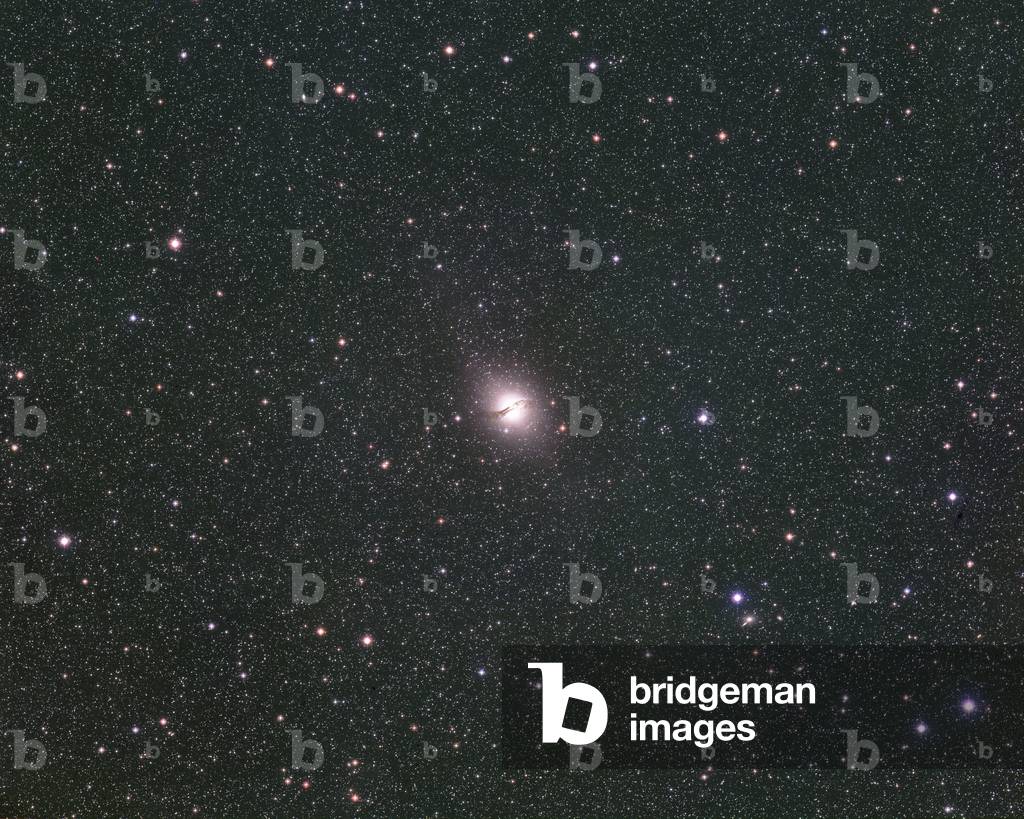
Elliptical galaxy Centaurus A (NGC 5128) in the Centaurus - Galaxy Centaurus A (NGC 5128). Wide field - The NGC 5128 galaxy is about 13 million light years away from Earth. Image obtained from the 1.2m telescope of Siding Spring, Australia. Centaurus A is a most unusual galaxy, set in a rich part of the southern sky. not only are there plenty of stars here to catch the eye, but the region is rich in galaxies as well. One of the nearer galaxies, at 13 million light years away, Centaurus A is the most powerful nearby radio source and is also a copious source of X - and gamma rays as well as visible and infrared radiation
Centaurus A elliptical galaxy (NGC 5128) in Centaurus - The radio galaxy Centaurus A (NGC 5128): The galaxy NGC 5128 is located about 13 million light years away from Earth in the southern constellation of Centaurus. A broad dark band crosses it in the middle, a probable vestige of a collision with a spiral galaxy. This giant galaxy is a powerful radio source known as Centaurus A. It is an active galaxy whose energy comes from a supermassive black hole. - NGC 5128 is the nearest large elliptical galaxies to our sun at about 13 million light years. It is also the nearest of the giant radio galaxies, possessing an active galactic nucleus (AGN) and optically one of the most luminous galaxies in the sky. In 1949, NGC 5128 was found to be a loud source of radio energy, in fact the loudest radio source in its region of the sky (second overall to Cygnus A), earning it the designation Centarus A. As a radio galaxy it releases 1000 times the radio energy of the Milky Way in the form of large bi-directional radio lobes that extend some 800,000 light years into intergalactic space. The source of the radio emission is very compact, about 10 light days across and is believed to be a supermassive black hole in the galaxy's center with a total mass of 200 million to possibly one billion suns. As a radio galaxy, NGC 5128 belongs to the subgroup of galaxies called Active Galaxies, which include Quasars, Seyfert galaxies, Blazars and Radio Galaxies. Active galaxies are distinguished by their prodigious energy output which cannot be explained by their stellar populations and must have another source. Active galaxies have in common an “Active Galactic Nucleus (AGN)”” which is believed responsible for their prodigious energy output. Supermassive black holes are almost certainly the central engines of Active Galactic Nuclei, powering the enormous outflows of energy which characterize this subgroup of bright galaxies. Composite Image from M
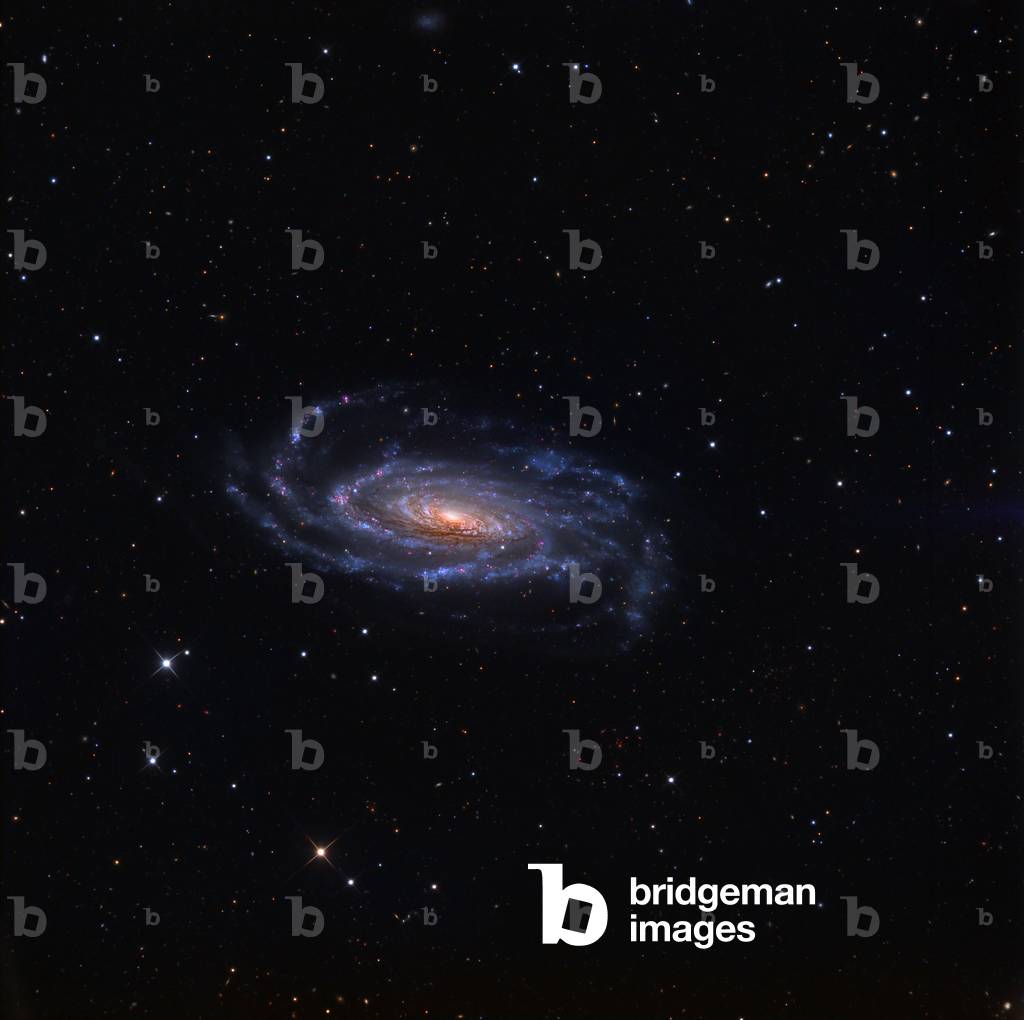
Spiral galaxy M81 in the Great Bear - Spiral galaxy M81 in Ursa Major - The spiral galaxy M81 is located 12 million years ago - light from Earth. Its arms are home to star-forming regions while its core is surrounded by much older yellow stars. An irregular dwarf galaxy, PGC 28757 (Holmberg IX), is visible at the top of the picture. M81 is the brightest member of the nearby galactic group called the M81 group. This group contains at least 25 other members including the peculiar starburst galaxy M82, the peculiar galaxy NGC 3077 and many dwarfs galaxies. The core galaxies of the group (M81, M82, NGC 3077, NGC 2976) are strongly interacting and are all imbedded within a large and extended molecular gas cloud. The Dwarf irregular Holmberg IX (seen above M81 in the image) most likely condensed from tidal debri existing between M81 and M82. M81 has the distinction of being the nearest spiral galaxy to have an active galactic nucleus (AGN). AGN galaxies are luminous galaxies that demonstrate much of their luminosity as nonstellar emission arising from their nucleus. The modern interpretation for the unusual energy output is the presence of a super massive black hole which consumes infalling matter from a rotating accretion disk in the galaxy's center
Spiral Galaxy M106 in Hunting Dogs - Spiral galaxy M106 in Canes Venatici - The galaxy M106 (NGC 4258) is located about 24 million years ago - light from Earth. It is an active galaxy with a black hole in its center. Image obtained from the Hubble Space Telescope (HST) combined with observations from the ground. M106 is a type Sb spiral galaxy in the constellation Canes Venatici. More edge - on than not, at a similar inclination to M31, its prominent dust lanes trace spiral structure back almost to its nucleus. M106 is around 25 million light - years away and is also a Seyfert galaxy. Image made from the Hubble Space Telescope (HST) archive and combined with ground - based observations
Barree spiral galaxy NGC 1365 in the Furnace - Barred spiral galaxy NGC 1365 in Fornax - NGC 1365 is a barree spiral galaxy that extends over 200,000 years - light. Located 60 million years ago - light, it belongs to the cluster of galaxies of the Furnace. Image obtained in 1999 by the European telescope Antu of the VLT in Chile. NGC 1365 is one of the most prominent “” barred”” galaxies in the sky. It is a supergiant galaxy with a diameter of about 200,000 light - years, seen in the direction of the southern constellation Fornax. It is a major member of the Fornax Cluster of Galaxies. The distance is about 60 million light - years. A massive straight bar runs through this galaxy and contains the nucleus at the centre. It consists mostly of older stars that give a reddish colour to the bar.The gravitational perturbation from the bar causes interstellar gas and dust clouds to form a pair of spiral arms that extend from the ends of the bar. Young luminous hot stars, born out of the interstellar clouds, give these arms a prominent appearance and a blue colour. The bar and spiral pattern rotates clockwise, as seen from us. One full turn takes about 350 million years. Image combined from three exposures with the FORS1 multi - mode instrument at VLT UT1, ANTU
Artist's view of a quasar - Quasar - Illustratio
Content Partner Restrictions
  • Only available to clients invoiced in Balkans;Only available to clients invoiced in Europe;Only available to clients invoiced in Norway;Only available to clients invoiced in Switzerland
Special Instructions
  • No additional copyright fee required
Spiral galaxy NGC 6814 in the Eagle - Spiral Galaxy NGC 6814: NGC 6814 is a spiral galaxy located in the constellation Eagle. It is an active galaxy called Seyfert, which probably houses a black hole in its heart. Image obtained with the Hubble telescope - Spiral galaxy NGC 6814 seen by Hubble Space Telescope. NGC 6814 has an extremely bright nucleus, a telltale sign that the galaxy is a Seyfert galaxy. These galaxies have very active centres that can emit strong bursts of radiation. The luminous heart of NGC 6814 is a highly variable source of X-ray radiation, causing scientists to suspect that it hosts a supermassive black hole with a mass about 18 million times that of the Sun. As NGC 6814 is a very active galaxy, many regions of ionised gas are studded along its spiral arms. In these large clouds of gas, a burst of star formation has recently taken place, forging the brilliant blue stars that are visible scattered throughout the galaxy
Spiral Galaxy M106 in Hunting Dogs - Spiral galaxy M106 in Canes Venatici - The galaxy M106 (NGC 4258) is located about 24 million years ago - light from Earth. It is an active galaxy with a black hole in its center. Image obtained from the Hubble Space Telescope (HST) combined with observations from the ground. M106 is a type Sb spiral galaxy in the constellation Canes Venatici. More edge - on than not, at a similar inclination to M31, its prominent dust lanes trace spiral structure back almost to its nucleus. M106 is around 25 million light - years away and is also a Seyfert galaxy. Image made from the Hubble Space Telescope (HST) archive and combined with ground - based observations
Spiral galaxy M77 in the Whale - Active galaxy M77 (NGC 1068) in Cetus - M77 (NGC 1068). This active galaxy is the typical example of a Seyfert II galaxy. It has an active core and houses a massive black hole. She is the object of intense star formation in her spiral arms. NGC 1068 is around 50 million years of light from Earth. Image obtained by Siding Spring's 3.9m telescope. M77 is a Seyfert galaxy, a class of galaxy named for Karl Seyfert who first identified galaxies with emission lines superimposed on the normal radiation from their nuclei in 1943. Such galaxies are a subset of an ill - defined species generally known as 'active galaxies' whose nuclei emit radio - and X - radiation as well as visible light. The least active of the active galaxies are the Seyferts, the most active are the quasars which are mostly so distant that they can only be distinguished from stars by their spectrum. <BR>The common feature of these galaxy types is a small, very bright nucleus thought to host a massive black hole. In Seyferts we see this black hole (or more likely its surrounding shroud of ultra - luminous gas) more or less pole - on. In other active galaxy types at different inclinations the spectrum of the nucleus changes as we see other manifestations of the black hole's influence on its surroundings. M77 is a member of a small group of galaxies at a distance of about 40 million light years
Field around the galaxy NGC 1672 in the bream - Wide field around galaxy NGC 1672 - The barree spiral galaxy NGC 1672 is located 60 million years - light in the southern constellation of the bream. Intense star formations are observed and many clusters of young stars are visible in the arms of the galaxy. NGC 1672 is a galaxy of Seyfert, whose core houses a supermassive black hole. Wide field ground - based image of NGC 1672's region in the Southern constellation of Dorado. This image is a colour composite taken by the Digitized Sky Survey
Spiral galaxy M77 in the Whale - Active galaxy M77 (NGC 1068) in Cetus - M77 (NGC 1068) This active galaxy is a typical example of a galaxy in Seyfert II. It has an active core and houses a massive black hole. She is the object of intense star formation in her spiral arms. NGC 1068 is around 50 million years of light from Earth. M77 is an archetypical example of a Seyfert type II galaxy and the brightest galaxy of its class. M77 is a large galaxy and together with its faint outer spiral arms may extend up to 170,000 light years across. It is located about 50 million light years away in Cetus constellation. In contrast to a normal galactic nucleus the energy released from the Seyfert nucleus arises from a nonstellar source. The central engine of the Seyfert nucleus (and all AGN) is believed to be an accretion disk that continuously drops matter into a supermassive black hole
Active galaxy NGC 1068 in the Whale - Active galaxy M77 (NGC 1068) in Cetus - This active galaxy is the typical example of a galaxy of Seyfert II. M77 (NGC 1068) has an active core and houses a massive black hole. She is the object of intense star formation in her spiral arms. NGC 1068 is around 50 million years of light from Earth. Image obtained with a telescope 61 cm in diameter. Located about 60 million light years from Earth, towards the direction of the constellation named Cetus, is an enormous galaxy, much larger than our own, that is surrounded by a even larger cloud of obscuring dust. M77 (NGC 1068) has a powerful jet pouring copious amounts of material into inter - galactic space at enormous speed. This galaxy is a seyfert II type with an active nucleus. It is now believed that the source of this conmotion is a super - massive black hole, ten million times more massive than our Sun, in the process of absorbing material that has ventured too close. Image taken with a 24 - inch telescope
Spiral galaxy NGC 1566 in the bream - The Seyfert Galaxy NGC 1566: NGC 1566 is a spiral galaxy located about 40 million light years ago. Its core is very bright. It is an active galaxy called Seyfert, which probably houses a black hole in its heart. Image obtained with the Hubble telescope - NGC 1566 is a galaxy located approximately 40 million light-years away in the constellation of Dorado (The Dolphinfish). NGC 1566 is an intermediate spiral galaxy, meaning that while it does not have a well defined bar-shaped region of stars at its centre - like barred spirals - it is not quite an unbarred spiral either (heic9902o). The small but extremely bright nucleus of NGC 1566 is clearly visible in this image, a telltale sign of its membership of the Seyfert class of galaxies. The centres of such galaxies are very active and luminous, emitting strong bursts of radiation and potentially harbouring supermassive black holes that are many millions of times the mass of the Sun. NGC 1566 is not just any Seyfert galaxy; it is the second brightest Seyfert galaxy known. It is also the brightest and most dominant member of the Dorado Group, a loose concentration of galaxies that together comprise one of the richest galaxy groups of the southern hemisphere. This image highlights the beauty and awe-inspiring nature of this unique galaxy group, with NGC 1566 glittering and glowing, its bright nucleus framed by swirling and symmetrical lavender arms. This image was taken by Hubble's Wide Field Camera 3 (WFC3) in the near-infrared part of the spectrum
Spiral galaxy M81 in the Great Bear - Spiral galaxy M81 in Ursa Major - The spiral galaxy M81 is located 12 million years ago - light from Earth. Its arms are home to star-forming regions while its core is surrounded by much older yellow stars. An irregular dwarf galaxy, PGC 28757 (Holmberg IX), is visible at the top of the picture. Image obtained with a 50 cm telescope through different filters, total of different poses: 20h. M81 is the brightest member of the nearby galactic group called the M81 group. This group contains at least 25 other members including the peculiar starburst galaxy M82, the peculiar galaxy NGC 3077 and many dwarfs galaxies. The core galaxies of the group (M81, M82, NGC 3077, NGC 2976) are strongly interacting and are all imbedded within a large and extended molecular gas cloud. The Dwarf irregular Holmberg IX (seen above M81 in the image) most likely condensed from tidal debri existing between M81 and M82. M81 has the distinction of being the nearest spiral galaxy to have an active galactic nucleus (AGN). AGN galaxies are luminous galaxies that demonstrate much of their luminosity as nonstellar emission arising from their nucleus. The modern interpretation for the unusual energy output is the presence of a super massive black hole which consumes infalling matter from a rotating accretion disk in the galaxy's center
Spiral galaxy M81 in the Great Bear - Spiral galaxy M81 in Ursa Major: The spiral galaxy M81 is located 12 million light years from Earth. Its arms are home to star-forming regions while its core is surrounded by much older yellow stars. An irregular dwarf galaxy, PGC 28757 (Holmberg IX), is visible at the top of the picture. - M81 is the brightest member of the nearby galactic group called the M81 group. This group contains at least 25 other members including the peculiar starburst galaxy M82, the peculiar galaxy NGC 3077 and many dwarfs galaxies. The core galaxies of the group (M81, M82, NGC 3077, NGC 2976) are strongly interacting and are all imbedded within a large and extended molecular gas cloud. The Dwarf irregular Holmberg IX (seen above M81 in the image) most likely condensed from tidal debri existing between M81 and M82. M81 has the distinction of being the nearest spiral galaxy to have an active galactic nucleus (AGN). AGN galaxies are luminous galaxies that demonstrate much of their luminosity as nonstellar emission arising from their nucleus. The modern interpretation for the unusual energy output is the presence of a super massive black hole which consumes infalling matter from a rotating accretion disk in the galaxy's center. Composite Image from Multiple Data Sources
Spiral galaxy M77 in the Whale - Active galaxy M77 (NGC 1068) in Cetus - This active galaxy is the typical example of a galaxy of Seyfert II. M77 (NGC 1068) has an active core and houses a massive black hole. She is the object of intense star formation in her spiral arms. NGC 1068 is around 50 million years of light from Earth. Image obtained with a telescope of 50 cm and more than 17 hours of installation. Located about 60 million light years from Earth, towards the direction of the constellation named Cetus, is an enormous galaxy, much larger than our own, that is surrounded by a even larger cloud of obscuring dust. M77 (NGC 1068) has a powerful jet pouring copious amounts of material into inter - galactic space at enormous speed. This galaxy is a seyfert II type with an active nucleus. It is now believed that the source of this commotion is a super - massive black hole, ten million times more massive than our Sun, in the process of absorbing material that has ventured too close
Active galaxy NGC 1068 in the Whale - Active galaxy M77 (NGC 1068) in Cetus - This active galaxy is the typical example of a galaxy of Seyfert II. M77 (NGC 1068) has an active core and houses a massive black hole. She is the object of intense star formation in her spiral arms. NGC 1068 is about 45 million years ago - light from Earth. Image obtained with the Hubble Space Telescope (HST). The NASA/ESA Hubble Space Telescope has captured this vivid image of spiral galaxy Messier 77 - - a galaxy in the constellation of Cetus, some 45 million light - years away from us. The streaks of red and blue in the image highlight pockets of star formation along the pinwheeling arms, with dark dust lanes stretching across the galaxy's starry centre. The galaxy belongs to a class of galaxies known as Seyfert galaxies, which have highly ionised gas surrounding an intensely active centre
Barree spiral galaxy NGC 1097 in the Furnace - Barred spiral galaxy NGC 1097 in Fornax - Located at a distance of about 45 million years - light, NGC 1097 is the object of intense star formation and is an active core galaxy with a supermassive black hole in its heart. At the top right of the image, a special elliptical satellite galaxy, NGC 1097A, probably interacted with NGC 1097 in the past. Image obtained by combining several poses of several hours. Located at a distance of about 45 million light - years in the southern constellation Fornax, NGC 1097 is a relatively bright, barred spiral galaxy of type SBB, seen face - on. At magnitude 9.5, and thus just 25 times fainter than the faintest object that can be seen with the unaided eye, it appears in small telescopes as a bright, circular disc. NGC 1097 is an acive galaxy with an Active Galactic Nuclei (AGN), whose emission is thought to arise from matter (gas and stars) falling into oblivion in a central black hole. There is indeed much evidence that a supermassive black hole is located at the very centre of NGC 1097; it is at least ten times more massive than the central black hole in our own Milky Way. NGC 1097 also has a small galaxy companion; it is designated NGC 1097A and is located about 42,000 light - years away from the centre of NGC 1097. This peculiar elliptical galaxy is 25 times fainter than its big brother. There is evidence that NGC 1097 and NGC 1097A have been interacting in the recent past
Active galaxies in collision - Artist view - Active galaxies collide - Artist view - Artist view of a quasar whose jet is powered by the material of a galaxy rentree in collision. Intense jets of energy burst from the core of an active galaxy
Content Partner Restrictions
  • Only available to clients invoiced in Balkans;Only available to clients invoiced in Europe;Only available to clients invoiced in Norway;Only available to clients invoiced in Switzerland
Special Instructions
  • No additional copyright fee required
Active galaxy NGC 1068 in the Whale - Composite X - visible - Active galaxy NGC 1068 seen in visible and X - ray - This visible X composite image shows that a strong stellar wind escapes from the heart of the galaxy NGC 1068. This active galaxy houses a massive black hole and is the object of intense star formation in its spiral arms. NGC 1068 stands at about 50 million years - light. Image obtained by the Chandra satellite in December 2000. This composite X - ray (blue and green) and optical (red) image of the active galaxy, NGC 1068, shows gas blowing away in a high - speed wind from the vicinity of a central supermassive black hole. Regions of intense star formation in the inner spiral arms of the galaxy are highlighted by both optical and X - ray emission
Spiral Galaxy NGC 1566 in the Dorado - The Seyfert Galaxy NGC 1566 - NGC 1566 is a spiral galaxy located about 50 million years ago - light. Its core is very bright. It is an active galaxy called Seyfert, which probably houses a black hole in its heart. Image made with Siding Spring's 3.9m telescope. NGC 1566 is the brightest member of a nearby group of galaxies in Dorado and is at a distance of about 50 million light years. It has beautifully symmetrical, tightly - wound spiral arms, which on deep images appear to almost encircle the galaxy. This striking galaxy is also of interest because it has a very luminous nucleus which has many of the characteristics of a quasar, though it is much less energetic. Galaxies of this type are known as Seyfert galaxies, after Carl Seyfert who first recognised their peculiar nature in 1943. The active region at the centre of NGC 1566 has recently been found to vary on a timescale of less than a month, which indicates that it is extremely compact. Spectra show that hot gas near the tiny nucleus is moving at an abnormally high velocity, suggesting that it may be in orbit around a massive black hole at the heart of NGC 1566
Centaurus A elliptical galaxy (NGC 5128) in Centaurus - The radio galaxy Centaurus A (NGC 5128) - The galaxy NGC 5128 is located about 13 million years away from Earth in the southern constellation of Centaurus. A broad dark band crosses it in the middle, a probable vestige of a collision with a spiral galaxy. This giant galaxy is a powerful radio source known as Centaurus A. It is an active galaxy whose energy comes from a supermassive black hole. Image obtained with a 35 cm telescope, 11 hours of cumulative poses. NGC 5128 is the nearest large elliptical galaxies to our sun at about 13 million light years. It is also the nearest of the giant radio galaxies, possessing an active galactic nucleus (AGN) and optically one of the most luminous galaxies in the sky. In 1949, NGC 5128 was found to be a loud source of radio energy, in fact the loudest radio source in its region of the sky (second overall to Cygnus A), earning it the designation Centarus A. As a radio galaxy it releases 1000 times the radio energy of the Milky Way in the form of large bi - directional radio lobes that extend some 800,000 light years into intergalactic space. The source of the radio emission is very compact, about 10 light days across and is believed to be a supermassive black hole in the galaxy's center with a total mass of 200 million to possibly one billion suns. As a radio galaxy, NGC 5128 belongs to the subgroup of galaxies called Active Galaxies, which include Quasars, Seyfert galaxies, Blazars and Radio Galaxies. Active galaxies are distinguished by their prodigious energy output which cannot be explained by their stellar populations and must have another source. Active galaxies have in common an “Active Galactic Nucleus (AGN)”” which is believed responsible for their prodigious energy output. Supermassive black holes are almost certainly the central engines of Active Galactic Nuclei, powering the enormous outflows of energy whi
Active galaxies in collision - Artist view - Active galaxies collide - Artist view - Artist view of a quasar whose jet is powered by the material of a galaxy rentree in collision. Active galaxies collide, feeding matter to the central black holes that power quasars
Content Partner Restrictions
  • Only available to clients invoiced in Balkans;Only available to clients invoiced in Europe;Only available to clients invoiced in Norway;Only available to clients invoiced in Switzerland
Special Instructions
  • No additional copyright fee required
Interacting galaxies Markarian 533 - Interacting galaxies Markarian 533 - The galaxy NGC 7674 (Markarian 533 or Arp 182) is located about 400 million years ago - light from Earth in the constellation Pegase. It is the most important member of a group of galaxies called Hickson 96 (HCG 96). This spiral galaxy seen from the front is in interaction with other companion galaxies. It has an active core. Image obtained by the Hubble Space Telescope on June 9, 2002. NGC 7674 (seen just above the center), also known as Markarian 533, is the brightest and largest member of the so - called Hickson 96 compact group of galaxies, consisting of four galaxies. This stunning Hubble image shows a spiral galaxy nearly face - on. The central bar - shaped structure is made up of stars. The shape of NGC 7674, including the long narrow streamers seen to the left of and below the galaxy can be accounted for by tidal interactions with its companions. NGC 7674 has a powerful active nucleus of the kind known as a type 2 Seyfert that is perhaps fed by gas drawn into the center through the interactions with the companions. NGC 7674 falls into the family of luminous infrared galaxies and is featured in ARP's Atlas of Peculiar Galaxies as number 182. It is located in the constellation of Pegasus, the Winged Horse, about 400 million light - years away from Earth. Image taken by the Hubble space telescope on June 9, 2002
M87 elliptical galaxy in Virgo - M87 elliptical galaxy in Virgo - The M87 galaxy (NGC 4486) is 54 million years ago - light from Earth, in the heart of the Virgin's cluster. This composite image obtained by the Hubble space telescope in 2003 and 2006 shows a gigantic jet of gas material ejected from the heart of the galaxy. A supermassive black hole would have caused this jet. The monstrous elliptical galaxy M87 is the home of several trillion stars, a supermassive black hole, and a family of 13,000 globular star clusters. M87 is the dominant galaxy at the center of the neighboring Virgo cluster of galaxies, which contains some 2,000 galaxies. Amid the smooth, yellow population of older stars, the two features that stand out most in this Hubble Space Telescope image of M87 are its soft blue jet and the myriad of starlike globular clusters scattered throughout the image. The jet is a black - hole - powered stream of material that is being ejected from the core of the galaxy. As gaseous material from the center of the galaxy accretes onto the black hole, the resultant energy released produces a fire - hose stream of subatomic particles that are accelerated to velocities near the speed of light. Being in the center of the Virgo cluster of galaxies, M87 may have accumulated some of its globular clusters by gravitationally pulling them from nearby dwarf galaxies that seem to be devoid of globulars today. The 120,000 - light - year - diameter galaxy lies at a distance of 54 million light - years from the Sun in the spring constellation Virgo. This image was made from data taken in 2003 and 2006 with Hubble's Advanced Camera for Surveys. The image is a composite of individual filtered data that cover the visible and infrared portions of the spectrum
Spiral galaxies NGC 1055 and NGC 1068 in the Whale - NGC 1055 and NGC 1068 spiral galaxies in Cetus - M77 (NGC 1068), bottom right: this active galaxy is a typical example of a galaxy of Seyfert II. It has an active core and houses a massive black hole. She is the object of intense star formation in her spiral arms. NGC 1068 is around 50 million years of light from Earth. NGC 1055, upper left, is a spiral galaxy seen by the slice. The field of this mosaic is about the size of the full moon. On bottom right, NGC 1068 (M77) at about 50 million light years away in the southern constellation of Cetus. It is a Seyfert 2 active galaxy with an active galactic nucleus and contains a massive black hole. On the top left, the edge - on NGC 1055 spiral galaxy. The mosaicked field is about the size of the full Moon
Elliptical galaxy NGC 1275 in Persee - Elliptical galaxy NGC 1275 in Perseus - This image obtained by the Hubble space telescope in 1995 shows a system of two colliding galaxies; in the foreground, a spiral galaxy seen almost from the edge, with many stars forming in the background, a giant, very bright elliptical galaxy, special because it has a spiral structure in its center. Its core probably houses a black hole. NGC 1275 is located about 230 million years ago - light; it belongs to the large cluster of galaxies of Persee. These images, taken with Hubble's Wide Field Planetary Camera 2 (WFPC2), show traces of spiral structure accompanied by dramatic dust lanes and bright blue regions that mark areas of active star formation. Detailed observations of NGC 1275 indicate that the dusty material belongs to a spiral system seen nearly edge - on in the foreground. The second galaxy, lying beyond the first, is actually a giant elliptical with peculiar faint spiral structure in its nucleus. These galaxies are believed to be colliding at over 6 million miles per hour. NGC 1275 is about 230 million light - years away in the constellation Perseus. Embedded in the center of a large cluster of galaxies known as the Perseus Cluster, it is also known to emit a powerful signal at both X - ray and radio frequencies. The galaxy collision causes the gas and dust already existing in the central bright galaxy to swirl into the center of the object. The X - ray and radio emission indicates the probable existence of a black hole at the bright galaxy's center. While the dark dusty material in the Hubble image falls inward, NGC 1275 displays intricate filamentary structures at a much larger scale outside the image. This is a typical feature of bright cluster galaxies
Barree spiral galaxy NGC 1097 in the Furnace - Barred spiral galaxy NGC 1097 in Fornax - Located at a distance of about 45 million years - light, NGC 1097 is the object of intense star formation and is an active core galaxy with a supermassive black hole in its heart. Image obtained by the Hubble Space Telescope (HST). The NASA/ESA Hubble Space Telescope provides us with a spectacular image of the bright star - forming ring that surrounds the heart of the barred spiral galaxy NGC 1097. In this image, the larger - scale structure of the galaxy is barely visible: its comparatively dim spiral arms, which surround its heart in a loose embrace, reach out beyond the edges of this frame. This face - on galaxy, lying 45 million light - years away from Earth in the southern constellation of Fornax (The Furnace), is particularly attractive for astronomers. NGC 1097 is a Seyfert galaxy. Lurking at the very centre of the galaxy, a supermassive black hole 100 million times the mass of our Sun is gradually sucking in the matter around it. The area immediately around the black hole shines powerfully with radiation coming from the material falling in. The distinctive ring around the black hole is bursting with new star formation due to an inflow of material towards the central bar of the galaxy. These star - forming regions are glowing brightly thanks to emission from clouds of ionised hydrogen. The ring is around 5000 light - years across, although the spiral arms of the galaxy extend tens of thousands of light - years beyond it. NGC 1097 is also pretty exciting for supernova hunters. The galaxy experienced three supernovae (the violent deaths of high - mass stars) in the 11 - year span between 1992 and 2003. This is definitely a galaxy worth checking on a regular basis. However, what it is really exciting about NGC 1097 is that it is not wandering alone through space. It has two small galaxy companions, which dance the dance of stars and the dance of spa
Elliptical galaxy NGC 1275 in Persee - Elliptical galaxy NGC 1275 in Perseus - View of the giant elliptical galaxy NGC 1275 located 230 million years ago - light in the center of the cluster of Persee galaxies. This image obtained by the Hubble Space Telescope in 2006 reveals filamentary structures surrounding the galaxy. These gas filaments would come from the interaction between the cold gas of the center of the galaxy or resides a supermassive black hole and the warmer gas present in the galaxy cluster. This Hubble Space Telescope image of galaxy NGC 1275 reveals the fine, thread - like filamentary structures in the gas surrounding the galaxy. The red filaments are composed of cool gas being suspended by a magnetic field, and are surrounded by the 100 - million - degree Fahrenheit hot gas in the center of the Perseus galaxy cluster. The filaments are dramatic markers of the feedback process through which energy is transferred from the central massive black hole to the surrounding gas. The filaments originate when cool gas is transported from the center of the galaxy by radio bubbles that rise in the hot interstellar gas. At a distance of 230 million light - years, NGC 1275 is one of the closest giant elliptical galaxies and lies at the center of the Perseus cluster of galaxies. The galaxy was photographed in July and August 2006 with the Advanced Camera for Surveys in three color filters
Barree spiral galaxy NGC 1097 in the Furnace - Barred spiral galaxy NGC 1097 in Fornax - Located at a distance of about 45 million years - light, NGC 1097 is the object of intense star formation and is an active core galaxy with a supermassive black hole in its heart. A special elliptical satellite galaxy, NGC 1097A, probably interacted with NGC 1097 in the past. Image obtained by combining several poses of several hours. Located at a distance of about 45 million light - years in the southern constellation Fornax, NGC 1097 is a relatively bright, barred spiral galaxy of type SBB, seen face - on. At magnitude 9.5, and thus just 25 times fainter than the faintest object that can be seen with the unaided eye, it appears in small telescopes as a bright, circular disc. NGC 1097 is an active galaxy with an Active Galactic Nuclei (AGN), whose emission is thought to arise from matter (gas and stars) falling into oblivion in a central black hole. There is indeed much evidence that a supermassive black hole is located at the very centre of NGC 1097; it is at least ten times more massive than the central black hole in our own Milky Way. NGC 1097 also has a small galaxy companion; it is designated NGC 1097A and is located about 42,000 light - years away from the centre of NGC 1097. This peculiar elliptical galaxy is 25 times fainter than its big brother. There is evidence that NGC 1097 and NGC 1097A have been interacting in the recent past
Jet from the elliptical galaxy M87 by Hubble - Jet in the elliptical galaxy M87 - The galaxy M87 (NGC 4486) is located about 60 million years ago - light from Earth, in the heart of the Virgin's cluster. This image obtained by the Hubble space telescope in February 1998 shows a gigantic jet of gas material ejected from the heart of the galaxy. A supermassive black hole would have caused this jet. M87 is the brightest radio source of the constellation, it is also called Virgo A. M87 (also known as NGC 4486) is a giant elliptical galaxy; one of many ellipticals in the nearby Virgo cluster of galaxies. In the 1950s when the field of radio was blossoming, one of the brightest radio sources in the sky, Virgo A, was discovered to be associated with M87 and its jet. <BR>After decades of study, prompted by these discoveries, the source of this incredible amount of energy powering the jet has become clear. Lying at the center of M87 is a supermassive black hole, which has swallowed up a mass equivalent to 2 billion times the mass of our Sun
Centaurus A elliptical galaxy (NGC 5128) in the Centaurus - Galaxy Centaurus A (NGC 5128) - The galaxy NGC 5128 is located about 13 million years away from Earth. This Giant Galaxy is a powerful radio source known as Centaurus A. It is an active galaxy whose energy comes from a supermassive black hole. This image obtained by the Kueyen telescope of the VLT in Chile on 1 February 2000 shows the star flames that occur in the dark band of the galaxy. Centaurus A is one of the foremost examples of a radio - loud active galactic nucleus (AGN). On images obtained at optical wavelengths, thick dust layers almost completely obscure the galaxy's centre. Until 1949, NGC 5128 was thought to be a strange object in the Milky Way, but it was then identified as a powerful radio galaxy and designated Centaurus A. The distance is about 10 - 13 million light - years (3 - 4 Mpc) and the apparent visual magnitude is about 8, or 5 times too faint to be seen with the unaided eye. There is strong evidence that Centaurus A is a merger of an elliptical with a spiral galaxy, since elliptical galaxies would not have had enough dust and gas to form the young, blue stars seen along the edges of the dust lane. The core of Centaurus A is the smallest known extragalactic radio source, only 10 light - days across. A jet of high energy particles from this centre is observed in radio and X - ray images. The core probably contains a supermassive black hole with a mass of about 100 million solar masses. Image taken with Kueyen telescope (VLT) in Chile
Centaurus A Elliptical Galaxy (NGC 5128) in the Centaur - Galaxy Centaurus A - The NGC 5128 galaxy is about 11 million years away - light from Earth. This image from the Hubble Space Telescope (HST) shows the star flames that occur in the dark band of the galaxy. This giant galaxy is a powerful radio source known as Centaurus A. It is an active galaxy whose energy comes from a supermassive black hole. Centaurus A, also known as NGC 5128, is well known for its dramatic dusty lanes of dark material. Hubble's observations, using its most advanced instrument, the Wide Field Camera 3, are the most detailed ever made of this galaxy. They have been combined here in a multi - wavelength image that reveals never - before - seen detail in the dusty portion of the galaxy. As well as features in the visible spectrum, this composite shows ultraviolet light from young stars, and near - infrared light, which lets us glimpse some of the detail otherwise obscured by the dust. The dark dust lane that crosses Centaurus A does not show an absence of stars, but rather a relative lack of starlight, as the opaque clouds block the visible light from reaching us. Hubble's Wide Field Camera 3 has focussed on these dusty regions, which span from corner to corner in this image. Wider views from ground - based telescopes show this stripe crossing the entire galaxy. Interesting features such as the warped shape of its disc of gas and dust (outside the view) hint that at some point in the past, Centaurus A collided and merged with another galaxy. The shockwaves of this event caused hydrogen gas to coalesce and sparked intense areas of star formation, as seen in its outlying regions and in red patches visible in this Hubble close - up. The galaxy's compact nucleus contains a highly active supermassive black hole at its centre. Powerful relativistic jets release vast amounts of radio and X - ray radiation - - although these are invisi
Centaurus A Elliptical Galaxy (NGC 5128) in the Centaur - Galaxy Centaurus A - The NGC 5128 galaxy is about 13 million years away - light from Earth. This image obtained by the Hubble Space Telescope in 1998 shows the star flames that occur in the dark band of the galaxy. In blue, these are the clusters of newly shaped young stars. At the top left, a photo of the galaxy obtained from the ground. This giant galaxy is a powerful radio source known as Centaurus A. It is an active galaxy whose energy comes from a supermassive black hole. NGC 5128 is the nearest large elliptical galaxies to our sun. It is also the nearest of the giant radio galaxies, possessing an active galactic nucleus (AGN) and optically one of the most luminous galaxies in the sky. Among many other things NGC 5128 is also the prototypical postmerger elliptical galaxy. Structural peculiarities including the prominent rotating disk of stars and gas and the complex shell structure of its halo point to a large scale merger within the last billion years. Tidal streams of young stars have also been identified in the halo of NGC 5128 thought to have occurred by cannibalization of a nearby gas rich dwarf galaxy some 300 million years ago, long after the large scale merger. Elliptical galaxies are typically devoid of gas, dust and young stars. The unexpected presence of gas rich disk elements within the structure of NGC 5128 supports the current belief that accretions and mergers of low mass galaxies may be an important agent in the evolution of galaxy formation. As a radio galaxy, NGC 5128 belongs to the subgroup of galaxies called Active Galaxies, which include Quasars, Seyfert galaxies, Blazars and Radio Galaxies. Active galaxies are distinguished by their prodigious energy output which cannot be explained by their stellar populations and must have another source. Active galaxies have in common an “Active Galactic Nucleus (AGN)”” which is beli
The elliptical galaxy M84 - The elliptical galaxy M84 - The M84 galaxy (NGC 4374) is 55 million light years away from Earth, in the Virgin's cluster. This image is a composite obtained in X-rays (blue), radio (red) and visible (yellow and white). Gas material is ejected from the heart of the galaxy. A supermassive black hole would have caused this jet. This composite image shows M84, a massive elliptical galaxy in the Virgo Cluster, about 55 million light years from Earth. Hot gas around M84 is shown in a Chandra X - ray Observatory image in blue and a radio image from the Very Large Array is shown in red. A background image from the Sloan Digital Sky Survey is shown in yellow and white. A number of bubbles are visible in the hot gas, outlined with blue X - ray emission. These bubbles were blown by relativistic particles generated by the central supermassive black hole in M84. These particles travel outwards in the form of a two - sided jet. Because smaller bubbles are found inside large bubbles, the impression given by the image is that of Russian dolls, where smaller dolls can be found inside large ones. These nested bubbles provide clear evidence for repeated outbursts from the central black hole
M87 elliptical galaxy in Virgo - M87 elliptical galaxy in Virgo - The M87 galaxy (NGC 4486) is 54 million years ago - light from Earth, in the heart of the Virgin's cluster. This image is a composite obtained in X-rays, radio and visible. Gas material is ejected from the heart of the galaxy. A supermassive black hole would have caused this jet. This image is a composite of visible (or optical), radio, and X - ray data of the giant elliptical galaxy, M87. M87 lies at a distance of 54 million light years and is the largest galaxy in the Virgo cluster of galaxies. Bright jets moving at close to the speed of light are seen at all wavelengths coming from the massive black hole at the center of the galaxy. It has also been identified with the strong radio source, Virgo A, and is a powerful source of X - rays as it resides near the center of a hot, X - ray emitting cloud that extends over much of the Virgo cluster. The extended radio emission consists of plumes of fast - moving gas from the jets rising into the X - ray emitting cluster medium. Chandra X - ray image in X - rays, M87 also reveals evidence for a series of outbursts from the central supermassive black hole. The loops and bubbles in the hot, X - ray emitting gas are relics of small outbursts from close to the black hole. Other interesting features in M87 are narrow filaments of X - ray emission, which may be due to hot gas trapped by magnetic fields. One of these filaments is over 100,000 light years long, and extends below and to the right of the center of M87 in almost a straight line. The optical data of M87 were obtained with Hubble's Advanced Camera for Surveys in visible and infrared filters
Active Galaxy NGC 1068 in the Whale - Active galaxy NGC 1068 - This composite image shows that a strong stellar wind escapes from the heart of the galaxy NGC 1068 or resides a massive black hole. NGC 1068 is located about 50 million light years away from Earth. Images obtained in X-ray by the Chandra satellite (red), visible by the Hubble space telescope (green) and radio waves (blue). This is a composite image of NGC 1068, one of the nearest and brightest galaxies containing a rapidly growing supermassive black hole. X - ray data from the Chandra X - ray Observatory are shown in red, optical data from the Hubble Space Telescope in green and radio data from the Very Large Array in blue. The spiral structure of NGC 1068 is shown by the X - ray and optical data, and a jet powered by the central supermassive black hole is shown by the radio data. The X - ray images and spectra obtained using Chandra's High Energy Transmission Grating Spectrometer show that a strong wind is being driven away from the center of NGC 1068 at a rate of about a million miles per hour. This wind is likely generated as surrounding gas is accelerated and heated as it swirls toward the black hole. A portion of the gas is pulled into the black hole, but some of it is blown away. High energy X - rays produced by the gas near the black hole heat the ouflowing gas, causing it to glow at lower X - ray energies. NGC 1068 is located about 50 million light years from Earth and contains a supermassive black hole about twice as massive as the one in the middle of the Milky Way Galaxy