[]
Your ongoing selection
Asset(s) Assets
Your quote 0

Your selection

Clear selection
Item added to cart
View cart and checkout
{"event":"pageview","page_type1":"undetected","page_type2":"_assets_search_override","language":"en","user_logged":"false","user_type":"ecommerce","nl_subscriber":"false"}
{"event":"ecommerce_event","event_name":"view_item","event_category":"browse_catalog","ecommerce":{"items":[{"item_id":"PIX4645992","item_category":"illustration","item_category2":"no_copyright","item_category3":"standard","item_category4":"d_ducros","item_category5":"not_balown","item_list_name":"search_results","item_name":"gaia_satellite_illustration_view_of_the_european_satellite_gaia_against_a_milky_lane_background_the_","item_variant":"undefined"},{"item_id":"PIX4645818","item_category":"illustration","item_category2":"no_copyright","item_category3":"standard","item_category5":"not_balown","item_list_name":"search_results","item_name":"jwst_mirror_compares_to_the_hubble_space_telescope_mirror_size_comparison_between_the_jwst_s_mirror_","item_variant":"undefined"},{"item_id":"PIX4646038","item_category":"illustration","item_category2":"no_copyright","item_category3":"standard","item_category4":"d_ducros","item_category5":"not_balown","item_list_name":"search_results","item_name":"satellite_planck_illustration_artist_s_view_of_the_european_satellite_planck_separating_from_the_upp","item_variant":"undefined"},{"item_id":"PIX4645661","item_category":"illustration","item_category2":"no_copyright","item_category3":"standard","item_category5":"not_balown","item_list_name":"search_results","item_name":"the_kepler_spacecraft_the_kepler_satellite_observes_exoplanets_in_transit_kepler_is_a_satellite_laun","item_variant":"undefined"},{"item_id":"PIX4645834","item_category":"photo","item_category2":"no_copyright","item_category3":"standard","item_category4":"c_carreau","item_category5":"not_balown","item_list_name":"search_results","item_name":"james_webb_space_telescope_jwst_artist_view_the_james_webb_space_telescope_jwst_artist_view_the_jame","item_variant":"undefined"},{"item_id":"PIX4645827","item_category":"illustration","item_category2":"no_copyright","item_category3":"standard","item_category4":"walter_b_myers","item_category5":"not_balown","item_list_name":"search_results","item_name":"james_webb_space_telescope_jwst_artist_view_the_james_webb_space_telescope_jwst_artist_view_the_jame","item_variant":"undefined"},{"item_id":"PIX4646301","item_category":"illustration","item_category2":"no_copyright","item_category3":"standard","item_category5":"not_balown","item_list_name":"search_results","item_name":"eureca_satellite_the_eureca_satellite_flies_to_space_after_it_was_deployed_by_the_atlantis_space_shu","item_variant":"undefined"},{"item_id":"PIX4645824","item_category":"photo","item_category2":"no_copyright","item_category3":"standard","item_category5":"not_balown","item_list_name":"search_results","item_name":"james_webb_space_telescope_jwst_jwst_in_clean_room_view_of_the_james_webb_space_telescope_jwst_at_na","item_variant":"undefined"},{"item_id":"PIX4645745","item_category":"photo","item_category2":"no_copyright","item_category3":"standard","item_category5":"not_balown","item_list_name":"search_results","item_name":"james_webb_space_telescope_mirrors_jwst_testing_of_the_jwst_s_mirrors_six_of_the_18_jwst_james_webb_","item_variant":"undefined"},{"item_id":"PIX4646347","item_category":"illustration","item_category2":"no_copyright","item_category3":"standard","item_category5":"not_balown","item_list_name":"search_results","item_name":"the_mission_stereo_stereo_artist_view_stereo_solar_terrestrial_relationships_observatory_is_a_space_","item_variant":"undefined"},{"item_id":"PIX4646040","item_category":"illustration","item_category2":"no_copyright","item_category3":"standard","item_category5":"not_balown","item_list_name":"search_results","item_name":"herschel_satellite_illustration_herschel_satellite_artwork_artist_s_view_of_the_european_satellite_h","item_variant":"undefined"},{"item_id":"PIX4646124","item_category":"illustration","item_category2":"no_copyright","item_category3":"standard","item_category4":"c_carreau","item_category5":"not_balown","item_list_name":"search_results","item_name":"satellite_herschel_illustration_artist_s_view_of_the_european_satellite_herschel_the_herschel_space_","item_variant":"undefined"},{"item_id":"PIX4645864","item_category":"illustration","item_category2":"no_copyright","item_category3":"standard","item_category4":"d_ducros","item_category5":"not_balown","item_list_name":"search_results","item_name":"satellite_corot_artist_s_view_of_corot_artist_s_view_of_corot_artist_s_view_of_the_satellite_corot_i","item_variant":"undefined"},{"item_id":"PIX4646089","item_category":"photo","item_category2":"no_copyright","item_category3":"standard","item_category4":"p_dumas","item_category5":"not_balown","item_list_name":"search_results","item_name":"mirror_of_the_herschel_satellite_herschel_spacecraft_s_mirror_inspection_of_the_mirror_of_the_europe","item_variant":"undefined"},{"item_id":"PIX4645898","item_category":"illustration","item_category2":"no_copyright","item_category3":"standard","item_category4":"d_ducros","item_category5":"not_balown","item_list_name":"search_results","item_name":"satellite_corot_artist_s_view_of_corot_artist_s_view_of_corot_artist_s_view_of_the_satellite_corot_i","item_variant":"undefined"},{"item_id":"PIX4646048","item_category":"illustration","item_category2":"no_copyright","item_category3":"standard","item_category5":"not_balown","item_list_name":"search_results","item_name":"herschel_satellite_illustration_herschel_satellite_artwork_artist_s_view_of_the_european_satellite_h","item_variant":"undefined"},{"item_id":"PIX4645639","item_category":"illustration","item_category2":"no_copyright","item_category3":"standard","item_category5":"not_balown","item_list_name":"search_results","item_name":"the_kepler_spacecraft_the_kepler_satellite_observes_exoplanets_in_transit_kepler_is_a_satellite_laun","item_variant":"undefined"},{"item_id":"PIX4646076","item_category":"photo","item_category2":"no_copyright","item_category3":"standard","item_category4":"p_dumas","item_category5":"not_balown","item_list_name":"search_results","item_name":"mirror_of_the_herschel_satellite_herschel_spacecraft_s_mirror_inspection_of_the_mirror_of_the_europe","item_variant":"undefined"},{"item_id":"PIX5973655","item_category":"photo","item_category2":"no_copyright","item_category3":"standard","item_category5":"not_balown","item_list_name":"search_results","item_name":"the_soho_satellite_photo","item_variant":"undefined"},{"item_id":"PIX4646142","item_category":"illustration","item_category2":"no_copyright","item_category3":"standard","item_category4":"d_ducros","item_category5":"not_balown","item_list_name":"search_results","item_name":"satellite_herschel_illustration_artist_s_view_of_the_european_satellite_herschel_the_herschel_space_","item_variant":"undefined"},{"item_id":"PIX4645931","item_category":"illustration","item_category2":"no_copyright","item_category3":"standard","item_category4":"d_ducros","item_category5":"not_balown","item_list_name":"search_results","item_name":"satellite_corot_and_double_star_illustration_artist_s_view_of_corot_watching_a_binary_star_artist_s_","item_variant":"undefined"},{"item_id":"PIX4646045","item_category":"illustration","item_category2":"no_copyright","item_category3":"standard","item_category4":"c_carreau","item_category5":"not_balown","item_list_name":"search_results","item_name":"euclid_satellite_illustration_euclid_satellite_artwork_artist_s_view_of_the_european_satellite_eucli","item_variant":"undefined"},{"item_id":"PIX4646288","item_category":"illustration","item_category2":"no_copyright","item_category3":"standard","item_category5":"not_balown","item_list_name":"search_results","item_name":"satellite_soho_artist_s_view_soho_spacecraft_artist_s_view_of_the_satellite_soho_solar_and_heliosphe","item_variant":"undefined"},{"item_id":"PIX4645535","item_category":"illustration","item_category2":"no_copyright","item_category3":"standard","item_category5":"not_balown","item_list_name":"search_results","item_name":"hubble_space_telescope_artist_s_view_hubble_space_telescope_artwork_artist_s_view_of_the_space_shutt","item_variant":"undefined"},{"item_id":"PIX4646368","item_category":"illustration","item_category2":"no_copyright","item_category3":"standard","item_category4":"d_ducros","item_category5":"not_balown","item_list_name":"search_results","item_name":"satellite_picard_artist_view_of_the_picard_satellite_this_microsatellite_should_study_the_sun_and_th","item_variant":"undefined"},{"item_id":"PIX4646372","item_category":"illustration","item_category2":"no_copyright","item_category3":"standard","item_category4":"d_ducros","item_category5":"not_balown","item_list_name":"search_results","item_name":"satellite_picard_artist_view_of_the_picard_satellite_this_microsatellite_should_study_the_sun_and_th","item_variant":"undefined"},{"item_id":"PIX4646049","item_category":"illustration","item_category2":"no_copyright","item_category3":"standard","item_category4":"c_carreau","item_category5":"not_balown","item_list_name":"search_results","item_name":"euclid_satellite_illustration_euclid_satellite_artwork_artist_s_view_of_the_european_satellite_eucli","item_variant":"undefined"},{"item_id":"PIX4645542","item_category":"illustration","item_category2":"no_copyright","item_category3":"standard","item_category4":"d_ducros","item_category5":"not_balown","item_list_name":"search_results","item_name":"space_telescope_xmm_newton_artist_view_xmm_newton_space_telescope_artwork_the_xmm_newton_space_teles","item_variant":"undefined"},{"item_id":"PIX4646337","item_category":"illustration","item_category2":"no_copyright","item_category3":"standard","item_category4":"d_ducros","item_category5":"not_balown","item_list_name":"search_results","item_name":"satellite_tournesol_artist_s_view_satellite_tournesol_artwork_artist_s_view_of_the_satellite_tournes","item_variant":"undefined"},{"item_id":"PIX4645282","item_category":"photo","item_category2":"no_copyright","item_category3":"standard","item_category5":"not_balown","item_list_name":"search_results","item_name":"hubble_space_telescope_4th_maintenance_mission_05_2009_hubble_space_telescope_fourth_repair_mission_","item_variant":"undefined"},{"item_id":"PIX4645472","item_category":"illustration","item_category2":"no_copyright","item_category3":"standard","item_category5":"not_balown","item_list_name":"search_results","item_name":"hubble_space_telescope_artist_view_hubble_space_telescope_artist_view_the_hubble_space_telescope_is_","item_variant":"undefined"},{"item_id":"PIX4645914","item_category":"illustration","item_category2":"no_copyright","item_category3":"standard","item_category4":"d_ducros","item_category5":"not_balown","item_list_name":"search_results","item_name":"satellite_corot_artist_s_view_of_corot_artist_s_view_of_corot_artist_s_view_of_the_satellite_corot_i","item_variant":"undefined"},{"item_id":"PIX4645915","item_category":"illustration","item_category2":"no_copyright","item_category3":"standard","item_category4":"d_ducros","item_category5":"not_balown","item_list_name":"search_results","item_name":"satellite_corot_artist_s_view_of_corot_artist_s_view_of_corot_artist_s_view_of_the_satellite_corot_i","item_variant":"undefined"},{"item_id":"PIX4644813","item_category":"photo","item_category2":"no_copyright","item_category3":"standard","item_category5":"not_balown","item_list_name":"search_results","item_name":"2_4_m_mirror_inspects_prior_to_installation_on_satellite_inspection_of_the_94_inch_primary_mirror_fo","item_variant":"undefined"},{"item_id":"PIX4645635","item_category":"illustration","item_category2":"no_copyright","item_category3":"standard","item_category4":"walter_b_myers","item_category5":"not_balown","item_list_name":"search_results","item_name":"chandra_space_telescope_artist_view_chandra_x_ray_observatory_view_of_the_chandra_telescope_in_orbit","item_variant":"undefined"},{"item_id":"PIX4645903","item_category":"illustration","item_category2":"no_copyright","item_category3":"standard","item_category4":"d_ducros","item_category5":"not_balown","item_list_name":"search_results","item_name":"satellite_corot_artist_s_view_of_corot_artist_s_view_of_corot_artist_s_view_of_the_satellite_corot_i","item_variant":"undefined"},{"item_id":"PIX4646255","item_category":"illustration","item_category2":"no_copyright","item_category3":"standard","item_category4":"d_ducros","item_category5":"not_balown","item_list_name":"search_results","item_name":"satellite_aura_d_2b_artist_view_satellite_aura_d_2b_artwork_artist_s_view_of_the_satellite_aura_d_2b","item_variant":"undefined"},{"item_id":"PIX4646098","item_category":"illustration","item_category2":"no_copyright","item_category3":"standard","item_category4":"d_ducros","item_category5":"not_balown","item_list_name":"search_results","item_name":"satellite_herschel_illustration_artist_s_view_of_the_european_satellite_herschel_the_herschel_space_","item_variant":"undefined"},{"item_id":"PIX4646218","item_category":"illustration","item_category2":"no_copyright","item_category3":"standard","item_category4":"d_ducros","item_category5":"not_balown","item_list_name":"search_results","item_name":"satellite_integral_illustration_artist_s_view_of_the_european_satellite_integral_international_gamma","item_variant":"undefined"},{"item_id":"PIX4645506","item_category":"illustration","item_category2":"no_copyright","item_category3":"standard","item_category5":"not_balown","item_list_name":"search_results","item_name":"hubble_space_telescope_artist_s_view_hubble_space_telescope_artwork_the_hubble_space_telescope_is_a_","item_variant":"undefined"},{"item_id":"PIX4575100","item_category":"photo","item_category2":"no_copyright","item_category3":"standard","item_category4":"walter_b_myers","item_category5":"not_balown","item_list_name":"search_results","item_name":"jupiter_seen_from_its_satellite_europe_illustration_jupiter_and_io_from_europa_s_surface_illustratio","item_variant":"undefined"},{"item_id":"PIX4646322","item_category":"illustration","item_category2":"no_copyright","item_category3":"standard","item_category4":"d_ducros","item_category5":"not_balown","item_list_name":"search_results","item_name":"satellite_picard_artist_s_view_of_the_picard_satellite_in_orbit_around_the_earth_this_microsatellite","item_variant":"undefined"},{"item_id":"PIX4607520","item_category":"photo","item_category2":"no_copyright","item_category3":"standard","item_category5":"not_balown","item_list_name":"search_results","item_name":"james_webb_space_telescope_jwst_jwst_in_thermal_vacuum_test_facility_the_james_webb_space_telescope_","item_variant":"undefined"},{"item_id":"PIX4575112","item_category":"photo","item_category2":"no_copyright","item_category3":"standard","item_category4":"miller_ron_b_1947","item_category5":"not_balown","item_list_name":"search_results","item_name":"jupiter_seen_from_its_satellite_europe_illustration_jupiter_from_europa_s_surface_illustration_jupit","item_variant":"undefined"},{"item_id":"PIX4646153","item_category":"illustration","item_category2":"no_copyright","item_category3":"standard","item_category4":"d_ducros","item_category5":"not_balown","item_list_name":"search_results","item_name":"satellite_herschel_illustration_ariane_5_stage_with_satellite_herschel_artwork_artist_s_view_of_the_","item_variant":"undefined"},{"item_id":"PIX4646264","item_category":"illustration","item_category2":"no_copyright","item_category3":"standard","item_category4":"d_ducros","item_category5":"not_balown","item_list_name":"search_results","item_name":"satellite_signe_3_artist_s_view_satellite_signe_3_artwork_artist_s_view_of_the_satellite_signe_3_sol","item_variant":"undefined"},{"item_id":"PIX4646229","item_category":"illustration","item_category2":"no_copyright","item_category3":"standard","item_category4":"d_ducros","item_category5":"not_balown","item_list_name":"search_results","item_name":"satellite_integral_illustration_artist_s_view_of_the_european_satellite_integral_international_gamma","item_variant":"undefined"},{"item_id":"PIX4646327","item_category":"illustration","item_category2":"no_copyright","item_category3":"standard","item_category4":"d_ducros","item_category5":"not_balown","item_list_name":"search_results","item_name":"satellite_picard_artist_s_view_of_the_picard_satellite_in_orbit_around_the_earth_this_microsatellite","item_variant":"undefined"},{"item_id":"PIX4646332","item_category":"illustration","item_category2":"no_copyright","item_category3":"standard","item_category4":"d_ducros","item_category5":"not_balown","item_list_name":"search_results","item_name":"satellite_picard_artist_s_view_of_the_picard_satellite_in_orbit_around_the_earth_this_microsatellite","item_variant":"undefined"},{"item_id":"PIX4645800","item_category":"photo","item_category2":"no_copyright","item_category3":"standard","item_category5":"not_balown","item_list_name":"search_results","item_name":"james_webb_space_telescope_mirrors_jwst_testing_of_the_jwst_s_mirrors_six_of_the_18_jwst_james_webb_","item_variant":"undefined"},{"item_id":"PIX4645744","item_category":"photo","item_category2":"no_copyright","item_category3":"standard","item_category5":"not_balown","item_list_name":"search_results","item_name":"james_webb_space_telescope_mirrors_jwst_testing_of_the_jwst_s_mirrors_six_of_the_18_jwst_james_webb_","item_variant":"undefined"},{"item_id":"PIX4645755","item_category":"photo","item_category2":"no_copyright","item_category3":"standard","item_category5":"not_balown","item_list_name":"search_results","item_name":"james_webb_space_telescope_mirrors_jwst_testing_of_the_jwst_s_mirrors_six_of_the_18_jwst_james_webb_","item_variant":"undefined"},{"item_id":"PIX4645569","item_category":"illustration","item_category2":"no_copyright","item_category3":"standard","item_category4":"d_ducros","item_category5":"not_balown","item_list_name":"search_results","item_name":"space_telescope_xmm_newton_artist_view_xmm_newton_space_telescope_artwork_the_xmm_newton_space_teles","item_variant":"undefined"},{"item_id":"PIX4645803","item_category":"photo","item_category2":"no_copyright","item_category3":"standard","item_category5":"not_balown","item_list_name":"search_results","item_name":"james_webb_space_telescope_mirrors_jwst_testing_of_the_jwst_s_mirrors_six_of_the_18_jwst_james_webb_","item_variant":"undefined"},{"item_id":"PIX4645785","item_category":"photo","item_category2":"no_copyright","item_category3":"standard","item_category5":"not_balown","item_list_name":"search_results","item_name":"james_webb_space_telescope_mirrors_jwst_testing_of_the_jwst_s_mirrors_six_of_the_18_jwst_james_webb_","item_variant":"undefined"},{"item_id":"PIX4646169","item_category":"illustration","item_category2":"no_copyright","item_category3":"standard","item_category4":"d_ducros","item_category5":"not_balown","item_list_name":"search_results","item_name":"satellite_herschel_illustration_ariane_5_fairing_with_satellite_herschel_artwork_artist_s_view_of_th","item_variant":"undefined"},{"item_id":"PIX4645644","item_category":"photo","item_category2":"no_copyright","item_category3":"standard","item_category5":"not_balown","item_list_name":"search_results","item_name":"satellite_kepler_kepler_spacecraft_kepler_satellite_in_clean_room_kepler_is_a_satellite_designed_to_","item_variant":"undefined"},{"item_id":"PIX4607506","item_category":"photo","item_category2":"no_copyright","item_category3":"standard","item_category5":"not_balown","item_list_name":"search_results","item_name":"james_webb_space_telescope_jwst_jwst_set_for_testing_in_space_simulation_chamber_the_james_webb_spac","item_variant":"undefined"},{"item_id":"PIX4645302","item_category":"photo","item_category2":"no_copyright","item_category3":"standard","item_category5":"not_balown","item_list_name":"search_results","item_name":"hubble_space_telescope_4th_maintenance_mission_05_2009_hubble_space_telescope_fourth_repair_mission_","item_variant":"undefined"},{"item_id":"PIX4645459","item_category":"photo","item_category2":"no_copyright","item_category3":"standard","item_category5":"not_balown","item_list_name":"search_results","item_name":"hubble_space_telescope_end_of_the_4th_maintenance_mission_05_2009_hubble_space_telescope_end_of_the_","item_variant":"undefined"},{"item_id":"PIX4645566","item_category":"photo","item_category2":"no_copyright","item_category3":"standard","item_category4":"l_bret","item_category5":"not_balown","item_list_name":"search_results","item_name":"the_hubble_space_telescope_is_a_telescope_orbiting_the_earth_at_about_600_km_altitude_it_is_13_metre","item_variant":"undefined"},{"item_id":"PIX4645398","item_category":"photo","item_category2":"no_copyright","item_category3":"standard","item_category5":"not_balown","item_list_name":"search_results","item_name":"hubble_space_telescope_4th_maintenance_mission_05_2009_hubble_space_telescope_fourth_repair_mission_","item_variant":"undefined"},{"item_id":"PIX4645452","item_category":"photo","item_category2":"no_copyright","item_category3":"standard","item_category5":"not_balown","item_list_name":"search_results","item_name":"hubble_space_telescope_end_of_the_4th_maintenance_mission_05_2009_hubble_space_telescope_end_of_the_","item_variant":"undefined"},{"item_id":"PIX4645789","item_category":"photo","item_category2":"no_copyright","item_category3":"standard","item_category5":"not_balown","item_list_name":"search_results","item_name":"james_webb_space_telescope_mirrors_jwst_testing_of_the_jwst_s_mirrors_six_of_the_18_jwst_james_webb_","item_variant":"undefined"},{"item_id":"PIX4645435","item_category":"photo","item_category2":"no_copyright","item_category3":"standard","item_category5":"not_balown","item_list_name":"search_results","item_name":"hubble_space_telescope_end_of_the_4th_maintenance_mission_05_2009_hubble_space_telescope_end_of_the_","item_variant":"undefined"},{"item_id":"PIX4645443","item_category":"photo","item_category2":"no_copyright","item_category3":"standard","item_category5":"not_balown","item_list_name":"search_results","item_name":"hubble_space_telescope_end_of_the_4th_maintenance_mission_05_2009_hubble_space_telescope_end_of_the_","item_variant":"undefined"},{"item_id":"PIX4646125","item_category":"illustration","item_category2":"no_copyright","item_category3":"standard","item_category4":"d_ducros","item_category5":"not_balown","item_list_name":"search_results","item_name":"satellite_herschel_illustration_ariane_5_fairing_with_satellite_herschel_artwork_artist_s_view_of_th","item_variant":"undefined"},{"item_id":"PIX4646080","item_category":"photo","item_category2":"no_copyright","item_category3":"standard","item_category4":"a_le_floch","item_category5":"not_balown","item_list_name":"search_results","item_name":"herschel_satellite_herschel_spacecraft_being_prepared_for_acoustic_tests_the_european_satellite_hers","item_variant":"undefined"},{"item_id":"PIX4575236","item_category":"photo","item_category2":"no_copyright","item_category3":"standard","item_category4":"bergeron_joe","item_category5":"not_balown","item_list_name":"search_results","item_name":"jupiter_and_its_satellite_io_illustration_io_and_the_great_red_spot_illustration_the_io_satellite_in","item_variant":"undefined"},{"item_id":"PIX4616921","item_category":"photo","item_category2":"no_copyright","item_category3":"standard","item_category5":"not_balown","item_list_name":"search_results","item_name":"mars_and_its_satellites_mars_and_its_moons_photomontage_showing_the_planet_mars_surrounded_by_its_tw","item_variant":"undefined"},{"item_id":"PIX4645290","item_category":"photo","item_category2":"no_copyright","item_category3":"standard","item_category5":"not_balown","item_list_name":"search_results","item_name":"hubble_space_telescope_4th_maintenance_mission_05_2009_hubble_space_telescope_fourth_repair_mission_","item_variant":"undefined"},{"item_id":"PIX4645890","item_category":"illustration","item_category2":"no_copyright","item_category3":"standard","item_category4":"d_ducros","item_category5":"not_balown","item_list_name":"search_results","item_name":"satellite_corot_artist_s_view_of_corot_artist_s_view_of_corot_artist_s_view_of_the_satellite_corot_i","item_variant":"undefined"},{"item_id":"PIX4646287","item_category":"illustration","item_category2":"no_copyright","item_category3":"standard","item_category4":"d_ducros","item_category5":"not_balown","item_list_name":"search_results","item_name":"the_points_of_lagrange_and_the_satellite_soho_lagrangian_points_with_soho_spacecraft_schema_showing_","item_variant":"undefined"},{"item_id":"PIX4646096","item_category":"photo","item_category2":"no_copyright","item_category3":"standard","item_category4":"p_dumas","item_category5":"not_balown","item_list_name":"search_results","item_name":"mirror_of_the_herschel_satellite_herschel_spacecraft_s_mirror_inspection_of_the_mirror_of_the_europe","item_variant":"undefined"},{"item_id":"PIX4646238","item_category":"illustration","item_category2":"no_copyright","item_category3":"standard","item_category4":"d_ducros","item_category5":"not_balown","item_list_name":"search_results","item_name":"satellite_integral_artist_s_view_satellite_integral_artwork_artist_s_view_of_the_european_satellite_","item_variant":"undefined"},{"item_id":"PIX4645293","item_category":"photo","item_category2":"no_copyright","item_category3":"standard","item_category5":"not_balown","item_list_name":"search_results","item_name":"hubble_space_telescope_4th_maintenance_mission_05_2009_hubble_space_telescope_fourth_repair_mission_","item_variant":"undefined"},{"item_id":"PIX4646082","item_category":"photo","item_category2":"no_copyright","item_category3":"standard","item_category4":"p_dumas","item_category5":"not_balown","item_list_name":"search_results","item_name":"mirror_of_the_herschel_satellite_herschel_spacecraft_s_mirror_inspection_of_the_mirror_of_the_europe","item_variant":"undefined"},{"item_id":"PIX4645580","item_category":"illustration","item_category2":"no_copyright","item_category3":"standard","item_category4":"d_ducros","item_category5":"not_balown","item_list_name":"search_results","item_name":"launch_of_the_space_telescope_xmm_newton_artist_s_view_launch_of_xmm_newton_space_telescope_the_spac","item_variant":"undefined"},{"item_id":"PIX4575196","item_category":"photo","item_category2":"no_copyright","item_category3":"standard","item_category4":"walter_b_myers","item_category5":"not_balown","item_list_name":"search_results","item_name":"jupiter_seen_from_his_satellite_ganymede_illustration_ridges_grooves_and_craters_on_ganymede_artist_","item_variant":"undefined"},{"item_id":"PIX4646354","item_category":"photo","item_category2":"no_copyright","item_category3":"standard","item_category5":"not_balown","item_list_name":"search_results","item_name":"spartan_201_satellite_spartan_201_satellite_seen_over_the_earth_from_space_shuttle_discovery_in_sept","item_variant":"undefined"},{"item_id":"PIX4575032","item_category":"photo","item_category2":"no_copyright","item_category3":"standard","item_category4":"miller_ron_b_1947","item_category5":"not_balown","item_list_name":"search_results","item_name":"aurore_boreale_sur_jupiter_et_io_illustration_backlit_io_with_aurora_artwork_view_of_aurora_boreales","item_variant":"undefined"},{"item_id":"PIX4625859","item_category":"photo","item_category2":"no_copyright","item_category3":"standard","item_category4":"bergeron_joe","item_category5":"not_balown","item_list_name":"search_results","item_name":"geyser_sur_enceladus_artist_view_water_geyser_on_enceladus_artist_view_artist_view_of_an_ice_geyser_","item_variant":"undefined"},{"item_id":"PIX4614370","item_category":"photo","item_category2":"no_copyright","item_category3":"standard","item_category4":"miller_ron_b_1947","item_category5":"not_balown","item_list_name":"search_results","item_name":"jupiter_seen_from_satellite_europe_illustration_europa_southern_hemisphere_jupiter_seen_from_an_ice_","item_variant":"undefined"},{"item_id":"PIX4645746","item_category":"illustration","item_category2":"no_copyright","item_category3":"standard","item_category4":"c_carreau","item_category5":"not_balown","item_list_name":"search_results","item_name":"james_webb_space_telescope_jwst_artist_view_the_james_webb_space_telescope_jwst_artist_view_the_jame","item_variant":"undefined"},{"item_id":"PIX4645627","item_category":"photo","item_category2":"no_copyright","item_category3":"standard","item_category5":"not_balown","item_list_name":"search_results","item_name":"spitzer_space_telescope_artist_s_view_artwork_of_spitzer_space_telescope_spitzer_space_telescope_obs","item_variant":"undefined"},{"item_id":"PIX4645823","item_category":"photo","item_category2":"no_copyright","item_category3":"standard","item_category5":"not_balown","item_list_name":"search_results","item_name":"james_webb_space_telescope_jwst_jwst_in_clean_room_view_of_the_james_webb_space_telescope_jwst_at_na","item_variant":"undefined"},{"item_id":"PIX4643578","item_category":"illustration","item_category2":"no_copyright","item_category3":"standard","item_category5":"not_balown","item_list_name":"search_results","item_name":"europa_clipper_probe_artist_view_europa_clipper_artist_view_artist_view_of_the_europa_clipper_probe_","item_variant":"undefined"},{"item_id":"PIX4575142","item_category":"photo","item_category2":"no_copyright","item_category3":"standard","item_category4":"miller_ron_b_1947","item_category5":"not_balown","item_list_name":"search_results","item_name":"jupiter_seen_from_its_satellite_europe_illustration_jupiter_from_europa_s_surface_illustration_jupit","item_variant":"undefined"},{"item_id":"PIX4625825","item_category":"photo","item_category2":"no_copyright","item_category3":"standard","item_category4":"steven_hobbs","item_category5":"not_balown","item_list_name":"search_results","item_name":"geysers_sur_enceladus_artist_view_enceladus_ice_geysers_artist_view_artist_view_of_ice_jets_on_the_s","item_variant":"undefined"},{"item_id":"PIX4645650","item_category":"photo","item_category2":"no_copyright","item_category3":"standard","item_category5":"not_balown","item_list_name":"search_results","item_name":"satellite_kepler_kepler_spacecraft_kepler_satellite_in_clean_room_kepler_is_a_satellite_launched_in_","item_variant":"undefined"}]}}
{"event":"custom_event","event_name":"view_search_result","event_category":"browse_catalog","keyword":"astronomical satellite","search_type":"standard","search_bridgeman_artists":"false","search_mode":"automatic","search_zero_result":"false","search_results":2036,"search_results_page_number":1}

'Astronomical Satellite' images and/or videos results page 1 of 23

Main filters
Buy Print option
Royalty-Free Option
Ecommerce option
Reuters Results
Media Type
Orientation
Colour
Rights Type
Rights
More filters
Bridgeman Artists
Bridgeman Photographers
Century
Footage filters
Video Original Format
Video Resolution
Video Category
Filter group
Filter colors
Order By:
per page
Filter group
Rights Type
Media Type
No copyright
Filter colors

Display options

View
Image Size
GAIA satellite - Illustration - View of the European satellite GAIA against a milky lane background. The objective of the Gaia mission is to carry out the largest possible census of the stars of our Galaxy and to create a 3D map of a very precise 3D map. The satellite will determine the position, color and proper movement of a billion stars. Gaia was launched since Kourou on December 19, 2013. Artist's print of Gaia. Gaia is an ambitious mission to chart a three - dimensional map of our Galaxy, the Milky Way, in the process revealing the composition, formation and evolution of the Galaxy. Gaia will provide unprecedented positional and radial velocity measurements with the accuracies needed to produce a stereoscopic and kinematic census of about one billion stars in our Galaxy and throughout the Local Group. This amounts to about 1 per cent of the Galactic stellar population. Combined with astrophysical information for each star, provided by on - board multi - colour photometry, these data will have the precision necessary to quantify the early formation, and subsequent dynamical, chemical and star formation evolution of the Milky Way Galaxy. Additional scientific products include detection and orbital classification of tens of thousands of extra - solar planetary systems, a comprehensive survey of objects ranging from huge numbers of minor bodies in our Solar System, through galaxies in the nearby Universe, to some 500,000 remote quasars. It will also provide a number of stringent new tests of general relativity and cosmology. Gaia was launched from Europe's Spaceport in French Guiana on December 19, 2013
JWST mirror compares to the Hubble space telescope mirror - Size comparison between the JWST's mirror and HST's mirror - The 6.5-metre primary mirror of the James Webb Space Telescope (JWST), composed of 18 mirrors, compares to the primary mirror of the Hubble space telescope. The large JWST 6.5 meters (21.3 feet) mirror compared to the Hubble Space Telescope primary mirror (at left). The James Webb Space Telescope (JWST) is a large, infrared - optimized space telescope scheduled for launch in 2014
Satellite Planck. Illustration - Artist's view of the European satellite Planck separating from the upper floor of the Ariane V rocket, 30 minutes after its launch. This satellite measures temperature fluctuations in the fossil radiation of the primordial universe. Planck separates from upper stage. Planck separated from the launcher about 30 minutes after launch, a couple of minutes after Herschel. The two spacecraft independently headed towards their respective orbits around the second Lagrange point of the Sun - Earth system (L2), some 1.5 million km from Earth in the direction opposite to the Sun. Planck is the first european mission to study the relic radiation from the Big Bang. Ever since the detection of small fluctuations in the temperature of this radiation, called Cosmic Microwave Background, astronomers have used the fluctuations to understand both the origin of the Universe and the formation of galaxies
James Webb Space Telescope (JWST) - Artist View - The James Webb Space Telescope (JWST) - Artist view - The James Webb Space Telescope (JWST) will replace the Hubble Space Telescope in 2014. Equipped with a 6.5 m mirror, he will observe the universe mainly in infrared. The James Webb Space Telescope (JWST) is a large, infrared - optimized space telescope scheduled for launch in 2014. Equipped with a large mirror 6.5 meters (21.3 feet) in diameter, it will find the first galaxies that formed in the early Universe, connecting the Big Bang to our own Milky Way Galaxy and will reside in an orbit about 1.5 million km (1 million miles) from the Earth
James Webb Space Telescope (JWST) - Artist view - The James Webb Space Telescope (JWST) - Artist view: The James Webb Space Telescope (JWST) will replace the Hubble Space Telescope in 2018. The James Webb Space Telescope (JWST) is a large, infrared-optimized space telescope scheduled for launch in 2018. Equipped with a large mirror 6.5 meters (21.3 feet) in diameter, it will find the first galaxies that formed in the early Universe, connecting the Big Bang to our own Milky Way Galaxy and will reside in an orbit about 1.5 million km (1 million miles) from the Earth - The shaded side of the James Webb Space Telescope (JWST) as it may appear later this decade when it is observing from the Earth-Sun L2 point about 930 thousand miles from the Earth. Part of the Milky Way can be seen reflected in the 21-foot diameter mirror assembly. This assembly is composed of 18 hexagonal segments of gold-coated beryllium which combines to create a near-infrared light-collecting area of about 80 square feet (the Hubble Space Telescope has a collecting area of 48 square feet) - The JWST's sensitive optical elements are shaded from the perpetual sunlight via a “” parasol” consisting of multiple spaced layers of polyimide film. These layers act as a passive cooling barrier between the 185* F sunward side and the -388* F shaded side hosting the optics and sensors
James Webb Space Telescope Mirrors (JWST) - Testing of the JWST's mirrors - Six of the 18 JWST (James Webb Space Telescope) mirrors seen at Nasa's Marshall Space Center. These mirrors will be tested there to ensure they will withstand the extreme temperatures of space vacuum. The JWST will replace the Hubble Space Telescope in 2014. Equipped with a 6.5 m mirror, he will observe the universe mainly in infrared. Six of the 18 James Webb Space Telescope mirror segments are being moved into the X - ray and Cryogenic Facility, or XRCF, at Nasa's Marshall Space Flight Center in Huntsville, Ala., to eventually experience temperatures dipping to a chilling - 414 degrees Fahrenheit to ensure they can withstand the extreme space environments. The test chamber takes approximately five days to cool a mirror segment to cryogenic temperatures. Marshall's X - ray & Cryogenic Facility is the world's largest X - ray telescope test facility and a unique, cryogenic, clean room optical test location. The James Webb Space Telescope (JWST) is a large, infrared - optimized space telescope scheduled for launch in 2014. Equipped with a large mirror 6.5 meters (21.3 feet) in diameter, it will find the first galaxies that formed in the early Universe, connecting the Big Bang to our own Milky Way Galaxy and will reside in an orbit about 1.5 million km (1 million miles) from the Earth
The Mission STEREO - STEREO Artist View - STEREO (Solar Terrestrial Relationships Observatory) is a space mission of NASA to study Sun - Earth relations. STEREO consists of two twin satellites, one precedent the Earth in its revolution around the Sun and the other following it. The mission entered the operational phase in December 2006. Its nominal term of 2 years has been extended. STEREO (Solar Terrestrial Relationships Observatory) is the third mission in NASA's Solar Terrestrial Probes program (STP). The mission, launched in October 2006, has provided a unique and revolutionary view of the Sun - Earth System. The two almost identical observatories - one ahead of Earth in its orbit, the other trailing behind - have traced the flow of energy and matter from the Sun to Earth. STEREO has revealed the 3D structure of coronal mass ejections; violent eruptions of matter from the sun that can disrupt satellites and power grids, and help us understand why they happen. STEREO is a key addition to the fleet of space weather detection satellites by providing more accurate alerts for the arrival time of Earth - directed solar ejections with its unique side - viewing perspective
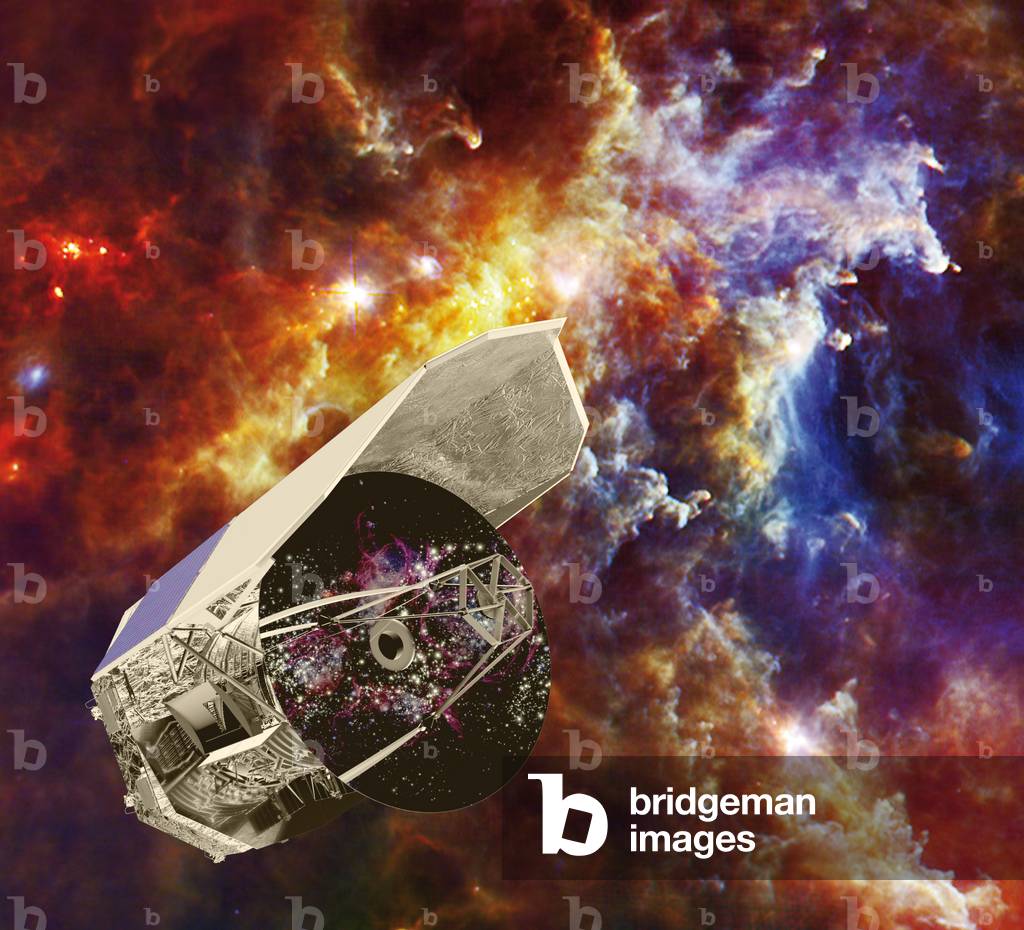
Herschel Satellite - Illustration - Herschel Satellite. Artwork - Artist's view of the European satellite Herschel. The Herschel Space Observatory, scheduled to launch in 2009, will study in the infrared the formation of galaxies, stars and planetary systems. This satellite measures nearly 7 metres high by 4.3 metres wide and weighs 3.25 tonnes. Its telescope has a 3.5-meter mirror, making it the largest mirror ever made for a scientific space mission. Herschel will orbit around Lagrange 2, approximately 1.5 million kilometres from Earth. ESA's Herschel Space Observatory (formerly called Far Infrared and Submillimetre Telescope or FIRST) will solve the mystery of how stars and galaxies were born. Infrared astronomy is as young as it is fruitful. In less than three decades infrared astronomers have unveiled tens of thousands of new galaxies, and have made discoveries as surprising as the huge amounts of water vapour that fill the galaxy. Yet scientists know there is still much more to discover. Objects such as other planetary systems, or processes like the birth of galaxies in the early universe, can best be studied with infrared space telescopes in space. This is the reason for Esa's Herschel. ESA's Herschel Space Observatory will be bigger and better than any of its predecessors. Moreover, it will observe at wavelengths never covered before. It will be located 1.5 million kilometers away from Earth, farther than any previous space telescope. Due for launch in 2009, Herschel is one the Cornerstone missions ESA's Horizons 2000 programme. Herschel is a key project space astronomy in the next millennium
Satellite Herschel - Illustration - Artist's view of the European satellite Herschel. The Herschel Space Observatory, launched in 2009, studies the formation of galaxies, stars and planetary systems in the infrared. This satellite measures nearly 7 metres high by 4.3 metres wide and weighs 3.25 tonnes. Its telescope has a 3.5-meter mirror, making it the largest mirror ever made for a scientific space mission. Herschel is in orbit around Lagrange 2, approximately 1.5 million kilometres from Earth. ESA's Herschel Space Observatory (formerly called Far Infrared and Submillimetre Telescope or FIRST) studies the mystery of how stars and galaxies were born. Objects such as other planetary systems, or processes like the birth of galaxies in the early universe, can best be studied with infrared space telescopes in space. This is the reason for Esa's Herschel. ESA's Herschel Space Observatory is bigger and better than any of its predecessors. Moreover, it observes at wavelengths never covered before. It is located 1.5 million kilometers away from Earth, farther than any previous space telescope. Launched in 2009, Herschel is one the Cornerstone missions ESA's Horizons 2000 programme. Herschel is a key project space astronomy in the next millennium
Satellite COROT - Artist's view of COROT - Artist's view of COROT - Artist's view of the satellite COROT in space. Launched at the end of December 2006, this satellite studies the physical phenomena occurring inside the stars. It is also used for the detection of extrasolar planets by observing the periodic micro-eclipses that these planets cause by passing in front of their mother star. Artist's view of COROT, the exoplanet hunter mission led by CNES, with ESA participation. Launched in December 2006, COROT is placed on a circular, polar orbit around Earth that allow for continuous observations of two large and opposite regions in the sky for more than 150 days each. Within each region there are many selected fields that will be monitored in turn. The reason for the oppositely sited regions is that, because of the Earth's movement around the Sun, the sun's rays start to interfere with the observations after 150 days. COROT then rotates by 180 degrees and start observing the other region
Mirror of the Herschel satellite - Herschel spacecraft's mirror - Inspection of the mirror of the European Herschel satellite. The Herschel Space Observatory, scheduled to launch in 2009, will study in the infrared the formation of galaxies, stars and planetary systems. This satellite measures nearly 7 metres high by 4.3 metres wide and weighs 3.25 tonnes. Its telescope has a 3.5-meter mirror, making it the largest mirror ever made for a scientific space mission. Herschel will orbit around Lagrange 2, approximately 1.5 million kilometres from Earth. The gigantic telescope of ESA's space - based infrared observatory, Herschel, is being prepared to be assembled with its spacecraft. Herschel's telescope, which will carry the largest mirror ever flown in space, has been delivered to ESA's European Space Research and Technology Centre, ESTEC, where engineers and scientists are busy with the final steps that will prepare the infrared observatory for launch in 2009. ESA's Herschel Space Observatory will observe at wavelengths never covered before. It will be located 1.5 million kilometers away from Earth, farther than any previous space telescope
Satellite COROT - Artist's view of COROT - Artist's view of COROT - Artist's view of the satellite COROT in space. Launched at the end of December 2006, this satellite studies the physical phenomena occurring inside the stars. It is also used for the detection of extrasolar planets by observing the periodic micro-eclipses that these planets cause by passing in front of their mother star. Artist's view of COROT, the exoplanet hunter mission led by CNES, with ESA participation. Launched in December 2006, COROT is placed on a circular, polar orbit around Earth that allow for continuous observations of two large and opposite regions in the sky for more than 150 days each. Within each region there are many selected fields that will be monitored in turn. The reason for the oppositely sited regions is that, because of the Earth's movement around the Sun, the sun's rays start to interfere with the observations after 150 days. COROT then rotates by 180 degrees and start observing the other region
Herschel Satellite - Illustration - Herschel Satellite. Artwork - Artist's view of the European satellite Herschel. The Herschel Space Observatory, scheduled to launch in 2009, will study in the infrared the formation of galaxies, stars and planetary systems. This satellite measures nearly 7 metres high by 4.3 metres wide and weighs 3.25 tonnes. Its telescope has a 3.5-meter mirror, making it the largest mirror ever made for a scientific space mission. Herschel will orbit around Lagrange 2, approximately 1.5 million kilometres from Earth. ESA's Herschel Space Observatory (formerly called Far Infrared and Submillimetre Telescope or FIRST) will solve the mystery of how stars and galaxies were born. Infrared astronomy is as young as it is fruitful. In less than three decades infrared astronomers have unveiled tens of thousands of new galaxies, and have made discoveries as surprising as the huge amounts of water vapour that fill the galaxy. Yet scientists know there is still much more to discover. Objects such as other planetary systems, or processes like the birth of galaxies in the early universe, can best be studied with infrared space telescopes in space. This is the reason for Esa's Herschel. ESA's Herschel Space Observatory will be bigger and better than any of its predecessors. Moreover, it will observe at wavelengths never covered before. It will be located 1.5 million kilometers away from Earth, farther than any previous space telescope. Due for launch in 2009, Herschel is one the Cornerstone missions ESA's Horizons 2000 programme. Herschel is a key project space astronomy in the next millennium
Mirror of the Herschel satellite - Herschel spacecraft's mirror - Inspection of the mirror of the European Herschel satellite. The Herschel Space Observatory, scheduled to launch in 2009, will study in the infrared the formation of galaxies, stars and planetary systems. This satellite measures nearly 7 metres high by 4.3 metres wide and weighs 3.25 tonnes. Its telescope has a 3.5-meter mirror, making it the largest mirror ever made for a scientific space mission. Herschel will orbit around Lagrange 2, approximately 1.5 million kilometres from Earth. The gigantic telescope of ESA's space - based infrared observatory, Herschel, is being prepared to be assembled with its spacecraft. Herschel's telescope, which will carry the largest mirror ever flown in space, has been delivered to ESA's European Space Research and Technology Centre, ESTEC, where engineers and scientists are busy with the final steps that will prepare the infrared observatory for launch in 2009. ESA's Herschel Space Observatory will observe at wavelengths never covered before. It will be located 1.5 million kilometers away from Earth, farther than any previous space telescope
The SOHO satellite (photo)
Satellite Herschel - Illustration - Artist's view of the European satellite Herschel. The Herschel Space Observatory, scheduled to launch in 2009, will study in the infrared the formation of galaxies, stars and planetary systems. This satellite measures nearly 7 metres high by 4.3 metres wide and weighs 3.25 tonnes. Its telescope has a 3.5-meter mirror, making it the largest mirror ever made for a scientific space mission. Herschel will orbit around Lagrange 2, approximately 1.5 million kilometres from Earth. ESA's Herschel Space Observatory (formerly called Far Infrared and Submillimetre Telescope or FIRST) will solve the mystery of how stars and galaxies were born. Objects such as other planetary systems, or processes like the birth of galaxies in the early universe, can best be studied with infrared space telescopes in space. This is the reason for Esa's Herschel. ESA's Herschel Space Observatory will be bigger and better than any of its predecessors. Moreover, it will observe at wavelengths never covered before. It will be located 1.5 million kilometers away from Earth, farther than any previous space telescope. Due for launch in 2009, Herschel is one the Cornerstone missions ESA's Horizons 2000 programme. Herschel is a key project space astronomy in the next millennium
Satellite COROT and double star - Illustration - Artist's view of COROT watching a binary star - Artist's view of the satellite COROT in space. Launched at the end of December 2006, this satellite studies the physical phenomena occurring inside the stars. It is also used for the detection of extrasolar planets by observing the periodic micro-eclipses that these planets cause by passing in front of their mother star. Artist's view of COROT, the exoplanet hunter mission led by CNES, with ESA participation. Launched in December 2006, COROT is placed on a circular, polar orbit around Earth that allow for continuous observations of two large and opposite regions in the sky for more than 150 days each. Within each region there are many selected fields that will be monitored in turn. The reason for the oppositely sited regions is that, because of the Earth's movement around the Sun, the sun's rays start to interfere with the observations after 150 days. COROT then rotates by 180 degrees and start observing the other region
Hubble space telescope - Artist's view - Hubble space telescope - Artwork - Artist's view of the space shuttle with the Hubble space telescope in its hold. The Hubble Space Telescope is a telescope orbiting the Earth at about 600 km altitude. It is 13 metres long, its main mirror has a diameter of 2.4 metres. He is equipped with spectrometer and several cameras observing the Universe in visible and infrared. Illustration showing the space shuttle with the Hubble space telescope in its payload bay during a servicing mission
Hubble space telescope - Artist view - Hubble space telescope - Artist view - The Hubble space telescope is a telescope orbiting the Earth at about 600 km altitude. It is 13 metres long, its main mirror has a diameter of 2.4 metres. He is equipped with spectrometer and several cameras observing the Universe in visible and infrared. The Hubble space telescope is in orbit at about 600 km around the Earth. This 13 meters in length telescope with a mirror of 2.4 meters (94.5 inches) in diameter is also equipped of many cameras and a spectrometer to observe the Universe in the visible and infrared light
Satellite COROT - Artist's view of COROT - Artist's view of COROT - Artist's view of the satellite COROT in space. Launched at the end of December 2006, this satellite studies the physical phenomena occurring inside the stars. It is also used for the detection of extrasolar planets by observing the periodic micro-eclipses that these planets cause by passing in front of their mother star. This artist's view shows the COROT satellite, consisting of a 30 - centimetre space telescope launched in late 2006. COROT uses its telescope to monitor closely the changes in a star's brightness that comes from a planet crossing in front of it. While it is looking at a star, COROT is also able to detect 'starquakes', acoustical waves generated deep inside a star that send ripples across a star's surface, altering its brightness. The exact nature of the ripples allows astronomers to calculate the star's precise mass, age and chemical composition
Chandra Space Telescope - Artist View - Chandra X - Ray Observatory - View of the Chandra Telescope in orbit around Earth. The Chandra space telescope observes the universe in X-ray; it was launched and put into orbit in July 1999. Nasa's Chandra X - ray Observatory as it may appear at about 50,000 miles from the Earth, almost twice as high as Earth - orbiting geosynchronous satellites. Named after the Indian astrophysicist Subrahmanyan Chandrasekhar, the Chandra X - ray Observatory is the world's most powerful X - ray telescope, and at a weight of over 5 tons (10 tons including the detachable booster rocket) was the heaviest payload ever delivered into orbit by the Space Shuttle. Chandra was carried into space by Columbia in July 1999. Originally designed for a 5 year mission dedicated to observing distant celestial objects in the X - ray spectrum, Chandra has been observing for over three times that long and is still going strong. In this image the Chandra X - ray Observatory reveals its objective “” lens”” which focuses high - energy X - ray photons by means of four layers of long nested metal mirrors oriented obliquely to the X - ray source. These mirrors constitute most of the length of Chandra's 45 - foot - long tapered tube shape with science instruments capping far end for analyzing the focused X - rays. In this image the concentric rings at the near end of the telescope are the opening through which the X - rays enter the mirror assembly. The Chandra X - ray Observatory is 45 feet long with a solar panel “” wingspan””” of 64 feet
Satellite COROT - Artist's view of COROT - Artist's view of COROT - Artist's view of the satellite COROT in space. Launched at the end of December 2006, this satellite studies the physical phenomena occurring inside the stars. It is also used for the detection of extrasolar planets by observing the periodic micro-eclipses that these planets cause by passing in front of their mother star. This artist's view shows the COROT satellite, consisting of a 30 - centimetre space telescope launched in late 2006. COROT uses its telescope to monitor closely the changes in a star's brightness that comes from a planet crossing in front of it. While it is looking at a star, COROT is also able to detect 'starquakes', acoustical waves generated deep inside a star that send ripples across a star's surface, altering its brightness. The exact nature of the ripples allows astronomers to calculate the star's precise mass, age and chemical composition
Satellite Herschel - Illustration - Artist's view of the European satellite Herschel. The Herschel Space Observatory, scheduled to launch in 2009, will study in the infrared the formation of galaxies, stars and planetary systems. This satellite measures nearly 7 metres high by 4.3 metres wide and weighs 3.25 tonnes. Its telescope has a 3.5-meter mirror, making it the largest mirror ever made for a scientific space mission. Herschel will orbit around Lagrange 2, approximately 1.5 million kilometres from Earth. ESA's Herschel Space Observatory (formerly called Far Infrared and Submillimetre Telescope or FIRST) will solve the mystery of how stars and galaxies were born. Objects such as other planetary systems, or processes like the birth of galaxies in the early universe, can best be studied with infrared space telescopes in space. This is the reason for Esa's Herschel. ESA's Herschel Space Observatory will be bigger and better than any of its predecessors. Moreover, it will observe at wavelengths never covered before. It will be located 1.5 million kilometers away from Earth, farther than any previous space telescope. Due for launch in 2009, Herschel is one the Cornerstone missions ESA's Horizons 2000 programme. Herschel is a key project space astronomy in the next millennium
Satellite Integral - Illustration - Artist's view of the European satellite INTEGRAL (International Gamma - Ray Astrophysics Laboratory) observing a black hole. Integral (International Gamma - Ray Astrophysics Laboratory) is the first space observatory that can simultaneously observe objects in gamma rays, X - rays, and visible light. Its main targets are violent explosions known as gamma - ray bursts, powerful phenomena such as supernova explosions, and regions in the Universe thought to contain black holes. Launched on 17 October 2002 (Proton launcher from Baikonur, Kazakhstan)
Jupiter seen from its satellite Europe - Illustration - Jupiter & Io from Europa's surface - Illustration - Jupiter and Io seen from the ice surface of the satellite Europe. The surface of Europe is about five times brighter than our Moon. A crescent Jupiter hovers near the horizon along with Jupiter's volcanic satellite Io. In the foreground a meandering crevasse cleaves Europa's icy surface, one of thousands that crisscross this moon's exceedingly flat and bright exterior. The surface of Europa is about five times brighter than our own Moon and is so flat that no feature rises more than 3,000 feet
Satellite Herschel - Illustration - Ariane 5 stage with satellite Herschel. Artwork - Artist's view of the European satellite Herschel during its launch by an Ariane 5 rocket. The Herschel Space Observatory, launched on 14 May 2009, is studying in the infrared the formation of galaxies, stars and planetary systems. This satellite measures nearly 7 metres high by 4.3 metres wide and weighs 3.25 tonnes. Its telescope has a 3.5-meter mirror, making it the largest mirror ever made for a scientific space mission. Herschel is in orbit around Lagrange 2, approximately 1.5 million kilometres from Earth. ESA's Herschel Space Observatory (formerly called Far Infrared and Submillimetre Telescope or FIRST) will solve the mystery of how stars and galaxies were born. Objects such as other planetary systems, or processes like the birth of galaxies in the early universe, can best be studied with infrared space telescopes in space. This is the reason for Esa's Herschel. ESA's Herschel Space Observatory will be bigger and better than any of its predecessors. Moreover, it will observe at wavelengths never covered before. It will be located 1.5 million kilometers away from Earth, farther than any previous space telescope. Launched on May 14 2009, Herschel is one the Cornerstone missions ESA's Horizons 2000 programme. Herschel is a key project space astronomy in the next millennium
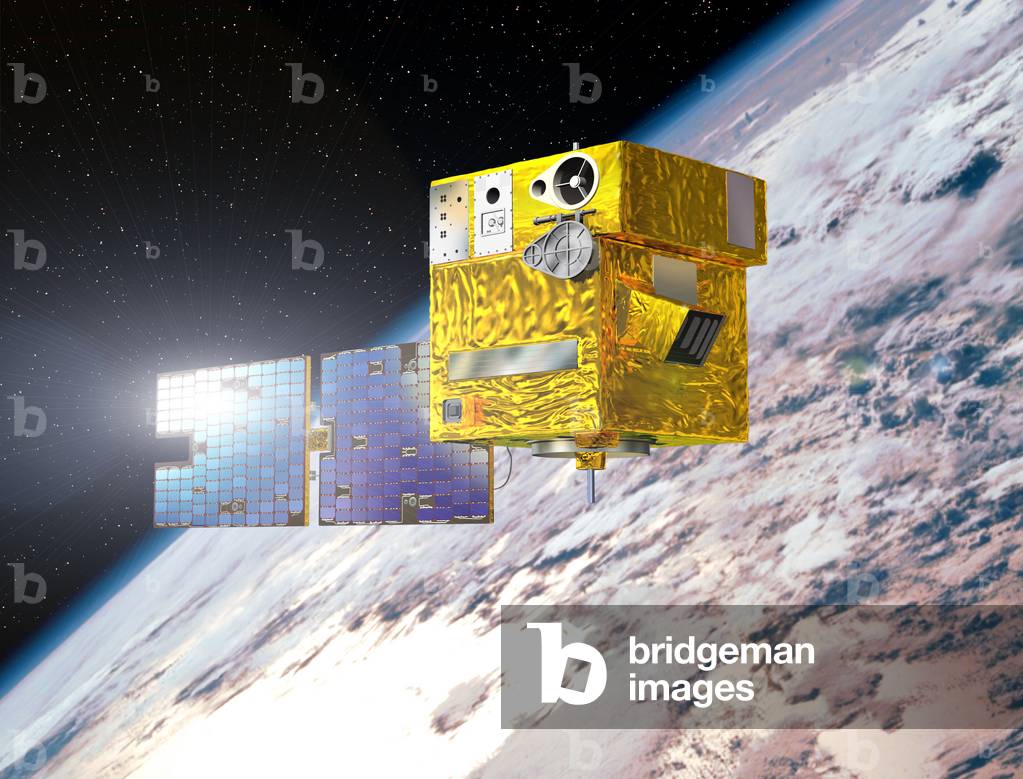
Satellite Integral - Illustration - Artist's view of the European satellite INTEGRAL (International Gamma - Ray Astrophysics Laboratory) observing a black hole. Integral (International Gamma - Ray Astrophysics Laboratory) is the first space observatory that can simultaneously observe objects in gamma rays, X - rays, and visible light. Its main targets are violent explosions known as gamma - ray bursts, powerful phenomena such as supernova explosions, and regions in the Universe thought to contain black holes. Launched on 17 October 2002 (Proton launcher from Baikonur, Kazakhstan)
James Webb Space Telescope Mirrors (JWST) - Testing of the JWST's mirrors: Six of the 18 JWST (James Webb Space Telescope) mirrors seen at Nasa's Marshall Space Center. These mirrors will be tested there to ensure they will withstand the extreme temperatures of space vacuum. The JWST will replace the Hubble Space Telescope in 2018. Team with a 6.5 m mirror, he will observe the universe mainly in infrared - Six of the 18 James Webb Space Telescope mirror segments are being moved into the X-ray and Cryogenic Facility, or XRCF, at Nasa's Marshall Space Flight Center in Huntsville, Ala., to eventually experience temperatures dipping to a chilling -414 degrees Fahrenheit to ensure they can withstand the extreme space environments. The test chamber takes approximately five days to cool a mirror segment to cryogenic temperatures. Marshall's X-ray & Cryogenic Facility is the world's largest X-ray telescope test facility and a unique, cryogenic, clean room optical test location. The James Webb Space Telescope (JWST) is a large, infrared-optimized space telescope scheduled for launch in 2018. Equipped with a large mirror 6.5 meters (21.3 feet) in diameter, it will find the first galaxies that formed in the early Universe, connecting the Big Bang to our own Milky Way Galaxy and will reside in an orbit about 1.5 million km (1 million miles) from the Earth
James Webb Space Telescope Mirrors (JWST) - Testing of the JWST's mirrors - Six of the 18 JWST (James Webb Space Telescope) mirrors seen at Nasa's Marshall Space Center. These mirrors will be tested there to ensure they will withstand the extreme temperatures of space vacuum. The JWST will replace the Hubble Space Telescope in 2014. Equipped with a 6.5 m mirror, he will observe the universe mainly in infrared. Six of the 18 James Webb Space Telescope mirror segments are being moved into the X - ray and Cryogenic Facility, or XRCF, at Nasa's Marshall Space Flight Center in Huntsville, Ala., to eventually experience temperatures dipping to a chilling - 414 degrees Fahrenheit to ensure they can withstand the extreme space environments. The test chamber takes approximately five days to cool a mirror segment to cryogenic temperatures. Marshall's X - ray & Cryogenic Facility is the world's largest X - ray telescope test facility and a unique, cryogenic, clean room optical test location. The James Webb Space Telescope (JWST) is a large, infrared - optimized space telescope scheduled for launch in 2014. Equipped with a large mirror 6.5 meters (21.3 feet) in diameter, it will find the first galaxies that formed in the early Universe, connecting the Big Bang to our own Milky Way Galaxy and will reside in an orbit about 1.5 million km (1 million miles) from the Earth
James Webb Space Telescope Mirrors (JWST) - Testing of the JWST's mirrors: Six of the 18 JWST (James Webb Space Telescope) mirrors seen at Nasa's Marshall Space Center. These mirrors will be tested there to ensure they will resist the extreme temperatures of space vacuum. The JWST will replace the Hubble Space Telescope in 2018. Equipped with a 6.5 m mirror, he will observe the universe mainly in infrared - Ball Aerospace lead optical test engineer Dave Chaney inspects six primary mirror segments, critical elements of Nasa's James Webb Space Telescope, prior to cryogenic testing in the X-ray & Cryogenic Facility at Nasa's Marshall Space Flight Center in Huntsville, Ala. The James Webb Space Telescope will be launched in 2018 to study the formation of the first stars and galaxies and shed new light on the evolution of the universe
James Webb Space Telescope Mirrors (JWST) - Testing of the JWST's mirrors: Six of the 18 JWST (James Webb Space Telescope) mirrors seen at Nasa's Marshall Space Center. These mirrors will be tested there to ensure they will resist the extreme temperatures of space vacuum. The JWST will replace the Hubble Space Telescope in 2018. Equipped with a 6.5 m mirror, he will observe the universe mainly in infrared - Space Telescope's primary mirror segments are prepared to begin final cryogenic testing at Nasa's Marshall Space Flight Center in Huntsville, Ala. This represents the first six of 18 segments that will form Nasa's James Webb Space Telescope's primary mirror for space observations. Engineers began final round-the-clock cryogenic testing to confirm that the mirrors will respond as expected to the extreme temperatures of space prior to integration into the telescope's permanent housing structure
Satellite Herschel - Illustration - Ariane 5 fairing with satellite Herschel. Artwork - Artist's view of the European satellite Herschel during its launch by an Ariane 5 rocket. The Herschel Space Observatory, launched on 14 May 2009, is studying in the infrared the formation of galaxies, stars and planetary systems. This satellite measures nearly 7 metres high by 4.3 metres wide and weighs 3.25 tonnes. Its telescope has a 3.5-meter mirror, making it the largest mirror ever made for a scientific space mission. Herschel is in orbit around Lagrange 2, approximately 1.5 million kilometres from Earth. ESA's Herschel Space Observatory (formerly called Far Infrared and Submillimetre Telescope or FIRST) will solve the mystery of how stars and galaxies were born. Objects such as other planetary systems, or processes like the birth of galaxies in the early universe, can best be studied with infrared space telescopes in space. This is the reason for Esa's Herschel. ESA's Herschel Space Observatory will be bigger and better than any of its predecessors. Moreover, it will observe at wavelengths never covered before. It will be located 1.5 million kilometers away from Earth, farther than any previous space telescope. Launched on May 14 2009, Herschel is one the Cornerstone missions ESA's Horizons 2000 programme. Herschel is a key project space astronomy in the next millennium
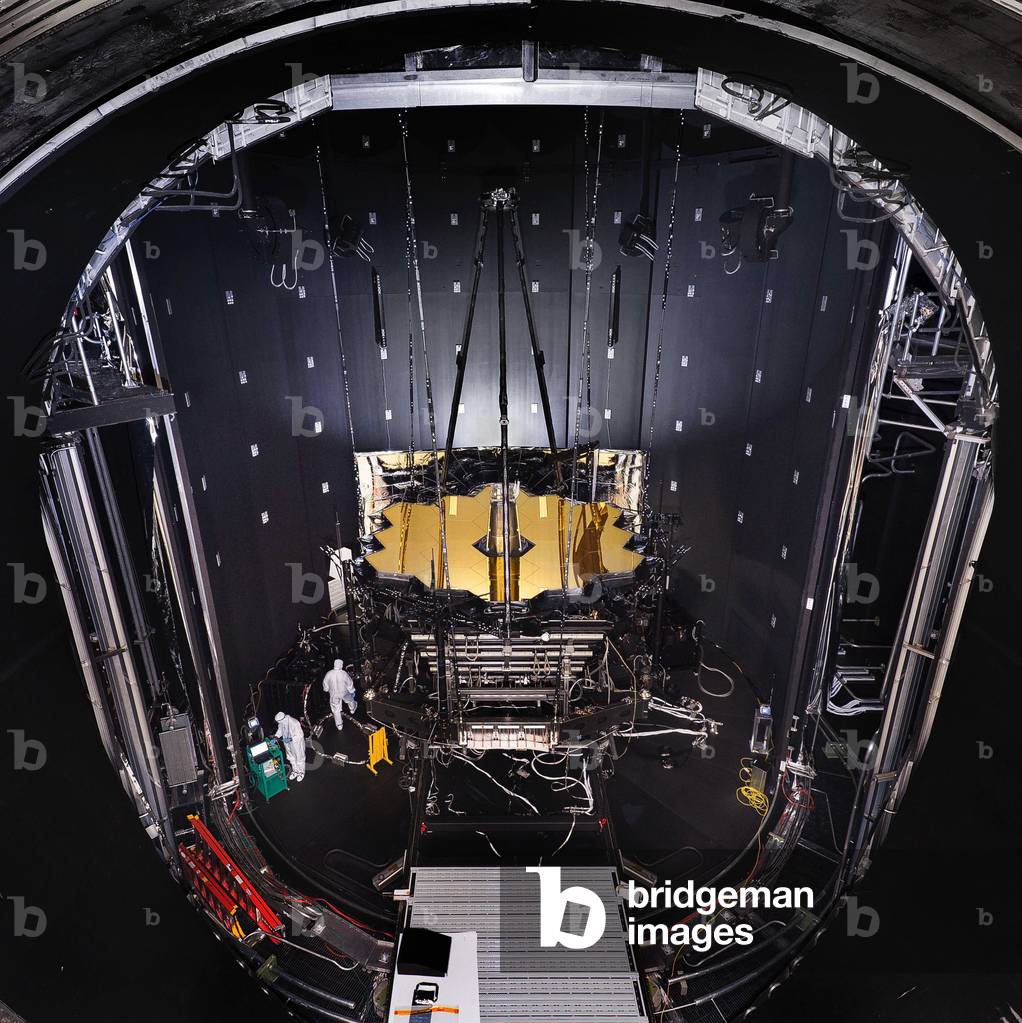
James Webb Space Telescope (JWST) - JWST Set for Testing in Space Simulation Chamber: The James Webb Space Telescope (JWST) in front of the empty chamber door of Nasa's Johnson Space Center. He'll be locked up for a series of tests. The JWST will replace the Hubble Space Telescope in 2018. Equipped with a 6.5 m mirror, he will observe the universe mainly in infrared. 25 May 2017. Nasa's James Webb Space Telescope sits in front of the door to Chamber A, a giant thermal vacuum chamber located at Nasa's Johnson Space Center. The telescope will soon be moved into the chamber, where it will spend a hot Houston summer undergoing tests at sub-freezing cryogenic temperatures. The telescope will operate at an extremely cold 39 K (-234* C or -389* F) in space, so NASA is simulating those conditions on the ground, ensuring the optics and instruments will perform perfectly after launch. May 25 2017.
Hubble space telescope: end of the 4th maintenance mission 05/2009 - Hubble space telescope: end of the fourth repair mission - The Hubble space telescope (HST) seen from space shuttle Atlantis after their separation on 19 May 2009. An STS - 125 crew member aboard the Space Shuttle Atlantis captured this still image of the Hubble Space Telescope as the two spacecraft begin their relative separation on May 19, after having been linked together for the better part of a week. During the week five spacewalks were performed to complete the final servicing. 19 May 2009
Hubble space telescope: 4th maintenance mission 05/2009 - Hubble space telescope: fourth repair mission 05/2009 - Astronauts Michael Good (left) and Mike Massimino perform various maintenance tasks on the Hubble space telescope (HST) during the fourth of five space sorties planned during the STS mission - 125. 17 May 2009. Astronauts Michael Good (left) and Mike Massimino, both STS - 125 mission specialists, participate in the mission's fourth session of extravehicular activity (EVA) as work continues to refurbish and upgrade the Hubble Space Telescope. During the eight - hour, two - minute spacewalk, Massimino and Good continued repairs and improvements to the Space Telescope Imaging Spectrograph (STIS) that will extend the Hubble's life into the next decade. 17 May 2009
Hubble space telescope: end of the 4th maintenance mission 05/2009 - Hubble space telescope: end of the fourth repair mission - The Hubble space telescope (HST) seen from space shuttle Atlantis after their separation on 19 May 2009. An STS - 125 crew member aboard the Space Shuttle Atlantis captured this still image of the Hubble Space Telescope as the two spacecraft begin their relative separation on May 19, after having been linked together for the better part of a week. During the week five spacewalks were performed to complete the final servicing. 19 May 2009
James Webb Space Telescope Mirrors (JWST) - Testing of the JWST's mirrors: Six of the 18 JWST (James Webb Space Telescope) mirrors seen at Nasa's Marshall Space Center. These mirrors will be tested there to ensure they will withstand the extreme temperatures of space vacuum. The JWST will replace the Hubble Space Telescope in 2018. Equipped with a 6.5 m mirror, he will observe the universe mainly in infrared - Primary Mirror Segment Cryogenic Testing - Six of the 18 James Webb Space Telescope mirror segments are being prepped to move into the X-ray and Cryogenic Facility, or XRCF, at Nasa's Marshall Space Flight Center in Huntsville, Ala., to eventually experience temperatures dipping to a chilling -414 degrees Fahrenheit to ensure they can withstand the extreme space environments. The test chamber takes approximately five days to cool a mirror segment to cryogenic temperatures. Marshall's X-ray & Cryogenic Facility is the world's largest X-ray telescope test facility and a unique, cryogenic, clean room optical test location
Hubble space telescope: end of the 4th maintenance mission 05/2009 - Hubble space telescope: end of the fourth repair mission - The Hubble space telescope (HST) seen from space shuttle Atlantis after their separation on 19 May 2009. An STS - 125 crew member aboard the Space Shuttle Atlantis captured this still image of the Hubble Space Telescope as the two spacecraft begin their relative separation on May 19, after having been linked together for the better part of a week. During the week five spacewalks were performed to complete the final servicing. 19 May 2009
Satellite Herschel - Illustration - Ariane 5 fairing with satellite Herschel. Artwork - Artist's view of the European satellite Herschel during its launch by an Ariane 5 rocket. The Herschel Space Observatory, scheduled to launch in 2009, will study in the infrared the formation of galaxies, stars and planetary systems. This satellite measures nearly 7 metres high by 4.3 metres wide and weighs 3.25 tonnes. Its telescope has a 3.5-meter mirror, making it the largest mirror ever made for a scientific space mission. Herschel will orbit around Lagrange 2, approximately 1.5 million kilometres from Earth. ESA's Herschel Space Observatory (formerly called Far Infrared and Submillimetre Telescope or FIRST) will solve the mystery of how stars and galaxies were born. Objects such as other planetary systems, or processes like the birth of galaxies in the early universe, can best be studied with infrared space telescopes in space. This is the reason for Esa's Herschel. ESA's Herschel Space Observatory will be bigger and better than any of its predecessors. Moreover, it will observe at wavelengths never covered before. It will be located 1.5 million kilometers away from Earth, farther than any previous space telescope. Due for launch in 2009, Herschel is one the Cornerstone missions ESA's Horizons 2000 programme. Herschel is a key project space astronomy in the next millennium
Herschel satellite - Herschel spacecraft being prepared for acoustic tests - The European satellite Herschel prepares for acoustic tests in June 2008. The Herschel Space Observatory, scheduled to launch in 2009, will study in the infrared the formation of galaxies, stars and planetary systems. This satellite measures nearly 7 metres high by 4.3 metres wide and weighs 3.25 tonnes. Its telescope has a 3.5-meter mirror, making it the largest mirror ever made for a scientific space mission. Herschel will orbit around Lagrange 2, approximately 1.5 million kilometres from Earth. A picture of the Herschel spacecraft being prepared for acoustic tests. On 5 and 6 June 2008, the Herschel spacecraft successfully passed its acoustic tests. During the tests, the spacecraft was subjected to acoustic noise, generated to simulate the noise levels during launch, at the European Space Research and Technology Centre's Large European Acoustic Facility (LEAF). ESA's Herschel Space Observatory will observe at wavelengths never covered before. It will be located 1.5 million kilometers away from Earth, farther than any previous space telescope. Due for launch in 2009, Herschel is one the Cornerstone missions ESA's Horizons 2000 programme. Herschel is a key project space astronomy in the next millennium
Satellite COROT - Artist's view of COROT - Artist's view of COROT - Artist's view of the satellite COROT in space. Launched at the end of December 2006, this satellite studies the physical phenomena occurring inside the stars. It is also used for the detection of extrasolar planets by observing the periodic micro-eclipses that these planets cause by passing in front of their mother star. Artist's view of COROT, the exoplanet hunter mission led by CNES, with ESA participation. Launched in December 2006, COROT is placed on a circular, polar orbit around Earth that allow for continuous observations of two large and opposite regions in the sky for more than 150 days each. Within each region there are many selected fields that will be monitored in turn. The reason for the oppositely sited regions is that, because of the Earth's movement around the Sun, the sun's rays start to interfere with the observations after 150 days. COROT then rotates by 180 degrees and start observing the other region
Mirror of the Herschel satellite - Herschel spacecraft's mirror - Inspection of the mirror of the European Herschel satellite. The Herschel Space Observatory, scheduled to launch in 2009, will study in the infrared the formation of galaxies, stars and planetary systems. This satellite measures nearly 7 metres high by 4.3 metres wide and weighs 3.25 tonnes. Its telescope has a 3.5-meter mirror, making it the largest mirror ever made for a scientific space mission. Herschel will orbit around Lagrange 2, approximately 1.5 million kilometres from Earth. The gigantic telescope of ESA's space - based infrared observatory, Herschel, is being prepared to be assembled with its spacecraft. Herschel's telescope, which will carry the largest mirror ever flown in space, has been delivered to ESA's European Space Research and Technology Centre, ESTEC, where engineers and scientists are busy with the final steps that will prepare the infrared observatory for launch in 2009. ESA's Herschel Space Observatory will observe at wavelengths never covered before. It will be located 1.5 million kilometers away from Earth, farther than any previous space telescope
Satellite INTEGRAL - Artist's view - Satellite INTEGRAL. Artwork - Artist's view of the European satellite INTEGRAL (International Gamma - Ray Astrophysics Laboratory) in orbit around the Earth. Integral (International Gamma - Ray Astrophysics Laboratory) is the first space observatory that can simultaneously observe objects in gamma rays, X - rays, and visible light. Its main targets are violent explosions known as gamma - ray bursts, powerful phenomena such as supernova explosions, and regions in the Universe thought to contain black holes. Launched on 17 October 2002 (Proton launcher from Baikonur, Kazakhstan)
Mirror of the Herschel satellite - Herschel spacecraft's mirror - Inspection of the mirror of the European Herschel satellite. The Herschel Space Observatory, scheduled to launch in 2009, will study in the infrared the formation of galaxies, stars and planetary systems. This satellite measures nearly 7 metres high by 4.3 metres wide and weighs 3.25 tonnes. Its telescope has a 3.5-meter mirror, making it the largest mirror ever made for a scientific space mission. Herschel will orbit around Lagrange 2, approximately 1.5 million kilometres from Earth. The gigantic telescope of ESA's space - based infrared observatory, Herschel, is being prepared to be assembled with its spacecraft. Herschel's telescope, which will carry the largest mirror ever flown in space, has been delivered to ESA's European Space Research and Technology Centre, ESTEC, where engineers and scientists are busy with the final steps that will prepare the infrared observatory for launch in 2009. ESA's Herschel Space Observatory will observe at wavelengths never covered before. It will be located 1.5 million kilometers away from Earth, farther than any previous space telescope
Jupiter seen from his satellite Ganymede - Illustration - Ridges, grooves, and craters on Ganymede - Artist's view of the surface of Ganymede, Jupiter's largest satellite. An impact crater about 15 km in diameter differs from the striated surface of the satellite. In the sky are represented Jupiter, the Europe satellite on the top right, and Io on the left of Jupiter. Jupiter's largest satellite Ganymede has a varying surface, some of which is characterized by rumpled bundles of ridges and grooves that run for hundreds of miles over a frozen surface of water - ice. They probably formed long ago when tectonic forces pulled apart Ganymede's upper crust; similar sets of faults occur in rift zones on Earth, as in eastern Africa. Subsequent meteoritic impacts have peppered - - and broken in places - - the continuity of the running formations. In this image an impact crater about 10 miles in diameter dominates a scene otherwise defined by a dozen long ridges. In the middle of the crater is a central peak, formed when the energy of the impact liquefied the crust long enough for it to rebound upward and solidify once again. Immediately above the horizon, Jupiter is still a majestic spectacle, even at a distance of nearly three times that between the Earth and its moon. Much closer on the upper right is Ganymede's sister satellite Europa. At a distance of 307 thousand miles from this vantage point, Europe is only a quarter again as far as the Earth is from its moon. To the lower left of Jupiter at nearly a million miles is Jupiter's volcanic satellite Io
Jupiter seen from satellite Europe - Illustration - Europa southern hemisphere: Jupiter seen from an ice valley of the satellite Europe - Europa ice chasm
James Webb Space Telescope (JWST) - Artist View - The James Webb Space Telescope (JWST) - Artist view - The James Webb Space Telescope (JWST) will replace the Hubble Space Telescope in 2014. Equipped with a 6.5 m mirror, he will observe the universe mainly in infrared. The James Webb Space Telescope (JWST) is a large, infrared - optimized space telescope scheduled for launch in 2014. Equipped with a large mirror 6.5 meters (21.3 feet) in diameter, it will find the first galaxies that formed in the early Universe, connecting the Big Bang to our own Milky Way Galaxy and will reside in an orbit about 1.5 million km (1 million miles) from the Earth