[]
Votre Sélection en cours
média(s) Média(s)
Votre devis 0

Votre sélection

Annuler la sélection
Média ajouté au panier
{"event":"pageview","page_type1":"undetected","page_type2":"_assets_search_override","language":"fr","user_logged":"false","user_type":"ecommerce","nl_subscriber":"false"}
{"event":"ecommerce_event","event_name":"view_item","event_category":"browse_catalog","ecommerce":{"items":[{"item_id":"PIX4584461","item_category":"photo","item_category2":"no_copyright","item_category3":"standard","item_category4":"p_carril","item_category5":"not_balown","item_list_name":"search_results","item_name":"artist_view_of_a_galactic_black_hole","item_variant":"undefined"},{"item_id":"PIX4573504","item_category":"photo","item_category2":"no_copyright","item_category3":"standard","item_category4":"miller_ron_b_1947","item_category5":"not_balown","item_list_name":"search_results","item_name":"exoplanete_near_the_galactic_center_exoplanet_near_the_galactic_center_artwork","item_variant":"undefined"},{"item_id":"PIX4637914","item_category":"photo","item_category2":"no_copyright","item_category3":"standard","item_category4":"alex_tudorica","item_category5":"not_balown","item_list_name":"search_results","item_name":"lactee_way_galactic_centre_region_the_milky_way_looking_towards_the_galactic_centre","item_variant":"undefined"},{"item_id":"PIX4635743","item_category":"photo","item_category2":"no_copyright","item_category3":"standard","item_category4":"stephane_guisard","item_category5":"not_balown","item_list_name":"search_results","item_name":"the_milky_way_the_milky_way_the_milky_way_and_the_galactic_center_region_the_milky_way_with_galactic","item_variant":"undefined"},{"item_id":"PIX4637943","item_category":"photo","item_category2":"no_copyright","item_category3":"standard","item_category5":"not_balown","item_list_name":"search_results","item_name":"panorama_of_galactic_center_seen_in_infrared","item_variant":"undefined"},{"item_id":"MTE12038050","item_category":"illustration","item_category2":"in_copyright","item_category3":"premium","item_category4":"sanders_martha","item_category5":"not_balown","item_list_name":"search_results","item_name":"galactic_aviator_1994_watercolor_on_paper","item_variant":"undefined"},{"item_id":"PIX4584466","item_category":"photo","item_category2":"no_copyright","item_category3":"standard","item_category4":"p_carril","item_category5":"not_balown","item_list_name":"search_results","item_name":"artist_view_of_a_galactic_black_hole","item_variant":"undefined"},{"item_id":"PIX4637572","item_category":"photo","item_category2":"no_copyright","item_category3":"standard","item_category4":"sebastian_voltmer","item_category5":"not_balown","item_list_name":"search_results","item_name":"the_lactee_way_milky_way_the_lactee_way_the_galactic_center_region_june_2012_milky_way_the_galactic_","item_variant":"undefined"},{"item_id":"PIX4637973","item_category":"photo","item_category2":"no_copyright","item_category3":"standard","item_category5":"not_balown","item_list_name":"search_results","item_name":"galactic_center_region_center_of_our_galaxy_photo","item_variant":"undefined"},{"item_id":"PIX4573476","item_category":"photo","item_category2":"no_copyright","item_category3":"standard","item_category4":"s_numazawa","item_category5":"not_balown","item_list_name":"search_results","item_name":"exoplanete_near_the_galactic_center_artist_s_view","item_variant":"undefined"},{"item_id":"XIR159321","item_category":"illustration","item_category2":"out_of_copyright","item_category3":"standard","item_category4":"spanish_school_13th_century","item_category5":"balown","item_list_name":"search_results","item_name":"detail_of_cantiga_28_depicting_soldiers_encircling_constantinople_which_was_in_the_hands_of_the_chri","item_variant":"undefined"},{"item_id":"PIX4636807","item_category":"photo","item_category2":"no_copyright","item_category3":"standard","item_category5":"not_balown","item_list_name":"search_results","item_name":"lactee_route_in_sagittarius_scutum_parts_of_ophiuchus_sagittarius_and_the_galactic_bulg","item_variant":"undefined"},{"item_id":"PIX4635725","item_category":"photo","item_category2":"no_copyright","item_category3":"standard","item_category4":"stephane_guisard","item_category5":"not_balown","item_list_name":"search_results","item_name":"the_lactee_way_seen_from_the_southern_hemisphere_sagittarius_region_with_galactic_center","item_variant":"undefined"},{"item_id":"PIX4613946","item_category":"photo","item_category2":"no_copyright","item_category3":"standard","item_category4":"l_bret","item_category5":"not_balown","item_list_name":"search_results","item_name":"black_hole_in_the_heart_of_a_quasar_artist_s_view_black_hole_with_jets_galactic_black_hole_of_a_few_","item_variant":"undefined"},{"item_id":"UIG528804","item_category":"photo","item_category2":"no_copyright","item_category3":"standard","item_category5":"not_balown","item_list_name":"search_results","item_name":"centre_of_the_milky_way_galaxy_viewed_by_the_spitzer_space_telescope_infrared_image_of_the_galactic_","item_variant":"undefined"},{"item_id":"AVE6327828","item_category":"footage","item_category2":"no_copyright","item_category3":"standard","item_category5":"not_balown","item_list_name":"search_results","item_name":"america_c_1990s_inside_of_nasa_mission_control_center","item_variant":"undefined"},{"item_id":"PIX4635758","item_category":"photo","item_category2":"no_copyright","item_category3":"standard","item_category5":"not_balown","item_list_name":"search_results","item_name":"lactee_and_zodiac_light_the_milky_way_from_cygnus_to_carina_extereme_wide_field_view_towqards_the_ga","item_variant":"undefined"},{"item_id":"PIX4574333","item_category":"photo","item_category2":"no_copyright","item_category3":"standard","item_category4":"miller_ron_b_1947","item_category5":"not_balown","item_list_name":"search_results","item_name":"quasar_illustration_a_quasar_is_a_very_energetic_galaxy_with_an_active_galactic_nucleus_quasars_are_","item_variant":"undefined"},{"item_id":"AVE6327805","item_category":"footage","item_category2":"no_copyright","item_category3":"standard","item_category5":"not_balown","item_list_name":"search_results","item_name":"america_c_1990s_inside_of_nasa_mission_control_center","item_variant":"undefined"},{"item_id":"PIX4638239","item_category":"photo","item_category2":"no_copyright","item_category3":"standard","item_category4":"s_numazawa","item_category5":"not_balown","item_list_name":"search_results","item_name":"artist_s_view_of_the_galactic_center_the_galactic_center_artwork_central_region_of_our_galaxy_it_con","item_variant":"undefined"},{"item_id":"PIX4638234","item_category":"photo","item_category2":"no_copyright","item_category3":"standard","item_category4":"s_numazawa","item_category5":"not_balown","item_list_name":"search_results","item_name":"artist_s_view_of_the_galactic_center_the_galactic_center_artwork_central_region_of_our_galaxy_it_con","item_variant":"undefined"},{"item_id":"PIX4636609","item_category":"photo","item_category2":"no_copyright","item_category3":"standard","item_category4":"b_s_fletcher","item_category5":"not_balown","item_list_name":"search_results","item_name":"lactee_mosaic_of_4_photos_showing_the_halves_visible_in_the_northern_hemisphere_of_the_lactee_on_the","item_variant":"undefined"},{"item_id":"PIX4635793","item_category":"photo","item_category2":"no_copyright","item_category3":"standard","item_category5":"not_balown","item_list_name":"search_results","item_name":"la_voie_lactee_de_l_aigle_a_la_carene_extreme_wide_angle_view_of_the_milky_way_from_aquila_to_carina","item_variant":"undefined"},{"item_id":"UIG867275","item_category2":"no_copyright","item_category3":"standard","item_category5":"not_balown","item_list_name":"search_results","item_name":"in_the_perseus_spiral_arm_of_the_milky_way_galaxy_opposite_the_galactic_center_lies_the_nebula_sh_2_","item_variant":"undefined"},{"item_id":"UIG867274","item_category2":"no_copyright","item_category3":"standard","item_category5":"not_balown","item_list_name":"search_results","item_name":"in_the_perseus_spiral_arm_of_the_milky_way_galaxy_opposite_the_galactic_center_lies_the_nebula_sh_2_","item_variant":"undefined"},{"item_id":"PIX4572231","item_category":"photo","item_category2":"no_copyright","item_category3":"standard","item_category5":"not_balown","item_list_name":"search_results","item_name":"star_field_in_the_constellation_sagittarius_starfield_in_sagittarius_stars_in_sagittarius_towards_th","item_variant":"undefined"},{"item_id":"PIX4637874","item_category":"photo","item_category2":"no_copyright","item_category3":"standard","item_category4":"r_gendler","item_category5":"not_balown","item_list_name":"search_results","item_name":"the_milky_way_looking_towards_the_galactic_centre_mosaic_of_50_images_presenting_the_region_of_the_c","item_variant":"undefined"},{"item_id":"UIG867163","item_category":"photo","item_category2":"no_copyright","item_category3":"standard","item_category5":"not_balown","item_list_name":"search_results","item_name":"this_image_is_taken_looking_towards_a_region_of_our_milky_way_galaxy_in_the_eagle_constellation_clos","item_variant":"undefined"},{"item_id":"UIG867164","item_category2":"no_copyright","item_category3":"standard","item_category5":"not_balown","item_list_name":"search_results","item_name":"this_image_is_taken_looking_towards_a_region_of_our_milky_way_galaxy_in_the_eagle_constellation_clos","item_variant":"undefined"},{"item_id":"UIG867162","item_category2":"no_copyright","item_category3":"standard","item_category5":"not_balown","item_list_name":"search_results","item_name":"this_image_is_taken_looking_towards_a_region_of_our_milky_way_galaxy_in_the_eagle_constellation_clos","item_variant":"undefined"},{"item_id":"PIX4637870","item_category":"photo","item_category2":"no_copyright","item_category3":"standard","item_category5":"not_balown","item_list_name":"search_results","item_name":"the_milky_way_looking_towards_the_galactic_centre_the_milky_way_looking_towards_the_galactic_centre_","item_variant":"undefined"},{"item_id":"PIX4638236","item_category":"photo","item_category2":"no_copyright","item_category3":"standard","item_category4":"dixon_don_b_1951","item_category5":"not_balown","item_list_name":"search_results","item_name":"galactic_atmosphere_artist_view_galactic_atmosphere_artist_view_artist_view_artist_view_of_the_atmos","item_variant":"undefined"},{"item_id":"PIX4608293","item_category":"photo","item_category2":"no_copyright","item_category3":"standard","item_category4":"miller_ron_b_1947","item_category5":"not_balown","item_list_name":"search_results","item_name":"exoplanete_sweeps_10_sweeps_10_is_an_exoplanet_located_towards_the_galactic_center_this_hot_jupiter_","item_variant":"undefined"},{"item_id":"PIX4637984","item_category":"photo","item_category2":"no_copyright","item_category3":"standard","item_category5":"not_balown","item_list_name":"search_results","item_name":"galactic_center_region_the_galactic_center_the_galactic_center_region_of_the_center_of_our_galaxy_se","item_variant":"undefined"},{"item_id":"PIX4637920","item_category":"photo","item_category2":"no_copyright","item_category3":"standard","item_category5":"not_balown","item_list_name":"search_results","item_name":"lactee_galactic_centre_seen_in_infrared_data_obtained_from_two_1_3m_diameter_telescopes_located_at_m","item_variant":"undefined"},{"item_id":"PIX4635568","item_category":"photo","item_category2":"no_copyright","item_category3":"standard","item_category4":"serge_brunier","item_category5":"not_balown","item_list_name":"search_results","item_name":"the_milky_way_seen_at_5000m_height_the_lactee_way_photographed_from_the_chajnantor_plateau_in_the_an","item_variant":"undefined"},{"item_id":"PIX4621390","item_category":"photo","item_category2":"no_copyright","item_category3":"standard","item_category4":"stephane_guisard","item_category5":"not_balown","item_list_name":"search_results","item_name":"around_the_baade_window_the_baade_s_window_region_the_baade_window_at_the_bottom_right_of_the_gamma_","item_variant":"undefined"},{"item_id":"PIX4635695","item_category":"photo","item_category2":"no_copyright","item_category3":"standard","item_category5":"not_balown","item_list_name":"search_results","item_name":"south_hemisphere_this_is_a_long_exposure_about_an_hour_made_with_an_ordinary_camera_and_colour_film_","item_variant":"undefined"},{"item_id":"PIX4637936","item_category":"photo","item_category2":"no_copyright","item_category3":"standard","item_category5":"not_balown","item_list_name":"search_results","item_name":"the_galactic_center_seen_by_spitzer_space_telescope_the_galactic_center_region_seen_by_spitzer_satel","item_variant":"undefined"},{"item_id":"PIX4608319","item_category":"photo","item_category2":"no_copyright","item_category3":"standard","item_category5":"not_balown","item_list_name":"search_results","item_name":"exoplanete_sweeps_10_sweeps_10_is_an_exoplanet_located_towards_the_galactic_center_this_hot_jupiter_","item_variant":"undefined"},{"item_id":"PIX4636028","item_category":"photo","item_category2":"no_copyright","item_category3":"standard","item_category4":"stephane_guisard","item_category5":"not_balown","item_list_name":"search_results","item_name":"milky_way_all_around_the_horizon_panorama_of_360_degrees_the_lactee_path_blends_with_the_horizon_lin","item_variant":"undefined"},{"item_id":"PIX4635811","item_category":"photo","item_category2":"no_copyright","item_category3":"standard","item_category4":"serge_brunier","item_category5":"not_balown","item_list_name":"search_results","item_name":"the_centre_of_our_galaxy_the_lactee_way_the_galactic_center_the_central_region_of_our_galaxy_the_lac","item_variant":"undefined"},{"item_id":"PIX4610936","item_category":"photo","item_category2":"no_copyright","item_category3":"standard","item_category4":"adam_block","item_category5":"not_balown","item_list_name":"search_results","item_name":"galaxies_ngc_3718_and_ngc_3729_in_ursa_major","item_variant":"undefined"},{"item_id":"PIX4610376","item_category":"photo","item_category2":"no_copyright","item_category3":"standard","item_category4":"r_jay_gabany","item_category5":"not_balown","item_list_name":"search_results","item_name":"spiral_galaxy_m81_in_the_great_bear_spiral_galaxy_m81_in_ursa_major_the_spiral_galaxy_m81_is_located","item_variant":"undefined"},{"item_id":"PIX4635846","item_category":"photo","item_category2":"no_copyright","item_category3":"standard","item_category4":"stephane_guisard","item_category5":"not_balown","item_list_name":"search_results","item_name":"the_center_of_our_galaxy_the_lactee_way_the_center_of_our_galaxy_the_milky_way_the_central_region_of","item_variant":"undefined"},{"item_id":"PIX4612265","item_category":"photo","item_category2":"no_copyright","item_category3":"standard","item_category4":"stephane_guisard","item_category5":"not_balown","item_list_name":"search_results","item_name":"centaurus_a_elliptical_galaxy_ngc_5128_in_centaurus_elliptical_galaxy_centaurus_a_ngc_5128_the_galax","item_variant":"undefined"},{"item_id":"PIX4618768","item_category":"photo","item_category2":"no_copyright","item_category3":"standard","item_category5":"not_balown","item_list_name":"search_results","item_name":"ngc_2264_s_monocerotis_hubble_nebula_and_trumpler_5_clusters_ngc_2261_2264_the_cone_nebula_and_trump","item_variant":"undefined"},{"item_id":"PIX4610379","item_category":"photo","item_category2":"no_copyright","item_category3":"standard","item_category4":"r_gendler","item_category5":"not_balown","item_list_name":"search_results","item_name":"spiral_galaxy_m81_in_the_great_bear_spiral_galaxy_m81_in_ursa_major_the_spiral_galaxy_m81_is_located","item_variant":"undefined"},{"item_id":"PIX4610399","item_category":"photo","item_category2":"no_copyright","item_category3":"standard","item_category5":"not_balown","item_list_name":"search_results","item_name":"spiral_galaxy_m81_in_the_great_bear_spiral_galaxy_m81_in_ursa_major_the_spiral_galaxy_m81_is_located","item_variant":"undefined"},{"item_id":"PIX4593992","item_category":"photo","item_category2":"no_copyright","item_category3":"standard","item_category5":"not_balown","item_list_name":"search_results","item_name":"constellations_of_sculptor_right_and_fornax_left_part_of_the_constellation_of_the_whale_is_visible_a","item_variant":"undefined"},{"item_id":"PIX6333928","item_category":"photo","item_category2":"no_copyright","item_category3":"standard","item_category4":"sebastian_voltmer","item_category5":"not_balown","item_list_name":"search_results","item_name":"total_eclipse_of_moon_mars_and_milky_way_photo","item_variant":"undefined"},{"item_id":"PIX4610632","item_category":"photo","item_category2":"no_copyright","item_category3":"standard","item_category4":"r_gendler","item_category5":"not_balown","item_list_name":"search_results","item_name":"galaxies_m95_m96_and_m105_in_the_lion_galaxies_m95_m96_and_m105_in_leo_m95_ngc_3351_at_the_top_left_","item_variant":"undefined"},{"item_id":"PIX4610335","item_category":"photo","item_category2":"no_copyright","item_category3":"standard","item_category4":"r_gendler","item_category5":"not_balown","item_list_name":"search_results","item_name":"spiral_galaxy_m81_in_the_great_bear_spiral_galaxy_m81_in_ursa_major_the_spiral_galaxy_m81_is_located","item_variant":"undefined"},{"item_id":"PIX5620776","item_category":"photo","item_category2":"no_copyright","item_category3":"standard","item_category4":"serge_brunier","item_category5":"not_balown","item_list_name":"search_results","item_name":"the_center_of_our_galaxy_the_milky_way_photographed_from_the_atacama_desert_in_chile","item_variant":"undefined"},{"item_id":"PIX4610325","item_category":"photo","item_category2":"no_copyright","item_category3":"standard","item_category4":"r_jay_gabany","item_category5":"not_balown","item_list_name":"search_results","item_name":"spiral_galaxy_m81_in_the_great_bear_spiral_galaxy_m81_in_ursa_major_the_spiral_galaxy_m81_is_located","item_variant":"undefined"},{"item_id":"PIX4611406","item_category":"photo","item_category2":"no_copyright","item_category3":"standard","item_category4":"r_gendler","item_category5":"not_balown","item_list_name":"search_results","item_name":"m87_elliptical_galaxy_in_virgo_m87_elliptical_galaxy_in_virgo_the_m87_galaxy_ngc_4486_is_located_abo","item_variant":"undefined"},{"item_id":"PIX6426019","item_category":"photo","item_category2":"no_copyright","item_category3":"standard","item_category4":"miller_ron_b_1947","item_category5":"not_balown","item_list_name":"search_results","item_name":"cygnus_a_illustration","item_variant":"undefined"},{"item_id":"PIX4609420","item_category":"photo","item_category2":"no_copyright","item_category3":"standard","item_category4":"r_gendler","item_category5":"not_balown","item_list_name":"search_results","item_name":"galaxy_ngc_660_in_pisces_galaxy_ngc_660_in_pisces_the_galaxy_ngc_660_is_located_about_20_million_lig","item_variant":"undefined"},{"item_id":"PIX4612543","item_category":"illustration","item_category2":"no_copyright","item_category3":"standard","item_category5":"not_balown","item_list_name":"search_results","item_name":"galaxy_m83_in_hydra_galaxy_m83_in_hydra_the_galaxy_m83_ngc_5236_is_about_15_million_years_away_from_","item_variant":"undefined"},{"item_id":"SZT11791584","item_category":"photo","item_category2":"no_copyright","item_category3":"standard","item_category5":"not_balown","item_list_name":"search_results","item_name":"eva_pflug_2003_photo","item_variant":"undefined"},{"item_id":"PIX4612309","item_category":"photo","item_category2":"no_copyright","item_category3":"standard","item_category5":"not_balown","item_list_name":"search_results","item_name":"centaurus_a_elliptical_galaxy_ngc_5128_in_centaurus_the_radio_galaxy_centaurus_a_ngc_5128_the_galaxy","item_variant":"undefined"},{"item_id":"PIX4610419","item_category":"photo","item_category2":"no_copyright","item_category3":"standard","item_category5":"not_balown","item_list_name":"search_results","item_name":"irregular_galaxy_m82_in_the_great_bear_the_irregular_galaxy_m82_in_ursa_major_m82_is_an_irregular_ga","item_variant":"undefined"},{"item_id":"PIX4635808","item_category":"photo","item_category2":"no_copyright","item_category3":"standard","item_category4":"stephane_guisard","item_category5":"not_balown","item_list_name":"search_results","item_name":"milky_way_and_echinopsis_atacamensis_these_cacti_are_echinopsis_atacamensis_between_6_and_8_metres_h","item_variant":"undefined"},{"item_id":"PIX4636032","item_category":"photo","item_category2":"no_copyright","item_category3":"standard","item_category4":"stephane_guisard","item_category5":"not_balown","item_list_name":"search_results","item_name":"milky_way_all_around_the_horizon_and_gegenschein_fisheye_view_of_the_southern_sky_the_lactee_path_bl","item_variant":"undefined"},{"item_id":"PIX4565139","item_category":"photo","item_category2":"no_copyright","item_category3":"standard","item_category5":"not_balown","item_list_name":"search_results","item_name":"globular_cluster_ngc_6934_globular_cluster_ngc_6934_ngc_6934_is_located_about_50_000_light_years_awa","item_variant":"undefined"},{"item_id":"PIX4609594","item_category":"photo","item_category2":"no_copyright","item_category3":"standard","item_category4":"jim_misti","item_category5":"not_balown","item_list_name":"search_results","item_name":"spiral_galaxy_m77_in_the_whale_active_galaxy_m77_ngc_1068_in_cetus_m77_ngc_1068_this_active_galaxy_i","item_variant":"undefined"},{"item_id":"PIX4609610","item_category":"photo","item_category2":"no_copyright","item_category3":"standard","item_category4":"r_gendler","item_category5":"not_balown","item_list_name":"search_results","item_name":"spiral_galaxies_ngc_1055_and_ngc_1068_in_the_whale_ngc_1055_and_ngc_1068_spiral_galaxies_in_cetus_m7","item_variant":"undefined"},{"item_id":"PIX4564878","item_category":"photo","item_category2":"no_copyright","item_category3":"standard","item_category5":"not_balown","item_list_name":"search_results","item_name":"around_baade_s_window_around_baade_s_window_stars_field_to_the_center_of_our_galaxy_the_bright_star_","item_variant":"undefined"},{"item_id":"PIX4612271","item_category":"photo","item_category2":"no_copyright","item_category3":"standard","item_category4":"r_gendler","item_category5":"not_balown","item_list_name":"search_results","item_name":"centaurus_a_elliptical_galaxy_ngc_5128_in_centaurus_the_radio_galaxy_centaurus_a_ngc_5128_the_galaxy","item_variant":"undefined"},{"item_id":"PIX4612157","item_category":"photo","item_category2":"no_copyright","item_category3":"standard","item_category5":"not_balown","item_list_name":"search_results","item_name":"centaurus_a_elliptical_galaxy_ngc_5128_in_the_centaur_galaxy_centaurus_a_the_ngc_5128_galaxy_is_abou","item_variant":"undefined"},{"item_id":"PIX4611054","item_category":"photo","item_category2":"no_copyright","item_category3":"standard","item_category5":"not_balown","item_list_name":"search_results","item_name":"galaxy_ngc_4027_in_the_raven_galaxy_ngc_4027_in_corvus_ngc_4027_is_a_spiral_galaxy_located_about_80_","item_variant":"undefined"},{"item_id":"PIX4611058","item_category":"photo","item_category2":"no_copyright","item_category3":"standard","item_category5":"not_balown","item_list_name":"search_results","item_name":"galaxy_ngc_4027_in_the_raven_galaxy_ngc_4027_in_corvus_ngc_4027_is_a_spiral_galaxy_located_about_80_","item_variant":"undefined"},{"item_id":"PIX4610672","item_category":"photo","item_category2":"no_copyright","item_category3":"standard","item_category4":"r_gendler","item_category5":"not_balown","item_list_name":"search_results","item_name":"galaxies_m95_and_m96_in_the_lion_galaxies_m95_and_m96_in_leo_m95_ngc_3351_on_the_left_is_a_barree_sp","item_variant":"undefined"},{"item_id":"PIX4609596","item_category":"photo","item_category2":"no_copyright","item_category3":"standard","item_category4":"r_jay_gabany","item_category5":"not_balown","item_list_name":"search_results","item_name":"spiral_galaxy_m77_in_the_whale_active_galaxy_m77_ngc_1068_in_cetus_this_active_galaxy_is_the_typical","item_variant":"undefined"},{"item_id":"PIX4609435","item_category":"photo","item_category2":"no_copyright","item_category3":"standard","item_category4":"adam_block","item_category5":"not_balown","item_list_name":"search_results","item_name":"galaxy_ngc_660_in_pisces_polar_ring_galaxy_ngc_660_in_pisces_the_galaxy_ngc_660_is_located_about_20_","item_variant":"undefined"},{"item_id":"PIX4589943","item_category":"photo","item_category2":"no_copyright","item_category3":"standard","item_category5":"not_balown","item_list_name":"search_results","item_name":"constellation_of_the_berenice_hair_constellation_of_coma_berenices_the_constellation_of_the_berenice","item_variant":"undefined"},{"item_id":"PIX4610403","item_category":"photo","item_category2":"no_copyright","item_category3":"standard","item_category5":"not_balown","item_list_name":"search_results","item_name":"irregular_galaxy_m82_in_the_great_bear_the_irregular_galaxy_m82_in_ursa_major_m82_is_an_irregular_ga","item_variant":"undefined"},{"item_id":"PIX4589874","item_category":"photo","item_category2":"no_copyright","item_category3":"standard","item_category5":"not_balown","item_list_name":"search_results","item_name":"constellation_of_the_berenice_hair_constellation_of_coma_berenices_the_constellation_of_the_berenice","item_variant":"undefined"},{"item_id":"PIX4610955","item_category":"photo","item_category2":"no_copyright","item_category3":"standard","item_category4":"jim_misti","item_category5":"not_balown","item_list_name":"search_results","item_name":"galaxies_ngc_3718_in_the_great_bear_galaxy_ngc_3718_in_ursa_major_ngc_3718_arp_214_is_a_special_gala","item_variant":"undefined"},{"item_id":"PIX4568102","item_category":"photo","item_category2":"no_copyright","item_category3":"standard","item_category5":"not_balown","item_list_name":"search_results","item_name":"open_cluster_m93_ngc_2447_in_puppis_open_cluster_m93_ngc_2447_in_puppis_m93_ngc_2447_is_a_cluster_of","item_variant":"undefined"},{"item_id":"PIX4568311","item_category":"photo","item_category2":"no_copyright","item_category3":"standard","item_category5":"not_balown","item_list_name":"search_results","item_name":"open_cluster_ngc_6242_in_scorpio_open_star_cluster_ngc_6242_in_scorpius_this_cluster_is_about_3500_y","item_variant":"undefined"},{"item_id":"PIX4610440","item_category":"photo","item_category2":"no_copyright","item_category3":"standard","item_category5":"not_balown","item_list_name":"search_results","item_name":"galaxy_m82_in_the_great_bear_seen_in_x_rays_the_galaxy_m82_seen_in_x_ray_image_obtained_by_chandra_i","item_variant":"undefined"},{"item_id":"PIX4636007","item_category":"photo","item_category2":"no_copyright","item_category3":"standard","item_category4":"stephane_guisard","item_category5":"not_balown","item_list_name":"search_results","item_name":"the_center_of_our_galaxy_the_milky_way_the_center_of_our_galaxy_the_milky_way_this_billion_pixel_mos","item_variant":"undefined"},{"item_id":"PIX4619350","item_category":"photo","item_category2":"no_copyright","item_category3":"standard","item_category5":"not_balown","item_list_name":"search_results","item_name":"nebulae_ngc_6334_and_ngc_6357_in_scorpio_nebulae_ngc_6334_and_ngc_6357_in_scorpius_these_nebulae_are","item_variant":"undefined"},{"item_id":"PIX4622607","item_category":"photo","item_category2":"no_copyright","item_category3":"standard","item_category5":"not_balown","item_list_name":"search_results","item_name":"nebulae_ic_2948_and_2944_in_centaur_a_large_southern_emission_nebula_ic_2948_nebula_ic_2948_is_a_vas","item_variant":"undefined"},{"item_id":"PIX4619360","item_category":"photo","item_category2":"no_copyright","item_category3":"standard","item_category5":"not_balown","item_list_name":"search_results","item_name":"nebula_ngc_6334_in_the_scorpion_the_reddened_nebulosity_of_ngc_6334_the_nebula_ngc_6334_is_located_a","item_variant":"undefined"},{"item_id":"PIX4610948","item_category":"photo","item_category2":"no_copyright","item_category3":"standard","item_category4":"r_gendler","item_category5":"not_balown","item_list_name":"search_results","item_name":"galaxies_ngc_3718_and_ngc_3729_in_the_great_bear_galaxies_ngc_3718_and_ngc_3729_in_ursa_major_ngc_37","item_variant":"undefined"},{"item_id":"PIX4564850","item_category":"photo","item_category2":"no_copyright","item_category3":"standard","item_category5":"not_balown","item_list_name":"search_results","item_name":"globular_clusters_ngc_6522_and_ngc_6528_in_sagittarius_baade_s_window_around_ngc_6522_ngc_6522_right","item_variant":"undefined"},{"item_id":"PIX4564845","item_category":"photo","item_category2":"no_copyright","item_category3":"standard","item_category5":"not_balown","item_list_name":"search_results","item_name":"globular_cluster_ngc_6522_in_sagittarius_globular_cluster_ngc_6522_in_sagittarius_this_cluster_of_st","item_variant":"undefined"},{"item_id":"PIX4564866","item_category":"photo","item_category2":"no_copyright","item_category3":"standard","item_category5":"not_balown","item_list_name":"search_results","item_name":"globular_clusters_ngc_6522_and_ngc_6528_in_sagittarius_baade_s_window_around_ngc_6522_ngc_6522_right","item_variant":"undefined"}]}}
{"event":"custom_event","event_name":"view_search_result","event_category":"browse_catalog","keyword":"galattico","search_type":"standard","search_bridgeman_artists":"false","search_mode":"automatic","search_zero_result":"false","search_results":117,"search_results_page_number":1}

'Galattico' images et/ou videos résultats page 1 of 2

Filtres Principaux
Option pour "Acheter un tirage"
Option Libre de Droits
Ecommerce option
Résultats pour Reuters
Type de média
Orientation
Couleur
Catégorie
Droits
Filtres supplémentaires
Artistes Bridgeman
Photographes Bridgeman
Siècle
Filtres vidéo
Video Original Format
Video Resolution
Video Category
Filter group
Filter colors
Classer par:
par page
Filter group
Catégorie
Type de média
No copyright
Filter colors

Options d'affichage

View
Image Size
Artist View of a Galactic Black Hole
Exoplanete near the galactic center - Exoplanet near the galactic center Artwork
Instructions spéciales
  • No additional copyright fee required
Lactee Way - Galactic Centre Region - The Milky Way looking towards the Galactic Centre
The Milky Way - The Milky Way - The Milky Way and the Galactic Center Region. The Milky way with galactic center
Panorama of galactic center seen in infrared
Galactic Aviator, 1994 (Watercolor on Paper)
Copyright
  • Le droit d'auteur s'applique
premium
Artist View of a Galactic Black Hole
The Lactee Way - Milky Way - The Lactee Way. The Galactic Center region. June 2012. Milky Way. The galactic center
Galactic Center Region - Center of our galaxy (photo)
Exoplanete near the galactic center - Artist's view
Restrictions relatives au partenaire de contenu
  • Only available to clients invoiced in France
Lactee route in Sagittarius - Scutum, parts of Ophiuchus, Sagittarius and the galactic bulg
The Lactee Way seen from the southern hemisphere - Sagittarius Region with Galactic Center
America, c.1990s: Inside of NASA mission control center
Instructions spéciales
  • Content within this clip may require additional clearances (eg: trademark, audio rights and/or property/personality releases) depending on Licensee’s specific use of material.
Quasar - Illustration: A quasar is a very energetic galaxy with an active galactic nucleus. Quasars are the brightest objects in the universe
America, c.1990s: Inside of NASA mission control center
Instructions spéciales
  • Content within this clip may require additional clearances (eg: trademark, audio rights and/or property/personality releases) depending on Licensee’s specific use of material.
Artist's view of the galactic center - The galactic center. Artwork. - Central region of our galaxy; it contains the powerful radio source Sagittarius A which is believed to be associated with a supermassive black hole. The central part of our galaxy contains a powerful radio source (Sagittarius A) which seems to be associated to a supermassive black hole
Lactee - Mosaic of 4 photos showing the halves visible in the northern hemisphere of the lactee. On the right, the Sagittarius and the galactic center, on the left, Cassiopee
The Milky Way, looking towards the Galactic Centre - Mosaic of 50 images presenting the region of the center of our galaxy. 60 hours of cumulative poses. The center of our galaxy is a remarkable place. In visible light the central brightening known as “” Baade's Window”” represents not the true center but a discrete “” window””” in the dust which allows the light of millions of bulge stars to shine through. This allowed Walter Baade to peer through and calculate the distance to the galactic center in the 1940's. The true galactic center lies in the lower right of the image, near the NGC 6334-6357 nebulas complex. 50 Frame Mosaic, 60 Hours Exposure
The Milky Way, looking towards the Galactic Centre - The Milky Way, looking towards the Galactic Centre - The bright point at the bottom left is Jupiter Planet The Milky Way is best seen on winter nights (May to August) from the southern hemisphere. This wide-angle picture shows a broad span of the southern Milky Way and is a photograph made using colour film in a conventional camera. The camera which was pointed towards the centre of our Galaxy, in the direction of the constellation of Sagittarius. The Galactic centre itself is totally hidden at visible wavelengths by the band of dust which divides the Milky Way along much of its length. The dust lane is only visible because it blots out background stars. Embedded in the dust are many star-forming regions, seen as bright red emission nebulae. The brightest, left of the centre of the picture, is Messier 8, the Lagoon Nebula, which is visible to the unaided eye. The bright 'star' at lower left is the planet Jupiter
Galactic atmosphere - Artist view - Galactic atmosphere - Artist view - Artist view - Artist view of the “atmosphere” of our galaxy or gas arches elevent from the galactic plane pushed by currents created by supernovae explosions. Even the galaxy has a kind of weather, in which fountains of tenous gas arch high above the galactic plain through vents blasted by supernova explosions
Restrictions relatives au partenaire de contenu
  • Only available to clients invoiced in Balkans;Only available to clients invoiced in Europe;Only available to clients invoiced in Norway;Only available to clients invoiced in Switzerland
Instructions spéciales
  • No additional copyright fee required
Exoplanete SWEEPS-10: SWEEPS-10 is an exoplanet located towards the galactic center. This hot jupiter is one of the hottest exoplanets discovered to date with a temperature of 1650 degres. SWEEPS-10 is an extrasolar planet orbiting the star SWEPS J175902.00 291323.7 located in the Galactic bulge at a distance of approximately 22,000 light years from Earth. It completes an orbit of its star in just 10 hours, and is categorized as an ultra-short period planet (USPP). Located only 1.2 million kilometers from its star, the planet is among the hottest ever detected; its estimated temperature is approximately 1,650 degrees Celsius. This planet must be at least 1.6 times the mass of Jupiter
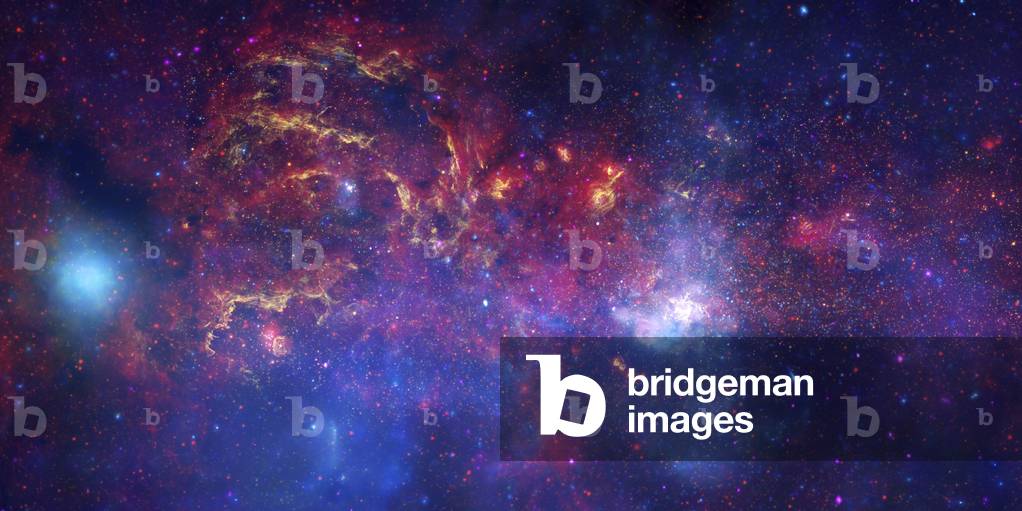
Galactic Center Region - The Galactic Center - The Galactic Center Region of the center of our galaxy seen the Chandra, Spitzer and Hubble satellites. The galactic center (Sagittarius A*) is located in the white area in the middle to the right of the image. In yellow, near-infrared images obtained by the Hubble Space Telescope; in red, infrared images obtained by the Spitzer Space Telescope; in blue and purple, X-ray observations obtained by the Chandra Space Telescope. Nasa's Great Observatories - the Hubble Space Telescope, the Spitzer Space Telescope, and the Chandra X-ray Observatory - have collaborated to produce an unprecedented image of the central region of our Milky Way galaxy. In this spectacular image, observations using infrared light and X-ray light see through the obscuring dust and reveal the intense activity near the galactic core. Note that the center of the galaxy is located within the bright white region to the right of and just below the middle of the image. The entire image width covers about one-half a degree, about the same angular width as the full moon. Each telescope's contribution is presented in a different color: - Yellow represents the near-infrared observations of Hubble. These observations outline the energetic regions where stars are being born as well as reveal hundreds of thousands of stars. - Red represents the infrared observations of Spitzer. The radiation and winds from stars create glowing dust clouds that exhibit complex structures from compact, spherical globules to long, stringy filaments. - Blue and violet represent the X-ray observations of Chandra. X-rays are emitted by gas heated to millions of degrees by stellar explosions and by outflows from the supermassive black hole in the galaxy's center. The bright blue blob on the left side is emission from a double star system containing either a neutron star or a black hole. When these views are brought together, this composite image provides one of the most detailed
Around the Baade window - The Baade's window region - The Baade Window (at the bottom right of the Gamma star of Sagittarius, the brightest of this image) is a region of the Lactee Way in the constellation of Sagittarius containing little interstellar dust. This region, named in reference to the astronomer Walter Baade, allows astronomers to have a more degagee view of the center of our galaxy. The Baade window, (at the bottom right of the bright star close to the center of this image), is a region of the Milky Way, in the Sagittarius constellation, with relatively little interstellar dust along our line of sight. It is therefore really a unique 'window' through which the astronomers can observe the Milky Way galactic Bulge, only a few degrees from the galactic center. The 'line of sight' through this 'window' passes 1800 light year nearby the Milky Way heart. This region of the sky was named after German astronomer Walter Baade
The galactic center seen by Spitzer Space Telescope - The galactic center region seen by Spitzer satellite. The area photographed extends over 890 light-years and over 640 light-years high. In visible light, this area is hidden by a large amount of interstellar dust. This picture in false colors shows the old and cold stars in blue, and the red regions the hot and massive stars. Dark and bright filamentous clouds are star-forming regions. The brightest area in the center of the image is the center of our galaxy which houses a supermassive black hole. This infrared image from Nasa's Spitzer Space Telescope shows hundreds of thousands of stars crowded into the swirling core of our spiral Milky Way galaxy. In visible-light pictures, this region cannot be seen at all because dust lying between Earth and the galactic center blocks our view. In this false-color picture, old and cool stars are blue, while dust features lit up by blazing hot, massive stars are shown in a reddish hue. Both bright and dark filamentary clouds can be seen, many of which harbor stellar nurseries. The plane of the Milky Way's flat disk is apparent as the main, horizontal band of clouds. The brightest white spot in the middle is the very center of the galaxy, which also marks the site of a supermassive black hole. The region pictured here is immense, with a horizontal span of 890 light-years and a vertical span of 640 light-years. Earth is located 26,000 light-years away, out in one of the Milky Way's spiral arms. Though most of the objects seen in this image are located at the galactic center, the features above and below the galactic plane tend to lie closer to Earth. This image is a mosaic of thousands of short exposures taken by Spitzer's Infrared Array Camera. The entire region was imaged in less than 16 hours
Exoplanete SWEEPS-10: SWEEPS-10 is an exoplanet located towards the galactic center. This hot jupiter is one of the hottest exoplanets discovered to date with a temperature of 1650 degres. SWEEPS-10 is an extrasolar planet orbiting the star SWEPS J175902.00 291323.7 located in the Galactic bulge at a distance of approximately 22,000 light years from Earth. It completes an orbit of its star in just 10 hours, and is categorized as an ultra-short period planet (USPP). Located only 1.2 million kilometers from its star, the planet is among the hottest ever detected; its estimated temperature is approximately 1,650 degrees Celsius. This planet must be at least 1.6 times the mass of Jupiter. This illustration presents a purely speculative view of what such a “” hot Jupiter”” might look like. It could have a powerful magnetic field that traps charged particles from the star. These particles create glowing auroral rings around the planet's magnetic poles
Milky way all around the horizon - Panorama of 360 degrees. The lactee path blends with the horizon line. In the sky, the three brightest galaxies visible on Earth: the two galaxies of the Magellan Cloud, and opposite it towards the right middle of the image, the galaxy of Andromede. 360 degrees panorama. The following image was taken at new Moon (No Moon light), middle of the night (minimum zodiacal light effect), in the Atacama desert close to Paranal observatory (no light pollution). The chosen place for this picture has the particularity to be located at a latitude which value is close to the declination of the galactic southern pole. The picture was therefore also taken when the galactic pole passes at zenith, ensuring that there is no Milky Way up in the sky. The Large (LMC) and Small (SMC) Magellanic clouds are visible to the left, Orion constellation with Barnard loop to the right, California Nebula and 'tiny' Andromeda galaxy to the right while the Milky Way is visible all around the image on the horizon line
The centre of our galaxy, the Lactee Way - The galactic center - The central region of our galaxy, the Lactee Way, photographed from the Atacama Desert, Chile. The total pose time of this image is 24 hours. It is here, in the constellations of Scorpio and Sagittarius, that is the most formidable concentration of stars in the sky. The center of our galaxy, the milky way, photographed from the Atacama desert in Chile. The total amount of exposures is 24 hours. This image shows the highest concentration of stars in Sagittarius and Scorpius constellations
Galaxies NGC 3718 and NGC 3729 in Ursa Major
Spiral galaxy M81 in the Great Bear - Spiral galaxy M81 in Ursa Major - The spiral galaxy M81 is located 12 million years ago - light from Earth. Its arms are home to star-forming regions while its core is surrounded by much older yellow stars. In the background at the top, an irregular dwarf galaxy, Holmberg IX. This image obtained by a 50 cm amateur telescope, in February 2010 for 23 hours of poses, shows gas filaments whose origin is uncertain. Located about 12 million light - years from our planet, M81 (NGC 3031) together with M82 (NGC 3034), NGC 3077 and NGC 2976 forms one of the most iconic groups of interacting galaxies. The M81 group has also been the subject of many studies searching for and analyzing evidence of strong interactions among its components. In 1965, Halton Arp detected an unusual looping feature near M81 while examining photographic plates produced with the 48 - inch Schmidt on Mount Palomar. Traditionally, ARP's loop has been interpreted as a tail resulting from the tidal interaction between M81 and M82. However, since its discovery that explanation has been doubted by many researchers. Interestingly, the region of the sky containing the M81 group of galaxies is filled with Galactic cirrus and ARP's loop exhibits colors and emission properties similar to those observed in Galactic cirrus clouds. This optical image suggests that the light observed at optical wavelengths is a combination of emissions from: recent star forming regions situated near M81, the extended disk of M81 and scattered light from the same Galactic cirrus that is responsible for the bulk of the far infrared emissions. Although our observations cannot exclude the presence of some material stripped from the disk of M81 (NGC 3031) and/or M82 (NGC 3034) that is chance located in our line of sight to and far behind this intruiging structure, our findings suggest that ARP's Loop is situated between the observer and M81 (
The center of our galaxy, the Lactee Way - The center of our galaxy, the milky way - The central region of our galaxy, the Lactee Way, photographed from Chile. This wide field image shows the Galactic Center region in the Milky Way. It is a very rich region of the sky, and is located in the constellations of Scorpius and Sagittarius. Among the zones and objects of interest on this image are: the colourful Antares region, the Baade window region, the Lagoon Nebula region with, just above it, the Trifid Nebula. The large and dark Pipe Nebula sits in the middle of this field
Centaurus A elliptical galaxy (NGC 5128) in Centaurus - Elliptical galaxy Centaurus A (NGC 5128) - The galaxy NGC 5128 is located about 13 million years away from Earth in the southern constellation of Centaurus. A broad dark band crosses it in the middle, a probable vestige of a collision with a spiral galaxy. This giant galaxy is a powerful radio source known as Centaurus A. NGC 5128 is the nearest large elliptical galaxies to our sun located at about 13 million light years. It is also the nearest of the giant radio galaxies, possessing an active galactic nucleus (AGN) and optically one of the most luminous galaxies in the sky
NGC 2264, S Monocerotis, Hubble Nebula and Trumpler 5 clusters - NGC 2261, 2264, the Cone nebula and Trumpler 5 - The Cone nebula on the left is a region H II located about 2600 years - light from Earth. The bright star on the top left is S Monocerotis, a star of magnitude 4.7. On the right, an open cluster of stars, Trumpler 5. Downstairs in the center, the Hubble nebula. Image obtained from the 1.2m Schmidt telescope of Siding Spring. The western end of the large constellation of Monoceros crossed by the Galactic plane and so is rich in the ingredients of star formation. Only five degrees south (not shown) is the beautiful Rosette nebula, also close to the Galactic plane. To the east (left) is the outline of the dark Cone nebula with its distinctive bright tip, apparently pointing to the star S Mon at the top (north) of the photograph. All around is faint nebulosity, hinting at star formation in the region. Around the dusty red nebula there are areas where the light from background stars is blocked out by dust which is unlit. At the lower center of the picture is Hubble's variable nebula (NGC 2261), a young star in a dusty cocoon, while at right is a large, old, open cluster of stars, Trumpler 5
Spiral galaxy M81 in the Great Bear - Spiral galaxy M81 in Ursa Major - The spiral galaxy M81 is located 12 million years ago - light from Earth. Its arms are home to star-forming regions while its core is surrounded by much older yellow stars. An irregular dwarf galaxy, PGC 28757 (Holmberg IX), is visible at the top of the picture. M81 is the brightest member of the nearby galactic group called the M81 group. This group contains at least 25 other members including the peculiar starburst galaxy M82, the peculiar galaxy NGC 3077 and many dwarfs galaxies. The core galaxies of the group (M81, M82, NGC 3077, NGC 2976) are strongly interacting and are all imbedded within a large and extended molecular gas cloud. The Dwarf irregular Holmberg IX (seen above M81 in the image) most likely condensed from tidal debri existing between M81 and M82. M81 has the distinction of being the nearest spiral galaxy to have an active galactic nucleus (AGN). AGN galaxies are luminous galaxies that demonstrate much of their luminosity as nonstellar emission arising from their nucleus. The modern interpretation for the unusual energy output is the presence of a super massive black hole which consumes infalling matter from a rotating accretion disk in the galaxy's center
Spiral galaxy M81 in the Great Bear - Spiral galaxy M81 in Ursa Major: The spiral galaxy M81 is located 12 million light years from Earth. Its arms are home to star-forming regions while its core is surrounded by much older yellow stars. An irregular dwarf galaxy, PGC 28757 (Holmberg IX), is visible at the top of the picture. - M81 is the brightest member of the nearby galactic group called the M81 group. This group contains at least 25 other members including the peculiar starburst galaxy M82, the peculiar galaxy NGC 3077 and many dwarfs galaxies. The core galaxies of the group (M81, M82, NGC 3077, NGC 2976) are strongly interacting and are all imbedded within a large and extended molecular gas cloud. The Dwarf irregular Holmberg IX (seen above M81 in the image) most likely condensed from tidal debri existing between M81 and M82. M81 has the distinction of being the nearest spiral galaxy to have an active galactic nucleus (AGN). AGN galaxies are luminous galaxies that demonstrate much of their luminosity as nonstellar emission arising from their nucleus. The modern interpretation for the unusual energy output is the presence of a super massive black hole which consumes infalling matter from a rotating accretion disk in the galaxy's center. Composite Image from Multiple Data Sources
Constellations of Sculptor (right) and Fornax (left); part of the constellation of the Whale is visible above.
Total eclipse of Moon Mars and Milky Way (photo)
Galaxies M95, M96 and M105 in the Lion - Galaxies M95, M96 and M105 in Leo - M95 (NGC 3351), at the top left, is a barred spiral of type SBB, M96 (NGC 3368), on its right, is a spiral galaxy of type Sa. M96 is the brightest member of the Leo I galaxy group, which is also called the M96 group. It also contains the elliptical galaxy M105, at the bottom of the image and a number of weaker galaxies. M95 (NGC 3351, top left), is a barred spiral galaxy, M96 (NGC 3368, right), is a spiral galaxy. With M105 (bottom), they are dominant members of the Leo I galactic group which also includes several fainter galaxies
Spiral galaxy M81 in the Great Bear - Spiral galaxy M81 in Ursa Major - The spiral galaxy M81 is located 12 million years ago - light from Earth. Its arms are home to star-forming regions while its core is surrounded by much older yellow stars. An irregular dwarf galaxy, PGC 28757 (Holmberg IX), is visible at the top of the picture. Image obtained with a 50 cm telescope through different filters, total of different poses: 20h. M81 is the brightest member of the nearby galactic group called the M81 group. This group contains at least 25 other members including the peculiar starburst galaxy M82, the peculiar galaxy NGC 3077 and many dwarfs galaxies. The core galaxies of the group (M81, M82, NGC 3077, NGC 2976) are strongly interacting and are all imbedded within a large and extended molecular gas cloud. The Dwarf irregular Holmberg IX (seen above M81 in the image) most likely condensed from tidal debri existing between M81 and M82. M81 has the distinction of being the nearest spiral galaxy to have an active galactic nucleus (AGN). AGN galaxies are luminous galaxies that demonstrate much of their luminosity as nonstellar emission arising from their nucleus. The modern interpretation for the unusual energy output is the presence of a super massive black hole which consumes infalling matter from a rotating accretion disk in the galaxy's center
The center of our galaxy, the milky way, photographed from the Atacama desert in Chile.
Spiral galaxy M81 in the Great Bear - Spiral galaxy M81 in Ursa Major - The spiral galaxy M81 is located 12 million years ago - light from Earth. Its arms are home to star-forming regions while its core is surrounded by much older yellow stars. In the background at the top, an irregular dwarf galaxy, Holmberg IX. Image obtained by an amateur telescope of 50 cm, composting different poses. M81 is the brightest member of the nearby galactic group called the M81 group. This group contains at least 25 other members including the peculiar starburst galaxy M82, the peculiar galaxy NGC 3077 and many dwarfs galaxies. The core galaxies of the group (M81, M82, NGC 3077, NGC 2976) are strongly interacting and are all imbedded within a large and extended molecular gas cloud. The Dwarf irregular Holmberg IX (seen above M81 in the image) most likely condensed from tidal debri existing between M81 and M82. M81 has the distinction of being the nearest spiral galaxy to have an active galactic nucleus (AGN). AGN galaxies are luminous galaxies that demonstrate much of their luminosity as nonstellar emission arising from their nucleus. The modern interpretation for the unusual energy output is the presence of a super massive black hole which consumes infalling matter from a rotating accretion disk in the galaxy's center
M87 elliptical galaxy in Virgo - M87 elliptical galaxy in Virgo - The M87 galaxy (NGC 4486) is located about 52 million years away - light from Earth, in the heart of the Virgin's cluster. M87 is the brightest radio source of the constellation, it is also called Virgo A. NGC 4486 (M87) is the largest and brightest elliptical galaxy within the northern Virgo Cluster at about 52 million light years from Earth. The galaxy also called Virgo A contains a notable active galactic nucleus that is a strong source of multiwavelength radiation, particularly radio waves. In 1918 astronomer Heber Curtis discovered a jet of matter coming from M87 which extends at least 5000 light - years from the nucleus of M87 and is made up of matter ejected from the galaxy, most likely by a supermassive black hole
Cygnus A - Illustration
Instructions spéciales
  • No additional copyright fee required
Galaxy NGC 660 in Pisces - Galaxy NGC 660 in Pisces - The galaxy NGC 660 is located about 20 million light years ago in the constellation Pisces. It is a polar ring galaxy, a fairly rare type of galaxy that features a ring of gas and dust almost perpendicular to the main galactic plane. Image of the central part of the galaxy obtained by the Hubble Space Telescope (HST). NGC 660 is described as being a “” polar ring””” galaxy. The central region of this galaxy is considered a “” starburst”” due to the extreme amount of luminous star formation.This galaxy is estimated to be 24 million light years away. Image taken with the Hubble space telescope (HST)
Galaxy M83 in Hydra - Galaxy M83 in Hydra - The galaxy M83 (NGC 5236) is about 15 million years away from Earth. This galaxy is a barred spiral. Image obtained by the Hubble Space Telescope (HST). M83 (NGC 5236) is located in the southern constellation Hydra at 15 million light years from the sun. It is classified as intermediate between normal and barred spiral galaxies. The vibrant magentas and blues reveal the galaxy is ablaze with star formation. This photograph captures thousands of star clusters, hundreds of thousands of individual stars, and “” ghosts”” of dead stars called supernova remnants. The galactic panorama unveils a tapestry of the drama of stellar birth and death spread across 50,000 light - years.Image taken with the Hubble space telescope (HST)
Eva Pflug, 2003 (photo)
Restrictions relatives aux images
  • Content within this photograph may require additional clearances (eg: trademark and personality rights) depending on Licensee's specific use of material, which may include book and magazine cover use.
Centaurus A elliptical galaxy (NGC 5128) in Centaurus - The radio galaxy Centaurus A (NGC 5128): The galaxy NGC 5128 is located about 13 million light years away from Earth in the southern constellation of Centaurus. A broad dark band crosses it in the middle, a probable vestige of a collision with a spiral galaxy. This giant galaxy is a powerful radio source known as Centaurus A. It is an active galaxy whose energy comes from a supermassive black hole. - NGC 5128 is the nearest large elliptical galaxies to our sun at about 13 million light years. It is also the nearest of the giant radio galaxies, possessing an active galactic nucleus (AGN) and optically one of the most luminous galaxies in the sky. In 1949, NGC 5128 was found to be a loud source of radio energy, in fact the loudest radio source in its region of the sky (second overall to Cygnus A), earning it the designation Centarus A. As a radio galaxy it releases 1000 times the radio energy of the Milky Way in the form of large bi-directional radio lobes that extend some 800,000 light years into intergalactic space. The source of the radio emission is very compact, about 10 light days across and is believed to be a supermassive black hole in the galaxy's center with a total mass of 200 million to possibly one billion suns. As a radio galaxy, NGC 5128 belongs to the subgroup of galaxies called Active Galaxies, which include Quasars, Seyfert galaxies, Blazars and Radio Galaxies. Active galaxies are distinguished by their prodigious energy output which cannot be explained by their stellar populations and must have another source. Active galaxies have in common an “Active Galactic Nucleus (AGN)”” which is believed responsible for their prodigious energy output. Supermassive black holes are almost certainly the central engines of Active Galactic Nuclei, powering the enormous outflows of energy which characterize this subgroup of bright galaxies. Composite Image from M
Irregular Galaxy M82 in the Great Bear - The irregular galaxy M82 in Ursa Major - M82 is an irregular galaxy distant about 12 million years - light of the Earth. Its nucleus, which appears to have suffered from the passage of the neighbouring galaxy M81, is in a phase of violent star activity. Its central regions visible on this image obtained by the space telescope are rich in star formation. These hot stars blow a stellar wind that becomes a very violent galactic wind. Located 12 million light - years away, M82 appears high in the northern spring sky in the direction of the constellation Ursa Major, the Great Bear. It is also called the “” Cigar Galaxy”” because of the elliptical shape produced by the oblique tilt of its starry disk relative to our line of sight. This image is a six - image composite mosaic obtained with the Hubble space telescope in March 2006
Milky Way and Echinopsis Atacamensis - These cacti are Echinopsis Atacamensis between 6 and 8 metres high. In the background, the lactee track. San Pedro de Atacama Region, Chile. Single installation of 2 minutes. June 2008. The 3 cacti on the image are Echinopsis Atacamensis. They are between 6m and 8m in height for a diameter of around 70 cm and live at an altitude between 2600 and 3800m in the San Pedro de Atacama region, north of Chile. It is a protected specie that was used for too long as construction 'wood' and (still!) for handycraft. This image also shows, in the background, the Southern Hemisphere Milky Way, with the Southern Cross and Coal bag in the far top right corner, and the rich region of our Galactic Center, Scorpius and Sagittarius constellations just in the middle. It is a 2 minute one-shot image taken with a digital camera
Milky way all around the horizon and Gegenschein - Fisheye view of the southern sky. The lactee path blends with the horizon line. In the sky, the three brightest galaxies visible on Earth: the two galaxies of the Magellan Cloud, and opposite it towards the right middle of the image, the galaxy of Andromede. Crossing the image on the right, the gegenschein, the blade glow made up of dust reflecting the light of the sun, observable only in a dense sky of any parasite light. The bright spot near the center of the image is Jupiter Planet. The following image was taken at new Moon (No Moon light), middle of the night (minimum zodiacal light effect), in the Atacama desert close to Paranal observatory (no light pollution). The chosen place for this picture has the particularity to be located at a latitude which value is close to the declination of the galactic southern pole. The picture was therefore also taken when the galactic pole passes at zenith, ensuring that there is no Milky Way up in the sky. When all these conditions are met, being very close to what the “” darkest””” sky could be, the very faint Gegenschein becomes visible. Like the zodiacal light, the gegenschein is sunlight reflected by interplanetary dust. Most of this dust is orbiting the sun in about the ecliptic plane. The Gegenschein is clearly visible covering most of the right side of the picture. The Large (LMC) and Small (SMC) Magellanic clouds are visible to the left, Orion constellation with Barnard loop to the top, California Nebula and 'tiny' Andromeda galaxy to the right while the Milky Way is visible all around the image on the horizon line. Bright jupiter is visible near the center of the image and bright red Eta Carina Nebula is rising on the horizon line at the very left
Globular cluster NGC 6934 - Globular Cluster NGC 6934 - NGC 6934 is located about 50,000 light years away from Earth in the constellation Dolphin. Image obtained by the Hubble Space Telescope (HST). This bright spray of stars in the small constellation of Delphinus (the Dolphin) is the globular cluster NGC 6934. Globular clusters are large balls of (typically) a few hundred thousand ancient stars that exist on the edges of galaxies. Lying 50 000 light - years from Earth, in the outer reaches of our Milky Way galaxy, NGC 6934 is home to some of the most distant stars still to be part of our galactic system - - in a sense, it is a far - flung suburb to the Milky Way's city centre. This picture was taken with the Wide Field Channel of the NASA/ESA Hubble Space Telescope's Advanced Camera for Surveys
Spiral galaxy M77 in the Whale - Active galaxy M77 (NGC 1068) in Cetus - M77 (NGC 1068) This active galaxy is a typical example of a galaxy in Seyfert II. It has an active core and houses a massive black hole. She is the object of intense star formation in her spiral arms. NGC 1068 is around 50 million years of light from Earth. M77 is an archetypical example of a Seyfert type II galaxy and the brightest galaxy of its class. M77 is a large galaxy and together with its faint outer spiral arms may extend up to 170,000 light years across. It is located about 50 million light years away in Cetus constellation. In contrast to a normal galactic nucleus the energy released from the Seyfert nucleus arises from a nonstellar source. The central engine of the Seyfert nucleus (and all AGN) is believed to be an accretion disk that continuously drops matter into a supermassive black hole
Spiral galaxies NGC 1055 and NGC 1068 in the Whale - NGC 1055 and NGC 1068 spiral galaxies in Cetus - M77 (NGC 1068), bottom right: this active galaxy is a typical example of a galaxy of Seyfert II. It has an active core and houses a massive black hole. She is the object of intense star formation in her spiral arms. NGC 1068 is around 50 million years of light from Earth. NGC 1055, upper left, is a spiral galaxy seen by the slice. The field of this mosaic is about the size of the full moon. On bottom right, NGC 1068 (M77) at about 50 million light years away in the southern constellation of Cetus. It is a Seyfert 2 active galaxy with an active galactic nucleus and contains a massive black hole. On the top left, the edge - on NGC 1055 spiral galaxy. The mosaicked field is about the size of the full Moon
Around Baade's window - Around Baade's window - Stars field to the center of our galaxy. The bright star at the bottom of the image is Gamma of Sagittarius. The globular cluster in the center of the image is NGC 6522. Image obtained from the 1.2m Schmidt UK telescope of Siding Spring. The German - American astronomer Walter Baade selected for study a region of the crowded star fields in Sagittarius where he believed the Galactic dust obscuration was both uniform and minimal. He used this line of sight to establish the distance of the unseen Galactic centre, using variable stars as his yardstick. He found it to be about 30,000 light years away. This part of the sky, around the globular cluster NGC 6522, is now known as Baade's window. The brightest star in the photograph is gamma Sagittarii, a deep yellow, naked eye star of about third magnitude. It is in the foreground at a distance of about 100 light years
Centaurus A elliptical galaxy (NGC 5128) in Centaurus - The radio galaxy Centaurus A (NGC 5128) - The galaxy NGC 5128 is located about 13 million years away from Earth in the southern constellation of Centaurus. A broad dark band crosses it in the middle, a probable vestige of a collision with a spiral galaxy. This giant galaxy is a powerful radio source known as Centaurus A. It is an active galaxy whose energy comes from a supermassive black hole. Image obtained with a 35 cm telescope, 11 hours of cumulative poses. NGC 5128 is the nearest large elliptical galaxies to our sun at about 13 million light years. It is also the nearest of the giant radio galaxies, possessing an active galactic nucleus (AGN) and optically one of the most luminous galaxies in the sky. In 1949, NGC 5128 was found to be a loud source of radio energy, in fact the loudest radio source in its region of the sky (second overall to Cygnus A), earning it the designation Centarus A. As a radio galaxy it releases 1000 times the radio energy of the Milky Way in the form of large bi - directional radio lobes that extend some 800,000 light years into intergalactic space. The source of the radio emission is very compact, about 10 light days across and is believed to be a supermassive black hole in the galaxy's center with a total mass of 200 million to possibly one billion suns. As a radio galaxy, NGC 5128 belongs to the subgroup of galaxies called Active Galaxies, which include Quasars, Seyfert galaxies, Blazars and Radio Galaxies. Active galaxies are distinguished by their prodigious energy output which cannot be explained by their stellar populations and must have another source. Active galaxies have in common an “Active Galactic Nucleus (AGN)”” which is believed responsible for their prodigious energy output. Supermassive black holes are almost certainly the central engines of Active Galactic Nuclei, powering the enormous outflows of energy whi
Centaurus A Elliptical Galaxy (NGC 5128) in the Centaur - Galaxy Centaurus A - The NGC 5128 galaxy is about 13 million years away - light from Earth. This image obtained by the Hubble Space Telescope in 1998 shows the star flames that occur in the dark band of the galaxy. In blue, these are the clusters of newly shaped young stars. At the top left, a photo of the galaxy obtained from the ground. This giant galaxy is a powerful radio source known as Centaurus A. It is an active galaxy whose energy comes from a supermassive black hole. NGC 5128 is the nearest large elliptical galaxies to our sun. It is also the nearest of the giant radio galaxies, possessing an active galactic nucleus (AGN) and optically one of the most luminous galaxies in the sky. Among many other things NGC 5128 is also the prototypical postmerger elliptical galaxy. Structural peculiarities including the prominent rotating disk of stars and gas and the complex shell structure of its halo point to a large scale merger within the last billion years. Tidal streams of young stars have also been identified in the halo of NGC 5128 thought to have occurred by cannibalization of a nearby gas rich dwarf galaxy some 300 million years ago, long after the large scale merger. Elliptical galaxies are typically devoid of gas, dust and young stars. The unexpected presence of gas rich disk elements within the structure of NGC 5128 supports the current belief that accretions and mergers of low mass galaxies may be an important agent in the evolution of galaxy formation. As a radio galaxy, NGC 5128 belongs to the subgroup of galaxies called Active Galaxies, which include Quasars, Seyfert galaxies, Blazars and Radio Galaxies. Active galaxies are distinguished by their prodigious energy output which cannot be explained by their stellar populations and must have another source. Active galaxies have in common an “Active Galactic Nucleus (AGN)”” which is beli
Galaxy NGC 4027 in the Raven - Galaxy NGC 4027 in Corvus - NGC 4027 is a spiral galaxy located about 80 million years ago - light. One of his arms is more extended, probably by the presence of a nearby dwarf galaxy. Image made with Siding Spring's 3.9m telescope. This galaxy is of interest because of its similarity to the Large Magellanic Cloud, (LMC) our nearest extra - galactic neighbour. Like the LMC, its light comes predominantly from young stars, which are hotter than the Sun and give the galaxy a bluish colour. However, because this galaxy is over 80 million light - years distant we see only the integrated light of millions of unresolved stars, rather than the individuals we see in the LMC. NGC 4027 has a somewhat distorted appearance and an elongated spiral arm, probably due to the gravitational effect of a smaller companion galaxy, not visible in this photograph but rather obvious on a much deeper image. NGC 4027 is less than half a degree south of the Antennae interacting galaxies
Galaxy NGC 4027 in the Raven - Galaxy NGC 4027 in Corvus - NGC 4027 is a spiral galaxy located about 80 million years ago - light. The photo shows some nearby dwarf galaxies. Image made with Siding Spring's 3.9m telescope. This galaxy is of interest because of its similarity to the Large Magellanic Cloud, (LMC) our nearest extra - galactic neighbour. Like the LMC, its light comes predominantly from young stars, which are hotter than the Sun and give the galaxy a bluish colour. However, because this galaxy is over 80 million light - years distant we see only the integrated light of millions of unresolved stars, rather than the individuals we see in the LMC. NGC 4027 has a somewhat distorted appearance and an elongated spiral arm, probably due to the gravitational effect of a smaller companion galaxy, not visible in this photograph but rather obvious on a much deeper image. NGC 4027 is less than half a degree south of the Antennae interacting galaxies
Galaxies M95 and M96 in the Lion - Galaxies M95 and M96 in Leo - M95 (NGC 3351), on the left, is a barree spiral of type SBB, M96 (NGC 3368), on the right, is a spiral galaxy of type Sa. M96 is the brightest member of the Leo I galaxy group, which is also called the M96 group. It also contains M95, M105 and a number of weaker galaxies. Their distance to our Sun was measured with great precision thanks to the discovery of cepheides in these galaxies and the appearance of a supernova of type Ia in M96 in May 1998. These two galaxies are located 37 million light years away from Earth. M95 (NGC 3351, left), is a barred spiral galaxy, M96 (NGC 3368, right), is a spiral galaxy. With M105 (not pictured here), they are dominant members of the Leo I galactic group which also includes several fainter galaxies. Their distance from our Sun has been determinated with great precision thanks to the discovery of Cepheids stars in these galaxies and a type IA supernova in M96 appeared in May 1998. Their distance to our Sun is 37 million light - years
Spiral galaxy M77 in the Whale - Active galaxy M77 (NGC 1068) in Cetus - This active galaxy is the typical example of a galaxy of Seyfert II. M77 (NGC 1068) has an active core and houses a massive black hole. She is the object of intense star formation in her spiral arms. NGC 1068 is around 50 million years of light from Earth. Image obtained with a telescope of 50 cm and more than 17 hours of installation. Located about 60 million light years from Earth, towards the direction of the constellation named Cetus, is an enormous galaxy, much larger than our own, that is surrounded by a even larger cloud of obscuring dust. M77 (NGC 1068) has a powerful jet pouring copious amounts of material into inter - galactic space at enormous speed. This galaxy is a seyfert II type with an active nucleus. It is now believed that the source of this commotion is a super - massive black hole, ten million times more massive than our Sun, in the process of absorbing material that has ventured too close
Galaxy NGC 660 in Pisces - Polar ring galaxy NGC 660 in Pisces - The galaxy NGC 660 is located about 20 million light years ago in the constellation Pisces. It is a polar ring galaxy, a fairly rare type of galaxy that features a ring of gas and dust almost perpendicular to the main galactic plane. Image made with a telescope 61 cm in diameter. NGC 660 is described as being a “” polar ring””” galaxy. Another remarkable picture of this rare type of galaxy was taken by the Hubble Space Telescope - the example in this case is NGC4650A. These galaxies are believed to have formed from the collision of two galaxies in the past. In the case of NGC 660 it would appear that our perspective is inclined from the axis of the disk so that the foreground portion of the ring does not cross the plane in the middle - but instead towards one side. The central region of this galaxy is considered a “” starburst”” due to the extreme amount of luminous star formation.This galaxy is estimated to be 24 million light years away. Image taken with a 24 - inch telescope
Constellation of the Berenice Hair - Constellation of Coma Berenices - The constellation of the Berenice Hair contains a cluster of stars, Melotte 111. Coma Berenice's (Berenices Hair) would be as insignificant as many of Lacaille's southern sky inventions if it were not for the subtle but distinctive Coma Star Cluster (Melotte 111), 270 light years away. The constellation's name alludes to the flowing hair of Queen Berenices of Egypt, allegedly cut off in gratitude for the safe return of her husband from some military escapade. This constellation was once considered to be part of Leo, where the hairy smudge of the open cluster was regarded as the tuft of the lion's tail. Melotte 111 is a large, open cluster of stars ranging between 5th magnitude (barely visible) to 10th magnitude, 100 times fainter. It extends over 5 degrees and despite the faintness of its constituent stars is clearly visible as a hazy patch in an otherwise undistinguished part of the sky. Coma is the direction of the north galactic pole, where we look beyond our galaxy through relatively few foreground stars. Had Melotte 111 been in the Milky Way it would be hard to see
Irregular Galaxy M82 in the Great Bear - The irregular galaxy M82 in Ursa Major - M82 is an irregular galaxy distant about 12 million years - light of the Earth. Its nucleus, which appears to have suffered from the passage of the neighbouring galaxy M81, is in a phase of violent star activity. Its central regions are rich in star formation. These hot stars blow a stellar wind that becomes a very violent galactic wind (visible in red). Image obtained by the 3.5m WIYN telescope at Kitt Peak and completed by data obtained by the Hubble space telescope. This image is a color - coded picture of the archetypal starburst galaxy M82. It shows the horizontal stellar disk of the galaxy, which harbors its active star formation, and a perpendicular supergalactic wind of ionized gas powered by the energy released in the starburst. To make this image, data from the WIYN 3.5 - meter telescope on Kitt Peak were combined with data from the WFPC2 camera on the Hubble Space Telescope. Purple represents emission in ionized hydrogen (H - alpha) and ionized nitrogen, and the green is ionized sulfur in the WIYN data
Constellation of the Berenice Hair - Constellation of Coma Berenices - The constellation of the Berenice Hair contains a cluster of stars, Melotte 111. Coma Berenice's (Berenices Hair) would be as insignificant as many of Lacaille's southern sky inventions if it were not for the subtle but distinctive Coma Star Cluster (Melotte 111), 270 light years away. The constellation's name alludes to the flowing hair of Queen Berenices of Egypt, allegedly cut off in gratitude for the safe return of her husband from some military escapade. This constellation was once considered to be part of Leo, where the hairy smudge of the open cluster was regarded as the tuft of the lion's tail. Melotte 111 is a large, open cluster of stars ranging between 5th magnitude (barely visible) to 10th magnitude, 100 times fainter. It extends over 5 degrees and despite the faintness of its constituent stars is clearly visible as a hazy patch in an otherwise undistinguished part of the sky. Coma is the direction of the north galactic pole, where we look beyond our galaxy through relatively few foreground stars. Had Melotte 111 been in the Milky Way it would be hard to see
Galaxies NGC 3718 in the Great Bear - Galaxy NGC 3718 in Ursa Major - NGC 3718 (Arp 214) is a special galaxy located about 42 million years ago - light from the Earth in the constellation Big Bear. It's an active nucleus galaxy. Its tormented form is probably due to the attraction exerted by another galaxy, NGC 3729 (off-field). On the right, Arp 322 (or Hickson 56), is a group of 5 galaxies far farther away, located about 300 million years from Earth. NGC 3718 (Arp 214) seems to have a rudimentary bar and spiral structure although it is recognized as a peculiar galaxy and as such is listed within ARP's Atlas of Peculiar Galaxies. NGC 3718 contains an active galactic nucleus (AGN) and is known as a Seyfert type 1.9 galaxy. Its strange shape is probably due to a gravitational interaction with its companion NGC 3729 (out of field). A grouping of 5 background galaxies 300 million light years distant are projected at right of NGC 3718 and are designated Arp 322 (also Hickson 56). Several members of the group appear to be a strongly interacting
Open cluster M93 (NGC 2447) in Puppis - Open cluster M93 (NGC 2447) in Puppis - M93 (NGC 2447) is a cluster of age stars located 3000 years - light. Image obtained by the 3.9m telescope of Siding Spring In March, 1871 Charles Messier noted as number 93 in his famous catalogue this conspicuous group as a cluster of small stars. It was one of the last objects that Messier himself listed though he lived until 1817. The cluster is in the southern constellation of Puppis (known to Messier as Argo Puppis) and is in a rich part of the Milky Way, almost on the Galactic equator. The group is quite compact and is on the threshold of naked - eye visibility under good conditions. It is at a distance of over 3000 light years. About 80 stars have been identified as being members of the cluster, however, as in most open clusters, a mere handful contribute most of the light, reflecting the broad distribution of stellar luminosities (and thus stellar masses) found in objects of this kind. M93 is at the upper end of the youth scale however, since its stars are estimated to be over 100 million years old
Open cluster NGC 6242 in Scorpio - Open star cluster NGC 6242 in Scorpius - This cluster is about 3500 years old - light from the Sun and is about 50 million years old. A bright yellow star is in the foreground. This cluster is one of many in the sparkling southern constellation of Scorpius. It is marked by a bright yellow star (spectral type K5) which happens to be in the foreground at a distance of about 1000 light years. The cluster itself is about 3,500 light years from the sun. The cluster is slightly dimmed by foreground dust. This so - called interstellar extinction is common with object close to the Galactic plane. Despite this, it is possible to estimate the age of the cluster by measuring the color and relative brightness of its stars. The age turns out to be about 50 million years, which is quite mature for an open cluster of this type. By now, most of the brightest stars will have turned into supernovae and vanished, leaving this quite modest group to compete with the many bright clusters of stars in this direction. The cluster was first noted by one of the earliest modern explorers of the southern sky, Abbe Lacaille, on his journey to South Africa in 1751 - 52
Galaxy M82 in the Great Bear seen in X-rays - The galaxy M82 seen in X-ray - Image obtained by Chandra in X-rays, reveals a cloud (in red) of very hot gas of several million degres emitted from the central regions of the galaxy. M82 is an irregular galaxy distant about 12 million years - light from Earth. Its nucleus, which appears to have suffered from the passage of the neighbouring galaxy M81, is in a phase of violent star activity. Its central regions are rich in star formation. These hot stars blow a stellar wind that becomes a very violent galactic wind. Chandra's X - ray image reveals gas that has been heated to millions of degrees by the violent outflow of matter blasting out of the galaxy. The eruption can be traced back to the central regions of the galaxy where stars are forming at a furious rate, some 10 times faster than in the Milky Way Galaxy. Many of these newly formed stars are very massive and race through their evolution to explode as supernovas. Vigorous mass loss from these stars before they explode, and the heat generated by the supernovas drive the gas out of the galaxy at millions of miles per hour. It is thought that the expulsion of matter from a galaxy during bursts of star formation is one of the main ways of spreading elements like carbon and oxygen throughout the universe
The center of our galaxy, the milky way - The center of our galaxy, the milky way - This billion pixel mosaic shows the central region of our galaxy, the Lactee Way. The 52 assembled images cover an area that extends from Sagittarius (with the galactic center and nebulae M8 and M20) on the left, to the Scorpio, with the star Antares and the colored cloud of Rho Ophiuchus on the right. Image obtained with a Takahashi FSQ 106 Ed bezel at Cerro Paranal Observatory in Chile; 200 hours of poses. This image is a 1 billion pixel RGB mosaic of the galactic center region (340 million pixels in each R, V and B color). It shows the region spanning from Sagittarius (with the Milky Way center and M8/M20 area on the left) to Scorpius (with colorful Antares and Rho Ophiuchus region on the right) and cat paw nebula (red nebula at the bottom). This mosaic was assembled from 52 different sky fields made from 1200 individual images and 200 hours total exposure time, final image size is 24000x14000 pixels. The images were taken with a SBIG STL camera+Takahashi FSQ106ed f/3.6 telescope and NJP160 mount from the clear skies of ESO Paranal Observatory in Chile. This mosaic is one of the three parts of the ESO Gigagalaxy Zoom project
Nebulae NGC 6334 and NGC 6357 in Scorpio - Nebulae NGC 6334 and NGC 6357 in Scorpius - These nebulae are located approximately 5500 years - light from Earth. Image made with the 1.2m Telescope of Schmidt UK from Siding Spring. The star - forming nebulae NGC 6334 and NGC 6357 show no evidence of a blue component in their colour - indeed, the blue - light plate used in these 3 - colour pictures had no nebulous image at all - nor is there any obvious sign of the bright blue stars normally found in these objects. They are excellent examples of the phenomenon known as 'interstellar reddening', the selective removal of blue light by minute particles of dust in the line of sight. This accounts for both the ruddy hue and apparent absence of blue stars. The hot stars are present but only some of the red part of their light is seen so they are not conspicuous. These nebulae are quite nearby (5500 light years) but located close to the Galactic plane and are buried in the dust of the Milky Way. Careful measurement of the colour of stars associated with the nebulae indicate that they are dimmed by a factor of about 10 in the green part of the spectrum, much more in the blue, but relatively little at red wavelengths. Some care has been taken to ensure that these images are as close to true - colour as possible
Nebulae IC 2948 and 2944 in Centaur - A large southern emission nebula, IC 2948 - Nebula IC 2948 is a vast nebula located about 6000 years from Earth in the southern constellation of Centaur. It is associated with the cluster of stars IC 2944 near which Bok's blood cells are visible. A Bok's blood cell is a dark interstellar cloud of gases and dust that absorb light. If it condenses enough, it gives birth to new stars. Between the Southern Cross and the rich Carina region, on the southern border of Centaurus, is a large, almost featureless emission nebula, IC 2948, with a sprinkling of bright stars, Collinder 249. It is against this uniform, backdrop that we see a brighter region (IC 2944) which hosts small group of dark clouds of the kind known as 'Bok globules'. They are named for the Dutch - American astronomer who first drew attention to them as the possible sites of star formation. There are young stars scattered through the nebula and these stars are responsible for its existence. The stars only 10 million years old and the hydrogen they illuminate seems to be unusually thinly spread and very uniform, so the nebula is both faint and extensive. It is also quite distant, about 6000 light years and is only two degrees from the Galactic plane, so there are many foreground stars
Nebula NGC 6334 in the Scorpion - The 'reddened' nebulosity of NGC 6334 - The nebula NGC 6334 is located about 5500 years - light from Earth. Image made with the 1.2m Telescope of Schmidt UK from Siding Spring. The star - forming nebula NGC 6334 shows no evidence of a blue component in their colour - indeed, the blue - light plate used in these 3 - colour pictures had no nebulous image at all - nor is there any obvious sign of the bright blue stars normally found in these objects. They are excellent examples of the phenomenon known as 'interstellar reddening', the selective removal of blue light by minute particles of dust in the line of sight. This accounts for both the ruddy hue and apparent absence of blue stars. The hot stars are present but only some of the red part of their light is seen so they are not conspicuous. This nebula is quite nearby (5500 light years) but located close to the Galactic plane and are buried in the dust of the Milky Way. Careful measurement of the colour of stars associated with the nebula indicate that they are dimmed by a factor of about 10 in the green part of the spectrum, much more in the blue, but relatively little at red wavelengths. Some care has been taken to ensure that these images are as close to true - colour as possible
Galaxies NGC 3718 and NGC 3729 in the Great Bear - Galaxies NGC 3718 and NGC 3729 in Ursa Major - NGC 3718 is a special galaxy located about 42 million years ago - light from Earth in the constellation of the Great Bear. It's an active nucleus galaxy. Its tormented shape is probably due to the attraction exerted by another galaxy, NGC 3729, visible to its left. To the south, Arp 322 (or Hickson 56), is a group of 5 galaxies far farther away, located about 300 million light years away from Earth. NGC 3718 and its companion NGC 3729 (left) are physically related members of the Ursa Major galaxy cluster. The two galaxies appear to orbit each other at a projected separation of 147,000 light years. NGC 3718 (Arp 214) seems to have a rudimentary bar and spiral structure although it is recognized as a peculiar galaxy and as such is listed within ARP's Atlas of Peculiar Galaxies. NGC 3718 contains an active galactic nucleus (AGN) and is known as a Seyfert type 1.9 galaxy. Its strange shape is probably due to a gravitational interaction with its companion NGC 3729. A grouping of 5 background galaxies 300 million light years distant are projected to the south of NGC 3718 and are designated Arp 322 (also Hickson 56). Several members of the group appear to be a strongly interacting