[]
Votre Sélection en cours
média(s) Média(s)
Votre devis 0

Votre sélection

Annuler la sélection
Média ajouté au panier
{"event":"pageview","page_type1":"undetected","page_type2":"_assets_search_override","language":"fr","user_logged":"false","user_type":"ecommerce","nl_subscriber":"false"}
{"event":"ecommerce_event","event_name":"view_item","event_category":"browse_catalog","ecommerce":{"items":[{"item_id":"PIX4564490","item_category":"photo","item_category2":"no_copyright","item_category3":"standard","item_category5":"not_balown","item_list_name":"search_results","item_name":"globular_cluster_m5_in_serpens_globular_cluster_m5_in_serpens_this_cluster_of_stars_is_located_about","item_variant":"undefined"},{"item_id":"PIX4572363","item_category":"photo","item_category2":"no_copyright","item_category3":"standard","item_category5":"not_balown","item_list_name":"search_results","item_name":"star_t_tauri_in_orion_bow_shock_around_t_tauri_star_in_the_orion_nebula_ll_ori_is_a_star_t_tauri_loc","item_variant":"undefined"},{"item_id":"PIX4617828","item_category":"photo","item_category2":"no_copyright","item_category3":"standard","item_category4":"sebastian_voltmer","item_category5":"not_balown","item_list_name":"search_results","item_name":"orion_nebula_the_trapeze_the_trapezium_region_in_m42_located_1500_years_light_orion_nebula_is_the_cl","item_variant":"undefined"},{"item_id":"PIX4568868","item_category":"photo","item_category2":"no_copyright","item_category3":"standard","item_category4":"r_gendler","item_category5":"not_balown","item_list_name":"search_results","item_name":"etoile_merope_in_the_pleiades_cluster_m45_the_merope_nebulosity_and_ic_349_close_up_on_the_star_mero","item_variant":"undefined"},{"item_id":"PIX4573022","item_category":"photo","item_category2":"no_copyright","item_category3":"standard","item_category4":"p_carril","item_category5":"not_balown","item_list_name":"search_results","item_name":"the_evolution_of_stars_illustration_the_evolution_of_the_stars_illustration_all_stars_are_born_in_in","item_variant":"undefined"},{"item_id":"PIX4568953","item_category":"photo","item_category2":"no_copyright","item_category3":"standard","item_category4":"tom_davis","item_category5":"not_balown","item_list_name":"search_results","item_name":"ic_348_in_persee_ic_348_in_perseus_ic_348_near_the_star_omicron_persei_is_a_cluster_of_300_stars_ass","item_variant":"undefined"},{"item_id":"PIX4619274","item_category":"photo","item_category2":"no_copyright","item_category3":"standard","item_category5":"not_balown","item_list_name":"search_results","item_name":"nebula_ngc_6188_in_the_altar_the_ngc_6188_nebula_and_ngc_6193_in_ara_nebula_ngc_6188_is_located_abou","item_variant":"undefined"},{"item_id":"PIX4618457","item_category":"photo","item_category2":"no_copyright","item_category3":"standard","item_category5":"not_balown","item_list_name":"search_results","item_name":"the_rosette_nebula_in_the_unicorn_the_rosette_nebula_and_ngc_2244_cluster_the_rosette_nebula_is_a_va","item_variant":"undefined"},{"item_id":"PIX4617791","item_category":"photo","item_category2":"no_copyright","item_category3":"standard","item_category5":"not_balown","item_list_name":"search_results","item_name":"orion_nebula_m42_m43_the_great_nebula_in_orion_located_1500_years_light_the_orion_nebula_is_the_clos","item_variant":"undefined"},{"item_id":"PIX4568871","item_category":"photo","item_category2":"no_copyright","item_category3":"standard","item_category4":"sebastian_voltmer","item_category5":"not_balown","item_list_name":"search_results","item_name":"open_cluster_of_pleiades_the_pleiades_star_cluster_the_pleiades_cluster_m45_is_a_cluster_of_about_50","item_variant":"undefined"},{"item_id":"PIX4569094","item_category":"photo","item_category2":"no_copyright","item_category3":"standard","item_category5":"not_balown","item_list_name":"search_results","item_name":"open_cluster_westerlund_2_in_carene_open_cluster_westerlund_2_in_carina_the_open_cluster_westerlund_","item_variant":"undefined"},{"item_id":"PIX4617801","item_category":"photo","item_category2":"no_copyright","item_category3":"standard","item_category5":"not_balown","item_list_name":"search_results","item_name":"a_deep_infrared_view_of_the_orion_nebula_from_hawk_i_located_1500_light_years_from_the_earth_the_ori","item_variant":"undefined"},{"item_id":"PIX4613594","item_category":"photo","item_category2":"no_copyright","item_category3":"standard","item_category5":"not_balown","item_list_name":"search_results","item_name":"galaxy_of_the_wheel_of_the_charette_in_the_sculptor_the_cartwheel_galaxy_the_ring_galaxy_of_the_whee","item_variant":"undefined"},{"item_id":"PIX4610214","item_category":"photo","item_category2":"no_copyright","item_category3":"standard","item_category5":"not_balown","item_list_name":"search_results","item_name":"barree_spiral_galaxy_ngc_2903_in_the_lion_barred_spiral_galaxy_ngc_2903_in_leo_the_barree_spiral_gal","item_variant":"undefined"},{"item_id":"PIX4572360","item_category":"photo","item_category2":"no_copyright","item_category3":"standard","item_category4":"adam_block","item_category5":"not_balown","item_list_name":"search_results","item_name":"variable_star_pv_cephei_and_nebula_gyulbudagyan_variable_star_pv_cephei_with_gyulbudagyan_s_nebula_p","item_variant":"undefined"},{"item_id":"PIX4620579","item_category":"photo","item_category2":"no_copyright","item_category3":"standard","item_category4":"adam_block","item_category5":"not_balown","item_list_name":"search_results","item_name":"nebula_ngc_7129_in_cephee_reflection_nebula_ngc_7129_in_cepheus_nebula_by_reflexion_located_3300_yea","item_variant":"undefined"},{"item_id":"PIX4620295","item_category":"photo","item_category2":"no_copyright","item_category3":"standard","item_category5":"not_balown","item_list_name":"search_results","item_name":"southern_crown_nebula_the_cra_reflection_nebula_r_coronae_australis_is_a_region_of_star_formations_v","item_variant":"undefined"},{"item_id":"PIX4617799","item_category":"photo","item_category2":"no_copyright","item_category3":"standard","item_category4":"jerry_lodriguss","item_category5":"not_balown","item_list_name":"search_results","item_name":"orion_nebula_the_trapeze_the_trapezium_in_orion_nebula_the_orion_trapeze_is_among_the_youngest_open_","item_variant":"undefined"},{"item_id":"PIX4572522","item_category":"photo","item_category2":"no_copyright","item_category3":"standard","item_category4":"l_bret","item_category5":"not_balown","item_list_name":"search_results","item_name":"brunette_dwarves_and_young_stars_artist_s_view_brown_dwarves_and_young_stars_artwork_surface_of_a_br","item_variant":"undefined"},{"item_id":"PIX4569042","item_category":"photo","item_category2":"no_copyright","item_category3":"standard","item_category5":"not_balown","item_list_name":"search_results","item_name":"the_cluster_of_stars_pismis_24_in_the_scorpio_pismis_24_star_cluster_in_scorpius_this_image_shows_th","item_variant":"undefined"},{"item_id":"PIX4621785","item_category":"photo","item_category2":"no_copyright","item_category3":"standard","item_category4":"adam_block","item_category5":"not_balown","item_list_name":"search_results","item_name":"dark_nebula_and_t_star_tauri_in_the_swan_dark_nebula_and_t_tauri_star_in_cygnus_dark_nebula_ldn_981_","item_variant":"undefined"},{"item_id":"PIX4621152","item_category":"photo","item_category2":"no_copyright","item_category3":"standard","item_category5":"not_balown","item_list_name":"search_results","item_name":"star_formation_in_cassiopee_star_formation_in_cassiopeia_this_star_forming_region_called_w5_is_locat","item_variant":"undefined"},{"item_id":"PIX4618093","item_category":"photo","item_category2":"no_copyright","item_category3":"standard","item_category5":"not_balown","item_list_name":"search_results","item_name":"nebula_m43_in_orion_m43_nebula_in_orion_nebula_m43_ngc_1982_is_part_of_the_great_nebula_of_orion_m42","item_variant":"undefined"},{"item_id":"PIX4567707","item_category":"photo","item_category2":"no_copyright","item_category3":"standard","item_category4":"jerry_lodriguss","item_category5":"not_balown","item_list_name":"search_results","item_name":"double_cluster_of_persee_double_cluster_in_perseus_ngc884_on_the_left_and_h_persei_ngc869_on_the_rig","item_variant":"undefined"},{"item_id":"PIX4569073","item_category":"photo","item_category2":"no_copyright","item_category3":"standard","item_category5":"not_balown","item_list_name":"search_results","item_name":"open_cluster_westerlund_1_in_the_altar_open_cluster_westerlund_1_in_ara_the_open_cluster_westerlund_","item_variant":"undefined"},{"item_id":"PIX4617588","item_category":"photo","item_category2":"no_copyright","item_category3":"standard","item_category4":"adam_block","item_category5":"not_balown","item_list_name":"search_results","item_name":"nebula_ngc_1788_in_orion_nebula_ngc_1788_in_orion_this_nebula_is_approximately_1500_years_old_light_","item_variant":"undefined"},{"item_id":"PIX4568290","item_category":"photo","item_category2":"no_copyright","item_category3":"standard","item_category5":"not_balown","item_list_name":"search_results","item_name":"open_cluster_ngc_6231_in_scorpio_open_star_cluster_ngc_6231_in_scorpius_ngc_6231_is_a_cluster_of_sta","item_variant":"undefined"},{"item_id":"PIX4610223","item_category":"photo","item_category2":"no_copyright","item_category3":"standard","item_category4":"r_jay_gabany","item_category5":"not_balown","item_list_name":"search_results","item_name":"barree_spiral_galaxy_ngc_2903_in_the_lion_barred_spiral_galaxy_ngc_2903_in_leo_the_barree_spiral_gal","item_variant":"undefined"},{"item_id":"PIX4573035","item_category":"photo","item_category2":"no_copyright","item_category3":"standard","item_category4":"p_carril","item_category5":"not_balown","item_list_name":"search_results","item_name":"the_evolution_of_the_sun_illustration_the_evolution_of_the_sun_illustration_artist_s_view_of_the_evo","item_variant":"undefined"},{"item_id":"PIX4617573","item_category":"photo","item_category2":"no_copyright","item_category3":"standard","item_category4":"adam_block","item_category5":"not_balown","item_list_name":"search_results","item_name":"nebula_ngc_1555_and_star_t_tauri_nebula_ngc_1555_with_t_tauri_nebula_ngc_1555_hind_variable_nebula_i","item_variant":"undefined"},{"item_id":"PIX4580124","item_category":"photo","item_category2":"no_copyright","item_category3":"standard","item_category4":"alex_conu","item_category5":"not_balown","item_list_name":"search_results","item_name":"orion_s_nebula_the_great_nebula_in_orion_located_1500_light_years_from_earth_orion_s_nebula_is_the_c","item_variant":"undefined"},{"item_id":"PIX4621903","item_category":"photo","item_category2":"no_copyright","item_category3":"standard","item_category4":"adam_block","item_category5":"not_balown","item_list_name":"search_results","item_name":"nebula_ic_405_star_ae_aurigae_in_the_coach_nebula_ic_405_and_runaway_star_ae_aurigae_ic_405_is_a_neb","item_variant":"undefined"},{"item_id":"PIX4568850","item_category":"photo","item_category2":"no_copyright","item_category3":"standard","item_category5":"not_balown","item_list_name":"search_results","item_name":"open_cluster_of_pleiades_the_pleiades_star_cluster_the_pleiades_cluster_is_a_cluster_of_about_500_yo","item_variant":"undefined"},{"item_id":"PIX4568697","item_category":"photo","item_category2":"no_copyright","item_category3":"standard","item_category4":"r_gendler","item_category5":"not_balown","item_list_name":"search_results","item_name":"open_cluster_of_pleiades_the_pleiades_star_cluster_the_pleiades_cluster_is_a_cluster_of_about_500_yo","item_variant":"undefined"},{"item_id":"PIX4620070","item_category":"photo","item_category2":"no_copyright","item_category3":"standard","item_category5":"not_balown","item_list_name":"search_results","item_name":"nebula_of_the_eagle_ic_4703_in_the_snake_detail_star_birth_in_the_eagle_nebula_the_pillars_of_creati","item_variant":"undefined"},{"item_id":"PIX4613675","item_category":"photo","item_category2":"no_copyright","item_category3":"standard","item_category5":"not_balown","item_list_name":"search_results","item_name":"interacting_galaxies_zw_ii_96_interacting_galaxies_zw_ii_96_the_galaxy_zw_ii_96_is_located_about_500","item_variant":"undefined"},{"item_id":"PIX4567770","item_category":"photo","item_category2":"no_copyright","item_category3":"standard","item_category5":"not_balown","item_list_name":"search_results","item_name":"double_cluster_of_persee_double_cluster_in_perseus_ngc_884_on_the_left_and_h_persei_ngc_869_on_the_r","item_variant":"undefined"},{"item_id":"PIX4618091","item_category":"photo","item_category2":"no_copyright","item_category3":"standard","item_category4":"adam_block","item_category5":"not_balown","item_list_name":"search_results","item_name":"nebula_ngc_1999_in_orion_nebula_ngc_1999_in_orion_ngc_1999_is_a_nebula_located_near_the_great_orion_","item_variant":"undefined"},{"item_id":"PIX4608587","item_category":"photo","item_category2":"no_copyright","item_category3":"standard","item_category5":"not_balown","item_list_name":"search_results","item_name":"galaxy_ngc_17_in_the_whale_galaxy_ngc_17_in_cetus_the_galaxy_ngc_17_is_located_about_250_million_yea","item_variant":"undefined"},{"item_id":"PIX4617879","item_category":"photo","item_category2":"no_copyright","item_category3":"standard","item_category4":"jerry_lodriguss","item_category5":"not_balown","item_list_name":"search_results","item_name":"orion_s_trapeze_trapezium_multiple_star_system_in_orion_orion_s_trapeze_is_one_of_the_youngest_open_","item_variant":"undefined"},{"item_id":"PIX4617856","item_category":"photo","item_category2":"no_copyright","item_category3":"standard","item_category5":"not_balown","item_list_name":"search_results","item_name":"orion_nebula_the_trapeze_the_trapezium_region_in_m42_located_1500_years_light_orion_nebula_is_the_cl","item_variant":"undefined"},{"item_id":"PIX4568939","item_category":"photo","item_category2":"no_copyright","item_category3":"standard","item_category5":"not_balown","item_list_name":"search_results","item_name":"star_clusters_ic_348_in_persee_seen_in_infrared_star_clusters_ic_348_in_perseus_ic_348_is_a_cluster_","item_variant":"undefined"},{"item_id":"PIX4618584","item_category":"photo","item_category2":"no_copyright","item_category3":"standard","item_category4":"jerry_lodriguss","item_category5":"not_balown","item_list_name":"search_results","item_name":"cone_and_hubble_nebulae_in_the_unicorn_cone_and_hubble_nebulae_in_monoceros_the_cone_nebula_at_the_b","item_variant":"undefined"},{"item_id":"PIX4568899","item_category":"photo","item_category2":"no_copyright","item_category3":"standard","item_category4":"r_gendler","item_category5":"not_balown","item_list_name":"search_results","item_name":"etoile_merope_in_the_pleiades_cluster_m45_the_merope_nebulosity_close_up_on_the_star_merope_des_plei","item_variant":"undefined"},{"item_id":"PIX4617817","item_category":"photo","item_category2":"no_copyright","item_category3":"standard","item_category5":"not_balown","item_list_name":"search_results","item_name":"orion_nebula_the_trapeze_the_trapezium_region_in_m42_located_1500_years_light_orion_nebula_is_the_cl","item_variant":"undefined"},{"item_id":"PIX4567708","item_category":"photo","item_category2":"no_copyright","item_category3":"standard","item_category4":"r_gendler","item_category5":"not_balown","item_list_name":"search_results","item_name":"double_cluster_of_persee_double_cluster_in_perseus_ngc884_on_the_left_and_h_persei_ngc869_on_the_rig","item_variant":"undefined"},{"item_id":"PIX4613620","item_category":"photo","item_category2":"no_copyright","item_category3":"standard","item_category5":"not_balown","item_list_name":"search_results","item_name":"interacting_galaxies_eso_593_8_in_sagittarius_interacting_galaxies_eso_593_8_in_sagittarius_the_gala","item_variant":"undefined"},{"item_id":"PIX4619136","item_category":"photo","item_category2":"no_copyright","item_category3":"standard","item_category5":"not_balown","item_list_name":"search_results","item_name":"nebula_ngc_3576_in_carene_star_formation_region_ngc_3576_in_carina_ngc_3576_is_located_about_7000_ye","item_variant":"undefined"},{"item_id":"PIX4611076","item_category":"photo","item_category2":"no_copyright","item_category3":"standard","item_category5":"not_balown","item_list_name":"search_results","item_name":"interacting_galaxies_ngc_4038_4039_in_the_raven_ngc_4038_39_the_interacting_galaxies_of_the_antennae","item_variant":"undefined"},{"item_id":"PIX4568736","item_category":"photo","item_category2":"no_copyright","item_category3":"standard","item_category5":"not_balown","item_list_name":"search_results","item_name":"open_cluster_of_pleiades_the_pleiades_star_cluster_the_pleiades_cluster_is_a_cluster_of_about_500_yo","item_variant":"undefined"},{"item_id":"PIX4609074","item_category":"photo","item_category2":"no_copyright","item_category3":"standard","item_category5":"not_balown","item_list_name":"search_results","item_name":"stars_in_the_spiral_galaxy_ngc_253_stars_in_galaxy_ngc_253_ngc_253_is_the_brightest_galaxy_of_the_sc","item_variant":"undefined"},{"item_id":"PIX4565155","item_category":"photo","item_category2":"no_copyright","item_category3":"standard","item_category5":"not_balown","item_list_name":"search_results","item_name":"globular_cluster_m30_in_capricornus_globular_cluster_m30_in_capricornus_the_globular_cluster_m30_ngc","item_variant":"undefined"},{"item_id":"PIX4568688","item_category":"photo","item_category2":"no_copyright","item_category3":"standard","item_category4":"jerry_lodriguss","item_category5":"not_balown","item_list_name":"search_results","item_name":"open_cluster_of_pleiades_the_pleiades_star_cluster_the_pleiades_cluster_is_a_cluster_of_about_500_yo","item_variant":"undefined"},{"item_id":"PIX4573016","item_category":"photo","item_category2":"no_copyright","item_category3":"standard","item_category4":"p_carril","item_category5":"not_balown","item_list_name":"search_results","item_name":"the_evolution_of_stars_illustration_the_evolution_of_the_stars_illustration_all_stars_are_born_in_in","item_variant":"undefined"},{"item_id":"PIX4611111","item_category":"photo","item_category2":"no_copyright","item_category3":"standard","item_category5":"not_balown","item_list_name":"search_results","item_name":"young_stars_in_the_dwarf_galaxy_ngc_4163_young_stars_in_dwarf_galaxy_ngc_4163_ngc_4163_is_an_irregul","item_variant":"undefined"},{"item_id":"PIX4619216","item_category":"photo","item_category2":"no_copyright","item_category3":"standard","item_category5":"not_balown","item_list_name":"search_results","item_name":"nebula_ngc_3603_in_carene_star_formation_region_ngc_3603_in_carina_ngc_3603_is_located_about_7000_ye","item_variant":"undefined"},{"item_id":"PIX4573041","item_category":"photo","item_category2":"no_copyright","item_category3":"standard","item_category4":"p_carril","item_category5":"not_balown","item_list_name":"search_results","item_name":"the_evolution_of_the_sun_illustration_the_evolution_of_the_sun_illustration_artist_s_view_of_the_evo","item_variant":"undefined"},{"item_id":"PIX4612954","item_category":"photo","item_category2":"no_copyright","item_category3":"standard","item_category5":"not_balown","item_list_name":"search_results","item_name":"galaxy_ngc_6670_in_the_peacock_galaxy_ngc_6670_in_pavo_the_galaxy_ngc_6670_is_about_400_million_ligh","item_variant":"undefined"},{"item_id":"PIX4613581","item_category":"photo","item_category2":"no_copyright","item_category3":"standard","item_category5":"not_balown","item_list_name":"search_results","item_name":"galaxy_ugc_10214_in_the_dragon_galaxy_ugc_10214_in_draco_the_galaxy_ugc_10214_is_about_420_million_y","item_variant":"undefined"},{"item_id":"PIX4568732","item_category":"photo","item_category2":"no_copyright","item_category3":"standard","item_category5":"not_balown","item_list_name":"search_results","item_name":"open_cluster_of_pleiades_the_pleiades_star_cluster_the_pleiades_cluster_is_a_cluster_of_about_500_yo","item_variant":"undefined"},{"item_id":"PIX4617858","item_category":"photo","item_category2":"no_copyright","item_category3":"standard","item_category5":"not_balown","item_list_name":"search_results","item_name":"orion_nebula_the_trapeze_the_trapezium_region_in_m42_located_1500_years_light_orion_nebula_is_the_cl","item_variant":"undefined"},{"item_id":"PIX4617827","item_category":"photo","item_category2":"no_copyright","item_category3":"standard","item_category5":"not_balown","item_list_name":"search_results","item_name":"orion_nebula_the_trapeze_the_trapezium_region_in_m42_located_1500_years_light_orion_nebula_is_the_cl","item_variant":"undefined"},{"item_id":"PIX4613690","item_category":"photo","item_category2":"no_copyright","item_category3":"standard","item_category5":"not_balown","item_list_name":"search_results","item_name":"markarian_galaxy_273_galaxy_markarian_273_the_markarian_galaxy_273_is_about_500_million_light_years_","item_variant":"undefined"},{"item_id":"PIX4620300","item_category":"photo","item_category2":"no_copyright","item_category3":"standard","item_category5":"not_balown","item_list_name":"search_results","item_name":"star_births_in_the_nebula_ngc_6729_young_stars_in_the_nebula_ngc_6729_close_up_on_a_star_forming_reg","item_variant":"undefined"},{"item_id":"PIX4568852","item_category":"photo","item_category2":"no_copyright","item_category3":"standard","item_category5":"not_balown","item_list_name":"search_results","item_name":"open_cluster_of_pleiades_the_pleiades_star_cluster_the_pleiades_cluster_is_a_cluster_of_about_500_yo","item_variant":"undefined"},{"item_id":"PIX4611087","item_category":"photo","item_category2":"no_copyright","item_category3":"standard","item_category4":"r_gendler","item_category5":"not_balown","item_list_name":"search_results","item_name":"interacting_galaxies_ngc_4038_4039_in_the_raven_ngc_4038_39_the_interacting_galaxies_of_the_antennae","item_variant":"undefined"},{"item_id":"PIX4613619","item_category":"photo","item_category2":"no_copyright","item_category3":"standard","item_category5":"not_balown","item_list_name":"search_results","item_name":"interacting_galaxies_arp_256_in_the_whale_interacting_galaxies_arp_256_in_cetus_the_galaxy_arp_256_a","item_variant":"undefined"},{"item_id":"PIX4621160","item_category":"photo","item_category2":"no_copyright","item_category3":"standard","item_category5":"not_balown","item_list_name":"search_results","item_name":"star_formation_in_cassiopee_star_formation_in_cassiopeia_this_star_forming_region_called_w5_is_locat","item_variant":"undefined"},{"item_id":"PIX4567773","item_category":"photo","item_category2":"no_copyright","item_category3":"standard","item_category4":"r_gendler","item_category5":"not_balown","item_list_name":"search_results","item_name":"double_cluster_of_persee_double_cluster_in_perseus_chi_persei_ngc_884_on_the_left_and_h_persei_ngc_8","item_variant":"undefined"},{"item_id":"PIX4612937","item_category":"photo","item_category2":"no_copyright","item_category3":"standard","item_category5":"not_balown","item_list_name":"search_results","item_name":"interacting_galaxies_arp_81_interacting_galaxies_arp_81_arp_81_is_located_about_300_million_light_ye","item_variant":"undefined"},{"item_id":"PIX4618724","item_category":"photo","item_category2":"no_copyright","item_category3":"standard","item_category4":"adam_block","item_category5":"not_balown","item_list_name":"search_results","item_name":"s_star_monocerotis_and_nebula_fox_fur_nebula_in_monoceros_the_region_to_the_right_of_the_bright_star","item_variant":"undefined"},{"item_id":"PIX4611081","item_category":"photo","item_category2":"no_copyright","item_category3":"standard","item_category4":"jim_misti","item_category5":"not_balown","item_list_name":"search_results","item_name":"interacting_galaxies_ngc_4038_4039_in_the_raven_ngc_4038_39_the_interacting_galaxies_of_the_antennae","item_variant":"undefined"},{"item_id":"PIX4611108","item_category":"photo","item_category2":"no_copyright","item_category3":"standard","item_category4":"adam_block","item_category5":"not_balown","item_list_name":"search_results","item_name":"interacting_galaxies_ngc_4038_4039_in_the_raven_ngc_4038_39_the_interacting_galaxies_of_the_antennae","item_variant":"undefined"},{"item_id":"PIX4619187","item_category":"photo","item_category2":"no_copyright","item_category3":"standard","item_category5":"not_balown","item_list_name":"search_results","item_name":"star_formation_regions_ngc_3576_and_3603_in_carina_ngc_3576_right_is_located_about_7000_years_light_","item_variant":"undefined"},{"item_id":"PIX4610276","item_category":"photo","item_category2":"no_copyright","item_category3":"standard","item_category5":"not_balown","item_list_name":"search_results","item_name":"spiral_galaxy_ngc_2997_in_the_pneumatic_machine_spiral_galaxy_ngc_2997_in_antlia_ngc_2997_is_a_spira","item_variant":"undefined"},{"item_id":"PIX4609940","item_category":"photo","item_category2":"no_copyright","item_category3":"standard","item_category5":"not_balown","item_list_name":"search_results","item_name":"star_formation_in_the_dwarf_galaxy_ngc_1569_starburst_galaxy_ngc_1569_ngc_1569_is_a_dwarf_irregular_","item_variant":"undefined"},{"item_id":"PIX4617544","item_category":"photo","item_category2":"no_copyright","item_category3":"standard","item_category4":"adam_block","item_category5":"not_balown","item_list_name":"search_results","item_name":"nebula_ngc_1333_in_persee_nebula_ngc_1333_in_perseus_ngc_1333_is_a_nebula_located_720_years_light_fr","item_variant":"undefined"},{"item_id":"PIX4613741","item_category":"photo","item_category2":"no_copyright","item_category3":"standard","item_category5":"not_balown","item_list_name":"search_results","item_name":"galaxy_system_arp_274_galaxy_triplet_arp_274_arp_274_ngc_5679_is_a_system_of_three_galaxies_located_","item_variant":"undefined"},{"item_id":"PIX4619660","item_category":"photo","item_category2":"no_copyright","item_category3":"standard","item_category5":"not_balown","item_list_name":"search_results","item_name":"hourglass_nebula_in_m8_the_hourglass_nebula_in_m8_ngc_6523_view_of_the_hourglass_nebula_in_the_heart","item_variant":"undefined"},{"item_id":"PIX4619672","item_category":"photo","item_category2":"no_copyright","item_category3":"standard","item_category4":"adam_block","item_category5":"not_balown","item_list_name":"search_results","item_name":"nebula_of_the_lagoon_m8_in_sagittarius_the_hourglass_nebula_in_m8_ngc_6523_view_of_the_nebula_of_the","item_variant":"undefined"},{"item_id":"PIX4609868","item_category":"photo","item_category2":"no_copyright","item_category3":"standard","item_category5":"not_balown","item_list_name":"search_results","item_name":"galaxy_ngc_1427a_in_the_furnace_the_irregular_galaxy_ngc_1427a_in_fornax_the_galaxy_ngc_1427a_is_loc","item_variant":"undefined"},{"item_id":"PIX4568835","item_category":"photo","item_category2":"no_copyright","item_category3":"standard","item_category5":"not_balown","item_list_name":"search_results","item_name":"open_cluster_of_pleiades_the_pleiades_star_cluster_the_pleiades_cluster_m45_is_a_cluster_of_about_50","item_variant":"undefined"},{"item_id":"PIX4612895","item_category":"photo","item_category2":"no_copyright","item_category3":"standard","item_category5":"not_balown","item_list_name":"search_results","item_name":"interacting_galaxies_ngc_6090_interacting_galaxies_ngc_6090_the_galaxy_ngc_6090_is_located_about_400","item_variant":"undefined"},{"item_id":"PIX4610295","item_category":"photo","item_category2":"no_copyright","item_category3":"standard","item_category5":"not_balown","item_list_name":"search_results","item_name":"spiral_galaxy_ngc_2997_in_the_pneumatic_machine_spiral_galaxy_ngc_2997_in_antlia_ngc_2997_is_a_spira","item_variant":"undefined"},{"item_id":"PIX4622627","item_category":"photo","item_category2":"no_copyright","item_category3":"standard","item_category5":"not_balown","item_list_name":"search_results","item_name":"nebula_ic_4628_in_scorpio_nebula_ic_4628_in_scorpius_nebula_with_low_light_emission_ic_4628_or_gum_5","item_variant":"undefined"},{"item_id":"PIX4621141","item_category":"photo","item_category2":"no_copyright","item_category3":"standard","item_category5":"not_balown","item_list_name":"search_results","item_name":"star_formation_in_the_southern_cross_star_formation_in_the_southern_cross_part_of_the_lactee_route_i","item_variant":"undefined"},{"item_id":"PIX4572239","item_category":"photo","item_category2":"no_copyright","item_category3":"standard","item_category5":"not_balown","item_list_name":"search_results","item_name":"star_field_in_the_antenna_galaxy_starfield_in_the_antennae_detail_in_the_antenna_galaxy_ngc_4038_403","item_variant":"undefined"},{"item_id":"PIX4622607","item_category":"photo","item_category2":"no_copyright","item_category3":"standard","item_category5":"not_balown","item_list_name":"search_results","item_name":"nebulae_ic_2948_and_2944_in_centaur_a_large_southern_emission_nebula_ic_2948_nebula_ic_2948_is_a_vas","item_variant":"undefined"},{"item_id":"PIX4613880","item_category":"photo","item_category2":"no_copyright","item_category3":"standard","item_category5":"not_balown","item_list_name":"search_results","item_name":"dwarf_galaxy_holmberg_ix_in_the_great_bear_dwarf_galaxy_holmberg_ix_in_ursa_major_the_dwarf_galaxy_h","item_variant":"undefined"},{"item_id":"PIX4611114","item_category":"photo","item_category2":"no_copyright","item_category3":"standard","item_category5":"not_balown","item_list_name":"search_results","item_name":"interacting_galaxies_ngc_4038_4039_in_the_raven_ngc_4038_39_the_interacting_galaxies_of_the_antennae","item_variant":"undefined"}]}}
{"event":"custom_event","event_name":"view_search_result","event_category":"browse_catalog","keyword":"young star","search_type":"standard","search_bridgeman_artists":"false","search_mode":"automatic","search_zero_result":"false","search_results":1875,"search_results_page_number":1}

'Young Star' images et/ou videos résultats page 1 of 21

Filtres Principaux
Option pour "Acheter un tirage"
Option Libre de Droits
Ecommerce option
Résultats pour Reuters
Type de média
Orientation
Couleur
Catégorie
Droits
Filtres supplémentaires
Artistes Bridgeman
Photographes Bridgeman
Siècle
Filtres vidéo
Video Original Format
Video Resolution
Video Category
Filter group
Filter colors
Classer par:
par page
Filter group
Catégorie
Type de média
No copyright
Filter colors

Options d'affichage

View
Image Size
Globular cluster M5 in Serpens - Globular cluster M5 in Serpens - This cluster of stars is located about 25,000 light years away from Earth. It is one of the most extensive (165 years - light) and one of the oldest known globular clusters. Globular clusters are generally peoples of very old stars, but here the Hubble space telescope has identified some young stars, blue stragglers. The globular cluster Messier 5, shown here in this NASA/ESA Hubble Space Telescope image, is one of the oldest belonging to the Milky Way. The majority of its stars formed more than 12 billion years ago, but there are some unexpected newcomers on the scene, adding some vitality to this aging population. Stars in globular clusters form in the same stellar nursery and grow old together. The most massive stars age quickly, exhausting their fuel supply in less than a million years, and end their lives in spectacular supernovae explosions. This process should have left the ancient cluster Messier 5 with only old, low - mass stars, which, as they have aged and cooled, have become red giants, while the oldest stars have evolved even further into blue horizontal branch stars. Yet astronomers have spotted many young, blue stars in this cluster, hiding among the much more luminous ancient stars. Astronomers think that these laggard youngsters, called blue stragglers, were created either by stellar collisions or by the transfer of mass between binary stars. Such events are easy to imagine in densely populated globular clusters, in which up to a few million stars are tightly packed together. Messier 5 lies at a distance of about 25 000 light - years in the constellation of Serpens (The Snake). This image was taken with Wide Field Channel of Hubble's Advanced Camera for Surveys
Star T - Tauri in Orion - Bow Shock around T - Tauri Star in the Orion Nebula - LL Ori is a star T - Tauri located about 1500 years ago - light from Earth in Orion's nebula. This young star emits a powerful stellar wind that hits the surrounding gas creating an arc-shaped shock wave Image obtained by the Hubble space telescope in February 1995. A bow shock can be created in space when two streams of gas collide. The star LL Ori emits a vigorous solar wind, a stream of charged particles moving rapidly outward from the star. Our own Sun has a less energetic version of this wind that is responsible for auroral displays on the Earth. The material in the fast wind from LL Ori collides with slow - moving gas evaporating away from the center of the Orion Nebula, which is located to the lower right in this Heritage image. The surface where the two winds collide is the crescent - shaped bow shock seen in the image. Unlike a water wave made by a ship, this interstellar bow shock is a three - dimensional structure. The filamentary emission has a very distinct boundary on the side facing away from LL Ori, but is diffuse on the side closest to the star, a characteristic common to many bow shocks. A second, fainter bow shock can be seen around a star near the upper right - hand corner of the image. Astronomers have identified numerous shock fronts in this complex star - forming region and are using this data to understand the many complex phenomena associated with the birth of stars. This image was taken in February 1995 as part of the Hubble Orion Nebula mosaic. A close visitor in our Milky Way galaxy, the nebula is only 1,500 light - years from Earth. The filters used in this color composite represent oxygen, nitrogen, and hydrogen emissions
Orion Nebula - the trapeze - The Trapezium region in M42 - Located 1500 years - light, Orion Nebula is the closest region of formation of stars of the Sun. In the center of the picture, the Trapeze of Orion. The Trapeze is among the youngest known open clusters, it is made up of 4 massive stars that make the nebula shine. The central 'star' of the three groups forming the asterism of Orion's sword is in reality a nebula, and is clearly nebulous to the unaided eye. At the heart of the most luminous nebulosity shimmer a handful of stars known as the Trapezium cluster, visible in binoculars. These are the brightest members of a substantial cluster of stars, most of which are still hidden in the dusty recesses of the Orion nebula against which they are seen. The stars of the Trapezium provide much of the energy which makes the brilliant Orion Nebula visible and are at a distance of about 1500 light years
Nebula NGC 6188 in the Altar - The NGC 6188 nebula and NGC 6193 in Ara - Nebula NGC 6188 is located about 4000 years from Earth. It is home to a cluster of young stars NGC 6193, formed three million years ago. Image obtained by Siding Spring's 3.9m telescope. Here we see two bright stars whose radiant energy is beating down on to the surface of a dark cloud, very similar to the Horsehead in Orion. The cloud itself is opaque and because of that, very cold inside. These conditions are ideal for the formation of organic molecules on the surfaces of the chilled dust particles. The opacity of the cloud protects the fragile molecules within from the energetic radiation of nearby stars, but as its surface is gradually warmed and eroded, the delicate organic molecules are destroyed and the hydrogen released glows as a distinctive red emission nebula
The Rosette Nebula in the Unicorn - The Rosette Nebula and NGC 2244 cluster - The Rosette Nebula is a vast cloud of dust and gas located about 5500 years from Earth. Towards the center of the nebula, a cluster of blue stars, NGC 2244 formed less than a million years ago. Image obtained by Siding Spring's 3.9m telescope. In the hollowed - out centre of the Rosette nebula lies NGC 2244, the cluster of young stars recently formed there. The cluster has itself created the cavity, radiation pressure and stellar winds from the stars blowing the gas and dust away from the young cluster. The hottest (and brightest) members of the group are seen as distinctly blue on this photograph, a colour corresponding to a surface temperature around 20,000K which may be compared with the Sun's 5500K. The nebula and its cluster is at a distance of about 4500 light years and shows many streaks and globules of dust, remnants of the cloud from which the stars formed
Orion Nebula - M42 - M43 - The Great Nebula in Orion - Located 1500 years - light, the Orion Nebula is the closest region to the formation of stars of the Sun. Image obtained from the 2.2 meter MPG/ESO telescope of the La Silla Observatory. The Orion Nebula is the greatest of all HII clouds visible from our location within the Milky Way. With a gaseous repository of 10,000 suns, and illuminated by a cluster of hot young stars, the clouds of M42 glow with fantastic colors and shapes, giving us a birds eye view of one of the greatest star forming nurseries in our part of the galaxy. At a distance of 1500 light years, the Orion nebula is the nearest star - forming region to the Sun. This new image of the Orion Nebula was captured using the Wide Field Imager camera on the MPG/ESO 2.2 - metre telescope at the La Silla Observatory, Chile. This image is a composite of several exposures taken through a total of five different filters. Light that passed through a red filter, as well as light from a filter that shows the glowing hydrogen gas, is colored red. Light in the yellow - green part of the spectrum is colored green, blue light is colored blue and light that passed through an ultraviolet filter has been colored purple. The exposure times were about 52 minutes through each filter
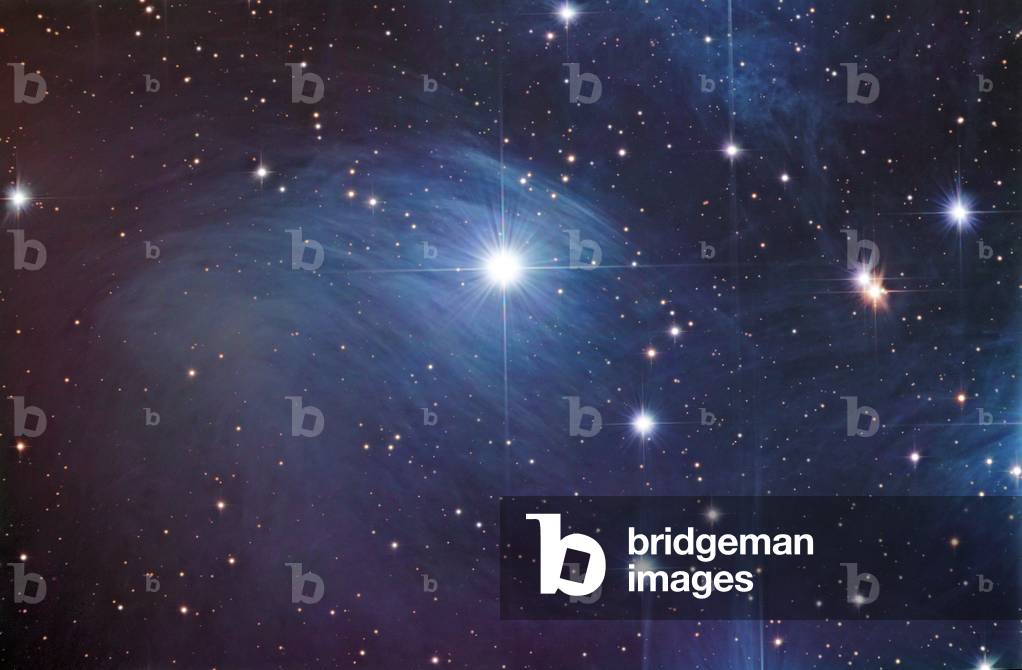
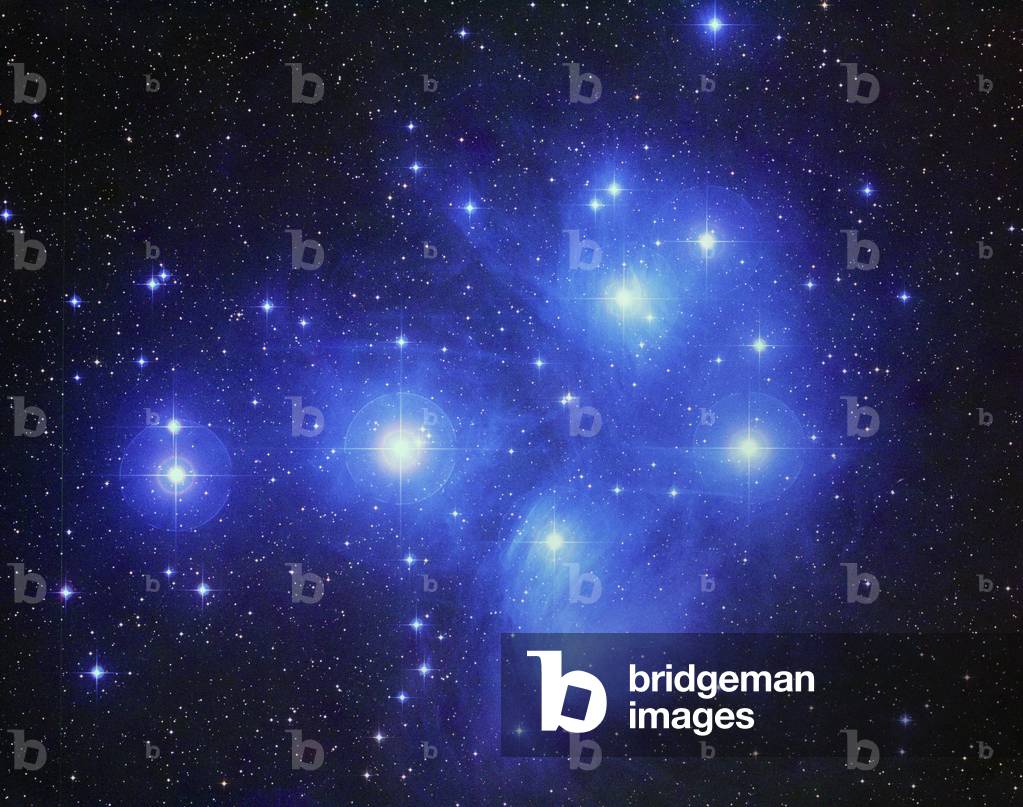
Open Cluster of Pleiades - The Pleiades star cluster - The Pleiades cluster (M45) is a cluster of about 500 young stars nees 150 million years ago. Visible in the constellation Taurus, this cluster is 440 years from the Earth. Brown dwarfs have been observed in this cluster. The Pleiades star cluster, also known as the Seven Sisters and Messier 45 (M45), is one of the brightest and famous star clusters visible in the northern hemisphere. It consists of about 500 bright, hot, young stars that were all born at the same time between 75 and 150 million years ago within a large cloud of dust and gas. This star cluster lie some 440 light years away from the Earth, in the constellation of Taurus
Open cluster Westerlund 2 in Carene - Open cluster Westerlund 2 in Carina - The open cluster Westerlund 2 is located about 20,000 years - light in the southern constellation of Carene, within the nebula Gum 29. About 3000 stars form this cluster. It contains a significant number of massive stars including one of the most massive stars known to date: WR 20a. Image obtained by the Hubble Space Telescope. The sparkling centerpiece of this image taken by the Hubble space telescope is a giant cluster of about 3,000 stars called Westerlund 2, named for Swedish astronomer Bengt Westerlund, who discovered the grouping in the 1960s. The cluster resides in a raucous stellar breeding ground known as Gum 29, located 20,000 light - years away from Earth in the constellation Carina. To capture this image, Hubble's near - infrared Wide Field Camera 3 near - infrared pierced through the dusty veil shrouding the stellar nursery, giving astronomers a clear view of the nebula and the dense concentration of stars in the central cluster. The cluster measures between 6 to 13 light - years across. The giant star cluster is only about 2 million years old and contains some of our galaxy's hottest, brightest, and most massive stars. Some of its heftiest stars unleash torrents of ultraviolet light and hurricane - force winds of charged particles that etch at the enveloping hydrogen gas cloud. The nebula reveals a fantasy landscape of pillars, ridges, and valleys. The pillars, composed of dense gas and thought to be incubators for new stars are a few light - years tall and point to the central star cluster. Other dense regions surround the pillars, including reddish - brown filaments of gas and dust. The brilliant stars sculpt the gaseous terrain of the nebula and help create a successive generation of baby stars. When the stellar winds hit dense walls of gas, the shockwaves may spark a new torrent of star birth along the wall of the cavity. The red dots scattered t
Galaxy of the Wheel of the Charette in the Sculptor - The Cartwheel Galaxy - The ring galaxy of the Wheel of the Charette is about 500 million years away - light from the Earth. It is surrounded by a ring of 150,000 years - light of diameter composed of young and very bright stars. This particular form is the result of a collision, probably with one of the two galaxies on the right. Image obtained by the Hubble Space Telescope in October 1994. A rare and spectacular head - on collision between two galaxies appears in this NASA Hubble Space Telescope true - color image of the Cartwheel Galaxy, located 500 million light - years away in the constellation Sculptor. The details of star birth resolved by Hubble provide an opportunity to study how extremely massive stars are born in large fragmented gas clouds. The striking ring - like feature is a direct result of a smaller intruder galaxy - - possibly one of two objects to the right of the ring - - that careened through the core of the host galaxy. Like a rock tossed into a lake, the collision sent a ripple of energy into space, plowing gas and dust in front of it. Expanding at 200,000 miles per hour, this cosmic tsunami leaves in its wake a firestorm of new star creation. Hubble resolves bright blue knots that are gigantic clusters of newborn stars and immense loops and bubbles blown into space by exploding stars (supernovae) going off like a string of firecrackers. The Cartwheel Galaxy presumably was a normal spiral galaxy like our Milky Way before the collision. This spiral structure is beginning to re - emerge, as seen in the faint arms or spokes between the outer ring and bulls - eye shaped nucleus. The ring contains at least several billion new stars that would not normally have been created in such a short time span and is so large (150,000 light - years across) our entire Milky Way Galaxy would fit inside. Hubble's new view does not solve the mystery as to which of the two small galaxies m
Barree spiral galaxy NGC 2903 in the Lion - Barred spiral galaxy NGC 2903 in Leo - The barree spiral galaxy Ngc 2903 is located about 25 million years ago - light and extends over 80,000 years - light. It is home to regions of intense star formations. The barred spiral galaxy NGC 2903 is located about 25 million light - years away in the direction of the constellation Leo and its width is roughly 80,000 light - years from edge to edge. NGC 2903 is known to contain numerous hot spots of violent stellar activity
Variable star PV Cephei and nebula Gyulbudagyan - Variable star PV Cephei with Gyulbudagyan's nebula - PV Cephei is an excessively fast variable star, moving almost 20 km per second in the interstellar medium. This young star, formed about 500,000 years ago, is now more than 30 years ago - light from its birthplace, the cluster of stars of the Iris nebula, NGC 7023. PV Cephei is the small orange star with a gas cloud located in the upper left middle of the image. Image obtained on October 19, 2008 with a telescope measuring 61 cm in diameter. PV Cephei is a variable star moving at roughly 20 km/sec through the interstellar medium. This young star was formed about 500,000 years ago and is located now at about 30 light years from its birth place, the star cluster of Iris nebula (NGC 7023). PV Cephei is the small oranged star visible near the middle of the image, at right of the brilliant blue star. It is associated with a small cloud of gas. Image taken on October 19 2008 with a 24 - inch telescope
Nebula NGC 7129 in Cephee - Reflection nebula NGC 7129 in Cepheus - Nebula by reflexion located 3300 years - light of the Earth. This nebula houses very young stars, aged less than a million years old. NGC 7129 is a star forming region located in Cepheus constellation, 3300 light years from us. Several Herbig Haro objects are visible in this nebula. Herbig - Haro objects are small emission nebulae found around young developing stars (protostars) and which are believed to be transient in their nature, for they only exist for a few thousand years
Southern Crown Nebula - The CRA reflection nebula - R Coronae Australis is a region of star formations visible in the southern hemisphere. It is located about 500 light years away from Earth. On the right, the globular cluster NGC 6723, located 30 000 light years from Earth in Sagittarius. Image made with the 1.2m Telescope of Schmidt UK from Siding Spring. Corona Australis (the southern crown, CRA) is in the far southern sky but visible from the southern states of the USA. The constellation is small but distinctive. The conspicuous globular cluster NGC 6723 is at the western (right) edge of the photograph, but it is in Sagittarius, and is about 30,000 light years distant. Almost all the nebulosity here is starlight, reflected from minute grains of dust, some of which gather into darker condensations ('molecular clouds'), blotting out the background stars. Fainter features can be seen here. Shiny NGC 6726 - 27 near middle of image contains both a visual binary and a variable star. Other wispy nebulae in the western part of the dark cloud betray the presence of young, hidden stars
The cluster of stars Pismis 24 in the Scorpio - Pismis 24 star cluster in Scorpius - This image shows the cluster of young stars Pismis 24, located about 8000 years - light in the nebula NGC 6357 of the Scorpio. This cluster is home to some of the most massive stars known to date. Image made with the 1.5m Danish telescope of La Silla in Chile in 2009. Located near the famous “” Cat Paw”” nebula (NGC 6334), the Stellar Cluster Pismis 24 lies at the core of NGC 6357. Its stars include some of the most massive stellar behemoths known. One of the brightest stars in the cluster, Pismis 24 - 1, was thought possibly to be the most massive on record, approaching 300 solar masses, until it was discovered by the Hubble Telescope to be a triple star, with large components exceeding 100 solar masses. Several of the other central stars also exceed 100 solar masses. The nebulosity visible in the image shows the effects of intense radiation which has sculpted the clouds into curious shapes. Massive protostars, invisible to optical telescopes, lie hidden within the gas and dust of the region. Image taken with the ESO/Danish 1.5m telescope at La Silla observatory in Chile
Star Formation in Cassiopee - Star Formation in Cassiopeia - This star-forming region, called W5, is located approximately 6500 light years ago in the constellation Cassiopee. Several generations of stars appear on this cliche; the older ones are the blue stars in the centre of the two cavities; the younger stars are grouped at the edges of these cavities and at the ends of the gas pillars or they appear like pink dots; the white areas are home to the very young stars in formation. In this infrared image, heated dust appears in red, dense gas clouds appear in green. Composite image obtained by the Spitzer space telescope in 2006 and 2007. Generations of stars can be seen in this infrared portrait from Nasa's Spitzer Space Telescope. In this wispy star - forming region, called W5, the oldest stars can be seen as blue dots in the centers of the two hollow cavities (other blue dots are background and foreground stars not associated with the region). Younger stars line the rims of the cavities, and some can be seen as pink dots at the tips of the elephant - trunk - like pillars. The white knotty areas are where the youngest stars are forming. Red shows heated dust that pervades the region's cavities, while green highlights dense clouds. W5 spans an area of sky equivalent to four full moons and is about 6,500 light - years away in the constellation Cassiopeia. The Spitzer picture was taken over a period of 24 hours. Like other massive star - forming regions, such as Orion and Carina, W5 contains large cavities that were carved out by radiation and winds from the region's most massive stars. According to the theory of triggered star - formation, the carving out of these cavities pushes gas together, causing it to ignite into successive generations of new stars. This image contains some of the best evidence yet for the triggered star - formation theory. Scientists analyzing the photo have been able to sho
Nebula M43 in Orion - M43 nebula in Orion - Nebula M43 (NGC 1982) is part of the great Nebula of Orion (M42), a vast region of star formation. This image obtained by the Hubble Space Telescope (HST) shows a detail of the nebula people of bright young stars accompanied by very young stars still surrounded by their cocoon of dust. The NASA/ESA Hubble Space Telescope has taken a close - up view of an outer part of the Orion Nebula's little brother, Messier 43. This nebula, which is sometimes referred to as De Mairan's Nebula after its discoverer, is separated from the famous Orion Nebula (Messier 42) by only a dark lane of dust. Both nebulae are part of the massive stellar nursery called the Orion molecular cloud complex, which includes several other nebulae, such as the Horsehead Nebula (Barnard 33) and the Flame Nebula (NGC 2024). This view shows several of the brilliant hot young stars in this less - studied region and it also reveals many of the curious features around even younger stars that are still cocooned by dust. This picture was created from images taken using the Wide Field Channel of Hubble's Advanced Camera for Surveys. Images through yellow (F555W, coloured blue) and near - infrared (F814W, coloured red) filters were combined. The exposure times were 1000 s per filter and the field of view is about 3.3 arcminutes across
Double cluster of Persee - Double cluster in Perseus - NGC884, on the left and h Persei NGC869 on the right are located about 7000 years - light in the constellation Persee. The double cluster in the constellation Perseus, normally known by its Greek designation transliterated. chi Persei (NGC884, on the left) and h Persei (NGC869) are about 7000 light - years away and less than 100 light - years apart. Although open clusters are quite common, this pair is exceptional due to the large number of young bright O and B stars in each, and their closeness
Open cluster Westerlund 1 in the Altar - Open cluster Westerlund 1 in Ara - The open cluster Westerlund 1 is located about 16,000 years - light in the southern constellation of the Altar. It contains hundreds of very young massive stars as well as the supergiant red star W26. Image obtained by the VST telescope in Chile. This exceptionally bright cluster lies about 16 000 light - years from Earth in the southern constellation of Ara (The Altar). It contains hundreds of very massive and brilliant stars, all of which are just a few million years old - - babies by stellar standards. But our view of this cluster is hampered by gas and dust that prevents most of the visible light from the cluster's stars from getting to Earth. Around one of the stars - - known as W26, a red supergiant and possibly the biggest star known - - astronomers have discovered clouds of glowing hydrogen gas, shown as green features in this new image. Such glowing clouds around massive stars are very rare, and are even rarer around a red supergiant - - this is the first ionised nebula discovered around such a star. W26 itself would be too cool to make the gas glow; the astronomers speculate that the source of the ionising radiation may be either hot blue stars elsewhere in the cluster, or possibly a fainter, but much hotter, companion star to W26. W26 will eventually explode as a supernova. The nebula that surrounds it is very similar to the nebula surrounding SN1987A, the remnants of a star that went supernova in 198
Barree spiral galaxy NGC 2903 in the Lion - Barred spiral galaxy NGC 2903 in Leo - The barree spiral galaxy Ngc 2903 is located 25 million years - light and extends over 80,000 years - light. It is home to regions of intense star formations. This extremely detailed picture was obtained in February 2007 thanks to 21 hours of combined poses with a 50 cm telescope. The barred spiral galaxy NGC 2903 is located about 25 million light - years away in the direction of the constellation Leo and its width is roughly 80,000 light - years from edge to edge. NGC 2903 is known to contain numerous hot spots of violent stellar activity. The picture represents almost 21 hours of total exposure through a 20 inch telescope
The evolution of the Sun - Illustration - The evolution of the Sun - Illustration - Artist's view of the evolution of a yellow star like the Solei
Nebula NGC 1555 and star T - Tauri - Nebula NGC 1555 with T - Tauri - Nebula NGC 1555 (Hind variable nebula) in the constellation Tauri. Within this nebula a yellow cloud surrounds a T - Tauri star, a very young star in formation. The orange star in this view is T Tauri, prototype of the class of T Tauri variable stars. Nearby it is a dusty yellow cosmic cloud historically known as Hind's Variable Nebula (NGC 1555/1554). Over 400 light - years away, at the edge of a molecular cloud, both star and nebula are seen to vary significantly in brightness but not necessarily at the same time, adding to the mystery of the intriguing region. T Tauri stars are now generally recognized as young (less than a few million years old), sun - like stars still in the early stages of formation
Orion's Nebula - The Great Nebula in Orion - Located 1500 light years from Earth, Orion's Nebula is the closest region to the formation of stars of the Sun. In its heart, a group of young stars called Orion's Trapeze. To the eye, the nebula appears as a misty patch around the central star of the line of three which form Orion's sword. The central group of stars is the Trapezium cluster and these stars are responsible for producing the nebula. It is the high concentration of dust and gas in this part of the sky which has resulted in the formation of the stars, so the Orion nebula is no random association of bright stars and dusty gas. At a distance of 1500 light years, the Orion nebula is the nearest star-forming region to the Sun
Nebula IC 405, star AE Aurigae in the Coach - Nebula IC 405 and runaway star AE Aurigae - IC 405, is a nebula illuminated by the massive star AE Aurigae. This type O star is a “” fleeing star”, a star ejected from the Orion nebula about 2.5 million years ago and continues its race at a speed of 200 km per second. The Flaming Star Nebula, IC 405, surrounds the variable star AE Aurigae. AE Aurigae is normally a 5.96 magnitude star of spectral class O. The star AE Aurigae itself is very bright, young, blue, and known as a runaway star since it appears to have been ejected from the Orion Nebula region about 2.5 million years ago
Open Cluster of Pleiades - The Pleiades star cluster - The Pleiades cluster is a cluster of about 500 young stars nees 150 million years ago. Visible in the constellation Taurus, this cluster is 440 years from the Earth. The Pleiades are one of the finest and nearest examples of a reflection nebula associated with a cluster of young stars. The cluster itself is a group of many hundreds of stars about 400 light years from Earth in the northern constellation of Taurus and has been recognised since ancient times. Seven of the brightest stars are quite easy to see with the unaided eye and bear the names of the Seven Sisters, the daughters of Atlas. The nebulosity seen here is light reflected from the particles in a cloud of cold gas and dust into which the cluster has drifted. It appears blue because these tiny interstellar particles scatter blue light more efficiently than the longer wavelengths of red light and it is streaky because of the distribution of dust particles in space
Open Cluster of Pleiades - The Pleiades star cluster - The Pleiades cluster is a cluster of about 500 young stars nees 150 million years ago. Visible in the constellation Taurus, this cluster is 440 years from the Earth. The Pleiades star cluster, also known as the Seven Sisters and Messier 45, is one of the brightest and famous star clusters visible in the northern hemisphere. It consists of about 500 bright, hot, young stars that were all born at the same time between 75 and 150 million years ago within a large cloud of dust and gas. The cluster contains many stars, of which only a handful are commonly visible to the naked eye. The blue haze that accompanies them is due to very fine dust which still remains and preferentially reflects the blue light from the stars. This star cluster lie some 440 light years away from the Earth, in the constellation of Taurus
Nebula of the Eagle (IC 4703) in the Snake - detail - Star - birth in the Eagle nebula. - The Pillars of Creation “” is undoubtedly the most famous image realized by the Hubble space telescope, obtained in 1995. 20 years later, the same telescope rephotographed this region with more finesse. These cold gas columns are home to star embryos. The NASA/ESA Hubble Space Telescope has revisited one of its most iconic and popular images: the Eagle Nebula's Pillars of Creation. This image shows the pillars as seen in visible light, capturing the multi - coloured glow of gas clouds, wispy tendrils of dark cosmic dust, and the rust - colored elephants trunks of the nebula's famous pillars. The dust and gas in the pillars is seared by the intense radiation from young stars and eroded by strong winds from massive nearby stars. With these new images comes better contrast and a clearer view for astronomers to study how the structure of the pillars is changing over time.
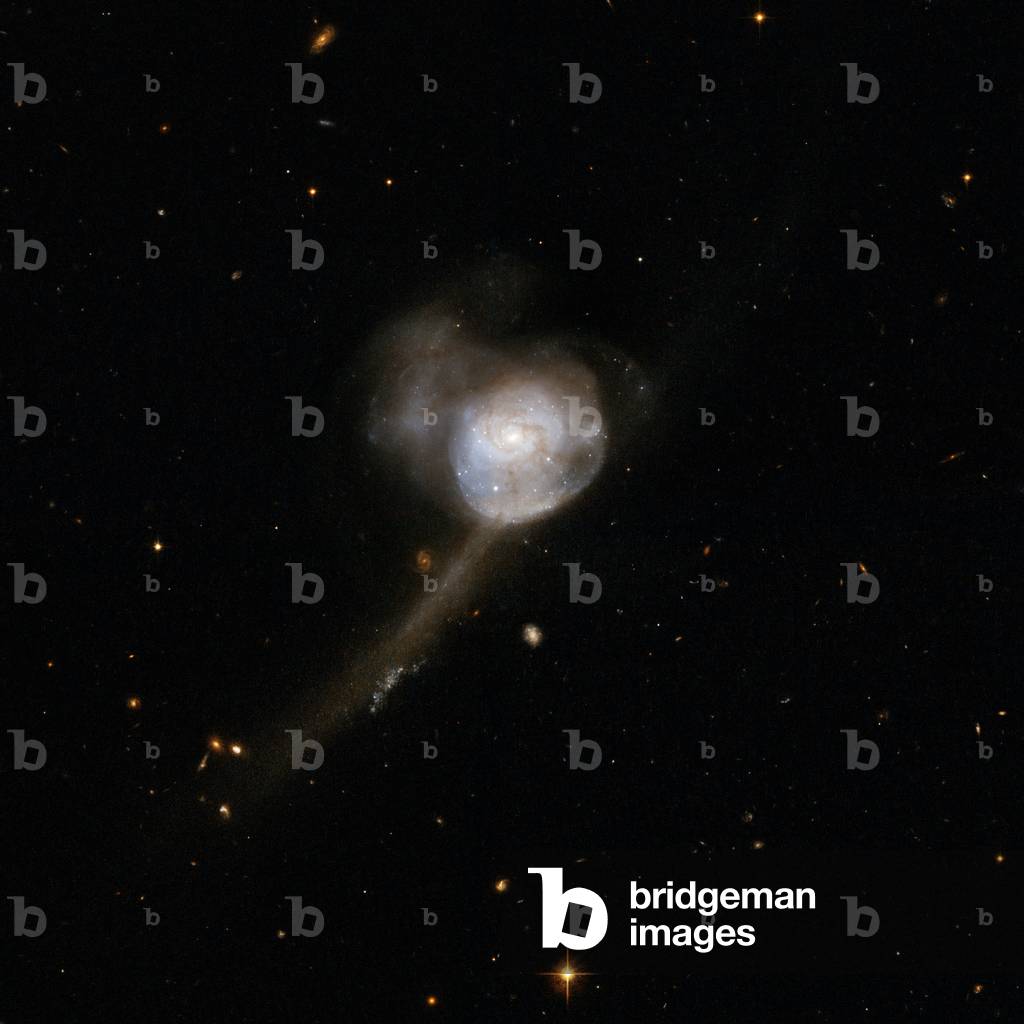
Interacting galaxies ZW II 96 - Interacting galaxies ZW II 96 - The galaxy ZW II 96 is located about 500 million light years away from Earth in the constellation of the Dolphin. This system consists of interacting galaxies shows an important star formation. This is a system of merging galaxies with a bizarre shape. Powerful young starburst regions hang as long threadlike structures between the main galaxy cores. The system almost qualifies as an ultra - luminous system, but has not yet reached the late stage of coalescence that is the norm for most ultra - luminous systems. ZW II 96 is located in the constellation of Delphinus, the Dolphin, about 500 million light - years away from Earth
Double cluster of Persee - Double cluster in Perseus - NGC 884, on the left and h Persei (NGC 869) on the right are located about 7000 years - light in the constellation Persee. This field corresponds to that of binoculars or a small telescope. The double cluster in the constellation Perseus, normally known by its Greek designation transliterated. chi Persei (NGC 884, on the left) and h Persei (NGC 869) are about 7000 light - years away and less than 100 light - years apart. Although open clusters are quite common, this pair is exceptional due to the large number of young bright O and B stars in each, and their closeness. This skyview is corresponding to binoculars and small telescopes
Galaxy NGC 17 in the Whale - Galaxy NGC 17 in Cetus - The galaxy NGC 17 is located about 250 million years away from Earth. Presented with a single nucleus, its shape indicates that it has finished absorbing another galaxy. Image obtained by the Hubble Space Telescope on 4 July 2002. This galaxy features a single nucleus, a containing a blue central disk with delicate fine structure in the outer parts and tidal tails indicative of two former disk galaxies. At present these galaxies appear to have completed their merger. The remnant shows clear signs that the merger was gas - rich and accompanied by a starburst. NGC 17 is gas - rich and can sustain its strong central starburst and present mild central activity for some time to come. NGC 17 is located about 250 million light - years away in the constellation of Cetus, the Whale. Image taken by the Hubble space telescope on july 4, 2002
Orion's Trapeze - Trapezium Multiple Star System in Orion - Orion's Trapeze is one of the youngest open clusters known, with new stars still forming in this region. The Trapezium is the most famous multiple star system in the entire night sky. Located at the very heart of M42, the Orion Nebula, it is one of the youngest star clusters known. The four brightest stars in the Trapezium (A, B, C and D) are easily visible in a four inch telescope with decent optical quality under good seeing conditions. They range in brightness from magnitude 5 to magnitude 8. They can be seen merged together as one star to the unaided eye as the middle star in the sword of Orion. The image above shows the four brightest stars of the Trapezium at the center of the photo. The core of M42 surrounding the Trapezium is a blue - green color from the predominantly green spectral emission line of Oxygen III, with a smaller amount of blue - green mixed in from the hydrogen - beta emission line. These particular wavelengths also happen to be the wavelengths to which the human visual system is most sensitive for color vision. Much of the rest of the Orion Nebula has a lot of red hydrogen - alpha emission, but the eye is not very sensitive to this wavelength. Some red can be seen in the brightest parts of the nebula that emit hydrogen - alpha light by observers with sensitive color vision. For most people however, if they see any color at all, it will be a very pale green, or blue - green, from the Oxygen III spectral lines
Orion Nebula - the trapeze - The Trapezium region in M42 - Located 1500 years - light, Orion Nebula is the closest region of formation of stars of the Sun. In the center of the picture, the Trapeze of Orion. The Trapeze is among the youngest known open clusters, it is made up of 4 massive stars that make the nebula shine. Image obtained with Siding Spring's 3.9m telescope. The central 'star' of the three groups forming the asterism of Orion's sword is in reality a nebula, and is clearly nebulous to the unaided eye. At the heart of the most luminous nebulosity shimmer a handful of stars known as the Trapezium cluster, visible in binoculars. These are the brightest members of a substantial cluster of stars, most of which are still hidden in the dusty recesses of the Orion nebula against which they are seen. The stars of the Trapezium provide much of the energy which makes the brilliant Orion Nebula visible and are at a distance of about 1500 light years. This image was made at the prime focus of the Anglo - Australian Telescope
Star clusters IC 348 in Persee seen in infrared - Star clusters IC 348 in Perseus - IC 348 is a cluster of 300 stars associated with a relatively bright nebula. The infrared image of the Spitzer telescope shows young stars (red and pink) that appeared about 3 million years ago and still surrounded by their gas cocoon. The nebula is located 1043 years of light from Earth. The IC 348 is a cluster which contains more than 300 young stars. Baby stars are forming near the eastern rim of the cosmic cloud Perseus, in this infrared image from Nasa's Spitzer Space Telescope. The baby stars are approximately three million years old and are shown as reddish - pink dots to the right of the image. The pinkish color indicates that these infant stars are still shrouded by the cosmic dust and gas that collapsed to form them. The Perseus Nebula is located about 1,043 light - years away in the Perseus constellation
Cone and Hubble Nebulae in the Unicorn - Cone and Hubble nebulae in Monoceros - The Cone nebula, at the bottom left, is an H II region located about 2600 years - light from Earth. The bright star in the middle left is S Monocerotis, a star of magnitude 4.7. Lower right, the Hubble nebula, overexposed. This large area of emission nebulosity and patch of blue reflection nebulosity also contains the Cone Nebula, a dark nebula at the lower right corner of the red nebulae. At the bottom right of the frame is NGC 2261, Hubble's Variable Nebula, in this image looking like an overexposed mis - shaped star because of the extreme processing needed to bring out the faint nebulosity in the Cone Nebula
Orion Nebula - the trapeze - The Trapezium region in M42 - Located 1500 years - light, Orion Nebula is the closest region of formation of stars of the Sun. In the center of the picture, the Trapeze of Orion. The Trapeze is among the youngest known open clusters, it is made up of 4 massive stars that make the nebula shine. Image obtained from the 1.5m Danish telescope of La Silla in Chile. The central 'star' of the three groups forming the asterism of Orion's sword is in reality a nebula, and is clearly nebulous to the unaided eye. At the heart of the most luminous nebulosity shimmer a handful of stars known as the Trapezium cluster, visible in binoculars. These are the brightest members of a substantial cluster of stars, most of which are still hidden in the dusty recesses of the Orion nebula against which they are seen. The stars of the Trapezium provide much of the energy which makes the brilliant Orion Nebula visible and are at a distance of about 1500 light years. This image was made at the danish 1.5 meter telescope in La Silla, Chile
Double cluster of Persee - Double cluster in Perseus - NGC884, on the left and h Persei NGC869 on the right are located about 7000 years - light in the constellation Persee. The double cluster in the constellation Perseus, normally known by its Greek designation transliterated. chi Persei (NGC884, on the left) and h Persei (NGC869) are about 7000 light - years away and less than 100 light - years apart. Although open clusters are quite common, this pair is exceptional due to the large number of young bright O and B stars in each, and their closeness
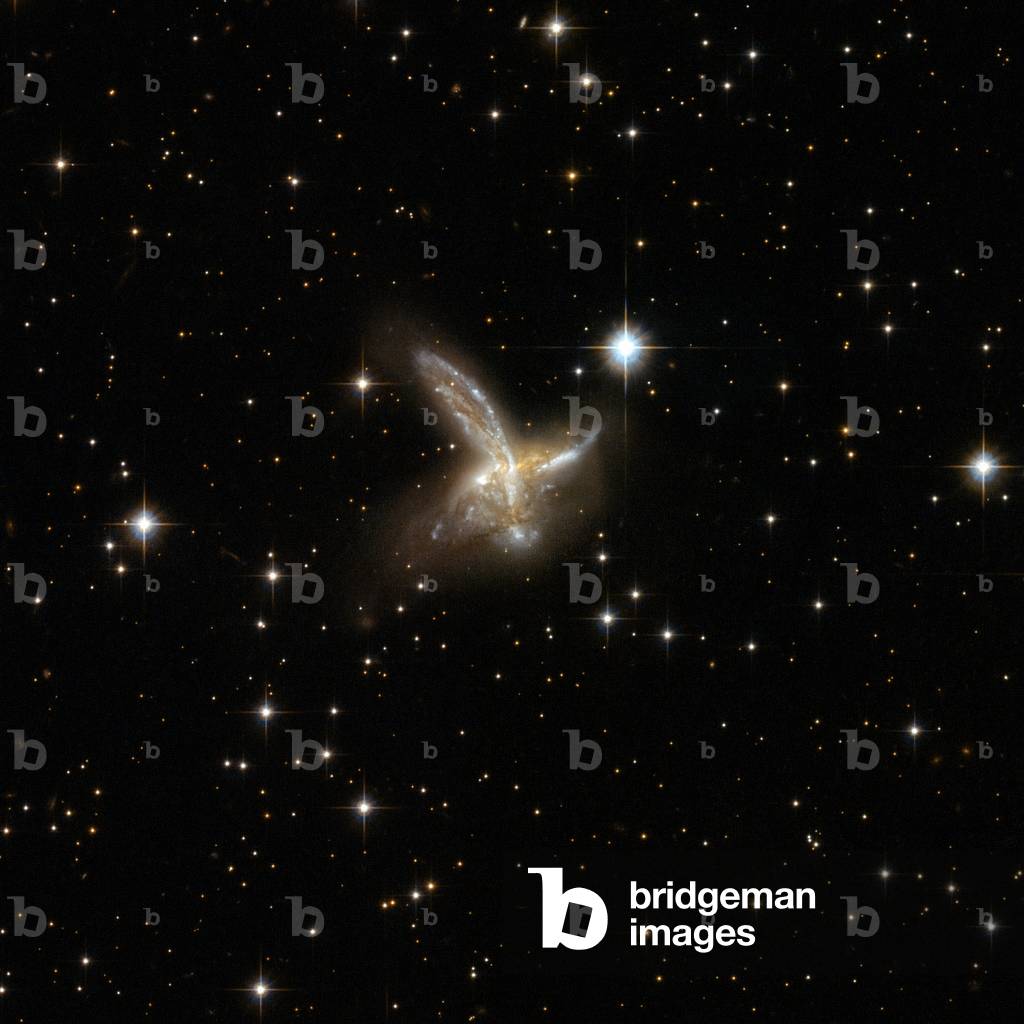
Interacting galaxies ESO 593 - 8 in Sagittarius - Interacting galaxies ESO 593 - 8 in Sagittarius - The galaxy ESO 593 - 8 is located about 650 million years away from Earth. It's a pair of interacting galaxies that will probably merge into a single galaxy. Regions of intense star formations appear in blue. Image obtained by the Hubble Space Telescope on 19 March 2002. ESO 593 - 8 is an impressive pair of interacting galaxies with a feather - like galaxy crossing a companion galaxy. The two components will probably merge to form a single galaxy in the future. The pair is adorned with a number of bright blue star clusters. ESO 593 - 8 is located in the constellation of Sagittarius, the Archer, some 650 million light - years away from Earth. Image taken by the Hubble space telescope on march 19, 2002
Nebula NGC 3576 in Carene - Star formation region NGC 3576 in Carina - NGC 3576 is located about 7000 years - light from Earth in the constellation Carene. Image obtained by Siding Spring's 3.9m telescope. The stars that excite this unusual nebula, NGC 3576, are not visible on this photograph. They are hidden in the dusty cloud at the 'base' (south) of the huge loops of nebulosity. This is material that has been blown out by radiation pressure and stellar winds from the concealed stars. Silhouetted against the tenuous loops are dark clouds of dust with bright rims which indicate the direction of the stars which excite the nebula. This large complex of gas and dust is at about the same distance as the much brighter Eta Carinae nebula, about 7000 light years away
Interacting galaxies NGC 4038 - 4039 in the Raven - NGC 4038 - 39, the interacting galaxies of the Antennae - Image of the galaxy NGC 4038 - 39 (antenna galaxy), located about 45 million years ago - light from Earth. These two galaxies are interacting. The collision started at least 100 million years ago causes intense star formation. NGC 4038 and 4039 are the well - known pair of interacting galaxies that show two broadly curved tails of stars, the 'antenna', extending a considerable distance from the action. The colour picture reveals the burst of star formation triggered by the encounter, the large numbers of pink emission nebulae in the inter - galaxy region and the location of the numerous dark, brownish - yellow clouds of dust. The yellow nuclei of the two galaxies are also still visible in the colour picture as separate entities
Open Cluster of Pleiades - The Pleiades star cluster - The Pleiades cluster is a cluster of about 500 young stars nees 150 million years ago. Visible in the constellation Taurus, this cluster is 440 years from the Earth. The Pleiades are a reflection nebula associated with a cluster of young stars. The cluster itself is a group of many hundreds of stars about 400 light years from Earth in the northern constellation of Taurus.Seven of the brightest stars are quite easy to see with the unaided eye.The nebulosity seen here is light reflected from the particles in a cloud of cold gas and dust into which the cluster has drifted. It appears blue because these tiny interstellar particles scatter blue light more efficiently than the longer wavelengths of red light and it is streaky because of the distribution of dust particles in space
Stars in the spiral galaxy NGC 253 - Stars in galaxy NGC 253 - NGC 253 is the brightest galaxy of the Sculptor's group, group of galaxies closest to the Local Group. It is about 13 million light years away. Here, the Hubble space telescope photographed the different star populations of this galaxy. A close - up view from Hubble space telescope shows that NGC 253 is ablaze with the light from thousands of young, blue stars. The spiral galaxy is undergoing intense star training. This image, taken with Hubble's Advanced Camera for Surveys, reveals colors and differing intensities of individual stars as well dark filaments of dust and gas interstellar dust intersperced among the stars. NGC 253 is the dominant galaxy in the Sculptor Group of galaxies and resides about 13 million light - years from Earth. This galaxy is part of a detailed survey called the ACS Nearby Galaxy Survey Treasury program (ANGST). The natural - color images were constructed using Hubble observations taken in infrared, visible, and blue light. Data from the Cerro Tololo Inter - American Observatory in Chile were used to fill in small gaps in the Hubble image of NGC 253
Globular cluster M30 in Capricornus - Globular cluster M30 in Capricornus - The globular cluster M30 (NGC 7099) is located about 28,000 light years away from Earth. Globular clusters are generally peoples of very old stars, but here the Hubble space telescope has identified some young stars, blue stragglers. Messier 30 formed 13 billion years ago and was discovered in 1764 by Charles Messier. Located about 28 000 light - years away from Earth, this globular cluster - - a dense swarm of several hundred thousand stars - - is about 90 light - years across. Although globular clusters such as this one are mainly populated by old stars, the crowded field of stars leads to some old stars apparently reclaiming their youth in the form of blue stragglers. Researchers using data from Hubble's now - retired Wide Field Planetary Camera 2 (WFPC2) have identified two types of blue stragglers in Messier 30: those that form in near head - on collisions with one another and those that are in twin (or binary) systems where the less massive star siphons “” life - giving”” hydrogen from its more massive companion. This image of Messier 30 (M30) was taken by Hubble's Advanced Camera for Surveys (ACS)
Open Cluster of Pleiades - The Pleiades star cluster - The Pleiades cluster is a cluster of about 500 young stars nees 150 million years ago. Visible in the constellation Taurus, this cluster is 440 years from the Earth. Object number 45 in Messier's catalog is the Pleiades, also know as the Seven Sisters for the seven stars that can be easily seen with excellent eyesight.The Pleiades is a relatively nearby open cluster, which according to new data from the Hipparcos satellite is located at a distance of 370 light years. The cluster is surrounded by blue nebulosity illuminated by the light reflected from the nearby stars. Astro - Physic's 130EDT F/8 Triplet Refractor working at f/6 two 20 minute exposures
Nebula NGC 3603 in Carene - Star formation region NGC 3603 in Carina - NGC 3603 is located about 7000 years - light from Earth in the constellation Carene. Within this nebula, a cluster of massive stars, Wolf - Rayet stars. Image obtained by Siding Spring's 3.9m telescope. Although stars are well known to form in clusters, most of the stars in the young groups we know of in our own galaxy are well separated in space. In NGC 3603 the stars are remarkably close together. Moreover, many of the stars in this compact constellation are Wolf - Rayet stars, extremely hot, massive objects, rarely found in such profusion in clusters. Exactly why some clusters form massive stars and others do not is a hot topic in astronomy, so this cluster and its environment has been extensively studied. This curious collection of young objects is, as far as we know, unique in our galaxy, though the enigmatic object at the centre of the Tarantula Nebula in the Large Magellanic Cloud is now known to be a similar compact cluster. The stars and their associated nebula are seen through considerable dust along the line of sight, and are dimmed and reddened by it
The evolution of the Sun - Illustration - The evolution of the Sun - Illustration - Artist's view of the evolution of a yellow star, such as the Sun
Galaxy NGC 6670 in the Peacock - Galaxy NGC 6670 in Pavo - The galaxy NGC 6670, is about 400 million light years away from Earth in the southern constellation of Peacock. This system consists of two collision galaxies seen by the slice. Their nuclei are approximately 50,000 light years away. Image obtained by the Hubble Space Telescope on 30 October 2001. NGC 6670 is a gorgeous pair of overlapping edge - on galaxies. Scientists believe that NGC 6670 has already experienced at least one close encounter and is now in the early stages of a second. The nuclei of the two galaxies are approximately 50,000 light - years apart. NGC 6670 glows in the infrared with more than a hundred billion times the luminosity of our Sun and is thought to be entering a starburst phase. The pair is located some 400 million light - years away from Earth
Galaxy UGC 10214 in the Dragon - Galaxy UGC 10214 in Draco - The galaxy UGC 10214 is about 420 million years away - light from Earth. The shape of this galaxy is due to a collision with another galaxy, the small galaxy, blue, visible in the upper left corner of the image. Powerful gravitational forces are responsible for the formation of the tail, consisting of stars of dust and gas, which stretches over nearly 28,000 light years and is composed of recently formed and extremely bright blue stars. In the background, more than 6000 galaxies are visible, some more than 12 billion years apart - light. Image obtained by the Hubble Space Telescope in April 2002. This picture of the galaxy UGC 10214 was taken by the Advanced Camera for Surveys (ACS), which was installed aboard Nasa's Hubble Space Telescope in March during Servicing Mission 3B. Its distorted shape was caused by a small interloper, a very blue, compact galaxy visible in the upper left corner of the more massive Tadpole. The Tadpole resides about 420 million light - years away in the constellation Draco. Seen shining through the Tadpole's disk, the tiny intruder is likely a hit - and - run galaxy that is now leaving the scene of the accident. Strong gravitational forces from the interaction created the long tail of debris, consisting of stars and gas that stretch out more than 280,000 light - years. Numerous young blue stars and star clusters, spawned by the galaxy collision, are seen in the spiral arms, as well as in the long “” tidal”” tail of stars. Each of these clusters represents the formation of up to about a million stars. Their color is blue because they contain very massive stars, which are 10 times hotter and 1 million times brighter than our Sun. Once formed, the star clusters become redder with age as the most massive and bluest stars exhaust their fuel and burn out. These clusters will eventually become old globula
Open Cluster of Pleiades - The Pleiades star cluster - The Pleiades cluster is a cluster of about 500 young stars nees 150 million years ago. Visible in the constellation Taurus, this cluster is 440 years from the Earth. The Pleiades are one of the finest and nearest examples of a reflection nebula associated with a cluster of young stars. The cluster itself is a group of many hundreds of stars about 400 light years from Earth in the northern constellation of Taurus and has been recognised since ancient times. Seven of the brightest stars are quite easy to see with the unaided eye and bear the names of the Seven Sisters, the daughters of Atlas. The nebulosity seen here is light reflected from the particles in a cloud of cold gas and dust into which the cluster has drifted. It appears blue because these tiny interstellar particles scatter blue light more efficiently than the longer wavelengths of red light and it is streaky because of the distribution of dust particles in space
Orion Nebula - the trapeze - The Trapezium region in M42 - Located 1500 years - light, Orion Nebula is the closest region of formation of stars of the Sun. In the center of the picture, the Trapeze of Orion. The Trapeze is among the youngest known open clusters, it is made up of 4 massive stars that make the nebula shine. Image obtained with Siding Spring's 3.9m telescope. The central 'star' of the three groups forming the asterism of Orion's sword is in reality a nebula, and is clearly nebulous to the unaided eye. At the heart of the most luminous nebulosity shimmer a handful of stars known as the Trapezium cluster, visible in binoculars. These are the brightest members of a substantial cluster of stars, most of which are still hidden in the dusty recesses of the Orion nebula against which they are seen. The stars of the Trapezium provide much of the energy which makes the brilliant Orion Nebula visible and are at a distance of about 1500 light years. This image was made at the prime focus of the Anglo - Australian Telescope
Orion Nebula - the trapeze - The Trapezium region in M42 - Located 1500 years - light, Orion Nebula is the closest region of formation of stars of the Sun. In the center of the picture, the Trapeze of Orion. The Trapeze is among the youngest known open clusters, it is made up of 4 massive stars that make the nebula shine. Image obtained with Siding Spring's 3.9m telescope. 30-sec poses. The central 'star' of the three groups forming the asterism of Orion's sword is in reality a nebula, and is clearly nebulous to the unaided eye. At the heart of the most luminous nebulosity shimmer a handful of stars known as the Trapezium cluster, visible in binoculars. These are the brightest members of a substantial cluster of stars, most of which are still hidden in the dusty recesses of the Orion nebula against which they are seen. The stars of the Trapezium provide much of the energy which makes the brilliant Orion Nebula visible and are at a distance of about 1500 light years. This image was made with three, 30 - second exposures at the prime focus of the Anglo - Australian Telescope
Markarian Galaxy 273 - Galaxy Markarian 273 - The Markarian galaxy 273 is about 500 million light years away from Earth in the constellation of the Great Bear. The presence of a 130,000-year-long maree tail suggests that Markarian 273 is the fusion of two galaxies. The collision caused a burst of star formations. This galaxy has a double core and is one of the brightest infrared galaxies. Image obtained by the Hubble Space Telescope on November 16, 2001. Markarian 273 shows an intricate central region and a striking tail that extends diagonally towards the bottom - right of the image. The tail is about 130 thousand light - years long and is strongly indicative of a merger between two galaxies. Markarian 273 has an intense region of starburst, where 60 solar masses of new stars are born each year. Near - infrared observations reveal a nucleus with two components. Markarian 273 is one of the most luminous galaxies when observed in the infrared, and is located 500 million light - years away from Earth in the constellation of Ursa Major. Image taken by the Hubble space telescope on November 16, 2001
Star births in the nebula NGC 6729 - Young stars in the nebula NGC 6729 - Close up on a star-forming region. The new stars are invisible, hidden behind the dust cloud at the top left of the image, but the material they eject at very high speed causes colorful and luminous arcs in contact with the surrounding gas. Image obtained in Chile with the VLT. This very detailed false - colour image from Eso's Very Large Telescope shows the dramatic effects of very young stars on the dust and gas from which they were born in the star - forming region NGC 6729. The baby stars are invisible in this picture, being hidden behind dust clouds at the upper left of the picture, but material they are ejecting is crashing into the surroundings at speeds of that can be as high as one million kilometres per hour. These shocks cause the gas to shine and create the strangely coloured glowing arcs and blobs known as Herbig - Haro objects. In this view the Herbig - Haro objects form two lines marking out the probable directions of ejected material. One stretches from the upper left to the lower centre, ending in the bright, circular group of glowing blobs and arcs at the lower centre. The other starts near the left upper edge of the picture and extends towards the centre right. The peculiar scimitar - shaped bright feature at the upper left is probably mostly due to starlight being reflected from dust and is not a Herbig - Haro object. This picture was taken by the FORS1 instrument and records the scene in the light of glowing hydrogen and sulphur
Open Cluster of Pleiades - The Pleiades star cluster - The Pleiades cluster is a cluster of about 500 young stars nees 150 million years ago. Visible in the constellation Taurus, this cluster is 440 years from the Earth. The Pleiades are one of the finest and nearest examples of a reflection nebula associated with a cluster of young stars. The cluster itself is a group of many hundreds of stars about 400 light years from Earth in the northern constellation of Taurus and has been recognised since ancient times. Seven of the brightest stars are quite easy to see with the unaided eye and bear the names of the Seven Sisters, the daughters of Atlas. The nebulosity seen here is light reflected from the particles in a cloud of cold gas and dust into which the cluster has drifted. It appears blue because these tiny interstellar particles scatter blue light more efficiently than the longer wavelengths of red light and it is streaky because of the distribution of dust particles in space
Interacting galaxies NGC 4038 - 4039 in the Raven - NGC 4038 - 39, the interacting galaxies of the Antennae - Image of the galaxy NGC 4038 - 39 (antenna galaxy), located about 63 million years ago - light. These two galaxies are interacting. The collision started at least 100 million years ago causes intense star formation. NGC 4038 and 4039 are the well - known pair of interacting galaxies that show two broadly curved tails of stars, the 'antenna', extending a considerable distance from the action. Massive star formations are resulting of a recent collision between two galaxies (100 million years ago). This galaxy is located 63 million light year from us
Interacting Galaxies Arp 256 in the Whale - Interacting galaxies Arp 256 in Cetus - The galaxy Arp 256, also called VV 352, is about 350 million years away from Earth. It's a pair of spiral galaxies interacting. Regions of intense star formations appear in blue. Image obtained by the Hubble Space Telescope on 22 May 2002. Arp 256 is a stunning system of two spiral galaxies in an early stage of merging. The Hubble image displays two galaxies with strongly disrupted shapes and an astonishing number of blue knots of star formation that look like exploding fireworks. The galaxy to the left has two extended ribbon - like tails of gas, dust and stars. The system is a luminous infrared system radiating more than a hundred billion times the luminosity of our Sun. Arp 256 is located in the constellation of Cetus, the Whale, about 350 million light - years away. It is the 256th galaxy in ARP's Atlas of Peculiar Galaxies
Star Formation in Cassiopee - Star Formation in Cassiopeia - This star-forming region, called W5, is located approximately 6500 light years ago in the constellation Cassiopee. Several generations of stars appear on this cliche; the older ones are the blue stars in the centre of the two cavities; the younger stars are grouped at the edges of these cavities and at the ends of the gas pillars or they appear like pink dots; the white areas are home to the very young stars in formation. In this infrared image, heated dust appears in red, dense gas clouds appear in green. Composite image obtained by the Spitzer space telescope in 2006 and 2007. Generations of stars can be seen in this infrared portrait from Nasa's Spitzer Space Telescope. In this wispy star - forming region, called W5, the oldest stars can be seen as blue dots in the centers of the two hollow cavities (other blue dots are background and foreground stars not associated with the region). Younger stars line the rims of the cavities, and some can be seen as pink dots at the tips of the elephant - trunk - like pillars. The white knotty areas are where the youngest stars are forming. Red shows heated dust that pervades the region's cavities, while green highlights dense clouds. W5 spans an area of sky equivalent to four full moons and is about 6,500 light - years away in the constellation Cassiopeia. The Spitzer picture was taken over a period of 24 hours. Like other massive star - forming regions, such as Orion and Carina, W5 contains large cavities that were carved out by radiation and winds from the region's most massive stars. According to the theory of triggered star - formation, the carving out of these cavities pushes gas together, causing it to ignite into successive generations of new stars. This image contains some of the best evidence yet for the triggered star - formation theory. Scientists analyzing the photo have been able to sho
Double cluster of Persee - Double cluster in Perseus - Chi Persei (NGC 884), on the left and h Persei (NGC 869) on the right are located about 7000 years - light in the constellation Persee. Mosaic of two images obtained with a 30 cm telescope. Time: 14 hours. The double cluster in the constellation Perseus, normally known by its Greek designation transliterated. chi Persei (NGC 884, on the left) and h Persei (NGC 869) are about 7000 light - years away and less than 100 light - years apart. Although open clusters are quite common, this pair is exceptional due to the large number of young bright O and B stars in each, and their closeness
Interacting galaxies Arp 81 - Interacting galaxies Arp 81 - Arp 81 is located about 300 million light years away from Earth in the constellation Dragon. This pair of interacting galaxies is composed of NGC 6621 on the left and NGC 6622 on the right. NGC 6621 is the largest of the two galaxies. The collision, seen here about 100 million years later, caused intense star flames. Image obtained by the Hubble Space Telescope on 15 March 1999. NGC 6621/2 (VV 247, Arp 81) is a strongly interacting pair of galaxies, seen about 100 million years after their closest approach. It consists of NGC 6621 (to the left) and NGC 6622 (to the right). NGC 6621 is the larger of the two, and is a very disturbed spiral galaxy. The encounter has pulled a long tail out of NGC 6621 that has now wrapped behind its body. The collision has also triggered extensive star formation between the two galaxies. Scientists believe that Arp 81 has a richer collection of young massive star clusters than the notable Antennae galaxies (which are much closer than Arp 81). The pair is located in the constellation of Draco, approximately 300 million light - years away from Earth. Arp 81 is the 81st galaxy in ARP's Atlas of Peculiar Galaxies. Image taken by the Hubble space telescope on March 15, 1999
S star Monocerotis and nebula - Fox Fur nebula in Monoceros - The region to the right of the bright star S Monocerotis is called Fox Fur nebula. This region where gas mixes with interstellar dust is located above the Cone nebula, about 2600 light years from Earth. Image obtained with a 61 cm telescope, composite of several images. The region around the 4.7 magnitude star S Mon is a fascinating mixture of red fluorescent hydrogen and dark, obscuring dust lanes. Some dust patches are close enough to bright stars to reflect light from them; these appear blue for the same reason that the day - time sky is blue - because some of the interstellar particles preferentially scatter blue light. The dust is mixed with gas and this affects the appearance of the emission nebulae, giving some of the faintest a curious 'fox fur' texture in this photograph. S Mon is part of a young open cluster of stars named NGC 2264 located about 2600 light years away, just north of the Cone nebula. Image taken with a 24 - inch telescope
Interacting galaxies NGC 4038 - 4039 in the Raven - NGC 4038 - 39, the interacting galaxies of the Antennae - Image of the galaxy NGC 4038 - 39 (antenna galaxy), located about 45 million years ago - light. These two galaxies are interacting. The collision started at least 100 million years ago causes intense star formation. NGC 4038 and 4039 are the well - known pair of interacting galaxies that show two broadly curved tails of stars, the 'antenna', extending a considerable distance from the action. Massive star formations are resulting of a recent collision between two galaxies (100 million years ago). This galaxy is located 45 million light year from us
Interacting galaxies NGC 4038 - 4039 in the Raven - NGC 4038 - 39, the interacting galaxies of the Antennae - Image of the galaxy NGC 4038 - 39 (antenna galaxy), located about 45 million years ago - light from Earth. These two galaxies are interacting. The collision started at least 100 million years ago causes intense star formation. NGC 4038 and 4039 are the well - known pair of interacting galaxies that show two broadly curved tails of stars, the 'antenna', extending a considerable distance from the action, as seen here. The colour picture reveals the burst of star formation triggered by the encounter, the large numbers of pink emission nebulae in the inter - galaxy region and the location of the numerous dark, brownish - yellow clouds of dust
Star formation regions NGC 3576 and 3603 in Carina - NGC 3576 (right) is located about 7000 years - light from Earth; NGC 3603 (left) is twice as far away. These two nebulae are located in the constellation Carene. Image obtained by Siding Spring's 3.9m telescope. These two star - formation regions appear side by side in the sky and seem to be linked as parts of an extensive nebula. However, the apparent intimacy is line - of - sight effect because these two objects are at quite different distances from the Sun. The curious looped nebula NGC 3576 is about 7000 light years from us while its neighbour NGC 3603 is more than twice as far away. That NGC 3603 is the more distant is confirmed by its colour, which is a ruddier red than the pinkish hue of NGC 3576. The change in colour is due to absorption of the blue - light component of the nebulosity by dust particles in the much longer line of sight. This effect is known as interstellar reddening, though it would be better described as 'de - blue'
Spiral galaxy NGC 2997 in the Pneumatic Machine - Spiral galaxy NGC 2997 in Antlia - NGC 2997 is a spiral galaxy distant about 55 million years - light. NGC 2997 seems to be a galaxy seen from the front but in reality is inclined by about 45 degrees. Its arms are home to large star-forming regions while its core is surrounded by much older yellow stars. The disc of NGC 2997 is inclined at about 45 degrees to our line of sight, revealing its internal structure and giving the galaxy an oval appearance. Like most spirals, the galaxy has two prominent spiral arms, which appear to originate in the yellow nucleus, are peppered with bright red blobs of ionised hydrogen which are similar to regions of star formation in our own Milky Way. Within these gas clouds are produced the hot blue stars which generate most of the light in the arms of the galaxy. A much older population of yellowish stars are concentrated around the nucleus. NGC 2997 is located in the southern constellation of Antlia, about 55 million light - years from us
Star Formation in the dwarf galaxy NGC 1569 - Starburst galaxy NGC 1569 - NGC 1569 is a dwarf irregular galaxy in the constellation Giraffe. The Hubble space telescope measured its distance with precision, placing it 11 million years - light from Earth, or 4 million years - light beyond the distance previously established by astronomers. This new measure explains better why this galaxy has a particularly high star formation rate. It resides among a group of galaxies that by gravity compresses its gas, thus creating a hundred times more stars than in our own galaxy. NGC 1569 is located in the middle of a group of about 10 galaxies centered on the spiral galaxy IC 342. Gravitational interactions among the group's galaxies may be compressing gas in NGC 1569 and igniting the star - birthing frenzy. The galaxy is forming stars at a rate more than 100 times higher than the rate in the Milky Way. This high star - formation rate has been almost continuous for the past 100 million years. Thanks to Hubble space telescope, astronomers have now measured the galaxy's distance at nearly 11 million light - years away, about 4 million light - years farther than the old distance
Galaxy System Arp 274 - Galaxy triplet Arp 274 - Arp 274 (NGC 5679) is a system of three galaxies located about 400 million years ago - light in the constellation of Virgo. Image obtained by the Hubble Space Telescope. Arp 274, also known as NGC 5679, is a system of three galaxies that appear to be partially overlapping in the image, although they may be at somewhat different distances. The spiral shapes of two of these galaxies appear mostly intact. The third galaxy (to the far left) is more compact, but shows evidence of star formation. Two of the three galaxies are forming new stars at a high rate. This is evident in the bright blue knots of star formation that are strung along the arms of the galaxy on the right and along the small galaxy on the left. The largest component is located in the middle of the three. It appears as a spiral galaxy, which may be barred. The entire system resides at about 400 million light - years away from Earth in the constellation Virgo. Hubble's Wide Field Planetary Camera 2 was used to image Arp 274. Blue, visible, and infrared filters were combined with a filter that isolates hydrogen emission. The colors in this image reflect the intrinsic color of the different stellar populations that make up the galaxies. Yellowish older stars can be seen in the central bulge of each galaxy. A bright central cluster of stars pinpoint each nucleus. Younger blue stars trace the spiral arms, along with pinkish nebulae that are illuminated by new star formation. Interstellar dust is silhouetted against the starry population. A pair of foreground stars inside our own Milky Way are at far right
Hourglass Nebula in M8 - The Hourglass Nebula in M8, NGC 6523 - View of the Hourglass Nebula in the heart of the Lagoon Nebula (M8/NGC 6523). Located in Sagittarius, at a distance of 5800 light years, it is a region of star formation whose gases are excited mainly by two massive supergeant stars Herschel 36 and 9 Sagittarii. Image made with the 1.5m Danish telescope of La Silla in Chile. At the heart of the Lagoon Nebula in Sagittarius lies the diminutive Hourglass Nebula. Its gases are excited primarily by two massive O-type supergiants designated Herschel 36 and 9 Sagittarii. These two stars lie to the west of NGC 6530 and are separated from it by a dark lane which divides the nebula like a black lagoon, giving it its name. Twisted funnel shaped clouds are visible close to the illuminating stars, especially Herschel 36. The twists are due to shear forces between the hot excited gases at the surface and the cold interior of the clouds. These stars are probably less than 10,000 years old, about as old as the Hourglass itself, and are evidence of recent star-formation in this very dusty and active region. Image taken with the ESO/Danish 1.5m telescope at La Silla observatory in Chile
Nebula of the Lagoon (M8) in Sagittarius - The Hourglass Nebula in M8, NGC 6523 - View of the Nebula of the Lagoon (M8/NGC 6523). Located in Sagittarius, at a distance of 5800 years - light, it is visible to the naked eye in good conditions. It is a star-forming region illuminated by several large O-type stars that belong to the open cluster NGC 6530 visible on the left of the image. The brightest part of the nebula is called the hourglass nebula whose gases are excited mainly by two massive supergeant stars Herschel 36 and 9 Sagittarii. At the heart of the Lagoon Nebula in Sagittarius lies the diminutive Hourglass Nebula. This extremely bright object is associated with the blue star alongside it, named Herschel 36 after its discoverer. Herschel described M8 as 'A noble nebula' and 'a fine and complicated nebula', but he was clearly intrigued by the Hourglass which he compared to the nucleus of the Andromeda nebula, M31 as 'decidedly not stellar'. The tiny bright nebula that captures Herschel's attention is energised partly by the bright star H36 and partly by a star which, for the present, remains hidden in the pinched waist of the Hourglass. The obscured star is only visible in infrared light which can penetrate the thick clouds of dust seen over much of the Lagoon Nebula and clearly evident in a recent Hubble Space Telescope photograph. These stars are probably less than 10,000 years old, about as old as the Hourglass itself, and are evidence of recent star - formation in this very dusty and active region
Galaxy NGC 1427A in the Furnace - The irregular galaxy NGC 1427A in Fornax - The galaxy NGC 1427A is located in the Furnace cluster about 62 million years ago - light from Earth. It is an irregular galaxy populated with young clusters of blue stars and many star-forming regions. Further away, other galaxies are visible in the background. The irregular galaxy NGC 1427A is a small bluish galaxy plunging headlong into the Fornax galaxy group at 600 kilometers per second or nearly 400 miles per second. NGC 1427A, which is located some 62 million light - years away from Earth in the direction of the constellation Fornax, shows numerous hot, blue stars in this image obtained by the Hubble Space Telescope. These blue stars have been formed very recently, showing that star formation is occurring extensively throughout the galaxy. NGC 1427A will not survive long as an identifiable galaxy passing through the cluster. Within the next billion years, it will be completely disrupted, spilling its stars and remaining gas into intergalactic space within the Fornax cluster. To the upper left of NGC 1427A is a background galaxy that happens to lie near Hubble's line of sight but is some 25 times further away
Open Cluster of Pleiades - The Pleiades star cluster - The Pleiades cluster (M45) is a cluster of about 500 young stars nees 150 million years ago. Visible in the constellation Taurus, this cluster is 440 years from the Earth. Brown dwarfs have been observed in this cluster. The Pleiades star cluster, also known as the Seven Sisters and Messier 45 (M45), is one of the brightest and famous star clusters visible in the northern hemisphere. It consists of about 500 bright, hot, young stars that were all born at the same time between 75 and 150 million years ago within a large cloud of dust and gas. The cluster contains many stars, of which only a handful are commonly visible to the naked eye. The blue haze that accompanies them is due to very fine dust which still remains and preferentially reflects the blue light from the stars. This star cluster lie some 440 light years away from the Earth, in the constellation of Taurus
Interacting galaxies NGC 6090 - Interacting galaxies NGC 6090 - The galaxy NGC 6090 is located about 400 million light years away from Earth in the constellation of the Dragon. This interacting galaxy consists of two spiral galaxies whose nuclei are distant from 10,000 light years. This system is halfway through its merger process. Image obtained by the Hubble Space Telescope on November 12, 2005. NGC 6090 is a beautiful pair of spiral galaxies with an overlapping central region and two long tidal tails formed from material ripped out of the galaxies by gravitational interaction. The two visible cores are approximately 10,000 light - years apart, suggesting that the two galaxies are at an intermediate stage in the merging process. The Hubble image reveals bright knots of newborn stars in the region where the two galaxies overlap. The right hand component has a clear spiral structure if viewed face - on, while the other is seen edge - on with no spiral arms visible. NGC 6090 is located in the constellation of Draco, the Dragon, about 400 million light - years away from Earth. A number of fainter, and more distant, background galaxies is seen in the image. Image taken by the Hubble space telescope on November 12, 2005
Spiral galaxy NGC 2997 in the Pneumatic Machine - Spiral galaxy NGC 2997 in Antlia - NGC 2997 is a spiral galaxy distant about 55 million years - light. NGC 2997 seems to be a galaxy seen from the front but in reality is inclined by about 45 degrees. Its arms are home to large star-forming regions while its core is surrounded by much older yellow stars. The disc of NGC 2997 is inclined at about 45 degrees to our line of sight, revealing its internal structure and giving the galaxy an oval appearance. Like most spirals, the galaxy has two prominent spiral arms, which appear to originate in the yellow nucleus, are peppered with bright red blobs of ionised hydrogen which are similar to regions of star formation in our own Milky Way. Within these gas clouds are produced the hot blue stars which generate most of the light in the arms of the galaxy. A much older population of yellowish stars are concentrated around the nucleus. NGC 2997 is located about 55 million light year from us
Nebula IC 4628 in Scorpio - Nebula IC 4628 in Scorpius - Nebula with low light emission, IC 4628 (or Gum 56) is alongside the open cluster Collinder 316, which houses many hot young stars. This beautiful, arc - like rim of nebulosity is in the far southern sky, out of sight from most of the USA and Europe. It is quite faint and has often been overlooked because of it, even by southern observers. However, it is in a rich region in Scorpius. This richness is reflected in the number of names associated with the objects in the field illustrated here. There is a large scattered star cluster, Collinder 316 which extends over most of the picture. It encloses Trumpler 24, more or less the same cluster under another name, and all of this is part of the Sco OB1 association, a much larger gathering of very hot, intrinsically luminous stars in this part of the sky. The nebula itself is also known as Gum 56, after the Australian Colin Gum who catalogued emission nebulae in the southern sky using wide field photography
Star Formation in the Southern Cross - Star Formation in the Southern Cross - Part of the lactee route in the constellation of the Southern Cross seen in infrared by the Herschel space telescope. The hottest dust appears in blue, the coldest ones appear in red, the new stars will be born. Composite images obtained by SPIRE and PACS instruments on September 3, 2009. Some of the coldest and darkest dust in space shines brightly in this infrared image from the Herschel Observatory, a European Space Agency mission with important participation from NASA. The image is a composite of light captured simultaneously by two of Herschel's three instruments - - the photodetector array camera and spectrometer, and its spectral and photometric imaging receiver. The image reveals a cold and turbulent region where material is just beginning to condense into new stars. It is located in the plane of our Milky Way galaxy, 60 degrees from the center. Blue shows warmer material, red the coolest. The red filaments are made up of the coldest material pictured here - - material that is slightly warmer than the coldest temperature theoretically attainable in the universe. Stars form in cold, dense environments. Light captured by the photodetector array camera and spectrometer (PACS) is colored blue (blue represents 70 - micron light). The light detected by the spectral and photometric imaging receiver (SPIRE) is colored red (and shows the combined wavelengths of 250, 350 and 500 microns). The image spans a region 2 by 2 degrees
Star Field in the Antenna Galaxy - Starfield in the Antennae - Detail in the Antenna Galaxy (NGC 4038 - 4039) photograph by the Hubble space telescope showing young blue stars as well as many galaxies in the background. Located about 45 million years ago - light, NGC 4038 and NGC 4039 interact. The collision started at least 100 million years ago causes intense star formation. NGC 4038 and 4039 are the well - known pair of interacting galaxies that show two broadly curved tails of stars, the 'antenna', extending a considerable distance from the action. Massive star formations are resulting of a recent collision between two galaxies (100 million years ago). This galaxy is located 45 million light year from us. Here is an image taken by the Hubble space telescope showing young blue stars and several galaxies in background
Nebulae IC 2948 and 2944 in Centaur - A large southern emission nebula, IC 2948 - Nebula IC 2948 is a vast nebula located about 6000 years from Earth in the southern constellation of Centaur. It is associated with the cluster of stars IC 2944 near which Bok's blood cells are visible. A Bok's blood cell is a dark interstellar cloud of gases and dust that absorb light. If it condenses enough, it gives birth to new stars. Between the Southern Cross and the rich Carina region, on the southern border of Centaurus, is a large, almost featureless emission nebula, IC 2948, with a sprinkling of bright stars, Collinder 249. It is against this uniform, backdrop that we see a brighter region (IC 2944) which hosts small group of dark clouds of the kind known as 'Bok globules'. They are named for the Dutch - American astronomer who first drew attention to them as the possible sites of star formation. There are young stars scattered through the nebula and these stars are responsible for its existence. The stars only 10 million years old and the hydrogen they illuminate seems to be unusually thinly spread and very uniform, so the nebula is both faint and extensive. It is also quite distant, about 6000 light years and is only two degrees from the Galactic plane, so there are many foreground stars
Dwarf galaxy Holmberg IX in the Great Bear - Dwarf galaxy Holmberg IX in Ursa Major - The dwarf galaxy Holmberg IX is located 12 million years - light from Earth in the constellation of the Great Bear, just above the spiral galaxy M81. Of the 20,000 stars visible on this image obtained by the Hubble space telescope, more than 90% are young stars aged between 10 and 200 million years. The proximity of other galaxies, including M81, is believed to be at the origin of this recent star formation. This loose collection of stars is actually a dwarf irregular galaxy, called Holmberg IX. It resides just off the outer edge of M81, a large spiral galaxy in Ursa Major. This image was taken with Hubble's Advanced Camera for Surveys in early 2006. Holmberg IX is of the so - called Magellanic type of galaxy, as its size and irregularity in structure are similar to the Small Magellanic Cloud, a neighbour to our own Milky Way. It is suspected that the dwarf galaxy was created as a result of a galactic interaction between M81 and neighbouring galaxy M82. Of the more than 20,000 stars that can be resolved in this Hubble image, only about 10% are considered to be old stars with ages of billions of years. The rest are thought to be young stars with ages of only 10 - 200 million years. Simulations predict that the triplet M81, M82, and nearby NGC 3077 had a close passage 200 - 300 million years ago. This close encounter may have triggered the newer star formation that has occurred in Holmberg IX
Interacting galaxies NGC 4038 - 4039 in the Raven - NGC 4038 - 39, the interacting galaxies of the Antennae - Image of the galaxy NGC 4038 - 39 (antenna galaxy), located about 45 million years ago - light from Earth. These two galaxies are interacting. The collision started at least 100 million years ago causes intense star formation. NGC 4038 and 4039 are the well - known pair of interacting galaxies that show two broadly curved tails of stars, the 'antenna', extending a considerable distance from the action, as seen here. The colour picture reveals the burst of star formation triggered by the encounter, the large numbers of pink emission nebulae in the inter - galaxy region and the location of the numerous dark, brownish - yellow clouds of dust. The yellow nuclei of the two galaxies are also still visible in the colour picture as separate entities