[]
La tua selezione corrente
asset(s) Asset
Il tuo preventivo 0

La tua selezione

Cancella la selezione
Articolo aggiunto al carrello
{"event":"pageview","page_type1":"undetected","page_type2":"_assets_search_override","language":"it","user_logged":"false","user_type":"ecommerce","nl_subscriber":"false"}
{"event":"ecommerce_event","event_name":"view_item","event_category":"browse_catalog","ecommerce":{"items":[{"item_id":"LRI741091","item_category":"object","item_category2":"out_of_copyright","item_category3":"standard","item_category4":"greek_school_4th_century_bc","item_category5":"not_balown","item_list_name":"search_results","item_name":"ring_decorated_with_head_of_gorgon_gorgoneion_from_cuma_tomb_furnishings_already_steven_collection","item_variant":"undefined"},{"item_id":"LRI741109","item_category":"object","item_category2":"no_copyright","item_category3":"standard","item_category4":"luisa_ricciarini","item_category5":"not_balown","item_list_name":"search_results","item_name":"spiral_ring_from_herakleia_heraclea_southern_necropolis_tomb_22","item_variant":"undefined"},{"item_id":"LRI741092","item_category":"object","item_category2":"out_of_copyright","item_category3":"standard","item_category4":"greek_school_4th_century_bc","item_category5":"not_balown","item_list_name":"search_results","item_name":"ring_with_the_small_cylinders_hold_a_hinge_around_which_a_scarab_in_engraved_onyx_sardonyx_rotates_a","item_variant":"undefined"},{"item_id":"LRI4608298","item_category":"illustration","item_category2":"out_of_copyright","item_category3":"standard","item_category4":"master_of_mocchirolo_fl_c_1350","item_category5":"not_balown","item_list_name":"search_results","item_name":"spiritual_marriage_of_christ_with_saint_mary_magdalene_detail_circa_1377_fresco_placed_on_canvas","item_variant":"undefined"},{"item_id":"PIX4606029","item_category":"photo","item_category2":"no_copyright","item_category3":"standard","item_category4":"bergeron_joe","item_category5":"not_balown","item_list_name":"search_results","item_name":"cassini_huygens_and_saturn_cassini_spacecraft_at_saturn_artist_s_view_of_the_cassini_probe_around_sa","item_variant":"undefined"},{"item_id":"PIX4633164","item_category":"photo","item_category2":"no_copyright","item_category3":"standard","item_category4":"walter_b_myers","item_category5":"not_balown","item_list_name":"search_results","item_name":"earth_at_the_end_of_permian_ring_arcs_over_the_permian_earth_a_ring_of_rocks_and_dust_is_orbiting_th","item_variant":"undefined"},{"item_id":"PIX4624811","item_category":"photo","item_category2":"no_copyright","item_category3":"standard","item_category5":"not_balown","item_list_name":"search_results","item_name":"the_planet_saturn_observed_with_the_hubble_space_telescope_in_october_1997_saturn_is_120_000_km_in_d","item_variant":"undefined"},{"item_id":"PIX4625859","item_category":"photo","item_category2":"no_copyright","item_category3":"standard","item_category4":"bergeron_joe","item_category5":"not_balown","item_list_name":"search_results","item_name":"geyser_sur_enceladus_artist_view_water_geyser_on_enceladus_artist_view_artist_view_of_an_ice_geyser_","item_variant":"undefined"},{"item_id":"PIX4643494","item_category":"illustration","item_category2":"no_copyright","item_category3":"standard","item_category5":"not_balown","item_list_name":"search_results","item_name":"the_cassini_and_saturn_probe_cassini_spacecraft_at_saturn_artist_s_view_of_the_cassini_probe_above_t","item_variant":"undefined"},{"item_id":"PIX4582280","item_category":"photo","item_category2":"no_copyright","item_category3":"standard","item_category5":"not_balown","item_list_name":"search_results","item_name":"saturn_seen_by_the_cassini_probe_saturn_seen_by_cassini_spacecraft_saturn_seen_by_the_cassini_probe_","item_variant":"undefined"},{"item_id":"PIX4575296","item_category":"photo","item_category2":"no_copyright","item_category3":"standard","item_category4":"walter_b_myers","item_category5":"not_balown","item_list_name":"search_results","item_name":"jupiter_illustration_jupiter_is_surrounded_by_a_system_of_very_dark_rings_composed_of_dust_removed_f","item_variant":"undefined"},{"item_id":"PIX4584328","item_category":"photo","item_category2":"no_copyright","item_category3":"standard","item_category4":"miller_ron_b_1947","item_category5":"not_balown","item_list_name":"search_results","item_name":"in_the_rings_of_uranus_illustration_the_uranus_ring_system_with_the_epsilon_ring_and_its_bergere_moo","item_variant":"undefined"},{"item_id":"PIX4945569","item_category2":"no_copyright","item_category3":"standard","item_category4":"miller_ron_b_1947","item_category5":"not_balown","item_list_name":"search_results","item_name":"the_formation_of_saturn_s_rings_artist_s_view_saturn_moon_break_up_a_satellite_of_saturn_breaks_givi","item_variant":"undefined"},{"item_id":"PIX4625757","item_category":"photo","item_category2":"no_copyright","item_category3":"standard","item_category4":"bergeron_joe","item_category5":"not_balown","item_list_name":"search_results","item_name":"in_the_rings_of_saturn_illustration_saturn_ring_particles_artist_view_artist_view_of_the_countless_i","item_variant":"undefined"},{"item_id":"PIX4623956","item_category":"photo","item_category2":"no_copyright","item_category3":"standard","item_category4":"s_numazawa","item_category5":"not_balown","item_list_name":"search_results","item_name":"neptune_et_triton_illustration_neptune_with_its_moon_triton_artwork","item_variant":"undefined"},{"item_id":"PIX4626232","item_category":"photo","item_category2":"no_copyright","item_category3":"standard","item_category4":"steven_hobbs","item_category5":"not_balown","item_list_name":"search_results","item_name":"saturn_seen_from_the_atmosphere_of_titan_saturn_from_titan_illustration","item_variant":"undefined"},{"item_id":"PIX4614259","item_category":"photo","item_category2":"no_copyright","item_category3":"standard","item_category4":"miller_ron_b_1947","item_category5":"not_balown","item_list_name":"search_results","item_name":"jupiter_ring_illustration_jupiter_ring_jupiter_is_surrounded_by_a_system_of_very_dark_rings_composed","item_variant":"undefined"},{"item_id":"PIX4626539","item_category":"photo","item_category2":"no_copyright","item_category3":"standard","item_category4":"miller_ron_b_1947","item_category5":"not_balown","item_list_name":"search_results","item_name":"a_satellite_of_saturn_breaks_into_the_rings_of_saturn_and_has_small_satellites","item_variant":"undefined"},{"item_id":"PIX4614839","item_category":"photo","item_category2":"no_copyright","item_category3":"standard","item_category4":"miller_ron_b_1947","item_category5":"not_balown","item_list_name":"search_results","item_name":"moon_formation_hypotheses_of_impact_giant_moon_formation_giant_impact_hypothesis_the_hypotheses_of_i","item_variant":"undefined"},{"item_id":"PIX4634804","item_category":"photo","item_category2":"no_copyright","item_category3":"standard","item_category4":"walter_b_myers","item_category5":"not_balown","item_list_name":"search_results","item_name":"uranus_and_its_satellite_puck_illustration_uranus_from_puck_orbit_illustration_the_planet_uranus_see","item_variant":"undefined"},{"item_id":"PIX4626404","item_category":"photo","item_category2":"no_copyright","item_category3":"standard","item_category4":"bergeron_joe","item_category5":"not_balown","item_list_name":"search_results","item_name":"saturn_and_satellites_shepherds_artist_view_saturn_and_shepherd_moons_artist_view_artist_view_of_sat","item_variant":"undefined"},{"item_id":"PIX4584271","item_category":"photo","item_category2":"no_copyright","item_category3":"standard","item_category4":"miller_ron_b_1947","item_category5":"not_balown","item_list_name":"search_results","item_name":"uranus_view_of_ariel_illustration_uranus_as_seen_from_ariel_illustration_artist_view_of_the_planet_u","item_variant":"undefined"},{"item_id":"PIX4584311","item_category":"photo","item_category2":"no_copyright","item_category3":"standard","item_category4":"miller_ron_b_1947","item_category5":"not_balown","item_list_name":"search_results","item_name":"uranus_view_from_cordelia_illustration_uranus_as_seen_from_cordelia_illustration_illustration_of_ura","item_variant":"undefined"},{"item_id":"PIX4624944","item_category":"photo","item_category2":"no_copyright","item_category3":"standard","item_category5":"not_balown","item_list_name":"search_results","item_name":"saturn_and_satellites_seen_by_voyager_saturn_system_montage_mounting_made_from_the_photos_obtained_b","item_variant":"undefined"},{"item_id":"PIX4573350","item_category":"photo","item_category2":"no_copyright","item_category3":"standard","item_category5":"not_balown","item_list_name":"search_results","item_name":"planete_extrasolaire_artist_view_extrasolar_planet_artist_vie","item_variant":"undefined"},{"item_id":"PIX4624600","item_category":"photo","item_category2":"no_copyright","item_category3":"standard","item_category4":"miller_ron_b_1947","item_category5":"not_balown","item_list_name":"search_results","item_name":"ring_around_pluto_view_d_artiste_pluto_s_ring_artist_view_view_of_hypothetical_rings_around_pluto_in","item_variant":"undefined"},{"item_id":"PIX4584302","item_category":"photo","item_category2":"no_copyright","item_category3":"standard","item_category4":"miller_ron_b_1947","item_category5":"not_balown","item_list_name":"search_results","item_name":"uranus_view_of_ariel_illustration_uranus_as_seen_from_ariel_illustration_artist_view_of_the_planet_u","item_variant":"undefined"},{"item_id":"PIX4624042","item_category":"photo","item_category2":"no_copyright","item_category3":"standard","item_category4":"walter_b_myers","item_category5":"not_balown","item_list_name":"search_results","item_name":"neptune_illustration_neptune_s_great_dark_spot_illustration_artist_s_view_of_neptune_with_its_ring_s","item_variant":"undefined"},{"item_id":"PIX4643507","item_category":"illustration","item_category2":"no_copyright","item_category3":"standard","item_category5":"not_balown","item_list_name":"search_results","item_name":"la_prode_cassini_et_saturn_cassini_spacecraft_at_saturn_this_illustration_shows_nasa_s_cassini_space","item_variant":"undefined"},{"item_id":"PIX4624800","item_category":"photo","item_category2":"no_copyright","item_category3":"standard","item_category5":"not_balown","item_list_name":"search_results","item_name":"the_planet_saturn_observed_with_the_hubble_space_telescope_in_october_1996_saturn_measures_120_000_k","item_variant":"undefined"},{"item_id":"PIX4626388","item_category":"photo","item_category2":"no_copyright","item_category3":"standard","item_category4":"miller_ron_b_1947","item_category5":"not_balown","item_list_name":"search_results","item_name":"saturn_view_from_its_satellite_rhea_artist_view_saturn_from_rhea_artist_view_artist_view_of_the_surf","item_variant":"undefined"},{"item_id":"PIX4625857","item_category":"photo","item_category2":"no_copyright","item_category3":"standard","item_category4":"bergeron_joe","item_category5":"not_balown","item_list_name":"search_results","item_name":"geyser_sur_enceladus_artist_view_water_geyser_on_enceladus_artist_view_artist_view_of_an_ice_geyser_","item_variant":"undefined"},{"item_id":"PIX4626419","item_category":"photo","item_category2":"no_copyright","item_category3":"standard","item_category4":"miller_ron_b_1947","item_category5":"not_balown","item_list_name":"search_results","item_name":"saturn_from_its_moon_epimethee_illustration_saturn_from_its_moon_epimetheus","item_variant":"undefined"},{"item_id":"PIX4643503","item_category":"illustration","item_category2":"no_copyright","item_category3":"standard","item_category4":"steven_hobbs","item_category5":"not_balown","item_list_name":"search_results","item_name":"the_cassini_probe_and_the_rings_of_saturn_cassini_spacecraft_with_saturn_s_rings_artist_s_view_of_th","item_variant":"undefined"},{"item_id":"PIX4617115","item_category":"photo","item_category2":"no_copyright","item_category3":"standard","item_category4":"miller_ron_b_1947","item_category5":"not_balown","item_list_name":"search_results","item_name":"mars_phobos_breaks_apart_illustration_phobos_breaking_up_to_form_ring_illustration_artist_s_view_of_","item_variant":"undefined"},{"item_id":"PIX4584287","item_category":"photo","item_category2":"no_copyright","item_category3":"standard","item_category4":"miller_ron_b_1947","item_category5":"not_balown","item_list_name":"search_results","item_name":"uranus_from_titania_illustration_uranus_as_seen_from_titania_illustration_illustration_of_the_planet","item_variant":"undefined"},{"item_id":"PIX4614085","item_category":"photo","item_category2":"no_copyright","item_category3":"standard","item_category4":"s_numazawa","item_category5":"not_balown","item_list_name":"search_results","item_name":"jupiter_et_io_vus_d_europe_jupiter_and_io_seen_from_conamara_chaos_on_europa_jupiter_seen_from_his_s","item_variant":"undefined"},{"item_id":"PIX4625794","item_category":"photo","item_category2":"no_copyright","item_category3":"standard","item_category4":"miller_ron_b_1947","item_category5":"not_balown","item_list_name":"search_results","item_name":"in_the_atmosphere_of_saturn_in_saturn_s_atmosphere_artwork_the_rings_seen_from_the_clouds_of_saturn_","item_variant":"undefined"},{"item_id":"PIX4624851","item_category":"photo","item_category2":"no_copyright","item_category3":"standard","item_category5":"not_balown","item_list_name":"search_results","item_name":"southern_aurora_seen_in_ultraviolet_and_saturn_seen_in_visible_by_the_hubble_space_telescope_january","item_variant":"undefined"},{"item_id":"PIX4634824","item_category":"photo","item_category2":"no_copyright","item_category3":"standard","item_category4":"miller_ron_b_1947","item_category5":"not_balown","item_list_name":"search_results","item_name":"uranus_view_of_umbriel_illustration_uranus_as_seen_from_umbriel_illustration_artist_view_of_the_plan","item_variant":"undefined"},{"item_id":"PIX4626439","item_category":"photo","item_category2":"no_copyright","item_category3":"standard","item_category4":"miller_ron_b_1947","item_category5":"not_balown","item_list_name":"search_results","item_name":"artist_s_view_of_ice_geysers_on_the_surface_of_the_enceladus_satellite_in_the_sky_the_sun_and_the_pl","item_variant":"undefined"},{"item_id":"PIX4626420","item_category":"photo","item_category2":"no_copyright","item_category3":"standard","item_category4":"miller_ron_b_1947","item_category5":"not_balown","item_list_name":"search_results","item_name":"saturn_seen_from_pandora_artist_view_saturn_and_pandora_artist_view_the_small_satellite_shepherd_pan","item_variant":"undefined"},{"item_id":"PIX4626441","item_category":"photo","item_category2":"no_copyright","item_category3":"standard","item_category4":"miller_ron_b_1947","item_category5":"not_balown","item_list_name":"search_results","item_name":"saturn_seen_from_a_satellite_irregulier_illustration_irregular_satellite_of_saturn","item_variant":"undefined"},{"item_id":"PIX4974168","item_category2":"no_copyright","item_category3":"standard","item_category4":"miller_ron_b_1947","item_category5":"not_balown","item_list_name":"search_results","item_name":"saturn_view_of_its_satellite_hyperion_artist_view_saturn_from_its_moon_hyperion_artist_view","item_variant":"undefined"},{"item_id":"PIX4626319","item_category":"photo","item_category2":"no_copyright","item_category3":"standard","item_category4":"walter_b_myers","item_category5":"not_balown","item_list_name":"search_results","item_name":"saturn_seen_from_its_satellite_japet_iapetus_ice_cave_the_planet_saturn_seen_from_the_inside_of_an_i","item_variant":"undefined"},{"item_id":"PIX4643481","item_category":"illustration","item_category2":"no_copyright","item_category3":"standard","item_category5":"not_balown","item_list_name":"search_results","item_name":"the_cassini_and_saturn_probe_cassini_spacecraft_at_saturn_artist_s_view_of_the_cassini_probe_around_","item_variant":"undefined"},{"item_id":"PIX4634800","item_category":"photo","item_category2":"no_copyright","item_category3":"standard","item_category4":"walter_b_myers","item_category5":"not_balown","item_list_name":"search_results","item_name":"uranus_illustration_the_planet_uranus_and_its_system_of_rings_this_image_suggests_how_uranus_might_l","item_variant":"undefined"},{"item_id":"PIX4584278","item_category":"photo","item_category2":"no_copyright","item_category3":"standard","item_category4":"miller_ron_b_1947","item_category5":"not_balown","item_list_name":"search_results","item_name":"uranus_from_miranda_illustration_uranus_as_seen_from_miranda_illustration_illustration_of_the_planet","item_variant":"undefined"},{"item_id":"PIX4625779","item_category":"photo","item_category2":"no_copyright","item_category3":"standard","item_category4":"miller_ron_b_1947","item_category5":"not_balown","item_list_name":"search_results","item_name":"the_formation_of_saturn_s_rings_artist_s_view_the_origin_of_saturn_s_rings","item_variant":"undefined"},{"item_id":"PIX4626379","item_category":"photo","item_category2":"no_copyright","item_category3":"standard","item_category4":"miller_ron_b_1947","item_category5":"not_balown","item_list_name":"search_results","item_name":"saturn_view_from_its_satellite_rhea_artist_view_saturn_from_rhea_artist_view_artist_view_of_the_surf","item_variant":"undefined"},{"item_id":"PIX4624055","item_category":"photo","item_category2":"no_copyright","item_category3":"standard","item_category4":"walter_b_myers","item_category5":"not_balown","item_list_name":"search_results","item_name":"neptune_from_triton_illustration_neptune_from_the_surface_of_triton_neptune_seen_from_the_icy_surfac","item_variant":"undefined"},{"item_id":"PIX4625850","item_category":"photo","item_category2":"no_copyright","item_category3":"standard","item_category4":"walter_b_myers","item_category5":"not_balown","item_list_name":"search_results","item_name":"geyser_sur_enceladus_artist_view_water_geyser_on_enceladus_artist_view_artist_view_of_an_ice_geyser_","item_variant":"undefined"},{"item_id":"PIX4625896","item_category":"photo","item_category2":"no_copyright","item_category3":"standard","item_category4":"walter_b_myers","item_category5":"not_balown","item_list_name":"search_results","item_name":"geyser_sur_enceladus_artist_s_view_water_geyser_on_enceladus_artist_s_view_of_an_ice_geyser_on_the_s","item_variant":"undefined"},{"item_id":"PIX4584199","item_category":"photo","item_category2":"no_copyright","item_category3":"standard","item_category4":"miller_ron_b_1947","item_category5":"not_balown","item_list_name":"search_results","item_name":"artist_s_view_of_the_asteroid_10199_chariklo_artist_impression_of_asteroid_10199_chariklo_10199_char","item_variant":"undefined"},{"item_id":"PIX4634813","item_category":"photo","item_category2":"no_copyright","item_category3":"standard","item_category4":"walter_b_myers","item_category5":"not_balown","item_list_name":"search_results","item_name":"uranus_and_its_satellite_puck_illustration_uranus_and_puck_illustration_planet_uranus_with_its_puck_","item_variant":"undefined"},{"item_id":"PIX4626289","item_category":"photo","item_category2":"no_copyright","item_category3":"standard","item_category4":"walter_b_myers","item_category5":"not_balown","item_list_name":"search_results","item_name":"saturn_seen_from_its_satellite_japet_saturn_from_iapetus_the_planet_saturn_accompanied_by_three_sate","item_variant":"undefined"},{"item_id":"PIX4624799","item_category":"photo","item_category2":"no_copyright","item_category3":"standard","item_category5":"not_balown","item_list_name":"search_results","item_name":"the_planet_saturn_observed_with_the_hubble_space_telescope_in_october_1998_saturn_is_120_000_km_in_d","item_variant":"undefined"},{"item_id":"PIX4625257","item_category":"photo","item_category2":"no_copyright","item_category3":"standard","item_category5":"not_balown","item_list_name":"search_results","item_name":"saturn_seen_by_the_cassini_probe_saturn_northern_hemisphere_seen_by_cassini_spacecraft_saturn_seen_b","item_variant":"undefined"},{"item_id":"PIX4606016","item_category":"photo","item_category2":"no_copyright","item_category3":"standard","item_category4":"bergeron_joe","item_category5":"not_balown","item_list_name":"search_results","item_name":"cassini_huygens_and_saturn_cassini_spacecraft_at_saturn_artist_s_view_of_the_cassini_probe_around_sa","item_variant":"undefined"},{"item_id":"PIX4625876","item_category":"photo","item_category2":"no_copyright","item_category3":"standard","item_category4":"miller_ron_b_1947","item_category5":"not_balown","item_list_name":"search_results","item_name":"geyser_sur_enceladus_artist_view_water_geyser_on_enceladus_artist_view_artist_view_of_an_ice_geyser_","item_variant":"undefined"},{"item_id":"PIX4625645","item_category":"photo","item_category2":"no_copyright","item_category3":"standard","item_category4":"miller_ron_b_1947","item_category5":"not_balown","item_list_name":"search_results","item_name":"saturn_from_his_satellite_dione_illustration","item_variant":"undefined"},{"item_id":"PIX4634783","item_category":"photo","item_category2":"no_copyright","item_category3":"standard","item_category4":"miller_ron_b_1947","item_category5":"not_balown","item_list_name":"search_results","item_name":"uranus_view_of_miranda_illustration_uranus_as_seen_from_miranda_illustration_artist_view_of_the_plan","item_variant":"undefined"},{"item_id":"PIX4945527","item_category2":"no_copyright","item_category3":"standard","item_category4":"miller_ron_b_1947","item_category5":"not_balown","item_list_name":"search_results","item_name":"surface_d_enceladus_artist_view_enceladus_panorama_artist_view_artist_view_of_ice_geysers_on_the_sur","item_variant":"undefined"},{"item_id":"PIX4629567","item_category":"photo","item_category2":"no_copyright","item_category3":"standard","item_category4":"miller_ron_b_1947","item_category5":"not_balown","item_list_name":"search_results","item_name":"ring_around_the_dwarf_planet_haumea_illustration_ring_around_dwarf_planet_haumea_artwork_haumea_1361","item_variant":"undefined"},{"item_id":"PIX4625874","item_category":"photo","item_category2":"no_copyright","item_category3":"standard","item_category4":"miller_ron_b_1947","item_category5":"not_balown","item_list_name":"search_results","item_name":"saturn_seen_from_enceladus_illustration_saturn_from_the_surface_of_enceladus_the_planet_saturn_seen_","item_variant":"undefined"},{"item_id":"PIX4629918","item_category":"photo","item_category2":"no_copyright","item_category3":"standard","item_category4":"walter_b_myers","item_category5":"not_balown","item_list_name":"search_results","item_name":"size_comparison_uranus_and_earth_uranus_and_earth_compared_the_planet_uranus_compares_to_earth_uranu","item_variant":"undefined"},{"item_id":"PIX4625773","item_category":"photo","item_category2":"no_copyright","item_category3":"standard","item_category4":"miller_ron_b_1947","item_category5":"not_balown","item_list_name":"search_results","item_name":"saturn_s_b_ring_artist_view_mountains_of_saturns_rings_artist_view_of_the_shadows_projected_by_ice_m","item_variant":"undefined"},{"item_id":"PIX4573359","item_category":"photo","item_category2":"no_copyright","item_category3":"standard","item_category5":"not_balown","item_list_name":"search_results","item_name":"planete_extrasolaire_artist_view_extrasolar_planet_artist_vie","item_variant":"undefined"},{"item_id":"PIX4625303","item_category":"photo","item_category2":"no_copyright","item_category3":"standard","item_category5":"not_balown","item_list_name":"search_results","item_name":"saturn_seen_by_the_cassin_probe_saturn_seen_by_cassini_spacecraft_on_october_10_2013_saturn_seen_by_","item_variant":"undefined"},{"item_id":"PIX4669572","item_category":"photo","item_category2":"no_copyright","item_category3":"standard","item_category4":"walter_b_myers","item_category5":"not_balown","item_list_name":"search_results","item_name":"a_ring_of_rocks_and_dust_is_orbiting_the_earth_the_massive_continent_below_is_pangee_and_the_ocean_t","item_variant":"undefined"},{"item_id":"PIX4623948","item_category":"photo","item_category2":"no_copyright","item_category3":"standard","item_category4":"s_numazawa","item_category5":"not_balown","item_list_name":"search_results","item_name":"triton_could_break_and_form_a_new_ring_triton_could_break_to_give_neptune_a_new_rings_system_neptune","item_variant":"undefined"},{"item_id":"PIX4626347","item_category":"photo","item_category2":"no_copyright","item_category3":"standard","item_category4":"miller_ron_b_1947","item_category5":"not_balown","item_list_name":"search_results","item_name":"saturn_vue_de_son_satellite_phoebe_vue_d_artiste_saturn_from_its_moon_phoebe_artist_view_phoebe_is_a","item_variant":"undefined"},{"item_id":"PIX4625007","item_category":"photo","item_category2":"no_copyright","item_category3":"standard","item_category5":"not_balown","item_list_name":"search_results","item_name":"saturn_en_jour_seen_by_cassini_backlit_saturn_seen_by_cassini_image_obtained_by_the_cassini_probe_on","item_variant":"undefined"},{"item_id":"PIX4624052","item_category":"photo","item_category2":"no_copyright","item_category3":"standard","item_category4":"walter_b_myers","item_category5":"not_balown","item_list_name":"search_results","item_name":"neptune_and_triton_illustration_neptune_from_triton_orbit_neptune_and_its_triton_satellite_foregroun","item_variant":"undefined"},{"item_id":"PIX4584208","item_category":"photo","item_category2":"no_copyright","item_category3":"standard","item_category4":"miller_ron_b_1947","item_category5":"not_balown","item_list_name":"search_results","item_name":"artist_s_view_of_the_asteroid_10199_chariklo_artist_impression_of_asteroid_10199_chariklo_10199_char","item_variant":"undefined"},{"item_id":"PIX4625768","item_category":"photo","item_category2":"no_copyright","item_category3":"standard","item_category4":"miller_ron_b_1947","item_category5":"not_balown","item_list_name":"search_results","item_name":"saturn_s_b_ring_artist_view_mountains_of_saturns_rings_artist_view_of_the_shadows_projected_by_ice_m","item_variant":"undefined"},{"item_id":"PIX4625315","item_category":"photo","item_category2":"no_copyright","item_category3":"standard","item_category5":"not_balown","item_list_name":"search_results","item_name":"saturn_en_jour_vue_par_cassini_backlit_saturn_seen_by_cassini_mosaic_of_141_photos_obtained_by_the_c","item_variant":"undefined"},{"item_id":"PIX4624072","item_category":"photo","item_category2":"no_copyright","item_category3":"standard","item_category4":"walter_b_myers","item_category5":"not_balown","item_list_name":"search_results","item_name":"neptune_from_triton_illustration_triton_s_shadow_on_neptune_neptune_seen_from_the_icy_surface_of_his","item_variant":"undefined"},{"item_id":"PIX4625635","item_category":"photo","item_category2":"no_copyright","item_category3":"standard","item_category4":"miller_ron_b_1947","item_category5":"not_balown","item_list_name":"search_results","item_name":"saturn_view_of_its_satellite_dione_illustration_ice_walls_of_dione","item_variant":"undefined"},{"item_id":"PIX4614860","item_category":"photo","item_category2":"no_copyright","item_category3":"standard","item_category4":"miller_ron_b_1947","item_category5":"not_balown","item_list_name":"search_results","item_name":"moon_formation_another_hypotheses_of_giant_impact_moon_formation_hit_and_run_giant_impact_scenario_t","item_variant":"undefined"},{"item_id":"PIX4625762","item_category":"photo","item_category2":"no_copyright","item_category3":"standard","item_category4":"bergeron_joe","item_category5":"not_balown","item_list_name":"search_results","item_name":"under_the_rings_of_saturn_saturn_atmosphere_probe_artwork_a_space_probe_descends_through_the_clouds_","item_variant":"undefined"},{"item_id":"PIX4625759","item_category":"photo","item_category2":"no_copyright","item_category3":"standard","item_category4":"bergeron_joe","item_category5":"not_balown","item_list_name":"search_results","item_name":"saturn_clouds_clouds_of_saturn_artwork_saturn_rings_seen_through_saturn_clouds_a_view_of_the_rings_a","item_variant":"undefined"},{"item_id":"LRI4689621","item_category":"object","item_category2":"out_of_copyright","item_category3":"standard","item_category4":"etruscan_7th_century_bc","item_category5":"not_balown","item_list_name":"search_results","item_name":"gilted_bronze_ring_7th_century_bc","item_variant":"undefined"},{"item_id":"PIX4624079","item_category":"photo","item_category2":"no_copyright","item_category3":"standard","item_category4":"walter_b_myers","item_category5":"not_balown","item_list_name":"search_results","item_name":"neptune_illustration_artist_s_view_of_neptune_with_its_ring_system_and_large_dark_spot_observed_by_t","item_variant":"undefined"},{"item_id":"PIX4614862","item_category":"photo","item_category2":"no_copyright","item_category3":"standard","item_category4":"miller_ron_b_1947","item_category5":"not_balown","item_list_name":"search_results","item_name":"moon_formation_a_debris_ring_around_the_earth_moon_formation_ring_around_the_earth_the_moon_in_the_f","item_variant":"undefined"},{"item_id":"PIX4625283","item_category":"photo","item_category2":"no_copyright","item_category3":"standard","item_category5":"not_balown","item_list_name":"search_results","item_name":"saturn_seen_at_equinox_saturn_during_equinox_saturn_seen_by_the_cassini_probe_on_august_12_2009_1_25","item_variant":"undefined"},{"item_id":"PIX4634815","item_category":"photo","item_category2":"no_copyright","item_category3":"standard","item_category4":"s_numazawa","item_category5":"not_balown","item_list_name":"search_results","item_name":"uranus_and_miranda_illustration_uranus_seen_from_its_moon_miranda_artwork","item_variant":"undefined"},{"item_id":"UIG4926575","item_category":"illustration","item_category2":"no_copyright","item_category3":"standard","item_category5":"not_balown","item_list_name":"search_results","item_name":"close_up_of_a_diamond_ring","item_variant":"undefined"},{"item_id":"PIX4614804","item_category":"photo","item_category2":"no_copyright","item_category3":"standard","item_category4":"miller_ron_b_1947","item_category5":"not_balown","item_list_name":"search_results","item_name":"moon_formation_a_ring_of_debris_around_the_earth_moon_formation_ring_around_the_earth_4_5_billion_ye","item_variant":"undefined"},{"item_id":"PIX4625230","item_category":"photo","item_category2":"no_copyright","item_category3":"standard","item_category5":"not_balown","item_list_name":"search_results","item_name":"tempete_sur_saturn_seen_by_the_cassini_probe_huge_storm_on_saturn_seen_by_cassini_spacecraft_evoluti","item_variant":"undefined"}]}}
{"event":"custom_event","event_name":"view_search_result","event_category":"browse_catalog","keyword":"annello","search_type":"standard","search_bridgeman_artists":"false","search_mode":"automatic","search_zero_result":"false","search_results":270,"search_results_page_number":1}

'Annello' immagini e video risultati page 1 of 3

Filtri Principali
Opzioni per Acquisto Stampa
Opzione royalty free
Ecommerce option
Risultati per Reuters
Tipo di media
Orientation
Colori
Categoria
Diritti
Altri filtri
Artisti Bridgeman
Fotografi Bridgeman
Secolo
Filtri video
Video Original Format
Video Resolution
Video Category
Filter group
Filter colors
Ordina per:
per pagina
Filter group
Categoria
Tipo di media
No copyright
Filter colors

Mostra opzioni

View
Image Size
Ring decorated with head of Gorgon (Gorgoneion) , from Cuma, tomb furnishings, already Steven Collection
Restrizioni immagine
  • Bridgeman Images only provides access to this image. Consent to license this image for any usage that includes Italy as a territory may be required according to the Italian Cultural Heritage Code. In such cases, an additional fee may apply, with the Ministry of Culture charging a potential minimum of €100. Any such clearance must be obtained in advance from the institution where the work is kept. Please contact us for further assistance.
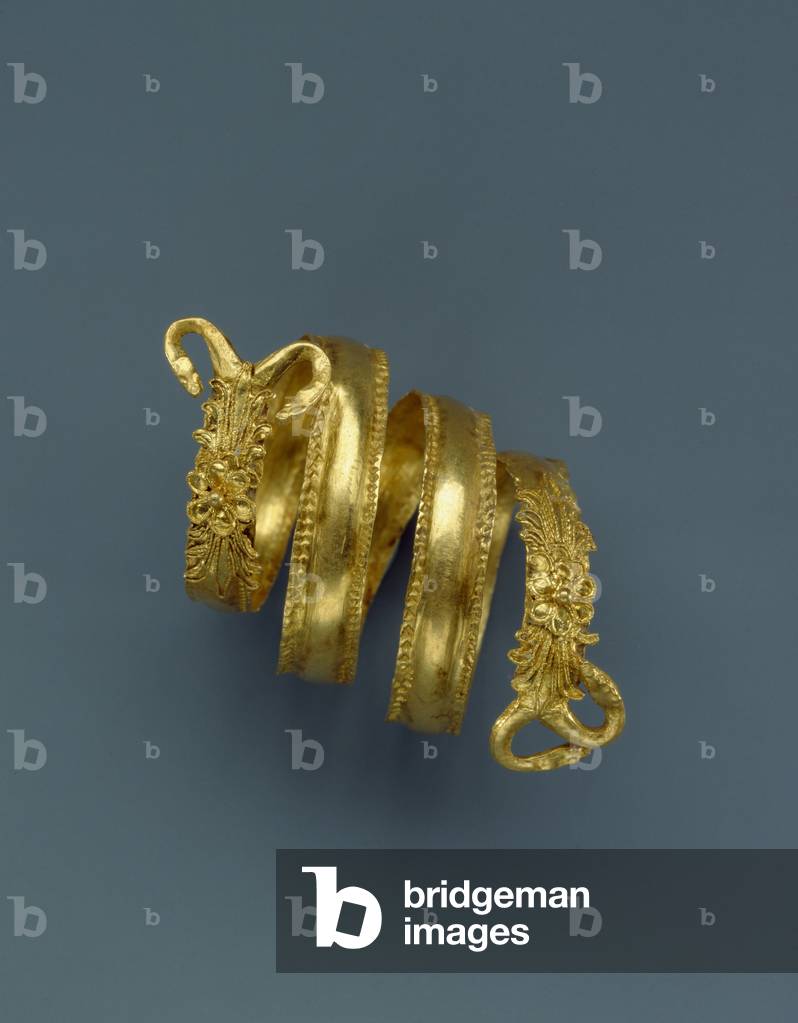
Spiral ring , from Herakleia (Heraclea), southern necropolis, tomb 22
Restrizioni immagine
  • Bridgeman Images only provides access to this image. Consent to license this image for any usage that includes Italy as a territory may be required according to the Italian Cultural Heritage Code. In such cases, an additional fee may apply, with the Ministry of Culture charging a potential minimum of €100. Any such clearance must be obtained in advance from the institution where the work is kept. Please contact us for further assistance.
Ring with the small cylinders hold a hinge around which a scarab in engraved onyx (= sardonyx) rotates and, on the flat face, a lion devours a deer , from Cuma, Steven Collection
Restrizioni immagine
  • Bridgeman Images only provides access to this image. Consent to license this image for any usage that includes Italy as a territory may be required according to the Italian Cultural Heritage Code. In such cases, an additional fee may apply, with the Ministry of Culture charging a potential minimum of €100. Any such clearance must be obtained in advance from the institution where the work is kept. Please contact us for further assistance.
Spiritual marriage of Christ with Saint Mary Magdalene, detail. (circa 1377, Fresco placed on canvas)
Restrizioni immagine
  • Bridgeman Images only provides access to this image. Consent to license this image for any usage that includes Italy as a territory may be required according to the Italian Cultural Heritage Code. In such cases, an additional fee may apply, with the Ministry of Culture charging a potential minimum of €100. Any such clearance must be obtained in advance from the institution where the work is kept. Please contact us for further assistance.
Cassini - Huygens and Saturn - Cassini spacecraft at Saturn - Artist's view of the Cassini probe around Saturn. The Huygens European module is attached to the probe. The Cassini-Huygens probe was launched on 15 October 1997 and has been placed in orbit around Saturn since 1 July 2004. The great Cassini orbiter, with the Huygens probe still in place, prepares to slip through the ring plane of Saturn. Cassini - Huygens was launched from the earth on october 15 1997 and is orbiting Saturn system from july 1st 2004
Earth at the end of Permian - Ring arcs over the Permian Earth - A ring of rocks and dust is orbiting the Earth. The massive continent below is Pangee and the ocean to the west is Panthalassa. This is what Earth was supposed to look like at the end of Permian, about 260 million years ago, before the first dinosaurs appeared. This ring around the Earth was of earthly origin, constitutes debris thrown into orbit by collision with a meteorite or comet. Over time, these debris have either fallen or fallen back to Earth in a meteorite rain. A dusty ring arc orbits four thousand miles above Earth's equator. The massive continent below is Pangea and the ocean to the west is Panthalassa. This is how the Earth may have appeared during the end of the Permian period, a time just prior to the appearance of the dinosaurs, when continental drift was pulling Pangea apart into the seven continents we know today. 260 million years ago the Earth may have been host to ring arcs similar to the incomplete rings that currently circumscribe the planet Neptune. Unlike Neptune's rings, the ring arcs around the Earth were of terrestrial origin, debris thrown into orbit by a collision with a large meteorite or comet. The debris consisted of tiny pebbles that were once molten droplets of ejecta, long since cooled in the vacuum of space. The orbit of the ring arc would eventually decay, returning the debris back to Earth as a shower of meteorites. This debris is found on Earth's surface today in the form of dark, glassy objects known as tektites
The Cassini and Saturn probe - Cassini spacecraft at Saturn - Artist's view of the Cassini probe above the northern hemisphere of Saturn. This illustration shows Cassini above Saturn's northern hemisphere prior to making one of its Grand Finale dives. During Cassini's Grand Finale, the spacecraft will make 22 orbits around Saturn that carry the spacecraft over the planet's north before diving between Saturn and its rings. At the conclusion of this final set of daring orbits, the spacecraft will plunge into Saturn's atmosphere, ending its mission on Sept. 15, 2017.
Saturn seen by the Cassini probe - Saturn seen by Cassini spacecraft: Saturn seen by the Cassini probe on 28 October 2016. Images taken on Oct. 28, 2016 with the wide angle camera using red, green and blue spectral filters were combined to create this color view. This view looks toward the sunlit side of the rings from about 25 degrees above the ringplane. The view was acquired at a distance of approximately 870,000 miles (1.4 million kilometers) from Saturn. Image scale is 50 miles (80 kilometers) per pixel
Jupiter - Illustration - Jupiter is surrounded by a system of very dark rings composed of dust removed from some of its satellites. This system consists of a main ring, located between the Metis and Adrastee satellites, then rings very held in the orbits of the Amalthee and Thebe satellites. This is how Jupiter might look from a position in space just beneath the plane of Jupiter's Main ring. Jupiter's Main ring is believed to be composed of dust and debris from meteoroid impacts with Jupiter's tiny innermost satellites Metis and Adrastea. Jupiter hosts two other broader and more diffuse rings (too faint to be rendered here) which are believed to be generated and replenished by meteoroid impacts on the tiny satellites Thebe and Amalthea
The formation of Saturn's rings - Artist's view - Saturn moon break up - A satellite of Saturn breaks giving birth to the rings of Saturn and has small satellites
Neptune et Triton- Illustration - Neptune with its moon Triton Artwork
Il Content Partner applica le seguenti restrizioni
  • Only available to clients invoiced in France
Saturn seen from the Atmosphere of Titan - Saturn from Titan - Illustration
Jupiter Ring - Illustration - Jupiter Ring: Jupiter is surrounded by a system of very dark rings composed of dust torn from some of its satellites. This system consists of a main ring, located between the satellites Metis and Adrastee, then rings very held on the orbits of the satellites Amalthee and Thebe - Jupiter's Main ring is believed to be composed of dust and debris from meteoroid impacts with Jupiter's tiny innermost satellites Metis and Adrastea. Jupiter hosts two other broader and more diffuse rings which are believed to be generated and replenished by meteoroid impacts on the tiny satellites Thebe and Amalthea
A satellite of Saturn breaks into the rings of Saturn and has small satellites.
Istruzioni particolari
  • No additional copyright fee required
Moon Formation: Hypotheses of impact giant - Moon Formation: Giant impact hypothesis: The hypotheses of impact giant suggests that the Moon was created from material ejecteated by a collision between the young Earth and a body the size of Mars named Theia, 4.5 billion years ago - The giant-impact hypothesis, sometimes called the Big Splash, or the Theia Impact suggests that the Moon formed out of the debris left over from a collision between Earth and a body of the size of Mars, approximately 4.5 billion years ago
Uranus and its satellite Puck - Illustration - Uranus from Puck orbit - Illustration - The planet Uranus seen from the orbit of its small satellite Puck. This is how Uranus and its tiny satellite Puck might look from a position in orbit around Puck. Puck in turn orbits Uranus at a height of 37 thousand miles above Uranus' cloud tops, completing one orbit in about 18 hours. Due to the fact that Puck's orbit is on the same plane as Uranus' rings, they would appear as little more than a thin line from this vantage punin
Uranus view of Ariel - Illustration - Uranus as seen from Ariel - Illustration: Artist view of the planet Uranus seen from his satellite Ariel
Uranus view from Cordelia - Illustration - Uranus as seen from Cordelia - Illustration: Illustration of Uranus seen from the Cordelia bergere Moon. Uranus as seen from shepherd moon Cordelia
Saturn and satellites seen by Voyager - Saturn system montage - Mounting made from the photos obtained by the Voyager 1 and 2 probes showing Saturn accompanied by its satellites. Enceladus is the largest satellite on the image, then clockwise we find Dione, Rhea, Titan (top right), Japet, Tethys, and Mimas. This montage of images of the Saturnian system was prepared from an assemblage of images taken by the Voyager 1 and 2 spacecrafts during their Saturn encounter. The large satellite at left is Enceladus, followed in clockwise order by Dione, Rhea, Titan (in top right corner), Iapetus, Tethys, & Mimas
Planete extrasolaire - Artist view - Extrasolar planet - Artist vie
Uranus view of Ariel - Illustration - Uranus as seen from Ariel - Illustration: Artist view of the planet Uranus seen from his satellite Ariel
Neptune - Illustration - Neptune's Great Dark Spot - Illustration - Artist's view of Neptune with its ring system and large dark spot observed by the Voyager 2 probe in 1989. This is how Neptune's Great Dark Spot and rings may have looked in 1989 from a position just beneath Neptune's ring plane. The outermost Adams ring is near the top of the frame, and beneath that is the much broader and diffuse Lassell ring. Further in toward Neptune and abutting the Lassell ring is the thin Le Verrier ring, and beyond that is the diffuse Galle ring. The Great Dark Spot is believed to be a storm similar to, but only half the size of, Jupiter's Great Red Spot. While Jupiter's Great Red Spot has been raging for at least 400 years, subsequent observations of Neptune's Great Dark Spot in 1994 by the Hubble Space Telescope revealed that this storm has since disappeared. The Great Dark Spot was a very dynamic weather system, generating massive, white clouds similar to high - altitude cirrus clouds on Earth. Unlike cirrus clouds on Earth however, which are composed of crystals of water ice, Neptune's cirrus clouds are made up of crystals of frozen methane. Neptune's clouds are driven by winds of 1,200 mph, the fastest winds of any planet in the Solar System
Saturn view from its satellite Rhea - Artist view - Saturn from Rhea - Artist view: Artist view of the surface of the satellite Rhea and the planet Saturn - Saturn rises above its moon Rhea
Geyser sur Enceladus - Artist view - Water geyser on Enceladus - Artist view - Artist view of an ice geyser on the surface of the Enceladus satellite. In the sky, the planet Saturn. A look at the water geysers of Saturn's moon Enceladus, which have been revealed to us so brilliantly by the Cassini Saturn orbiter. This digital illustration shows the water jets shooting out from vents in the bottom of one of the icy moon's multitude of folded, fractured valleys
Saturn from its moon Epimethee - Illustration - Saturn from its moon Epimetheus
Istruzioni particolari
  • No additional copyright fee required
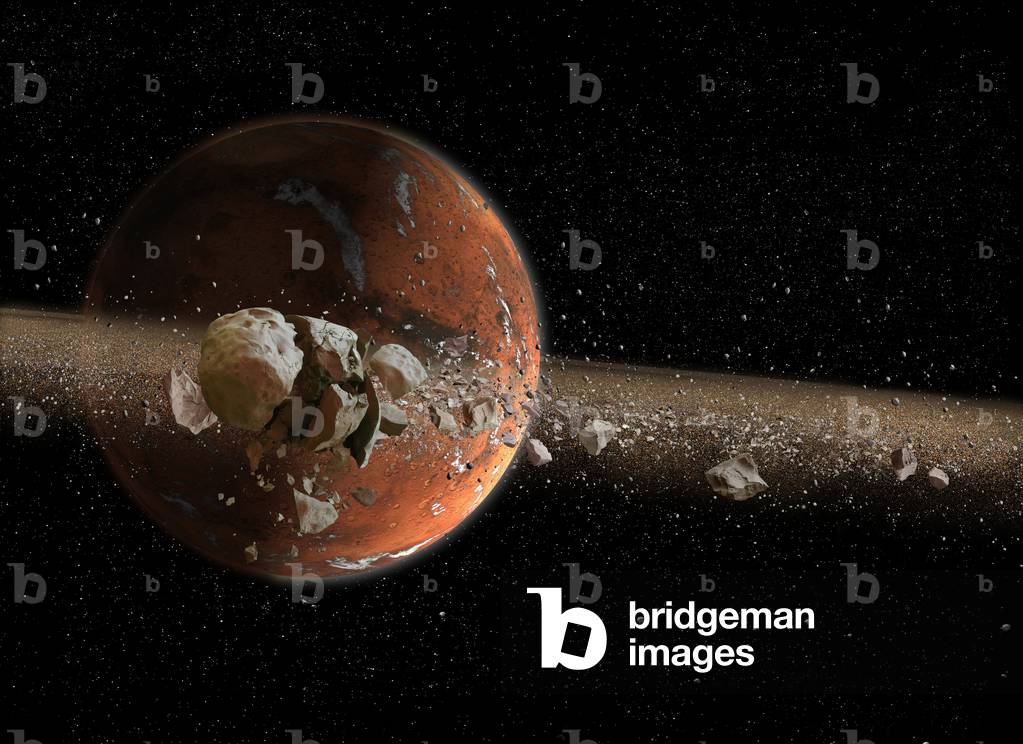
Mars: Phobos breaks apart - Illustration - Phobos breaking up to form ring - Illustration - Artist's view of Phobos, the largest of Mars's two satellites, which due to its proximity to the planet Mars will break in 20 to 50 million years. The larger pieces will crush on Mars, forming new crateres, but the smaller ones and the dust should remain in suspension, in orbit and leave all around Mars to form a ring. Phobos, one of Mars' moons, is getting closer to the planet and in several million years Phobos will break apart upon reaching the Roche limit, and become a set of rings
Uranus from Titania - Illustration - Uranus as seen from Titania - Illustration: Illustration of the planet Uranus from its satellite Titania
Jupiter et Io vus d'Europe - Jupiter and Io seen from Conamara Chaos on Europa.: Jupiter seen from his satellite Europe- Illustration - Jupiter seen from Europa. Artwork
Il Content Partner applica le seguenti restrizioni
  • Only available to clients invoiced in France
In the atmosphere of Saturn - In Saturn's atmosphere. Artwork: The rings seen from the clouds of Saturn. Artist's view. Rings seen from Saturn's atmosphere
Artist's view of ice geysers on the surface of the Enceladus satellite. In the sky, the Sun and the Planet Saturn.
Saturn seen from Pandora - Artist view - Saturn and Pandora - Artist view: The small satellite shepherd Pandora and the F-ring of Saturn - Pandora, a shepherd moon, and the F-ring of Saturn
Saturn seen from a satellite Irregulier - Illustration: Irregular satellite of Saturn
Istruzioni particolari
  • No additional copyright fee required
Saturn view of its satellite Hyperion - Artist view - Saturn from its moon Hyperion - Artist view
Istruzioni particolari
  • No additional copyright fee required
Uranus - Illustration - The planet Uranus and its system of rings. This image suggests how Uranus might look from a position in space several hundred thousand miles above its south pole. Like Saturn and Jupiter, Uranus is a Gas Giant, composed primarily of hydrogen and helium gases surrounding a relatively small, dense core of molten rock and metal. Its bluish color is due to the presence of methane in its upper atmosphere. Also like Saturn and Jupiter, Uranus has rings. However Uranus' rings are over three orders of magnitude dimmer than Saturn's; where Saturn's rings are almost white, Uranus' rings are more like the color of charcoal. Uranus 'rings are so dim that they went undetected from 1781, when the English astronomer William Herschel first observed Uranus through a telescope, until 1977 when astronomers watched as a star passing behind Uranus appeared to blink several times, caused by the ten rings surrounding the planet. One bizarre aspect of Uranus is that its axis of rotation is tipped beyond 90 degrees in relation to the plane of its orbit around the Sun. This puts Uranus' north and south poles, relative to the Sun, where the other planets have their equators
Uranus from Miranda - Illustration - Uranus as seen from Miranda - Illustration: Illustration of the planet Uranus from its Miranda satellite. Artist's impression of Uranus as seen from Miranda
The formation of Saturn's rings - Artist's view - The origin of Saturn's rings
Istruzioni particolari
  • No additional copyright fee required
Saturn view from its satellite Rhea - Artist view - Saturn from Rhea - Artist view: Artist view of the surface of the satellite Rhea and the planet Saturn - Saturn rises above its moon Rhea
Neptune from Triton - Illustration - Neptune from the surface of Triton - Neptune seen from the icy surface of his Triton satellite. White cirrus clouds race across a crescent Neptune as it presides over Triton's bleak and frozen south polar region. Sheets of frozen nitrogen ice with traces of other substances, including frozen methane and carbon monoxide, overlie Triton's darker material. The ice has turned pink due to the interaction with ultraviolet light from the distant Sun. Further south all of the surface of Triton is covered by such ices
Geyser sur Enceladus - Artist view - Water geyser on Enceladus - Artist view - Artist view of an ice geyser on the surface of the Enceladus satellite. In the sky, the planet Saturn and its satellite Mimas. Liquid water reaches the surface of Enceladus' south pole and drives a massive plume of ice crystals into the sky. The combination of Enceladus' low surface gravity and the geyser's force accelerate the crystals to escape velocity, where sunlight breaks the water molecules down into their constituent atoms of hydrogen and oxygen. Saturn itself appears low on the horizon due to the proximity to Enceladus' pole. The small object immediately to Saturn's left is another icy moon named Mimas. Somewhat smaller than Enceladus and closer to Saturn, Mimas sprints around Saturn in slightly less than one Earth day. In March 2006 Nasa's Cassini probe revealed evidence of water - driven geysers on the surface of Enceladus. At first glance Enceladus doesn't seem to be a likely host for liquid water as the surface is extremely cold, about - 330* F. However, tidal forces from Saturn's massive gravity alternately pull and push on Enceladus 'interior, creating enough heat to melt the water ice immediately beneath the surface. This water is believed to periodically break through the surface as geysers, similar to Yellowstone's Old Faithful. There are only three other places in the Solar System where this kind of geologic activity is known to exist: our own Earth, Jupiter's satellite Io, and Neptune's satellite Triton. What makes Enceladus especially interesting is that this the most compelling evidence yet for liquid water - - a requirement for life - - on any world beyond the Earth
Geyser sur Enceladus - Artist's view - Water geyser on Enceladus - Artist's view of an ice geyser on the surface of the Enceladus satellite. In the sky, the planet Saturn and its satellite Mimas. Liquid water reaches the surface of Enceladus' south pole and drives a massive plume of ice crystals into the sky. The combination of Enceladus' low surface gravity and the geyser's force accelerate the crystals to escape velocity, where sunlight breaks the water molecules down into their constituent atoms of hydrogen and oxygen. Saturn itself appears low on the horizon due to the proximity to Enceladus' pole. The small object immediately to Saturn's left is another icy moon named Mimas. Somewhat smaller than Enceladus and closer to Saturn, Mimas sprints around Saturn in slightly less than one Earth day. In March 2006 Nasa's Cassini probe revealed evidence of water - driven geysers on the surface of Enceladus. At first glance Enceladus doesn't seem to be a likely host for liquid water as the surface is extremely cold, about - 330* F. However, tidal forces from Saturn's massive gravity alternately pull and push on Enceladus 'interior, creating enough heat to melt the water ice immediately beneath the surface. This heated water is believed to periodically erupt like a volcano, a process known as cryovolcanism. There are only three other places in the Solar System where active volcanism is known to exist: our own Earth, Jupiter's satellite Io, and Neptune's satellite Triton. What makes Enceladus especially interesting is that this the most compelling evidence yet for liquid water - - a requirement for life - - on any world beyond the Earth
Artist's view of the asteroid 10199 Chariklo - Artist impression of asteroid 10199 Chariklo: (10199) Chariklo, is a centaur, an asteroid whose orbit crosses that of the outer planets of the solar system. Discovered on 15 February 1997 by the Spacewatch program, it is the first known asteroid with rings. 10199 Chariklo is the largest confirmed centaur (minor planet of the outer Solar System). It orbits the Sun between Saturn and Uranus, grazing the orbit of Uranus. On 26 March 2014, astronomers announced the discovery of two rings (nicknamed Oiapoque and Chui), around Chariklo by observing a stellar occultation making it the first known minor planet to have rings
Uranus and its satellite Puck - Illustration - Uranus and Puck - Illustration - Planet Uranus with its Puck satellite in the foreground. On the right, closer to the planet, is the Belinda satellite. Even closer to Uranus, on the left, the Portia satellite. On Uranus, a giant storm is represented. This is how Uranus and its tiny satellite Puck might look from a position in space about a thousand miles above and beyond Puck itself. With a diameter of about 100 miles, Puck is the largest and outermost of the ten known “” inner”” satellites that orbit Uranus within a radius of 51 thousand miles. Further in toward Uranus on the right is Belinda, a satellite that is about 40 miles in diameter. Even closer to Uranus on the far left is the 60 - mile - diameter satellite Portia. On Uranus itself can be seen a giant, cyclonic storm that's almost as big as the Earth
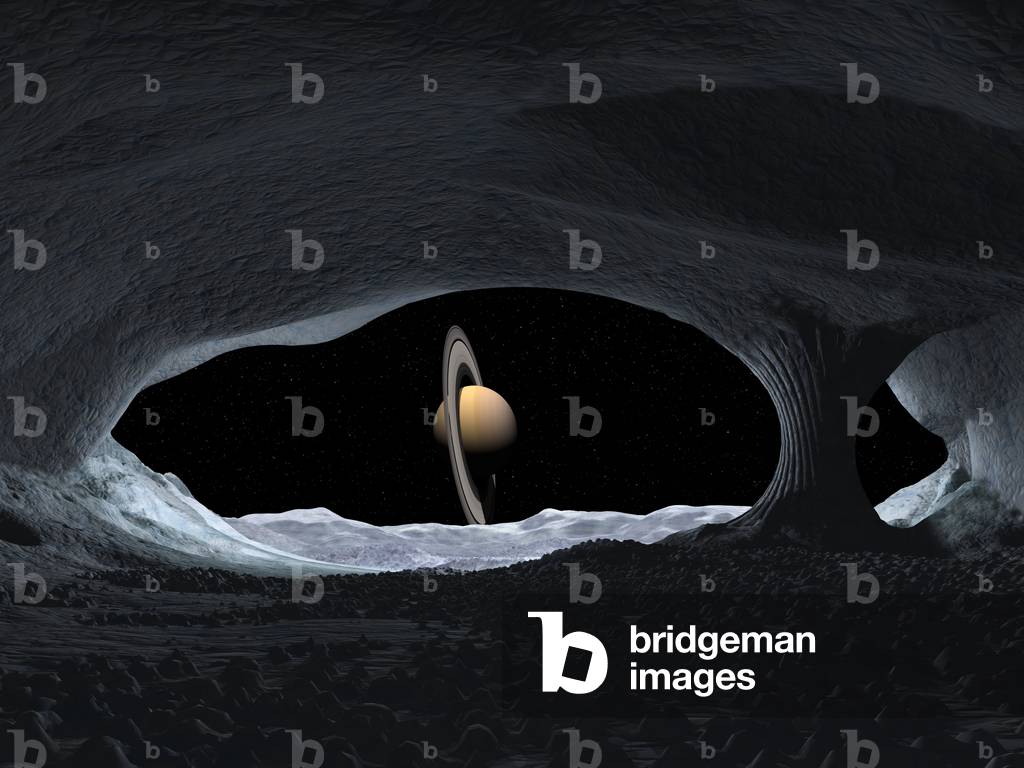
Saturn seen from its satellite Japet - Saturn from Iapetus - The planet Saturn accompanied by three satellites (from left to right Tethys, Rhea and Dione) seen from the icy surface of Japet. In this image Saturn dominates Iapetus' velvet black sky framed by three inner moons. Left to right are Tethys, Rhea and Dione. Less than half the size of the Earth's moon, ice - covered Iapetus is one of the few places in the Solar System that offers a good view of Saturn's rings. This is because Iapetus' orbit is inclined almost 15 degrees to Saturn's equator. With the exception of Phoebe, none of Saturn's other satellites offer such a vantage point. Unlike haze - shrouded Titan, Iapetus has no atmosphere to speak of and is believed to be composed almost entirely of water ice
Saturn seen by the Cassini probe - Saturn northern hemisphere seen by Cassini spacecraft: Saturn seen by the Cassini probe on 25 April 2016. Cassini scanned across the planet and its rings on April 25, 2016, capturing three sets of red, green and blue images to cover this entire scene showing the planet and the main rings. The images were obtained using Cassini's wide-angle camera at a distance of approximately 1.9 million miles (3 million kilometers) from Saturn and at an elevation of about 30 degrees above the ring plane. The view looks toward the sunlit side of the rings from a Sun-saturn-spacecraft angle, or phase angle, of 55 degrees.
Cassini - Huygens and Saturn - Cassini spacecraft at Saturn - Artist's view of the Cassini probe around Saturn. The Huygens European module is attached to the probe. The Cassini-Huygens probe was launched on 15 October 1997 and has been placed in orbit around Saturn since 1 July 2004. The great Cassini orbiter, with the Huygens probe still in place, prepares to slip through the ring plane of Saturn. Cassini - Huygens was launched from the earth on october 15 1997 and is orbiting Saturn system from july 1st 2004
Saturn from his satellite Dione - Illustration
Istruzioni particolari
  • No additional copyright fee required
Ring around the Dwarf Planet Haumea - Illustration - Ring around Dwarf Planet Haumea - Artwork - Haumea, (136108 Haumea), is a transneptunian dwarf planet (a plutoid) of the Solar System member of the Kuiper belt. Discovered in 2004, Haumea has two known natural satellites, a very fast rotation (less than 4 h), an ellipsoidal shape and a high albedo caused by water ice crystals on its surface. Haumea would measure between 1,960 and 2,500 km, barely less than Pluto and twice as much as Ceres, the smallest known dwarf planet. Haumea, minor-planet designation 136108 Haumea, is a dwarf planet located beyond Neptune's orbit. It was discovered in 2004 and was recognized as a dwarf planet in 2008. Haumea's mass is about one-third that of Pluto, it has an elongated shape with a rapid rotation and has two known moons, Hi iaka and Namaka
Saturn seen from Enceladus - Illustration - Saturn from the surface of Enceladus: The planet Saturn seen from the icy surface of its satellite Enceladus
Planete extrasolaire - Artist view - Extrasolar planet - Artist vie
Saturn seen by the Cassin probe - Saturn seen by Cassini spacecraft on october 10 2013: Saturn seen by the Cassini probe on October 10, 2013. - A swing high above Saturn by Nasa's Cassini spacecraft revealed this stately view of the golden-hued planet and its main rings. The view is in natural color, as human eyes would have seen it. This mosaic was made from 36 images in three color filters obtained by Cassini's imaging science subsystem on Oct. 10, 2013 - A bright, narrow wave of clouds around 42 degrees north latitude appears to be some of the turbulent aftermath of a giant storm that reached its violent peak in early 2011. The mysterious six-sided weather pattern known as the hexagon is visible around Saturn's north pole - The rings shown here include Saturn's main rings. The rings known as the C, B and A rings - listed here in order of closeness to Saturn - are easily seen. The F ring is also there, but not easily seen without enhancing the contrast of the image. (Rings were named in order of their discovery rather than their position around Saturn.) The rings also cast a shadow on Saturn at the limb of the planet in the lower right quadrant
A ring of rocks and dust is orbiting the Earth. The massive continent below is Pangee and the ocean to the west is Panthalassa. This is what Earth was supposed to look like at the end of Permian, about 260 million years ago, before the first dinosaurs appeared. This ring around the Earth was of earthly origin, constitutes debris thrown into orbit by collision with a meteorite or comet. Over time, these debris have fallen or fallen to Earth in a meteorite rain - A dusty ring arc orbits four thousand miles above Earth's equator. The massive continent below is Pangea and the ocean to the west is Panthalassa. This is how the Earth may have appeared during the end of the Permian period, a time just prior to the appearance of the dinosaurs, when continental drift was pulling Pangea apart into the seven continents we know today - 260 million years ago the Earth may have been host to ring arcs similar to the incomplete rings that currently circumscribe the planet Neptune . Unlike Neptune's rings, the ring arcs around the Earth were of terrestrial origin, debris thrown into orbit by a collision with a large meteorite or comet. The debris consisted of tiny pebbles that were once molten droplets of ejecta, long since cooled in the vacuum of space. The orbit of the ring arc would eventually decay, returning the debris back to Earth as a shower of meteorites. This debris is found on Earth's surface today in the form of dark, glassy objects known as tektites.: La Terre à la fin du Permien - Ring arcs over the Permian Earth
Triton could break and form a new ring - Triton could break to give Neptune a new rings system.: Neptune and Triton- Illustration - Neptune with its moon Triton. Artwork
Il Content Partner applica le seguenti restrizioni
  • Only available to clients invoiced in France
Saturn en jour seen by Cassini - Backlit Saturn seen by Cassini - Image obtained by the Cassini probe on October 17, 2012 at a distance of 800,000 km from the planet. At the bottom left of the image, the two brilliant dots are the Enceladus and Tethys satellites. Nasa's Cassini spacecraft has delivered a glorious view of Saturn, taken while the spacecraft was in Saturn's shadow. The cameras were turned toward Saturn and the sun so that the planet and rings are backlit. (The sun is behind the planet, which is shielding the cameras from direct sunlight.) In addition to the visual splendor, this special, very - high - phase viewing geometry lets scientists study ring and atmosphere phenomena not easily seen at a lower phase. Also captured in this image are two of Saturn's moons: Enceladus and Tethys. Both appear on the left side of the planet, below the rings. Enceladus is closer to the rings; Tethys is below and to the left. This view looks toward the non - illuminated side of the rings from about 19 degrees below the ring plane. Images taken using infrared, red and violet spectral filters were combined to create this enhanced - color view. The images were obtained with the Cassini spacecraft wide - angle camera on Oct. 17, 2012 at a distance of approximately 500,000 miles (800,000 kilometers) from Saturn. Image scale at Saturn is about 30 miles per pixel (50 kilometers per pixel)
Neptune and Triton - Illustration - Neptune from Triton orbit - Neptune and its Triton satellite (foreground). Looking like an over - ripe cantaloupe, Neptune's satellite Triton is in the foreground while Neptune itself looms on the upper right. At a distance of 220 thousand miles, Triton is about the same distance from Neptune as the moon is from the Earth. A frozen world that's somewhat smaller than the moon, Triton is the seventh and largest of Neptune's satellites, completing an orbit every six days. Triton is believed to be composed primarily of rock and water ice with traces of methane and other compounds
Artist's view of the asteroid 10199 Chariklo - Artist impression of asteroid 10199 Chariklo: (10199) Chariklo, is a centaur, an asteroid whose orbit crosses that of the outer planets of the solar system. Discovered on 15 February 1997 by the Spacewatch program, it is the first known asteroid with rings. 10199 Chariklo is the largest confirmed centaur (minor planet of the outer Solar System). It orbits the Sun between Saturn and Uranus, grazing the orbit of Uranus. On 26 March 2014, astronomers announced the discovery of two rings (nicknamed Oiapoque and Chui), around Chariklo by observing a stellar occultation making it the first known minor planet to have rings
Saturn en jour vue par Cassini - Backlit Saturn seen by Cassini - Mosaic of 141 photos obtained by the Cassini probe on 19 July 2013 at a distance of 1.2 million km from the planet. The Cassini probe was then in the shadow of the Planet Saturn; this portrait of the Giant Planet highlights its ring system and seven of its satellites appear in the image. The planets Mars, Venus and Earth are also visible. On July 19, 2013, Nasa's Cassini spacecraft slipped into Saturn's shadow and turned to image the planet, seven of its moons, its inner rings - and, in the background, our home planet, Earth. With both Cassini's wide-angle and narrow-angle cameras aimed at Saturn, Cassini was able to capture 323 images in just over four hours. This final mosaic uses 141 of those wide-angle images. Images taken using the red, green and blue spectral filters of the wide-angle camera were combined and mosaicked together to create this natural-color view. This image spans about 404,880 miles (651,591 kilometers) across. In the lower right of the mosaic, in between the bright blue E ring and the faint but defined G ring, is the pale blue dot of our planet, Earth. Earth's twin, Venus, appears as a bright white dot in the upper left quadrant of the mosaic, also between the G and E rings. Mars also appears as a faint red dot embedded in the outer edge of the E ring, above and to the left of Venus. Cassini was approximately 746,000 miles (1.2 million kilometers) from Saturn when the images in this mosaic were taken.
Neptune from Triton - Illustration - Triton's shadow on Neptune - Neptune seen from the icy surface of his Triton satellite. The satellite projects its shadow on the Giant Planet. A full Neptune washes Triton's frozen surface with an indigo light, the only source of illumination on this now Triton's dark side. Fortuitous alignment of the Sun, Triton and Neptune causes this satellite's shadow to fall on Neptune's distant cloud tops 220 thousand miles away. This view is from within a deep, crater - like depression on Triton's northern hemisphere
Saturn view of its satellite Dione - Illustration - Ice walls of Dione
Istruzioni particolari
  • No additional copyright fee required
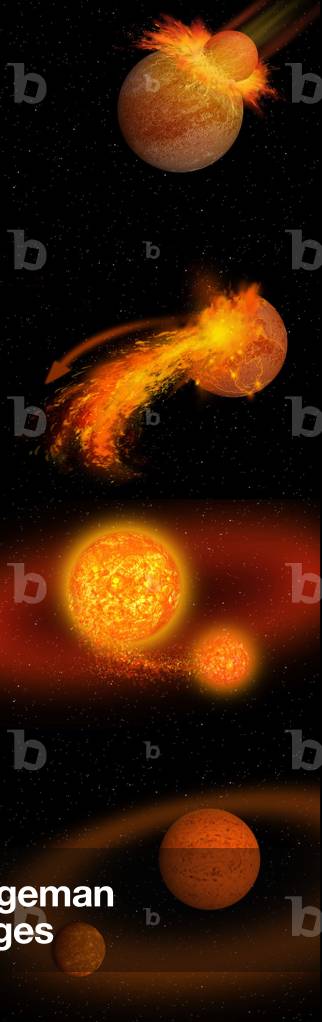
Moon Formation: Another Hypotheses of Giant Impact - Moon Formation: Hit-and-run Giant Impact Scenario: The hypothesis of giant impact suggests that the Moon was created from material ejected by a collision between the young Earth and a body the size of Mars named Theia 4.5 billion years ago. This scenario is widely accepted, but analyses of lunar samples have shown a major problem with this theory: the Moon should be composed mainly of Theia materials. The elements of the Moon and the Earth show remarkable similarities. Researchers explored a new collision geometry, changing the impact configuration. Their simulation also integrates a more energetic impact (called “hit and run”) that could tear more matter from Earth and make the pre-lunar debris disc dominate by terrestrial matter - The giant-impact hypothesis, sometimes called the Big Splash, or the Theia Impact suggests that the Moon formed out of the debris left over from a collision between Earth and a body of the size of Mars, approximately 4.5 billion years ago - Unfortunately, samples taken from the Earth and from the Moon show that the ratio of the Earth's and the Moon's oxygen isotopes is almost identical. And a fresh analysis of lunar samples taken by the Apollo missions show that the Moon and the Earth share a very similar isotope ratio of the metal titanium... All which should not be the case, if the Big Splat theory is correct. Researchers (A.Reufer et al.) have proposed a variation on the Big Splat. They have suggested that instead of a collision with a slow-moving body like Theia, a much larger and fast-moving body hit the earth a glancing blow. Unlike Theia - which would have been largely sacrificed in the creation of our Moon - this new body would have lost only a small amount of material in the collision. After smacking the Earth, the pla
Saturn Clouds - Clouds of Saturn - Artwork - Saturn rings seen through Saturn clouds. A view of the rings as seen from a point just above the main cloud deck of Saturn
Gilted bronze ring, 7th century BC
Neptune - Illustration - Artist's view of Neptune with its ring system and large dark spot observed by the Voyager 2 probe in 1989. This image suggests how Neptune might look from a position in space above the plane of its rings. Like Uranus, Neptune is a Gas Giant, composed primarily of hydrogen and helium gases surrounding a relatively small, dense core of molten rock and metal. Also like Uranus, Neptune has charcoal - colored rings, although they appear to be fewer in number than Uranus's. While Neptune's diameter is slightly less than Uranus ', it has more mass. Neptune's blue color is due to the presence of methane in its upper atmosphere. The dark spot in the southern hemisphere beneath the rings, dubbed “” The Great Dark Spot,””” is believed to be a giant storm which was active in 1989 when Voyager 2 photographed Neptune. Just beyond the rings at Neptune's 7 o'clock position, barely discernable from the background stars, is the tiny satellite Proteus. With an average diameter of 260 miles, Proteus is the second - largest of Neptune's eight known satellites (a distant second compared to Neptune's largest satellite Triton which has a diameter of 1,677 miles)
Saturn seen at equinox - Saturn during Equinox - Saturn seen by the Cassini probe on August 12, 2009, 1.25 days after the exact date of Saturn equinox. The images that make up this mosaic were obtained at a distance of 847,000 km from the planet. Several satellites are visible in this image: Janus (lower left), Epimethee (lower middle), Pandora (on the right of the image, outside the rings) and Atlas (on the right, inside the F ring). Seen from our planet, the view of Saturn's rings during equinox is extremely foreshortened and limited. But in orbit around Saturn, Cassini spacecraft had no such problems. From 20 degrees above the ring plane, Cassini's wide angle camera shot 75 exposures in succession for this mosaic showing Saturn, its rings, and a few of its moons a day and a half after exact Saturn equinox, when the sun's disk was exactly overhead at the planet's equator. The novel illumination geometry that accompanies equinox lowers the sun's angle to the ring plane, significantly darkens the rings, and causes out - of - plane structures to look anomalously bright and to cast shadows across the rings. These scenes are possible only during the few months before and after Saturn's equinox which occurs only once in about 15 Earth years. Also at equinox, the shadows of the planet's expansive rings are compressed into a single, narrow band cast onto the planet as seen in this mosaic. The images comprising the mosaic, taken over about eight hours, were extensively processed before being joined together. At this time so close to equinox, illumination of the rings by sunlight reflected off the planet vastly dominates any meager sunlight falling on the rings. Hence, the half of the rings on the left illuminated by planetshine is, before processing, much brighter than the half of the rings on the right. On the right, it is only the vertically extended parts of the rings that catch any substantial sunlight. With no enhancement, the rings woul
Uranus and Miranda- Illustration - Uranus seen from its moon Miranda. Artwork
Il Content Partner applica le seguenti restrizioni
  • Only available to clients invoiced in France
Close-up of a diamond ring.
Moon Formation: A ring of debris around the Earth - Moon Formation: ring around the earth: 4.5 billion years ago, the planet Theia collided with the primitive Earth. For a short time, a ring formed around the Earth. Soon, these debris will merge into the Moon - 4.5 billion years ago. After Theia collision and for a short time, the earth is surrounded by a ring of debris. The ring is only temporary, however: it soon begins to coalesce into a solid mass. Only a few years might have been required for it to form into a moon
Tempete sur Saturn seen by the Cassini probe - Huge Storm on Saturn seen by Cassini spacecraft - Evolution of a huge tempete on Saturn seen by the Cassini probe from December 5, 2010 to August 12, 2011. This series of images from Nasa's Cassini spacecraft shows the development of the largest storm seen on the planet since 1990. These true - color and composite near - true - color views chronicle the storm from its start in late 2010 through mid - 2011, showing how the distinct head of the storm quickly grew large but eventually became engulfed by the storm's tail. The earliest image of the storm, taken Dec. 5, 2010, is in the top left of the panel. The storm appears only as a small, white cloud on the terminator between the day side and night side of the planet. The next view, in the top middle of the panel and taken Jan. 2, 2011, shows that the head quickly grew much larger and a tail began to trail a great distance eastward. Some of the clouds moved south and got caught up in a current that flows to the east (to the right) relative to the storm head. In the top right of the panel, this tail, which appears as slightly blue clouds south and now west (left) of the storm head, can be seen encountering the storm in the Feb. 25 image.The April 22 image, in the bottom left of the panel, is one of Cassini's last views of the storm when it still had a recognizable head. In this view, the tail is south of the head and is well established by this time.The May 18 view, in the bottom middle, shows only the storm's tail. The head still existed at this time, but it is beyond the horizon and out of the field of view here.Between the time of the May 18 image and the next image shown here (from Aug. 12), the head of the storm was engulfed by the part of the storm's tail that spread eastward at the same latitude as the head. The Aug. 12 image, in the bottom right, shows that the head has lost its distinct identity and is now just part of the jumble of the storm. Also visible in these