[]
La tua selezione corrente
asset(s) Asset
Il tuo preventivo 0

La tua selezione

Cancella la selezione
Articolo aggiunto al carrello
{"event":"pageview","page_type1":"undetected","page_type2":"_assets_search_override","language":"it","user_logged":"false","user_type":"ecommerce","nl_subscriber":"false"}
{"event":"ecommerce_event","event_name":"view_item","event_category":"browse_catalog","ecommerce":{"items":[{"item_id":"UIG528826","item_category":"photo","item_category2":"no_copyright","item_category3":"standard","item_category5":"not_balown","item_list_name":"search_results","item_name":"composite_of_cassiopeia_a_supernova_remnant_across_the_spectrum_gamma_rays_magenta_fermi_gamma_ray_s","item_variant":"undefined"},{"item_id":"UIG867329","item_category2":"no_copyright","item_category3":"standard","item_category5":"not_balown","item_list_name":"search_results","item_name":"the_star_cluster_ngc_281_is_located_about_6_500_light_years_from_earth_and_remarkably_almost_1_000_l","item_variant":"undefined"},{"item_id":"UIG867317","item_category2":"no_copyright","item_category3":"standard","item_category5":"not_balown","item_list_name":"search_results","item_name":"this_composite_of_30_doradus_aka_the_tarantula_nebula_contains_data_from_chandra_hubble_and_spitzer_","item_variant":"undefined"},{"item_id":"UIG867331","item_category":"photo","item_category2":"no_copyright","item_category3":"standard","item_category5":"not_balown","item_list_name":"search_results","item_name":"infrared_images_from_nasa_s_spitzer_space_telescope_wise_and_chandra_are_combined_in_this_image_of_r","item_variant":"undefined"},{"item_id":"UIG867319","item_category2":"no_copyright","item_category3":"standard","item_category5":"not_balown","item_list_name":"search_results","item_name":"this_composite_of_30_doradus_aka_the_tarantula_nebula_contains_data_from_chandra_hubble_and_spitzer_","item_variant":"undefined"},{"item_id":"UIG867318","item_category":"photo","item_category2":"no_copyright","item_category3":"standard","item_category5":"not_balown","item_list_name":"search_results","item_name":"this_composite_of_30_doradus_aka_the_tarantula_nebula_contains_data_from_chandra_hubble_and_spitzer_","item_variant":"undefined"},{"item_id":"UIG867316","item_category":"photo","item_category2":"no_copyright","item_category3":"standard","item_category5":"not_balown","item_list_name":"search_results","item_name":"this_composite_of_30_doradus_aka_the_tarantula_nebula_contains_data_from_chandra_hubble_and_spitzer_","item_variant":"undefined"},{"item_id":"PIX4645635","item_category":"illustration","item_category2":"no_copyright","item_category3":"standard","item_category4":"walter_b_myers","item_category5":"not_balown","item_list_name":"search_results","item_name":"chandra_space_telescope_artist_view_chandra_x_ray_observatory_view_of_the_chandra_telescope_in_orbit","item_variant":"undefined"},{"item_id":"PIX4583213","item_category":"photo","item_category2":"no_copyright","item_category3":"standard","item_category5":"not_balown","item_list_name":"search_results","item_name":"remains_of_supernova_sn_1006_supernova_remnant_sn_1006_remains_of_supernova_sn_1006_located_7000_yea","item_variant":"undefined"},{"item_id":"PIX4583187","item_category":"photo","item_category2":"no_copyright","item_category3":"standard","item_category5":"not_balown","item_list_name":"search_results","item_name":"supernova_remnants_snr_b0509_67_5_supernova_remnant_snr_b0509_67_5_snr_b0509_67_5_or_snr_0509_is_the","item_variant":"undefined"},{"item_id":"PIX4623257","item_category":"photo","item_category2":"no_copyright","item_category3":"standard","item_category5":"not_balown","item_list_name":"search_results","item_name":"planetary_nebula_ngc_6543_in_the_dragon_planetary_nebula_ngc_6543_in_draco_composite_view_of_the_pla","item_variant":"undefined"},{"item_id":"PIX4565787","item_category":"photo","item_category2":"no_copyright","item_category3":"standard","item_category5":"not_balown","item_list_name":"search_results","item_name":"galaxy_clusters_abell_2744_black_material_x_rays_dark_matter_and_galaxies_in_cluster_abell_2744","item_variant":"undefined"},{"item_id":"PIX4612291","item_category":"photo","item_category2":"no_copyright","item_category3":"standard","item_category5":"not_balown","item_list_name":"search_results","item_name":"centaurus_a_elliptical_galaxy_ngc_5128_in_the_centaurus_galaxy_centaurus_a_ngc_5128_the_galaxy_ngc_5","item_variant":"undefined"},{"item_id":"PIX4611313","item_category":"photo","item_category2":"no_copyright","item_category3":"standard","item_category5":"not_balown","item_list_name":"search_results","item_name":"the_elliptical_galaxy_m84_the_elliptical_galaxy_m84_the_m84_galaxy_ngc_4374_is_55_million_light_year","item_variant":"undefined"},{"item_id":"PIX4626499","item_category":"photo","item_category2":"no_copyright","item_category3":"standard","item_category5":"not_balown","item_list_name":"search_results","item_name":"crab_nebula_seen_in_different_wavelength_the_crab_nebula_in_multi_wavelength_m1_the_crab_nebula_is_t","item_variant":"undefined"},{"item_id":"REU8336487","item_category":"photo","item_category2":"no_copyright","item_category3":"standard","item_category4":"nasa","item_category5":"not_balown","item_list_name":"search_results","item_name":"images_taken_by_chandra_observatory_and_hubble_space_2001_03_13_photo","item_variant":"undefined"},{"item_id":"PIX4617509","item_category":"photo","item_category2":"no_copyright","item_category3":"standard","item_category5":"not_balown","item_list_name":"search_results","item_name":"nebula_ngc_604_in_the_galaxy_m33_ngc_604_star_forming_nebula_ngc_604_is_a_very_large_star_forming_re","item_variant":"undefined"},{"item_id":"PIX4637984","item_category":"photo","item_category2":"no_copyright","item_category3":"standard","item_category5":"not_balown","item_list_name":"search_results","item_name":"galactic_center_region_the_galactic_center_the_galactic_center_region_of_the_center_of_our_galaxy_se","item_variant":"undefined"},{"item_id":"PIX4609662","item_category":"photo","item_category2":"no_copyright","item_category3":"standard","item_category5":"not_balown","item_list_name":"search_results","item_name":"active_galaxy_ngc_1068_in_the_whale_active_galaxy_ngc_1068_this_composite_image_shows_that_a_strong_","item_variant":"undefined"},{"item_id":"REU8429745","item_category":"photo","item_category2":"no_copyright","item_category3":"standard","item_category4":"reuters_photographer","item_category5":"not_balown","item_list_name":"search_results","item_name":"widow_thanks_builders_of_observatory_for_honouring_husband_1999_07_19_photo","item_variant":"undefined"},{"item_id":"REU8556995","item_category":"photo","item_category2":"no_copyright","item_category3":"standard","item_category4":"nasa","item_category5":"not_balown","item_list_name":"search_results","item_name":"chandra_image_of_young_star_cluster_2001_06_07_photo","item_variant":"undefined"},{"item_id":"PIX4647570","item_category":"photo","item_category2":"no_copyright","item_category3":"standard","item_category5":"not_balown","item_list_name":"search_results","item_name":"e_collins_aboard_columbia_07_1999_eileen_m_collins_looks_over_a_procedures_checklist_eileen_m_collin","item_variant":"undefined"},{"item_id":"UIG532285","item_category2":"no_copyright","item_category3":"standard","item_category5":"not_balown","item_list_name":"search_results","item_name":"kepler_s_supernova","item_variant":"undefined"},{"item_id":"REU8014803","item_category":"photo","item_category2":"no_copyright","item_category3":"standard","item_category4":"nasa","item_category5":"not_balown","item_list_name":"search_results","item_name":"black_hole_image_taken_by_nasa_observatory_2000_09_12_photo","item_variant":"undefined"},{"item_id":"REU7614656","item_category":"photo","item_category2":"no_copyright","item_category3":"standard","item_category4":"nasa","item_category5":"not_balown","item_list_name":"search_results","item_name":"new_x_ray_photo_of_milky_way_reveals_heart_of_the_galaxy_2002_01_09_photo","item_variant":"undefined"},{"item_id":"PIX4582940","item_category":"photo","item_category2":"no_copyright","item_category3":"standard","item_category5":"not_balown","item_list_name":"search_results","item_name":"remnants_of_the_supernova_cassiopee_a_in_x_rays_visible_and_infrared_this_stunning_picture_of_the_su","item_variant":"undefined"},{"item_id":"REU7580181","item_category":"photo","item_category2":"no_copyright","item_category3":"standard","item_category4":"pierre_ducharme","item_category5":"not_balown","item_list_name":"search_results","item_name":"french_space_shuttle_columbia_astronaut_michel_tognini_appears_at_the_post_landing_press_conference_","item_variant":"undefined"},{"item_id":"UIS5101904","item_category":"object","item_category2":"no_copyright","item_category3":"standard","item_category5":"not_balown","item_list_name":"search_results","item_name":"x_rays_from_sirius_b_6_october_2000","item_variant":"undefined"},{"item_id":"REU8492879","item_category":"photo","item_category2":"no_copyright","item_category3":"standard","item_category4":"pierre_ducharme","item_category5":"not_balown","item_list_name":"search_results","item_name":"french_space_shuttle_columbia_astronaut_michel_tognini_1999_07_28_photo","item_variant":"undefined"},{"item_id":"PIX4583154","item_category":"photo","item_category2":"no_copyright","item_category3":"standard","item_category5":"not_balown","item_list_name":"search_results","item_name":"remains_of_supernova_g292_0_1_8_in_x_g292_0_1_8_supernova_remnant_x_ray_view_of_the_rest_of_supernov","item_variant":"undefined"},{"item_id":"REU8304401","item_category":"photo","item_category2":"no_copyright","item_category3":"standard","item_category4":"pierre_ducharme","item_category5":"not_balown","item_list_name":"search_results","item_name":"columbia_returns_from_orbit_to_kennedy_space_cenfer_1999_07_28_photo","item_variant":"undefined"},{"item_id":"REU8574058","item_category":"photo","item_category2":"no_copyright","item_category3":"standard","item_category4":"reuters_photographer","item_category5":"not_balown","item_list_name":"search_results","item_name":"space_shuttle_columbia_commander_eileen_collins_1999_07_28_photo","item_variant":"undefined"},{"item_id":"REU8499154","item_category":"photo","item_category2":"no_copyright","item_category3":"standard","item_category4":"joe_skipper","item_category5":"not_balown","item_list_name":"search_results","item_name":"columbia_blasts_skyward_with_eileen_collins_in_command_1999_07_23_photo","item_variant":"undefined"},{"item_id":"REU8403539","item_category":"photo","item_category2":"no_copyright","item_category3":"standard","item_category4":"pierre_ducharme","item_category5":"not_balown","item_list_name":"search_results","item_name":"columbia_returns_from_space_1999_07_28_photo","item_variant":"undefined"},{"item_id":"PIX4582960","item_category":"photo","item_category2":"no_copyright","item_category3":"standard","item_category5":"not_balown","item_list_name":"search_results","item_name":"remains_of_the_supernova_kepler_in_ophiuchus_nasa_s_three_great_observatories_the_hubble_space_teles","item_variant":"undefined"},{"item_id":"PIX4609424","item_category":"photo","item_category2":"no_copyright","item_category3":"standard","item_category4":"adam_block","item_category5":"not_balown","item_list_name":"search_results","item_name":"spiral_galaxy_m74_in_pisces_spiral_galaxy_m74_in_pisces_image_of_the_spiral_galaxy_m74_ngc_628_this_","item_variant":"undefined"},{"item_id":"REU8559092","item_category":"photo","item_category2":"no_copyright","item_category3":"standard","item_category4":"molly_riley","item_category5":"not_balown","item_list_name":"search_results","item_name":"columbia_poised_for_launch_atop_pad_39b_at_kennedy_space_center_1999_07_19_photo","item_variant":"undefined"},{"item_id":"REU8559450","item_category":"photo","item_category2":"no_copyright","item_category3":"standard","item_category4":"reuters_photographer","item_category5":"not_balown","item_list_name":"search_results","item_name":"columbia_poised_for_launch_atop_pad_39b_at_kennedy_space_center_1999_07_19_photo","item_variant":"undefined"},{"item_id":"REU8557572","item_category":"photo","item_category2":"no_copyright","item_category3":"standard","item_category4":"pierre_ducharme","item_category5":"not_balown","item_list_name":"search_results","item_name":"crew_of_space_shuttle_columbia_after_landing_at_kennedy_space_center_1999_07_28_photo","item_variant":"undefined"},{"item_id":"REU8573200","item_category":"photo","item_category2":"no_copyright","item_category3":"standard","item_category4":"karl_ronstrom","item_category5":"not_balown","item_list_name":"search_results","item_name":"launch_cheered_by_shalala_and_nasa_administrator_goldin_1999_07_23_photo","item_variant":"undefined"},{"item_id":"REU8531990","item_category":"photo","item_category2":"no_copyright","item_category3":"standard","item_category4":"karl_ronstrom","item_category5":"not_balown","item_list_name":"search_results","item_name":"french_astronaut_tognini_arrives_with_crew_to_prepare_for_launch_1999_07_16_photo","item_variant":"undefined"},{"item_id":"REU8572972","item_category":"photo","item_category2":"no_copyright","item_category3":"standard","item_category4":"molly_riley","item_category5":"not_balown","item_list_name":"search_results","item_name":"columbia_set_to_try_launch_again_at_kennedy_space_center_1999_07_21_photo","item_variant":"undefined"},{"item_id":"REU8498610","item_category":"photo","item_category2":"no_copyright","item_category3":"standard","item_category4":"molly_riley","item_category5":"not_balown","item_list_name":"search_results","item_name":"columbia_set_to_try_again_at_kennedy_space_center_1999_07_21_photo","item_variant":"undefined"},{"item_id":"REU7593788","item_category":"photo","item_category2":"no_copyright","item_category3":"standard","item_category4":"joe_skipper","item_category5":"not_balown","item_list_name":"search_results","item_name":"mission_commander_eileen_collins_listens_as_reporters_ask_questions_after_she_exited_her_t_38_aircra","item_variant":"undefined"},{"item_id":"PIX4612917","item_category":"photo","item_category2":"no_copyright","item_category3":"standard","item_category5":"not_balown","item_list_name":"search_results","item_name":"galaxy_ngc_6240_in_ophiuchus_galaxy_ngc_6240_in_ophiuchus_the_galaxy_ngc_6240_is_about_400_million_l","item_variant":"undefined"},{"item_id":"REU8486276","item_category":"photo","item_category2":"no_copyright","item_category3":"standard","item_category4":"joe_skipper","item_category5":"not_balown","item_list_name":"search_results","item_name":"mission_commander_collins_arrives_with_crew_to_prepare_for_launch_1999_07_16_photo","item_variant":"undefined"},{"item_id":"REU8452799","item_category":"photo","item_category2":"no_copyright","item_category3":"standard","item_category4":"joe_skipper","item_category5":"not_balown","item_list_name":"search_results","item_name":"mission_commander_collins_arrives_with_crew_to_prepare_for_launch_1999_07_16_photo","item_variant":"undefined"},{"item_id":"REU7592416","item_category":"photo","item_category2":"no_copyright","item_category3":"standard","item_category4":"joe_skipper","item_category5":"not_balown","item_list_name":"search_results","item_name":"mission_commander_eileen_collins_speaks_with_journalists_after_she_exited_her_t_38_aircraft_at_the_k","item_variant":"undefined"},{"item_id":"PIX4609403","item_category":"photo","item_category2":"no_copyright","item_category3":"standard","item_category4":"r_jay_gabany","item_category5":"not_balown","item_list_name":"search_results","item_name":"spiral_galaxy_m74_in_pisces_spiral_galaxy_m74_in_pisces_image_of_the_spiral_galaxy_m74_ngc_628_this_","item_variant":"undefined"},{"item_id":"REU8544122","item_category":"photo","item_category2":"no_copyright","item_category3":"standard","item_category4":"karl_ronstrom","item_category5":"not_balown","item_list_name":"search_results","item_name":"crew_arrives_at_kennedy_space_center_to_prepare_for_launch_1999_07_16_photo","item_variant":"undefined"}]}}
{"event":"custom_event","event_name":"view_search_result","event_category":"browse_catalog","keyword":"chandra x ray observatory","search_type":"standard","search_bridgeman_artists":"false","search_mode":"automatic","search_zero_result":"false","search_results":50,"search_results_page_number":1}

'Chandra X Ray Observatory' immagini e video risultati page 1 of 1

Filtri Principali
Opzioni per Acquisto Stampa
Opzione royalty free
Ecommerce option
Risultati per Reuters
Tipo di media
Orientation
Colori
Categoria
Diritti
Altri filtri
Artisti Bridgeman
Fotografi Bridgeman
Secolo
Filtri video
Video Original Format
Video Resolution
Video Category
Filter group
Filter colors
Ordina per:
per pagina
Filter group
Categoria
Tipo di media
No copyright
Filter colors

Mostra opzioni

View
Image Size

Immagini di 'Chandra X Ray Observatory' trovate, 50

Chandra Space Telescope - Artist View - Chandra X - Ray Observatory - View of the Chandra Telescope in orbit around Earth. The Chandra space telescope observes the universe in X-ray; it was launched and put into orbit in July 1999. Nasa's Chandra X - ray Observatory as it may appear at about 50,000 miles from the Earth, almost twice as high as Earth - orbiting geosynchronous satellites. Named after the Indian astrophysicist Subrahmanyan Chandrasekhar, the Chandra X - ray Observatory is the world's most powerful X - ray telescope, and at a weight of over 5 tons (10 tons including the detachable booster rocket) was the heaviest payload ever delivered into orbit by the Space Shuttle. Chandra was carried into space by Columbia in July 1999. Originally designed for a 5 year mission dedicated to observing distant celestial objects in the X - ray spectrum, Chandra has been observing for over three times that long and is still going strong. In this image the Chandra X - ray Observatory reveals its objective “” lens”” which focuses high - energy X - ray photons by means of four layers of long nested metal mirrors oriented obliquely to the X - ray source. These mirrors constitute most of the length of Chandra's 45 - foot - long tapered tube shape with science instruments capping far end for analyzing the focused X - rays. In this image the concentric rings at the near end of the telescope are the opening through which the X - rays enter the mirror assembly. The Chandra X - ray Observatory is 45 feet long with a solar panel “” wingspan””” of 64 feet
Remains of supernova SN 1006 - Supernova remnant SN 1006 - Remains of supernova SN 1006 located 7000 years ago - light in the constellation Wolf. This supernova that appeared in 1006 is the result of a white dwarf star that absorbs the matter of a companion star became unstable and eventually exploded. This image is a composite of X-ray images obtained by the Chandra telescope (blue), by Cerro Tololo's 90 cm telescope (yellow) and by the Digitized Sky Survey (orange and light blue), and by the VLA and the Green Bank's telescope radio (red). Just over a thousand years ago, the stellar explosion known as supernova SN 1006 was observed. It was brighter than Venus, and visible during the day for weeks. The brightest supernova ever recorded on Earth, this spectacular light show was documented in China, Japan, Europe, and the Arab world. Astronomers now understand that SN 1006 was caused by a white dwarf star that captured mass from a companion star until the white dwarf became unstable and exploded. Recent observations of the remnant of SN 1006 reveal the liberation of elements such as iron that were previously locked up inside the star. Because no material falls back into a neutron star or black hole after this type of supernova explosion, the liberation of this star's contents is complete. This is a composite image of the SN 1006 supernova remnant, which is located about 7000 light years from Earth. Shown here are X - ray data from Nasa's Chandra X - ray Observatory (blue), optical data from the University of Michigan's 0.9 meter Curtis Schmidt telescope at the NSF's Cerro Tololo Inter - American Observatory (CTIO; yellow) and the Digitized Sky Survey (orange and light blue), plus radio data from the NRAO's Very Large Array and Green Bank Telescope (VLA/GB/GBV T ; red)
Supernova Remnants SNR B0509 - 67.5 - Supernova Remnant SNR B0509 - 67.5 - SNR B0509 - 67.5 (or SNR 0509) is the rest of a star explosion in the galaxy of the Great Magellan Cloud. This 23-year bubble - light of diameter extends at a speed of 18 million km/h. A composite of visible images and X-rays obtained by the Hubble Space Telescope (HST) in 2006 and 2010 and by the Chandra satellite. This delicate shell, photographed by the NASA/ESA Hubble Space Telescope, appears to float serenely in the depths of space, but this apparent calm hides an inner turmoil. The gaseous envelope formed as the expanding blast wave and ejected material from a supernova tore through the nearby interstellar medium. Called SNR B0509 - 67.5 (or SNR 0509 for short), the bubble is the visible remnant of a powerful stellar explosion in the Large Magellanic Cloud (LMC), a small galaxy about 160,000 light - years from Earth. Ripples in the shell's surface may be caused either by subtle variations in the density of the ambient interstellar gas, or possibly be driven from the interior by fragments from the initial explosion. The bubble - shaped shroud of gas is 23 light - years across and is expanding at more than 18 million km/h. Hubble's Advanced Camera for Surveys observed the supernova remnant on 28 October 2006 with a filter that isolates light from the glowing hydrogen seen in the expanding shell. These observations were then combined with visible - light images of the surrounding star field that were imaged with Hubble's Wide Field Camera 3 on 4 November 2010, and archival X - ray observations taken by Nasa's Chandra X - ray Observatory
Planetary nebula NGC 6543 in the Dragon - Planetary nebula NGC 6543 in Draco - Composite view of the planetary nebula NGC 6543 in the Dragon obtained by the Hubble space telescope and X-ray (blue) by the Chandra satellite. NGC 6543 is located about 3000 years of light from Earth. This composite of data from Nasa's Chandra X - ray Observatory and Hubble Space Telescope is a new look for NGC 6543, better known as the Cat's Eye nebula. This famous object is a so - called planetary nebula that represents a phase of stellar evolution that the Sun should experience several billion years from now. When a star like the Sun begins to run out of fuel, it becomes what is known as a red giant. In this phase, a star sheds some of its outer layers, eventually leaving behind a hot core that collapses to form a dense white dwarf star. A fast wind emanating from the hot core rams into the ejected atmosphere, pushes it outward, and creates the graceful filamentary structures seen with optical telescopes. Chandra's X - ray data (colored in blue) of NGC 6543 shows that its central star is surrounded by a cloud of multi - million - degree gas. By comparing where the X - rays lie in relation to the structures seen in optical light by Hubble (red and purple), astronomers were able to deduce that the chemical abundances in the region of hot gas were like those in the wind from the central star and different from the outer cooler material. In the case of the Cat's Eye, material shed by the star is flying away at a speed of about 4 million miles per hour. The star itself is expected to collapse to become a white dwarf star in a few million years
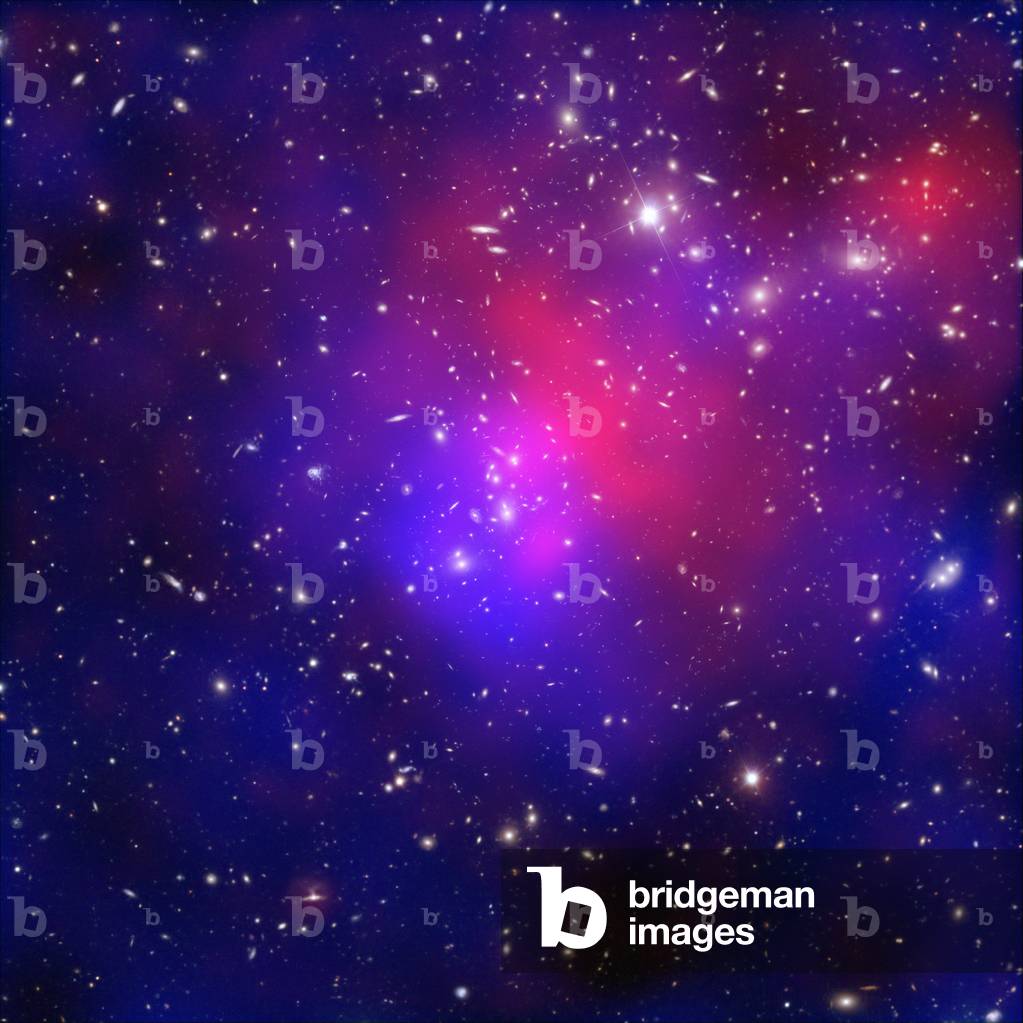
Galaxy clusters Abell 2744 - Black material - X - rays, dark matter and galaxies in cluster Abell 2744
Centaurus A elliptical galaxy (NGC 5128) in the Centaurus - Galaxy Centaurus A (NGC 5128) - The galaxy NGC 5128 is located about 13 million years away from Earth. This composite image reveals the lobes and jets that escape from the center of this active galaxy, or replaces a black hole. To produce this image, three instruments observing in different wavelengths were used; in orange, the data obtained by the APEX submillimetre telescope, in blue the X-ray image obtained by the Chandra space telescope, in visible, the image obtained by the 2,2m MPG telescope of La Silla in Chile. Colour composite image of Centaurus A, revealing the lobes and jets emanating from the active galaxy's central black hole. This is a composite of images obtained with three instruments, operating at very different wavelengths. The 870 - micron submillimetre data, from LABOCA on APEX, are shown in orange. X - ray data from the Chandra X - ray Observatory are shown in blue. Visible light data from the Wide Field Imager (WFI) on the MPG/ESO 2.2 m telescope located at La Silla, Chile, show the background stars and the galaxy's characteristic dust lane in close to “” true colour””
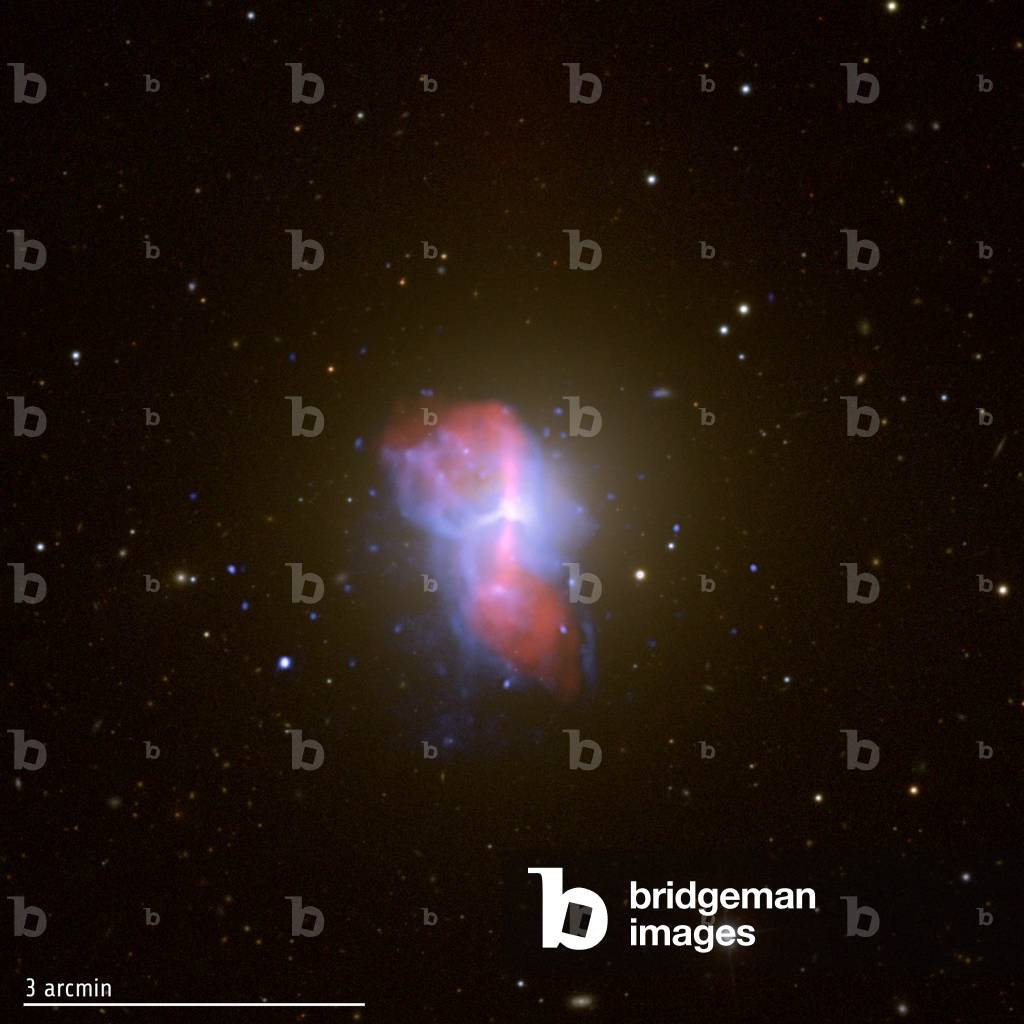
The elliptical galaxy M84 - The elliptical galaxy M84 - The M84 galaxy (NGC 4374) is 55 million light years away from Earth, in the Virgin's cluster. This image is a composite obtained in X-rays (blue), radio (red) and visible (yellow and white). Gas material is ejected from the heart of the galaxy. A supermassive black hole would have caused this jet. This composite image shows M84, a massive elliptical galaxy in the Virgo Cluster, about 55 million light years from Earth. Hot gas around M84 is shown in a Chandra X - ray Observatory image in blue and a radio image from the Very Large Array is shown in red. A background image from the Sloan Digital Sky Survey is shown in yellow and white. A number of bubbles are visible in the hot gas, outlined with blue X - ray emission. These bubbles were blown by relativistic particles generated by the central supermassive black hole in M84. These particles travel outwards in the form of a two - sided jet. Because smaller bubbles are found inside large bubbles, the impression given by the image is that of Russian dolls, where smaller dolls can be found inside large ones. These nested bubbles provide clear evidence for repeated outbursts from the central black hole
Crab Nebula seen in different wavelength - The Crab Nebula in multi wavelength: M1, the Crab Nebula, is the rest of a supernova that exploded on July 4, 1054. It is located about 6500 light years from Earth in the constellation Taurus. At the heart of this nebula is a pulsar. To obtain this photo, different observatories and telescopes combined their observations; the VLA provided the radio image (in red), the Spitzer telescope the infrared image (in yellow), the Hubble telescope for the visible part (here in green), XMM-Newton the ultraviolet image (in blue) and the Chandra telescope for X-ray data (purple). The pulsar is the bright spot in the center of the image. The unusual image was produced by combining data from telescopes spanning almost the entire electromagnetic spectrum, from radio waves to X-rays. The Karl G. Jansky Very Large Array (VLA) provided information about the nebula gathered in the radio regime (colored in red). Nasa's Spitzer Space Telescope took images in the infrared (yellow). The NASA/ESA Hubble Space Telescope provided the images made in optical wavelengths (colored in green). ESA's XMM-Newton telescope observed the Crab Nebula in the ultraviolet (blue) and Nasa's Chandra X-ray Observatory provided the data for X-ray radiation (purple). The Crab Nebula, located 6500 light-years from Earth in the constellation of Taurus, is the result of a supernova explosion which was observed by Chinese and other astronomers in 1054. At its centre is a pulsar: a super-dense neutron star, spinning once every 33 milliseconds, shooting out rotating light-like beams of radio waves and visible light. Surrounding the pulsar lies a mix of material; some of it was originally expelled from the star before it went supernova, and the rest was ejected during the explosion itself. Fast-moving winds of particles fly off from the neutron star, energising the dust and gas around it.
IMAGES TAKEN BY CHANDRA OBSERVATORY AND HUBBLE SPACE, 2001-03-13 (photo)
Permessi
  • Permission required for non-editorial use (inc book covers and in-context promotional use in documentaries). Please contact us
Restrizioni immagine
  • Content within this photograph may require additional clearances (eg: trademark and personality rights) depending on Licensee's specific use of material, which may include book and magazine cover use.
Il Content Partner applica le seguenti restrizioni
  • Minimum fee applies to this image;Only available to clients invoiced in Australia, Belgium, Brazil, Bulgaria, Canada, China, Cyprus, Czech Republic, Estonia, Finland, France, French Southern Territories, Greece, Hong Kong, Hungary, India, Ireland, Israel, Italy, Lebanon, Luxembourg, Mexico, the Netherlands, New Zealand, Portugal, Qatar, Republic of Korea, Romania, Russian Federation, Singapore, South Africa, Spain, Sweden, Switzerland, Taiwan, Turkey, United Arab Emirates, United Kingdom and United States
Nebula NGC 604 in the galaxy M33 - NGC 604 star forming nebula - NGC 604, is a very large star-forming region located in the galaxy M33 of the Triangle. This image is a composite of X-ray images (blue) obtained by the Chandra Space Telescope and visible (green and red) by the Hubble Space Telescope. The study of very hot gas observed in X-ray allows us to better understand the star formation activity within this nebula. NGC 604, is one of the largest known seething cauldrons of star birth in a nearby galaxy. NGC 604 is similar to familiar star - birth regions in our Milky Way galaxy, such as the Orion Nebula, but it is vastly larger in extent and contains many more recently formed stars. This monstrous star - birth region contains more than 200 brilliant blue stars within a cloud of glowing gases some 1,300 light - years across, nearly 100 times the size of the Orion Nebula. The bright stars in NGC 604 are extremely young having formed a mere 3 million years ago. The most massive stars in NGC 604 exceed 120 times the mass of our Sun, and their surface temperatures are as hot as 72,000 degrees Fahrenheit (40,000 Kelvin). Ultraviolet radiation floods out from these hot stars, making the surrounding nebular gas fluoresce. NGC 604 lies in a spiral arm of the nearby galaxy M33, located about 2.7 million light - years away in the direction of the constellation Triangulum. The image is a composite of images taken in X - ray (in blue) by Chandra X - Ray observatory and in optical (red and green) by the Hubble space telescope. It shows a divided neighborhood where some 200 hot, young, massive stars reside. Bubbles in the cooler gas and dust have been generated by powerful stellar winds, which are then filled with hot, X - ray emitting gas. Scientists find the amount of hot gas detected in the bubbles on the right side corresponds to the amount entirely powered by winds from the 200 hot massive stars. The situation is different on th
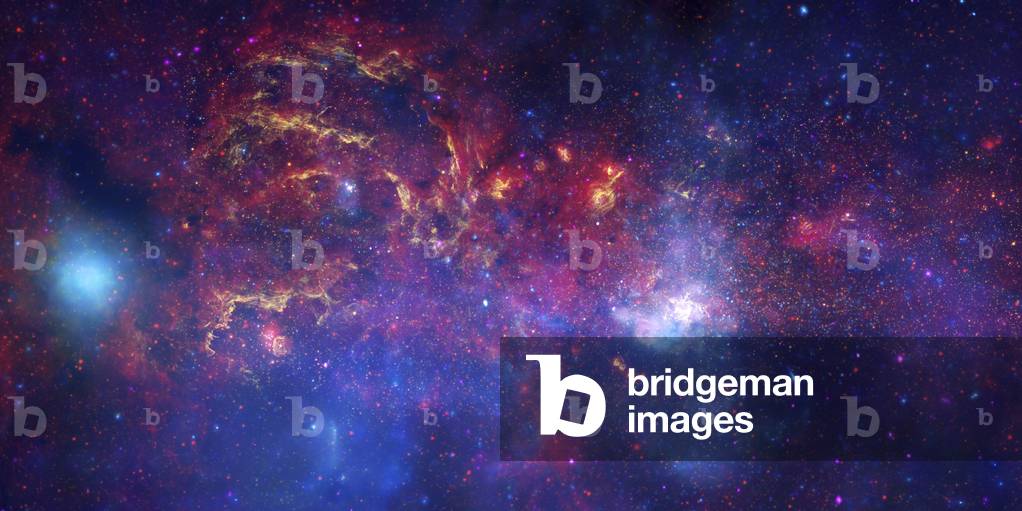
Galactic Center Region - The Galactic Center - The Galactic Center Region of the center of our galaxy seen the Chandra, Spitzer and Hubble satellites. The galactic center (Sagittarius A*) is located in the white area in the middle to the right of the image. In yellow, near-infrared images obtained by the Hubble Space Telescope; in red, infrared images obtained by the Spitzer Space Telescope; in blue and purple, X-ray observations obtained by the Chandra Space Telescope. Nasa's Great Observatories - the Hubble Space Telescope, the Spitzer Space Telescope, and the Chandra X-ray Observatory - have collaborated to produce an unprecedented image of the central region of our Milky Way galaxy. In this spectacular image, observations using infrared light and X-ray light see through the obscuring dust and reveal the intense activity near the galactic core. Note that the center of the galaxy is located within the bright white region to the right of and just below the middle of the image. The entire image width covers about one-half a degree, about the same angular width as the full moon. Each telescope's contribution is presented in a different color: - Yellow represents the near-infrared observations of Hubble. These observations outline the energetic regions where stars are being born as well as reveal hundreds of thousands of stars. - Red represents the infrared observations of Spitzer. The radiation and winds from stars create glowing dust clouds that exhibit complex structures from compact, spherical globules to long, stringy filaments. - Blue and violet represent the X-ray observations of Chandra. X-rays are emitted by gas heated to millions of degrees by stellar explosions and by outflows from the supermassive black hole in the galaxy's center. The bright blue blob on the left side is emission from a double star system containing either a neutron star or a black hole. When these views are brought together, this composite image provides one of the most detailed
Active Galaxy NGC 1068 in the Whale - Active galaxy NGC 1068 - This composite image shows that a strong stellar wind escapes from the heart of the galaxy NGC 1068 or resides a massive black hole. NGC 1068 is located about 50 million light years away from Earth. Images obtained in X-ray by the Chandra satellite (red), visible by the Hubble space telescope (green) and radio waves (blue). This is a composite image of NGC 1068, one of the nearest and brightest galaxies containing a rapidly growing supermassive black hole. X - ray data from the Chandra X - ray Observatory are shown in red, optical data from the Hubble Space Telescope in green and radio data from the Very Large Array in blue. The spiral structure of NGC 1068 is shown by the X - ray and optical data, and a jet powered by the central supermassive black hole is shown by the radio data. The X - ray images and spectra obtained using Chandra's High Energy Transmission Grating Spectrometer show that a strong wind is being driven away from the center of NGC 1068 at a rate of about a million miles per hour. This wind is likely generated as surrounding gas is accelerated and heated as it swirls toward the black hole. A portion of the gas is pulled into the black hole, but some of it is blown away. High energy X - rays produced by the gas near the black hole heat the ouflowing gas, causing it to glow at lower X - ray energies. NGC 1068 is located about 50 million light years from Earth and contains a supermassive black hole about twice as massive as the one in the middle of the Milky Way Galaxy
WIDOW THANKS BUILDERS OF OBSERVATORY FOR HONOURING HUSBAND, 1999-07-19 (photo)
Permessi
  • Permission required for non-editorial use (inc book covers and in-context promotional use in documentaries). Please contact us
Restrizioni immagine
  • Content within this photograph may require additional clearances (eg: trademark and personality rights) depending on Licensee's specific use of material, which may include book and magazine cover use.
Il Content Partner applica le seguenti restrizioni
  • Minimum fee applies to this image;Only available to clients invoiced in Australia, Belgium, Brazil, Bulgaria, Canada, China, Cyprus, Czech Republic, Estonia, Finland, France, French Southern Territories, Greece, Hong Kong, Hungary, India, Ireland, Israel, Italy, Lebanon, Luxembourg, Mexico, the Netherlands, New Zealand, Portugal, Qatar, Republic of Korea, Romania, Russian Federation, Singapore, South Africa, Spain, Sweden, Switzerland, Taiwan, Turkey, United Arab Emirates, United Kingdom and United States
CHANDRA IMAGE OF YOUNG STAR CLUSTER, 2001-06-07 (photo)
Permessi
  • Permission required for non-editorial use (inc book covers and in-context promotional use in documentaries). Please contact us
Restrizioni immagine
  • Content within this photograph may require additional clearances (eg: trademark and personality rights) depending on Licensee's specific use of material, which may include book and magazine cover use.
Il Content Partner applica le seguenti restrizioni
  • Minimum fee applies to this image;Only available to clients invoiced in Australia, Belgium, Brazil, Bulgaria, Canada, China, Cyprus, Czech Republic, Estonia, Finland, France, French Southern Territories, Greece, Hong Kong, Hungary, India, Ireland, Israel, Italy, Lebanon, Luxembourg, Mexico, the Netherlands, New Zealand, Portugal, Qatar, Republic of Korea, Romania, Russian Federation, Singapore, South Africa, Spain, Sweden, Switzerland, Taiwan, Turkey, United Arab Emirates, United Kingdom and United States
Kepler's Supernova
BLACK HOLE IMAGE TAKEN BY NASA OBSERVATORY, 2000-09-12 (photo)
Permessi
  • Permission required for non-editorial use (inc book covers and in-context promotional use in documentaries). Please contact us
Restrizioni immagine
  • Content within this photograph may require additional clearances (eg: trademark and personality rights) depending on Licensee's specific use of material, which may include book and magazine cover use.
Il Content Partner applica le seguenti restrizioni
  • Minimum fee applies to this image;Only available to clients invoiced in Australia, Belgium, Brazil, Bulgaria, Canada, China, Cyprus, Czech Republic, Estonia, Finland, France, French Southern Territories, Greece, Hong Kong, Hungary, India, Ireland, Israel, Italy, Lebanon, Luxembourg, Mexico, the Netherlands, New Zealand, Portugal, Qatar, Republic of Korea, Romania, Russian Federation, Singapore, South Africa, Spain, Sweden, Switzerland, Taiwan, Turkey, United Arab Emirates, United Kingdom and United States
NEW X RAY PHOTO OF MILKY WAY REVEALS HEART OF THE GALAXY, 2002-01-09 (photo)
Permessi
  • Permission required for non-editorial use (inc book covers and in-context promotional use in documentaries). Please contact us
Restrizioni immagine
  • Content within this photograph may require additional clearances (eg: trademark and personality rights) depending on Licensee's specific use of material, which may include book and magazine cover use.
Il Content Partner applica le seguenti restrizioni
  • Minimum fee applies to this image;Only available to clients invoiced in Australia, Belgium, Brazil, Bulgaria, Canada, China, Cyprus, Czech Republic, Estonia, Finland, France, French Southern Territories, Greece, Hong Kong, Hungary, India, Ireland, Israel, Italy, Lebanon, Luxembourg, Mexico, the Netherlands, New Zealand, Portugal, Qatar, Republic of Korea, Romania, Russian Federation, Singapore, South Africa, Spain, Sweden, Switzerland, Taiwan, Turkey, United Arab Emirates, United Kingdom and United States
Remnants of the supernova Cassiopee A in X-rays - visible and infrared - This stunning picture of the supernova remnant Cassiopeia A (Cas A) is a composite of images taken by three of Nasa's Great Observatories. Infrared data from the Spitzer Space Telescope are colored red; optical data from the Hubble Space Telescope are yellow; and X - ray data from the Chandra X - ray Observatory are green and blue. Cas A is the 300 - year - old remnant created by the supernova explosion of a massive star. Each Great Observatory image highlights different characteristics of the remnant. Spitzer reveals warm dust in the outer shell with temperatures of about 10 degrees Celsius (80 degrees Fahrenheit), and Hubble sees the delicate filamentary structures of warmer gases about 10,000 degrees Celsius. Chandra shows hot gases at about 10 million degrees Celsius. This hot gas was created when ejected material from the supernova smashed into surrounding gas and dust at speeds of about ten million miles per hour. A comparison of the infrared and X - ray images of Cas A should enable astronomers to better understand how relatively cool dust grains can coexist in the superhot gas that produces the X - rays. It should also help to determine whether most of the dust in the supernova remnant came from the massive star before it exploded, or from the rapidly expanding supernova ejecta. The turquoise dot at the center of the shell may be a neutron star created during the supernova. Blue Chandra data were acquired using broadband X - rays (low through high energies); green Chandra data correspond only to intermediate energy X - rays; yellow Hubble data were taken using a 900 nanometer - wavelength filter, and red Spitzer data are from the telescope's 24 - micron detector. Observation Dates 9 pointings between Feb 8 - May 5, 2004 Observation Time 11 days, 14 hours Distance Estimate About 10,000 light year
French Space shuttle Columbia astronaut Michel Tognini appears at the post-landing press conference .., 1999-07-28 (photo)
Permessi
  • Permission required for non-editorial use (inc book covers and in-context promotional use in documentaries). Please contact us
Restrizioni immagine
  • Content within this photograph may require additional clearances (eg: trademark and personality rights) depending on Licensee's specific use of material, which may include book and magazine cover use.
Il Content Partner applica le seguenti restrizioni
  • Minimum fee applies to this image;Only available to clients invoiced in Australia, Belgium, Brazil, Bulgaria, Canada, China, Cyprus, Czech Republic, Estonia, Finland, France, French Southern Territories, Greece, Hong Kong, Hungary, India, Ireland, Israel, Italy, Lebanon, Luxembourg, Mexico, the Netherlands, New Zealand, Portugal, Qatar, Republic of Korea, Romania, Russian Federation, Singapore, South Africa, Spain, Sweden, Switzerland, Taiwan, Turkey, United Arab Emirates, United Kingdom and United States
X-rays from Sirius B, 6 October 2000
Il Content Partner applica le seguenti restrizioni
  • Not available to clients invoiced in the UK
FRENCH SPACE SHUTTLE COLUMBIA ASTRONAUT MICHEL TOGNINI, 1999-07-28 (photo)
Permessi
  • Permission required for non-editorial use (inc book covers and in-context promotional use in documentaries). Please contact us
Restrizioni immagine
  • Content within this photograph may require additional clearances (eg: trademark and personality rights) depending on Licensee's specific use of material, which may include book and magazine cover use.
Il Content Partner applica le seguenti restrizioni
  • Minimum fee applies to this image;Only available to clients invoiced in Australia, Belgium, Brazil, Bulgaria, Canada, China, Cyprus, Czech Republic, Estonia, Finland, France, French Southern Territories, Greece, Hong Kong, Hungary, India, Ireland, Israel, Italy, Lebanon, Luxembourg, Mexico, the Netherlands, New Zealand, Portugal, Qatar, Republic of Korea, Romania, Russian Federation, Singapore, South Africa, Spain, Sweden, Switzerland, Taiwan, Turkey, United Arab Emirates, United Kingdom and United States
Remains of supernova G292.0+1.8 in X - G292.0+1.8 supernova remnant - X-ray view of the rest of supernova G292.0+1.8 located about 20,000 years - light in the constellation Centaurus. In the center of the image, the massive star that exploded gave way to a pulsar. The different colours represent different chemical elements (oxygen, magnesium...). The image was composed with a black and white image obtained in visible light. The aftermath of the death of a massive star is shown in detail in this composite image of G292.0+1.8. In color is the Chandra X - ray Observatory image and in white is optical data from the Digitized Sky Survey. Near the center of G292.0+1.8 is the so - called pulsar wind nebula, most easily seen in high energy X - rays. This is the magnetized bubble of high - energy particles that surrounds the “” pulsar””, a rapidly rotating neutron star that remained behind the original, massive star exploded. The narrow, jet - like feature running from north to south in the image is likely parallel to the spin axis of the pulsar. Each color represents different elements such as oxygen, neon, magnesium, and silicon. The distribution of these elements gives astronomers clues about how the star exploded. The distance estimated of this object is about 20,000 light years
COLUMBIA RETURNS FROM ORBIT TO KENNEDY SPACE CENFER, 1999-07-28 (photo)
Permessi
  • Permission required for non-editorial use (inc book covers and in-context promotional use in documentaries). Please contact us
Restrizioni immagine
  • Content within this photograph may require additional clearances (eg: trademark and personality rights) depending on Licensee's specific use of material, which may include book and magazine cover use.
Il Content Partner applica le seguenti restrizioni
  • Minimum fee applies to this image;Only available to clients invoiced in Australia, Belgium, Brazil, Bulgaria, Canada, China, Cyprus, Czech Republic, Estonia, Finland, France, French Southern Territories, Greece, Hong Kong, Hungary, India, Ireland, Israel, Italy, Lebanon, Luxembourg, Mexico, the Netherlands, New Zealand, Portugal, Qatar, Republic of Korea, Romania, Russian Federation, Singapore, South Africa, Spain, Sweden, Switzerland, Taiwan, Turkey, United Arab Emirates, United Kingdom and United States
SPACE SHUTTLE COLUMBIA COMMANDER EILEEN COLLINS, 1999-07-28 (photo)
Permessi
  • Permission required for non-editorial use (inc book covers and in-context promotional use in documentaries). Please contact us
Restrizioni immagine
  • Content within this photograph may require additional clearances (eg: trademark and personality rights) depending on Licensee's specific use of material, which may include book and magazine cover use.
Il Content Partner applica le seguenti restrizioni
  • Minimum fee applies to this image;Only available to clients invoiced in Australia, Belgium, Brazil, Bulgaria, Canada, China, Cyprus, Czech Republic, Estonia, Finland, France, French Southern Territories, Greece, Hong Kong, Hungary, India, Ireland, Israel, Italy, Lebanon, Luxembourg, Mexico, the Netherlands, New Zealand, Portugal, Qatar, Republic of Korea, Romania, Russian Federation, Singapore, South Africa, Spain, Sweden, Switzerland, Taiwan, Turkey, United Arab Emirates, United Kingdom and United States
COLUMBIA BLASTS SKYWARD WITH EILEEN COLLINS IN COMMAND, 1999-07-23 (photo)
Permessi
  • Permission required for non-editorial use (inc book covers and in-context promotional use in documentaries). Please contact us
Restrizioni immagine
  • Content within this photograph may require additional clearances (eg: trademark and personality rights) depending on Licensee's specific use of material, which may include book and magazine cover use.
Il Content Partner applica le seguenti restrizioni
  • Minimum fee applies to this image;Only available to clients invoiced in Australia, Belgium, Brazil, Bulgaria, Canada, China, Cyprus, Czech Republic, Estonia, Finland, France, French Southern Territories, Greece, Hong Kong, Hungary, India, Ireland, Israel, Italy, Lebanon, Luxembourg, Mexico, the Netherlands, New Zealand, Portugal, Qatar, Republic of Korea, Romania, Russian Federation, Singapore, South Africa, Spain, Sweden, Switzerland, Taiwan, Turkey, United Arab Emirates, United Kingdom and United States
COLUMBIA RETURNS FROM SPACE, 1999-07-28 (photo)
Permessi
  • Permission required for non-editorial use (inc book covers and in-context promotional use in documentaries). Please contact us
Restrizioni immagine
  • Content within this photograph may require additional clearances (eg: trademark and personality rights) depending on Licensee's specific use of material, which may include book and magazine cover use.
Il Content Partner applica le seguenti restrizioni
  • Minimum fee applies to this image;Only available to clients invoiced in Australia, Belgium, Brazil, Bulgaria, Canada, China, Cyprus, Czech Republic, Estonia, Finland, France, French Southern Territories, Greece, Hong Kong, Hungary, India, Ireland, Israel, Italy, Lebanon, Luxembourg, Mexico, the Netherlands, New Zealand, Portugal, Qatar, Republic of Korea, Romania, Russian Federation, Singapore, South Africa, Spain, Sweden, Switzerland, Taiwan, Turkey, United Arab Emirates, United Kingdom and United States
Remains of the supernova Kepler in Ophiuchus - Nasa's three Great Observatories - - the Hubble Space Telescope, the Spitzer Space Telescope, and the Chandra X - ray Observatory - joined forces to probe the expanding remains of a supernova, called Kepler's supernova remnant, first seen 400 years ago by sky watchers, including famous astronomer Johannes Kepler. The combined image unveils a bubble - shaped shroud of gas and dust that is 14 light - years wide and is expanding at 4 million miles per hour (2,000 kilometers per second). Observations from each telescope highlight distinct features of the supernova remnant, a fast - moving shell of iron - rich material from the exploded star, surrounded by an expanding shock wave that is sweeping up interstellar gas and dust. Each color in this image represents a different region of the electromagnetic spectrum, from X - rays to infrared light. The X - ray and infrared data cannot be seen with the human eye. By color - coding those data and combining them with Hubble's visible - light view, astronomers are presenting a more complete picture of the supernova remnant. Visible - light images from the Hubble telescope's Advanced Camera for Surveys [colored yellow] reveal where the supernova shock wave is slamming into the densest regions of surrounding gas. The bright glowing knots are dense clumps from instabilities that form behind the shock wave. The Hubble data also show thin filaments of gas that look like rippled sheets seen edge - on. These filaments reveal where the shock wave is encountering lower - density, more uniform interstellar material. The Spitzer telescope shows microscopic dust particles [colored red] that have been heated by the supernova shock wave. The dust re - radiates the shock wave's energy as infrared light. The Spitzer data are brightest in the regions surrounding those seen in detail by the Hubble telescope. The Chandra X - ray data show regions of very hot gas, and extremely high - energy particles
Spiral galaxy M74 in Pisces - Spiral galaxy M74 in Pisces - Image of the spiral galaxy M74 (NGC 628). This galaxy is about 80,000 light years and is 30 million light years apart. Viewed face on, as it appeared about 30 million years ago, M74 is considered to be one of the most photogenic spiral galaxies in the sky. The galaxy is rich in young bright blue stars and glowing red regions of dust and molecular hydrogen where new stars are being created. M74, however, is quite camera shy - it has a low surface brightness that makes it challenging for both visual observers and astrophotographers to see it's entire form. The Chandra X - Ray observatory, discovered M74 to be the home of a super massive black hole, tucked away in one of it's outer arms. This black hole is one of the largest ever discovered and has the mass of over 10,000 suns
COLUMBIA POISED FOR LAUNCH ATOP PAD 39B AT KENNEDY SPACE CENTER, 1999-07-19 (photo)
Permessi
  • Permission required for non-editorial use (inc book covers and in-context promotional use in documentaries). Please contact us
Restrizioni immagine
  • Content within this photograph may require additional clearances (eg: trademark and personality rights) depending on Licensee's specific use of material, which may include book and magazine cover use.
Il Content Partner applica le seguenti restrizioni
  • Minimum fee applies to this image;Only available to clients invoiced in Australia, Belgium, Brazil, Bulgaria, Canada, China, Cyprus, Czech Republic, Estonia, Finland, France, French Southern Territories, Greece, Hong Kong, Hungary, India, Ireland, Israel, Italy, Lebanon, Luxembourg, Mexico, the Netherlands, New Zealand, Portugal, Qatar, Republic of Korea, Romania, Russian Federation, Singapore, South Africa, Spain, Sweden, Switzerland, Taiwan, Turkey, United Arab Emirates, United Kingdom and United States
COLUMBIA POISED FOR LAUNCH ATOP PAD 39B AT KENNEDY SPACE CENTER, 1999-07-19 (photo)
Permessi
  • Permission required for non-editorial use (inc book covers and in-context promotional use in documentaries). Please contact us
Restrizioni immagine
  • Content within this photograph may require additional clearances (eg: trademark and personality rights) depending on Licensee's specific use of material, which may include book and magazine cover use.
Il Content Partner applica le seguenti restrizioni
  • Minimum fee applies to this image;Only available to clients invoiced in Australia, Belgium, Brazil, Bulgaria, Canada, China, Cyprus, Czech Republic, Estonia, Finland, France, French Southern Territories, Greece, Hong Kong, Hungary, India, Ireland, Israel, Italy, Lebanon, Luxembourg, Mexico, the Netherlands, New Zealand, Portugal, Qatar, Republic of Korea, Romania, Russian Federation, Singapore, South Africa, Spain, Sweden, Switzerland, Taiwan, Turkey, United Arab Emirates, United Kingdom and United States
CREW OF SPACE SHUTTLE COLUMBIA AFTER LANDING AT KENNEDY SPACE CENTER, 1999-07-28 (photo)
Permessi
  • Permission required for non-editorial use (inc book covers and in-context promotional use in documentaries). Please contact us
Restrizioni immagine
  • Content within this photograph may require additional clearances (eg: trademark and personality rights) depending on Licensee's specific use of material, which may include book and magazine cover use.
Il Content Partner applica le seguenti restrizioni
  • Minimum fee applies to this image;Only available to clients invoiced in Australia, Belgium, Brazil, Bulgaria, Canada, China, Cyprus, Czech Republic, Estonia, Finland, France, French Southern Territories, Greece, Hong Kong, Hungary, India, Ireland, Israel, Italy, Lebanon, Luxembourg, Mexico, the Netherlands, New Zealand, Portugal, Qatar, Republic of Korea, Romania, Russian Federation, Singapore, South Africa, Spain, Sweden, Switzerland, Taiwan, Turkey, United Arab Emirates, United Kingdom and United States
LAUNCH CHEERED BY SHALALA AND NASA ADMINISTRATOR GOLDIN, 1999-07-23 (photo)
Permessi
  • Permission required for non-editorial use (inc book covers and in-context promotional use in documentaries). Please contact us
Restrizioni immagine
  • Content within this photograph may require additional clearances (eg: trademark and personality rights) depending on Licensee's specific use of material, which may include book and magazine cover use.
Il Content Partner applica le seguenti restrizioni
  • Minimum fee applies to this image;Only available to clients invoiced in Australia, Belgium, Brazil, Bulgaria, Canada, China, Cyprus, Czech Republic, Estonia, Finland, France, French Southern Territories, Greece, Hong Kong, Hungary, India, Ireland, Israel, Italy, Lebanon, Luxembourg, Mexico, the Netherlands, New Zealand, Portugal, Qatar, Republic of Korea, Romania, Russian Federation, Singapore, South Africa, Spain, Sweden, Switzerland, Taiwan, Turkey, United Arab Emirates, United Kingdom and United States
FRENCH ASTRONAUT TOGNINI ARRIVES WITH CREW TO PREPARE FOR LAUNCH, 1999-07-16 (photo)
Permessi
  • Permission required for non-editorial use (inc book covers and in-context promotional use in documentaries). Please contact us
Restrizioni immagine
  • Content within this photograph may require additional clearances (eg: trademark and personality rights) depending on Licensee's specific use of material, which may include book and magazine cover use.
Il Content Partner applica le seguenti restrizioni
  • Minimum fee applies to this image;Only available to clients invoiced in Australia, Belgium, Brazil, Bulgaria, Canada, China, Cyprus, Czech Republic, Estonia, Finland, France, French Southern Territories, Greece, Hong Kong, Hungary, India, Ireland, Israel, Italy, Lebanon, Luxembourg, Mexico, the Netherlands, New Zealand, Portugal, Qatar, Republic of Korea, Romania, Russian Federation, Singapore, South Africa, Spain, Sweden, Switzerland, Taiwan, Turkey, United Arab Emirates, United Kingdom and United States
COLUMBIA SET TO TRY LAUNCH AGAIN AT KENNEDY SPACE CENTER, 1999-07-21 (photo)
Permessi
  • Permission required for non-editorial use (inc book covers and in-context promotional use in documentaries). Please contact us
Restrizioni immagine
  • Content within this photograph may require additional clearances (eg: trademark and personality rights) depending on Licensee's specific use of material, which may include book and magazine cover use.
Il Content Partner applica le seguenti restrizioni
  • Minimum fee applies to this image;Only available to clients invoiced in Australia, Belgium, Brazil, Bulgaria, Canada, China, Cyprus, Czech Republic, Estonia, Finland, France, French Southern Territories, Greece, Hong Kong, Hungary, India, Ireland, Israel, Italy, Lebanon, Luxembourg, Mexico, the Netherlands, New Zealand, Portugal, Qatar, Republic of Korea, Romania, Russian Federation, Singapore, South Africa, Spain, Sweden, Switzerland, Taiwan, Turkey, United Arab Emirates, United Kingdom and United States
COLUMBIA SET TO TRY AGAIN AT KENNEDY SPACE CENTER, 1999-07-21 (photo)
Permessi
  • Permission required for non-editorial use (inc book covers and in-context promotional use in documentaries). Please contact us
Restrizioni immagine
  • Content within this photograph may require additional clearances (eg: trademark and personality rights) depending on Licensee's specific use of material, which may include book and magazine cover use.
Il Content Partner applica le seguenti restrizioni
  • Minimum fee applies to this image;Only available to clients invoiced in Australia, Belgium, Brazil, Bulgaria, Canada, China, Cyprus, Czech Republic, Estonia, Finland, France, French Southern Territories, Greece, Hong Kong, Hungary, India, Ireland, Israel, Italy, Lebanon, Luxembourg, Mexico, the Netherlands, New Zealand, Portugal, Qatar, Republic of Korea, Romania, Russian Federation, Singapore, South Africa, Spain, Sweden, Switzerland, Taiwan, Turkey, United Arab Emirates, United Kingdom and United States
Mission Commander Eileen Collins listens as reporters ask questions after she exited her T-38 aircra.., 1999-07-16 (photo)
Permessi
  • Permission required for non-editorial use (inc book covers and in-context promotional use in documentaries). Please contact us
Restrizioni immagine
  • Content within this photograph may require additional clearances (eg: trademark and personality rights) depending on Licensee's specific use of material, which may include book and magazine cover use.
Il Content Partner applica le seguenti restrizioni
  • Minimum fee applies to this image;Only available to clients invoiced in Australia, Belgium, Brazil, Bulgaria, Canada, China, Cyprus, Czech Republic, Estonia, Finland, France, French Southern Territories, Greece, Hong Kong, Hungary, India, Ireland, Israel, Italy, Lebanon, Luxembourg, Mexico, the Netherlands, New Zealand, Portugal, Qatar, Republic of Korea, Romania, Russian Federation, Singapore, South Africa, Spain, Sweden, Switzerland, Taiwan, Turkey, United Arab Emirates, United Kingdom and United States
Galaxy NGC 6240 in Ophiuchus - Galaxy NGC 6240 in Ophiuchus - The galaxy NGC 6240, is about 400 million light years away from Earth in the constellation Ophiuchus. This system consists of two colliding galaxies each with a central black hole; in several millions of years, they will form only one galaxy. Image obtained by the Hubble space telescope on 10 February 2002. NGC 6240 is a peculiar, butterfly - or lobster - shaped galaxy consisting of two smaller merging galaxies. It lies in the constellation of Ophiuchus, the Serpent Holder, some 400 million light - years away. Observations with NASA s Chandra X - ray Observatory have disclosed two giant black holes, about 3,000 light - years apart, which will drift towards one another and eventually merge together into a larger black hole. The merging process, which began about 30 million years ago, triggered dramatic star formation and sparked numerous supernova explosions. The merger will be complete in some tens to hundreds of millions of years. Image taken by the Hubble space telescope on February 10, 2002
MISSION COMMANDER COLLINS ARRIVES WITH CREW TO PREPARE FOR LAUNCH, 1999-07-16 (photo)
Permessi
  • Permission required for non-editorial use (inc book covers and in-context promotional use in documentaries). Please contact us
Restrizioni immagine
  • Content within this photograph may require additional clearances (eg: trademark and personality rights) depending on Licensee's specific use of material, which may include book and magazine cover use.
Il Content Partner applica le seguenti restrizioni
  • Minimum fee applies to this image;Only available to clients invoiced in Australia, Belgium, Brazil, Bulgaria, Canada, China, Cyprus, Czech Republic, Estonia, Finland, France, French Southern Territories, Greece, Hong Kong, Hungary, India, Ireland, Israel, Italy, Lebanon, Luxembourg, Mexico, the Netherlands, New Zealand, Portugal, Qatar, Republic of Korea, Romania, Russian Federation, Singapore, South Africa, Spain, Sweden, Switzerland, Taiwan, Turkey, United Arab Emirates, United Kingdom and United States
MISSION COMMANDER COLLINS ARRIVES WITH CREW TO PREPARE FOR LAUNCH, 1999-07-16 (photo)
Permessi
  • Permission required for non-editorial use (inc book covers and in-context promotional use in documentaries). Please contact us
Restrizioni immagine
  • Content within this photograph may require additional clearances (eg: trademark and personality rights) depending on Licensee's specific use of material, which may include book and magazine cover use.
Il Content Partner applica le seguenti restrizioni
  • Minimum fee applies to this image;Only available to clients invoiced in Australia, Belgium, Brazil, Bulgaria, Canada, China, Cyprus, Czech Republic, Estonia, Finland, France, French Southern Territories, Greece, Hong Kong, Hungary, India, Ireland, Israel, Italy, Lebanon, Luxembourg, Mexico, the Netherlands, New Zealand, Portugal, Qatar, Republic of Korea, Romania, Russian Federation, Singapore, South Africa, Spain, Sweden, Switzerland, Taiwan, Turkey, United Arab Emirates, United Kingdom and United States
Mission Commander Eileen Collins speaks with journalists after she exited her T-38 aircraft at the K.., 1999-07-16 (photo)
Permessi
  • Permission required for non-editorial use (inc book covers and in-context promotional use in documentaries). Please contact us
Restrizioni immagine
  • Content within this photograph may require additional clearances (eg: trademark and personality rights) depending on Licensee's specific use of material, which may include book and magazine cover use.
Il Content Partner applica le seguenti restrizioni
  • Minimum fee applies to this image;Only available to clients invoiced in Australia, Belgium, Brazil, Bulgaria, Canada, China, Cyprus, Czech Republic, Estonia, Finland, France, French Southern Territories, Greece, Hong Kong, Hungary, India, Ireland, Israel, Italy, Lebanon, Luxembourg, Mexico, the Netherlands, New Zealand, Portugal, Qatar, Republic of Korea, Romania, Russian Federation, Singapore, South Africa, Spain, Sweden, Switzerland, Taiwan, Turkey, United Arab Emirates, United Kingdom and United States
Spiral galaxy M74 in Pisces - Spiral galaxy M74 in Pisces - Image of the spiral galaxy M74 (NGC 628). This galaxy is about 80,000 light years and is 30 million light years apart. Viewed face on, as it appeared about 30 million years ago, M74 is considered to be one of the most photogenic spiral galaxies in the sky. The galaxy is rich in young bright blue stars and glowing red regions of dust and molecular hydrogen where new stars are being created. M74, however, is quite camera shy - it has a low surface brightness that makes it challenging for both visual observers and astrophotographers to see it's entire form. The Chandra X - Ray observatory, discovered M74 to be the home of a super massive black hole, tucked away in one of it's outer arms. This black hole is one of the largest ever discovered and has the mass of over 10,000 suns. Thirty six, fifteen minute photographs were combined to create this picture, with a total exposure time of almost nine hours. The images were taken with a 20 inch Ritchey - Chretien telescope and an eleven mega - pixel camera at f/8 from high in the south central mountains of New Mexico
CREW ARRIVES AT KENNEDY SPACE CENTER TO PREPARE FOR LAUNCH, 1999-07-16 (photo)
Permessi
  • Permission required for non-editorial use (inc book covers and in-context promotional use in documentaries). Please contact us
Restrizioni immagine
  • Content within this photograph may require additional clearances (eg: trademark and personality rights) depending on Licensee's specific use of material, which may include book and magazine cover use.
Il Content Partner applica le seguenti restrizioni
  • Minimum fee applies to this image;Only available to clients invoiced in Australia, Belgium, Brazil, Bulgaria, Canada, China, Cyprus, Czech Republic, Estonia, Finland, France, French Southern Territories, Greece, Hong Kong, Hungary, India, Ireland, Israel, Italy, Lebanon, Luxembourg, Mexico, the Netherlands, New Zealand, Portugal, Qatar, Republic of Korea, Romania, Russian Federation, Singapore, South Africa, Spain, Sweden, Switzerland, Taiwan, Turkey, United Arab Emirates, United Kingdom and United States