[]
La tua selezione corrente
asset(s) Asset
Il tuo preventivo 0

La tua selezione

Cancella la selezione
Articolo aggiunto al carrello
{"event":"pageview","page_type1":"undetected","page_type2":"_assets_search_override","language":"it","user_logged":"false","user_type":"ecommerce","nl_subscriber":"false"}
{"event":"ecommerce_event","event_name":"view_item","event_category":"browse_catalog","ecommerce":{"items":[{"item_id":"PIX4652638","item_category":"illustration","item_category2":"no_copyright","item_category3":"standard","item_category5":"not_balown","item_list_name":"search_results","item_name":"radiotelescopes_alma_the_atacama_large_millimeter_array_alma_artwork_artist_s_view_of_the_european_n","item_variant":"undefined"},{"item_id":"PIX4621694","item_category":"photo","item_category2":"no_copyright","item_category3":"standard","item_category5":"not_balown","item_list_name":"search_results","item_name":"star_birth_in_scorpio_stellar_nursery_in_scorpius_rcw_120_is_a_star_forming_region_about_4200_years_","item_variant":"undefined"},{"item_id":"PIX4646124","item_category":"illustration","item_category2":"no_copyright","item_category3":"standard","item_category4":"c_carreau","item_category5":"not_balown","item_list_name":"search_results","item_name":"satellite_herschel_illustration_artist_s_view_of_the_european_satellite_herschel_the_herschel_space_","item_variant":"undefined"},{"item_id":"PIX4652596","item_category":"illustration","item_category2":"no_copyright","item_category3":"standard","item_category5":"not_balown","item_list_name":"search_results","item_name":"radiotelescopes_alma_the_atacama_large_millimeter_array_alma_artwork_artist_s_view_of_the_european_n","item_variant":"undefined"},{"item_id":"PIX4652609","item_category":"illustration","item_category2":"no_copyright","item_category3":"standard","item_category5":"not_balown","item_list_name":"search_results","item_name":"radiotelescopes_alma_the_atacama_large_millimeter_array_alma_artwork_artist_s_view_of_the_european_n","item_variant":"undefined"},{"item_id":"PIX4646089","item_category":"photo","item_category2":"no_copyright","item_category3":"standard","item_category4":"p_dumas","item_category5":"not_balown","item_list_name":"search_results","item_name":"mirror_of_the_herschel_satellite_herschel_spacecraft_s_mirror_inspection_of_the_mirror_of_the_europe","item_variant":"undefined"},{"item_id":"PIX4646048","item_category":"illustration","item_category2":"no_copyright","item_category3":"standard","item_category5":"not_balown","item_list_name":"search_results","item_name":"herschel_satellite_illustration_herschel_satellite_artwork_artist_s_view_of_the_european_satellite_h","item_variant":"undefined"},{"item_id":"PIX4646076","item_category":"photo","item_category2":"no_copyright","item_category3":"standard","item_category4":"p_dumas","item_category5":"not_balown","item_list_name":"search_results","item_name":"mirror_of_the_herschel_satellite_herschel_spacecraft_s_mirror_inspection_of_the_mirror_of_the_europe","item_variant":"undefined"},{"item_id":"PIX4652635","item_category":"illustration","item_category2":"no_copyright","item_category3":"standard","item_category5":"not_balown","item_list_name":"search_results","item_name":"radiotelescopes_alma_the_atacama_large_millimeter_array_alma_artwork_artist_s_view_of_the_european_n","item_variant":"undefined"},{"item_id":"PIX4646142","item_category":"illustration","item_category2":"no_copyright","item_category3":"standard","item_category4":"d_ducros","item_category5":"not_balown","item_list_name":"search_results","item_name":"satellite_herschel_illustration_artist_s_view_of_the_european_satellite_herschel_the_herschel_space_","item_variant":"undefined"},{"item_id":"PIX4646040","item_category":"illustration","item_category2":"no_copyright","item_category3":"standard","item_category5":"not_balown","item_list_name":"search_results","item_name":"herschel_satellite_illustration_herschel_satellite_artwork_artist_s_view_of_the_european_satellite_h","item_variant":"undefined"},{"item_id":"PIX4646098","item_category":"illustration","item_category2":"no_copyright","item_category3":"standard","item_category4":"d_ducros","item_category5":"not_balown","item_list_name":"search_results","item_name":"satellite_herschel_illustration_artist_s_view_of_the_european_satellite_herschel_the_herschel_space_","item_variant":"undefined"},{"item_id":"PIX4646082","item_category":"photo","item_category2":"no_copyright","item_category3":"standard","item_category4":"p_dumas","item_category5":"not_balown","item_list_name":"search_results","item_name":"mirror_of_the_herschel_satellite_herschel_spacecraft_s_mirror_inspection_of_the_mirror_of_the_europe","item_variant":"undefined"},{"item_id":"PIX4612291","item_category":"photo","item_category2":"no_copyright","item_category3":"standard","item_category5":"not_balown","item_list_name":"search_results","item_name":"centaurus_a_elliptical_galaxy_ngc_5128_in_the_centaurus_galaxy_centaurus_a_ngc_5128_the_galaxy_ngc_5","item_variant":"undefined"},{"item_id":"PIX4646169","item_category":"illustration","item_category2":"no_copyright","item_category3":"standard","item_category4":"d_ducros","item_category5":"not_balown","item_list_name":"search_results","item_name":"satellite_herschel_illustration_ariane_5_fairing_with_satellite_herschel_artwork_artist_s_view_of_th","item_variant":"undefined"},{"item_id":"PIX4646153","item_category":"illustration","item_category2":"no_copyright","item_category3":"standard","item_category4":"d_ducros","item_category5":"not_balown","item_list_name":"search_results","item_name":"satellite_herschel_illustration_ariane_5_stage_with_satellite_herschel_artwork_artist_s_view_of_the_","item_variant":"undefined"},{"item_id":"PIX4652295","item_category":"photo","item_category2":"no_copyright","item_category3":"standard","item_category4":"stephane_guisard","item_category5":"not_balown","item_list_name":"search_results","item_name":"alma_plateau_de_chajnantor_2011_chajnantor_plateau_and_starry_sky_alma_network_chajnantor_plateau_51","item_variant":"undefined"},{"item_id":"PIX4646080","item_category":"photo","item_category2":"no_copyright","item_category3":"standard","item_category4":"a_le_floch","item_category5":"not_balown","item_list_name":"search_results","item_name":"herschel_satellite_herschel_spacecraft_being_prepared_for_acoustic_tests_the_european_satellite_hers","item_variant":"undefined"},{"item_id":"PIX4646125","item_category":"illustration","item_category2":"no_copyright","item_category3":"standard","item_category4":"d_ducros","item_category5":"not_balown","item_list_name":"search_results","item_name":"satellite_herschel_illustration_ariane_5_fairing_with_satellite_herschel_artwork_artist_s_view_of_th","item_variant":"undefined"},{"item_id":"PIX4646096","item_category":"photo","item_category2":"no_copyright","item_category3":"standard","item_category4":"p_dumas","item_category5":"not_balown","item_list_name":"search_results","item_name":"mirror_of_the_herschel_satellite_herschel_spacecraft_s_mirror_inspection_of_the_mirror_of_the_europe","item_variant":"undefined"},{"item_id":"PIX4652290","item_category":"photo","item_category2":"no_copyright","item_category3":"standard","item_category4":"stephane_guisard","item_category5":"not_balown","item_list_name":"search_results","item_name":"alma_plateau_de_chajnantor_2011_chajnantor_plateau_and_starry_sky_alma_network_chajnantor_plateau_51","item_variant":"undefined"},{"item_id":"PIX4637973","item_category":"photo","item_category2":"no_copyright","item_category3":"standard","item_category5":"not_balown","item_list_name":"search_results","item_name":"galactic_center_region_center_of_our_galaxy_photo","item_variant":"undefined"},{"item_id":"PIX4650395","item_category":"illustration","item_category2":"no_copyright","item_category3":"standard","item_category4":"d_ducros","item_category5":"not_balown","item_list_name":"search_results","item_name":"the_electromagnetic_spectrum_electromagnetic_spectrum_artwork_artist_s_view_of_the_different_means_o","item_variant":"undefined"},{"item_id":"PIX4655194","item_category":"photo","item_category2":"no_copyright","item_category3":"standard","item_category4":"guillaume_blanchard","item_category5":"not_balown","item_list_name":"search_results","item_name":"mauna_kea_observatory_jcmt_radiotelescope_jcmt_radiotelescope_of_mauna_kea_observatory_the_15_metre_","item_variant":"undefined"},{"item_id":"PIX4652301","item_category":"photo","item_category2":"no_copyright","item_category3":"standard","item_category4":"stephane_guisard","item_category5":"not_balown","item_list_name":"search_results","item_name":"alma_plateau_de_chajnantor_2011_chajnantor_plateau_and_starry_sky_alma_reseau_the_moon_shines_in_the","item_variant":"undefined"},{"item_id":"PIX4655189","item_category":"photo","item_category2":"no_copyright","item_category3":"standard","item_category4":"guillaume_blanchard","item_category5":"not_balown","item_list_name":"search_results","item_name":"mauna_kea_observatory_jcmt_radiotelescope_jcmt_radiotelescope_of_mauna_kea_observatory_the_15_metre_","item_variant":"undefined"},{"item_id":"PIX4655199","item_category":"photo","item_category2":"no_copyright","item_category3":"standard","item_category4":"benjamin_boccas","item_category5":"not_balown","item_list_name":"search_results","item_name":"mauna_kea_observatory_sma_radiotelescope_photographer_the_new_sub_millimetric_sma_sub_millimeter_arr","item_variant":"undefined"}]}}
{"event":"custom_event","event_name":"view_search_result","event_category":"browse_catalog","keyword":"millimetric","search_type":"standard","search_bridgeman_artists":"false","search_mode":"automatic","search_zero_result":"false","search_results":27,"search_results_page_number":1}

'Millimetric' immagini e video risultati page 1 of 1

Filtri Principali
Opzioni per Acquisto Stampa
Opzione royalty free
Ecommerce option
Risultati per Reuters
Tipo di media
Orientation
Colori
Categoria
Diritti
Altri filtri
Artisti Bridgeman
Fotografi Bridgeman
Secolo
Filtri video
Video Original Format
Video Resolution
Video Category
Filter group
Filter colors
Ordina per:
per pagina
Filter group
Categoria
Tipo di media
No copyright
Filter colors

Mostra opzioni

View
Image Size

Immagini di 'Millimetric' trovate, 27

Radiotelescopes ALMA - The Atacama Large Millimeter Array (ALMA) - Artwork - Artist's view of the European network of submilimetric antennas ALMA (Atacama Large Millimeter Array) located in the Atacama Desert, Chile. The Atacama Large Millimeter Array (ALMA), one of the largest ground - based astronomy projects of the next decade, is a major new facility for world astronomy. ALMA will be comprised of a giant array of 12 - m submillimetre quality antennas, with baselines of several kilometers. An additional, compact array of 7 - m and 12 - m antennas is also foreseen. Construction of ALMA started in 2003 and will be completed in 2010. The ALMA project is an international collaboration between Europe, Japan and North America in cooperation with the Republic of Chile
Star Birth in Scorpio - Stellar nursery in Scorpius - RCW 120 is a star-forming region about 4200 years from Earth in the constellation Scorpio. In the center a hot and massive star emits powerful ultraviolet radiation, which ionize the surrounding gas, tearing off electrons from the hydrogen atoms and producing the characteristic red glow of H - alpha emissions. As this ionized region extends into space, the associated shock wave meets the surrounding cold interstellar gas and cosmic dust. This gas becomes unstable and collapses under its own gravite forming dense, cold clouds or new stars will be born. These very cold clouds (- 250 degres Celsius) can only be detected in submillimetre wavelength; they appear here in blue thanks to the data obtained by the APEX telescope which observes this radiation. Illustrating the power of submillimetre - wavelength astronomy, an APEX image reveals how an expanding bubble of ionised gas about ten light - years across is causing the surrounding material to collapse into dense clumps that are the birthplaces of new stars. The region, called RCW120, is about 4200 light years from Earth, towards the constellation of Scorpius. A hot, massive star in its centre is emitting huge amounts of ultraviolet radiation, which ionises the surrounding gas, stripping the electrons from hydrogen atoms and producing the characteristic red glow of so - called H - alpha emission. Here, the submillimetre emission is shown as the blue clouds surrounding the reddish glow of the ionised gas (shown with data from the SuperCosmoS H - alpha survey). The image also contains data from the Second Generation Digitized Sky Survey (I - band shown in blue, R - band shown in red). As this ionised region expands into space, the associated shock wave sweeps up a layer of the surrounding cold interstellar gas and cosmic dust. This layer b
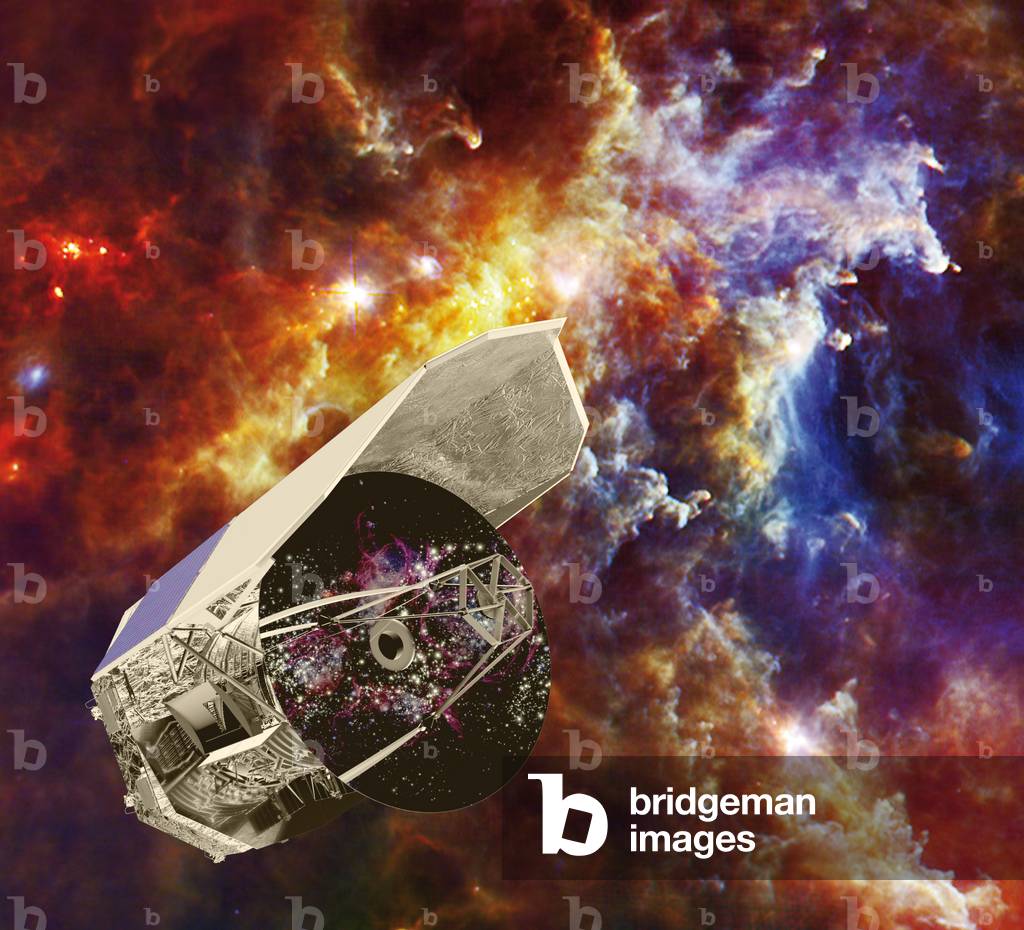
Satellite Herschel - Illustration - Artist's view of the European satellite Herschel. The Herschel Space Observatory, launched in 2009, studies the formation of galaxies, stars and planetary systems in the infrared. This satellite measures nearly 7 metres high by 4.3 metres wide and weighs 3.25 tonnes. Its telescope has a 3.5-meter mirror, making it the largest mirror ever made for a scientific space mission. Herschel is in orbit around Lagrange 2, approximately 1.5 million kilometres from Earth. ESA's Herschel Space Observatory (formerly called Far Infrared and Submillimetre Telescope or FIRST) studies the mystery of how stars and galaxies were born. Objects such as other planetary systems, or processes like the birth of galaxies in the early universe, can best be studied with infrared space telescopes in space. This is the reason for Esa's Herschel. ESA's Herschel Space Observatory is bigger and better than any of its predecessors. Moreover, it observes at wavelengths never covered before. It is located 1.5 million kilometers away from Earth, farther than any previous space telescope. Launched in 2009, Herschel is one the Cornerstone missions ESA's Horizons 2000 programme. Herschel is a key project space astronomy in the next millennium
Radiotelescopes ALMA - The Atacama Large Millimeter Array (ALMA) - Artwork - Artist's view of the European network of submilimeter antennas Alma located in the Atacama Desert, Chile. The Atacama Large Millimeter Array (ALMA), one of the largest ground - based astronomy projects of the next decade, is a major new facility for world astronomy. ALMA will be comprised of a giant array of 12 - m submillimetre quality antennas, with baselines of several kilometers. An additional, compact array of 7 - m and 12 - m antennas is also foreseen. Construction of ALMA started in 2003 and will be completed in 2010. The ALMA project is an international collaboration between Europe, Japan and North America in cooperation with the Republic of Chile
Radiotelescopes ALMA - The Atacama Large Millimeter Array (ALMA) - Artwork - Artist's view of the European network of submilimetric antennas ALMA (Atacama Large Millimeter Array) located in the Atacama Desert, Chile. The Atacama Large Millimeter Array (ALMA), one of the largest ground - based astronomy projects of the next decade, is a major new facility for world astronomy. ALMA will be comprised of a giant array of 12 - m submillimetre quality antennas, with baselines of several kilometers. An additional, compact array of 7 - m and 12 - m antennas is also foreseen. Construction of ALMA started in 2003 and will be completed in 2010. The ALMA project is an international collaboration between Europe, Japan and North America in cooperation with the Republic of Chile
Mirror of the Herschel satellite - Herschel spacecraft's mirror - Inspection of the mirror of the European Herschel satellite. The Herschel Space Observatory, scheduled to launch in 2009, will study in the infrared the formation of galaxies, stars and planetary systems. This satellite measures nearly 7 metres high by 4.3 metres wide and weighs 3.25 tonnes. Its telescope has a 3.5-meter mirror, making it the largest mirror ever made for a scientific space mission. Herschel will orbit around Lagrange 2, approximately 1.5 million kilometres from Earth. The gigantic telescope of ESA's space - based infrared observatory, Herschel, is being prepared to be assembled with its spacecraft. Herschel's telescope, which will carry the largest mirror ever flown in space, has been delivered to ESA's European Space Research and Technology Centre, ESTEC, where engineers and scientists are busy with the final steps that will prepare the infrared observatory for launch in 2009. ESA's Herschel Space Observatory will observe at wavelengths never covered before. It will be located 1.5 million kilometers away from Earth, farther than any previous space telescope
Herschel Satellite - Illustration - Herschel Satellite. Artwork - Artist's view of the European satellite Herschel. The Herschel Space Observatory, scheduled to launch in 2009, will study in the infrared the formation of galaxies, stars and planetary systems. This satellite measures nearly 7 metres high by 4.3 metres wide and weighs 3.25 tonnes. Its telescope has a 3.5-meter mirror, making it the largest mirror ever made for a scientific space mission. Herschel will orbit around Lagrange 2, approximately 1.5 million kilometres from Earth. ESA's Herschel Space Observatory (formerly called Far Infrared and Submillimetre Telescope or FIRST) will solve the mystery of how stars and galaxies were born. Infrared astronomy is as young as it is fruitful. In less than three decades infrared astronomers have unveiled tens of thousands of new galaxies, and have made discoveries as surprising as the huge amounts of water vapour that fill the galaxy. Yet scientists know there is still much more to discover. Objects such as other planetary systems, or processes like the birth of galaxies in the early universe, can best be studied with infrared space telescopes in space. This is the reason for Esa's Herschel. ESA's Herschel Space Observatory will be bigger and better than any of its predecessors. Moreover, it will observe at wavelengths never covered before. It will be located 1.5 million kilometers away from Earth, farther than any previous space telescope. Due for launch in 2009, Herschel is one the Cornerstone missions ESA's Horizons 2000 programme. Herschel is a key project space astronomy in the next millennium
Mirror of the Herschel satellite - Herschel spacecraft's mirror - Inspection of the mirror of the European Herschel satellite. The Herschel Space Observatory, scheduled to launch in 2009, will study in the infrared the formation of galaxies, stars and planetary systems. This satellite measures nearly 7 metres high by 4.3 metres wide and weighs 3.25 tonnes. Its telescope has a 3.5-meter mirror, making it the largest mirror ever made for a scientific space mission. Herschel will orbit around Lagrange 2, approximately 1.5 million kilometres from Earth. The gigantic telescope of ESA's space - based infrared observatory, Herschel, is being prepared to be assembled with its spacecraft. Herschel's telescope, which will carry the largest mirror ever flown in space, has been delivered to ESA's European Space Research and Technology Centre, ESTEC, where engineers and scientists are busy with the final steps that will prepare the infrared observatory for launch in 2009. ESA's Herschel Space Observatory will observe at wavelengths never covered before. It will be located 1.5 million kilometers away from Earth, farther than any previous space telescope
Radiotelescopes ALMA - The Atacama Large Millimeter Array (ALMA) - Artwork - Artist's view of the European network of submilimetric antennas ALMA (Atacama Large Millimeter Array) located in the Atacama Desert, Chile. The Atacama Large Millimeter Array (ALMA), one of the largest ground - based astronomy projects of the next decade, is a major new facility for world astronomy. ALMA will be comprised of a giant array of 12 - m submillimetre quality antennas, with baselines of several kilometers. An additional, compact array of 7 - m and 12 - m antennas is also foreseen. Construction of ALMA started in 2003 and will be completed in 2010. The ALMA project is an international collaboration between Europe, Japan and North America in cooperation with the Republic of Chile
Satellite Herschel - Illustration - Artist's view of the European satellite Herschel. The Herschel Space Observatory, scheduled to launch in 2009, will study in the infrared the formation of galaxies, stars and planetary systems. This satellite measures nearly 7 metres high by 4.3 metres wide and weighs 3.25 tonnes. Its telescope has a 3.5-meter mirror, making it the largest mirror ever made for a scientific space mission. Herschel will orbit around Lagrange 2, approximately 1.5 million kilometres from Earth. ESA's Herschel Space Observatory (formerly called Far Infrared and Submillimetre Telescope or FIRST) will solve the mystery of how stars and galaxies were born. Objects such as other planetary systems, or processes like the birth of galaxies in the early universe, can best be studied with infrared space telescopes in space. This is the reason for Esa's Herschel. ESA's Herschel Space Observatory will be bigger and better than any of its predecessors. Moreover, it will observe at wavelengths never covered before. It will be located 1.5 million kilometers away from Earth, farther than any previous space telescope. Due for launch in 2009, Herschel is one the Cornerstone missions ESA's Horizons 2000 programme. Herschel is a key project space astronomy in the next millennium
Herschel Satellite - Illustration - Herschel Satellite. Artwork - Artist's view of the European satellite Herschel. The Herschel Space Observatory, scheduled to launch in 2009, will study in the infrared the formation of galaxies, stars and planetary systems. This satellite measures nearly 7 metres high by 4.3 metres wide and weighs 3.25 tonnes. Its telescope has a 3.5-meter mirror, making it the largest mirror ever made for a scientific space mission. Herschel will orbit around Lagrange 2, approximately 1.5 million kilometres from Earth. ESA's Herschel Space Observatory (formerly called Far Infrared and Submillimetre Telescope or FIRST) will solve the mystery of how stars and galaxies were born. Infrared astronomy is as young as it is fruitful. In less than three decades infrared astronomers have unveiled tens of thousands of new galaxies, and have made discoveries as surprising as the huge amounts of water vapour that fill the galaxy. Yet scientists know there is still much more to discover. Objects such as other planetary systems, or processes like the birth of galaxies in the early universe, can best be studied with infrared space telescopes in space. This is the reason for Esa's Herschel. ESA's Herschel Space Observatory will be bigger and better than any of its predecessors. Moreover, it will observe at wavelengths never covered before. It will be located 1.5 million kilometers away from Earth, farther than any previous space telescope. Due for launch in 2009, Herschel is one the Cornerstone missions ESA's Horizons 2000 programme. Herschel is a key project space astronomy in the next millennium
Satellite Herschel - Illustration - Artist's view of the European satellite Herschel. The Herschel Space Observatory, scheduled to launch in 2009, will study in the infrared the formation of galaxies, stars and planetary systems. This satellite measures nearly 7 metres high by 4.3 metres wide and weighs 3.25 tonnes. Its telescope has a 3.5-meter mirror, making it the largest mirror ever made for a scientific space mission. Herschel will orbit around Lagrange 2, approximately 1.5 million kilometres from Earth. ESA's Herschel Space Observatory (formerly called Far Infrared and Submillimetre Telescope or FIRST) will solve the mystery of how stars and galaxies were born. Objects such as other planetary systems, or processes like the birth of galaxies in the early universe, can best be studied with infrared space telescopes in space. This is the reason for Esa's Herschel. ESA's Herschel Space Observatory will be bigger and better than any of its predecessors. Moreover, it will observe at wavelengths never covered before. It will be located 1.5 million kilometers away from Earth, farther than any previous space telescope. Due for launch in 2009, Herschel is one the Cornerstone missions ESA's Horizons 2000 programme. Herschel is a key project space astronomy in the next millennium
Mirror of the Herschel satellite - Herschel spacecraft's mirror - Inspection of the mirror of the European Herschel satellite. The Herschel Space Observatory, scheduled to launch in 2009, will study in the infrared the formation of galaxies, stars and planetary systems. This satellite measures nearly 7 metres high by 4.3 metres wide and weighs 3.25 tonnes. Its telescope has a 3.5-meter mirror, making it the largest mirror ever made for a scientific space mission. Herschel will orbit around Lagrange 2, approximately 1.5 million kilometres from Earth. The gigantic telescope of ESA's space - based infrared observatory, Herschel, is being prepared to be assembled with its spacecraft. Herschel's telescope, which will carry the largest mirror ever flown in space, has been delivered to ESA's European Space Research and Technology Centre, ESTEC, where engineers and scientists are busy with the final steps that will prepare the infrared observatory for launch in 2009. ESA's Herschel Space Observatory will observe at wavelengths never covered before. It will be located 1.5 million kilometers away from Earth, farther than any previous space telescope
Centaurus A elliptical galaxy (NGC 5128) in the Centaurus - Galaxy Centaurus A (NGC 5128) - The galaxy NGC 5128 is located about 13 million years away from Earth. This composite image reveals the lobes and jets that escape from the center of this active galaxy, or replaces a black hole. To produce this image, three instruments observing in different wavelengths were used; in orange, the data obtained by the APEX submillimetre telescope, in blue the X-ray image obtained by the Chandra space telescope, in visible, the image obtained by the 2,2m MPG telescope of La Silla in Chile. Colour composite image of Centaurus A, revealing the lobes and jets emanating from the active galaxy's central black hole. This is a composite of images obtained with three instruments, operating at very different wavelengths. The 870 - micron submillimetre data, from LABOCA on APEX, are shown in orange. X - ray data from the Chandra X - ray Observatory are shown in blue. Visible light data from the Wide Field Imager (WFI) on the MPG/ESO 2.2 m telescope located at La Silla, Chile, show the background stars and the galaxy's characteristic dust lane in close to “” true colour””
Satellite Herschel - Illustration - Ariane 5 fairing with satellite Herschel. Artwork - Artist's view of the European satellite Herschel during its launch by an Ariane 5 rocket. The Herschel Space Observatory, launched on 14 May 2009, is studying in the infrared the formation of galaxies, stars and planetary systems. This satellite measures nearly 7 metres high by 4.3 metres wide and weighs 3.25 tonnes. Its telescope has a 3.5-meter mirror, making it the largest mirror ever made for a scientific space mission. Herschel is in orbit around Lagrange 2, approximately 1.5 million kilometres from Earth. ESA's Herschel Space Observatory (formerly called Far Infrared and Submillimetre Telescope or FIRST) will solve the mystery of how stars and galaxies were born. Objects such as other planetary systems, or processes like the birth of galaxies in the early universe, can best be studied with infrared space telescopes in space. This is the reason for Esa's Herschel. ESA's Herschel Space Observatory will be bigger and better than any of its predecessors. Moreover, it will observe at wavelengths never covered before. It will be located 1.5 million kilometers away from Earth, farther than any previous space telescope. Launched on May 14 2009, Herschel is one the Cornerstone missions ESA's Horizons 2000 programme. Herschel is a key project space astronomy in the next millennium
Satellite Herschel - Illustration - Ariane 5 stage with satellite Herschel. Artwork - Artist's view of the European satellite Herschel during its launch by an Ariane 5 rocket. The Herschel Space Observatory, launched on 14 May 2009, is studying in the infrared the formation of galaxies, stars and planetary systems. This satellite measures nearly 7 metres high by 4.3 metres wide and weighs 3.25 tonnes. Its telescope has a 3.5-meter mirror, making it the largest mirror ever made for a scientific space mission. Herschel is in orbit around Lagrange 2, approximately 1.5 million kilometres from Earth. ESA's Herschel Space Observatory (formerly called Far Infrared and Submillimetre Telescope or FIRST) will solve the mystery of how stars and galaxies were born. Objects such as other planetary systems, or processes like the birth of galaxies in the early universe, can best be studied with infrared space telescopes in space. This is the reason for Esa's Herschel. ESA's Herschel Space Observatory will be bigger and better than any of its predecessors. Moreover, it will observe at wavelengths never covered before. It will be located 1.5 million kilometers away from Earth, farther than any previous space telescope. Launched on May 14 2009, Herschel is one the Cornerstone missions ESA's Horizons 2000 programme. Herschel is a key project space astronomy in the next millennium
Herschel satellite - Herschel spacecraft being prepared for acoustic tests - The European satellite Herschel prepares for acoustic tests in June 2008. The Herschel Space Observatory, scheduled to launch in 2009, will study in the infrared the formation of galaxies, stars and planetary systems. This satellite measures nearly 7 metres high by 4.3 metres wide and weighs 3.25 tonnes. Its telescope has a 3.5-meter mirror, making it the largest mirror ever made for a scientific space mission. Herschel will orbit around Lagrange 2, approximately 1.5 million kilometres from Earth. A picture of the Herschel spacecraft being prepared for acoustic tests. On 5 and 6 June 2008, the Herschel spacecraft successfully passed its acoustic tests. During the tests, the spacecraft was subjected to acoustic noise, generated to simulate the noise levels during launch, at the European Space Research and Technology Centre's Large European Acoustic Facility (LEAF). ESA's Herschel Space Observatory will observe at wavelengths never covered before. It will be located 1.5 million kilometers away from Earth, farther than any previous space telescope. Due for launch in 2009, Herschel is one the Cornerstone missions ESA's Horizons 2000 programme. Herschel is a key project space astronomy in the next millennium
Satellite Herschel - Illustration - Ariane 5 fairing with satellite Herschel. Artwork - Artist's view of the European satellite Herschel during its launch by an Ariane 5 rocket. The Herschel Space Observatory, scheduled to launch in 2009, will study in the infrared the formation of galaxies, stars and planetary systems. This satellite measures nearly 7 metres high by 4.3 metres wide and weighs 3.25 tonnes. Its telescope has a 3.5-meter mirror, making it the largest mirror ever made for a scientific space mission. Herschel will orbit around Lagrange 2, approximately 1.5 million kilometres from Earth. ESA's Herschel Space Observatory (formerly called Far Infrared and Submillimetre Telescope or FIRST) will solve the mystery of how stars and galaxies were born. Objects such as other planetary systems, or processes like the birth of galaxies in the early universe, can best be studied with infrared space telescopes in space. This is the reason for Esa's Herschel. ESA's Herschel Space Observatory will be bigger and better than any of its predecessors. Moreover, it will observe at wavelengths never covered before. It will be located 1.5 million kilometers away from Earth, farther than any previous space telescope. Due for launch in 2009, Herschel is one the Cornerstone missions ESA's Horizons 2000 programme. Herschel is a key project space astronomy in the next millennium
Mirror of the Herschel satellite - Herschel spacecraft's mirror - Inspection of the mirror of the European Herschel satellite. The Herschel Space Observatory, scheduled to launch in 2009, will study in the infrared the formation of galaxies, stars and planetary systems. This satellite measures nearly 7 metres high by 4.3 metres wide and weighs 3.25 tonnes. Its telescope has a 3.5-meter mirror, making it the largest mirror ever made for a scientific space mission. Herschel will orbit around Lagrange 2, approximately 1.5 million kilometres from Earth. The gigantic telescope of ESA's space - based infrared observatory, Herschel, is being prepared to be assembled with its spacecraft. Herschel's telescope, which will carry the largest mirror ever flown in space, has been delivered to ESA's European Space Research and Technology Centre, ESTEC, where engineers and scientists are busy with the final steps that will prepare the infrared observatory for launch in 2009. ESA's Herschel Space Observatory will observe at wavelengths never covered before. It will be located 1.5 million kilometers away from Earth, farther than any previous space telescope
Galactic Center Region - Center of our galaxy (photo)
Mauna Kea Observatory - SMA Radiotelescope - photographer - The new sub-millimetric SMA (Sub Millimeter Array) network of the Mauna Kea Observatory